


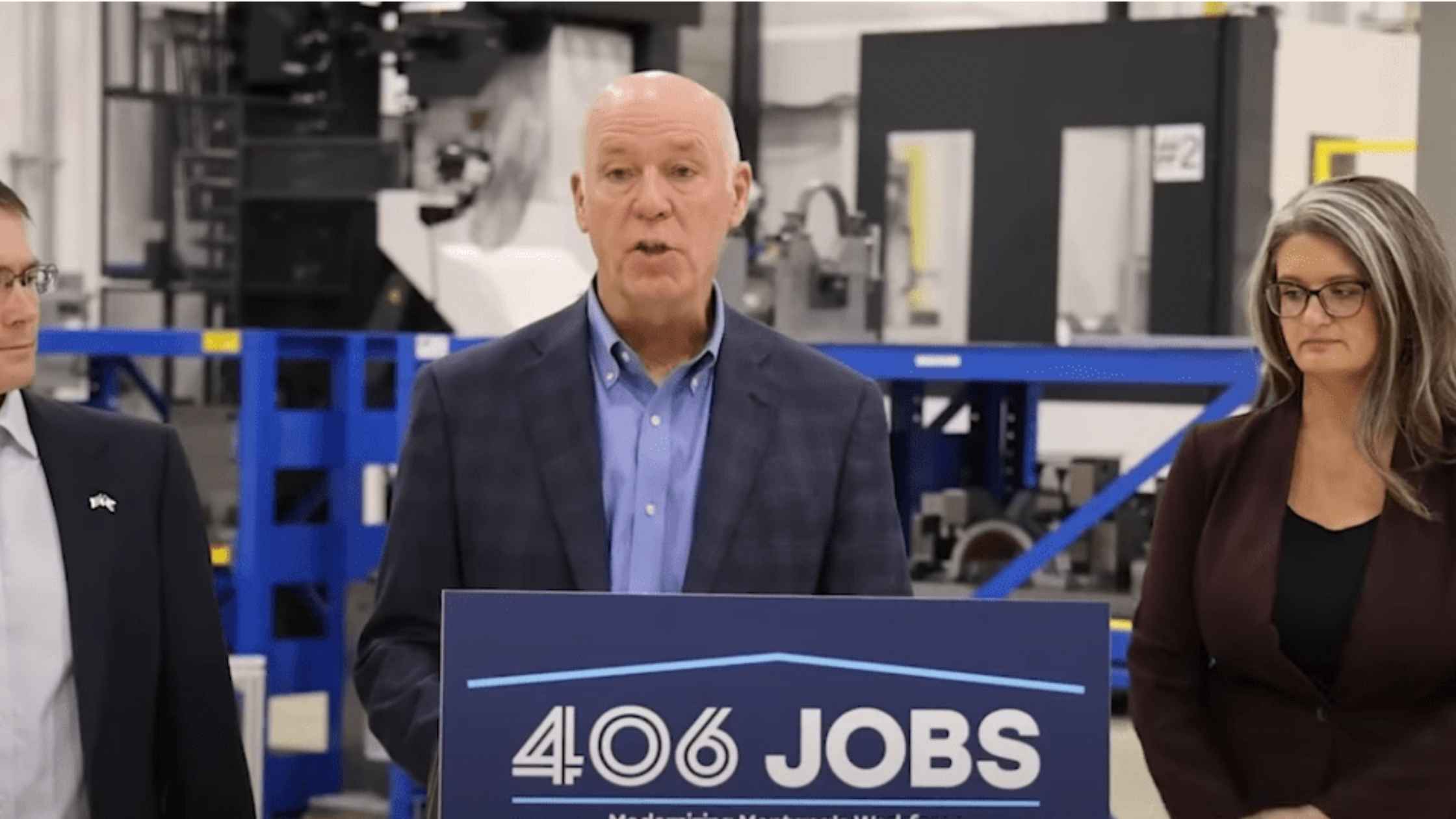
Gov. Greg Gianforte (00:00):
So good morning. It's great to be here at the Boeing Manufacturing plant in Helena to celebrate adding another new tool to the toolbox to strengthen Montana's workforce. Across Montana, thanks to our largest employers like Boeing, as well as our smallest mom-and-pop shops, we have more opportunity than ever for Montanans to secure a good-paying job. To make sure that is everyone's reality, we're implementing a new initiative and I'm glad to be joined here today by Department of Labor Commissioner Sarah Swanson to announce the launch of 406 Jobs.
(00:45)
406 Jobs will work across the public and private sector to promote career, college, military, and entrepreneurship pathways for all Montanans. 406 Jobs stands for four pathways to employment, zero barriers to work, and six high demand sectors. Those sectors include healthcare, construction, hospitality and recreation, advanced manufacturing and computing, education and child care and financial and professional services. We're following President Trump's lead on this to make America skilled again.
(01:38)
In April, President Trump issued two executive orders instructing states to implement workforce training initiatives to prepare Americans for skilled trade jobs and to advance artificial intelligence in education. Today, just before coming out here, I signed an executive order to ensure Montana is doing its part to strengthen our workforce and prepare the next generation for the workplace. When I took office, I made these two things a top priority because I fundamentally believe that education and workforce training can change lives, open the door to greater opportunities, and allow Montanans to reach their full and outstanding potential.
(02:29)
Providing our next generation with a high quality education and empowering our workforce with the skills they need to thrive are amongst the greatest responsibilities. That's why I've been proud to improve access to educational opportunities for Montana students by unlocking career and technical education pathways and apprenticeships. Through hands-on learning and workforce training in our schools, we're preparing students for high-demand careers.
(03:02)
Last year I announced that a record number of Montana high school students received college credit in a CTE program, and we reached a record number of apprentices learning new skills in partnership with nearly 700 Montana companies. This year, working with the legislature, we approved 32 new pathways for apprenticeships to learn occupational licenses on the job, expanding career options and helping employers build skilled licensed workers access many industries. These programs have been at the heart of our work at DLI and the Office of Public Instruction.
(03:50)
With this new initiative 406 Jobs, we are streamlining our work acts across state agencies and in partnership with the private sector to see even more growth and to tap into new resources like artificial intelligence, to support job seekers and career programs in our schools. Commissioner Swanson through the State Workforce Innovation Board, DLI will administer this initiative. Commissioner, what would you like to add?
Commissioner Sarah Swanson (04:26):
Thank you, Governor. Good morning, everyone. It was just over a year ago that the governor challenged the Department of Labor and the State Workforce Innovation Board to develop a plan, to build bigger, better, and more workforce solutions for Montana. To tear down barriers to work, to communicate the successes and those success stories to best practices around the state, to engage the private sector and to find efficiencies to make sure government agencies work together.
(04:55)
Today's announcement of the 406 Jobs initiative delivers on that challenge. Creating a path forward to modernize Montana's workforce and to ensure that every Montana has a pathway to a career and a plan to achieve it. Under this plan, we will ensure that our workforce system values all the ways that people enter and move around our labor market. Apprenticeships, industry-recognized credentials, sprint degrees, military service, entrepreneurship, and traditional college degree programs. 406 Jobs will focus us on a statewide level on those things that are keeping people from attaining work.
(05:33)
Finally, we will partner with our local employers to build talent pipelines that address specific local occupational shortages in our high-demand industries sectors where the data shows that we have chronic year-over-year projected labor shortages in Montana. To be clear, when we talk about high-demand industries such as the construction trades, healthcare, or advanced computing, we're focusing on those sectors with the largest current projected shortfalls of available workers. 406 Jobs will continue to support employment in all sectors, but we have identified a few areas where the lack of workforce is proving to be a sustained challenge for Montana's economy.
(06:15)
Last week, the Department of Labor and Industry released our Montanans for Hire report indicating that there are almost 100,000 Montanans of prime working age that have left the workforce entirely. Some of those people are making the choice to be stay-at-home parents or to retire early, and when family finances allow for that, we celebrate those choices. When Montanans want to work and face serious barriers like lack of access to child care, chronic illness or disability, criminal justice history, or even challenges transitioning from military to civilian service, we need to build some bridges back to work, especially in these high-demand sectors.
(06:55)
Montana's economy has incredible strengths, sustained low employment, real wage growth, and the best place to start a small business in America, but we also face some headwinds. Our labor force is shrinking as our population continues to age with fewer young people entering our workforce. Layoffs in the mining and forest products industries have upended some communities and have caused some people to move out of state. Rural and tribal communities feel left behind in accessing career tools in planning for a high-wage future.
(07:29)
We want to see more people achieve the kind of high-wage jobs that allow them to support themselves and their families and to have those jobs in every corner of our state. We want to encourage people to upskill their careers, to explore entrepreneurship and service pathways, and to be able to move along the career pathway with real opportunity. At the Governor's direction, the State Workforce Innovation Board will be focusing our state workforce system on a couple of key priorities through this work.
(07:58)
First, we must prepare Montana for the workforce of the future. 406 Jobs prioritizes next-generation skills, increasing career awareness, and preparation programs in our schools, providing opportunities to upskill people that are already in the workforce and supporting local businesses in attracting the workforce that they need to remain competitive.
(08:21)
Second, many communities in Montana have identified that public safety is their number one concern. We need to reduce recidivism in Montana by ensuring that people who have paid their dues can return to gain full employment to be productive members of society. So we're standing up a new office at the Department of Labor, the Office of Reentry, bringing public and private sector together to get people back to work as they exit the system.
(08:48)
Third, Montanans deserve access to education and training programs all across our state. As the Commissioner of Labor, I'm committed to expanding apprenticeship programs throughout Montana, ensuring that people can learn and earn wherever they live. With the recently enacted STARS Act that the governor referenced, career and technical education will be given the priority it deserves in our public school system, allowing high school students in every school district in Montana to earn industry-recognized credentials before graduation and to reward schools financially for supporting those opportunities.
(09:24)
Finally, we must end the fractionated splintered workforce system that we have now. There is too much duplication, too little coordination, and too much complexity for our employers to participate meaningfully in the system. Today, Governor Gianforte signed a bold executive order to launch the 406 Jobs initiative setting a clear expectation that in Montana industry will lead workforce reform, that state government will streamline our services and work better together, and that we will align our work with the real needs of Montana's communities.
(09:59)
Under this executive order, we will build a workforce in Montana that's future-ready. We'll increase access to IT and AI training programs and support small businesses in adapting to that changing environment. Inside state government, we will use technology to extend our services to every part of the state, reduce inefficiencies, and streamline our operations so that our workforce system actually works for Montanans.
(10:25)
The 406 Jobs initiative positions Montana as a leader of workforce development in this country, embracing technology, requiring agencies to work better together and asking actual employers to chart our path forward rather than assuming government has all the answers. Over the next few weeks, the State Workforce Innovation Board and the Department of Labor and other workforce partners around the state will be traveling the state to share this plan, invite your feedback, and build on the local strategies that make sense in your communities.
(10:56)
We invite you to be a part of this effort, employers, educators, workers and community organizations. Today, the governor has launched a transformation in Montana and we welcome your engagement to build a brighter future for us all.
Gov. Greg Gianforte (11:13):
Thank you, Commissioner. This initiative will be led by the State Workforce Innovation Board, and we're grateful to be joined today by Jason Yager, who serves on the board and is the executive director of the Montana Photonics and Quantum Alliance. Jason, can you speak to the impact of this initiative on the industry?
Jason Yager (11:44):
I'd like to begin by thanking Governor Gianforte for his leadership and commitment to economic opportunities for all Montanans. I joined the SWIB board just over a year ago when the governor challenged us to bring him a plan that reduces barriers to employment, supports new business attraction to our state, and truly engages industry in modernizing Montana's workforce. Today's release of the 406 Jobs strategic framework, catapults Montana to the forefront of workforce development in the United States.
(12:16)
This plan is designed to equally promote every avenue Montanans can take to enter the workforce. It identifies dominant barriers to work that must be eliminated so that our labor force can grow, and it invites employers and local community partners to collaborate and create talent pipelines in key sectors with ongoing labor shortages.
(12:40)
My background is in the tech sector, and I can tell you firsthand that Montana's opportunities in advanced manufacturing and information technology and computing are enormous. Companies from all over the world are looking to come to Montana and they need a skilled prepared workforce. Even back in 2013 when the Montana Photonics and Quantum Alliance was founded, workforce was among the top challenges facing our membership, and this remains true today.
(13:09)
Just a few weeks ago, the governor led a ribbon cutting with one of our members in Lewistown, Montana who announced the need to hire up to 50 employees and is the key supplier for advanced semiconductor manufacturers just as ASML. Later this month, we'll be co-hosting a public networking social with Montana State University in their new engine works building, celebrating the launch of the MSU QCore, which includes an advanced compute testbed with not one, but two quantum computers, and this is just the beginning.
(13:43)
We need to mobilize employers, educators, workers, and community partners around a set of shared goals to capitalize on the economic opportunities before us today. The 406 Jobs framework provides that foundation for modernization. With the signing of today's executive order and at the direction of Governor Gianforte, SWIB will begin engaging with stakeholders over the next 90 days to launch our implementation efforts.
(14:10)
Supported by Commissioner Sarah Swanson and the team at DLI, we'll begin traveling across the state to share our plan, to listen to your feedback and to begin building employer-led local initiatives that deliver the workforce that Montana needs. You'll hear us talking more about industry-recognized credentials, apprenticeships, opportunities for young people, and more access to training programs in our rural communities. Thank you, Governor, for bringing us all together today, and we look forward to reporting back to you soon.
Gov. Greg Gianforte (14:46):
Thank you, Jason. We're grateful to be here at the Boeing facility in Helena to make this historic announcement. Kevin Poulin is the director of Boeing's Helena division. Kevin, thank you for having us here today. Would you like to offer a little bit on Boeing's perspective on this initiative?
Kevin Poulin (15:09):
Good morning, everyone. I'm Kevin Poulin, the leader for the Boeing Helena site here, part of Boeing Commercial Airplanes Fabrication. It's a great honor to be with you here this morning, Governor, and I appreciate this opportunity.
(15:22)
Boeing is deeply invested in Montana. I'm proud to work closely with Montana businesses and suppliers. In fact, we have 37 local companies that contribute to our operations and Boeing's operations contribute nearly 59 million to the state's economy last year. We are also a proud part of the larger community that includes hundreds of Boeing retirees and military veterans living and working here in the state.
(15:50)
This partnership supports an estimated 800 direct and indirect jobs across Montana showing how workforce initiatives like 406 Jobs can have a wide-reaching impact beyond just one company or site. Building a skilled workforce in industries like advanced manufacturing benefits our communities and strengthens Montana's economy by creating opportunities for good jobs and promoting growth. That's why Boeing has previously invested in the public schools here in Helena, supporting curriculum to help students build manufacturing skills.
(16:29)
These skills connect to real-world advanced manufacturing careers. The industry needs these highly skilled tradespeople and Boeing is no exception. In fact, we're hosting an event at the Helena Regional Airport next Monday, August 18th from eight AM to three PM and we encourage everyone looking for a job opportunity to come to that event.
(16:51)
We know that the partnerships between industry, government, community groups are essential to building a strong and capable workforce. We look forward to learning more about this initiative and exploring ways to work together to keep Montana in manufacturing and aerospace. Thank you, Governor.
Gov. Greg Gianforte (17:11):
Thank you, Kevin. Thank you, Kevin. I was excited when I drove up to see the construction outside.
Kevin Poulin (17:19):
Yes.
Gov. Greg Gianforte (17:19):
You shared with me that you're out of space, so they're adding additional space to expand here, and thank you for your investment in Montana. Ultimately, 406 Jobs is designed to ensure that every Montanan has a clear pathway to a meaningful career and a plan to make it a reality. With historically low unemployment in Montana and more Montanans working today than ever before, we want to go even further, boosting labor force participation, reducing barriers to employment, and helping more Montanans reach their full and outstanding potential. That's what 406 Jobs is all about.
(18:02)
Appreciate you being here. We'd be happy to take a few questions if there are any. Yes?
Speaker 5 (18:08):
As this framework comes to fruition, one, two years down the road, what's the metrics for [inaudible 00:18:17] and Department of Labor be looking at to measure success?
Gov. Greg Gianforte (18:19):
Yeah, I'll let the Commissioner comment in a second, but as she noted, we have about a hundred thousand people that are not participating in the labor force today. Some with very good reasons, and we celebrate that, but we want to see increased labor force participation, and that's the whole point. Is there anything you want to add?
Commissioner Sarah Swanson (18:36):
Certainly. We all know that if we can't measure it, we can't manage it, and so we've held three strategic planning sessions with the state workforce board over the last year focused on metrics that matter. We have 10 or 11 proposed metrics, but before we finalize them, that's what our statewide roadshow is about. We'll be in 16 communities over the next eight weeks and we want to hear from Montanans. Are those the same metrics that matter to them, and then we'll finalize and publish with the governor what those metrics that matter for 406 Jobs are.
Gov. Greg Gianforte (19:06):
I would just add that as I talk to business owners about their expansion plans, the number one impediment is workforce across all industries. With record low unemployment, we have a tight labor market. One of the lowest, best opportunities we have is these people that are in Montana, they're Montanans, but they're not participating in the labor force today. We want to build bridges for them for their benefit and the employers. Yeah.
Zeke (19:36):
Sounds like people in Montana… Sounds like there's a lot of private, public partnerships. How can we understand the number of public dollars that are going into this effort?
Gov. Greg Gianforte (19:42):
Do you want to address it?
Commissioner Sarah Swanson (19:46):
Yeah, great question, Zeke. As of right now, there are no new public dollars going into this. The president did just announce some funding for states that meet his executive order challenge and launch partnerships and initiatives like this, but we will be pursuing some of those dollars.
(20:00)
Otherwise, this is a reorganization of existing agency workforce programs across all of the state agencies that the governor leads. Really focusing on making sure the departments work better together and that we're maximizing the workforce investments that are already in existence in Montana, focusing on letting the private sector and the employers lead and going where they'd like us to follow.
Gov. Greg Gianforte (20:22):
Just to put a point on that. I mean, we have apprenticeship intern programs administered out of the Department of Labor and Industry. We have programs at Department of Health and Human Services which serve the same Montanans.
(20:37)
There are also programs at the Department of Commerce which help with housing affordability, child care, but historically, there hasn't been coordination across these programs, even though all these disparate programs are serving the same people. That's part of what this executive order does is to provide a better career development path to the people that have needs. Jonathan?
Jonathan (20:58):
[inaudible 00:21:09].
Gov. Greg Gianforte (21:14):
Yeah. The goal is to help employers expand their workforce and to help Montanans find meaningful work. When these programs existed separately, they're not always pulling in the same direction, so the goal is really focused on increased labor participation and expanded opportunities for Montanans. That's more important than any streamlining that might come out of this. Yes, Zeke.
Zeke (21:45):
How do we understand the timeline for next steps? You're talking about a lot of different sectors. Are there already concrete plans for how to increase workforce in those areas, or is that going to be detailed after the tour? What can we expect in the next few months [inaudible 00:22:00]?
Gov. Greg Gianforte (21:59):
Okay, Commissioner.
Commissioner Sarah Swanson (22:04):
Great question, Zeke. We are committed to delivering the governor a final implementation plan for 406 Jobs 90 days from today. It's really important that we travel Montana, we hear from leaders in every corner of the state, what are the industries that matter to them in their communities? So in 90 days, we'll deliver a plan to the governor, and as soon as he approves it, we'll get to work.
Gov. Greg Gianforte (22:26):
Okay. We'll take one last question. Yeah.
Speaker 5 (22:31):
I'm curious about this, the office of reentry, can you tell us more about that? Is that underway now or is that [inaudible 00:22:38]?
Commissioner Sarah Swanson (22:38):
Yeah. The Office of Reentry was a partnership between the governor's administration and the legislature. House Bill 718 authorized the creation of a three-person office within the Department of Labor, whose job it is to coordinate state services across all state agencies serving the population of individuals, leaving incarceration or the correction system and re-entering the workforce. We are recruiting right now for the director of that office, but it will be a new focused effort on how does the state workforce system best serve that population with everybody working together.
Speaker 5 (23:10):
[inaudible 00:23:14].
Commissioner Sarah Swanson (23:14):
Led by the legislation. Correct.
Gov. Greg Gianforte (23:17):
Okay. Well, thank you very much. I just want to note, Boeing is hiring. So if you're looking for work, give Kevin a call.
Kevin Poulin (23:23):
Next Monday at the airport.
Gov. Greg Gianforte (23:25):
Thank you very much. Good, thanks.
Kevin Poulin (23:29):
Thank you.