Speaker 1 (09:00):
Hey, how are you?
Speaker 2 (09:00):
[inaudible 00:09:00]
Caitlyn (09:00):
Every press conference [inaudible 00:09:00]-
Scott (09:00):
I'm Scott.
Caitlyn (09:00):
Caitlyn. [inaudible 00:09:00]
Scott (11:06):
Of course. Of course. Yes.
(11:06)
[inaudible 00:08:43]
Mayor Jacob Frey (11:07):
Come on over here.
(11:07)
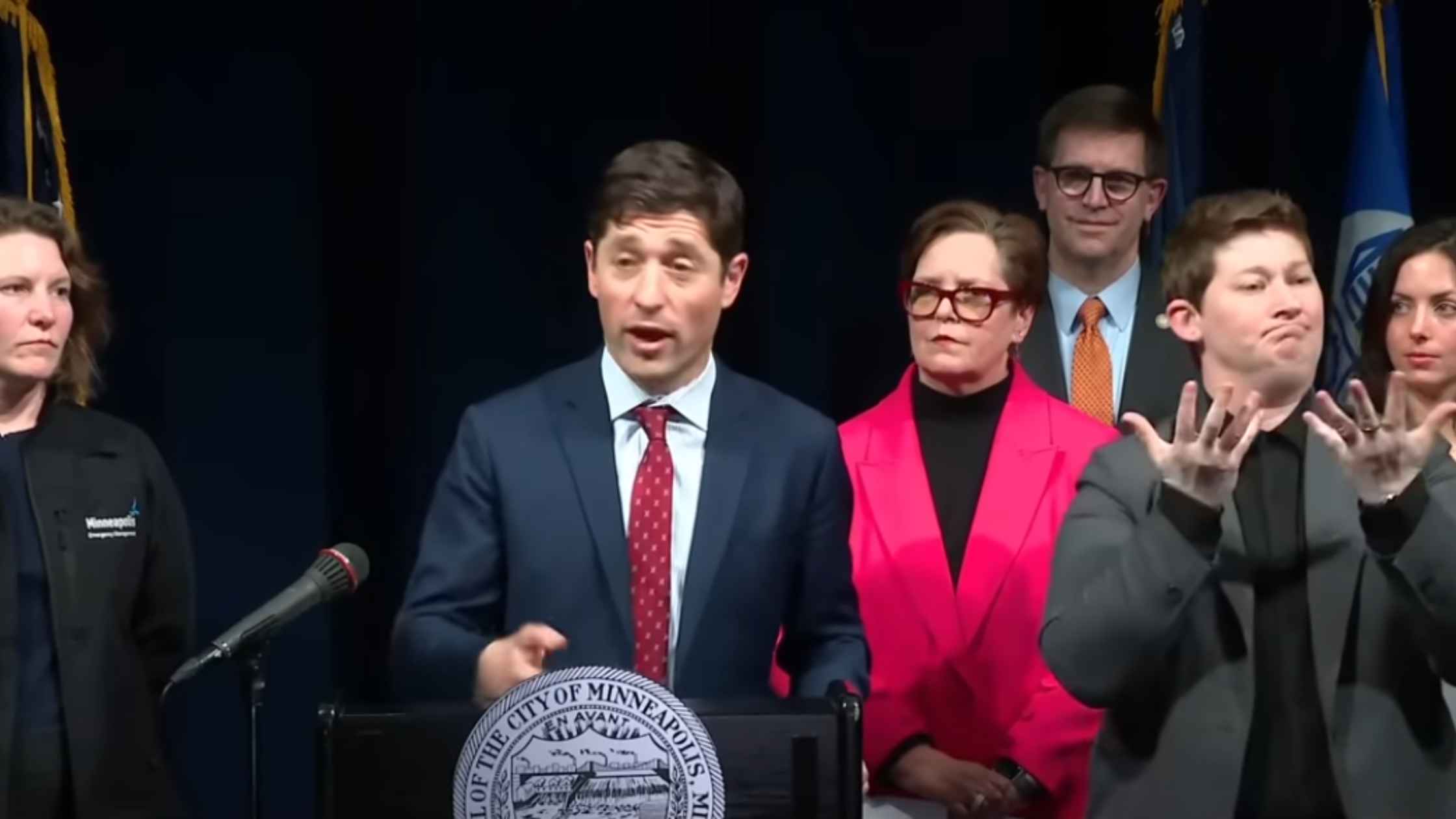
Good afternoon. Yesterday, it was announced that Operation Metro Surge will be coming to an end, and at the same time the damage caused by this operation has been staggering. We knew from the very beginning that this was not about safety. It was not even about immigration. This was about stoking fear and ultimately chaos in the communities that we love. Our communities stood up in brilliant fashion. Neighbors stood up for neighbors. Groceries were dropped off for people that were otherwise afraid to go outside. We had people standing watch on a daycare and we had Minneapolis residents and well beyond saying that what is important right now is that we are united as a large family here in Minneapolis, and we're all a part
Mayor Jacob Frey (12:00):
... of that family.
(12:02)
Since it began in December of 2025, this unprecedented federal escalation has upended daily life. It has eroded trust and inflicted a whole lot of harm on the operation that we need to provide as a city. The whole world's been watching. Messages from across the country have reminded us that we're not alone.
(12:26)
And the two times that I have left Minneapolis, what we have been met with is a whole lot of love. People are inspired by what is taking place in Minneapolis. And I got to tell you, I'm among those that are truly inspired by the residents that have stood up.
(12:46)
But today we're here to talk about how destructive this operation has been to our city, but also how we plan to move forward. Our city team has had boots on the ground from the very beginning.
(12:57)
And whether that's community service officers that have delivered food to families that are in need, or an emergency operations plan that has been executed from those early days in December to a both preemptive and responsive legal team that has been stepping up to the plate, making sure that these unconstitutional infractions are not just noticed, but we have a legal response to them.
(13:26)
And then of course, as part of this emergency, we've also seen great damage. Our emergency management team led by Director Sayer has been doing very hard and deliberate work to calculate what these damages have been, while those damages are simultaneously being inflicted.
(13:48)
At least 76,000 people are in need of urgent relief and assistance. We've seen at least $203 million in economic impact in just January alone. We were seeing somewhere between 10 and $20 million worth of losses to small and local businesses per week.
(14:12)
Small businesses have collectively lost more than $80 million in revenue. Hotel cancellations at this point will exceed $5 million and more than 75,000 additional people are experiencing some form of food insecurity. Thousands of school-aged children are in need of support and services.
(14:35)
This is not even an exhaustive list. There is much more far beyond that that we'll ever have to comprehend. And it begs the question, was it worth it? Was this operation that has inflicted so much damage on our city that we can indeed calculate in real dollars, was it worth it?
(14:59)
Was the chaos worth it? Was the fear worth it? Certainly this operation did not improve safety and it indeed decimated trust. But I know this city. Minneapolis does not let hardship define us. We define ourselves by how we rise and how we respond.
(15:21)
Our focus must now be on moving forward and making sure that our neighbors, our businesses, have our support. So we're going to do what we always have done. We're going to rebuild. We will restore trust, and we're going to move forward as a unified city.
(15:39)
Just as Minneapolis responded, when federal agents sowed chaos in our streets and disrupted daily life, what you will now see Minneapolis responding in unified fashion is we're going to step up for those small local businesses. We're going to make sure that we experience that big Minneapolis comeback in full. People from around the country have asked, "What can we do to help?" And the answer is, upon this Operation Metro Surge ending, come to Minneapolis, support these local entrepreneurs, support these immigrant-owned businesses that have added so greatly to the fabric of our communities and the fabric of these corridors.
(16:25)
It's about the easiest ask that I could possibly make of you. Buy some incredible food. Stay at a hotel. Minneapolis is a tremendous city, one that I myself fell in love with and decided to start my life here. I am not unique.
(16:41)
There are countless immigrants and whether they're from northern Virginia or Mexico or Europe, people have come to this city to start a life and they love it. And so Minneapolis taxpayers should not be left to foot the bill of this situation that has been created by the federal government. And so we're calling on the federal government to fully step up, to provide direct financial assistance to our city, to stabilize our small businesses and to help residents recover. Emergency response reimbursement for humanitarian assistance, infrastructure, public safety support, and then economic recovery funding.
(17:22)
We're also asking the state of Minnesota to stand with us to partner in securing resources, expediting relief, and ensuring we have the tools that are necessary to recover quickly.
(17:34)
We know that Minneapolis is the economic engine of our entire state. For every $3 worth of tax revenue that Minneapolis raises, we get $1 back. And we are proud, we are proud to be that economic engine, and we are proud to help support the incredible smaller communities and towns and cities throughout our state.
(17:56)
And at the same time, Minneapolis has experienced a great deal of duress over the last couple of months. As Minnesota, we now have the opportunity to stand together. By standing for Minneapolis. You are standing for our state, for those that are beyond Minnesota, by standing for Minneapolis, you're standing up for America.
(18:19)
I'm going to now turn it over to Director Rachel Sayer of Emergency Management. And I just want to note, we have done a great deal of work since 2020. People have witnessed the arc of our story here locally following the murder of George Floyd, the subsequent unrest that we saw.
(18:45)
We didn't just sit back on our hands. We did a whole lot of emergency preparation and work. We ran simulations. We conducted trainings, all culminating in a trip out to Emmitsburg, Maryland where FEMA was headquartered for their simulations.
(19:01)
And we practiced these scenarios, and this operation has been led by Director Sayer. I'm really proud of her and her team's work, and I think it sets an example for other cities to follow throughout the country. Director.
Director Rachel Sayer (19:19):
Thank you, Mayor Frey. Operation Metro Surge has created what aid workers call a protection crisis. A human-driven, large-scale event marked by violence and human rights violations that affect individual's freedom and rights to access basic services. And we know those impacts have not been felt equally across the city.
(19:46)
The vast majority of incidents have occurred in neighborhoods with large immigrant and refugee populations, as well as American Indian, Black and other communities of color.
(19:58)
As is too often the case, those who were most vulnerable before Operation Metro Surge are the ones bearing the greatest burden today. Right now, as the mayor said, we estimate there are 76,000 Minneapolis residents, nearly 20% of our city, who are in urgent need of relief assistance.
(20:17)
To understand both the scale of the impact and how best to respond, we took the unique step of conducting and developing a preliminary impact assessment and relief needs overview. This rapid early analysis provides initial recommendations to guide our system-wide response and recovery, drawing on best practices for responding to protection crises.
(20:43)
Those recommendations that we developed include securing state and federal funding for both immediate relief and long-term recovery, increasing philanthropic and nongovernmental funding for organizations providing direct assistance.
(20:59)
Strengthening coordination among partners to accelerate access to foundation and emergency funds, strengthening supply and distribution systems to reach households who are unable to access centralized sites.
(21:13)
Supporting partner organizations with capacity building resources to meet increased demand. Expanding mental health and psychosocial support models tailored to the community's most harmed, and most importantly, ending Metro Surge so that our community's freedom to access basic services and needs is restored.
(21:35)
The assessment that we conducted features preliminary estimates based on currently available data and reasonable assumptions, and we will continue refining our recommendations as more information becomes available.
(21:47)
As the mayor stated, at this stage, we estimate the overall financial impact to the city is at least 203 million from January alone. The largest impact is in livelihoods. That is $ 171 million at this time. This includes household income losses, estimated at 47 million per month as residents have been unable to or afraid to go to work.
(22:14)
Small business losses as high as 81 million in January alone. 4.7 million in lost hotel revenue due to cancellations extending through summer, and a 37.9 million gap in construction valuation. This is the lowest January construction total in a decade.
(22:35)
The second sector that we analyzed is housing specific to rental assistance needs. Before Operation Metro Surge, there were 35,000 low-income renter households who are already struggling to afford rent in our city.
(22:49)
The surge has dramatically intensified that instability. Lost household income since December 2025 has created an additional 15.7 million in monthly rental assistance needs.
(23:04)
The third sector we assessed is food security. As families lose income, emergency food providers have seen significant increases in demand. The estimated weekly food costs to meet current food needs is $2.4 million, and we face growing gaps, especially as food prices continue to rise.
(23:24)
Finally, one of the most critical needs in any protection crisis is mental health and psychosocial support. Operation Metro Surge has not only disrupted these services, but increased the demand for them.
(23:37)
Providers have reported a 50% reduction in client contact as some residents have gone underground. An estimated at least 8,700 additional school-aged children now need services as a result of the Operation Metro Surge.
(23:54)
The report also identifies additional needs, including immigrant legal services and healthcare
Director Rachel Sayer (24:00):
Their access, many of which we have not yet been able to fully quantify. This assessment outlines both the scale of the impact and a roadmap for action. It includes an initial review of city expenditures, including operating costs and the growing financial strain of responding to this crisis, which my colleague will discuss in greater detail in a moment. So, with all of this, I hope that many of you are wondering how to help, whether that is through donating or finding some other way to contribute to Minneapolis. First, visit our federal response page on our website, minneapolismn.gov/federal. There, you can find ideas about how and where to donate. We have listed just a few of the larger organizations and it is by no means a full list. Donating monetarily to rapid response funds is one of the best ways to help people here. Rapid response funds go to mutual aid and other organizations who are immediately meeting the need on the ground for our neighbors and community members.
(25:06)
If you're a national foundation and you can help financially, please reach out to us or to the Minnesota Council on Foundations or the Minnesota Council on Nonprofits. We are all available to discuss with you ways to help. As you look to donate, just a reminder to be aware of scams and any time like this, you need to make sure you're donating to a legitimate organization. Just take extra care. Another thing anyone can do is just check on your neighbor, Minneapolis or otherwise. Our assessment shows that here, it's as many as one in five people need help. But I'm confident that that is an undercount. I don't know anyone in our community who has not felt the impacts of this surge. And through it all, we've stood up together, we remain committed to each other, especially to our residents who have been disproportionately impacted. Our focus will be relief and recovery across Minneapolis while continuing to stand with and love our neighbors. I'll now turn it over to our City's Chief Operating Officer, Margaret Anderson-Kelleher.
Maragaret Anderson-Kelleher (26:20):
Thank you, Director Sayre for your leadership at this time. I want to also thank the dedicated public servants at the City of Minneapolis have been working nonstop on issues all around our city and even beyond. They have been asked to step up. Director Sayre just presented to you some very stark numbers. They're stark, they're upsetting, they're heartbreaking to this city. In addition to the hundreds of millions of dollars lost for our residents and businesses in Minneapolis, the expense to the city operations also because of Metro Surge is hitting our budget hard. We are in the very first months of our budget this year, and in January alone, Operation Metro Surge has cost the City of Minneapolis an estimated $6 million. This $6 million includes extra staff time adding to our payroll. This includes expenses for street cleanups. This includes costs for equipment needs.
(27:42)
We are very optimistic that this surge is going to end soon, but if it continues for any longer, we know that that $6 million will double by March 1st, $12 million. We anticipate even further impacts from reduced revenues, reduced sales tax, which we will not know the numbers of until about April. So, make no mistake, that is money that we needed to spend to take care of the city, to serve residents, and we are going to still do all of that service for our residents, but we're now facing a significant, significant financial challenge. One, that risks our ability to deliver our most important core services without further burdening the residents, homeowners, businesses, and renters of Minneapolis with increased property taxes.
(28:53)
The city's very financial stability has been called into question because of the actions of our own federal government. That is why we need assistance, financial assistance from both the federal government and the state government, our partners. The people of Minneapolis should not have to foot the bill for this crisis that was created by the federal government. We need to not only end the violent occupation, but we also need to have support in the recovery from this violent occupation. Obviously, incidents like this have countless cascading effects in many ways on so, so many people, and that includes our police officers. And with that, I'm going to turn it over to Assistant Chief Chris Gaiters with Minneapolis Police.
Chris Gaiters (29:51):
Thank you.
(29:55)
First, I'd like to state just that we're pleased with the announcement that the Federal Immigration Operation Metro Surge has completed. The Minneapolis Police Department respects the role and the mission that the federal law enforcement partners and recognizes that their operation posture can have a direct impact on the local public safety dynamics here in the City of Minneapolis. As far as our hope and our officers, as this mission concludes as far as the Metro Surge, it will assist us with our operations as far as the demands associated with our officers. We'll be able to not necessarily respond to the unlawful assemblies that have taken place. The protest management will be a lot better now and manageable now with the resources we have within our own police department and the related responses from our request from our state, our county, and other local agencies outside of Minneapolis will also be reduced and we can get back to our core values here within Minneapolis of serving our communities within Minneapolis and giving them the service that they have expected from us over the years.
(31:24)
As far as our officers, our officers have worked tirelessly. These officers have taken days off and those days off have been canceled. Our officers have canceled vacations, they've missed birthdays, they've missed anniversaries, and they've done this so they can serve our citizens here in Minneapolis. The one thing I will say about it is that I'm very proud and Chief O'Hara is very proud of the fact that they have remained professional and they have shown great restraint when serving during these challenging circumstances. These officers and along with our community members who are also very proud, we work here in Minneapolis together, community and in the police department, and over the past several years, in a few months, it'll be six years, the Police Chief, Chief O'Hara, along with our mayor, along with our Commissioner Barnette, has put together strategies.
(32:29)
So, we will make sure and certain that we are working together with our communities, and that's what we will continue to do and that's what has gotten us to this part today of being able to serve our communities respectfully and making sure that we're treating them the way they want to be treated. Again, to our officers, again, to our communities, thank you so much, so much for working with us over the years. We've developed strategies and programs that have been tested and every time we're in a relationship and our relationship with our communities, every time you're tested, you get stronger. And by getting stronger, the next time something occurs, we will come out successfully. And I'm very proud of our citizens and our police department, and I just want to say thank you all for that and we're much appreciated as a police department for you coming along with us on this very difficult journey. Mayor.
Mayor Jacob Frey (33:26):
Thank you. Thank you so much. We are in the midst of a galvanizing event. As difficult and as traumatic as this has been, obviously, our city has come together in a really beautiful way. It's been our community members, it's been our city officers, and our enterprise more broadly. I just had a meeting moments ago with about 15 CEOs from throughout downtown Minneapolis and beyond, and they are also going to be a big part of this effort and this recovery. We're looking at having some form of galvanizing event where we're bringing people together from a thousand different backgrounds to celebrate our great city, to bring people into Minneapolis from across the country. And this event is not going to be unique. In fact, I think we're going to have a series of these put on by a number of different organizations that celebrate the pride in the inspiration that has been exhibited during the hardest of times. With that, I'll open it to any questions you might have.
Questioner 1 (34:33):
Mayor, these are huge numbers you're talking about. Do you have confidence that you can get the aid you need from the state and the feds and not raise property taxes in the city?
Mayor Jacob Frey (34:46):
The total figure that we're talking about is $203 million. The direct impact to our city enterprise has been approximately $6 million. It's incumbent on us just to give people the reality of the damage that people in our city are experiencing. And look, I'm not too naive to think that we're going to go to the state and the federal legislatures and get the entire amount. That being said, we're going to be putting together a package through our intergovernmental relations team that we feel is both reasonable and can be met. And so, we're going to be moving through those numbers in the near future.
Questioner 2 (35:24):
Is there enough money to do things at the city level? They're spend the $1 million in rental assistance, the $5 million small business relief package proposed. Is there money to do city-level relief like that or given the $12 million number that we could be looking at, is there no more discretionary?
Mayor Jacob Frey (35:43):
So, the question is, is there discretionary money to do these additional packages that has been put together? The answer is no. There is not free money right now. Every dollar that is spent has an impact. There's
Mayor Jacob Frey (36:00):
There's no magic pot that we can tap that does not have an impact on property taxes or other essential city services. Money goes out the door. It means that we have to make some form of cut or drawback internally. So there are instances, and we felt this was the case with the emergency rental assistance where it's necessary and it's worth it, where both we have the ability to provide some additional funds and there were cuts that could be made and we had the ability to actually implement a program. That's another key part. There will be instances where it just doesn't make sense, and so we're going to be exploring each one issue by issue.
Speaker 3 (36:44):
Do you then support the $5 million being transferred from the Downtown Assets Fund to a small business fund that's being proposed?
Mayor Jacob Frey (36:50):
Yeah. We're still exploring that right now. Obviously we heard about the proposal coming from council members. What I will reiterate is that there isn't just free money. Yes.
Questioner 1 (37:02):
The federal government-
Mayor Jacob Frey (37:03):
I'll get you next, I promise.
Questioner 1 (37:04):
... Who was behind Operation Metro Surge, how optimistic or how willing do you think they would be to help the cost of the recovery?
Mayor Jacob Frey (37:19):
The question was how willing do we believe the federal government will be to help with this recovery? This has been a crisis in Minneapolis. We have set up an emergency response to deal with that crisis. In the past when Minneapolis or any city throughout the country encounters an emergency, there's partnership. There's participation. 15, 18 years ago, whatever it was, a bridge collapsed in Minneapolis, a federal administration, a Republican federal administration under Bush came in, left politics at the water's edge and worked hand-in-hand with then Mayor Rybak and with our governor to make sure that funds were delivered in short form to make sure that Minneapolis had the necessary tools to recover from that emergency. This has been an emergency caused by the federal government, and so it's all the more important that they also participate in the recovery from the damage that they themselves have caused.
Speaker 4 (38:33):
Does it look like, from everything [inaudible 00:38:34] does it look like they're receding yet today?
Mayor Jacob Frey (38:37):
Yeah, so the question was based on information that we have, does it look like they are receding yet today? We have not yet had the SitRep that would outline incidents that have taken place. Obviously, we were made aware by the Border Czar home that activity through Operation Metra Surge would continue in the coming days prior to the exit of the agents themselves. And we also know that ICE as an agency will continue to do work as they did in the past, but not at the same level, not with the same conduct that we saw through Operation Metro Surge. Assistant Chief, do we have an answer as to the drawdown or when the planes literally leave?
Assistant Chief (39:25):
We don't have an answer.
Mayor Jacob Frey (39:26):
We don't. We will try to get you a better answer to that.
Questioner 2 (39:36):
[inaudible 00:39:30] a lot of businesses and organizations that have been doing rent assistance, running Mutual Aid at a great loss to their business finances, will they be able to apply for any assistance or how can, I guess, they ask for help from the rest of the government?
Mayor Jacob Frey (39:49):
Well, that's a great question. And the Mutual Aid organizations that have been set up have done honorable patriotic work to help people in need through this incredibly difficult time. There are funds obviously, that are available, I can't speak for the criteria for applications for each one of them. There's $10 million that is going through the state in the form of forgivable loans. There's $1 million that we recently approved in the form of emergency rental assistance. And so each one of those we're going to have to confront on a piece-by-piece basis. But thank you.
Questioner 2 (40:29):
Mayor, on the theme of [inaudible 00:40:32] trust, could you talk about comments from Tom Holman that allude to a deal that may have been made with local leaders? How do you gain community trust with comments like that? And what's your response to that amid this drawdown?
Mayor Jacob Frey (40:46):
The position that I have had for months is exactly the position that we have as a city today, and that position is the following. We do not enforce federal immigration law, period. We do not cooperate with ICE or any agency around enforcement of federal immigration law. Period. We do work with a number of different agencies to keep people safe in our city and where the impetus, where the underlying issue is crime and safety we've worked with many administrations, including the present one to keep people safe. That has been my position, as you all have heard from the very beginning, and that position has not changed. So the notion that there was a deal is false.
Speaker 5 (41:40):
We'll do one more question.
Questioner 2 (41:42):
Hey Mayor, you talked about the state assistance. Is that something maybe the city could set up? Something like that? A fund for low interest loans or critical loans?
Mayor Jacob Frey (41:51):
I'm sorry, can you repeat the question?
Questioner 2 (41:53):
The state set up their $10 million loan program yesterday. It's got to be passed by the legislature. Could the city do something like that in Minneapolis?
Mayor Jacob Frey (42:03):
Practically speaking, yes. The question again is where the funds come from. Recognizing that in the last budget address, I also painted a pretty severe picture of what the budget looked like. And so again, there's not free money. I'll do one more.
Chris Gaiters (42:24):
Could the assistant chief speak to the police morale right now? There have been questions raised by certain media outlets of how their morale is? I'm just wondering if you could speak to that.
Mayor Jacob Frey (42:36):
Yeah, let's get the assistant chief up here. But let me first start off. So the question was about police morale. The work that our officers have done over these last couple of months has been incredible. We have about 600 police officers in total. There were instances where really dangerous circumstances were taking place and we maybe only had 30 officers on duty at those moments. Officers have canceled days off, they have missed birthdays, they have stepped up, and people are seeing the deep juxtaposition between the way a Minneapolis police officer will treat a constituent, a neighbor, and the way these federal agents were treating their neighbors. And it's not as if the Minneapolis Police Department has always been known for community trust, but there's a lot of work that's happened over these last five years. There's training that has taken place, policies have been shifted. Officers have both stayed and are applying because they want to make the difference.
(43:51)
And I can tell you, I have heard from some of the deepest critics that Minneapolis Police is actually wanted on scene when something is going down. Why? Because we've got policies in place that ensure accountability. And I'll note we've also been making sure to have those body cameras used so that footage is collected, that evidence has been garnered, and then that evidence could be used in ensuring justice and accountability. And I say that as broadly as possible. And so that is specific direction that has been given and they've stepped up in a great way. The chief can speak to the morale, but I want to say directly to those police officers, we are grateful.
Chris Gaiters (44:43):
That's a great question. As far as our morale in our police department, like any organization, you always have concern about the morale of your employees. However, I will say again, our officers have been resilient along with our community members. And as far as our wellness piece, we offer wellness. We have it as a high priority. The chief has put many resources into making certain, along with the mayor and the cabinet all the way down through, that the officers have the resources that they need, and we're making it more robust as we go. However, when it comes to our morale and our police department, that is something that we evaluated and it's continuous. We look at it and we make certain that we're giving them the resources and we'll continue to evaluate it. Right now, we want to make certain that our officers are taken care of and they're healthy so they can serve and come back and serve our community members.
(45:40)
And like I said, it's a great question. That's something that we'll continue to answer for you as we know more. But our officers are, like I said, I'm very proud of them. Very, very proud of them. And they seem, as, I call it, Minneapolis Strong. As a community, community members are coming up and they're hugging them out at scenes. During protests, they're coming and hugging our officers. And that's something that we didn't see a few years back. And through the hard work and commitment through the mayor, through the commissioner, through Police Chief Brian O'Hara, the deposits that we made are paying off to us. And that helps morale when you're getting hugs from your community members that you're serving.
Mayor Jacob Frey (46:21):
Thank you everybody.
Speaker 6 (46:23):
Great way to end. If anybody didn't get a news release, please let me know.