
Mr. Davis (00:00):
... engagement, your involvement. I thank you, Mr. Chairman, and I yield back.
Chairman Smith (00:06):
Thank you, Mr. Davis, for your commitment to the foster children of the United States. I will now turn to the work and welfare chairman, Mr. Darin LaHood, for his remarks.
Darin LaHood (00:15):
Thank you, Chairman Smith, for having this full committee round table. And I want to welcome you, Madam First Lady, and just commend you for your passion and commitment to our foster youth. Your voice and the way that you've championed this cause is inspiring and we're grateful to have you here today. Your longstanding attention to uplifting America's foster youth through the Be Best and Fostering the Future Initiatives has been a catalyst for meaningful and transformative change. I don't know if everybody realizes, but your engagement with this committee on foster care dates back to 2022 when you co-authored an op-ed with our colleague, former representative Jackie Walorski, highlighting May as National Foster Care Month in 2022. We thank you for that.
(01:05)
And as chairman of the Work and Welfare Subcommittee, one of my priorities has been how do we modernize the Chafee Foster Care Program? Last January, we received a troubling report from the Government Accountability Office, which found states across the country have been returning unused Chafee funds since 2007, despite the need from foster youth. In 2023 alone, more than 30 states returned 8.9 million in unused funds.
(01:31)
Over the past year, a bipartisan group of members of this committee has been working to develop and introduce common sense reforms to make sure Chafee dollars are getting to the youth that need them. And I want to thank Ranking Member Davis and my friend and the members who are leading these bills for their leadership and partnership on this.
(01:50)
During our hearings, I have consistently heard that access to stable housing is one of our biggest barriers that youth face as they work towards self-sufficiency. One study found that 35% of foster youth experienced homelessness by age 21.
(02:06)
We also know that federal programs are fragmented and don't always coordinate with each other. To address this, I introduced the Foster Youth Housing Opportunity Act with my colleague, Gwen Moore, to improve coordination between child welfare programs and the Melania Trump Foster Youth to Independence Housing Program. As you know, many public housing authorities have been unable to secure the vouchers required for supportive services, preventing youth from being able to utilize the voucher as intended. Our bill, which has more than 100 endorsements, would allow states to use Chafee funds for housing supportive services and aligns age eligibility between the programs reducing a key barrier to access. This bill is one of the six bipartisan bills with important reforms to Chafee that members of this committee have worked on together.
(02:58)
Mrs. Trump, your presence here today and leadership on Fostering the Future has elevated foster care at the highest level of government. Thank you for your commitment and for taking the time to come here today to speak with members on both sides of the aisle about these reforms and listen to the different perspectives in the room. Through our bipartisan efforts and with continued support, Mrs. Trump, I'm confident that we can successfully advance these reforms through Congress.
(03:24)
This isn't just a round table to discuss ideas. We have legislation and an opportunity to deliver a transition age foster youth with the tools that they need to achieve greater opportunity, upward mobility, and long-term success. And I am committed to working with you and my Democrat colleagues to do what it takes to get this across the finish line to turn words into actions. Again, I thank you, Mrs. Trump and Jaydan and Jocelyn for joining us here today, and I yield back.
Chairman Smith (03:55):
Thank you, Mr. LaHood. No one has done more than the first lady to champion the cause of foster youth, and I look forward to hearing her perspective. So I would now like to turn the floor over to the first lady of the United States.
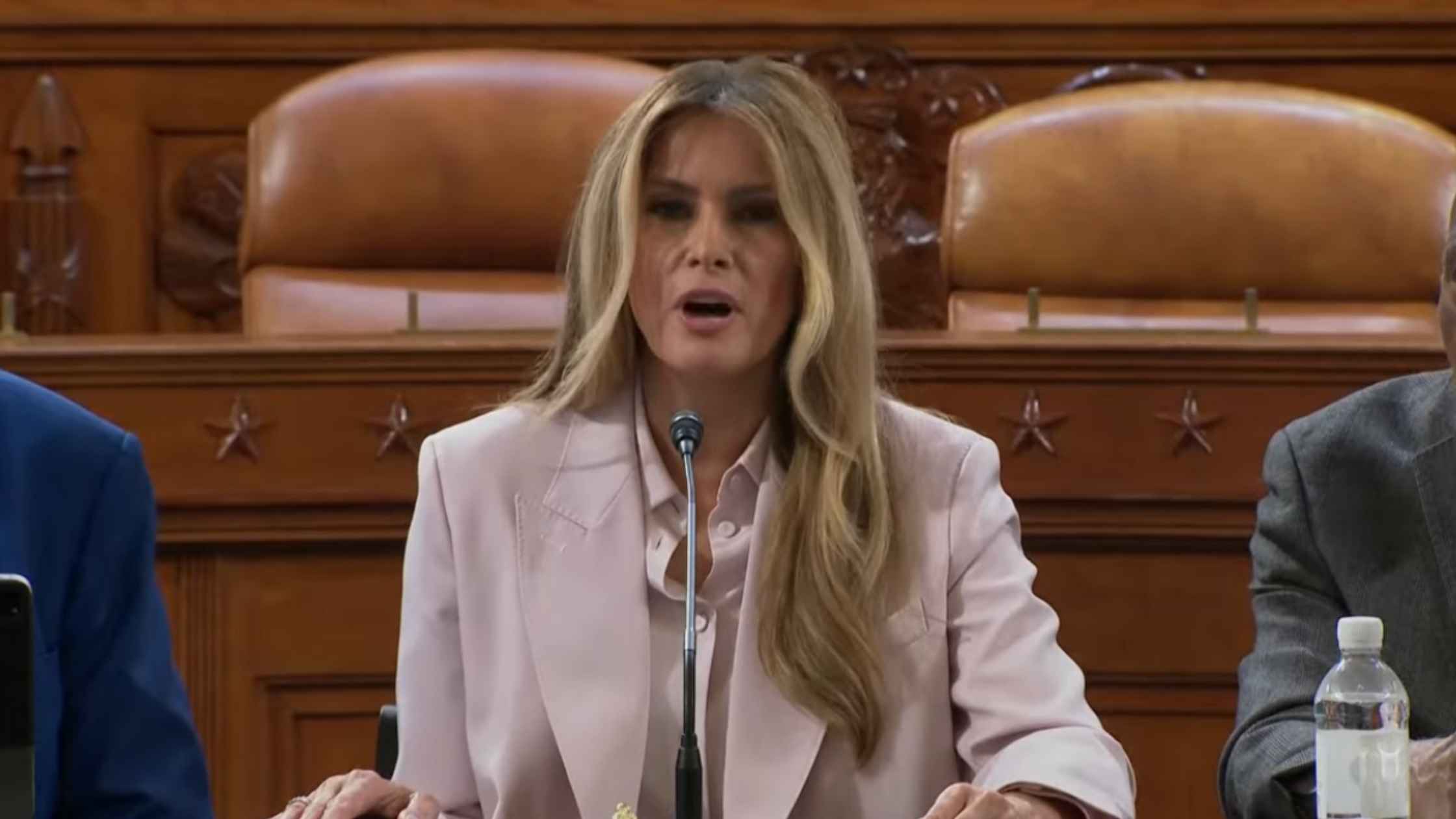
Melania Trump (04:09):
Good afternoon. Thank you, Chairman Smith, for hosting today's critical decision discussion surrounding America's foster care community. Chairman LaHood and Ranking Member Davis, your efforts to shape the legislation with your subcommittee are of tremendous value to our nation and to all the representatives of this prestigious committee who have worked so hard to introduce decisive reform within foster care. Mr. Miller, Mr. Chow, Mr. Moran, Mr. Yakym, Ms. Moore, Mr. Evans, and Mr. Carey, thank you. I would also like to extend my warm welcome to all of the Congress people in attendance today. Your bipartisan support is appreciated. And finally, a special thanks to Jacqueline Ronnie Fetting, and Jordan Martinez.
(05:20)
We are gathered here today, not because America's children rely on us, but rather because America's children are our moral equals. As parents and leaders, it is our ethical obligation to ensure American children develop emotionally and physically within a safe environment. As a community, we strive to nurture our children's curiosity, protect their innocence, and guide them with hearts full of care.
(05:57)
Through respect, participation, and protection, American parents deliver the essentials to our next generation, housing, nutrition, clothing, and healthcare. In safeguarding our children's wellbeing, we shape the integrity of our nation, but to get there, a strong knowledge base is required. Education is the cornerstone of a child's future. Clearly, education is the foundation that can remain throughout one's lifetime. Yes, knowledge is permanent.
(06:39)
In 2021, I launched Fostering the Future, a nationwide initiative to provide individuals from foster care community with access to education and then at the university level. My goal is to prepare these individuals to secure entry level jobs, become financially independent, and eventually innovate, create new businesses, and generate employment opportunities.
(07:09)
When I first developed Fostering the Future, one thing became very clear. The foster care community requires action over awareness. This truth stands today. I'm proud to share that Fostering the Future currently maintains a footprint of over 20 university across the country from coast to coast. In fact, academic institutions such as Vanderbilt University, the University of Miami, LSU, UVA, University of Texas, the Ohio State University, and the University of Alabama all educate Fostering the Future students. Although reports vary, roughly 3% of individuals in foster care community earn a college degree in 2025. We can close this gap.
(08:09)
But still, foster youth face a special set of challenges outside the classroom that have a serious impact of their academic performance. These issues include housing instability, educational advocacy, financial barriers, transportation, continuity, access to technology, and other related issues.
(08:36)
New legislation for the foster care community is a moral imperative. Some of you joined me in the White House last November for the signing of the Fostering the Future Executive Order. And although the executive order is a transformative vision, Congress now has the opportunity to create a lasting positive impact on this community. Beginning here in this room, we can once again change people's lives. With the new legislation, we can ensure that the opportunity is more than helpful for individuals in the foster care community. It can be their birth drive. Thank you.
Chairman Smith (09:21):
Thank you, Mrs. Trump. It's an honor to have you with us. I would now like to turn to the two foster youth that we have with us today. Jaydan Martinez is from Texas and a student at Stephen F. Austin University. Jaydan has been in the foster care system since the age of six. He has been formally recognized by Texas Governor Greg Abbott as "the son of Texas," it's a big state, so the son of Texas for his advocacy efforts. Jaydan, I invite you to share a few words.
Jaydan Martinez (09:58):
Thank you. Good afternoon, Chairman Smith, Chairman LaHood, our first lady, and members of the committee. My name is Jaydan Martinez. I'm a freshman at Stephen F. Austin State University. Recently, Governor Greg Abbott named me the son of Texas for my resilience, a title earned by refusing to let the foster care system live in my future. But the honor doesn't describe where I started.
(10:22)
Before I draped the flags over my shoulder, I was a six-year-old entering foster care, scared, hungry, but hopeful. At the age of 10, I received one last hug from my mother, a hug I wish would take me to magical places I read about in storybooks. Instead, she walked out of the office in tears. I never saw my mother again. I became a ward of the state, a title that has never showed how much that terrified little boy just wanted a hug from his mother.
(10:50)
I waited years for adoption, but that family never came. So at 16, I decided if I was going to be chosen, I would choose myself. I renamed myself a son of the state, and I spent my 18th birthday alone in a dark crowded boy's home. I entered an independent living program with $42 and everything I had left. I lived off of that money for a month while trying to eat and start school. I made it into college, but my education was spotty for moving placements so often. I sat up my first semester with 19 hours, including remedial math, desperately trying to learn what I missed in high school. I had success through great luck and a passionate new family, but success for a foster youth shouldn't be a result of luck, it should be a result of opportunity.
(11:36)
And today, US Congress have the power to turn luck into law bypassing the bipartisan Chafee bills. In Texas, I received $2,007.50 a semester for a youth on their own that disappears in a blink of an eye. I used it for bedding, a laptop, and professional clothing, so I could stand before you as the leader that I am.
(12:00)
The Postsecondary Education Access and Success Act raises the ETV cap to $12,000. You provide a bed and food when classes end or for those without families to call. The Workforce Opportunity Act provides remedial support and vocational paths for my brothers and sisters need to thrive. I'm not here to check a box or tell you what you want to hear. I'm here for my brothers and sisters who are in this system who need these bills. I am a product of this system and I am the son of Texas. And I ask you as our family to invest into us as your children. Pass this package. Thank you.
Chairman Smith (12:45):
Thank you. Thank you, Jaydan.
(12:46)
Thank you, Jaydan, very much. Jocelyn Fetting is from Illinois and recently earned her master's of social work from the University of Illinois Urbana-Champaign. Jocelyn spent eight and a half years in the Illinois foster care system, aging out at 21. She too has been a strong advocate for foster youth, including providing mentorship and guidance to those navigating the foster care system. Jocelyn, I invite you to share a few words and thank you for being here.
Jocelyn Fetting (13:24):
Good afternoon. I hope you all are well. First, I'd like to extend a heartfelt thank you to the first lady, Chairman Smith, Ranking Member Davis, and the committee. Right now, there are thousands of young people from foster care doing everything right and are still struggling, not because they lack effort or potential, but because the systems meant to support them have not kept pace with their needs.
(13:46)
I'm here today with FosterClub, not just as one voice, but as a reflection of those young people whose lives are shaped by the policies we choose. My name is Jocelyn Fetting. I am 22 years old, 23 next week, and I earned both my bachelor's and master's from the University of Illinois. Go [inaudible 00:14:05]. I serve as a substitute teacher, grades pre-K through eighth, and a peer navigator for young adults in foster care. I entered foster care at 12, alongside my younger siblings after losing my parents. But I made the most out of that time, and I graduated with honors and was admitted to a top university.
(14:22)
In college, though, even with scholarships, I worked three jobs just to meet my basic needs: food, hygiene, housing, transportation. Support like education and training vouchers existed, but it was out of reach, not because I didn't need it, but because no one ensured I could access it.
(14:40)
I carried the emotional weight of being the oldest. To stay connected with my younger siblings, I used to pay my friends for rides to see them. And this pressure made it difficult to succeed academically, so my honors GPA dropped to academic probation.
(14:56)
The Connect Act would prioritize family connections for youth like me. And while I always knew I wanted to go to college, that path isn't the right option for everyone. My brother found his niche in auto mechanics, and one of my best friends wants to go to cosmetology school. Their goals are just as valid as mine, but they don't always come with the same opportunity or support.
(15:17)
The Foster Youth Postsecondary Education Access and Success Act and the Foster Youth Workforce Opportunity Act would help ensure that no matter the path, young people have the resources they need to succeed. We are expecting young people to achieve self-sufficiency without providing support to do so. That's why each of these bipartisan reforms to the Chafee program matter. They shorten the distance between survival and success.
(15:41)
Foster youth are not broken, we are ready. But readiness is not the problem, access and having people in our corner is. If we truly believe every young person deserves a fair chance, then Congress must pass these reforms, continue to utilize our voices in policy changes, and make sure all foster youth have support. Thank you so much.
Chairman Smith (16:05):
Thank you, Jocelyn. Prior to our further discussion, I'd like to ask the press to please exit the hearing room.