Speaker 1 (00:00):
... of welcoming our distinguished guest who will give remarks and then answer questions from the media. U.S. foreign policy should be driven by the pursuit of a strong, safer, and more prosperous America. As President Trump rightly recognizes, that means paying special attention to our hemisphere. We are blessed by so many of our neighbors who want to live in peace and respect their people. Because of our geographic, economic, and societal ties, maligned developments in the Americas make the United States disproportionately vulnerable. If you don't believe that, then just ask some of the hundreds of thousands of American families who have lost loved ones to deadly drugs in recent years, or notice how China, Russia, and Iran have all invested heavily in establishing a strategic foothold in our hemisphere.
(00:54)
Nicolás Maduro led an anti-American socialist regime that weaponized deadly drugs, mass migration, and trend [foreign language 00:01:03] against our towns and our cities. Meanwhile, he offered American adversaries an operating base. The American people, the Venezuelan people, and our entire hemisphere are far safer today because President Trump boldly sent U.S. Special Forces and the Department of Justice to capture Maduro and to bring him to justice. Securing our hemisphere also means working with our friends, our partners, and our allies, and the United States has many. We are honored to have one of those friends with us here today.
(01:36)
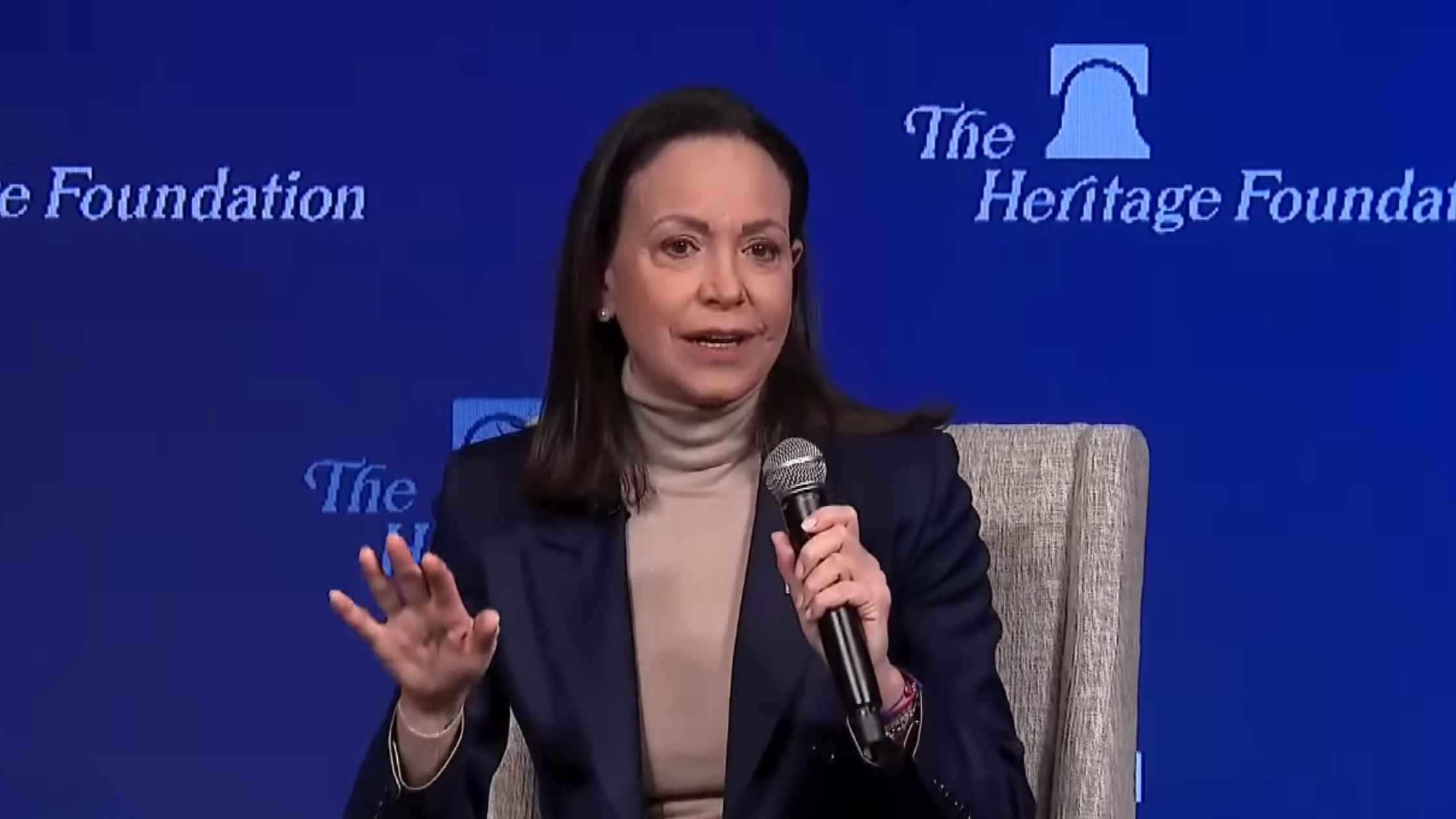
María Corina Machado has been a brave fighter against Nicolás Maduro and the regime since it began to take form. Unlike many others in Venezuela and Washington, she recognized the danger from the very beginning. The Venezuelan people rewarded her principled opposition by casting their ballots amidst harsh repression from the regime. Her efforts, along with those of President Trump, have brought Venezuela closer to the restoration of freedom, stability, and security, and we all hope to see the return of legitimate elections in Venezuela in the near future. We are honored to host history here at the Heritage Foundation and important conversations like the one you are going to participate in today. Here, we work to build an America where freedom, opportunity, prosperity, and civil society flourish. I'm delighted to welcome to the stage María Corina Machado.
María Corina Machado (02:34):
Thank you. Thank you very much. Thank you very much. So such a pleasure to be here. Very grateful to the Heritage Foundation and every one of you to join us this morning. I have to say that looking back, what has happened in the last years, and especially in the last days, it seems like a miracle to be sitting here in a free country in front of people that have also given their lives to fight for freedom, justice, and democracy. And that's why I am very honored, not only with the Heritage Foundation, but with every single citizen of this country that has welcomed us and has honored the immense struggle that the Venezuelan people has fought for so long. And finally, we can say that we are yes, the threshold of freedom.
(03:39)
On January 3, 2026, a new milestone was achieved, and we are definitely now into the first steps of a true transition to democracy that will have not only immense impact in the lives of all Venezuelans, those who stayed in our country, those who have been forced to flee around the world, but that will have immense impact in the region, in our hemisphere and I will say even further in the whole world, because what we have proven is that people determined to be free, even without resources, without money, without the free press supporting, even facing the most cruel tyranny can prevail because the force of conviction and the force of love is the strongest of all. I am very proud to be part of these generations of Venezuelans. Most of them have never known what it means to live in freedom or what it means to be part of democratic society, but they have risked their lives, their loved ones, everything they have because they share that dream to live in a free country.
(05:05)
It's all about human dignity. It's all about justice, it's all about love. And it's love for children, love for our country, and love for freedom that has brought us here. Now we face a very complex and delicate process, and as Venezuelans, we are absolutely grateful to President Trump, his team, his administration, and the people of the United States because it took a lot of courage to do what he did. And he did it, yes, on behalf of the American people, but also because he cares for the people of Venezuela, and he told me that yesterday. And I think that was the most important message I can bring back to my country, tell the Venezuelan people that the American people and the President of the United States truly cares for the life, the well-being, and the future. I'm certainly talking about our political prisoners and all those have been persecuted, those who are all today in exiled.
(06:21)
But I'm also talking about those children that are growing without their mothers because they had to flee, to send food back, that are growing without education because public schooling in Venezuela works two days a week because teachers earn $1.00 A day and they need to get other jobs in order to eat, that are growing without health and food. And we have the generation that is suffering the highest levels of malnutrition in a century. That's our children right now. And it is because of them. It's because of saving lives that we're doing what we're doing right now, and that's why we're going to win. And the only thing I want to assure the Venezuelan people is that Venezuela is going to be free, and that's going to be achieved with the support of the people of the United States and the President, Donald Trump of the United States.
(07:28)
So I'm very grateful to be here. We are facing challenging times ahead. We are prepared to do what it takes as a legitimate government. And Edmundo González Urruti and I have been in communication permanently all these days and we feel not only with a mandate from the Venezuelan people, and that's why I'm here and that's why what I convey to the President of United States, but also a huge task in front of us to prepare with other teams around the world and in Venezuela to take over government when the right time arrives. So thank you very much, and I'm more than willing to hear your questions now. So I believe there is a procedure that has been designed because we thought there might be some interest today.
Speaker 2 (08:26):
Thank you very much. It's an honor to have you, Ms. Machado.
María Corina Machado (08:29):
Thank you.
Speaker 2 (08:31):
I'm going to start off with a question and then we're going to open it up to the press. My question to you, Ms. Machado, is you know the Venezuelan people more than anyone, and that's apparent from the very...
María Corina Machado (08:42):
[inaudible 00:08:43]
Speaker 2 (08:44):
Sorry. You know the Venezuelan people more than anyone, and that's apparent from the very strong support that they've shown for you time and time again. As you know, your country has been destroyed by socialism, Cuba, Russia, and Iran looting your nation and your wealth. And the primary victim of this has been the Venezuelan people. Do you see a future in which at all possible where a free and fair election and return to democracy in Venezuela restores anything but a strong staunched U.S. ally and a country that leaves behind the shackles of socialism?
María Corina Machado (09:30):
Well, thank you very much. Can you hear me? I'm hearing an echo here. Yeah.
Audience (09:37):
We can hear you.
Speaker 1 (09:37):
We can hear you.
María Corina Machado (09:37):
It's fine?
Audience (09:43):
Yeah. Yes.
María Corina Machado (09:44):
Okay. No, there's a problem with an echo, right?
Audience (09:50):
Yes. Use that microphone. Can you answer at the podium? Yes, please.
María Corina Machado (09:56):
No, please. It's comfortable sitting down. You want me to stand up? You prefer that I stand up?
Audience (09:59):
Yes.
María Corina Machado (09:59):
No? That's better now? Okay. Look, I'm very glad we start with this issue because I understand that there are many concerns regarding the transition in Venezuela and compared to previous events in all parts of the world. And I always insist in the difference between what Israel... today compared to Middle East countries that went through change in governments or regimes. We're talking about a society that is perhaps the most cohesive in the region, I would dare to say even in the world. I ask you to think any other society in which 90% of the population wants the same; not only that they reject the actual regime, but we want the same. There are not religious tensions within the Venezuelan society, or racial, or regional, or political, or social. There was one longing that brought Venezuelans together, and that was, we want our children back home.
(11:14)
And it was that demand that I heard all around Venezuela in 2023 when we were moving forward to the primary process that made me realize how powerful it was to unite country, to tear down the barriers that the regime had built to divide us between rich and poor, Black and white, left and right, military and civilians, and we brought a country back together. That's why I always said, "You know what? Maduro's going to go. We're going to get rid of him one day or the other." What's important is the country that's coming afterwards, and it's a country based on shared values. We want to live with dignity. We want to live with the result of our work, our effort, a society based in merit and not if you know the Chavista who is in certain place at certain time. Women do not want handouts. They don't want to live in a... give their children a box of food that has a high cost because then you have to lower your head and repeat what the regime wants you to say or dress as they will expect you to dress. They want to live with their job well done. That's dignity, and that's what Venezuela deserves and wants today. And that's what we represent. So of course, the result of this hard process will be a society based on these values, a society that is profoundly pro-America. And I want to insist on this. Delcy Rodriguez, yes, she's a communist. She's the main ally and representation of the Russian regime, the Chinese and Iranians, but that's not the Venezuelan people, and that's not the armed forces as well. So I am profoundly, profoundly confident that we will have an orderly transition. This is a complex phase we are at right now. Some of the dirty work is being done by them, but then the result of a stable transition will be a proud Venezuela who is going to be the best ally the United States has ever had in the Americas.
Speaker 2 (13:53):
We're going to have a person come up and [inaudible 00:13:56].
María Corina Machado (13:56):
Sorry for that. I'm going to lead.
Speaker 2 (13:57):
Thank you very much.
Speaker 3 (13:58):
Hi, thank you very much for coming. I realize there's a lot of interest. We're going to try to get to every question. I'm going to go through a list. There's outlets that have more than one reporter accredited, so I would like to please ask you to raise your hand so we can get one of our kind staff to bring the microphone to you as I call you out. Julio Vaqueiro Vaquero from Telemundo, please.
Julio Vaqueiro (14:19):
Gracias. Hola [inaudible 00:14:20]
Speaker 3 (14:20):
Hola, Julio.
Julio Vaqueiro (14:20):
Gracias. Hola, Maria Corina. [foreign language 00:14:21] Washington D.C., President Donald Trump [foreign language 00:14:28] Venezuela?
María Corina Machado (14:49):
Gracias, Julio. [foreign language 00:14:52]
Audience (15:00):
Phones down. Put your phones down. Put the phone down.
María Corina Machado (15:02):
[foreign language 00:15:02]
Audience (15:02):
No, no. No, no. [inaudible 00:15:03]
María Corina Machado (15:18):
Ah, no telephone. Okay. [foreign language 00:15:18]
Audience (15:18):
[foreign language 00:15:25]
María Corina Machado (15:45):
[foreign language 00:15:27]. Okay. [foreign language 00:15:46]
Audience (15:45):
Si. Si.
María Corina Machado (15:45):
Si?
Audience (15:56):
Si. Yes.
María Corina Machado (16:00):
Okay. [foreign language 00:16:01]
María Corina Machado (16:00):
[foreign language 00:17:07].
Speaker 4 (17:06):
Nick Schifrin for PBS, please.
Nick Schifrin (17:12):
Thank you so much. It's great to see you in person after seeing you virtually for the last few years. Two questions, if I could, similar to what you just answered, but in English, you had a very good meeting with the president yesterday, but he still maintains a positive relationship and positive language about Delcy Rodriguez. The CIA director was just there. So what's your message to the president and to the United States when US policy is still to support the Chavismo government that still exists in Caracas? And I have to ask, your statement last night said that you felt like you were going to die at one point when you left Venezuela in the boat. Can you just tell us exactly what happened in that moment when you were in that boat? Thank you.
María Corina Machado (18:00):
Well, regarding all the details of how and when I left Venezuela, for the protection of those involved and helped me get here, I will wait until the regime is no longer in capacity to harm them to share that in detail. Yes, there was a certain moment in the trip in the boat where I was hurt because the waves were very high, over six feet, and there was a strong wind and we got lost in the ocean. We lost the sign of the GPS and satellite phone stopped working and startling antenna did not work as well all at the same time. So it was very risky, dangerous, and scary moment, I have to say. And it lasted several hours. But at the end, as I say, we have work moved ahead. [foreign language 00:19:25].
(19:25)
That's why I believe it is a miracle and I'm here. And I know that someday I will be able to tell you all the details and thank personally all those that risk their lives in order for this to happen because they knew it was very important, very important for our cause that I was able to leave my country at that moment.
(19:50)
Regarding your first question, look, this has nothing to do with a tension or decision between Delcy Rodriguez and myself. This is about the cartel and justice. This is about a criminal structure that is a regime and the mandate of the Venezuelan people. That's what at stake at this moment. I'm just one member of a huge movement of millions of Venezuelans that have decided and are committed to be free. And I have no doubt that President Trump, his administration, and the people of the United States support democracy, justice, freedom, and the mandate of the people of Venezuela.
(20:47)
I have absolutely no doubt. Not only because it's in the wellbeing of Venezuela people, but as I say, because it's crucial for the American people. United States today is a safer nation after January 3rd. And once the regime is out and the transition is accomplished, the United States will not only be a safer nation, but one that will have more prosperity and strength in our hemisphere.
Speaker 4 (21:22):
Can we get Eric Martin from Bloomberg, please?
Eric Martin (21:39):
Thank you. Maria Corina, would like to ask you about the timeline for Democratic transition within Venezuela because obviously the Constitution calls for within 30 days a new election. You've already been recognized by a number of countries, including the US in 2024. Edmundo Gonzalez as having won that election and accusations that the election was stolen by the Maduro regime. As you've mentioned, you overwhelmingly won the primary in 2023. Do you have an expectation? Is your expectation that the next step in this process would be a new election in Venezuela? Do you expect that to happen in 2026? Or what does the roadmap look like from getting from today's government by Delcy Rodriguez, the government de facto that is in control to a democratically elected government? Thank you.
María Corina Machado (22:41):
Thank you, Eric. Well, if the Venezuelan constitution were respected, we wouldn't have a thousand political prisoners. We wouldn't have nine million people fleeing and living around the country. We wouldn't have our president elect exiled in Madrid. I mean, he would have taken power on January 9, 2025. We realized that there's no rule of law in Venezuela. I don't know actually if you're aware, Venezuela is currently in the last place globally in terms of rule of law. Out of 142 countries that have been evaluated by the World Justice Project, Venezuela's in place 142, so much for the constitution.
(23:33)
At the end, it is a matter of strength, and that was what made this process, started on January 3rd, happened. I mean, that was the main difference. They realized, the regime realized that they are facing the strength of the people organized, but mostly in this last phase, the strength of the Democratic allies that are concerned about the structure of the regime, of the criminal regime in Venezuela.
(24:05)
So this is a process that have several phases. We are in one that it's complex, as I said, in which the regime is forced to dismantle themselves. Some of the structures that have been maintaining them in power, starting with the repression system that requires not only that all political prisoners are liberated, but that they are free. The fact that you are not in a prison doesn't mean that you are free.
(24:38)
In Venezuela, they have left the jails, but they cannot speak to the press. They cannot leave the country, and they are still terrified. All torture centers have to be closed, and certainly there have to be guarantees for journalists to speak out, and those who have left the country to come back and organize, and make the will of the people be respected.
(25:11)
Eric, believe me, I understand the urgency. I have been speaking with the families, not only of those that have been freed, liberated this last hours, but especially with those that have not, and that they don't know where their loved ones are right now. They have simply disappeared. I'm talking about hundreds of people.
(25:37)
Actually, we found out in this last hours that there were more political prisoners than we thought, because many families had been scared, just even to denounce that their loved ones had been in prison or disappeared by the regime. So some of those that have been liberated were not even registered by us. And this is still in place. I mean, there is a criminal structure of terror, not only on the civilian population, but also in the military. So that one of the main urgencies and priorities that have to take place in the days to come is we need to dismantle that terrorist structure by the DGCIM or La Casa Militar, which are those that have committed crimes against humanity and that are those that have not only the civilian, but the military under terror and ultra laws.
(26:41)
Once these steps are taken, then we can move forward in the transnacionalización of our government and eventually we will have free and fair elections. And I'm talking about governors, mayors, national assembly. We need to have the will of the people be expressed freely.
(27:06)
I have to remember that in the last election, presidential election or president elected Edmundo Gonzalez. One, nearly 40% of Venezuelans that have a right to vote couldn't do it because the regime wouldn't allow them. That's one of the main things we need to correct. Every single Venezuelan living in Venezuela or abroad should have the right to vote as soon as possible. Thank you.
Speaker 4 (27:37):
Gaby Perozo from VPI, please.
Gaby Perozo (27:38):
[foreign language 00:27:51].
María Corina Machado (27:38):
[foreign language 00:28:32].
Speaker 4 (31:36):
This was supposed to last until noon. It is now noon, but if everyone's game to stay, please stay. Paolo Mastrolilli from La Repubblica, please.
Paolo Mastrolilli (31:55):
Thank you very much for doing this. You met in Rome with Pope Leo. Can you talk about what you discussed with him if the Holy See is willing and able to help you in this transition?
María Corina Machado (32:07):
Thank you very much. That was a very important meeting. I'm a Catholic, as you know, and believe me during my trip, I prayed a lot. So I was able not only to talk to him, but to present him some of the rosaries that I had brought with me during the trip. And it was a day that earmarked my life in a personal dimension, but also I had a reassurance of the Holy Father that he knows very well what's going on in Venezuela.
(32:49)
He knows what the Catholic Church is being going through because of the persecution and pressure on our bishops and priests and nuns. And I believe that he's not only concerned, but actively helping and supporting a peaceful transitional process to take place. I think it was a very important and timely message to Venezuelan society, which is mostly, as you know, Christian. So I think it couldn't have been in a better moment, and it brought a lot of hope and reassurance to our people.
(33:41)
Thank you.
Speaker 4 (33:42):
[inaudible 00:33:42] Please.
María Corina Machado (33:42):
[foreign language 00:33:55].
Maria Corina (33:42):
[foreign language 00:34:00].
Speaker 6 (34:02):
Okay. Sorry, sorry for that. No, [foreign language 00:34:06].
Maria Corina (34:03):
[foreign language 00:34:08].
Speaker 6 (34:08):
Okay, [foreign language 00:34:08].
Maria Corina (38:06):
[foreign language 00:34:48] fact finding mission [foreign language 00:38:49].
Speaker 7 (38:50):
Maxine Wallace, Washington Post, please. Maxine is not here? Washington Post?
Maria Corina (39:01):
Washington Post here.
Audience (39:07):
[inaudible 00:39:07].
(39:07)
I think he's here.
Speaker 7 (39:13):
No Washington Post? Okay. Then let's go with Carla Angola, please. She's right next to you.
Speaker 5 (39:17):
Thank you. I can hold it. Okay, okay [foreign language 00:39:25].
Maria Corina (42:02):
[Foreign language 00:40:33] one day at a time, [foreign language 00:42:04] one hour at a time. [foreign language 00:42:07] take for granted [foreign language 00:43:31].
Speaker 7 (44:27):
Can we get Vera from the Wall Street Journal, please? Vera's not here? Wall Street Journal? Okay. Then we go with Ilia Calderon from Univision.
Speaker 8 (44:37):
[foreign language 00:44:38]. Thank you. [foreign language 00:44:38].
Maria Corina (44:37):
[foreign language 00:44:38].
Audience (44:37):
[inaudible 00:46:57].
Maria Corina (44:37):
[foreign language 00:46:57] by the way [foreign language 00:48:10].
Speaker 8 (44:38):
[foreign language 00:48:55].
Maria Corina (44:38):
[foreign language 00:48:58].
Speaker 7 (44:38):
[foreign language 00:49:15].
Speaker 9 (44:38):
[foreign language 00:49:24].
Maria Corina (44:38):
[foreign language 00:49:52].
Speaker 7 (50:38):
We're going to take a couple of questions in English. Erik from Politico, are you here, please?
Speaker 10 (50:53):
Thank you so much. Maria Corina, it's good to see you in person, as others have said. Today, Venezuela accepted its first deportation flight since the operation on January
Speaker 11 (51:00):
... rotation flights since the operation on January 3rd. It followed a month of pauses. There's been some worry that Rodríguez could use migration cooperation with the United States as a way to defray pressure to go towards elections or dismantle criminal networks in the country. Do you share those concerns that she could use an issue that is very central to this administration's foreign policy?
María Corina Machado (51:23):
Thank you very much. We all know how this regime weaponized migration against several countries, not only United States. And migration in Venezuela was designed by the regime. Wasn't just spontaneously happened. It was designed by them. And certainly, they've tried to use our people as a trade bargain, which is very, very painful. But I think everybody knows that the only way that we can have people on their own means and talking hundreds of millions, sorry, hundreds of thousands coming back is given the Venezuelan people the hope, the certainty that we will have a democratic future and security in our country. It's not a matter of having all economic problems solved. People are willing to go back to be part of the solution, but if they have hope that we will have a freedom and democracy in the future. So I think it is clearly in the best interest of the United States and those that are concerned about migration to have a transition take place as soon as possible because you will see millions coming back home.
Speaker 4 (53:02):
I have several accredited journalists from the AP. I don't know who wants to take the question. Josh Goodman from Associated Press.
Joshua Goodman (53:15):
Hi, María Corina. Thank you. Lots of questions still about the meeting yesterday with President Trump. I just have three specific ones. Did you urge him to seek the arrest of Diosdado Cabello? Did you urge him not to meet with Delcy Rodríguez as he's indicated he would? And did you urge him to not allow Delcy Rodríguez to reopen the Venezuelan embassy in Washington? Those are three specifics. Want to know what your position on those are. Thanks.
María Corina Machado (53:42):
Well, I think I don't need to urge the president of specific things. I think he's very clear what has to be done right now. We exchange views about the implications of several actions. And I just want to tell you that I was very impressed of the degree of information he has, how closely he follows the situation in Venezuela, and how much he's concerned about the wellbeing of our people. Certainly, we did talk about the political prisoners and their families and importance to stop repression from the root in Venezuela right now, because you cannot talk of a transition even in its first steps if there's still repression in our nation.
Speaker 4 (54:39):
The Daily Signal.
Speaker 12 (54:48):
Thank you so much. Wondering regarding your meeting with President Trump yesterday, do you believe that you earned the trust of the president and did you all specifically talk about a transition of power in Venezuela in which you would become president? Thank you.
María Corina Machado (55:03):
Point again, this is not about me. It is about the will of the people. And we certainly talk about how popular sovereignty has been expressed in Venezuela and absolutely terrible conditions in which we did and how the regime stalled that result. And I think he can certainly relate to that. So I believe that the point here is Venezuela has decided as a nation to be united first, to unite back again, and to fight for a right to be free. And he understands the moment and the implication for, I would say, the whole hemisphere.
(55:57)
We talked, and I would say this, I know you can imagine that, about other countries and specifically about Cuba and the implications of a transition to democracy in Venezuela, what would mean to Cuba. And I insisted in something I've said many times, that I believe that for the first time in history, we will have the Americas free of communism, dictatorship, and narcoterrorism for the first time in history. And that's what's already happening. Sometimes you are so immersed in processes that it's hard to understand the implication and historic implications. Imagine what this will mean to have these dictatorships finally gone in Venezuela, in Cuba, and Nicaragua. I mean, this is equivalent to the fall of the Berlin Wall in the Americas. So this is huge from a historic perspective, and this is happening as we speak.
Speaker 4 (57:04):
Torao Kono, NHK Japan. No. Japan media? Can we get Mr. Rosen from Newsmax? Also not here. Jesús [inaudible 00:57:20], please.
Jesús (57:31):
Okay. I was wondering if President Trump is aware of how many political prisoner have been released so far. I mean, it's less than 10%, and I was wondering if he's aware of that and if he's told you some strategies that he will do to enforce... I mean, to make them release in the next months or weeks or something.
María Corina Machado (57:57):
Certainly aware. President Trump is certainly aware of what's happening with the political prisoners, how they are not being compliant as they were expected, and committed to see that happened. I have no doubt. Well, what specifically he plans to do, we didn't get involved into that, but I trust his word that that's something it will take place. And as you know, Jesús, and we've talked about this, this is one of my top priorities right now, certainly.
Speaker 4 (58:38):
We do have another media outlet from Japan. If you're in the room, please raise your hand. No. AFP, Agence France-Presse, over there.
Speaker 13 (58:52):
[foreign language 00:59:00].
María Corina Machado (58:52):
[foreign language 00:59:17].
Speaker 4 (01:02:33):
One last question from Mr. [inaudible 01:02:35], please.
Speaker 14 (01:02:34):
[foreign language 01:02:44].
María Corina Machado (01:02:34):
[foreign language 01:03:08].
Speaker 15 (01:04:50):
Thank you very much. ... to file out and then we'll all orderly [inaudible 01:05:00]. But thank you very much. Let's welcome or thank Ms. Machado for her time.