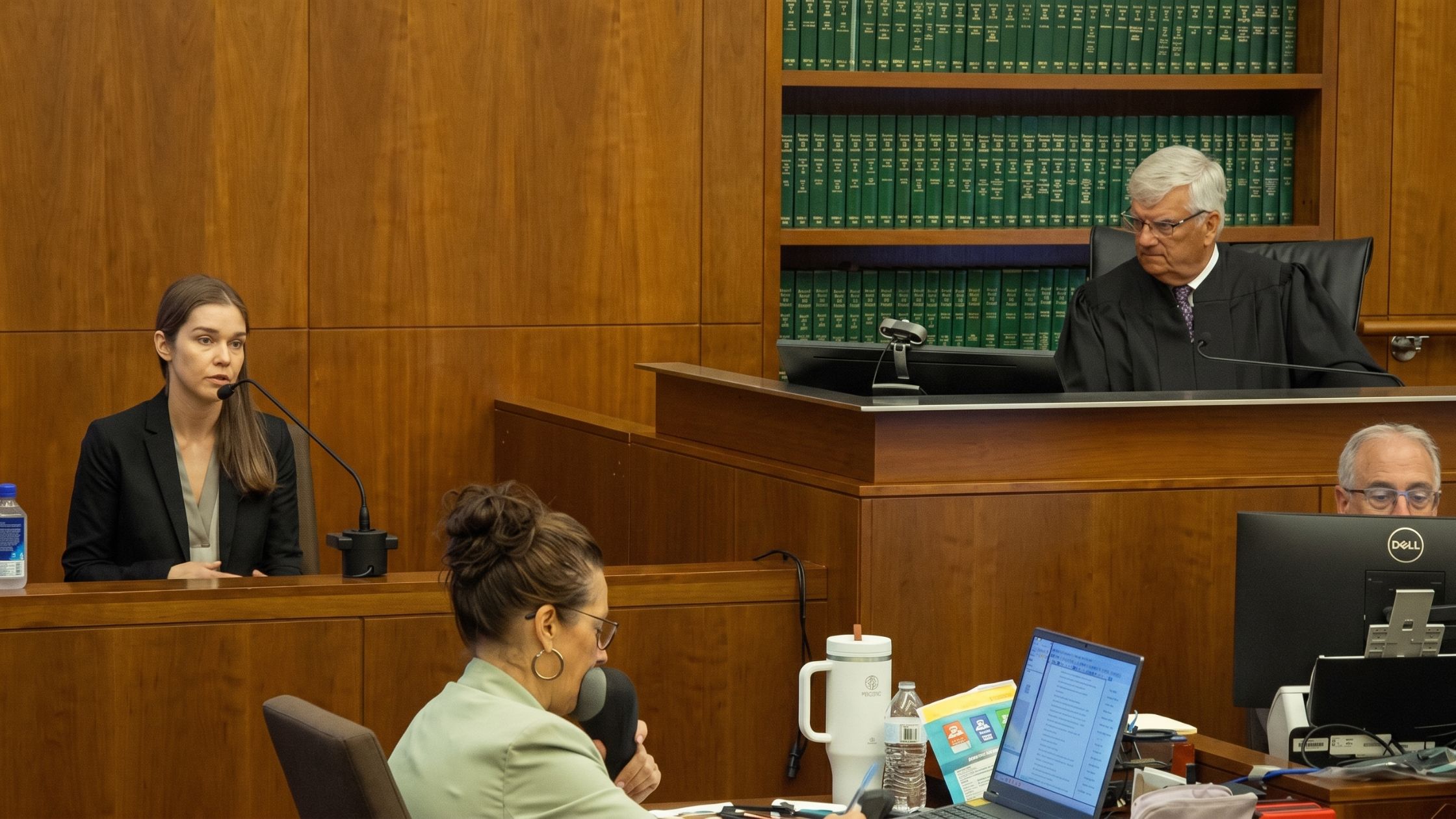
William F. Sullivan (00:00):
... the case. So first let me ask the questions. Has any member of the jury read, seen, heard, or overheard anything from any source about any aspect of this case that would affect your ability to be a fair and impartial juror?
Juror (00:14):
No.
William F. Sullivan (00:14):
All right. Next, is there any other serious matter or concern bearing on your service as a juror in this case that anybody needs to bring to my attention? All right. Thank you for following those instructions. And then in regards to today's schedule, we've got a number of witnesses. I'm not quite sure how long it may go. So we may break a little bit early today, just kind of depending on the way the case comes in. And then, in regards to where we are right now, we're going to, if you remember, when we broke on Friday, there was a witness, a Dr. Tufts. The Commonwealth had finished their direct examination. We're now going to have that witness return to the stand and the cross-examination by the defendant will begin. All right. And so with that, if we could recall that witness.
Bailiff (01:01):
Good Morning.
Dr Jennifer Tufts (01:31):
Good morning.
Bailiff (01:31):
Stop right there and raise your right hand for the clerk, please.
Clerk (01:43):
Good morning. Do you solemnly swear that the testimony and the evidence you shall give to the court and the jury in the matter now pending between the Commonwealth and the defendant shall be the truth, the whole truth, and nothing but the truth, so help you God?
Dr Jennifer Tufts (01:44):
Yes.
Clerk (01:44):
You may have a seat.
Bailiff (01:44):
Just watch your step, please.
William F. Sullivan (01:44):
All right. Good morning, doctor.
Dr Jennifer Tufts (01:44):
Good morning.
William F. Sullivan (01:44):
All right. Mr. Reddington?
Kevin Reddington (01:49):
Thank you. Good morning, doctor.
Dr Jennifer Tufts (01:51):
Good morning.
Kevin Reddington (01:56):
Do you have your record in front of you? Your notes or-
Dr Jennifer Tufts (01:59):
I do.
Kevin Reddington (02:00):
... record? Great. Thank you. And you can look at that anytime you want, just to refresh your memory with what's what.
Dr Jennifer Tufts (02:06):
Thank you.
Kevin Reddington (02:13):
Dr. Tufts, you are presently a psychiatrist, correct?
Dr Jennifer Tufts (02:20):
Correct.
Kevin Reddington (02:21):
And can you tell me where you went to med school?
Dr Jennifer Tufts (02:26):
University of Vermont.
Kevin Reddington (02:27):
And what were the years that you were at the University of Vermont?
Dr Jennifer Tufts (02:31):
2014 to 2018.
Kevin Reddington (02:37):
Beautiful country out there. Great place to go to school, right?
Dr Jennifer Tufts (02:39):
It is. It's beautiful.
Kevin Reddington (02:40):
And when you graduated from med school, you then did your residency?
Dr Jennifer Tufts (02:46):
Correct.
Kevin Reddington (02:47):
And where was the residency?
Dr Jennifer Tufts (02:48):
Boston Medical Center.
Kevin Reddington (02:51):
And can you tell me, what is it exactly that you do as a psychiatric resident or a psychiatrist resident? What do you do?
Dr Jennifer Tufts (02:59):
Well, you do a lot. A lot of different things. You rotate in all the different aspects of psychiatry as well as internal medicine so that you have a foundational knowledge of broad medical topics. You admit patients into the inpatient hospital. You manage emergencies in the hospital and in the emergency room. Decide whether patients need to be admitted psychiatrically or not, and also carry a panel of outpatients.
Kevin Reddington (03:42):
And is this a hospital that you're working in or is it Boston University? Is it a medical center?
Dr Jennifer Tufts (03:47):
So yes, it's the Boston University program located at the hospital, Boston Medical Center, with also a lot of time spent at the various Boston VA locations.
Kevin Reddington (04:04):
Okay. And what were the years? I'm sorry, that you did your residency?
Dr Jennifer Tufts (04:06):
2018 to 2022.
Kevin Reddington (04:10):
So you basically were working as either a person studying to be a doctor, graduating, and then becoming a resident through the entire pandemic?
Dr Jennifer Tufts (04:25):
For the first part of the pandemic, yes.
Kevin Reddington (04:27):
Well, the pandemic ended when Joe Biden said it ended. I think it was July of 2022, right?
Dr Jennifer Tufts (04:33):
I'm not sure exactly when he said that.
Kevin Reddington (04:35):
Would you agree with me that when the pandemic started around 2019, when you began your residency, 2020, '21 into '22, it was a, if you will, of the pandemic timeframe? So, when you finished, do you graduate from a residency or is it like you get a certificate or something?
Dr Jennifer Tufts (05:04):
Yes, there is a certificate for completing it.
Kevin Reddington (05:11):
And then at that point, you are now a licensed doctor. Is that how it works?
Dr Jennifer Tufts (05:14):
Well, you're actually a licensed doctor the entire time that you're in residency, but upon the completion of that, you can obtain a full unrestricted Massachusetts license and also become board certified.
Kevin Reddington (05:32):
And the board certification, for example, you have a board certification in general psychiatry. Is that correct?
Dr Jennifer Tufts (05:39):
Yes, sir.
Kevin Reddington (05:43):
And when was it that you got that certification?
Dr Jennifer Tufts (05:44):
When was it?
Kevin Reddington (05:44):
Yes.
Dr Jennifer Tufts (05:45):
It was September 12th, 2022.
Kevin Reddington (05:53):
When was it that you actually started working as a physician, as a psychiatrist?
Dr Jennifer Tufts (05:59):
I started working as a physician and as a psychiatrist during the residency training program, but I started practicing completely independently at Aster Mental Health in August of 2022.
Kevin Reddington (06:18):
August of 2022?
Dr Jennifer Tufts (06:20):
Yes.
Kevin Reddington (06:21):
Now prior to working with or at Aster, is that A-S-T-O-R or E-R?
Dr Jennifer Tufts (06:26):
A-S-T-E-R, like the flower.
Kevin Reddington (06:31):
And what is Aster? Is it like a group of doctors? Is it a medical center? What is it?
Dr Jennifer Tufts (06:36):
It is a outpatient practice that is owned by a psychiatrist. It has a number of psychiatrists as well as therapists.
Kevin Reddington (06:48):
And where is it located? Is it a brick and mortar type place where you have offices?
Dr Jennifer Tufts (06:51):
Yes. The original offices were in Braintree, Massachusetts, and now there's an office in Peabody as well.
Kevin Reddington (06:59):
Where was your office? Where do you work?
Dr Jennifer Tufts (07:03):
So at the time I saw the patient, I was working in the Braintree office. I currently work in Peabody.
Kevin Reddington (07:11):
Where? I'm sorry.
Dr Jennifer Tufts (07:12):
Currently, in Peabody, Massachusetts.
Kevin Reddington (07:15):
Okay. So when you start working at Aster, obviously like anybody else, you submit a resume, an application perhaps, and then they hired you, right?
Dr Jennifer Tufts (07:24):
It's a fairly lengthy process and a number of interviews with different staff at the practice and some recommendations, letters of reference, verification of credentials, all of that. But yes, it can be comparable to another profession in that process.
Kevin Reddington (07:44):
Now in August of '22, when you... Congratulations, obviously you were hired by Aster. How many women had you treated in your residency regularly postpartum?
Dr Jennifer Tufts (07:58):
With postpartum depression? Or just in the postpartum period?
Kevin Reddington (08:04):
How many women that were in the postpartum period did you treat prior to August of '22?
Dr Jennifer Tufts (08:10):
Many. It's hard to give an exact number, but I did have specific training in that population.
Kevin Reddington (08:18):
In that population. And where did you have the training in that population?
Dr Jennifer Tufts (08:22):
At Boston Medical Center.
Kevin Reddington (08:23):
And can you tell us in that two-year period, approximately how many women that were in the postpartum period that you treated, as a resident?
Dr Jennifer Tufts (08:34):
Okay. So it's really hard to give an exact number, but if I had to say, at least 50.
Kevin Reddington (08:41):
So in the two-year period, you treated 50 people in the residency that had postpartum. And can you tell me, what is postpartum? What does that mean?
Dr Jennifer Tufts (08:51):
Well, I just want to address that it was a four-year period, not a two-year period.
Kevin Reddington (08:54):
Oh, I'm sorry. Okay.
Dr Jennifer Tufts (09:00):
I'm sorry, what was your question?
Kevin Reddington (09:00):
Hold on. You saw 50 people in a four-year period that had postpartum. In other words, that had been after having the baby, right?
Dr Jennifer Tufts (09:08):
Possibly. Yeah, more or less. I saw a number of other patients.
Kevin Reddington (09:11):
Of course.
Dr Jennifer Tufts (09:11):
I saw much more than 50, but yes.
Kevin Reddington (09:14):
So after you had your residency, and after you were hired by Aster, is that when you began in August of '22, your practice as a practicing psychiatrist?
Dr Jennifer Tufts (09:30):
Yes.
Kevin Reddington (09:31):
And when was it that you actually got your DEA license that authorizes you to prescribe medication to citizens?
Dr Jennifer Tufts (09:43):
So during residency, I had a DEA license, but it was affiliated with Boston Medical Center. And then when I started at Aster, I had my own DEA number. I don't know exactly when, maybe sometime around August.
Kevin Reddington (10:00):
So August of '22, you start working at Aster. August of '22, you got your DEA license individually that authorized you to prescribe medication, correct?
Dr Jennifer Tufts (10:11):
Yes.
Kevin Reddington (10:12):
And it was when that you saw Lindsay Clancy?
Dr Jennifer Tufts (10:15):
I believe our first visit was September 15th.
Kevin Reddington (10:21):
Of?
Dr Jennifer Tufts (10:21):
2022.
Kevin Reddington (10:21):
So you were practicing as a psychiatrist for a little more than a month?
Dr Jennifer Tufts (10:31):
I was practicing independently with my full credentials for about a month, but the training is just immense that goes on before that.
Kevin Reddington (10:41):
Absolutely. It must be. But that's a residency that you're talking about, right?
Dr Jennifer Tufts (10:44):
Yes.
Kevin Reddington (10:45):
And you know with a residency... I mean, all I know is Grey's Anatomy, but I mean, you're working under a doctor, the doctors are supervising you, and they tell you what to do, and then you report to them, correct?
Dr Jennifer Tufts (10:55):
They don't really tell you what to do. They're there as a resource if you need additional support, but I followed many of my own patients. I was the only person in the room with them. And my notes were signed off by an attending physician and that attending was available for any support I needed.
Kevin Reddington (11:16):
So in August of '22, when you started working at Aster, you actually filled out a form for your advertising. Is that correct?
Dr Jennifer Tufts (11:30):
I believe that was handled by other people at the practice.
Kevin Reddington (11:34):
And who would that be?
Dr Jennifer Tufts (11:35):
Well, we have non-clinical staff that handle the administrative matters.
Kevin Reddington (11:43):
Okay. But you're a doctor, and you're out there to the public. You're advertising yourself and your services to the public. Is that fair?
Dr Jennifer Tufts (11:53):
I believe, yes. I'm not directing the marketing of our office, but yes.
Kevin Reddington (11:58):
Okay. Never mind your office. I'm talking about you. You had an ad that was on the computer that if somebody wanted to reach out to a doctor, they could see your ad amongst many others, right?
Dr Jennifer Tufts (12:14):
Well, I don't think there was an ad. I think we have a website that had some information about myself.
Kevin Reddington (12:20):
Okay. Now, in August of '22, up until when you saw Lindsay, how many patients in that month or so had you treated for postpartum psychosis?
Dr Jennifer Tufts (12:35):
How many patients in a month? Up until that month?
Kevin Reddington (12:38):
I'm asking you about when you started working in August of '22 for Aster. And you are now on your own as an employee. How many patients had you treated before you saw Lindsay Clancy for postpartum psychosis?
Dr Jennifer Tufts (12:54):
Well, in the span of one month, I would say none because it's a very rare disorder.
Kevin Reddington (12:59):
Okay. But it exists, doesn't it?
Dr Jennifer Tufts (13:02):
Absolutely.
Kevin Reddington (13:10):
And one of the things would be the voices that people hear, right?
Dr Jennifer Tufts (13:10):
That is a symptom of psychosis. Absolutely.
Kevin Reddington (13:12):
And that's legitimate, isn't it?
Dr Jennifer Tufts (13:15):
It is a legitimate diagnosis. Absolutely.
Kevin Reddington (13:17):
Ignore the diagnosis. People that have postpartum psychosis hear voices, do they not?
Dr Jennifer Tufts (13:23):
Many do. The disorder can manifest differently in different people, but yes, many people do hear voices.
Kevin Reddington (13:33):
How about postpartum depression? How many people in that month or so before you met Lindsay did you treat for postpartum depression?
Dr Jennifer Tufts (13:45):
In the span of one month? It's really hard to pinpoint that. Maybe a couple.
Kevin Reddington (13:52):
Maybe a couple? And do you recall how long you treated them for?
Dr Jennifer Tufts (14:02):
Again, it's hard to really pin down the individuals-
Kevin Reddington (14:05):
Okay.
Dr Jennifer Tufts (14:05):
... in a short span of time.
Kevin Reddington (14:08):
Can you tell the jury what you put in your ad or in the Aster website that you indicated that described you?
Dr Jennifer Tufts (14:18):
I don't recall.
Kevin Reddington (14:19):
Well, one of the things you did is that you said that you basically were a specialist in the postpartum... People that have postpartum psychiatry. You indicated that on your website, didn't you?
Dr Jennifer Tufts (14:35):
Are you able to read the actual document? I don't remember exactly the wording.
Kevin Reddington (14:41):
You've been working with them for how many years now? Three since you saw Lindsay or more?
Dr Jennifer Tufts (14:46):
Almost four, yes.
Kevin Reddington (14:46):
You haven't changed your ad on the website, have you?
Dr Jennifer Tufts (14:51):
I know, I have not personally, no.
Kevin Reddington (14:53):
And you've read it probably a bunch of times, right?
Dr Jennifer Tufts (14:56):
I've read it a couple of times, but I don't spend a lot of time on my website.
Kevin Reddington (15:02):
Okay. Do you recall that you indicated that you were specializing in any particular aspect of psychiatry?
Dr Jennifer Tufts (15:11):
Yes. It probably includes a special interest in women's health, in perinatal psychiatry, in trauma-related disorders, anxiety. And there may be some other things that were mentioned.
Kevin Reddington (15:29):
Yeah, like women that have babies, and they're suffering from postpartum depression, right?
Dr Jennifer Tufts (15:33):
Absolutely.
Kevin Reddington (15:34):
You advertised that after a month working for Aster, right?
Dr Jennifer Tufts (15:39):
That's listed as one of my interests, definitely.
Kevin Reddington (15:42):
And again, forgive me. How many women did you treat for postpartum depression in that month and a half before you met Lindsay?
Dr Jennifer Tufts (15:51):
I don't know, maybe a couple. But I've treated many of them in the residency, which was just immediately before.
Kevin Reddington (15:59):
So when a person needs to see a psychiatrist, generally they're not well. Is that fair?
Dr Jennifer Tufts (16:09):
Some are not well. It really can vary.
Kevin Reddington (16:12):
So when someone comes to see a psychiatrist like you, it's because they need help, right?
Dr Jennifer Tufts (16:19):
Yes.
Kevin Reddington (16:20):
And when they come to you because they need help, for example, with Lindsay Clancy, she came to you because of your ad, right? Or your website for Aster, what you said about yourself?
Dr Jennifer Tufts (16:33):
I don't know exactly how she found us.
Kevin Reddington (16:38):
Well, do you know why she came to see you?
Dr Jennifer Tufts (16:44):
I'm not sure exactly.
Kevin Reddington (16:47):
Friday, we spent a long period of time going through your initial or the initial intake that she had to fill out. Is that correct? Do you recall that?
Dr Jennifer Tufts (16:58):
Yes, we did.
Kevin Reddington (16:59):
And the district attorney kept asking you, and this is in September. Is it September 12th? Is that when that form was filled out?
Dr Jennifer Tufts (17:06):
I believe she completed the form on the 12th. The appointment was on the 15th.
Kevin Reddington (17:12):
So what does a person do? Do they call you or do they talk to somebody in administration? How do you get the form to fill out?
Dr Jennifer Tufts (17:20):
Yes. Our administration handles that.
Kevin Reddington (17:22):
And what do they do? How does that happen?
Dr Jennifer Tufts (17:27):
They send them the documents, probably by email, and the patient fills them out. Actually, it might be all within the portal that we use.
Kevin Reddington (17:44):
Within the portal?
Dr Jennifer Tufts (17:45):
The patient portal, yes.
Kevin Reddington (17:46):
Okay. And that means that you go online, and you can access Aster Mental Health and then all these little dropdown boxes would come up?
Dr Jennifer Tufts (17:53):
Something like that.
Kevin Reddington (17:56):
Are you aware? Something like that or are you aware of what it does?
Dr Jennifer Tufts (18:00):
So, because I don't handle the scheduling and send you the forms, I don't know exactly what it looks like.
Kevin Reddington (18:07):
Well, this is the form that you're giving a person that needs help because they're possibly mentally ill. Is that right?
Dr Jennifer Tufts (18:13):
Yes. And what's important is that I review the forms, and we go through them-
Kevin Reddington (18:19):
You do?
Dr Jennifer Tufts (18:19):
... in the appointment. Absolutely. Yes. Yes.
Kevin Reddington (18:22):
Now understand that your records, Exhibit 219, I believe that the jury will have access to the Tufts records. Okay? You're aware of that, right? You know it's an exhibit?
Dr Jennifer Tufts (18:37):
Yes.
Kevin Reddington (18:39):
Because you have talked to the prosecution about what an exhibit is, and you know that your records are now in evidence before this jury, right?
Dr Jennifer Tufts (18:50):
If that's what you say, yes.
Kevin Reddington (18:52):
I wouldn't take what I said. If you don't know, that's fine.
Dr Jennifer Tufts (18:56):
I don't know the details of how this works.
Kevin Reddington (18:58):
All right. Have you talked to them prior to your testimony?
Dr Jennifer Tufts (19:01):
No.
Kevin Reddington (19:01):
You haven't talked to the DA's office?
Dr Jennifer Tufts (19:05):
No, not at all.
Kevin Reddington (19:05):
You're a defendant in a very large lawsuit, are you not?
Jennifer Sprague (19:09):
Objection.
William F. Sullivan (19:15):
Overruled.
Dr Jennifer Tufts (19:15):
Yes.
Kevin Reddington (19:17):
You wouldn't happen to be represented by an attorney, would you?
Dr Jennifer Tufts (19:21):
I am.
Kevin Reddington (19:22):
And the fact that you have an attorney is your right under the constitution. It doesn't mean that you're guilty of anything, right?
Dr Jennifer Tufts (19:27):
Right.
Kevin Reddington (19:30):
Okay. And you know that the outcome of this case is very, very major to the outcome of your lawsuit.
Jennifer Sprague (19:44):
Objection.
William F. Sullivan (19:45):
Overruled.
Dr Jennifer Tufts (19:45):
I don't actually know that.
Kevin Reddington (19:49):
So you understand that if, in fact, it's determined that you advertised as an expert in postpartum psychiatry, and you've had a month experience plus a residency, would you consider that to be negligent or a misrepresentation?
Dr Jennifer Tufts (20:10):
I do not believe that I have been negligent.
Kevin Reddington (20:13):
Do you understand what misrepresentation is?
Dr Jennifer Tufts (20:16):
Yes.
Kevin Reddington (20:17):
With a month under your belt plus your residency, do you really want this jury to believe that you were an expert? Can you empathize that?
Dr Jennifer Tufts (20:24):
I don't think that's exactly the wording that I used.
Kevin Reddington (20:27):
Then what's the wording?
Dr Jennifer Tufts (20:28):
I think I said that it was an interest of mine. I think-
Kevin Reddington (20:29):
You were [inaudible 00:20:30]?
Dr Jennifer Tufts (20:29):
... was the answer.
William F. Sullivan (20:29):
No. Go ahead answer.
Dr Jennifer Tufts (20:34):
I just think the wording was that it's an interest of mine. I don't believe I called myself an expert.
Kevin Reddington (20:42):
Are you an expert in postpartum?
Dr Jennifer Tufts (20:47):
I may be. I don't know. I think it depends on what you define an expert as.
Kevin Reddington (20:51):
Well, when a patient comes to you, and they fill out the form, you agree with me that your records reflect that form that she filled out on September 12th of 2022, right?
Dr Jennifer Tufts (21:08):
Yes.
Kevin Reddington (21:10):
And the form that the district attorney went through painstakingly with you is basically put something like this, right? That's one of the forms that you have to fill out, right?
Dr Jennifer Tufts (21:25):
Yes.
Kevin Reddington (21:25):
Right?
Dr Jennifer Tufts (21:25):
Yes.
Kevin Reddington (21:31):
You see the little check mark?
Dr Jennifer Tufts (21:34):
Yes.
Kevin Reddington (21:35):
Who puts the check mark in there?
Dr Jennifer Tufts (21:37):
The patient.
Kevin Reddington (21:38):
So how many pages, because I don't want to go through all the pages again. How many pages does a patient or how many pages did Lindsay go through to check the boxes for Aster?
Dr Jennifer Tufts (21:52):
There were a lot of pages.
Kevin Reddington (21:54):
What's a lot? 10, 20?
Dr Jennifer Tufts (21:54):
Yeah, maybe between 10 and 20.
Kevin Reddington (21:59):
Okay. And basically they're all little checks and boxes, correct?
Dr Jennifer Tufts (22:02):
Not just checks.
Kevin Reddington (22:05):
No? So does the person then answer questions by typing in answers such as, "Do you have any legal problems?" "No." "Have you ever been arrested?" "No." Things of that nature, right?
Dr Jennifer Tufts (22:21):
Those are some of the questions.
Kevin Reddington (22:23):
And the questions also, do they ask the patient what medications they were on?
Dr Jennifer Tufts (22:29):
Yes.
Kevin Reddington (22:30):
Before seeing you?
Dr Jennifer Tufts (22:31):
Yes.
Kevin Reddington (22:32):
And Lindsay told you that she was on SSRIs in the past, right?
Dr Jennifer Tufts (22:37):
Yes.
Kevin Reddington (22:39):
And SSRI means what?
Dr Jennifer Tufts (22:40):
Selective serotonin reuptake inhibitors.
Kevin Reddington (22:44):
And that's pretty powerful stuff.
Dr Jennifer Tufts (22:47):
It's an effective treatment for depression and anxiety.
Kevin Reddington (22:50):
Well, it affects the serotonin levels in the brain, doesn't it?
Dr Jennifer Tufts (22:53):
Yes.
Kevin Reddington (22:54):
It rewires the brain, doesn't it?
Dr Jennifer Tufts (22:56):
It doesn't rewire the brain. It increases the serotonin, and many individuals with depression have low levels of serotonin.
Kevin Reddington (23:06):
So Lindsay told you that she had been prescribed an SSRI when she was in nursing school. Is that right?
Dr Jennifer Tufts (23:15):
Yes.
Kevin Reddington (23:16):
What was the SSRI?
Dr Jennifer Tufts (23:18):
Prozac.
Kevin Reddington (23:20):
And how long was she on the Prozac?
Dr Jennifer Tufts (23:21):
I'm not sure.
Kevin Reddington (23:21):
Did you ever ask her?
Dr Jennifer Tufts (23:21):
I probably asked.
Kevin Reddington (23:26):
Probably asked. Isn't it true? Don't you guys have a saying that if it's not written, it didn't happen? You take copious notes, do you not?
Dr Jennifer Tufts (23:35):
It's impossible to write down every single thing that's said. So I write down what is clinically relevant, clinically necessary. But there's a lot that is discussed over an hour that is not able to be written down.
Kevin Reddington (23:52):
Such as the fact that a person was on an SSRI when they were in nursing school was not a good important fact to find out-
Dr Jennifer Tufts (23:56):
Oh, no, that's important.
Kevin Reddington (23:56):
Excuse me.
Dr Jennifer Tufts (23:56):
Sorry.
Kevin Reddington (24:04):
No problem. I'm not doing the Sophie Cunningham. I'm just asking a question. That's all. And you can answer it. Okay? How about if she had a reaction to Prozac?
Dr Jennifer Tufts (24:16):
I asked her about the Prozac.
Kevin Reddington (24:18):
Is that written in your notes?
Dr Jennifer Tufts (24:18):
Yes.
Kevin Reddington (24:18):
And what did she say?
Dr Jennifer Tufts (24:23):
I mean, she said that she took it for a period of time. She didn't mention any side effects.
Kevin Reddington (24:28):
Oh, she didn't tell you that she had side effects. I see. So when a patient comes to see you with a month under your belt, and they're sick, and they're looking for help, you wait for them to volunteer facts to you?
Dr Jennifer Tufts (24:42):
She volunteered a lot of information. She knew very well what her medical history was and was able to provide that for me.
Kevin Reddington (24:50):
Such as what? That she was in nursing school and took Prozac?
Dr Jennifer Tufts (24:54):
That's part of it.
Kevin Reddington (24:56):
And she told you that, right?
Dr Jennifer Tufts (24:57):
Yes.
Kevin Reddington (24:58):
And she was pretty upfront and honest with you, wasn't she, in answering these questions, right?
Dr Jennifer Tufts (25:03):
I believe that she was.
Kevin Reddington (25:04):
We all spent some time talking about the fact that she declared that she had consumed alcohol and that she felt guilty about it. You recall that on Friday? We dwelled on that for a while, didn't we?
Dr Jennifer Tufts (25:17):
Yes. That was a component. Yes.
Kevin Reddington (25:18):
I mean, that's something that's important, right?
Dr Jennifer Tufts (25:18):
Yes.
Kevin Reddington (25:23):
What was her drink of choice?
Dr Jennifer Tufts (25:29):
I'm not sure.
Kevin Reddington (25:30):
Did you ever ask her?
Dr Jennifer Tufts (25:30):
I'm not sure. We were not concerned that her level of alcohol use-
Kevin Reddington (25:39):
Well, the VA certainly was Friday, right?
Jennifer Sprague (25:39):
Objection. Give the witness time to answer.
William F. Sullivan (25:44):
[inaudible 00:25:44]. Doctor, wait for the question, all right? And then same thing. I'll have counsel wait till you finish your answer. All right? Go ahead, Mr. Reddington.
Kevin Reddington (25:52):
So is it important, doctor, for you as a physician to know your patient? In other words, know who they are?
Dr Jennifer Tufts (26:03):
Yes.
Kevin Reddington (26:05):
And you know that Lindsay was a nurse, correct?
Dr Jennifer Tufts (26:08):
Yes.
Kevin Reddington (26:09):
You know that she graduated obviously from college, right?
Dr Jennifer Tufts (26:13):
Yes.
Kevin Reddington (26:13):
Was she a good student?
Dr Jennifer Tufts (26:19):
I don't recall.
Kevin Reddington (26:19):
Do you know when she got married?
Dr Jennifer Tufts (26:23):
I don't recall-
Kevin Reddington (26:24):
Did you ask her?
Dr Jennifer Tufts (26:25):
... that specific detail. I don't know. I knew she was married.
Kevin Reddington (26:29):
She had three kids, right?
Dr Jennifer Tufts (26:31):
Yes.
Kevin Reddington (26:31):
And the reason that you knew that she was married is because you spoke to her husband, Patrick, correct? Or did you?
Dr Jennifer Tufts (26:41):
Sorry?
Kevin Reddington (26:41):
Or did you?
Dr Jennifer Tufts (26:42):
He attended one of the appointments and I spoke with him on that date.
Kevin Reddington (26:46):
And did you say, "Hi, how are you?" And give him a handshake when you came into your office?
Dr Jennifer Tufts (26:54):
It was telemedicine.
Kevin Reddington (26:56):
It was what?
Dr Jennifer Tufts (26:56):
Telemedicine.
Kevin Reddington (27:01):
Telemedicine. Is it fair to say that after, what is it, 14, that you said to the jury, 14 appointments that you had with Lindsay during that period from September till January? 14 appointments?
Dr Jennifer Tufts (27:15):
Yes.
Kevin Reddington (27:16):
Every single one of them were via telemedicine, weren't they?
Dr Jennifer Tufts (27:20):
Yes.
Kevin Reddington (27:21):
Until you came into this courtroom Friday, you never saw this woman in person. Did you?
Dr Jennifer Tufts (27:24):
Correct.
Kevin Reddington (27:27):
Were you ever concerned about her mental health as a person?
Dr Jennifer Tufts (27:34):
Absolutely.
Kevin Reddington (27:35):
She was crying. She told you symptoms that she couldn't get out of bed. Isn't that right?
Dr Jennifer Tufts (27:42):
At one time she said it was difficult to get out of bed.
Kevin Reddington (27:45):
Oh, difficult to get out. Why was it difficult for Lindsay Clancy to get out of bed?
Dr Jennifer Tufts (27:49):
Because she was very depressed.
Kevin Reddington (27:51):
And did you give her a hug? Oh no, you're on telemedicine, so you couldn't give her a hug, could you? You didn't have any chance to even look at her in person, did you?
Dr Jennifer Tufts (28:02):
I could look at her. It was always a video appointment. I couldn't give her a hug, but that's not actually something that psychiatrists typically do with patients.
Kevin Reddington (28:13):
I imagine. Now I'm looking at you, and you've got the witness stand cutting you off in half, right? So I can't see from your waist down, your legs, your feet, your hands, anything. That's the same view that you have on telemedicine, right?
Dr Jennifer Tufts (28:31):
Yes.
Kevin Reddington (28:33):
Isn't it fair to say that you've studied and that you've learned that there are objective manifestations that patients may have that would be a tell, like if you're playing poke, you have a tell that would be an indicia of the fact that they're stressed or emotionally disturbed, right?
Dr Jennifer Tufts (28:52):
Yes.
Kevin Reddington (28:52):
Like hand wringing, right?
Dr Jennifer Tufts (28:55):
Yes.
Kevin Reddington (28:55):
Were you able to see the hands wringing when you were on telemedicine?
Dr Jennifer Tufts (29:03):
I don't recall seeing her hands.
Kevin Reddington (29:04):
Do you recall how people sit there and they do this with their leg and the leg bounces because they're going through some type of emotional stress? You couldn't even see her legs, could you?
Dr Jennifer Tufts (29:14):
I couldn't see her legs, but I knew that she was under stress.
Kevin Reddington (29:20):
So when she came to you, September 15th, I believe is the first time that you all actually discussed her condition, correct?
Dr Jennifer Tufts (29:36):
Yes.
Kevin Reddington (29:37):
And looking at the medical records which the jury will be able to look at, it says visit date, September 15th, 2022. And you can look along with me if you wish. Indicates why she came to see you, right?
Dr Jennifer Tufts (29:55):
Yes.
Kevin Reddington (29:55):
Right? Yes?
Dr Jennifer Tufts (30:01):
Yes.
Kevin Reddington (30:02):
Okay. Why did she come to see you? Not guessing and speculating, never mind the TV. You just look at your notes. Tell me what brought Lindsay Clancy to your office.
Dr Jennifer Tufts (30:15):
Postpartum anxiety.
Kevin Reddington (30:18):
Is that it? Is that what you noted in the records?
Dr Jennifer Tufts (30:22):
Well, those were her words when asked, "What are the problems for which you are seeking help?"
Kevin Reddington (30:27):
I see. Postpartum anxiety. Now, as a psychiatrist, meeting with this young woman, after a month or so of working as a psychiatrist for Aster, there are tests that you administer to a woman who's in postpartum to find out what type of anxiety they have, right?
Dr Jennifer Tufts (30:52):
There are some screening tests, but the most important thing is what the patient tells you and what my assessment is in the session.
Kevin Reddington (31:01):
I see. And that would carry through the Tufts evaluations for all 14 of those meetings is what the patient tells you, right?
Dr Jennifer Tufts (31:11):
Yes, and what I observed from the session.
Kevin Reddington (31:13):
Through the telephone?
Dr Jennifer Tufts (31:15):
Through the computer.
Kevin Reddington (31:18):
What, if you can tell me, is the Edinburgh test?
Dr Jennifer Tufts (31:26):
It is a scale that looks at symptoms of postpartum depression.
Kevin Reddington (31:33):
And when you administer... That's a major test, isn't it, for a doctor to evaluate a patient for PPD?
Dr Jennifer Tufts (31:40):
I wouldn't say it's a major test.
Kevin Reddington (31:42):
It's a pretty big one though, isn't it? It's the only one that measures postpartum depression, right?
Dr Jennifer Tufts (31:48):
It's a common one.
Kevin Reddington (31:48):
It's a what?
Dr Jennifer Tufts (31:48):
Common.
Kevin Reddington (31:50):
Common.
Dr Jennifer Tufts (31:51):
Commonly used.
Kevin Reddington (31:52):
Commonly, right. So when you used it on Lindsay, when was that administered to her?
Dr Jennifer Tufts (31:58):
I did not use it on Lindsay.
Kevin Reddington (32:01):
Why?
Dr Jennifer Tufts (32:01):
We...
Kevin Reddington (32:01):
Why?
Dr Jennifer Tufts (32:03):
We used the PHQ-9, which is a-
Kevin Reddington (32:07):
What is PHQ-9?
Dr Jennifer Tufts (32:08):
It's a depression screening form.
Kevin Reddington (32:11):
That's like generalized anxiety disorder, general depression. It's got nothing to do with a woman suffering from postpartum depression, does it?
Dr Jennifer Tufts (32:19):
I disagree.
Kevin Reddington (32:20):
Well, do you agree that people perhaps that may know a little more than you determined that the Edinburgh scale is the appropriate scale to administer to a pregnant or postpartum woman?
Speaker 1 (32:31):
Objection.
Judge Sullivan (32:31):
Sustained as to form.
Kevin Reddington (32:33):
You're familiar with the Edinburgh scale, right?
Dr Jennifer Tufts (32:36):
I've heard of it.
Kevin Reddington (32:37):
And can you explain to me how it's graded?
Dr Jennifer Tufts (32:40):
No, I cannot.
Kevin Reddington (32:45):
There are 30 questions in it, are there not?
Dr Jennifer Tufts (32:49):
William F. Sullivan (00:00):
... the case. So first let me ask the questions. Has any member of the jury read, seen, heard, or overheard anything from any source about any aspect of this case that would affect your ability to be a fair and impartial juror?
Juror (00:14):
No.
William F. Sullivan (00:14):
All right. Next, is there any other serious matter or concern bearing on your service as a juror in this case that anybody needs to bring to my attention? All right. Thank you for following those instructions. And then in regards to today's schedule, we've got a number of witnesses. I'm not quite sure how long it may go. So we may break a little bit early today, just kind of depending on the way the case comes in. And then, in regards to where we are right now, we're going to, if you remember, when we broke on Friday, there was a witness, a Dr. Tufts. The Commonwealth had finished their direct examination. We're now going to have that witness return to the stand and the cross-examination by the defendant will begin. All right. And so with that, if we could recall that witness.
Bailiff (01:01):
Good Morning.
Dr Jennifer Tufts (01:31):
Good morning.
Bailiff (01:31):
Stop right there and raise your right hand for the clerk, please.
Clerk (01:43):
Good morning. Do you solemnly swear that the testimony and the evidence you shall give to the court and the jury in the matter now pending between the Commonwealth and the defendant shall be the truth, the whole truth, and nothing but the truth, so help you God?
Dr Jennifer Tufts (01:44):
Yes.
Clerk (01:44):
You may have a seat.
Bailiff (01:44):
Just watch your step, please.
William F. Sullivan (01:44):
All right. Good morning, doctor.
Dr Jennifer Tufts (01:44):
Good morning.
William F. Sullivan (01:44):
All right. Mr. Reddington?
Kevin Reddington (01:49):
Thank you. Good morning, doctor.
Dr Jennifer Tufts (01:51):
Good morning.
Kevin Reddington (01:56):
Do you have your record in front of you? Your notes or-
Dr Jennifer Tufts (01:59):
I do.
Kevin Reddington (02:00):
... record? Great. Thank you. And you can look at that anytime you want, just to refresh your memory with what's what.
Dr Jennifer Tufts (02:06):
Thank you.
Kevin Reddington (02:13):
Dr. Tufts, you are presently a psychiatrist, correct?
Dr Jennifer Tufts (02:20):
Correct.
Kevin Reddington (02:21):
And can you tell me where you went to med school?
Dr Jennifer Tufts (02:26):
University of Vermont.
Kevin Reddington (02:27):
And what were the years that you were at the University of Vermont?
Dr Jennifer Tufts (02:31):
2014 to 2018.
Kevin Reddington (02:37):
Beautiful country out there. Great place to go to school, right?
Dr Jennifer Tufts (02:39):
It is. It's beautiful.
Kevin Reddington (02:40):
And when you graduated from med school, you then did your residency?
Dr Jennifer Tufts (02:46):
Correct.
Kevin Reddington (02:47):
And where was the residency?
Dr Jennifer Tufts (02:48):
Boston Medical Center.
Kevin Reddington (02:51):
And can you tell me, what is it exactly that you do as a psychiatric resident or a psychiatrist resident? What do you do?
Dr Jennifer Tufts (02:59):
Well, you do a lot. A lot of different things. You rotate in all the different aspects of psychiatry as well as internal medicine so that you have a foundational knowledge of broad medical topics. You admit patients into the inpatient hospital. You manage emergencies in the hospital and in the emergency room. Decide whether patients need to be admitted psychiatrically or not, and also carry a panel of outpatients.
Kevin Reddington (03:42):
And is this a hospital that you're working in or is it Boston University? Is it a medical center?
Dr Jennifer Tufts (03:47):
So yes, it's the Boston University program located at the hospital, Boston Medical Center, with also a lot of time spent at the various Boston VA locations.
Kevin Reddington (04:04):
Okay. And what were the years? I'm sorry, that you did your residency?
Dr Jennifer Tufts (04:06):
2018 to 2022.
Kevin Reddington (04:10):
So you basically were working as either a person studying to be a doctor, graduating, and then becoming a resident through the entire pandemic?
Dr Jennifer Tufts (04:25):
For the first part of the pandemic, yes.
Kevin Reddington (04:27):
Well, the pandemic ended when Joe Biden said it ended. I think it was July of 2022, right?
Dr Jennifer Tufts (04:33):
I'm not sure exactly when he said that.
Kevin Reddington (04:35):
Would you agree with me that when the pandemic started around 2019, when you began your residency, 2020, '21 into '22, it was a, if you will, of the pandemic timeframe? So, when you finished, do you graduate from a residency or is it like you get a certificate or something?
Dr Jennifer Tufts (05:04):
Yes, there is a certificate for completing it.
Kevin Reddington (05:11):
And then at that point, you are now a licensed doctor. Is that how it works?
Dr Jennifer Tufts (05:14):
Well, you're actually a licensed doctor the entire time that you're in residency, but upon the completion of that, you can obtain a full unrestricted Massachusetts license and also become board certified.
Kevin Reddington (05:32):
And the board certification, for example, you have a board certification in general psychiatry. Is that correct?
Dr Jennifer Tufts (05:39):
Yes, sir.
Kevin Reddington (05:43):
And when was it that you got that certification?
Dr Jennifer Tufts (05:44):
When was it?
Kevin Reddington (05:44):
Yes.
Dr Jennifer Tufts (05:45):
It was September 12th, 2022.
Kevin Reddington (05:53):
When was it that you actually started working as a physician, as a psychiatrist?
Dr Jennifer Tufts (05:59):
I started working as a physician and as a psychiatrist during the residency training program, but I started practicing completely independently at Aster Mental Health in August of 2022.
Kevin Reddington (06:18):
August of 2022?
Dr Jennifer Tufts (06:20):
Yes.
Kevin Reddington (06:21):
Now prior to working with or at Aster, is that A-S-T-O-R or E-R?
Dr Jennifer Tufts (06:26):
A-S-T-E-R, like the flower.
Kevin Reddington (06:31):
And what is Aster? Is it like a group of doctors? Is it a medical center? What is it?
Dr Jennifer Tufts (06:36):
It is a outpatient practice that is owned by a psychiatrist. It has a number of psychiatrists as well as therapists.
Kevin Reddington (06:48):
And where is it located? Is it a brick and mortar type place where you have offices?
Dr Jennifer Tufts (06:51):
Yes. The original offices were in Braintree, Massachusetts, and now there's an office in Peabody as well.
Kevin Reddington (06:59):
Where was your office? Where do you work?
Dr Jennifer Tufts (07:03):
So at the time I saw the patient, I was working in the Braintree office. I currently work in Peabody.
Kevin Reddington (07:11):
Where? I'm sorry.
Dr Jennifer Tufts (07:12):
Currently, in Peabody, Massachusetts.
Kevin Reddington (07:15):
Okay. So when you start working at Aster, obviously like anybody else, you submit a resume, an application perhaps, and then they hired you, right?
Dr Jennifer Tufts (07:24):
It's a fairly lengthy process and a number of interviews with different staff at the practice and some recommendations, letters of reference, verification of credentials, all of that. But yes, it can be comparable to another profession in that process.
Kevin Reddington (07:44):
Now in August of '22, when you... Congratulations, obviously you were hired by Aster. How many women had you treated in your residency regularly postpartum?
Dr Jennifer Tufts (07:58):
With postpartum depression? Or just in the postpartum period?
Kevin Reddington (08:04):
How many women that were in the postpartum period did you treat prior to August of '22?
Dr Jennifer Tufts (08:10):
Many. It's hard to give an exact number, but I did have specific training in that population.
Kevin Reddington (08:18):
In that population. And where did you have the training in that population?
Dr Jennifer Tufts (08:22):
At Boston Medical Center.
Kevin Reddington (08:23):
And can you tell us in that two-year period, approximately how many women that were in the postpartum period that you treated, as a resident?
Dr Jennifer Tufts (08:34):
Okay. So it's really hard to give an exact number, but if I had to say, at least 50.
Kevin Reddington (08:41):
So in the two-year period, you treated 50 people in the residency that had postpartum. And can you tell me, what is postpartum? What does that mean?
Dr Jennifer Tufts (08:51):
Well, I just want to address that it was a four-year period, not a two-year period.
Kevin Reddington (08:54):
Oh, I'm sorry. Okay.
Dr Jennifer Tufts (09:00):
I'm sorry, what was your question?
Kevin Reddington (09:00):
Hold on. You saw 50 people in a four-year period that had postpartum. In other words, that had been after having the baby, right?
Dr Jennifer Tufts (09:08):
Possibly. Yeah, more or less. I saw a number of other patients.
Kevin Reddington (09:11):
Of course.
Dr Jennifer Tufts (09:11):
I saw much more than 50, but yes.
Kevin Reddington (09:14):
So after you had your residency, and after you were hired by Aster, is that when you began in August of '22, your practice as a practicing psychiatrist?
Dr Jennifer Tufts (09:30):
Yes.
Kevin Reddington (09:31):
And when was it that you actually got your DEA license that authorizes you to prescribe medication to citizens?
Dr Jennifer Tufts (09:43):
So during residency, I had a DEA license, but it was affiliated with Boston Medical Center. And then when I started at Aster, I had my own DEA number. I don't know exactly when, maybe sometime around August.
Kevin Reddington (10:00):
So August of '22, you start working at Aster. August of '22, you got your DEA license individually that authorized you to prescribe medication, correct?
Dr Jennifer Tufts (10:11):
Yes.
Kevin Reddington (10:12):
And it was when that you saw Lindsay Clancy?
Dr Jennifer Tufts (10:15):
I believe our first visit was September 15th.
Kevin Reddington (10:21):
Of?
Dr Jennifer Tufts (10:21):
2022.
Kevin Reddington (10:21):
So you were practicing as a psychiatrist for a little more than a month?
Dr Jennifer Tufts (10:31):
I was practicing independently with my full credentials for about a month, but the training is just immense that goes on before that.
Kevin Reddington (10:41):
Absolutely. It must be. But that's a residency that you're talking about, right?
Dr Jennifer Tufts (10:44):
Yes.
Kevin Reddington (10:45):
And you know with a residency... I mean, all I know is Grey's Anatomy, but I mean, you're working under a doctor, the doctors are supervising you, and they tell you what to do, and then you report to them, correct?
Dr Jennifer Tufts (10:55):
They don't really tell you what to do. They're there as a resource if you need additional support, but I followed many of my own patients. I was the only person in the room with them. And my notes were signed off by an attending physician and that attending was available for any support I needed.
Kevin Reddington (11:16):
So in August of '22, when you started working at Aster, you actually filled out a form for your advertising. Is that correct?
Dr Jennifer Tufts (11:30):
I believe that was handled by other people at the practice.
Kevin Reddington (11:34):
And who would that be?
Dr Jennifer Tufts (11:35):
Well, we have non-clinical staff that handle the administrative matters.
Kevin Reddington (11:43):
Okay. But you're a doctor, and you're out there to the public. You're advertising yourself and your services to the public. Is that fair?
Dr Jennifer Tufts (11:53):
I believe, yes. I'm not directing the marketing of our office, but yes.
Kevin Reddington (11:58):
Okay. Never mind your office. I'm talking about you. You had an ad that was on the computer that if somebody wanted to reach out to a doctor, they could see your ad amongst many others, right?
Dr Jennifer Tufts (12:14):
Well, I don't think there was an ad. I think we have a website that had some information about myself.
Kevin Reddington (12:20):
Okay. Now, in August of '22, up until when you saw Lindsay, how many patients in that month or so had you treated for postpartum psychosis?
Dr Jennifer Tufts (12:35):
How many patients in a month? Up until that month?
Kevin Reddington (12:38):
I'm asking you about when you started working in August of '22 for Aster. And you are now on your own as an employee. How many patients had you treated before you saw Lindsay Clancy for postpartum psychosis?
Dr Jennifer Tufts (12:54):
Well, in the span of one month, I would say none because it's a very rare disorder.
Kevin Reddington (12:59):
Okay. But it exists, doesn't it?
Dr Jennifer Tufts (13:02):
Absolutely.
Kevin Reddington (13:10):
And one of the things would be the voices that people hear, right?
Dr Jennifer Tufts (13:10):
That is a symptom of psychosis. Absolutely.
Kevin Reddington (13:12):
And that's legitimate, isn't it?
Dr Jennifer Tufts (13:15):
It is a legitimate diagnosis. Absolutely.
Kevin Reddington (13:17):
Ignore the diagnosis. People that have postpartum psychosis hear voices, do they not?
Dr Jennifer Tufts (13:23):
Many do. The disorder can manifest differently in different people, but yes, many people do hear voices.
Kevin Reddington (13:33):
How about postpartum depression? How many people in that month or so before you met Lindsay did you treat for postpartum depression?
Dr Jennifer Tufts (13:45):
In the span of one month? It's really hard to pinpoint that. Maybe a couple.
Kevin Reddington (13:52):
Maybe a couple? And do you recall how long you treated them for?
Dr Jennifer Tufts (14:02):
Again, it's hard to really pin down the individuals-
Kevin Reddington (14:05):
Okay.
Dr Jennifer Tufts (14:05):
... in a short span of time.
Kevin Reddington (14:08):
Can you tell the jury what you put in your ad or in the Aster website that you indicated that described you?
Dr Jennifer Tufts (14:18):
I don't recall.
Kevin Reddington (14:19):
Well, one of the things you did is that you said that you basically were a specialist in the postpartum... People that have postpartum psychiatry. You indicated that on your website, didn't you?
Dr Jennifer Tufts (14:35):
Are you able to read the actual document? I don't remember exactly the wording.
Kevin Reddington (14:41):
You've been working with them for how many years now? Three since you saw Lindsay or more?
Dr Jennifer Tufts (14:46):
Almost four, yes.
Kevin Reddington (14:46):
You haven't changed your ad on the website, have you?
Dr Jennifer Tufts (14:51):
I know, I have not personally, no.
Kevin Reddington (14:53):
And you've read it probably a bunch of times, right?
Dr Jennifer Tufts (14:56):
I've read it a couple of times, but I don't spend a lot of time on my website.
Kevin Reddington (15:02):
Okay. Do you recall that you indicated that you were specializing in any particular aspect of psychiatry?
Dr Jennifer Tufts (15:11):
Yes. It probably includes a special interest in women's health, in perinatal psychiatry, in trauma-related disorders, anxiety. And there may be some other things that were mentioned.
Kevin Reddington (15:29):
Yeah, like women that have babies, and they're suffering from postpartum depression, right?
Dr Jennifer Tufts (15:33):
Absolutely.
Kevin Reddington (15:34):
You advertised that after a month working for Aster, right?
Dr Jennifer Tufts (15:39):
That's listed as one of my interests, definitely.
Kevin Reddington (15:42):
And again, forgive me. How many women did you treat for postpartum depression in that month and a half before you met Lindsay?
Dr Jennifer Tufts (15:51):
I don't know, maybe a couple. But I've treated many of them in the residency, which was just immediately before.
Kevin Reddington (15:59):
So when a person needs to see a psychiatrist, generally they're not well. Is that fair?
Dr Jennifer Tufts (16:09):
Some are not well. It really can vary.
Kevin Reddington (16:12):
So when someone comes to see a psychiatrist like you, it's because they need help, right?
Dr Jennifer Tufts (16:19):
Yes.
Kevin Reddington (16:20):
And when they come to you because they need help, for example, with Lindsay Clancy, she came to you because of your ad, right? Or your website for Aster, what you said about yourself?
Dr Jennifer Tufts (16:33):
I don't know exactly how she found us.
Kevin Reddington (16:38):
Well, do you know why she came to see you?
Dr Jennifer Tufts (16:44):
I'm not sure exactly.
Kevin Reddington (16:47):
Friday, we spent a long period of time going through your initial or the initial intake that she had to fill out. Is that correct? Do you recall that?
Dr Jennifer Tufts (16:58):
Yes, we did.
Kevin Reddington (16:59):
And the district attorney kept asking you, and this is in September. Is it September 12th? Is that when that form was filled out?
Dr Jennifer Tufts (17:06):
I believe she completed the form on the 12th. The appointment was on the 15th.
Kevin Reddington (17:12):
So what does a person do? Do they call you or do they talk to somebody in administration? How do you get the form to fill out?
Dr Jennifer Tufts (17:20):
Yes. Our administration handles that.
Kevin Reddington (17:22):
And what do they do? How does that happen?
Dr Jennifer Tufts (17:27):
They send them the documents, probably by email, and the patient fills them out. Actually, it might be all within the portal that we use.
Kevin Reddington (17:44):
Within the portal?
Dr Jennifer Tufts (17:45):
The patient portal, yes.
Kevin Reddington (17:46):
Okay. And that means that you go online, and you can access Aster Mental Health and then all these little dropdown boxes would come up?
Dr Jennifer Tufts (17:53):
Something like that.
Kevin Reddington (17:56):
Are you aware? Something like that or are you aware of what it does?
Dr Jennifer Tufts (18:00):
So, because I don't handle the scheduling and send you the forms, I don't know exactly what it looks like.
Kevin Reddington (18:07):
Well, this is the form that you're giving a person that needs help because they're possibly mentally ill. Is that right?
Dr Jennifer Tufts (18:13):
Yes. And what's important is that I review the forms, and we go through them-
Kevin Reddington (18:19):
You do?
Dr Jennifer Tufts (18:19):
... in the appointment. Absolutely. Yes. Yes.
Kevin Reddington (18:22):
Now understand that your records, Exhibit 219, I believe that the jury will have access to the Tufts records. Okay? You're aware of that, right? You know it's an exhibit?
Dr Jennifer Tufts (18:37):
Yes.
Kevin Reddington (18:39):
Because you have talked to the prosecution about what an exhibit is, and you know that your records are now in evidence before this jury, right?
Dr Jennifer Tufts (18:50):
If that's what you say, yes.
Kevin Reddington (18:52):
I wouldn't take what I said. If you don't know, that's fine.
Dr Jennifer Tufts (18:56):
I don't know the details of how this works.
Kevin Reddington (18:58):
All right. Have you talked to them prior to your testimony?
Dr Jennifer Tufts (19:01):
No.
Kevin Reddington (19:01):
You haven't talked to the DA's office?
Dr Jennifer Tufts (19:05):
No, not at all.
Kevin Reddington (19:05):
You're a defendant in a very large lawsuit, are you not?
Jennifer Sprague (19:09):
Objection.
William F. Sullivan (19:15):
Overruled.
Dr Jennifer Tufts (19:15):
Yes.
Kevin Reddington (19:17):
You wouldn't happen to be represented by an attorney, would you?
Dr Jennifer Tufts (19:21):
I am.
Kevin Reddington (19:22):
And the fact that you have an attorney is your right under the constitution. It doesn't mean that you're guilty of anything, right?
Dr Jennifer Tufts (19:27):
Right.
Kevin Reddington (19:30):
Okay. And you know that the outcome of this case is very, very major to the outcome of your lawsuit.
Jennifer Sprague (19:44):
Objection.
William F. Sullivan (19:45):
Overruled.
Dr Jennifer Tufts (19:45):
I don't actually know that.
Kevin Reddington (19:49):
So you understand that if, in fact, it's determined that you advertised as an expert in postpartum psychiatry, and you've had a month experience plus a residency, would you consider that to be negligent or a misrepresentation?
Dr Jennifer Tufts (20:10):
I do not believe that I have been negligent.
Kevin Reddington (20:13):
Do you understand what misrepresentation is?
Dr Jennifer Tufts (20:16):
Yes.
Kevin Reddington (20:17):
With a month under your belt plus your residency, do you really want this jury to believe that you were an expert? Can you empathize that?
Dr Jennifer Tufts (20:24):
I don't think that's exactly the wording that I used.
Kevin Reddington (20:27):
Then what's the wording?
Dr Jennifer Tufts (20:28):
I think I said that it was an interest of mine. I think-
Kevin Reddington (20:29):
You were [inaudible 00:20:30]?
Dr Jennifer Tufts (20:29):
... was the answer.
William F. Sullivan (20:29):
No. Go ahead answer.
Dr Jennifer Tufts (20:34):
I just think the wording was that it's an interest of mine. I don't believe I called myself an expert.
Kevin Reddington (20:42):
Are you an expert in postpartum?
Dr Jennifer Tufts (20:47):
I may be. I don't know. I think it depends on what you define an expert as.
Kevin Reddington (20:51):
Well, when a patient comes to you, and they fill out the form, you agree with me that your records reflect that form that she filled out on September 12th of 2022, right?
Dr Jennifer Tufts (21:08):
Yes.
Kevin Reddington (21:10):
And the form that the district attorney went through painstakingly with you is basically put something like this, right? That's one of the forms that you have to fill out, right?
Dr Jennifer Tufts (21:25):
Yes.
Kevin Reddington (21:25):
Right?
Dr Jennifer Tufts (21:25):
Yes.
Kevin Reddington (21:31):
You see the little check mark?
Dr Jennifer Tufts (21:34):
Yes.
Kevin Reddington (21:35):
Who puts the check mark in there?
Dr Jennifer Tufts (21:37):
The patient.
Kevin Reddington (21:38):
So how many pages, because I don't want to go through all the pages again. How many pages does a patient or how many pages did Lindsay go through to check the boxes for Aster?
Dr Jennifer Tufts (21:52):
There were a lot of pages.
Kevin Reddington (21:54):
What's a lot? 10, 20?
Dr Jennifer Tufts (21:54):
Yeah, maybe between 10 and 20.
Kevin Reddington (21:59):
Okay. And basically they're all little checks and boxes, correct?
Dr Jennifer Tufts (22:02):
Not just checks.
Kevin Reddington (22:05):
No? So does the person then answer questions by typing in answers such as, "Do you have any legal problems?" "No." "Have you ever been arrested?" "No." Things of that nature, right?
Dr Jennifer Tufts (22:21):
Those are some of the questions.
Kevin Reddington (22:23):
And the questions also, do they ask the patient what medications they were on?
Dr Jennifer Tufts (22:29):
Yes.
Kevin Reddington (22:30):
Before seeing you?
Dr Jennifer Tufts (22:31):
Yes.
Kevin Reddington (22:32):
And Lindsay told you that she was on SSRIs in the past, right?
Dr Jennifer Tufts (22:37):
Yes.
Kevin Reddington (22:39):
And SSRI means what?
Dr Jennifer Tufts (22:40):
Selective serotonin reuptake inhibitors.
Kevin Reddington (22:44):
And that's pretty powerful stuff.
Dr Jennifer Tufts (22:47):
It's an effective treatment for depression and anxiety.
Kevin Reddington (22:50):
Well, it affects the serotonin levels in the brain, doesn't it?
Dr Jennifer Tufts (22:53):
Yes.
Kevin Reddington (22:54):
It rewires the brain, doesn't it?
Dr Jennifer Tufts (22:56):
It doesn't rewire the brain. It increases the serotonin, and many individuals with depression have low levels of serotonin.
Kevin Reddington (23:06):
So Lindsay told you that she had been prescribed an SSRI when she was in nursing school. Is that right?
Dr Jennifer Tufts (23:15):
Yes.
Kevin Reddington (23:16):
What was the SSRI?
Dr Jennifer Tufts (23:18):
Prozac.
Kevin Reddington (23:20):
And how long was she on the Prozac?
Dr Jennifer Tufts (23:21):
I'm not sure.
Kevin Reddington (23:21):
Did you ever ask her?
Dr Jennifer Tufts (23:21):
I probably asked.
Kevin Reddington (23:26):
Probably asked. Isn't it true? Don't you guys have a saying that if it's not written, it didn't happen? You take copious notes, do you not?
Dr Jennifer Tufts (23:35):
It's impossible to write down every single thing that's said. So I write down what is clinically relevant, clinically necessary. But there's a lot that is discussed over an hour that is not able to be written down.
Kevin Reddington (23:52):
Such as the fact that a person was on an SSRI when they were in nursing school was not a good important fact to find out-
Dr Jennifer Tufts (23:56):
Oh, no, that's important.
Kevin Reddington (23:56):
Excuse me.
Dr Jennifer Tufts (23:56):
Sorry.
Kevin Reddington (24:04):
No problem. I'm not doing the Sophie Cunningham. I'm just asking a question. That's all. And you can answer it. Okay? How about if she had a reaction to Prozac?
Dr Jennifer Tufts (24:16):
I asked her about the Prozac.
Kevin Reddington (24:18):
Is that written in your notes?
Dr Jennifer Tufts (24:18):
Yes.
Kevin Reddington (24:18):
And what did she say?
Dr Jennifer Tufts (24:23):
I mean, she said that she took it for a period of time. She didn't mention any side effects.
Kevin Reddington (24:28):
Oh, she didn't tell you that she had side effects. I see. So when a patient comes to see you with a month under your belt, and they're sick, and they're looking for help, you wait for them to volunteer facts to you?
Dr Jennifer Tufts (24:42):
She volunteered a lot of information. She knew very well what her medical history was and was able to provide that for me.
Kevin Reddington (24:50):
Such as what? That she was in nursing school and took Prozac?
Dr Jennifer Tufts (24:54):
That's part of it.
Kevin Reddington (24:56):
And she told you that, right?
Dr Jennifer Tufts (24:57):
Yes.
Kevin Reddington (24:58):
And she was pretty upfront and honest with you, wasn't she, in answering these questions, right?
Dr Jennifer Tufts (25:03):
I believe that she was.
Kevin Reddington (25:04):
We all spent some time talking about the fact that she declared that she had consumed alcohol and that she felt guilty about it. You recall that on Friday? We dwelled on that for a while, didn't we?
Dr Jennifer Tufts (25:17):
Yes. That was a component. Yes.
Kevin Reddington (25:18):
I mean, that's something that's important, right?
Dr Jennifer Tufts (25:18):
Yes.
Kevin Reddington (25:23):
What was her drink of choice?
Dr Jennifer Tufts (25:29):
I'm not sure.
Kevin Reddington (25:30):
Did you ever ask her?
Dr Jennifer Tufts (25:30):
I'm not sure. We were not concerned that her level of alcohol use-
Kevin Reddington (25:39):
Well, the VA certainly was Friday, right?
Jennifer Sprague (25:39):
Objection. Give the witness time to answer.
William F. Sullivan (25:44):
[inaudible 00:25:44]. Doctor, wait for the question, all right? And then same thing. I'll have counsel wait till you finish your answer. All right? Go ahead, Mr. Reddington.
Kevin Reddington (25:52):
So is it important, doctor, for you as a physician to know your patient? In other words, know who they are?
Dr Jennifer Tufts (26:03):
Yes.
Kevin Reddington (26:05):
And you know that Lindsay was a nurse, correct?
Dr Jennifer Tufts (26:08):
Yes.
Kevin Reddington (26:09):
You know that she graduated obviously from college, right?
Dr Jennifer Tufts (26:13):
Yes.
Kevin Reddington (26:13):
Was she a good student?
Dr Jennifer Tufts (26:19):
I don't recall.
Kevin Reddington (26:19):
Do you know when she got married?
Dr Jennifer Tufts (26:23):
I don't recall-
Kevin Reddington (26:24):
Did you ask her?
Dr Jennifer Tufts (26:25):
... that specific detail. I don't know. I knew she was married.
Kevin Reddington (26:29):
She had three kids, right?
Dr Jennifer Tufts (26:31):
Yes.
Kevin Reddington (26:31):
And the reason that you knew that she was married is because you spoke to her husband, Patrick, correct? Or did you?
Dr Jennifer Tufts (26:41):
Sorry?
Kevin Reddington (26:41):
Or did you?
Dr Jennifer Tufts (26:42):
He attended one of the appointments and I spoke with him on that date.
Kevin Reddington (26:46):
And did you say, "Hi, how are you?" And give him a handshake when you came into your office?
Dr Jennifer Tufts (26:54):
It was telemedicine.
Kevin Reddington (26:56):
It was what?
Dr Jennifer Tufts (26:56):
Telemedicine.
Kevin Reddington (27:01):
Telemedicine. Is it fair to say that after, what is it, 14, that you said to the jury, 14 appointments that you had with Lindsay during that period from September till January? 14 appointments?
Dr Jennifer Tufts (27:15):
Yes.
Kevin Reddington (27:16):
Every single one of them were via telemedicine, weren't they?
Dr Jennifer Tufts (27:20):
Yes.
Kevin Reddington (27:21):
Until you came into this courtroom Friday, you never saw this woman in person. Did you?
Dr Jennifer Tufts (27:24):
Correct.
Kevin Reddington (27:27):
Were you ever concerned about her mental health as a person?
Dr Jennifer Tufts (27:34):
Absolutely.
Kevin Reddington (27:35):
She was crying. She told you symptoms that she couldn't get out of bed. Isn't that right?
Dr Jennifer Tufts (27:42):
At one time she said it was difficult to get out of bed.
Kevin Reddington (27:45):
Oh, difficult to get out. Why was it difficult for Lindsay Clancy to get out of bed?
Dr Jennifer Tufts (27:49):
Because she was very depressed.
Kevin Reddington (27:51):
And did you give her a hug? Oh no, you're on telemedicine, so you couldn't give her a hug, could you? You didn't have any chance to even look at her in person, did you?
Dr Jennifer Tufts (28:02):
I could look at her. It was always a video appointment. I couldn't give her a hug, but that's not actually something that psychiatrists typically do with patients.
Kevin Reddington (28:13):
I imagine. Now I'm looking at you, and you've got the witness stand cutting you off in half, right? So I can't see from your waist down, your legs, your feet, your hands, anything. That's the same view that you have on telemedicine, right?
Dr Jennifer Tufts (28:31):
Yes.
Kevin Reddington (28:33):
Isn't it fair to say that you've studied and that you've learned that there are objective manifestations that patients may have that would be a tell, like if you're playing poke, you have a tell that would be an indicia of the fact that they're stressed or emotionally disturbed, right?
Dr Jennifer Tufts (28:52):
Yes.
Kevin Reddington (28:52):
Like hand wringing, right?
Dr Jennifer Tufts (28:55):
Yes.
Kevin Reddington (28:55):
Were you able to see the hands wringing when you were on telemedicine?
Dr Jennifer Tufts (29:03):
I don't recall seeing her hands.
Kevin Reddington (29:04):
Do you recall how people sit there and they do this with their leg and the leg bounces because they're going through some type of emotional stress? You couldn't even see her legs, could you?
Dr Jennifer Tufts (29:14):
I couldn't see her legs, but I knew that she was under stress.
Kevin Reddington (29:20):
So when she came to you, September 15th, I believe is the first time that you all actually discussed her condition, correct?
Dr Jennifer Tufts (29:36):
Yes.
Kevin Reddington (29:37):
And looking at the medical records which the jury will be able to look at, it says visit date, September 15th, 2022. And you can look along with me if you wish. Indicates why she came to see you, right?
Dr Jennifer Tufts (29:55):
Yes.
Kevin Reddington (29:55):
Right? Yes?
Dr Jennifer Tufts (30:01):
Yes.
Kevin Reddington (30:02):
Okay. Why did she come to see you? Not guessing and speculating, never mind the TV. You just look at your notes. Tell me what brought Lindsay Clancy to your office.
Dr Jennifer Tufts (30:15):
Postpartum anxiety.
Kevin Reddington (30:18):
Is that it? Is that what you noted in the records?
Dr Jennifer Tufts (30:22):
Well, those were her words when asked, "What are the problems for which you are seeking help?"
Kevin Reddington (30:27):
I see. Postpartum anxiety. Now, as a psychiatrist, meeting with this young woman, after a month or so of working as a psychiatrist for Aster, there are tests that you administer to a woman who's in postpartum to find out what type of anxiety they have, right?
Dr Jennifer Tufts (30:52):
There are some screening tests, but the most important thing is what the patient tells you and what my assessment is in the session.
Kevin Reddington (31:01):
I see. And that would carry through the Tufts evaluations for all 14 of those meetings is what the patient tells you, right?
Dr Jennifer Tufts (31:11):
Yes, and what I observed from the session.
Kevin Reddington (31:13):
Through the telephone?
Dr Jennifer Tufts (31:15):
Through the computer.
Kevin Reddington (31:18):
What, if you can tell me, is the Edinburgh test?
Dr Jennifer Tufts (31:26):
It is a scale that looks at symptoms of postpartum depression.
Kevin Reddington (31:33):
And when you administer... That's a major test, isn't it, for a doctor to evaluate a patient for PPD?
Dr Jennifer Tufts (31:40):
I wouldn't say it's a major test.
Kevin Reddington (31:42):
It's a pretty big one though, isn't it? It's the only one that measures postpartum depression, right?
Dr Jennifer Tufts (31:48):
It's a common one.
Kevin Reddington (31:48):
It's a what?
Dr Jennifer Tufts (31:48):
Common.
Kevin Reddington (31:50):
Common.
Dr Jennifer Tufts (31:51):
Commonly used.
Kevin Reddington (31:52):
Commonly, right. So when you used it on Lindsay, when was that administered to her?
Dr Jennifer Tufts (31:58):
I did not use it on Lindsay.
Kevin Reddington (32:01):
Why?
Dr Jennifer Tufts (32:01):
We...
Kevin Reddington (32:01):
Why?
Dr Jennifer Tufts (32:03):
We used the PHQ-9, which is a-
Kevin Reddington (32:07):
What is PHQ-9?
Dr Jennifer Tufts (32:08):
It's a depression screening form.
Kevin Reddington (32:11):
That's like generalized anxiety disorder, general depression. It's got nothing to do with a woman suffering from postpartum depression, does it?
Dr Jennifer Tufts (32:19):
I disagree.
Kevin Reddington (32:20):
Well, do you agree that people perhaps that may know a little more than you determined that the Edinburgh scale is the appropriate scale to administer to a pregnant or postpartum woman?
Speaker 1 (32:31):
Objection.
Judge Sullivan (32:31):
Sustained as to form.
Kevin Reddington (32:33):
You're familiar with the Edinburgh scale, right?
Dr Jennifer Tufts (32:36):
I've heard of it.
Kevin Reddington (32:37):
And can you explain to me how it's graded?
Dr Jennifer Tufts (32:40):
No, I cannot.
Kevin Reddington (32:45):
There are 30 questions in it, are there not?
Dr Jennifer Tufts (32:49):
I don't use this scale, so I don't know how many questions there are.
Kevin Reddington (32:52):
So the Edinburgh scale, do you even know that [inaudible 00:32:57] for someone that is depressed in their condition of postpartum would be 15? Anything over that, they're in severe depression?
Dr Jennifer Tufts (33:07):
Okay.
Kevin Reddington (33:09):
Do you know that her first Edinburgh test that was administered to her put her at a 23?
Speaker 1 (33:15):
Objection.
Judge Sullivan (33:16):
Overruled.
Kevin Reddington (33:17):
Severe depression?
Dr Jennifer Tufts (33:20):
I was not aware of this test. I was not aware that this had been administered to her.
Kevin Reddington (33:28):
Well, you know that except for the Prozac that she had when she was a nurse, what, 23, 24, 23 years old, she hadn't, other than seeing her own doctor for having a baby, she hadn't seen any doctors. You knew that, right?
Dr Jennifer Tufts (33:49):
I didn't know exactly which doctor she sees. I think we ask about your primary care doctor, but she did not report any other medical issues that she was under treatment for.
Kevin Reddington (34:03):
So is it important for Dr. Jennifer Tufts to know whether or not a patient who is coming to you for help has a prior medical history other than what they might tell you?
Dr Jennifer Tufts (34:17):
Well, when patients are able to advocate for themselves and share their medical history, we rely on what they tell us.
Kevin Reddington (34:30):
Was she able to advocate for herself in your opinion when she came to see you when you evaluated her in September?
Dr Jennifer Tufts (34:37):
Absolutely.
Kevin Reddington (34:38):
What about October?
Dr Jennifer Tufts (34:40):
Yes.
Kevin Reddington (34:41):
How about November?
Dr Jennifer Tufts (34:42):
Yes.
Kevin Reddington (34:44):
What about December?
Dr Jennifer Tufts (34:45):
Yes.
Kevin Reddington (34:46):
And your medical records, you would agree, show that during that period of time that she was deteriorating, was a word that was used on Friday. Isn't that right?
Dr Jennifer Tufts (35:02):
So-
Kevin Reddington (35:03):
No, no. No so. You used the word "deteriorating" on Friday, did you not?
Dr Jennifer Tufts (35:08):
She was a little bit worse at certain appointments. And the "deteriorating" word, which is not my word choice, is what is in the note because I had to select that.
Kevin Reddington (35:18):
Because why? You have some kind of a program that you have to check the box and you have to bring down the drop box. You can't take a pen and write something down about a patient.
Dr Jennifer Tufts (35:28):
There are certain parts of the note where I can write whatever I feel is necessary, but that specific aspect of the note is a button where you have to click one of three choices.
Kevin Reddington (35:41):
So when the jury's going through your medical records, one of the things that they're going to see is that when you meet with a patient, you have a form that you fill out where it says, "If you feel like you're going to harm yourself or somebody else, make sure you go to the emergency room," right?
Dr Jennifer Tufts (36:00):
Yes.
Kevin Reddington (36:01):
"If you have any urges to harm yourself or others, go to the nearest emergency room." That's in every single time that you meet with a patient, right?
Dr Jennifer Tufts (36:13):
Yes.
Kevin Reddington (36:15):
And it indicates that if there's any... "Call the suicide prevention and crisis hotline if you feel that you're in crisis, you may text "home" to a particular number at any time." What's a suicide hotline?
Dr Jennifer Tufts (36:35):
It's a phone number that patients in crisis can call and speak to a trained counselor.
Kevin Reddington (36:44):
Now a psychiatrist, you'd agree with me, is not a counselor, that's for sure, right?
Dr Jennifer Tufts (36:49):
Well, a psychiatrist has training in therapy as well as in medicine.
Kevin Reddington (36:54):
Did you give Lindsay Clancy any therapy?
Dr Jennifer Tufts (36:57):
There was some therapy incorporated in our sessions, but we did-
Kevin Reddington (37:02):
Like what? Like what?
Dr Jennifer Tufts (37:04):
Providing emotional support, listening to her-
Kevin Reddington (37:07):
Excuse me. Hold on.
Speaker 1 (37:11):
Objection.
Kevin Reddington (37:11):
No, please.
Speaker 1 (37:12):
She can finish her answer.
Kevin Reddington (37:13):
No, she can't.
Judge Sullivan (37:13):
Hold on everybody.
Speaker 1 (37:14):
I'm sorry, Judge.
Judge Sullivan (37:15):
You asked the question. Sustained. I'm going to let her finish and then you can follow up with any questions you want.
Kevin Reddington (37:19):
[inaudible 00:37:19].
Judge Sullivan (37:19):
Go ahead, Doc.
Kevin Reddington (37:19):
Is there anything else you want to say?
Dr Jennifer Tufts (37:24):
So her sessions were largely focused on the medication management, but there was an aspect of therapy including those items.
Kevin Reddington (37:37):
Okay. And the sessions were for what, 17 minutes?
Dr Jennifer Tufts (37:37):
No.
Kevin Reddington (37:37):
How long were they?
Dr Jennifer Tufts (37:38):
25 to 30 minutes.
Kevin Reddington (37:39):
So 25 to 30 minutes on the television. And were you faced the TV screen with her for the full 25 minutes?
Dr Jennifer Tufts (37:47):
Yes.
Kevin Reddington (37:49):
And that's not noted in your records. It says 17 minutes on all the records, doesn't it?
Dr Jennifer Tufts (37:52):
So if you look closely, it says the therapy component was for 17 minutes. It doesn't say the entire duration is 17 minutes.
Kevin Reddington (38:07):
So what do you do when you're trying to give therapy as a psychiatrist to a patient that came to see you? What do you do? What do you do with therapy?
Dr Jennifer Tufts (38:19):
It depends on the person.
Kevin Reddington (38:19):
Well, how about Lindsay Clancy? What did you do for therapy with her?
Dr Jennifer Tufts (38:26):
I listened to her. I listened to her concerns and provided support. I tried to provide her with hope that eventually things would improve.
Kevin Reddington (38:43):
So you listened to her, you listened to her concerns, and you'd agree with me that her concerns were, for example, that she actually was unable to sleep is one of her concerns, right?
Dr Jennifer Tufts (38:58):
She was having a lot of difficulty with sleep.
Kevin Reddington (39:01):
On the September 15th meeting, you indicate that her mood was okay, but her affect was anxious and you called it incongruent. What does that mean?
Dr Jennifer Tufts (39:22):
So she said she was feeling okay. She appeared anxious, and she also stated that she was anxious.
Kevin Reddington (39:31):
So one of the things that you talked about Friday is when a patient presents with an incongruent something or other, I don't remember, appearance perhaps. That would mean that they're saying I'm okay, but they don't look like they're okay, right?
Dr Jennifer Tufts (39:49):
Well, it could. I don't think her affect and her mood were really that incongruent at that time. I think that she didn't appear terribly depressed. I didn't say she was terribly depressed in that initial visit, but she said she was anxious and she appeared anxious. That's pretty congruent.
Kevin Reddington (40:20):
Okay. So did you put in the report that she was congruent or incongruent?
Dr Jennifer Tufts (40:25):
So that is not an option for me to indicate in that section-
Kevin Reddington (40:30):
So-
Dr Jennifer Tufts (40:30):
But it was congruent.
Kevin Reddington (40:31):
So you're like a robot. You can't take a pen and write something down. You have to do the drop box and the Xs on the computer?
Dr Jennifer Tufts (40:41):
Well, if it's on the computer, I'm limited by the options that are up there.
Kevin Reddington (40:48):
Why? You're a doctor? Why are you limited?
Dr Jennifer Tufts (40:51):
Because of the technology.
Kevin Reddington (40:54):
What technology? The fact that there's a form on a computer? You're trying to treat a human being who comes to you for help.
Dr Jennifer Tufts (41:01):
And that's what's most important. What's most important was the treatment, not what is checked off on a box.
Kevin Reddington (41:09):
Makes sense. So you were unable to make a note as to whether or not her affect and her mood appeared to be in conflict and that she wouldn't have been incongruent and that she had poor insight. You couldn't write that down, is that right, because the box doesn't let you.
Dr Jennifer Tufts (41:32):
Correct.
Kevin Reddington (41:36):
So basically she's telling you that I'm okay. Well, actually, when she came... Do you know that she never saw her, other than when she was in nursing school, would it surprise you, a psychiatrist? And that was only for like a week when she got the Prozac in nursing school because she was afraid of public speaking. Did you know that?
Dr Jennifer Tufts (41:56):
I was aware that she did not have a significant past psychiatric history. I was aware of that.
Kevin Reddington (42:04):
Okay. So you were the first psychiatrist that she had the pleasure of meeting. Is that correct?
Dr Jennifer Tufts (42:13):
Yeah. I think it was.
Kevin Reddington (42:16):
And isn't that important for you as a doctor to take a history?
Dr Jennifer Tufts (42:18):
I did take a history.
Kevin Reddington (42:21):
So can you tell us, you're testifying here for the government. Tell us whether or not she had any past psychiatric history other than in nursing school for weekly Prozac.
Dr Jennifer Tufts (42:30):
She did not report any other past psychiatric history other than the Prozac and Wellbutrin.
Kevin Reddington (42:38):
So when a patient comes to see you and you're treating to help that patient, if they don't report something to you, you don't know about it apparently, right?
Dr Jennifer Tufts (42:47):
Well, I think it depends. There are certainly things I can assess, but if it's related to their history, I do need them to tell me.
Kevin Reddington (42:57):
Well, you can't assess it unless you ask, right?
Dr Jennifer Tufts (43:01):
Unless I ask or they volunteer it or they [inaudible 00:43:04].
Kevin Reddington (43:04):
Of course. We already talked about the volunteering. How about you as a doctor when you're evaluating a patient coming to you for help, do you ask them questions?
Dr Jennifer Tufts (43:14):
Yes.
Kevin Reddington (43:15):
You didn't ask her a prior history.
Dr Jennifer Tufts (43:17):
I did.
Kevin Reddington (43:17):
What did she tell you?
Dr Jennifer Tufts (43:21):
She said that her prior history was what we discussed about the Prozac in the nursing school.
Kevin Reddington (43:31):
So basically, other than hoping to give her hope is what you said for the therapy. How do you give someone hope for therapy, you're the doctor?
Dr Jennifer Tufts (43:50):
Try to encourage them. And-
Kevin Reddington (43:53):
What did you encourage her on September 15th?
Dr Jennifer Tufts (43:54):
Sorry?
Kevin Reddington (43:56):
What did you encourage her to give her hope on September 15th?
Dr Jennifer Tufts (43:59):
What did I encourage her?
Kevin Reddington (44:00):
Yeah.
Dr Jennifer Tufts (44:01):
I don't remember exactly the words. It was almost [inaudible 00:44:05].
Kevin Reddington (44:04):
Did you write it down in your records?
Dr Jennifer Tufts (44:07):
No, we don't write those details of everything else.
Kevin Reddington (44:11):
Well, that's the therapy you're talking about, right? Yes?
Dr Jennifer Tufts (44:14):
Yes.
Kevin Reddington (44:14):
And you don't write down the therapy you give the patient in the records, right?
Dr Jennifer Tufts (44:19):
Well, I write something about it. I'd mention that-
Kevin Reddington (44:21):
You write it down... No, not... Excuse me.
Judge Sullivan (44:21):
Hold on. Hold on.
Kevin Reddington (44:21):
It's a yes or no.
Judge Sullivan (44:25):
Hold on. Let her finish the question. Listen to the question and answer just what they asked, okay? Go ahead. You could rephrase that question.
Kevin Reddington (44:33):
No, I'll let her answer it.
Judge Sullivan (44:33):
All right.
Dr Jennifer Tufts (44:33):
I mentioned that I provided supportive therapy.
Kevin Reddington (44:39):
What is supportive therapy?
Dr Jennifer Tufts (44:41):
It's listening to the patient's concerns and providing emotional support and validation.
Kevin Reddington (44:47):
So emotional support and validation all sounds good. Here's a young woman who was what? 29, 30 years old, came to see you?
Dr Jennifer Tufts (44:56):
Yes.
Kevin Reddington (45:00):
And came to see you for help, right?
Dr Jennifer Tufts (45:02):
Yes.
Kevin Reddington (45:02):
Told you she couldn't sleep and she was anxious, correct?
Dr Jennifer Tufts (45:06):
Yes.
Kevin Reddington (45:06):
You know that she was postpartum, correct?
Dr Jennifer Tufts (45:08):
Yes.
Kevin Reddington (45:09):
You know that as a patient who was postpartum, and by the way, what is your opinion of the period of postpartum wherein one could have postpartum depression and more importantly, postpartum psychosis? What's the timeframe?
Dr Jennifer Tufts (45:26):
It's typically one year.
Kevin Reddington (45:28):
So she was well within that timeframe, correct?
Dr Jennifer Tufts (45:32):
Yes.
Kevin Reddington (45:35):
And you tried to provide therapy by giving her hope. And how long do you figure did that take? Five minutes, 10 minutes, two minutes?
Dr Jennifer Tufts (45:44):
I'm not sure. I think it was different in each session.
Kevin Reddington (45:48):
Okay. So the only thing that you diagnosed Lindsay with on September 15th was GAD, generalized anxiety disorder, correct?
Dr Jennifer Tufts (45:59):
It was generalized anxiety disorder as well as an adjustment disorder with depressed mood.
Kevin Reddington (46:04):
And you prescribed medications to her, right?
Dr Jennifer Tufts (46:08):
Yes.
Kevin Reddington (46:08):
And the medication that you provided to her was the sertraline, right?
Dr Jennifer Tufts (46:15):
Yes.
Kevin Reddington (46:15):
And the sertraline would be Zoloft, right?
Dr Jennifer Tufts (46:19):
Yes.
Kevin Reddington (46:20):
Now this is a little chart that shows the prescriptions that Lindsay was on, and you are the yellow columns. You can see that. Would you agree with me that on September 15th, you prescribed Sertraline, Zoloft, 30 count on September 15th, 25 milligrams, right?
Dr Jennifer Tufts (46:46):
Yes.
Kevin Reddington (46:54):
Have you ever read the website for Sertraline?
Dr Jennifer Tufts (47:02):
The website for sertraline?
Kevin Reddington (47:04):
Yeah. I mean, sertraline, Zoloft is a chemical that is marketed as a pharmaceutical, right?
Dr Jennifer Tufts (47:11):
Yes.
Kevin Reddington (47:13):
Right?
Dr Jennifer Tufts (47:13):
Yes.
Kevin Reddington (47:15):
It's a pill, right?
Dr Jennifer Tufts (47:17):
Yes.
Kevin Reddington (47:18):
And as we said, it's an SSRI pill, correct?
Dr Jennifer Tufts (47:22):
Yes.
Kevin Reddington (47:23):
Do you know that Zoloft is not indicated for generalized anxiety? Why'd you give her Zoloft?
Dr Jennifer Tufts (47:30):
It is a very effective medication for generalized anxiety disorder.
Kevin Reddington (47:35):
So you're familiar with the drug labeling for Zoloft, is that correct?
Dr Jennifer Tufts (47:44):
Generally.
Kevin Reddington (47:44):
Generally. Are you aware of what the manufacturer of Zoloft indicates it can be used for to treat?
Dr Jennifer Tufts (48:01):
I'm aware that it's used to treat various forms of anxiety disorders as well as major depression.
Kevin Reddington (48:08):
So when Lindsay came to see you, you know that she had stopped breastfeeding her son, right?
Dr Jennifer Tufts (48:17):
Not at the time of the first appointment.
Kevin Reddington (48:19):
When did she stop breastfeeding in October?
Dr Jennifer Tufts (48:23):
Something around then.
Kevin Reddington (48:25):
You know that she had little or no psychiatric history other than seeing you, correct?
Dr Jennifer Tufts (48:30):
And the Prozac, yes.
Kevin Reddington (48:32):
You know that, in fact, that she had stopped drinking whatever it was that she was drinking because you never asked, right?
Dr Jennifer Tufts (48:40):
I was not concerned about her level of drinking.
Kevin Reddington (48:44):
Well, it's in your form, right?
Dr Jennifer Tufts (48:46):
That was at the intake, but I-
Kevin Reddington (48:50):
You know that she wasn't drinking when you were meeting with her, correct?
Dr Jennifer Tufts (48:55):
Yeah, that's what she told me.
Kevin Reddington (48:56):
Okay. And you believe what she told you, right?
Dr Jennifer Tufts (48:59):
Yes.
Kevin Reddington (49:01):
So when she sees you, she's not on any psychiatric anti-tropics or whatever they're called, medications, correct? She wasn't on any medication?
Dr Jennifer Tufts (49:11):
Correct.
Kevin Reddington (49:12):
And she had stopped drinking anything, whatever it may have been, right?
Dr Jennifer Tufts (49:19):
I'm not sure when she completely stopped drinking, but yes.
Kevin Reddington (49:22):
You don't know when she started, when she stopped, what she drank, do you?
Dr Jennifer Tufts (49:25):
Well, I was not concerned that she was an alcoholic.
Kevin Reddington (49:29):
That's a yes or no. Did you have any idea, because we spent a long time on Friday talking about her guilt and having that she drank alcohol. You don't know what she drank, when she drank, when she started, when she stopped, do you?
Dr Jennifer Tufts (49:44):
I know some details about her alcohol use, but it was overall minimal.
Kevin Reddington (49:49):
What were the details then? Tell me what the details were. There was that one little box that was checked off. What other details were there?
Dr Jennifer Tufts (49:57):
That she drank one to two times a week, one to two servings, five times a week.
Kevin Reddington (50:04):
And you don't know where, what it was? You have no idea, right?
Dr Jennifer Tufts (50:10):
I think she had mentioned at some point that it was calming. It was something that was-
Kevin Reddington (50:16):
It was what? I'm sorry.
Dr Jennifer Tufts (50:17):
Calming.
Kevin Reddington (50:18):
Calming. Okay. So it was numbing. It was like trying to numb something, I guess, right?
Dr Jennifer Tufts (50:23):
That's one way of saying it.
Kevin Reddington (50:27):
I imagine you've treated veterans that had post-traumatic stress disorder, right?
Dr Jennifer Tufts (50:31):
Yes.
Kevin Reddington (50:32):
And would you agree with me that many times when people have an anxiety disorder or PTSD, whatever the case may be, they try to numb their feelings. Is that fair?
Dr Jennifer Tufts (50:43):
Sometimes they do.
Kevin Reddington (50:44):
And sometimes they use alcohol, right?
Dr Jennifer Tufts (50:44):
Sometimes they do.
Kevin Reddington (50:44):
We don't know what alcohol she was drinking, we don't know if it was a beer, do we?
Dr Jennifer Tufts (50:44):
I didn't think that was relevant for her.
Kevin Reddington (50:57):
Okay. So with that information, you then prescribed Zoloft to her, correct?
Dr Jennifer Tufts (51:03):
Yes.
Kevin Reddington (51:07):
You went over the side effects of Zoloft, sertraline, I imagine with her, right?
Dr Jennifer Tufts (51:11):
Yes.
Kevin Reddington (51:12):
Did you tell her that one of the known side effects is suicidal thoughts and actions and ideation?
Dr Jennifer Tufts (51:17):
Well, that's specifically in children. So I don't think I mentioned that because it wasn't relevant.
Kevin Reddington (51:22):
Well, not really. Suicidal ideation and homicidal ideation, there's a black box warning on Zoloft, along with other SSRIs, right?
Dr Jennifer Tufts (51:48):
Under-
Kevin Reddington (51:48):
Yes or no?
Dr Jennifer Tufts (51:48):
For children and adults younger than Lindsay.
Kevin Reddington (51:48):
Excuse me, Doctor. I apologize. Can you just listen to my question and answer it yes or no? Is there a black box warning on the Zoloft?
Dr Jennifer Tufts (51:48):
Yes.
Kevin Reddington (51:52):
All right. And a black box warning is required or prescribed by what? The FDA?
Dr Jennifer Tufts (51:57):
Probably.
Kevin Reddington (52:00):
Probably. And it basically warns that, especially with young people or young adults, that it may cause suicidal or God forbid a homicidal ideation, yes?
Dr Jennifer Tufts (52:19):
Yes. In-
Kevin Reddington (52:20):
And you're aware that in fact, the FDA has determined that that goes up possibly to a 23, 24, 25 year old. You know that, right?
Dr Jennifer Tufts (52:31):
I think 24 exactly is what they said.
Kevin Reddington (52:31):
24. All right, I'll give you 24. It's possible, is it not, that the SSRIs that get into a person's brain affect a person that's three or four years older than the FDA cutoff with suicidal ideation or homicidal ideation? It's possible.
Dr Jennifer Tufts (53:00):
There's a lot of development that happens in the brain between ages up to 24 and closer to 30. The brain is fully matured past age 24. And so it's less vulnerable than in a younger individual.
Kevin Reddington (53:17):
So with 24, you're suggesting as a cutoff. Are you suggesting to the jury that a drug that increases the risk of suicide in a 24-year-old patient cannot increase the risk of suicide in a 29 or a 30-year-old patient, just a little bit?
Dr Jennifer Tufts (53:34):
I don't believe there's evidence that it causes that at all in individuals over 24.
Kevin Reddington (53:40):
So as a psychiatrist who had the ability to issue these types of medications to patients and citizens, what research did you do on Zoloft and suicidal ideation, homicidal ideation?
Dr Jennifer Tufts (53:56):
I was taught extensively about SSRIs and suicidal ideation in my training.
Kevin Reddington (54:02):
That's back in Vermont, right?
Dr Jennifer Tufts (54:05):
In Vermont, in Boston, yes.
Kevin Reddington (54:06):
Okay. So in Vermont was when you got your medical degree, right?
Dr Jennifer Tufts (54:10):
Yes.
Kevin Reddington (54:10):
And Boston would be when you were a resident, right?
Dr Jennifer Tufts (54:14):
Yes.
Kevin Reddington (54:15):
And then you have board certification on general psychiatry, right?
Dr Jennifer Tufts (54:20):
Yes.
Kevin Reddington (54:21):
You can have the certification on the subspecialty, right?
Dr Jennifer Tufts (54:25):
There are certain subspecialties, yes.
Kevin Reddington (54:27):
Right. And some of the subspecialties deal with postpartum or women that are pregnant and have babies and have psychiatric symptomology.
Dr Jennifer Tufts (54:37):
There's no board certification for perinatal or reproductive psychiatry.
Kevin Reddington (54:42):
Well, there are plenty of classes that are recognized as, for example, at Harvard Medical School, there's an annual class or symposium, if you will, for postpartum. Have you ever been to that?
Dr Jennifer Tufts (54:58):
No, sir.
Kevin Reddington (54:59):
What have you done to research or to improve your education? I understand you went to med school and that you were a resident. What programs, continuing education, symposiums, have you attended since you got the ability to prescribe these medicines to people?
Dr Jennifer Tufts (55:21):
I have not attended a symposium.
Kevin Reddington (55:24):
Have you attended anything?
Dr Jennifer Tufts (55:26):
I have not, but I have done a lot of reading on my own of research and guidelines about this area in psychiatry.
Kevin Reddington (55:38):
Did you tell Lindsay when you were going... Because one of the things that you guys are always concerned about is what's called informed consent, right?
Dr Jennifer Tufts (55:46):
Yes.
Kevin Reddington (55:46):
And what is informed consent? What does that mean?
Dr Jennifer Tufts (55:49):
It means that-
Kevin Reddington (55:49):
In a medical sense, not just like out in the street or something.
Dr Jennifer Tufts (55:53):
Explaining to a patient the risks and benefits of treatment and possible alternatives and making sure that the patient understands what you're saying.
Kevin Reddington (56:07):
Now, when you were going over the symptomology or when you were going over the side effects of Zoloft, one of the side effects of Zoloft is, and I quote, "Severe trouble sleeping," right?
Dr Jennifer Tufts (56:20):
Yes.
Kevin Reddington (56:21):
Did you tell her that?
Dr Jennifer Tufts (56:25):
Well, insomnia is listed as a side effect.
Kevin Reddington (56:29):
No, no, no, no, no. You already said yes, you know it. Did you tell her that Zoloft has a side effect of giving the patient severe trouble sleeping? That's all.
Dr Jennifer Tufts (56:42):
So I didn't use the word "severe" because it typically doesn't cause severe trouble sleeping, but I though you were referring to when she told me that she did have severe trouble sleeping.
Kevin Reddington (56:54):
Well, that's what she told you, right? That she had severe trouble sleeping, right?
Dr Jennifer Tufts (56:58):
She told me, yes.
Kevin Reddington (57:00):
Yes? And you know that one of the side effects of Zoloft is, let's say, trouble sleeping. You know that, right?
Dr Jennifer Tufts (57:07):
Yes.
Kevin Reddington (57:08):
Your answer is yes. The jury has to be able to hear you.
Dr Jennifer Tufts (57:10):
Yes.
Kevin Reddington (57:13):
And why would you prescribe Zoloft to a young woman who's postpartum, who's coming to you with anxiety, who's telling you she can't sleep. She's got all of these symptoms and you prescribe a medication that would have a side effect of trouble sleeping?
Dr Jennifer Tufts (57:30):
So individuals have very varied responses to medications. Some have no side effects. Some have one or two. It's impossible to predict but Zoloft is a top choice, a first line medication for-
Kevin Reddington (57:48):
Says who? Says who?
Dr Jennifer Tufts (57:48):
It's the general consensus. [inaudible 00:57:52]-
Kevin Reddington (57:54):
Well, you know about the lawsuits against Zoloft, right?
Judge Sullivan (57:54):
Again, we can't have both of you talking at the same time. So let her finish her answer and then I'll give you plenty of time to follow-up any questions regarding her answer. So can you finish your answer on that?
Dr Jennifer Tufts (58:08):
There's extensive research supporting the use of sertraline in this instance. And the general consensus among psychiatrists is that it's a first line safe medication for individuals, including postpartum women.
Kevin Reddington (58:25):
How about the kids that shoot other kids in high school from the lawsuits that come out of that against Zoloft? Do you ever read about them?
Speaker 1 (58:31):
Objection.
Judge Sullivan (58:32):
Overruled.
Dr Jennifer Tufts (58:35):
Sorry? I wasn't sure what the question was.
Kevin Reddington (58:39):
The question was, in response to your observation about how all the psychiatrists or the psychiatrists think it's a very, very safe, wonderful first line drug in research. How about the kids that kill other kids in schools with the lawsuits that arise out of the use of SSRIs? Have you ever researched that?
Dr Jennifer Tufts (59:03):
I don't know much about that.
Kevin Reddington (59:08):
Do you know about the SSRIs messing with someone's brain that they go out and they shoot people for no reason, right?
Dr Jennifer Tufts (59:12):
I'm not aware that that's linked to SSRIs.
Kevin Reddington (59:18):
So you didn't really talk to her about increased risk of suicide in 24-year-olds or down because she's four or five years older than that. You didn't talk to her about the trouble sleeping, that can be a side effect. But she describes there's other drugs that you could have given her that would be perfectly safe and common and allow someone with no psychiatric history to sleep better, right?
Dr Jennifer Tufts (59:43):
Not necessarily.
Kevin Reddington (59:46):
Okay. So you prescribed her with the Zoloft. It was 25 milligrams, right?
Dr Jennifer Tufts (59:50):
Yes.
Kevin Reddington (59:51):
And when you prescribed her with the Zoloft, 25 milligrams, was that increased up to 0.05 milligrams or did you increase it at some point?
Dr Jennifer Tufts (01:00:02):
The instructions were to increase it to 50 after one week.
Kevin Reddington (01:00:08):
After one week?
Dr Jennifer Tufts (01:00:09):
Yes.
Kevin Reddington (01:00:10):
And you expected that she would listen to your instructions, right?
Dr Jennifer Tufts (01:00:14):
Yes.
Kevin Reddington (01:00:14):
And she did, right?
Dr Jennifer Tufts (01:00:17):
She waited about a month, but then yes, she did.
Kevin Reddington (01:00:19):
Why did she wait a month?
Dr Jennifer Tufts (01:00:20):
I think it took her some time to decide whether that was truly what she wanted to do.
Kevin Reddington (01:00:26):
Right. She was afraid of the drugs, wasn't she?
Dr Jennifer Tufts (01:00:29):
She was afraid of side effects.
Kevin Reddington (01:00:30):
And she didn't want to take the pills, did she?
Dr Jennifer Tufts (01:00:34):
She eventually did want to take the pills because she wanted to feel better.
Kevin Reddington (01:00:38):
A month later, right?
Dr Jennifer Tufts (01:00:40):
Yes.
Kevin Reddington (01:00:41):
So you prescribe the Zoloft, SSRI, and then you tell her after a week to increase it, and she doesn't take that medication for a month, correct?
Dr Jennifer Tufts (01:00:58):
Correct.
Kevin Reddington (01:00:59):
And then she did take the medication, right?
Dr Jennifer Tufts (01:01:03):
Yes.
Kevin Reddington (01:01:03):
And did you meet with her or talk to her before she actually started to implement that particular regimen?
Dr Jennifer Tufts (01:01:12):
I had met with her beforehand, but I was not aware of when she made the decision to go ahead and take it.
Kevin Reddington (01:01:23):
So you met her on the 15th of September, right?
Dr Jennifer Tufts (01:01:27):
Yes.
Kevin Reddington (01:01:27):
When was the next time you met her?
Dr Jennifer Tufts (01:01:30):
Can I check?
Kevin Reddington (01:01:31):
Sure, of course. Absolutely. You can look at anything you want.
Dr Jennifer Tufts (01:01:32):
September 28th.
Kevin Reddington (01:01:37):
And on September 28th, did you discuss with her the fact that she was afraid to take the Zoloft?
Dr Jennifer Tufts (01:01:44):
Yes.
Kevin Reddington (01:01:44):
And did you recommend that she do that?
Dr Jennifer Tufts (01:01:49):
Well, she said that she was feeling better at that point.
Kevin Reddington (01:01:52):
It's a real easy question. When you talked with her, did you recommend that she increase or take this Zoloft?
Dr Jennifer Tufts (01:02:02):
At that visit, I don't think that I did.
Kevin Reddington (01:02:06):
Okay. So when did she actually take the Zoloft?
Dr Jennifer Tufts (01:02:22):
She told me in her October 20th visit that she had taken it one week prior.
Kevin Reddington (01:02:28):
And she told you that when she increased it in accordance with your instructions, she went off the rails, right?
Dr Jennifer Tufts (01:02:35):
I don't think she used those words, but she had said that-
Kevin Reddington (01:02:39):
What words did she use for you as her doctor?
Dr Jennifer Tufts (01:02:43):
She felt awful.
Kevin Reddington (01:02:45):
Awful. Why did she feel awful? Did she have a stomachache? Did she have a headache? Why did she feel awful?
Dr Jennifer Tufts (01:02:51):
She did have some stomachaches. She had some diarrhea and had a difficult time eating. She also had increased anxiety. She had some more depressed feelings. She had more difficulty sleeping.
Kevin Reddington (01:03:10):
And what was your advice to her as her doctor on the 28th of October, after she told you about the effect that Zoloft had on her?
Dr Jennifer Tufts (01:03:18):
I told her to stop it. Stop the medication.
Kevin Reddington (01:03:21):
Okay. Now, Zoloft being an SSRI and a patient that is taking the Zoloft in 0.05 we spent Friday afternoon going over the drugs and 0.05 milligrams is the lowest dose and all that, that's the dose that is prescribed to people invariably, correct?
Dr Jennifer Tufts (01:03:43):
It goes up to 200, but that is a starting dose.
Kevin Reddington (01:03:48):
For pretty much all of you psychiatrists would agree with that, right? 0.05, right?
Dr Jennifer Tufts (01:03:52):
50.
Kevin Reddington (01:03:52):
50. Okay. And you then told her to stop?
Dr Jennifer Tufts (01:04:03):
Yes.
Kevin Reddington (01:04:00):
... stop?
Dr Jennifer Tufts (01:04:03):
Yes.
Kevin Reddington (01:04:04):
What does it mean to titrate something?
Dr Jennifer Tufts (01:04:07):
To slowly increase the amount.
Kevin Reddington (01:04:13):
What do you tell patients when they're on an SSRI as to weaning them off the SSRIs?
Dr Jennifer Tufts (01:04:19):
Depends what the dose is. If it's a high dose, you need to slowly decrease the dose, so kind of the opposite of titration. But if it's a low dose to begin with, you can stop it.
Kevin Reddington (01:04:38):
Are you supposed to tell a person that's on an SSRI to stop immediately or to slowly withdraw from it?
Dr Jennifer Tufts (01:04:47):
At 50 milligrams, it is perfectly fine to stop it immediately.
Kevin Reddington (01:04:49):
So you didn't have any concerns at all about telling her to immediately stop taking the Zoloft. And what'd you do, put her on another drug?
Dr Jennifer Tufts (01:04:58):
Not immediately.
Kevin Reddington (01:04:59):
Okay. So did she relate to you on that October 28th meeting that you had, was it the 28th or the 26th?
Dr Jennifer Tufts (01:05:14):
I met with her the 21st and then the 26th.
Kevin Reddington (01:05:17):
Okay. Now on the 26th of October, what did she tell you her condition was?
Dr Jennifer Tufts (01:05:26):
So she was feeling back to how she was before the Zoloft, which is not great still, and that she was considering a new medication.
Kevin Reddington (01:05:39):
So she was considering it. Did she do research on medication as to what medication she wanted to take? Is that what you were telling this jury?
Dr Jennifer Tufts (01:05:47):
She didn't specify exactly what medication she wanted to take, but that she wanted to try something else because she was still having significant anxiety.
Kevin Reddington (01:06:01):
So when you say she wanted to try something else, I'm just asking, did you tell her what you recommended she try or is that something that she decided to do on her own?
Dr Jennifer Tufts (01:06:11):
No, I gave her my recommendation.
Kevin Reddington (01:06:13):
Okay. The only reason why I asked that is that a lot of times people might think that she's a psychopharmacologist, that she's a heart surgeon, that she's a vascular surgeon, that she knows everything about medicine. That's not true, is it?
Dr Jennifer Tufts (01:06:25):
No.
Kevin Reddington (01:06:33):
Would you agree with me that prior to telling her to stop the Zoloft, that one of the concerns that you had is that Zoloft affects anxiety and affects sleep, and you hope that it treats the underlying anxiety by balancing brain chemistry and increasing serotonin, right?
Dr Jennifer Tufts (01:06:51):
Yes.
Kevin Reddington (01:06:51):
That fair? Okay. And you'd agree with me that it does, as a side effect, have an impact on a person's falling asleep or staying asleep as a common side effect, right?
Dr Jennifer Tufts (01:07:02):
It can happen. It doesn't happen to everyone, but it certainly happens to some, but it is temporary. That's the important distinction, is that there are many side effects that disappear entirely and then the medicine is quite helpful for those certain conditions.
Kevin Reddington (01:07:27):
What's that?
Dr Jennifer Tufts (01:07:27):
Yes.
Kevin Reddington (01:07:27):
She had problems sleeping, didn't she?
Dr Jennifer Tufts (01:07:29):
Yes.
Kevin Reddington (01:07:30):
Even after the Zoloft, right?
Dr Jennifer Tufts (01:07:30):
Yes.
Kevin Reddington (01:07:36):
So you, not her, you recommended a particular drug that she should take, right?
Dr Jennifer Tufts (01:07:43):
Yes.
Kevin Reddington (01:07:45):
And again, as it relates to what one would expect a young woman who's a labor and delivery nurse to know about psychiatric medication, what is methagene? Do you know?
Dr Jennifer Tufts (01:07:55):
I'm sorry?
Kevin Reddington (01:07:55):
Methagene.
Dr Jennifer Tufts (01:07:59):
I'm not sure.
Kevin Reddington (01:08:01):
How about hermababate? B-A-T-E, H-E-R-M-A-B-A-T-E. How about that? You ever heard of that?
Dr Jennifer Tufts (01:08:06):
I'm not familiar with that.
Kevin Reddington (01:08:09):
That's what's used to administer to a woman who's going through birth. You don't have an obligation to know that, do you?
Dr Jennifer Tufts (01:08:17):
No.
Kevin Reddington (01:08:17):
You have an obligation to know about psychiatric medications though, right?
Dr Jennifer Tufts (01:08:21):
Yes.
Kevin Reddington (01:08:22):
There's a difference between what's known as metience, which is not knowing what you have no duty to know, and ignorance, which is you don't know what you should know. Is that fair?
Dr Jennifer Tufts (01:08:32):
Yes.
Kevin Reddington (01:08:38):
So did you ever gauge Lindsay's knowledge or ability to judge what medication would be good for her?
Dr Jennifer Tufts (01:08:51):
So that was my role. That was my role. I didn't expect her to know significantly the details about different psychiatric medications.
Kevin Reddington (01:09:07):
Is it important to know that a woman that's coming to you because of postpartum issues, shall we say, had prior problems in prior deliveries?
Dr Jennifer Tufts (01:09:28):
Yes.
Kevin Reddington (01:09:29):
And you'd agree with me that you're on the front line of healthcare for pregnant women when someone comes to see you, either pregnant or after having a baby, right?
Dr Jennifer Tufts (01:09:40):
They're usually referred by a therapist or an OB, but yes.
Kevin Reddington (01:09:47):
Okay. So being on the front line dealing with these people, and you advertise that you deal with pregnant people before they got babies, right?
Dr Jennifer Tufts (01:09:54):
Yes.
Kevin Reddington (01:09:55):
And after, correct?
Dr Jennifer Tufts (01:09:57):
Yes.
Kevin Reddington (01:10:00):
Did she have any prior issues with her prior babies?
Dr Jennifer Tufts (01:10:05):
I knew that she had had some anxiety symptoms with her prior... After her prior child was... Or sorry, after her second child was born.
Kevin Reddington (01:10:20):
And that would be Dawson?
Dr Jennifer Tufts (01:10:22):
Yes.
Kevin Reddington (01:10:23):
And when she saw you after having Callan, how old was Dawson, if you know?
Dr Jennifer Tufts (01:10:31):
A few years old, maybe two or three.
Kevin Reddington (01:10:35):
Did she tell you what the side effects were after she had Dawson?
Dr Jennifer Tufts (01:10:41):
She did. I did not list them because-
Kevin Reddington (01:10:44):
Excuse me. That means you didn't write them down?
Dr Jennifer Tufts (01:10:47):
Yes.
Kevin Reddington (01:10:48):
So what is it, your memory that we'll go by, right?
Dr Jennifer Tufts (01:10:50):
Sorry?
Kevin Reddington (01:10:51):
We'll go by your memory.
Dr Jennifer Tufts (01:10:55):
Go by my memory about what? I don't recall exactly which side effects she said, but I recall that they were some of the very common ones, the ones that are temporary-
Kevin Reddington (01:11:16):
Hold on, hold on. You're telling this jury that you don't recall what the side effects were that she told you, but your memory is that they were general, common? Is that what you said?
Dr Jennifer Tufts (01:11:27):
Yes, because if they were anything else, I would've documented it.
Kevin Reddington (01:11:32):
Well, how about when she took Zoloft? Did she take Zoloft, SSRI, after having Dawson?
Dr Jennifer Tufts (01:11:39):
I think she took it for about a week.
Kevin Reddington (01:11:41):
You think, or she did?
Dr Jennifer Tufts (01:11:42):
She did.
Kevin Reddington (01:11:44):
So isn't that something that would be indicative of the fact that there was some psychiatric issues after she had her second child?
Dr Jennifer Tufts (01:11:53):
Yes, but she did not describe them as being severe.
Kevin Reddington (01:11:59):
As a psychiatrist, can you ask her whether or not they're severe or did you just wait for them to tell you?
Dr Jennifer Tufts (01:12:06):
Based on her description, they did not sound severe.
Kevin Reddington (01:12:09):
Tell me about bipolar. What's bipolar?
Dr Jennifer Tufts (01:12:11):
Bipolar is a mood disorder that has both depressive episodes as well as episodes of mania.
Kevin Reddington (01:12:23):
And is it your understanding that if a person has a difficult birth and in fact has some psychiatric attributes as a result of that difficult birth, that you should not prescribe SSRIs to that person because they could be bipolar?
Dr Jennifer Tufts (01:12:42):
Having a difficult birth does not... It's not a contraindication to an SSRI.
Kevin Reddington (01:12:49):
So after she had her second child, she took Zoloft, and you did not detail any side effects, and you don't remember any side effects. Do you agree that Lindsay had, at this point, a history of mental problems during postpartum?
Dr Jennifer Tufts (01:13:09):
She had a history of anxiety postpartum.
Kevin Reddington (01:13:12):
Anxiety to the point that she was prescribed an SSRI?
Dr Jennifer Tufts (01:13:18):
Yes.
Kevin Reddington (01:13:21):
And she also had mental problems when she came to see you, right?
Dr Jennifer Tufts (01:13:28):
Yes.
Kevin Reddington (01:13:28):
So she had mental problems after she'd had the second child, mental problems after she had the third child, correct?
Dr Jennifer Tufts (01:13:37):
Yes.
Kevin Reddington (01:13:39):
And you'd agree with me that this is not easy stuff for somebody to be talking about. People get embarrassed in our society if they had mental problems, don't they?
Dr Jennifer Tufts (01:13:47):
Some do.
Kevin Reddington (01:13:49):
She did, didn't she?
Dr Jennifer Tufts (01:13:51):
I'm not sure.
Kevin Reddington (01:13:52):
So not documenting any of the side effects, did you think it would be important to document the side effects of the drug before you prescribed Zoloft a second time? She's telling you that she had... You don't know, but she had side effects with Zoloft. Was it important for you to document the second time that you're giving a Zoloft?
Dr Jennifer Tufts (01:14:19):
I did not feel that it was necessary to document the specific side effects.
Kevin Reddington (01:14:27):
So if someone comes to you as a person who is in postpartum and has all the symptomology that she had related to you, that if she told you that she was on Zoloft after her second child and had side effects, you don't think it's important to document the side effects, number one, right?
Dr Jennifer Tufts (01:14:51):
It depends what the side effects are.
Kevin Reddington (01:14:52):
Which we don't know because you didn't write them down. You don't remember it.
Dr Jennifer Tufts (01:14:56):
I would've written them down if they were-
Kevin Reddington (01:14:58):
No, not what you wanted.
Speaker 2 (01:14:58):
Objection.
Kevin Reddington (01:14:58):
What did you do?
Judge Sullivan (01:14:58):
Overruled. Go ahead.
Dr Jennifer Tufts (01:15:01):
I would've written them down if-
Kevin Reddington (01:15:03):
What did you do?
Dr Jennifer Tufts (01:15:05):
I wrote that she had side effects.
Kevin Reddington (01:15:07):
What are they?
Dr Jennifer Tufts (01:15:09):
I'm not sure.
Kevin Reddington (01:15:12):
And then you prescribed Zoloft again, didn't you, in 2022?
Dr Jennifer Tufts (01:15:16):
Yes.
Kevin Reddington (01:15:23):
Do you recall in the period of September of '22, October of '22 into November of '22, that she used the word overwhelmed, told you that she was overwhelmed? Is that correct?
Dr Jennifer Tufts (01:15:37):
Sorry, which visit are we looking at?
Kevin Reddington (01:15:39):
Well, the period of time, September, October, November. Did she use the terminology that she was overwhelmed?
Dr Jennifer Tufts (01:15:43):
Yes.
Kevin Reddington (01:15:44):
Okay. And when you were treating her, you didn't think that she was just merely overwhelmed with three children. You knew she was really struggling, didn't you?
Dr Jennifer Tufts (01:15:54):
I did.
Kevin Reddington (01:15:58):
And it was at that point that you diagnosed her with a psychiatric condition and you prescribed psychiatric meds. Isn't that right?
Dr Jennifer Tufts (01:16:08):
I prescribed psychiatric medications, yes.
Kevin Reddington (01:16:12):
So when you prescribed the Zoloft and told her to increase it, she told you that she was having all these difficulties, you told her to stop. Did you give her therapy when you saw her?
Dr Jennifer Tufts (01:16:28):
Yes.
Kevin Reddington (01:16:29):
What did you do?
Dr Jennifer Tufts (01:16:29):
I didn't think that I-
Kevin Reddington (01:16:34):
I apologize, but not what you think. I want to know what you did. And that's why you write stuff down. So take your time and look at your notes. What did you do for this young woman for therapy?
Dr Jennifer Tufts (01:16:46):
On which day?
Kevin Reddington (01:16:48):
On what?
Dr Jennifer Tufts (01:16:49):
Which day are we talking about specifically?
Kevin Reddington (01:16:50):
When she came to you and told you that she was overwhelmed and you diagnosed her with a mental illness and prescribed a psychiatric condition, the psychiatric meds, what therapy did you give her? Because you told us that when you're on the television, you still give them therapy too, right?
Dr Jennifer Tufts (01:17:09):
I do.
Kevin Reddington (01:17:10):
What did you do?
Dr Jennifer Tufts (01:17:11):
Well, I'm having trouble identifying exactly when she said the words overwhelmed, so it's hard to pinpoint exactly what I said in a span of a number of different visits.
Kevin Reddington (01:17:29):
Did you indicate that there's information on the website that if a person has an emergency, that they should do something?
Dr Jennifer Tufts (01:17:37):
I did, and I advised her the same.
Kevin Reddington (01:17:42):
So basically if one of your patients becomes suicidal... And on that note, did she tell you at that point up to November of '22, that she was dwelling on suicidal thoughts?
Dr Jennifer Tufts (01:17:59):
It was a while before she mentioned anything about suicidal thoughts.
Kevin Reddington (01:18:02):
Tell us when.
Dr Jennifer Tufts (01:18:05):
I might need to look through the records to see when she first did.
Kevin Reddington (01:18:07):
Go right ahead.
Dr Jennifer Tufts (01:18:33):
December 1st.
Kevin Reddington (01:18:35):
So on December 1st, what did she tell you?
Dr Jennifer Tufts (01:18:43):
That she denied feeling suicidal, but that she was close to feeling suicidal.
Kevin Reddington (01:18:52):
That's kind of like being a fisherman out in the ocean who's worried about the possibility of a storm and is thinking about the storm and is dwelling on the storm, almost in fear of the storm, right?
Speaker 2 (01:19:08):
Objection.
Judge Sullivan (01:19:09):
Overruled.
Kevin Reddington (01:19:09):
Isn't it?
Dr Jennifer Tufts (01:19:09):
I guess.
Kevin Reddington (01:19:14):
So when she tells you that she's... And I don't want to put words in your mouth, what did she say? She's having suicidal thoughts or what did she say? How close to it?
Dr Jennifer Tufts (01:19:26):
She denied having suicidal thoughts, but felt that she was getting close to it.
Kevin Reddington (01:19:33):
Okay. So she was dwelling on it or thinking about it, right? Is that fair?
Dr Jennifer Tufts (01:19:38):
She was fearful of eventually having those kinds of thoughts.
Kevin Reddington (01:19:43):
To kill herself?
Dr Jennifer Tufts (01:19:45):
Yes.
Kevin Reddington (01:19:47):
And how frequently were the thoughts?
Dr Jennifer Tufts (01:19:50):
I'm not sure exactly how frequent they were.
Kevin Reddington (01:19:52):
Did you ask her?
Dr Jennifer Tufts (01:19:55):
It's very likely that I did ask her the frequency.
Kevin Reddington (01:19:58):
Wouldn't that be in your medical records? When you see some patients... You had some patients other than Lindsay Clancy at that point, right?
Dr Jennifer Tufts (01:20:06):
Yes.
Kevin Reddington (01:20:07):
And you document when a patient... Frankly, when a patient comes in and tells you that she's in postpartum distress and she's close to having suicide thoughts, to kill herself, that's important, isn't it?
Dr Jennifer Tufts (01:20:22):
It's important that I am aware that she's having these thoughts.
Kevin Reddington (01:20:26):
What thoughts?
Dr Jennifer Tufts (01:20:28):
That she is fearful she could become suicidal.
Kevin Reddington (01:20:34):
And she told you, and I imagine, or you asked, how frequently these thoughts were?
Dr Jennifer Tufts (01:20:42):
I don't have it documented how frequently they were, but that is a question that I usually ask when we're talking about suicidal thoughts.
Kevin Reddington (01:20:49):
So when you're usually testifying in a murder case, we usually have facts that you can tell the jury, not speculation.
Speaker 2 (01:20:56):
Objection.
Judge Sullivan (01:20:58):
Sustained.
Kevin Reddington (01:20:59):
Did she tell you or did you ask about suicidal thoughts?
Dr Jennifer Tufts (01:21:05):
Yes.
Kevin Reddington (01:21:06):
What did she tell you? If you don't know, tell us.
Dr Jennifer Tufts (01:21:08):
No, I know, sorry, but it's what I said before that she denied having them and she wasn't having them when we were meeting, but she felt close to it, close to having those thoughts.
Kevin Reddington (01:21:30):
Okay. So would you agree with me that many times patients, especially psychiatric patients, may minimize their symptomology?
Dr Jennifer Tufts (01:21:38):
Patients sometimes do.
Kevin Reddington (01:21:40):
And sometimes when a woman has just had a child and has other little kids at home, that you're worried about the government taking kids away from them, because you're a mandated reporter, aren't you?
Speaker 2 (01:21:52):
Objection.
Judge Sullivan (01:21:53):
Overruled.
Kevin Reddington (01:21:55):
You're a mandated reporter, right?
Dr Jennifer Tufts (01:21:56):
I am.
Kevin Reddington (01:21:57):
And if she told you, "I'm having suicidal thoughts, I'm close to it, homicidal..." You'd report that, wouldn't you?
Dr Jennifer Tufts (01:22:10):
Not necessarily. I think it really depends on the context, but having suicidal thoughts alone is not a reportable condition.
Kevin Reddington (01:22:19):
All right. So basically we know that she was close to having suicidal thoughts to kill herself, whatever that means. We don't know how frequently she was having them, yeah?
Dr Jennifer Tufts (01:22:33):
Today, I don't know how frequently, but at that point, I believe I did know how frequently they were.
Kevin Reddington (01:22:39):
Okay. So as a result of that, you then gave her therapy, I imagine, right? Through the television?
Dr Jennifer Tufts (01:22:45):
Yes.
Kevin Reddington (01:22:45):
And what therapy did you give her in November of '22?
Dr Jennifer Tufts (01:22:50):
I gave her supportive psychotherapy.
Kevin Reddington (01:22:53):
And what does that mean? It sounds great. What do you do?
Dr Jennifer Tufts (01:22:56):
It's listening to the patient and providing-
Kevin Reddington (01:23:01):
Sorry. Listening to the patient-
Speaker 2 (01:23:02):
Objection.
Kevin Reddington (01:23:02):
When they say they're having...
Judge Sullivan (01:23:02):
Hold on. Sustained. Next question.
Speaker 2 (01:23:08):
She could finish the answer.
Judge Sullivan (01:23:12):
Right. Next question.
Kevin Reddington (01:23:13):
Thank you, Judge. Listening to the patient, that would be when, for example, one of your patients tells you after all the treatment that you had provided prior to that, all the symptomology that she had, insomnia, anxiety and all of that, that she's close to having suicidal thoughts, that would I imagine impact on you?
Dr Jennifer Tufts (01:23:43):
Yes.
Kevin Reddington (01:23:43):
So what did you do with this psychotherapy?
Dr Jennifer Tufts (01:23:48):
So I provided emotional support and validation and-
Kevin Reddington (01:23:57):
What does that mean? Validation?
Dr Jennifer Tufts (01:23:59):
Encouragement.
Kevin Reddington (01:24:00):
What does that mean?
Dr Jennifer Tufts (01:24:02):
Something like, "I understand this is a very difficult time." It really varies on the individual.
Kevin Reddington (01:24:13):
Sure. How about Lindsay?
Dr Jennifer Tufts (01:24:16):
I don't remember the exact therapeutic words that I used.
Kevin Reddington (01:24:19):
Okay. How long did you give the therapy, validation and all that stuff?
Dr Jennifer Tufts (01:24:25):
I don't remember exactly the duration.
Kevin Reddington (01:24:29):
About 10 minutes?
Dr Jennifer Tufts (01:24:31):
Maybe.
Kevin Reddington (01:24:32):
Through the television, right?
Dr Jennifer Tufts (01:24:32):
Through the computer.
Kevin Reddington (01:24:37):
So as we've pointed out, you tell the people that come to see you, when I say you, I mean collectively Aster Medical, that you would expect that if a person is in crisis, as you guys say, or is suicidal, that they would have to go to a computer or their cell phone, right? They would have to punch in your office, right? Look up the number?
Dr Jennifer Tufts (01:25:02):
We advise them to call 911 or go to the emergency room as quickly as possible.
Kevin Reddington (01:25:08):
How about suicide hotlines? Do you give them advice to call them?
Dr Jennifer Tufts (01:25:11):
That's an option as well, yes.
Kevin Reddington (01:25:13):
Sure. Did she call suicide hotlines?
Dr Jennifer Tufts (01:25:15):
I was not aware that she did.
Kevin Reddington (01:25:18):
Did you ever ask her?
Dr Jennifer Tufts (01:25:24):
I don't think I specifically asked that question.
Kevin Reddington (01:25:25):
How about non-specifically? Did you ask her anything, beat around the bush, maybe? Ask her anything about suicide hotlines?
Dr Jennifer Tufts (01:25:32):
I don't think I asked her about suicide hotlines.
Kevin Reddington (01:25:34):
It surprise you to know that she called suicide hotline in that timeframe not once, but twice and was turned away? You guys were in the front line of this, aren't you?
Speaker 2 (01:25:48):
Objection.
Judge Sullivan (01:25:48):
Overruled.
Dr Jennifer Tufts (01:25:53):
It does surprise me, yes.
Kevin Reddington (01:25:54):
It does what?
Dr Jennifer Tufts (01:25:56):
It surprised me that she called them twice.
Kevin Reddington (01:26:00):
And you never asked her if she had ever called the suicide hotline, did you?
Dr Jennifer Tufts (01:26:03):
I don't think that I did.
Kevin Reddington (01:26:03):
I understand. You're a doctor. You were trying to do the right thing. You obviously... This is just horrible, isn't it?
Dr Jennifer Tufts (01:26:13):
Yes.
Kevin Reddington (01:26:21):
She continued on with her treatment with you, correct?
Dr Jennifer Tufts (01:26:25):
Yes.
Kevin Reddington (01:26:41):
What was the next medication that you put her on? Let's say we're up to... I guess it would be the October 26th date, is that right?
Dr Jennifer Tufts (01:26:55):
October 26th.
Kevin Reddington (01:27:01):
Is that when you prescribed Ativan?
Dr Jennifer Tufts (01:27:02):
I prescribed that on the 21st.
Kevin Reddington (01:27:21):
Sorry?
Dr Jennifer Tufts (01:27:21):
I prescribed the Ativan on the 21st.
Kevin Reddington (01:27:23):
All right. Did you prescribe anything on the October 26th appointment?
Dr Jennifer Tufts (01:27:29):
Yes.
Kevin Reddington (01:27:29):
And what was that?
Dr Jennifer Tufts (01:27:30):
Buspirone.
Kevin Reddington (01:27:32):
Buspirone. And would you agree with me that... Is that also Vanspar?
Dr Jennifer Tufts (01:27:44):
Buspar or buspirone are the common names for it.
Kevin Reddington (01:27:48):
Okay. You ever heard of Vanspar? V-A-N, V as in Victor, A-N-S-P-A-R? You ever heard of that?
Dr Jennifer Tufts (01:27:52):
No, I haven't.
Kevin Reddington (01:27:53):
Okay. And would you agree with me that there are a number of side effects of buspirone?
Dr Jennifer Tufts (01:28:00):
Every medication has side effects, but-
Kevin Reddington (01:28:02):
Okay. So my question is pretty simple. Buspirone, you mentioned it. I'm asking any side effects?
Dr Jennifer Tufts (01:28:07):
Yes.
Kevin Reddington (01:28:07):
What are the side effects?
Dr Jennifer Tufts (01:28:11):
They could be tiredness or dizziness or rarely some upset stomach, but it's generally a very, very well tolerated mild medicine.
Kevin Reddington (01:28:26):
And do you recall, was she taking any other medication at that point, if you know?
Dr Jennifer Tufts (01:28:33):
Yeah, she was taking some of the Ativan.
Kevin Reddington (01:28:35):
Some Ativan. Did you prescribe that to her?
Dr Jennifer Tufts (01:28:38):
Yes.
Kevin Reddington (01:28:39):
When did you prescribe the Ativan to her?
Dr Jennifer Tufts (01:28:42):
The 21st.
Kevin Reddington (01:28:43):
And she was compliant with your recommendations, right?
Dr Jennifer Tufts (01:28:48):
Yes.
Kevin Reddington (01:28:54):
Was she also reporting to you that she was taking Benadryl? It's like over-the-counter stuff.
Dr Jennifer Tufts (01:29:02):
It was being used as needed, yes.
Kevin Reddington (01:29:04):
That's PRN, on the record it's PRN or whatever, you take it as required, right?
Dr Jennifer Tufts (01:29:09):
Yes.
Kevin Reddington (01:29:10):
And she reported to you that she was taking Benadryl, right?
Dr Jennifer Tufts (01:29:13):
She reported that, yes.
Kevin Reddington (01:29:15):
And you didn't document how much she was taking, right?
Dr Jennifer Tufts (01:29:19):
It's only available as one dose over the counter.
Kevin Reddington (01:29:23):
Okay. Did she re-up the dose over the counter? Do you know?
Dr Jennifer Tufts (01:29:29):
She didn't tell me that she did.
Kevin Reddington (01:29:32):
Did you ask her?
Dr Jennifer Tufts (01:29:35):
I don't remember asking her about if she increased it. I think she was just taking one of them.
Kevin Reddington (01:29:43):
You think? Did you know that Ativan and Benadryl are contraindicated, that they can have a serious impact to the central nervous system and depressant effects?
Dr Jennifer Tufts (01:29:58):
Yes, but can I explain that when they say depressant-
Kevin Reddington (01:30:02):
Excuse me. The answer is yes, right? Is the answer yes?
Judge Sullivan (01:30:06):
Yeah, if that's the question, the Commonwealth may be able to ask you further questions if you'd like.
Dr Jennifer Tufts (01:30:13):
Well, I can't say yes to that entire statement.
Judge Sullivan (01:30:17):
All right. Next question.
Kevin Reddington (01:30:17):
Did you discuss anything about Benadryl combined with Ativan on October 26th?
Dr Jennifer Tufts (01:30:25):
I don't recall.
Kevin Reddington (01:30:26):
On October 26th, was she still worried about suicidal thoughts?
Dr Jennifer Tufts (01:30:41):
She denied that.
Kevin Reddington (01:30:44):
And on October 26th... How did she deny that? Do you have that noted in your record?
Dr Jennifer Tufts (01:30:52):
I do.
Kevin Reddington (01:30:52):
And what does it say?
Dr Jennifer Tufts (01:30:53):
Patient denies suicidal ideation.
Kevin Reddington (01:30:56):
Okay. So there's a huge difference between suicidal ideation and somebody having thoughts of suicide or being close to it, right?
Dr Jennifer Tufts (01:31:09):
Not exactly.
Kevin Reddington (01:31:10):
Well you knew that the last time you spoke to the woman, she told you that she was close to having thoughts of killing herself, right?
Dr Jennifer Tufts (01:31:20):
Yes.
Kevin Reddington (01:31:20):
And you're her doctor, right?
Dr Jennifer Tufts (01:31:22):
Yes.
Kevin Reddington (01:31:23):
So what do you do? You just say, "Do you have..." And check the box, and say, "Do you have any suicidal ideation?" And she says no, and you check the box?
Dr Jennifer Tufts (01:31:31):
No, it's not that simple.
Kevin Reddington (01:31:33):
Do you ask her like, "Well, gee, the last time I spoke to you, you told me that you were close to having suicidal thoughts, thoughts of killing yourself. Did you pursue that on the 26th of October?"
Dr Jennifer Tufts (01:31:43):
Yes.
Kevin Reddington (01:31:44):
And what did she say?
Dr Jennifer Tufts (01:31:46):
That she wasn't.
Kevin Reddington (01:31:49):
Now, how long was that appointment, if you recall? Would you agree it was 17 minutes and then there was some therapy?
Dr Jennifer Tufts (01:31:55):
The entire appointment was something between 25 and 30 minutes.
Kevin Reddington (01:31:59):
And that was again through the television, right?
Dr Jennifer Tufts (01:32:04):
The computer, yes.
Kevin Reddington (01:32:05):
Computer. Did you also add a drug called hydroxyzine?
Dr Jennifer Tufts (01:32:12):
Yes.
Kevin Reddington (01:32:13):
When was that?
Dr Jennifer Tufts (01:32:17):
So that was the same visit as an alternative to the Benadryl.
Kevin Reddington (01:32:23):
Okay, so on October 26th, when she told you that she was taking over the counter Benadryl, I asked you what you prescribed to her and you said Ativan, right? Right?
Dr Jennifer Tufts (01:32:36):
Yes.
Kevin Reddington (01:32:37):
And then I asked you about the contraindication of Ativan and Benadryl, right?
Dr Jennifer Tufts (01:32:46):
You asked me about that, yes.
Kevin Reddington (01:32:46):
And then you, on October 26th, started her on Buspar, correct?
Dr Jennifer Tufts (01:32:51):
Yes.
Kevin Reddington (01:32:52):
And what is the purpose of Buspar? Is that's for anxiety?
Dr Jennifer Tufts (01:32:56):
Yes.
Kevin Reddington (01:32:57):
And what kind of drug is Buspar?
Dr Jennifer Tufts (01:33:02):
It doesn't really fall into a class, but it does act on serotonin.
Kevin Reddington (01:33:09):
So it's another... Similar to an SSRI, right?
Dr Jennifer Tufts (01:33:11):
It's kind of like a more mild version of an SSRI.
Kevin Reddington (01:33:16):
Okay. So she's on Benadryl over the counter, Ativan, which is a benzodiazepine, Buspar, which is an SSRI, and then you prescribe hydroxyzine on the same day, right?
Dr Jennifer Tufts (01:33:29):
They weren't all to be taken at the same time.
Kevin Reddington (01:33:33):
What's hydroxyzine?
Dr Jennifer Tufts (01:33:33):
Hydroxyzine is an antihistamine.
Kevin Reddington (01:33:37):
Okay. Is that over the counter or is that... Can you just buy that over the counter or do you have to go to the back where the pharmacist is?
Dr Jennifer Tufts (01:33:49):
You have to go to the pharmacist.
Kevin Reddington (01:33:50):
Okay. And as far as you're concerned, she was taking the medications as she was required, right?
Dr Jennifer Tufts (01:33:58):
That's what I was told.
Kevin Reddington (01:33:59):
I'm sorry?
Dr Jennifer Tufts (01:34:00):
Yes, that's what I was told.
Kevin Reddington (01:34:01):
Did you, by her?
Dr Jennifer Tufts (01:34:02):
Yes.
Kevin Reddington (01:34:03):
And did you at any time tell her that she should keep a diary of her medications and keep a diary of any side effects that she has?
Dr Jennifer Tufts (01:34:12):
I didn't instruct her to do that.
Kevin Reddington (01:34:12):
Well, you don't have to instruct somebody to do anything, but did you recommend it, like say, "Hey, if you're on all these meds, if you're having an effect, you should write it down." When, time, date, anything like that?
Dr Jennifer Tufts (01:34:23):
I didn't tell her to do that.
Kevin Reddington (01:34:24):
Would that be helpful?
Dr Jennifer Tufts (01:34:27):
Maybe, but usually we go through all of that in the appointments and we met very frequently.
Kevin Reddington (01:34:34):
Now you'd agree with me that at this point, prior to the next appointment, which was November 2nd, she had gotten significantly worse even after all this medication that you had been prescribing, right? Did you make a note that she was telling you that she had depression and that she was crying, had more anxiety, insomnia had increased, brain fog, and worrying about suicide?
Dr Jennifer Tufts (01:35:23):
In the couple weeks after starting those medicines, I don't recall that the symptoms were significantly exacerbated.
Kevin Reddington (01:35:35):
Okay. Friday afternoon you answered the DA and you said that you recall that she used the word brain fog, right?
Dr Jennifer Tufts (01:35:42):
She used that at some point. I don't recall when.
Kevin Reddington (01:35:45):
Okay. What is brain fog?
Dr Jennifer Tufts (01:35:48):
It's a subjective... It's a very subjective feeling that someone might have where maybe it's hard to think of a word that you're trying to think of, or maybe it feels like-
Dr Jennifer Tufts (01:36:00):
... or that you're trying to think of, or maybe it feels like maybe you're thinking of things a little bit more slowly than you normally would.
Kevin Reddington (01:36:11):
And how often was she dwelling on suicide?
Dr Jennifer Tufts (01:36:17):
At what point?
Kevin Reddington (01:36:18):
At the point she told you that she had anxiety, insomnia, brain fog, crying inconsolably?
Speaker 3 (01:36:35):
Objection. If we could have a date.
William F. Sullivan (01:36:35):
I think he's going to get to that. Go ahead.
Kevin Reddington (01:36:36):
October 26th, heading into November 2nd. I'll rephrase it. Do you recall going into the November month meeting with her and she told you that she had brain fog?
Dr Jennifer Tufts (01:36:51):
It was mentioned at some point.
Kevin Reddington (01:36:58):
Okay.
Dr Jennifer Tufts (01:36:59):
I don't see that on the 26th, specifically.
Kevin Reddington (01:37:02):
All right. So let's talk about brain fog. Did you ask her what that meant? 'Cause when you say subjective, that means that's her interpretation. That's in her head, she's telling you, right?
Dr Jennifer Tufts (01:37:13):
Yes.
Kevin Reddington (01:37:13):
As opposed to objective, which would be what people in general would think, right?
Dr Jennifer Tufts (01:37:19):
Yes.
Kevin Reddington (01:37:19):
So when she's telling you, in addition to the anxiety, in addition to the crying, in addition to the stress that she was undergoing, she was worrying about suicide. She talked about brain fog. So you must have asked her, what does that mean? Subjectively, what does that mean?
Dr Jennifer Tufts (01:37:34):
Subjectively means in the patient's own opinion, that's what their experience is.
Kevin Reddington (01:37:41):
Okay. So she's the one that's inside her head, right?
Dr Jennifer Tufts (01:37:44):
Yes.
Kevin Reddington (01:37:44):
So what were the symptoms? When a patient tells you that they had brain fog, is that something you would consider as being a potential side effect of the medications that you would put her on?
Dr Jennifer Tufts (01:37:58):
It depends.
Kevin Reddington (01:37:59):
On what?
Dr Jennifer Tufts (01:38:01):
I mean, sometimes it could be and sometimes it could be unrelated. It's a symptom of depression as well. So sometimes it's hard to tell what it's attributed to.
Kevin Reddington (01:38:12):
So at this point, heading into November, your answer was to prescribe more medication, three more drugs, right? You prescribed Ativan or increased the Ativan. What was her load for Ativan at this point? Do you remember?
Dr Jennifer Tufts (01:38:27):
Sorry?
Kevin Reddington (01:38:28):
What was her milligrams, if that's right, or nanograms, whatever it is on the Ativan, on the script that you had provided her?
Speaker 3 (01:38:35):
Objection. If you could just have a date.
William F. Sullivan (01:38:36):
I think she said ... If you can answer that, go ahead.
Dr Jennifer Tufts (01:38:40):
Which date are we referring to for the Ativan? 'Cause there were-
Kevin Reddington (01:38:43):
She already objected.
Dr Jennifer Tufts (01:38:43):
I'm sorry?
Kevin Reddington (01:38:44):
She already objected.
Dr Jennifer Tufts (01:38:45):
Oh.
Kevin Reddington (01:38:45):
He already said you can answer it. When did you increase her Ativan and to what level?
Dr Jennifer Tufts (01:38:52):
So she was prescribed Ativan 0.5 milligrams.
Kevin Reddington (01:39:01):
Right.
Dr Jennifer Tufts (01:39:01):
And then when I next saw her, she said it was a little bit helpful. So I said you could increase it and see if one milligram is more helpful.
Kevin Reddington (01:39:15):
Did she increase it?
Dr Jennifer Tufts (01:39:16):
Yes.
Kevin Reddington (01:39:18):
And when was the next time you saw her to talk to her on the television or on the computer?
Dr Jennifer Tufts (01:39:25):
Well, I saw her on the 26th and then I saw her on the 31st. I'm sorry.
Kevin Reddington (01:39:35):
How was she on the 31st? Halloween, how was she?
Dr Jennifer Tufts (01:39:38):
Right. That's not my note. That's her therapy note.
Kevin Reddington (01:39:41):
Okay. So how about this November 2nd? Was that the next time you saw her?
Dr Jennifer Tufts (01:39:47):
I saw her on November 2nd.
Kevin Reddington (01:39:49):
And she told you that she was hesitant to use the medications, the BuSpar and the hydroxyzine, right?
Dr Jennifer Tufts (01:39:56):
She said she was hesitant to try the BuSpar.
Kevin Reddington (01:40:01):
She was scared of the drugs, right?
Dr Jennifer Tufts (01:40:03):
She was afraid to take a medication.
Kevin Reddington (01:40:05):
She wasn't doctor shopping and asking you to give her drugs so she could get high. She was asking you for help. Isn't that right?
Dr Jennifer Tufts (01:40:12):
Yes.
Kevin Reddington (01:40:14):
And she was afraid to take the drugs and told you that she was afraid to take the drugs, right?
Dr Jennifer Tufts (01:40:19):
She told me she was afraid to take the buspirone.
Kevin Reddington (01:40:22):
Did you advise her or counsel her or give her therapy about that? Validations?
Dr Jennifer Tufts (01:40:29):
Yes.
Kevin Reddington (01:40:30):
And what did you tell her?
Dr Jennifer Tufts (01:40:33):
Well, I advised her of the risks.
Kevin Reddington (01:40:35):
What were the risks?
Dr Jennifer Tufts (01:40:41):
Well, the risks of medicine, like we had said, sedation or dizziness.
Kevin Reddington (01:40:47):
Okay. How about interfering with sleep?
Dr Jennifer Tufts (01:40:52):
Buspirone doesn't usually interfere with sleep.
Kevin Reddington (01:40:53):
Not usually? Did you ask her about any thoughts of suicide or being close to having thoughts of suicide?
Dr Jennifer Tufts (01:41:01):
Yes.
Kevin Reddington (01:41:01):
Did she indicate to you that she had any thoughts of suicide at all?
Dr Jennifer Tufts (01:41:08):
Not at that date.
Kevin Reddington (01:41:09):
Did she use those words or is that a box that you checked off?
Dr Jennifer Tufts (01:41:14):
I don't remember her exact words, but we talked about suicide or thoughts of hurting yourself.
Kevin Reddington (01:41:22):
Right. And there's a distinction between, in your records in the notation, between suicidal ideation and I quote, "Worrying about, thinking about suicide." Would you agree with that?
Dr Jennifer Tufts (01:41:35):
Yes.
Kevin Reddington (01:41:36):
And what did she mean when she told you, as her doctor, that she was, "Worrying about, thinking about suicide"?
Dr Jennifer Tufts (01:41:45):
You mean in the prior appointment?
Kevin Reddington (01:41:47):
I'm talking about a woman that's sitting in front of you on your television or your computer telling you that she was worried about thinking about suicide.
Dr Jennifer Tufts (01:41:57):
Well, on the 2nd, she didn't say that.
Kevin Reddington (01:42:00):
Okay. When was the next time that she told you that she was worried about or thinking about or suicidal ideation?
Dr Jennifer Tufts (01:42:18):
That was the December 1st visit.
Kevin Reddington (01:42:22):
Okay. So go back to the November 2nd visit. Would you agree with me that she, after you talked with her for that period, however long it was, that you then brought up four medications to her recommending that they might be safer and I quote, "Safer alternatives." Would you agree with that?
Dr Jennifer Tufts (01:42:42):
I see the word alternatives, not safer alternatives.
Kevin Reddington (01:42:50):
Do you remember talking to her about Remeron?
Dr Jennifer Tufts (01:42:53):
Yes.
Kevin Reddington (01:42:53):
Did you recommend that she take Remeron?
Dr Jennifer Tufts (01:42:55):
No.
Kevin Reddington (01:42:58):
Did you ever prescribe Remeron?
Dr Jennifer Tufts (01:43:00):
No.
Kevin Reddington (01:43:01):
And is that mirtazapine as far as its generic name?
Dr Jennifer Tufts (01:43:05):
Yes.
Kevin Reddington (01:43:06):
And Remeron is an antidepressant, isn't that right?
Dr Jennifer Tufts (01:43:08):
Yes.
Kevin Reddington (01:43:12):
And you did not feel that that would be an appropriate medication for her to take at that time?
Dr Jennifer Tufts (01:43:17):
It was a very reasonable option, but we didn't decide to start it.
Kevin Reddington (01:43:22):
So is this a collaboration? In other words, you and the patient, you would both make a decision as to when to start a drug? Or is it your decision and advice to the patient?
Dr Jennifer Tufts (01:43:32):
Well, it's ultimately my decision, but the patient's thoughts about the matter are very important. At the end of the day, the patient has to go home and take it themselves. I'm not there to ensure that that is happening or not.
Kevin Reddington (01:43:47):
So you had a November 22nd appointment, right?
Dr Jennifer Tufts (01:43:58):
Yes.
Kevin Reddington (01:43:59):
And it was at that time that she told you that she had been to see South Shore Perinatal Clinic, right?
Dr Jennifer Tufts (01:44:08):
Yes.
Kevin Reddington (01:44:09):
And did she tell you why she was seeing someone from the South Shore Perinatal Clinic?
Dr Jennifer Tufts (01:44:15):
I think she told me that it was because they were exclusively focused on treating perinatal conditions.
Kevin Reddington (01:44:25):
Yeah, but so were you, right?
Dr Jennifer Tufts (01:44:27):
Not exclusively. I'm a general psychiatrist.
Kevin Reddington (01:44:29):
I see. And did she mention the name of any doctor or nurse practitioner that she was seeing at the South Shore Perinatal Clinic?
Dr Jennifer Tufts (01:44:39):
Yes.
Kevin Reddington (01:44:40):
Who'd she mention?
Dr Jennifer Tufts (01:44:41):
I think she said something about Julie.
Kevin Reddington (01:44:46):
Paul?
Dr Jennifer Tufts (01:44:47):
Yes.
Kevin Reddington (01:44:48):
Okay. And a woman by the name of Nurse Gelada?
Dr Jennifer Tufts (01:44:53):
I heard her name a little bit later, but yes.
Kevin Reddington (01:44:56):
Okay. Did she advise that in fact, by script, she was using Ativan and Benadryl, and you told her to tape her off the Ativan at that appointment, right? Had she tapered off the Ativan?
Dr Jennifer Tufts (01:45:17):
I think I had told her to ... I gave her a prescribed taper prior to that appointment.
Kevin Reddington (01:45:25):
What does that mean? What does that mean you gave her a prescribed taper?
Dr Jennifer Tufts (01:45:28):
So I told her that she should reduce her dose by 0.25 milligrams every two weeks until the medication was stopped.
Kevin Reddington (01:45:39):
Did she do that?
Dr Jennifer Tufts (01:45:42):
I mean, I don't believe that she completely stopped it, no.
Kevin Reddington (01:45:46):
No. You don't believe or she didn't?
Dr Jennifer Tufts (01:45:49):
Well, she-
Kevin Reddington (01:45:51):
Trying to give the jury facts.
Dr Jennifer Tufts (01:45:51):
Yeah. She said she was taking Ativan. So no, she didn't completely stop it.
Kevin Reddington (01:45:56):
Had she tapered?
Dr Jennifer Tufts (01:45:58):
I'm not sure how much she had reduced the dose 'cause I wasn't prescribing it again.
Kevin Reddington (01:46:04):
Right. So did you know that she had been, or had she been, to any emergency wards between that period of time that you last saw her and when you were seeing her on this meeting?
Dr Jennifer Tufts (01:46:15):
I know she went to the ER, but I think it was after that.
Kevin Reddington (01:46:15):
Okay. Which ER did she go to? Do you know?
Dr Jennifer Tufts (01:46:27):
I think she went to Mass General.
Kevin Reddington (01:46:29):
Do you know why she went to the ER?
Dr Jennifer Tufts (01:46:33):
Because of depression.
Kevin Reddington (01:46:35):
So was she treated at the ER? Did they make any, to your knowledge, as her doctor make any recommendations?
Dr Jennifer Tufts (01:46:42):
I'm not sure what they told her, but they-
Kevin Reddington (01:46:44):
[inaudible 01:46:45]-
Dr Jennifer Tufts (01:46:44):
... ultimately-
Kevin Reddington (01:46:44):
Go ahead.
Dr Jennifer Tufts (01:46:47):
They ultimately discharged her. They didn't-
Kevin Reddington (01:46:49):
This-
Dr Jennifer Tufts (01:46:49):
... admit her.
Kevin Reddington (01:46:49):
Go ahead.
Dr Jennifer Tufts (01:46:52):
Sorry.
Kevin Reddington (01:46:52):
It's all right. Was she put on any medication?
Dr Jennifer Tufts (01:46:58):
Not from the ER.
Kevin Reddington (01:47:02):
When you looked at the records from South Shore Perinatal Clinic, what did they indicate about suicidal ideation, worrying about suicide, close to suicide, anything?
Dr Jennifer Tufts (01:47:14):
I didn't have access to those records.
Kevin Reddington (01:47:17):
You're got to keep your voice up so everybody can hear you. You what?
Dr Jennifer Tufts (01:47:20):
I did not have access to those records.
Kevin Reddington (01:47:24):
Why not?
Dr Jennifer Tufts (01:47:24):
Because we're a completely separate clinic.
Kevin Reddington (01:47:28):
Seriously?
Speaker 3 (01:47:29):
Objection.
Kevin Reddington (01:47:30):
She's visiting with you as a patient and you can't access her medical records, is what you're telling this jury?
Dr Jennifer Tufts (01:47:37):
I did not have access to them, no.
Kevin Reddington (01:47:39):
Could she have signed a release, a HIPAA form?
Dr Jennifer Tufts (01:47:42):
Yes, she could have.
Kevin Reddington (01:47:44):
Then you could have got the records?
Dr Jennifer Tufts (01:47:48):
Yes.
Kevin Reddington (01:47:48):
But you didn't?
Dr Jennifer Tufts (01:47:50):
I did not feel like it was necessary because she provided all the relevant information about her treatment there.
Kevin Reddington (01:47:58):
How do you know? She's got a mental disease and she's seeing you and she's on all this cocktail of drugs. How do you know that she is an accurate historian at this point in her life?
Dr Jennifer Tufts (01:48:12):
It felt very accurate when she was able to recall the names of the medicines, doses of the medicines, specific days. She provided a lot of incredibly detailed information. So it showed me she was capable of doing that.
Kevin Reddington (01:48:29):
So when you talked to her husband, Pat, how many times did you talk to her husband, Pat?
Dr Jennifer Tufts (01:48:36):
I think it was-
Kevin Reddington (01:48:37):
The guy who's living with her.
Dr Jennifer Tufts (01:48:38):
I think it was once.
Kevin Reddington (01:48:40):
And he came to your office, right? No, he didn't. He got on the television or the computer screen, right?
Dr Jennifer Tufts (01:48:45):
Yes.
Kevin Reddington (01:48:46):
And when was that?
Dr Jennifer Tufts (01:48:53):
I think it was the December 16th visit.
Kevin Reddington (01:48:54):
So-
William F. Sullivan (01:48:54):
Mr. Reddington, before we get to that-
Kevin Reddington (01:48:54):
Okay.
William F. Sullivan (01:48:55):
... it's probably a good spot to stop. We're going to take the morning recess and then we'll come right back. Okay?
Speaker 4 (01:49:06):
Court, all rise. Jurors, please close your notebooks, place it on your chairs.
Speaker 5 (01:49:06):
[inaudible 01:49:18].
Speaker 4 (01:51:01):
Okay. Let's wait, please.
Speaker 6 (01:51:01):
Folks, exit outside, please. We'll, let you back in when we call back.
(01:51:02)
Court is now in session. Please be seated.
William F. Sullivan (01:51:02):
Y'all set for the jury?
Speaker 3 (01:51:02):
Yes.
Speaker 7 (01:51:02):
[inaudible 01:51:02].
Speaker 4 (01:51:02):
Court, all rise. Jurors entering. This court is now in session. Please be seated.
Madam Clerk (01:51:03):
Your Honor, for the purpose of the record, we returned back to the trial of Commonwealth v. Lindsay Clancy. All parties are present, including the defendant and the 18 jurors.
William F. Sullivan (01:51:10):
All right. Thank you. Ms. Reddington?
Kevin Reddington (01:51:16):
Okay. If you would just please look at your medical records that you have in front of you, I believe. And just go back to the October 20th record where you have, I believe it's called interval history.
Dr Jennifer Tufts (01:51:31):
I had a trouble hearing the date. Can you repeat that?
Kevin Reddington (01:51:33):
Sure. October 20th. Sorry.
Dr Jennifer Tufts (01:51:35):
Okay.
Kevin Reddington (01:51:42):
So looking at the interview history, that's when you decided to start Zoloft. It says a week ago, right?
Dr Jennifer Tufts (01:51:51):
That's when the patient started it, yes.
Kevin Reddington (01:51:52):
Okay. And she then increased the dose and it says last night, right?
Dr Jennifer Tufts (01:51:57):
Yes.
Kevin Reddington (01:51:59):
And what was she telling you on the computer screen when you were talking to her? What did she say about increasing the dose of the Zoloft?
Dr Jennifer Tufts (01:52:11):
That she felt awful. She couldn't sleep. Had insomnia, which became worse when she increased her dose. She didn't want to eat. She was having diarrhea. Food felt really unappealing. She was more depressed on it, crying all day yesterday, which is not normal for her. She had some mental fog and was terrified to start something new.
Kevin Reddington (01:52:41):
Did she also tell you about her anxiety level?
Dr Jennifer Tufts (01:52:44):
Anxiety was really bad even before med. Now hard to differentiate. Overnight, racing thoughts, paranoid of getting suicidal thoughts. Something bad happening. Doesn't want to be alone.
Kevin Reddington (01:53:05):
That must have given you concern that you had a pretty sick patient on your hands at that point, right?
Dr Jennifer Tufts (01:53:11):
I was concerned, yes.
Kevin Reddington (01:53:13):
So you gave her some therapy, did you?
Dr Jennifer Tufts (01:53:15):
I gave her some therapy in conjunction with discussing all of her symptoms and assessing her and managing the medication.
Kevin Reddington (01:53:25):
Okay. And again, I apologize. You have to keep your voice up so people can hear you way down here. So when you say you were talking about the symptoms, what did you do? Just talk about the same thing that we had just gone over, the symptoms?
Dr Jennifer Tufts (01:53:40):
There were a number of them to discuss in more detail. That's the summary of them.
Kevin Reddington (01:53:47):
Okay. So did she discuss it in detail?
Dr Jennifer Tufts (01:53:51):
Yes.
Kevin Reddington (01:53:51):
Did she tell you that her symptomology at this point on October 20th was so bad that she had to have her mother come and stay with her?
Dr Jennifer Tufts (01:54:02):
Her mom was coming to provide support, yes.
Kevin Reddington (01:54:05):
She wasn't coming to provide support. She was coming to stay with them, to live with them, wasn't she?
Dr Jennifer Tufts (01:54:14):
Yes. I don't know for how long, but yes.
Kevin Reddington (01:54:16):
Did you bother to ask her why is her mother having to stay with them?
Dr Jennifer Tufts (01:54:22):
'Cause she needed some help.
Kevin Reddington (01:54:25):
Do you know how long her mother stayed with her?
Dr Jennifer Tufts (01:54:27):
I don't.
Kevin Reddington (01:54:28):
Do you know that she ended up sleeping in the basement?
Dr Jennifer Tufts (01:54:33):
Kevin Reddington (02:38:04):
Yeah. Well, this is the only source of information that you're getting apparently is what she's telling you, right?
Dr Jennifer Tufts (02:38:10):
Yes.
Kevin Reddington (02:38:12):
So what suicidal ideation did she have? Was she thinking of cutting her throat? Was she thinking of throwing herself off a building or running out in front of a cab? What?
Dr Jennifer Tufts (02:38:21):
No.
Kevin Reddington (02:38:22):
What was she thinking of?
Dr Jennifer Tufts (02:38:24):
So I asked her those important follow-up questions and that's-
Kevin Reddington (02:38:28):
With what?
Dr Jennifer Tufts (02:38:30):
" What do you mean when you say I'm feeling suicidal?" And that's when she said, "It means I'm feeling hopeless." And then I asked, "Do you have intention of hurting yourself? Do you have a plan for hurting yourself?" And she denied those.
Kevin Reddington (02:38:50):
And that's where you left it?
Dr Jennifer Tufts (02:38:53):
I'm sure more was said, but that's the most important part of that clinical encounter.
Kevin Reddington (02:39:00):
And did you give her therapy via the computer on that date too?
Dr Jennifer Tufts (02:39:04):
Yes.
Kevin Reddington (02:39:05):
What did you do for therapy about her suicidal ideation and saying she wanted to kill herself?
Dr Jennifer Tufts (02:39:10):
Well, we explored what that meant and what to do if you're feeling that way.
Kevin Reddington (02:39:20):
To do what? Call 911?
Dr Jennifer Tufts (02:39:22):
To go to the emergency room.
Kevin Reddington (02:39:25):
Did you discuss prescribing Seroquel to her or was she getting Seroquel? Did Seroquel enter into your discussion at all?
Dr Jennifer Tufts (02:39:32):
We talked about it. I was not prescribing it for her.
Kevin Reddington (02:39:36):
What is Seroquel?
Dr Jennifer Tufts (02:39:38):
That's an antipsychotic.
Kevin Reddington (02:39:46):
So at the conclusion of your meeting on December 16th, basically, what you took away is that she had now increased the suicidal ideation, was feeling hopeless, all the rest of the things that we've talked about. And then she, what, just moved on? What...
Kevin Reddington (02:40:00):
... Both. And then she what, just moved on and went home?
Dr Jennifer Tufts (02:40:06):
Well, she was assessed in the emergency room and was not admitted. And I assessed her on that day again. And while she was certainly struggling, she did not require hospitalization at that moment. So she was planning on going to the [inaudible 02:40:27] program, and I supported that.
Kevin Reddington (02:40:31):
Did you know that around that time she confessed to her husband that she was having now thoughts of harming the children?
Dr Jennifer Tufts (02:40:40):
No.
Kevin Reddington (02:40:41):
Would that have been something you were concerned about?
Dr Jennifer Tufts (02:40:43):
If I heard that, I would've been very concerned.
Kevin Reddington (02:40:46):
You would've called DCF, right?
Dr Jennifer Tufts (02:40:48):
I might have.
Kevin Reddington (02:40:49):
Yeah. When you spoke to Pat, did you ever ask him what his observations were of her spiraling into November and December? Not that one time that he stuck his face on the computer and talked to you. Did you ever talk to him?
Dr Jennifer Tufts (02:41:06):
He never called me again or he never called at all. I never spoke with him again.
Kevin Reddington (02:41:10):
So he is a husband of a woman who just had a baby, who was postpartum with all of these symptoms that we talked about, all of the drugs that you were prescribing, and that she was dealing with trying to get help. And you never talked to her husband about what he observed because he didn't call you?
Dr Jennifer Tufts (02:41:29):
Well, we did speak on that visit.
Kevin Reddington (02:41:32):
Which visit?
Dr Jennifer Tufts (02:41:33):
The 16th, or I think that that's the one that he was at.
Kevin Reddington (02:41:38):
You think it was? It's not noted in your records?
Dr Jennifer Tufts (02:41:40):
It's not noted, but I remember some of what we talked about. And so in reading that record, it seems like that's the likely one that he was at.
Kevin Reddington (02:41:59):
December 16th, on your objective findings, you note that her mood was depressed, right?
Dr Jennifer Tufts (02:42:09):
Yes.
Kevin Reddington (02:42:10):
And what does that mean? Did she just say, "I'm depressed," or did she give you symptoms? I mean, you checked a little box.
Dr Jennifer Tufts (02:42:18):
Yeah. Yeah, it means she's saying that she's depressed.
Kevin Reddington (02:42:20):
Okay. So you're the doctor, you checked a little box. What did your patient tell you about her symptoms that she was depressed on that date? Was she crying? Was she able to get out of bed? Was she worshiping at the force of God? What was going on in her life?
Dr Jennifer Tufts (02:42:40):
She said she was having a really tough time.
Kevin Reddington (02:42:45):
Her affect was flat, right?
Dr Jennifer Tufts (02:42:51):
Yes.
Kevin Reddington (02:42:52):
And again, depressed, you check it off twice. One under mood and one under affect, right?
Dr Jennifer Tufts (02:42:59):
Yes.
Kevin Reddington (02:43:01):
And then on next page it says, "Recent lab work." That wouldn't be blood testing, would it? I mean, Aster, does Aster do blood testing?
Dr Jennifer Tufts (02:43:12):
We don't have a phlebotomist or a lab, no.
Kevin Reddington (02:43:16):
Well, why does it say recent lab work typed into your form when you check off the little boxes?
Dr Jennifer Tufts (02:43:22):
That's something that auto-populates. It's a template that-
Kevin Reddington (02:43:26):
It's a what?
Dr Jennifer Tufts (02:43:26):
... many different... It's a template.
Kevin Reddington (02:43:27):
Template.
Dr Jennifer Tufts (02:43:28):
The whole note is something that psychiatrists probably all across the country use.
Kevin Reddington (02:43:35):
Probably. You can't diagnose someone's illness by a template though, can you?
Dr Jennifer Tufts (02:43:40):
No.
Kevin Reddington (02:43:42):
You filled in, "No lab results were found," right?
Dr Jennifer Tufts (02:43:45):
There were none in the computer, yes. I didn't type that in though. It just auto-populated.
Kevin Reddington (02:43:50):
So, who typed it in?
Dr Jennifer Tufts (02:43:51):
It was auto-populated.
Kevin Reddington (02:43:54):
So on the next page where it talks about symptom goals, treatment goals, I'm sorry, symptom reduction and improved functioning. What does that mean?
Dr Jennifer Tufts (02:44:08):
Symptom reduction is to have fewer mental health symptoms and improved functioning means improved day-to-day life functioning, things that she's doing in her daily life.
Kevin Reddington (02:44:29):
Really? Did you tell her all that?
Dr Jennifer Tufts (02:44:32):
Yes.
Kevin Reddington (02:44:32):
You got a young woman that's obviously mentally ill, very sick. She's deteriorating, whether you like that word or it's automatically imported. What on that date did you do? Nevermind all those words you just said. What did you tell her on the television or the computer?
Dr Jennifer Tufts (02:44:54):
I told her to go to the partial hospitalization program and if she was having more suicidal thoughts again or felt like she was at risk of hurting herself or anybody else, that she should go immediately to the emergency room.
Kevin Reddington (02:45:11):
How long did that meeting take?
Dr Jennifer Tufts (02:45:14):
Probably about 30 minutes.
Kevin Reddington (02:45:16):
And was that the therapy that you provided, telling her to go to the emergency room?
Dr Jennifer Tufts (02:45:23):
I mean, that was probably a component.
Kevin Reddington (02:45:25):
So the plan, excuse me, on December 16th was to follow up with women and infants, right?
Dr Jennifer Tufts (02:45:35):
Yes.
Kevin Reddington (02:45:37):
Did she?
Dr Jennifer Tufts (02:45:39):
Yes.
Kevin Reddington (02:45:40):
Do you know when?
Dr Jennifer Tufts (02:45:44):
I don't know exactly the day.
Kevin Reddington (02:45:44):
[inaudible 02:45:45].
Dr Jennifer Tufts (02:45:45):
Shortly after.
Kevin Reddington (02:45:49):
Then you were considering a brexanoline or brexanolone infusion, right?
Dr Jennifer Tufts (02:45:56):
That's the Zulresso.
Kevin Reddington (02:45:58):
That's the same thing you wrote out?
Dr Jennifer Tufts (02:46:00):
Yeah.
Kevin Reddington (02:46:02):
Okay. And that didn't go anywhere, right? That's never-
Dr Jennifer Tufts (02:46:05):
No.
Kevin Reddington (02:46:07):
It says start Lamictal, 25 milligrams daily, right?
Dr Jennifer Tufts (02:46:12):
Yes.
Kevin Reddington (02:46:13):
Continue Seroquel, right? What was the milligram for the Seroquel up to at this point?
Dr Jennifer Tufts (02:46:21):
Well, she had told me it was 200.
Kevin Reddington (02:46:24):
Well, was it?
Dr Jennifer Tufts (02:46:25):
I did not write that prescription, so that's what her provider had prescribed her.
Kevin Reddington (02:46:31):
Okay. So you can ask somebody to show me the bottle, pill bottle. You can ask somebody to show me the CVS receipt. You can ask somebody who you can call to verify, right?
Dr Jennifer Tufts (02:46:41):
I could.
Kevin Reddington (02:46:42):
Yeah. But anyway, she said that she was on Seroquel 200 milligrams, right? And had stopped with the Valium, right?
Dr Jennifer Tufts (02:46:53):
Yes.
Kevin Reddington (02:46:54):
And then you go on with that form thing saying if you have urges to harm yourself or others, you got to call 911 crisis hotlines and everything else. Right? That's the next two paragraphs that are in that report, right?
Dr Jennifer Tufts (02:47:05):
Yes.
Kevin Reddington (02:47:09):
Was her mother and father still staying with her on December 16th, if you know, with Pat and the kids?
Dr Jennifer Tufts (02:47:14):
I'm not sure.
Kevin Reddington (02:47:16):
Did you ever ask anybody, other than her, how she was doing?
Dr Jennifer Tufts (02:47:24):
I asked her husband when he was at the appointment.
Kevin Reddington (02:47:26):
Yeah, that's the other appointment though. How about now? We're talking December 16th into the month of December. Did you ever ask anyone how she was doing?
Dr Jennifer Tufts (02:47:34):
Well, I think he was at that visit.
Kevin Reddington (02:47:38):
You think he was at the visit? What did he say to you about how she was doing?
Dr Jennifer Tufts (02:47:43):
He said she wasn't doing well.
Kevin Reddington (02:47:45):
She's got an objection, Judge.
Judge (02:47:45):
Right.
District Attorney (02:47:45):
Objection.
Judge (02:47:50):
Overruled.
Kevin Reddington (02:47:50):
Go ahead.
Dr Jennifer Tufts (02:47:53):
He said she wasn't doing well.
Kevin Reddington (02:47:55):
Anything else?
Dr Jennifer Tufts (02:47:56):
Yeah. He felt that it might have been, his opinion was that it was related to when she started the Seroquel.
Kevin Reddington (02:48:07):
And he basically said you guys are turning her into a zombie, right?
District Attorney (02:48:10):
Objection.
Kevin Reddington (02:48:12):
Were those his words?
Judge (02:48:12):
Overruled. Overruled.
Dr Jennifer Tufts (02:48:12):
I don't have that written. He may have said that.
Kevin Reddington (02:48:19):
Does that kind of hit you though, that you might remember that? You might have been, as some people worry about suicide, you might be thinking in your brain that he did say, "You're turning her into a zombie." It's possible.
Dr Jennifer Tufts (02:48:30):
It's very possible.
Kevin Reddington (02:48:36):
Okay. Excuse me. Next meeting. After the December 16th, was it?
Dr Jennifer Tufts (02:48:45):
Yes.
Kevin Reddington (02:48:45):
Was it December 16th? Is that what we were just doing?
Dr Jennifer Tufts (02:48:51):
Yes.
Kevin Reddington (02:48:51):
Okay. The next meeting was January 6th?
Dr Jennifer Tufts (02:48:54):
Yes.
Kevin Reddington (02:48:54):
Okay. And how does this happen? Does the patient call? I know you don't set up these appointments. Somebody has to deal with somebody in administration or whatever. But do you on December 16th say to Lindsay, "Call me or set up an appointment for January 6th," or do they have to do it themselves?
Dr Jennifer Tufts (02:49:20):
So at the end of an appointment, I typically will schedule their next appointment.
Kevin Reddington (02:49:27):
So, did you schedule January 6th?
Dr Jennifer Tufts (02:49:30):
I think that one she scheduled herself.
Kevin Reddington (02:49:34):
And that was the day after she got out of McLean, right?
Dr Jennifer Tufts (02:49:37):
Yeah. Usually the hospital coordinates the discharge appointment.
Kevin Reddington (02:49:41):
Well, if I tell you that in fact the hospital told her to set up the appointment and that within an hour she set up the appointment. Is that in your notes?
Dr Jennifer Tufts (02:49:52):
It's not in my notes, no.
Kevin Reddington (02:49:54):
Do you remember that? That was a pretty big deal that she was in McLean locked wards for four and a half days, right?
Dr Jennifer Tufts (02:50:04):
Yes.
Kevin Reddington (02:50:05):
And she's your patient and she's really gone downhill bad, right?
Dr Jennifer Tufts (02:50:09):
No, she wasn't doing well.
Kevin Reddington (02:50:14):
And she admitted herself to the locked wards at McLean, right?
Dr Jennifer Tufts (02:50:18):
Yes.
Kevin Reddington (02:50:19):
What was the diagnosis at McLean?
Dr Jennifer Tufts (02:50:23):
I believe they diagnosed her with major depression.
Kevin Reddington (02:50:26):
Did they recommend any medication?
Dr Jennifer Tufts (02:50:29):
They took her off of the Seroquel.
Kevin Reddington (02:50:33):
They took her-
Dr Jennifer Tufts (02:50:33):
Off of it.
Kevin Reddington (02:50:38):
... off, okay. So, did you look at the McLean records?
Dr Jennifer Tufts (02:50:40):
Yes, definitely.
Kevin Reddington (02:50:42):
And those were important, easily, because you're part of the same structure or whatever?
Dr Jennifer Tufts (02:50:47):
No, but after someone is hospitalized, the hospital usually faxes it to their doctor.
Kevin Reddington (02:50:53):
All right. So if I tell you that the McLean records are really pretty voluminous, that's not what they faxed. They faxed you like a two-page discharge summary, right?
Dr Jennifer Tufts (02:51:06):
Yes.
Kevin Reddington (02:51:08):
You didn't get that by fax, right?
Dr Jennifer Tufts (02:51:09):
No.
Kevin Reddington (02:51:13):
So what did McLean tell you, within your notes?
Dr Jennifer Tufts (02:51:49):
Which part do you want me to read?
Kevin Reddington (02:51:52):
Did you ever have her sign a release from McLean? Did you ever get access to the McLean records?
Dr Jennifer Tufts (02:51:58):
I had access to the discharge summary.
Kevin Reddington (02:52:00):
Okay. So put the discharge summary aside, because that's what they faxed you, a couple of pages. What about the records?
Dr Jennifer Tufts (02:52:08):
No, but that's typically not done.
Kevin Reddington (02:52:10):
Well, nevermind typically. The answer is no. You never got the records, right?
Dr Jennifer Tufts (02:52:16):
A discharge summary is a record.
Kevin Reddington (02:52:18):
Did you talk to the doctor that discharged her?
Dr Jennifer Tufts (02:52:22):
No. No one called me.
Kevin Reddington (02:52:24):
No, what?
Dr Jennifer Tufts (02:52:26):
No, no one called me. I wasn't notified about the hospitalization until she was discharged.
Kevin Reddington (02:52:33):
So you just sit there behind your computer and wait for people, Patrick, wait for the doctor from McLean, wait for the sick person who's the patient, to call you? And if these people don't call you, it doesn't exist, apparently, right?
Dr Jennifer Tufts (02:52:51):
No, not exactly. I had no way of knowing she was even at McLean.
Kevin Reddington (02:52:54):
Well, you did once she got discharged, right?
Dr Jennifer Tufts (02:52:56):
Yeah, but that was after the fact.
Kevin Reddington (02:52:59):
Right. So, did you care why she was in McLean?
Dr Jennifer Tufts (02:53:01):
Of course.
Kevin Reddington (02:53:03):
And why was she in McLean?
Dr Jennifer Tufts (02:53:04):
Because she was depressed.
Kevin Reddington (02:53:06):
And what was the... Does your record indicate that she was discharged yesterday under interval history?
Dr Jennifer Tufts (02:53:22):
Yes.
Kevin Reddington (02:53:23):
And discharged from where?
Dr Jennifer Tufts (02:53:27):
Well, I said MGH.
Kevin Reddington (02:53:27):
Is that Mass General Hospital?
Dr Jennifer Tufts (02:53:31):
Yes.
Kevin Reddington (02:53:33):
And she was currently on Trazodone?
Dr Jennifer Tufts (02:53:36):
Yes.
Kevin Reddington (02:53:39):
She indicated that the goal was to come off Seroquel?
Dr Jennifer Tufts (02:53:43):
Yes.
Kevin Reddington (02:53:44):
And she described herself as still being very numb?
Dr Jennifer Tufts (02:53:50):
Yes.
Kevin Reddington (02:53:51):
She couldn't sleep, right?
Dr Jennifer Tufts (02:53:58):
That's not entirely true.
Kevin Reddington (02:54:00):
Am I lying? I'm reading the medical records here. Sleep, taking Ativan and Trazodone. Slept five hours broken. Wondering about increasing Trazodone and switching to Valium. What is that?
Dr Jennifer Tufts (02:54:16):
Well, it means she was having trouble sleeping. It wasn't that she wasn't sleeping at all.
Kevin Reddington (02:54:26):
Ah, I see, okay. So, was the Trazodone increased at that point?
Dr Jennifer Tufts (02:54:30):
Yes, yes.
Kevin Reddington (02:54:43):
How about on January 9th? Did you see her through the computer or whatever then?
Dr Jennifer Tufts (02:54:51):
Yes.
Kevin Reddington (02:54:52):
And did you prescribe medication to her on that date?
Dr Jennifer Tufts (02:55:00):
Yes.
Kevin Reddington (02:55:00):
And was that diazepam?
Dr Jennifer Tufts (02:55:03):
Yes.
Kevin Reddington (02:55:04):
14 count, one milligram? No, I'm sorry. 14 count, five milligram.
Dr Jennifer Tufts (02:55:11):
That sounds right.
Kevin Reddington (02:55:12):
Okay. Did you also, on January 12th, three days after January 9th meeting, prescribe additional medication to her?
Dr Jennifer Tufts (02:55:23):
I'm not sure. I don't have a record from January 12th.
Kevin Reddington (02:55:27):
Do you recall on January 12th that in fact you prescribed Trazodone 150 milligrams, 30 count?
Dr Jennifer Tufts (02:55:37):
Yes.
Kevin Reddington (02:55:41):
Three days later, or a couple of days later, January 16th, do you recall prescribing amitriptyline?
Dr Jennifer Tufts (02:55:52):
Yes.
Kevin Reddington (02:55:53):
What is amitriptyline?
Dr Jennifer Tufts (02:55:55):
It's a tricyclic antidepressant.
Kevin Reddington (02:55:57):
What does a tricyclic antidepressant mean?
Dr Jennifer Tufts (02:56:04):
Well, it's an older antidepressant. It's called a tricyclic because it has three rings, if you look at the chemical itself, like a tricycle. But it's an older but efficacious medicine for depression and anxiety, as well as insomnia.
Kevin Reddington (02:56:24):
On January 16th, look at your interval history. Did she indicate to you that her mood was very low, no motivation?
Dr Jennifer Tufts (02:56:40):
Yes.
Kevin Reddington (02:56:40):
Numb?
Dr Jennifer Tufts (02:56:40):
Yes.
Kevin Reddington (02:56:42):
Able to force herself out of bed, taking care of basics, eating, concentration, fine. Caring for baby, bonding feels forced. Is that what she told you?
Dr Jennifer Tufts (02:57:00):
Yes.
Kevin Reddington (02:57:01):
Through the computer, right?
Dr Jennifer Tufts (02:57:02):
Yes.
Kevin Reddington (02:57:04):
What did that tell you? Were you concerned about this woman postpartum well within the year from the CDC at that point with these symptoms that she's telling you about?
Dr Jennifer Tufts (02:57:12):
I was concerned that she was depressed.
Kevin Reddington (02:57:16):
And in all of the times that you spoke to her, you'd agree with me that she appeared to be honest and forthright telling you what she felt, right?
Dr Jennifer Tufts (02:57:24):
That's what I thought she was, yes.
Kevin Reddington (02:57:27):
Do you have any reason to think that she was lying to you?
Dr Jennifer Tufts (02:57:30):
No.
Kevin Reddington (02:57:33):
Diazepam taper on January 16th, five milligrams last two nights. Slept for four hours, and then a light sleep, maybe two hour stretches. Did she express that she was still having concerns about side effects from medications?
Dr Jennifer Tufts (02:57:56):
Not at that point.
Kevin Reddington (02:57:58):
So what does ROS mean under interval history, that we're looking at?
Dr Jennifer Tufts (02:58:03):
Review of symptoms.
Kevin Reddington (02:58:06):
Okay. And then it says, "Patient denies SIHI," that'd be suicidal ideation, homicidal ideation, correct?
Dr Jennifer Tufts (02:58:13):
Yes.
Kevin Reddington (02:58:14):
Denies other questions or concerns and you recommend a low dose of amitriptyline for depression, correct?
Dr Jennifer Tufts (02:58:21):
Yes.
Kevin Reddington (02:58:24):
Patient agrees with the treatment. And you guys were also going to explore ketamine treatment. Ketamine treatment, is that right? Esketamine.
Dr Jennifer Tufts (02:58:37):
Yes.
Kevin Reddington (02:58:38):
Now, did you know that she was on her computer looking up medication, after medication, after medication, after medication, treatments, ketamine treatments and all. Did you know that?
Dr Jennifer Tufts (02:58:52):
No.
Kevin Reddington (02:58:52):
Did you ever ask her whether or not she was looking up the symptomology of pharmacology and having interactions between drugs?
Dr Jennifer Tufts (02:59:04):
No.
Kevin Reddington (02:59:07):
January 23rd, you had that meeting, correct, with her?
Dr Jennifer Tufts (02:59:13):
Yes.
Kevin Reddington (02:59:15):
And this is after obviously, excuse me, the January 16th appointment. And in the January 16th appointment, she told you that her mood was very low. And that's the worst that she ever reported her mood to you. Isn't that right?
Dr Jennifer Tufts (02:59:34):
On the 16th?
Kevin Reddington (02:59:34):
Yeah.
Dr Jennifer Tufts (02:59:39):
I don't know if that was the worst it was ever reported, but it was certainly bad.
Kevin Reddington (02:59:44):
And you didn't recommend that she have a hospital evaluation, did you? This is the day before she killed the kids, right?
Dr Jennifer Tufts (02:59:54):
The 23rd?
Kevin Reddington (02:59:54):
Yeah.
Dr Jennifer Tufts (02:59:54):
It was the day before.
Kevin Reddington (02:59:56):
You didn't recommend a hospital evaluation, did you?
Dr Jennifer Tufts (02:59:59):
No. There were no-
Kevin Reddington (03:00:00):
The answer's no?
Dr Jennifer Tufts (03:00:00):
No.
Kevin Reddington (03:00:02):
They'll ask you all the questions they want.
Dr Jennifer Tufts (03:00:03):
Okay.
Kevin Reddington (03:00:04):
Your answer's no. January 23rd, Friday, you testified that she said her mood was depressed and you noted that her affect was depressed and flat, right?
Dr Jennifer Tufts (03:00:20):
Yes.
Kevin Reddington (03:00:21):
She also reported that her heart was racing, right?
Dr Jennifer Tufts (03:00:26):
Yes.
Kevin Reddington (03:00:27):
She had, "No motivation," is what she told you, right?
Dr Jennifer Tufts (03:00:31):
Yes.
Kevin Reddington (03:00:32):
She told you that she, "Had been feeling numb and no emotion for 17 days straight," is what she told you, right?
Dr Jennifer Tufts (03:00:42):
I'm not sure about 17 days straight, but that's how she was feeling.
Kevin Reddington (03:00:47):
You didn't reach out to her mother and father at that point. They didn't call you, I guess, right?
Dr Jennifer Tufts (03:00:53):
No.
Kevin Reddington (03:00:54):
And Patrick didn't call you at that point, right?
Dr Jennifer Tufts (03:00:57):
No.
Kevin Reddington (03:00:57):
So she's sitting in front of her computer getting help from her doctor on January 23rd. And what did you do?
Dr Jennifer Tufts (03:01:11):
Well, I thought about how I could best help her with the medicines that she'd tried and what her current symptoms were, and it made sense to slowly titrate the amitriptyline so that we could get her to a dose that reduced her depression so that she would feel better.
Kevin Reddington (03:01:36):
But you increased the amitriptyline?
Dr Jennifer Tufts (03:01:41):
Yes.
Kevin Reddington (03:01:42):
And that pushed her over the edge, didn't it?
Dr Jennifer Tufts (03:01:43):
I don't think so.
Kevin Reddington (03:01:43):
That's all I have.
Judge (03:01:43):
Members of the jury, we're going to take the afternoon recess at this time. All right?
Speaker 8 (03:01:43):
Court, all rise. [inaudible 03:02:16].
(03:01:43)
Jurors [inaudible 03:02:55] this court's in session.
Judge (03:01:43):
Dr. Lee. Stand. Counsel, anything we need to discuss before the break?
District Attorney (03:01:43):
No, Your Honor.
Kevin Reddington (03:01:43):
No, your Honor. Thank you.
Judge (03:01:43):
[inaudible 03:03:06]. We'll be in recess. [inaudible 03:03:11].
Speaker 8 (03:01:43):
[inaudible 03:03:12].
(03:01:43)
All rise. Jurors ready.
Clerk (03:03:55):
[inaudible 03:03:53] Clancy, all parties are present, including the defendant and including the 18 jurors.
Judge (03:03:56):
All right. Thank you, Madam Clerk. Commonwealth, redirect.
District Attorney (03:03:59):
Thank you.
(03:03:59)
Good afternoon, Doctor. I apologize for my voice. If you can't hear me, just let me know.
Dr Jennifer Tufts (03:04:05):
Okay.
District Attorney (03:04:06):
You were asked on cross-examination about your residency. At that point, you were already a doctor, correct?
Dr Jennifer Tufts (03:04:13):
Yes.
District Attorney (03:04:14):
And during your residency, that was a four-year period, correct?
Dr Jennifer Tufts (03:04:19):
Yes.
District Attorney (03:04:19):
And you were saying that you treated patients during that time. Is that correct?
Dr Jennifer Tufts (03:04:24):
Yes.
District Attorney (03:04:25):
Was there someone with you while you treated these patients telling you what to do and how to handle them?
Dr Jennifer Tufts (03:04:30):
No.
District Attorney (03:04:31):
Were you alone responsible for the evaluation, diagnosis, and treatment of your patients?
Dr Jennifer Tufts (03:04:36):
For the most part, but if I had questions or needed to talk it through, I had help.
District Attorney (03:04:42):
And approximately how many patients did you treat during those four years?
Dr Jennifer Tufts (03:04:47):
Thousands.
District Attorney (03:04:49):
And those were all psychiatric patients, correct?
Dr Jennifer Tufts (03:04:51):
Yes.
District Attorney (03:04:54):
You said approximately 50 of those patients were patients dealing with postpartum depression or some postpartum issues. Is that correct?
Dr Jennifer Tufts (03:05:01):
Yes.
District Attorney (03:05:02):
You also said you had some specialized or specific training in that area. Can you describe that for us?
Dr Jennifer Tufts (03:05:07):
Yes. I did a specialized elective with a specifically perinatal psychiatrist, where I worked in an obstetrics clinic and I saw patients who were pregnant and postpartum.
District Attorney (03:05:20):
And how long was that clinic for?
Dr Jennifer Tufts (03:05:23):
It was for about a year.
District Attorney (03:05:24):
And so for a year, you were evaluating and diagnosing and treating women with postpartum issues?
Dr Jennifer Tufts (03:05:32):
Yes.
District Attorney (03:05:33):
And that's separate and apart from your residency?
Dr Jennifer Tufts (03:05:36):
It's a part of the residency, it's an elective.
District Attorney (03:05:38):
So for one year out of the four, that was specifically designated to postpartum issues?
Dr Jennifer Tufts (03:05:45):
Yes. It wasn't every single day, but it was continuing the same patients for about a year.
District Attorney (03:05:50):
So you would follow those same patients throughout the year, is that what you're saying?
Dr Jennifer Tufts (03:05:54):
Yes.
District Attorney (03:05:54):
And you were asked about postpartum psychosis and you said it was rare. How rare is it?
Dr Jennifer Tufts (03:06:04):
I'm not sure of the statistic, but low.
District Attorney (03:06:06):
Low. Have you dealt with patients in your four years of residency that had other types of psychosis?
Dr Jennifer Tufts (03:06:15):
Yes, many.
District Attorney (03:06:16):
And psychosis, whether it's from postpartum or some other mental illness, does it present the same or does it matter what the underlying illness is?
Dr Jennifer Tufts (03:06:27):
I mean, it can present different based on the individual, but it's the same general disorder.
District Attorney (03:06:34):
And so, what are the symptoms or signs that you look for to determine whether someone has psychosis?
Dr Jennifer Tufts (03:06:40):
So you look at them, you assess their appearance. Are they disheveled? And then you look at how cooperative they are, how they're engaging in your interview. Are they answering your questions or maybe refusing to answer your questions, maybe being very aggressive? You look at their speech, whether they're speaking very fast, very loud, or the opposite, like maybe not really even speaking much at all. You look at what their thoughts are like and we assess thoughts by what they're saying, that's how we know what people are thinking. And whether what they say makes sense linearly, or whether someone's jumping around and you can't follow them. We also assess the thoughts for their content. If someone is speaking about things that are very bizarre, things that are very paranoid. If someone is talking or making noises or it seems like they're communicating with somebody that's not in the room, those are all things, behaviors that we assess for.
District Attorney (03:07:52):
So although you'd never treated someone with postpartum psychosis, you had evaluated, diagnosed, and treated people with other types of psychosis. Is that correct?
Dr Jennifer Tufts (03:08:00):
Yes.
District Attorney (03:08:01):
Did you see any signs of psychosis in any of your interactions with Lindsay Clancy?
Dr Jennifer Tufts (03:08:05):
No.
District Attorney (03:08:07):
Defense counsel mentioned that part of your residency was during COVID. Did mental health issues just stop during COVID?
Dr Jennifer Tufts (03:08:14):
Of course not. They often got worse.
District Attorney (03:08:17):
And so, it's fair to say you still kept busy seeing patients on a daily basis?
Dr Jennifer Tufts (03:08:22):
Yes.
District Attorney (03:08:25):
You also mentioned that some of the patients you saw in your residency, it was outpatient care. Is that correct?
Dr Jennifer Tufts (03:08:32):
Yes.
District Attorney (03:08:33):
Is that similar to the care you were providing to Lindsay Clancy?
Dr Jennifer Tufts (03:08:36):
Yes.
District Attorney (03:08:36):
And was that all four years you were providing outpatient care to psychiatric patients?
Dr Jennifer Tufts (03:08:41):
For three of the four.
District Attorney (03:08:43):
Three of the four. You were also asked about telehealth. Is telehealth appointments in psychiatric care standard in the industry?
Dr Jennifer Tufts (03:08:53):
Yes.
District Attorney (03:08:54):
And how long has that been standard?
Dr Jennifer Tufts (03:08:56):
Since COVID.
District Attorney (03:08:57):
And is it a fairly common and accepted practice at this point?
Dr Jennifer Tufts (03:09:01):
Yes.
District Attorney (03:09:02):
Most of the session, for a psychiatric session, you're talking to someone, right?
Dr Jennifer Tufts (03:09:09):
Yes.
District Attorney (03:09:09):
Does looking at someone through a computer screen somehow inhibit how you hear the answers?
Dr Jennifer Tufts (03:09:15):
No, it does not.
District Attorney (03:09:16):
Or inhibit the way you ask your questions?
Dr Jennifer Tufts (03:09:18):
No.
District Attorney (03:09:19):
And defense counsel asked you about not being able to see below the way someone's shaking or moving, but if someone's sitting and they're bouncing, can you see it elsewhere? Can you see other movement?
Dr Jennifer Tufts (03:09:31):
Yeah. Sometimes it can reverberate in different parts of the body.
District Attorney (03:09:37):
You were also asked about the Edinburgh scale. You said you don't use it, right?
Dr Jennifer Tufts (03:09:41):
Yes.
District Attorney (03:09:42):
You said you use the PHQ-9. Why do you use that instead of the Edinburgh scale?
Dr Jennifer Tufts (03:09:47):
It's not my choice. That's the practice at Aster of what we use.
District Attorney (03:09:52):
And the PHQ-9, what does that look for?
Dr Jennifer Tufts (03:09:57):
It assesses various symptoms of depression.
District Attorney (03:10:01):
And postpartum depression, are there questions on the PHQ-9 that look for the signs and symptoms of postpartum depression?
Dr Jennifer Tufts (03:10:10):
Not specifically postpartum depression, but the symptoms of postpartum depression are symptoms of depression that occur during postpartum. It's the same symptoms.
District Attorney (03:10:20):
So the PHQ-9 is asking the patient questions that would reveal whether or not they might be depressed, but not whether or not they just had a baby?
Dr Jennifer Tufts (03:10:29):
Correct.
District Attorney (03:10:31):
And then with your interaction with the patient, you're able to know whether or not they are in the postpartum phase?
Dr Jennifer Tufts (03:10:37):
Yes.
District Attorney (03:10:38):
And so would it be fair to say that you take the PHQ-9, plus the information you learned from the patient, put it together, and come up with a diagnosis?
Dr Jennifer Tufts (03:10:46):
Yes.
District Attorney (03:10:48):
When you take a history from a patient, you were asked about taking history from Ms. Clancy. How important is it that the patient give you accurate information?
Dr Jennifer Tufts (03:10:59):
It's very important.
District Attorney (03:11:00):
And why is that?
Dr Jennifer Tufts (03:11:02):
Well, that information is being used to make treatment decisions. And a lot of things can be assessed, the things that I described before, that's very helpful, but we can't see what someone else's thoughts exactly are. So, the person does have to tell them to us.
District Attorney (03:11:26):
And would you agree that people in the medical field, such as nurses, are acutely aware of the necessity of an accurate medical history and symptom presentation?
Dr Jennifer Tufts (03:11:35):
Yes.
District Attorney (03:11:38):
You mentioned that the defendant was able to advocate for herself. In what ways did she show you that?
Dr Jennifer Tufts (03:11:44):
In scheduling her own appointments, in presenting herself to the emergency room when things were really not going well.
District Attorney (03:12:51):
... script or conversation?
Dr Jennifer Tufts (03:12:53):
It's a conversation.
District Attorney (03:13:02):
... providing therapy to someone like Ms. Clancy, is that dependent on what she's telling you and then how she's responding to what you're saying? Basically a conversation?
Dr Jennifer Tufts (03:13:12):
Yes. Therapy is a lot of listening.
District Attorney (03:13:15):
Listening. Would you say it's more important in therapy for the psychiatrist or therapist to talk or listen?
Dr Jennifer Tufts (03:13:22):
Listen.
District Attorney (03:13:23):
And why is that?
Dr Jennifer Tufts (03:13:25):
Because that's how you really understand what a person is feeling.
District Attorney (03:13:33):
Now, is it accurate to state that in every one of your sessions with Ms. Clancy, you told her about individual therapy and encouraged her to attend individual therapy?
Dr Jennifer Tufts (03:13:46):
That was the treatment recommendation each time. I'm not sure if I explicitly mentioned it each time, but I did many times.
District Attorney (03:13:53):
And you in fact wrote it on the work form that we talked about previously. On page 104 of the records, it lists, "Was the patient referred to other healthcare providers for evaluation or treatment?" Says, "Yes." "If yes, state the nature of such treatments and expected duration of treatment," and it says, "Individual weekly therapy," correct?
Dr Jennifer Tufts (03:14:18):
Yes.
District Attorney (03:14:19):
And this is the form that the defendant asked you to fill out, correct?
Dr Jennifer Tufts (03:14:22):
Yes.
District Attorney (03:14:23):
And you sent it back to her, and the first version she wanted you to make some corrections on, correct?
Dr Jennifer Tufts (03:14:29):
Yes.
District Attorney (03:14:29):
But she didn't ask you to change that portion, correct?
Dr Jennifer Tufts (03:14:32):
No.
District Attorney (03:14:33):
And in fact, on the second version on page 107 of the record, it still says individual weekly therapy recommended, correct, for follow-up?
Dr Jennifer Tufts (03:14:41):
Yes.
District Attorney (03:14:42):
Would it be accurate to state that the defendant only saw Jennifer McAllister twice the entire time that she was with your practice for therapy?
Dr Jennifer Tufts (03:14:51):
Yes.
District Attorney (03:14:55):
You were asked about Zoloft being used for general anxiety disorder. Is that a common drug used for general anxiety disorder?
Dr Jennifer Tufts (03:15:02):
Yes.
District Attorney (03:15:04):
And why is that?
Dr Jennifer Tufts (03:15:05):
Because it's effective and it's safe.
District Attorney (03:15:08):
You were also asked about the suicide warning on it, that there is a suicide warning. Is that for all ages?
Dr Jennifer Tufts (03:15:13):
No.
District Attorney (03:15:14):
What ages or groups is that suicide warning for?
Dr Jennifer Tufts (03:15:18):
It's really for children and adolescents. They do say up to 24 years, but it's really children and adolescents.
District Attorney (03:15:27):
Would it be accurate to state that the defendant was 32 years old when she saw you?
Dr Jennifer Tufts (03:15:33):
That sounds right.
District Attorney (03:15:34):
Well, if you want to check the record-
Dr Jennifer Tufts (03:15:35):
I can check.
District Attorney (03:15:35):
... to be sure.
Dr Jennifer Tufts (03:15:38):
Yes.
District Attorney (03:15:41):
Is that correct?
Dr Jennifer Tufts (03:15:42):
Yes.
District Attorney (03:15:43):
Okay. So 32 years old is not three to four years older than 24, correct?
Dr Jennifer Tufts (03:15:48):
No.
District Attorney (03:15:52):
Why didn't you have to titrate the 50 milligrams of Zoloft?
Dr Jennifer Tufts (03:15:57):
You mean to stop it?
District Attorney (03:15:58):
Yes.
Dr Jennifer Tufts (03:15:58):
Because it's still a very low dose, so it can be stopped right away.
District Attorney (03:16:04):
So it wasn't necessary?
Dr Jennifer Tufts (03:16:05):
Not necessary.
District Attorney (03:16:10):
The defendant waited about a month after receiving the prescription before taking the medication, correct?
Dr Jennifer Tufts (03:16:18):
Yes.
District Attorney (03:16:18):
And she only took the medication when she decided she was ready to take it, correct?
Dr Jennifer Tufts (03:16:24):
Yes.
District Attorney (03:16:25):
So she was taking in the information you gave her, correct?
Dr Jennifer Tufts (03:16:29):
Yes.
District Attorney (03:16:30):
She was making her own decisions, correct?
Dr Jennifer Tufts (03:16:33):
Yes.
District Attorney (03:16:34):
She was not forced to, correct?
Dr Jennifer Tufts (03:16:37):
Yes.
District Attorney (03:16:37):
She actually had an appointment in between when you first prescribed it and when she started taking it, where she was still discussing with you whether or not she wanted to take it. Is that correct?
Dr Jennifer Tufts (03:16:46):
Yes.
District Attorney (03:16:47):
Is that part of the advocating for herself that you were talking about?
Dr Jennifer Tufts (03:16:50):
Yes.
District Attorney (03:16:51):
Is that part of the medical sophistication that she possessed that you were talking about?
Dr Jennifer Tufts (03:16:56):
Yes.
Kevin Reddington (03:16:56):
Your Honor, at some point, in light of the fact this is direct, I have to object.
District Attorney (03:17:01):
Sure. Yeah, if you could just not ask leading questions.
District Attorney (03:17:04):
Sure. I want to direct your attention to the September 12th, 2022 form that the defendant filled out on page 16 of the record. Oh, we have different page numbers, right?
Dr Jennifer Tufts (03:17:19):
We do, but if you just tell me what you're looking at, I can find it.
District Attorney (03:17:23):
The past psychiatric history.
Dr Jennifer Tufts (03:17:25):
Okay.
District Attorney (03:17:39):
What did she tell you, Ms. Clancy tell you about the, where it says, "If yes, list the reason and dates," what did she tell you?
Dr Jennifer Tufts (03:17:48):
She said anxiety, September 2013 to September 2014, postpartum anxiety, May 2020.
District Attorney (03:18:00):
On the following page, under the past or current psychiatric medications, which ones did she list?
Dr Jennifer Tufts (03:18:11):
Prozac, 50 milligrams, and Wellbutrin, 100 milligrams.
District Attorney (03:18:17):
Is there a column there that says, "Effective, yes or no?"
Dr Jennifer Tufts (03:18:20):
Yes.
District Attorney (03:18:20):
What was the defendant's answer with whether or not Prozac was effective?
Dr Jennifer Tufts (03:18:25):
Yes.
District Attorney (03:18:26):
What was her answer as to whether or not Wellbutrin was effective?
Dr Jennifer Tufts (03:18:30):
Yes.
District Attorney (03:18:31):
Is there another column there that said, "Experienced side effects?"
Dr Jennifer Tufts (03:18:34):
Yes.
District Attorney (03:18:35):
Did she check off any side effects experienced for Prozac?
Dr Jennifer Tufts (03:18:39):
No.
District Attorney (03:18:40):
Did she check off any side effects experienced for Wellbutrin?
Dr Jennifer Tufts (03:18:44):
No.
District Attorney (03:18:48):
Going to the October 20th, 2022 appointment. You were asked about this on cross-examination about documenting side effects in your notes. Did you document the side effects that the defendant reported from the Zoloft on October 20th, 2022?
Dr Jennifer Tufts (03:19:34):
Yes.
District Attorney (03:19:35):
And what did you document?
Dr Jennifer Tufts (03:19:38):
Well, I checked the box for GI, but I also talked about the side effects and the interval history.
District Attorney (03:19:45):
What does GI mean?
Dr Jennifer Tufts (03:19:47):
Gastrointestinal.
District Attorney (03:19:48):
So would that mean stomach issues?
Dr Jennifer Tufts (03:19:50):
Yeah.
District Attorney (03:19:50):
And what did you put in your notes?
Dr Jennifer Tufts (03:19:56):
"Couldn't sleep. Insomnia. Worse on increased dose. Doesn't want to eat. Diarrhea. Food really unappealing. Was more depressed on it. Crying all day yesterday. Not normal. Mental fog. Terrified to start something new."
District Attorney (03:20:15):
So you did document the side effects that she reported to you, correct?
Dr Jennifer Tufts (03:20:19):
Yes.
District Attorney (03:20:20):
You also documented in the interval history, "Paranoid of getting suicidal thoughts." Was that the defendant's phrasing?
Dr Jennifer Tufts (03:20:29):
Yes.
District Attorney (03:20:30):
Is there a difference between someone being worried about having suicidal thoughts and someone actually having suicidal thoughts?
Dr Jennifer Tufts (03:20:38):
Yes.
District Attorney (03:20:39):
And what's the difference in terms of how a psychiatrist sees it?
Dr Jennifer Tufts (03:20:46):
That's the difference between what a patient might answer and then what the psychiatrist actually assesses. Say a patient might say they're having suicidal thoughts, but when they describe them, they're not actual suicidal thoughts, they're fears of suicidal thoughts. So that's the difference there. I'm sorry, I think I forgot exactly what your question was.
District Attorney (03:21:14):
What's the difference in your training and experience between someone having fears of suicidal thoughts and actually having suicidal thoughts?
Dr Jennifer Tufts (03:21:23):
Well, so if it's a fear, then it means that they're not actually having suicidal thoughts. It's a negative.
District Attorney (03:21:31):
And does that affect the way you proceed with treatment?
Dr Jennifer Tufts (03:21:36):
Yes. In some ways, yes.
District Attorney (03:21:38):
How?
Dr Jennifer Tufts (03:21:39):
Well, you still proceed with treatment. It's still concerning, but it is a level of concern that can be managed on an outpatient basis, not requiring hospitalization.
District Attorney (03:21:53):
So according to the defendant, she was not yet having suicidal thoughts at that time?
Dr Jennifer Tufts (03:21:58):
Yes.
District Attorney (03:21:59):
So when Defense Counsel asked you repeatedly why you didn't document how many times she had those thoughts, she hadn't had those actual thoughts yet, correct?
Dr Jennifer Tufts (03:22:08):
Correct.
District Attorney (03:22:10):
That was later in December, is that right?
Dr Jennifer Tufts (03:22:12):
Yes.
District Attorney (03:22:14):
Now, she also told you that she was worried about something bad might happen, so she arranged for her mother to stay. Is that correct?
Dr Jennifer Tufts (03:22:24):
Well, she arranged for her mother to stay. I'm not sure if that was because she was afraid something bad was happening or it just seemed like they needed more help.
District Attorney (03:22:35):
Okay. So you don't recall the two being together as a thought?
Dr Jennifer Tufts (03:22:39):
Correct.
District Attorney (03:22:40):
And the fact that she was struggling and arranged to have her mother stay, got support, advocated for herself, would those be protective factors?
Dr Jennifer Tufts (03:22:52):
Yes.
District Attorney (03:22:52):
How so?
Dr Jennifer Tufts (03:22:56):
If someone demonstrates that they can advocate for themselves, that they can seek help if symptoms worsen, then that shows that they have good judgment. They can be trusted to present for care if serious safety concerns were to arise.
District Attorney (03:23:20):
So based on your training and experience with Ms. Clancy where she says she's worried about getting suicidal thoughts and she has her mom come stay with her, do you see that as a positive decision?
Dr Jennifer Tufts (03:23:32):
Yes.
District Attorney (03:23:36):
You were asked about not asking the defendant if she had called a suicide hotline. If a patient denies suicidal ideation, would you typically ask them if they had called a suicide hotline?
Dr Jennifer Tufts (03:23:50):
No.
District Attorney (03:23:51):
And why not?
Dr Jennifer Tufts (03:23:53):
Because I wouldn't think that they would have. If a patient were to call a suicide hotline, I would think that they would be telling me they're having suicidal thoughts as well.
District Attorney (03:24:12):
You were asked about prescribing hydroxyzine, Ativan and BuSpar. Did you tell the defendant how to take those medications?
Dr Jennifer Tufts (03:24:22):
Yes.
District Attorney (03:24:24):
What were your instructions?
Dr Jennifer Tufts (03:24:26):
The Ativan was to take as needed for severe anxiety, the BuSpar was to be an everyday medicine, and the hydroxyzine, we had started that to see if she could use that as an alternative to the Ativan, so to take it instead of the Ativan, but if the hydroxyzine wasn't working, she still had the Ativan to use, which is, it's stronger.
District Attorney (03:24:58):
Was there ever an instruction for her to take all three at the same time?
Dr Jennifer Tufts (03:25:01):
No.
District Attorney (03:25:02):
You were asked about the contraindications of Ativan and Benadryl. Do you recall that?
Dr Jennifer Tufts (03:25:07):
Yes.
District Attorney (03:25:08):
Are there contraindications for taking the two together?
Dr Jennifer Tufts (03:25:12):
It's not an absolute contraindication. You have to be careful that the person is not excessively sedated, meaning they're so sleepy that it's hard for them to engage in normal activities because they're so sleepy or maybe they might feel a little bit dizzy, but it's not an absolute contraindication. You just have to monitor them.
District Attorney (03:25:38):
Is that one of the reasons that you prescribed the hydroxyzine?
Dr Jennifer Tufts (03:25:42):
I'm sorry, is what one of the reasons?
District Attorney (03:25:44):
It's the fact that the two of them together, Ativan and Benadryl. Well, let me strike that question. Why did you prescribe the hydroxyzine?
Dr Jennifer Tufts (03:25:56):
She had been taking Benadryl, which is not a prescription medication. It's not classically within the scope of psychiatry, but it's very similar to hydroxyzine. So I thought that hydroxyzine might be a better alternative than the Benadryl.
District Attorney (03:26:15):
Okay. I'm just going to direct you to your November 2nd, 2022 interval history. Now would it be fair to say that on the November 2nd date, the defendant reported she was fine all day. Evenings, bedtime, get anxious. Ativan helps. Sleeping great on it. Afraid to try something else, but knows it's not a long-term solution. Is that correct?
Dr Jennifer Tufts (03:26:55):
Yes.
District Attorney (03:26:56):
What part of that did the defendant tell you was not a long-term solution?
Dr Jennifer Tufts (03:27:02):
Taking the Ativan.
District Attorney (03:27:03):
And why is that?
Dr Jennifer Tufts (03:27:05):
Because it was indicated for short-term use only. People can struggle more with dependence if they're taking it for a very long period of time.
District Attorney (03:27:17):
Was there a plan developed based on that concern?
Dr Jennifer Tufts (03:27:20):
Yes, there was.
District Attorney (03:27:21):
What was the plan?
Dr Jennifer Tufts (03:27:22):
To reduce the dose by 0.25 milligrams every two weeks until she was off it.
District Attorney (03:27:27):
So the defendant was able to express to you a concern she had about the medication, you had a conversation about it, and you addressed that with her and came up with a plan. Is that right?
Dr Jennifer Tufts (03:27:36):
Yes.
District Attorney (03:27:40):
She also told you that day that she was in therapy and exercising daily, correct?
Dr Jennifer Tufts (03:27:45):
Yes.
District Attorney (03:27:49):
Did the defendant ever tell you that she went to the South Shore Hospital Emergency Department on November 16th, 2022?
Dr Jennifer Tufts (03:27:56):
I don't recall that.
District Attorney (03:27:57):
Did she tell you that they had prescribed Trazodone to her at that time?
Dr Jennifer Tufts (03:28:01):
I don't recall that.
District Attorney (03:28:03):
Did she ever tell you that she was trying some alternative methods like weed gummies?
Dr Jennifer Tufts (03:28:07):
No.
District Attorney (03:28:10):
Do you have any way of knowing these things if the patient doesn't tell you?
Dr Jennifer Tufts (03:28:14):
No.
District Attorney (03:28:19):
Now on December 1st, 2022, Defense asked you about that date. That's the date that she again said she had the fear of thoughts of suicide. Is that correct?
Dr Jennifer Tufts (03:28:29):
Yes.
District Attorney (03:28:30):
Up until that point, had she consistently denied suicidal ideation or intent or a plan?
Dr Jennifer Tufts (03:28:37):
Yes.
District Attorney (03:28:38):
Had she consistently denied homicidal ideation, intent or a plan?
Dr Jennifer Tufts (03:28:42):
Yes.
District Attorney (03:28:43):
What's the difference... Well, let me ask you this. When you talk to a patient, do you ask them, "Do you have suicidal ideation?"
Dr Jennifer Tufts (03:28:51):
Not usually. Not in that way.
District Attorney (03:28:53):
How do you get that information from them? What types of questions do you ask?
Dr Jennifer Tufts (03:28:57):
It depends how the course of the conversation is going. I might ask if they're having thoughts of hurting themselves, if they sometimes wish that they weren't alive. It can be a lot of different words, and sometimes I use the patient's own words, but things like that.
District Attorney (03:29:17):
Is there a difference between having thoughts of suicide versus having the intent and a plan to do it?
Dr Jennifer Tufts (03:29:25):
Yes.
District Attorney (03:29:26):
And are there different types of treatment or things that you would do if someone has intent or plan to do it?
Dr Jennifer Tufts (03:29:35):
Yes. That would generally require hospitalization.
District Attorney (03:29:39):
So if Ms. Clancy had told you she had thoughts of hurting herself... Or, actually, strike that. If she told you that she had a plan to hurt herself or a plan to hurt her children, would you have moved to commit her?
Dr Jennifer Tufts (03:29:49):
Yes.
District Attorney (03:29:51):
And that would be a Section 12?
Dr Jennifer Tufts (03:29:52):
Yes.
District Attorney (03:30:01):
You were asked about the October 31st therapy session with Jennifer McAllister. I know you weren't present from that, you're just going from the records, but you did say that in that session, the defendant denied suicidal ideation and homicidal ideation, correct?
Dr Jennifer Tufts (03:30:20):
Yeah, that's what's documented.
District Attorney (03:30:21):
Would there be any reason based on your training and experience to do that further suicidal intent assessment?
Dr Jennifer Tufts (03:30:28):
No.
District Attorney (03:30:29):
Why not?
Dr Jennifer Tufts (03:30:30):
Because if someone is denying suicidal ideation, they're just going to deny every other detail about suicide.
District Attorney (03:30:41):
But that further evaluation, is that very specific questions about planning for suicide, how you do it, all of those things?
Dr Jennifer Tufts (03:30:50):
Yes.
District Attorney (03:30:50):
Okay. You were also asked about evaluating the defendant for bipolar, and you said that based on your conversations with her, there were no signs of mania, correct?
Dr Jennifer Tufts (03:31:02):
Correct.
District Attorney (03:31:04):
What are the types of questions you ask a patient to determine if they've experienced an episode of mania?
Dr Jennifer Tufts (03:31:11):
Well, a lot of it is what I can see in the session. I might also ask about some of those symptoms, like decreased need for sleep or racing thoughts or increased risk-taking activities. But even if they're reporting those things, I would have to really see it for myself to diagnose that.
District Attorney (03:31:35):
And what would you see physically?
Dr Jennifer Tufts (03:31:39):
I might see that the person is talking very fast and it's almost impossible to interrupt their rate of speech. It might also be very loud. They might be hyperactive, not able to sit still. They might be yelling and jumping from one thought to another without any linear connection between the thoughts. Yeah, I guess that's probably what I would observe in terms of behaviors.
District Attorney (03:32:15):
Did you observe any of those behaviors with Lindsay Clancy?
Dr Jennifer Tufts (03:32:18):
No, it was the opposite.
District Attorney (03:32:20):
What do you mean it was the opposite?
Dr Jennifer Tufts (03:32:25):
The opposite of euphoria is dysphoria or depression. The opposite of hyperactivity is tiredness and fatigue. So in a way, it was the opposite of mania that I observed.
District Attorney (03:32:40):
In terms of the questions you asked about her past behavior, were any of the answers that she gave indicative of mania?
Dr Jennifer Tufts (03:32:47):
No.
District Attorney (03:32:52):
You were asked about discussing Seroquel with the defendant, even though you weren't the prescriber. Why did you discuss that medication with her?
Dr Jennifer Tufts (03:33:00):
Because the patient was asking about it and her husband was also asking me about it. They really wanted my opinions about it. It wasn't necessarily that I was prompting this line of conversation.
District Attorney (03:33:17):
And what did you tell them about it?
Dr Jennifer Tufts (03:33:20):
Well, I shared that it has very good evidence for treating depression, and I may have shared that Seroquel does different things at different doses. Sometimes people are concerned that it is called an antipsychotic, but it actually doesn't function as an antipsychotic until you get up to really high doses like 800 milligrams. In low doses, it's more of a sleep medicine or an antidepressant. I think that I explained that to them. It's obviously a very important part of it, but they were also concerned about that causing the depression that she was experiencing, so we talked a bit about how you would tell. It can be hard to tell whether a medicine is causing that or it's just occurring because of depression.
District Attorney (03:34:19):
What did you tell them in terms of how to tell?
Dr Jennifer Tufts (03:34:21):
That it's really based on the timing, if you were to notice a significant decline after starting or increasing the medication.
District Attorney (03:34:31):
Prior to Ms. Clancy taking the Seroquel, had you noticed signs of depression in her?
Dr Jennifer Tufts (03:34:38):
Yes.
District Attorney (03:34:39):
And after she was off of the Seroquel in January, did you see signs of depression in her?
Dr Jennifer Tufts (03:34:46):
Yes.
District Attorney (03:34:47):
So that was completely off the Seroquel, both before and after, still showing signs of depression?
Dr Jennifer Tufts (03:34:52):
Yes.
District Attorney (03:34:56):
During January, the defendant told you she had trouble getting out of bed?
Dr Jennifer Tufts (03:35:03):
Is there a specific visit?
District Attorney (03:35:05):
I think it was right after she got out of the hospital, maybe your first or second visit with her.
Dr Jennifer Tufts (03:35:25):
I see that on the 16th, she did say that she was able to force herself out of bed and take care of basics, yeah, so on and so forth.
District Attorney (03:35:36):
Were you aware that she had gone to the Museum of Science with her family on January 8th and spent a few hours there interacting with the exhibits and the children?
Dr Jennifer Tufts (03:35:44):
No.
District Attorney (03:35:45):
Were you aware on January 15th, the day before that session, she had been to the Cape Codder down in Hyannis with the family interacting with the kids and going down little water slides and all of that?
Dr Jennifer Tufts (03:35:57):
No.
District Attorney (03:35:58):
Were you aware that on January 14th, she watched all three kids while Pat went to a brunch and was fine?
Dr Jennifer Tufts (03:36:05):
No.
District Attorney (03:36:06):
Were you aware that on January 16th, her husband took Cora skiing and she was alone with the boys all day and had no issues?
Dr Jennifer Tufts (03:36:14):
No.
District Attorney (03:36:17):
You were asked about the thyroid and how that can affect mental health and postpartum. Were you aware that at both South Shore Hospital and Brigham and Women's Hospital, her thyroid limits were in normal range?
Dr Jennifer Tufts (03:36:34):
No, I was not.
District Attorney (03:36:37):
You received a discharge summary from McLean Hospital?
Dr Jennifer Tufts (03:36:40):
Yes.
District Attorney (03:36:41):
What's contained in the discharge summary?
Dr Jennifer Tufts (03:36:44):
It includes information about how the patient initially presented, what they said when they first came to the hospital, and their initial assessment from the psychiatrist that they spoke with. It talks a bit about their course, their treatment course, how things progressed, any changes that were made, and then it talks about how the patient appears on the day of discharge.
District Attorney (03:37:13):
Does it also include what medications they were prescribed and what the diagnosis might have been?
Dr Jennifer Tufts (03:37:18):
Yes.
District Attorney (03:37:19):
And was that sufficient in terms of your review of the information that you needed to know about your patient at that time?
Dr Jennifer Tufts (03:37:29):
Yes. That was a very helpful amount of information that I would typically review that amount of information for a patient after the hospital.
District Attorney (03:37:43):
Now, you were asked about your January 23rd, 2023 session with the defendant. Defense counsel asked if you had recommended a hospital evaluation for her on that day and you said no. Why not?
Dr Jennifer Tufts (03:38:01):
Because she was completely denying any suicidal ideation or homicidal ideation. There were no signs of psychosis or mania, so there were no serious signs that her safety or that anyone else's safety was at risk.
District Attorney (03:38:27):
During that session, did she ever tell you that she planned to harm herself or the children?
Dr Jennifer Tufts (03:38:32):
No.
District Attorney (03:38:32):
If she had done that, what would you have done?
Dr Jennifer Tufts (03:38:36):
It depends exactly how it would've played out. It would definitely include hospitalization. If the children were in immediate harm, it might include enlisting help from my staff so that they could call the police while I'm on the phone with her. I think it depends, but I would address it promptly.
District Attorney (03:39:01):
You were asked by Defense Counsel about the amitriptyline that you prescribed on January 16th, 2023. That initial prescription was for 10 milligrams, correct?
Dr Jennifer Tufts (03:39:12):
Yes.
District Attorney (03:39:22):
Showing you the bottle from Exhibit 155 of amitriptyline. Would you agree with me that this shows that the prescription was filled on that same day, January 16th, 2023?
Dr Jennifer Tufts (03:39:36):
Yes.
District Attorney (03:39:37):
Out of this pill bottle here, there were 30 pills in this prescription, correct?
Dr Jennifer Tufts (03:39:45):
Yes.
District Attorney (03:39:46):
And there are eight pills missing from this bottle. So filled on January 16th. 16th, 17th, 18th, 19th, 20th, 21st, 22nd, 23rd would be eight days, correct?
Dr Jennifer Tufts (03:40:00):
Mm-hmm.
District Attorney (03:40:00):
And on the 23rd is when you said she could raise it to 20 milligrams?
Dr Jennifer Tufts (03:40:04):
Yes.
District Attorney (03:40:04):
So if there are only eight pills missing, she never took that additional dose, correct?
Dr Jennifer Tufts (03:40:12):
That's what I would think based on what you just said.
District Attorney (03:40:15):
So the amitriptyline, increasing it from 10 milligrams to 20 milligrams wouldn't have pushed her over the edge, correct?
Dr Jennifer Tufts (03:40:24):
Well, if she didn't take 20 milligrams, then that's correct.
District Attorney (03:40:27):
I have nothing further. Thank you.
District Attorney (03:40:38):
All right. Then recross, briefly.
Kevin Reddington (03:40:47):
One of the questions that Prosecutor asked you pertained to whether or not you could reach out to a third party. Do you recall that question, like mother, father, husband?
Dr Jennifer Tufts (03:41:01):
Yes.
Kevin Reddington (03:41:02):
We already on cross talked about that, that you didn't and they didn't call you, but then the DA also raised that, and you said you didn't have HIPAA permission. Do you recall just telling that to the jury?
Dr Jennifer Tufts (03:41:16):
Yes. That was an additional detail.
Kevin Reddington (03:41:19):
All right. What does that mean?
Dr Jennifer Tufts (03:41:23):
Well, HIPAA is the privacy law for patients, which we have to respect and honor very diligently, so we are not allowed to talk about a patient's treatment to anyone. We're not even allowed to say that they are a patient at our clinic, unless they were to waive those HIPAA rights.
Kevin Reddington (03:41:50):
And she was very cooperative, would've been more than willing to have you talk to her mother and father and her husband, right?
District Attorney (03:41:54):
Objection.
District Attorney (03:41:54):
Sustained.
Kevin Reddington (03:41:58):
Well, did you ever tell her, ask her to sign a HIPAA form?
Dr Jennifer Tufts (03:42:02):
That was not the main reason why it wasn't done. It wasn't-
Kevin Reddington (03:42:05):
Did you ever ask her to sign a HIPAA form?
Dr Jennifer Tufts (03:42:07):
A release, you mean?
Kevin Reddington (03:42:07):
Yeah.
Dr Jennifer Tufts (03:42:12):
Yes. No, I did not ask her to sign a release.
Kevin Reddington (03:42:17):
And if she did sign a release, even though her mother, her father, her husband didn't call you, you could have then reached out to them, right?
Dr Jennifer Tufts (03:42:28):
I could have, but it is not typically something that is done when you have an adult patient who's able to speak for themselves.
Kevin Reddington (03:42:36):
All right. What is that? It's not typically done when?
Dr Jennifer Tufts (03:42:38):
When you have an adult patient who is able to speak for themselves.
Kevin Reddington (03:42:42):
My God, you don't call the parents that she's living with because they're helping her or her husband?
Dr Jennifer Tufts (03:42:48):
No.
Kevin Reddington (03:42:50):
Because why? She's able to advocate for herself?
Dr Jennifer Tufts (03:42:56):
Yes.
Kevin Reddington (03:43:02):
Prosecutor yet again raises the issue of the marijuana. Do you recall that question?
Dr Jennifer Tufts (03:43:10):
Yes.
Kevin Reddington (03:43:11):
She wasn't smoking marijuana, was she?
Dr Jennifer Tufts (03:43:16):
She did not tell me she was smoking marijuana.
Kevin Reddington (03:43:16):
Did she tell you that she was using marijuana?
Dr Jennifer Tufts (03:43:19):
No.
Kevin Reddington (03:43:20):
Did she tell you that she was using gummies?
Dr Jennifer Tufts (03:43:24):
No.
Kevin Reddington (03:43:26):
Because gummies in plural is what the DA asked you, right? She was using gummies?
Dr Jennifer Tufts (03:43:30):
Yes.
Kevin Reddington (03:43:32):
Now I asked you about getting access to the Women & Infants Hospital records, which you did not. Which you did not, right?
Dr Jennifer Tufts (03:43:41):
I did not.
Kevin Reddington (03:43:43):
And we already went over that. You could have if you asked for them with a HIPAA form, right?
District Attorney (03:43:48):
Objection. Didn't ask about these records.
Kevin Reddington (03:43:51):
I don't care if she asked about the records.
District Attorney (03:43:53):
It's beyond the scope.
District Attorney (03:43:53):
Overruled. You can answer the question.
Kevin Reddington (03:43:56):
She asked you about marijuana gummies, right?
Dr Jennifer Tufts (03:44:00):
Yes.
Kevin Reddington (03:44:01):
Okay. Your Honor, I would offer...
Dr Jennifer Tufts (03:44:00):
Yes.
Kevin Reddington (03:44:01):
Okay. Your Honor, I would offer the woman and infants hospital records from Rhode Island dealing with Lindsay Clancy.
District Attorney (03:44:13):
No objection.
Speaker 9 (03:44:14):
Okay. They may be admitted.
District Attorney (03:44:18):
I just want to look at them at some point to make sure it's a clean copy.
Speaker 9 (03:44:21):
Sure. Yeah. Before it goes to the jury, you can review it.
Kevin Reddington (03:44:32):
And it's important for a... Excuse me. It's important for a patient to be forthright when asked questions by their provider?
Dr Jennifer Tufts (03:44:44):
Yes.
Kevin Reddington (03:44:45):
And you always, in your opinion, found her to be forthright?
Dr Jennifer Tufts (03:44:47):
Yes.
Kevin Reddington (03:44:50):
Okay. If I could approach you with Exhibit 220, excuse me. And see the second paragraph that begins in the middle of November. Could you read that first sentence?
Dr Jennifer Tufts (03:45:06):
In the middle of November, she tried taking a marijuana edible to help her sleep, which caused her to have increased anxiety and palpitations.
Kevin Reddington (03:45:17):
So the records, if you had obtained them, you would have seen that it was not marijuana, it was not gummies, plural. It was one gummy that she tried and it didn't work out?
Dr Jennifer Tufts (03:45:30):
Based on what I just read, yes.
Kevin Reddington (03:45:32):
Then you told us that there's a difference between a thought of suicide versus a plan. Of suicide, one of which would result in your words were a commit, a commitment.
Dr Jennifer Tufts (03:45:51):
Yes.
Kevin Reddington (03:45:52):
What does that mean? Thought versus plan equals commit?
Dr Jennifer Tufts (03:45:57):
A suicidal plan means that they know exactly what they're going to do to end their life, what they're going to use, maybe when they're going to do it. They've researched it, and that presents an immediate threat. And that is something that would require hospitalization.
Kevin Reddington (03:46:24):
District attorney had asked you also about the thyroid levels and you indicated, or she indicated that they were in the low range at Mass General Hospital read. Is that correct?
Dr Jennifer Tufts (03:46:38):
I thought she said they were normal.
Kevin Reddington (03:46:38):
Oh, I thought she said low, but normal or low. MGH, Mass General Hospital?
Dr Jennifer Tufts (03:46:46):
Sorry, what's the question?
Kevin Reddington (03:46:48):
District Attorney asked you whether or not they were thyroid reads. Do you remember that question?
Dr Jennifer Tufts (03:46:52):
She said her thyroid had been tested.
Kevin Reddington (03:46:54):
The question now is, do you remember that question that she asked you that you answered with no problem?
Dr Jennifer Tufts (03:47:02):
Yes.
Kevin Reddington (03:47:04):
Okay. And your response was that my memory, this juror's accounts, that it was low reads, MGH and South Shore Hospital. Is that right?
Dr Jennifer Tufts (03:47:19):
I thought she said that it was normal or within normal limits.
Kevin Reddington (03:47:22):
That's fine. We'll go with normal. So your memory is that there were thyroid blood level reads of Lindsay Clancy from two healthcare providers. Is that correct?
Dr Jennifer Tufts (03:47:35):
Yes.
Kevin Reddington (03:47:36):
One would be Mass General Hospital?
Dr Jennifer Tufts (03:47:44):
I don't remember exactly. I think she said yes. I think she said Mass General.
Kevin Reddington (03:47:45):
Okay. Do you remember where the other hospital healthcare provider was?
Dr Jennifer Tufts (03:47:50):
It might've been South Shore.
Kevin Reddington (03:47:52):
Do you know what date those were?
Dr Jennifer Tufts (03:47:54):
No.
Kevin Reddington (03:47:55):
Those are old reads, weren't they?
Dr Jennifer Tufts (03:47:56):
I don't know.
Kevin Reddington (03:47:59):
One of the things that the district attorney asked you about on a number of occasions that seems to be important is if the person that you're treating has, I guess, what do they call it? Pressured speech?
Dr Jennifer Tufts (03:48:11):
Yes.
Kevin Reddington (03:48:12):
And you told us repeatedly that you never detected that Lindsay had pressured speech?
Dr Jennifer Tufts (03:48:19):
Correct.
Kevin Reddington (03:48:20):
I'm sorry?
Dr Jennifer Tufts (03:48:20):
Correct.
Kevin Reddington (03:48:22):
Looking at the record from October 21st, would you-
District Attorney (03:48:32):
Objection. His writing on this.
Kevin Reddington (03:48:35):
All right. You know what? I'll ask her to just look at it.
Speaker 9 (03:48:39):
Why don't take a look at it and if you want to get the actual exhibit, we could do that?
Kevin Reddington (03:48:44):
All right. So forget all about my sloppy writing. I'm looking here on October 21st of 22. Is that correct? Right up there?
Dr Jennifer Tufts (03:48:51):
Yes.
Kevin Reddington (03:48:51):
Okay.
Dr Jennifer Tufts (03:48:51):
Yes.
Kevin Reddington (03:48:55):
And can you just read this paragraph here for us?
Dr Jennifer Tufts (03:48:59):
Sorry. No sleep last night. Falls asleep after 40 minutes. Heart racing, severe anxiety. Worrying about kids, baby, sleep. Yawns, but not drowsy. Not hyper pressured speech.
Kevin Reddington (03:49:14):
What was that? Not hyper what?
Dr Jennifer Tufts (03:49:15):
Not hyper, not pressured speech is what I meant. I know it doesn't say not, but that is exactly what I meant.
Kevin Reddington (03:49:21):
Wait. When did you see this that you noticed that it did not say not?
Dr Jennifer Tufts (03:49:25):
I don't care what it says. I know what I meant.
Kevin Reddington (03:49:28):
Well, when you wrote this, you did not say not pressured speech. You said in the medical record, pressured speech?
Dr Jennifer Tufts (03:49:39):
No.
Kevin Reddington (03:49:40):
Does it say that?
Dr Jennifer Tufts (03:49:42):
Yeah. The word not is right before not hyper, pressured speech. The two are following but not-
Kevin Reddington (03:49:51):
When you put down in a medical record heart racing, severe anxiety, worried about kids, baby, sleep, yawns but not drowsy. Not hyper, pressured speech. That's what you wrote?
Dr Jennifer Tufts (03:50:09):
She did not have pressured speech.
Kevin Reddington (03:50:11):
Did you write that, Doctor?
Dr Jennifer Tufts (03:50:12):
I wrote that, but you're misinterpreting my note.
Kevin Reddington (03:50:14):
Am I reading this correctly, and the jury will be able to look at it, that you put not hyper, pressured speech. Did I read that right?
Dr Jennifer Tufts (03:50:28):
Yes, but your interpretation is incorrect.
Kevin Reddington (03:50:33):
As opposed to yours? That's all I have.
Speaker 9 (03:50:39):
Just in regards to what was raised there.
District Attorney (03:50:43):
Yes, just two brief issues. Approaching you with your records from October 21st, 2022, the section labeled speech where there are all the boxes where you can put pressured, word salad, all of the different things. What do you check off for speech on October 21st, 2022?
Dr Jennifer Tufts (03:50:59):
Appropriate.
District Attorney (03:51:01):
And defense asked you about the thyroid levels. Would it be accurate to state that I asked you if you were aware that her levels were normal at South Shore Hospital and Brigham and Women's Hospital?
Dr Jennifer Tufts (03:51:16):
Yes.
District Attorney (03:51:17):
And your answer was no, correct?
Dr Jennifer Tufts (03:51:19):
No, I was not aware.
District Attorney (03:51:21):
Because you don't have those records, correct?
Dr Jennifer Tufts (03:51:22):
Correct.
District Attorney (03:51:23):
Thank you.
Kevin Reddington (03:51:25):
All right. Do we have any clue as to how old they were?
Dr Jennifer Tufts (03:51:29):
I don't know. You're asking me about something I never saw.
Speaker 9 (03:51:35):
All right.
Kevin Reddington (03:51:35):
Nothing further. Thank you.
Speaker 9 (03:51:36):
All right. Anything further? All right. Thank you, Doctor. You may step down. Thank you.
Speaker 10 (03:51:50):
Your Honor, the Commonwealth would move to submit the certified copy of the Spalding rehabilitation records for the defendant.
Kevin Reddington (03:51:55):
No objection. That's by agreement.
Speaker 9 (03:51:56):
Okay. By agreement of counsel, the Spalding records will be introduced.
Speaker 10 (03:52:00):
Exhibit 221.
Bailiff (03:52:01):
May I call the next witness?
Speaker 9 (03:52:12):
Yes. Please, counsel.
Bailiff (03:52:14):
Commonwealth would call Julie Paul.
Speaker 11 (03:52:14):
Good afternoon. Raise your right hand for the clerk.
Bailiff (03:52:42):
Good afternoon. Do you solemnly swear that the testimony and the evidence you should give to the court and the jury in the matter now having [inaudible 03:52:52]? Thank you. You may have a seat.
Speaker 9 (03:52:45):
Counsel, step please.
Bailiff (03:52:45):
Thank you.
Speaker 9 (03:52:56):
All right. Good afternoon.
Attorney Buckingham (03:52:58):
Good afternoon.
Speaker 9 (03:52:58):
All right. Yes, Attorney Buckingham, please.
Attorney Buckingham (03:53:01):
Thank you. Good afternoon.
Julie Paul (03:53:04):
Good afternoon.
Attorney Buckingham (03:53:04):
Could you please tell the jury your first and last name?
Julie Paul (03:53:07):
Julie Paul.
Attorney Buckingham (03:53:09):
And what do you do for work?
Julie Paul (03:53:11):
I am a psychiatric mental health nurse practitioner, board certified.
Attorney Buckingham (03:53:15):
And can you tell us a little bit about your educational background?
Julie Paul (03:53:18):
Sure. I graduated in 1991 from St. Anson College with my nursing degree. Worked as a labor and delivery nurse for 17 years, and then graduated in 2006 from Frontier Nursing University with my midwifery degree. And then in 2018, I graduated from Frontier Nursing University with my psychiatric nurse practitioner degree. I also have a perinatal mental health certification from Postpartum Support International from 2018.
Attorney Buckingham (03:53:44):
Okay. Are you also a certified midwife?
Julie Paul (03:53:47):
Yes, I am.
Attorney Buckingham (03:53:48):
And are you licensed in the state of Massachusetts to be a psychiatric nurse practitioner?
Julie Paul (03:53:54):
Yes, I am.
Attorney Buckingham (03:53:55):
And what is required in order for you to become certified to be a psychiatric nurse practitioner in Massachusetts?
Julie Paul (03:54:02):
I attended a certified program, did two years additional training, and then took the certification exam through the ANCC.
Attorney Buckingham (03:54:10):
And can you tell us a little bit about your work history, your work background?
Julie Paul (03:54:15):
Sure. Like I said, in New Hampshire, I worked as a labor and delivery nurse before transferring to Massachusetts in 2006 to work as a certified nurse midwife. And then in 2018, I started the Perinatal Behavioral Health Program at South Shore Hospital as a psychiatric nurse practitioner.
Attorney Buckingham (03:54:33):
And so the Perinatal Behavioral Health Clinic, explain to us a little bit about how that came about.
Julie Paul (03:54:40):
Sure. There's a lack of resources on the South Shore for pregnant and postpartum people with mood disorders. So I really felt compelled because I had a couple clients that really struggled with mental health issues as a nurse midwife and really wanted additional education and be able to prescribe for them and take care of them in a proper way. So I went back, got my Psych NP, and then worked with South Shore Hospital to establish the program.
Attorney Buckingham (03:55:04):
And where was the program actually located?
Julie Paul (03:55:07):
It was located right in Weymouth, Massachusetts.
Attorney Buckingham (03:55:10):
And you said you worked with the South Shore Hospital?
Julie Paul (03:55:13):
Correct.
Attorney Buckingham (03:55:14):
So the clinic is tied to South Shore Hospital in the South Shore Health System?
Julie Paul (03:55:18):
Yes, it is.
Attorney Buckingham (03:55:19):
Now, when did you start that program specifically? When was it up and running?
Julie Paul (03:55:24):
2018 is when I started in October of 2018.
Attorney Buckingham (03:55:30):
Okay. And did you do that by yourself or did you have other practitioners that were doing that with you?
Julie Paul (03:55:33):
Initially, it was just me. I started doing it two days a week and then grew the program gradually over the next year or two.
Attorney Buckingham (03:55:40):
And what makes up this program other than you?
Julie Paul (03:55:44):
So at the time when it was just me, I just saw patients two days a week and then gradually built up to five days a week. And we included a therapist and the team, two different prescribers. We also worked with women with substance use disorders as well, so we had additional support that way. And then when the building grew, we also had the Bridge Clinic on the other side, and then we were on the other side of that program.
Attorney Buckingham (03:56:08):
And what's the Bridge Clinic?
Julie Paul (03:56:09):
The Bridge Clinic works with people with substance use disorders.
Attorney Buckingham (03:56:14):
And all of this is under that umbrella of what's classified as South Shore Behavioral Health, correct?
Julie Paul (03:56:20):
That is correct.
Attorney Buckingham (03:56:22):
Now, as the clinic grew, did your role there change?
Julie Paul (03:56:26):
I'm sorry, can you repeat that?
Attorney Buckingham (03:56:28):
As the clinic grew to what you described as having additional therapists and other prescribers on staff, did your role there change at all?
Julie Paul (03:56:37):
I became the director of the program.
Attorney Buckingham (03:56:40):
And as director of the program, did you still see patients?
Julie Paul (03:56:44):
Yes, I did.
Attorney Buckingham (03:56:45):
And was that at the same level as it had before or did it decrease because of your administrative roles?
Julie Paul (03:56:51):
It actually increased because I increased my hours to five days a week. I did have a little bit of administrative time.
Attorney Buckingham (03:56:57):
Okay. And can you tell us a little bit about how the clinic would work for a woman who was coming in either during the birth period or prior to birth and after birth? What kinds of things would they be offered at the clinic?
Julie Paul (03:57:14):
So I'd receive a referral and then the client would come in. We would do a 90-minute intake. When they left, when it was just me, I was using outside therapists, that sort of thing. But as the program grew, we had moms groups run by doulas. We had therapists that we brought in that was brought in from Aspire, but part of our program embedded within our program. And I brought in two additional prescribers as well as nursing staff.
Attorney Buckingham (03:57:41):
And when you talk about people as prescribers in your role as a psychiatric nurse practitioner who could prescribe, what were you offering to patients as part of this clinic as a prescriber?
Julie Paul (03:57:53):
We were offering the proper medication for anxiety, depression, mood disorders, really any psychiatric disorder that came in. Mostly for pregnant and postpartum people up to two years postpartum. We also offered therapy focused on sleep hygiene, really looked at the whole person, not just medication management.
Attorney Buckingham (03:58:11):
And fair to say that the medication is one piece and the therapy is another piece, and this is part of a team approach that you had at the clinic-
Julie Paul (03:58:19):
That's correct.
Attorney Buckingham (03:58:20):
... to address all these resources for patients?
Julie Paul (03:58:23):
That's correct.
Attorney Buckingham (03:58:23):
So while you as the psychiatric nurse practitioner might have been a prescriber, were you also engaged in the therapy or psychotherapy?
Julie Paul (03:58:33):
I would do supportive therapy, but I'm not a therapist. I mainly am responsible for assessing, diagnosing, prescribing, but I also really understand the importance of sleep, nutrition, and exercise.
Attorney Buckingham (03:58:50):
And so being that you had a history of working as a midwife and working as a nurse in labor and delivery, do you have a lot of experience with moms or women who are in that postpartum period?
Julie Paul (03:59:04):
Yes.
Attorney Buckingham (03:59:04):
And how about your experiences with diagnosing and prescribing for women in that period? Do you have experience in that?
Julie Paul (03:59:11):
In the labor and delivery realm as a nurse midwife, yes. I diagnosed labor and that sort of thing. And even depression, anxiety, not to the extent of higher acuity psychiatric conditions, but as a psychiatric nurse practitioner, I did.
Attorney Buckingham (03:59:27):
Okay. And as far as your role at the Perinatal Behavioral Health Clinic, fair to say that your primary patient base was all going to be women who are either pregnant or after birth?
Julie Paul (03:59:38):
Correct.
Attorney Buckingham (03:59:44):
And a part of this team approach at the clinic, is it also to work on developing a treatment plan for patients when they come in?
Julie Paul (03:59:51):
Correct.
Attorney Buckingham (03:59:51):
And so what encompasses a treatment plan generally?
Julie Paul (03:59:55):
Generally, if it were a situation where we were referring them for therapy, then we would work with the therapist to bring in the client to figure out what their needs are and then really stress whatever... The therapist works on certain aspects of the therapy that we work together, but not in tandem. We talk, but not to the extent we jury in our own disciplines.
Attorney Buckingham (04:00:20):
Okay. And as far as the resources that the clinic had available to you, is it fair to say that there are certain types of therapy, for instance, cognitive behavioral therapy or dialectic behavioral therapy that are not necessarily encompassing with the social workers that you work with at the clinic?
Julie Paul (04:00:39):
Our social workers primarily did cognitive behavioral therapy. We did group therapy for more social support. What I did mainly was just supportive therapy.
Attorney Buckingham (04:00:49):
Okay. And would you oftentimes, through the clinic, refer clients out to other local community providers?
Julie Paul (04:00:57):
Yes, we would.
Attorney Buckingham (04:01:00):
Now, as the psychiatric nurse practitioner, does medication play an important role when you are dealing with a particular patient that came into the clinic?
Julie Paul (04:01:11):
Yes, it does play a role.
Attorney Buckingham (04:01:13):
And how is it that you determine what's the appropriate medication track for any given patient?
Julie Paul (04:01:18):
We do proper screening and then we do a complete interview with the client. And then based on what their responses are, together we work as a team to develop the best medication options or treatment options for that client.
Attorney Buckingham (04:01:31):
When you say work as a team, does that include the patient themselves?
Julie Paul (04:01:34):
Absolutely. The patient is the most important part of the team.
Attorney Buckingham (04:01:42):
And in your training and experience working with postpartum women, what is the acceptable period to determine postpartum?
Julie Paul (04:01:51):
Anywhere within the first year.
Attorney Buckingham (04:01:57):
Did you know a nurse or do you know a nurse named Susan Clancy?
Julie Paul (04:02:00):
I do.
Attorney Buckingham (04:02:01):
How do you know her?
Julie Paul (04:02:02):
I worked with her off and on throughout my years as a nurse midwife.
Attorney Buckingham (04:02:07):
And what's the nature of your relationship with her other than the working with her?
Julie Paul (04:02:13):
Essentially, we just worked together. When we did births together, we worked well as a team.
Attorney Buckingham (04:02:19):
Okay. And do you know where she worked?
Julie Paul (04:02:22):
She worked at Telstra Hospital.
Attorney Buckingham (04:02:25):
On November 20th of 2022, did you have a conversation or did you get a call from Sue Clancy?
Julie Paul (04:02:32):
I did. She was referred to me through Nanette Landry, another midwife that I work with.
Attorney Buckingham (04:02:37):
Okay. And so as a result of the phone call that you had with her, did you get in contact with a woman by the name of Lindsay Clancy?
Julie Paul (04:02:46):
Yes, I did.
Attorney Buckingham (04:02:47):
Was that the same day or a different day?
Julie Paul (04:02:48):
It was the same day.
Attorney Buckingham (04:02:50):
And your contact with Lindsay Clancy, was it by phone or virtual or in person?
Julie Paul (04:02:56):
It was by phone.
Attorney Buckingham (04:02:58):
And so what was the purpose of calling Lindsay Clancy?
Julie Paul (04:03:00):
I just wanted to get her side of what had been going on with her history. Sue had alluded that she was struggling in the postpartum period, so I wanted to know exactly what she was struggling with to see if she'd be a good candidate for our program.
Attorney Buckingham (04:03:13):
So did you initiate the call to Lindsay Clancy?
Julie Paul (04:03:16):
With the permission. I asked Sue Clancy if Lindsay had given permission. She said she had.
Attorney Buckingham (04:03:21):
And in the conversation that you had with her, do you know approximately how long that phone conversation lasted?
Julie Paul (04:03:26):
I don't recall.
Attorney Buckingham (04:03:27):
Okay. But were you able to get all the pertinent information from her during that phone call?
Julie Paul (04:03:32):
I got enough data to determine that she would be a good candidate for the program.
Attorney Buckingham (04:03:37):
So she would've met criteria for a referral from any other resource?
Julie Paul (04:03:41):
Correct.
Attorney Buckingham (04:03:43):
Now, is it fair to say that in this conversation, in order to determine whether she qualified, you had to ask her some background questions?
Julie Paul (04:03:50):
I did.
Attorney Buckingham (04:03:51):
And so were you able to identify whether she was in that postpartum period?
Julie Paul (04:03:56):
Yes. I asked when the birth of Callan was, and she said it was May 26th, 2022.
Attorney Buckingham (04:04:07):
And so after determining that she was in fact postpartum with a baby at home, did you ask her any questions or did you learn any information about how the experience was earlier in the postpartum right after birth?
Julie Paul (04:04:28):
I did. She said she did really well for the first 12 weeks. She was excited, really happy. And then when Patrick went back to work, she said she started to struggle with some anxiety.
Attorney Buckingham (04:04:39):
And you knew Patrick to be her husband, Patrick Clancy?
Julie Paul (04:04:42):
Correct.
Attorney Buckingham (04:04:44):
And do you recall her indicating that she was having difficulty leaving the baby, that she was feeling overwhelmed and having racing thoughts?
Julie Paul (04:04:51):
Yes.
Attorney Buckingham (04:04:52):
And so in your training and experience, are those things that you would hear from new moms?
Julie Paul (04:04:58):
It was very typical of what I'd hear.
Attorney Buckingham (04:05:03):
Did you learn from her whether she had engaged with any other treatment prior to contacting or prior to you having this conversation with her?
Julie Paul (04:05:10):
She did say that she had met with a psychiatrist. She didn't give the name. And then she had also said that she had been in the emergency room a few days prior to.
Attorney Buckingham (04:05:18):
Okay. And were you able to determine that was actually the South Shore emergency room?
Julie Paul (04:05:22):
Yes, it was.
Attorney Buckingham (04:05:23):
And that would've been on November 16th of 2022?
Julie Paul (04:05:25):
Correct.
Attorney Buckingham (04:05:26):
Now, in addition to seeing a psychiatrist, did she identify to you some medications that she had been taking up to that point?
Julie Paul (04:05:34):
She did. She said she had trialed Zoloft for one week. She also said that she'd been trialing Ativan and Benadryl, which worked the best to help her sleep. She identified she had questions about BuSpar. Didn't say specifically whether she had been prescribed that or not, but that she had questions about BuSpar.
Attorney Buckingham (04:05:51):
Okay. And did she mention anything about that combination of Ativan and Benadryl in her treatment history that was of concern to her?
Julie Paul (04:06:01):
Just that she had been taking it for two weeks. It worked really well, but then she was getting concerned about dependence, so she self-weaned herself off of that.
Attorney Buckingham (04:06:10):
And were you aware, did she tell you that she had been prescribed Trazodone after that?
Julie Paul (04:06:15):
Yes. After she went to the emergency room, she was prescribed Trazodone.
Attorney Buckingham (04:06:18):
Did she indicate whether the Trazodone gave her any relief to her sleep issues?
Julie Paul (04:06:23):
She said she was able to fall asleep, but was having difficulty staying asleep.
Attorney Buckingham (04:06:27):
Did she also indicate to you that one of her goals was not to be on long-term medications?
Julie Paul (04:06:32):
Yes, she did.
Attorney Buckingham (04:06:35):
And based on this initial phone conversation, did you recommend that she come in for an intake appointment?
Julie Paul (04:06:43):
I did.
Attorney Buckingham (04:06:44):
Okay. How about the immediate need for sleep? Did you address that with her in the phone call?
Julie Paul (04:06:52):
I just encouraged her to take the medication that she already had on hand, that if the Benadryl and the Ativan were working, she should take that to help her sleep that night. And we talked the next morning about different options.
Attorney Buckingham (04:07:04):
And also in this initial phone call, did you have a conversation with her about options and risks of various types of SSRIs or continued use of benzodiazepines?
Julie Paul (04:07:15):
Yes. We viewed that being on SSRI most of the time is preferable than being on benzodiazepines for long periods of time, especially to address her concern about addiction or dependency on the medication.
Attorney Buckingham (04:07:26):
Okay. And is this a normal conversation you would have with somebody to screen them and determine whether the clinic, the South Shore Perinatal Clinic, was an appropriate fit?
Julie Paul (04:07:38):
Yes. It's more to establish rapport and get a basic understanding and make sure that she was safe. And she did indicate that she was safe.
Attorney Buckingham (04:07:45):
And so that's my follow-up to that. So in the course of that phone call, you were able to communicate with her, correct?
Julie Paul (04:07:52):
Correct.
Attorney Buckingham (04:07:53):
And what she was telling you about her reported history, did that seem to make sense to you?
Julie Paul (04:07:58):
Yes, it did.
Attorney Buckingham (04:08:00):
And did you identify or were you addressing or assessing during the whole course of this conversation whether there was any immediate safety risk or need for her?
Julie Paul (04:08:09):
Yes, I was.
Attorney Buckingham (04:08:09):
And did you find that there was any?
Julie Paul (04:08:11):
There was no immediate need.
Attorney Buckingham (04:08:14):
Now, as a result of this conversation, did you determine whether she was having any suicidal ideations?
Julie Paul (04:08:25):
Yes. I asked her specifically if she felt like she wanted to harm herself or her children, and she said no.
Attorney Buckingham (04:08:30):
And how about asking her about homicidal ideations?
Julie Paul (04:08:33):
Yes.
Attorney Buckingham (04:08:34):
And did she indicate whether she had any?
Julie Paul (04:08:36):
She did not.
Attorney Buckingham (04:08:37):
Did you also ask her whether she had experienced any auditory hallucinations?
Julie Paul (04:08:42):
I did.
Attorney Buckingham (04:08:43):
And did she experience any?
Julie Paul (04:08:44):
Not at the time, no.
Attorney Buckingham (04:08:46):
And did she indicate to you whether she'd ever experienced any?
Julie Paul (04:08:48):
No.
Attorney Buckingham (04:08:49):
How about visual hallucinations? Did you ask her about those?
Julie Paul (04:08:52):
I did.
Attorney Buckingham (04:08:53):
And did she indicate that she had experienced any?
Julie Paul (04:08:56):
No.
Attorney Buckingham (04:08:57):
And delusions. Did you ask her whether she had any delusions?
Julie Paul (04:09:00):
I didn't ask specifically about delusions, I believe.
Attorney Buckingham (04:09:03):
Okay. And in the course of talking with an individual, do you constantly keep that in mind with what they're telling you, whether they're having any ideas of delusion?
Julie Paul (04:09:14):
Yes, I do.
Attorney Buckingham (04:09:16):
In the conversation you had with her on November 20th, did you identify, based on your conversation with her, whether she was experiencing delusions?
Julie Paul (04:09:23):
No, I did not.
Attorney Buckingham (04:09:25):
And fair to say a standard set of questions that you also ask have to do with drug use or tobacco or alcohol. Did you ask those questions as well?
Julie Paul (04:09:34):
I don't recall.
Attorney Buckingham (04:09:43):
If I were to show you your note, would that refresh your memory?
Julie Paul (04:09:46):
I have my notes right here. I could look at it.
Attorney Buckingham (04:09:48):
Okay. I'm going to draw your attention to the note from November 20th of 2022.
Julie Paul (04:09:58):
Yes, I did ask her apparently. And she said no to illicit drug use, tobacco, or marijuana or alcohol at that time.
Attorney Buckingham (04:10:08):
Okay. And she also indicated to you that at this time on November 20th, that she had stopped breastfeeding?
Julie Paul (04:10:13):
That's correct.
Attorney Buckingham (04:10:19):
Now, did she schedule or did you schedule with her an intake for the next day, November 21st?
Julie Paul (04:10:25):
We did.
Attorney Buckingham (04:10:26):
And at the clinic, what generally is the practice for whether a person appears in person or on a telehealth visit or virtually?
Julie Paul (04:10:35):
Generally speaking, we like to do the intake in person as long as it's feasible. And for her it was.
Attorney Buckingham (04:10:41):
Okay. And just while we're on that topic, going forward with a patient who's being seen at the clinic, what are the criteria to determine an in-person visit or a telehealth visit?
Julie Paul (04:10:53):
They're given the option about what works best for them.
Attorney Buckingham (04:10:57):
And are there instances where you as a provider might insist a person comes in person?
Julie Paul (04:11:02):
If somebody needs to do a urine drug screen or laboratory work, we'll have them come in. Or if they seem to be not making sense or having more difficulties, we'll have them come in person.
Attorney Buckingham (04:11:13):
And if a person is scheduled for an in-person visit and there are no observed issues on your end, can they opt to change it to a virtual appointment at any point?
Julie Paul (04:11:24):
Yes.
Attorney Buckingham (04:11:25):
Okay. And that's just the normal course of business at the clinic?
Julie Paul (04:11:28):
Correct.
Attorney Buckingham (04:11:29):
Now, in this particular instance, you said the intake was in person?
Julie Paul (04:11:34):
Yes.
Attorney Buckingham (04:11:35):
And during the course of the intake, are there particular types of questions that are asked of the person to get to know them and get to know their situation?
Julie Paul (04:11:47):
Yes. Generally, we do a full intake. The first thing they do is meet with the nurse who does all the screenings.
Attorney Buckingham (04:11:54):
And one of the things that is asked of an individual when they come in is to tell you why they are there.
Julie Paul (04:12:06):
Correct.
Attorney Buckingham (04:12:07):
What their complaint is?
Julie Paul (04:12:08):
Yes.
Attorney Buckingham (04:12:08):
And so for this patient, for Lindsay Clancy, what did she identify as the reason for the visit?
Julie Paul (04:12:14):
Would it be okay if I refer to my note?
Attorney Buckingham (04:12:16):
Sure.
Julie Paul (04:12:17):
So she said pretty much I cannot sleep, was her major concern.
Attorney Buckingham (04:12:21):
Okay. And is that something that you've seen in your experience with new moms that come through the clinic and are postpartum?
Julie Paul (04:12:30):
It's very typical.
Attorney Buckingham (04:12:32):
Now, even with that report or that reason, do you do a full history to try to identify what's going on in the present and what has happened in the past?
Julie Paul (04:12:45):
Yes, I do.
Attorney Buckingham (04:12:46):
And generally, is it fair to say that that's the goal of an intake?
Julie Paul (04:12:50):
I do that with every client. I have a standard set of questions.
Attorney Buckingham (04:12:56):
Is that just for the intake or any follow-up?
Julie Paul (04:12:58):
Any follow-up, I have a basic script, but I always adjust it based on what they're saying.
Attorney Buckingham (04:13:04):
Okay. But fair to say once a person gives that history of their background, especially if they've had prior births before, prior experiences with mental health professionals or psychiatric history, that that follows the patient as they go through with their subsequent visits?
Julie Paul (04:13:18):
Yes.
Attorney Buckingham (04:13:19):
So in this instance, you had some background information from the phone call you had with her, but did you go back through those standard questions that you'd ask in an intake?
Julie Paul (04:13:27):
I did.
Attorney Buckingham (04:13:29):
And did you learn a little bit more about her current mental status? Did you ask her some questions about currently how she was in this November 21st meeting?
Julie Paul (04:13:44):
I did.
Attorney Buckingham (04:13:45):
And so again, do you go through in each and every instance whether the person has any thoughts of suicide or harming themselves or others?
Julie Paul (04:13:55):
At every visit, those are standard questions that I ask, if they have any type of suicidal homicide ideation or auditory or visual hallucinations.
Attorney Buckingham (04:14:02):
Do you ask the same questions each time or is it fluid based on your rapport and conversation with the patient?
Julie Paul (04:14:10):
Generally, I try and touch upon the topic. Sometimes we get to that answer indirectly just by the line of questioning that we're using.
Attorney Buckingham (04:14:17):
Okay. And where it had been reported to you that she had been on the Zoloft and stopped you insomnia, that she was overwhelmed and her mind was racing. Did you talk with her about intrusive thoughts?
Julie Paul (04:14:31):
I did.
Attorney Buckingham (04:14:32):
And did she indicate whether at that point she was having any intrusive thoughts of harming herself or her babies?
Julie Paul (04:14:37):
She was not.
Attorney Buckingham (04:14:40):
Did she report to you how she was feeling at home with having now three children to take care of?
Julie Paul (04:14:46):
She was feeling overwhelmed.
Attorney Buckingham (04:14:49):
And again, reiterating that around 12 weeks when Patrick went back to work, that she was having increased anxiety?
Julie Paul (04:14:56):
Correct.
Attorney Buckingham (04:14:57):
And did she indicate to you that that was something that she had experienced to some extent with her other two children?
Julie Paul (04:15:03):
At least with her second pregnancy.
Attorney Buckingham (04:15:06):
And was she able to manage that with her second pregnancy without medication?
Julie Paul (04:15:14):
As far as what I was told, yes.
Attorney Buckingham (04:15:16):
And fair to say she indicated that she would use breathing, meditation, and yoga to work through it?
Julie Paul (04:15:20):
Correct.
Attorney Buckingham (04:15:23):
And so on this November 21st intake date, you again ask about drug use?
Julie Paul (04:15:32):
Correct.
Attorney Buckingham (04:15:33):
And at this point she had told you that she did trial one CBD gummy at some point, but that did not help.
Julie Paul (04:15:41):
Correct.
Attorney Buckingham (04:15:43):
And you also learned about any prior psychiatric medications she had been on?
Julie Paul (04:15:48):
Yes. She had been on the Zoloft, the Ativan. She had been prescribed BuSpar, but she didn't indicate whether she had taken that or not.
Attorney Buckingham (04:15:57):
Okay. And so that was her report of her most recent course of treatment, but did she talk about having anxiety-
Attorney Buckingham (04:16:00):
... course of treatment, but did she talk about having anxiety issues-
Julie Paul (04:16:05):
Oh, yes.
Attorney Buckingham (04:16:05):
... further back in her history?
Julie Paul (04:16:07):
Yes. In college, she had trialed Prozac, propranolol and Wellbutrin.
Attorney Buckingham (04:16:10):
And fair to say she indicated that to you, that she did well on those medications in nursing school?
Julie Paul (04:16:16):
Correct. With the only side effect being sexual side effects.
Attorney Buckingham (04:16:22):
Did you talk to her at this point on November 21, excuse me, 2022, about whether she had a plan to go back to work?
Julie Paul (04:16:34):
I don't know if that was a specific day. I know that we talked about work at a different date.
Attorney Buckingham (04:16:42):
Okay. If you have your note in front of you, I'll just draw your attention to maybe the last paragraph of the history of present illness.
Julie Paul (04:16:51):
Oh, I'm sorry. And you're talking about the day of the intake?
Attorney Buckingham (04:16:54):
Yes, sorry.
Julie Paul (04:16:55):
Sorry, I thought you said the 22nd. So, yeah, she had planned to go back to work in October, but it got delayed. She pushed it forward to November because she was having anxiety.
Attorney Buckingham (04:17:06):
Okay. And during the course of this intake, again, you did those same mental status screens for any concerns, right?
Julie Paul (04:17:17):
Correct.
Attorney Buckingham (04:17:17):
Did you know any in this face-to-face in-person meeting with her?
Julie Paul (04:17:21):
No. She was goal-directed, linear. She was a great historian, actively participated in the care plan.
Attorney Buckingham (04:17:28):
Okay. And as far as some of the screenings that you do during these visits. For a person who is in that postpartum period, are there any specific screenings that you do?
Julie Paul (04:17:41):
Yes. We do the Edinburgh Postnatal Depression Scale. We did the GAD, which is the Generalized Anxiety Depression Scale. We did the Mood Disorders Questionnaire Scale, the Columbian Suicidal Scale, as well as the Five Ps, which assesses for substance use disorders and pregnancy and postpartum.
Attorney Buckingham (04:17:57):
And so, as far as in each one of those screens, what did you find as it pertained to this particular patient?
Julie Paul (04:18:03):
She was significantly high in the GAD-7, which is for generalized anxiety. She scored 21 out of 21, which is... They're just screening, so it's not diagnostic, but it did indicate that she was experiencing extreme anxiety. And then with the Edinburgh Postnatal Depression Scale, she scored a 23 out of 30. But the one that I look for the most in that scale is number 10, and she was negative. And that's for suicidality.
Attorney Buckingham (04:18:26):
Okay. And so, why is it that you look at that one in particular? Or why do you consider that most?
Julie Paul (04:18:33):
Because that shows significant depression, especially if they have thoughts of harming themselves.
Attorney Buckingham (04:18:38):
Is it fair to say that that Edinburgh scale, it also could fluctuate with a postpartum mom, depending on their situation?
Julie Paul (04:18:45):
Yes.
Attorney Buckingham (04:18:48):
And the other screens that you performed, did you identify whether there was any substance use issues?
Julie Paul (04:18:52):
No, there wasn't.
Attorney Buckingham (04:18:55):
Now, once you were able to gather all this information from her and do these screenings, were you able to come up with an assessment and a plan for how to help her?
Julie Paul (04:19:06):
Yes.
Attorney Buckingham (04:19:08):
And what was going to be the plan with Ms. Clancy?
Julie Paul (04:19:11):
So, we had discussed starting Prozac.
Attorney Buckingham (04:19:14):
Okay. Why Prozac? Why start there?
Julie Paul (04:19:18):
Because she'd had a history of being successful on it in the past. And that's a good indicator that instead of trialing multiple medications, to start with the ones that actually work. So, I gave her 10 milligrams for the first four days to make sure there were no adverse reactions. And then I gave her... I was going to increase her to 20 milligrams if she tolerated that well.
Attorney Buckingham (04:19:36):
Okay. And what about some of the medications that she was already on, the Ativan and Benadryl and the Trazodone? Did you have a plan for those?
Julie Paul (04:19:45):
I did. So, I encouraged her to take the Ativan. So, when Prozac can sometimes be very activating, it can make the anxiety worse before it gets better when you first start it. So, I wanted to pair it with the Ativan just in the beginning, just to help her be more comfortable with the anxiety and to make sure that it didn't interfere with her sleep.
Attorney Buckingham (04:20:02):
And as far as Prozac goes, what class of medication is it?
Julie Paul (04:20:07):
It's an SSRI, a selective serotonin reuptake inhibitors.
Attorney Buckingham (04:20:10):
Is it commonly prescribed to treat people with depression?
Julie Paul (04:20:14):
Yes. It's a first line treatment.
Attorney Buckingham (04:20:16):
You said first line treatment?
Julie Paul (04:20:17):
Correct.
Attorney Buckingham (04:20:18):
And the idea of pairing a particular medication like an SSRI with another medication, is that a fairly common practice with psychiatric medications?
Julie Paul (04:20:28):
Yes.
Attorney Buckingham (04:20:33):
You mentioned that sometimes symptoms could get worse before they get better. Is that also common with SSRIs?
Julie Paul (04:20:39):
Yes, it is.
Attorney Buckingham (04:20:40):
Does it take a while for a medication to get into a person's system and stabilize them?
Julie Paul (04:20:47):
Generally, side effects are the first week or two, but to get to a therapeutic level, it's about four to six weeks.
Attorney Buckingham (04:20:54):
And was this something that you discussed with her about the timetable it would take to reach a therapeutic level?
Julie Paul (04:21:00):
Yes.
Attorney Buckingham (04:21:01):
And when we say therapeutic level, what's the goal of reaching therapeutic level?
Julie Paul (04:21:05):
Is remission in symptoms.
Attorney Buckingham (04:21:08):
People start to feel better then, right?
Julie Paul (04:21:09):
Correct.
Attorney Buckingham (04:21:14):
Now, even though you were advising that she continued with the Ativan and she had told you that she had concerns about continuing with the benzodiazepine, did you indicate that there would be a plan to taper that or reduce that?
Julie Paul (04:21:28):
Yes. Once the activating symptoms went away, then we would look at reducing that and moving away from the Ativan and moving more towards a BuSpar.
Attorney Buckingham (04:21:41):
Okay. And as far as talking about that plan and what the risks and benefits of that plan were, did she appear to understand and engage in conversation with you about that?
Julie Paul (04:21:51):
Yes. She verbally understood and said that she understood the instructions.
Attorney Buckingham (04:21:55):
Did she ask the appropriate questions or follow up?
Julie Paul (04:21:58):
Yes, she did.
Attorney Buckingham (04:21:59):
And as far as overall what the plan was moving forward, was medication the only recommendation that you were making or did you have other recommendations for her?
Julie Paul (04:22:10):
No. I set her up with talk therapy, with Latiesha Dukes as well.
Attorney Buckingham (04:22:15):
Sorry. When you say talk therapy, what do you mean by that?
Julie Paul (04:22:17):
So, coming in and actually doing cognitive behavioral therapy with a clinician, someone who is trained in this.
Attorney Buckingham (04:22:25):
Okay. And so, you mentioned Latiesha Dukes?
Julie Paul (04:22:29):
Correct. She was the clinician in our program at the time.
Attorney Buckingham (04:22:34):
And when you make this recommendation and this intake visit, do you work with the patient to schedule something before they leave or is it up to them to schedule the time with the social worker?
Julie Paul (04:22:44):
It was set up with her before she left, I believe.
Attorney Buckingham (04:22:46):
Okay. And you're aware that the first scheduled appointment with Latiesha was for December 2nd?
Julie Paul (04:22:53):
Correct. I believe because it was a holiday week that week.
Attorney Buckingham (04:22:57):
Okay. Now, this time that you were with Ms. Clancy during this initial intake, fair to say it was approximately 60 minutes?
Julie Paul (04:23:05):
Yeah. She spent 30 minutes with my nurse and 60 minutes with myself.
Attorney Buckingham (04:23:10):
So, she was there for an hour and a half?
Julie Paul (04:23:12):
Correct.
Attorney Buckingham (04:23:15):
And is that normal time period that you allot for people coming in for intakes?
Julie Paul (04:23:20):
Yes.
Attorney Buckingham (04:23:22):
And as far as follow up with you as the clinician and prescriber, was there a plan set for when she was going to return?
Julie Paul (04:23:30):
Yes. We had established a return in two weeks.
Attorney Buckingham (04:23:33):
Now, at this point, because you had made that initial contact with her and you had done this intake, was she going to be assigned to you as a patient?
Julie Paul (04:23:40):
This was going to be a short-term arrangement. I was already in the process of leaving the program at the time.
Attorney Buckingham (04:23:47):
Had that been communicated to her?
Julie Paul (04:23:48):
I don't recall.
Attorney Buckingham (04:23:50):
Okay. And as far as what your plan was, how long were you remaining at the practice?
Julie Paul (04:23:58):
I was at the practice until mid-December.
Attorney Buckingham (04:24:04):
So, this was like a pre-planned-
Julie Paul (04:24:07):
I was moving back to New Hampshire, yes.
Attorney Buckingham (04:24:13):
But as far as the preliminary care, did you continue on with Lindsay as a patient?
Julie Paul (04:24:22):
No. I transferred her care on November 30th and I communicated with that to Lindsay.
Attorney Buckingham (04:24:31):
Okay. So, as far as after the intake, she was provided with that December 2nd video... excuse me, intake or meeting with Latiesha Dukes, the social worker. And then the next scheduled event would've been December 7th, right? For a follow-up?
Julie Paul (04:24:57):
I believe I don't recall the actual what her next follow-up with me was. I don't recall that date, but she did have a follow-up with Rebecca Gilotta.
Attorney Buckingham (04:25:05):
Okay. Prior to you communicating November 30th that you were transferring her care, did you have further contact with Lindsay Clancy?
Julie Paul (04:25:16):
Yeah. We had a few phone calls and MyChart messages going back and forth.
Attorney Buckingham (04:25:20):
Can you just explain to the jury what the MyChart messaging system is in your practice?
Julie Paul (04:25:25):
It's kind of a chat feature between the client. They can reach out directly to the provider. It goes right to our inbox and we can talk back and forth between visits.
Attorney Buckingham (04:25:34):
And do you encourage patients when they come in on that first meeting to utilize the MyChart messaging system?
Julie Paul (04:25:40):
I do often. It's the quickest way to get ahold of me if they're experiencing any major issues.
Attorney Buckingham (04:25:44):
And fair to say it's just an easy way in between visits to communicate particular points of information or concerns or symptoms?
Julie Paul (04:25:53):
Yes.
Attorney Buckingham (04:25:54):
Do you in your practice often use MyChart messages if you're not available to meet with the patient, to make changes to their treatment plan?
Julie Paul (04:26:03):
Occasionally, yes.
Attorney Buckingham (04:26:05):
Now, prior to your first MyChart message with Lindsay Clancy, did you get a text message from her on your personal phone?
Julie Paul (04:26:21):
I don't recall.
Attorney Buckingham (04:26:22):
Okay. Do you recall whether Sue Clancy provided your number to Lindsay?
Julie Paul (04:26:32):
I know I did. So, she had my number because I called her from my personal phone call, because it was on a Sunday when I reached out to her initially.
Attorney Buckingham (04:26:41):
So, that November 20th phone conversation was a communication between you and her on your personal phone?
Julie Paul (04:26:46):
Correct.
Attorney Buckingham (04:26:47):
And so, do you recall on November 22nd getting a message from her saying, "Hi, Julie, this is Lindsay Clancy. I'm sorry to contact you like this, but when you have a minute, can you please call?"
Julie Paul (04:26:57):
I can't recall whether that was a MyChart message or if that was on my personal phone. I apologize.
Attorney Buckingham (04:27:02):
That's okay. As a result of some way her contacting you, did you then have a... or send her a message or have a conversation with her on November 23rd?
Julie Paul (04:27:16):
I know we communicated on the 22nd. I sent a message saying... That was the day she was getting nervous about starting the Prozac, so we encouraged her to go ahead and start the Prozac. I know we communicated on the 23rd either by phone or by MyChart message, that indicated that she had taken the medication. She had started it on the 22nd.
Attorney Buckingham (04:27:37):
Okay. And were you aware at this time period that she was currently already a patient in the South Shore Health System Network with a primary care physician named Margaret Anastasia?
Julie Paul (04:27:49):
Yes.
Attorney Buckingham (04:27:50):
And she's a nurse practitioner, right?
Julie Paul (04:27:52):
Correct.
Attorney Buckingham (04:27:57):
Now, as far as these concerns that she relayed to you about starting the Prozac, do you know whether she did start the Prozac?
Julie Paul (04:28:10):
Yes. She stated that she started the Prozac on the 22nd of November.
Attorney Buckingham (04:28:14):
Okay. And by November 25th of 2022, did you start having some MyChart communications with Lindsay Clancy?
Julie Paul (04:28:24):
I did.
Attorney Buckingham (04:28:25):
And so, just referring first to November 25th of 2022, fair to say that you gave her or sent her a MyChart message encouraging to stick with the plan, right?
Julie Paul (04:28:38):
Correct. Prior to that, yes.
Attorney Buckingham (04:28:39):
At that point, had you prescribed her something to help her sleep outside what you had previously provided or outside what she had?
Julie Paul (04:28:47):
Before November 25th, I did not.
Attorney Buckingham (04:28:50):
Okay. So, on November 25th, did you prescribe her some additional medications?
Julie Paul (04:28:56):
I did. So, she wasn't tolerating the Prozac, so we had a conversation about stopping the Prozac. She was really having a hard time sleeping, so I gave her a one-time dose of Ambien. And then I also prescribed mirtazapine, which is another antidepressant, but it works really good for sedation and anxiety. So, we started that at 7.5 milligrams, told her to stop the Prozac. And I also paired it with Klonopin. But I told her explicitly not to take the Ativan, just to take the Klonopin to help... its longer acting, benzodiazepine, to help her with sleep and longer acting anxiety support while we got this new medication up and running.
Attorney Buckingham (04:29:35):
And so, in your conversations with her about her concerns about the Prozac, fair to say she reported to you that she was feeling disconnected, out of it, a little bit spacey. Does that sound right?
Julie Paul (04:29:46):
Yes, that's correct.
Attorney Buckingham (04:29:47):
And so, you said your recommendation at that point was to discontinue the Prozac?
Julie Paul (04:29:52):
Correct.
Attorney Buckingham (04:29:53):
And as far as the Prozac went, she hadn't taken it for very long, had she?
Julie Paul (04:30:00):
She took it for three days.
Attorney Buckingham (04:30:01):
Three days?
Julie Paul (04:30:02):
Correct.
Attorney Buckingham (04:30:03):
And again, you had that conversation with her about waiting it out for the four to six weeks, but based on what she was reporting to you, did you have any concerns about her stopping the Prozac after only three days?
Julie Paul (04:30:16):
When a client doesn't have buy-in to the medication, it's awful. It doesn't work as well. So, I was working with Lindsay to try and find a medication that would make her feel more comfortable. She was feeling very uncomfortable, very anxious. And the Prozac, she just wasn't tolerating the activation from the Prozac. So, mirtazapine is a little bit more calming, which I thought she would resonate with better.
Attorney Buckingham (04:30:36):
Okay. And so, again, this is not one of those follow-up visits on a telehealth or a face-to-face. So, were you relying heavily on what she was reporting to you?
Julie Paul (04:30:47):
Yes.
Attorney Buckingham (04:30:50):
And again, in that MyChart message, you did indicate to stop the Prozac, Benadryl, and Ativan, and don't take while taking Klonopin, right?
Julie Paul (04:31:01):
Correct.
Attorney Buckingham (04:31:04):
And in your practice as a psychiatric nurse practitioner who prescribes medication, is it common that you have to trial different medications to find the right one to work for any given patient?
Julie Paul (04:31:17):
Yes. It's pretty common practice in psychiatry.
Attorney Buckingham (04:31:19):
And fair to say there's no way to anticipate how a particular patient is going to respond to any particular medication treatment?
Julie Paul (04:31:28):
Correct.
Attorney Buckingham (04:31:31):
So, after prescribing the Klonopin, the mirtazapine, and giving her that single dose of Ambien, did you do anything or set anything up to follow up with her after changing those prescriptions?
Julie Paul (04:31:51):
I just told her to keep... she can MyChart message me over the weekend. It was the holiday weekend. So, I made sure she knew I was available to answer her questions.
Attorney Buckingham (04:32:00):
And fair to say she did, in fact, MyChart... You sent you MyChart messages over the course of that weekend, correct?
Julie Paul (04:32:05):
She did, yes.
Attorney Buckingham (04:32:06):
And so, starting at 7:51 on November 26th, she reported to you how that night went, didn't she?
Julie Paul (04:32:15):
Yes.
Attorney Buckingham (04:32:16):
Where she said, "I did better last night. I took 7.5 mirtazapine and 0.5 Klonopin at bedtime. Slept fairly well on and off until 3:45." And then she asked, "Do you think increasing the mirtazapine will help me stay asleep longer? I can survive like this, but would be helpful to get to sleep until at least 5:00. Thoughts? Thank you, Lindsay."
Julie Paul (04:32:38):
Yes.
Attorney Buckingham (04:32:38):
Did you respond to that message?
Julie Paul (04:32:40):
I did.
Attorney Buckingham (04:32:41):
And what did you advise her to do when she asked about increasing the mirtazapine and wanting to stay asleep longer?
Julie Paul (04:32:47):
I said she could trial the 15 milligrams.
Attorney Buckingham (04:32:50):
And again, is that something that is common for you to do in prescribing, that maybe you have to adjust the dosage?
Julie Paul (04:32:55):
Yes.
Attorney Buckingham (04:32:56):
Did you have any concerns that increasing the mirtazapine up to 15 would've had any issues or problems?
Julie Paul (04:33:04):
No.
Attorney Buckingham (04:33:06):
And then again, on November 27th, you had a correspondence with her starting at 9:59 AM, where she again reports to you how she did that night. Is that something you encouraged her to do, to just give you a nightly... or a follow-up the next day, check-in to let you know how she was or what she was experiencing by way of symptoms?
Julie Paul (04:33:25):
I do that with a lot of clients that are really anxious. I like to make myself available to them so that they have that reassurance.
Attorney Buckingham (04:33:31):
Okay. So, this wasn't kind of unexpected?
Julie Paul (04:33:35):
It wasn't out of the ordinary for me.
Attorney Buckingham (04:33:38):
And so, on the 27th, she indicated she slept well, taking the 15 of mirtazapine and a 0.5 Klonopin. Feel rested, but super disconnected with myself and reality and describes it was a scary feeling. Thinking of stopping Klonopin tonight and just taking the mirtazapine. Do you recall that communication?
Julie Paul (04:33:56):
I do.
Attorney Buckingham (04:33:56):
And she acknowledges that I've only taken it two nights, so that should be right, okay? Or sorry. "I've only taken it two nights, so that should be okay, right?" Do you recall her asking that?
Julie Paul (04:34:09):
She's referring to the Klonopin and yes, she did. She was really anxious about being dependent on benzodiazepines, so I think her goal was to not be on them. And if she was going to... The disorientation might've been because of all the sedation from the mirtazapine, which is a common side effect, which is why we chose that and she knew that. And adding the Klonopin, maybe removing that might've helped with some of the sedative factors for it.
Attorney Buckingham (04:34:33):
So, did you find there to be any issues with stopping the Klonopin or her deciding not to take it after two days?
Julie Paul (04:34:40):
No, I did not.
Attorney Buckingham (04:34:42):
And in fact, you indicated and told her that should help with the disorientation, right?
Julie Paul (04:34:47):
Yes, it might.
Attorney Buckingham (04:34:48):
Okay. And so, that was on November 27th. And fair to say that there was another communication via MyChart on November 28th with Lindsay Clancy?
Julie Paul (04:35:08):
Yes, there was.
Attorney Buckingham (04:35:09):
And at this point she was asking for... or there was some back and forth about needing a note for work, correct?
Julie Paul (04:35:17):
Correct.
Attorney Buckingham (04:35:18):
And is that something that you had talked about with her, about getting another note for work?
Julie Paul (04:35:23):
Yes. That's what I do that often.
Attorney Buckingham (04:35:26):
And in fact, you went back and forth with her. And ultimately, she said nevermind, that she didn't qualify for short-term disability anymore and she's just going to be on personal leave.
Julie Paul (04:35:37):
Correct.
Attorney Buckingham (04:35:37):
So, on the 28th, there was no back and forth about her taking the medicine and the effects or how she was feeling?
Julie Paul (04:35:45):
She actually had a panic attack earlier in the day before there was communications about work. And I recommended she take 0.5 of Ativan and go for a run. And I also recommended that she consider doing the partial hospitalization program at Women & Infants.
Attorney Buckingham (04:36:00):
And what was her response to the recommendation for the partial hospitalization program?
Julie Paul (04:36:04):
At that time, she felt it wasn't going to work logistically for her or her family.
Attorney Buckingham (04:36:09):
Okay. And why did you recommend maybe going for a run?
Julie Paul (04:36:12):
To get rid of some of the adrenaline from the anxiety. And running has been a really good thing for her in the past and I thought it would help calm her down.
Attorney Buckingham (04:36:22):
Okay. Now, on November 29th of 2022, that was the first day that she actually met with Rebecca Gilotta, but you had some conversation with her or she sent you a message, I should say, earlier in the day, correct?
Julie Paul (04:36:35):
She sent me a message earlier in the day. And at that time I wasn't working that day and Rebecca had an opening, so I offered the appointment with Rebecca for her. So, I didn't actually communicate with her that day.
Attorney Buckingham (04:36:46):
Okay. But you did receive her message at 6:05 AM, where she reported that at that point she took 15 Remeron and CBD and it only worked slightly.
Julie Paul (04:36:56):
Correct.
Attorney Buckingham (04:36:56):
So how did you get from what you have told us now was the mirtazapine or that's Remeron, right?
Julie Paul (04:37:05):
Correct.
Attorney Buckingham (04:37:07):
How do we get from just the mirtazapine with not the other, without the Klonopin or without some other-
Julie Paul (04:37:13):
The Klonopin was an as needed medication, so I honored her choice to be able to decide whether she wanted to take that or not.
Attorney Buckingham (04:37:21):
Okay. So, after this panic attack, after the communication about the work form, she reports the next morning that she took the 15 of the mirtazapine or Remeron, and then she was having some sleep issues, right?
Julie Paul (04:37:36):
Correct.
Attorney Buckingham (04:37:37):
And that she tried breathing meditation and muscle relaxation, but that she ended up having to take the Ativan?
Julie Paul (04:37:44):
Correct.
Attorney Buckingham (04:37:45):
Now, had you had any conversation with her in this back and forth in these MyChart messages about whether Ativan was something that she should continue to take?
Julie Paul (04:37:53):
It was understood that she wouldn't take it until I had that conversation with her. I was under the understanding that she wouldn't be taking it while taking the Klonopin.
Attorney Buckingham (04:38:04):
Okay. But she had told you she wanted to discontinue the Klonopin?
Julie Paul (04:38:07):
Correct.
Attorney Buckingham (04:38:10):
And so, you said as of November 30th that you had then fully transferred care.
Julie Paul (04:38:17):
I let her know that I would be leaving the clinic. And I though it would be best if she saw a clinician that was working five days a week.
Attorney Buckingham (04:38:23):
And Rebecca Gilotta, is she a clinician that works at the clinic?
Julie Paul (04:38:27):
Correct.
Attorney Buckingham (04:38:28):
And had you worked with her for quite some time?
Julie Paul (04:38:31):
She had been in the clinic, I think, for two years, I believe at the time.
Attorney Buckingham (04:38:34):
Okay. And you said that you had recommended on the day before on the 29th, that she set up that meeting with Rebecca because she was available.
Julie Paul (04:38:44):
Correct.
Attorney Buckingham (04:38:45):
So, it just was kind of happenstance that she ended up with Rebecca?
Julie Paul (04:38:48):
I was in the process of transferring all of my patients between Rebecca and our new hire. And Rebecca was an experienced clinician, so I felt she would be a better match for Lindsay.
Attorney Buckingham (04:38:59):
Okay. And as far as when you sent or communicated to Ms. Clancy that you were transferring her care, that was via MyChart message, right?
Julie Paul (04:39:09):
Correct.
Attorney Buckingham (04:39:10):
And Lindsay then responded to you, or do you recall if she responded to you? I'm sorry.
Julie Paul (04:39:17):
She did respond to me saying thank you for the care that I provided. She appreciated it and wished me luck.
Attorney Buckingham (04:39:24):
Okay. Did you have any other contact with Lindsay Clancy after that point?
Julie Paul (04:39:28):
No, I did not.
Attorney Buckingham (04:39:44):
And just to be clear. So, when we were talking about moving from November 28th to the 29th in time, did you have a phone call with her outside the MyChart messages about that panic attack? Or do you recall entering a progress note about that?
Julie Paul (04:40:06):
I do remember entering a progress note about that. And that's when I told her to go for the run. I made the recommendation for the PHP.
Attorney Buckingham (04:40:22):
Did you ever have any further contact with Sue Clancy about Lindsay Clancy's care after that first contact on November 20th, 2022?
Julie Paul (04:40:33):
I don't recall that.
Attorney Buckingham (04:40:33):
I have no further questions at this time.
William F. Sullivan (04:41:51):
Counsel, can I see it? [inaudible 04:40:47]. All right. Ma'am, you may step down.
Julie Paul (04:41:51):
Thank you.
William F. Sullivan (04:42:02):
All right. Well, members of the jury, just a couple minutes there. So, we're going to break. The Commonwealth is finished on their direct. We're going to start with the cross-examination of this witness, but we're going to start that tomorrow, all right? So, we're going to break till tomorrow. Remember my instructions. Don't talk about this case. Don't read about this case or even similar cases in regards to this. Don't read anything. Don't take any field trips. Don't do any research. You kind of know what the instructions are. I'm going to ask you those questions. We'll come in. We might start... I'd ask you to be here ready to go at 9:00. There may be an issue where I have to talk to counsel. It might cause a little bit of a delay, but we'll try and keep that minimized. We'll get you in here tomorrow, okay? Great. Thank you for all your work. And I hope you have a nice evening. We'll see you tomorrow.
Bailiff (04:42:51):
All rise. [inaudible 04:42:57] follow me.
William F. Sullivan (04:43:29):
Jurors have exited the court that was in session. Please be seated. All right. Anything else we need to address the court? Thank you. So, the plan will be to start tomorrow. Before we bring the jury back in, my plan would be to address the defendant's motion for that additional witness. We could maybe do that first thing. And then after I do that, go right back into the presentation evidence.
Speaker 12 (04:43:57):
All right.
William F. Sullivan (04:43:57):
All right. Thank you, everyone.
Speaker 12 (04:43:58):
Thank you.
Speaker 13 (04:43:58):
Board, all rise.