

Emily (00:03):
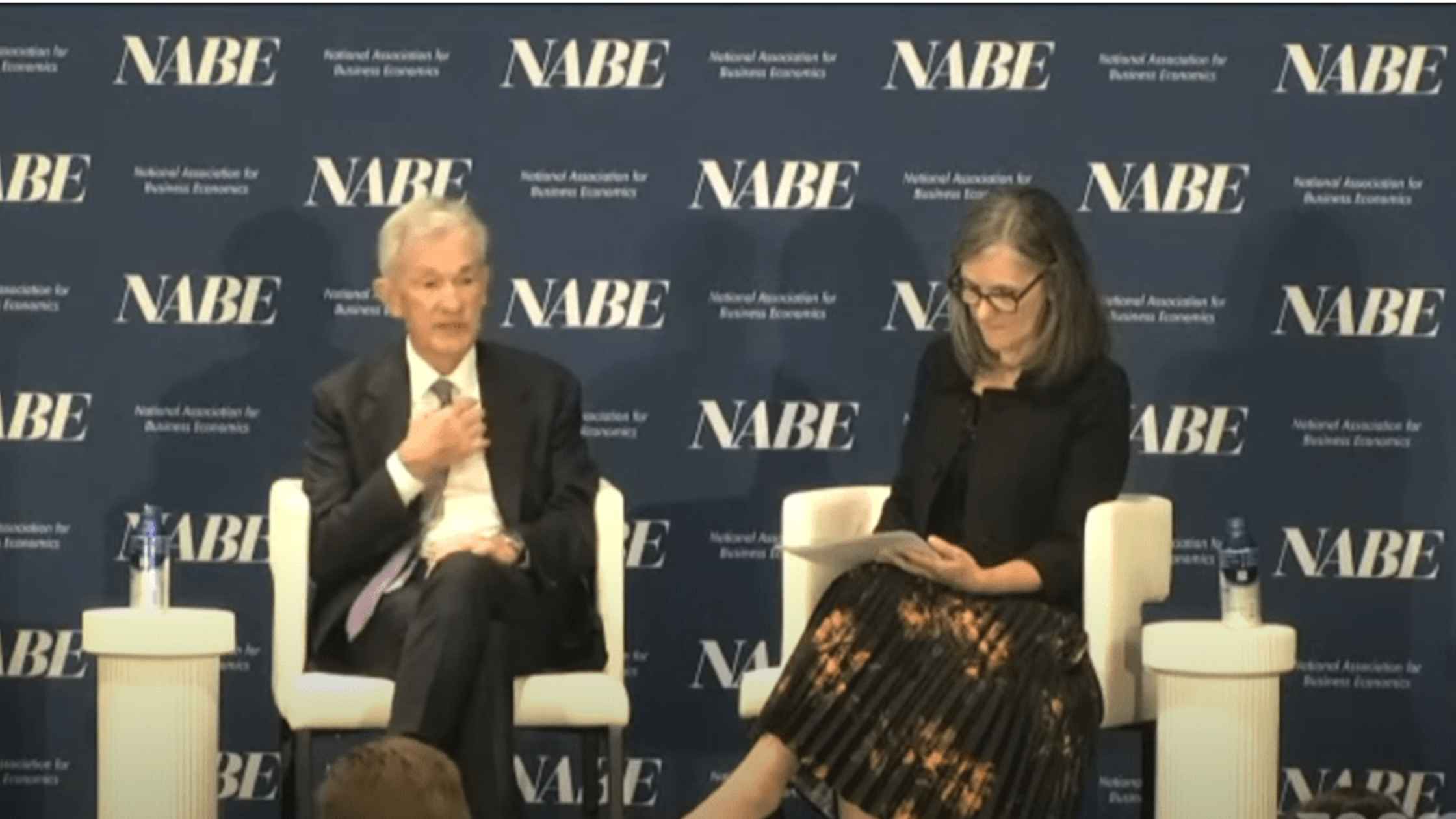
All right, now we'll move on to our awards presentation. So normally when we have such a well-known and respected speaker, I would say, "This person needs no introduction and you would rather hear them speak than hear me speak about them." But at this moment, and in the case of the presentation of the Adam Smith Award, I think it's more than appropriate that we take a moment to appreciate exactly who it is we're recognizing today. So Jerome Powell first took office as chair of the Board of Governors of the Federal Reserve System in February of 2018 for a four-year term, and he was reappointed to the office and sworn in for a second four-year term in May of 2022. He serves as chair of the Federal Open Market Committee, the system's principle monetary policymaking body. Mr. Powell has also served as a member of the Board of Governors since taking office on May 25th, 2012, to fill an unexpired term, and he was reappointed to the board in June of 2014 for a term ending in January of 2028.
(01:17)
Prior to his appointment to the board, Mr. Powell was a visiting scholar at the Bipartisan Policy Center in Washington D.C., where he focused on federal and state fiscal issues. From 1997 to 2005, he was a partner at the Carlyle Group. He served as an assistant secretary and as an undersecretary of the U.S. Department of the Treasury under President George H. W. Bush, with responsibility for policy on financial institutions, the Treasury debt market and related areas. And prior to joining the Bush administration, he worked as a lawyer and investment banker in New York City. In addition to service on corporate boards, Mr. Powell has served on charitable and educational institutional boards, including the Bendheim Center for Finance at Princeton University and the Nature Conservancy of Washington, D.C. and Maryland. And of course, among his many other professional engagements, he has been a strong and consistent supporter of the National Association for Business Economics, and we are very grateful for that engagement.
(02:22)
So because of that, we are very pleased to be presenting him today with the Adam Smith Award. The Adam Smith Award is NABE's highest honor, and it was named for the 18th century Scottish philosopher and economist whose ideas about economics led to the growth of modern capitalism. And this award has been given annually by NABE since 1982, and it is essentially, as one of my colleagues said to me, this is our hall of fame. Past recipients include several Fed presidents and prestigious economists across the spectrum, including Janet Yellen and Ben Bernanke, as well as Arthur Laffer, Susan Athey, and going a little bit further back, William Poole from the Federal Reserve Bank of St. Louis and Lawrence Klein, who won the award in 2004.
(03:18)
We are very pleased today to be awarding this honor to Jerome Powell. Jerome Powell's exemplary leadership as chair of the Federal Reserve, especially in navigating the complexities of monetary policy during challenging times, has had a profound and lasting impact on both the U.S. economy and the global financial system. Under his stewardship, the Federal Reserve has effectively managed unprecedented economic challenges, including the COVID-19 pandemic, by taking a thoughtful and data-driven approach to monetary policy setting. His decisive actions to support economic recovery, promote financial stability, and ensure a resilient financial system, have demonstrated an unwavering commitment to U.S. economic growth and well-being.
(04:12)
The strength of his leadership has also earned him the respect of policymakers, economists, and business leaders worldwide. His work, particularly in the areas of monetary policy, financial regulation, and economic resilience, absolutely align with the ideals of the Adam Smith Award. He has consistently applied foundational economic principles to address real-world challenges, upholding the Federal Reserve's high standards of sound economic management and transparent policymaking in the process. So with that, I am very pleased to welcome to the stage Chair Jerome Powell. Thank you.
Chair Jerome Powell (05:10):
Thank you. Here we go. Thank you very much. You got a camera somewhere?
Emily (05:16):
I thought we did, but maybe not.
Chair Jerome Powell (05:20):
There we go. We don't have a camera.
Emily (05:21):
[inaudible 00:05:21].
Chair Jerome Powell (05:31):
There we go. Thank you. Thank you so much.
Emily (05:32):
[inaudible 00:05:35].
Chair Jerome Powell (05:53):
Thank you, Emily. And thanks to the National Association for Business Economics for the Adam Smith Award. It for me is an unexpected honor just to be mentioned alongside many of your past recipients, including particularly my predecessors, Janet Yellen and Ben Bernanke. So thank you very much for this recognition. I will say on a more personal note, I have greatly enjoyed my regular visits to your annual meeting and your conferences. It's really been my favorite venue all these years. It's a place… This is a place where we can talk about economic issues and not worry that someone's eyes might glaze over. I also appreciate the warm welcome I've always received here and putting Fed staff aside for a minute, I can't think of a more lovable group of econ nerds anywhere. So thank you again for this prestigious award and for the opportunity to speak to you here today. So as we all know, monetary policy is more effective when the public understands what the Federal Reserve does and why. With that in mind, I hope to enhance understanding of one of the more arcane and technical aspects of monetary policy, the Federal Reserve's balance sheet. A colleague recently compared this topic to a trip to the dentist, but I found that comparison somewhat unfair to dentists. So today I'll discuss the essential role that our balance sheet played during the pandemic, along with some lessons learned. I'll then review our ample reserves implementation framework and the progress we've made toward normalizing the size of our balance sheet. And I'll conclude with some brief remarks on the economic outlook.
(07:55)
So one of the primary purposes of a central bank is to provide the monetary foundation for the financial system and the broader economy. This foundation is made of central bank liabilities. On the Fed's balance sheet, the liability side of the ledger totaled $6.5 trillion as of October 8, and three categories account for roughly 95% of the total. First, Federal Reserve notes, that is physical currency, totaled 2.4 trillion. Second, reserves, funds held by depository institutions at Federal Reserve Banks, totaled 3 trillion. These deposits allow commercial banks to make and receive payments and meet regulatory requirements. Reserves are the safest and most liquid asset in the financial system, and only the Fed can create them. The adequate provision of reserves is essential to the safety and soundness of our banking system, the resilience and efficiency of our payment system, and ultimately the stability of our economy. Third is the Treasury General Account, or TGA, currently at about $800 billion, which is essentially the checking account for the federal government. When the Treasury makes or receives payments, those flows affect, dollar for dollar, the supply of reserves or other liabilities in the system.
(09:11)
The asset side of our ledger consists almost entirely of securities, including $4.2 trillion of U.S. Treasury securities and 2.1 trillion of government guaranteed agency mortgage backed securities or MBS. When we add reserves to the system, we generally do so by purchasing Treasury securities in the open market and crediting the reserve accounts of the banks involved in the transaction with the seller. This process effectively transforms securities held by the public into reserves, but does not change the total amount of government liabilities held by the public.
(09:44)
So the Fed's balance sheet serves as a critical policy tool, especially when the policy rate is constrained by the effective lower bound or ELB. When COVID-19 struck in March 2020, the economy came to a near standstill and financial markets seized up, threatening to transform a public health crisis into a severe, prolonged economic downturn. In response, we established a number of emergency liquidity facilities. Those programs, supported at the time by Congress and the administration, provided critical support to markets and were remarkably effective in restoring confidence and stability. At their peak in July 2020, loans from these facilities totaled just over 200 conditions stabilized. At the same time, the market for U.S. Treasury securities, normally the deepest and most liquid market in the world and the bedrock of the global financial system, was under extraordinary pressure and on the verge of collapse. We used large-scale purchases of securities to restore functionality to the Treasury market.
(10:46)
Faced with unprecedented market dysfunction, the Fed purchased Treasury and agency securities at an extraordinary pace in March and April of 2020. These purchases supported the flow of credit to households and businesses and fostered more accommodative financial conditions to support the recovery of the economy when it ultimately came. This source of policy accommodation was particularly important as we had already lowered the federal funds rate, close to zero, and expected that it would remain there for some time. By June 2020, we slowed our purchase pace to a still substantial $120 billion per month. And in December of 2020, as the economic outlook remained highly uncertain, the FOMC said that we expected to maintain that pace of purchases until substantial further progress has been made toward the committee's maximum employment and price stability goals.
(11:38)
That guidance provided assurance that the Fed would not prematurely withdraw support while the economic recovery remained fragile amid unprecedented conditions, and we maintained that pace of asset purchases through October 2021. By then, it had become apparent that elevated inflation was not likely to go away without a strong monetary response. At our meeting in November 2021, we announced a phase out of our purchases, and at our next meeting in December, we doubled the pace of that taper and said that asset purchases would conclude by mid-March of 2022. Over the entire period of purchases, our securities holdings increased by $4.6 trillion.
(12:18)
So a number of observers have raised questions, fairly enough, about the size and composition of asset purchases during the pandemic recovery. Throughout 2020 and '21, the economy continued to face significant challenges as successive waves of COVID caused widespread disruption and loss. During that tumultuous period, we continued to purchase in order to avoid a sharp unwelcome tightening of financial conditions at a time when the economy still appeared to be highly vulnerable. Our thinking was, pardon me, was informed by recent episodes in which signals about reducing the balance sheet had triggered significant tightening in financial conditions. And we were thinking of the events of December 2018, as well as the 2013 taper tantrum.
(13:10)
Regarding the composition of our purchases, some have questioned the inclusion of agency MBS purchases given the strong housing market during the pandemic recovery. Outside of purchases aimed specifically at market functioning, MBS purchases are primarily intended, like our purchases of Treasury securities, to ease broader financial conditions when the policy rate is constrained by the effective lower bound. The extent to which these MBS purchases disproportionately affected housing market conditions during that period is challenging to determine. Many factors affect the mortgage market, and many factors beyond the mortgage market affect supply and demand in the broader housing market. With the clarity of hindsight, we could have, and perhaps should have, stopped asset purchases sooner. Our real-time decisions were intended to
Chair Jerome Powell (14:00):
… serve as insurance against downside risks. We knew that we could unwind purchases relatively quickly once we ended them, which is exactly what we did. Research and experience tell us that asset purchases affect the economy through expectations regarding the future size and duration of our balance sheet, so that when we announced our taper market participants began pricing in its effects, pulling forward the tightening and financial conditions. Stopping sooner could have made some difference, but not likely enough to fundamentally alter the trajectory of the economy. Nonetheless, our experience since 2020 does suggest that we can be more nimble in our use of the balance sheet and more confident that our communications will foster appropriate expectations among market participants given their growing experience with these tools.
(14:50)
Some have also argued that we could have better explained the purchases… Sorry, the purpose of asset purchases in real time. There's always room for improved communication, but I believe our statements were reasonably clear about our objectives, which were to support and then sustain smooth market functioning and to help foster accommodative financial conditions. Over time, the relative importance of those objectives evolve with the economic conditions, but the objectives were never in conflict. So at the time this issue appeared to be a distinction without much of a difference. That's not always the case, of course. For example, the March 2023 banking stress led to a sizable increase in our balance sheet through lending operations. We clearly differentiated these financial stability operations from our monetary policy stance. Indeed, we continue to raise the policy rate through that time.
(15:41)
Turning to my second topic. Pardon me. Our ample reserve regime has proven highly effective, delivering good control of our policy rate across a wide range of challenging economic conditions while promoting financial stability and supporting a resilient payment system. In this framework, an ample supply of reserves ensures adequate liquidity in the banking system and control of our policy rate is achieved through the setting of our administered rates, interest on reserve balances, and the overnight repurchase rate. Reverse repo rate, rather. This approach allows us to maintain rate control independently of the size of our balance sheet. And that's important given large unpredictable swings and liquidity demand from the private sector and significant fluctuations in the autonomous factors affecting reserve supply such as the TGA. This framework has proved resilient whether the balance sheet is shrinking or growing. Since June 2022, we've reduced the size of our balance sheet by $2.2 trillion from 35% to just under 22% of GDP while maintaining effective interest rate control.
(16:51)
Our long stated plan is to stop balance sheet runoff when reserves are somewhat above the level we judge consistent with ample reserves conditions. We may approach that point in coming months and we are closely monitoring a wide range of indicators to inform this decision. Some signs have begun to emerge that liquidity conditions are gradually tightening, including a general firming of repo rates, along with more noticeable but temporary pressures on selected dates. The committee's plans lay out a deliberately cautious approach to avoid the kind of money market strains experienced in September 2019. Moreover, the tools of our implementation framework, including the standing repo facility and a discount window, will help contain funding pressures and keep the federal funds rate within our target range through this transition to lower reserve levels. Normalizing the size of our balance sheet does not mean going back to the balance sheet we had before the pandemic.
(17:47)
In the longer run, the size of our balance sheet is determined by the public's demand for our liabilities rather than by our pandemic related asset purchases. Non-reserved liabilities currently stand about $1. 1 trillion higher than just prior to the pandemic, thus requiring that our securities holdings be equally higher. Demand for reserves has risen as well, in part reflecting the growth of the banking system and the overall economy. Regarding the composition of our securities' portfolio relative to the outstanding universe of treasury securities, our portfolio is currently overweight longer term securities and underweight shorter term securities. The longer run composition will be a topic of committee discussion. Transition to our desired composition will occur gradually and predictably, giving market participants time to adjust and minimizing the risk of market disruption. Insistent with our long-standing guidance, we aim for a portfolio consisting primarily of treasury securities over the longer run.
(18:52)
Some have questioned whether the interest we pay on reserves is costly to taxpayers. In fact, that is not the case. The Fed earns interest income from treasury securities that back reserves. Most of the time, our interest earnings from Treasury holdings more than cover the interest paid on reserves, generating significant remittances to the treasury. By law, we remit all profits to the treasury after covering expenses and since 2008, even after accounting for the recent period of negative net income, our total remittances to treasury have totaled more than $900 billion. While our net interest income has temporarily been negative due to the rapid rise in policy rates to control inflation, this is highly unusual. Our net income will soon turn positive again, as it typically has been throughout our history. Of course, having negative net income has a no bearing at all on our ability to conduct monetary policy or meet our financial obligations.
(19:49)
If our ability to pay interest on reserves and other liabilities were eliminated, the Fed would lose control over rates. The stance of monetary policy would no longer be appropriately calibrated to economic conditions and would push the economy away from our employment and price stability goals. To restore rate control, large sales of securities over a short period of time would be needed to shrink our balance sheet. In the quantity of reserves in the system, the volume and speed of these sales could strain Treasury, market functioning and compromise financial stability. Market participants would need to absorb the sales of Treasury securities and agency MBS, which would put upward pressure on the entire yield curve, raising borrowing costs for the Treasury and private sector. Even after that volatile and disruptive process, the banking system would be less resilient and more vulnerable to liquidity shocks. The bottom line is that our ample reserves regime has proven remarkably effective for implementing monetary policy and supporting economic and financial stability.
(20:52)
So I will close with a brief discussion of the economy and the outlook for monetary policy. Although some important government data have been delayed due to the shutdown, we routinely review a wide variety of public and private sector data that have remained available. We also maintain a nationwide network of contacts through the reserve banks who provide valuable insights which will be summarized in tomorrow's Beige Book. Based on the data we do have, it's fair to say that the outlook for employment and inflation does not appear to have changed much since our September meeting four weeks ago. Data available prior to the shutdown however show that growth in economic activity maybe on a somewhat firmer trajectory than expected.
(21:39)
While the unemployment rate remained low through August, payroll gains have slowed sharply, likely in part due to a decline in labor force growth due to lower immigration and lower labor force participation. In this less dynamic and somewhat softer labor market, the downside risks to employment appear to have risen. While official employment data for September are delayed, available evidence suggests that both layoffs and hiring remain low and that both households perceptions of job availability and firm's perceptions of hiring difficulty continue their downward trajectories. Meanwhile, 12-month core PCE inflation was 2.9% in August, up slightly from earlier this year as rising core goods inflation has outpaced continued disinflation in housing services. Available data and surveys continue to show that goods price increases primarily reflect tariffs rather than broader inflationary pressures. Consistent with these effects, near-term inflation expectations have generally increased this year, while most longer-term expectation measures remain aligned with our 2% goal. Rising downside risks to employment have shifted our assessment of the balance of risks.
(22:51)
As a result, we judged it appropriate to take another step toward a more neutral policy stance at our September meeting. There is no risk-free path for policy as we navigate the tension between our employment and inflation goals. This challenge was evident in the dispersion of committee participants projections at the September meeting. And I'll stress again that these projections should be understood as representing a range of potential outcomes whose probabilities evolve as new information informs our meeting-by-meeting approach to policymaking. We'll set policy based on the evolution of the economic outlook and the balance of risks rather than following a predetermined path. And with that, thank you again for this wonderful award and for inviting me here today. I look forward to our discussion. Thank you.
Emily (23:45):
Do you need [inaudible 00:23:46]?
Chair Jerome Powell (23:47):
No, [inaudible 00:23:47].
Emily (23:58):
Thank you, Chair Powell for the excellent remarks in the Adam Smith address and we will have about half an hour for questions.
Chair Jerome Powell (24:08):
Sounds like a long time.
Emily (24:09):
Should have talked longer than. So let me start with… Before I go to some of the questions coming in from the audience and do use the connect app to generate those. You have said, and you repeated again here that there are no risk-free paths for the Fed now. So in light of that, and in particular with where the recent inflation data are running, let me group this with some of the questions that we're seeing coming in on the app as well. Obviously always data dependent, but thinking about the dual mandate of maximum employment and price stability, how concerned are you that if the rate of pass-through of tariffs is slower, that that might begin to look like more persistent inflation as opposed to a one-time as if the tariff adjustment came through all at once and then it would be quite clearly a one-time price level shift?
Chair Jerome Powell (25:11):
So that's certainly a risk. As I mentioned, there really isn't a risk-free path now since it appears that inflation certainly is running above our target and appears to be continuing to increase quite gradually, but increase, it's still on the way up. So there's a risk there that would lend to greater persistence. But now the labor market has demonstrated pretty significant downside risks as payroll jobs have declined in… Both the supply and demand for labor has declined quite sharply. So those two states of affairs for our two variables or two goal variables call for different monetary policy responses.
(25:57)
So yeah, as they come more into balance, I think the idea has been that policy should move from being tight to some degree, to being more neutral as those two things balance out. But it is clear though that if we move too quickly, then we may leave the inflation job unfinished and have to come back later and finish it. And if we move too slowly, there may be unnecessary losses, painful losses in the employment market. So we're in the difficult situation of balancing those two things. I think for the last few months, we've been able to maintain a restrictive stance because the labor market was still pretty solid. I think that the data we got right after the July meeting showed that… Which adjusted back all the way through May, showed that the labor market has actually softened pretty considerably and puts us in a situation where the two risks are closer to being in balance.
Emily (26:49):
Let's move to the other risk then and talk about employment a little bit. We had Anna Paulson here yesterday and she spoke about the breakeven on employment… Breakeven employment growth rate. And that's a question from the audience as well. So I believe she said that it's certainly lower than it was, and the standard error around those estimates probably include some numbers that might even be negative. Where do you see the monthly breakeven employment growth rate at this point?
Chair Jerome Powell (27:19):
I'm not going to try to give you a pinpoint number, but as you pointed out, the standard error around these things is 50,000 plus or minus, something like that. And that would certainly… I think the range of plausible numbers for the breakeven rate is probably… It does go below zero accounting for those standard errors. It's clearly come down a great deal. What's so challenging about this is that both supply and demand in the labor market have come down so sharply, so quickly. And the fact that the unemployment rate has barely moved is kind of remarkable in and of itself and suggests that they're moving at roughly
Chair Jerome Powell (28:00):
Hopefully the same pace, although of course the unemployment rate has ticked up, which suggests that demand is moving a little faster than supply. I wouldn't want to point to a specific number other than to say that it's come way down. And there are many, many estimates out there, by the way, there are many ways to calculate it. So you're going to get different estimates.
Emily (28:21):
We're certainly in a volatile and changing environment. So one question I have is whether you see any changes in the transmission mechanism of monetary policy actions. So when we speak of long and variable lags as we do, are those changing? And in particular, do you think there might be any difference in the impacts of policy on inflation versus employment? Is one changing more than the other.
Chair Jerome Powell (28:47):
That's like two or three questions, so I might have to come back to you. So on transmission, in theory at least I see two things. One is what we say and the actions that we take on monetary policy and how quickly that gets into financial markets. So if you go back to when I was in college, that part would've taken weeks, months, probably. Now, that part happens essentially instantaneously, but the rest of it, once it's in the financial markets, how quickly does it affect economic activity, unemployment, employment, inflation, et cetera. I think that's more dependent on the conditions in the economy. For example, if you take the group of people who had extremely low rate mortgages, if you can cut rates, but they're a long way down and they're sort of in a place where it's going to be expensive, to move and to take out a much higher rate mortgage, even assuming significant numbers of cuts.
(29:53)
So that has probably blunted the transmission of lower rates into that part of the economy. But overall, I think it still works the way we think it works, which is long and variable lags means a lot of uncertainty about how it's being affected. I think the last part of your question, the law has been that inflation and employment come later. The first decisions are purchasing decisions, hiring decisions, purchasing decisions can be affected probably more quickly, but then those would eventually affect employment and inflation. So the research generally shows longer and longer lags for employment and inflation.
Emily (30:39):
I guess the variable part of that comment does give us a bit of cover.
Chair Jerome Powell (30:43):
A lot of uncertainty.
Emily (30:46):
So you spoke about the adjustments or the challenges that you're facing with some government data not currently being published, beyond the headline unemployment rate, which we're not going to see right away. What other labor market indicators are you monitoring most closely to gauge that side of the mandate?
Chair Jerome Powell (31:08):
So I think everyone's looking at the same non-government data. So there's a set of non-government data around or non-federal government data around labor markets. For example, state level unemployment claim reports. You can add those up and get a pretty decent estimate and that's a really good one. There's also, ADP has its data and employment. So in the employment space there's some plausible data. I will say generally the private data, the alternative data that we look at is better used as a supplement for the underlying governmental data, which is the gold standard, and it won't be as effective as the main course as it would've been as a supplement. So we don't expect that we'd be able to replace the data we're not getting. So I think in job, employment space, there's some pretty good substitutes, less so in inflation space and in economic activity space.
(32:10)
And also there are different private data providers use different universes and different levels of rigor in their data analysis. So we're looking at lots of things and we're going to make our decisions according to the FOMC schedule, but I think it will be a lot better once we start getting, for example, the September employment report is going to be a very important report and we were not on track to have that. There would still be time for us to get that. We will get, of course, the September inflation, the CPI and PPI reports. So that's a positive, but we don't comment on fiscal matters. But from our standpoint, we'll start to miss that data and particularly the October data, if this goes on for a while, they won't be collecting it and it could become more challenging.
Emily (33:05):
You used the term gold standard, and you didn't mean it in this context, but I'm going to pivot here because there's a question from the audience that's getting a lot of up votes. So one of your predecessors, Alan Greenspan, used to view the price of gold as an indicator of inflation risk. So in that context, how do you view the rally that we've seen in gold? And if you want to throw in Bitcoin, you can comment on that too.
Chair Jerome Powell (33:29):
I am not going to comment on any particular asset price including that one. And I think we think of inflation as driven by fundamental supply and demand factors, and it's not something we look at actively.
Emily (33:52):
Okay, fair. The September projections, we saw revised GDP growth projections revised upward for both 2025 and 2026. Now, sometimes it's just an issue to issue thing, but how do you reconcile that projection of stronger growth is what we're seeing in terms of a likely weakening labor market.
Chair Jerome Powell (34:13):
So even subsequent to the September, SEP, we've seen economic activity data, which are surprising to the upside. And as I mentioned in my remarks, so you do have a bit of a tension there between the labor market data that we see very low levels of job creation and yet people are spending, so economic activity is strong and we're going to have to see how that plays out. Right now, of course, we're not getting any new government data on that, any new federal government data on that, but it does create, of course, if the economy, if economic activity were stronger, then that would tend to support labor market activities in hiring. And so we'll have to see how that works out.
Emily (35:00):
Great. Another topic that has permeated the conference over the last two days has been AI. So as the Federal Reserve, like all of us grapple with the implications of generative AI, what plans are in place to assess its long-term impact on productivity, implications for labor markets and overall economic stability? And does that present any new risks to monetary policy or financial stability?
Chair Jerome Powell (35:26):
So you're right, we are doing what other people are doing, which is reading all the things that, I mean, so many researchers are working on AI now. It's just amazing. And so we follow all of that. We also have people at the Fed who are doing lots and lots of research on AI and in terms of, it's just such early days to be looking for the kind of things that will happen. So question of productivity, was it Robert Solow who said that technology's showing up everywhere, but in the productivity data. So this could be the same kind of thing where it's there, but it takes a long time to show itself because you would think of another big technological advance is potentially raising productivity. But I think it's early to say that we're seeing it. Also, you're seeing, I think some researchers have found effects on hiring from AI for entry-level people and for coders and things like that.
(36:24)
So there's probably some of that out there, but it's just so early to say what it will be. We also monitor very carefully what public companies are saying, increasingly bold statements from mainly large private companies on things that they think they can do across their whole business area with AI and either sort of freeze hiring where it is or reduce hiring. And I think we're pretty aware of what the potential outcomes are, but the range of potential outcomes is very broad. I will say in terms of what the Fed can do, we deal with supply and demand, we have an interest rate and we also do regulation, that kind of thing. But if what's needed is greater education and skills, I mean I've always liked the model that technology can work for everybody as long as everybody's getting the skills and aptitudes they need to use that technology.
(37:26)
This is Goldin and Katz, their work, which they actually spoke about it Jackson Hole this year, but it's a 20-year-old book that they wrote. So we can't do that. That's not something the Fed can do. We can't address the potential societal disruptions that could happen potentially if there's really significant job loss. So there are a lot of, I mean we're the least of it. There are potentially really significant implications for people in the labor force and I think we are all speculating about what those might be. But it's only the beginning of this story.
Emily (38:05):
I'm looking at some of the other questions that are getting uploaded and you can get as far into the weeds as you want, but this is where people want to go. So let me try this one. As you think of the appropriate level of reserves in the system, what indicators are most important? Is it the price of money? So repo levels or the volume of borrowings from the Fed, like the discount window and so on?
Chair Jerome Powell (38:31):
So we have a nice spider chart and a five main indicators, one of which is sort of repo levels. And I think overall what they're showing is that we're still at ample reserves, sorry, abundant reserves. We're still at abundant reserves, meaning above our goal of ample reserves, a little bit above ample reserves. But you're starting to see a little bit of tightening and money market conditions, particularly repo rates have moved up and those are the things we're going to be watching. So we think we're still at abundant and the pace of runoff is now very, very slow. So we're going to be watching all those factors very carefully. We're not so far away now, but there's a ways to go.
Emily (39:22):
I think we're not going to get away without addressing this one. So I'll try to, again, group some of these together. First, there's definitely appreciation from the audience in your ability to try to remain above the political fray. And I think also as in your remarks, you said gradually and predictably, and that sounds really nice, right about now. But with those that ongoing scrutiny of the policy decisions of the Fed, what measures is the Federal Reserve taking and are you taking to ensure and demonstrate the continued independence in setting monetary policy?
Chair Jerome Powell (40:01):
So the main thing we can continue to do is to do our work the way we've always done it, which is think really carefully about evolving economic conditions and the evolving outlook and the balance of risks and try to make good decisions to best serve the American public. And then explain those decisions and talk about them in a way that makes sense and is grounded in the data and our overall approach. I think we're going to keep doing that and as long as we're doing that, people will be able to tell, if we start doing something else, I think people will be able to tell that too, but that's just not something we're ever going to do. We're always going to keep doing our work. We don't engage in back and forth with people. It's just not, that gets to be political sort of right away.
(40:51)
So we just do our work and do it as best we can. I mean, overall I would say the Fed comes through the last, if you think about it, go back to the beginning of the global financial crisis. We've had two world historical crises back to back essentially, and the U.S. economy, it is been quite a ride for the U.S. economy and for American citizens. But we've come through it as well or better than any other country in the world. And we had to innovate and did innovate. There was really no choice.
(41:23)
We can look back now and as I did today and second guess ourselves, which is only appropriate that we've been doing it for 10 years since, I got to the Fed 12 years ago, we were already doing a lot of that. So that's an ongoing process. But I think if you take a step back, the Fed isn't a government agency that does a good job for the public that it serves. And that is our only goal and I think we do it pretty well. Don't look for perfection. These are close calls that have to be made in real-time. But I guess that's what I would say.
Emily (41:59):
It's fantastic.
Emily (42:00):
And in that context then, internally, to the FOMC, how important is it that you have consensus on it? I mean, we're economists, we understand the value of spirited debate, but is that important in terms of communicating the results and the decisions of the committee?
Chair Jerome Powell (42:15):
I mean, consensus is great, but I mean, the most important thing of all is to get it right. You come to places, not very commonly, but sometimes you come to places where people have different views, and this is one of them. You have a situation here where literally inflation's above target and gently rising, the labor market is subject to pretty clear downside risks. What do you do? How do you think about that? That's not a problem that you face very often in central banking or in the economy. People are going to have different weights and different risk aversion and different risk appetites on those things. It would be kind of surprising if you had no debate over those things. So we have a healthy debate going. I think it's very healthy.
(43:02)
I think the meetings that we've been having are as good as any we've had in terms of people sincerely giving their absolute best argument for their positions. But they're different positions. I mean, when I was an investor, I always felt like the most dangerous thing is if everybody agreed on something, because you need someone to come in and try to explain why this is a terrible idea. Hopefully somebody really smart. And that would give you the ability to really test your thinking. So I think that's a healthy discussion that we're having right now. And I'm not at all surprised that we have people across the board. I do think we also as an institution do try to come together around a central answer. And that's, of course, part of what I try to do, is find an answer that will attract as much support as possible.
Emily (43:56):
Absolutely. I know you probably won't want to comment in great detail on global conditions, but there are a few questions around that and what that implies for U.S. monetary policy, and also just looking at the interest rate differentials between the U.S. and other advanced economies, and how long that could persist. And is there a risk there?
Chair Jerome Powell (44:20):
Sorry, what?
Emily (44:21):
The interest rate differentials between the U.S. and other advanced economies.
Chair Jerome Powell (44:26):
Yeah. I mean, we said interest rates according to the place where our economy is domestically, taking into account the international aspects of our economy. So again, it's not surprising. I mean, you could name many, many factors, but for example, tariffs are clearly more disinflationary for countries that are subjected to them. They're more, I won't say heavily inflationary, but there's some inflationary pass-through to consumers from countries that are putting tariffs on. So this is a very different monetary policy response potentially just in that. So I think we need to set… As every other central bank does, they're setting rates in whatever their room it is, geographically, and they're going to be different answers. It's not unusual.
Emily (45:22):
We have a large number of young economists in the audience today. Could you talk a little bit about… As we look back… It's a momentous award, it's a nice time to reflect. If you looked back on your early career and your early goals, how do you think that young Jerome Powell would view where Jerome Powell is, sitting today as chair of the Federal Reserve?
Chair Jerome Powell (45:48):
Surprised. No, what I would tell young economists is, you've chosen a great profession, a tremendous profession. Basically, you're getting the tools to analyze public policy, and what works and what doesn't work, and what should be expected to work, and why. Also, what's the state of the economy? And guess what, it's not just hard, it's basically impossible. It's a very, very difficult thing, but it yields itself up over time. It's just an incredibly important subject that carries the capability to do really good things for the general public who may not feel great gratitude toward economists, but sometimes. But no, it's really important. You've made a great choice, and I would say, wish you the best of luck.
Emily (46:43):
Thank you. Agree. Okay, we'll do a little bit of a lightning round here. We have about five minutes left, so I'll ask a bunch of questions that you may not want to get into great detail anyway. Some of these are pretty straightforward. So we talked quite a bit about labor markets, but we have not specifically asked the question about the effect of immigration policies on labor supply. How restrictive do you think that current policy is? And is that something that, we'll just-
Chair Jerome Powell (47:18):
Current immigration policy?
Emily (47:19):
Yeah.
Chair Jerome Powell (47:20):
Yeah, let me start by saying that we don't have a view on immigration. It's not our job to have a view. So we take that as completely… It is what it is. We take it as it arrives. More, I'd say, a stronger policy than most people had expected. We've seen a very sharp decline in growth of the labor force and people entering the country. I think you're only beginning to see the strength of that policy too. There's more expulsions, those are rising, and that kind of thing.
(48:00)
So yeah, that's a big economic factor. So that will mean fewer people to work. You have anecdotal evidence of industries that are just having a hard time finding people. You don't see it in wages or anything like that at this point. You don't see, at least, in the aggregate, you don't. But yeah, it's going to be a really important economic factor. Because that's new people who come into the workforce, they create their supply, but they also create demand. They create their own demand. Again, from our standpoint, our job is to achieve maximum employment or maximum sustainable employment. And that will depend both on the supply of workers and the demand for workers.
Emily (48:52):
Mm-hmm. Back to the balance sheet, some questions, again, I'll kind of try to group these together, around mortgage-backed securities and housing affordability. Again, not directly part of the dual mandate, but would the Fed ever look at any specific actions with regard to NBS to address mortgage rates or affordability for housing?
Chair Jerome Powell (49:16):
The answer is, look, we look at overall inflation, and we don't target housing prices. Also, I don't know how you would. We would certainly not engage in mortgage-backed security purchases as a way of addressing mortgage rates or housing directly. That's not what we do. We do have, as I mentioned, a very large amount of mortgage-backed securities, and they're running off, but they run off pretty slowly.
Emily (49:47):
Mm-hmm. Fair. Question on the beverage curve.
Chair Jerome Powell (49:51):
Ah.
Emily (49:53):
Maybe that's not a lightning round question, but let's try it. So do you think that the shift in the beverage curve is a structural shift or just a blip?
Chair Jerome Powell (50:03):
I think you're at a place where further declines in job openings might very well start to show up in unemployment. You've had this amazing time where you came straight down, but I just think you're going to reach a point at which unemployment starts to go up. We may be hitting that now, but it's been remarkable how that line had just comes down, down, down, down, down, down, down, which has been really a great part of the recovery.
Emily (50:39):
All right. Well, we have just a couple minutes left. I think we'll end with another philosophical question. Michael Barr spoke to the policy conference in 2024, I believe it was, and he gave some advice to economists. What would your advice be to the economists in the room in terms of how we can best serve the challenges that are facing us collectively in this moment?
Chair Jerome Powell (51:10):
I'm inclined to say, keep your heads up. It's a time when people are challenging expertise. I think it's a distinguished profession. It's a very high-order profession, and you should be proud of your work, and keep at it. I mean, ultimately, we're learning about how the economy works and how society works. Our understanding is so basic and so uncertain really still after all these years. But you got to think we're making some progress and doing some good and imposing sort of an analytical framework around the kind of decisions people make about the economy. So I just want to give you a vote of support and say keep at it.
Emily (51:50):
And likewise, NABE supports you.
Chair Jerome Powell (51:51):
Are we done?
Emily (51:52):
We're done. Thank you so much.
Chair Jerome Powell (52:08):
Thank you. Thank you. Thank you very much.