
Bennie Thompson (00:09):
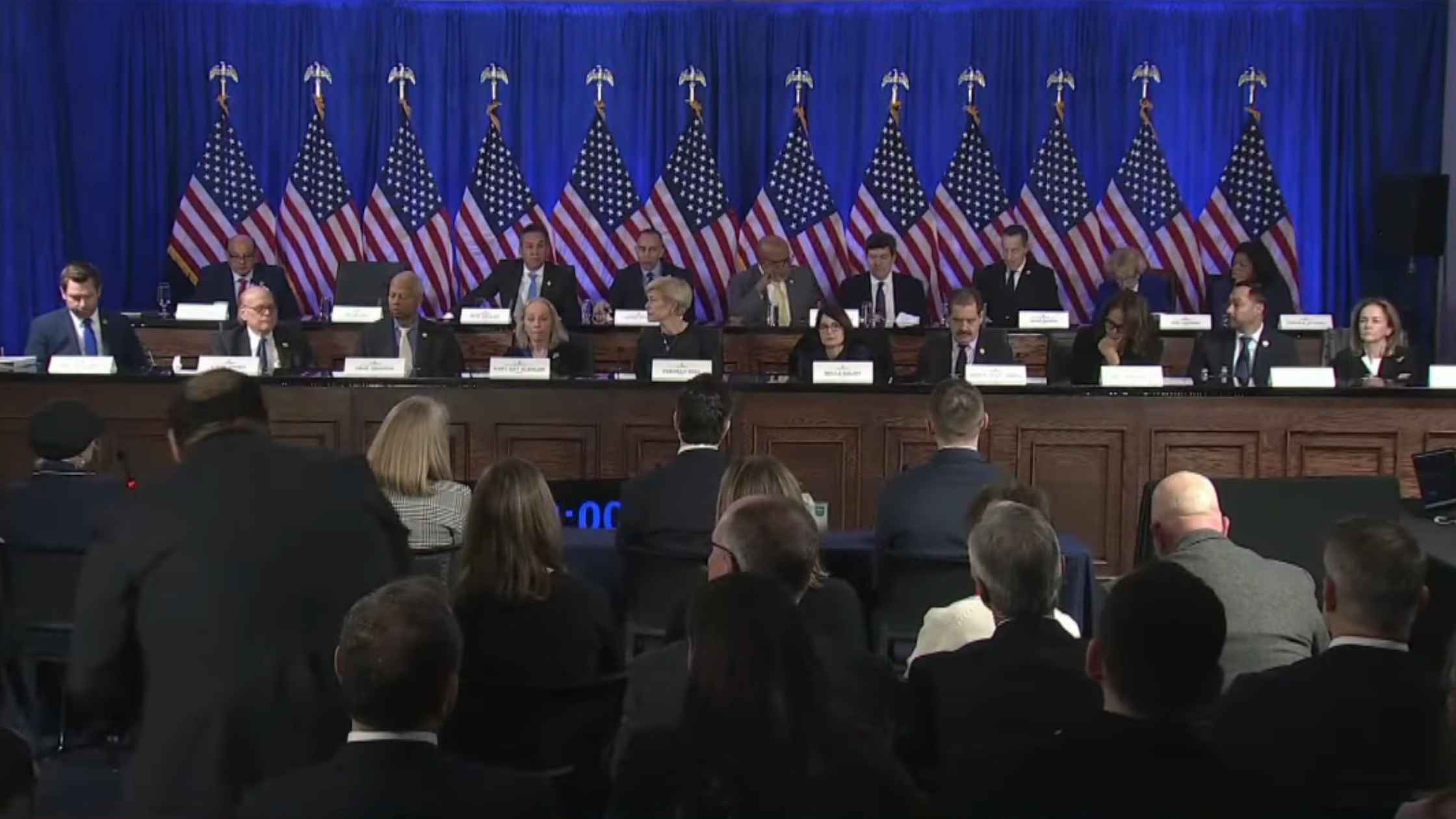
We'd like to call our hearing to order. In the beginning, we'd like to pay tribute to a colleague that we've learned who's passed, Congressman Doug LaMalfa Norfa and we're sorry for his passing and I'm sure that leader will have some comments in his opening statement. We will now hear from Leader Jeffries to open this hearing.
Hakeem Jeffries (00:54):
Thank the distinguished chairman for his leadership and for convening us this morning on this very solemn, important occasion. Before we begin, in light of the passing of Congressman Doug LaMalfa, great member of Congress from the great state of California, we'd just like to ask for a moment of silence. Thank you. Thank you all for your presence here today on this solemn anniversary. Five years ago today, a violent mob incited by Donald Trump attacked the Capitol as part of a concerted effort to overturn the results of the 2020 presidential election and halt the peaceful transfer of power for the first time in American history. This bloodthirsty, treacherous mob brutally assaulted police officers and seriously injured more than 140 brave men and women of law enforcement. Many have suffered lasting physical and psychological damage. Several tragically lost their lives. Because of the extraordinary bravery of the U.S. Capitol Police, other law enforcement officials, and the resolve of the Congress to return that night, this unprecedented attack on our country and on our democracy failed.
(02:52)
Over the last five years, instead of holding those responsible for the attack accountable, Donald Trump and far right extremists in Congress have repeatedly attempted to rewrite history and whitewash the horrific events of January 6th. We will not let that happen.
(03:20)
On the first day in office of his second term, instead of fulfilling his promise to lower the high cost of living on day one, Donald Trump pardon hundreds of violent felons who brutally beat police officers while storming the United States Capitol. The criminals and thugs that Donald Trump pardon have flooded communities across the country, unleashing violence and mayhem. The crimes committed by those rioters before and after the violent insurrection include child sexual assault, production of child pornography, possession of child pornography, rape, conspiracy to murder FBI agents, kidnapping, sexual assault, aggravated robbery, reckless homicide, driving under the influence causing death, illegal possession of firearms, domestic violence by strangulation, burglary, vandalism, grand theft, stalking, violation of protection orders, threatening public officials, and drug trafficking. It's been a Trump-inspired crime spree. Why won't Republicans in Congress condemn this dangerous behavior, an ongoing threat to public safety? They refuse to serve as a check and balance on an increasingly out of control executive branch, preferring to be nothing more than a reckless rubber stamp for Donald Trump's extreme agenda. The January 6th violent attack on the Capitol that took place five years ago today was shameful then, it is shameful now, and it will be shameful always and forever. We must continue to learn from what happened on January 6th in order to make sure that it never happens again. We must protect our free and fair elections. We must protect the peaceful transfer of power. We must protect the preeminence of the rule of law, and we must protect the eternal commitment to a Democratic America, which remains the last best hope on Earth.
(06:20)
It is now my honor to yield to the distinguished gentlemen from the great state of Mississippi, the once and future chair of the Homeland Security Committee and the chairman emeritus of the January 6th Select Committee, Congressman Bennie Thompson.
Bennie Thompson (06:40):
Thank you so much, Leader Jeffries. And before I start with my opening comments, let me note, as we've already indicated, the passing of our colleague, Congressman Doug LaMalfa. Our thoughts are with his family and staff at this sad time.
(07:02)
Good morning and welcome to all who've joined us. I want to extend an especially warm welcome and thanks to the brave members of law enforcement who are joining us today. They protected us, they protected the Capitol, and they protected the Democratic process. We can be here today because they were here then. Thank you.
(07:28)
I'm also honored to rejoin my colleagues on the January 6th Select Committee, both on this panel and among our witnesses. Five years ago today, an armed mob of thousands incited by President Donald Trump attacked, breached, and laid siege to the United States Capitol. They did so as Congress was carrying out one of its most fundamental constitutional duties, counting electoral votes, certifying a presidential election and facilitating the peaceful transfer of power.
(08:06)
What unfolded that day was both brutal and calculated. Officers were stabbed with metal fence stakes and bludgeoned with flagpoles. They were crushed in doorways until their ribs were broken. Eyes were gouged. At least one officer was dragged into the mob, beaten, tased, and left for dead. Others suffered lasting damage from concussions and traumatic brain injuries. In the days and weeks that followed, five police officers died due to the physical or psychological trauma they endured protecting Congress and the Constitution.
(08:54)
The years may have muffled the screams we heard and the horrible images of that day may have faded. So as we mark this grim anniversary, it's important that we remember exactly what happened. January 6th was not a regular tourist visit. It was not a day of love. It was a bloody riot that pushed our democracy to the breaking point. To bring us back to that day, we're going to play a short video reminding us that for a little over three hours five years ago, this sacred temple of our democracy, where we are sitting today, was transformed into a war zone. I warn those watching that this video contained violence and strong language.
Video (09:46):
DC is a mother fucking war zone.
(09:46)
C.D.U 12 up to help maintain the lines.
(09:46)
Let's get their guns.
(09:46)
Let's get their guns.
(09:46)
Nancy! Nancy! Nancy!
(09:46)
Hang Mike Pence!
(09:46)
Hand Mike Pence!
(09:46)
We cannot hold this without more munitions or more manpower.
(09:46)
Cruiser 50, we've lost the line. We've lost the line. All M.P.D pull back.
(09:46)
10-33. I repeat, 10-33, west front of the Capitol. We have been flanked and we've lost the line.
(09:46)
I was invited here by the president.
Bennie Thompson (11:19):
Some people want to rewrite the history of January 6th to ignore what we saw with our own eyes. Some people want us to forget the lessons of that day, to pretend that we have overcome the threats facing our democracy and the rule of law. We will not allow that to happen. We gather to continue to uphold our oath to support and defend the Constitution against all enemies, foreign and domestic. To defend against the lawlessness of that day and the lawlessness we continue to see today. We gather because in the words of Martin Luther King Jr., "Human progress is neither automatic or inevitable. Every step toward the goal of justice requires sacrifice, suffering, and struggle, the tireless exertion and passionate concern of dedicated individuals."
(12:23)
Five years ago, police told us to move the lapel pins that identified us as members of Congress, so we would be less likely to be attacked by the mob that was desecrating our Capitol. I did not take my pin off then, and I'm still wearing it today because the work we do mattered then and continues to matter today. The rule of law and our oaths continue to matter, especially as we see Donald Trump pardon those who were charged or convicted in the January 6th attack, engaged the military abroad while passing Congress, tears down the White House, shut the whole government agencies, order mass goons to round up and deport U.S. citizens and unlawfully put his name on a memorial to a better man.
(13:25)
The bipartisan January 6th Select Committee, which I was privileged to lead, was charged with uncovering the facts, circumstances, and causes of what happened on that awful day, and to ensure it never happens again. It was one part of ensuring our constitutional republic could withstand President Trump's repeated attacks, and it offers lessons for today. One such lesson was seeing how important it was for officials, most of them Republicans, to put their country over their party. They remembered their oath was to the Constitution and not to one man. And we need to remember that lesson today because five years on, the danger has not dissipated. President Trump still refuses to acknowledge that he lost the 2020 election.
(14:24)
Many who promoted or litigated his big lie have been rewarded with powerful positions. Dozen of nonpartisan career prosecutors and FBI agents who worked on January 6th cases have been summarily fired. State election officials who stood up to the Trump pressure campaign have been faced with threats and retaliation. The Department of Justice has become an instrument for retribution. The message is clear. Uphold the rule of law and you will be punished. Only loyalty to one man will be rewarded. Violence and service of Trump is above the law.
(15:10)
Remembering January 6th is not an exercise in partisanship, it's an obligation to those who have sacrificed for this country and all those who will in the future. Democracy depends on the courage of those who will defend it and on our willingness to hold accountable those who wish to destroy it. Today's forum is another step toward the goal of justice, another way of honoring our oath, another way of showing that our constitutional republic is bigger and stronger than its enemies or one man.
(15:49)
This morning, we'll hear from some of those courageous defenders of American democracy. I look forward to their testimony and to the hard work of preserving the truth, upholding the rule of law, and giving us a roadmap to ensure what happened five years ago never happens again.
(16:10)
Now, I'm happy to recognize my former Select Committee colleague and the ranking member of the Judiciary Committee, the gentleman from Maryland, Jamie Raskin.
Jamie Raskin (16:21):
Well, thank you kindly, Chairman Thompson. Welcome to all of our witnesses. Welcome to all of the members who joined us. William Faulkner once said, "The past isn't dead. It isn't even past." But Speaker Johnson would love to kill the past, indeed the very recent past. Republicans today are observing the solemn anniversary by doing exactly nothing. They've even refused to hang up the plaque, which a bipartisan congressional majority voted to put up to honor the officers who defended the Capitol and the peaceful transfer of power and the vice president on J6.
(17:01)
So it's been five years since January 6th, it's been three years since that plaque was supposed to be put up, but they still haven't put it up. It took them 24 hours to put up a new plaque, allegedly changing the name of the Kennedy Center to the Trump-Kennedy Center, 24 hours. And that was illegal. That's like graffiti that was put up on the Kennedy Center building. They have a legal requirement to put it up and I call on Speaker Johnson to put it up today. It's gathering dust in a closet somewhere.
(17:35)
Thank you, Leader Jeffries. Thank you, Chairman Thompson, for not surrendering to the Orwellian project of forgetting, but rather insisting that we remember. Long after we are all gone, future generations will speak the names of Hodges and Dunn, Gonell and Fanone, Sicknick and Pingeon. They will be remembered as the great patriots that they are and the people who smashed them in the face with Confederate battle flags and Trump flags, the people who tried to destroy our constitutional order will be remembered as fascist traitors to their own country.
(18:19)
So we must remember three rings of sedition that took place on J6, the realm of the coup, the realm of the insurrection, and the realm of the mob violence. The coup was anchored in months of the big lie. Trump claimed to have won an election he lost by more than seven million votes, 306 to 232 in Electoral College. He needed to get MAGA followers to simply disregard reality and facts and dismiss more than 60 federal and state court decisions that had rejected every claim of electoral fraud and corruption that they advanced in courtrooms across the land.
(18:58)
This was critical because the president understood that lies would be the fuel for violence. As Voltaire said, "Anyone who can make you believe absurdities can make you commit atrocities." Well, the coup depended also on coercive pressure campaigns, trying to force state election officials to just find me 11,780 votes. Coercive pressure campaigns to get DOJ to endorse the false claims, " Just say the election was corrupt and leave the rest to me and the Republican Congressman." The recruitment of counterfeit electors, the plot to bully Pence into rejecting Electoral College votes from swing states and either just declare Trump president or kick the whole thing into a contingent election in the House.
(19:51)
So that was the coup part of the operation. The second layer out, the realm of the insurrection was the Proud Boys, the Oath Keepers, the Three Percenters, the muscle. These were the white supremacists, violent groups, white Christian nationalist groups that had trained for weeks or months to get ready, staging confrontations at state capitals as dress rehearsals for what was to happen. The Proud Boys came to DC twice in the lead up to J6 and provoked brawls with anyone that they would describe as Antifa. They organized in military fashion and they were dead set on attacking the police, storming the Capitol and stopping the steal.
(20:33)
So as ferocious and violent as the organized insurrectionists of maybe 6 or 700 were, they could not have succeeded without that third tier of sedition, the mob itself, the mob riot. After Trump convinced the organizers to change the date of their rally from January 20th, Inauguration Day, to January 6th, the electoral count day, he then went on social media to recruit tens of thousands of mob extras to back up the Proud Boys and the Oath Keepers who would get the fight against the police started. And you know that Trump kicked it off with the famous tweet saying, "Be there. Will be wild." Which set the MAGA Twitter verse on fire.
(21:21)
Well, it all culminated, of course, with his speech on the Ellipse where he said, "You got to go and fight and fight like hell, and if you don't, you won't have a country anymore." So the attempted coup, the insurrection, the mob violence converged and exploded on J6. Today, we analyze the shocking resurgence of political violence in this century, its relationship to propaganda, misinformation and disinformation and the threat that it poses to American constitutional government. We honor the heroes who helped us to defeat this attack on our democracy.
(22:01)
We also recognize today that the political violence unleashed by Trump did not end on J6. On his first day back in office last year, he parted nearly 1,600 of the rioters and insurrectionists, including hundreds who violated police officers, including several in this room. Those pardons were raw spoils shared indiscriminately without regard to their actual offenses, their criminal sentences, their prior records, their contrition, their repentance, or their reform and rehabilitation. They were essentially a payoff to Trump's private militia, which is now ready to stand back and stand by again for future engagements.
(22:45)
We could play this video.
Zachary Alam (22:48):
I believe that by Donald Trump pardoning me, he going to be pardoning a good man.
Speaker 1 (22:53):
As one of Donald Trump's first acts back in office-
Donald Trump (22:56):
Approximately 1,500 for a pardon. Full pardon.
Speaker 1 (23:01):
… he pardoned criminals who attacked the Capitol on January 6th.
Donald Trump (23:05):
So this is January 6th and these are the hostages.
Speaker 1 (23:11):
Convicts who beat and battered police officers.
Video (23:15):
DC is a mother fucking war zone.
Donald Trump (23:19):
Full pardon.
Video (23:19):
We've lost the line. All M.P.D pull back.
Speaker 1 (23:22):
These are the criminals he released back into our communities.
Video (23:29):
Let's get their guns.
(23:29)
Let's get their guns.
Speaker 1 (23:29):
Home invaders, burglars, sex offenders. People who continued plotting violence against their political opponents set free by Donald Trump to terrorize their neighbors.
Donald Trump (23:40):
We hope they come out tonight, frankly.
Jamie Raskin (23:46):
They pose a serious threat to public safety. As we show in a report released by House Judiciary Dems, this week, at least 33 pardon insurrectionists have since committed additional crimes since January 6th, including child sexual assault, terroristic threats, domestic violence, and conspiracy to murder FBI agents, and yet Trump indiscriminately pardoned all of them.
(24:14)
When you reward and normalize criminal behavior, of course, you invite more of it. And the president didn't just free his rioters for doing his dirty work, he punished law enforcement for doing their jobs, purging hundreds of career FBI agents and prosecutors just because they worked on J6. He installed actual participants in the attack in the Department of Justice itself. The new U.S. pardon attorney, Ed Martin, tweeted from the Capitol grounds on this day five years ago and described the mayhem as Mardi Gras in DC. His senior counselor at the Department of Justice, Jared Wise, is another J6 defendant captured on body camera footage yelling, "Kill 'em. Kill 'em." Five different times as police were being attacked right next to him.
(25:08)
These leaders at the Department of Justice today have never once regretted their participation in this nightmare. With election deniers and J6 conspiracists, Pam Bondi and Kash Patel, at the top of the DOJ, it's like the Joker and the Riddler and the Penguin have taken over Gotham City. So I close with the thought that it is still January 6th in America and it will be until the forces of strong, nonviolent democracy prevail. We are still in the fight of our lives, my friends.
(25:41)
And now I want to introduce our witnesses for the first panel. First, we have Officer Winston Pingeon, who is a former Capitol police officer who defended the Capitol and all of us on J6 2021. He was stationed on the west front, the scene of the most brutal violence that day. He was punched in the face, knocked on his back, and had his baton ripped from his hands by rioters. The men who attacked him have been pardoned and celebrated as heroes.
(26:11)
Next, we have Brendan Ballou, a former federal prosecutor at the U.S. Attorney's Office in Washington DC who spent two years prosecuting J6 rioters and resigned three days after Trump pardoned them. Mr. Ballou has described Trump's pardons as part of an authoritarian playbook.
(26:29)
Next, we have Mary McCord, the executive director of the Institute for Constitutional Advocacy and Protection at Georgetown Law School, who spent nearly 20 years as a federal prosecutor and rose to become an acting assistant AG for national security. She was among the first to sound the alarm in 2020 that Trump's lies were whipping his die-hard MAGA supporters into a frenzy. Her warnings were prescient.
(26:52)
Finally, we have Pamela Hemphill, who has traveled to us from Idaho. She is a 72-year-old Idaho woman, formerly known as the MAGA granny, who, unlike nearly all the other 1,600 J6 defendants, formally rejected President Trump's pardon. Ms. Hemphill was once a true believer who pushed past police lines because she believed in Trump's lies. She pleaded guilty and served her time and has steadfastly pushed back against attempts by Donald Trump and his allies to rewrite and whitewash the history of what happened on January 6th. I'm so eager to hear from all four of our witnesses, and I'm thrilled that you decided to join us today. Thank you for being here. And Mr. Pingeon, we can go ahead and start with you.
Bennie Thompson (27:41):
Thank you so much, Mr. Raskin. I will now recognize our witnesses each for three minutes to provide summaries of their testimony. Their full written remarks will be submitted for the record.
(27:57)
Officer Pingeon, you're recognized.
Winston Pingeon (28:03):
Thank you all for the opportunity to testify and be here today. I was just a kid who had a dream of becoming a police officer and was lucky enough that it came true here with the Capitol Police. Five years ago today, I was called a traitor, violently assaulted in the line of duty, punched in the face, pepper sprayed, and thought, "I'm going to die here on the steps of the U.S. Capitol." My name is Winston Pingeon and I was an officer with the Capitol Police for over five years. I do not speak on behalf of all officers nor the department, which I left 10 months later, but I believe my experience is not unique as one of many who showed up to work on January 6th like I did every day, ready to protect and serve the Congress, the Congressional community, and the Capitol itself.
(28:57)
Serving as an officer was the honor of my life, especially with the ceremonial unit, honoring the inauguration of President Biden, as well as the lying in state ceremonies of Justice Ruth Bader Ginsburg, Officer Brian Sicknick, and Officer William Evans. I would be remiss to not mention honoring the life and service of Officer Howie Liebengood, who sadly took his own life just days after January 6th, 2021.
(29:27)
On that day, I was assigned to the Civil Disturbance Unit, the hard gear riot team, on the west front as thousands descended upon the Capitol from Pennsylvania Avenue. Before I knew it, we were completely overrun and what started with mere insults turned into being brutally attacked. This should serve as no surprise to anyone. The evidence of violence is obvious and extensive. Hundreds of police officers, my friends, fought valiantly to defend the Capitol and our Democratic process that day. From the west front to inside the Capitol, the mob said to me, "President Trump sent us and we don't want to hurt you, but we will."
(30:14)
While I suffered immensely on and because of January 6th, I do not wish to dwell on my own pain and want to be clear this is not about me or any one person here today. The events of that day are bigger than any of us. What happened that day is wrong. It should go without saying, pardoning criminals who severely beat me and my fellow officers that day is completely unacceptable. We cannot accept violent felons being pardoned and released back into our neighborhoods without consequence. That is not justice. Violence is never acceptable. It must be unequivocally condemned by the president and our fellow Americans, not selectively ignored or pardoned. I implore America to not forget what happened on January 6th. We must refuse to accept the normalization of violence.
(31:03)
In this deeply divided time, I believe the vast majority of Americans have so much more in common than what separates us. And finally, to all the officers who continue to show up day in and day out in service to Congress and to our nation, thank you.
Bennie Thompson (31:20):
Thank you so much. We'll now recognize Mr. Ballou.
Brendan Ballou (31:25):
Thank you. My name is Brendan Ballou, and for two years I was on the team that prosecuted rioters who attacked the Capitol on January 6th. I should make clear that I was a very small part of a very large team, but because I'm in a position to speak publicly, I will.
(31:40)
Let me start not with January 6th, but with January 20th, 2025, when President Trump pardoned over 1,500 rioters. Now, here I confess my own ignorance. I believed if nothing else then out of pure political self-interest, President Trump would not pardon those rioters who attacked and tried to kill police officers. I was wrong. In fact, the president pardoned rioters who attacked officers with pipes, flagpoles, bear spray and whips, who dragged officers into the crowd, tased them, and tried to gouge out their eyes. He even pardoned rioters who had previously been convicted, as you noted, of manslaughter and charged with production of child pornography. When his first pardon was insufficient, he re-pardoned one defendant on an unrelated gun charge to set him free.
(32:27)
After the pardons, like several of my colleagues, I chose to resign from the Justice Department. But since then, President Trump has continued to try to rewrite the history of January 6th. He's fired or demoted career FBI agents and prosecutors, my former colleagues who investigated and prosecuted rioters. He appointed an election denier, Ed Martin, to be interim U.S. attorney for the District of Columbia and appointed a literal rioter, Jared Wise, to a senior Department of Justice job. His appointees have tried to erase the public records of the attack on government websites and to create a false equivalence, have used many of the same charging statutes used against rioters against the president's political opponents. Congresswoman LaMonica McIver, for instance, and protestors in Los Angeles and DC. I'll note that many of those charges have since been reduced or dropped entirely.
(33:21)
Why has the president continued to focus on erasing the history of January 6th? I believe it's because he knows that if he can convince Americans to forget the attack on the Capitol, then he can convince us to attack any attack on democracy, no matter how violent. And if that happens, if January 6th is forgotten or worse yet, excused as legitimate political discourse, then January 6th, an attacks like it, more violent, will certainly happen again.
(33:53)
So what can be done? To protect the future of our democracy, we have to preserve our past. Memorials like this event matter, and so do symbols. As some of you have noted, in 2022, Congress passed a law to install a plaque to honor the officers who defended the Capitol that day and required that it be installed within a year. That deadline was nearly three years ago, and though the plaque has been made, the Speaker of the House reportedly refuses to install it.
(34:20)
Two officers, Harry Dunn and Daniel Hodges, who are here today, both of whom protected the Capitol on January 6th, have sued to have the memorial installed, and we will soon see if the speaker and the subordinate offices will be compelled to follow the law.
(34:35)
Well, we can do more than lawsuits. For people who want to honor the memory of January 6th, there is much that they can do. Keep talking about the day, keep writing about it. Develop school curricula, archive the history of the attack, have your local government annually memorialize the history of the attack. The fight over the past is ultimately a fight over the future, and there is a role for all of us to play. In a world where so many
Brendan Ballou (35:00):
… politicians' political careers depend on forgetting. Simply remembering the past is an act of resistance. Thank you.
Speaker 2 (35:08):
Thank you so much. Professor McCord, you're recognized.
Speaker 3 (35:13):
Thank you for inviting me to speak about political violence today. To learn from January 6, we must understand both that miss and disinformation are the primary drivers of political violence. And that political violence is not limited to physical attacks, including killings, but also includes the threats, intimidation, and harassment that squelch civic participation and undermine the functioning of our Democratic Republic. In the years leading up to January 6, conspiracy theories emboldened extremists. The Great Replacement Theory, which posits a conspiracy to replace majority white populations with non-white immigrants was behind the deadly Unite the Right rally and multiple mass shootings.
(35:57)
Conspiracies about Democrats taking away Americans' freedoms were behind attacks on statehouses during the pandemic. And by election day 2020, President Trump's election fraud conspiracy was well-seated in the populace, so that by January 6th, the thousands of people he had summoned to the Capitol were ready and willing to act when he called for them to fight like hell. President Trump's pardons cannot erase what happened on January 6th. His revisionist history is based on more falsehoods, that January 6 was a peaceful protest, that the January 6 defendants were politically persecuted and that Trump himself was the victim of a weaponized department of justice made up of evil people.
(36:38)
Add to this, the baseless claims of non-citizen voting and pervasive violent crime by immigrants and the risk of political violence increases, despite polls that show that most Americans are firmly against it. Political violence does not have to be physical to cause great damage. Threats against election officials have resulted in the highest recorded rate of turnover in the past quarter-century. Elected officials at every level have decided not to run for reelection after threats to themselves and their families. And new research shows that roughly 5.5 million Americans may have not voted in 2024, because of fears of violence.
(37:17)
Executive actions in the last year have created a culture of fear and intimidation. The blacklisting of law firms has chilled lawyers from representing people and causes the president opposes. The demands for prosecution of the president's perceived enemies signals that those who challenge him will be punished. The targeting of media organizations risks bearing stories about government overreach and failing to fact check false and misleading statements by government officials. And NSPM-7, the one-sided presidential proclamation directing the federal government to go after those the president characterizes as espousing anti-Americanism, has impacted the crucial work of nonprofits fearful of being subjected to baseless investigations and audits. And there is state sponsored physical violence as well.
(38:05)
ICE and CBP have physically assaulted individuals suspected of being undocumented, as well as protestors, university students, and clergy members, all to instill fear in immigrant communities and a chill First Amendment protected protest. And the federalization and deployment of the National Guard into so-called blue cities attempts to normalize the militarization of the country. We cannot afford to ignore the false narratives that this administration seeks to rely on to suppress voting rights and public protest. Congressman's used its authorities to combat disinformation and political violence, whether by private actors or government officials. And Americans must refuse to be silenced or chilled from civic participation. Thank you.
Speaker 2 (38:51):
Thank you so much for your testimony. Ms. Hemphill, you're recognized.
Speaker 4 (38:58):
Thank you. My name is Pam Hemphill. I'm a mother, and a grandmother, and a cancer survivor, and a retired addiction counselor. I am also a convicted criminal for what I did on January the 6th, 2021. Thank you for having me back to the Capitol today. I am deeply grateful for this chance to try to make amends and talk about what happened five years ago. Once I got away from the MAGA cult and started educating myself about January the 6, I knew what I did was wrong. I pleaded guilty to my crimes because I did the crime. I received due process and the DOJ was not weaponized against me.
(40:11)
When Donald Trump pardoned us, I rejected the pardon, accepting that pardon would be lying about what happened on January the 6. I am guilty and I own that guilt. Five years ago, I traveled from Idaho to DC to see Donald Trump speak. I had fallen for the president's lies, just like many of his supporters. I'm sorry. Local people had welcomed me into the circle when I was around them. I heard them saying things like, "The Democrats are trying to turn this into a communist country or the radical left wants to do away with our constitution." The gaslighting caused a lot of fear and I was scared. With that fear in my heart, I came here on January the 6. I went from Trump's speech to the Capitol, because I thought Mr. Trump would go to the Capitol with us.
(41:31)
I heard people saying that Trump was going to walk down to the Capitol, so I went. Well, as you know, Donald Trump never showed, but the rioters did and the attack began. The police officers were the heroes. They protected the Capitol, and everyone inside the Capitol, and even people like me. I was trampled on by the rioters. And if it weren't for the Capitol Police helping me that day, I might have died. To the Capitol Police officers sitting… If I may address you for a minute? I am truly sorry from the bottom of my heart for being part of the mob that put you and so many officers in danger. I want the Capitol Police to know how truly grateful I am to them and how deeply sorry I am. I can't believe people are still disrespecting you and trying to lie about January the 6.
(43:16)
I will do everything I can to stop the lies about our brave officers like you, who protected us during the attack. Thank you. Speaking about January the 6 has caused a great risk to my personal safety. I have been doxed online, harassed, and physically assaulted, but I am here and I don't care. I won't let it stop me. I can't sit here while Mr. Trump and others are lying. I also want others who feel like me to know that we must stop the lies being pushed by the public, and the leaders, and Trump himself. Thank you again for having me here. I am glad for the opportunity to speak to you and answer any of your questions.
Speaker 2 (44:29):
Thank you so much for your testimony. I'd like to thank our witnesses in total for their powerful testimony. Officer Pingeon, thank you for your service. One thing we've heard from the MAGA folks is that January 6th was just a normal tourist visit at the Capitol. Nothing but some protestors who got too rowdy. I'd like to begin my asking this panel, based on what you know of January 6th, from being there to prosecuting, to studying it, do you agree with that statement? And what would you say to those who would downplay what happened that day five years ago? And Officer Pingeon, we'll start with you and we'll go down the line.
Speaker 5 (45:25):
Thank you. I would absolutely not agree. That statement that it was a normal tourist visit is completely false. I spent over five years at the Capitol dealing with many actual normal tourist day visits, and this was not one at all. It is offensive to me and I'm sure to many of my fellow officers to hear it so diminished, when we make sacrifices day in and day out and over the years in service to Congress. And that includes working around the clock, missing holidays and family events. And to have it be so whitewashed and so diminished is incredibly offensive. And to those who say that, I wish they would actually listen to what we are saying here today and actually talk to officers like myself who experienced firsthand brutal violence that day.
Speaker 2 (46:19):
Thank you so much. Mr. Ballou?
Brendan Ballou (46:23):
For those who question whether January 6 was a day of violence, they should just look at the tape. This was the most documented crime in American history, and it's obvious what happened there. In terms of what the experience was like for those who were there, in the course of being part of the teams that investigated and prosecuted rioters, we had the opportunity to talk to many US Capitol Police and Metropolitan Police Department officers. If you talk to most officers, they're pretty stoic folks. The number of officers that we had that candidly broke down crying in our office, still processing the horror of that day, is something that's very hard to forget. And I think that pain is evidence alone of how violent that day was.
Speaker 2 (47:17):
Professor?
Speaker 3 (47:19):
Yes. The video shown this morning makes clear this was not a normal day of peaceful protest. I've never seen tourists break through windows and come in the second floor, scale the walls of the Capitol, in my nearly 40 years in Washington, D.C. But I would also say this is dangerous because these lies about January 6th cause more conspiracy theories. The theory that it was a Fed-surrection, not an insurrection. And in other words, it was actually put on by federal government and had federal agents who were actually agitating the protests. The idea that the new charges against the person who allegedly planted the pipe bombs is a coverup for some scheme that a Capitol Police officer planted those pipe bombs.
(48:07)
These are dangerous conspiracy theories that will continue to provoke political violence. And the theory that those who were pardoned are victims and who they are owed something, reparations, other types of rewards for their victimization, seeds even more of that. So, no, Mr. Chairman, I disagree very much with the rhetoric.
Speaker 2 (48:31):
Thank you so much. Ms. Hemphill.
Speaker 4 (48:35):
Thank you for the question. You can't gaslight me. I was there. I saw what you did. I saw the officers being pepper sprayed. When I was on the steps, I watched one of them fall down and hit his head and his back. So, don't be telling me it wasn't violent. Don't come to me with that ever again. I watched you. I was on the east side, but I saw what you did.
Speaker 2 (49:07):
Thank you so much. I now recognize other members for question as we've identified. Mr. Swalwell, you recognized.
Speaker 6 (49:21):
Thank you. Since the Civil War, the three most important days in American history are December 7, 1941, September 11, and January 6. And we don't need the years for the last two, because we know what happened. They aren't dates on the calendar. They're scar tissue. And as you just said, Ms. Hemphill, we saw them unfold live and in terrifying detail with our own eyes. But five years later, Donald Trump has pardoned the insurrectionists. The steps have been cleaned. The broken glass has been repaired. And because the 22nd Amendment says he can't run again, maybe we exhale. If this country had one word that defined its march higher, it wouldn't be liberty or justice. It would be next, because we have a tendency to just move on so quickly from the tragedies that define us. We have a tendency to not look back, but I can't do that.
(50:21)
I'm the son of a cop, the brother of cops, a former prosecutor who stood up in a courtroom defending the idea of the people. But you don't need a badge on your chest to know that January 6 was a moral crater. You don't need a law degree on your wall to know that in a country like ours, we don't tolerate violence. You don't choose the criminal over the constable. What Trump is attempting to do is to gaslight a nation on an industrial scale. It's the same playbook the French theorists used after September 11. They told us there were no planes. They told us it was holograms, missiles, a controlled demolition. We didn't buy that nonsense then, and we cannot whitewash history now.
(51:08)
Ms. McCord, I was hoping you'd engage in a hypothetical with me and put aside the politics. Picture George Bush. Remember him standing on the pile of twisted steel at ground zero, his arm around a retired firefighter, holding that bullhorn. He bucked us up. He gave us a spine when ours was fractured. Now, imagine if he had been the one to incite the attacks. Imagine if he had held a rally in Battery Park 10 minutes before impact. Imagine if he had pointed at the towers and told a seething armed crowd to fight like hell, to stop the steal and make them do the right thing. Could January 6th have happened if Donald Trump had not called to assemble the mob?
Speaker 3 (51:59):
I think that it could not, Representative Swalwell, and I think Jack Smith's testimony during his deposition recently makes that very clear. The evidence amassed about what Donald Trump knew, how many people, Republicans included, had told him there was no fraud in the election that's significant enough to change the results. His own attorney general had told them that. He called the crowd, knowing that they responded to his dog whistles. And when he knew there was violence, when he knew that his own vice president was in danger, dire danger, that the mob had erected a gallows and said, "Hang Mike Pence," he let things continue and continue to let things continue.
(52:38)
And according to Jack Smith's testimony the other day and the indictments, even the night after, the night of January 6, he was still agitated. And we know that because five years later, he continues to propound those lies. I don't think just for the record, George W. Bush would've ever said anything like that. Whatever policy disagreements those in this room may have with him, he's a man of integrity who would've never done such a thing.
Speaker 6 (53:04):
Agreed. And on January 6, what you just described is what happened. That's reality. It's important that we tackle the future. More than ever, it's coming at us at a breathtaking speed. But if we don't acknowledge a past wound, it stays poisoned. If we don't right these wrongs, we don't just get a repeat of January 6th. We get January 7th and 8th. And the country we are barely holding onto now will slip forever through our fingers. It doesn't matter who you voted for. Our job, our civic sacrament is to reject the comforting lie, even when it comes from our friends, as Pamela Hemphill has told us. So, we remember we don't look away. We treat the day with the same reverence, the same sorrow, and the same resolve as the day the towers fell, because the moment we forget is the moment we as a country also fall. And I yield back.
Speaker 2 (53:57):
Thank you, gentlemen. Time has expired. We now recognize for three minutes, the gentlemen from Maryland, Mr. Raskin.
Jamie Raskin (54:05):
Thank you, Mr. Chairman. Ms. Hemphill, thank you so much for joining us today. Pardons are supposed to be reserved for people who are contrite, who are repentant, who have paid their debt to society, and are reformed, and are no longer dangerous to society. On those standards, you may be the only one of the J6 insurrectionists who actually deserves a pardon, and yet they all got pardons and accepted them. You were granted a pardon as part of the all mass action, but you decided not to take it. Can you just elaborate a little bit further why you decided not to take the removal of the criminal record?
Speaker 4 (54:52):
Thank you for the question. I do not deserve a pardon for what I did on January the 6. I deserve to finish my sentence. I broke the law. To me, taking a pardon would be a slap in the Capitol Police's face. It was wrong that day. And you don't take a pardon for when you broke the law. No, ever. I'm sorry. I just get so angry.
Jamie Raskin (55:26):
We've spoken before on the phone, but I was not aware that you had suffered harassment and that people were attacking you in the wake of your announcement. I wonder if you would just say a further word about that.
Speaker 4 (55:39):
Attacking me on January the 6 or recently?
Jamie Raskin (55:41):
No, no. I mean, in the wake of not accepting the pardon, that there was a backlash against you, that you were…
Speaker 4 (55:48):
Oh, yeah. They find out you support me, they come after you. It's that bad. I don't care. I'm going to keep speaking out.
Jamie Raskin (55:58):
Yeah. Well, thank you. And Ms. McCord, would you describe how the methodology and the history of these pardons differs from the history of pardons generally?
Speaker 3 (56:14):
How much time do we have? So, the pardon attorney is an office within the Department of Justice that normally reviews the applications for pardons. And they look at things like the person's criminal record, their individual characteristics, the things you already mentioned. What is their contrition? What have they done with their lives since they committed their crimes? And all of these things are taking into consideration and recommendations are being made to the president. Here, so far as I can tell, the pardon attorney was completely sidelined. And there was no individualized assessment about the criminal records of those that were going to be pardoned, criminal records before January 6th. Their indications of dangerousness. Whether they had accepted responsibility, it was just en masse. So, it is as far removed from anything that I've ever seen. The closest is the pardons of draft defectors after Vietnam. Very, very, very different situation.
Jamie Raskin (57:10):
Thank you. I yield back, Mr. Chairman.
Speaker 2 (57:12):
Thank you very much. Gentlemen yields back. Chair recognizes the young lady from Washington for three minutes, Ms. Jayapal.
Ms. Jayapal (57:19):
Thank you, Mr. Chairman. And thank you, Leader Jeffries, for holding this very important hearing. Mr. Pingeon, I want to just start by saying thank you so much from all of us who were here. We deeply appreciate your bravery, your sacrifice, and that of all the law enforcement officers who protected us and protected the Capitol that day. Ms. Hemphill, I want to thank you for your very honest and moving testimony. And I hope that it inspires others across the country to do and say what you have said. I think it's incredibly important. And I want to focus my few minutes on the toll on our democracy with Mr. Ballou and Ms. McCord. When I questioned Jack Smith recently, Special Counsel Jack Smith recently about the toll on our democracy, if we do not hold those who try to steal an election accountable, he described it as catastrophic. Mr. Ballou, can you talk about the effects of these pardons, not only on January 6th defendant's actions going forward, but on Trump supporters more generally?
Brendan Ballou (58:26):
Yeah. I think that there are two concerns here with the January 6 pardons specifically. With the mass pardons of January 6 rioters, particularly the violent ones, I think the clear message here, probably the intent and certainly the effect of the pardons was to empower a group of people who were loyal to the president, willing to enact violence in his name, but quite literally beyond the reach of the law. Immediately after the pardons came out, a number of rioters made statements saying that they were going to get retribution or revenge. Some said that they were going to immediately buy guns. It's clear what the effect of being told that the law doesn't apply to them is having on these rioters. But I also think that the January 6 pardons fit into a broader narrative of what's going on with this administration, that if people are sufficiently loyal and willing to support the president, either in words or financially, they will be put beyond the reach of the law.
(59:22)
You look at the extraordinary donations, for instance, to the Trump Inaugural Committee, people giving a million dollars to have their SEC or CFPB investigations dropped or their criminal prosecutions dropped. I think it means that quite literally for a certain group of people right now in America, the law does not apply to them.
Ms. Jayapal (59:44):
Ms. McCord, I want to ask you what this does for public safety. I'm deeply concerned that the total lack of accountability here puts our country at risk of another January 6 or something much, much worse. Do you believe that we can deter future insurrections like what happened five years ago when the president has pardoned all of these people?
Speaker 3 (01:00:04):
I think that there's the damage to the even-handed administration of justice is really very strong. And people can think rationally right now that if what they do is at the behest of someone like Donald Trump, who has the power to absolve them from the wrongs that they commit, that there is an incentive to continue to commit those wrongs. And we are in a dangerous place right now where Mr. Trump still has three more years left of his term and is even talking about things like a third term, which of course, would violate the Constitution. So, these are all seeding these narratives already now that I think could prompt additional acts of violence. I don't think this Capitol could be attacked the way it was before because of what has happened since January 6th, but that does not mean that there can't be other similar acts of violence elsewhere.
Ms. Jayapal (01:01:00):
Thank you all so much. I yield back, Mr. Chairman.
Speaker 2 (01:01:04):
Thank you. Gentle lady's time has expired. Chair recognizes gentlemen from California for three minutes, Mr. Correa.
Mr. Correa (01:01:08):
Thank you, Mr. Chairman. I also want to thank our witnesses for your bravery for being here today, testify to make sure we don't forget January 6th. If I can turn to Ms. Hemphill. Ma'am, thank you also for being here. If I can ask you some very quick questions. Do you believe in God?
Speaker 4 (01:01:30):
Thank you for the question. Absolutely.
Mr. Correa (01:01:33):
Are you a God-fearing person?
Speaker 4 (01:01:36):
Yes.
Mr. Correa (01:01:38):
Why did you come to Washington on January 6th?
Speaker 4 (01:01:42):
I believe that the election had been stolen.
Mr. Correa (01:01:46):
So, you believe the lies that the 2020 election had been stolen?
Speaker 4 (01:01:50):
Absolutely.
Mr. Correa (01:01:52):
Were you involved in politics before that?
Speaker 4 (01:01:55):
No.
Mr. Correa (01:01:56):
So, you're not a person involved in this process?
Speaker 4 (01:02:00):
No, sir.
Mr. Correa (01:02:04):
You pled guilty to a crime committed on January 6. Why did you plead guilty?
Speaker 4 (01:02:11):
Because I was guilty.
Mr. Correa (01:02:14):
You came to fight to stop, steal, and you pled guilty. Did you realize that the 2020 election was not stolen?
Speaker 4 (01:02:28):
At the time I pled guilty.
Mr. Correa (01:02:32):
Did you serve time in jail?
Speaker 4 (01:02:35):
Yeah. 60 days in prison.
Mr. Correa (01:02:38):
And you refused Donald Trump's pardon. Why?
Speaker 4 (01:02:46):
Because it was a lie. January 6 was an insurrection. I broke the law.
Mr. Correa (01:02:55):
Police officers were being assaulted that day, were getting beat up. I know, I was there. I watched. I felt it. Yet these police officers also came to your rescue?
Speaker 4 (01:03:10):
Yeah. The crowd had knocked me down in front of another officer and stepped on my head, pulled my shoulder, cut my knee, and broke my glasses. I was not breathing. If it hadn't been for the Capitol Police officers, I would've died.
Mr. Correa (01:03:25):
So, these same police officers that were assaulted also saved your life despite you being one of the rioters?
Speaker 4 (01:03:34):
They saved those inside the Capitol and even rioters like myself.
Mr. Correa (01:03:39):
What would you say to people watching this today about what's going on in the country? What would you say to them today about whitewashing, about forgetting what happened January 6th?
Speaker 4 (01:03:55):
It's wrong. I point the finger, everything to Trump.
Mr. Correa (01:04:00):
So, it really happened? This was an assault on our democracy, on our Capitol?
Speaker 4 (01:04:06):
Absolutely orchestrated by Trump.
Mr. Correa (01:04:10):
Thank you, Mr. Chair. I yield.
Speaker 2 (01:04:12):
Thank you very much. Gentleman's time has expired. We now recognize gentleman from Tennessee, Mr. Cohen, for three minutes.
Speaker 7 (01:04:21):
Thank you, Mr. Chair, and thank you for heading up this panel, which Speaker Meredith Pelosi appointed, which needed to be done. And it was important, and this day is important too, because we should never forget this day. This, like Pearl Harbor, is a day that will live in infamy, an attack on our country by a man who had been president and was again president. Mr. Ballou, as I understand it, you resigned from your position with the Justice Department. How many years had you worked at Justice?
Brendan Ballou (01:04:48):
Six years.
Speaker 7 (01:04:49):
And why did you resign?
Brendan Ballou (01:04:50):
Well, it became clear what the president was going to do to the Department of Justice, and then it was a question about whether you could be most effective at resisting the illegal actions or at least unjustified actions that the president seemed to be pursuing, whether you could do so most effectively inside or outside of government. It became clear to me that given that this administration was so willing to fire people that opposed it, that there was very little point as I saw it the staying in government and instead I would be most effective outside.
Speaker 7 (01:05:21):
Many of the people in Justice Department who engaged in the prosecutions were fired or dismissed. What damage has that done to the Department of Justice?
Brendan Ballou (01:05:33):
It's extraordinary in two ways. The first is just on the level of expertise, that there were senior level prosecutors, ones who were running the Capitol siege section, the team that prosecuted rioters, who were demoted to entry level jobs, borderline clerical jobs. You simply lost the muscle memory of experienced prosecutors in the office because of those demotions and firings. I think at a broader level, independent of the expertise, the department is hemorrhaging credibility with judges, with juries, and with grand juries. And the only tool that the Department of Justice has is its credibility, the ability to convince people to accept its position. And it is rapidly losing that power.
Speaker 7 (01:06:19):
The president has gone after quite a few people, people on this panel who were on the January 6 committee, Mr. Schiff, who's here, Senator Schiff. He's been targeted for same kind of situations as the former FEI director and the New York prosecutor. Grand juries refused to indict a couple of people there. I know that this is expression, the ham sandwich. How rare is it that a grand jury stands up to the government and says, "No, we will not indict?"
Brendan Ballou (01:06:52):
And these are approximate statistics, but I think for the most recent year that data was available, it was something on the order of six no bills out of 130,000 attempted indictments. So, at the DC US Attorney's Office where this has happened, I think at least a half dozen times, you're talking about six to 130th to the sixth power. So, extremely rare.
Speaker 7 (01:07:14):
Well, it's good that the citizenry that serve on the grand juries have got more understanding and more backbone than most of our Republican colleagues, unfortunately. We must never forget this day, and I won't. I was in the gallery, I was concerned. Capitol police came up in the gallery, locked the doors, had their guns ready, helped me with my gas hood, which I couldn't put on, and all experience and got out of there. But I was certainly frightened. And I don't think I had post-traumatic stress disorder, but I've thought about it a lot. And when I sit in my house now and watch television, I lower a shade next to me at night so nobody can see in. Thank you. Thank you.
Speaker 2 (01:07:54):
Gentleman's time has expired. Thank you so much. Chair now recognizes a gentle lady from North Carolina, Ms. Ross.
Speaker 8 (01:08:03):
Thank you, Mr. Chairman, and thank you so much to Leader Jeffries and to you, Mr. Chairman, and the folks who served on the January 6th committee for making sure that we never, ever, ever forget. And I think if we didn't have this president and this speaker, this hearing wouldn't be just a Democratic hearing. We would be remembering together the collective trauma that this country has gone through. Mr. Ballou, I want to talk a little bit about how the pardons and some of the effects of the pardons have re-traumatized victims. One of the things that we don't talk about with the pardons is that the fact that the insurrectionists who were convicted owed $3 million in restitution to Capitol Police officers and others who they had injured on that day. And only about 15% of that amount, $400,000 was paid before President Trump liquidated the rest of the restitution owed with his pardon spree. Can you talk about how that restitution was an important part of the work that you and others did in your prosecutions?
Brendan Ballou (01:09:28):
Absolutely. So, January 6 was an attack on individuals. It was also an attack on quite literally the Capitol itself. The architect of the Capitol, I think, estimated that there was $29 million in damages to the building itself. And that's separate from the restitution that you're talking about to individual officers. That is a life-saving amount of money for people, many of whom are no longer working, many of whom are no longer able to work. And so, the fact that they may not be able to collect on this means that
Speaker 8 (01:09:59):
Okay.
Brendan Ballou (01:10:00):
… but quite literally they might not be able to heal.
Rep. Ross (01:10:03):
Okay. And what does it say that the president instead now wants to provide some kind of restitution to the insurrectionists who caused this pain, these injuries, and has left people uncompensated?
Brendan Ballou (01:10:21):
Well, I think this fits to the broader concern that the pardons of the rioters are going to empower people that are loyal to the president, but beyond the reach of the law. If they are given money, which it seems like the president is trying to do… The Proud Boys are seeking $150 million in damages, the Department of Justice is currently opposing that, but we don't know how that's going to play out… we're going to have a situation very similar to what we've seen in other countries where you have essentially militias or paramilitary forces that are loyal to an administration, but unaccountable to anyone or any institution.
Rep. Ross (01:10:54):
And paid with our tax dollars.
Brendan Ballou (01:10:56):
Precisely.
Rep. Ross (01:10:58):
And I only have five seconds left, but I'd really like our officer to speak to this issue too. Do you know people who haven't been compensated?
Officer Pingeon (01:11:08):
I don't know of any officers who have received any kind of compensation outside of their normal salary for what they sacrificed on January 6th.
Rep. Ross (01:11:17):
Okay. Thank you. And I yield back.
Rep. Thompson (01:11:19):
Thank you very much. Gentlelady yields back. Chair recognizes gentlelady from California, Ms. Kamlager-Dove for three minutes.
Rep. Kamlager-Dove (01:11:26):
Thank you, Mr. Chair. And I just want to thank all of you for your courage for what you did for us on January 6th, and for what each of you continue to do today by speaking out and by showing up. This is a very emotional room. It's been very sobering to watch the videos and to hear the testimonies. I watched it on television and didn't think I was watching something happening in the United States, and wondered if every single person inside the Capitol was going to die. It was terrifying. And I can only imagine what you're going through as you're recounting what you experienced. Ms. Hemphill said that she received due process. Is that true?
Ms. Hemphill (01:12:18):
Thank you for the question. Absolutely.
Rep. Kamlager-Dove (01:12:20):
Yes. And so Mr. Ballou, you resigned from the Department of Justice. Would you agree that Ms. Hemphill and many others, all of the other 1,500 cases that were prosecuted, did they all receive due process?
Brendan Ballou (01:12:38):
Absolutely. I think it was the largest prosecution in American history and it was extraordinary to watch sort of more senior prosecutors, the care and attention they brought to every case.
Rep. Kamlager-Dove (01:12:49):
I would agree with that. In fact, I think it's probably an example of how due process actually can and should work in this country if only all of us were afforded it. Mr. Ballou, I want to ask you a couple of additional questions. Let's just say, hypothetically, that Joe Antifa showed up at the Capitol, upset that this president was doing away with his healthcare, and causing him to spend more money at the grocery store and at the gas station because of the tariffs. And let's just say that Joe came up and he was so upset that he started bear-spraying and pepper-spraying and beating up members of the Capitol Police because he was so outraged. Would it be right to call Joe Antifa a patriot?
Brendan Ballou (01:13:43):
No. Absolutely, he committed a crime.
Rep. Kamlager-Dove (01:13:45):
And would it be right to arrest him?
Brendan Ballou (01:13:48):
Absolutely. And I can just briefly say this isn't a hypothetical. The Department of Justice was prosecuting protestors that turned into rioters from the summer of 2020, the very same 12 month period. And the analysis was, at least the initial analysis, was that those rioters actually received harsher sentences than those from January 6th.
Rep. Kamlager-Dove (01:14:08):
That's right. And yet this president said that we assaulted the January 6ers, right, the insurrectionists. And that they were illegally detained and in fact sort of as presumed that they didn't receive any due process. I'm so glad that you're sharing with us that it is not a hypothetical, that in fact it happened. And I just also want to share, Mr. Chair, that now we've learned that the Department of Justice is actually and actively deleting records of the January 6th cases. That they are scrubbing references to the January 6th insurrection as a riot, and in fact have fired prosecutors that worked on all of these cases. Would you agree to those statements?
Brendan Ballou (01:14:50):
Yes.
Rep. Kamlager-Dove (01:14:53):
Thank you for the time.
Rep. Thompson (01:14:53):
Thank you very much. Chair recognizes gentlemen from Texas, Mr. Castro, for three minutes.
Rep. Castro (01:14:59):
Thank you, chairman. And I want to say thank you to each of you for your courage and for your bravery and your candor today. I had the opportunity to serve as an impeachment manager to try to convict Donald Trump in the Senate, thanks to the appointment of, at the time, Speaker Nancy Pelosi.
(01:15:18)
January 6th was an attempted coup. The mob that showed up was trying to stop Congress from doing its job of accepting the election results of the 2020 presidential election. And on that day, Donald Trump left everyone in this building for dead. Our brave police officers, elected officials of both parties, of course. But also our staff who work here in the House and the Senate, the journalists who covered this place. People that are not often discussed, like maintenance workers, cafeteria workers, all of the support staff in these buildings. Their lives were at stake as well.
(01:16:05)
And for five years, we've had to listen to Donald Trump and others whitewash that history and pretend as though it was a tourist visit or something peaceful. That day was a dangerous day, not just for the people in this building, but for our democracy and our country.
(01:16:26)
So thank you, each of you, for the roles that you've played. Thank you, Ms. Hemphill, for the grace that you've shown in accepting responsibility for what you did, and also acknowledging the truth of that day and that mob.
(01:16:43)
I wanted to ask you, Mr. Ballou and Ms. McCord. We exist now in a time of social media where misinformation, lies, distortions can become accepted as truth, unlike any other time in human history, and Donald Trump has exploited that and his hardcore supporters have exploited that. What work remains in making sure that this never happens again in the United States of America?
Ms. McCord (01:17:19):
Thank you, Congress member. One of the problems is that social media and technology companies basically bear no responsibility when it comes to the way their platforms are misused, the way that their algorithms amplify extreme content. And people, unfortunately, many studies have shown if you do not yourself break out of that loop of more and more extremist content, you will just kept being feeding more and more. So I think one thing for Congress to take under consideration, and I know it's a very difficult task, is what to do about the Communications Decency Act.
Brendan Ballou (01:17:59):
Sure. And I'll just add very briefly. I think one of the best antidotes to that is the people who were at the Capitol that day speaking out. Obviously, members like yourselves, but the Capitol Police officers, including Officers Dunn and Hodges who are here today, I think have shown enormous personal courage.
Rep. Castro (01:18:16):
Thank you. I yield back, Chair.
Audience (01:18:19):
My name is Adam [inaudible 01:18:20]. And if I could respectfully ask, why is this committee only composed of Democrats? Why [inaudible 01:18:29]-
Rep. Thompson (01:18:28):
Sir, well, I'm glad you asked. Because no Republicans participated. You're not part of the thing. You're welcome to be here as a spectator. Thank you very much. Chair now recognizes gentlelady from Pennsylvania, Ms. Dean.
Rep. Dean (01:18:50):
Thank you, Mr. Chairman, and thank our leadership for convening us here in this basement room. Crowded in here, because I guess the Republican majority didn't want to see this in a bigger, more open space. As Jamie Raskin said in the beginning, it is still January 6th in America, and that is why we are here to make sure that we continue to shine a light on the grievous errors of that day and those who perpetrated it, particularly Mr. Trump.
(01:19:23)
I believe that his pardons on the very first day of his second administration was an attempt to pardon himself for all of history. Just wash it away. I didn't do anything wrong. It was a party and they were patriots.
(01:19:39)
I want to tell you, Ms. Hemphill, Sophocles emphasized that to make a mistake is human, but real wisdom comes when you recognize your mistake and you correct it. You're an extraordinary role model. I think about you, you said you're a mom and a grandmom, what a role model you are for your grandchildren. To give them that sense of, "I am human. I made a mistake and I'm going to correct it publicly." That's hard to do privately in your own home. I know it, I'm human. I have a hard time admitting mistakes sometimes. I just want to tell you your humility, your courage, I pray that it is contagious. May it take over this country and I thank you for it. Ms. McCord, thank you for your clarity, your guidance. Keep speaking, keep guiding us, and together we're going to make a difference. Officer Pingeon, thank you so much for your work. How difficult was it for you to leave the service?
Officer Pingeon (01:20:47):
It was very difficult because I loved my job, I loved being an officer, and I'm so thankful for my years that I had here. I didn't leave only because of January 6th, but it did certainly play a factor. And I think, quite possibly, had January 6th not happened, I would still be an officer here today.
Rep. Dean (01:21:04):
And I thank you and all the officers. We have seen the faces of so many of you, but every single officer needs to be recognized and thanked whether they were on duty, off duty. I know so many of you and you're great people.
(01:21:17)
And finally, I too was here on January 6th up in the gallery, and Mr. Ballou, I totally share with you the idea that symbols matter. I've actually met with the architect of the Capitol twice and asked that an installation be preserved for all of history. I recognize that's not going to be installed anytime soon under this administration or under this speaker of the House who won't even put up a plaque, but I really call upon this House, the Capitol, the architect of the Capitol. And I actually wrote a letter and asked, "What artifacts did you preserve? The broken glass, the shards, everything that you preserved." I never got an answer to that letter, but I call again. So what do you think about that notion that we need to preserve this history?
Brendan Ballou (01:22:05):
It's absolutely the only way that this isn't going to happen again.
Rep. Dean (01:22:09):
I thank you.
Rep. Thompson (01:22:11):
Thank you very much. Chair now recognize our last person, Ms. Balint from Vermont.
Rep. Balint (01:22:21):
Thank you so much, Mr. Chair, and thank you to the witness for being here today. I'd like to most wholeheartedly thank Ms. Hemphill for your courage in speaking out. By being here today, you are showing more bravery than so many of our colleagues on the other side of the aisle that still refuse to admit what happened on January 6th. And I'm grateful that you're here.
(01:22:52)
You talked in your opening statement about what you witnessed that day, about the violence. You said, " Nobody's going to gaslight me. I was there. I saw what happened." You talked about how you yourself were injured. And I just want to have you say it again. Who helped you when you were injured? Who helped you when you were feeling despair, Ms. Hemphill?
Ms. Hemphill (01:23:21):
Thank you for the question. The Capitol Police. Wow, they grabbed my arm and they were all yelling to tell people to get off of me. And then another one came over and I was not breathing. They pulled me up and they put me up on the steps, and another female officer came over and she was helping me. And I couldn't talk to her and I couldn't get up because I couldn't breathe, but she was so kind and so loving. And I thought, "Here I'm one of the rioters," so that's why I can't thank them enough for what they did for me that day.
Rep. Balint (01:24:07):
So despite your actions, they were still there for you?
Ms. Hemphill (01:24:11):
Yes.
Rep. Balint (01:24:13):
It's extraordinary, isn't it?
Ms. Hemphill (01:24:15):
It's amazing. They are amazing.
Rep. Balint (01:24:18):
Yeah, they are.
Ms. Hemphill (01:24:20):
They are.
Rep. Balint (01:24:20):
And we're grateful for them every single day when we walk into this building.
Ms. Hemphill (01:24:24):
Absolutely. And they deserve more than what-
Rep. Balint (01:24:26):
They do. They deserve so much more than what they have been given by their government.
Ms. Hemphill (01:24:33):
Yeah.
Rep. Balint (01:24:34):
And I want to touch for a moment on the fact that you, by being here and by speaking out and by denying the pardon, you are showing everyday courage. And I keep coming back and I just wrote it down again for myself. Mark Twain said, "Courage is resistance to fear." It's not mastery of fear. It's not absence of fear. And so you talked about your own fear, right, in coming forward and that you've been doxed and you've been harassed and you've been threatened. And yet you still stand so solidly in your conviction that what you did was wrong and that you want to speak out, you want to use this moment to right the wrong and to rewrite history. Can you just talk for a moment about how you found that courage? Because I want other people to find that courage.
Ms. Hemphill (01:25:28):
I find that courage through a God that of my own understanding, because sometimes I don't have it. So I ask him to give me that courage and he does. He stands with me in front of me and beside me. But this was about the Capitol Police officers. There's something in me that I can't allow them to not be recognized and to be lied about for what they did for us on that day. How dare you? The Capitol Police and those that lost their life as a result bothers me to this day deeply. And until I can see that plaque get up there, I'm not done.
Rep. Balint (01:26:11):
Thank you. Thank you so much. I see my time has expired. Again, thank you so much for being here. We can never forget. I yield back.
Rep. Thompson (01:26:19):
Thank you very much. Gentlelady's time has expired. Once again, I'd like to thank our witnesses for appearing here today and thank the members for their excellent questions. I now excuse you as witnesses and invite our second panel of witnesses to take their seat.
Congress members (01:26:47):
And then so are we rotating out?
(01:26:47)
I think other people are going to come in. I'm not going to be here for the member panel. Are you going down there?
(01:27:00)
I don't know. I'm going to leave because I'm doing a whole bunch of press, so I'm not going to be here for the next [inaudible 01:27:14].
Rep. Thompson (01:30:21):
One of the things I'm tasked with is make sure we complete the committee's work. 30 seconds. Thank you all for being so kind in letting the chair do his duty. Before I recognize my friend from California, I'd like to offer a special welcome to Gladys Sicknick, the mother of Officer Brian Sicknick, who lost his life following the events of January 6th. We are also joined by Officer Sicknick's brother, Ken. In addition to that, we are also joined by Erin Smith, the widow of Officer Jeffrey Smith, who lost his life on January 6th as well. And I'd like to thank you for being here and continuing to honor their memory.
(01:32:38)
I now recognize the gentlewoman… I now recognize the gentlewoman from California, Zoe Lofgren, my colleague on the January 6th Select Committee, the former chair of House Administration Committee and the current ranking member of the Science, Space and Technology Committee. Good morning.
Rep. Zoe Lofgren (01:33:04):
Well, good morning and thank you, Mr. Chairman. Five years ago today was one of our country's darkest days. It's one of the few dates in history where most people can remember exactly where they were. On January 6th, I was chair of the House Administration Committee and therefore was one of the tellers during the counting of electoral votes for the 2020 election. I stood on the House rostrum with then Vice President Mike Pence and then Speaker Nancy Pelosi as we formalized the election of Joe Biden and Kamala Harris.
(01:33:41)
We'd heard plenty of talk in the days before, that many Republican members planned to object to the certification of several states at the behest of President Donald Trump. What we didn't expect was for Trump to summon an armed mob to march to the Capitol, urging his supporters to "fight like hell." He had been feeding them lies for weeks, fomenting their rage, and at 2:11, all hell broke loose.
(01:34:15)
A man had ripped away a police officer's riot shield and broke a window on the Senate side, becoming the first insurrectionist to breach the Capitol, and then they began to pour in. Vice President Pence was evacuated by the Secret Service, avoiding, by mere seconds, the insurrectionists, many of whom were calling for his execution. On the House side, Speaker Pelosi was pulled out by her detail, as members of the mob roamed the halls of Congress, yelling menacingly, "Where's Nancy?"
(01:34:49)
Since it was a goal of the mob and Trump, it's a miracle that the vice president and no member of Congress were hurt or killed that day. However, the same cannot be said for the brave law enforcement officers that defended our Capitol on January 6th. And my thoughts are with them and their families, as the pain of this day surely has not faded for them in the past five years.
(01:35:18)
In the months that followed, the House voted to form an independent 9/11 commission style group that would investigate these attacks, and that passed with bipartisan support in the House, only to be blocked by Senate Republicans. Speaker Pelosi decided then that the House would form its own select committee, and that resolution passed 222 to 190.
(01:35:44)
I sit here today with several of my January 6th committee colleagues, including now Senator Adam Schiff, who had to step away, will be back in a minute, former Representative Elaine Luria of Virginia, and former Representative Adam Kinzinger of Illinois. Our work together was an intense bipartisan and collaborative effort. We were focused on getting the truth and then revealing the truth, and I think both our hearings and the final report succeeded in doing that. It was important to us that the information we obtained was accessible to every American. Not some dense document filled with DC jargon, but a report where people could easily understand the magnitude of the January 6th attacks and what led up to that day.
(01:36:35)
January 6th each year serves as a somber reminder of how fragile American democracy is and how close we came to losing it. This year is especially grim as it is the first year in which insurrectionists are walking free, thanks to President Trump's blanket pardons. The president, who purports to be "pro police and tough on crime," set over a thousand criminals free, many guilty of assaulting law enforcement officers. And it's absolutely shameful that President Trump chose, on his very first day in office, to turn his back on our men and women in uniform, and excuse the violence that he incited, and to send these criminals back out into the country to menace and hurt innocent Americans.
(01:37:27)
Let me just have this one last thought. No matter how much President Trump and his allies seek to rewrite the past and cover up this stain on our history, the American people remember. With over a million documents and hundreds of hours of footage from our investigation, it is one of the most documented crimes in American history, and there's no doubt about who was the most culpable for that terrible tragedy.
(01:37:57)
January 6th was about Trump illegally attempting to seize power. And as president, he continues to aggressively exercise power to the detriment of the American people, for example, his use of tariffs, which is hurting the pocketbooks of Americans all across the country. I think it's important that we see January 6th for what it is, an illegal effort to overturn the Constitution so Trump could have unlimited power.
(01:38:29)
I'd now like to introduce the panel of my fellow January 6th committee colleagues. The Honorable Elaine Luria represented the Southeastern Virginia in the House. Before she was a member of Congress, she served as a surface warfare officer in the Navy. She retired as the rank of commander. She served with such distinction here in the Armed Services Committee and showed her patriotism, not only as an officer in the Navy, but as a member of Congress and a member of our January 6th Committee.
(01:39:12)
I'm also happy to introduce former Representative Adam Kinzinger. He served in the Air Force as a pilot for two decades. He earned six Air Force medals before retiring at the rank of lieutenant colonel, and he showed his patriotism in this House by putting country over party, and worked very hard as a member of the January 6th Committee. And it's wonderful to see him again.
(01:39:41)
And I'll introduce Adam Schiff, who I understand will be back in just a few minutes. Adam served in the House for many, many years. He served as the chair of the Intelligence Committee during the January 6th events. And he was respected so much for that service that he was elected California's junior senator and serves with distinction representing my constituents in the United States Senate. So with that, Mr. Chairman, I yield back.
Rep. Thompson (01:40:19):
Thank you, Ms. Lofgren. I'll now recognize our witnesses for five minutes to provide summaries of their testimony. Their full written remarks will be submitted for the record. Representative Luria, you're recognized.
Rep. Luria (01:40:38):
Thank you to Leader Jeffries, Representative Thompson, and my former colleagues from the Select Committee. I'm grateful to be back in the Capitol, but unfortunately what brings us together today is the somber remembrance that five years ago, the Capitol and our democratic process were under attack by a mob summoned by President Donald Trump. As a retired naval officer who served two decades in uniform, I first took the oath to support and defend the Constitution against all enemies foreign and domestic at the age of 17, when I entered the United States Naval Academy as a midshipman. And then again, as a member of Congress, as we all do. My service has been to this country and to the Constitution. My focus this morning will be what the Select Committee exposed about Donald Trump's failure to uphold his oath, which states to the best of his ability to preserve, protect, and defend the Constitution of the United States, and his dereliction of duty as commander-in-chief, and furthermore, how this has persisted during his second term in office.
(01:41:47)
President Trump's failure to act to end the violence that day, his rewriting and whitewashing of history, and his mass pardons of January 6th rioters, literally transforming hundreds of convicted and violent criminals into political martyrs and folk heroes, has served to undercut the rule of law and in turn weakened our democratic institutions. Veterans of our armed services know firsthand the leadership that is required in a time of crisis, urgent and decisive action that puts the country first. But on January 6th, when lives and our democracy hung in the balance, President Trump, as commander-in-chief, refused to act because of his selfish desire to stay in power.
(01:42:35)
Think about what we saw on January 6th, undeniable violence at the Capitol. The vice president being evacuated to safety by the Secret Service. Senators running through the hallways to escape the mob. Law enforcement valiantly defending the Capitol against brutal attack.
(01:42:52)
As commander-in-chief, President Trump was oath and duty bound to protect the Capitol. But for over three hours, as Adam and I in our hearing described in detail, for 187 minutes, he disregarded the advice and pleas from his closest staff and his own family members to take action, to simply speak the words necessary to stop the violence and send the rioters home. And furthermore, when he spoke, he addressed those who instigated the violence with words of solidarity. He said, "I know your pain. I know you're hurt." He doubled down on the stolen election claims and then finally said, "I know how you feel, but go home and go in peace."
(01:43:37)
President Trump also bears responsibility for the extreme delay in the DC National Guard arriving at the Capitol until after the violence had largely subsided. The DC National Guard is unique, it answers directly to the President. Senior Guard leaders have since testified that President Trump could have expedited the Guard's deployment with a single phone call. Instead, the Guard waited for hours, despite being positioned merely blocks away at the DC Armory.
(01:44:05)
Rather than act, President Trump watched the chaos unfold on television from his private West Wing dining room. He made no call to deploy the Guard. Instead, he watched the attacks on Vice President Pence and justified the mob's hang Mike Pence chants as common sense. The Guard arrived three hours and 19 minutes after being requested, well after the worst of the violence had already occurred. We'll never know how many law enforcement officers might have been spared their brutal injuries, how many lives might have been saved had the commander-in-chief done his duty in the moment when it mattered the most. What we do know is that it was an outrageous dereliction of duty and a profound violation of President Trump's oath of office.
(01:44:50)
President Trump has rescripted the norms of government service to require personal loyalty over loyalty to the Constitution. Our military leadership has resisted
Rep. Luria (01:45:00):
… this and has held firm despite ever-increasing pressure. Yet President Trump continues to blur the lines between the duty of the military to the Constitution and his political aims. Days after losing the 2020 presidential election, President Trump fired Secretary of Defense, Mark Esper, for this very reason, insufficient personal loyalty. This was an extraordinary action by a lame duck president during a presidential transition that alarmed national security professionals on both sides of the aisle. Secretary Esper had resisted Trump's efforts to use the active duty military forces for domestic political purposes. He imposed invoking the Insurrection Act to deploy troops to American streets during protest. He counseled against Trump's suggestions that troops should just shoot protestors. Since resuming office, President Trump has again politicized the armed forces, opening a baseless investigation into the former chairman of the Joint Chiefs of Staff, Mark Milley. He and his administration purged senior military leadership and fired the service branch's top lawyers, simply deeming them roadblocks. He threatened to recall a sitting US Senator to active duty to be tried for claims of sedition under the Uniform Code of Military Justice.
(01:46:20)
This is an extraordinary step to weaponize DOD against a member of the legislative branch. He has described fellow Americans as the enemy within, suggested the military straighten out American cities and even proposed using American communities as military training grounds. These statements coincided with troop deployments to American cities over the objections of state and local leaders, and with a systematic effort to muzzle the Pentagon reporting by restricting press access to the Pentagon unless pre-approved by the administration. As someone who served in the military and in uniform for two decades, I find this vision for our military deeply un-American. President Trump did not only attack this building and our democracy, he attacked the fundamental idea that the military serves the constitution, not a man, not a party, and not a political agenda. This trend has only accelerated since his explicit display of dereliction of duty on January 6th, and should stand as a warning to all Americans that living in a free democracy is not self-executing, it depends on leaders and citizens choosing to uphold our values.
(01:47:35)
We owe it to the law enforcement officers who defended the Capitol, those serving in uniform today and the generations to come to lead that fight. And this is one that I will never abandon. Thank you.
Speaker 2 (01:47:49):
Thank you so much. All right. Chair now recognizes Representative Kinzinger. You're recognized.
Representative Kinzinger (01:47:57):
Well, thank you, Chairman, Leader Jeffries. Thanks for having me. It's way different on this side, guys. Let me tell you. I want to just briefly talk about the whole idea of this plaque. It's shocking to me, by the way, that that has not been put up. Now, I am convinced that it will be put up at least by next January, and I'll humbly suggest maybe you can double the size of it by then. Five years ago today, the President decided that America's legacy of transfer of power was beneath him. It was beneath him. And we all know what he did. He sent the mob to the Capitol and tried to rob the American people of their votes. He aimed to destroy America's self-determination and replace it with his own corrupt will. We've all seen the videos. We even saw him today. You know how vicious it was. No rational person can look at that violence that occurred on January 6th and think that it is not wrong. But even more concerning is that threats to our democracy have continued beyond what we've witnessed five years ago, and it's continued to today.
(01:49:04)
The persisting threat to our nation lies in how Donald Trump and his allies have manufactured an alternate reality of conspiracies to support their violent siege of our democracy. It's simple, they want to rewrite history. By the way, we won't let them. These conspiracies started even before January 6th. The moment that Donald Trump realized that he could lose to Joe Biden, he began touting the big lie to undercut the public's trust in the election. And we all know that the thing that holds us together as Americans and the thing that allows us to self-govern is our belief that we can vote. If you're allowed to vote, the votes are counted in the winner wins. And when you violate that, you create real damage to the American people. When he began touting that big lie, he wanted us to believe that the election was stolen, that there was widespread voter fraud. This has been unequivocally disproven. It's been debunked by a series of independent agencies, Trump's own advisors and more than 60 courts that did not rule in Trump's favor. And yet Donald Trump continues to spin.
(01:50:14)
Trump even lied a few weeks ago when he told a little girl calling the White House on Christmas Eve that he had won Pennsylvania in 2020. He said he won Pennsylvania three times. It's a great thing to tell a kid that wants to know where Santa is. And the supporters follow suit either knowingly pushing debunked conspiracy theories or still duped by the MAGA cult to spread ridiculous, widely disproven narratives whitewashing Trump's role and minimizing the attack. For example, his followers claim that Capitol Police opened the door to rioters, even though we have the footage of these officers being attacked and run down with rioters literally stepping over injured officers to get inside. They claim that the January 6th attack was a sudden unpredictable event. In reality, Trump sent rioters to the Capitol on January 6th, and we have the receipts showing that extremist right-wing groups planned the attacks for weeks beforehand. They also like to claim that the left-wing group Antifa, not Trump supporters, secretly orchestrated all the violence on January 6th, but we know it was groups like the Proud Boys, Oath Keepers that started the violence on the 6th.
(01:51:23)
DOJ and FBI's own investigation debunked that wild theory. Many of my fellow Republicans even want to pretend that Donald Trump wasn't responsible for it and that he did not condone the violence on January 6th, even though we all can plainly see that it was Donald Trump who called on his suborders to march down Pennsylvania Avenue and fight like hell. It was Donald Trump who sat in the White House, as we discussed, for 187 minutes watching the attack unfold, throwing gasoline on the flames with this 2:24 PM tweet targeting Vice President Pence in the middle of it. And since then, he's called January 6th defendants, political prisoners and hostages. I want to point out here for a second that when these folks were arrested, they were contrite as Ms. Hemphill was. And then the whole media organization of some of these came around and started calling them political prisoners. And when they did, they made them victims. And then that's when you saw the narrative change from they broke the law to their victims.
(01:52:26)
Then in one of the first act of the President's term, he immediately pardoned all of those people who took up arms for his wicked cause that day. I hear often, "Well, Adam, Trump only pardoned the innocent ones. He never pardoned cop beaters are real criminals." Well, that's obviously another false narrative. He didn't just pardon the non-violent or non-dangerous people, he pardoned every single criminal who beat, kicked, punched, and pepper sprayed over 140 of our law enforcement officers. He pardoned every single criminal who helped drag a screaming officer into a crowd and said to shoot him with his own gun. I get asked frequently, " Why are you still going on about January 6th? Can't you just let it go?" If our country had achieved real accountability and deterrence we could move on, but we have not, a fact made clear by Donald Trump still spinning his conspiracies and his base still continuing to promote him. Donald Trump knows that these lies and stories only strengthen his power over the American people.
(01:53:22)
How can I allow this without sharing what I know to be true that on January 6th he tried to overthrow his government and call myself a patriot? How can I let that happen and call myself a patriot? How can we ever ensure that our votes matter, if we bow to the narrative of a president who incites an insurrection, denies doing it, and then pardons the insurrectionist? The rewriting of January 6th is un-American. That's why we're here on this important day, to safeguard our democracy and call out corruption without fear of Donald Trump's persecution so that a day like this may never stay in our country again. And I also get asked a lot, "What did the January 6th committee accomplish?" And I'll tell you, we may have another few years where we would have to continue to battle this misinformation, but I guarantee you that my kid and my grandkid and his grandkid will know the truth of what happened on that day because while the DOJ was not allowed to finish their investigation because the President knew exactly what they had and he made them drop it.
(01:54:22)
Because of that the only living record was the January 6th committee, and I am proud of our work and I yield back.
Speaker 2 (01:54:31):
Thank you so much for your testimony today, very powerful. You both have served this country in various ways before, during and after your service. Representative Luria, you've had a distinguished career in the US Navy. Representative Kinzinger, you've served in the US Air Force and National Guard. Given that record of service, what would you tell those who are in nonpartisan professional roles in the US government right now?
Rep. Luria (01:55:12):
Well, thank you, Mr. Chair. During my time in the military I was never a very partisan person. And I think that serving on a deployment, sailors operating nuclear reactors, for example, I didn't turn to them and say, "Are you a Democrat or are you Republican?" We're serving the country. We're serving the Constitution. We're carrying out a mission that's very important for the defense of our nation and preserving democracy. And I think for today, some people in uniform, it can be challenging to see the rhetoric that's surrounding this, to see the lies I cited in my remarks on the attacks on a sitting US Senator. It's chilling to say that someone who has simply said the words only follow legal orders is being persecuted, perhaps punished directly by DOD financially for saying those words.
(01:56:04)
What about the sailor or soldier on the deck plates or in the field? What are they to do in this environment if they're given an illegal order when someone with so many resources and such a powerful platform to speak and defend themselves is being attacked? I find it very concerning. And along the themes of what I was trying to describe about how not only January 6th, but the follow on to January 6th and not how that has perpetuated through the second Trump administration has a very dangerous and chilling effect on our democracy and for our armed services.
Representative Kinzinger (01:56:40):
Very well said, I agree 100%. I'll add one thing, which is just generally to anybody out there that's working in a career position, that's in the military, whatever, is don't give up hope. Listen, this is all going to get better in a year and in three years. Those are like different increments of how much better it's going to get, I believe. And someday we're going to look back and four years is going to seem like nothing. I mean, we always know in history it seems like nothing, but we lose this fight for our country if we get discouraged and we get exhausted. In chaos, like the people that we're up against, they love chaos. This actually energizes them. It's like a shot of five hour energy drink. For us, it exhausts us. And so our battle is to stay engaged through the exhaustion. And so that's what I would encourage.
Speaker 2 (01:57:30):
Thank you so much. Chair now recognizes for three minutes, the gentle lady from California, Ms. Kamlager-Dove.
Rep. Kamlager-Dove (01:57:38):
Thank you, Mr. Chair, and I want to thank our witnesses for being here today. I have to say, Representative Kinzinger, I've been rereading some of your interviews and your article on Substack, and I have to tell you that I'm not reading Republican, I am not reading Democrat, I am reading American. And so I thank you for that and for fighting against the brain rot. You were on the select committee and you shared your experiences post January 6th. Can you sort of share with us what made you make the decision to put democracy over power or personal power or party?
Representative Kinzinger (01:58:27):
Well, thank you. Look, what made me do it is just simply my oath. I mean, what shocks me is that there were more people that didn't. I said this and I mean it like I'm not… Nothing that I did was heroic, but I was just surrounded by a bunch of cowards that were too scared to do it. I mean, this is like, to me, it's the most basic thing. How do you defend your country? You have been, as a member of the House, God has basically, they have picked you to represent 700,000 people, what an honor that is. And you're going to sit there and say, "My career is more important than this moment with 700,000 people."
(01:59:07)
I wear the name of Andreas O'Keeffe, who's a friend of mine that was killed in Iraq on my wrist. And I said, since the day I ran for Congress, I said, "How can I, as a member of Congress, worry about my career if I'm going to vote for and eventually ask young people to go and die for their country?" How can we ask a young person to die for their country if we are unwilling to give up our career for the same cause? That's how.
Rep. Kamlager-Dove (01:59:33):
And so thank you for that. And when you talk about cowardice and when you talk about leadership, what message is the speaker sending when he refuses to put up this plaque?
Representative Kinzinger (01:59:45):
If I can say this just humbly, now that I'm out too, it makes it easier. Look, I'm a Christian, I have no reason to doubt that the speaker's a Christian. What I have a hard time seeing is how we can openly lie to 300 million people and say that's in line with our faith. Look, I'm not walking in his shoes, but the plaque is very simple. You don't have to say that Donald Trump won or lost 2020. All you have to say is DC Metro and Capitol Police did a hell of a job defending this Capitol that day. And had they not been there, and I can tell you, hand on the Bible, had they not been there, it would have been a very different and very bad day, so why the speaker can't do it? Because he's scared of people saying, "Oh my gosh, you put up a plaque." That's why I say double the size of it when you guys put it up.
Rep. Kamlager-Dove (02:00:37):
I am running out of time, but I just want to say thank you. I want to say thank you for your voice and for your courage and for your commitment to this country. We must work and be as steadfast as possible in fighting against the rationalization, the socialization and the legitimization of political violence and terror. And you are a warrior in that space. Thank you. I yield back.
Speaker 2 (02:01:03):
Thank you, the gentle lady yields back. Chair recognized gentlemen from Maryland, Mr. Raskin, for three minutes.
Jamie Raskin (02:01:08):
Mr. Chairman, thank you. Adam Kinzinger, you're a great American Patriot. It was such an honor serving with you on the January 6th select committee under Chairman Thompson. You were the only member of the committee who flew himself to work and there's always an air hanger for you in the free state where you need a place to land. I wonder, you were, among other things, an officer in the Air National Guard. I wonder if you've had an opportunity to reflect on January 6th and the National Guard and what happened there? What was the standard set by Donald Trump on the threshold for activating the National Guard because he was unilaterally on top of the DC National Guard so he could have sent it at any point and decided not to, even when you had thousands of people in a violent mob storming the Capitol, driving the members out of the House and the Senate. Is that a standard that you think he has maintained in his new administration in terms of deployments to places like Los Angeles and Chicago?
Representative Kinzinger (02:02:18):
Look, it's interesting because as a… I was an active guardsman during January 6th, and I remember the whole time, just where's the National Guard, my people? And I remember actually when I left after we reconvened and voted, I saw my first guard soldiers and that was very emotional for me. And in a good and bad way, it was good because it's like I'm proud of them. It was bad because they're here. If you guys remember after that day, my fellow Republicans tried this conspiracy theory that it was either Speaker Pelosi or the Mayor of DC who was in charge of the DC National Guard. And I would get hit all the time saying, "Well, why didn't Speaker Pelosi or why didn't the mayor activate the National Guard?"
(02:03:01)
Well, easy because they have no control over the National Guard. The commander in chief of the DC National Guard is not… There's no governor of DC, it's the President of the United States and by definition, the Secretary of the Army. And so it was clear. And ironically, four years later, the President is very proud to announce how in charge of the DC National Guard he in fact is, so all those conspiracies that we conveniently forget, he has a very different viewpoint now.
Jamie Raskin (02:03:32):
Ms. Luria, it's wonderful to see you again and thank you for joining us from Virginia. I wonder to what extent you think the work of the January 6th select committee in terms of the hearings, the videos, the report has been important in terms of the understanding of your constituents back in Virginia. Do you think that this is something that's actually made a difference in terms of developing an historical memory and consciousness of what happened?
Rep. Luria (02:04:04):
Well, thank you. And it's great to be back with you and other members from our committee. I think it's been stated in several ways and Adam mentioned it just a few minutes ago, it is the record that will exist for history and for posterity. Our children, our grandchildren, their children, they will know the history, they will know the truth as much in this moment in time, however brief it is in the big scheme of things, although it may feel a long day today, that will be recorded for history that President Trump summoned a mob to the Capitol, which violently attacked police officers, caused deaths, threatened the functioning of our democracy, but it didn't succeed. And the myths that are being perpetuated today to keep it alive, they're not going to succeed either because the history books that our grandchildren will study and not only about the day of January 6th, but continuing to study the way that our government is continuing to function as an effective and fair democracy will prove that the work we did on January 6th was important.
Speaker 9 (02:05:15):
You're back. Thank you.
Speaker 2 (02:05:17):
Thank you very much. We've been joined by Senator Schiff. We've been anxiously awaiting your testimony. Senator Schiff.
Senator Schiff (02:05:28):
Thank you, Mr. Chairman. Five years ago in the aftermath of January 6th and the attack on the Capitol, the select committee documented in painstaking detail how our democracy held just barely in large part thanks to a critical mass of honorable officials who withstood President Trump's pressure campaign to subvert the law and overturn the election results. People like Brad Raffensperger, Gabriel Sterling, Rusty Bowers, Ruby Freeman, and Shay Moss, among many others, who as the select committee documented faced extraordinary pressure to betray their oaths and to overturn the will of the voters. They never bent or yielded and their names will be etched in history. The select committee's final report detailed how President Trump pressured, for example, Georgia's Secretary of State, Brad Raffensperger, and that now infamous phone call demanding that he find 11,780 votes. As Raffensperger told the committee, "I felt then, and I still believe today that this was a threat." When Raffensperger refused, the President and his allies turned their eye on election workers like Ruby Freeman and Shay Moss, subjecting them to threats and harassment that upended their lives.
(02:06:43)
The committee's report documents at least 200 acts of pressure by President Trump targeting state and local officials through meetings, phone calls, text messages, as well as social media campaigns. Then Arizona Speaker Rusty Bowers testified to the committee that when asked by President Trump and Rudy Giuliani to overturn Arizona's results, he told them directly, "You are asking me to do something against my oath and I will not break my oath." Officials in Michigan and Pennsylvania received the same phone calls from President Trump telling them to have some backbone and do the right thing. What allowed these officials to hold the line in 2020? Courage, yes. Patriotism, without question. Dedication to duty, without a doubt. But they also had federal partners willing to follow the law. They had the cybersecurity and infrastructure security agency providing critical election security support. They had federal courts, including judges appointed by President Trump himself, reject baseless claims and uphold the rule of law.
(02:07:47)
Even Attorney General Bill Barr, who crossed many lines on behalf of the President, nevertheless testified before the committee, "I repeatedly told the President in no uncertain terms that I did not see evidence of fraud, you know that would have affected the outcome of the election." Today, however, the landscape has fundamentally changed. The election officials who stood strong in 2020 are being systematically purged and the guardrails to protect the integrity of our elections are being taken down brick by brick, by Donald Trump, by his enablers, by those willing to look the other way for the sake of political expediency. This administration is working methodically to ensure that when the next test comes, there will be few, if any, left to resist.
(02:08:33)
First, they've eliminated the federal support system. They've ended all election security work at the Cybersecurity and Infrastructure Security Agency. They fired employees who worked on election related programs. They've ceased funding the Election Infrastructure Information Sharing and Analysis Center, the very organization that helped state and local officials respond to cyber attacks on election systems. Second, they've replaced trusted public servants with loyalists. Attorney General Pam Bondi and the President's former personal lawyers are now in leadership positions at the Justice Department and they have proved themselves more than willing to adopt and disseminate conspiracy theories about the 2020 election. An attorney who worked alongside the architects of the fake elector scheme now represents DOJ in its Fulton County litigation. Another who tried to throw out 200,000 ballots in Wisconsin now works at the DOJ Civil Rights Division. Trump's Justice Department has even fired or demoted career prosecutors and investigators who are doing their jobs by holding violent attackers accountable.
(02:09:40)
Third, they're creating legal pretexts for future subversion. In March 2025, the President issued an executive order that purports to establish documentary proof of citizenship requirements for voter registration to decertify voting machines used throughout the country and to restrict election funding to states that allow post-election day receipt of ballots. While federal courts have stopped parts of this order, it serves to sow confusion and provide cause to refuse to certify future election results. How the President may ask in November, can we trust the results from an election run on voting machines that he previously sought to decertify? And fourth, they're weaponizing DOJ to intimidate voters and local officials. The department has filed lawsuits against 18 states, largely those with Democratic majorities, seeking complete unredacted voter rules with American's personal identifying information. It's easy to see the script they could deploy to call into question future election outcomes without any basis in fact.
(02:10:47)
They could claim, for example, the Department of Justice cannot confirm that X state's elections were free of voter fraud because they refused to share voter information with the federal government. And perhaps most ominously, we've seen the President's efforts to coerce Colorado into releasing Tina Peters, a county clerk convicted of serious state level election related crimes, including going so far as to veto a bill unanimously passed by both chambers of Congress that delivers clean drinking water to rural Coloradans. In doing so, President Trump continues to signal to election administrators nationwide that if they commit crimes on his behalf, they will have the full support of the office of the President and if needed, a pardon. As a result we're seeing massive turnover among election workers since 2020. Many who stood firm have been pushed out, harassed, and driven out by threats. They're now being replaced by individuals who may be more than willing to bend or break the law when pressure comes.
(02:11:50)
As the select committee warned in its findings, the greatest threat to democracy comes from those in positions of power who are willing to subvert the rule of law. That is exactly what this administration is trying to engineer. Despite the challenges facing our democracy, we can and must ensure a free and fair election this fall and far into the future. As the select committee concluded in its report, had enough state officials gone along with President Trump's plot, his attempt to stay in power might have worked. It is fortunate that a critical mass of honorable officials withstood President Trump's pressure to participate in this scheme. These brave individuals proved that standing firm in defense of democracy is possible even under extraordinary pressure. We must prepare to do so again. I thank you.
Speaker 2 (02:12:45):
I thank the gentlemen for his testimony. We will now hear from our last questioner, the gentle lady from Pennsylvania, Ms. Dean.
Rep. Dean (02:12:55):
Thank you, Chairman. And I thank Representative Luria, Representative Kinzinger and Senator Schiff, colleagues and friends for your testimony, for your work on the select committee. That work will last for all of history, and I thank you for it. I went to every single one of the meetings that I possibly could. And Adam, to your point, to hear from the brave Americans who put themselves at risk, not just representatives, but the brave Americans who had the courage to tell the truth about what had happened and the pressures that they had been under, whether they were in the administration or outside the administration. Elaine, you started with the notion of oaths and duty. Actually, I think all of you spoke to that issue. It is so clear that as Jack Smith's testimony reveals, the President, after a series of lies, the lies that continue to this day, he invited the mob. He incited the mob, and then he exploited the mob as he continued the series of lies to millions of Americans.
(02:14:01)
And I remember I had this solemn honor, probably the highest honor I will ever serve here as a member of Congress, I was asked by Speaker Pelosi to be an impeachment manager for the second impeachment of Donald Trump, serving alongside so many of the folks here. And I remember people saying, "Well, wait a second. He couldn't have foreseen that that could have happened." Well, of course he could foresee and the folks around him could foresee, but the 187- minute delay sitting in the dining room, are you kidding me? Representative Swalwell asked about comparison to another president acting in such a way. Could you imagine another president waiting five minutes when his vice president, members of the House and Senate were under such a critical attack? And I guess I want to just ask you each quickly, I agree with you. We're going to face this Same problem again. And maybe Mr. Kinzinger, you could help us the most. Most people say to me, "Why is it only Adam Kinzinger and a few others? When will they part company with this man of lies and corruption?" Can you give us any understanding of that?
Representative Kinzinger (02:15:20):
I mean, when it's been 10 years of him around and you invest so much of yourself in helping to advance the lie, you now take ownership of it if you admit that's what it is. And humans are unbelievably capable of convincing ourselves of anything. And keep in mind the first term of Donald Trump, there are a lot of your colleagues, my colleagues that either didn't run again, they were beat or whatever for speaking out. And so after 10 years the only folks left are those that are very willing to bow down and to offer everything to the great Donald Trump. And I tell you when it ends is in three years when he's out of office and all of a sudden, and potentially what happens here, power. Power is the one thing that can wake them up. And so they're going to lose it and it's going to be a pretty bad day for them when they do.
Rep. Dean (02:16:08):
Thank you all for your extraordinary service to our country. I yield back.
Speaker 2 (02:16:12):
Thank you so much. Senator, you'd like to comment on that?
Senator Schiff (02:16:16):
I would. One of the issues that we looked at as part of the January 6th committee, but it was also larger than the scope of what we could effectively wrap our heads around is the challenge of where Americans now get their information and how we get it from such very different places. And I think in answer to your question, not just about this president, but about so much of what divides the country, we're going to have to figure out a way of becoming better consumers of information or breaking down some of the stove-pipes again, because we each live in such different information worlds. I'm old enough to have rushed back to my college dormitory to watch Walter Cronkite's last broadcast, and that was a time when there was a large body of agreed upon fact. And we might differ with what to do with those facts, but at least we agreed there were facts.
(02:17:08)
Now people tune into the news they want to hear to reinforce the views they already have, or they have it curated for them on social media that shows them only what they want to see because it rewards time on their platform. This to me is one of the most cross-cutting challenges we have. And I think in order to avoid this kind of ability to gaslight a significant part of the country by claiming you cannot believe your lying eyes, you can't believe what you're hearing, you can only believe me, we're going to have to find a way to break through those information silos. And I think this disruption we've had in how we get information is every bit as seismic as the invention of the printing press must have been, but civilization had centuries to get used to that innovation and not a few wars. We've had a relative millisecond to get used to this media environment and we're going to have to figure this out.
(02:18:10)
But chairman, I thank you for hosting this hearing along with Leader Jeffries. Thank you, Chairman, for your service and to Adam and Elaine, my colleagues, very grateful for your work. Was very proud to serve with you on the January 6th committee. And Adam, thank you for your continued courage and willingness to speak out.
Speaker 2 (02:18:34):
And I want to thank our colleagues for appearing here today. And I'll now excuse you and invite our next panel of witnesses to take their seat.
Speaker 10 (02:18:44):
[inaudible 02:19:45].
Speaker 11 (02:18:44):
[inaudible 02:20:01].
Rep. Thompson (02:20:22):
… so [inaudible 02:20:23]. I'll now recognize our distinguished current members for three minutes to provide summaries of their testimony. The full written remarks will be submitted for the record. However, our first speaker has the magic minute.
Speaker 12 (02:20:46):
That's why I wore the pin today, to get that magic minute. Thank you very much, Mr. Chairman. Thank you for your leadership. You and Liz Cheney did such a remarkable job leading the committee and now under the leadership of our… Our leadership, Hakeem Jeffries, Pete Aguilar, who's there and others. Congresswoman Clark as well. Thank you for bringing us together today. On January 6th, five years ago, we began the day prayerfully. We had a Zoom call with our members because it was the time of COVID. And on that call, I said, "This is the feast of the epiphany. This is an important Christian feast. And let us hope that that word epiphany, which means we also not only a feast of the epiphany, but the idea of the epiphany that people will see the light in a different way." We were prepared that day under leadership of Jamie Raskin.
(02:21:54)
He had prepared us in advance to go to the floor very, very legally. It was about the facts and it was about the law. And it was very nonpartisan. In fact, all of our testimony was based on Republican testimony throughout the states that would be in question. We prayed for the president. We said we weren't going to mention his name in our testimonies of facts and the law, the numbers and the [inaudible 02:22:26]. And I continued to pray for the president because I could never have had the idea that a President of the United States would incite an insurrection on the capital of the United States, this symbol of democracy throughout the world on the Constitution of the United States, which he took… As we all took an oath to uphold. On the Congress of the United States, who that day had the congressional responsibility to accept the results, to certify the results of the election. The list goes on and on. And today, that president who incited that insurrection continues to lie about what happened that day. On my way over here, I saw on TV that he was claiming that we did not ask for the National Guard. I thank Representative Henseler and as well as Elaine Luria for setting the record straight and other testimony that you've heard here. For over three hours, we begged him to send the National Guard. He never did it. He took joy in not doing it and was savoring that. And right now, he was saying on TV today, "I wanted to send it. They just wouldn't do it. " His own acting Secretary of Defense, testified under oath, against what the president is saying today. Maybe not in public, but under oath. God forbid that they ever put this president under oath. His people know never to do that because who knows what would happen. But what he's saying today, still lying about it, is an insult to the American people, good thinking people in our country, and I believe in the goodness of the American people.
(02:24:20)
Leading in their goodness is what gives us hope that we can move on from this even stronger. His lies that he continues to tell are an insult, the courage of our founders, the beautiful vision they have of this country. And they wrote the Constitution. Thank God they made it amendable so that we could expand freedom over time. But in that constitution, they knew that we could have a rogue president, hence, they put impeachment there, but they never suspect that at the same time we'd have a rogue United States Senate, wouldn't have the courage to testify to the truth. However, Senator Mitch McConnell, the leader of the Senate at that time, joined us in calling for the National Guard, "Get it over here right away." He used a little slight profanity in what he said, and yet he refused to vote for the impeachment.
(02:25:25)
But nonetheless, getting back to this actual date. Because of Sergeant Aquilino Gonell, Harry Dunn, Eugene Goodman, Michael Fanone, Daniel Hodgins, Caroline Edwards, because of the actions of these members of Congress and their courage, and I name just a few, but because of the National Guard, our members of Congress were protected and some of them are here, and I see so many more who will testify. We all know the leadership that was provided by one of our colleagues who will testify and he told them to take off their pins because these people were coming to get us. How many times did I hear they were going to put a bullet in my F-word head? That's what I heard while we were seeing this on TV. But one thing I knew, when we saw that on TV, was despite what anything anybody would say, that we would go to the floor that night and show the world that the Congress of the United States, that our democracy had survived the insurrection that the United States President had incited.
(02:26:40)
And I want to especially thank the Gladys Ankeny in attendance of Officer Brian Sicknick, Officer Deputy Smith, his widow Erin is in attendance, and also Officer Howard Liebengood's family, Officer Kyle DeFreytag and Officer Hashida. These families made the Supreme sacrifice for our democracy. And that day, what offended me was we know that our founders, the Times have found us, right, Mr… The Times found our founders to establish this country. The Times found Lincoln to save the Union. The Times found us to save our democracy as well. But when we were watching this on TV, we could see the Confederate flag being flown under Lincoln's dome, the dome that Lincoln built during the Civil War to show the world that America was resilient. Lincoln's dome, there's a Confederate flag, while they were defecating on the floor of the Capitol, insulting the people who managed the capital of the staff and all the rest.
(02:27:52)
But it was the courage of our national police and also the metropolitan police that saved our lives. It was a courage of our members to go back to the floor that night. I was so proud of them because you never know in terms of whatever is happening in the White House still. It took courage to go back to that floor. Still when we went back to the floor to continue the work of the Constitution, the Republican members decided to still challenge the results of the election, that it wasn't… I mean, the lies were so pervasive. They were so sad. They were so sick. It's almost if you drum up something from the past. Have you no decency? Do you not care about your oath of office? Is your loyalty to that man who incited an insurrection more than your oath of office? Is your political career more important than America to you?
(02:29:05)
Why are you here? Why are you here? So again, I want to just say that with all of this, one of the proudest moments of my eight years of speaker and 12 other years as leader, but the speaker part was that we went to the floor and we honored… Our members had the courage to go there after being under threat, being chased by these people, being under threat to go to the floor to honor their oaths of office. Again, there's one thing, we're not going to forget, and this committee, the January 6th committee, thank you all for your service and that regard because there is the record. Think what it would have been if we didn't even have that. The public would not even know the destruction of it. The president is always saying to me, "Well, you weren't ready." I wasn't ready for a President of the United States. Yeah, I wasn't ready for a President of the United States to incite an insurrection against the Congress of the United States, against the Constitution, against the capital of the United States. No, who would be ready for that?
(02:30:19)
But we are ready to save our democracy. The times have found us to do that. And again, much to his dismay, we went to the floor that night in the House and in the Senate to honor our oath and to certify the results of the Electoral College. But the one thing that I'll never forgive them for is the trauma that they've created in the lives of our members and their families who are seeing this and the staff. When we came back from the undisclosed location, where they wanted us to stay there, they said, " You stay there. In a couple of days, you can do that." No. We're going now and we're going to the Capitol and we're not staying any undisclosed location and we're not doing that. Forget that.
(02:31:11)
So when we went in and saw the staff, the staff, these young people who are idealistic, who come to Washington, Democrats and Republicans come here to be part of what's happening and what will happen for the future, and to see the trauma in their eyes because of this insider of an insurrection and these people who followed him, again, one of them having a shirt, "Auschwitz six million were not enough," for example, of some of the people who were there. So again, I thank you for the Magic Minute. Again, there was so much going on there, but what was going on there is in a bipartisan way we were asking the President of the United States again and again and again. When we had the Department of Defense on the phone, we said, "Pretend this was the Pentagon and they were doing this at the Pentagon. What would you do? What would you do?"
(02:32:17)
But this president continues to lie about that fact and that fact is important because it costs lives. It caused trauma. It sent the wrong message to the world about what democracy is. It was something that made Putin proud. See, democracy doesn't really work because of this President of the United States. An insult to the institution in which he serves, an insult to the founders of our country, an insult to the intelligence of the American people. I yield that.
Rep. Thompson (02:32:55):
Thank you very much. The gentle lady yields back her time. For the record, I'd like to say that there are between 2,300 and 2,600 National Guardsmen stationed in the District of Columbia right now, brought here by the President of the United States. Chair recognizes gentle lady from Illinois for three minutes, Ms. Kelly.
Ms. Kelly (02:33:23):
First, I'd like to thank Leader Jeffries and the leadership team, Congressman Bennie Thompson, and Congressman Jamie Raskin for hosting this hearing as we remember January 6th insurrection five years ago. We remember this day as Republicans try to erase this insurrection from history. I will never, ever forget hiding on my hands and knees in the gallery. I'm not as brave as Congressman Bennie Thompson. So I took my pin off. I took my… It was COVID, I took my mask off, anything that was identifying. I remember texting my late husband and my adult children to tell them what was happening. After receiving so many texts and phone calls because family, friends, and associates were so concerned, I clearly remember hearing the shot when the police officers shot the woman. I remember the three knocks on the door and no one wanted to answer because we didn't know who it was.
(02:34:16)
And then finally it was the Capitol Police telling us that we could run out the door, running downstairs and running across halls to get to the safe place. I want to thank all those police officers that helped save our lives and protect us and the police officers, as we've talked about, the 140 that suffered injuries, the five that died. I also want to thank all of my colleagues that were in the gallery that day for all of the support. We have an unbreakable bond now, and we have our little gallery group that we lean on and talk to each other. I truly believe that day has led to even more political violence. That was a big impetus. After being sworn into a second term, President Trump pardoned, as we know, the January 6th insurrection, it's an outrageous decision. And many have been arrested for a child molestation, sexual assault and kidnapping.
(02:35:14)
He let criminals loose in our country because he does not care for law and order unless it serves him. And his violent rhetoric has only gotten worse and political violence across this country has increased drastically, and just the lies he's spreading about Minnesota State Representative Melissa Hortman who was shot and killed in her own home. I believe it is our duty to uphold Democratic norms and we must condemn anyone who tries to overtake our democracy, whether it is the president or not. And lastly, I would be very, very interested… I don't know how we do it, but as a person that represents Chicago, who are those people behind the mask?
(02:35:55)
I really believe that a lot of them could be the people that he let go. I don't have any proof, but it just really concerns me their behavior and just the trauma that they have caused in the city and area that I represent, that Congressman Garcia represents. And I just wonder, "Who are those people behind the mask?" And I would not be surprised if a lot of them, the way they advertise for their employment, are those people he let go. Thank you. And I yield back.
Rep. Thompson (02:36:24):
Thank you so much. Gentle lady yields back. Chair recognizes young lady from Alabama for three minutes, Ms. Sewell.
Ms. Sewell (02:36:33):
It's hard to believe that five years has passed since the horrific January 6th attack on our nation's Capitol. For me, it is a memory that will be seared in my brain forever. As many of you know, I was one of the 30 members of Congress trapped in the House Gallery as the Capitol was breached. If I close my eyes, I can still hear the thundering sound of the mob and the pounding of the door of the house chamber. I can still feel the sense of sheer terror as we struggle to fit on our gas masks and crawl on our knees towards the only open door at the opposite end of the gallery. As I sat huddled with my colleagues, I remember trembling and softly weeping, not just for our safety, but for the devastating threat to our democracy. Many of us frantically dialed our loved ones, unsure of what the next hours would bring.
(02:37:36)
I don't think that any of us fully understood the magnitude of the danger that we were in until we got home in the wee hours of the morning and we turned on the television. Never in my wildest dreams would I have imagined what I saw. The images of rioters waving Confederate flags, smashing windows, assaulting police officers, and threatening to kill members of Congress and even the sitting vice president. What we saw on January 6th was an attempted coup. It was an effort to subvert the will of the American people and overturn the results of a free and fair election. It was incumbent upon all of us to condemn the violence that we witnessed and those who waged it. There are moments throughout history that have tested us as a nation. January 6th is one of them, as was Bloody Sunday in my hometown of Selma, Alabama, and the bombing of the four little girls at the 16th Street Baptist Church in Birmingham and so many other defining moments along the way.
(02:38:44)
Those moments can either make us stronger as a nation or they can tear us apart. We can use them as an opportunity to heal or to move forward, or we can sweep them under a rug for the sake of political convenience. It's maddening that so many of my colleagues across the aisle continue to choose the latter. I find it shameful that President Trump chose as a first action of his second term to condemn the criminals responsible for the violence. I find it equally disturbing that Speaker Johnson refuses to honor the brave officers who defended our democracy by installing the plaque that Congress voted on and passed more than three years ago. They say that if you don't know your history, you are bound to repeat your history. As a member of Congress that represents Alabama Civil Rights District, I often tell my constituents, "If we don't tell our stories, others will tell our stories and they may not get it right."
(02:39:45)
I am grateful to Leader Jeffries, Chairman Bennie Thompson, for giving us this opportunity to tell our story and to shine a light on the horrific events of January 6th. In closing, I want to express my heartfelt gratitude to the many Capitol police officers and law enforcement officers who defended our democracy that day. I also want to thank my fellow gallery colleagues, as we call ourselves. I want to thank them for checking on us even now, five years later. This is the first time that I've been able to publicly speak about it, because frankly, I could not believe that in our place of work, in the people's house, we were threatened that way. January 6th was a dark day in our nation's history, and I hope that we can all work together to ensure that such a heinous attack never, ever, ever happens again. I want to thank all of you for being here today, and I want to thank my fellow gallery colleagues for your courage. Thank you.
Rep. Thompson (02:40:54):
Thank you very much. Gentle lady yields back. We'll now recognize gentlemen from Colorado, Mr. Crowe, for three minutes.
Mr. Crowe (02:41:05):
Thank you, Chairman Thompson. Thank you, Speaker Pelosi, Leader Jeffries, Chairman Thompson, and members of the select committee for your incredible work, your leadership in articulating and preserving the facts and the memory and the history of what happened on January 6th. All my colleagues have done a remarkable job chronicling the violence, the sheer brutality as we saw 140 police officers brutally beaten by a mob, inspired and weaponized and sent to the United States Capitol on his behalf to do violence, to derail our democracy in the will of the voters. I served three combat tours in Iraq and Afghanistan as a paratrooper and an Army Ranger, and I never thought I would see the type of violence that I saw overseas at the Pantheon of our democracy.
(02:41:51)
But I want this moment to be a moment of hope and resolve. It must be a moment of hope and resolve. There's been a lot of talk about oaths and leadership and bravery versus cowardice. There's a lot of cowardice in our country today. There are universities buckling, CEOs taking the knee, law firms cowing, members of Congress capitulating. There is a lot of it, but in moments of greatness and pivotal times of our country, it's never the story of the cowards. It's never their story. It's always the story of the heroes who are more often than not regular Americans doing amazing things. The story of people like Youman Wilder, a little league coach in Harlem, who when federal agents descended on his baseball field and harassed and intimidated and threatened his kids, he said, "No, these are my kids. This is my baseball field. You leave. You have no right to be here." It's the story of the millions of Americans who show up for No Kings rallies. The story of election officials who despite threats and harassment and intimidation say, "No, I will do my duty." It is their story.
(02:43:18)
As a paratrooper, there's a history and tradition that the senior paratrooper in a plane jumps out of the plane first, and then the other paratroopers follow. And it's based on the idea that fear is contagious, but so is courage. This is our moment. We never asked for it. None of us woke up this morning thinking we wanted to live in an era of extremism and violence where our democracy is being threatened and disassembled brick by brick, but that is always the nature of leadership. We never get to choose our moment. We only have to answer the question of what we are willing to do to stand up and meet that moment.
(02:44:04)
And that is why I'm so proud to be here with the people at this table, the people at this diocese, because you are all meeting the moment, America will meet the moment, and the little league coaches, the election officials, the store clerks, the police officers, everybody will stand up and defend our country and our democracy at this time of great need. And I'm so proud to be a part of it. I'm proud to be an American, and it is a time for new American patriotism, for us to take back our democracy and to move us forward in a better direction. I yield back.
Rep. Thompson (02:44:41):
Thank you so much for your testimony. I thank our colleagues for appearing here today.
Speaker 12 (02:44:47):
Mr. Chairman-
Rep. Thompson (02:44:47):
[inaudible 02:44:49]-
Speaker 12 (02:44:49):
I just want to say that so much has been said by our colleagues about courage and I want to acknowledge Pamela Hemphill for being a demonstration of so much courage here today. I also want to say that one year after January 6th, we had testimony from members and now today we'll have more testimony and this is really an important part of the record. So thank you. Thank you so much. We have the, shall we say, this… They're bonded together forever for being protected. Thank you, Mr. Crowe for doing that. And I will just say this, two years after that, I'll mention what [inaudible 02:45:34] mentioned, she said that they were going through the Capitol saying, "Where is Nancy? Where is Nancy? Where's Nancy?" Two years after that, a person was going through my house saying, "Where is Nancy? Where's Nancy? Where's Nancy?" And acted violently against my husband. So this was a horrible thing, but it bore other horrible things with it. And again, our resilience is our hope and our hope is our resilience to save our democracy. Thank you for giving us this opportunity.
Rep. Thompson (02:46:07):
Thank you so much. And I know most of us have had similar challenges of that day. The committee members have constantly getting threats and all that thing. It's not who we are as a country, but when the person at the top promotes that kind of action, this is what you get and it's so unfortunate. We can differ, but we don't have to do it violently. And so that's where we are faced. So again, let me thank all of you for appearing here today and offering your testimony. And I'll now excuse you and invite our next panel of witnesses to take their seat.
Speaker 12 (02:46:51):
Thank you, Mr. Chairman.
Speaker 13 (02:46:51):
[inaudible 02:47:56]…
Rep. Thompson (02:48:01):
I now recognize our distinguished current members each for three minutes to provide summaries of their testimony. Their written testimony in full will be submitted for the record. Mr. Morelle.
Mr. Morelle (02:48:22):
Mr. Chairman, members of the panel, thank you for the opportunity to be here today. As Leader Jeffries has often noted, January 6th must be remembered as a dark day in American history like September 11th or December 7th. We must never forget what happened here five years ago. Regretfully, that's what Congressional Republicans want us to do. House Republicans attempts to whitewash January 6th, 2021, began the weeks that followed the attack, but they accelerated when then Leader McCarthy reportedly promised to direct the committee on house administration to release tens of thousands of hours of sensitive capital security footage in exchange for votes to become Speaker of the House. As a result of this corrupt bargain, in February of 2023, the committee provided unfettered access to tens of thousands of hours of sensitive capital security footage to MAGA media personality, Tucker Carlson. The footage was made public without approval from the United States Capitol Police.
(02:49:23)
To the contrary, the Capitol Police had already informed committee Republicans that it opposed releasing the footage citing the significant security concerns it presented. Indeed, the top lawyer for the Capitol Police noted, and I quote, "The location of each CCV camera might enable a bad actor to exploit vulnerabilities in the system," end quote. The assistant chief of police testified that camera footage of the interior of the Capitol is, again, I quote, "Highly sensitive information that access to it should be strictly limited," end quote. Congressional Republicans ignored these law enforcement officials and released it anyway. This disclosure was just the first of many efforts to rewrite the history of the Capitol attack. Congressional Republicans created a subcommittee of the Committee on House Administration to investigate the select committee's investigation. That subcommittee issued a historical report in service of nothing more than politically distorting a shameful and tragic chapter in our nation's history.
(02:50:28)
They lied about the select committee members, about their work and they haven't stopped lying about January 6th ever since. Yet after spending millions of taxpayer dollars during their two-year sham investigation, the subcommittee found no evidence of wrongdoing by the select committee because there was none. The absurd effort lasted longer than the select committee itself. Instead, the majority spent nearly two years trafficking in paranoid, long debunked conspiracy theories and dangerous lies while ignoring its actual responsibility to run the House of Representatives and ensure that members and their families are safe from the very people that perpetrated the attack. Colleagues have given the privilege to chair the committee on House Administration under Speaker Jeffries. I will restore the committee's proper oversight functions. I will not waste taxpayer dollars entertaining ridiculous and disproven, but nonetheless, harmful conspiracy theories. We will respect the women and men of the United States Capitol Police by giving them not just empty words and gestures of appreciation, but the training they need and the pay they deserve.
(02:51:36)
During the select committee's June 9th, 2022 public hearing, Vice Chair Cheney rightly observed that President Trump summoned the mob, assembled the mob and lit the flame of this attack. But an arsonist isn't the only one responsible for a fire. Those who stand by and watch it burn, or worse, fan the flames, carry that moral stain as well. Congressional Republicans experienced firsthand a deadly attack on this sacred place, on them, on their staffs, and on their country. But they chose and continue choose cowardice, demonizing the innocent, protecting the guilty, and disparaging the patriotism of police officers who saved their lives even before the bloodstains were washed from the Capitol steps, all while claiming to back the blue no matter what. We cannot allow that to stand. We will not allow that to stand. And with that, I yield back, sir.
Rep. Thompson (02:52:31):
Gentlemen yields back. Chair recognized gentle lady from California for three minutes. Ms. Jacobs.
Ms. Jacobs (02:52:37):
Thank you, Mr. Chairman. I wish I didn't, but I still remember January 6th, 2021 very clearly. It was my fourth day here in the Capitol as a member of Congress, and I literally didn't know my way around yet. My team walked me to the House Gallery so I could watch the election certification proceedings. I was so proud to be one of the members chosen to be there. And I remember sitting there thinking about this incredible feat, peacefully passing the torch in our democracy. But then the insurrectionists breached the Capitol. Even five years later, there are things that I can't shake. The buzzing of the escape hoods, the fear when I couldn't open the packaging, the sound of the doors closing and being locked, introducing myself to my new colleagues as we were cowering under our chairs, thinking through what I could use as a weapon if I needed to, pens, my high heels, being sure that the elevator doors were going to open and someone with a machine gun was going to be right there.
(02:53:41)
Climbing over the chairs and under the railings to finally get out of the gallery. And I remember Annie Kuster's hand pulling me where I needed to go. I learned a few years ago that the insurrectionists were only 30 seconds behind us. 30 seconds. 30 seconds could have meant losing our democracy that day, that's how close we came.
(02:54:07)
Before Congress, I spent my career working on conflict and political violence at the United Nations and the State Department. I worked on post-coup transitions and responses to electoral violence and violent extremism. I never thought that my experience would be quite so relevant here at home. I never thought that the US Capitol would be the place my parents most feared that I was still alive. I've worked in countries even more torn apart than ours is. And because of that, I know that there is a way to heal and to repair and to move forward. To do that, we need accountability. Accountability for all the damage done that day, not just for the foot soldiers, but those at the top doing the planning, the justifying, the ordering, the enabling. And we need to make sure our history doesn't get erased. But even beyond that, we need long-term
Speaker 14 (02:55:00):
… Term solutions. We need to heal the deep divisions and feelings of mistrust and resentment in our country. Now, addressing these fault lines in our society, especially around race and class and inequality, they won't be easy and it won't happen overnight, but it is necessary to bring us back together again as Americans. Since January 6th, 2021, we've seen more attacks on our Democratic institutions and while they've bent, they haven't broken. And even with all of the chaos caused by our colleagues and by those trying to divide us, I'm still optimistic. I think we have brighter days ahead of us.
(02:55:43)
I know that we do because I've seen it happen in other places. All it takes is all of us coming together to decide that our future and our democracy is worth fighting for. Thank you, Mr. Chairman. I yield back.
Rep. Thompson (02:55:57):
Thank you so much. Chair now recognizes Gentle Lady from Connecticut, Miss Dolora, three minutes.
Miss Dolora (02:56:04):
Thank you, Mr. Chairman. Thank you for your work on this committee and I want to thank Leader Jeffries and the entire committee for the great work that you have done and continued to do. January 6th, 2021 was one of the darkest days in our nation's history. I was here that day. Any insinuation that the rioters who assaulted that Capitol that day were anything less than violent offenders is an insult to the brave police officers and the Capitol staff who put their lives and some who lost their lives to defend our democracy. And I witnessed firsthand the violence, the fear, the chaos that Trump's lies and conspiracy theories brought to our sacred halls. It was not simply an attack on the Capitol building.
(02:56:46)
It was an attack on our democracy, our constitution, our shared values, and those values that we share with Americans. By story, very simply, I went to the Capitol. Connecticut was not one of the states being challenged. I asked staff person drove me there. I said to him, "Harper, you go stay in my Capitol office. I'm going to the gallery where I joined other members." And we were just sitting listening and I wanted to see. It was a historic experience of what was happening. And as I was sitting there not long after, I see the speaker of the house removed. I see the majority leader removed. I see the whip moved.
(02:57:29)
And so, we all know that that means that something is afoot and we're looking around and trying to figure out what happened. And the Capitol police go to the microphone and they say, "Sit down. We're going to continue the proceedings." And then a few minutes later they got back up and said, "Get your gas masks out." And to be very honest, I never even knew that there were gas masks under the seats and the House of Representative pulled it out, couldn't get it open, didn't know what the hell to do with it and so forth. That's Jim Himes. Help me, which he did. But I have that gas mask and I have it in my office as a reminder of what that day was about. And they told us then to evacuate, we had to evacuate you.
(02:58:13)
And as Sarah has described, it's not a continuous area around that gallery. You're up over railings, under railings, et cetera. And we saw the barricaded door, the broken glass window with insurrections putting their hands through and guns being pointed at them. And then there were the gunshots. Then there were the gunshots. And then we heard them say, "Hit the floor," which we all did. We hit the floor. And Jason Crow told us to take off our pins, take off any form of identification. We held hands going around that Capitol gallery. And I had my phone and I was afraid to call my husband because we called nine eleven. Nine eleven when people made that last phone call to their loved ones.
(02:59:04)
But I did call and I said, "Stan, just tell the kids I'm all right. They're going to get us out of here." And the Capitol Police got us out of there. They told us to hold when we got to that door to go out because we weren't sure who was behind the door. And then they said, "Okay." They opened the doors and the insurrectionists were lying on the ground with the Capitol police with guns over them. They hurried us down the steps to get out. I wanted to get my staff member. They said, "No, ma'am, we can't do that." He is forever traumatized. It took him months before he would ever go back into the Capitol.
(02:59:43)
Let me just end here because we had a president who incited a riot and we witnessed that he refused to call the National Guard out, which was his jurisdiction. Nancy Pelosi did not have that authority to do that. And so, that frightening message is that those who can commit political violence, that the president is there on their behalf. And he says, "I have your back. I have your back." We cannot allow the story of January 6th to be rewritten as a mere riot or a protest that got out of hand. To do so would dishonor the sacrifices that the Capitol police officers made to preserve our republic and bolden those who would undermine it. I joined my colleagues today.
(03:00:39)
I thank the Capitol Pleas every day when they come to work to protect us and our democracy. We faced the hell on January 6th and despite overwhelming violence, they protected our democracy. They secured our Capitol regardless of who is in the White House. I know that I will and my colleagues will keep the faith of this great democracy. Thank you. And I know I've gone over time and I thank you for your indulgence.
Rep. Thompson (03:01:09):
Gentle lady yields back, chair recognizes the gentle lady from Washington, Ms. Jayapal for three minutes.
Ms. Jayapal (03:01:15):
Thank you, Mr. Chairman. It has been five years since Donald Trump incited an insurrection at the United States Capitol to stop Congress from certifying the 2020 election and five years that Trump and Republicans have tried to erase and rewrite that day. Across the country, Americans want to know what are the consequences for a president who tried to steal an election in furtherance of his own singular power. If we cannot tell the truth of that day, then we fail our founders and our future. We embolden dictators and authoritarians around the world, and we betray Benjamin Franklin's challenge to us when he said, " We have a republic if we can keep it."
(03:02:03)
January 6th was created by a madman, his cult followers, and those too afraid to stand up for him. I too was one of the few dozen members of Congress trapped in the House Gallery, one of the very last to be evacuated. I had just had knee surgery. I was unable to easily move. I had a cane ready to whack insurrectionists that came in. To this day, I vividly hear the pounding on the doors, the screaming of insurrectionists threatening to kill us. And when we finally escaped, I still see those insurrectionists lying spread-eagled on the floor, surrounded by those brave Capitol police officers with guns pointed at them.
(03:02:51)
I didn't know if I would make it out alive that night, and in the early hours of the next morning, I am so proud that Democrats and a few brave Republicans came back and fulfilled our enormous responsibility to certify the election and ensure a peaceful transfer of power. And I am forever indebted to our incredible gallery group that formed that very next day and that was there throughout this time for each other. However, the personal and collective trauma of that day remain, you hear it here today, and the after effects have continued to ripple out.
(03:03:29)
Trump's pardoning of over 1500 insurrectionists, the largest pardon of violent criminal offenders in our history, made a mockery of our justice system and allowed for several to recommit violence. Our brave Capitol police officers and law enforcement officers who defended and even died for our country have still not seen a congressionally mandated plaque installed that honors their service. The refusal of most Senate Republicans to convict Trump after the House impeached him allowed for his return as president. This time unleashed to steal American's healthcare, enrich himself and engage in authoritarian behavior that violates our constitution and our separation of powers.
(03:04:16)
Without accountability, our democracy is not safe, and this can happen again with worse consequences. For 244 years, we have had peaceful transfers of power. The founders planned for a potential dictator as president, but they did not plan for an entire party to follow that dictator. They had faith that members of Congress of both parties would put country first. That faith is being severely tested. In the courts, there is one last chance to hold Trump accountable with a case that several of us members filed to ensure that we have guardrails against tyranny. And here in Congress, we have a responsibility every single day to never rest until we have that real accountability for that day.
(03:05:06)
That is the only way we can keep our republic. And I'm grateful to you, Mr. Chairman, and our colleagues for having this testimony today. I yield back.
Rep. Thompson (03:05:17):
Thank you so much. I thank our colleagues for appearing here today, and I'll now excuse you and invite our next panel of witnesses to take their seat.
(03:05:27)
I will now recognize our distinguished current members each for three minutes to provide summaries of your testimony. Their written remarks will be submitted for the record. I now recognize the gentle lady from California. Ms. Torres, for three minutes.
Ms. Torres (03:06:35):
Thank you, Chairman Thompson and members for convening this hearing. I want to start by thanking the heroes that saved the day that day, and that is the law enforcement officers, Capitol Police, who were here protecting us. Five years ago, I was on the balcony of the House Chamber as a violent mob instructed by Donald Trump to march to the Capitol and to stop the certification of a free and fair election invaded the Capitol. Those were the scariest 45 minutes of my life. Reading the alerts, preparing to fight, watching my colleagues being evacuated below us and not seeing a clear exit for myself. No immediate security and a balcony door that would not be locked, that couldn't be locked from the inside.
(03:07:47)
Before coming to Congress, I spent more than 17 years as a 911 dispatcher. That training took over for me that day. I have heard horrific crimes unfold in my ears. I've never saw myself being involved in one. I began recording and photographing what was happening, not knowing if the security cameras were still working. I did not know then that those images would become some of the only evidence of the terror unfolding in the gallery. I know what gunshots sound like, but when I heard one inside the Capitol, I had to question whether it was real. It was unthinkable that a gun could be fired inside the temple of American democracy.
(03:08:45)
When the shot rang out, we were lying face down on the floor just above it. At one point, officers believed that they had cleared a path for evacuation. We had only seconds. And as I looked back to make sure every member was moving towards safety, time ran out. We were ordered down again to be silent and to crawl away from the threat. Eventually, another path was cleared, and we were told to run. And as we exited the balcony, we saw men running toward us in plain clothes. And for a moment, we thought they were part of the mob. They turned out to be our security who escorted us to a safe room. And as I began to run down the first of three flights of steps, my phone rang.
(03:09:41)
Up until that moment, I was in survival mode. I did not think to call my family, but I answered a call from my son. My son is a police officer. He was watching the attack unfold on television. I had seconds to tell him. Sweetheart, I am okay. I can't talk to you right now. I am running for my life. Five years later, the threat to fuel that violence has returned. The same president who incited his back in more than 1500 January 6th violent insurrectionists have been pardoned. We cannot erase the violence of January 6th, 2021, and I am introducing legislation to confront political violence, close accountability gaps and preserve the truth.
(03:10:45)
The January 6th Truth and Transparency Act tracks whether pardon individuals re-offend. The Insurrection Sentencing Enhancement Act ensures January 6th convictions carry consequences even if later pardon. The January 6th Oral History Project Act preserves firsthand testimony so the truth is never erased or rewritten. These laws are about truth, responsibility, and memory. We want the American people to know what happens after the January 6th pardons. That violence against our democracy has real consequences and that the truth of that day is never erased or rewritten. Thank you, Chairman Thompson, for the opportunity to be with all of you today.
Rep. Thompson (03:11:38):
Thank you so much for your testimony. Chair will yield three minutes to the gentle lady from Texas, Ms. Escobar.
Ms. Escobar (03:11:46):
Thank you, Chairman, and thanks to everyone who took time today to make sure that we do not forget the truth of January 6th. The videos, audio, and photographs of the violent domestic terrorists who attacked the Capitol five years ago are still very chilling for those of us who were there that day. And frankly, much of what we've heard today is really triggering. It's for those of us who were trapped in the gallery, it's really hard to relive that terror and that trauma. And so, I'm grateful to all of you for your strength and resilience. I've many times recounted the terror, rage, and fear I felt while trapped in the gallery of the House of Representatives and the trauma that followed.
(03:12:35)
But I'd like to focus on something that doesn't nearly get enough attention in our country. The betrayal by Donald Trump of the brave men and women who defended us and our nation's Capitol that day. Some of them were here with us during this event. These brave patriots, these law enforcement heroes were beaten, attacked, some died, and the emotional and physical injuries that they sustained remained to this day. Some of them had to leave their law enforcement career, a career that they loved because of those injuries. And some of those who had to leave their careers still haven't financially recuperated.
(03:13:23)
It is absolutely shameful that while Donald Trump pardoned and released nearly 1600 of those insurrectionists, members of the violent mob, there are law enforcement professionals who were forced to retire, who are still struggling today, who still have to get physical therapy, who still have to undergo serious behavioral health treatment, all because they defended our democracy and defended us. Many of those who were pardoned have gone on to commit additional crimes like child molestation, kidnapping, and sexual assault. And by the way, they're back in DC today. They are celebrating themselves and they're marching to the Capitol, but back to our heroes and our protectors.
(03:14:17)
Despite the loss of their career, their health and mental health, what's been outrageous is that these officers are being denied their public safety officers benefits. To date, not a single living, injured January 6th officer has been awarded this benefit, and some are resorting to go fund me accounts in order to get by. We have to fix this. We have to address this. This is not right. And at the same time, Donald Trump has talked about setting up a compensation fund for the criminals who committed these horrific acts. Colleagues, we cannot let this happen. We will not let this happen.
(03:15:05)
I want to, again, thank these law enforcement heroes for saving our lives for their courage, for their commitment, and their resilience. Every American should know that this administration, led by the man who inspired this attack and who has never faced accountability for this attack, this administration rewards criminals and punishes patriots. As long as we are alive, we will not allow history to be whitewashed, and as long as we are in public service, we have to remain committed to a country where truth matters and where these patriots are protected and upheld. Thank you, chairman, for the opportunity. I yield back.
Rep. Thompson (03:15:52):
Gentle lady yields back, chair recognized gentlemen from Tennessee, Mr. Cohen, for three minutes.
Mr. Cohen (03:15:59):
Thank you, Mr. Chair and my neighbor to the south. This is a day none of us will forget. I was in the gallery. I had my phone with me so I could see some of the information of what was going on outside, but we didn't know it was going to come to the chamber. At some point I saw disorder on the floor and Sergeant Arms coming down and some of the member on the dais who was presiding coming down and I knew something was happening. And I looked down and I yelled, "Call Trump and tell him to call his revolutionary guard off." Of course he didn't do that, but it was the revolutionary guard and they still are there. And I don't know if they're with ice or if they're standing for another time, stand back, but stand by.
(03:16:42)
They're around and Trump hadn't changed. I got up and an officer came, was helping protect and make sure the doors were locked and I heard the pounding on the doors and all, and he helped me put my mask on. And I was walking out, David Trone proceeded me to go out in the gallery and there's rails in the gallery and we were going out towards the Republican side and Trone just put his leg over it and went on. Well, I got a real bad leg from heaven polio and I knew if I put my leg over there, I might get stuck on that pole and that'd be real embarrassing and maybe painful too. So, I limboed, a reverse limbo and got under the rail and got out.
(03:17:18)
We got in an elevator and we came down and a couple of guys said, "Where do we go now?" I said, "Just follow me and come on." And we went as fast as we could towards Rayburn while we saw policemen come in the opposite direction with their guns out. It was a scary time. I got to my office at Rayburn, I locked the doors to the outside and I locked myself in my office. And while I was there, I probably got at least 500 texts and phone calls from everybody I'd ever met in my life, I think. Well, my hero was a child who was a ballplayer named Minnie Minoso.
(03:17:46)
We maintained a friendship through his life and up until the fact, in essence, got him in the hall of fame, helped with that, and we were friends and we'll be friends forever. So, I'm sitting there with a mini… I got a mini Minoso bat in my hand, sitting in my office waiting for him to come in. And one of my text messages is from Charlie Minoso, Charlie Rice Minoso, who's Mini's son. And he said, "I hope you're okay and I hope everybody in the office is okay. I'm concerned about you. I want you to know my dad will be thinking about you." I said, "I got your dad's bat in my hand." And he said, "If he was there, he'd be swinging it." I said, "You right he would."
(03:18:19)
Well, we stayed there and I watched the tube and then we got up and went and voted and that was a great day that we voted. Speaker Pelosi was heroic and getting us called back and Mike Pence was heroic and not succumbing to President Trump's dictations that he changed the law and the rules and count the votes differently. All of the public officers were great. Capitol police, the metropolitan police here, National Guardsmen and others, great heroes. And I value all of them and they protect us every day and they don't get the respect that they should and the regard. But I think the greatest hero of all is Jack Smith. Jack Smith is like Mr. Stewart goes to Washington.
Ms. Torres (03:19:06):
Yes.
Mr. Cohen (03:19:06):
He is a lawyer who is a lawyer's lawyer and he found in his work that there was an indictable offense and he indicted the president for what he did. That needed to happen. He was only stopped because of the Justice Department's rule that you can't prosecute a sitting president. It was not dropped. It was because Trump won the election, but Jack Smith pursued it all the way through. And he is, in my opinion, he testified before a Republican committee that was set up to try to get him in a trap so they could prosecute him for something they could create. Their vindictive tour needs to stop, but it's still going on, vendetta. Jack Smith stood firm.
(03:19:45)
He spoke truth, even though he knew that if he said anything at all that they could possibly conjure up in another manner, he would be indicted and they'd probably take the bar license away and try to put him in jail. He said he followed the facts and then applied it to the law. In his recent deposition, he told the judiciary committee, "The decision to bring charges against President Trump was mine, but the basis for those charges rest entirely with President Trump and his actions as alleged in the indictments returned by the grand jury in two different districts.
(03:20:11)
Our investigation developed and proved beyond a reasonable doubt that President Trump engaged in a criminal scheme to overturn the results of the 2020 election and to prevent the lawful transfer of power." That was heroic actions by him. President Trump is a treasonous individual and it's awful that he's still in the White House and destroyed the east wing and as Mr. Raskin quite said, had graffiti put up over John Kennedy's name at the Kennedy Center. One date, somebody mentioned dates will always remember it in the September date, January date, and Pearl Harbor. We'll never forget November 22, 1963, those of us who are alive. I remember it all the time.
(03:20:51)
Whenever I think about it, I start to tear up. I'm about to tear up now. And the idea that he put his name over John Kennedy's should never be forgotten and he should be wiped out. I yield back the balance of my time.
Rep. Thompson (03:21:04):
Chair recognized gentlemen from Georgia, Mr. Johnson, for three minutes.
Mr. Johnson (03:21:09):
Thank you, Mr. Chairman, and thanks to Leader Jeffries and all of the other leaders who have made sure that we commemorate this day appropriately with this hearing. I was born and raised in Washington DC and the United States Capitol has been a building permanently etched in my mind from an early age. It regularly came into my view as daily life took my family and I around the District of Columbia. To me, the Capitol was always a citadel, a beacon of freedom, democracy, and justice. At the age of 10, I developed the vision that one day I would serve there as a legislator. I was always so proud.
(03:22:02)
Even today, I'm still in awe of the United States Capitol, what it stands for, and the fact that it has been my workplace for the last 19 years. On January 6th, 2021, amidst social distancing in response to the COVID pandemic, then still out ongoing, I was so proud to be one of a limited number of members of the house to be in the chamber to witness the certification of the 2020 elections. Though somewhat envious of those who were seated on the floor, I nonetheless savored the honor of having a seat in the house gallery from which I could observe this solemn proceeding. As the peaceful transfer of power was taking place in the chamber, the proceedings were rudely, then violently interrupted.
(03:22:59)
The disorder became louder and louder as the insurrectionists got nearer and nearer. The cacophony shut down the speaker and caused the business of the house to stop. From the gallery, I watched as the speaker was extracted from the chair and my colleagues evacuated from the floor. "What would happen to us in the gallery? "I thought. The situation became scary, dire and dangerous. I felt like a sitting duck. In those moments while in self-preservation mode, I thought of jumping from the gallery onto the house floor so that I could be evacuated. My thoughts then turned to my colleagues also in the gallery and my thoughts turned to my moral responsibility to them.
(03:23:55)
I would never leave them to save myself. As we were being spirited out of the chamber into the hallway, I saw dozens of violent insurrectionists lying spread-eagled on the marble floor under the gunpoint of Capitol Hill Police. I later learned that all of those insurrectionists had been released without charges because there were not enough law enforcement manpower to take them into custody. They all walked. They came into the US Capitol, disrupted our work and desecrated this citadel of democracy, and they all walked. Needless to say, I was gratified later when more than 1500 perpetrators were prosecuted, some of the worst offenders receiving 20 years sentences.
(03:24:43)
There was a sense that people had been held accountable for their crimes. Then on January 20th, 2025, Donald J. Trump shot Lady Justice on Fifth Avenue in broad daylight by partnering each and every January 6th insurrectionist. It was a blow to justice and the rule of law in America. And my sense of anger at injustice has intensified as Donald Trump and his lockdog Republicans in Congress do everything in their power in an unholy and futile attempt to whitewash and rewrite the history of what happened on January 6th.
(03:25:24)
While Donald Trump and MAGA Republicans continue their systematic assault on truth and justice, I will proudly stand in the breach with House Democrats and all people of goodwill to defend the concepts of truth, freedom, liberty, and justice for all, which is American democracy. And I'd like to thank the Capitol Hill police officers and the Metropolitan Police Department officers who defended us on that faithful day and thank you Speaker Emerita Pelosi for your leadership during those troubled times. With that, I yield back.
Rep. Thompson (03:26:02):
Thank you very much. We've been joined by another member of the panel, a gentle lady from Pennsylvania, Ms. Scanlon, who is not necessarily one person in this situation, but we're trying to move forward. And we thank Ms. Torres for giving up her seat so you can join us. Ms. Scanlon, for three minutes.
Ms. Scanlon (03:26:32):
Thank you. And thank you for arranging this hearing. I started January 6th along with Congresswoman Dean in a meeting with Democratic members of Congress from Pennsylvania. Pennsylvania was key to President Trump's effort to overturn the 2020 election. He and his allies had spread lies and conspiracy theories about the votes in Pennsylvania and elsewhere, but those claims were universally debunked and disproven and rejected in over 60 different cases, although a third of them were in Pennsylvania. That didn't stop his big lie. It just grew bigger, culminating in the violent attack on this building on January 6th.
(03:27:15)
My colleagues and I that morning knew we'd have to defend Pennsylvania's votes, including from our Republican colleagues who'd just been sworn in on the very same ballots they were now challenging. But we had no idea that a violent mob would interrupt Congress's vote count, turning this building into a war zone. I never expected to have to barricade the doors to my office or to see the vice president, members of Congress and staff fleeing for their lives. To see hundreds of injured police officers, some losing their lives and their livelihoods in the aftermath. Those officers are our guardians, but also our friends.
(03:27:53)
There's one young officer who I still can't see without tearing up, because I didn't see him for weeks after January 6th, and I was afraid he'd been grievously injured. So, I do still embarrass him by crying on his shoulder. But most of all, I never expected that five years later, the lies that led to that tragic day would continue. While members of the president's own party begged for his help that day and condemned his actions for a few days afterwards, they quickly knuckled under and joined his effort to erase or rewrite history. The handful of Republicans who put loyalty to country over party at that time have been driven from that party, and those remaining have encouraged his pernicious lies to fester.
(03:28:43)
In his second term, Trump has elevated his allies and pardoned those who attacked the police and this building on his behalf, and he's attacked the truth tellers. Just last month, the House Judiciary Committee refused to allow Special Counsel Jack Smith to testify publicly about the mountain of evidence he's compiled that proved beyond a reasonable doubt that Trump had tried to overturn the 2020 election, once again, trying to slam the door on the truth. Everyone should read or watch Jack Smith's testimony. Look, our country was built on shared truths.
(03:29:17)
The Declaration of Independence opens with truths that we hold to be self-evident, and our Constitution strives to form a more perfect union grounded in the common good, but this president and his allies have rejected that sturdy foundation of shared facts and values. Instead, they built a house of cards on lies and greed and the pursuit of power, but houses without a secure foundation cannot endure. The truth matters. Those who deny the horrific violence and lawlessness that inspired the January 6th attack on the Capitol want the American people to forget.
(03:29:54)
They don't want you to question their house of cards or hold them accountable, but we must remember.
Ms. Scanlon (03:30:00):
Ever since January 6th, our Republican colleagues have said it's time to move on so the country can unite. We need the country to unite, but to unite in respect for the truth and love of country. To unite in holding accountable those who would lie and undermine our constitution because we've seen the consequences of the failure to do so. There can be no unity or accountability without a shared truth based on facts. So today we remember and thank you for this opportunity. I yield back.
Bennie Thompson (03:30:33):
Gentlelady yields back. Let me thank the witnesses for that testimony. I'd like to now excuse that witness and bring on our next panel of witnesses. We'll pause for the changeover.
Jamie Raskin (03:31:49):
I now recognize the chairman of the House Democratic Caucus, Pete Aguilar, from California. Another colleague from the January 6th Select Committee.
Pete Aguilar (03:31:57):
Thank you Ranking Member Raskin. It's a privilege to be here with you, Chairman Bennie Thompson, our current and former colleagues to mark the fifth anniversary of the attacks on the Capitol and honor the bravery of the police officers who sacrificed so much for our safety and democracy that day. We know Donald Trump is determined to whitewash what happened on January 6th, but try as he might, the facts have not changed. Five years ago today Donald Trump sat in the White House for 187 minutes, more than three hours, and did nothing as the Capitol was invaded, police officers were beaten, and his own vice president was hunted. The most powerful person in the world watched his supporters attack the Capitol from just blocks away and did nothing to stop it.
(03:32:52)
Not only did he refuse to call off the mob, but he poured fuel on the fire. As rioters were chanting, "Hang Mike Pence," streamed into the Capitol through smashed doors and windows, Trump tweeted, "Mike Pence didn't have the courage to do what should have been done to protect our country and our Constitution." In the minutes following that tweet, the violence intensified. Vice President Pence was rushed to safety, coming within 40 feet of the very people searching for him. Rioters closed in on the House and Senate chambers and members of Congress still trapped inside. And all around the Capitol, police were beaten, bear sprayed, tasered by the mob acting in Trump's name. But still, Trump sat back and did nothing.
(03:33:43)
As shocking as the January 6th insurrection was to us, it shouldn't have been a surprise to Donald Trump. It was what he wanted. For months, Trump had undermined the results of the 2020 election with the help of Republicans in Congress, concocted criminal schemes to subvert the Constitution, and ultimately instructed his supporters to march on the Capitol, all in an attempt to cling to power. In the words of former special counsel Jack Smith, the evidence was that he caused it and that he exploited it and that it was foreseeable to him. And the dangers of that day did not cease when the Capitol was eventually cleared. For years, career prosecutors and law enforcement professionals worked tirelessly to put the perpetrators of that day behind bars. Now, President Trump is putting the perpetrators in power and punishing those who held them accountable. Let's watch.
Speaker 15 (03:34:56):
This is Jared Wise. He breached the Capitol on January 6th. Now he's a member of Donald Trump's Department of Justice, where he is a senior advisor to the head of the Weaponization Working Group, targeting law enforcement officials who pushed for accountability after January 6th.
Speaker 16 (03:35:15):
Second floor.
Speaker 17 (03:35:16):
Multiple Capitol injuries. Multiple Capitol injuries.
Speaker 15 (03:35:19):
It's key tool in Donald Trump's retaliation campaign. In the last year, the Department of Justice and Donald Trump have pressured FBI leadership to hand over lists of staff who worked on January 6th prosecutions.
Matthew Beckwith (03:35:33):
For that to suddenly be coming from inside the Department of Justice, for this extraordinary example of political violence to be normalized and legitimated, that was what was most shocking to me.
Speaker 15 (03:35:45):
Trump fired senior FBI officials who didn't cooperate, purged dozens more prosecutors who worked on January 6th cases, and pardoned hundreds of rioters-
Donald Trump (03:35:54):
Full pardon.
Speaker 15 (03:35:55):
Who continue to seek their own retribution.
Enrique Tarrio (03:35:57):
The people who did this, they need to feel the heat. They need to be put behind bars and they need to be prosecuted.
Speaker 15 (03:36:05):
For the people who bravely defended the rule of law on and after January 6th, the political violence continues.
Brendan Ballou (03:36:12):
These political firings I believe have the purpose and effect of empowering vigilantes and militias that are loyal to the president, but ultimately unaccountable to the law.
Speaker 15 (03:36:23):
Because their fellow rioters now have political appointments at the Department of Justice, they believe violence and service to Trump is above the law.
Michael Gordon (03:36:31):
We should all be terrified.
Pete Aguilar (03:36:38):
Since January 6th, Donald Trump has only intensified his attacks on America's fundamental Democratic institutions. He has weaponized our justice system to reward his allies and punish his enemies. He's pursued policies that prioritize the interests of his wealthy friends over the needs of working people. And he's flouted the system of checks and balances that has been the bedrock of our nation for nearly 250 years. But at a time when it feels our democracy is in peril, Americans of all stripes are coming together to preserve our great experiment. There's an ever-growing coalition of people who are willing to put patriotism above allegiance to any person or party, who share a fundamental commitment to an America by and for the people where no one is above the law. That's why I'm honored today to introduce three witnesses who have been center to those efforts. Geoff Duncan served in the Georgia House of Representatives from 2013 to 2017, and then as the state's lieutenant governor from 2019 to 2023. As Lieutenant Governor, Mr. Duncan was instrumental in resisting Trump's pressure campaign to overturn the results of the 2020 election in Georgia. He rebuffed Trump's bogus calls to find 11,780 votes and refused to convene the special legislative session to facilitate Trump's illegal fake elector scheme. Because of his continued refusal to bend the need of Donald Trump, he was expelled from the Georgia Republican Party.
(03:38:12)
We're also joined by Illinois Attorney General Kwame Raoul. A Chicago native, Attorney General Raoul served in the Illinois State Senate for 14 years before becoming state's attorney general in 2019. Mr. Raoul has repeatedly and successfully taken the Trump administration to court to combat its unlawful actions, including its efforts to deploy the National Guard in Chicago. Our third and final witness is Skye Perryman. Ms. Perryman is the president and CEO of Democracy Forward, a nonpartisan legal organization dedicated to defending our democracy. Under her leadership, Democracy Forward has led hundreds of legal challenges designed to expand reproductive rights, combat corruption, protect workers, and safeguard Americans' civil liberties. Welcome to our witnesses.
(03:39:02)
Lastly, I'd like to take a moment to note that January 6th isn't the only anniversary of political violence we remember this week. 15 years ago this Thursday a gunman opened fire on our former colleague, Congresswoman Gabby Giffords, as she met with constituents outside of supermarket in Tucson, Arizona. 6 people were murdered and 14 injured. Among those killed was Gabriel Zimmerman, a young congressional aid who served as Congresswoman Gifford's community outreach director. A social worker by training, Gabe devoted his life to helping people in his hometown. His decision to enter public service should have been one step and a long and rewarding career. Instead, it made him a target.
(03:39:49)
Democracy demands disagreement, but it cannot abide violence. Civil debate and disobedience are the American way, the only way. Death and destruction have no place in our politics. Today as we sit here in the Gabe Zimmerman Memorial Room of the United States Capitol, we remember Gabe's service and sacrifice on behalf of this country, and we commit to honoring him the best way we know how, continuing our work to stem the rising tide of political violence in America. Our democracy depends on it. Thank you, and I yield back to Chairman Thompson.
Bennie Thompson (03:40:28):
Thank you so much, Mr. Aguilar. I'll now recognize our witnesses, each for five minutes, to provide summaries of that testimony. Their full written remarks will be submitted for the record. Lieutenant Governor Duncan, you're recognized.
Geoff Duncan (03:40:48):
Thank you, Mr. Chairman and members of the committee for inviting me here today to testify. I want to start my comments by restating the obvious. Donald Trump's attempt to overturn the 2020 election was not about validating an election, but instead was a series of organized and unlawful acts meant to upend the Democratic process through any means necessary. In 2020, Donald Trump lost the election in Georgia by more than 11,000 votes, and he immediately launched a pressure campaign trying to get elected officials from all around the state to overturn the election. At the time, I was a Republican, but there was no way I was going to illegally throw out millions of votes in our state. So within hours of the polls closing and Donald Trump started spreading lies, I stood up to him. And make no mistake about it. It's instantly put a target on my back.
(03:41:37)
Our families had fully armed state patrol officers positioned outside our house because our family received death threats virtually every time Donald Trump went to Twitter and lied about me. We were harassed by MAGA disciples almost everywhere we went out in public. Our kids got picked on in school. The list goes on and on and on, all because I was telling the truth. I'm often asked, "Why'd you do it, Geoff? Why did you stand up against a sitting president? Why did you take on an entire political party?" It's in that moment I was reminded of our family motto. Doing the right thing will never be the wrong thing.
(03:42:12)
In the immediate aftermath of the 2020 election, it was a very difficult time for my family, as you can imagine, between the threats and the constant harassment. In the depths of that terrible moment in time for our family, one of my three sons came downstairs and reminded me of our family motto. "Hey, dad, doing the right thing will never be the wrong thing. Stay strong." That gave me the courage to stand up and to keep moving. Doing the right thing is why I endorsed Vice President Kamala Harris and spoke to the DNC on her behalf. It's why I campaigned for her in the 2024 election in battleground states all across the country, all because I was bold enough to say out loud that Donald Trump should never be president ever again. And guess what? I was right.
(03:42:56)
It's also why I switched parties, and it's why today I'm grateful to wake up every day as a proud Democrat. When asked by some if I've lost my mind, the answer is no. I found my heart. As a Democrat, I have access to a much improved toolkit to meet the needs of millions of Georgians. I can now talk about things like expanding Medicaid, passing common sense gun legislation, and yes, even repealing Georgia's six-week abortion ban. Trump's number one ally in our state is current Lieutenant Governor Burt Jones. Trump said it himself. The New York Times just put out a story with audio where Trump specifically said that Burt Jones is totally on our side, and he is. Burt Jones was a fake elector and tried to call for a special session to try to steal the election on behalf of Donald Trump. He tried to rally troops with lies and conspiracy theories, and that's exactly why I fired him as the chairman of the insurance committee when I was lieutenant governor.
(03:43:50)
When he was sitting in my office and asked why, I said, "If you're willing to lie about an election, how can Georgians trust you to chair a committee as important as this?" It's this willingness to put Trump above all else that is the fundamental difference, not only between myself and Burt Jones, but also between the Trump's Republican Party and the rest of us who believe in service to others above self-interest. Trump is a man-made disaster and hardworking Americans are paying dearly for it. Georgia, like all states, is in the midst of a crisis like we've never seen before, and we need somebody who has the courage to stand up, not just to only stand up to Donald Trump, but to stand up in this moment for them, their families, and their communities.
(03:44:33)
I've decided to take that challenge and I'm encouraging millions of Georgians to join me on that journey. It will never be okay for any of us in this room to let the reality of what happened on January 6th give way to the lies, corruption, and violence of Donald Trump's jaded vision of America. It's time we start turning the chaos into conversations in this country and get back to solving people's real problems instead of creating them. I'm working with a coalition of Georgians ranging from Democrats, independents, and the growing list of disgusted Republicans to continue to fight back against Donald Trump. I implore all of us in this room and across the country to do the same. It's time for all of us to stand up. Thank you.
Bennie Thompson (03:45:17):
Thank you for that very much. The gentleman yields back. I will yield to Congressman Garcia to introduce the next witness if he chooses.
Jesús G. "Chuy" García (03:45:30):
Thank you, Mr. Chairman, and to all the witnesses that have testified and are about to testify. I wasn't meaning to introduce him, but I certainly will, because Attorney General Raoul is a longtime friend, a former state senator in Illinois, a true public servant, and someone who's distinguishing his office and the people of Illinois by fighting for democracy, by standing up for the constitution, the rule of law, and of course, protecting communities across the state of Illinois. So without further ado, please join me in welcoming the honorable Kwame Raoul.
Bennie Thompson (03:46:15):
Mr. Attorney General, welcome.
Kwame Raoul (03:46:18):
Thank you, Mr. Chair and members of the committee. I'm honored to testify in front of you this afternoon, and since you gave me a couple of extra minutes, I want to say thank you to Congressman Garcia who has served the community within Illinois for years and who's been a friend and a strong advocate on communities who have been under siege. And I would also thank Congresswoman Kelly as well as former Congressman Kinzinger, both also from Illinois for their courage. Today I want to address the work that I and several of my state attorney general colleagues are doing to protect the rule of law. The rule of law isn't an abstract concept. It's the principle that laws are applied in consistent and predictable manner. The rule of law ensures that the constitution's bedrock principles of separation of power, state sovereignty, democratic accountability, due process, and equal protection under law can be relied upon.
(03:47:34)
To protect the rule of law in 2025, I collaborated with other state attorneys general to file 48 lawsuits and more than 100 amicus briefs. Those lawsuits have successfully addressed dozens of issues, including education and the environment, privacy and public health, birthright citizenship and terrorists, and state sovereignty and public safety. One particularly critical example of executive overreach and the need to protect the rule of law has been the president's efforts to federalize and deploy the Illinois and Texas National Guards into Illinois over our state's strong objection. Let me be clear, the American people, regardless of where they reside, should not live under the threat of occupation by the United States military, particularly for the reason that their city or state leadership has fallen out of the president's favor. With regard to deploying the National Guard, a president cannot go beyond the authority granted by Congress, consistent with the Militia Clause of the United States Constitution. In addition, the Posse Comitatus Act prohibits members of the military from engaging in civilian law enforcement activities. There has been no emergency requiring a militarized response in Chicago or anywhere else in the state of Illinois. Since our country's founding, protecting against precisely this threat has been at the core of creating constitutional protections against executive overreach. Alexander Hamilton stated in the Federalist Paper 29 that just the suggestion that one state's militia could be sent to another state for the purpose of political retribution was inflammatory, and that it is impossible to believe that a president would employ such preposterous means to accomplish their designs. Yet, that is exactly what President Trump did.
(03:50:06)
This is an extraordinary moment in American history. My office immediately filed suit to stop the president's unlawful and autocratic actions. Within days we won a temporary restraining order in the district court. And two weeks ago, after concerting our respective briefs, the Supreme Court in a six to three ruling agreed with this. In its decision, the Supreme Court recognized that deployment of the military to execute the laws is exceptional and held that the government has failed to identify a source of authority that would allow the military to execute the laws in Illinois. This decision was not only important to those of us in the state of Illinois, but to those in California, Oregon, and throughout our nation. I and my partner state attorneys general remain unafraid to defend the rule of law for all of the American people. Thank you for inviting me to speak today, and I'm happy to answer any questions.
Bennie Thompson (03:51:21):
Thank you so much for your testimony. Ms. Perryman, you're recognized.
Skye Perryman (03:51:26):
Thank you, Mr. Chairman, and thank you for convening this hearing today. We've heard throughout the day about the horrific acts of January 6th, 2021, and so today I'm going to focus on the aftermath and what we can all do to respond. In the months following January 6th, 2021, the United States was added to a list of global backsliding democracies by the International Institute of Democracy and Electoral Assistance. And our nation has remained on that list every year since. That already concerning backslide has become accelerated and rapidly accelerated over the past 11 or so months, as the President and his allies and this Congress have sought to govern in a way that is on a collision course with the United States Constitution. The President has sought to usurp the power of this Congress through impounding funds, through removing a head of state without notification or authorization from Congress, and blatantly dismantling agencies across the federal government that Congress has sought and created to serve people.
(03:52:36)
The Department of Justice has become politicized, aiding and abetting the types of conduct that we saw on January 6th, and there are reports now of scores of cases where the Department of Justice is providing false and incorrect information to federal courts across the country. The president has sought to enrich himself and his friends and allies while people in this country have no healthcare and are struggling to make ends meet. The president and his allies in Congress are seeking to undermine the ability of people to vote in our free and fair election system. And all of this is happening while on a near daily basis we at Democracy Forward and so many lawyers across the country are having to go to court every single day to defend the rights of people, whether under the First Amendment, the Due Process Clause or the Equal Protection Clause of our Constitution from the president's attacks.
(03:53:23)
The threats to our democracy that many of you experienced on January 6th, 2021 are now on a national and global stage because of the president and his allies' approach to governing, and it is all the more ironic that this is happening on the 250th year where we will celebrate the anniversary of this country declaring its independence from a king. But yet there is another part of this story that we have been honored at Democracy Forward to see every single day in communities across the country, and that is as powerful institutions have pulled back or decided they're going to sit on the sidelines and succumb to the president's intimidation tactics, we have seen the American people all across the country step forward. As the president and his allies tried to intimidate Americans for peacefully using their voices in protest of this administration's excesses, as he tried to intimidate people for peacefully declaring the most American slogan I can think of, "No kings."
(03:54:28)
Millions of people took to the streets and the largest peaceful mobilization of United States citizens in this country's history last year, unintimidated by the president. It's a stroke of dark irony that as this president would pardon violent rioters and insurrections, he would have the audacity to call the American people across this country un-American for saying something like no kings. Over the past 11 months, there have been more than 500 federal court cases filed by people and communities, attorneys general, and members of civil society across this country seeking to defend people's rights, and the people are winning. They're winning in courts with judges that were appointed by President Trump himself, judges appointed by Republican presidents and judges appointed by Democratic presidents, and they are winning not withstanding that the president continues to intimidate and seek to threaten lower court judges, as well as lawyers bringing these cases.
(03:55:24)
Civil servants, the individuals who serve our government regardless of who is in power, those civil servants that the president has sought to fire, or undermining their jobs, they're still working for the American people. At Democracy Forward, a number of civil servants … former civil servants who have been fired by the president are putting their expertise to work to be able to plan for a government that someday will listen to and deliver for the people unlike this administration through our Democracy Works 250 program. And across the nation, we have seen people of all ideological and political backgrounds join together in defense of our democracy and in defense of non-negotiable principles behind our democracy as part of a We Hold These Truths initiative that launched on July 4th last year.
(03:56:12)
Today, we are launching a pledge during this 250th anniversary of the United States, this anniversary year, and on the anniversary of January 6th, for all Americans to show their support around the five principles, non-negotiable principles of American democracy. That's voting in elections, equality, due process, personal freedom, and the rule of law. And so as we reflect on five years since January 6th, our democracy is in peril and is in crisis, but there is a path forward and it is through the people. This Congress is going to need to do a lot of work to check the president's excesses, to protect the American people and our right to vote and our right to elections, and people across this country are going to have to continue to keep showing up, and we will in communities and courts across the country. Thank you so much for having me and I look forward to your questions.
Bennie Thompson (03:57:10):
Thank you so much for your enlightening testimony from our witnesses. In my opening statement, I said one of the lessons from January 6th select committee was that our institutions withstood President Trump's coordinated attack because Republicans put country over party. They put their oath to the constitution above loyalty to one man. Lieutenant Governor Duncan is one example of that type of political courage. I'd like to ask this panel what each of you think Republicans should do when they see what is coming out of the current administration, and where should the Republican Party go after Trump to help restore American Democratic institutions? Lieutenant Governor?
Geoff Duncan (03:58:11):
Well, thank you for the question. I made the decision to leave the party altogether to move on to a better place to call home, a better place to meet the needs of Georgians. Like I said in my statements, it gives me a much better toolkit every morning when I wake up to not drive by that hospital and see a scared family because they don't have health insurance walking in there knowing they're going to bankrupt their family, or driving by that school and having to blame the teachers or trying to justify anything that Donald Trump does. I think that Republicans are in the midst of a crisis right now, a crisis of epic proportion. Even Marjorie Taylor Green's leaving, as it appears. But they're in a crisis because nobody can explain Donald Trump. Nobody wants to explain Donald Trump. Nothing makes sense.
(03:58:53)
So for me, I think we need to wake up and want to solve problems. I'll say this, the job of president has the least effect on any of our lives, average Americans. The president doesn't determine what your kids learn in school right away or how much traffic you sit in or how safe your neighborhood is, but the president sets the tempo for the country, and this country is desperate for a role model. For somebody who gets up every day slightly left, slightly right, you pick it. But somebody who's a role model who's respectable and honest and sets an example for kids and college kids and students and entrepreneurs and retirees and military officials, sets the example for everybody. That's what this country's in desperate need of. Donald Trump's not that example.
Bennie Thompson (03:59:37):
Mr. Attorney General, you want to take a stab at it?
Kwame Raoul (03:59:40):
Yeah. Thank you, Mr. Chairman. Mr. Chairman, there are some matters that I do collaborate with my Republican counterparts and consumer protection and other matters. However, this area of executive overreach is one that I would hope that … I would I wish that they would partner with us, but they have not because the traditional values that Republicans have advocated for, state sovereignty, the 10th amendment used to be their thing, but they've been silent. The cases that we've filed, those to preserve education funding have not been cases filed just that impact blue states, but they impact red states as well. The Congress, you all have put conditions on making sure that critical cancer research, Alzheimer research at NIH is appropriately funded. This does not only impact research institutions in blue states, but it also impacts research institutions in red states. And so we have 23 Democratic attorney generals stepping up to the plate when in fact it should be all state attorney generals stepping up to plate to protect the citizens of all 50 states from the executive overreach that we've seen from this administration.
Bennie Thompson (04:01:21):
Thank you so much. Ms. Perryman?
Skye Perryman (04:01:21):
I think the president and his allies in this Congress and the Republican Party need to understand that people are watching and that history is watching. And the Republican members of this body, as well as any member of this body, has to understand in this moment that this is a moment where history will look back to see is the Republican Party going to sit idly by while this democracy completely backslides into an autocracy, or is it going to be part of the turnaround? There should be no room in this body or any body across the United States for elected representatives that will not defend the right to vote, that will not decry violence, that will not defend free and fair elections. And yet we have a president and his allies that are trying to use the machinery of the federal government to undermine free and fair elections and to undermine people's basic constitutional rights, literally disappearing people.
(04:02:12)
Right now at Democracy Forward, we have attorneys that are in courtrooms across this country arguing right now to try to have to preserve programs that are keeping infant mortality rates down and programs for pediatricians and doctors and public education, let alone rights that everyone in this country has to due process and to civil rights. So I think that this is really that moment and we need everyone to step up to the plate and there should just be these non-negotiables. I would encourage anyone listening, including any Republicans that may be listening to go to weholdtruths.org, which is the five non-negotiable principles around American democracy, ranking member Raskin has already signed on to the pledge, and really do some soul searching and determine to be part of the solution as opposed to continuing to aid and abet an administration that is on a collision course with the US Constitution and that is operating harmfully to the American people.
Bennie Thompson (04:03:06):
Thank you so much. We recognize our members for three minutes. Our first person will be from Illinois, Mr. Garcia, for three minutes.
Jesús G. "Chuy" García (04:03:20):
Thanks again, Mr. Chairman. Today's hearing shines a spotlight on a dark chapter in our country's history where an outgoing president sought to overturn a democratic election. Trump's insurrection was not a random act, nor was pardoning the rioters on his first day in office. Instead, he was deploying the playbook of chaos and lawlessness that's at the heart of the MAGA movement. Let's take one example, the abuse of military power. Despite pleas from local officials and law enforcement, Trump refused to deploy the National Guard on January 6th, five years ago, during a literal rebellion against the federal government. He got away with that.
(04:04:09)
So in his second term, he's tried to illegally invade our cities, including Chicago, with the National Guard under wildly false pretenses, as Attorney General Raoul described in his remarks. And Trump is not stopping there. He's abused military power to invade our cities, and now he's abusing military power to attack a foreign country, kidnap its leader, and steal its resources for the benefit of big oil companies. It's a shakedown. This is not a coincidence. This is the defining feature of Donald Trump and his political movement. They want a gangster state where violence, corruption, and abuse of power are the norm, not the exception. And the only way we'll stop them, the only antidote to
Speaker 18 (04:05:00):
… to impunity is accountability. Attorney General Raoul, can you speak to your office's work on stopping the illegal National Guard deployment in Illinois? You made reference to it already, and the lessons that we can learn about the role of states in holding the federal government accountable for its lawless actions.
Kwame Raoul (04:05:22):
Yes. Thank you, Congressman. In doing so, I want to thank you all, Congress, for filing an amicus brief in the case where you all spoke to the extremity of what the federal government was asking for. What the federal government was asking for, and essentially in that case, was to ignore Congress and Congress' power given through the militia clauses, to ignore the courts. They basically argued that the president has discretion. It's not reviewable by even the courts to deploy the military onto the streets of American cities. I can't overstate how extreme that position, and how frightening that position and that argument is. And that's why we took to action. And unfortunately, the Supreme Court denied their motion to stay.
Speaker 18 (04:06:32):
And what should Congress take away from that?
Kwame Raoul (04:06:35):
That you should continue to assert your power as Congress. One consistent theme throughout the 48 cases that I mentioned is the administration ignoring what we learned in Schoolhouse Rock! that we have separations of powers, and that Congress has been given the authority to appropriate, and Congress has been given the authority to set guidelines for the executive branch to carry out its duty.
Speaker 18 (04:07:07):
Thank you. Appreciate your indulgence. Mr. Chairman, yield back.
Bennie Thompson (04:07:10):
Thank you very much, chair recognizes the gentleman from Maryland. Mr. Raskin.
Jamie Raskin (04:07:15):
Thank you kindly, Mr. Chairman. Thank you to all the witnesses. Lieutenant Governor Duncan, you were one of the people being told by Donald Trump, "Just find me 11,780 votes. That's all I need." Right? And he thought it was just a matter of party loyalty. It would be obvious because at that point you were Republican, right? But you didn't think it was a question of party loyalty. You thought it was just a question of where were the votes? Counting the actual votes of the people, right? You were one of numerous election officials around the country who refused to buckle under when Trump did that. That wasn't Donald Trump trying to stop election fraud. That was Donald Trump trying to commit election fraud. I wonder if you would give us a little more insight into what your thought process was. And also, what do you think would have happened had you given in, and other election officials given in at that point?
Geoff Duncan (04:08:22):
Thank you for the question. I think that's the important part to hang on is how… I don't think most Americans recognize or realize how close we were to breaking the back of democracy. If just a handful of us that had, early on were very out front with this, saying, "Look, there's no election fraud." And then all of a sudden we would have checked the breaks at some point, and walked up to a microphone, and said, "You know what? I now do have concerns." The momentum would have shifted and we would have seen chaos.
(04:08:47)
The moves made by Donald Trump and those around him, his MAGA disciples in his administration, were very granular researched moves, right? They understood the mechanics of what a special session could do, but also, they didn't understand the legalities or the constitutionality of why we would have a special session. We would do that to take care of the needs of Georgians, not to investigate some sort of conspiracy theory.
(04:09:12)
I think it's most often when, even to this day, more than five years removed, where a lot of Republicans walk up to me, and they put their arm around me, and they look both ways to make sure there's no microphones or cameras, and they'll say, "Hey, I appreciate you standing up for the right thing. I wish one day I could do it too." And I have two choices. I can either get mad, and scream and holler at them, and lose my mind in the moment, or I can play the long game and hope they wake up. And I think Republicans, as a mass, are starting to wake up one, by one, by one, and creating this new way forward.
Jamie Raskin (04:09:42):
So when all that failed, then Trump went to Mike Pence, to his own vice president, and he tried to get him to exercise imaginary powers to nullify electoral college votes on the floor of the House, including Georgia's. At that point, he basically just said, "Discredit these results and we've got you a slate of counterfeit electors. Use those instead." Do people in Georgia understand that this was not only violence, not only violence, but this was a massive assault on voting rights. It was an attempt to steal the voice of the people of Georgia in the election.
Geoff Duncan (04:10:28):
I think some do, but not all. It's unfortunate. That's part of the frustrating process, that all of these pardons have come out. The gentleman I spoke about, Burt Jones, who is his chief cheerleader and is now the current lieutenant governor, was just recently pardoned. He was the ringleader of the fake electors group and this effort to create a special session. It was a very granular effort, as I mentioned earlier, and it's unfortunate. And in America, Americans are paying the price, as I said in my testimony, Americans, day by day, if you're waking up and can't afford your groceries, that's a problem.
Jamie Raskin (04:11:02):
Yeah. Final question for the other two witnesses, both of you are on the front lines of defending our freedom, defending our democracy in court. And we're winning overwhelmingly in the federal district courts and in the federal appeals courts. And people have to understand the rule of law is holding there. The big problem is we get up to the Roberts Court's emergency docket, the shadow docket, and it's like the twilight zone for justice there. Tell us how you are maintaining hope and faith through this process, and what you're telling people about still the persisting fundamental importance of defending rights in court, and treating our federal judiciary with the respect that it's traditionally deserved.
Kwame Raoul (04:11:48):
Well, Congressman, I draw some hope from Illinois v. Trump in the Supreme Court case that I've been referring to for a couple of reasons. Although the court did not address the issue of reviewability, which I thought it should, because this notion that the president has this authority to deploy the military and the courts don't have authority to review it is a very extreme notion. But one of the things that I think that many missed is footnote four in the case, which is Justice Kavanaugh taking a step backwards from his prior position, that in essence, race can be used as a notion for immigration stops. And that he took the time in that footnote to explicitly take a step back, gives me a sense of hope.
Skye Perryman (04:12:56):
The ability of the American people to initiate litigation against their government, as you know, Ranking Member Raskin, is an incredible right and power that people have. And what we see in court after court is it's not just the court decisions. And we are winning in the vast majority of these cases because the president's policies are so extreme, but it's not just the court decisions. It's individual Americans stepping up to the plate and saying, "I'm going to require a public accounting of what my government is doing to me because I have rights." And what we have seen is that this administration in many instances has backed off of a number of the cases that we are bringing in court once we win or even sometimes before we win because the people are using their voices. It helps when you all use your voices too here in Congress.
(04:13:41)
We are seeing that the vast majority of these cases are not going to the Supreme Court. And then of course, when they do go to the Supreme Court, it hasn't been a complete losing record on behalf of people and communities, but it is concerning. But I will say that this is a place, on the shadow docket, where Congress really does have a role, and you've been a champion of asking these questions. Congress has a role and can have a role in the future in asking questions and in checking the way the Supreme Court is managing its dockets. It is not American, it is not consistent with the way the judicial process is supposed to work, to have a Supreme Court that is issuing orders, unexplained to the American people, overriding explained decisions from judges. And by the way, judges that all presidents have appointed, Democratic presidents, Republican presidents, and President Trump himself. That is a practice that needs oversight by this Congress and it is a place where I would implore this Congress to pay attention and do more in the future.
(04:14:43)
All of that said, is the people are winning in courts. The ability to initiate this litigation is incredibly important. And one of the reason that Donald Trump is attacking judges and lawyers, and one of the reasons that they hold broad press conferences, anytime they get even a morsel of a win from the Supreme Court, is because the legal strategies are working, and they want to discourage people, and want people to believe that they're not. And so we find hope in that and in the American people's persistence, day in and day out.
Jamie Raskin (04:15:12):
Yield back, thank you.
Bennie Thompson (04:15:14):
Gentleman yields back. Chair recognizes the gentlelady from Washington, Ms. Jayapal, for three minutes.
Ms. Jayapal (04:15:21):
Thank you, Mr. Chairman. And thank you all so much for your testimony. Very, very important. Attorney General Raoul, I want to thank you for your leadership in, amidst Trump's assault on Chicago. As the top Democrat on the immigration subcommittee, I had the privilege of leading a field hearing with many of the members on this dais where we came to Chicago. And while the stories we heard were horrifying, the resilience, the strength, the courage, the unity of the leaders in Chicago and in Illinois was truly inspiring. As you've heard, five years ago today, as armed insurrectionists stormed the Capitol and overwhelmed our Capitol Police, then President Donald Trump took no action to deploy the National Guard for three hours and 19 minutes as police officers came under brutal assault defending democracy.
(04:16:16)
Now, as president again, Donald Trump has attempted to deploy the National Guard troops to cities across the country over the objections of duly elected governors, as well as the American people. And your victory, major Supreme Court victory that you've mentioned today, blocking the Trump administration's attempt to deploy 300 National Guard troops into Chicago over the governor's objections is an important victory. Why did the president have clear legal authority to deploy the D.C. National Guard during the January 6th insurrection, but not the legal authority to deploy the Illinois National Guard into Chicago in 2025?
Kwame Raoul (04:16:56):
Well, I think as my colleague, AG Brian Schwalb, would say, that raises a question of D.C. statehood. We stand different from the District of Columbia in terms of our sovereignty as a state and what I referenced to earlier that the notion in our case is not only the attempt federalization and deployment of the Illinois National Guard, it was the deployment of the Texas National Guard that the Texas governor had yielded into our state. And as I mentioned, Alexander Hamilton, who was a strong advocate for strong federal government, said it'd be ridiculous that this would ever happen, that the militia of one state, the National Guard of one state would be sent to another. That really puts an exclamation point on where we have reached. And I stand and I still think that there's probably still as a room for the District of Columbia to argue against the rationale for deployment here within the district, but we stood a little bit stronger with regards to our autonomy as a state.
Ms. Jayapal (04:18:38):
Thank you. Mr. Chairman, I yield back.
Bennie Thompson (04:18:40):
Thank you very much. Gentlelady, yields back. Chair recognizes gentleman from California, Mr. Correa, for three minutes.
Mr. Correa (04:18:47):
Thank you, Mr. Chair. I want to also thank all of you for being here today. And Lieutenant Governor Duncan, first of all, I want to say that thinking my high school football coach, how he would describe you, I think he'd be saying, "Pure guts. Man with guts." And I would say, "You're a patriot." Thank you very much for what you've done for being an example, not only to Republicans, but to Democrats as well. President won this reelection with a lot of Democratic votes as well as Republican, and I appreciate you being here because we need to send the message to people. The fight today is not a partisan fight, but it's about our great nation. So I hope you keep standing on that soapbox and you start telling people, continue to tell people, that this is about our great country and not partisan politics.
(04:19:40)
To me, the two minutes I've got left, the challenge I have, what keeps me up at night is this next election cycle. I come from Orange County, California. We know voter suppression. We've had poll guards at our polling stations to scare away our voters. We've had letters written, primarily to Hispanic voters saying, "If you vote, you are subject to being charged with a felony." Most of our working class voters don't want to mess with a criminal justice system. That's what I fear moving forward. I walk away from your comments today, Mr. Raoul and Ms. Perryman, with some optimism. They're beginning to win these fights. I want you to continue to tell people, get on your microphone and tell people that we are winning, because out there people are hurting, they're concerned. We're going to fight, but we need to make sure the troops know that we have more than a winning chance this next election cycle. So I'd ask you, do what you can to let people know that we're winning these court cases, that we in this country are still a democracy and that we have separation of power.
(04:21:11)
Ms. Perryman, what are we going to do to help us there?
Skye Perryman (04:21:15):
Well, we obviously need the president's allies in Congress. We need some of your Republican colleagues to show that Congress has power by using congressional power. And we know that that's a lot of what people want, but what we have seen across the country is that the American people are stepping up. As powerful institutions are confused, or are stepping back, or capitulating, people in communities are on the front lines every day. It is hard for people. We've had to go to federal court in order to defend SNAP benefits because the president sought to deprive 42 million people of food in the last [inaudible 04:21:50] work every single day for people in communities, but we are seeing that people will step up and you have my commitment that we'll continue to show up and voice that message.
Mr. Correa (04:22:01):
Thank you very much. Mr. Chair, I yield.
Bennie Thompson (04:22:03):
Gentleman yields back. Chair recognizes the gentlelady from Pennsylvania for three minutes, Ms. Scanlon.
Ms. Scanlon (04:22:10):
Thank you, sir. Mr. Duncan, like Georgia, Pennsylvania was targeted by President Trump, and Giuliani, and Scott Perry, and Jim Jordan, and their gang, to try to overturn our election results using many of the same tactics. I don't think we had to deal with the find more votes part, but certainly we had to deal with a lot of lies and disinformation about the election results in Pennsylvania, as well as a campaign to deliver fake electors. And I agree with you, we'd be in a much different place if folks like yourself, Republicans at the time, had not stood up. We had Al Schmidt was the Republican election commissioner in Pennsylvania who endured death threats and pressure because he wouldn't undermine the vote totals there.
(04:23:03)
We had, as we had testimony from Jack Smith just a couple weeks ago, the pressure campaign on folks who'd signed up to be Trump electors was intense and several of them refused to participate because they looked at what was happening and said, "This isn't legal." And instead of that giving pause to the president and his allies, they just got rid of those electors and found some substitutes who were willing to do their bidding. Can you talk a little bit about what that is like? And again, I would invite anyone to read Special Council Smith's testimony, but just the kind of pressure campaign that was being instituted just against Republican elected officials, not against Democrats, I guess on the assumption that it's a zero-sum game and Democrats wouldn't care about voter fraud.
Geoff Duncan (04:23:57):
I keep mentioning this term granular because it just sticks in my mind how granular Donald Trump was in that specific election cycle. It was not uncommon for a state senator or a state representative to be directly called by Donald Trump with some sort of planting a seat of misinformation or doubt. Who knows what else was going on on those calls, what guarantees were being made, what promises were being made, but it was just, it was a doubt game and it really felt and continues to feel like a lot like a Ponzi scheme, right? Donald Trump is running one big Ponzi scheme right now and it's dangerously close to falling apart, and I think even Republicans are feeling it. But in that moment in time, here's the part that scares me, we didn't know what was coming down the pipe during this period.
(04:24:44)
There was a meeting in the Capitol and I was like, "Why are all these people meeting at the Capitol? What is this all about?" And it ended up being a room full of fake electors, right? Now people understand that they can gain momentum. There's tens of millions of MAGA disciples out there that would fall for it again. And so I think we have to be diligent. And that's why meetings like this continue to answer the question, why am I doing this? Because the truth is the truth, and if we don't pay attention to the truth, then it's all going to be whitewashed and it will repeat itself again, and again, and again. And who knows when and who knows how, but it will repeat itself again.
Ms. Scanlon (04:25:20):
I think you're right. And one of the big tells that we saw when our colleagues would try to push these lies is if they knew better, they would say, "Well, people are saying… People are asking the question." They were trying to throw in those seeds of doubt knowing there was absolutely no proof and no basis for it. So thank you for your testimony. I yield back.
Bennie Thompson (04:25:42):
Gentlelady yields back. Chair recognizes gentlelady from Pennsylvania for three minutes, Ms. Dean.
Ms. Dean (04:25:48):
Thank you again, Mr. Chairman, and thank you to all of you for testifying and more importantly for your service to our country, for your courage, for your humility. What we've done here today, I hope we will continue to do, which is to document exactly what happened in the days leading up to January 6th, because it was not a one-day event, as we well know. And of course, in the days that followed. I'll go back to Jamie Raskin's original point. We are still living January the 6th, and that's why it is important that we continue to do this. Maybe one good thing could come of this. Maybe the speaker of the house, Mike Johnson, might take courage and humility from the example of Ms. Pamela Hemphill and say, "I got it wrong. I need to hang that plaque and recognize the police officers, those who supported us that day and every day." That's my hope.
(04:26:43)
I hope we recognize the heroes. I think about my constituents back home in suburban Philadelphia. We're very excited. We have the 250th anniversary of the Declaration of Independence and Philadelphia's going to be the place to be. So please, everybody come. But my constituents are mighty worried. How the heck do we celebrate this birthday when we are under this threat to the rule of law, to the Constitution, to our order in terms of our government? So I hear in all of you optimism. Can I ask you each, can you each give me more reason for optimism that I can take home to my constituents to say, "Here's why you can be optimistic."? Because we're here now and our constituents, our kids, our grandkids are going to say, "Where were you in this crisis moment for our government?" Tell us some of your inspiration and hope for the future. My constituents are hungry for ethical government based on the rule of law.
Geoff Duncan (04:27:43):
I wake up every day believing truly that our best days are in front of us. And I hope every American can wake up with that mindset that our best days are in front of us, but there's a lot of Americans that can't right now. There's a lot of Americans that can't afford groceries, can't afford rent, can't afford childcare. Those are the issues that we need to focus in on. We have a healthcare crisis of epic proportion and we have a president who hasn't mentioned it one single time. In weeks, we have millions of Americans waking up, millions of Georgians waking up today that have no idea how they're going to pay for their healthcare for their family. They're going to go uninsured. They're going to wait months, if not years, to get something treated or walk into the hospital and bankrupt themselves forever.
(04:28:26)
Our better days are in front of us, but we got a lot of work to do between here and there. This country's only as strong as our people, and I continue to pray for our people to be strong and to stand up for what is right. What is right is to push back on authoritarians. What's right is to do the right thing, regardless of what's next to your name, an R, or a D, or an I, doesn't matter. We're Americans. We're bonded at the hip.
Ms. Dean (04:28:50):
Mr. Raoul?
Kwame Raoul (04:28:53):
I draw hope from the fact that, of our collective work. I sit before you as the Attorney General of the State of Illinois, but on every week I am in communication with Attorneys General from 22 other states and we also, with certain governors like my former colleague from Pennsylvania-
Ms. Dean (04:29:21):
That's right, Josh Shapiro.
Kwame Raoul (04:29:23):
… Josh Shapiro, who served as attorney general. And there's collective work amongst us as principals, as well as our staff. And I like to really lift up the lawyers who have lent themselves to public service. Many of these lawyers could be making two, three times what they're compensated for. Don't tell them I said that, but…
Ms. Dean (04:29:45):
We'll keep it quiet.
Kwame Raoul (04:29:46):
They've committed themselves in this time to save our republic as we know it, and this, it's no small thing.
Ms. Dean (04:29:56):
Thank you. Skye?
Skye Perryman (04:29:57):
I have a lot of hope in the fights that we've been part of collectively in this nation in the past and what we can do in the future. You talked about Philadelphia. I'm going to be taking my 10-year-old son to Philadelphia this year, but we spent New Year's in Williamsburg because we're visiting all of the sites. And what impressed us as a family when we were there was how much people have done in the past with less than we have now. We have defeated a king. This country also defeated the institution of slavery, not just in this country, but of millennia of ordering society where some are on a pedestal and others are dehumanized. This country overcame that too, and it was all because of the people.
(04:30:43)
It was all because of the will of people in their everyday lives, making a decision that they were going to rise above whatever barrier is out in front of them. And we see that in our work at Democracy Forward every day, where we see people across this country figuring out how they can engage in this matter.
(04:30:59)
When large law firms and big corporate institutions won't go to court to challenge a president that's taking away, by the way, their very rights too, people in this country have shown up to do that work. So I get a lot of inspiration and hope from that, and we're seeing that it is something that really transcends people's backgrounds and ideologies. And I think there's this moment in this crisis to create a catalyst for real change, but all of us are going to have to do our part, every single person, not just the lawyers, not just members of Congress, not just the people running for office, everyone. And I think that we'll see people step up to the plate.
Ms. Dean (04:31:34):
We the people, thank you very much. Thank you, chairman.
Bennie Thompson (04:31:37):
Thank you very much to gentlelady yields back. Let me say for our final panel, that hope and inspiration, we heard very clearly from your testimony here today. I thank you for that testimony. I'd like to thank everyone else who participated. Ms. Hamilton, you're a rockstar. I promise you, your participation here gives us that hope that these witnesses have said today. Your testimony is essential to setting the record straight for the Capitol insurrection of January 6th, 2021, because even the White House official website has turned into propaganda. We have to keep fighting against lies and it's a tall order for all of us to push back.
(04:32:44)
As we close today, let us be clear about a few things. First, the violent siege of the United States Capitol would not have happened if Donald Trump was not a lawless bully who summoned a mob to promote the big lie that he won the 2020 presidential election. January 6th, 2021 would have just been as quiet as January 6th, 2025, if Donald Trump had honored his oath to the Constitution or even had just an ounce of dignity.
(04:33:26)
Second, Donald Trump's lying and lawlessness continues till this very day, and our democracy is in peril because of it. After his plot to overturn the 2020 election fail because of civil servants with integrity stood up to him, Trump learned that he needed to install blind lawless to important government positions. And we are all at risk because he has elevated the worst people and created the most incompetent administration in living memory.
(04:34:08)
Third, Donald Trump and those who have enabled him know what they have done is wrong, and their guilty consciences will lead them to bully the folk who have held them to account for their crimes. But today's forum has offered many ways forward, many paths out of the abyss Donald Trump wants to drag us into.
(04:34:37)
I hope you walk out of here with renewed energy for the fight ahead. We have to keep up the struggle because as Benjamin Franklin said, "We only have a republic if we can keep it." And with that, I'd like to thank again the members and witnesses who participated in today's forum. May God bless those who were taken from [inaudible 04:35:05] five years ago, and may God continue to bless the United States of America. We stand adjourned.