Hunter Biden (00:00):
I was drinking so much alcohol, almost a handle of vodka a day. And alcohol is the most destructive drug, not just to your body, but it puts you in more danger than any other drug that I've ever experienced. And then you add on top of that the amount of crack that I was using at the time. And crack cocaine, in terms of your physical health, is not as dangerous as the situation that you put yourself in to be able to obtain it.
Andrew Callaghan (00:25):
How do you get crack?
Hunter Biden (00:28):
One of the things I don't want to do is give a how-to to any moron like myself that may think that it's a good idea. But crack cocaine is a… I am fully aware when I'm talking about it in relationship to my own experience with it, it is still a shocking thing for most people because we have been fed this perception of crack cocaine; it's more than just a drug. It's more than like if you say meth or if you say heroin, or if you say cocaine, it comes with a whole bunch of different baggage. And because of that, places that you can go get it are some of the most dangerous places in whatever location you happen to be in. And it's everywhere. Mainly for that reason, I learned how to make my own. Have you read… I'm going to pretend like you're not getting attacked by a bee right now.
Andrew Callaghan (01:18):
Hey, it's all right.
Hunter Biden (01:19):
Keep my train of thought.
Andrew Callaghan (01:20):
Without them, we would all die.
Hunter Biden (01:21):
By the way, that's true too. Birds aren't real, but bees are.
Andrew Callaghan (01:29):
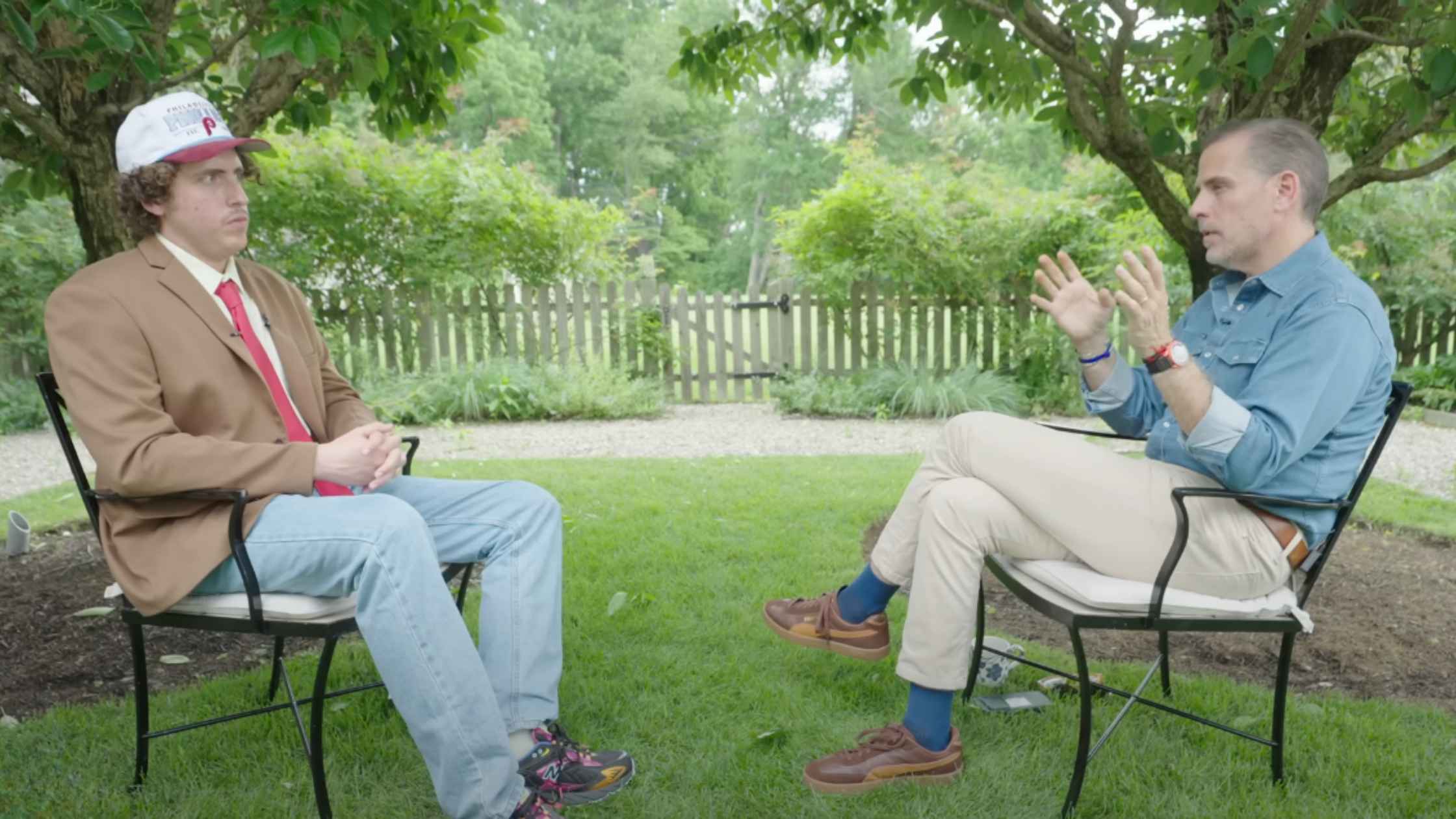
Good morning America, and the world. My name is Andrew Callaghan, the host and creator of Channel 5, the largest independent crowdfunded newsroom in the United States. The following interview is with Hunter Biden. The controversial, storied son of former President Joe Biden, who issued a full and unconditional pardon for Hunter during his final month in office. Shortly after Hunter was found guilty of tax-related crimes, and being an illegal drug user in possession of a firearm. Hunter has yet to speak to the media about this pardon. And hasn't done a televised interview in years. In fact, aside from a very limited and controlled press run to promote his new book, Beautiful Things in 2021, Hunter hasn't given a single statement to the media, especially in regard to the laptop scandal that was a crucial component in the Stop the Steal movement back in 2020. Wherein, millions of Trump supporters alleged that Joe Biden was being controlled and manipulated by nefarious foreign actors who leveraged their business connections with Hunter to peddle influence in the White House.
(02:22)
As I mentioned, this alleged intel connects to private messages and emails that were found on a laptop that Rudy Giuliani and his lawyer claim Hunter left in a computer repair shop in Delaware sometime in 2020. Whereafter, the laptop repairman, John Paul Mac Isaac, pictured here, essentially leaked its contents to the world. Along with evidence of alleged corruption, tax evasion, and influence-peddling, what was also leaked from the laptop is nearly a decade of private photos of Hunter in the thralls of crack cocaine addiction. All right, in today's interview, we're going to discuss the laptop, the 2020 election, crack cocaine and more. With an emphasis on recovery and away from gossip and family drama.
(02:58)
And by the way, if you'd like to listen to or download an audio version of this interview, I've uploaded a crispy WAV file to the podcast feed of our long-form program, 5CAST, which is available now on Spotify, Apple Music, and Amazon. All right, let's get into it. Without further ado, ladies and gentlemen, Hunter Biden.
(03:15)
All right, Mr. Biden, thank you so much for your time, man. I really appreciate it. How long has it been since you've done a formal sit-down interview?
Hunter Biden (03:23):
It's been a while. Been a long while. I had a conversation with Jamie Harrison, who's the former chair of the DNC. Who is a great friend, loyal, and I was down in South Carolina for other things, and kind of like family down there. So I sat down with him and talked about some stuff, but nothing like this.
Andrew Callaghan (03:40):
What made you feel like now's the time for official, unedited long-form?
Hunter Biden (03:44):
Well, I don't know when it is the right time or not the right time. I'm an admirer of your work and we have a mutual acquaintance. It didn't take me much to agree to be really interested. I think the work that you've done is some of the most interesting commentary on the moment we're living in. The expanded moment that we seem to be continuing to live in from 2020 on. I hadn't seen much of the earlier work that you had done, but I do know that I at least appreciate the sincerity with what you approach everything that you do.
Andrew Callaghan (04:20):
I appreciate it. You said 2020 on, do you feel like that's the year the world kind of went crazy?
Hunter Biden (04:24):
No. I think that that's the year that we all kind of woke up to the realization that things are crazy. But no, I think that they've been going crazy for a while. And I don't know whether crazy is the right word. I think that… I don't know how interested people are in my take on why I think the world is a little bit crazy right now.
Andrew Callaghan (04:46):
Well, I think there's probably millions of people out there who just want to know how you're doing.
Hunter Biden (04:50):
Personally, I am great. I tell everybody, and Melissa gets kind of upset with me, because it has been obviously a difficult time. The past five years have not, at least from any outsider's perspective, been fun. But for me, as a person in recovery, and being able to maintain that recovery through this and stay clean and sober throughout it, is the one thing I allow myself to take some pride in. And I know about my life, is that I survived almost certain death. And I mean, I don't know if you've read my book, but I'm pretty transparent about it. Having survived that hell, kind of prepared me to be able to make it through the public humiliation that I don't know any other way to put it that I've experienced over the past close to five years now. And it doesn't seem to stop, but I'm more grounded in who I am and what matters to me, and what I'm grateful for on a daily basis than I've ever been my life. And physically, I'm in a hell of a lot better shape than I was since my last drink or drug six years ago.
Andrew Callaghan (06:06):
So it's been six years?
Hunter Biden (06:07):
Yeah, just over six years.
Andrew Callaghan (06:09):
When you say you almost died, can you kind of give us some more context?
Hunter Biden (06:12):
I was a drinker. And at the end, my addiction had progressed so much that it was potentially deadly on a daily basis. The thing that was the most concerning and the most real about facing death was in actuality the alcohol. Once you fall into that lifestyle, and I wouldn't call it a lifestyle because there's no life to it at all, you enter a completely different world in which you're living kind of completely outside of the bounds of any communal norms. I don't know, it's a scary place to be. And I've met some of the most truly heroic, astounding, thoughtful, kind people that I've ever met in my life that are living lives of quiet desperation, not quiet, very loud desperation, but even in that, found space in their hearts for empathy and kindness. And I've met some of the most awful predatory people that I've ever experienced in my life.
Andrew Callaghan (07:20):
So you feel that the thralls of addiction do oftentimes swallow up very genuine earnest people, but at the same time that underbelly is home to a specific breed of evil as well?
Hunter Biden (07:29):
One of the things that I've realized is that addiction is one of the most universal conditions. I don't know many people that have not been impacted by it in some way. Whether it's addiction to drugs or addiction to behaviors. They have the same dilatory effect on not just you, but more importantly on your immediate community, your family. And then it just spirals outward. And I don't know anybody that hasn't been impacted by drugs and alcohol in a really significant way, or at least a way in which it's created trauma in their own personal lives and the lives of those that they really love. And so while it's universal, it's something that we rarely talk about. And it's kind of the way in which we treat drug use as it's something that someone else is doing and that someone else happens to be your brother, your sister, your mom, your dad, yourself, your coworker. And it only becomes a problem when it becomes a problem for you.
Andrew Callaghan (08:24):
Do you think that you would've been treated differently by the media if your addiction was to an opiate or perhaps methamphetamine as opposed to crack, which kind of has a racialized context to it?
Hunter Biden (08:37):
Well, maybe. I don't know, because it depends upon what media you're talking about because what is the media? I think it was just an added bonus for them that they could say, "Crack addict." And everybody would go, "Oh my God, he's a monster." So I think for those that wanted to use it as a bludgeon, it's easier when you slap the word crack addict onto it. It made me a lot easier target for the Don Juniors of the world, the Marjorie Taylor Greenes of the world, just because of their inherent kind of meanness about things. But I'm not a victim here. I was a crack addict. I wrote about it, I was transparent about it. I wasn't naive to the idea that somehow that would be something that anyone or everyone would be able to fully comprehend and have empathy for. We're lacking empathy across the board, not just for Hunter Biden.
(09:30)
But I guess I was a little bit surprised in terms of a lot of people in the press, now whether it was in the New York Times or the New York Post, kind of dismissed addiction as somehow unique to my family or without taking into account what they were doing to other people that were looking to get clean and sober. One of the things about getting clean and sober, at least I've found, I don't know what your experience in your life with your friends or others is. One of the things that keeps us in the cycle of addiction is our guilt and our shame, is the lies we tell ourselves and the lies that we tell the people that we care about the most. And you get clean and you get sober, and what ends up happening is you still hold onto these secrets like, I smoke crack. I was a crack smoker. They know that I did cocaine or they know that I was drinking, but they don't know that I was also an inveterate drug user.
(10:28)
And so you keep that secret, and that guilt kind of boils up. And the only place that you can talk about it is in rooms full of virtual strangers, which is really helpful, but it doesn't release you from that awful feeling that I'm about to be found out, and that anxiety. And so then you get triggered. Your brain tells you to do the only thing that it's learned how to do is that you need to save yourself. And the fastest way to save yourself is a drink or a drug. So you get caught in this loop. And the favor that they did for me is, I don't have any more secrets. Now, not everything that's been said about me is true, but the things that most people would be very embarrassed about, I've been very open about.
(11:17)
I spent more time on my hands and knees picking through rugs, smoking anything that even remotely resembled crack cocaine. I probably smoked more Parmesan cheese than anyone. And so I don't get triggered in the same way. But the thing that scares me is for people that look at the way that I'm treated in the media, whatever the hell the media is, and think, "Do I want to get honest?" I mean, seems to me if you look at that as a test case, better to keep some things unsaid. And I think that's really dangerous for people, at least in my experience with recovery.
Andrew Callaghan (11:52):
As the media goes, what do you think are the three craziest things you've heard about yourself in the press?
Hunter Biden (11:58):
Oh my God, the list is forever and forever. They got stuck on, for a while, even Fox News, that I funded the Wuhan lab. I said that to someone a long time ago on camera in response to a question like you just asked. And she said, "You got to be really careful. Somebody's going to be able to cut that and say, 'I funded…'" I did not fund the Wuhan lab.
Andrew Callaghan (12:17):
I did.
Hunter Biden (12:17):
Yeah. Oh, you did? Yeah, exactly. Me and George Soros. Supposedly, me and George Soros have a lot in common. The one thing I'm positive we don't have in common is that I am very, very far from being a billionaire. But those conspiracies are kind of the craziest. I just heard Jake Tapper's going on TV saying that I basically acted as the chief of staff.
Jake Tapper (12:40):
I think Hunter was driving the decision-making for the family in a way that people… He was almost like a chief of staff of the-
Speaker 1 (12:48):
Does that strike you as pretty bizarre?
Hunter Biden (12:50):
I think I spent 12 days in the White House in the last two years of the administration. I had a lot of other things going on. I think the one that was like the… Feel like you just got hit in the gut by an elephant is when Rudy Giuliani and Bernie Kerik went to the New Castle County Courthouse here in Delaware and talked about me being involved in, I think, child sex crimes and stuff like that. I mean, literally with no… Nothing. That one is like, was the last and the only one that was kind of hard to wake up from. Is like, how do you ever take that out of somebody's head after they've heard it? But I mean truly the list just goes on and on.
Andrew Callaghan (13:41):
Did you try to sue for defamation or damages or anything after that?
Hunter Biden (13:45):
No. I mean, I am in a defamation suit right now. I mean, one of the craziest ones is what Patrick Byrne said about me. And let me get this straight. He said that I was the key person in ensuring that the sanctioned Iranian oil money that was being held in South Korea was released at the behest of myself and somebody in Pakistan. And I took a 10% fee off the $8 billion for my family. We have to give 10% to the big man. You're the big man, I think. And that I had traveled to Tehran and to the Middle East in 2022 and 2023 in order to effectuate this. And then that ultimately, as followers made the direct connection that that money was used to fund Hamas for the murder of over 1,400 Jews on October 7th. That's the kind of stuff.
(14:39)
And now I know you guys look and say, "But who believes that?" I don't know, the million people that read that tweet. I had one guy in California who is a, I don't remember his name, but he's associated with SpaceX, a big, big investor in SpaceX, a very, very wealthy guy, claim just months ago, that I rented a house from him and that I trashed the house and I had the Secret Service stiff him on the rent and that I tried to pay him with a book of art made of my own feces.
Speaker 2 (15:17):
His ex-landlord claims he stiffed him on a whopping $300,000 in rent. "What happens to the back rent that Hunter Biden owes my family? Is that pardoned now?"
Hunter Biden (15:29):
How insane is that, right? But you look into the background of this person and he's a major, major investor in SpaceX. He's probably worth a few hundred million dollars and he has this huge following on X. Elon Musk retweeted that and it went viral.
Andrew Callaghan (15:45):
It's pretty messed up, man. There's also some people though, who just think that if you leave the country, you're a spy. You know what I mean? Why is he going so many places?
Hunter Biden (15:52):
Oh, me?
Andrew Callaghan (15:52):
Yeah.
Hunter Biden (15:54):
Oh, yeah. Yeah. The really interesting thing is, they created a character that is both in some sense a ne'er‑do‑well fail‑son that has not ever accomplished anything and a criminal mastermind all in one. I kind of feel like, pick one. Most of my travel during that period of time when my dad was vice president, and by the way, I didn't travel anywhere when my dad was president. I don't think I left the country. But during that time, I was the chairman of the board of what's called the US-UN World Food Program, and I was also chairman of the board of the Truman National Security Project, chairman of the board of the Center for National Policy. I was a professor at Georgetown University, adjunct professor for over four years in the master's program at the School of Foreign Service. I taught a course on advocacy largely based upon the implementation of a thing called PEPFAR, President's Emergency Plan for AID Relief in Africa. And as the chairman of the board of the US-UN World Food Program, is kind like what you know of, as a kid growing up, like UNICEF.
(17:01)
UN has voluntary aid organizations in which each nation state that is a part of the UN voluntarily contributes to the continued operations of UNICEF, UNHCR, UNESCO. All of these organizations are all voluntary aid organizations. UN World Food Program is the largest voluntary aid program in the United Nations, and it is the largest humanitarian organization in the world. It serves over 80 million meals on a daily basis in 72 different countries. And it is the first on the ground because it controls all the airlift and communications for all of the relief efforts globally in any natural disaster or civil war or conflict.
(17:42)
And so the US is responsible for about 65% of the budget of the World Food Program, which was my responsibility as chairman of the board. And I increased the budget of the World Food Program, which just won the Nobel Peace Prize two or three years ago, by 50% when I was chairman over my term to $2.4 billion. It's all gone now. Trump ended all of that. But point about traveling. So I went to the Philippines after Typhoon Haiyan, I went to Kenya to Dadaab when refugees were flowing in from across Southern Africa and Ethiopia. I've been to Syria, Lebanon, and Jordan, and I've been to all over the world. 75% of my travel during that period of time was on behalf of the World Food Program and other NGOs that I worked on behalf of.
Andrew Callaghan (18:30):
So I want to back all the way up to the very, very beginning. A little short bio. We could do a long bio too. So you're born here in Delaware or born here in Pennsylvania?
Hunter Biden (18:39):
In Delaware.
Andrew Callaghan (18:40):
Okay. In Delaware.
Hunter Biden (18:41):
Yeah. Wilmington.
Andrew Callaghan (18:42):
Wilmington.
Hunter Biden (18:43):
10 minutes from here. 15.
Andrew Callaghan (18:44):
What are your thoughts on Wilmington, Delaware? Nice place?
Hunter Biden (18:46):
Oh, yeah. One of the things that I still do love about the East Coast and Delaware and the Mid-Atlantic is the history. And so I'm a little bit of a history geek.
Andrew Callaghan (18:57):
Yeah, because Delaware doesn't really get much of representation. Because you got Philadelphia, powerhouse of history and culture. You got Rocky. A lot of other things going on there, doing important stuff. And then-
Hunter Biden (19:06):
We agree on that. I'm basically living in the suburb of Philly, yeah.
Andrew Callaghan (19:09):
Well, I don't want to say that. But you got Baltimore, The Wire, we've got people on horses in the streets out there, people on ATVs. And then Delaware is kind of sitting in between. People know that it's a corporate tax haven. People know that the Biden family's from there. What's something that people don't know about Delaware that they should?
Hunter Biden (19:25):
Delaware is the first state. I don't know if they should know this, but it's the first state to ratify the constitution. When Thomas Penn basically colonized Pennsylvania, he carved out Delaware and he called it the diamond and the jewel in the crown of the colonies. Delaware is almost a state of almost all coastline. Here's the thing that's interesting about Delaware. Delaware is geographically and historically and emotionally, both a southern and a northern state. So the northern part of the state feels very much like Philadelphia. The southern part of the state feels very much like South Carolina.
Andrew Callaghan (20:06):
So do you see Confederate flags in Dover?
Hunter Biden (20:08):
Maybe not Dover, but definitely Gumboro. I think that the National Association for the Advancement of White People started in Gumboro, Delaware.
Andrew Callaghan (20:16):
How are they doing?
Hunter Biden (20:17):
I don't know. It was a long, long time ago.
Andrew Callaghan (20:19):
It seems like they're doing pretty well.
Hunter Biden (20:20):
I think they probably had a real comeback, but that's because Delaware was a slave state that fought on the side of the union. And the Mason-Dixon line, actually Delaware is the only state the Mason-Dixon line does not bisect. And that is because it starts at our western border, the actual line for the Mason-Dixon line and right in the middle of the state. So there's three counties in Delaware, and if you go below the canal, you're in the southern part of Delaware, Kent and Sussex.
Andrew Callaghan (20:51):
And you were born in the 70s?
Hunter Biden (20:54):
I was born in 1970.
Andrew Callaghan (20:55):
Wow.
Hunter Biden (20:56):
Yeah.
Andrew Callaghan (20:56):
A couple years after the Summer of Love.
Hunter Biden (20:58):
Yeah. My brother was born 1969, February 3rd, and I was born February 4th, 1970. And my sister was a year and a couple months after that in '71.
Andrew Callaghan (21:09):
Now, I know that you've talked about this story before, but there was a tragedy pretty early on in your life. Can you kind of tell people what happened? For those who don't know.
Hunter Biden (21:17):
Yeah. My dad got elected to the Senate on December 18th of 1972. So I was almost three years old. And my brother, myself, my little sister, were with my mom and the dog in a station wagon and we were hit by a tractor trailer. My mother and sisters were killed instantly. My brother and I were trapped inside the car, but they got us out. And I had significant head trauma. My brother basically broke almost every bone of his body and was in traction. And we were in the hospital together for weeks. And family, and this community, saved us. And my aunts and uncles moved in with my dad and he figured out a way to be with us and be a dad to us and also be a senator, commuted every day. And so I grew up here. I spent a lot of time with my dad. My brother and I had this rule with my dad is that we could go with him whenever we wanted to, and kind of no questions asked.
(22:10)
And obviously we didn't take advantage of it, otherwise it would've gone away. But we were smart enough to do that. But we spent a lot of time on the train going down to the Russell Senate Office Building with my dad, just to be with him. We did everything together. The thing about my mom and my sister dying and my brother and I being in that accident, it's like the realization that I have with addiction and being someone public, is that I'm no way unique. Everybody's had a tragedy in their family. And when you're in the public eye, and as transparent, I think, as my family has been about those tragedies and whether we wanted to or not, you have this incredible wellspring of other people that come to you and want to talk to you about your own experience or their experience. Like, "How'd you get through it? I had the same thing." And you realize that we are almost all universal in that way, is the one thing that binds each and every one of us is not necessarily love. People can go through life without being loved.
(23:07)
The only experience that we will all have between the time we're born and when we die, is pain. And being able to recognize pain is a thing that connects us all. It's a real gift, I think, at least, and given me a lot of strength when I needed it.
Andrew Callaghan (23:24):
How do you feel that particular experience impacted you growing up?
Hunter Biden (23:28):
I don't know. I think it's something that's a lifelong journey to be able to figure out what that kind of a trauma has on you. I don't know. I mean, I used to fight against the idea that it had anything to do with my addictive behavior. I don't fight about that as much anymore. It kind of makes sense me in a way. I think that some of the genetics make sense to me in a way too. But in terms of that trauma and how I see it today and the way that people responded, it's all about the love that I experienced during that time.
(24:02)
I look back and I think of the way in which my family surrounded me. I was given the gift of having known and having two mothers that I consider my mom, both of them, my birth mother and my mom now. And I feel incredibly lucky for that. Instead of thinking of it as some tragedy, I feel incredibly lucky that I had my aunts and uncles that literally moved in with us, and I got the experience of having an extended family. My uncle is my best friend in the world, outside of my dad and my brother. And that, I don't know whether we would all be as close if it weren't for that. But I mean, you come from a big Irish Catholic family. This isn't like, oh, woe is me. I mean, everybody's gone through this.
Andrew Callaghan (24:48):
It was definitely a cultural kind of instinct to not allow ourselves to be defined by traumatic events and to take responsibility for the way that we've handled things that have happened.
Hunter Biden (24:59):
Oh, yeah, I think so. And I think ultimately, at the end of the day, we all have to take responsibility regardless of the reason. The consequences aren't always fair. But I think the biggest question is, is whether you use it as an excuse or do you use it as a catalyst to be more empathetic with other people and also yourself?
Andrew Callaghan (25:21):
Yeah.
Hunter Biden (25:22):
Does that make sense?
Andrew Callaghan (25:23):
Yeah. And it sounds like the double-edged sword you're talking about, or the flip side of the coin, is that even in the wake of tragedy, the wake of tragedy allowed for your extended family, like your uncles and stuff to become closer because they recognized that you needed an extra layer of support. And so do you feel like without that happening there wouldn't have been as strong of a bond within the family?
Hunter Biden (25:40):
I don't know. I do know this, is that my family is just incredibly close-knit. But I can't imagine that, I mean obviously, yeah. I think your relationships are forged by the circumstances, and the more dire and consequential the circumstances, the stronger the bond. I mean, I don't know what your experience is, but I do know this, is that I feel very lucky. And the reason I feel very lucky is because this state, not just just my family, but the people in this state, it's like when I was on trial here, I walked out of that courtroom after the conviction in Delaware in the gun case. And the first thing I said to the group of people that were there, my family and closest friends, is that how grateful I was.
(26:27)
I mean, I'm truly grateful. It was like being able to go to your own funeral. I looked behind me and realized that no matter what, there was a whole courtroom full of people that knew who I was, and I had a whole family of people that were like aunts and uncles to me. I felt lucky and I still feel lucky, and I don't take it for granted.
Andrew Callaghan (26:48):
I think in a lot of ways catastrophe reveals character. You're able to see how far someone's willing to go to help you, or how much they care about your wellbeing when things aren't going well.
Hunter Biden (26:58):
Yeah.
Andrew Callaghan (26:58):
And I feel like you've had a couple different cycles of that throughout your life.
Hunter Biden (27:01):
Yeah. It feels like a never-ending cycle of that. And that's life. I hope that at the end of the day… Look, I am trying to figure out how to make as clear as possible, addiction is not an excuse, but it is an explanation. There are consequences for people, as you know, or anybody that's in recovery or spent any time is, regardless of whether those consequences are legal, financial, relationship-wise or any way, is that addiction… And when I say addiction, I mean alcohol too. Because I don't know of any more destructive drug than alcohol. There are consequences. I'm still appropriately paying the price for some of it, or trying to make amends for stuff that are personal that I believe that I still need to make amends for.
(27:59)
I don't believe that there should be a continued… That somebody should have to wear a Scarlet A for the rest of their life. It's interesting the way that people talk about addicts because if they just step back for a second and examine their own lives and the people that they idolize, I guarantee you at least 50, 60% of them are, or were, or are in recovery hopefully, or experienced some level of addiction in their lives, without kind of attaching this Scarlet A to everything that they do.
Andrew Callaghan (28:36):
How old were you when you first started, I guess, drinking or experimenting with drugs?
Hunter Biden (28:40):
I think the first time that… I think I write about this, the first time I took a drink was a party where I stole a glass of champagne and hid under the table. Maybe 8. 8, 11, something like that.
Andrew Callaghan (28:52):
Okay, so before high school.
Hunter Biden (28:54):
Yeah. My first memory with alcohol was that, I don't think then I didn't continue drinking after that, but I can remember that distinctively. But then in high school was when I started to drink. I played football, so you wouldn't really drink during the football season. But weekend drinking, yeah.
Andrew Callaghan (29:14):
So just like standard going out Friday, Saturday.
Hunter Biden (29:17):
Yeah.
Andrew Callaghan (29:18):
Obviously no crack?
Hunter Biden (29:19):
No, no, no, no. I experimented with drugs in high school, but drugs as an issue did not occur until crack.
Andrew Callaghan (29:36):
So it was just like you didn't go from cocaine to crack?
Hunter Biden (29:41):
No, it wasn't as linear as that. And so with me, what ended up happening was when my brother was dying, he was dying in a very slow but certain way because he had glioblastoma multiform stage IV cancer. Which basically, you have a 2% survival rate. And even that 2%, your chances of being fully intact physically and mentally are basically 0.2%. People survive without their life. But almost a 98% certainty that you're not going to live outside of two years. And so my brother never wanted to really know those numbers. And so I remember, I haven't read all of the book, but the people give me little synopses, this guy Alex Thompson, who no reason anybody would know who the hell Alex Thompson is, he has this whole thing I understand in which he says, "The Biden's covered up Beau's cancer diagnosis." And I feel like saying, "What the fuck are you talking about, man?" You get a terminal diagnosis, okay, what do you do? Do you accept it, go home and die? Or do you say, "I'm not dying. I'm going to be part of that 2%." I sit down with the oncologists and the oncologists tell me that there are new procedures and there are new experimental things that they're doing as it relates to X, Y and Z at MD Anderson or at Sloan Kettering. And I'm going to do that and I'm going to try that and I'm going to survive and I'm going to run for governor. My brother was the Attorney General. He was no longer the Attorney General. He did not run for re-election as Attorney General, but he was considering running for governor at the time. When my brother would be asked, he'd say, "I'm okay. I'm okay." And he'd keep doing his job. And he was in private practice at this time.
(31:31)
And so what does Alex Thompson think my brother would owe fucking anyone to say, "Oh, no, I'm dying. I'm not going to run for governor." And why would he do that? Why would you give up on life? And it's almost like somehow that this human being is not a human being. Like he has not experienced life. He has not had anyone in his life that is… And I find that really hard to believe in a day and age when I don't know anybody that hasn't had somebody in their family that has cancer. And so what do you say to them? "Oh, you have cancer. Oh, so you're going to go tell your boss that you're dying. You should quit now." No, you don't. You go do your chemo, you do your radiation, you get up in the morning and you eat better, and you go on a different diet plan and you get experimental procedures done and you fight and you fight and you fight. At least that's what my brother did.
(32:26)
Anyway, my point being, it was slow. And I knew that there was going to be a real transition. And I knew that there was going to be, in the entire family, not for any other reason than proximity. I was with them all the time, as was his wife and as was his children, and as was the rest of the family. But I was with him all the time. And so I knew what every doctor was saying and what every… And I stayed, I was clean and sober through that period of time. Off and on, I had some relapses, but I had gotten sober in
Hunter Biden (33:00):
… 2003, from alcohol, and I was clean and sober basically for an eight-year period of time, and then I cycled in and out. But when my brother was sick, I was extensively clean most of that time. And when he died, it was a awful… I mean, my brother kind of connected us all in a way that it was almost impossible to imagine him not being that glue. I mean, it's the hardest thing of anything, anything I've ever been through, and I know people are close to their brothers and sisters. Again, I'm not unique, but the only nightmare that I ever had as a kid was losing my brother. Like the one that you wake up in a cold sweat. And I did. And it was really difficult and my wife of 20 years stopped talking to me. Maybe 20 years of reasons not to have a relationship, but it was pretty awful timing and I fell apart.
(34:01)
And I went to rehab almost immediately and I stayed in rehab for a long time. Well inpatient, outpatient for close to a year and between, up in a place in Pennsylvania and then back in D.C. to be near my kids and was not wanted by my ex-wife back in the house. And so for the first time in 46 years, I'm living alone, I don't have my brother, the rest of the family is in this awful state of grief and we feel rudderless, I think, for the first time in my life. Completely rudderless. And anyway, long story short is I kind of held it together for about a year, almost exactly a year to my brother's death, and then I admitted that I slipped up with a drink and the outpatient program that I was in, I was going to four times a day and getting tested, I said, look, "I drank."
(34:58)
He said, "Well, we want to test you anyway." And I said, "If you test me, it becomes a part of a record and I don't want it as a part of a record because it's not protected by HIPAA." And he said, "Well, you can't come back in if we don't test you." And I said, "Well, this is what I did." And they said, "It doesn't matter, you're telling us," and he said, "We need it for our records." I said, "Well, fuck you," and I walked out and I walked out to the park across the street, Lincoln Park in D.C., which is not very far from the White House, which is I knew to be sometimes an open-air drug market. And I saw someone that I knew from my past life, as being in the streets, a woman that I referred to as Bicycles, and I knew that it was kind of a suicidal thought. I said, "Do you got any crack?" She sold me crack, and then that was it. From there, it just progressively got worse and worse.
Andrew Callaghan (35:55):
What kind of places did it take you?
Hunter Biden (35:57):
I mean geographically, it took me to the worst parts of any city, town, state that you've been through. I mean, I know that you've been through these places, I've watched. But it takes you to metaphorically and literally to the Super Eight Motel off the highway, rooms for rent on an hourly or daily basis for tens of dollars, and that's kind of where it takes you.
Andrew Callaghan (36:29):
It takes you to public housing too?
Hunter Biden (36:30):
Yeah. And not safe places. Places people live, but not safe places.
Andrew Callaghan (36:37):
How long was the run for after you saw Bicycles?
Hunter Biden (36:39):
That was in June of 2016, but almost three years.
Andrew Callaghan (36:48):
Wow.
Hunter Biden (36:48):
Yeah. Now, there were periods where I would stop. I would try to get help or half try to get help or appease people in my life and say that I was getting help. And so I did a whole host of different things to try to pull myself out of it. I did try and people would come in and out of my web and try to help me, and my level of toxicity would drag them down until they would disappear, and then people that would come into my life that were nothing but blood-sucking leeches that literally saw vulnerability and latched on and drained me of literally every thing that I had, whether from emotional well-being, to my physical well-being, to my bank account, and that was the ebb and flow for almost three years until I met Melissa.
(37:35)
The one thing that is true about it is that, as I said before, I met some people in that period of time that have no escape. I had an escape. My family. I thought that I had burned all bridges, there was no exit. I was in a hotel in a big city, and I don't want to name the city, and this drug dealer who had pretended to be my friend and would organize these things around me where they just would live off of me for days at a time and they'd get hotel rooms and they'd bring people in and it'd be like a big party and I would find myself invariably trapped in the room and trotted out to deal with hotel security, whatever at any time. Someone had given me something and there was a spa tub, like a big hot tub pool, and they had found me floating face down in the pool, and this person saved me, and I woke up after about 12 hours where they just held me.
(38:48)
My whole point of this story is that this person put themselves at enormous risk to save my life for nothing other than to be human because every single other person that was there, literally, they stole the shoes off my feet, stole my clothes. I've gotten over the fact that Matt Gaetz or Eric Trump is going to use this story as another data point for how fucked up Hunter Biden is, but I don't give a shit anymore. And what I don't give a shit about is because people, even in the midst of their addiction, some people, can be so incredible and generous and humane and caring. I mean, this person had literally nothing to gain, and I don't even know their name, but they saved my life and they sat with me and they nursed me back to health until I was good enough to be able to get up and realize.
(39:55)
But I mean literally, for what? The most likely outcome for them was that the hotel could walk in and I was dead, and they get blamed for it. Anyway, I guess my point is, is that I think I was worth saving, and I think there's millions of people out there that are suffering from addiction that are worth saving.
Andrew Callaghan (40:18):
You mentioned one thing earlier that I thought was pretty interesting is that you would take breaks throughout this period of time, and I think that when you're in active addiction especially, those tolerance breaks can give you the illusion of control. 'Cause you're like, "Oh, I'm just going to chill for a bit."
Hunter Biden (40:30):
It's the oldest story in the book.
Andrew Callaghan (40:31):
"I'm so good at moderation. Wow, I'm the best." But in your mind, you're like, "I'm chilling so that I can mentally be on board for the next bender."
Hunter Biden (40:39):
Absolutely.
Andrew Callaghan (40:39):
You know what I'm talking about?
Hunter Biden (40:40):
A hundred percent. I mean, it's the oldest story in the rooms. At least my experience is that so many relapses start with the assumption that, "Well, look, I can smoke pot," or, "I can drink beer, which is not hard liquor," or, "I can drink, but I'm not going to use hard drugs," or, "I can take prescription drugs and not drink." Or the very beginning, I remember when I first thought, "Maybe I should stop drinking so much," you'd say, "Well, you know what? I'm not going to drink for the month of January." And I don't know how many people that I know do that, but I would make it 10 days and you'd say, "Well, I'm not going to drink for the first 10 days of January." And then it's like, "Well, I'm not going to drink on weekdays in January." And then it's like, "Well, I'm not going to drink on Wednesdays in January." And it's like, "Fuck it."
(41:33)
But yeah, you tell yourself that, and it's the same with any… You get 30 days away from the drug, but you haven't created any new habits, and you put yourself right back into the environment in which you were using, and all of your problems have just built up and built up and built up, and that anxiety comes crashing down on you and you don't have any outlet other than your brain. And this is the thing that people don't understand is this. Why do addicts drink and drug? Because it works.
Andrew Callaghan (42:04):
Yo-yo. What's up everybody? Let's take a quick break here and look at the media coverage of Trump's executive order to cut funding for PBS and NPR across the US, a political move that will have massive ramifications for how the country is informed. As we know, different outlets push different agendas, shaping the story to fit their own narratives, which is why independent reporting matters. And we here at Channel Five are a hundred percent committed to bringing y'all raw unfiltered coverage straight from the streets. But before we hit the streets, we get informed., "Using what?," you might ask. Ground News. Ground News is a dope-ass news aggregate, but lets you see exactly how different media outlets left, right and center are covering the same stories as they unfold. Here you can see, using the Ground News bias distribution tool, how the left and right are covering Trump's executive order quite differently.
(42:50)
For example, the left-leaning NBC News headline reads, "Public radio stations targeted for cuts by Trump, offer lifelines to listeners during disasters," Choosing to appeal to the humanity of their audience. Whereas you can see the right-wing outlet called The Federalist say, "12 reasons why NPR and PBS deserve to be defunded." Not too hard to see where they stand. Ground News, boom. Something else that doesn't get enough attention is how many news stories aren't actually newsworthy at all. That's why Ground News shows you exactly how many actual sources are covering a specific story, so you can determine if an article is legit, real news, or just echo chamber, algorithmic manipulation nonsense.
(43:26)
Another feature we love to use. Their blind spot tool, which shows you the stories that might not be appearing in your typical media bubble. For all those reasons, I trust Ground News to help Channel Five and myself cut straight through the noise. And right now you can subscribe for 40% off the unlimited access Vantage plan, which comes out to less than five bucks a month. Just scan the QR code here or click the link below to sign up. Supporting Ground News means helping to support us, which means we can keep making videos like this, talking to Hunter Biden, and giving you guys coverage that isn't watered down or dictated by corporate interests. So check it out, stay informed, and most importantly, don't let the media tell you what to think. All right. Back to Delaware.
Hunter Biden (44:04):
I would drink because it would take care of what I believed my rewired chemistry of my brain was telling me is that, "You're going to die from. You have to take care of this. And I know the fastest way to take care of it. Best way to take care of it is a drink or a drug." Unlearning that is a really, really difficult process.
Andrew Callaghan (44:25):
Did you find that a lot of addictions, especially, are kind of co-morbid, they go with each other? So you said alcohol was one. Do you feel like drugs and alcohol, specifically stimulants and alcohol, would work really well together, or did you ever find yourself smoking crack just without drinking?
Hunter Biden (44:39):
No, almost invariably I found with all the addicts I've had personal experience with over my life, whether it's the meth addicts with the benzodiazepines or the cocaine users with alcohol. I mean really hardcore addicts… When I say hardcore, what does that mean? Most people try to find some kind of stasis in which they can withstand the downsides of whatever their addiction is, but it never works and it always falls out of balance, and you always overdo one and don't prepare enough for another. Let's say this. Alcohol causes more death and violence than every single other drug combined times five.
Andrew Callaghan (45:22):
Do you think a lot of that has to do with the normalization of alcohol culture or do you think it's the substance itself?
Hunter Biden (45:26):
Both.
Andrew Callaghan (45:27):
'Cause it's like everywhere you go, you [inaudible 00:45:29]
Hunter Biden (45:29):
So let me tell you about alcohol. My dad never drank. My brother never drank really. And the reason that they didn't isn't because of some bad experience that they had with alcohol. It's because they witnessed what alcohol did in the lives of the people around them.
Andrew Callaghan (45:44):
You're not talking about Irish ancestral memory here?
Hunter Biden (45:47):
I am kind of.
Andrew Callaghan (45:48):
Okay, cool. That's what I'm thinking.
Hunter Biden (45:49):
Yeah, no, I really am. I think it is in our bones. I look at my family tree and one of the cool things about your dad becoming president is the Latter-day Saints who have the largest database of genealogy in the world, I have a lot of material on both sides of the family, the Bidens, the Finnegans, the Hunters, but mainly the Bidens and the Finnegans. When you go back particularly on the Finnegan side, and you see Francis W. Finnegan, died age 32, consumption. All these people, they died age 39, left four children, consumption, and it's a catch-all disease, and what it is, is it's alcoholism. You died of alcoholism, and the reason is, is this. It's alcohol is the only drug that impacts every single organ in your body. So from your brain to your liver, to your kidneys, to your spleen, it enters your bloodstream and it's the only drug that you can die from withdrawing from.
Andrew Callaghan (46:45):
What about Xanax?
Hunter Biden (46:45):
Except for benzodiazepines, which are, in large quantities, you can die in because it has the same impact that alcohol does on your body. Because once you withdraw it from your body, it's the only drug along with benzodiazepines that can send you into seizures because your body is saying, "I need this to live." And so it has tricked it so conclusively that the sugars of those alcohol in every single organ scream out and basically you have seizures and die. The way in which alcohol, as a disinhibitor, works, it causes people to do some of the most ridiculous, fucked up things that you can possibly imagine. From what they do in terms of what they say, to the car that they get in and get behind a wheel, to the anger with which they respond. Most people, with alcohol, it simply is an amplification of their worst qualities and your worst… Mine was never violence and I'm not going to judge what my worst qualities were, but maybe delusions of grandeur. Those are my worst things, but that, it's a really, really toxic mix.
Andrew Callaghan (47:47):
For me, it's extremely depressive nostalgia. You know what I mean? I'll hijack the touch tunes and play some song that makes me think of a different time. I'll start getting really sad and talking about how I miss 2008. So you're most prolific bender was during the Trump era, between 2016 and 2020, which I think is important to clarify, is not when your father was in the White House.
Hunter Biden (48:09):
Exactly. Exactly. 100% not. There's this conflation that people have. I mean, I think they're opening up an investigation to cocaine that was found in a cubby outside the West Wing of the White House.
Andrew Callaghan (48:21):
You think it was Don Junior? Oh, you're talking about old White House?
Hunter Biden (48:25):
Yeah, when my dad was there.
Andrew Callaghan (48:27):
Oh, they just got to blame you automatically.
Hunter Biden (48:29):
Yeah, I mean they're literally going to do, FBI, another congressional investigation because they've convinced themselves that it had to be me, that there was a little tiny… that's my point of even bringing it up is that no, I have been clean and sober since June of 2019, and I have not touched a drop of alcohol or a drug, and I'm incredibly, incredibly proud of that.
Andrew Callaghan (48:52):
And why would you bring cocaine to the White House?
Hunter Biden (48:56):
Why would I bring cocaine to the White House, stick it into a cubby outside the situation room in the West Wing when I wasn't there? Anyway, who the fuck knows?
Andrew Callaghan (49:06):
And politicians, I mean they do blow, right?
Hunter Biden (49:09):
I testified before the House Oversight Judiciary and Ways and Means Committee. It was a whole big family shindig on the Republican side. All of them showed up, from Marjorie Taylor Greene to Lauren Boebert, to Matt Gaetz. They're all sitting there. Now, none of them had the guts, except for a couple at the very end, to ask me any questions. At one point in the seven hours that I was being deposed, and which by the way, I demanded that they do it in public and they refused, and the reason is, is because they're fucking morons.
(49:36)
Matt Gaetz of all people was giving me shit about my drug use. I said, "Really? All the people at this table, you're going to talk to me about my addiction and my alcoholism?" And I said, "How many of you have had your own experience with alcoholism and addiction?" Because I knew at least four or five people in that room on the Republican side that were in recovery, and I knew of three that have been accused credibly of being drug users, and I knew that every single one of them had somebody in their family that was absolutely facing a serious drug problem.
Andrew Callaghan (50:19):
I think there might be a lack of understanding there because they think that cocaine is fundamentally different from crack cocaine.
Hunter Biden (50:26):
I don't know what they know. Do you know what I mean?
Andrew Callaghan (50:28):
Well, because they think, "Cocaine, Scarface, very cool." Crack cocaine, they think, "The Wire."
Hunter Biden (50:33):
Oh, in that sense? Oh, absolutely.
Andrew Callaghan (50:33):
You know what I mean-
Hunter Biden (50:33):
You mean like high school.
Andrew Callaghan (50:35):
… like, they don't know how similar the chemical compounds are.
Hunter Biden (50:37):
Well, the only difference between crack cocaine and cocaine is sodium bicarbonate and water and heat. Literally.
Andrew Callaghan (50:43):
That's it?
Hunter Biden (50:44):
That's it.
Andrew Callaghan (50:45):
And those things are pretty much free if you go to a science store.
Hunter Biden (50:48):
This is free. You can go to your neighborhood convenience store and just get… Anyway, I don't want to tell people how to make crack cocaine, but it literally is a [inaudible 00:51:00] jar of cocaine and baking soda.
Andrew Callaghan (51:02):
How different is the experience?
Hunter Biden (51:03):
It's vastly, vastly different, and for real, I feel really reluctant to have some euphoric discussion. I know you're not asking me to do that, but have some euphoric discussion about crack cocaine.
Andrew Callaghan (51:17):
I think this might be kind of the opposite here.
Hunter Biden (51:18):
Okay. No, it's the exact opposite. I'm saying I don't want to have the experience of some euphoric recall. That's how powerful crack cocaine is. Does crack cocaine make you act any differently? No. Is it safer than alcohol? Probably. People think of crack as being dirty. It's the exact opposite. When you make crack, what you're doing is you're burning off all the impurities so that it combines with the sodium bicarbonate, which makes it smokable. That's all. All of these actors and people in the past that talked about they had a problem with cocaine and freebasing. They were smoking crack.
Andrew Callaghan (51:57):
So straw on the stove is the same thing.
Hunter Biden (51:59):
Not exactly, but close to it, but it's a little bit different. But anyway, your point about it, which I think is true, is that there's a thing about crack that is really insidious, and what it is, is that anytime… I think one of the reasons that they believe that smoking cigarettes is so addictive is because it combines three really important things. It's habit-forming, there is an oral fixation, and there is a ritual combined with it. And so the idea of hand to mouth is a habit and a fixation that we learned very early, even as children, with a pacifier, with a spoon, with your thumb, even to breastfeeding. So really, and I don't want to get into the psychology of it because I'm no expert, but I do know this. Is that you combine with that ignition combustion, and then you combine the ritual, you have your cigarette in the morning, you have your cigarette when you get out of the car, you have your cigarette with your coffee.
(52:59)
Crack is that on steroids. It's over and over. There's a ritual to it. There's a ritualized part of it. The combination of all of those addictive behaviors together becomes really powerful, and the drug in and of itself is a more immediate euphoric sensation connected to it than, in my experience, cocaine alone.
Andrew Callaghan (53:18):
Does it require more frequency to maintain the high?
Hunter Biden (53:21):
Yes, yes. And the capacity to use more than you could otherwise with powder cocaine, just physically to be able to ingest it.
Andrew Callaghan (53:31):
So you're kind of saying that cocaine reaches a certain plateau of euphoria where you can't necessarily get any higher?
Hunter Biden (53:37):
In my experience, yes. This is like a PSA. If you want to completely, utterly fuck up your life, I don't think that anything is necessarily, "Oh, you do it once you're addicted," but about the closest thing that statement could be true would be with crack cocaine.
Andrew Callaghan (53:52):
Yeah. I mean, if you look at the impact in communities in the inner city in the 80s, I mean, it led to an entire generation being destroyed, left without parental guidance and stuff like that.
Hunter Biden (54:04):
I went to Yale Law School and I had a Professor Duke, who was one of the key voices in the country at the time from a policy perspective and a law perspective, about the inequities of our drug laws, and you could very much make an argument that, by the way, the Clinton crime bill that my dad helped architect was the consequences of what you call the crack wars during those period of time. The result of the war against crack cocaine, or was it the result of the crack cocaine itself? I'm not saying that crack in and of itself is in any way safe or recommended, but the response to it, I think, was far more destructive in those communities than the actual drug itself, which by the way, like all drugs, all addictions, are completely dependent upon the way in which a community responds to them. Nobody gets clean and sober without community. Nobody gets clean and sober without support if the response is met with just violence from the dealing to the destruction.
Andrew Callaghan (55:12):
Do you think that looking back at the crime bill and stuff, your dad and that kind of-
Hunter Biden (55:17):
Oh, yeah. My point was when I was at Yale, my senior analytical thesis was on the disparity between crack and powder cocaine sensing. That was in 1996 in which… I mean we knew then. And that's when my dad became president. He did away with all of that. I think that Obama did part of it, and he eradicated it all, and then he pardoned almost everybody at the very end of his administration that had been swept up and were still in prison as it related to those disparities in federal sentencing. Obviously he has no control of the State, but hundreds of people had commuted sentences and were pardoned.
Andrew Callaghan (55:53):
And you feel like your paper at Yale ?helped implant that idea in his mind and help forward that cause
Hunter Biden (55:58):
No, I don't think he even remembers my paper at Yale more than anybody remembers my paper at Yale. I think I'm the only one who remembers my paper at Yale. But I do know this, is that at the very end, the only thing that I can say, that I truly weighed in on with my dad, was on that level and he was pushing on an open door. I think people forget the historic record number of people that he pardoned based upon the drug laws.
Andrew Callaghan (56:27):
Also, he pardoned Leonard Peltier or commuted his sentence from life imprisonment in Florida to house arrest at the Turtle Mountain Reservation.
Hunter Biden (56:34):
I was never more proud of my dad, and again, literally the only things that I advocated for were those things.
Andrew Callaghan (56:41):
Peltier and the sentencing reform?
Hunter Biden (56:42):
Yeah.
Andrew Callaghan (56:43):
Yeah. We just did a report up in North Dakota about his homecoming event, and it was definitely interesting. I didn't think it would happen.
(56:48)
Hey guys, here's a quick preview of our upcoming episode that's being referenced, called Leonard Peltier Comes Home.
Speaker 3 (56:54):
Today is a victorious day as a relative is here in the flesh.
Speaker 4 (56:58):
President Joe Biden commuted the life sentence of Leonard Peltier.
Speaker 5 (57:02):
The 79-year-old has served nearly 50 years in prison after being convicted for the 1975 killing of two FBI agents.
Peter Matthiessen (57:09):
The young man was spending his life in prison for something he almost certainly did not do.
Speaker 6 (57:13):
Leonard Peltier and others killed Williams and Coler in cold blood on the reservation because they happened to be there at the wrong place at the wrong time.
Speaker 7 (57:22):
He's considered by a lot of people to be America's longest-serving political prisoner.
Speaker 8 (57:27):
People today don't understand the FBI of '73. They went after Martin Luther King. It is in that context that Peltier was gone after.
Speaker 6 (57:37):
The Peltier group, who could have just driven, away came to the agent's cars, Williams and Coler and killed them both at point-blank. I think I speak for all FBI agents, it's a kick in the balls. A mess.
Leonard Peltier (57:49):
I know in my heart I never killed nobody.
Jake (57:51):
Howdy there. Jake Fowler here with the C-Five crew in beautiful Belcourt, North Dakota, homelands of the Turtle Mountain band of Chippewa Indians. Right now we're standing at the entrance to the casino here and they're hosting an amazing event to honor the longest-held political prisoner in the United States, Leonard Peltier. So let's check it out.
Speaker 9 (58:09):
My spirit name is One Who Carries a Light. Turtle mountain, born and raised, just here to celebrate Leonard Peltier coming home. There's a town that you enter before you come into the Turtle Mountain. We got word that there was all sorts of community members who stood out on the side of the road. Children, elders, probably 20 below, maybe even colder with the wind, and they're out there fists high cheering on Leonard, and it was a powerful moment.
Speaker 10 (58:31):
If you could describe today in one word, what word would that be?
Speaker 11 (58:34):
[inaudible 00:58:35] coming today? Thank you, Turtle Mountain.
Leonard Peltier (58:37):
If I was to be described, someone that loved this people. I want to describe.
Speaker 11 (58:37):
Turtle Mountain Chippewa Tribe. Thank you for inviting us.
Hunter Biden (58:47):
So I've been studying his case, and you have to realize there are elements that were inside of the FBI that still, to the very end, were very threatening. They said that there would be huge consequences within that community of the former and current FBI agents who still firmly believe that Leonard Peltier was responsible for the death of that agent. Anyway, so I knew an inordinate amount about the case and had studied the case. I was in a course of a guy named Stephen Bright who ran the Southern Center for Human Rights, not the Southern Poverty Law Center, two different organizations, same purpose, but the Southern Center for Human Rights, which mainly dealt with representing people on death row. One of the cases that we touched on… Because I don't think Leonard was ever taken off of death row.
(59:41)
Anyway, we worked on Hurricane Carter's case, and I became friendly with Stephen Bright, who was the leading expert and unjustly imprisoned people, and so we studied Leonard's case. I was really, really, really proud because it was a really courageous thing that I think that my dad did by letting him out, and I think some people take it for granted that, "Why wouldn't the president do that? It was the right thing to do. He was 80," blah, blah, blah, because you have a lot of really, really powerful people that can really mess with your life, and particularly in this atmosphere by doing the right thing.
Andrew Callaghan (01:00:11):
What do you think is the biggest inconsistency in the government's case against Peltier?
Hunter Biden (01:00:15):
The two cases that were held against his two accomplices, who both were acquitted, and the lack of evidence that was allowed in Leonard's case as it related to the lead-up to that event on Pine Ridge, where the tribal police force, along with the FBI, had basically created a goon squad and over 60 individuals had been tribal members, and living on the reservation had, I think it was over 60, had been murdered by this goon squad, had been taken out. Was it 60 or 16? I can't remember the exact numbers. But they were on a mission basically backed by the FBI, and the judge never allowed all of that information, which they had got, into the case when Leonard was tried. And I can't remember all the other inconsistencies, but one of the things that also was, is that the woman that they said was Leonard's girlfriend, when they were able to extradite him from Canada to the United States, they used her testimony to justify the extradition from Canada.
(01:01:13)
Once they got him back, she completely recanted and said that she was basically threatened by the FBI to say that she was Leonard Peltier's girlfriend and that she witnessed the whole thing, when in fact they hardly even knew each other. She had lived on the reservation but didn't have any relationship to Leonard. But there's a whole bunch of other inconsistencies
Andrew Callaghan (01:01:29):
On a deeper level, what do you think it was about Leonard that scared the federal government in such capacity?
Hunter Biden (01:01:34):
That's a good question. If you believed Leonard, then you had to understand the rest of the story of what the federal government was doing. It was they were systematically murdering members of an organization that were setting out to highlight the injustice that was occurring on reservations across the country. I think that we are in such a historical… Is that even the term time right now? I know why they want to erase history. I know why they don't want to teach about the actual history of this country. Because to do so makes a lie out of almost everything that they are trying to achieve. And how could anyone see the way in which Native Americans then and now are treated on Pine Ridge by the federal government to the degree that they basically paid for and implemented a program to systematically murder those that were simply speaking the truth.
(01:02:30)
Our government, the FBI, by the way, they were able to do much of it at [inaudible 01:02:36] but all of the documentation was available, all of the communications available at the time of the trial, and the judge wouldn't allow that information to be shared with the jury.
Andrew Callaghan (01:02:47):
Yeah, I mean, because if you look at the bigger picture, American Indian movement was just one of many groups they were targeting.
Hunter Biden (01:02:52):
Oh, absolutely.
Andrew Callaghan (01:02:53):
Maybe one of like 150.
Hunter Biden (01:02:55):
Yeah, absolutely. Absolutely. 40, 50 years later, what has it been? How long was Leonard in? 48?
Andrew Callaghan (01:03:02):
Something like 50.
Hunter Biden (01:03:03):
Yeah, almost exactly 50 years I think, right? '75. Why do we still hold onto that? Because it still makes a lie. I don't believe in conspiracy theories, in the sense of I don't believe that the government has the capacity to carry out a conspiracy, a secret plant. It's all in the open, man. There's no conspiracy behind what ICE agents are doing in the streets of Los Angeles right now, or by the way, in the streets of Detroit or Chicago or Philadelphia or Tampa or wherever the hell they are. It's that they're openly terrorizing people for the purpose of scaring the shit out of them. People look at this moment in time and they get this impression. I used to think of it was hyperbole. I'm not so sure now in the comparisons to 1930s and 1939 and 1932 and Kristallnacht, and this is the time, and are we before this? Are we after this? And I look at what we're going through right now as more associated with a moment in our own history, which was Reconstruction.
Andrew Callaghan (01:04:04):
You're talking about, for reference, after the Civil War?
Hunter Biden (01:04:07):
Yes. From 1865 to 1877. What people don't understand about Reconstruction is that we just fought the Civil War. All of the freedoms, which the Constitution guaranteed was guaranteed for black citizens that had just been released from slavery, and people think there was this great migration, it all fell apart, that black population, because of the weight of slavery or whatever other excuse you want to make, fell into these communities of poverty and disenfranchisement and blah, blah, blah, blah. Total bullshit. Between 1865 and 1877, the South Carolina state legislature was a majority black.
Andrew Callaghan (01:04:41):
I was going to say the state senate that was, I think, at the time based in Charleston, was almost all black.
Hunter Biden (01:04:45):
Yeah, all black. And on top of that it, because, by the way, it's a vast majority of African-American state after the Civil War in South Carolina, and by the way, which was where the first slaves were delivered in the 1600s, right there in Charleston. And so what happened after the Civil War? This amazing thing, this amazing renaissance, these people that jumped in, that had been in slavery for over 200 years, these communities are thriving. And then you have in Colfax, Louisiana-
Andrew Callaghan (01:05:17):
Is that where the first clans started?
Hunter Biden (01:05:18):
Not where the first clans started, but the first major lynching occurred in the sense of this, is that you had, in Colfax, Louisiana, you had black lawmakers that had gone in to secure the vote in this little town in the courthouse and white supremacists surrounded the courthouse, and they rolled up a cannon and they said, "We're going to kill of you unless you come out and give up this effort to…" And they're all wearing masks. Part of them were the local law enforcement. And so the black leadership comes out and they murder them all, and then they go on a rampage and they kill 105 African-Americans in Colfax, a little town in Louisiana. What happens? Nothing.
Hunter Biden (01:06:00):
… nothing. So the US government doesn't do anything. The Union troops throughout the South won't take any action. Local law enforcement and the state does not prosecute any of the people. And then the federal government does prosecute a number of the people, but the Jim Crow Supreme Court overturns their convictions. So nothing gets done. So what ends up happening? That happens all across the South, all across the country, is this campaign of violence, a campaign of intimidation. And by the way, remember how many states at that time? 16 states, 18 states at the time?
Andrew Callaghan (01:06:32):
Not too many.
Hunter Biden (01:06:32):
You had 14 members of Congress that were Black. You had two United States senators that were Black between 1865 and 1877. And then the door shuts because everybody gave in to the corruption of the Supreme Court, the corruption of the president, Johnson ripping the rug out from under the entirety of Lincoln's reconstruction plan. All achieved through violence, corruption, and making a complete and utter mockery of the Constitution.
Andrew Callaghan (01:06:59):
And there's also this perception, if you look at whenever segregation on public transport was codified with Plessy versus Ferguson, I think it was in 1902, there's this perception because of the voting records at that time that most people supported it. People don't understand, or some people do, but the Klan emerged as a voter intimidation force. It wasn't just simply terror for terror's sake, that was a part of it, but it was to specifically target Black area polling stations, voting booths.
Hunter Biden (01:07:26):
It did. And by the way, and that's exactly what they're doing right now. Whether it's voter suppression through violence and intimidation or disinformation, it's the same goddamn thing. Whether it's an algorithm or whether it's a cross burning in your yard. That is what we have fought. We are caught in this loop. It's like the permanent reconstruction loop, the permanent Jim Crow loop is that every single time that we get closer to that idea, that promise, that potential of a more perfect union, what ends up fucking happening is they come in and they shut the door down because there's this evil symbiosis between money and power. So what do we do?
(01:08:07)
If I said to you, look, I'm going to tell you a story from the past. It's about a minority group of people that live in a country. It's a Constitutional democracy that has had its problems in the past, but it's an economic powerhouse and it is the center of learning, it's the center of culture. It has a deep and rich history. But there is a minority group that those in power that came into power through democratically elected means are going to target this minority group because they're stealing all the jobs.
Donald Trump (01:08:39):
Today our cities are flooded with illegal aliens. Americans are being squeezed out of the labor force and they're jobs are taken.
Hunter Biden (01:08:47):
They're not originally citizens. They're not the original people.
Donald Trump (01:08:50):
When Mexico sends its people, they're not sending their best. They're not sending you, they're not sending you.
Hunter Biden (01:08:57):
On top of that, they're spreading disease and distrust and they're criminals and they can be violent. They're eating your dogs and cats.
Donald Trump (01:09:04):
They're eating the dogs, the people that came in, they're eating the cats.
Hunter Biden (01:09:08):
And what we're going to do is we're going to send masked men to this marginalized group and we are going to take them, put them on planes, put them on buses, put them on trains, and send them to a prison camp in a foreign country. What am I describing right then? Am I describing Germany or am I describing the United States right now? Because I will tell you what, if you think that the prison in El Salvador is not a fucking concentration camp, you're out of your fucking mind. Tell me anybody that's returning from there.
(01:09:35)
You saw those pictures, do you think anybody's getting out of there? Is it a rehabilitation center? I've been to those places in South Sudan and in those areas, do you think anybody's getting out of those South Sudan prisons ever, ever? You're out of your fucking mind. That's a death camp. They're done. They're over. And if you're not dead, you would want to be dead if you were in that prison. And we just sent a bunch of people without due process, some of them most likely legally in the United States. I think of that poor guy that they said was a gang member because he had a tattoo on his arm that was a makeup artist. And they say he's an MS-13. He's literally a makeup artist that fled, I think I'm making it up, Venezuela because of a dictator and came to the United States and sought asylum, received asylum.
(01:10:24)
And they literally take this poor guy and they pick him up and he has a family and he has friends and he has an entire community and they give him no due process and they put him on a plane with maybe a bunch of other criminals and send him to that fucking hellscape. He's dead and nobody gives a shit. And I mean it. We sit here and we talk about the one guy, the one guy because there's a clear legal path to being able to get him back. What about all those other people? Am I not supposed to feel for someone? Am I going to be like all these Democrats and say, "You have to talk about and realize that people are really upset about illegal immigration."
(01:10:58)
Fuck you. How do you think your hotel room gets cleaned? How do you think you got food on your fucking table? Who do you think washes your dishes? Who do you think does your fucking garden? Who do you think is here by the fucking sheer, fucking just grit and will that they figured out a way to get here because they thought that they could give themselves and their family a better chance? And he's somehow convinced all of us that these people are the fucking criminals. White men in America are 45 more times likely to commit a fucking violent crime than an immigrant. And you've got David Axelrod and Rahm fucking Emanuel, so fucking smart Rahm Emanuel. They said, "We've got to understand that these people are really mad and we've got to appeal to these white voters."
(01:11:45)
Rahm, the only people that fucking appealed to those fucking white voters was Joe Biden at 81 years old and he got 81 million votes. And he did not because he appeased their fucking Trumpian sense, but because he challenged it. And he said, you can be an 81-year-old Catholic from fucking Scranton that doesn't understand it, but still has empathy for transgender people and immigrants. Then nobody said, "Oh, Joe Biden's going to turn us into a socialist state." No matter how much they said it. But these guys think that we need to run away from all values in order for us to lead. I say, fuck you. How are we getting those people back from fucking El Salvador? Because I'll tell you what, if I became president in two years from now or four years from now or three years from now, I would pick up the phone and call the fucking president of El Salvador and say, "You either fucking send them back or I'm going to fucking invade." It's a fucking crime what they're doing. He's a fucking dictator thug.
Andrew Callaghan (01:12:40):
Bukele or Trump?
Hunter Biden (01:12:41):
Both.
Andrew Callaghan (01:12:42):
The craziest thing to me is especially interviewing migrants and hearing about the journey they went through to get here. You've got some people who walked for 30 days through the deserts of Mexico into the Arizona desert in the 110 degree hot summer. Their feet are bleeding, they have a gallon of water. There's people dropping dead while they're walking, who they physically cannot stop to help because they're so determined and because the coyotes trafficking them will kill them if they stop too. And then finally get to the US just to do menial labor. And you have people saying, "Do it the right way." It's like, trust me, if there was an easier way, they would've done anything but that.
(01:13:16)
And secondly, I feel like anybody who goes to that length to get here deserves to fucking be here. I mean, deserves to be an American. We didn't do to shit get here. I mean, I'm sure at some point our great-grandparents did get on the boat from Ireland and we're like, " Fuck, I don't know what's going to be over there." But it wasn't like the grueling conditions that people experience on the way here. And it's just the lack of humanity and also the lack of understanding as to how American corporations economically dominate those countries and how US intervention has created unlivable conditions there too.
Hunter Biden (01:13:47):
And are the incredible beneficiaries of that new blood that enters our bloodstream year after year after year. The only thing that makes us different from fucking China or Russia or anywhere else or Europe or anywhere and the only reason that I believe that we as America are different beyond the fact of the idea of the Constitution, the idea that we represent, is immigration. And I can't even believe sometimes I'm having this discussion with anybody. How do you think that we are reborn every generation? How do you think that we attract the smartest people in the world to the United States of America? Through immigration. I mean, you sit here and… I mean, just think about it. You've got some motherfucker who's made over $ 251 billion being a United States citizen, that got here and stayed here illegally before he got his citizenship, sitting here lecturing us on who we should allow into the United States of America and given us a fucking Heil Hitler along the way.
Andrew Callaghan (01:14:47):
And talking about-
Hunter Biden (01:14:47):
Are you fucking kidding me?
Andrew Callaghan (01:14:48):
And talking about how gangs are a threat that's going to come here from other places. I'm like, "MS-13 started in Korea Town in LA."
Hunter Biden (01:14:54):
Yeah.
Andrew Callaghan (01:14:54):
Not to mention, the US prison system invented gangs.
Hunter Biden (01:14:58):
Yes.
Andrew Callaghan (01:14:58):
We are basically the creators of worldwide gang warfare, the styles, basically everything about it. And so it's just crazy the idea that we're going to build a wall to keep gang members out, yet 21 Savage is on Saturday Night Live.
Hunter Biden (01:15:11):
Yeah, exactly. Or we sit here and watch Sons of Anarchy. It's just such bullshit. It's just such racism. It's just so easy pickings. And it just makes me so angry. Have you read that quote from Dietrich Bonhoeffer?
Andrew Callaghan (01:15:23):
No, it's a cool name though. I wish it was my name.
Hunter Biden (01:15:25):
Dietrich Bonhoeffer was a philosopher in the '30s in Germany. He fled Germany, but he went back to be a part of the resistance inside of Germany against the Nazis. He was a devout Christian and real intellectual writer and thinker about how to apply the principles of Christ in your everyday life and in society. And he wrote this piece about the Third Reich. And of course he was imprisoned and murdered by the SS.
(01:15:51)
He wrote this quote, and I'm paraphrasing, but basically it says, is that the real problem, and obviously it was in the context of what was happening in the world at that time, is not evil. And it's like Hannah Arendt's, The Banality of Evil. You know what I mean? When she witnessed the Eichmann trials and Eichmann himself. It was like evil is boring, the real problem is stupidity, is ignorance. Because how do you defeat ignorance? You can point out to people that are willing to hear of the evil of someone. And I mean this sincerely. I don't know anyone personally that if you took Stephen Miller isolated and you played a clip of the things that he says-
Stephen Miller (01:16:37):
Every day we arrest another alien they've let into this country, who raped a child, who beat a woman.
Speaker 12 (01:16:44):
Quote, "All the kinky haired, swarthy skinned, long despised phantoms, all the teeming ants toiling for the white man's comfort."
Hunter Biden (01:16:52):
In his little physical demeanor and not be able to say, there's something fucked up about that. However, how do you identify and change the mind of someone who is so ignorant that they cannot discern between a fact in an outright lie?
Andrew Callaghan (01:17:13):
Which brings me to the one conspiracy that I believe in, I believe in some, but really is that-
Hunter Biden (01:17:20):
I've watched your shit, you believe more than one.
Andrew Callaghan (01:17:22):
That's true. But modern conspiracy theories and that lore that often convinces dumb people they're doing important research is the true conspiracy. Because freedom and understanding would be reading alternative histories, actually digesting information and processing the crazy things in the world. And also, like you said, coming to terms with the chaotic and unknown variables that lead to some of these situations.
Hunter Biden (01:17:43):
Great. Explain that to me again. So what's the conspiracy in that?
Andrew Callaghan (01:17:46):
The conspiracy is that most mainstream conspiracy theories, flat Earth, chemtrails, QAnon, all that stuff is deliberate misinformation to convince dumb people that they're doing important research and keep them away from the truth, which requires a higher intellectual-
Hunter Biden (01:17:59):
Oh, I totally believe that. Look here, I'll give you the hierarchy of things. You have Steve Bannon. If you want to understand what the intellectual direction of what, we'll call it the MAGA movement is, just listen to Steve Bannon. He spells it out, he says flat out, he says that he's going to bring the war, that they've known for a long time that the war for the United States of America is going to be won on the streets of Los Angeles. Steve Bannon flat out said that, "You know what we're going to do?" Before the election was even over, he said that, "We're going to contest the election. We're going to say that the mail-in ballots were fraudulent. And we're going to contest the election and we're going to go as far as we can and we're going to break the institutions as much as we possibly can."
Steve Bannon (01:18:41):
Almost 100% believe strongly that the 2020 election was stolen. And we're not going to allow this to be stolen in the canvassing room.
Hunter Biden (01:18:48):
And we'll break the courts and we will break Congress and we will break the Constitution. And he lays it out exactly what he intends to do. My point being is on the hierarchy of that, it goes from Steve Bannon to fucking Alex Jones. And Alex Jones talks about the flat Earth and he talks about whatever Alex Jones talk about.
Alex Jones (01:19:09):
I eat babies. I eat them every night. I eat them with barbecue sauce. And I flew to the moon last night with a witch. And I took DMT with Easter bunnies.
Hunter Biden (01:19:16):
Sandy Hook and things like that. Just a holy alliance has come together because of one really big reason. They've all figured out how to become incredibly fucking rich because of it.
Andrew Callaghan (01:19:28):
So maybe the conspiracy isn't Russia telling people what to do and how to think, it's just profit-incentivized content creators farming outrage through these ridiculous conspiracies?
Hunter Biden (01:19:38):
Yeah. And for instance, what is that? What's that thing called? It's a technique that the Russians perfected and of course they had a term of art for it.
Andrew Callaghan (01:19:47):
Neuro-linguistic programming.
Hunter Biden (01:19:49):
What?
Andrew Callaghan (01:19:49):
NLP, neuro-linguistic-
Hunter Biden (01:19:50):
No. It's more along the lines is that if you say the most outrageous thing possible about someone or a group of people, that by the time if you say it over and over and over again… Rachel Maddow did a whole thing on it. I can't remember the term of art.
Andrew Callaghan (01:20:07):
We'll put it on screen here.
Hunter Biden (01:20:08):
But basically here it is. And they did it. I'll give you the example of how they did it. The way that they did it is when Vladimir Putin came to power after Yeltsin in the early 2000s. Remember? And everybody looked at him and said, "Hey, this guy may be okay." He is a technocrat and he is really smart and he has seemed to be able to quell and control all of these oligarchical tendencies that are occurring. And so what he systematically did is he eliminated all potential dissent from inside of Russia. And the way that he did it to many people was he took people that were of good stock, that were decent human beings, that were family people, and he accused them of being pedophiles. Everybody said, "What? Are you kidding me?" And it didn't matter, they would send out these things, they would say, "They're pedophiles. They're pedophiles. They're pedophiles."
Andrew Callaghan (01:21:03):
He used loyal press organizations to distribute that.
Hunter Biden (01:21:06):
Yeah. Or just at that time, that time goes on, and whatever way that you distribute it. To the point that what he did to a couple of them, including one guy, I just saw an interview of him. It's an oligarch, he made it to London, they planted pictures on his laptop, London police raided him, and he spent five years defending himself. And I forget what it's called, but my point being is that I believe in those conspiracies. I believe that there is a real conspiracy in academia to not actually tell the true history of the United States or of global history.
Andrew Callaghan (01:21:44):
Interesting thing about erasing history is it's only possible when you create a monolith out of the past, like capital P past. I always think about the way they do that. If you watch some of the Charlie Kirk debates, he says, "Well, why should we talk about the past? I'm trying to move forward to the future. Don't be a victim. Don't feel bad about things that happened." And it's playing on a trope in psychiatry that you should just move on. But they're using it to cut the connective tissue between the present and the past. So they want you to believe that the past has no connection and nothing that was done by the ancestors or anybody else, or even the older people of today, has any coherent connection to modern times. And we need to be utopian and look forward because looking back will only cause that trauma to repeat itself. And it's just total bullshit.
Hunter Biden (01:22:23):
Yeah. It almost invariably ensures that we're going to repeat the past.
Andrew Callaghan (01:22:29):
Yeah.
Hunter Biden (01:22:30):
And by the way, isn't that the point?
Andrew Callaghan (01:22:32):
Hey guys, it's me again. So obviously Hunter here is somebody who's dealt with a complete lack of privacy in the past couple of years. But you don't need to be the president's son to have your data leaked. In fact, it's most likely happening to you right now. And the perpetrators weren't backed by Russia and didn't have to steal your laptop or hack your iCloud to get in. Corporate surveillance is real, as we all know. And data brokers around the world probably have a folder out there somewhere labeled, "Andrew wants to buy new Nikes," or, "Interested in Rogaine," for you. I'm not saying that you specifically have hair problems, but if you do, it's okay. It's part of growing up. That's why I use Incogni, the privacy tool that makes invasive data hoarders delete your information.
(01:23:07)
Maybe you're looking for a job on Indeed or you just got out of a four-year relationship and you're signing up for a dating app like Tinder or Hinge, or maybe you're scoping out the housing market on Zillow. Well, guess what? With every account you make and every search you make from your account, your name, email, home address, IP data and shopping history is being painstakingly collected and sold to whoever's paying, mostly to companies you've never even heard of, data brokers. That's where Incogni comes in. They reach out to data broker sites on your behalf, file official removal requests, and fight back when companies try to play dumb and hold onto your info.
(01:23:38)
After I signed up, Incogni hit up 86 data brokers that had my information, and a week later I noticed a massive drop in spam emails. No more creepy phone calls from healthcare providers I never contacted. No more emails from longevity pill companies that somehow know my blood type. It was like a whole new reality set in. And now they've got an extra level of protection. You know those sketchy people search sites that say your full name, old address, high school mascot, and landline from 2014? With Incogni's custom removals feature, part of their Unlimited and Family Unlimited plans, you can point to any site that's airing out your digital laundry and one of their privacy agents will handle it for you.
(01:24:15)
Incogni. To live in this reality, here's all you've got to do. Go to incogni.com/channel5 and use the code Channel5 to get 60% off your annual plan. That's incogni.com/channel5, code Channel5, or just click the link below. I'm going to make it easy as hell and so do they. You just sign up, give them your permission to fight for your data rights, and then you sit back while they go full Rambo on your digital trail. And if you care about your privacy and you don't want your name, your weird search history or your old Facebook photos ending up in the hands of the highest bidder, get Incogni, protect your info, take your personal data off the market before someone tries to use it against you. And that's word to Hunter Biden. Just use code Channel5 and incogni.com/channel5 to get an exclusive 60% off. And supporting Incogni means helping to support us here at the office and helps keep Channel 5 corporate data leak free. All right you guys, stay safe out there. Back to Hunter Biden.
(01:25:07)
So I want to talk about the 2020 election because I feel like that's when your personal affairs took center stage as far as the media cycle goes. You also mentioned, before we get into that, that your sobriety date was before the 2020 election cycle. When exactly do you think you had your last go?
Hunter Biden (01:25:23):
Officially, June 1st, 2019.
Andrew Callaghan (01:25:25):
Oh, so pretty significantly before?
Hunter Biden (01:25:27):
Yeah.
Andrew Callaghan (01:25:28):
And you met Melissa right around then?
Hunter Biden (01:25:29):
Yeah. I met Melissa in the beginning of May, we got married in the middle of May. I tell the story and I have enough sense to recognize that if I was being told this story by my daughter in real time, I would say, "You're out of your mind." It was a miracle that I found her. I met Melissa and within literally an hour, I was telling her my whole unvarnished life history and the immediate problems that I was facing, which was crack addiction. And she literally said, "Well, that ends now." And it did. I mean, not that minute, but over the next two weeks. And then I asked her to marry me and she said yes. And I said, "Well, why wouldn't we do it right now?" And so we literally called Justice Tupeese to the house. She came and she married us.
(01:26:15)
For me, it was a miracle. For Melissa, the really hard part started then. In the sense of getting clean and sober is not easy. It's even harder on the people that love you. And if they're that support system, it's a full-time job in that immediate period of time. Because as I said to you before, the dangerous part is withdrawing from alcohol and it can be scary. And she went through all of that and she went through the entire process with me. And she did things that I wouldn't allow anybody else to do. I saw in Melissa somebody that done any history between us, looked at me with as much love as I looked at her. And I accepted that love in that moment. And a lot of it was tough love. I mean, she took my car keys, she took my wallet. I mean, she took my clothes for a period of time, so I couldn't leave the house.
Andrew Callaghan (01:27:05):
Wait, took your clothes?
Hunter Biden (01:27:06):
I didn't have anything. I mean, it would've been impossible. We were living in the Hollywood Hills. There was nowhere to go. And if I could go anywhere, there's nothing to buy anything with.
Andrew Callaghan (01:27:16):
So I can remember covering the 2020 election about a year later, and I think it was the first stop, the steel rally at Reading Terminal Market in Philadelphia. And I saw what I thought was a BLM flag, Black Lives Matter, but it actually said Biden's Laptop Matters.
Hunter Biden (01:27:31):
Oh, yeah.
Andrew Callaghan (01:27:31):
And so I asked the guy, "What the hell does that mean?" And he just kept yelling the slogan over and over again, couldn't get much out of him. So for those who don't know, what happened with that?
Hunter Biden (01:27:40):
Well, I don't know, you tell me. And I really mean that sincerely. You'll have a lot of people that will come up with something about the laptop. But I always say to anybody, I mean if you're steeped in and just through your work, the right wing narrative around it, and my question to anybody that is keeping an open mind is what is it that you think the laptop proves? Or what you call the laptop? So everybody has a laptop, so when they say, "Hunter Biden's laptop," what is it that they're talking about? Do you know?
Andrew Callaghan (01:28:09):
Well, I know that your entire iCloud was connected to it, all of your personal text messages, private photos, all that kind of stuff.
Hunter Biden (01:28:17):
Like everybody's laptop.
Andrew Callaghan (01:28:18):
Yeah.
Hunter Biden (01:28:18):
Okay, so-
Andrew Callaghan (01:28:19):
And you left it with a repair shop owner who for some reason gave it to Rudy Giuliani. Not exactly sure how that's legal. He distributed it to the press, particularly I think the New York Post was involved in the spearheading of this mass dissemination of your private materials. From what it seemed like, it was a lot of private texts between you and your friends, family. Your entire private life was on there.
Hunter Biden (01:28:41):
Yeah. And again, so everybody has a laptop, everybody has a-
Andrew Callaghan (01:28:47):
Well, assuming that-
Hunter Biden (01:28:48):
No, not everybody has a laptop. Everybody has a digital life. Almost everybody has a digital life. Everybody has a digital life pretty much. And that includes voicemails and pictures and text messages and emails and location data and everything. Everybody, you do, you do, everybody that is here right now. By whatever means, they got my digital footprint going back decades, over 20 years. Again, I ask anybody, you're steeped in this, and this isn't a challenging question, but it makes my point. What does my laptop prove about criminality or anything? Other than what I had already readily admitted to, was completely transparent about, is my drug addiction.
Andrew Callaghan (01:29:35):
Well, I'm trying to remember specifically what the most radical conspiracies that I heard. I think that a lot of people are concerned or curious about various international business dealings.
Hunter Biden (01:29:46):
So I served on the board of well over a dozen different entities, way more than that, including major global organizations. It was the vice chairman of the board of the National Passenger Rail Corporation, which is otherwise known as Amtrak. It's the largest passenger rail company in the world. Which is more than just a rail company, it's also a real estate company and it's also a commercial real estate company, it's a residential real estate company. And it is probably the largest owners of property in urban metro centers of any organization in the country and a huge employer and a multi-billion dollar business.
(01:30:25)
And I was the chairman of the Corporate Governance Committee on that board and vice chairman. And elected chairman and then resigned before the Obama administration took. As I told you before, I was the chairman of the board of the US UN World Food Program, responsible for sustaining a budget above $2 billion a year for the World Food Program and the contribution the United States makes to the global relief effort as it relates to hunger. I was chairman of the board of the Center for National Policy. I was on the board of Catholic Charities. I was on the board of Jesuit Volunteer Corps Northwest. I mean, I can keep going down the list of board memberships that I had. And a year and a half before my dad was to leave office, I was approached by a Ukrainian natural gas company through one of their board members to consider being of assistance to a company that was being threatened by the Russian aggression and the invasion of Crimea and the incursions into Donetsk and Donbass.
(01:31:28)
And I took them on as a client because I was a council at Boies Schiller Flexner, which is a major national global law firm in which I focused on corporate governance and commercial law. And I represented them for about a three-month period of time. And through that representation, they asked if I would join the board, which I did. The day that I joined the board, I announced it and sent out a press release of the reasons of why that I was joining the board. Of which came and went and did not become an issue until Rudy Giuliani, along with a guy named Andriy Derkach and a number of others that have all been convicted of treason for being Russian agents, came up with a conspiracy that Joe Biden was involved in a bribery scheme.
Ms. Ocasio-Cortez (01:32:17):
The FBI arrested the person who offered those allegations for falsifying his testimony to the FBI.
Hunter Biden (01:32:25):
For over a 10-year period of time, I worked with a group of people that had a cross border private equity firm inside of China. And I had a business that was based around advisory for multinational global private equity funds doing infrastructure work and others. And I was asked to join a fund, the startup inside of China that had headquarters in Beijing, Shanghai, Hong Kong, and New York. And I had a 10% equity stake in that of which I paid. I made my equity contribution in that just like every other member of that.
Speaker 13 (01:33:07):
Federal officials are looking at his foreign business dealings, including his ties to a Chinese energy company.
Hunter Biden (01:33:14):
And those are my two foreign business dealings.
Andrew Callaghan (01:33:18):
Yeah. Because I was looking into it and it seems like the conspiracy is that through those connections that you had to these, I guess foreign governments, they were using you to leverage pressure onto your dad's somehow.
Hunter Biden (01:33:28):
Again, like what?
Andrew Callaghan (01:33:29):
Well, that's the thing, is that when you're looking for-
Hunter Biden (01:33:30):
And I'm not putting you on the spot. And I guess my whole point is that I asked these same questions to the House Oversight Committee. I've been investigated by the House of Oversight Committee, the House Ways and Means Committee, the House Judiciary Committee, the Senate Judiciary Committee, the Senate Oversight Committee. And I have been investigated by Main Justice, the US attorney in Pittsburgh, the US attorney in Philadelphia, the US attorney in District Columbia, the US attorney in Los Angeles, the US attorney of Delaware, the Special Counsel's Office. Not one single person has ever accused me of a crime based upon anything that was in or discovered as it relates to my laptop. Not one. Not a single thing about my laptop. So this whole idea that there was some conspiracy to cover up the laptop. They uncovered 20 years unvarnished of every single communication that I've ever had over a phone or by text or over email or a computer in any digital way.
(01:34:20)
There's not one communication that you can even remotely say is evidence of a crime. Not one. Not one time, not one communication. I would challenge anybody to show one instance other than me seeking drugs for myself, for my own personal use or women as it relates to people that were in the drug trade that I would seek for the purchase of drugs, one single instance in which anyone has used any one of those communications as evidence of any kind of crime at all. Now, take that. Okay, that's it. So you say Hunter Biden's laptop. What? By the way, and I'm talking out there to people that I would assume want to be on my side or at least want to be on the side that I'm a part of. What about Hunter Biden's laptop? How about this? Well, it was a cover-up. Twitter took it down. And it was a big cover-up. And you have Matt Taibbi and all these guys who say, "Yeah, Twitter took it down and Facebook took it down."
Speaker 14 (01:35:29):
It seems that big tech only censors media companies, only censors stories when they're negative towards the Biden campaign.
Hunter Biden (01:35:39):
You know why they took it down? Because what they did was they published naked photos of me and women, which is in violation of their terms. And which by the way is a criminal act under the new federal law that was accredited to Melania Trump with universal support in the House and the Senate. That's why they took it down. It wasn't a cover-up. And then you had 100 former national security officials come out and say, "This looks like it could be a Russian op."
(01:36:11)
Because it is. Because in the course of an election, what happens? You have Rudy Giuliani in conjunction with Steve Bannon, in conjunction with Miles Guo, who's in jail, who is, I don't know how many other counts of fraud and bribery and is a Chinese national, was working directly with Steve Bannon. And a number of others, including Bernie Kerik who, God rest his soul, is dead. They basically came out and said, "We have Hunter Biden's laptop." And the big reveal about Hunter Biden's laptop was that I was a crack addict. But unfortunately for them, I had already admitted that I was a crack addict in the pages of The New Yorker. And did a 13,000 word article with Adam Entous, in which I told everything about myself and my own struggles.
(01:37:00)
And they just simply conflated the two. They said, "Well, Joe Biden fired the prosecutor in Ukraine to benefit his son." Completely debunked. The person that said that I took a bribe for that happens to be a guy named Shokin, who is in prison for lying to the FBI on a Form FD-1023. In prison, admitted to it, admitted that he was enticed into making it up on behalf of the Trump team, side. The only other guy that came up and said that there was illegal and wrongdoing and bribery was a guy named Gal Luft, who was later convicted in absentia, both by the EU and has a arrest warrant out for him by Interpol and the United States as a arms dealer, selling Chinese weapons to the Iranians and to the Libyans. And so again, I ask, so Hunter Biden's laptop, so what?
Andrew Callaghan (01:37:59):
It sounds like it just became political cannon fodder to make that election cycle as colorful as possible.
Hunter Biden (01:38:07):
How do you defend yourself against it though? So somebody say-
Andrew Callaghan (01:38:09):
Well, let's start with the fact that your private photos were leaked by somebody that was supposed to be repairing your laptop.
Speaker 15 (01:38:15):
Some people will go, "Well, hey, wait a second. Aren't you just leafing through someone else's private property?"
Speaker 16 (01:38:21):
It can be perceived that way, but again, he hired me to do that.
Hunter Biden (01:38:23):
Number one, I literally have no memory of ever dropping my laptop off there. This guy swears that I did. Regardless, to your point, this is Wilmington, that laptop repair shop is in Trolley Square. I had family that owned a business that was literally the opposite side of them. There are literally within a stone's throw of where that person is in a very, very small community, at least a dozen people directly related to my family. Every night he used to go to two or three different bars in which he could have literally turned
Andrew Callaghan (01:38:59):
You're talking-
Hunter Biden (01:39:00):
… and talked to anyone and said, "Do you know how to get in touch with Hunter?"
Andrew Callaghan (01:39:03):
You're talking about the laptop repair shop-
Hunter Biden (01:39:04):
The laptop repair shop guy. Somehow that doesn't happen, but somehow this guy who's supposed to be repairing a laptop, he decides what he's going to do is he's going to review the material and what he sees is he thinks is evidence of a crime.
Speaker 17 (01:39:21):
Mac Isaac says he also found documents that show payments made to Hunter Biden from a Ukrainian energy company that have become the center of a political firestorm.
Speaker 18 (01:39:31):
More emails from Hunter Biden's laptop keep surfacing.
Mr. Gaetz (01:39:35):
I want to know where Hunter Biden's laptop is.
Speaker 19 (01:39:37):
Let's get the truth. What's in this laptop?
Hunter Biden (01:39:39):
Now again, the evidence he thinks is of a crime is my drug use. He thinks it's embarrassing, and all of a sudden, who ends up with my laptop? The one person in that moment in time that had more to gain than anyone else.
Rudy Giuliani (01:39:55):
I got the hot drive legally, completely, legally. Why are they worried about how I got it? Why don't they just say it's untrue?
Hunter Biden (01:40:01):
Rudy Giuliani and his lawyer on behalf of Donald Trump, how is that possible? Does that just happen, happen to happen?
Andrew Callaghan (01:40:11):
Do you think it's somebody that knows you may have been paid off to orchestrate some kind of deal here?
Hunter Biden (01:40:15):
I don't know, and at this point it's like, who cares? Then I get into an argument about like, okay, well who took the laptop? How did the laptop disseminate it? Was there really a laptop? Because there really isn't, by the way. Here's another anomaly of this. There really isn't a laptop. There's a hard drive, and then there's an amalgamation of a hard drive. There's an original hard drive that said, he says he has, and he argues with everybody else who says that there are like 400 gigabytes more that were added onto that from the dark web.
Speaker 20 (01:40:44):
You never got a laptop before you wrote that story, did you?
Speaker 21 (01:40:49):
That's correct.
Speaker 20 (01:40:49):
You got a hard drive.
Speaker 21 (01:40:51):
Hard drive.
Speaker 20 (01:40:51):
And you received that hard drive from Rudy Giuliani, right?
Speaker 21 (01:40:54):
Yep.
Speaker 20 (01:40:55):
Who had been openly associating with an agent of Russian intelligence in the months leading up to your story, you agree with that, right?
Speaker 21 (01:41:03):
I guess.
Andrew Callaghan (01:41:04):
You think the repair shop story is made up?
Hunter Biden (01:41:06):
I don't know, but all I know is that whatever this amalgamation of stuff is came from a whole host of different sources because you literally, you can look at it now and the stuff that like… Who thinks this is right? Who thinks it's right that every picture that you've ever taken, the ones that you would be embarrassed by and the ones that you would be proud of should be on a website controlled by a guy that is a Christo-fascist, fucking incel that lives in Indiana or Illinois. I forget which one.
Andrew Callaghan (01:41:36):
Let's hope Indiana because it's worse.
Hunter Biden (01:41:37):
But really who comes up with a 435-page dossier about all the crimes that it details, but literally it just is an entire fiction that he makes money off of. Who thinks that's right? But again, I get these discussions where, how did the laptop… Their laptop really doesn't exist, so what is it? You go down these rabbit holes and you do exactly what they say. As long as they say laptop loud enough, often enough, you automatically… And Hunter Biden, crack, crack cocaine, and here's the picture, and here he is shirtless smoking crack in a bathtub, and I keep flashing that over and over again and I say, Hunter Biden laptop, Ukraine, China, Ukraine, China, Hunter Biden, laptop, bird flu. Literally, you keep doing that over and over and over again, none of it bears any resemblance to reality. The reality is this, I ran into legal trouble based on two things. One, is I failed to pay my taxes on time during the worst time of my addiction. Remember I said to you that I started in the downward spiral of my life and I did not come out of that until May of 2019. When I came out of it, I immediately started to try to pick up the pieces of my life and put them back together. And like anybody that comes into recovery, you don't come into the rooms of Alcoholics Anonymous or anywhere else, you don't come in on a winning streak. Nobody comes in like just having won the lottery. Everybody's on the balls of their ass that come in and they got a lot of things to clean up in their life and some worse than others. Mine at this point was about relationships and my finances, and one of the things that I realized is that my accountant had died. I go to get a new accountant. I figure out how I'm going to pay for the new accountant and they go to get the transcripts of my previous taxes, and they say, "We don't have any record of your taxes being filed in 2016 and '17," which would mean the years 2017 and '18, like the worst years of my addiction.
(01:43:49)
Now, for 15 years of my life, I had my own business and I had a partner and I had an accountant, and I had a staff of people that did my taxes, somebody else did my taxes. They had authorization to sign my name and send my taxes in, and they had a tax account and they would pay it out of the tax account because it would be withheld from my income. That all fucking completely fell apart when I was smoking crack every 15 minutes and my business failed, and the people in my life left, my wife divorced me. It all went away. And when I realized that my taxes had never been filed, they'd all been filled out, signed, check attached, but never sent in, because that was the final step of my responsibility. I realized that I didn't, I filed my taxes and I paid penalties and interest. That's one thing.
(01:44:35)
The second thing is I, in 2018 went and I bought… I was here in Delaware. It was a period of time in which I was… I had one of those times that I was trying to get clean and sober and I had just come back from a rehab. I came back here, I went to get my phone replaced at AT&T. Next door there was a survival gun shop, and I went in and just to look around while I was waiting for my phone. And on a whim I bought a handgun, put it in my truck. Somebody in my life thought I was going to hurt myself with it, threw it in a trash can, and I made them go back and try to find it. And when they couldn't, I told them that they needed to call the police and file a report that the gun had been lost. The gun was recovered, it had never been loaded, never been fired, was in my possession inside of a lock box for a total of 10 days. They charged me with tax evasion, 13 different counts and three different jurisdictions.
(01:45:32)
By the way, over 50 million Americans a year pay their taxes late. There are over $100 billion in taxes that there are identified people that have failed to pay their taxes for over five years. There's a box that you check. In that box when you go to purchase a gun, it says that you're not addicted to a narcotic, illegal substance including marijuana. And I checked that box because in my mind it was a state of mind question. Are you in the moment right now addicted to any illegal drug? Well, even though it had not been used in the commission of a crime, even though I had never ever fired the gun, even though I'd never bought it with the intent to do a crime, even though people buy guns every single day, obviously that smoke marijuana, and it is equally against the law to check that box if you do or to own a gun if you smoke marijuana on a regular basis in any way. They charged me with three different counts that could be up to 30 years in prison.
(01:46:40)
Those are the two things, and this is obviously a special counsel that had come to an agreement with me and a plan in which I would have a diversion agreement and a plea agreement, and they blew it up on purpose at the behest of the right wing.
Speaker 22 (01:46:55):
I got sober in 2019. So the acknowledgments in his own words, he read his audiobook are that, "Hey, I was not sober when I was… I was not off drugs when I was purchasing that gun," which is illegal.
Hunter Biden (01:47:06):
My whole point of all of that is that was the culmination of years of investigating me. Nothing about Ukraine, nothing about a laptop, nothing about my father, nothing about bribery, nothing about China, nothing about children, nothing about nothing. None of it.
Andrew Callaghan (01:47:28):
I'm on your team.
Hunter Biden (01:47:29):
No, I know you are, and I get so tired of… I'm not saying to you, but it's just like spitting into the wind, man. What's the point? How do I fight against New York Post? How do I fight against Fox News and their echo chamber? No matter what I say, they can say whatever the hell they want to say and they know it. They absolutely know it. They can say whatever they want to say. For over a year, I was the number three most spoken about person on Fox News without having done anything, in three years.
(01:48:06)
Like me personally, I have not left the country. I had not left the state of California. I had not left my house on more than two or three occasions for the simple fact of not being harassed. I literally sat in the garage by virtue of my choice and my desire and painted for three years, and then they accused me of crimes for painting.
Andrew Callaghan (01:48:27):
What do you mean?
Hunter Biden (01:48:27):
No, that I couldn't sell my… That it was a clear conspiracy to launder money and to curry influence by selling acrylic on canvas abstract painting by Hunter Biden.
Speaker 23 (01:48:36):
How do you prevent a purchaser paying too much so as to ingratiate themselves with the first family?
Hunter Biden (01:48:43):
All of a sudden, the Iranians are going to change their nuclear weapons program. It's such fucking insane bullshit. Meanwhile, these motherfuckers-
Speaker 24 (01:48:51):
With Trump Mobile, we're going to be introducing an entire package of products.
Hunter Biden (01:48:54):
… they're selling gold telephones and sneakers and $2 billion investments in golf courses and selling tickets to the White House for investment into their meme coin.
Speaker 25 (01:49:05):
Overnight President Trump returning to the White House after a black tie gala for the biggest buyers of the Trump crypto coin.
Hunter Biden (01:49:11):
The Qataris give him a jet, and the Emiratis put $2 billion into their cryptocurrency, and the Saudis are going to build a tower. And by the way, that's just what we see. And I even hate mentioning my name in that because either I'm the biggest fucking moron on the face of the earth or… What the fuck are we talking about? What is Fox News talking about? Anybody that mentions my name and crime family in the same… I'm like, "What are you talking about?"
(01:49:40)
Okay, believe the worst case scenario that you believes about me, believe that I was painting paintings, not because I've been a painter my whole life, not because it literally saved my life, not because it's really meaningful to me, believe that I was painting paintings to somehow curry favor with whomever. As compared, like if you believe the worst possible thing that they've ever said about me, what they are openly doing, they're openly doing, and nobody's batting an eye. Don Jr. is opening a club called the Executive Club in Georgetown, in which it is promised that you will be able to rub shoulders at the cost of a $500,000 initiation fee-
Speaker 26 (01:50:25):
The $500,000 membership fee would make it the most expensive private membership club in the country after Mar-a-Lago
Hunter Biden (01:50:33):
… to join the club with people and decision-makers in the cabinet of his father.
Speaker 26 (01:50:38):
Now, the launch party on Saturday night included a who's who from the Trump cabinet with Secretary of State, Marco Rubio, Attorney General, Pam Bondi, SEC Chair, Paul Atkins, Dr. Oz, and a lot of others.
Hunter Biden (01:50:51):
What is that other than literally the sale of influence. And by the way, that's just like a side thing for them.
Andrew Callaghan (01:50:58):
And like you mentioned, that's what we know about now.
Hunter Biden (01:51:01):
Exactly. And that's the stuff that's out in the open.
Andrew Callaghan (01:51:03):
That's stuff you can Google at this moment, at this present moment.
Hunter Biden (01:51:06):
I don't get it. I don't get how… I don't get why people don't understand that it is the biggest grift that there is. And just look over here, look at Hunter Biden, the crack addict, look at him. Laptop. Laptop. And then I get in an argument about the provenance of the laptop and what it was and where it came from. And these random morons, like the laptop repair shop owner.
Andrew Callaghan (01:51:34):
He's seriously-
Hunter Biden (01:51:34):
The blind laptop repair shop owner that wears a Scottish-
Andrew Callaghan (01:51:37):
I know you're not supposed to judge people, but that guy looks like a fucking moron.
Hunter Biden (01:51:40):
Oh, my God.
Speaker 27 (01:51:41):
Do you fear for your safety every day?
Speaker 28 (01:51:44):
Yeah, I don't leave the house.
Hunter Biden (01:51:45):
But regardless, by the way, watch him speak and anyway… Whatever. I don't know the motivations other than I think that a lot of people that are just so in need of some kind of relevance, and so they convince themselves. I don't think that all of these people just come at this… I've watched the way in which you have communicated with and had sincere conversations with people that are crazy, but you did it with empathy and you do it with a open… At least in my opinion, is that the thing that I like about the… And I'm not blowing smoke, is that you do it with sincerity, you listen and you give space for them to not be laughed at. And so I don't want to make fun of these people.
Andrew Callaghan (01:52:39):
Well, the thing is, the reason I do that is because I have a fundamental belief that most people think they're doing the right thing. Most people out there don't wake up and say, I'm going to repeat misinformation, cause harm to people and make people feel like shit. Those people do exist. I always look a level deeper for Kelly, for example, from the movie. To help with context, this conversation that I'm having with Hunter is in reference to my recently released independent documentary film called Dear Kelly, which chronicles the radicalization of a middle-class family man from California into a diehard January 6th MAGA soldier. The protagonist is a man named Kelly J. Patriot, who I first met in 2021 at the White Lives Matter rally in Huntington Beach.
Speaker 29 (01:53:18):
Kobe Bryant was assassinated by the Quins.
Speaker 30 (01:53:25):
You can see at least two men carrying Trump 2020 flags and one going head to head with protesters who surround him and rip his flag down.
Speaker 29 (01:53:33):
They just try to cancel you. If they don't like your position, they just attack you and try to cancel you, attack you and try to cancel you, attack you and try to cancel you, attack you and try to cancel you.
Andrew Callaghan (01:53:41):
After meeting him, I took a four-year deep dive and captured what I believed to be a powerful portrait of a family broken up by economic downturn, and then reactionary political discourse that preyed on those financial hardships.
Speaker 29 (01:53:52):
Do you guys know who Hunter Biden is? I've heard that Hunter Biden and Bill Joyner are tight. He's tied in with the White House. Oops, careful, careful. If you go this way, look out for Bill Joyner.
Andrew Callaghan (01:54:02):
If you want to watch Dear Kelly. It's not on YouTube or anything like that, but it's currently available on streaming for a $5 and 55 cent rental fee at www.DearKellyFilm.com. And I'm being pretty badly sued over the film right now for reasons that you'll come to understand. If you watch it.
Speaker 31 (01:54:18):
Fuck Bill Joyner.
Andrew Callaghan (01:54:19):
To be transparent, I can use as many streams as I can possibly get right now. And for those of you who are in the physical media, we also have a limited quantity of around 100 Dear Kelly DVDs here in the office right now, I'm pretty stoked about these. We just had them made, and those are actually listed for sale right now at www.dearkellyfilmdvd.bigcartel.com for 25.55 with like three or $4 shipping. It's not just a film. If you already seen the film, this could also still be beneficial to you because it has multiple deleted scenes and then a whole new director's cut with full commentary from me, uncle Pill and our buddy Elliot. If you want to see that, if you want to watch the movie at DearKellyFilm.com or you want to cop a DVD, because I'm going to put the link to both those things in the pinned comment and the description box of this video.
(01:55:02)
Anyways, when talking to Hunter about Dear Kelly, I was explaining that in addition to tracking a through line directly from the 2008 financial crisis up to January 6th, the film also explores exactly how batshit conspiracy theories begin to fester in the darkest corners of the internet, like from a human perspective, asking the question, who's telling them this shit? Who is feeding him this information? Who is using him as a pawn to forward their own agenda? Who's taking advantage of whatever grievances or economic or social insecurities he has to make him think this way? And so I think that the evil, and maybe that's a simple term, I would call it the sort of nihilistic, capital driven, self-interested crowd who just want to grow their own profile and make as much money as they can by giving people misinformation. That is where I'm more critical of.
(01:55:50)
What I was curious about when I met Kelly is what are your media consumption habits? Where do you get your information from? If you're able to understand the informational ecosystem and then you can get to the bottom of it. And so I was really curious, going back to when those contents of the laptop first leaked, I want to help the audience understand the anatomy of a smear. Because we know that there was nothing in those files that was significant enough to hold you liable for any criminal prosecutions, but how does it work? Because know that it went from the repair shop man to Giuliani, who were the first journalists to take that story and make it the massive story that it was?
Hunter Biden (01:56:26):
Miranda Devine at the New York Post-
Speaker 32 (01:56:29):
Miranda Devine is on the case in her book, Laptop from Hell.
Hunter Biden (01:56:33):
… has made an entire cottage industry in two books and her own podcast now. She's an Australian journalist, I don't know when she came to the New York Post to work for the Murdoch Empire for I think in some form or fashion between Australia and the United States.
Andrew Callaghan (01:56:47):
Those two things are interesting. You have New York Post, which is definitely based upon ad revenue and clicks as more of a tabloid, and then the Murdoch family is a bit of a deeper agenda with more committed investors. Were they different or were they together?
Hunter Biden (01:56:59):
I don't know enough to know the level to which the Murdoch family involves itself in whatever choices the Post or Fox News is making about the stories that they're going to tell. I just don't know, and I don't want to speculate, but I do know this, is that it's all a business. What I figured out really quickly is that everybody that is… By the way, really smart people, smart people that have been in the business of politics and communications and media for a long time, people that I trusted, that I trusted in the past for good reason because they're smart and they care, and they have a great track record, said, "Look, it's going to pass. The only way that the story continues is if you feed it by responding to it. It's so outrageous that the only way that it stays in the news and stays a thorn in your side is if you respond to it."
(01:58:06)
When the laptop story came out at the October surprise, the advice was, "Don't respond to it because the insanity of what they were saying about…" Like Miles Gao was going out there with that guy in New Zealand who took the hard drives in New Zealand and was pressing a story about how I was running sex trafficking rings in China, and they were doing all this stuff, and it was so outrageous. 68 national security people came out and said, this has all of the hallmarks of a Russian operation, because it did. They didn't say it was, but it had all the hallmarks of it. And so everybody said, "Just don't respond. Don't respond. Don't respond." Well, what I figured out is this, is that it doesn't matter. Once they had a story that involved the son of the President of the United States, drugs, sex, nude pictures, mysterious figures across the globe, all in the mix of the biggest political story in all time, it was just too much of a moneymaker for them.
(01:59:15)
All they had to do… If you go back and look at all these stories, it didn't matter whether it was a story about what color shirt I was wearing that day, every single story included a picture of me naked. Every single story, the story that you would come to with the title, and Hunter Biden heads to court today, it was a story of me smoking a crack pipe in a bathtub without a shirt on or with a blurred out woman in a hotel room, almost every single one of them. And so they would draw people's eyes with that, and then people would click on it. And so instead of doing one story about me a day, they would do two stories about me a day. And then the Daily Mail picked up on it. Do you know how the Times the Daily Mail over the course of the last six years has reported that I was, from witnesses, that I am in rehab or that I was seeing at an Airbnb, or that I had bought a home in Beverly Hills and crashed a Ferrari?
Andrew Callaghan (02:00:07):
How many times? 500?
Hunter Biden (02:00:10):
I'm really not joking, dozens and dozens of times.
Andrew Callaghan (02:00:13):
Okay, so maybe 30 times?
Hunter Biden (02:00:15):
Yeah, it just became a moneymaker for them. I think Miranda Devine said it's the number one revenue generating story in the history of the paper.
Andrew Callaghan (02:00:25):
Because you also, like I was saying, you have the individual egos and pockets of these journalists who are looking for a juicy story to make a name for themselves.
Hunter Biden (02:00:33):
And meanwhile, it became this thing, and I really don't mean it like, oh, poor woe was me, but it became this thing. Where do I start with my defense? Do I start with my defense about the fact that the special counsel charged me? Yeah, I didn't pay my taxes on time, but then I paid with penalties and interest, but then this happened. But wait, what about the gun? And you were a crack addict, right? And when were you crack addict and there was cocaine found in the… Oh, wait a second. You were doing business in Ukraine. What about that Bio-weapons lab in Ukraine? And don't you have some connections to George Soros? You can go down that chain, like I said before, from the reality based conspiracies that are trumpeted by Steve Bannon all the way down to Alex Jones and below.
Andrew Callaghan (02:01:25):
I just feel like, maybe this isn't a woe is me thing, but it's just sad. I don't want to make you play the victim here or anything, but you got a year plus sober. You've just married the love of your life. Things are starting to look up, and all of a sudden all of your private messages and photos for two decades are now owned by the political opposition of your father and are being published by a horrible ecosystem of these carnivorous journalists who are just looking to destroy and dissect every element of your private life. Do you feel like sobriety became harder after the October surprise?
Hunter Biden (02:02:02):
You would think the answer was yes, but what it ended up doing is, is that it ended up, I had for the first time ever to truly make a choice in sobriety, like in full sobriety, a month of sobriety for the first time in my life to make a choice whether to live or die. And what I mean is, is that I knew there would be no coming back. If I lost it then at that moment in time, the level of shame and guilt that I would've had and blowing it for everybody, I would've rather had died. That was the first time in my life in which I was able to literally say, "Are you going to get out of bed this morning and exist without a drink or a drug, or are you going to kill yourself?" Because that was the real choice, because how could you ever make it back from that? In that moment, if I had relapsed or in any moment since, but my level of confidence in who I am, it's given me much more of a reason to not be that dramatic about it every morning.
(02:03:05)
But in that moment, if I had used, can you imagine the fallout from that? It would've been a failure that I know that I truly don't believe that I could have recovered from. And by the way, potentially a lot of the people that I loved, I don't know whether they could have recovered from that. And so the incredible gift that they gave me was a freedom that I had never known, which is to fully comprehend the choice that you have in life is that you can wake up and live, or you can wake up and die. And every day since then, to varying degree of success, I've chose to live. And I know that that sounds hyperbolic, or maybe it just sounds a little melodramatic, but I can tell you from my perspective, it has not been melodramatic or hyperbolic in any way. And I've chosen to live every day since then, and I really do mean it. I'm in a better place inside than I've ever been in my life because of that. I don't know if it makes sense, but-
Andrew Callaghan (02:04:18):
It makes perfect sense to me. You mean to say when those headlines first broke, the emotional impact was so strong that you felt like, for one, if you would've relapsed, you would've gone down a hole that you never would've been able to dig out of. And because you were able to survive, and also because overexposure has kind of whittled down your sensitivity to certain headlines, pictures, and buzzwords, that you're now stronger and able to face things with less fear?
Hunter Biden (02:04:44):
Yeah, I think for a lot of people, what happened to me is literally their worst nightmare, particularly if you've ever suffered from addiction. Imagine having every most embarrassing moment of your life, or some that aren't even embarrassing but just private, literally not just published once in your local newspaper or in a magazine article that went away, but by everyone over and over and over again, constantly. And then add on top of it and then add on top of it. And so then everything that you do, whether it's positive or completely neutral to move on with your life is reframed to fit their narrative. Take the painting, for instance.
Andrew Callaghan (02:05:33):
Well, to clarify, you had an art show pretty much in the midst of all of this controversy. I remember I was trying to cover it, I think back in the day, but it was almost impossible to get press because I emailed the gallery where you had the show like the day before. But I remember thinking to myself, that's cool that he's putting himself out there. I didn't realize that it had also been spun into the laptop web.
Hunter Biden (02:05:51):
Well, by the way, not only spun into that, but what it ended up happening was is that the gallery got attacked, literally physically attacked. Someone came into the gallery and assaulted two of the people that worked there, spray-painted the walls. They set up a protest for weeks on end in front of the gallery. They doxed the gallery owner. They doxed the people that was known, that purchased the playbook. They got subpoenaed. My gallery owner had to spend close to half a million dollars to defend himself before Congress. I came to the conclusion that one of the reasons that I didn't choose a life that is as an artist, at a younger age is because I didn't have the courage to do it.
Andrew Callaghan (02:06:32):
Well, like you were scared to put yourself out there in a way. It's not like traditionally-
Hunter Biden (02:06:36):
Exactly, so I took a different route and I went to law school and I became a professor, and I opened up a law firm. And by the way, I think I did all of those things pretty successfully. But when it became the only thing that I could do to not sink into absolute and complete despair was to fall back on the thing that I loved to do the most was to paint, and that's what I painted. And then somebody came by just by happenstance one day, who had a gallery in New York, literally a friend of a friend. He said, "You should do a show." And I said, "I would love to do a show." And then I was scared to death when I did it. And in the first show that I had in LA, I didn't offer anything for sale. I just did the show. It wasn't even for sale. And immediately it became this thing. I realized that also gave me a gift, which is this. I said, "I don't give a shit. I paint."
(02:07:27)
I paint every day and I paint for the people that I love. I paint for myself, and one day I'll have another show, but I really don't give a shit what the fucking New York Post or James Comer of Kentucky, the chairman of the Oversight Committee thinks about my fucking paintings or what anybody really thinks for that matter. The whole point of even talking about it is that it wasn't just the fact of the investigations, the congressional, the DOJ, all of it. It wasn't just the constant from the Murdoch media empire and all of the ancillary organizations around it and the New York Times. Do you know how many stories the New York Times wrote about my art?
Andrew Callaghan (02:08:15):
How many?
Hunter Biden (02:08:15):
I don't know, like a dozen. To what end? Really, to what end? At the time that they were writing about my art, Jared Kushner was in Saudi Arabia after being the head of the Middle Eastern policy group for the White House and covering for the leader of Saudi Arabia and the murder of Khashoggi collecting $2.1 billion investment. When he was doing that, and they were selling golden sneakers and Bibles to people off their donor list, the New York Times was still writing stories about the legitimacy of me deciding that I wanted to be a painter or not.
Andrew Callaghan (02:08:54):
Well, as you mentioned, it's a business. Businesses are profit-driven and they know that there's a bigger appetite, a larger media market that's going to prefer to hear about Hunter Biden's potential artistic career after the scandal, versus a typical Kushner, Trump family corruption thing possibly happening in a different country. They know that Trump's audience is going to be more hungry for anything about you than about… It's a classic diversion thing too. It's like, don't look at what I'm doing, look at this guy.
Hunter Biden (02:09:22):
One of the things that's interesting is that when we first talked, I said to you… We had a brief conversation about whether we would do this or not, and I said, I suspect that many people in your audience, for lack of a better phrase, your loyal listeners would have probably looked at me over the past five years and said, we don't know if Hunter Biden is the villain that they say that he is, but kind of a sleazeball. I recognize that. And the question that I have is, how do you move forward in this world if every discussion you begin is a defense of… I know why I went on the board of a Ukrainian national gas company, a lot of it had to do with money, 100%. I had an organization that was willing to pay me for a service that I was 100% qualified to do.
(02:10:23)
I went to Yale Law School. I served on dozens of boards before this. I was an expert in corporate governance. I have a encyclopedic knowledge of the region. I had served on a major infrastructure company's board and had done work in global aid relief throughout the entire world and had an enormous list of connections of my own. And I was qualified to be on that board. And it gave me the freedom at a time when I really needed the freedom to be with my family, to focus on my brother's health, and I chose to do it, and I was transparent about it, and I did it.
Andrew Callaghan (02:11:00):
There's nothing wrong with making some money here and there.
Hunter Biden (02:11:01):
But by the way, you say that, and I could say that and lighten to be like, oh, it's just… There's this reporter, Ken Vogel, and he calls it soft corruption.
Andrew Callaghan (02:11:12):
As if.
Hunter Biden (02:11:14):
I could separate myself from my father in any meaningful way that would not disadvantage or remove the advantage or potential disadvantage of being his son. For instance, if I decided to be a painter, I chose something when my dad became President that was completely 100% outside of any of the purview of what I thought of the federal government. What control does the federal government have, or the White House or administration or President could have on whether somebody buys a painting of mine or not. It became a national scandal. How
Hunter Biden (02:12:03):
How can I possibly argue that I've not had enormous advantages afforded me because of who my dad was? But I certainly have paid the fucking price, too, and I've been held accountable in ways that nobody that didn't have my last name would be held accountable. I've been afforded options as it relates to that accountability that nobody that had my last name would be afforded that. I'm not looking for sympathy in any way.
Andrew Callaghan (02:12:29):
It's just interesting. I mean, the way you put it-
Hunter Biden (02:12:31):
It's just the fact of life.
Andrew Callaghan (02:12:31):
The way you put it is actually pretty fascinating. Every way that you've been able to get ahead boomerangs to where if you do anything that is seen in the public eye as being negative or problematic, it gets thrown back in your face 10 times harder.
Hunter Biden (02:12:42):
Yeah. The thing is this, too, is that here I am, I'm a 55-year-old man, I've raised children, I'm a grandfather. I'm obviously a father and a brother. I'm a son and a grandson and a nephew and a painter and a business person and a lawyer and I'm sitting here talking about my dad. Do you know what I mean? Jesus Christ. I don't know if that makes any sense, but my point is-
Andrew Callaghan (02:13:12):
Oh, yeah, no. I interviewed Tom Hanks' son once and he's got a similar dilemma. He's a rapper. He's a weightlifter. He's also in recovery. He does a bunch of cool stuff, but still people want to ask him, "Hey man, can I meet your dad one day?" Or he still has to comment about what it's like being Tom Hanks' son. I remember he said he was getting a haircut and the guy was like, "Yo, tell your pops I love Forrest Gump." He just walked out. It was around 1,000 and I take it that you've had a similar experience.
Hunter Biden (02:13:38):
Yeah, I can't judge anybody else's relationship with their dad. All I know is this. I'm more proud to be my dad's son than anything in my life. I mean, I truly mean that. I don't know. I am not exaggerating. I haven't seen somebody depict it in fiction, in a movie, in a book, story from a friend, real life, my own experience that anyone that is as good as father as my dad is. The one single thing that I aspire to that I don't know whether I'd ever achieve to the degree that he has is the way in which he has been a father to me, to my brother, to my sister, and a grandparent to my children, and a father to so many people that you'll never meet.
(02:14:29)
There are story after story after story that will never be told of the kid that he met on the rope line, that stuttered, and he was 12 years old. You do know once, but I'm telling you, there are dozens. My dad, any given moment, you turn around and he's on the phone with somebody you met on the train whose brother just died and they're having a hard time because their mom's drinking again. He'll slip him his number as president of the United States, as vice president. Story after story after story while still having the time to never, never not be there for me. I'm not kidding.
(02:15:08)
I think people think it's an exaggeration. My dad does not go a day without leaving me a message by phone or by text. Not a single day that I can remember in my whole life and that goes from my children. It's all born out of from him. The lesson he learned from when he lost my mom and my sister is that you will have a day in your worst moment like he did, in which you won't be able to pick up the phone and call that person ever again.
(02:15:36)
For me, I heard this… Who's that guy? Chuck Todd, the guy that got fired from MSNBC or whatever he did. I mean, he to used to be one of the big reporters. Do you know what I'm talking about?
Andrew Callaghan (02:15:49):
Mm-hmm.
Hunter Biden (02:15:49):
Yeah. I saw him say he think about Joe Biden. He said, "It's all a lie. He was a horrible father because who would put their loved ones that they knew were suffering from addiction through the grueling process? It's beyond selfish. There's no one that could do that that could be good." What the fuck do you know about fucking anything? By the way, what percentage do I have to say now would I say about my dad other than he literally is exactly who you think he is or exactly who he appears to be? Exactly who he says he is.
Andrew Callaghan (02:16:32):
How's he doing now?
Hunter Biden (02:16:35):
He's okay. The one thing about my dad is that he will never complain. Sometimes, I wish he would. I mean, it's not only about the big things but the little things. Sometimes I get scared that I wish he would complain a little bit more. But to the question how is he, he's just out. He just keeps going.
Andrew Callaghan (02:17:11):
I mean, with the health step, though, I saw in the news.
Hunter Biden (02:17:13):
Yeah, no, that's what I mean. He has very advanced cancer spread beyond… I mean, this is all public, so it's spread beyond his prostate. For some reason, they did not do a PSA. I guess after the age of 70 or 75, if you don't have prostate cancer, the standard of care is not to give a PSA and they didn't while he was president. He went in and got tested and he had prostate cancer and it had spread to his bones along his spinal cord. It's called bone mets. I guess it's the metastatic bone cancer. His bones are strong, he's strong, he's in good health otherwise, he's in great health otherwise. They can treat it but it's not curable. That's all the public knowledge of it, but I think that that is literally everything that there is to know about it. They do this thing called hormone therapy and it makes you tired and stuff like that.
Andrew Callaghan (02:18:05):
But seeing him day to day, he is doing well?
Hunter Biden (02:18:07):
Yeah. What was it yesterday? He flew to Galveston, Texas and showed up at a tiny little church, AME church, to celebrate Juneteenth. The day before that, we were up in Philly out to breakfast with my sister and my mom. He's working on his book and he's writing speeches and he's talking on the phone every day and he's going out every day.
Andrew Callaghan (02:18:27):
Did you see him dropping out of the race? Did you see that coming?
Hunter Biden (02:18:31):
No. No. I thought that we had cleared all the hurdles that they had set up for us. If you remember, it was a horrible debate and there's no arguing that it was anything but an absolutely horrible debate. I think it scared the shit out of a lot of people because they were already concerned about his age. But as I say about everybody, the thing that we're going to have to grapple with as a society that's bigger than Joe Biden is this: how we handle people that age in front of our eyes and recognize that they may have lost a physical step. But that does not mean they don't have the mental capacity to continue to do their job and whether they're to be valued.
(02:19:10)
My dad grew old in front of everybody's eyes. The difference between whether or not you thought that he was politically viable based upon your own biases or whether you thought that he was politically capable based upon his accomplishments… Just remember Joe Biden got 81 million votes and it wasn't because of Donald Trump that Joe Biden got 81 million votes. Joe Biden got more votes than anybody that's ever run for president in the United States before by a large margin. I mean, just think about it this way. The maximum number of votes that Barack Obama had got just eight years earlier was 69 million. Okay? Population hasn't grown that much.
(02:19:53)
He had the highest voter participation of any presidential election since 1901. Joe Biden had the most successful midterms of any president on either party in their first term since FDR in 1932. We won more state legislative, we won more state houses, more governor shifts. We picked up a seat in the Senate, which has never happened since 1932, and the Republican gains in the House to an all-time low, lower than even 1932. Then with the slimmest majority of any president ever, with a 50/50 Senate in, I think, a four or five-vote majority in the House of Representatives, he passed more legislation in two years than any president has in eight years since Lyndon B. Johnson, including the Investment Reduction Act, the Recovery Act, including the PACT Act, which was troops healthcare, the first gun legislation that has been passed over a generation. The list goes on and on and he came off of that.
(02:20:58)
For some reason, the intelligentsia of the Democratic Party with 20/20 hindsight believes that Joe Biden should have considered not running again because of their perception that he was too old. Then the drumbeat began and The New York Post wrote, I mean The New York Times, on a near daily basis, egged on by the Pod Save America, saviors of the Democratic Party, with, what, four white millionaires that are dining out on their association with Barack Obama from 16 years ago, living in Beverly fucking Hills, telling the rest of the world what Black voters in South Carolina really want or what the waitress living outside of Green Bay, Wisconsin really believes. I mean, what the fuck? I mean, I can't believe that we do this over and over again.
Andrew Callaghan (02:22:01):
Yeah.
Hunter Biden (02:22:02):
Or I hear Rahm Emanuel is going to run for president. What a fucking… David Axelrod is going to run his campaign for him. That's like, "Oh, boy. There's the answer. There's the fucking answer. Genius is all." All the things that they want… You remember this is that everybody talks about Joe Biden now as if he was somehow the choice of the Democratic Party. Bullshit. We lost Iowa. We lost New Hampshire. We came in second in Nevada. David Plouffe and David Axelrod went on TV. They said that there's no way Joe Biden can get the nomination, not a chance in the world. Mike Bloomberg is going to crush him in California. Elizabeth Warren is going to beat him in Massachusetts. There's going to get wiped out in Texas. He doesn't have the money to run. A lot of rural voters said, "Fuck you. We love Joe." A lot of urban voters said, "Fuck you. We love Joe." And they voted for him overwhelmingly. Not only that, everybody said, "Well, he'll never be able to beat Trump." And then they said, "Well, he'll never bring us out of COVID," and then they said, "He will never be able to pass bipartisan legislation and he doesn't know what the hell he's talking about. He's living in a different generation and he's living in a pastime." And over and over again, David Axelrod would go on and say, "The thing about the president is that he is just a man who time has passed by and he doesn't understand Congress." We passed bipartisan legislation more than any presidents and Lyndon B. Johnson who had a super majority in both the House and the Senate with Joe Manchin and Kyrsten Sinema. Who did that? That didn't happen by magic. That didn't happen in the Obama administration. That happened because Joe Biden got on the phone with Kyrsten Sinema and Joe Manchin and Chuck Schumer and the rest of the party and Republicans in the party and he passed a fucking bill because Mitch McConnell didn't stand in the way like he did to every other president other than Joe Biden.
(02:23:56)
He got it done. He did it, him alone. And then they said, "Well, look, it's all going to come down to this State of the Union speech. It's going to come down to the State of Union speech," and he knocks it out of the park.
Andrew Callaghan (02:24:09):
It was that one debate that caused the full [inaudible 02:24:11]
Hunter Biden (02:24:12):
Yeah. I'll tell you what, I know exactly what happened in that debate. He flew around the world basically in the mileage that he could have flown around the world three times. He's 81 years old. He's tired as shit. They give him ambient to be able to sleep. He gets up on the stage and he looks like he's a deer in the headlights. It feeds into every fucking story that anybody wants to tell and Jake Tapper with literally how many anonymous sources.
(02:24:35)
If this was a conspiracy, Andrew, you know this. Somehow, the entirety of a White House in which you're literally living on top of each other has kept their mouth shut about… What? In what's conspiracy? That Joe Biden got old? Yeah, he got old. He got old before our eyes. The people that came out against him were who? Nobody, except Speaker Emeritus Pelosi did not give a full throated endorsement, which allowed everybody else to kind of go, "Okay." Who came out full throated? Progressives, AOC, Bernie, [inaudible 02:25:16] progressive ring, Ro Khanna. The entirety of the progressive side of the Democratic Party said, "Joe Biden has gotten more of our agenda accomplished in four years than any president in history, the largest investment into climate change in history." Just that alone, okay?
(02:25:41)
He gets over the hump, he goes and does [inaudible 02:25:44] and everybody's, "Okay, that's not enough. We got to see him give a press conference." For what? Do you remember that? It was about two-hour long press conference and he gave a tour de force around the world history lesson about the existence of NATO, Russian aggression, and Ukraine. He said, "Okay, well, wait, he's going to speak to NAACP," because the NAACP and the Hispanic Caucus and the Black Caucus said, "If you fuck over, Joe, don't count on us." Because you know what now they're doing? They're trying to take South Carolina away as the first primary state. The first time in history that the heart and soul of the Democratic Party gets to have its voice heard first after 50 years of Iowa and New Hampshire with 3% black population states-
Andrew Callaghan (02:26:34):
I thought it was less.
Hunter Biden (02:26:35):
Less than that.
Andrew Callaghan (02:26:35):
New Hampshire has got to be closer to one.
Hunter Biden (02:26:37):
Closer to one.
Andrew Callaghan (02:26:38):
I saw a few blacks [inaudible 02:26:39]
Hunter Biden (02:26:38):
Finally. And you know what? You know what you have the Pod Save America motherfuckers saying, "I don't think South Carolina. That was only there because of Joe Biden and that's what he did to save his own self. Why should South Carolina have the…" What the fuck? I mean, are they out of their fucking minds?
Andrew Callaghan (02:26:55):
So moving forward, you feel like did he want to drop out?
Hunter Biden (02:26:59):
No. We got to Nevada and he made the speech before the Black Caucus, which was rousing success, and he then was going to give a speech to the Hispanic Caucus who was in Las Vegas at the same time in Nevada. He woke up in the morning and he had a severe case of COVID. The pictures of him getting on and off the plane were just devastating and then the vultures descended. George Clooney came out, maybe it was a little before that, with his op-ed and then he had all the money people, and then you had a whole host of other people that had… I guess that Truman saying can be applied to Joe Biden more than anybody else. If you want a friend in Washington, get a dog.
Andrew Callaghan (02:27:41):
Why is George Clooney always saying shit? I thought he was just acting in Ocean's Eleven and stuff like that. He's seriously been saying shit.
Hunter Biden (02:27:48):
Yeah, here's what he said. He said that the president needed to be introduced to him at a fundraiser that he was ostensibly the host of. There was this gigantic fundraiser in which George Clooney wasn't really the host. He was the entertainment, I guess. You know what I mean? God bless him. I appreciate when entertainers and movie stars and people of conscience that are on our side want to raise money and stuff like that. If you're with the president at any given time… Have you been at a rope line for the president or anything like that? Anyway, what happens is that people come to take pictures. And usually before or after an event, the president will line up, people will come, and they'll take a picture with them, and he'll say hello.
(02:28:42)
There's a person that stands next to the president and they say, "Mr. President, George Clooney and Julia Roberts." "Hey, George, Julia. How you doing?" "Mr. President, Andrew Callahan." You may have been filming him all day and he may know George for the last 30 years and he may have met him 15 times, but the guy on his shoulder, who's usually a military officer, has one job to say the name of the person that's walking up. That's it. George Clooney is now to rationalize why he attempted to cut the knees out from a sitting president, the most successful president in the history of his party and his life in terms of the legislative policies that he wanted to see pass, had to justify somehow him going above and beyond to write an op-ed in the New York Times to try to force the sitting president of the United States out of the race. He makes up this story about how the president had to be introduced to him.
Andrew Callaghan (02:29:44):
Oh, he didn't recognize George Clooney?
Hunter Biden (02:29:46):
Exactly.
Andrew Callaghan (02:29:46):
Because of dementia or something?
Hunter Biden (02:29:48):
I don't know. That's the implication.
Andrew Callaghan (02:29:50):
Right, yeah. Yeah. He's forgetting things.
Hunter Biden (02:29:52):
Yeah. And by the way, I remember this story as this, is that George Clooney wasn't going to show up to that fundraiser and he was bitching to the White House staff and to the senior staff. Is that he was so angry that the president would criticize the arrest warrant that was executed for Netanyahu. The president when asked, "Would they arrest Netanyahu if he came to the United States?" And he said he would not have the authority nor would he do that. I guess George Clooney's wife was the principal architect of that warrant for Netanyahu. I don't judge that in one way or another, whether it was the right thing or not. He was very, very angry that my dad did not, I guess, pay homage to her or something. I understand defending your wife or something, but, I mean, I saw the text messages that he wrote, reams of text messages like, "How dare he do that?" He kept promising that he was going to embarrass the president and pull out of the fundraiser.
Andrew Callaghan (02:30:50):
Before we continue about the vultures, I have a George Clooney story. Hopefully, we can leave it in. My only really famous Hollywood friend is actor Jack Black from School of Rock. We used to be neighbors in Los Feliz. Tenacious D did a concert in Sydney, Australia. This is a day after they tried to assassinate Trump in Butler, PA and I guess Jack Black's guitarist or whatever jumps up on stage and he yells something to the effect of, "Hey, next time you try to shoot Trump, aim a little bit closer."
Speaker 33 (02:31:15):
Don't miss Trump next time.
Andrew Callaghan (02:31:19):
George Clooney is blowing his phone up being like, "If you don't kick your band member out of the band and publicly denounce this guy…" I don't know what the consequences were, but it was kind of like, "You're out." Out of what? We don't know. His hand was basically forced to be like, "Oh, sorry, my band member has serious mental health problems. We're breaking up the band for now. The tour is canceled." I mean, it is cool to see Hollywood actors voice more progressive opinions.
Speaker 33 (02:31:45):
But fuck him and everybody around him. I don't have to be fucking nice. Number one, I agree with Quentin Tarantino. George Clooney is not a actor. He is a fucking… I don't know what he is. He's a brand. By the way, God bless him. You know what? He supposedly treats his friends really well, you know what I mean? Buys them things and he's got a really great place in Lake Como and he's great friends with Barack Obama. Fuck you. What do you have to do with fucking anything? Why do I have to listen to you? What right do you have to step on a man who's given 52 years of his life to the service of this country and decide that you, George Clooney, are going to take out basically a full-page ad in The New York Times to undermine the president at a time in which…
(02:32:30)
By the way, what do people care about the most? Why do you think that the Republicans have an advantage over us? Because they're unified. They will go along with anything. I wasn't asking anybody to go along with anything. I was asking people to go along with this. The most successful administration in my lifetime, and I'm including the Obama administration, I'm including the Reagan administration. I'm including every administration in my lifetime. We have gotten more done for the agenda of the things that your generation and my generation cared about than any president in history. We didn't get it all done, but more than anybody else with the slimmest majority ever.
(02:33:06)
Everybody said that there's no way that he's ever going to be able to do that. And you know what George Clooney did? Because he sat down, I guess, because he was given the blessing by the Obama team or the Obama people and whoever else and David Axelrod and whoever the fuck else. He used to go, "Okay, yeah. You know what? We are going to insert our judgment over yours. We, me and James Carville, who hasn't run a race in 40 fucking years, and David Axelrod who had won success in his political life and that was Barack Obama." That was because of Barack Obama, not because of fucking David Axelrod. David Plouffe and all of these guys and the Pod Save America guys who were junior fucking speech writers on Barack Obama's senate staff who had been dining out on the relationship with him for years, making millions of dollars.
(02:33:55)
The Anita Dunns of the world who's made 40, $50 million off the Democratic Party, they're all going to insert their judgment over a man who has figured out, unlike anybody else, how to get elected to the United States Senate over seven times, how to pass more legislation than any president in history, how to have a better midterm election than anybody in history, and how to garner more votes than any President that has ever won. They're going to replace their judgment for his.
Andrew Callaghan (02:34:22):
Not to mention, too, about actors. When actors take up very staunch progressive opinions, it gives working-class Americans the perception that left-leaning beliefs are elitist because they're seeing all these rich people that they perceive to be these untouchable celebrities in the shining lights in the marquee as being liberal. It's really easy to market conservatism as a working man's counter-cultural thing.
Hunter Biden (02:34:42):
What was the one thing that Joe Biden, no one ever could pin on him?
Andrew Callaghan (02:34:45):
That he was a rich kid.
Hunter Biden (02:34:46):
That he was a left-leaning rich liberal elitist. The one thing that Joe Biden was not that they could not take away from Joe Biden, he was the stuttering kid from fucking Scranton that fucking worked his way up and that he said some things that were a little impolitic at times. But you know what? He reminded me of my dad. Not my idiot dad, but my dad who brought us through the tough times. I knew, at the end of the day, that Joe Biden actually cared about me. You know what? I think Joe Biden is a little bit as confused about what transgender is as I am. And you know what anybody else is not going to do? He's not going to beat the out of my kid if I decide to let my kid be transgender, but he's going to say, "I don't care. Explain it to me." You know what I mean?
Andrew Callaghan (02:35:25):
Yeah.
Hunter Biden (02:35:25):
Explain it to me. That's who he is. He's the guy that's going to be asked in an interview when he was vice president, "Well, what do you think about marriage between a man and a man?" And he's going to say, "I think love is love." Doesn't mean that he has to necessarily understand it, but all he knows is his own personal experience, but he wasn't shoving it down your throat like George Clooney shoving it down your fucking throat.
Andrew Callaghan (02:35:45):
Also, I know you're a man of peace now.
Hunter Biden (02:35:47):
Who says that?
Andrew Callaghan (02:35:50):
But if you did see Jake Tapper, would it be time for a little bit of a [inaudible 02:35:55]
Hunter Biden (02:35:55):
No. No. Look, man, I mean this sincerely. It's almost not worth commenting on it because he's completely irrelevant. I really mean this. Who's Jake Tapper's audience? Jake Tapper.
Andrew Callaghan (02:36:09):
My mom or something? I don't know.
Hunter Biden (02:36:11):
Well, I don't know. For real, though, I don't even think it's your mom anymore, because by the numbers, what influence does Jake Tapper have over anything? He has the smallest audience on cable news. Beyond that, I think that the book is right now on the Amazon that he put out. I mean, his ratings just went to shit after he put the book out. They did a two-week infomercial for it. I mean, it was such a money grab, such a disservice to everybody that he serves with that the journalism that he purports to take part in.
(02:36:39)
He's very personal. He has a real problem with me. He does this whole rant about how I was the acting chief of staff and that I took control of the White House and I orchestrated this cover-up of my dad's health and well-being. At the same time as who would ever trust a person like me that was a crack addict, that got their sister-in-law addicted to crack, cocaine, things that he has no notion of or idea about in personal… Jesus Christ, Jake. Grow the fuck up.
Andrew Callaghan (02:37:06):
Well, a lot of these dudes-
Hunter Biden (02:37:08):
Really? This a personal thing with me?
Andrew Callaghan (02:37:10):
I feel like this is the Trump era now. You're seeing a lot of liberals and progressives start to shift a little bit or at least capitulate to right-wing tendencies because they're following power and capital. I don't know if you've seen this A24 recently called Warfare. It's a really good movie, but it's borderline valorizing the Iraq war veterans, which I think… I respect veterans in general, but with no context as to what was going on in Iraq, why we were there, and paints the locals as these sort of-
Hunter Biden (02:37:36):
Is this based off the book?
Andrew Callaghan (02:37:37):
I think so.
Hunter Biden (02:37:38):
That he said he would take 15 minutes with his coffee and he wrote a book in six months because he's some kind of fucking genius?
Andrew Callaghan (02:37:45):
I believe it was. But the point is A24 is the same company that made Moonlight and was making movies that were all about trans issues four or five years ago. Now, you're seeing money move, right? So I'm not surprised that somebody like Jake Tapper who's probably concerned about revenge-
Hunter Biden (02:37:59):
That's it. By the way, again, it all comes down to money. Every single thing is that you can see the choices that these people make. What is the historical value of a book that is not sourced? Correct me if I'm wrong, but I don't know of any on-the-record source of any significance other than the story that's being repeated over and over again, which I can tell you, I was there. I watched George Clooney be introduced to my dad with 30 other people in line and the guy said, "Mr. President, George Clooney and Julia Roberts." That's it. That's the story. There's dozens of witnesses
(02:38:33)
Other than that story, there's literally no sourcing. So what's it about? It's about money. It was a money grab. Jake decided, "I could basically do this infomercial. I'm going to pick up the entire right wing because they're going to want to read this book and they're going to do exactly…" They're not reading it, they're not buying the book, and they're criticizing them, but what they're also doing is they started a congressional investigation. And now I have to deal with another subpoena because Jake Tapper has decided that he's, through anonymous sources, going to create some conspiracy of a crime and here we are. To what end? To what end? As the world falls apart around us, why do I have to fucking spend my time worrying or thinking about or even talking about somebody as irrelevant as Jake Tapper? I mean, really? Jake Tapper in history. Where does he stand? I don't know.
Andrew Callaghan (02:39:20):
I saw him in the streets of Ukraine in Lviv during the war. I think he thought that I was a right wing troll or something, so I was like, "Hey, Tapper." I don't know why I said, "Hey, Tapper." I just thought he would respond. He just started fucking walking away as fast as he could. I was like, "Tapper." He was just out of there. I mean, that made me think, "All right, this is not really my guy." But backing up a little bit…
Hunter Biden (02:39:43):
I've known Jake for 30 years.
Andrew Callaghan (02:39:45):
Okay, well, Jake, if you see this, you should have said, "What's up," to me. Moving back to the vultures that ensued after that, I feel like we lost track a bit. You're talking about the decision to drop out and you're talking about the day after COVID.
Hunter Biden (02:39:57):
So he gets out of that. He comes off of the plane, he looks absolutely distraught and disheveled, and it's the exact wrong image at the exact wrong time. And then they descended and they truly descended. This is my recollection of what happened and it is not his. He will be able to tell his of why he decided and what he decided and what he did, but what I felt happened is that he was given a choice. Either they decided on a nuclear option, they said, "We are going to blow up the party if you don't drop out. We are going to protest this all the way up for the next month, all the way up to the convention. Every single moment and every single day is going to be a test of your ability to put one front in front of the other without tripping and blowing the whole thing up. We are going to hold you to such a microscopic accountability in terms of your health, that if you have an off day and misspeak, if you do one of the things that Donald Trump does 35 fucking times a day…" You see the other day when Donald Trump pointed to the Declaration of Independence and said, "You know, I'm against war. I think we could have saved 600,000 lives in the Civil War."
Speaker 34 (02:41:13):
You look right up there. I don't know. I see the Declaration of Independence and I say, "I wonder if…" The Civil War always seemed, to me maybe, that could have been solved without losing 600,000-plus people.
Hunter Biden (02:41:27):
As if there's a connection between the Declaration of Independence and the Civil War. But can you imagine my dad did that? Can you imagine if he opened up that treaty with the Prime Minister Starmer at the G7 in Canada and all the pages fell out, and then he said that he just signed a treaty with the European Union with the prime minister of the UK standing next to him? Can you imagine? And then if he got on a plane and said the reason that he was going home early from the G7 is because he had a major, major announcement the next day, then the next day he put up a flagpole? Can you imagine any of those things?
Speaker 34 (02:41:52):
So you're saying-
Hunter Biden (02:41:53):
Where the fuck is Jake Tapper? Where the fuck is George Clooney? George Clooney is making money off of play because he's such a God's gift to the defense of democracy that he is doing a play on Broadway for us. Thank you very much. He was given a choice. "We are going to fight you every step of the way. The party is going to implode. We are going to have a floor fight, we are going to attempt to stop you, we are going to challenge you. We're going to have the Black caucus, the Hispanic caucus, the progressive wing of the party against the liberal elite money side of the party," and that they were going to dry up all the money. They decided that they were going to do a nuclear option.
(02:42:29)
Joe Biden, I think, did the most selfless thing that I had know of any politician in the history of this fucking country did. He stepped aside to save the party and, in that void, filled the only person that he would ever, ever, ever endorse out of the gate because he chose her as his vice president. There's no choice in that. By the way, I love Kamala Harris. I think that she would've made an incredible president. I know that she was an incredibly loyal vice president and she did everything that she could to support my dad, everything, and to support me and my family personally.
(02:43:02)
I mean, I truly love her like family and I think that she would've made an incredible president and I think she ran an incredible campaign. You know who did not want Kamala Harris to be president and did not want her to be the nominee? Nancy Pelosi didn't want her to be. None of Nancy Pelosi's people wanted her to be. They wanted an open convention. They wanted a floor fight. I don't know what the hell they wanted, but they wanted to be the ones to anoint whoever they were going to anoint to become the next president of the United States.
Speaker 34 (02:43:33):
Who do you think that would've been?
Hunter Biden (02:43:34):
I don't know. I really don't know. I don't have any idea. All I know is that they definitely did not want Kamala Harris and, again, which undermined her, which undermined the campaign. I mean, I look at these people and talk about like, "Well, where were they?" We had 100 days. She literally was handed a $100 million check. She ran her off. She had an incredible organization, incredible grassroots organization. David Plouffe took over the campaign. What did they do? Where'd they spend their money?
Andrew Callaghan (02:44:03):
Those camo hats, they thought were going make the kids go crazy, but most of the kids are pretty [inaudible 02:44:09]
Hunter Biden (02:44:09):
Look, I'm telling you, the reason I think that whether… I'm not a conspiracy theorist completely, but I don't know what happened in that election. I don't think that it was her fault necessarily. I don't think that it was anybody's fault, except this. One of the reasons that people would stick with my dad is because of the loyalty that they had to him and you had to be unified. You have to make it feel like you're part of something. What they proved, what the Democratic Party proved, is they have no guts. I mean, by the way, I say party. The elite, white, ultra… I wouldn't even say liberal because it's not liberal. The old
Hunter Biden (02:45:00):
… Old school, monied, liberal wing of the Democratic party.
Andrew Callaghan (02:45:05):
Like the people who donate to the colleges.
Hunter Biden (02:45:06):
The people that donate to the colleges, the people that donate multimillion dollar checks to the DNC and the DTTT and the DSCC, the Schumer people and the Pelosi people and those people, not the rank and file of the Democratic Party, not the Black Caucus, not the Hispanic Caucus, not the progressive wing, not the people that came out for AOC and Bernie and those people. I'm talking about not the heart of the Democratic Party, but the controlling interest of the corporate side of the Democratic Party. They proved to America that there is no loyalty in the Democratic Party. 81 million votes in 2020 was all about Donald Trump and nothing about Joe Biden. I'm asking you this question, if that's the truth, then what? Did people become more comfortable with Donald Trump after 34 felony counts, January 6th and a civil lawsuit in the E. Jean Carroll case?
Andrew Callaghan (02:46:00):
I think a huge issue, too, especially in my generation, was the post-October 7th Israel-Palestine situation. I think there was so many people that felt like that was kind of like the BLM 2.0 with the campus protests and [inaudible 02:46:12] movements.
Hunter Biden (02:46:12):
Yeah. Where are they now?
Andrew Callaghan (02:46:13):
Who?
Hunter Biden (02:46:15):
Those protesters.
Andrew Callaghan (02:46:16):
Some of them. Well-
Hunter Biden (02:46:17):
When he said that he's going to turn Gaza into a Trump, literally, Trump-branded golf course, and he's on track to doing that, he said that he would have the conflict, the war over the day that he took office. More people have died in Gaza between when he was inaugurated and today then at any time between October 7th and when my dad left office. And where are they now?
Andrew Callaghan (02:46:42):
The protesters?
Hunter Biden (02:46:43):
Yeah.
Andrew Callaghan (02:46:44):
They're still active but not as active. I think part of that has to do with just the fact that the conflict's been going on for longer, but I'm saying this made a lot of people not even vote. You know what I mean?
Hunter Biden (02:46:52):
Oh, I agree with you.
Andrew Callaghan (02:46:53):
Not for Trump or Harris. They're just like, you know what? Because you talk about a media market, I had a lot of friends who were just so buried algorithmically in the Hamas-Israel conflict that they're just like, that's all they're seeing. And so if they're only seeing these and the images are horrible, the videos are nightmarish. So if you're consuming this all the time-
Hunter Biden (02:47:10):
I'm in that algorithm. I understand what you're saying.
Andrew Callaghan (02:47:13):
And then you just see this, you're like, all right, well, if this huge issue is not going to change, then why would I even participate? And that's the sort of, they call it the blackpilling. It's like the nihilism is setting in. And I'm glad that you don't have that, and I resist it all the time. And I think that our generation will learn for next election because Trump wasn't able to do that many destructive things between 2016 and 2020 in a lot of our lives compared to what's happening now. The situation in LA, there being no taco carts in Los Angeles on the streets, not seeing one multicolored rainbow umbrella in anywhere in LA, that's something you can feel in the streets. And so I think a lot of the crowd that said, nothing will change, it's just going to be two sides of the same coin. It's just the establishment.
(02:47:52)
And I fell victim to a lot of that thinking too, especially because I was only around both probably Antifa and the Proud Boys for four years. So I'm only seeing radical fronts on both ends. And now I'm looking back thinking, damn, it will be a lot better right now if Trump was not in office. Just straight up. I mean, just on a day-to-day basis, I know that people like to blame the media for sowing fear and discontent, but this LA situation is the first time that I can say, and maybe it's just a result of underexposure, that I've seen genuine fear amongst the populace of a large metropolitan area.
Hunter Biden (02:48:24):
It'd be interesting that you said that you wanted to get out and start roaming again and to see if you see that across the country. Well, I mean, by the way, I am afraid. I'm afraid for the people that I love. I'm afraid for what he could do. I mean, he constantly continues to talk about me, and there's still threats of criminality and lawsuits and all of that kind of stuff. But I can't imagine what it's like to be someone here that has gone through the legal process to apply for asylum that's going to the next court case in the Newcastle County courthouse here, and wondering whether you're going to end up in a prison camp in El Salvador and legitimately believe that that's a real possibility.
(02:49:12)
How long have people put up with that, I guess is the question? And friends and neighbors. One of the things that shifted the post-Reconstruction Era, Dred Scott era into the Civil rights movement was the Fugitive Slave Act and watching community members literally being ripped out of their house by people in masks, in hoods, and taken away and never seen from again. How do you turn back the clock here? I don't think there's turning back the clock in the trust of our allies, will trust us on anything for a long while. But here in the United States, in terms of the guardrails to democracy, what will it take?
Andrew Callaghan (02:49:56):
Do you think the Democratic Party is dead?
Hunter Biden (02:49:59):
No. No, I don't think the Democratic Party's dead. I think that there's some really incredible leaders in the Democratic Party. Wes Moore gives me incredible amount of hope. He's incredibly dynamic. He's so goddamn smart, and he's truly a genuinely decent human being. I love Governor Moore. I think that Tim Walz is an incredible leader. I think that Kamala Harris is an incredible leader. Whether or not they can run again, I don't know whether or not they want to run again, I don't know. I think that the Democratic Party, that thing that Will Rogers said, "I don't belong to any organized party. I'm a Democrat." Is that everybody in every election before a president or somebody is nominated to lead the party says the Democratic Party is in disarray. There's no leadership, nobody's doing anything, and everybody… That's always been the Democratic Party, but someone will emerge. There will be a leader that will emerge.
(02:50:47)
The stakes are too high. Whether they'll succeed in this environment, I don't know. And that's the question. How far are people willing to go? And I don't mean violence, but in terms of putting themselves in jeopardy on behalf of the American people. How many congressmen, congresswomen are going to show up to detention centers to get arrested? How many senators are going to go and demand to be heard at these show trials and press conferences by the likes of Kristi Noem? How many people are going to go and challenge Tom Homan to arrest him on the spot? How many people are going to demand that ICE agents take their masks off because it's just fucking un-American for law enforcement to be masked, unmarked, pulling people with no due process, no habeas corpus off the streets of the United States. We fought a revolution against the king based on two things in particular, habeas corpus and due process, and we're so willing to give them up.
(02:51:55)
Anybody that sets foot on U.S. soil had those two guarantees, and that set us apart. We literally fought a fucking revolution over it. And here we are having a debate about whether we want to defend illegal aliens. I don't want to defend illegal aliens. I don't want to do this. You know what I want to do? I don't want defend due process and the humanity of actually a living human being that fought his way to get here. That Tom Homan individually and Kristi Noem of all fucking people don't have a right. And Stephen Miller don't have a right to say, "You. You're gone. You go to a concentration camp because nobody's going to give a about you."
Andrew Callaghan (02:52:34):
Do you think that coming full circle, your experience with addiction and having those kind of lows has helped you feel more sympathy for people who are being disenfranchised and being dehumanized by the press and by politicians?
Hunter Biden (02:52:50):
I'm certain that my own experience, yeah, but I think more than anything, it comes from watching my dad who has given his entire life to this. And by the way, I understand generation to generation from political party to inside the party to progressives, to you can criticize my dad for some of the choices that he's made in terms of the things that he supported. Sometimes I do, too. I don't agree with everything that my dad has supported, but I know this, is that at base, the one thing that you cannot challenge about Joe Biden is that everything that he's done was with the intent of making people's lives better, not enriching himself, not doing it for his friends and donors, is to actually impact lives of people in a way that, as he always talk about, the people that he grew up with, the neighborhoods where he came from, just making it a little bit easier to make it through the day.
(02:53:45)
Understanding that people sit around the kitchen table if people sit around their kitchen tables and have time to do it anymore with their family and eat dinner and talk about how are we going to pay for college if you get into college? More than that, how are we going to pay for groceries next week? How are we going to pay for groceries? How are we going to pay for baby formula? That's what people are fucking worrying about. 90%, nobody's sitting here talking about whether what George Clooney wrote in the New York Times editorial or whatever.
Andrew Callaghan (02:54:13):
On a totally different note, you mentioned baby formula and babies and stuff. You know that there are some adults who identify as babies.
Hunter Biden (02:54:24):
Some days I identify as a baby. I didn't tell you that.
Andrew Callaghan (02:54:28):
But have you heard of this subculture?
Hunter Biden (02:54:30):
No, I have not heard of this subculture.
Andrew Callaghan (02:54:33):
All right, guys, it's me again. Brace yourself here. I'm about to show you a preview of our upcoming return episode for our secondary show, All Gas No Breaks, which if you missed the news, we've decided to resurrect after the four-year process of buying the rights back from our former parent company. Now, this episode is not on Patreon. This is not any kind of advertisement.
Speaker 35 (02:54:52):
Let them know.
Andrew Callaghan (02:54:52):
I just want to get people excited about it because I know a ton of people love All Gas, No Breaks and are anticipating a return sometime soon. So here's a little preview that I hope can get you guys a little bit stoked on what's coming out soon.
Mommy Mona (02:55:02):
I'm Mommy Mona, and I am changing an adult baby. It's okay to poop in your diaper. It's okay to be a baby.
Andrew Callaghan (02:55:19):
And why do people do this kind of thing?
Mommy Mona (02:55:20):
To soothing, cathartic, therapeutic experience where they can just release negative emotions and experience love and bliss and happiness.
Speaker 36 (02:55:33):
I like to play with blocks. I like to color. I like to ride my rocking horse. I like to sometimes stack my paci and play with my stuffies. Those are gratifying things that just takes all the life pressure away from me.
Andrew Callaghan (02:55:42):
Yeah, there's something about corporate industrial society that makes people believe after puberty they have to let go of all the things they enjoyed as little tikes.
Speaker 36 (02:55:50):
Absolutely.
Hunter Biden (02:55:52):
You know what you should ask them is who do they support? Who do they vote for? I'm wondering who the adult baby diaper lover's population, are they more Democrat or Republican right now? That will be interesting.
Andrew Callaghan (02:56:06):
Because Trump looks more like a baby than Harris. I mean, he's sort of shaped that way.
Hunter Biden (02:56:11):
There's that whole conspiracy.
Andrew Callaghan (02:56:13):
I don't know. That Trump's a baby?
Hunter Biden (02:56:15):
No, we could start it. We could start a conspiracy.
Andrew Callaghan (02:56:21):
Oh, the baby? Eating the babies.
Hunter Biden (02:56:25):
Oh, no. Eating the babies?
Andrew Callaghan (02:56:26):
Yeah.
Hunter Biden (02:56:26):
I didn't know that one.
Andrew Callaghan (02:56:28):
Well, that was a big one back in 2020.
Hunter Biden (02:56:29):
Oh, was it?
Andrew Callaghan (02:56:30):
Yeah. Adrenochrome, you know?
Hunter Biden (02:56:31):
Oh, oh, that. Yeah. Yeah.
Andrew Callaghan (02:56:32):
Well, really it comes from the book, Fear and Loathing.
Hunter Biden (02:56:34):
I was thinking about the diaper thing, the whole diaper thing.
Andrew Callaghan (02:56:38):
Oh, okay.
Hunter Biden (02:56:38):
Yeah.
Andrew Callaghan (02:56:39):
Because eating a baby and being a baby are two different animals. One's illegal. The other maybe should be. Well, some elements of the adult baby stuff. I understand. The music is comforting. Maybe nursery music. Yeah. You know what I mean? You mentioned oral fixation.
Hunter Biden (02:56:58):
Oh my God. Is he going to actually make me go through with this conversation about that whole baby diaper fucking thing.
Andrew Callaghan (02:57:03):
Okay. Do you see our involvement in the Middle East as something that should be limited or increased?
Hunter Biden (02:57:10):
I definitely think it should be limited. It's really interesting is this, is that I am a firm believer in the right of the state of Israel to exist, but I'm also a firm believer in the right of the state of Palestine to exist. And so I sit here and I believe in a two state solution, and I believe that any of these conflicts you should have been able to find that was the only obvious and potentially realistic path forward. Because on either side, you're not going to sit and allow for or condone a genocide or mass upheaval of an entire population. Somehow Israelis and the Palestinians have to find a way to coexist. Correct?
(02:57:48)
And I do know this is that if you don't start there, then you end up where he is, the current president, which is that the Palestinian population of the West Bank and Gaza have to be completely removed from the region. So then the idea of a mass deportation of millions of people is the most unreasonable and unrealistic, impossible thing to even conceive of. But even if you could where, and there's not one of the regional partners could possibly handle that. Not the Egyptians, not the Jordanians, not the Syrians, not the Lebanese. Not the Saudis. Nobody that would take that population.
Andrew Callaghan (02:58:29):
Do you think that's because they're concerned with their trade relationships being threatened or they just don't want their country to become a hotbed for Israeli bombardment?
Hunter Biden (02:58:36):
Oh, I think that they don't want it to become a hotbed for poverty unrest. I think that they look at the lesson of Lebanon in which the Palestinian refugees settled in Beirut and Beirut has never been the same, and Lebanon has never been the same. It's completely [inaudible 02:58:52]. It collapsed, by the way, because of pressure from the Israelis, because of pressure from regional partners, because of pressure from internally, because of the political pressure, because of the Shia- Sunni split. And then you have this situation in which nobody wants the Palestinians, but everybody wants to protect the Palestinians, but nobody wants to take the Palestinians.
Andrew Callaghan (02:59:10):
And they don't want to move.
Hunter Biden (02:59:11):
It's their home. So what do you do? And the same as this, if you're an Israeli and just a citizen, not a part of this government, not a supporter of Netanyahu, you are somebody that is sitting there and you watch what they did on October 7th, and you go, "How the fuck can I possibly live this way?" How can anybody live this way? How can you live this way without eradicating the threat? And that's humanity. I know that there's no way about talking about this without really offending so many people.
Andrew Callaghan (02:59:43):
Yeah. It's what I call a can't win topic.
Hunter Biden (02:59:44):
There is no win in the topic other than to say this. There's only one way forward, and the only way forward is a two-state solution and a diplomatic solution. Bombing the shit out of whatever remains of Hamas in Gaza and turning it into a golf course, like Donald Trump said, is not going to work no matter what. Unless you literally kill every single person that inhabits Gaza right now. You would have a generation upon generation that would justifiably haunt Israel.
Andrew Callaghan (03:00:17):
And haunt the United States.
Hunter Biden (03:00:19):
And haunt the United States and haunt any of the Western allies.
Andrew Callaghan (03:00:23):
9/11 every weekend.
Hunter Biden (03:00:24):
Yeah. And why people can't understand that. Same goes for Iran, the Iranian people, the Persian population that is not a part, which the vast majority adherence to the Ayatollah or a supporter of the dictatorial government that rules Iran right now, they don't support their government. But I'll tell you what they also don't support, they don't support being bombed to the fucking Stone Ages by the United States and Israel to rid them of the leadership that they have not risen up to rid themselves of. Seems to me that's up to them. And Bibi Netanyahu has been promising us that Iran was on the verge of a nuclear weapon for what, 22 years now, longer than that. I think he first wrote it in a book that they were months away from nuclear weapon in 1996. And then he said it again in 2000 and then he did it in 2004 and then he did it during the Iraq War, and then he did it a few months ago, and then he did it a few weeks ago, and then he dropped bombs.
(03:01:22)
But he's been wrong every time, but he's the boy who cried wolf. And one day the wolf is going to be pushed. They have no other option. If they do have the fissile material to be able to create a crude weapon, which according to Secretary Moniz, former Secretary of Energy, they have enough uranium to create basically a crude nuclear bomb they could be transported by rail car or tractor trailer.
(03:01:49)
Now, the ability for them to deliver that payload into Israel would be almost near impossible with the intelligence capacity and capabilities of the United States and Israel, because you would not have safe passage through Syria now without Assad. So even if they could do it, their ability to deliver it is almost zero. Does anybody think that Bibi Netanyahu is not doing this to save his own so that he doesn't end up in jail because he has a favorability rating inside of Israel of about 22% that the Assad is completely in disarray? Look, here's the real question I have, and this get me in trouble not to relate to anybody but Bibi Netanyahu. If the Mossad had the plans for the October 7th attack a year before it occurred, why were you not prepared? Why did you not have soldiers in the southern part of Israel were the attacks occurred for up to seven to 12 hours?
Andrew Callaghan (03:02:40):
Maybe the same reason they didn't capture Osama after the Kenya bombings?
Hunter Biden (03:02:44):
Maybe, but I don't know the answer to that. But no one has been able to actually ask that question in earnest, because we have still been in the fog of war because we've maintained the fog of war. I don't know if you've read Tom Friedman. I think it's probably the most prescient thing that's been written about this in at least many months. Tom Friedman wrote a thing is that the worst thing that's happened to the Jewish people is the Israeli government, Jewish people globally, the threats to their lives, the anti-Semitism that it has generated, the implication that if you are a Jew, that you support Netanyahu. By the way, not Israel, not the right of Israel to exist. Not that you aren't a Zionist as my father is a Zionist, not that you do not believe Israel and the state of Israel is sacred, but that you are associated almost implicated with the horrific acts of Bibi Netanyahu of a man who last night went on TV and said about the awful sacrifices that he's had to go to because his son has had to cancel his scheduled wedding twice now.
Andrew Callaghan (03:03:48):
He said that on TV?
Hunter Biden (03:03:49):
On TV. And then said, and his wife has gone through so much pain because she's had to put her life on hold these last two years since October 7th. And he hadn't said one fucking thing about how many people that are still hostages that he refuses to negotiate for.
Andrew Callaghan (03:04:06):
100.
Hunter Biden (03:04:07):
That, to me, is a monster. And I support Israel, and I definitely support my Jewish wife and my Jewish son, and I believe in the right of the state of Israel to exist in peace and prosperity. How do we talk about it without offending everyone? And I think my dad tried his hardest to be able to figure that out. The people that you said that stood up and just felt despondent because they didn't think that anything has changed. At least my dad was saying over and over again, the only solution is a two-state solution, and we must find the answer to two-state solution without dropping bombs. He took away the bunker busting bombs from the Israelis. He tried to curtail Netanyahu's thing. He forced Netanyahu to open up shipping lanes and aid lanes at the [inaudible 03:04:53] crossing to be able to get food aid in. He put pressure over and over and over again.
(03:04:58)
And now, by the way, that is not even remotely happening. What is happening is they were bombing food lines. There is no one in there to be able to record it. The World Food Program, the UNHCR, none of the eight organizations are able to make it in. Doctors Without Borders no longer can make it in. There have been more journalists killed at this war in Gaza than in any other war combined, and nobody's doing anything about it. And if you don't think that Donald Trump gave Bibi Netanyahu all the free hand, he wanted to when he said, "What I think is that I think it's great waterfront real estate and the US will own it."
(03:05:31)
Literally said that. And so I do really ask you, where are all those young people that I saw show up en masse on campuses in front of the White House every single day? There were hundreds of people outside of the White House chanting Genocide Joe. Where are they today? Because it is 10 times worse than it was, and the end is near. And so I think that the one thing that we all have to do, your audience, those people that you're talking about, those people that became despondent, the Muslim Americans, Latino Americans that all said that they're going to vote for Trump because they believe this, that or the other thing that are now in ICE detention centers, or were facing a world conflagration in Iran in the Middle East at the scale of which we haven't seen since Iraq. I think that we all have to fucking unite. And what they did to my dad in 2024, and the reason I think that we failed in November of 2024 is because we showed the world that we did not have the one thing that is required to lead and that is unity.
(03:06:28)
That there was a purpose to us getting up in the morning and being together, that there was a purpose for the Black community to trust the Latino community, to trust the gay community, to trust the Jewish community, to trust the communities that were at risk. For transgender people to not be embarrassed to say that they're transgender or can be concerned about whether they're going to get beat up. One thing that we all have to do is just unify. I mean, there's so many more of us than them. I always point out to everybody, I talk too much, I'm sorry, but I always point out to everybody that Donald Trump garnered 75 million votes. Okay? That is, what, out of 350 million people, it's-
Andrew Callaghan (03:07:10):
Pretty much the West coast.
Hunter Biden (03:07:11):
28% the entire population, and that is who we're being governed by now, 28% of the population. That is not the majority of Americans. It's not. It's the majority of people that voted in the last election. We just have to convince normal people of what's at stake. I think it's lots at stake.
Andrew Callaghan (03:07:38):
Maybe not if they watch this podcast.
Hunter Biden (03:07:44):
If we're counting on us, man, I think we're in trouble. Oh my God. Well look, either this podcast or the one that you're doing tomorrow with the baby diaper wearing, one of the two.
Andrew Callaghan (03:08:01):
Adult baby diaper lovers.
Hunter Biden (03:08:01):
One of the two.
Andrew Callaghan (03:08:01):
And there's a big division in the community.
Hunter Biden (03:08:03):
Yeah, I was going to stop between, I swear to God I can't do it.
Andrew Callaghan (03:08:06):
But you can probably guess.
Hunter Biden (03:08:07):
I'm sorry that I even brought it back up.
Andrew Callaghan (03:08:10):
Brought it back up. But you can imagine what the division is. What do you think it would be?
Hunter Biden (03:08:16):
I'm not going to guess. I'm not going to guess.
Andrew Callaghan (03:08:17):
Well, I mean, the division that I thought is angry baby versus happy baby, because you have a young child, they're not always happy. And an angry baby has very different activities than a happy one. Happy is laughing. They read Good Night Moon, they like milk. And then angry baby, you know what they do? Scream, throw stuff. But they also-
Hunter Biden (03:08:38):
I swear to God, stop. Oh my God.
Andrew Callaghan (03:08:42):
So the term for shitting your diaper in the adult-
Hunter Biden (03:08:45):
[inaudible 03:08:45] get there. Literally, I knew you were going to get there. Stop.
Andrew Callaghan (03:08:48):
Okay. Okay.
Hunter Biden (03:08:49):
What is messing?
Speaker 36 (03:08:50):
Is when you do number two.
Mommy Mona (03:08:51):
For me personally, I don't allow poop-poop. No poop-poop. That's a big no-no.
Hunter Biden (03:08:56):
Oh my god.
Andrew Callaghan (03:08:57):
I'll tell you. But everyone needs representation. Do you have any message to the people out there, not adult babies, but just people who might be struggling with addiction or have an uncertain future ahead?
Hunter Biden (03:09:06):
Yeah, I do. In earnest is that getting clean and sober is the fucking easiest thing you'll ever do. All you got to do is change everything, but if you do, you know what? I promise you there is literally, and I'm here to attest that there is no problem too big that… Come here, come here, come here, come here. There's no problem too big that being clean and sober doesn't make it 1,000 times easier.
Andrew Callaghan (03:09:46):
You think that it's easier to do with the program, or do you advise people to just try doing it by themselves at first?
Hunter Biden (03:09:51):
Oh, no, no. Always try to get support. The best part, look, there's one thing is that regardless of what you think about the program, or it saved my life in so many different ways, and it saved the lives of so many. Nothing is a silver bullet. Nothing is ever a silver bullet. But I'll tell you what, having a place to go to know that you're not terminally unique, having a place to go to say one time I realize that there's six other people in the room that are listening to you or that you're listening to, they're like, "Hey, me too. I'm not so awful. Or I'm not so unique."
(03:10:28)
I think one of the things that addiction does to us is that regardless of how many people may be around, it isolates us in the most awful ways. It isolates us and makes us feel as if that we're completely alone. And then one of the things about being in the rooms it gives you is a knowledge that you're never alone.
Andrew Callaghan (03:10:49):
And different piece of advice to somebody out there who might find themselves in the midst of a scandal of any kind that involves media attention, whether it be warranted or unwarranted. What's your advice to them?
Hunter Biden (03:10:58):
That's a great question. I don't know if I have any advice to give other than this. No matter how awful it is, always remember that you are in control of your life. I mean, what somebody else thinks about you can't affect you unless you let it, whatever it may be or whatever being said about you. Whether it is true or not true, or whether you need to make amends for it or whether you need to be able to stand up for yourself about it, is the fact of the matter is that the only people that matter in my life, the ones that I know at the end of the day, that the only thing that I can rely on is what I think about myself, based upon what the people I love the most in the world think about me.
(03:11:43)
And the only way that I can garner their esteem is to do esteemable things. So one of the things that we learned in the program that I'm part of is just try to do the next right thing. That's all you can do is just try to do the next right thing. I don't know. Does that makes any sense?
Andrew Callaghan (03:12:01):
Super good. So prioritize acts of service and kindness to the people closest to you.
Hunter Biden (03:12:06):
That's what I tell everybody about the program is that at the end of the day, there's only one thing that you're told that you will achieve or that you need to continue to do over and over again is to get to a point in which you will have the ability to be able to serve those that are still sick and suffering. And the only thing that takes you out of yourself, the only thing that ever takes you out of yourself is to be of service to somebody else, whether it's somebody that is in need in the program or whether it's your family. There's that great quote from, I don't know if she actually said it, but Mothers Teresa, "If you want to save the world, go home and love your family."
Andrew Callaghan (03:12:40):
Do you have any advice out there to Irish Americans from the Philadelphia area that have a hard time with vulnerability and are scared to open up to their friends and family?
Hunter Biden (03:12:49):
The only advice I have is to fly, eagles, fly. That's it.
Andrew Callaghan (03:12:57):
Would you sponsor Jake Tapper?
Hunter Biden (03:12:59):
Would I sponsor Jake Tapper? Of course, I'd sponsor Jake Tapper. I don't think Jake Tapper has that problem though, and he's got one thing, good thing going for him. He's an Eagles fan, so he can't be that bad. Yeah.
Andrew Callaghan (03:13:09):
All right. Well, thanks so much for the great interview, man. I really appreciate it.
Hunter Biden (03:13:12):
Yeah, thanks buddy.
Andrew Callaghan (03:13:15):
That was it. I really hope that you guys enjoyed this interview with Hunter. Now, at the time of the interview, which was conducted about a month ago in the beautiful foothills of rural Delaware, a corporate tax haven, just a stone's throw from Kensington, Hunter wasn't really in the news and was enjoying something of a long-awaited break from the constant onslaught of attacks from Trump and Co. that had been a near weekly occurrence in Hunter's life for four years straight.
(03:13:37)
But a few weeks after this interview, that would all change, of course, when President Trump and Attorney General Pam Bondi dropped what may have been the worst deflection of all time related to the Jeffrey Epstein files. I'm sure you guys have seen this footage, so I'm not going to go through the process of putting it on screen. But in short, the White House, FBI and DOJ dropped a report unanimously signing off on the fact that there was no significant wrongdoing to report inside of the Jeffrey Epstein files, alleged client list and flight logs that were seized from international underage sex trafficker, Jeffrey Epstein, to the shock of the entire world.
(03:14:09)
And not just on the progressive or liberal side, this inflamed the core Trump base to an apocalyptic degree because after all, Donald Trump, along with Cash Patel and JD Vance had ran nearly an entire campaign promising to release these files and framing themselves as the protectors of children sent by God to wage a Holy War against a satanic pedophile cabal of Democrats and Hollywood actors. And then, boom, Trump's lambasting reporters in real time for even asking about the Epstein files and shaming them for not instead focusing on the victims of the floods in Texas, and of course, evoking the Hunter Biden laptop conspiracy once again in a desperate attempt to divert attention away from himself and back toward his former adversaries, pleading that MAGA supporters stop asking about the Epstein files, which by the way are simply an Obama and Bill Clinton false flag, and instead focus on more important things like the contents of Hunter Biden's laptop.
(03:14:58)
This resulted in a renewed surge of headlines about Hunter, and I felt like given the rapport that him and I had it warranted a second interview to get his thoughts on the Epstein matter. To my surprise, Hunter was not at the Biden estate in Delaware, but instead in Southern California at his home studio working on some art and spending time with his wife and son. So I figured I'd pay him a visit. And it goes without saying that our second interview was a bit crazier than the first, as far as the stuff that we talked about.
(03:15:22)
Unpopular opinion, if there was no underage kids at Epstein Island…
Hunter Biden (03:15:30):
Nice place to go. Yeah, I tell you, I can't believe you suckered me into saying that. That's something that could definitely be taken out of context. So you cut that. All right, what the fuck? Now I feel like I just got fucking trapped.
Andrew Callaghan (03:15:44):
No, no. We'll cut that.
Hunter Biden (03:15:46):
That's going to be the whole interview.
Andrew Callaghan (03:15:47):
Well, no, I've always-
Hunter Biden (03:15:48):
Hunter Biden says… You fucker. Fuck you.
Andrew Callaghan (03:15:54):