


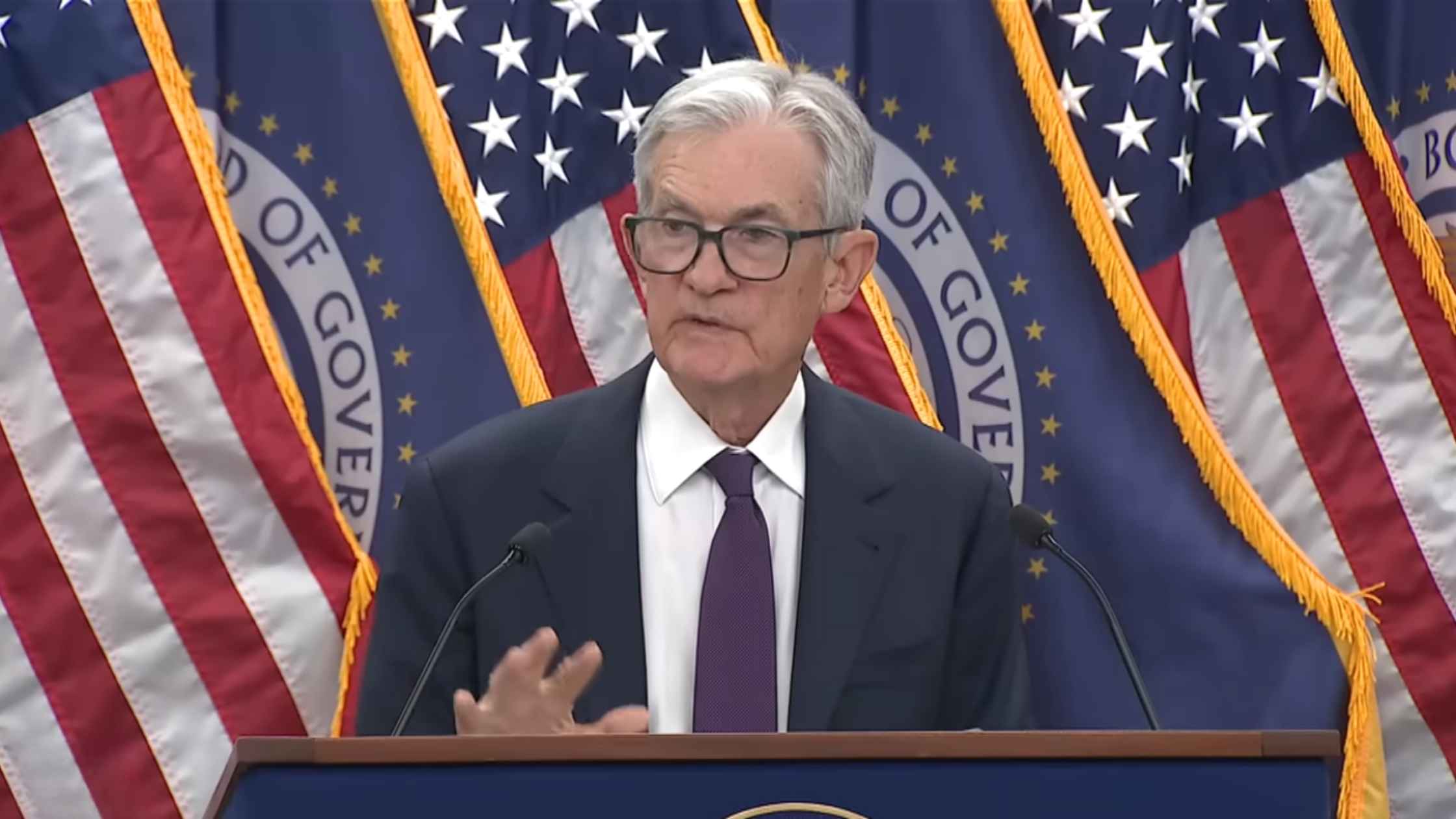
Jerome Powell (00:04):
Good afternoon. My colleagues and I remain squarely focused on achieving our dual mandate goals of maximum employment and stable prices for the benefit of the American people. The U.S. economy expanded at a solid pace last year and is coming into 2026 on a firm footing. While job gains have remained low, the unemployment rate has shown some signs of stabilization and inflation remains somewhat elevated.
(00:35)
In support of our goals, today the Federal Open Market Committee decided to leave our policy rate unchanged. Having lowered our policy rate by 75 basis points over the course of our previous three meetings, we see the current stance of monetary policy as appropriate to promote progress toward both our maximum employment and 2% inflation goals. I will have more to say about monetary policy after briefly reviewing economic developments.
(01:02)
Available indicators suggest that economic activity has been expanding at a solid pace. Consumer spending has been resilient and business fixed investment has continued to expand. In contrast, activity in the housing sector has remained weak. The temporary shutdown of the federal government likely weighed on economic activity last quarter, but these effects should be reversed as the reopening boosts growth this quarter. In the labor market, indicators suggest that conditions may be stabilizing after a period of gradual softening. The unemployment rate was 4.4% in December and has changed little in recent months. Job gains have remained low. Total non-farm payrolls declined at an average pace of 22,000 per month over the last three months. Excluding government employment, private payrolls rose at an average pace of 29,000 per month. A good part of the slowing in the pace of job growth over the past year reflects a decline in the growth of the labor force due to lower immigration and labor force participation, though labor demand has clearly softened as well. Other indicators, including openings, layoffs, hiring, and nominal wage growth show little change in recent months.
(02:22)
Inflation has eased significantly from its highs in mid-2022, but remains somewhat elevated relative to our 2% longer-run goal. Estimates based on the Consumer Price Index indicate that total PCE prices rose 2.9% over the 12 months ending in December, and that excluding the volatile food and energy categories, core PCE prices rose 3.0%. These elevated readings largely reflect inflation in the goods sector, which has been boosted by the effects of tariffs. In contrast, disinflation appears to be continuing in the services sector. Near-term measures of inflation expectations have declined from last year's peaks as reflected in both market and survey-based measures. Most measures of longer term expectations remain consistent with our 2% inflation goal.
(03:16)
Our monetary policy actions are guided by our dual mandate to promote maximum employment and stable prices for the American people. At today's meeting, the committee decided to maintain the target range for the federal funds rate at 3.5 to 3 3/4%. Since last September, we have lowered our policy rate 75 basis points, or three-quarters of a percentage point, bringing it within a range of plausible estimates of neutral. This normalization of our policy stance should help stabilize the labor market, while allowing inflation to resume its downward trend toward 2% once the effects of tariff increases have passed through. We are well positioned to determine the extent and timing of additional adjustments to our policy rate based on the incoming data, the evolving outlook, and the balance of risks. Monetary policy is not on a preset course, and we will make our decisions on a meeting-by-meeting basis.
(04:13)
To conclude, the Fed has been assigned two goals for monetary policy, maximum employment and stable prices. We remain committed to supporting maximum employment, bringing inflation sustainably to our 2% goal, and keeping longer term inflation expectations well anchored. Our success in delivering on these goals matters to all Americans. We, at the Fed, will continue to do our jobs with objectivity, integrity, and a deep commitment to serve the American people. Thank you. I look forward to your questions.
Speaker 1 (04:43):
Chris.
Chris Rugaber (04:47):
Hi. Chris Rugaber at Associated Press. Thank you. I wanted to ask, you attended the Supreme Court hearing last week on the Lisa Cook case, and Treasury Secretary Scott Bessent criticized that as political. Can you say why you attended and what you would say in response to the secretary's criticism?
Jerome Powell (05:10):
So let me start with, I don't respond to comments by other officials, whoever they may be. It's just not appropriate to do that. I will tell you why I attended. I would say that that case is perhaps the most important legal case in the Fed's 113-year history. And as I thought about it, I thought it might be hard to explain why I didn't attend.
(05:35)
In addition, Paul Volcker went to a Supreme Court case famously in I guess 1985 or so. So it's precedented, and I thought it was an appropriate thing and I did it.
Speaker 1 (05:46):
Great. And then just quickly follow on the job market, you mentioned last month that the household survey might be distorted and you also mentioned the potential for over counting jobs, which would suggest that we are still in a negative hiring pace. So do you see that drop in the unemployment rate as solid, and what's the basis for saying that things have stabilized? Thank you.
Jerome Powell (06:16):
Yeah, really two questions. One is, so we're getting through the distortions in the data from the shutdown. However big they were in November, they're smaller in December. So we're getting to a place where they're no longer material. They're still there, but it's a tweak here and there. The reason why we changed the statement, let me pull it out, was simply, it used to say that judges that downside risks to employment rose in recent months. So we saw data coming in, which suggests some signs of stabilization. I wouldn't go too far with that, but some signs of stabilization. There are also some signs of continued cooling. And so we thought that was no longer an accurate description of the data.
(07:01)
In addition, the outlook for economic activity has clearly improved since the last meeting, and that should matter for labor demand and for employment over time. So for those two reasons, we thought we would take that language out of the statement.
Chris Rugaber (07:23):
Thank you.
Speaker 1 (07:24):
Nick.
Nick Timiraos (07:24):
Nick Timiraos, the Wall Street Journal. Chair Powell, you've generally avoided engaging with political controversies directly, and the video statement on January 11th was a departure. What made this different, and are you concerned it could draw the institution further into political debates?
Jerome Powell (07:42):
I'm simply going to refer you to the statement that I made on January 11. I'm not going to expand on it or repeat it. So I'm just not going to ... This is really about the press conference and the economy and what we did today and some ancillaries, but I'm not going to be getting into that.
Nick Timiraos (07:59):
Can you say whether the Fed has responded to the subpoenas?
Jerome Powell (08:02):
I have nothing for you on that today.
Speaker 1 (08:10):
Mike.
Michael McKee (08:10):
Michael McKee from Bloomberg Radio TV. Have you made a decision on whether you would remain as a governor of the Federal Reserve? And if so, would you tell us what it is? And if not, when might we anticipate a decision?
Jerome Powell (08:25):
No. And I really, once again, have nothing for you on that today, that either.
Michael McKee (08:32):
Why would you want to leave at all under the circumstances?
Jerome Powell (08:36):
Again, I don't want to get into this. There's a time and place for these questions, but not something I'm going to be getting into today. Thank you.
Speaker 1 (08:48):
Claire.
Claire Jones (08:52):
Thank you. Claire Jones, Financial Times. Thanks a lot for taking my questions. And another one that might lead to a similar answer.
Jerome Powell (09:02):
Give it a try.
Claire Jones (09:05):
We've seen quite big movements in the dollar over recent days. What do you think is driving the U.S. currency lower? And have you been at all concerned just by the extent of the volatility we've seen this week? Thank you.
Jerome Powell (09:19):
Claire, as you probably know, we don't comment on the dollar. Really the administration, especially the Treasury Department, has the job of oversight over the currency and exchange rates and all that. We don't comment on that. It's not our role, so I have nothing for you.
Claire Jones (09:36):
I mean, what's your view on the market movements? I mean, what do you think behind them? Is it asset managers diversifying? Is it ...
Jerome Powell (09:42):
Yeah, we don't talk about the dollar. We don't talk about what moves it around. It's just not appropriate for us to do so. Really, the Treasury Department has that. It's their role, their bailiwick, and we stay off it. We do monetary policy and some other things, but we don't comment on the dollar. Sorry.
Speaker 1 (10:04):
Neil.
Neil Irwin (10:04):
Hi, Chair Powell. Neil Irwin with Axios. Obviously no SEP in this meeting, but in light of the slight firming up of the language around growth in the labor market and the statement, should we assume that the timeline for any further rate cuts is pushed back compared to what people might have thought in December?
Jerome Powell (10:19):
Well, first of all, if you look at the incoming data since the last meeting, clear improvement in the outlook for growth. The data have come in and sentiment, the Beige Book, everything comes in suggesting that this year starts off on a solid footing for growth. Inflation performed about as expected, and as I mentioned, some of the labor market data came in suggesting evidence of stabilization. So it's overall a stronger forecast, really, if that's your question. I'm not sure I answered your question.
Neil Irwin (10:55):
But in terms of timing or pacing of any additional easing.
Jerome Powell (11:01):
What we'd say about this was that after this meeting, after the three recent rate cuts, we're well positioned to address the risks that we face on both sides of our dual mandate and we'll continue to make our decisions meeting-by-meeting, based on the incoming data and the implications for the outlook and the balance of risks. Haven't made any decisions about future meetings, but the economy's growing at a solid pace. The unemployment rate has been broadly stable, and inflation remains somewhat elevated. So we'll be looking to our goal variables and letting the data light the way for us.
Speaker 1 (11:33):
Steve.
Steve Liesman (11:39):
Steve Liesman, CNBC, and sticking with questions you might answer. Thank you. You had previously, I believe, described the current policy rate being at the higher end of neutral. And if you look at the longer-run, the SEP and the longer-run rate, 16 of 19 officials are actually below there on their long
Speaker 2 (12:00):
... long run. Is the Fed still in a process of bringing it down towards a middle range of neutral and what would it take to get there?
Jerome Powell (12:08):
So the count I did was that four of the 19 were at or above that. Maybe I missed by one, but I thought it was four. And if you look at the dealer survey, it was 10 out of 58 where we're at or above. So you're right. It's the higher end of the range. What we say is it's within the range of plausible estimates. This is the higher end of that range, but for some people, they think it's neutral.
(12:36)
I think, and many of my colleagues think, it's hard to look at the incoming data and say that policy is significantly restrictive at this time. It may be sort of loosely neutral or it may be somewhat restrictive. It's in the eye of the beholder and of course no one knows with any precision. So if you had a follow-up.
Speaker 2 (12:58):
I get what you're saying, but some officials have described the Fed being in a mode of bringing it down eventually over time. Are you still in that mode or is this a place to hang out?
Jerome Powell (13:10):
Yeah, no. I would say if you look at the SEP from December, most people had additional normalization. But at the same time, we've done a lot of the process of normalizing. A good piece of it is done with 75 basis points and before that, 100. So 175 basis points we've cut since we began cutting in September of 2024. So you've moved now to three point ... Fed funds is running just a little below 3.65%. So you've moved a good way and we think we're well positioned here to watch how the economy performs, look at the data. We're not making decisions about future meetings, but we do think we're well positioned after those three cuts to let the data speak to us.
Speaker 3 (13:59):
And Mayor. Thank you Chair Powell. [inaudible 00:14:00] from Bloomberg News. To what extent did the committee discuss the possibility of cutting at this meeting or in March? And how are you all thinking about the conditions that would merit another rate cut? Is there broad agreement on the committee about what it would take?
Jerome Powell (14:14):
So there was broad support on the committee for holding today. Broad, I would say, including among non-voters. So that's where that was. Of course, some people did want to cut and dissented, but committee pretty broadly for holding today.
(14:33)
We're not trying to articulate a test for when to next cut or whether to cut at the next meeting. What we're saying is we're well positioned as we make decisions meeting by meeting, looking at the incoming data, evolving outlook and all that. And we're in a position where we still have some tension between employment and inflation, but it's less than it was. I think that the upside risks to inflation and the downside risks have probably both diminished a bit. So we'll be looking at that. It's about how you weigh the risks to the two goals and quantify them. And so there are different views on the committee and we'll find our way forward as the data evolve.
Speaker 3 (15:22):
Thank you.
Speaker 4 (15:23):
Thank you, Mr. Chairman. Edward Lawrence from Fox Business. Has the effects of tariffs already moved through the economy on prices?
Jerome Powell (15:33):
A lot of it has. So basically, there are many different estimates and they're all highly uncertain, but most of the overrun in goods prices is from tariffs. And that's actually good news because if it weren't from tariffs, it might mean it's from demand and that's a harder problem to solve. We do think tariffs are likely to move through and be a one time price increase. So most of the overshoot, if you were to take that out, you'd get ... I mean, core PC inflation is running just a bit above 2% X the effects of tariffs on goods.
(16:11)
And the other good news is, if you look away from goods and look at services, you do see ongoing disinflation in all the categories of services. So that's a healthy development. So that's what's going on. The expectation is that we will see the effects of tariffs flowing through goods prices, peaking and then starting to come down, assuming there are no new major tariff increases that are begun. And that's what we expect to see over the course of this year. If we see that, that would be something that tells us that we can loosen policy.
(16:46)
Also, if we see something that suggests that the labor market is not stabilizing, that in fact the downside risks reemerge or the data just get worse, we'd have to look at both of those. We have a two-sided mandate.
Speaker 4 (16:58):
Oh, if I could, if President Trump does pick a new Fed chairman before May, what does that look like? How would you work with that person and what does that transition period look like?
Jerome Powell (17:07):
I don't have anything for you on that. That will depend on Congress's actions and things I can't speculate on.
Speaker 5 (17:17):
Howard.
Speaker 6 (17:19):
Howard Schneider with Reuters. Thank you for taking our questions. Given the changes in the statement and all you've said so far, is it fair to describe risks to both sides of the Band- Aid as roughly balanced right now and is the next move necessarily down?
Jerome Powell (17:37):
I'd say that again, the upside risks to inflation and the downside risks to employment have diminished, but they still exist. So there's still some tension between the mandates. Are they fully in balance? Hard to say. Hard to say. And again, we think our policy is in a good place. I've just discussed reasons why we might change our policy and we'll just have to see how the data lead us.
Speaker 6 (18:09):
I'm wondering, a minute ago you said you felt expectations were consistent with your mandate that the two and the 10-year break evens have moved quite notably in the last couple of weeks, I believe. Is there any concern on that front?
Jerome Powell (18:23):
I mean, I recently looked at all of the both survey and market based short term inflation expectations have come way down. They were in a good place at the beginning of last year. They spiked around Liberation Day and now they've fully retraced in the last few months. So that's very comforting. And the longer term inflation expectations have remained in places that are very consistent with 2% inflation over time. So expectations have been solid and they reflect confidence in the return to 2% inflation.
Speaker 5 (18:59):
Andrew.
Speaker 7 (19:02):
Apologies if this is a little bit repetitive, but in the past you've said that the reason you cut rates was that the risk to the labor market was greater than the risk to the inflation side. Is that still true?
Jerome Powell (19:16):
You're right. We saw the labor market weakening and we acted and I think that was the appropriate thing to do. We will always act to address what we see as the economy moving away from our goals. Risks to both of the variables are a little less. I think that the upside risk to inflation, again, a little bit less and the downside risk to employment a little less. I just would say that I'm not making a judgment about how one of them is more at risk than the other. Just that the risks to both of them have diminished.
Speaker 7 (19:55):
Okay, thanks. BIS wrote a paper last summer, which concluded that global investors were hedging their dollar exposures in ways that previously they hadn't because of policy uncertainty. Do you agree with BIS?
Jerome Powell (20:08):
We really don't see much at all about that, that whole story. There's just not a lot of data that suggests that there's much to that.
Speaker 7 (20:17):
Thanks.
Speaker 5 (20:17):
Anna.
Speaker 8 (20:21):
Anna Swanson with the New York Times. Can you talk more about what you would need to see in the labor market to conclude its time to resume easing? Do you need to see further deterioration in the labor market or would it be enough for inflation to soften?
Jerome Powell (20:35):
So we'll always be looking at both things. And so there could be combinations, infinite numbers of combinations that would cause us to want to move. Certainly, a weakening labor market would be an argument for loosening, but what's happening with inflation? If inflation were at the same time getting worse, you just have a very difficult situation there. So we'll be looking at both. Clearly, a weakening labor market calls for cutting. A stronger labor market says that the rates are in a good place. We'll have to be making similar judgments too on inflation though.
Speaker 8 (21:05):
And if inflation does pick back up and the labor market doesn't show further signs of deterioration, is there a chance that you could raise rates rather than simply remaining on hold? What would you need to see to consider hiking?
Jerome Powell (21:16):
We don't take things off the table, but it isn't anybody's base case right now, anybody's base case, that the next move will be a rate hike. But ultimately, we'll do what we think is the right thing, but that's not where people's expectations are right now.
Speaker 5 (21:33):
Victoria.
Speaker 9 (21:36):
Hi, Victoria Guida with Politico. I wanted to ask, you've talked in the past about concerns about the US fiscal trajectory, and we've seen in the Japanese bond market, a lot of turmoil recently, in part due to concerns over their fiscal and long term economic outlook. So do you worry that the US could at some point find itself in a similar situation to Japan, whether for fiscal or demographic reasons?
Jerome Powell (21:59):
Over time, you've seen that US rates have remained pretty ... They haven't moved a lot really for a while, but they haven't moved a lot because of what's been happening in Japan. So it's more of an overtime thing. The US federal budget deficit is uncontroversially on an unsustainable path. The level of debt is not unsustainable. It's very much sustainable, but the path is unsustainable and the sooner we work on it, the better. But right now we're running a very large deficit at essentially full employment, and so the fiscal picture needs to be addressed, and it's not really being addressed. So that's important.
(22:40)
I'm not in any way connecting it to some sort of near term market event, but ultimately it's something we'll have to deal with. And in the end game, that's where you wind up is in some kind of a difficult thing. But that's not where we are. It's not where Japan is either, but it's certainly not where we are right now.
Speaker 9 (22:58):
Does it reduce the effect of your rate cuts that longer term rates have overall not really budged that much?
Jerome Powell (23:05):
I wouldn't say that. The thing is, I mean, technically higher longer term rates means less accommodated financial conditions, but remember many, many things move longer term rates. And it's not mostly what happens on the short end. There can be effects of longer term rates from our moving our policy around. But it's much more assessments of the fiscal path and fiscal policies and risks and things like that that move the 10-year around. You can look back at and find periods where we've been very actively moving the policy rate over the course of a year and over the course of the 10 year is exactly where it started. So there's not a tight link between 10 year rates and the overnight rate.
Speaker 5 (23:55):
Elizabeth.
Speaker 10 (23:57):
Thanks so much. Elizabeth Schulze with ABC News.
Speaker 11 (24:00):
Republican Senator Thom Tillis, who sits on the Senate Banking Committee, said he will block any Fed nominee, including the chair, until this investigation into you is resolved. Do you support this move by the Senator? And what conversations have you had with the Senator?
Jerome Powell (24:13):
I've got nothing for you on that.
Speaker 11 (24:15):
More broadly, what would happen to American households if the Federal Reserve loses its ability to operate independent from politics?
Jerome Powell (24:26):
So really the point of independence is not to protect policymakers or anything like that. It just is that every advanced economy democracy in the world has come around to this common practice. It's just an institutional arrangement that has served the people well. And that is to have a separation between ... To not have direct elected official control over the setting of monetary policy. And the reason is that monetary policy can be used through an election cycle to affect the economy in a way that will be politically worthwhile. So I'm not talking about the US context, this is every advanced economy democracy of any size.
(25:08)
So it's a good practice. It's pretty much everywhere among countries that look at all like the United States. And I think if you lose that, first of all, it would be hard to restore the credibility of the institution. If people lose their faith that we're making decisions only on the basis of our assessment of what's best for everyone, for the wide public, rather than trying to benefit one group or another, if you lose that, it's going to be hard to retain it. And we haven't lost it. I don't believe we will. I certainly hope we won't. But it's very important. And the reason it's important is that it's enabled central banks generally not to be perfect, but to serve the public well.
Speaker 11 (25:51):
You're confident it can maintain that independence at this point?
Jerome Powell (25:54):
Yes. I mean, I'm strongly committed to that and so are my colleagues.
Speaker 12 (26:00):
Archie.
Archie Hall (26:04):
Archie Hall from The Economist. On that sort of stabilization of the labor market question, how much do you see the weakening we saw over the past six months, year, as a kind of data mirage around immigration and the government shutdown and so on that's now resolved? Or how much have we seen a kind of real underlying firming up in the state of the labor market, do you think?
Jerome Powell (26:23):
Well, part of it is, to your point, part of it just is that labor supply, growth in labor supply has come to essentially a halt from a fairly fast clip of growth over the last couple of years, driven by immigration. And then the halt being driven by a very sudden stop in immigration. So many outcomes were possible with that. Supply came way down. It turns out that demand for labor also came down a very similar amount, maybe just a little bit more, which is why the unemployment rate has gone up. So I don't know whether that's a coincidence or not, but that's what's happened with that part.
(27:03)
But if you look at other things like, for example, just to pick a couple, The Conference Board's measure of job availability that came out, I don't know, was it yesterday or today, but it shows ... It's a survey showing that workers feel like job availability is ... It's a very low reading. Just one reading, but it's an indication of softening. People, part-time for economic reasons, which is a category within the broader U6 category measure, has moved up significantly. And I could go on and on. There are lots of little places that suggest that the labor market has softened.
(27:44)
But you're right. Part of payroll job softening is that both the supply and demand for labor has come down. Growth in those two have come down. So that makes it a difficult time to read the labor market. So imagine they both came down a lot to the point where there is no job growth. Is that full employment? In a sense it is. If demand and supply are in balance, you could say that's full employment. At the same time, do we really feel like that's a maximum employment economy? It's a very challenging and quite unusual situation.
Archie Hall (28:22):
Thanks. And one more. On growth and the kind of strong growth outlook, your strengthening growth outlook you're now seeing, how much of that is the fiscal stimulus we're seeing from the Beautiful Bill, the tax cuts and all of that?
Jerome Powell (28:32):
So you're seeing it already. You don't have much of the fiscal ... I think the outlook, you're right. It's financial conditions and it's fiscal policy for '26. But you've got strong consumption that's been happening before financial conditions have been supportive, but before the fiscal effects really are shown. So essentially the economy has once again surprised us with its strength, not for the first time. Consumer spending, although it's uneven across income categories, but consumer spending, overall numbers are good. And we're benefiting from the AI build out of data centers. That's another thing we're benefiting from. But the economy overall, growth is on a solid footing, it looks like. And it's not just those things. It's just the consumers ... The consumer is filling out surveys that sound really negative and then spending. So there's been a disconnect for some time between downbeat surveys and reasonably good spending data.
Speaker 12 (29:39):
Christine.
Christine Romans (29:41):
Thanks, Chair Powell. Christine Romans from NBC News. You talked about how consumer spending is uneven. The president calls inflation defeated and solved. The FOMC says it's a somewhat elevated inflation. But you talked about those consumer sentiment surveys and public opinion polls that show that most families say the cost of living is still issue number one. What is the conversation around the table with your colleagues about how wealthier consumers seem to be driving so much of the economy and why so many families still feel like they just can't make ends meet after five years of rising prices? What is that discussion like?
Jerome Powell (30:21):
So a couple of things. One, there's something to it, in that we know that higher income households that tend to own real estate and tend to own stocks, securities, and those assets have been going up in value and increases in wealth do support spending over time. And that's clearly a part of the story. We also know that for some time now, for a year or more, we've been hearing from retailers, for example, that serve lower income customers, whether it be food or the big box stores or anything, they're saying the same thing, which is our consumers are looking to economize. They're trading down from brands and they're buying less and it's changing their buying habits and that kind of thing. So we're seeing that. And that is a reality of what we're seeing. They're still consuming, but they're feeling it in a different way.
(31:18)
I would say more broadly on affordability, we have a vast network through the reserve banks and also through the board of governors where we talk to small and large businesses and households. So we do hear a lot about affordability and we take that very seriously. And we take it to heart because one of our jobs is price stability. And so the best thing we can do for people who are feeling that squeeze is to keep inflation under control and frankly to finish the job of getting inflation back down to 2%.
Christine Romans (31:51):
You mentioned the AI build out as being positive for economic growth this year. I wonder as you look at the weakest year last year for job creation of a non-recession year since like 2003, are you concerned about AI maybe supplanting more entry-level work and entry-level jobs? And how does that play into what you're watching about the labor market?
Jerome Powell (32:12):
So everyone of course is watching AI and the deployment and trying to understand exactly what's happening. And there's a wide range of possibilities. It's hard to say. And of course anyone who uses it is amazed at what it can accomplish, right? So every technological wave will eliminate some jobs and create other jobs. And it's always been the case. If you look back, wave after wave after wave, there will be some disruption. But ultimately technology increases productivity, which is the basis for rising wages. And it may not all happen immediately, but over time, it's what enables incomes to rise, over time is rising productivity. And we always ask, "Well, this is going to be different. Is it going to be different?" And we don't know.
(33:02)
And we may in any case see in the short term jobs that are being eliminated by the capabilities of AI. We may see that. We just don't know what the overall effect is going to be. So how to think about it in macroeconomic terms, it's very hard. We can look at the aggregate data. We can analyze. For example, there is some connection that appears between the low hiring rate for recent college grads and AI, but it's not the main or only driver. You hear large companies though saying, many of them saying that they either won't be hiring for some time or that they're hiring less or that they're laying people off and they tend to refer to AI when they do that. So we're all watching and learning. And it could certainly have pretty significant effects on the economy, the workforce and our society. We don't really have the tools to address the concerns that may arise. But we have a lot of people who focus on analyzing it and try to understand what the macroeconomic implications are, which is our job.
Speaker 12 (34:12):
Beiyi.
Beiyi Seow (34:15):
Thank you, Chair Powell, Beiyi from AFP News Agency. You mentioned earlier that on inflation the broad expectation was for a one time price increase and then for inflation to come down. And I was wondering, is your expectation still for inflation to start cooling in the second half of 2026? And if you could elaborate how far we are from target currently? Thank you.
Jerome Powell (34:37):
So how far we are from target is, as I mentioned in my opening remarks, we had 3.0% core PCE inflation over the 12 months ending in December. And that's pretty much what we had the year before. So on net, no progress. But the story behind that is modestly positive, in that most of the overshoot was in goods prices, which we think is related to tariffs. And ultimately we think those will not result in inflation, as opposed to a one time price increase. Okay, so that's where it is.
(35:08)
In terms of you asked ... So no one thinks they will ex ante understand really clearly precisely when this will happen. But there's an expectation that sometime in the middle quarters of the year, we'll see tariff inflation topping out. So what we do is, when a tariff is put in place, we track the effect of those tariffs over a six, seven, eight, nine month period. And then you can see for that tariff how long it takes to reach a place where it's affected the price level and that's it. So we're getting better at that. And our estimate is that it'll be sometime in the middle of the year, but I wouldn't look for great precision in that. But we'll be able to see whether things are moving in that direction. I think we will be able to see.
Speaker 12 (00:00):
Speaker 13 (36:01):
Richard Escobedo.
Richard Escobedo (36:06):
Thanks, Chair Powell. I'm Richard Escobedo with CBS News. I want to look outside the US about what's happening outside our shores and how it impacts the US. Canada's prime minister said last week that there's been a rupture in the global order. And I wonder how you're thinking about geopolitical risk as it relates to the US economy.
Jerome Powell (36:24):
So I can't comment on that speech or statement, or anything like that. Geopolitical risk for us is, a lot of it is around energy, oil. And so far, we haven't, for all the turmoil, oil prices have come down, as you know. So we don't really see much.
(36:44)
Longer than that, it's trade. And, the trade, our economy has pulled through pretty well, you'd have to say, given the very significant changes in trade policy. The US economy has pushed right through. Partly that is that the way that what was implemented was significantly less than what was announced at the beginning. In addition, other countries didn't retaliate. And in addition, a good part of it hasn't been passed through to consumers yet. It's being taken by companies that stand between the consumer and the exporter. So that's where that is.
Speaker 13 (37:24):
Jennifer.
Jennifer Schonberger (37:27):
Thank you, Chair Powell. Jennifer Schonberger with Yahoo Finance. With third quarter GDP growing at 4.4% and the fourth quarter expected to have a five handle on it, as to what the Atlanta Fed is predicting, at a time when you had a government shutdown and we thought that was going to shave off some growth. You've also got the fiscal tailwinds you've talked about, big tax refunds coming, potential tariff dividend. How could you cut rates and not spur inflation in that environment?
Jerome Powell (37:55):
Well, we didn't cut rates today. But, it depends on how fast potential output is growing, right? I'm just asked in principle. I'm not saying this is what's happening. But there's growth and there's how fast the potential is growing. And at a time of high productivity growth, potential output is rising. So it really matters whether potential output is growing as fast as actual output. And it would matter over time.
(38:26)
The numbers you cite were for quarters. And quarterly GDP is, you need to look at 12 months because quarterly GDP can be very lumpy. GDP was negative in the first quarter last year. So the overall, over the year, the numbers were nothing like that. It was more in the mid-twos for the year.
Jennifer Schonberger (38:44):
And how do you explain the divide right now between strong economic growth and the job market? Is it productivity that's filling the gap? And is productivity being driven by AI at this point?
Jerome Powell (38:59):
You're right. There has been a divide of solid growth but what looked like a weakening labor market. And that can be explained by rising productivity. But I would say we do see signs of, certainly, of the unemployment rate stabilizing. So it may be we're seeing the beginning of the resolution of those two things.
(39:24)
Also, as you probably know, the lore is that when GDP and the labor market get into an argument, in the end the labor market data is more reliable. GDP data is just very hard to collect and understand. But nonetheless, I think we may be seeing that tension resolving a little bit. Too soon to say with any confidence, though.
Speaker 13 (39:49):
Matt Egan.
Matt Egan (39:52):
Matt Egan with CNN. Chair Powell, after today you have two meetings left as Fed chair. You've obviously experienced a lot during your time as Fed chair, served under multiple presidents. I'm wondering what advice you have for whoever your successor might be.
Jerome Powell (40:13):
Honestly, I'd say a couple of things. One is, stay out of elected politics. Don't get pulled into elected politics. Don't do it. And that's another thing. Another is that our window into democratic accountability is Congress. And it's not a passive burden for us to go to Congress and talk to people. It's an affirmative, regular obligation. If you want democratic legitimacy, you earn it by your interactions with our elected overseers. And so it's something you need to work hard at. And I have worked hard at it.
(40:57)
And the last thing is, it's easy to criticize government institutions in so many ways. I will tell whoever it is, you're about to meet the most qualified group of people you not only have ever worked with, you will ever work with. And when you meet Fed staff, and not everybody's perfect, but there isn't a better cadre of professionals more dedicated to the public well-being than work at the Fed.
Matt Egan (41:25):
Thanks for that answer. If I may follow up, as I'm sure you've noticed gold and silver prices have experienced historic gains of late. And I'm wondering how much attention, if any, you pay to those moves? And what message you may take from these significant price increases we've seen for precious metals.
Jerome Powell (41:45):
Don't take much message macroeconomically. The argument can be made it's that we're losing credibility or something. It's simply not the case. If you look at where inflation expectations are, our credibility is right where it needs to be. So we look at those things. We don't get spun up over particular asset price changes, although we do monitor them, of course.
Speaker 13 (42:08):
Nicole for the last question.
Nicole Goodkind (42:13):
Hi. Nicole Goodkind, Barron's. Some prominent critics have charged that the Fed's economic models are somewhat backward looking, but should be more forward-looking, incorporating things like productivity increases from AI. How do you incorporate current and future developments into your analysis and decision-making? And do you have an answer to those critics?
Jerome Powell (42:35):
Yeah. So by and large those criticisms, as somebody on the inside, they just don't make sense, and I'll tell you why. Every FOMC participant writes down a forecast every quarter, right? The Summary of Economic Projections. And that's the basis for how we think about the economy.
(42:55)
And the other thing is, what an economic model can do is it can grind up all the data for the last number of years, 50 years, let's say, and it can identify what are the relationships between variables A, B, C, D, and all that kind of thing. And it can tell you, if you change one of those variables, this is what should happen in the macroeconomy. And that's just the way it works.
(43:20)
However, the structure of the macroeconomy is constantly changing. For example, we hadn't had a pandemic in 100 years. It wasn't in the model. And we knew it from the very beginning. It was not in the model. A trade war of this scope, we'd never had that in 100 years. And so there's great uncertainty at different points.
(43:43)
Another thing I'll say is, when it comes to technological developments that raise potential output, some kind of technological revolution like happened in the '90s here and like may be happening now with AI, we're all over that. Everyone studies those periods. We're very clear-eyed about the possibility that this higher productivity may persist, and also that it may not. No one's sitting here unaware of the possibility of higher productivity. We've been talking about it for three years. It long predates the current situation. It's been going on for five or six years, we've had productivity higher. We've been talking about it that whole time.
(44:26)
So it's very much on our minds, and we are well aware that higher productivity means higher potential output and it changes the way you think about, potentially, inflation, growth, labor market, and all those things. That's all in our models. I mean, if it's a question of using better models, bring them on. Where are they? We'll take them. But I think, we certainly are in contact with anybody who does economic modeling, and we're always looking to do better at that. But that's how I think about that.
Nicole Goodkind (44:56):
Then just a quick follow-up. We've been talking a lot about tariffs and passing through, and we've been talking a lot about them for the past few months. The trade landscape is still in a constant state of flux. Announcements, threats, negotiations, they're all frequently changing. So I'm wondering how you actually track these. What data or channels are most critical to follow this in real time?
Jerome Powell (45:19):
Trade?
Nicole Goodkind (45:20):
Yeah, the impact of tariffs and how they're changing.
Jerome Powell (45:23):
Yeah. I think our staff has done a really nice job on that, and they've kind of put it together in real time. So, as I mentioned, a tariff gets put in place. You can pretty much track its effects on pricing and on everything. And so you build a model up from all of the tariffs. At the beginning, it was very much of a forecast. Now it's every cycle that goes by it becomes more informed by actual data.
(45:53)
Our forecasts were not far off. What changed was, as I think I said earlier, what changed was what was implemented was smaller than what was announced. In addition, we didn't see retaliation internationally, and I think people did generally expect that because we saw that in the past, and that really mattered, too.
(46:11)
And then the other thing is that pass-through, didn't know how fast that was going to be, the consumers didn't know how much exporters would take, how much companies in the middle would take, and how much the consumer would take. And it turns out it's a lot of companies in the middle, who, by the way, are pretty strongly committed to passing the rest of it through, which is one of the reasons why we need to keep our eye on inflation and not declare victory prematurely.
Speaker 13 (46:35):
Thank you.
Jerome Powell (46:37):
We're done?
Speaker 13 (46:37):
We're done.
Jerome Powell (46:38):
Okay. Thank you very much.