






Kaz Daughtry (00:02):
All right. Good morning everyone.
(00:05)
My name is Kaz Daughtry. I'm the Deputy Mayor for Public Safety. I'm joined here today by the Mayor Eric Adams, the New York City Police Commissioner Jessica Tisch, Councilmember Francisco Moya, and Norma Nazrio, a mother who has endured every parent's worst nightmare, the unimaginable pain of losing a child. And we are here today because no parent should ever have to experience that kind of tragedy. And this administration is committed to doing everything in its power to protect the lives of all New Yorkers, especially our young people.
(00:44)
Under Mayor Eric Adams leadership, we have taken a bold, proactive approach to public safety, using the latest tools and technology to protect New Yorkers in a smarter, more effective way. We are using innovation not just to solve problems, but also to save lives.
(01:03)
In just a moment, you will hear from the mayor about the results of one of those efforts, a milestone that reflects the power of taking action with urgency and compassion.
(01:16)
Every one of us up here takes protecting public safety personally, especially as parents ourselves, and we are going to continue to be relentless in our effort to focus on saving lives because the tragedies are largely preventable and because the lives of our young people are worth fighting for.
(01:35)
With that, I am honored to turn it over to the man leading the charge, the mayor of the safest big city in America, Mayor Eric Adams.
Mayor Eric Adams (01:44):
Thanks so much, Deputy Mayor Daughtry, and I join you. And really, I pointing out the courageous action of Norma, who's here. From the first day I met her, she was clear on, she did not want to see this occur or impact the lives of other parents. Losing her son was a painful moment, but she has done what we often have to do, and that's to turn our pain into purpose. She has been driven. She inspires me and she inspires our entire team, as we deal with justice phenomena of subway surfing and how it impacts the lives of our children.
(02:31)
And there's so many dynamics that's attached to it, including the role of social media. When you watch some of the videos and you see millions of lives and young people watching over and over again on what happens on these subway surfing and train rides, it really impacts them in a real way.
(02:55)
As a young man growing up and here in Queens, I did not have to look and see something like this on social media, that becomes not only attractive and addictive to behaviors of children, but extremely dangerous. Subway surfing is dangerous. There's no other way to get around it, and we're going to do everything that's possible, to make sure that it does not take the life of an innocent person.
(03:24)
And we're clear today as we announced we had over 200 recoveries of young people, subway surfing. Those are 200 potential lives that we could have lost because of subway surfing. It's not a game. It's not a venture. It's a dangerous action that must be dealt with appropriately.
(03:50)
The NYPD's drone operation that targets subway surfing, and their 200 rescue incidents, we know that this operation is working, and I want to thank DM Daugherty for being creative and bringing this initiative and using drones.
(04:10)
As a former transit police officer, I would patrol just from the surface level. In fact, I did not even know what the top of a train looked like. And so it was almost impossible to be able to patrol every aspect of the system.
(04:28)
Drones allow us to do just that. They can identify individuals riding on the top, side, or rear of train cars, intervening and removing them from harm way before it is too late. And this is that multi-dimensional approach to public safety that technology allows us to carry out and this is why this department is going to continue under the leadership of Commissioner Tisch, to be the leading law enforcement industry and utilizing technology to keep New Yorkers safe.
(05:08)
And you have to really understand the impact of losing a loved one to Subway Surfing, impacts not only the family, it impacts the neighborhood and impacts the school community, and it impacts our city.
(05:26)
Since November 2023, the NYPD has deployed more than 340 drone operations that have saved, potentially saved the lives of these 200 incidents that we were able to prevent. And this year alone, 125 operations resulted in 52 New Yorkers being removed out of harm's way.
(05:52)
And it's sad to say that this year, the average age of the participants, the average age has been 15 years old; 15 years old. And another startling number, the youngest subway surfer this year was 11 years old. Can you imagine a child on top of a train at 11 years old, moving at a high rate of speed, walking along the top of the train? That is unimaginable for any parent, whether the 11- year-old child or any child?
(06:33)
And I know as being a young man growing up, young people often do things that are reckless, not understanding the full impact of it. That's why we must make adult decisions to ensure that we keep them out of harm's way, as they go into the natural state of a young person of exploring.
(06:53)
But we want to continue to highlight our Subway "Surfing Kills - Ride Inside, Stay Alive" campaign, a campaign that was created and implemented by young people, to communicate directly to each other. It includes public service announcements and stations recorded by students and distributes anti-subway surfing posters designed by them as well.
(07:20)
I want to be clear. Riding outside, it's not only dangerous, but it is a crime. And we don't want to be heavy-handed in our enforcement, but we want to educate parents and students alike of how dangerous this is. And as a city, we will continue to utilize this technology.
(07:37)
In November, 2024, the NYPD launched its drone as first responder program, the first in the nation initiative that deploys drones and response to 911 calls and emergency incidents. And today's announcement is just another way our administration is leveraging the latest technology to keep New York is safe. Every accident, injury and death, is 100% preventable when you look at the subway surfing incident and we're going to do our part to prevent them.
(08:11)
I want to now turn it over to the Police Commissioner of the City of New York, Commissioner Jessica Tisch.
Commissioner Jessica Tisch (08:17):
Thank you, sir. I could have used your hat and your sunglasses. Good morning everyone.
(08:23)
Before we begin, I want to provide an update on two recent cases. First, the shooting incident involving the off-duty customs and border protection officer on Saturday. Our federal partners on the HSI Violent Gangs Task Force have now apprehended the second suspect, the alleged scooter driver. His name is Cristian Aybar Berroa.
(08:49)
Once Mr. Berroa was in custody, NYPD homicide detectives conducted a debrief of him. During that interrogation, Berroa implicated both himself and the person we had identified as a person of interest in the shooting, Miguel Mora. We expect both Berroa and Mora to be charged federally, today, by the Southern District.
(09:14)
A bit more about Mr. Berroa. He was arrested eight times between March and April, 2024 for grand larsenies and robberies involving a scooter in the Bronx. He's also a suspect in at least four additional cases. He entered this country illegally through Texas in 2022.
(09:36)
The second update is on the arson at the eight three precinct lot that occurred on June 12th. I'm pleased to report that Jakhi Lodgson-McCray, the individual responsible for setting fire to 11 department vehicles and causing at least $800,000 in damage to NYPD property, was taken into custody this morning.
Commissioner Jessica Tisch (10:00):
… the NYPD identified Mr. McCray in mid-June through forensics and video evidence, and today he agreed to surrender through his attorney. He turned himself in without incident at a food bazaar in Brooklyn, accompanied by his lawyer and his mother. He's expected to be charged federally on arson charges by the Eastern District this morning.
(10:24)
Now, I'm going to turn to another serious issue putting lives at risk, subway surfing. We've learned a lot about this issue over the past few years, and here's what we know. Subway surfing is not a trend. It's not a rite of passage, and it's certainly not viral entertainment. It's a deadly risk taken mostly by kids, often in groups fueled by social media, amplified by peer pressure and sustained by a false and naive sense of invincibility. It is Russian roulette on rails and too many kids are playing it without understanding the stakes, but we know the consequences and we are leveraging modern technology to act before it's too late.
(11:10)
Last week, as the mayor said, we hit a milestone, the 200th subway surfing rescue made using drones since we launched our transit program in late 2023. That's young lives pulled from the edge of death. That's preventing a tragedy instead of responding to it. And that success is possible because our drone teams are out there five days a week, strategically deployed to hot spots, like along the 7 Line in Queens, which accounts for almost 50% of all subway-surfing incidents.
(11:44)
This is not guesswork. These are focused deployments based on pattern analysis through 911 call data and incident response. When our pattern emerges, we send our drone teams out. They deploy around sections of elevated track, launch drones and monitor the tops of moving trains. If they spot subway surfers, they radio directly to nearby transit officers who quickly respond and get the kids down safely. It's fast, it's coordinated, and it is highly successful.
(12:16)
In fact, out of the 343 drone deployments over the past two years, nearly 60% identified subway surfers. And while these rescues often end in arrests, we call them saves because that's what we're doing here. We're saving lives and in the vast majority of cases, we're talking about children's lives. Since we've started tracking these incidents in 2022, our list of 63 repeat offenders has an average age of 14. Some of them have been caught doing this 3, 4, 5 times, and one of them a total of 13 times. This isn't a game, it's a public health and safety crisis and the cost of inaction is steep.
(13:05)
Since 2022, 16 people have died subway surfing, the youngest being 11. And 20 people have been severely injured, some lost limbs, others suffered traumatic brain injuries, many won't ever fully recover. We are not going to wait for the next fatality. We're not going to let this become the new normal. Our job is to take every step necessary to change this reckless and deadly behavior, but enforcement alone won't do that. That's why we are in homes talking directly to the families of repeat offenders. We're in the schools talking to students, warning them, educating them.
(13:46)
However, those efforts are being undermined by what kids see online, so let's be honest about what's feeding this, the videos, the views, the likes, the fake clout. Social media platforms need to take this content down, not after it's gone viral, but before it can spread. And for the app developers who gamify this deadly behavior, you are part of the problem too. We won't tolerate it and neither should app stores. That's the work we're doing and it's only possible because of strong leadership and execution at every level.
(14:26)
I want to thank Deputy Mayor Kaz Daughtry for his focus on bringing drone technology into our subway-surfing response during his time with the NYPD, and still today as deputy mayor. And of course, our chief of transit, Joseph Galata, our transit officers, our TARU drone teams for taking that vision and turning it into real measurable public safety wins.
(14:51)
Finally, I want to thank Mayor Adams for his vision on this issue. When people talk about defunding the police, what they're really talking about is stripping away the tools that make the NYPD's life-saving and crime-fighting work possible, like drones. Under Mayor Adams' leadership, for the past three years and seven months, the NYPD has not been stripped of these tools. We have been equipped with them.
(15:18)
I think I speak on behalf of so many of the women and men of the NYPD when I say that we do not take that for granted, sir, and no one else should. I watched as Mayor Adams virtually single-handedly pull the NYPD out of the defund abyss. The 200 lives saved that we celebrate today are to his direct credit.
(15:44)
Now, I want to call up someone who knows the tragic consequences of subway surfing all too well. Our friend, Norma Nazario.
Speaker 1 (15:52):
Good morning.
Speaker 3 (16:00):
Good morning.
Speaker 1 (16:03):
Morning. My name is Norma Nazario and I lost my son, Zachary, to subway surfing in 2023. Zach was only 15 years old. He has so much life ahead of him. He was an honors student, smart, kind, curious, and full of life. He loved music, sports, and school. His favorite subject was history. His teachers used to call him The Historian. He especially loved learning about New York City and the subway system.
(16:35)
Zach was the light of my life. He had so much ahead of him, although he was only a sophomore when the tragedy happened, he left such a mark on his school that this past June 23 at what would've been we have been his graduation, his high school awarded him with a diploma. That's the kind of impact he had in two years. Like so many kids, Zach spent a lot of time on social media, that's where he first saw subway-surfing videos. There was sent to him by algorithms, dangerous challenges disguised as entertainment.
(17:17)
I miss my son every single day. Yesterday was his two years and five months that he passed. Today, I'm holding Zach's funeral card in my hand and I want to say this clearly, no parent should ever have carried the child's funeral card in their wallet, in their pocketbook anywhere. That's why I'm here because we have to do more to keep our children safe and I'm grateful that Major Adams and the NYPD are some are doing something about it.
(17:56)
This Jump program is saving lives. Thank you. More than 200 lives already. That's 200 kids who were stopped before it was too late, 200 families who don't have to live with the grief I carry every day, but this can't just fall on the police. Social media companies must step up, take this videos down, please. Stop pushing dangerous challenges to our kids, they so vulnerable. You have a role to play too, and you are failing them.
(18:36)
I'm also calling on other parents, please, other parents, let's step up together. We need to talk to our children and our communities about the real dangers of subway surfing. We need to look out for each other. Please join me on this. No child should lose their life chasing likes or trying to fit in. No family should have to wake up every morning without their beloved son or daughter, like I do every day.
(19:05)
Our message is simple and urgent. Please, ride inside, stay alive. Thank you so much for having me. I would now like to introduce Counselor Member Francisco Moya to speak. I'm sorry.
Speaker 4 (19:20):
Just before you do that, ma'am, could you just hold up the picture to the camera right there? Hold it up for us.
Speaker 2 (19:32):
To Mrs. Nazario, thank you so much for your courage and your advocacy to fight, so that no other child has to go through the same suffering and family that has to go through what you're going through tonight. You're a great New Yorker and we are very thankful to have you here today. Thank you to Mayor Adams. Thank you to the police commissioner. Thank you to Deputy Mayor Daughtry. Subway surfing isn't a trend, it's a tragedy that's waiting to happen. On the number 7 train alone,
Speaker 2 (20:00):
We've seen too many young lives put at risk and family lives that are left shattered. That's why we took action. This administration took action by deploying drones in high-risk areas, especially along the elevated parts of the number seven line. They have been able to spot and stop subway surfing before it turns deadly and the results speak for themselves. Fewer incidents, no fatalities, and a clear message that safety comes first. This isn't about punishment, it's about prevention, innovation, and protecting our kids. Thanks to Mayor Adams, the NYPD, and everyone who has helped us get this drone program together, done. This is really proving to be smart solutions that really save lives. But I just have to add that some of the other things that this administration has been doing, we lost in this very district, in one of the local schools a few months ago, a young boy with subway surfing and he tragically died. We need to do more here that just doesn't bring the drone system here in place. But they've been adding programs in our schools to give kids an opportunity to get off the streets, to look at other avenues in which they can channel their abilities to be doing something more productive. Saturday Night Lights programs with the NYPD, DYCD, Mayor Adams, myself, we've put in four programs here in the district that deal with at-risk youth here as well. We've implemented programs that are now going into all of our local schools doing advocacy work with the NYPD and our schools to bring education to these schools to let them know the tragedies that can happen because of these stupid games that they're playing, just to get more likes on social media. Thank you to this administration and thank you for all those that are involved in this program that are really going out there to save lives. Thank you so much.
Mayor Eric Adams (21:51):
Thank you. Thank you.
Speaker 5 (21:56):
On topic questions? On topic, yes.
Speaker 6 (21:57):
Can you talk about how your new initiative to incorporate public safety measures into the Citizen app might apply to help reduce the number of subway surfing incidents? And can maybe drones somehow be included in that in some way?
Mayor Eric Adams (22:17):
Yes, we are. Actually, I was on the phone this morning on my way over here, communicating with some of the Citizen app personnel. What we are finding and what the Commissioner and DM Daughtry, we're looking at how do we use all forms of technology and Citizen apps currently, they have millions of viewers and the push notifications, how they can localize the information in communities, how they could assist us, and being the eyes and ears. We've always said, see something, say something, do something. This is a easy way to engage the public into public safety, to put the public into public safety now that I think about it.
(23:08)
And so we are exploring and we will be sitting down with the commissioner and the team over at Citizen app to see how we can go even further. This is a great use of technology where it is citizen driven and we believe that we can also utilize it here because if you look at particularly seven line, which is one of the highest level of subway surfing, if not the highest level of it passes by windows where people can actually see young people on top of the train. And we believe by incorporating Citizen app, it can be very helpful in that early detection and that early identification.
Speaker 6 (23:49):
Also, maybe if people see other subway surfing though and post that, I mean, do you think I might encourage, is there some way to prevent people being encouraged to subway surf by having videos?
Mayor Eric Adams (24:08):
Yes. Without a doubt. And that's why it must be a well-thought-out process of how we do it. We don't want to encourage, we don't want to become part of the problem that the social media has created, but at the same time, that early notification can be part of our rescues and that's our goal. Our goal is to rescue as many of the participant, particularly the young people involved.
Marsha (24:34):
I have-
Mayor Eric Adams (24:34):
How are you, Marsha?
Marsha (24:35):
How are you?
Mayor Eric Adams (24:35):
Good.
Marsha (24:39):
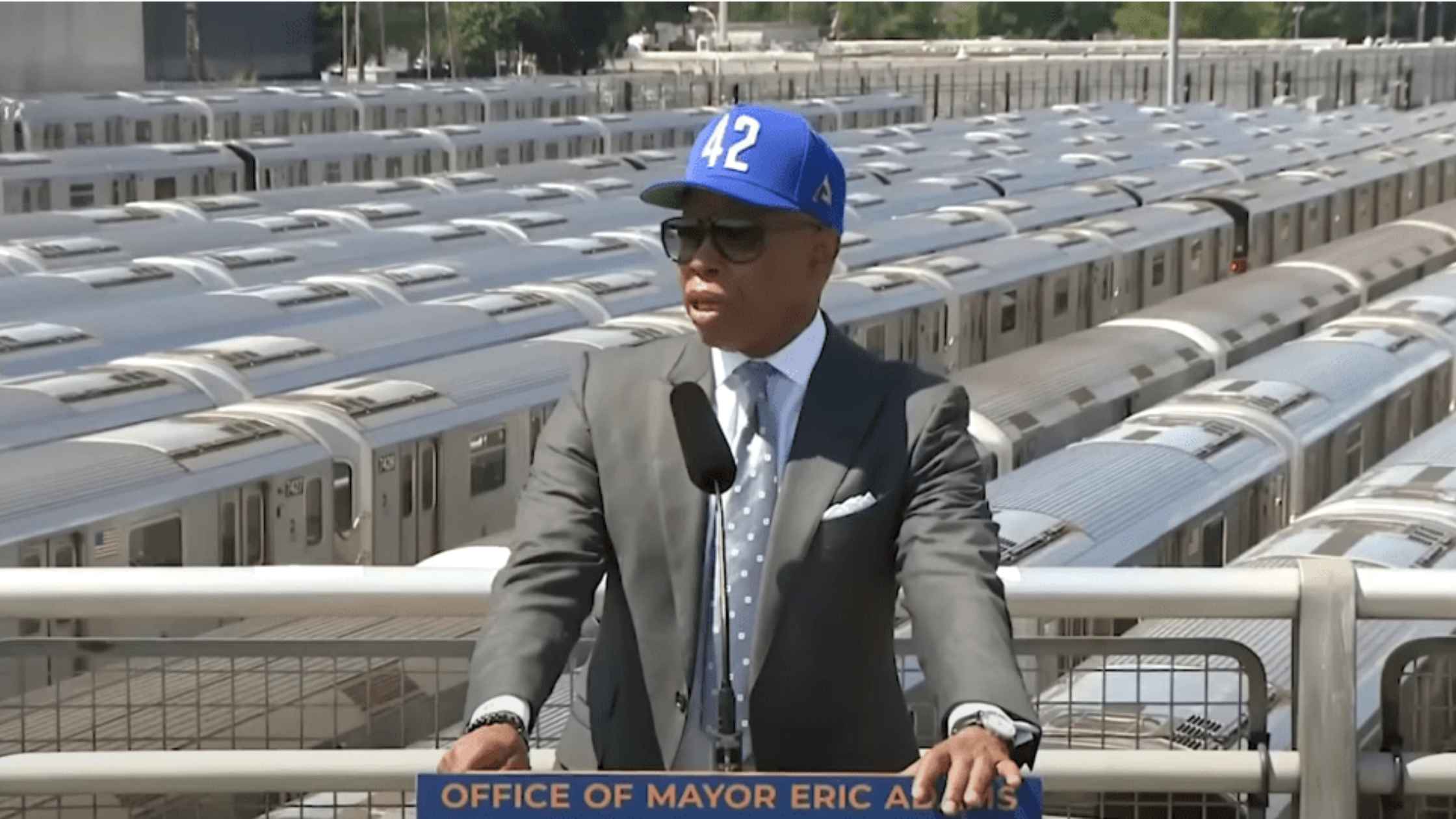
Before I forget, why are you wearing a hat that says 42?
Mayor Eric Adams (24:40):
42 is Jackie Robinson.
Marsha (24:42):
Aha. And we're here.
Mayor Eric Adams (24:43):
Yes.
Marsha (24:45):
So I have two parts of this question.
Mayor Eric Adams (24:45):
Yes.
Marsha (24:48):
But one, I wonder exactly how the drone technology works. Do you have to get a call from somebody saying somebody's on a train where the drone to go? And secondly, police commissioner talked about the idea that people who call for defunding the police could be jeopardized in a program like this. So if you could comment on both points.
Mayor Eric Adams (25:10):
Yeah. DM Daughtry, we talk about the way the system is set up. It's almost a pull-up patrol measure. As I stated, as a transit cop, I only patrol the platforms and on the train, one dimensional approach. What we have done is changed that one dimensional to an aerial approach at a cheap price, pennies on the dollars. Using helicopters, extremely expensive. Helicopters can't really go into places these drones are going. I think you're going to see an incorporation on drones in our transit patrol in many ways. These drones can patrol platforms, it can move through tunnel areas where you can't get a helicopter there. The aerial advantage these drones give us as we're seeing across the globe the use of drones, unfortunately it's used in some war action, but we're using it in a peaceful way and we're excited. We're excited about what the possibilities are.
Marsha (26:09):
[inaudible 00:26:10] a person on the subway and say, get down, get off?
Mayor Eric Adams (26:16):
Yes. Either the Commissioner or the DM Daughtry can go into that. But your first question was asking about-
Marsha (26:27):
I also want to talk about the Commissioner's comments about people calling for defunding the police.
Mayor Eric Adams (26:28):
Yes. Yes.
Marsha (26:29):
I mean, could that put a program like this in jeopardy and what other programs could be in jeopardy because of that?
Mayor Eric Adams (26:35):
Yes. Understanding the full scope of public safety, and that's probably one of the advantages I have from patrolling these subways and patrolling our streets. You're just hearing a lot of things that people are saying such as defund. When you defund these programs, you are taking away the ability to do to on your rescues. When you have concepts and belief not sending police to domestic violence incidents. Those are major impacts. Officer Mora and Rivera were assassinated on a domestic violence incident.
(27:12)
There are no routine calls for services, and when you send civilians to do the job that well-trained, uniformed personnel should do, something simple as a car stop, very dangerous for police officers. One of the most dangerous jobs you could do. And it's just having a full scope of what these programs are doing. But if you don't have number one respect for the well-trained actions of trained law enforcement officers, or don't understand what it takes to save lives and prevent people from harming others and harming themselves, you could put the officers in danger, you could put civilians in danger, and you could put the family members who are responding in danger. Just looking at the Officer de Mora and Rivera's assassination, there were family members in that house. I still reflect on looking at that chilling video of watching the level of violence that was displayed on Officer Mora and Rivera when they were assassinated. You want to talk about the patrol?
Speaker 7 (28:15):
Sure. The way it works, Marsha, is we do some data analysis of where we expect to see subway surfing and so we know the lines and the times, where and when it occurs the most. And so we will do proactive drone flights of those lines and at those times, and as I mentioned, in 60% of our flights, we actually catch people subway surfing. We don't currently use the feature that will allow someone to speak through the drone to the person that is subway surfing. What we do is our drone team will radio over to the nearest transit cops who will stop those people at the next stop and take them off the train.
Marsha (29:06):
List of places that get the most subway surfing. What's the-
Speaker 7 (29:10):
We do and we can provide that.
Mayor Eric Adams (29:12):
And we do have the feature to talk, but we don't use it in this incident. We use it at the beaches, we use it. So we do have, this technology is really just some amazing technology that's going to continue to evolve.
Speaker 8 (29:28):
Just one other thing before, on topic is this technology, as you heard Mr. Rosario say, is saving lives. Other municipalities throughout the country have been reaching out to me and asking about the technology we're using here to combat subway surfing. And what they're trying to emulate, I'm not going to go into specific cities, but they're emulating what this mayor is doing here in New York City.
Speaker 5 (29:56):
Another
Mayor Eric Adams (30:00):
Yeah. [inaudible 00:30:01] does feel off. You guys can bounce.
(30:04)
All right.
Speaker 9 (30:04):
[inaudible 00:30:05] I'll stay [inaudible 00:30:14].
(30:14)
I'm [inaudible 00:30:14].
(30:14)
[inaudible 00:30:14].
Kelly (30:14):
All right [inaudible 00:30:15]-
Mayor Eric Adams (30:18):
I like that. I like that. Good idea.
Kelly (30:20):
All right, Mr. Mayor. How are you?
Mayor Eric Adams (30:21):
What's up, Kelly? How are you?
Kelly (30:23):
Good. I'm good.
(30:23)
I wanted to ask you, earlier today, Secretary Noam criticized sanctuary city mayors, including yourself, about your policies in connection to the shooting of the Border Patrol officer and said sanctuary cities are unsafe and [inaudible 00:30:37] to that shooting. Your response to that?
Mayor Eric Adams (30:38):
Well, if you're covering the story, I'm sure you're going to correct it and let everyone know that I have nothing to do with the rules that are put in place. I just carry out the rules. The rules are if you're in the city of New York, you have a right to services; to go to the hospital, educate your children, you have a right to get police services if need be.
(31:02)
When you do an analysis of this case, we arrest people; the courts determine if they're going to stay in jail or not. This person has been part of a revolving door criminal justice system and allowed to get back on the streets. And I'm sure in the last three years and seven months that you've covered me, you know how outraged I am because of Andrea's bail reform laws on how we have this revolving door criminal justice system. So I am extremely angry that we have a custom border patrol officer that is in the hospital because a person that should have not been on our street was on our street. And I've said this over and over again.
(31:46)
And so when you hear people who defend the shooter, they defend my actions of coordinating with federal authorities to take dangerous people off the streets, that is who they're protecting. I'm not protecting them. I'm very clear, always have been clear: stop the revolving door system, go after the dangerous migrants and asylum seekers who are here, and allow hard-working people who are in this city to go on with their lives as they go through the processes.
(32:15)
So I'm sure in your reporting you will correct that problem for me.
Kelly (32:21):
Okay, I just want to follow up. Tom Donlan's lawyer today filed a defamation complaint against you for your accusations about mental health. He claims you only talked about his cognitive health and deflected from the serious claims in his lawsuit last week. Your response to that new defamation complaint.
Mayor Eric Adams (32:38):
I know many of you won't talk about it, but if you see the original report, the original complaint, you see the misspels, you see the grammatical errors, you see the space. There was a rush. And so this will be handed out in court.
Marsha (32:57):
So-
Mayor Eric Adams (32:57):
How are you?
Marsha (33:00):
I'm okay, Mr. Mayor.
Mayor Eric Adams (33:00):
Good.
Marsha (33:00):
Another follow up because Kristi Noem, when she was here this morning to talk about the shooting of the border patrol agent-
Mayor Eric Adams (33:00):
Mm-hmm.
Marsha (33:00):
… [inaudible 00:33:08]. And while I don't [inaudible 00:33:13] agree to what she said [inaudible 00:33:14] I do have the transcript.
(33:00)
Talk about the fact that while you did that [inaudible 00:33:20] locations [inaudible 00:33:22] work with [inaudible 00:33:23]-
Speaker 10 (33:00):
We love you, Mayor. You're my guy.
Marsha (33:00):
… [inaudible 00:33:29]. So-
Speaker 11 (33:00):
[inaudible 00:33:28] your first question.
Marsha (33:00):
What, sorry?
Speaker 11 (33:00):
That was the first question [inaudible 00:33:30].
Marsha (33:00):
I know, but [inaudible 00:33:30].
Mayor Eric Adams (33:31):
If it's okay, Scott [inaudible 00:33:32] the cameras catch it when the guy said … Oh, make sure you got that. Make sure you record that. [inaudible 00:33:39].
Marsha (33:38):
I think you should respond to exactly what she said. She said, "We wish we had that kind of partnership with Mayor Adams. And I know you guys have got a leadership election coming up in this city that's going to be happening soon. Boy, start looking at the candidates today and see which one is going to start making the city safer. Because you've got a mayor today that could have done better and could have done better, and maybe he'd have more support today if he had put the people first."
(34:04)
So I want you to respond to that comment.
Mayor Eric Adams (34:07):
I think that she's accurate. You should look at the candidates and determine who's going to do the best for this city.
(34:17)
When it comes down to migrants and asylum seekers, you know, handling 237,000, 90% have gone on to the next step in their journey. What we have done in ensuring that about 112,000 have gone through our application process center, what we have done to make sure we don't have children and families sleeping on the streets, that's in the spirit of what we do as New Yorkers. And so I think she's accurate that we should do an analysis in that area, that we should do an analysis of who we want to run this city during crises, and who has been fighting against the far left mindset that we should have porous borders and open borders.
(35:03)
And the history is going to show and the facts are going to speak on my behalf how well we've done at the city. We took down several gang members with our task force; what we have accomplished on taking dangerous people off the street that not only have been impacting the lives of documented New Yorkers, but undocumented New Yorkers. And so we know what we are doing. My job is to keep our streets safe, to make sure that people are brought to justice. It's not my job to navigate the judicial system. Yeah?
Speaker 12 (35:50):
[inaudible 00:35:47], Mayor Adams. [inaudible 00:35:52], dawg. For real.
Marsha (35:50):
Are you really saying, Mr. Mayor, that somebody with a far left viewpoint is not going to keep the city as safe as you would keep it?
(35:50)
[inaudible 00:35:58].
Mayor Eric Adams (35:50):
Go ahead. I'm sorry, go ahead.
Marsha (35:59):
Are you really saying that somebody with a far left mindset is not going to keep the city as safe as you might keep it?
Mayor Eric Adams (36:07):
Well, I think that we have to be clear. There's a balance between humane treatment and very clear actions, and we've shown that. I have not let any areas to be gray on where I stand on those who are here doing the right thing and pursuing the American dream and those who are here who are turning that dream into a nightmare. That clarity has not been lost for me. I don't think anyone has been more direct on what we're going to do. We're going to allow people to use the services their tax dollars pay for, but we're going to go after those who commit violent acts in our country, in our city.
Speaker 6 (36:47):
Thank you. Just a quick follow up though.
(36:51)
As you said, we know how outraged you are about the situation overall.
Mayor Eric Adams (36:56):
Yes.
Speaker 6 (36:56):
But the fact that Secretary Noem and the Border Patrol specifically named you; they tweeted out, "Detainers were ignored thanks to Eric Adams for NYC sanctuary city policies"; the fact that they'd single out you regarding the shooting of their agent, how do you feel about that?
Mayor Eric Adams (37:19):
Yeah, you guys are confusing me. You know that? When they say I do a good job, you attack me and say that they never criticize me and I never criticize them. Although we've taken administration to court more than any mayor in the country. And when they say I did something wrong, you're saying, "Why aren't you upset that you did something wrong?" You can't have it both ways. You know?
(37:42)
We are not joined at the hip. They have an analysis apart of what I do and the city that they disagree with, and when we lost the $80 million that they called back, I disagreed with. That's what governments and that's what people do. There are places you agree, there are places that you disagree.
(38:01)
So I thank you for being so outraged that someone mentioned my name, but when they mention my name of the good things I do, y'all say I'm in the pocket, I'm under the thumb. I mean, which one is it? I'm a little confused here, you know?
(38:18)
They have their perspective, I have my perspective, and then we come together sometimes, such as we were able to get the stop work order lifted that allowed a multi-billion dollar project to happen. That's what government do.
(38:31)
Yes. And Jay. Let's get in Jay before I bounce.
Jay (38:34):
Thank you, sir.
(38:35)
As a result of the shooting over the weekend, Tom Homan is now saying, his words, "I'm going to flood the zone in New York City with ICE officers." Do you welcome that?
Mayor Eric Adams (38:48):
To do what? To go after dangerous people like this individual who shot an innocent custom border patrol agent; he's lying in the hospital when I went to see him, heavily sedated; he was shot while sitting down enjoying the heat? If he's going to assist us to go after those individuals, I welcome it. If it's going to be to go after every day individuals who are trying to complete the path to be a citizen, then I don't think we should do that.
(39:17)
Okay.