Speaker 1 (00:00):
The senator from Michigan.
Senator Elissa Slotkin (00:02):
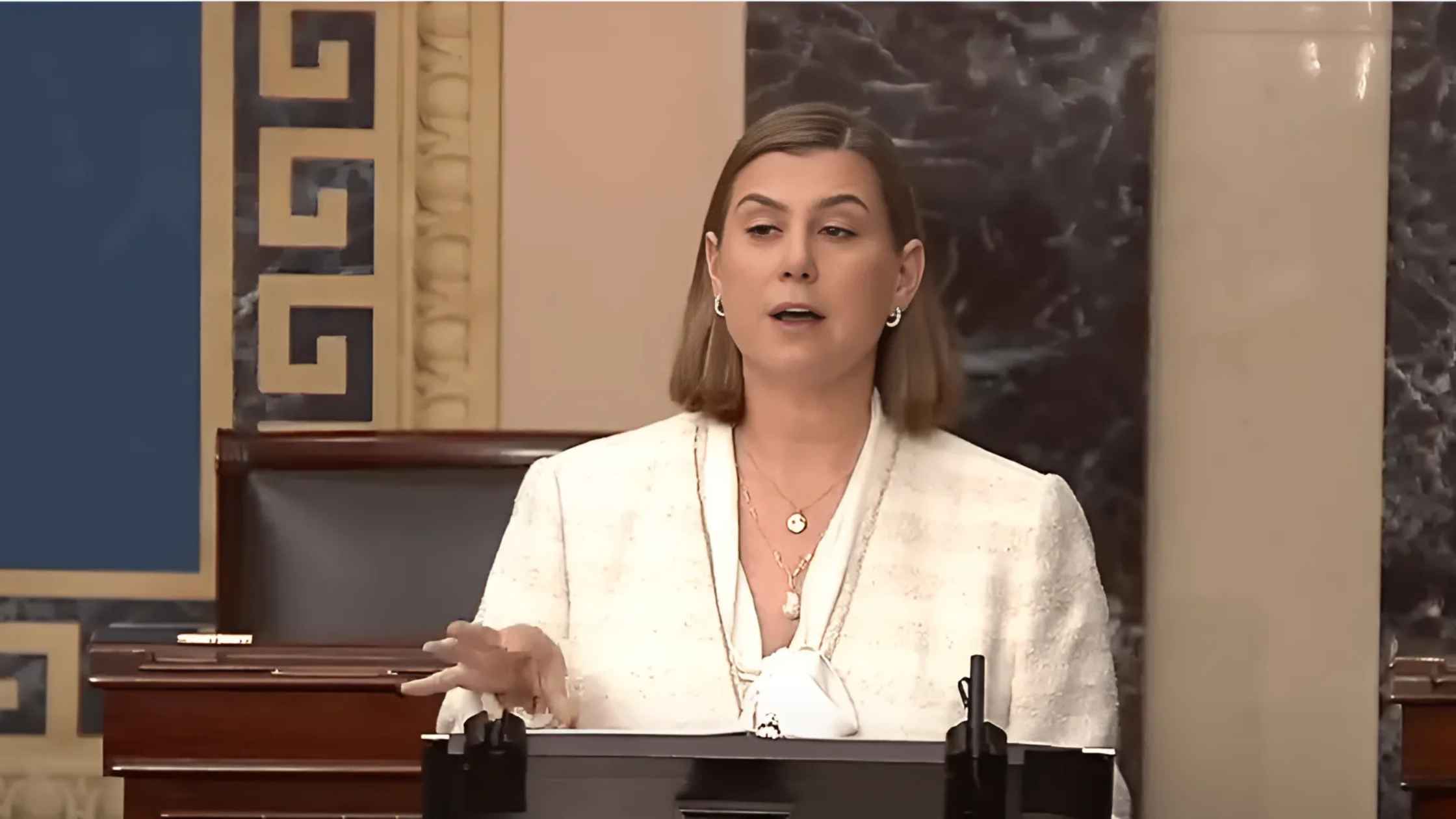
Mister President, I rise today to deliver my maiden speech. This is a proud and personal moment for me to represent my home state of Michigan as a junior senator alongside Gary Peters, and to follow in the footsteps of legendary senators like Debbie Stabenow and Carl Levin.
(00:22)
This maiden speech has been a long-standing tradition in the Senate. Every junior member gets to deliver in their freshman year, their vision for their state and what they plan to do in their time in office. Thank you to my colleagues from both sides of the aisle who have joined me, and to my great staff and my interns, even my niece who came in.
(00:44)
If you remember nothing else, I want you to remember two things. First, nothing is more important to me than the state of Michigan. I'm a third-generation Michigander. For me, Michigan is where it all started. Everything I've done in my life, everywhere I've gone, everything I've done, everyone I've met, it all started in Michigan. It's where I learned the values that still shape me today. Community, putting your head down and working hard, taking care of your neighbors when they are in need. Nothing matters more than my home state. So, this speech is my love letter to the state of Michigan. To stand here and represent the state that I love on the floor of the US Senate is the greatest privilege of my life.
(01:30)
Second, my goal for my time in office is to address what I believe to be the existential threat of our time to my state and to all Americans, the threat of a shrinking middle class. Now, I'm a national security person by training. I'm what's called a 9/11 baby. I happened to be in New York City on my second day of graduate school when 9/11 happened. I was recruited into the CIA right out of grad school and I served three tours in Iraq alongside our military before serving at the Pentagon.
(02:02)
I served proudly under presidents, both Democrat and Republican. I've come face-to-face with some of the greatest threats facing our country, but I believe in my bones that the single greatest threat today to our national security is not coming from abroad, but coming from the very real threats that come from that shrinking middle class.
(02:23)
So, my goal as a senator is to deliver for Michigan's middle class, to expand it, to secure it. That mission is personal. Michigan is where my family achieved that very American dream. My great-grandfather at 13 years old came through Ellis Island, not speaking English. He ended up starting a meat company, moved to Michigan and built that business, and built an iconic hot dog that Michiganders have enjoyed for 60 years. Michigan has been the place where hard work means something. It's where the middle class was literally invented. Where you could work at an auto plant and afford the car that you were building. That was a revolutionary idea at the time. It shouldn't be revolutionary now.
(03:11)
So, as a U.S. senator, my highest priority is to help make Michigan a place where that American dream is achievable again. Today, too many Michiganders are falling out of that middle class. Too many families can't get in at all. I live on my family farm in Holly, Michigan. Growing up, I was surrounded by families whose path to the middle class ran through Michigan's factories, our farms, our small businesses. We are people who build things and grow things. People proud of their role in manufacturing Americans' future. Our cars, our tanks, our food. People who, like my great-grandfather, were prepared to work hard for success and often achieved it.
(03:53)
But over the years I've watched younger generations of those same families live a very different story. Parents can't provide for their kids what was provided to them. That fishing cabin up north that dad had, the son can't have. A trip to Disneyland, can't do it. Across Michigan, there are so many families who feel like hard work doesn't seem to be enough anymore. No matter what your political views are it is just a fact that the middle class has shrunk over the past 40 years.
(04:27)
And I've seen firsthand what happens next. When people feel like they can't get ahead, when they can't provide for their kids what was provided for them, they feel anger, they feel shame, they lose their dignity and they look for something or someone to blame. In a multiracial, multiethnic experiment in democracy, people end up blaming people who don't look like them, or speak like them, or pray like them. I've seen this up close and personal, how that kind of anger and suspicion can tear communities apart.
(05:02)
If you want to understand how we got to this moment in our politics, this angry, vitriolic, polarized moment in American history, all you have to do is understand that shrinking middle class. So, even among today's chaos, especially now, there are things we have to do, simple things to bring back that middle class and make it thrive. This is my north star. It will guide my work in the Senate.
(05:32)
Okay, so how do we do that? Our government certainly needs to change. I don't think it's hard to understand that our government is not working for a majority of Americans, not just Republicans, Democrats as well. And you have to hear that loud and clear. Fundamentally, I believe that government needs to get back to the basics. No one cares about your trick plays if you don't have your fundamentals right. Government needs to set the conditions for success, and Michiganders and Americans need to work hard to achieve that success.
(06:06)
These basics are jobs that pay you enough to save every month. Healthcare you can actually afford. A home you can call your own. Schools that prepare our kids for the workforce. Energy to power our lives. An environment we can pass on to our kids. And safety and security from fear. That is it.
(06:28)
First, on jobs, we need job creation for Michigan's middle class to create the jobs of the future. Imagine that the middle class is basically a ship at sea, for the better part of 40 years it's been taking on water, and now we're about to hit a Category 5 hurricane in the form of artificial intelligence. Artificial intelligence has the potential to change our economy more than the internet did. Think about that. Productivity will go up, jobs will be gained, but jobs will also be lost. Maybe not Michigan jobs at first. Entry-level college jobs like paralegals or accountants are probably first on the list, but change is coming and we need to be ready.
(07:10)
Job creation in the era of artificial intelligence means supporting our small businesses. Small businesses employ of half of all Americans. They are intrinsic to the American dream. It's about betting on yourself. And we need to own the fact that it is hard to start and succeed as a small business. We need to make life easier for Michigan's small businesses.
(07:34)
Second, we need to bring critical industries and critical supply chains back home to the United States. Michiganders understand this better than most, because of what we do, our manufacturing. No foreign country should ever have a veto on our economic security. We should always make critical items here in the United States, and I want to bring as many of those jobs and industries back to Michigan.
(07:57)
And finally, let us say it very clearly. We need an immigration system that actually works and is keyed to our economy. Immigrants are critical for our labor shortages in our factories, in our hospitals, in our firms. More than that, we are a nation of immigrants. I'm standing here today because my great-grandfather left fear of persecution and death at 13 years old, and found a place in America. So, we need an immigration plan that brings legal, vetted immigrants into our countries, keyed to our economy, sometimes more, sometimes less, and we need to have border security that literally makes sense. Without immigrants, there is no America and without immigrants, our economy will not thrive.
(08:46)
Second, on healthcare. Is there anyone in America who thinks healthcare is working? Is there anyone in America who thinks we are paying too little for healthcare? Is there anyone in America who is missing the groundswell of anger because we cannot provide the healthcare we need to our parents and to our children? Few things are as fundamental.
(09:08)
There are just in my mind, few systems as broken as healthcare in America in 2025, and we all know it. This is, again, extremely personal to me. It's why I ran for office in the first place. Of all my time spent in war zones, in dangerous places, nothing was harder than my mom being diagnosed with Stage 4 ovarian cancer when she did not have insurance. There is nothing worse than that desperate feeling when your parent, that first parent to get sick, needs emergency tests and emergency surgery. And the same moment that you are fighting to get those things, you are struggling just to fill out the paperwork so she won't go bankrupt.
(09:52)
We are at a breaking point. We must change our healthcare, and this is as good a time as any. Every American deserves access to healthcare they can afford, regardless of your job, regardless of your income or your age. So, I support a nationwide public insurance plan at a reasonable price for every American.
(10:13)
Second, we got to be able to afford the medicines that we are prescribed. Is there anyone who thinks that we are paying too little for our drug prices? We need in every part of our healthcare system to be able to negotiate the price of our drugs. It's like Costco. You buy in bulk, you get a lower per-unit price, and we are prohibited from doing that across the country. Why? Because I have never seen an issue in Washington more polluted by lobbyists and corporate PAC donations than this issue. I have never seen an industry with more control over elected leaders than on the issue of healthcare. Right now, I am one of six senators who doesn't take corporate PAC money. Six out of 100. It should be 100 out of 100. The middle class does not have a lobbyist, but they sure have the leaders that they elected.
(11:09)
On housing, there's nothing more foundational to the American dream than having a home of your own. It is as fundamental to us as Americans as apple pie. Right now, the average age of a first-time homeowner in America is 40 years old. Completely different than in generations before us. This is not a good story. Today, we could declare in this body a housing state of emergency. We need four million units of housing built in our country. That's a national strategy, yes, but I want Michigan to be ground zero for responding to the urgency of that need.
(11:44)
On education, we need schools that actually prepare our kids for the future. So much of what we were able to do as a middle class was because people could afford the education in front of them. If you wanted to go to college, you could, but in Michigan, you wanted to work with your hands, succeed, go on, become rich, only if you had a high school diploma, you could do that. There were job options for you. We need an obsessive focus and reorganization of our job training federal programs. We have 17 different organizations doing job training. It's broken. We need to focus on trade schools and apprenticeships and an education system that prepares us for what is coming.
(12:27)
On energy, we all know we're using more energy. Every single one of us in this room right now are using more energy than we did 10 years ago. Modern life is demanding it, but supply isn't meeting demand and Michiganders are seeing that hitting their wallets every single day. If you don't plan now, it's going to get worse. Rolling blackouts and brownouts in a decade. And what I'm asking for is not a renewable energy plan or a fossil fuel plan. It's an all-of-the-above energy plan. Natural gas, you can't do it without it. Nuclear, batteries, renewables, solar, hydropower, new stuff that's in creation right now. We need all of it. And we can't be willing to scrap certain energy because it's woke. Anyone who disagrees with that is just scoring political points and doesn't give a damn about people's electricity bills.
(13:21)
On the environment, I'm committed to protecting the environment, especially our water. In Michigan, clean water and the Great Lakes are not partisan. It's our heritage. It's in our blood. No single Michigander lives more than six miles away from a lake or 82 miles from a Great Lake. We all know the sound of water hitting the beach or how the light looks up north. Our water is why people raise their kids in Michigan. And sharing that legacy with our kids is the dream that every Michigander has.
(13:55)
We have the responsibility of being the stewards of the Great Lakes. So, when our water is threatened, when our kids are poisoned, when they can't swim in contaminated lakes, it's not just a health issue, it's a security issue. Lead, PFAS, invasive species in our Great Lakes, these are threats to us as Michiganders, and it's my job to fight these threats.
(14:16)
And last, can we just say that climate change is upon us? 20 years ago, it was theoretical. Now, Michiganders, understand that extreme weather is real. It is here. They feel it in their pocketbooks. We have to mitigate it, we have to accept it, and we have to be ready to prepare ourselves when we have these crazy ice storms, these crazy once-in-a-generation tornadoes, and move on, and not exclude people because they don't want to talk about woke policies.
(14:46)
Safety and security, finally. Every Michigander has the right to live free from fear, to feel safe in their own homes and in the country they love. That's what got me into public service in the very beginning, right after 9/11. Shootings in our schools and our businesses are a threat to our lives. Our government and our computers, our personal data, shouldn't be hacked, neither should our cars or our homes. And we should get to know and understand always who is coming across our border. We're a border state in Michigan. Every country in the world has the right to know who's coming inside its borders.
(15:23)
So, in the Senate, I'm going to spend my time protecting American citizens as I have always done. For that, we need the best military in the world, one that understands the threats that are coming around the corner, not just the threats of the past. We need to be able to control our own fate. That means not letting our national debt be controlled by countries like China. And we need to understand that to make people safe in America, we need a strong leadership role in the world, because the next a hundred years are either going to be dominated by the United States of America or by China. And while we make mistakes every single day, and I will own that, I served in Iraq and I saw it close up, I will take American leadership over Chinese leadership any day of the week.
(16:09)
So, in conclusion, let me just say that we all know, everyone here knows that we're going through an extremely tough time in American politics. We know that when people look back on this period in history, they are going to say, "That was the moment that Americans were turned against each other, when neighbors turned against each other." But it is not the end, and it is not always going to be this way.
(16:35)
As Michiganders, we understand how to survive bad times by rallying together, by helping one another, by living up to our Midwestern values and getting back into the fight. As elected leaders and certainly as a senator, I have a responsibility to chart the path through the dark tunnel and into the light, not by just complaining and whinging that it's all bad, but by charting a strategy from beginning to end on how we get through this moment. And we will. For God's sakes, people, the Detroit Lions are going to win the national championship and the Super Bowl and they were in the toilet for years.
(17:13)
So, it is my privilege to stand on behalf of my state here. It is the most important thing I've ever done. It is the most impactful thing I will ever do. It is my job as that next generation of leader to change the course of this place and this country. And I commit to you, I will not let you down. Thank you very much. And I yield back.
Speaker 3 (17:37):
Hear, hear.