


Speaker 1 (00:00):
Three, two.
Muriel Bowser (01:47):
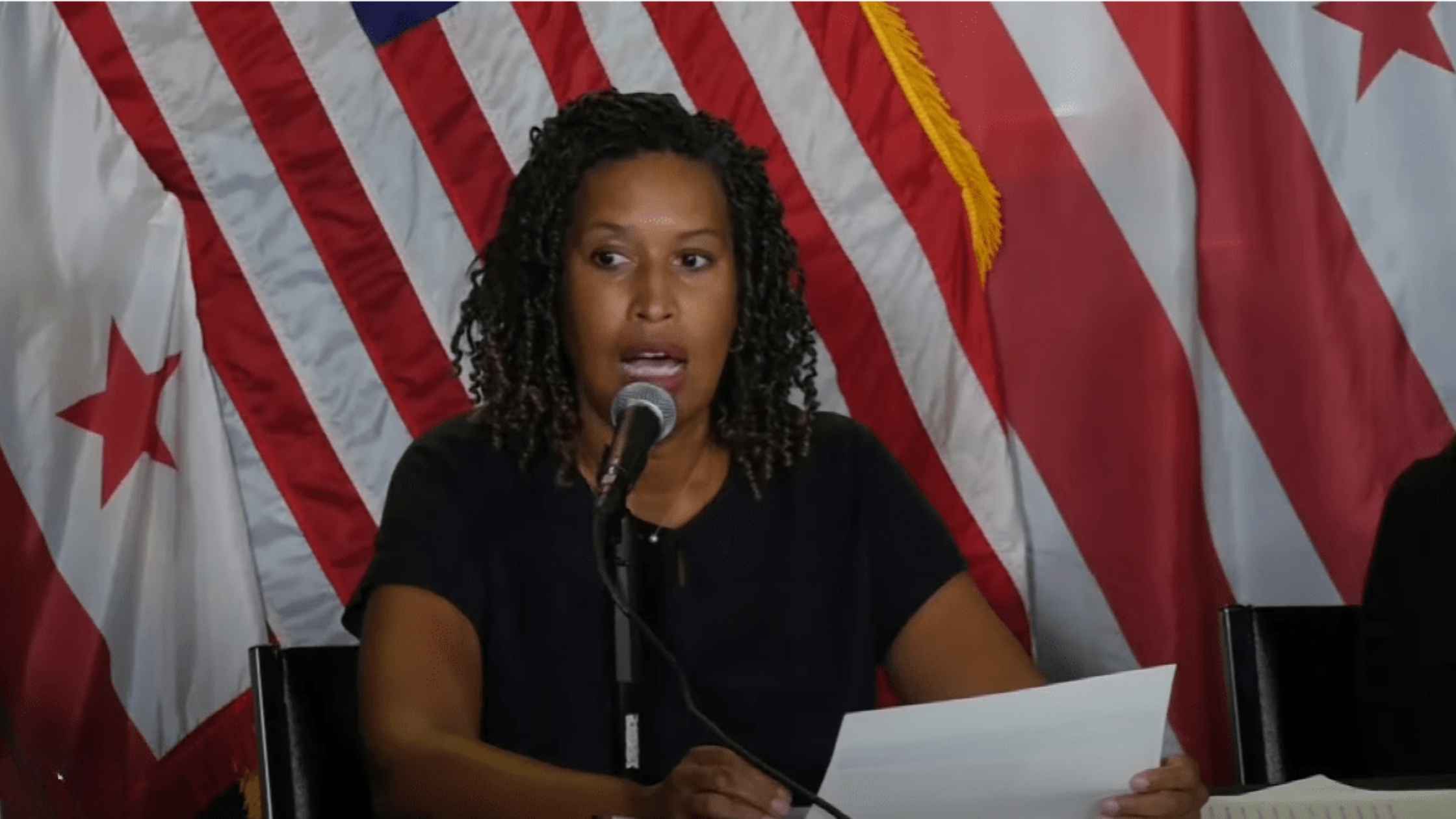
Good afternoon everyone. I am Muriel Bowser. I'm the mayor of Washington DC. We are in one of the district's buildings, the Marion Barry Building. And I'm joined by members of my senior team: the City Administrator for the District, Kevin Donahue; MPD's Chief, the Chief of Police, Pamela Smith; Deputy Mayor for Public Safety and Justice, Lindsey Appiah; the Deputy Mayor for Health and Human Services, Wayne Turnage; and the Director of the DC Department of Human Services, Rachel Pierre. So I am here today for those of you who are new to covering us, we are providing a situational update on the surge of federal resources in Washington DC. This will be a longish update. We're going to go through many slides, giving you a state of affairs. And then we will have time for questions. I always want to remind people and give you a quick little primer of who we are in Washington DC. We are unlike any other place in America, not quite a state, not exactly a city.
(03:10)
We function as a city, county, and state. More than 700,000 Americans live here. We have a greater population than two states, and we fulfill all of the responsibility of citizenship. We pay federal taxes. In fact, we pay more per capita than most places and we get back less. We have no voting representation in Congress. Our Congresswoman, Eleanor Holmes Norton, does not have a vote, and we do not have any voting… we have no representation in the Senate. The district was granted Home Rule by the Congress in 1973, giving us the ability to govern ourselves, but leaving the Congress and the president approval authority in many aspects of our budgets and laws. And as I have discussed over the last couple of weeks, the Home Rule Charter that I just referenced also gives the President of the United States a special provision allowing the president to compel the Mayor of Washington DC to provide NPD services for federal purposes if the president declares an emergency.
(04:49)
So the district is coordinating with the federal government, our federal partners, while we are maintaining on all aspects of the presidential emergency, while we are maintaining the provision of excellent government services. Last week I instituted an emergency operation center. At the time we called it an incident management team that helps us to organize within the government how we respond to emergent situations. And responding, making sure we are getting back to the federal government and making sure that our lead agencies and DMPSJ and NPD have everything that they need from the fed. We organize in this manner. This emergency operation center will also allow us to support federal surge or any federal task force activities beyond the emergency. So today, we will be mainly focused on three of the four work streams. And let's start with public safety. And you have heard us talk many times, many friends don't know how unique our system is in Washington DC.
(06:23)
So when we talk about the criminal justice system in DC, it's not a local system. So unlike any state or city, our city ecosystem for public safety combines local responsibility and federal responsibility. As you see, the Metropolitan Police Department, the brave men and women who protect us, of course our city government, the DC Jail is where people who have been arrested are held pretrial. The federal system includes supervision of people before they go to trial. The federal government and the United States Attorney is responsible for all adult prosecution. Youth prosecution is a local responsibility belonging to the attorney general for the district. The courts are federally-appointed judges. And then when we talk about detention and incarceration, DC Jail will hold some people and other people will go on to serve the remainder of their sentences at federal prisons in the Bureau of Prisons, we detain our youth with the DYRS. All of probation, both for adults and for youth are a federal responsibility. I like now to talk about something you've also heard me talk about and there's been some debate in our local press about what's happening with policing in DC and the number of police that we have in particular. So we wanted to give you a long view about where we are with the number of police and we can talk a little bit about where I think we need to go. And Kevin and Lindsey, if you want to jump in to talk about this, the trajectory of policing, police hiring.
Kevin Donahue (08:36):
Sure. I'll talk about the long view and Deputy Mayor Appiah will sort of talk about the prior for the past few years. So this chart shows an arc that dates back about 30 years. The first portion you see a steady rise to try to drive towards 4,000 officers. That was achieved in 2008. Then you see a period of about 10 or 15 years where it undulates up and down often for different reasons. There was a recession in 2008 to 2010. Budgets were cut as a result and you see the numbers slide down, then it pushed to build it back up to 4,000. Then there was a retirement bubble largely from folks hired 25 years prior in the late '80s, early '90s. So it slides down to 3,700. Then we put in place very specific hiring and retention strategies and you see it go back up, it undulates back up towards 4,000.
(09:24)
The difference now is that you see a departure from that trend up and down between 4,000, 3,700 that you saw over the past 10 years starting in 2020 that began a steady decline. Part of this was a national trend where it was just more difficult to hire law enforcement. Part of it was the result of choices that we made in DC around the budgets in 2020. And subsequently around the laws that govern policing that would make DC and NPD a less desirable place to come if you're a young person considering that career and you have choices between where to become an officer, whether it's local or federal. And I'll have DM Appiah talk in more detail about what we've seen the past few years.
Lindsey Appiah (10:06):
Sure. So as the city administrator said, there's been a number of things that have affected our sworn staff and we on the executive side have worked to try and address those issues because what the mayor has maintained is that we always say the path to 4,000. And so we believe we need 3,800 to 4,000 officers. And so, some of the work that we've done in the past several years, you can see when we started to see more significant decreases, more attrition than those coming in is working with counsel to rebalance our ecosystem towards accountability because we know that certainly affects police as well. When people commit violent offenses, we say they need to be held. There's a lot of work that goes into actually effectuating arrests in the district. And so we want an environment where police know people will be held appropriately accountable.
(10:53)
We also worked on rebalancing some laws that affected policing, the ability to pursue, the ability to what serious use of force looked like to ensure that we were engaging in constitutional policing, but adjusting an environment that had become what we would say out of balance in supporting good constitutional policing. And so we made a number of those changes. We also instituted a host of incentives and across the board listening to officers what they wanted from hiring incentives to new CBAs, to retention bonuses, to things like take-home cars. And a variety of incentives both to retain our officers as well as to invest in bringing new officers in the door. And also in growing our cadet program and building a local pipeline of people, young people predominantly, from our city to bolster our numbers. And so we continue to do that work to stabilize and to increase our force strength to what we believe is where we need to be, 3,800 to 4,000 officers.
Muriel Bowser (12:00):
Right. So we wanted to show this slide. And you've heard me say, and I will continue to say, we need at least 500 new officers to hire 500 new officers over the course of the next several years to have the number of officers that we need and to decrease the amount of overtime that we use. And so, I want to move on to share with you, and I know that there have been data shared throughout this period. And this is a chart, it shows, and this is the type of categories that the chief reports to me on a weekly basis about what's happening in crime in the district. We've highlighted the area in yellow that shows the impact of the surge of FBI, DEA, ATF, and Park, and Capitol Police, and other federal agencies in the district. And the federal surge has had a significant increase on crime in Washington DC. And we greatly appreciate the surge of officers that enhance what NPD has been able to do in this city.
(13:29)
The most significant thing that we are highlighting today is the area of crime that was most troubling for us in 2023. Now we have driven it down over the last years. But I'm going to get my glasses so I can make sure I can see it correctly. But for carjackings, the difference between this period, this 20-day period of this federal surge and last year represents a 87% reduction in carjackings in Washington DC. We know that when carjackings go down, when use of gun goes down, when homicide or robbery go down, neighborhoods feel safer and are safer. So this surge has been important to us for that reason. I want to say that I have been personally engaged with Attorney General Bondi and the president's chief of staff, Susie Wiles. And I spoke with the president this afternoon. And I was reminded of our first meeting after his re-election where we discussed shared priorities for the district.
(14:52)
There, I was reminded that the president's interest in cities predates his time in office, and his knowledge of DC had significantly increased from the first time he was in the White House. And so we knew that the priorities around safety and investment in infrastructure would be on the president's mind. Now, since this surge has begun, it has been my charge to my team, especially the chief, to make sure that while we have federal resources, that we are strategically using them to enhance NPD's efforts and to make sure that we are getting the best outcomes for DC residents. While at the same time making sure that we're living up to our commitments to DC residents and protecting local control in our autonomy.
(16:04)
So we'll say a little bit more about what has worked and what we think needs to change. But before we do that, we're going to say a little bit more about the beautification efforts in DC. So let me first say how proud we are of our city and how beautiful and green our city is. When people visit our city, they comment on how green it is, how wide the avenues are, how many trees we have, how great our parks are. And it is an effort that we take great pride in as city officials. Our teams, of course, include DPW, DDOT, DGS, Parks and Rec, and our teams work with federal partners. The map you see, I think all of the red is federal parks
Muriel Bowser (17:00):
And like many things in Washington, there is a mix of local and federal responsibility. And the red spaces that you see are major federal parks as well as pocket parks throughout the district. The district over the last 10 years, I have had a significant effort on improving infrastructure, especially alleys, local streets, trees, lights throughout the district, and you can see the change over these last 10 years of roads that were in poor condition to roads that are now in good or excellent condition. We will, though I don't know much of the details, we will be supportive of the President's $2 billion request to improve infrastructure, especially federal infrastructure in the district.
(17:58)
So I want to move on now to talk about homelessness and our efforts to help people who are experiencing homelessness, who are in encampments, who are on the street. I wanted to share a little data about our experience over the last couple of years. We do a point in time count every year. This point in time count showed that just over 5,000 people were experiencing homelessness in DC. Most of those people are utilizing shelter. We achieved a decrease from 2024, which was our first major decrease in three years since the pandemic. We've seen an 18% decrease in family homelessness and 4.5% decrease among single adults.
(18:50)
Now this sometimes people are surprised when I make this statement, but it is a fact. We have a relatively small encampment problem in DC. It however is highly visible, and we spend a lot of time with our outreach staff at encampment sites trying to connect residents to services. It is among the most difficult human services issues of our time, connecting people who frequently have very significant mental health issues to services and getting them to voluntarily accept services.
(19:40)
So you'll note that in January '23, this was the height we think of our encampment proliferation with 94 locations. By 2025, that was down to 74 locations. The number of people we believe were in those encampments at the height were 294 people, down to 128 people by July of 2025. So what we're doing now, there has been, and it is also our belief that our system can accommodate everybody inside. So this week, I think Thursday or Friday, we are going to do another census count of unsheltered people in DC. That will give us an accounting of if any tents remain, where those tents are, the number of residents living there, and the number of people who may not be in tents but are still on the street. We want to know where they are so that we can connect them to services and get them to come inside.
(20:55)
So I just want to wrap up by talking a little bit about next steps. Firstly, in the next couple of days, I will issue a mayor's order that spells out how our emergency operations center will continue to engage with the federal, safe and beautiful task force and ensure that task force resources continue to be strategically deployed in the district. This is what we think in just a couple of weeks of experience has worked, having more federal law enforcement officers on the street. We think having more stops that got to illegal guns has helped. We think that there's more accountability in the system, or at least perceived accountability in the system that is driving down illegal behavior. We know that we have had fewer gun crimes, fewer homicides, and we have experienced an extreme reduction in carjackings.
(22:06)
What we know is not working is a break in trust between police and community, especially with new federal partners in our community. We know having masked ICE agents in the community has not worked and national guards from other states has not been an efficient use of those resources. What's still needed in the city, we are going to continue to need more police. We continue to need more prosecutors, more judges, more effective prevention programs, and we need to ensure local control.
(22:51)
We also know what has helped us in the last two years drive down crime numbers. We looked at the ecosystem similar to the changes we saw in the police numbers, and we advanced legislation, the council advanced legislation, but we know there's more to do. We will continue to work with the DC Council and the Attorney General on legislative changes that would promote more accountability. We will approve the police contract to retain our force strength and look for other ways that will help us recruit and retain high quality officers. We will offer a hiring and retention bonus to help us shore up our path to 500 new officers. And we of course are focused on ensuring accountability throughout our system.
(23:51)
There are other non-law enforcement things that we will continue to focus on to promote safety, including unifying our violence intervention programs, increasing the capacity of our homeless services programs, making sure we're providing more mental health services to youth and adults, and delivering a new residential youth treatment center. Now, while this isn't a work stream of the federal task force, we include it in all of our discussions, and that's how we recharge the district's economy. You have covered a lot. The problem with the CR that caused us, the most recent CR that caused us to have to cut a billion dollars from our budget, which in fact impacts our ability to quickly pay pay raises for firefighters and police officers. We are also very focused in working with the feds on stabilizing the federal workforce, accelerating land transfers where it makes sense, modernizing federal leasing and other specific DC incentives that will promote our economic growth and recovery from many of the changes in our federal landscape.
(25:28)
So that is a quick update, quick ish update on where we've been in the last two weeks and where things stand. So with that, we'll be able to take a few questions.
Speaker 2 (25:41):
Madam Mayor, Could you respond-
Muriel Bowser (25:44):
Let me get you please. Thank you.
Speaker 2 (25:49):
[inaudible 00:25:47], Channel 9. It says that there have been, two questions, that there have been more than 1500 arrests. Can we make the distinction between or how are we quantifying between a federal arrest or an MPD arrest? And then another question for Chief Smith. Chief Smith, I think we made it clear that there's a trust that's been broken because some of the lines are being blurred when people in the street see MPD and federal agents responding maybe to the same scene. Perhaps to you, it's clear who's doing what, but to the community, it's not. How do you build that trust after the search?
Muriel Bowser (26:20):
So let me just answer the question on these data represent MPD and federal arrests, but maybe not all federal arrests.
(26:29)
Okay. And Chief, you want to talk about trust?
Chief Smith (26:33):
Sure. Just the second question, with regard to building community, we've come a long ways I believe here in the District of Columbia with police and community. We know that there is some work for us to do once the surge ends. We need to make sure that we are in our communities again. We're still there. We're still working with our community, and we're still creating, if you will, a space where we can have Q&A and answers with regards to our federal partners. We have worked with our federal partners. This is nothing new. We just have an enhanced presence.
(27:05)
One of the things that I shared maybe a couple of weeks ago is that we have been specific in the locations where we would like for our federal partners to support us in with respect to those areas where we've seen a little bit of high crime, and we've placed them there in those locations with us to support those efforts.
Muriel Bowser (27:25):
Yep. Right here.
Phylicia Ashley (27:29):
Good afternoon. Phylicia Ashley, ABC7. In talking with community interactions, the joint task force just sent an update yesterday that MPD made a request to have joint task force staffing at certain Metro stations as relates to where school areas are at the start of school. Can you elaborate on what that partnership will look like and also your intention and hope behind that request as well?
Chief Smith (27:53):
So with respect to the Metro stations, I think that's really Metro transit because I don't have oversight over the Metro stations with regard to having a federal task force available to us. When we do see surges and spikes in crime, it will certainly be helpful for us. We know that our federal partners work with us when we have various operations, or some folks like to call them takedowns around the city. Very complimentary in that space. And the expectation is that we will continue those efforts and hopefully have the opportunity when we want to conduct different operations or different surges, we can call upon them to be able to support us.
Muriel Bowser (28:32):
Yep. I'll get you in a second. Yep.
Speaker 3 (28:35):
Madam Mayor, again, thanks. In your conversations with the President, what assurance did you get that he would not attempt to go beyond the 30 days?
Muriel Bowser (28:45):
That was not something that I discussed with the President, but with the Attorney General Bondi, and we will continue to work on how our emergency operations center and the federal task force can work together.
Speaker 3 (29:05):
Earlier this week, activists were out front of the DC courthouse during arraignments that lasted well into the night, about a hundred. My understanding is a good portion of them were no papered. I just wanted to get your thoughts around that, just seeing as though police are arresting people.
Muriel Bowser (29:22):
Yep. That's a great question. We don't have any information around what the courts have done or what the US attorney has done. We just don't have that information available for this briefing. But I do think it's important to understand.
Speaker 4 (29:40):
Mayor?
Muriel Bowser (29:40):
Yes.
Speaker 4 (29:43):
You might not have seen it, but did you respond to the plan by the federal government, the Department of Transportation, to take over the management of Union Station?
Muriel Bowser (29:49):
Well, the federal government owns Union Station, and I don't know the details of what will happen. If it is just about management, I would consider that step one. If it's about what Union Station needs for its total transformation, that would be an amazing initiative for the federal government to take on. I have had a very early conversation when I visited the President during his most recent transition about Union Station and how that could represent a very significant and good investment for this region.
Tom Fitzgerald (30:31):
Mayor?
Muriel Bowser (30:31):
Yep.
Tom Fitzgerald (30:37):
Hi, Tom Fitzgerald, Fox 5. We've seen some remarkable scenes from the people of Washington DC over the last couple of weeks reacting to the situation, dealing with the situation, the protest in front of the courthouse was mentioned. When you've looked around the district, what do you have to say about how the people of Washington have reacted over the last couple of weeks?
Muriel Bowser (30:55):
I think DC residents are being what I would expect from DC residents, to be very focused on our autonomy, local control, and their neighbors. So I think DC residents are very concerned about each other, and they're very concerned about their rights as Americans. So yeah, I think DC residents are defending their city. They're promoting their city, and they are giving me ideas, talking to me, and trusting my judgment.
(31:38)
Yep.
Randi Bass (31:40):
Chief Smith, Randi Bass with DC News Now. Can you speak to any kind of hesitation that we might be seeing in the community when it comes to working with not only MPD, but working with federal law enforcement, creating that community connection and any kind of hesitation when it comes to seeking out emergency services right now?
Chief Smith (31:58):
Well, what I can say with our communities, our team is still working. We're still doing community outreach. We're still having the programs and initiatives that we typically had prior to the surge. I mean clearly, there is some hesitation obviously with some of our community members, which is very important to me that my team, myself, that we are educating our communities on the relationships that we have with our federal partners.
(32:23)
Again, I'll emphasize that the relationships are not new, it's just an enhanced presence. And what we want to do is to make sure that we're educating our communities, community members on how to engage with law enforcement when they come in contact with law enforcement for any reason. And we still want our community to reach out to us. Because like I said, MPD, the Metropolitan Police Department members are here. They're doing a fantastic job every single day in the community, and we want our communities to continue to have that trust with us when it comes to different type of activities that's going on that we need to know about.
Muriel Bowser (32:56):
Now, if I could just add onto that. We don't know who's not calling, but we do know a lot of people are calling and on that data sheet, which now I can't see.
Lindsey Appiah (33:07):
Yeah, so you'll notice on the data sheet, it has calls for service, which in fact have increased during the surge. One of the things that we know about DC residents and visitors is that we are the fourth busiest 911 center in the country, while our population is not necessarily the fourth. So we encourage people to continue to call, continue to use 311. Now MPD continues to be our primary, this is our local police department that responds to calls for service. And so for those who feel hesitancy, although you can see a lot of people don't, those calls are quite high, that we'll continue to work with MPD Outreach, but all of our ANCs, our MOCaRS, and everybody, for those who feel hesitancy to continue to encourage engagement because we do want people to continue to call when they need help.
Muriel Bowser (33:59):
Let me go this
Muriel Bowser (34:00):
This way and I'll come right over to you guys. Okay? Yep.
Speaker 6 (34:05):
Two questions. First of all, for the Mayor, President Trump had said in prior days that he may look at a national emergency to keep the surge going, and then recently said that he doesn't think that is necessary. Do you think this is going to end after 30 days? And if it has been successful, do you want it to end after 30 days?
Muriel Bowser (34:20):
What we want is local control of our public safety ecosystem, and that includes deployment of officers, and we want federal officers that work in coordination with us, DEA, ATF, FBI, who, as the Chief just mentioned, work with us on major crime issues all the time, and our officers are familiar with working with them and they have been helpful in the field.
Speaker 6 (34:52):
So do you think this is going to end after 30 days?
Muriel Bowser (34:53):
I think we're going to have officers and we want officers. We want to enhance our officer presence.
Speaker 6 (35:00):
And for the Chief, the Chairman of the Government Oversight Committee, Comer, sent a letter to you recently asking for all kinds of things, all kinds of records, and for transcribed interviews with seven MPD commanders. Are you cooperating with that? How is that going?
Chief Smith (35:17):
We have been cooperating and we will continue to cooperate.
Speaker 6 (35:20):
Thank you [inaudible 00:35:21].
Muriel Bowser (35:21):
Yep.
Speaker 7 (35:23):
For the Mayor, could you say why you believe that Trump administration exerting greater control over Union Station would be a good thing?
Muriel Bowser (35:30):
They own Union Station. It's owned by the Department of Transportation, and it will be a good thing because that station has suffered from needing, some say, $12 billion, but let's call it at least $8 billion worth of investment in the renovation. And that is not something that the district will be able to support. It is an important regional asset. It's an important asset for the Eastern Seaboard. It's an important asset for the nation. It is appropriate, in my view, for the federal government to make the necessary investments in the transformation of Union Station.
Speaker 7 (36:15):
Do you know whether or not they plan to make those investments?
Muriel Bowser (36:17):
I don't. It's not in any current budgets, and it hasn't been for as long as I've been familiar with the plans. It has suffered from not being able to get the money that it needs for the renovation.
Speaker 7 (36:30):
Thank you.
Muriel Bowser (36:32):
Yep.
Scott Campbell (36:35):
Just two… Scott Campbell with WTOP. Two questions for the Mayor. First, what can you share, if anything, about the President's conversation regarding city roads, medians, infrastructure? He's been critical of those. And secondarily, possibly for the Chief as well, how could you all be sure that MPD officers wouldn't be making the arrests that you showed on that data screen without the federal surge?
Muriel Bowser (36:54):
Can you give me that last question again?
Scott Campbell (36:57):
Sure. Just how could you be sure that MPD officers wouldn't have made all of the arrests that were illustrated on those charts without the federal law enforcement surge?
Muriel Bowser (37:06):
Well, we know, and I'll turn to the… Let me just turn to the Chief about some additional deployments that could have been made. Let me put it this way. If there were 500 additional MPD officers, that same activity, arrests and gun recovery, would've likely been made.
Chief Smith (37:29):
That's it?
Muriel Bowser (37:29):
That's it.
Scott Campbell (37:29):
The infrastructure, roadway-
Muriel Bowser (37:32):
Oh, the infrastructure and roads. I think that it was a very high level conversation, and I wouldn't say it's any different than what he's already said about roads, medians, and grass. Yes.
Joe Khalil (37:48):
Thank you, Mayor Bowser. Joe Khalil with News Nation. You've said you agree with the $2 billion investment that President Trump is asking Congress for DC. He has said he expects those projects could take anywhere from six months to a year. So do you expect that that timeline is accurate? If it is, do you expect there will be some kind of federal presence here in some form for a full year doing that?
Muriel Bowser (38:13):
I have no idea what the projects are other than what I've heard or the timeline. Our experience with those type of projects is they take long. But I couldn't comment on that because I don't think there's been a listing of projects.
Joe Khalil (38:31):
And you've acknowledged here that some of the crime has come down significantly in the federal takeover here. There are-
Muriel Bowser (38:37):
The surge. Federal surge.
Joe Khalil (38:39):
Excuse me. There are several other cities President Trump has floated also for potential National Guard presence. A lot of those cities leaders have pushed back on that. Would you recommend that they accept the guard or federal resources as this happened here?
Muriel Bowser (38:57):
Let me just say this. We're unique. I'm the mayor of Washington DC. My comments relate to Washington DC. And we are unique in that we're always going to have a different relationship with the federal government because we are the seat of the nation's capital. And so that's different. So I wouldn't comment or extrapolate to any other place, this is what we are dealing with. Was that your whole question? Okay. Yeah.
Campbell Robertson (39:30):
This is Campbell Robertson with the New York Times. Chief Smith… And y'all kind of answered this a few minute ago, that the operations that are unfolding are very much what y'all would be doing if they were 500 MPD officers. But given… You hear a lot of folks in some of these neighborhoods who feel a lot of stops and searches, what's in your pocket, all this kind of stuff. And these are strangers, they don't recognize them, they're not local police. Your initial concerns about trust, do you feel that the way these operations are being done are exactly what MPD has been advising the federal partners to do? Or do you concern that it's a little bit too aggressive and do you have worries of what effect it might have on communal trust going forward?
Chief Smith (40:12):
I think anytime you have an influx of anything, there is some concern, and especially in this case where we've built relationships with our community and now we have additional law enforcement officers present, which is why it's really key and important for me to make sure we have the Metropolitan Police Department officers aligned with our federal partners. Some of the things that you're seeing is some of the ask and requests from community. Our community wanted to see more traffic stops. They would like to see more police officers present in various communities. And so what we've done is been very strategic and thoughtful about taking into account some of the requests and also making sure that in areas… I'll just use for an example, like the traffic safety compliance checkpoints, right? I've heard, since I've been here, over and over again, that officers are not conducting traffic stops.
(41:06)
And so we initiated the traffic safety compliance checkpoint in order to ensure that we can educate folks about traffic and traffic safety. Number one, opportunities for us to ensure that we are getting guns off of our street if guns are present. And then number two, making sure that our operators are operating the way they should based on vehicle traffic laws. And so I don't think we're doing anything different in that space with the exception of the fact that we have an additional surge, if you will, of police officers, and we'll continue to do that. If they're here, we will utilize our federal partners in spaces and places where we've heard from our community. We've looked at our own data and analysis and areas across the city where we know that we've had just a certain spike in crime and we'd like to see that reduced. And what you've seen over the last two weeks is the efforts with having an additional 500 or so officers supporting us in that area.
Kevin Donahue (42:05):
If I could just… I want to maybe go in a bit more detail and I'm wondering from the slot, if we can pull up the data chart again because I do want to highlight… It's a complicated slide, so I want to make sure, since you all have copied, spread well. So when we look at, in any circumstance, has there been in a change in crime reported. We can slice it and compare it different ways. So the one you see in yellow is the most traditional way that we and other people compare crime now to… When we ask ourselves, "How are we doing," which is we compare how crime is now to the same period of time in the prior year. The reason for that is that crime can be seasonal. So we want to have a consistent basis for comparison. In the yellow, you see the most traditional comparison that we have, which is over the period of time in which we've had a federal surge this year, what did it look like last year?
(42:53)
And so you see fairly precipitous declines, particularly in robbery, carjacking and overall violent crime. If you were to go to the MPD's website and look at crime cards and look at violent crimes with a gun, it'll more or less mirror the robbery, about a 60% reduction in crimes involving a gun when we look at the period of time now to the pastime. But then because of the scrutiny, said, "Well, how else do we look at it?" So if you look at to the right of the slide, you see… Well, let's compare within this year. Look at the 20 days since the federal surge, compare it to the 20 days prior. And the way to read those numbers is not based on last year, but recognizing we already had good momentum coming into the federal surge, and it made it better.
(43:38)
And so in the far right… And I'll just sort of look at the violent crime. The very far right was sort of the year to date prior to the date of the surge, it was down about 26%. And as a result of the drops we've seen during the surge, you see it take upwards. And the most significant manifestation of this, we really see in carjackings, which as the Mayor said, is a crime that strikes fear in many people because you can be targeted quite randomly. And that's where you've seen the largest impact of nearly a 90% change when we look at what's happened during the past 20 days and what looked at this in the past year. So that's for the totality of that slide.
Muriel Bowser (44:19):
Okay. Who has that? Mark.
Mark (44:24):
Thanks. Mayor Bowser, I'm wondering if you could put some meat on the bones of your conversation with the President, particularly what you told him about… I mean, did you thank him as you did here… I mean, basically, this has been pretty pro-surge press conference briefly.
Muriel Bowser (44:44):
This is pretty pro-we-have-seen-reductions-in-crime.
Mark (44:49):
Right. And this comes just after President Trump said, "Mayor Bowser better get her act straight or she won't be mayor for long." So I'm wondering if this is in response to that, what you said to the President, what he said to you. Did you push back at all? Because while, yes, the numbers are down, when we look at what's happening in the streets, there are a lot of neighbors who are really upset and not happy about seeing masked federal agents. You didn't say anything about the detentions of ICE, what's happening with those people, if you're doing any tracking, if you're doing any… So I'm just wondering about that conversation. And if you gave any pushback to the President about the intrusion on home rule and what he told you as to what to expect in the future.
Muriel Bowser (45:31):
Mark, let me say, the… We had, what I would call, a courtesy meeting with the President. I had a following a substantive meeting with the Attorney General who is his designee on this issue along with the Chief of Staff. And I'm not going to about the details of that conversation. You have seen what I have laid out in terms of our concerns, and you have seen what I have laid out in terms of the benefits, and that is the huge number of federal law enforcement, not National Guard, federal law enforcement that have enhanced in PD's deployment capacity.
Mark (46:18):
Did you push back about the masks at all with either the Attorney General or the President about these law enforcement agents not wearing name tags-
Muriel Bowser (46:26):
Mark, I'm concerned about mask. And so while I'm not going to give you a rundown of every word that was said in the meeting, you can be assured that the things that we are very concerned about, we are working on a resolution for.
Mark (46:44):
And what about the ICE detention? You haven't said much about those at all. Do you have any numbers on that, on how many people have been detained? And are you tracking who those people are, what's happening to those people?
Muriel Bowser (46:54):
We do not have any information on anybody who was detained by ICE, as far as I know. And I am concerned for sure, because we think anything that we do and anything that we're going to ask federal partners to do is focused on violent crime.
Speaker 8 (47:16):
Mayor, about the economic impact of those ICE-
Muriel Bowser (47:19):
I'm sorry, I don't know who's speaking. Okay.
Speaker 8 (47:21):
[inaudible 00:47:22]
Muriel Bowser (47:21):
Okay.
Speaker 8 (47:24):
About the economic impact of those ICE, the tensions within, covering families who are losing their homes, they're losing their jobs due to the immigration enforcement. What can you tell us and what can you tell the Hispanic community and the immigrant community?
Muriel Bowser (47:43):
Well, I am devastated by people living in fear. I think you know very clearly how I feel about our nation needing comprehensive immigration reform, about the Congress establishing a pathway to citizenship for hardworking people who came to this country for a better life and who are not criminals, who are law-abiding. And I think when that question is finally answered, that's the only way to deal with this fear or to deal with these agencies going after law-abiding people. Yeah. Yeah.
Speaker 9 (48:32):
[inaudible 00:48:30]. Two questions. First, for the Mayor. Under the Home Rule Act, what specific requests have been made for MPD services by the federal government and how have those requests been communicated?
Muriel Bowser (48:43):
Oh, we wouldn't be able to enumerate them here, but we do have a way of centralizing requests.
Speaker 9 (48:52):
And one for Chief Smith, related to what was just asked, in what capacity is MPD assisting ICE with immigration enforcement?
Chief Smith (49:05):
Based on the President's executive order, we are supporting the ask of the Metropolitan Police Department to support our federal partners in this effort.
Muriel Bowser (49:15):
Yep.
Josh Chapin (49:17):
Mayor, thank you. Josh Chapin of Channel 7. Unfortunately, we saw a murder this week. I know there were some people in the federal government that were counting days without homicide. It doesn't matter. Unfortunately, someone was taken. I'm just wondering, and maybe this is better question for Chief Smith, but more officers going in, whether it's MPD officers or federal troops going into a place like Southeast or places where we've seen violence in recent weeks. Is that on the docket? Is that on the agenda, to put more officers there?
Muriel Bowser (49:50):
Well, talk about deployment, Chief.
Chief Smith (49:52):
Yes, we do have officers deployed in all of our areas within all seven districts. The plan initially was to ensure that we looked at various locations around our city where we were seeing a spike in crime. And so in… You mentioned Southeast. We have officers assigned in Southeast within all of our districts as well.
Josh Chapin (50:11):
Is the National Guard… Is it worth the National Guard going in there or directing them there? I don't know how that's-
Chief Smith (50:16):
I don't know anything about how the National Guard is being deployed, with respect to that.
Muriel Bowser (50:21):
Okay. We'll be able to take a… Did you get one? Oh, okay. Martin.
Martin (50:26):
Hey, Mayor, how are you? Chief, I just wanted to go back to something you said about things that residents were asking for that their MPD is now doing, like traffic stops. But what we're hearing is that no resident said, "We want a traffic stop followed by a guy asking you for your papers." So how do you balance what you say is a strategic use of MPD resources and what people are perceiving as things that are infringing upon their rights in a pretty dramatic way, specifically targeting a community that is now telling us that they don't want to call MPD because they're afraid that
Speaker 10 (51:00):
If they call MPD, ICE is coming with them.
Chief Smith (51:02):
And I do understand the concerns. I've had many conversations with many residents here in the city and community members. However, I also have heard from members who want us to enhance our presence in communities. And clearly what I will say about the members of the Metropolitan Police Department, it is a responsibility of every member to ensure that we're showing up in our communities as we have been prior to our federal partners or the surge. And the expectation is that they will continue to do that. My oversight is over the members of the Metropolitan Police Department and we do have great relationships with our federal partners and it is my hope that if there are any concerns that members and community have with respect to, I won't say over-aggressive or any violations, that there's a space and a place for them to report that.
Speaker 10 (51:54):
And just to follow-up on that one, I mean, there's already plenty of things that happened this week regarding more things that the president wants to do with the district. One thing he said in this executive order is that the attorney general is now empowered to ask MPD to change its general orders, the way the police officers are told to operate. Now, MPD doesn't have to say yes, but requests can be made. When would you push back? Mayor Bowser, when would you push back and what type of request would you push back on? What if the attorney general said, "Listen, I want you to loosen standards on uses of force. I want you to allow more pursuits using vehicles. I want to get rid of body cameras." How far is too far?
Muriel Bowser (52:33):
I think all of those things you mentioned seem kind of too far. But that hasn't happened. Nothing has happened in that regard. The requests have to be made to me and I would work with MPD on like reviewing of requests. Yes.
Fabianna Rincón (53:00):
Mayor Bowser, this morning there was a kind of a volatile situation in Mount Pleasant with federal officers accompanied by MPD conducting an operation and being surrounded by according to witnesses and people we had on the scene enraged, screaming residents right in their faces with according to what we saw, MPD officers trying to explain things and keep the situation calm. But it was a very volatile situation. How concerned are you about an escalation in this as you've spoken about the breach of trust and the tensions rising?
Muriel Bowser (53:33):
Well, I feel strongly that D.C. residents know their rights and know how to engage in a way that is lawful. Yes.
Chief Smith (53:48):
And so this morning's incident that you referenced was our criminal apprehension unit, which oftentimes throughout the course of a week we'll execute arrest warrant or search warrant. And in this particular case, they were doing what they would typically do any other day. And while they were there, we had about a significant number of protesters to come out in the neighborhood. We were able to maintain calm, the numbers decreased. I think, when I say numbers and numbers of protesters decreased and we were able to affect the efforts that we were intended to affect during that time period.
Muriel Bowser (54:25):
Okay. Yes. I'm going to take a couple more. One, two, three, four. One, two, three, four, okay, five. All right.
Fabianna Rincón (54:33):
Hi, thank you. Fabiana Rincon with El Tiempo Latino. This might be also for Chief Smith as well. Given the confirmed priorities of collaboration between the MPD and federal officers, can you provide an update on DC's status as a sanctuary city?
Muriel Bowser (54:46):
The council, the law is in place. There's been no change to the law. If you're referring to the sanctuary values, been no change.
Speaker 11 (54:59):
And on Chief Smith's order with collaborations between federal officers, especially with suspects outside of custody, does that impact the execution of the counsel order mentioned?
Chief Smith (55:14):
So when you say suspects outside of…
Speaker 11 (55:18):
Or collaboration with providing information and even transportation of those outside of custody.
Chief Smith (55:24):
We're still doing that.
Muriel Bowser (55:27):
Yep.
Speaker 12 (55:31):
Mayor, the DC Police Union supports this federal surge. They have been relentless in saying that the police force will be in a freefall their word until the Police Reform Act is repealed by the D.C. City Council. They believe that police officers don't want to come work here because of what the council did. What's your opinion on that?
Muriel Bowser (56:02):
We're looking at a number of pieces of legislation to see what should be tweaked or replaced. And I am committed to working with the council if they are interested to make any changes. Yeah.
Speaker 13 (56:20):
Madam Mayor, and Chief Smith, if you could possibly both answer this, what is your response to the House Oversight Committee now investigating the alleged manipulation of D.C. crime statistics? Do you have an opinion on them doing that and why they're doing it? And can you tell us the status of your own investigation into that?
Muriel Bowser (56:40):
I would only add what the chief has added about the earlier question. We'll answer any questions that are posed to us and we don't have any update at this time on the internal investigation, yeah.
Annemarie Cuccia (56:55):
Annemarie Cuccia with Street Sense Media. Can you give a little bit of your reasoning behind doing the emergency count? Is there a concern that people have been arrested or have moved out of the district in large numbers, people experiencing homelessness?
Muriel Bowser (57:08):
I think our concern is that people have moved around the district. We think, I think the number I reported is that we think that, well, we know that 80, about 81 more people have come into shelter. We don't necessarily know where they came from. They could have come from encampments. So we think that people have moved around.
Annemarie Cuccia (57:30):
And will the results of that be shared with the federal government and is there any concern that they could use that to then target homeless encampments?
Muriel Bowser (57:39):
We don't expect that we're going to have homeless encampments and we are going to work to make sure that people can come into shelter.
Kevin Donahue (57:51):
If I could just add some of the purpose of doing the Point-in-Time count again, is there's been anecdotal conversation, anecdotal stories about people believing that there are changes and there may be changes. And those anecdotal stories are anything from encampments, have they moved from downtown core to neighborhoods? Are there fewer of them, have more people taken shelter? So it's an attempt to cut through the anecdote and really get a sense of, given we're 20 days into a focus on homelessness in addition to crime, and quite frankly, the city has made available additional shelter capacity. What does the numbers really sort of see at that? We're not collecting names for those who haven't done a Point-in-Time count. It is, there's no names collected. It is really just individuals identifying those who are unsheltered or are homeless on a particular given night.
Annemarie Cuccia (58:50):
Are you still going to be doing the full demographic survey or just counting?
Speaker 14 (58:53):
No, just counting.
Annemarie Cuccia (58:54):
Just counting. Okay, thank you.
Muriel Bowser (58:58):
Okay. One, two, three, four. You got the final question. Okay. Yep.
Speaker 14 (59:07):
Hey, Mayor Bowser, Liz O'Gorek, Hill Rag. We're hearing from a lot of residents fears that are described ranging from tension to a sinister feeling like a horror movie, where you can hear in the music, something bad's about to happen. What do you say to those residents who are having these feelings even as they try to go about their normal lives during this federal surge?
Muriel Bowser (59:26):
I'm not sure I'm qualified to answer that question because I know there's a lot of anxiety. There's tremendous anxiety in the district. When I look and I see residents putting things on social media or neighborhood chats, I know that there's a lot of anxiety. There's a lot of anxiety with kids going back to school with writing [inaudible 00:59:52] so I know that there's a lot of anxiety, but I also know there's a lot of anxiety in our nation. It's anxiety over people being able to pay the bills or pay their electricity bill or I looked at what I spent last year on school supplies versus what I spent this year. So there is a lot of anxiety and what I've told everybody is that we all have a role to play your role or that of my constituents is different than the role I have to play, but we all have to play our role in advancing and protecting our democracy. Yeah.
Beatrice Peterson (01:00:33):
Beatrice Peterson, ABC News, Mayor Bowser, I was wondering if you could talk a little bit about an estimate about how much this federal surge is costing. Is MPD doing overtime? Is there support from local agencies? How much money is being spent?
Muriel Bowser (01:00:50):
We, MPD always does overtime and so I don't know that we're going to have a distinction with this surge or not as it relates to MPD overtime. One benefit of the IMTM setting up the operations center, and I didn't get a chance to introduce Clint Osborne earlier, who leads DC HSEMA, but HSEMA acts as our incident command for this new structure and we are able to track expenses. Yes.
Speaker 15 (01:01:23):
Mayor Bowser, Arthur Delaney with HuffPost. You mentioned conversation with the Attorney General, Pam Bondi about the 30-day time period. Are you expecting them to let this run its course at that time? Could you expand on that conversation at all?
Muriel Bowser (01:01:40):
This is what I know and I can't speak for them, but we will be prepared to take advantage of additional federal officers to focus on the beautification, to support the federal task force when that time period expires. We will be prepared as a city.
Carlos (01:02:02):
Mayor. Nice to meet you. My name Carlos, Univision.
Muriel Bowser (01:02:05):
Hi, Carlos.
Carlos (01:02:06):
What is your message to [inaudible 01:02:09] Hispanic workers?
Muriel Bowser (01:02:15):
Earlier I said, Carlos, that the answer is to have an immigration system that works and that is responsive to people who want to live in the best nation on earth, raise their families and have a better way of life. And we know in Washington D.C. so many people have immigrated here and legally immigrated here who have TPS protection. And whether you have documents or you're undocumented, you feel like you're being caught up in a dragnet. And that is horrible. And to the extent that there is enforcement in this town that does not have, let me just say, we should be focused all these additional federal resources on violence and that is what my hope will continue to be. And I would just express to them as a neighbor how very sorry I am that they're living in this terror. Okay. Thank you everybody.
Speaker 16 (01:03:29):
Thank you. [inaudible 01:03:44]