
Speaker 1 (00:00):
Thank you very much.
Mark Carney (00:12):
All right. Good afternoon. [French 00:00:13]
(00:15)
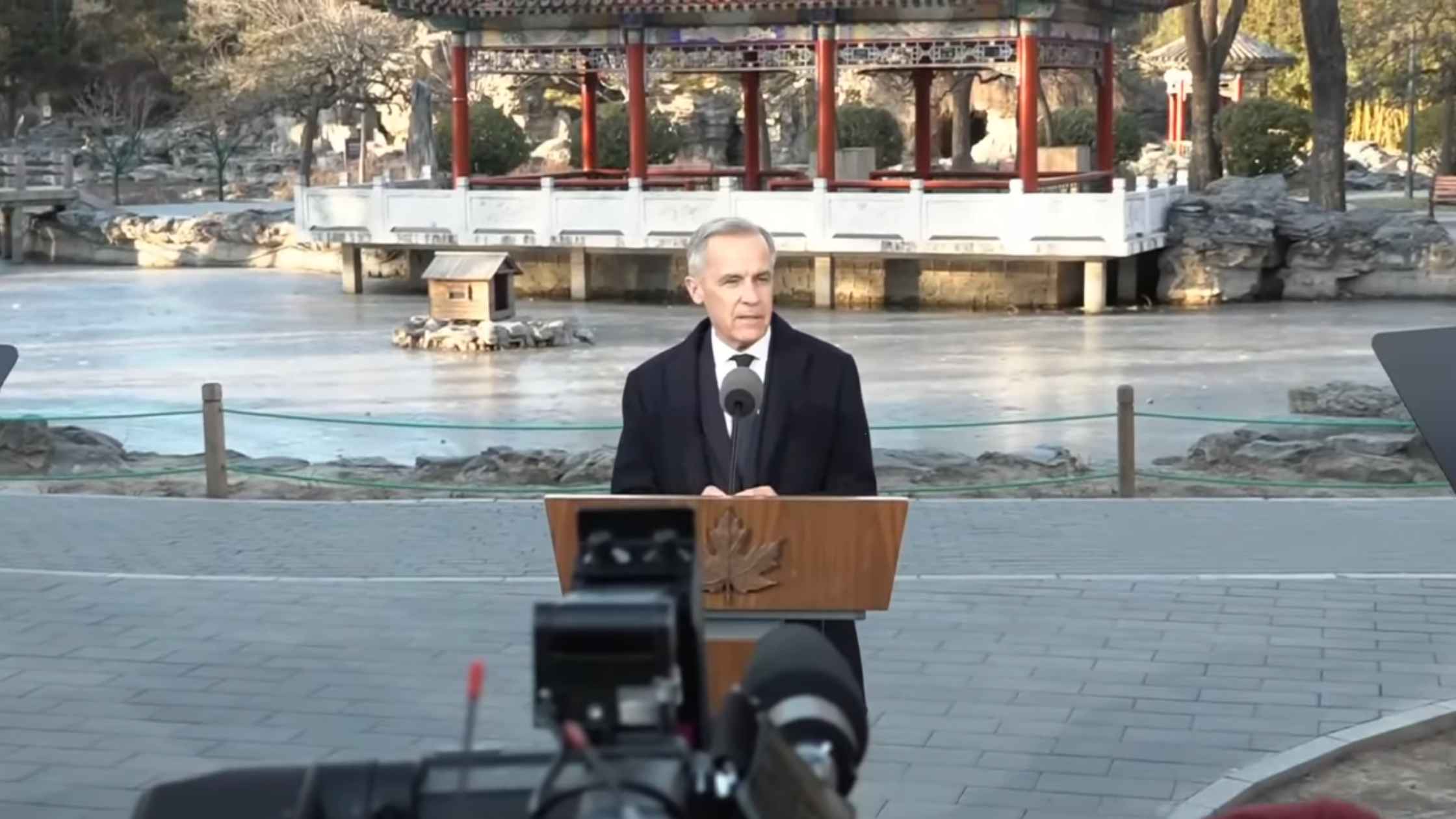
It has been a historic and productive two days during which myself and fellow ministers have had the opportunity to meet with President Xi, Premier Li, Chairman Zhao, as well as business leaders across a number of key sectors. And I am very pleased to announce that we have made significant progress in a number of key areas.
(01:03)
Stepping back, it's been eight years since a Canadian Prime Minister visited China. And in that time, the world has changed dramatically. The technological revolution and the energy transition are accelerating at an unprecedented pace. The global trading system is undergoing a fundamental change and the effectiveness of multilateral institutions on which trading powers such as Canada and China have greatly relied, that effectiveness has been greatly reduced. This is happening fast, it's large, it's a rupture, it's not a transition. What we do now as Canada, how we position ourselves in the world will shape our future for decades to come.
(01:49)
Canada can thrive in a new system, but to do so, we must be ambitious. We must work at speed and scale to find new partners, to diversify our trade and attract unprecedented levels of investment in our country. And we must be pragmatic.
(02:09)
That means we have to understand the differences between Canada and other countries, and then focus our efforts to work together where we're aligned. And it's with this approach that Canada's forging a new strategic partnership with China.
(02:26)
China is the world's second-largest economy. It contributes one third to global growth. It's our second-largest trading partner and our third-largest investor. Two-way trade between our countries amounts to nearly $120 billion a year. There are 400,000 careers across Canada. Farmers in the prairies, manufacturers and engineers in Ontario and Quebec, fish harvesters in Atlantic, Canada and British Columbia, they are all supported by trade with China. $20 billion in wages are earned each year by Canadians because of our existing trade relationship.
(03:13)
And this is a relationship that has been distant and uncertain for nearly a decade. That has held back investment, it stalled business growth and cost Canadian workers good opportunities. And it has had the consequence of leaving us even more dependent on our largest trading partner.
(03:36)
And that's why immediately after the election, Canada's new government began to recalibrate our relationship with China, strategically, pragmatically, and decisively. [French 00:03:49]
(03:49)
Ours is a longstanding relationship. Canada was one of the first Western nations to recognize China in 1970. Over many decades, Chinese Canadians have helped build communities in every part of our country from dynamic small businesses to schools and hospitals, straight through to innovation across advanced technologies. [French 00:04:52]
(04:54)
There are two million Canadians of Chinese descent, leaders across commerce, technology, and culture. Mandarin is Canada's fourth most spoken language. There is much to protect in this relationship and much on which to build and much to be gained. So leveraging our strengths and focusing on areas of alignment, Canada and China can create greater stability, security, and prosperity for both our nations.
(05:55)
And to that end, President Xi and I are announcing that Canada and China are forging a new strategic partnership. It will focus on five key areas where both our nations stand to make substantial and sustained gains. The first is in clean energy and climate competitiveness, areas where Canada and China have immense strengths and complementary strengths. Second, we're expanding trade, particularly in agriculture and food, where Canada is a reliable partner. Third, our commitment to multilateralism and strengthening global governance comes at a time when all of this is in flux. Fourth, we're deepening engagement in public safety and security to protect our peoples. And finally, people to people ties and culture are being enhanced to enrich our lives.
(06:49)
To begin, we're leveraging our strengths in energy, clean tech, and climate competitiveness. Canada is an energy superpower in both conventional and clean energies. We have an over 80% clean electricity grid with vast potential to power the clean economy of the future. [French 00:07:08] China's strengths in electric vehicle sector are undeniable. China produces some of the most affordable and energy efficient vehicles in the world. And in order for Canada to build our own competitive EV sector, we need to learn from innovative partners, access their supply chains, and increase local demand. And to help bring down costs for Canadians, Canada has agreed to allow up to 49,000 Chinese electric vehicles into the Canadian market with the most favored nation tariff rate of 6.1%. This is a return to the levels that existed prior to recent trade frictions, but it's a return under an agreement that promises much more for Canadians.
(08:44)
It's expected that within three years, this agreement will drive considerable Chinese investment in Canada's auto sector, creating good careers in Canada and accelerating our progress towards the net-zero future and the auto industry of the future. With this agreement, it's also anticipated that within five years, more than 50% of these vehicles will be affordable EVs with an import price of less than $35,000.
(09:14)
Over the next 15 years, Canada intends to double our energy grid through major investments in hydro, nuclear, solar and wind power. That creates tremendous opportunities for Chinese partnerships in these investments, including in energy storage and offshore wind. On the other hand, Canada is developing our oil and natural gas reserves, one of the world's largest to be the lowest risk, lowest cost, and lowest carbon. Last June, we exported our first LNG shipment to Asia, and we're scaling up quickly, making major investments in streamlining approvals. By 2030, Canada will produce 50 million tons of LNG each year, all of which will be destined for Asian markets. [French 00:09:59]
(09:59)
The second pillar of our strategic partnership aims to increase trade directly between Canada and China. Our agricultural cooperation built the foundation of our bilateral relationship. For more than six decades, Canada has been a reliable partner for China in food exports. Canadians export more than $7 billion in agricultural products to China each year. China used to be the largest market for Canadian canola seed. We want to not just return to those levels, but to surpass them.
(10:48)
And so I'm pleased today to announce that Canada and China have reached a preliminary but landmark trade agreement to remove trade barriers and reduce tariffs. By March the 1st, Canada expects that China will lower tariffs on Canadian canola seed to combined rate of approximately 15%. China is a four billion canola seed market for Canadian producers, and this change represents a significant drop from the current combined tariff levels of 84%.
(11:21)
Furthermore, Canada expects Canadian canola meal, as well as Canadian lobsters, crabs, and peas will not be subject to relevant anti-discrimination tariffs from March 1st of this year until at least the end of this.
(11:34)
Together, these results will unlock nearly $3 billion of export orders for Canadian farmers, fish harvesters, and processors, as they realize the full potential of this market of 1.4 billion people.
(11:49)
With this agreement, we also expect to see a resolution of many long-term obstacles for a range of important agricultural sectors from beef to pet food. [French 00:12:00]
Mark Carney (12:25):
We welcome Chinese business plans to significantly scale up their investment in Canada in major clean energy projects, as well as in agriculture and consumer projects. And by building this new strategic partnership, we're creating the stability and certainty needed to catalyze new investment and opportunities for Canadian workers.
(12:44)
Both Canada and China are strong advocates of multilateralism. [foreign language 00:12:50]. The leadership to Canada [foreign language 00:12:56]. China will be the host of APEC this year, and Canada stands ready to support their agenda, focused on strengthening and reinvigorating the multilateral system. Canada appreciates China's support for our bid to host the APEC's Leader Summit in 2029.
(13:57)
The fourth pillar of our new strategic partnership is public safety and security. And this is an area where pragmatic and constructive engagement with China is crucial. Through this pillar, our law enforcement agencies will increase cooperation to better combat narcotics trafficking, transnational crime, cyber crime, synthetic drugs, and money laundry. And we will create safer communities for people in both our countries.
(14:28)
And finally, people have always been at the core of this relationship. As I said, Canada's home to a Chinese diaspora of 2,000,000. Over 300,000 Chinese visitors came to Canada in 2024. China is Canada's seven largest source of tourism. So the fifth pillar of this partnership will build on opportunities for cultural exchanges and partnerships that further deepen our people to people ties. That means museums, digital content creators, visual artists, and other creative professionals in our respective countries will have new opportunities to collaborate. It also means more tourism, including following China's decision in November to grant approved destination status for group travelers to Canada. And we're building on this progress, looking to increase travel, exchange, and deepen our cultural ties. I'm very pleased to share that President Xi in our meeting today has committed to ensuring visa- free access for Canadians traveling to China. [foreign language 00:15:35].
(15:44)
We're different countries. We have different systems, different histories, different perspectives. Yet, we have much in common. And when we focus on our strengths and we focus our ambition towards those areas where we have the most in common, Canada and China have done great things. In the mid 1980s, our bilateral trade was roughly $2 billion. In just two decades, that increased to $30 billion. Through periods of global tension and disruption, we've created more opportunities for our workers, businesses, and investors by working together. And with this new strategic partnership, that's the opportunity before us now. It's a partnership that reflects the world as it is today with an engagement that's realistic, respectful, and interest-based.
(16:36)
The work in the recent months, the discussions and the meetings over the past two days have not been a question of putting things back on track. It's been more a question of designing new tracks that will benefit the people of both our countries. In a world of increasing uncertainty, Canada is building with speed, confidence, and determination. We're forging new partnerships around the world. We're diversifying trade. Over a dozen new agreements across four continents. In recent months, we're attracting record levels of new investment in order to unleash $1 trillion of investment in the Canadian economy over the next five years. We're building a web of new connections with China to create transformative opportunities for Canadian workers, build more stability, more certainty, and prosperity on both sides of the Pacific. And with that, I very much look forward to your questions. Thank you very much-
Speaker 2 (17:57):
Thank you, Prime Minister. [foreign language 00:17:58]. First question, Tonda. We'll do one question, one follow up.
Tonda MacCharles (18:04):
Tonda MacCharles, Toronto Star right here, Prime Minister, right here.
Mark Carney (18:08):
How are you? Ah, there you are. Sorry.
Tonda MacCharles (18:09):
Hi.
Mark Carney (18:09):
And in plain sight. Sorry.
Tonda MacCharles (18:12):
We're so many reporters here, so it'll be one question. We won't take followups, but please bear with us. Prime Minister, this announcement allow... I'd like you to characterize it in terms of how big an entry into the market you expect it really is. And how do you intend to explain it to the US in allowing that entry? And separately, how do you tend to explain it to Canadian car makers who fear any softening on Chinese EVs?
Mark Carney (18:45):
Okay. So you mean the auto portion of the broader partner? Yes. Okay. So I think the first thing to say is exactly that, that it's part of a broader partnership, and the fundamental issue is we have a broader strategic partnership on which to build and create big opportunity. But to get to the auto question and your various questions around specifically, let's put this in context. 49,000 vehicles, which is the cap on Chinese electric vehicle exports to Canada that's part of this agreement. That's a return to levels last seen in 2023, or the last full year before the Canadian tariff actions. That's first point.
(19:26)
Second point, again, to put it in, dimension it, that's less than 3% of the size of the Canadian auto market. The third point to put in context, and I reference this, is that part of this agreement, and it takes a few years to build this, a couple of years to build this, that a portion, increasing portion of those exports will be in a new segment of the Canadian market. In other words, electric vehicles that cost less than $35,000 at the landed price. So there's huge opportunity here to get more affordable cars in the electric vehicle market for Canada.
(20:05)
The fourth element, and in many respects, the most important element is the beginning of discussions and expectation of Chinese investment in Canada and partnership in Canada to produce vehicles over time. So, to partner with Canadian firms. And putting all this, and if I can take the last part of your question, then move to colleagues, which is vis-a-vis the US. I think we need to look at this in the context of building. I mean, we're building new part of our car industry, building cars of the future in partnership, bringing affordable autos for Canadians at a time when affordability is top of mind, and doing it at a scale that allows for a smooth transition in the sector. Thanks.
Speaker 2 (21:03):
Next question. Steve.
Steve Chase (21:05):
Steve Chase, Globe and Mail. Good afternoon.
Mark Carney (21:07):
Good afternoon.
Steve Chase (21:10):
This week, two Liberal MPs cut short their visit to Taiwan. It was a friendship and outreach visit. They cut it short before they were going to meet with President William Lai. They said in a statement that they were advised to do this by the government. So why did the government advise these two Liberal MPs to cut short their visit? And is this an indication we're willing to tailor our foreign policy to placate Beijing?
Mark Carney (21:36):
Well, a couple of things. One is our policy with respect to Taiwan, our One China policy, which was set in 1970, has not changed. We're reaffirming our one China policy. It remains constant, it's consistent. We have relations with the government here, People's Republic of China, and we have people-to-people relations in Taiwan. Those MPs, members of my caucus, the members of our caucus, participated in the people to-people proportion of that trip, but no, not in the government proportion. And that's straightforward, not causing confusion about what the policy is of the government, the policy of Canada that has been the policy of liberal governments and the policy of conservative governments over the course of the last 55 years.
Speaker 2 (22:29):
[foreign language 00:22:30].
Speaker 3 (22:29):
[foreign language 00:22:34].
Mark Carney (22:29):
[foreign language 00:22:53].
Speaker 3 (22:29):
[foreign language 00:23:23].
Mark Carney (22:29):
[foreign language 00:23:26].
Speaker 3 (22:29):
[foreign language 00:23:32].
Speaker 2 (23:33):
[inaudible 00:23:33] Ashley.
Speaker 3 (23:33):
[foreign language 00:23:34].
Mark Carney (23:33):
[foreign language 00:23:35].
Speaker 2 (23:36):
Ashley [inaudible 00:23:37].
Mark Carney (23:36):
[foreign language 00:23:38].
Ashley (23:39):
Good afternoon, Prime Minister. Less than a year ago, you said that China was the biggest security threat to Canada. Do you still believe that?
Mark Carney (23:47):
The security landscape continues to change, and in a world that's more dangerous and divided, we face many threats.
Mark Carney (24:00):
That's the reality. And the job, my responsibilities as Prime Minister, the job of the government is to manage those threats. You manage those threats by building resilience, building security. You manage those threats through alliances. You manage those threats through engagement, and we're pursuing all of those. And I would say that while the threat environment has increased, the risks have multiplied, so too has our resilience and our engagement, which is protecting Canadians on balance.
Speaker 4 (24:44):
But does that threat from China still exist?
Mark Carney (24:49):
I'll refer to my previous answer.
Speaker 4 (24:51):
Next question, Matina.
Matina Stevis (24:53):
Prime Minister, Matina Stevis, New York Times. After your visit, is it fair to say that you're concluding that China is a more predictable and maybe reliable partner to Canada than the United States is today?
Mark Carney (25:11):
Well, let me answer it. I'm going to answer it directly with respect to the relations with China and our engagement with China. And I will say that from the first conversation I had with the Premier Li, telephone conversation, then the meeting in New York, the long meeting with President Xi in Korea, and then the meetings over the course of the last few days. There are a number of specific issues, and I've outlined them where we've made progress in our strategic partnership. But we spent a fair bit of time in all of those meetings about the guardrails, if you will, of the relationship, where we felt we could cooperate, where we had differences of opinion, where we had differences of view in the system, respecting each other's differences in the system.
(26:04)
And that sort of candid and consistent dialogue, frank dialogue, that leads to a more predictable and effective relationship. Our relationship, the one comparison I will give you with the United States, our relationship, this is no insight, is much more multifaceted, much deeper, much broader than it is with China. But yes, in terms of the way that our relationship has progressed in recent months with China, it is more predictable and you see results coming from that.
Speaker 4 (27:02):
Next-
Matina Stevis (27:02):
Thank you.
Speaker 5 (27:03):
[foreign language 00:27:03].
Mark Carney (27:03):
[foreign language 00:27:03].
Speaker 4 (27:03):
Next question. [foreign language 00:27:05].
Speaker 6 (27:03):
[foreign language 00:27:05].
Mark Carney (27:03):
[foreign language 00:27:05].
Speaker 6 (27:03):
[foreign language 00:27:05].
Mark Carney (27:03):
[foreign language 00:27:05].
Speaker 6 (27:03):
[foreign language 00:27:05].
Mark Carney (27:03):
[foreign language 00:27:05].
Speaker 6 (27:03):
[foreign language 00:29:52].
Mark Carney (27:03):
[foreign language 00:29:54].
Speaker 4 (27:03):
Next question.
Mark Carney (27:03):
[foreign language 00:29:55].
Speaker 4 (27:03):
Annie.
Annie (27:04):
Hello, Prime Minister Carney. CSIS has called China an enduring threat to Canadian tech and democracy, and some of the auto sector have said that Chinese EVs could pose a national security risk if allowed into Canada. Your plan is to increase the number of those EVs that are coming into Canada every year. Did you get any assurances from President Xi that China would stay out of elections, for example, and sensitive sectors before allowing more Chinese investment in many sectors, including the auto sector?
Mark Carney (30:20):
So several aspects. Thank you for the question. Several aspects of what you said. The first is, and I'm going to refer to something I said a few minutes ago, which is we're returning to the levels of Chinese automobiles as a cap that we had two years ago. Okay? Secondly, just to reinforce, that's less than 3% of the Canadian auto sector. So again, let's keep that in, keep it in perspective.
Annie (30:46):
But that's going up by 6.5% every year after.
Mark Carney (30:48):
Yeah. Again, well, again, but you bring that, you compound that growth and you're getting to about 70,000 vehicles at year five, although the agreement has it reviewed after year three. So again, it's still in low single digit proportion of the size of the Canadian auto sector. Canadians buy about 1.8 million autos a year, just to put it in context. The second thing, but you had autos mentioned, but then you asked if I may, a deeper question around our relations, and as you said, foreign interference, transnational aspects. The first thing I'd say is that part of the agreement includes a security aspect, greater cooperation between law enforcement on a series of cross-border crime issues. That's the kind of progress we need in order to address a range of issues, including illicit narcotics, but as well as interference. And then the second is that we have an understanding. These are some of the issues that we discuss in terms of our expectations in Canada, our red lines in terms of preventing foreign interference, not tolerating foreign interference and addressing it when we see it. And as Prime Minister, I've always taken this extremely seriously just from the point when I got my security clearance well before I was elected leader of the Liberal Party. Thank you.
Speaker 4 (32:22):
Next question, Christopher.
Christopher Nardi (32:25):
Good afternoon, Prime Minister. Christopher Nardi from the National Post. Canola tariffs are not completely disappearing, and more importantly, they're not disappearing on all products either. What do you say to the industry who is hoping, obviously, for progress on this, but will still be dealing with tariffs going forward in their second biggest export market?
Mark Carney (32:42):
This is enormous progress. The first thing is this is enormous progress. We are dropping the [inaudible 00:32:48] starting from March 1st. So in advance of planting, we're seeing canola tariffs. We fully expect canola tariffs to drop from 85% to a combined 15%, approximately 15%. I'll use the exact language in the agreement, but we have a high degree of confidence that that's going to happen, and that's going to create an opportunity combined between meal and seed, a $7 billion market opportunity. That's the first point.
(33:21)
The second is that the spirit of this agreement. So there's agreements and technical aspects of the agreement and expecting those to be followed, that's important. But it's also the spirit of what is a new partnership, a new era, turning the corner, historic agreement, building more broadly. That creates a series of expectations about where we're going from here, whether it's in canola, other grains, pulses, lobster, beef, pork, pet food, all these covered. So there's movement and there's a real ... It's a return and actually more than a return to Canada as an important agriculture partner with China.
Speaker 4 (34:08):
Next question, Brian.
Brian Platt (34:12):
Prime Minister, Brian Platt with Bloomberg News. Yesterday, when you met with Premier Lee, one of the things you said in the public remarks was, "This partnership Canada and China, this new partnership sets us up well for the new world order." What did you mean by that? What is the new world order?
Mark Carney (34:28):
Well, it's a great question, Brian, because I think the world is still determining what that order is going to be. And let's be clear what we're talking about first and foremost, which is what is going to govern global trade? What is the role of the WTO going to be? How important are bilateral deals such as the one we're developing, plurilateral deals, if I can use that term, transpacific partnership, potential linkages between transportation Pacific partnership and the EU. Where is financial regulation, payment system regulation going to fit into that?
(35:06)
All of these aspects, I'm going to use a fancy word, like the architecture, the multilateral system that has been developing these is being eroded to use a polite term, undercut, use another term. So the question is, what gets built in that place? How much of a patchwork is it? How much is it just on a bilateral basis or where do like-minded countries in certain areas? So like-minded countries, just to be clear, doesn't mean you agree on everything. So aspects, for example, on digital trade or agricultural trade, climate finance as another area to move into areas of geo strategy, geo security, you will have different coalitions that are
Mark Carney (36:00):
... form. So, what this partnership does is in areas, for example, of clean energy, conventional energy, agriculture, as we were just talking about, and financial services, which we've talked less about, but the evolution of the global financial system, the role of the Renminbi over time, the evolution of cross border payments. I know it all sounds very dry except for your organization, which I think takes an interest in it.
(36:29)
These are important elements of how the system's going to work. And, look, the expectation is that rather than these being developed necessarily through the IMF, the WTO and other multilateral organizations, it is going to be coalitions that develop them, not for the world, but for sub sectors of the world. Okay?
Speaker 7 (36:54):
Next question, Tom.
Tom Perry, CBC (36:56):
Hi, Prime Minister. Tom Perry with CBC. I know that you're talking about China offering stability. There are still, of course, though, concerns in this country about human rights.
Mark Carney (37:04):
Yes.
Tom Perry, CBC (37:04):
About freedom of expression. I'm wondering where those fit into your calculations. Are these things that Canada just can't afford to think about because we're, got to diversify our markets?
Mark Carney (37:14):
No. Look, we fundamentally stand up for human rights. We stand up for democracy, territorial integrity, rights to self-determination. We take the world as it is, not as we wish it to be. That means the following.
(37:34)
We do engage with countries. We calibrate that engagement depending on our values and our interests so that engagement is more narrow when there are those issues.
(37:48)
We also have, if you will, a sort of value-based realism to the approach. In other words, we will engage on those issues. We'll engage with coalitions on those issues because that has more influence. And we will form coalitions with those countries with which we share those broader values.
(38:14)
I will give you a current example of the last point, which is we are a member, as you know, of the Coalition of the Willing to back Ukraine. And that is an example. Those countries in that coalition, over 30 countries, share values on a broad range, including all of those that I just mentioned.
(38:35)
With other countries, our engagement is more narrow, it's more specific, and we keep within those guardrails. And for those relationships, we're very clear about where we will cooperate, where we differ. We'll have those engagements, but in a way that looks to make progress.
Tom Perry, CBC (38:55):
Can I just ask you a follow-up, sir? In your meetings over the last couple of days, did any of these issues come up?
Mark Carney (39:00):
Yes. Yes, ah, sorry, that, yeah.
Tom Perry, CBC (39:02):
Could you be a little more...
Mark Carney (39:03):
That was your follow-up.
Tom Perry, CBC (39:04):
I guess so. How did you discuss that in you're, ah...
Speaker 7 (39:08):
We're going to move on to the next question.
Tom Perry, CBC (39:10):
How did you discuss that in your questions?
Mark Carney (39:11):
Oui.
Speaker 7 (39:12):
We're going to move to the next question right after, en francais.
Speaker 8 (39:14):
[foreign language 00:39:15].
Mark Carney (39:14):
Oui. [foreign language 00:39:20]
Speaker 7 (39:23):
Next question. Maria?
Maria Chang, Reuters (39:26):
Thanks. Maria Chang from Reuters. Just for a follow-up. Can you tell us specifically how you raised these concerns about human rights?
(39:33)
Did you address the issue of things like Jimmy Lai, concerns about Taiwan, violations of human rights in China in your discussions with President Xi?
Mark Carney (39:42):
Well, a couple of things. One is, with respect to Mr. Lai, Canada led a G7 statement in the course of recent weeks calling for his humanitarian release, a foreign ministers' statement. These issues were raised in our broader discussions over the past few days.
(40:03)
With respect to One China and Taiwan and expectations, our longstanding policy, I think I answered this earlier, but just to be clear that we had a clear exchange in terms of what our policy is and a reaffirmation of, as I say, our longstanding policy.
(40:22)
We have different systems. Let's take a step back. We have different systems, Canada and China. That has several consequences, one of which is the breadth of our engagement with China. We respect the differences in each other's systems.
(40:43)
It does mean that our cooperation is more focused and more limited. But to have the effective relationship, we have the direct conversations. We don't grab a megaphone and have the conversations that way.
Speaker 7 (40:58):
And we'll have time for one last question. Kyle. Or David?
David Akin, Global News (41:02):
Thanks, Kyle. David Akin, Global News.
Mark Carney (41:04):
Oh, close, comfy.
David Akin, Global News (41:04):
Good afternoon, Prime Minister. I get shoved to the front here. I'd like to know what Canada is doing to protect the integrity of Greenland. And related, China fashions itself a near Arctic power and with some claims to Arctic resources.
(41:21)
So I wonder if you could answer that question. What we're doing to help protect Greenland's integrity, and how do you feel about China's claims such as they are to Arctic resources?
Mark Carney (41:30):
Well, to several aspects of that. The first with respect to Greenland. Greenland, the future of Greenland is a decision for Greenland and for the Kingdom of Denmark.
(41:44)
We are NATO partners with Denmark, and so our full partnership stands. Our obligations on Article 5, Article 2 of NATO stand, and we stand full square behind those.
(41:57)
Thirdly, with respect to our relations with Greenland, as you know, we've opened our consulate. As you may know, the Governor General is visiting with the Minister of Foreign Affairs. There she is. No rest for you. Going to Nuuk in the first week of February, we'll be there.
(42:20)
We're in discussions with our NATO partners and with Denmark about Arctic security through various fora, through bilaterally with Greenland and very much with Denmark, through the Nordic countries, Nordic Baltic 8.
(42:39)
And as you know, maybe just remind others, that we've taken decisive steps in terms of Arctic security over the course of this year. One of the first things that I did as a Prime Minister was to move our Arctic presence from four months a year to 365 days a year on land, sea, and in air. And we will continue to reinforce that.
(43:05)
I will say that I had discussions with President Xi about the situation in Greenland, about our sovereignty in the Arctic, about the sovereignty of the people of Greenland and the people of Denmark, and I found much alignment of views in that regard.
Speaker 8 (43:25):
[foreign language 00:43:26].
Mark Carney (43:25):
[Foreign language 00:43:26].
Speaker 9 (43:25):
In English?
Mark Carney (44:12):
[foreign language 00:44:12].
(44:12)
We respect our obligations and our responsibilities in NATO, and we expect all NATO partners to do the same.
Speaker 7 (44:37):
Thank you. This puts an end to our press conference. [foreign language 00:44:39].
Mark Carney (44:44):
[foreign language 00:44:42].
(44:44)
Should have brought some gloves.