


Speaker 2 (00:00):
[inaudible 00:00:06]
Speaker 1 (01:52):
Please welcome the founding members of the Board of Peace. The minister of the Prime Minister's Court of the Kingdom of Bahrain. The minister of Foreign Affairs of the Kingdom of Morocco. The president of the Argentine Republic. The prime minister of Armenia. The president of the Republic of Azerbaijan. The prime minister of the Republic of Bulgaria. The prime minister of Hungary. The president of the Republic of Indonesia. The deputy prime minister and minister of Foreign Affairs and Expatriates of the Hashemite Kingdom of Jordan. The president of the Republic of Kazakhstan. The president of the Republic of Kosovo. The prime minister of the Islamic Republic of Pakistan. The president of the Republic of Paraguay. The prime minister and minister of Foreign Affairs of the State of Qatar. The minister of Foreign Affairs of the Kingdom of Saudi Arabia. The minister of Foreign Affairs of the Republic of Turkey. The special envoy to the United States for the United Arab Emirates. The president of the Republic of Uzbekistan. The prime minister of Mongolia.
(05:18)
Please welcome the chairman of the Board of Peace, the president of the United States of America, Donald J. Trump.
Donald Trump (06:47):
Thank you very much. Well, this is a very exciting day, long in the making, and many countries have just received their notice, and everybody wants to be a part of it, and we'll work with many others, including the United Nations. But I want to thank you all for being here. Yesterday, we had a incredibly successful visit with many of the world's top business leaders, the best, the biggest, most successful, and foreign heads of state, and now, we have one of the most important meetings of all, the official formation of what is known as the Board of Peace. I want to thank the Secretary of State Marco Rubio, Special Envoy Steve Witkoff and Jared Kushner and their extraordinary work. I mean, they have done an amazing job. We have peace in the Middle East. Nobody thought that was possible. We've settled eight wars, and I believe another one's coming pretty soon.
(08:08)
You know what that is? The one that I thought was going to be an easy one. It's turned out to be probably the most difficult. Last month, 29,000 people died, mostly soldiers in Ukraine and Russia. Think of that 29,000, 27,000 in the month before, 26,000 in the month before that. It's terrible, but we have meetings where we think we're making a lot of progress. Thanks as well to Secretary Scott Bessent, Howard Lutnick, and Chris Wright, US Trade Representative Jamieson Greer. They're all doing such an incredible job. Ambassador Callista Gingrich, who is here doing a really fantastic work, thank you, Callista. And many of the members of my administration who are so committed to peace and they're also committed to great success.
(09:06)
Very importantly, let me recognize the very first group of distinguished members of the Board of Peace. They will be introduced by name in just a moment. Caroline will be doing that introduction. Each and every one of you, we are truly honored by your presence today, leaders of countries, and most cases, very popular leaders. Some cases not so popular, but that's the way it goes in life. Thanks as well to President Karol Nawrocki of Poland, who's a fantastic man. He just won a very big election. I'm very proud of him. Amazing. Along with former prime minister of the United Kingdom, Tony Blair, thank you, Tony, for being here. We appreciate it. And members of the Board of Peace Executive Board, great group.
(10:04)
This week marks the one-year anniversary of my second inauguration as president. No administration and history has achieved such a sweeping turnaround in 12 months time at home and abroad. We have a tremendous mandate. We won the popular vote by millions. We won every swing state to seven. They were saying, "Can you win all seven? Is it possible because it's not done," and we won all seven. We have a great mandate back at home.
(10:34)
As I said yesterday, the US economy is booming with virtually no inflation. It was 1.2% for the last three months, and we inherited the worst inflation in the history of our country, and we have economic growth now of 5.4%, it looks like. I think that number can double and triple if we do the right things and if we change thinking so that if you announce good numbers, the markets go up instead of if you announce good numbers, the market goes down because everybody tries to kill it by lowering or raising interest rates depending on the situation. When America booms, the entire world booms, and we have secured commitments for over $18 trillion in new investment coming into our country, which is a record by many times over, not just by a little bit, but by many times. There's no country ever in history that's gotten anywhere near that number. Slashed our trade deficit by 77%. This is in one year. Yesterday was one year and signed historic trade deals with nations from all over the globe.
(11:46)
Today, the world is richer, safer, and much more peaceful than it was just one year ago. We put out all those fires. A lot of people didn't know, including me, that some of those wars were going on, and some of them were going on for, in one case, 32 years and another case, 35 years and another one, 37 years. We were very happy to stop the war that had started with India and Pakistan, two nuclear nations. I was very honored when the prime minister of Pakistan said, "President Trump saved 10 and maybe 20 million lives by getting that stopped just before bad things were going to happen." As president, I ended those eight wars in nine months, including Cambodia and Thailand, and by the way, many of the leaders are here, Kosovo and Serbia, the Democratic Republic of the Congo and Rwanda, Pakistan and India, Israel and Iran. Egypt and Ethiopia, we're working on that right now.
(12:55)
I met yesterday with a very good general and a very good leader of Egypt. We're working on a dam that was built, which precludes the Nile River from getting water. It's a little tough situation, but we'll get that settled. I really had it just about settled in my first term, and then we had a rigged election. Took me out of commission for a little while, but here I am back. We'll get it settled. But it's a pretty tough situation. A dam was built, and the water doesn't come down to the Nile. When I think of Egypt, I think of the Nile, but I think of the Nile with water in it. Armenia and Azerbaijan, who... I mean, a lot of these leaders have become my friends. They've become my friends. They're here. And of course, the war in Gaza, which is really coming to an end. We have little fires that we'll put out, but they're little. They were giant, giant, massive fires. Now, they're down to little fires, and we can put them out very easily.
(14:03)
We have 59 countries that are involved in peace in the Middle East. Many of them not in the Middle East, they're near the Middle East, but they're not in the Middle East. Many have said that if Hamas doesn't do what they promised they were doing, I think they probably will, but they were born with rifles in their hands. They were literally born. The first day, they had a rifle put into their hands, but they have to give up their weapons, and if they don't do that, it's going to be the end of them. But many countries have told me, "We want to go in and do it," and they really aren't countries that you traditionally think of as being involved in that, but that's the fire. Hezbollah and Lebanon, we have to do something about that, but these are... I call them remnants. They're small remnants compared to what it was. Before, it was massive, large, powerful countries fighting each other. In another great victory for the ultimate goal of peace, in June, we obliterated Iran's nuclear enrichment capacity with operation. We call it Operation Midnight Hammer. It was midnight. It was dark, no moon, and every single one of those bombs from the B-2 bombers hit the air shafts and went deep into the earth and totally obliterated everything that they were doing. They were two months away from having a nuclear weapon. We can't let that happen. Iran does want to talk, and we'll talk. We've also hit ISIS in Syria and very strongly. As you know, in my first administration, I took out al-Baghdadi, the founder of ISIS, and he was trying to start it up again because due to the tremendous talent of General Razin Caine, as I call him, he wiped out ISIS in a period of three weeks in my first term. We had a great first term, but the second term is, I think, blowing it away, actually.
(16:04)
But we took out ISIS, and it was gone, but during the Biden administration, it formed again a little bit. We hit it very hard in Syria. And Syria, by the way, spoke with the president, is making a lot of progress, tremendous progress actually. We're very happy about that. We took off all sanctions, which gives them a chance to breathe. He is working very, very hard, and I think he's going to put it all together. So, many things are happening, many good things. Threats to Europe and America, the Middle East, and other places are really calming down. It's a lot different than it was just one year ago. Just one year ago, the world was actually on fire. A lot of people didn't know it. In Nigeria, we're annihilating terrorists who are killing Christians. We've hit them very hard.
Donald Trump (17:01):
They've killed thousands and thousands of Christians. What's that all about? Much of this unprecedented success is possible because I rebuilt our military in my first term and now we're making it even stronger. We have a budget of over a trillion dollars this year and next year we're going to 1.5 trillion. Our country's never done better economically. We're taking in numbers that we've never taken in, not only the fact that the investment is at 18 trillion plus, but our jobs numbers, everything is I think maybe better than ever before. I think you're going to see some... And a lot of you are investing in our country. I think you're going to be extremely happy with your investments. I think you'll see numbers like you haven't seen before.
(17:48)
I also secured commitments from virtually all NATO allies to increase their defense spending to 5% of GDP. Everybody but Spain. I don't know what's happening with Spain. Why would they not do that? They want a free ride, I guess, huh? Every country but Spain increased to 5%. I don't know why. We're going to have to talk to Spain. With America's renewed attention to security of the Western Hemisphere, I've stopped the invasion on our southern border and designated the drug cartels as foreign terrorist organizations. And you probably saw that we've virtually stopped almost 100% all drugs coming in by water and now we're going to stop them on land. The land is easy. The water is tough, but that's down now. I heard it just last night. It was 97, now it's 98.1%. And we're trying to figure out who are the 2% that are willing to get onto those boats. I don't think they watch television or the news, but we've taken out almost 100% of all of the drugs coming into the United States by water. And now we'll, I think, very easily stop them on land. That's the easy part.
(19:01)
We wanted to wait till the other was taken care of. And earlier this month, thanks to the unrivaled skill, power, and light of the US Military, we have the most powerful military in the world by far, we captured the outlaw dictator Nicholas Maduro, and the people of Venezuela are very happy about it. And we're having great relationships with the new leaders of Venezuela. The relationships have been good. We're opening up the country to our giant oil companies and it's going very well. We've already taken out, think of this, 50 million barrels of oil and a lot of that's going to go back to Venezuela. They'll do more income with us in a short period of time than they did in years because as much oil as they have, and they have a lot just about the most after us, there's a couple of countries that are in that category, but we have the most actually and they're second.
(20:03)
Between Venezuela and us, we have 62% of the world's oil, but they have very little production, so they'll have a lot of production. All the oil companies, we had meetings. You probably saw all the oil companies want to go in. They want to go in immediately. They're already touring the sites. But our military was amazing. That strike was amazing. We had a second wave coming. We didn't need it. They said, "No second wave. We don't want a second wave." The first wave was enough. And of course, we're working to end the horrible killing in Ukraine, a war that should never have happened and would have never happened if I were president. That was not going to happen. I used to speak to Vladimir Putin about Ukraine, and it was the apple of his eye, but he would never have ever done it. I said, "You can't do that, Vladimir."
(20:53)
As part of this historic record of major peace initiatives, today we're announcing more details regarding the Board of peace, so important. This board has the chance to be one of the most consequential bodies ever created and it's my enormous honor to serve as its chairman. I was very honored when they asked me to do it. We had an idea to do it, and then they came. They said, "You be the chairman." But I take it very seriously. We have a great group of people and incredible young people that are leading it from within. It's running beautifully, started already. And every country, just about, every country wants to be a part of it. And we just sent out the letters a couple of days ago, and these are just the countries that are here. They happen to be in Davos. So we said, "Would be honored if you wanted to join us up on the stage." And it's really great. They're friends of mine, I think. Let me see.
(21:57)
Yeah, every one of them is a friend of mine. Let's see, a couple I like. A couple I don't like. No, actually, this group, I like every single one of them. Can you believe it? Usually I have about two or three that I can't stand. Usually I have two or three that I don't like. I don't find them up here. I like every one of these people. No, they're great people. They're great leaders. And the Board of Peace is composed of leaders, the top leaders in the world, actually. Last October, we released a plan for the permanent end to the conflict in Gaza, and I'm pleased to say that our vision was unanimously adopted by the United Nations Security Council late last year.
(22:40)
Under phase one of this plan, we have painstakingly maintained that Gaza, and we're going to have it very strongly and it's what we have, maintained the Gaza ceasefire, delivered record levels of humanitarian aid. We've given aid. You used to hear all the people were starving and it was terrible. You don't hear that anymore. We've delivered record levels of humanitarian aid. I want to thank the United States, but I want to thank some of the countries that are sitting right up here, because they've sent great aid, great aid also in the form of money where we go out and purchase food and you don't hear those stories anymore with people starving and secured the release of all 20... We secured the release of all 20 living hostages.
(23:29)
Now I want to thank Steve Witkoff and Jared and everybody for doing and working so hard. They work so hard, but there were 20 remaining living hostages. Now we got hundreds out, but the last 20, I said, "Boy, that's going to be a tough one." I said that a year before, and it was a tough one, but we got them. Got all 20, every one of them. And we had also about 28 that were dead, but the parents wanted them just as though they were living just as much. Some cases it almost seemed more... It was amazing actually, the love, but their boy had been killed, in just about all cases, young men, their baby, their boy had been killed and they wanted the body of their boy and it looked like it couldn't be done. And with the exception of one, and we're close on the track of that, we've got them all, every single one of them, which is amazing. It's a rough job. That was a rough job.
(24:32)
And I've been very clear that Hamas must return that last remaining deceased hostage as well, and that will be the full commitment. And then we get onto other things and we're committed to ensuring Gaza is demilitarized, properly governed, and beautifully rebuilt. It's going to be a great plan. And that's where the Board of Peace really started and I think we can spread out to other things as we succeed with Gaza. We're going to be very successful in Gaza. It's going to be a great thing to watch and we can do other things. We can do numerous other things. Once this border is completely formed, we can do pretty much whatever we want to do. And we'll do it in conjunction with the United Nations.
(25:17)
I've always said the United Nations has got tremendous potential, has not used it, but there's tremendous potential in the United Nations and you have some great people at the United Nations, but so far it hasn't. On the eight wars that I ended, I never spoke to the United Nations about any of them. And you would think that I should have. You would think they could have done those eight wars, but they couldn't have and they tried, I guess, in some of them, but they didn't try hard enough. But there's tremendous potential with the United Nations and I think the combination of the Board of Peace with the kind of people we have here coupled with the United Nations can be something very, very unique for the world, for the world. This isn't United States. This is for the world.
(26:05)
As everyone can see today, the first steps toward a brighter day for the Middle East and a much safer future for the world are unfolding right before your very eyes. Together, we are in a position to have an incredible chance, I don't even call it a chance, I think it's going to happen, to end decades of suffering, stop generations of hatred and bloodshed and forge a beautiful, everlasting and glorious peace for that region and for the whole region of the world, because I'm calling the world a region. The world is a region. We're going to have peace in the world. And boy, would that be a great legacy for all of us?
(26:43)
Everybody in this room is a star or you wouldn't be here. There's a reason that you're here and you're all stars. You're the biggest people, the most important people in the world, most powerful people in the world. And when you use that genius that you have, that very unusual, very inspired genius, when you use that for peace, the opposite of peace has no chance. So I just want to say it's tremendous to be with you and I think this is something that we're doing that's very important. This is the most important. I was so looking forward to being here and yesterday was a tremendous success. A lot of good things happened, but this was something that I really wanted to be here and do, and I could think of no better place because so many people were together.
(27:33)
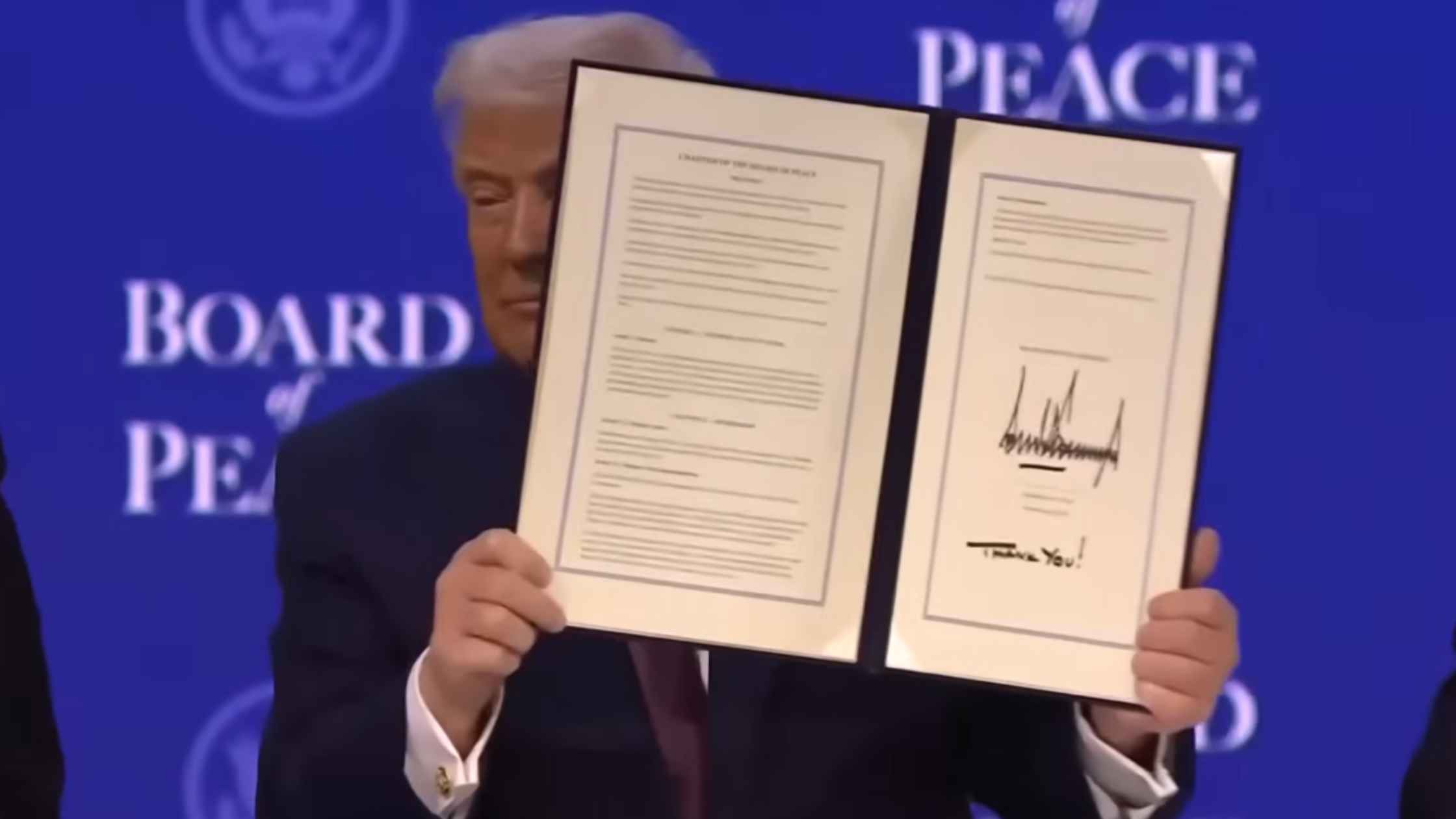
And now to bring the Board of Peace into full force, I ask Shaikh Isa of Bahrain and Foreign Minister Bourita of Morocco to join me in signing and ratifying the Board of Peace Charter. Thank you very much, everybody. Appreciate it. Thank you. Thank you.
Speaker 4 (27:51):
Sit down. Sit down. Sit down.
Speaker 3 (28:43):
Okay.
Speaker 1 (28:55):
Congratulations, President Trump. The charter is now in full force, and the Board of Peace is now an official international organization. We will now continue the signing ceremonies, beginning with the President of Argentina and the Prime Minister of Armenia. Next up, the President of the Republic of Azerbaijan and the Prime Minister of the Republic of Bulgaria. Thank you. Next, the Prime Minister of Hungary and the President of the Republic of Indonesia.
Donald Trump (31:03):
These are two tough guys. You think it's easy, right?
Speaker 1 (31:38):
Next, the Deputy Prime Minister of the Kingdom of Jordan and the President of the Republic of Kazakhstan. Next, the president of the Republic of Kosovo and the Prime Minister of the Islamic Republic of Pakistan. That's it. Yes. Thank you. Next, the President of the Republic of Paraguay and the Prime Minister of the State of Qatar.
Speaker 3 (33:55):
Hello. How are you?
Speaker 1 (34:32):
Next, the Minister of Foreign Affairs of the Kingdom of Saudi Arabia and the Minister of Foreign Affairs of the Republic of Turkey. Great. Next, the Chairman of the Executive Authority Affairs of the UAE and the presidents of the Republic of Uzbekistan. And last but not least, the Prime Minister of Mongolia. Congratulations, everyone. This concludes the signing ceremony. If President Trump and all of the Board of Peace members could please join the President around the table, the President is now going to sign the inaugural resolution that will resolve the Board of Peace's Gaza mandate per the United Nations Security Council Resolution 2803. Congratulations. If President Trump and All Board of Peace members could please take their seats in the front. Now it is my honor to introduce the United States Secretary of State, Marco Rubio, who will speak about President Trump and his accomplishments. Without further ado, Secretary Rubio.
Marco Rubio (38:39):
Thank you very much. It's an honor to be here today. It's an honor to serve as the Secretary of State during a historic presidency. And it's a historic presidency because the President of the United States, Donald J. Trump, is someone who is not limited by what others say is possible or what others say is impossible. He's not limited by some of the things that have happened in the past, and he's willing to talk to or engage with anyone in the interest of peace. Always putting the American people on our national security first, but understanding that in the world that we share with so many others, peace is paramount to all of us.
(39:10)
We are here today because of President Trump's vision. If we go back just a few months ago, people thought what was happening in Gaza was impossible to solve. 28 hostages that were dead, others that were still living, all these hostages that were being held, no one thought that that would ever come to a resolution without more fighting and more bloodshed along the way. In fact, frankly, many thought it was intractable.
(39:31)
And sadly, many of the institutions that have served us well in many cases for the last 70 years were unable to do anything about it. But President Trump had the vision and the courage to dream the impossible, to believe that it was doable and to pursue it with all of his heart. And he was in that capacity assisted by an extraordinary team. And I think both Jared and Steve deserved a tremendous amount of credit, Jared Kushner and Steve Witkoff for all the work they put in. And all of our partners here today. And now we have this board of peace who I believes possibilities are endless. Obviously, with a focus first and foremost on making sure that this peace deal in Gaza becomes enduring. And I know this president has its highest priority and we'll give it everything he has to make sure that this is successful.
(40:18)
I also want to acknowledge the extraordinary leaders that are here today. This is not just a board of peace, this is a board of action. Just like President Trump is a president of action. A lot of times people like to give speeches. I've been to many at these forums and they're not useless and they have utility in many cases. But oftentimes in international affairs, we often find ourselves at events where people are reading these scripted statements, these strongly worded letters that they put out, but no action, nothing happens.
(40:44)
This is a group of leaders that are about action. And the President of the United States is a president of action, of getting things done. And today is the beginning of that, of a new era and a new stage that we think is so important as a model to the rest of the world of what is possible. And clearly the focus is right now on Gaza and making sure that the plan that's about to be presented to you here today, this vision for the future of Gaza, this vision for the future of the region is not just possible and promising. It is our destiny if we put the time and the effort that it requires, as I know this board will do. But I also think it will serve as an example of what's possible in other parts of the world.
(41:22)
Without losing focus on what's before us now, this is what's possible for other places and other conflicts that seem impossible to solve right now. So I want to, on behalf of the United States, on behalf of the team that works so hard on this, thank every single one of the leaders that are here today and all the countries that have committed to joining and many others who are going to join. Others either are not in town today or they have to go through some procedure internally in their own country because of constitutional limitations, but others will join. Many want to be a part of this effort because it is going to be a successful effort.
(41:55)
And you see it reflected here today among countries of different backgrounds from different parts of the world, majority Christian some, majority Muslim others who've come together in time, in fact, former adversaries who have joined here as part of this board of peace. And all was possible. And I want to acknowledge this again because of the vision and the drive of the President of the United States. So thank you all for joining us here today. We appreciate it very much.
Speaker 1 (42:26):
Thank you, Secretary Rubio. Please, if you could now turn your attention to the screens for a video message from the head of the National Committee for the Administration of Gaza, Dr. Ali Shaath.
Dr. Ali Shaath (42:39):
Distinguished leaders, colleagues, and the friends. It is an honor to be here today. I want to start by thanking President Donald J. Trump and his administration for their intensive efforts to advance peace in the whole region. I also thank Egyptian President Abdel Fattah El-Sisi, Qatar and Turkey as mediators, the Palestinian Authority and members of the United Nations Security Council for welcoming the Comprehensive Peace Plan.
(43:10)
These efforts created the opportunity for a new future in Gaza strip, but what will really matter is what comes next. This transition will succeed only if it delivers real tangible improvements in daily life for Gazans. As Chief Commissioner of the National Committee for the Administration of Gaza, it's my responsibility to turn this moment into action, to restore orders, to rebuild institutions, and to create a future for the people of Gaza defined by opportunity and dignity. Under the principle of one authority, one law and one weapon.
(43:56)
As a first step, I am pleased to announce the Rafah Crossing will open next week in both directions. For Palestinians in Gaza, Rafah is more than a gate. It is a lifeline and a symbol of opportunity. Opening Rafah signals that Gaza is no longer closed to the future and to the world. I want to be clear, there is much more work ahead and none of it is easy. The road forward will involve difficult decisions and setbacks, but this is a real step and it marks a new direction.
(44:37)
Now, I would like to address the people of Gaza. [foreign language 00:44:43]. Today I ask the international community not only to support this effort, but to work with us, judge us by our actions. Hold us to clear the standards and stand with the people of Gaza as we take this responsibility for our future. Thank you, ladies and gentlemen.
Speaker 1 (46:35):
I now would like to welcome to the podium U.S. Special Envoy, Steve Witkoff and Jared Kushner.
Donald Trump (46:58):
Thank you, everyone, and welcome here. This is really my honor to be up here speaking. I remember when the president asked Jared I, and of course our great Secretary of State to work on something that the world thought was impossible and unattainable. But the president on this peace deal for Gaza, as on all other deals we work on, on his behalf, said we had to try. And of course we were inspired by that. We have achieved a peace deal in Gaza. We have brought the hostages home, all of the bodies except for one, and we will bring that body home too. And maybe most importantly, we have created a sense of hope for what the future can bring to in Gaza and all other places where the Board of Peace will operate. And I am so honored, Mr. President, to have worked on this on your behalf. I'd like to thank some people who are here with us tonight, who have done so much, done indispensable work to bring this deal together. Sheikh Mohammed, my good friend from Qatar and Ali Al Thawadi, Hakan Fidan, and Ibraham, General Hassan, and Foreign Minister Badr Abdelatty, and of course, President Sisi and Prime Minister Netanyahu, a former special envoy, Ron Dermer, and Michael Eisenberg for all that they did.
(48:42)
I would also like to thank our core working group and members of the Board of Peace who have been working nonstop on behalf of this incredible noble effort around the clock for months on end, sacrificing time with their families and their own personal lives, because they believe in the mission and the vision that the president has set out for us. I'd also like to thank ... and those people include Tony Blair, Yakir Gabay, Josh Gruenbaum, Aryeh Lightstone, Loron Tunkman, Admiral Cooper, General Frank, and I probably have forgotten some along the way.
(49:26)
And then perhaps most importantly, I want to thank our administration. We have an incredible team. It's amazing to work for this administration. I think you see the results that we get on behalf of the President because he inspires us so much. So I'd like to thank the Vice President of the United States, JD Vance, for all of his help and guidance, our treasury secretary, of course, the Secretary of State who we work hand in glove with, and a special thanks to our chief of staff, Susie Wiles, who was always available to us for consultation, for steering and for all else that she does. Thank you.
Jared Kushner (50:09):
Thank you, Steve. And I have to say one of the great honors for me of being able to work on this has been working with Steve, who really is as brilliant as he is, his heart is tremendous. It's a lot of fun to be with. And even in some of these very difficult moments where we didn't think things were happening, working together really was an amazing treat.
(50:28)
I'm going to go now today just through a couple quick slides just to show you the progress that's been made in the last couple months. It was just over 100 days ago that we got the final deal done and everyone was celebrating and joyous about the hostages coming home and the end of this long war that nobody thought was possible. And Steve and I were panicking saying, "What do we do next? How do you implement peace?"
(50:48)
And as you guys know, peace is a different deal than a business deal because you're changing a mindset. And in Israel, there was two years of very intense war for the people in Gaza. There was more than just two years of war. They had 20 years of hopelessness
Jared Kushner (51:00):
... [inaudible 00:51:00] being ruled by a terrorist organization. For the people in the Middle East, their hearts were pulled by this. And throughout the entire world, it really was weighing on us. And so we needed to think about what do we do next? How do we change the habits? How do we change the behaviors? And we really got to work right away. And the team that Steve thanked, including the White House team and the team, the volunteers, it's really been an incredible effort, very entrepreneurial. And we really did it in the way, I've been working now with President Trump for 10 years on politics, and what continues to amaze me is that he always takes a first principal's approach and says, "What's the most optimal outcome? Aim for that."
(51:34)
Whereas politicians are always focused on the downside or what could go wrong or how to make it a little bit better, he always says, "Aim for the best possible and do your best to get there. And if everyone thinks it's impossible, that's even more reason why you should aim for it. " And so really thank you for the leadership and the inspiration for doing this. And I think you'll see today we've achieved more than thought was possible. And our ambition is still to go for something I think better than most people think is possible as well.
(51:58)
So let's see if these things work. They never usually work. Good. So quickly, I'll go through this two year war, 90,000 tons of munitions. There's over 60 million tons of rubble there and tens of thousands of fatalities. Through the ceasefire, we were able to get to the 20 point plan, ceasefire, release of hostages. Getting the UN resolution passed was a huge, huge effort. Really thanks to Mike Waltz and the whole team there, they did an incredible job.
(52:24)
And we've then, with the help of the UN, we've worked very, very well with them, this is why you need a new organization like the Board of Peace to work with the UN. I want to thank Tom Fletcher, did an incredible job of really getting it going. We've done historic humanitarian aid. Going forward, number one thing is going to be security. Obviously we've been working very closely with the Israelis to figure out a way through deescalation. And the next phase is working with Hamas on demilitarization, which I'll talk about in a second. But without security, nobody's going to make investments. Nobody's going to come build there. We need investments in order to start giving jobs.
(52:56)
We want to take these people. 85% of the GDP of Gaza has been aid for a long time. That's not sustainable. It doesn't give these people dignity. It doesn't give them hope. And so we want to use free market economy principles. A lot of what President Trump spoke about that he's doing in America, we want to bring the same mindset, the same approach, to a place like Gaza to give these people the ability to thrive and have a good life.
(53:21)
Let's see. So on the aid, I mentioned the UN. So now people are talking about famine. 100% of the food needs are met. And that's been overabundance. The cost of goods have gone down tremendously. Over 55,000 trucks have gone in and over 1.4 million pallets. So it's been the largest humanitarian effort done into a war zone that anyone's been able to tell us about. This really has been a great joint effort that everyone's been able to do. And so it's a great thing.
(53:49)
We all just heard from Ali. We have been so impressed. Steve and I were speaking to him and the entire committee. Such bravery of these people to step up. And we've worked with the Palestinian Authority who's been helping us as well. But this committee is the first time, this technocratic, apolitical committee, I really want to thank the Arab partners for helping us select the right people to do this. And we just need to believe in them and support them.
(54:10)
I put this up here, it's probably a little too small for me to read, but this is really important if you saw the mission statement. So Hamas' mission statement was, "We need to destroy the state of Israel." That has not worked well for the people as we've seen. Their mission statement "Is we are committed to establishing security, restoring the essential services that form the bedrock of human dignity, such electricity, water, healthcare, and education, as well as cultivating a society rooted in peace, democracy, and justice, operating with the highest standards of integrity, transparency."
(54:40)
So these are the basic things. Their goal is to have peace and to help their people, which is an obvious mission statesman for a government, but actually fairly novel for Gaza. So we did a master plan. We brought in, I thank Yakir Gabay, who's one of the most successful real estate developers and brilliant people I know. He's volunteered to do this not for-profit, really because of his heart he wants to do this. And we've developed ways to redevelop Gaza.
(55:02)
Gaza, as President Trump's been saying, has amazing potential. And this is for the people of Gaza and we've developed it into zones. In the beginning, we were toying with the idea of saying, "Let's build a free zone, and then we have a Hamas zone." And then we said, "You know what? Let's just plan for catastrophic success." Hamas signed a deal to demilitarize. That is what we are going to enforce. People ask us what our plan B is. We do not have a plan B. We have a plan. We signed an agreement. We are all committed to making that agreement work. There's a master plan. We'll be doing it in phasing.
(55:28)
In the Middle East, they build cities like this two, three million people, they build this in three years. And so stuff like this is very doable if we make it happen. Rafah, we'll start with. This will show a lot of workforce housing. We think this could be done in two, three years. We've already started removing the rubble and doing some of the demolition. And then New Gaza. It could be a hope, it could be a destination, have a lot of industry, and really be a place that the people there can thrive, have great employment.
(55:54)
Once this starts going, we think there should be 100% full employment and opportunity for everybody there, and we have a lot of data on what can be, but we think that this really gives the Gazan people an opportunity to live their aspirations. But it all starts with security and it all starts with governance.
(56:08)
Final note I'll just say on the Board of Peace, which is that all the lessons we're doing is we're basically studying the best practices from all over the world and we're watching who does education the best, who does healthcare delivery the best. All of these things are ... It's not a secret IP. All this is IP that the Board of Peace is going to make public, and we want to encourage all the countries to be able to follow these best practices. A lot of the things that President Trump is doing in America, if they're working, we should all be copying them. If we find what's working in other countries, we should be copying them too.
(56:36)
And so what the Board of Peace will have the ability to do if we're successful with Gaza is really show how do you do peace implementation, which is something that when we got this deal done, we didn't really find too much expertise or know how on how to do it. So as we're creating this system, hopefully it's something that we can just document these learnings and make them available to all else who want to use them in the future.
(56:56)
So demilitarization, this is something we're starting now. We have a new government in Gaza. This government will be working with Hamas on the demilitarization to really take the principles that were agreed to in the document to the next phase, and hopefully that will be successful. Without that, we can't rebuild. So if Hamas does not demilitarize, that will be what holds back Gaza and the people of Gaza from achieving their aspiration, and that's very important.
(57:20)
So the next hundred days, we're going to continue to just be heads down and focused on making sure this is implemented. We continue to be focused on humanitarian aid, humanitarian shelter, but then creating the conditions to move forward. So thank you.
(57:33)
Final point I'll just make is this is really only possible because of the work of so many people and President Trump's great leadership, but a lot of you have been asking, how can we help? So the countries have all been incredibly generous. We'll be doing the first conference where we'll announce a lot of the contributions that'll be made in a couple of weeks in Washington.
(57:50)
From the private sector, there'll be amazing investment opportunities, I know it's a little risky to be investing in a place like this, but we need you to come, take faith, invest in the people, try to be a part of it. And then finally, I'll just talk to people on the media and on the social media, which is this deal only happened because we worked with Israel, we worked with Turkey, we worked with Qatar, we worked with Saudi, we worked with Egypt. I mean, everyone worked together. We worked with UAE. We all worked together to make this happen.
(58:17)
I see a lot of people trying to escalate, criticizing Israel or Israelis, criticizing Turkey or Qatar. Just calm down for 30 days. I think that the war's over, let's do our best to try working together. Our goal here is peace between Israel and the Palestinian people. Everyone wants to live peacefully. Everyone wants to live with dignity. Let's put our efforts towards promoting those who are doing the work to build this up, like Ali and his committee. Let's focus on the positive stories and let's just calm down, turn a new chapter, and if we believe that peace is possible, then peace really can be possible.
(58:46)
So we're going to continue to work every day. We need all of your help to do it. And again, I just really want to thank President Trump for his leadership in doing this. This would not have been possible without your commitment to this. Everyone thought it was impossible to end this war. You never gave up. You never stopped. Every time there was a setback, you told us to try harder, you gave us different ideas, and we've made several impossible things happen just in Gaza to date, and there's no reason why we shouldn't be able to make even more impossible things happen. So really thank you for your amazing leadership.
Speaker 5 (59:22):
Thank you, Jared and Steve. Now I would like to introduce and welcome to the podium, the high representative for Gaza, Nickolay Mladenov.
Nickolay Mladenov (59:44):
Mr. President, it's a great honor and a massive responsibility for me, for my team, for all of us to be here with you to begin this journey. Who would have thought two years ago that we will be sitting here with this group of countries, with this leadership, giving the people of Gaza a new chance? Who would've thought that last Friday, I would be sitting Mr. President in Cairo with an amazing group of Palestinian technocrats, people who you don't see on the news, people who are not media personalities, but who are experts, who are committed to giving their people a chance in life.
(01:00:22)
And this is what this is all about. For too long, Gazans, Palestinians, and Israelis have lived with conflict, with death, with destruction. Now, the page turns, and whether the page turns successfully really depends on all of us. We have the ingredients for it. We have the leadership of the United States and President Trump. We have a great group of countries joining the Board of Peace and more to come. We have a fantastic Palestinian team on the ground and we must make it work. Our partnerships are there, our plans are in place, and we need your support.
(01:00:57)
And finally, I look to all of you who are in this room and who are watching this meeting from their screens at home or in their offices. Please put away your talking points for a minute. Please put away your fears. Please put away your concerns. Please stop listening to the rumors and to the gossip. Focus on what we have to do today because the future of two million Palestinians is at stake and if we give them a chance, we will do more than that. We will create opportunities for one billion people who live in the Middle East and beyond and who are responsible, also who want to see transformation and a chance in life for the future.
(01:01:39)
So please join us on this journey, join the Board of Peace and join us in supporting this excellent initiative. And thank you again, President Trump and the United States for taking this decisive leadership forward.
Speaker 5 (01:01:54):
Thank you. President Trump, would you like to make some concluding remarks?
Donald Trump (01:02:08):
Great job. Great job. Well, I just want to tell you it's all happening. And one of the first things I said when we really got involved in this project, and it's a big one, but it's very doable. I said to Jared and Steve and some of the other folks, including Larry Fink, and congratulations on the great success. The two of you have done a fantastic job. This is bigger and better than ever. We usurped some of your time for a very important reason, and you understand that better than anybody, and we appreciate that you're here very much. Thank you both very much.
(01:02:49)
But I said that this is a great location. It all begins ... See, I'm a real estate person at heart, and it's all about location. And I said, "Look at this location on the sea. Look at this beautiful piece of property, what it could be for so many people. It'll be so great. People that are living so poorly are going to be living so well." But it all began with the location that's the vision. They look out on the waters and very few places that like it.
(01:03:18)
So we put together a team that's outstanding, a team that's done it before, a team that I think has done tougher jobs, if you want to know the truth. We've done some tough jobs and we continue to. As far as the United States is concerned, we're behind it. And the United States has never been stronger, never been bigger, better. It's doing really well. You see that, building thousands of businesses, plants, factories all over the United States are right now under construction. Nobody's ever seen anything like it.
(01:03:50)
And this is just an honor to be involved with this and to be involved with the great people in this room and the great leaders that are sitting on stage. We thank you very much. And we have many others that have signed up and they all want to be members of the Board of Peace because it really will be important. This is not going to be a waste of time. We waste so much time on things that never happened, this will happen and it's already happening. Thank you very much, everybody. It's a great honor to be with you. Thank you. Thank you.