




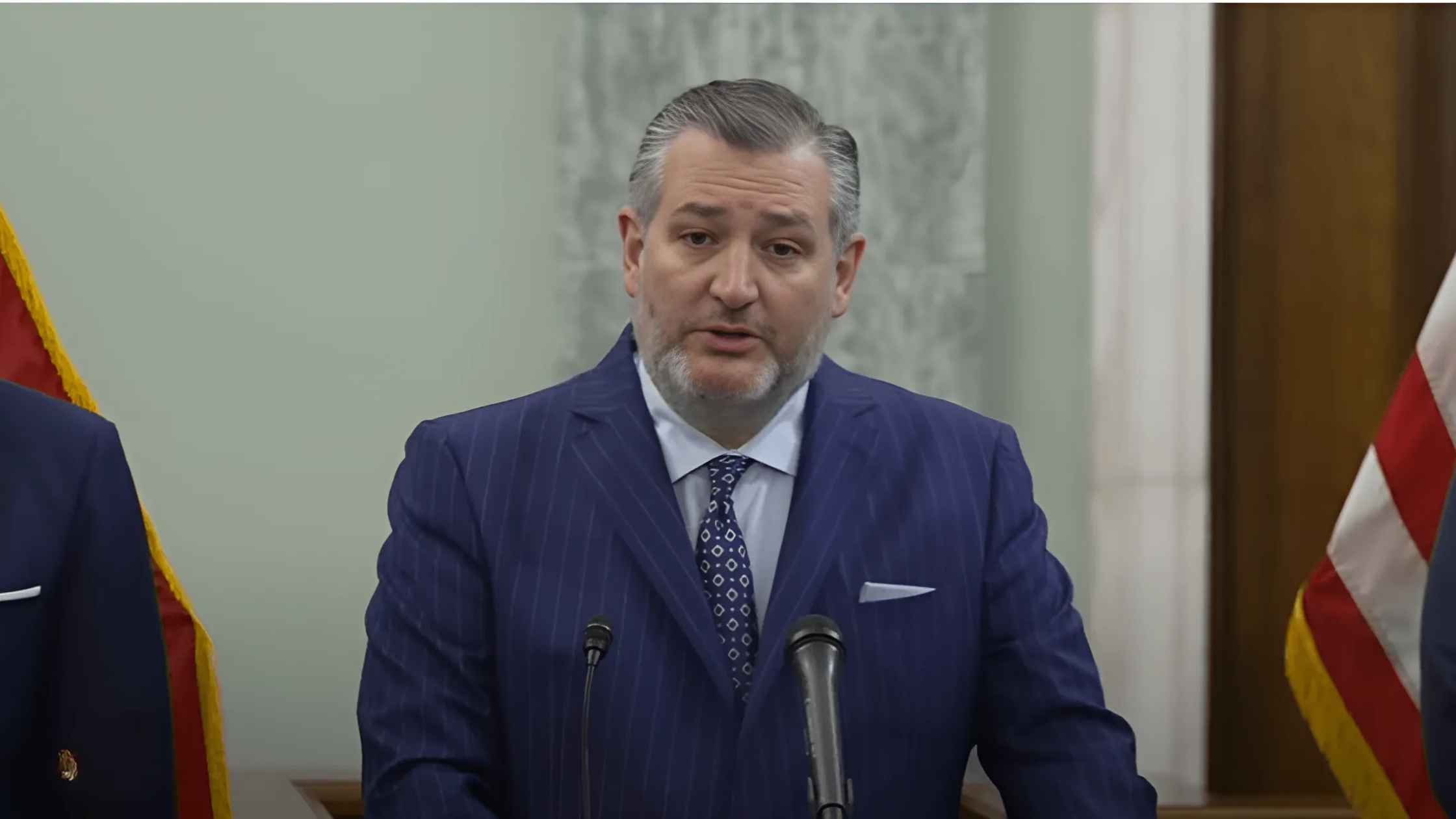


Senator Ted Cruz (00:00):
… I hope by a revived spirit of hope and a shared determination to act in the face of an unforgettable tragedy. American skies must be as safe as possible, and our duty as lawmakers is to ensure that they are.
(00:18)
I would like to start by thanking the individuals who are joining me for the introduction of the Rotorcraft Operations Transparency and Oversight Reform, or the ROTOR Act. Secretary Duffy, Chairwoman Homendy, Tim and Sheri Lilley, Doug Lane, and my colleagues have all worked hard to make the American skies safer.
(00:44)
Tim, Sheri, Doug, thank you for your courage and your advocacy. Your presence reminds us of what is at stake. You've turned your grief into purpose. We are here today because of your efforts and the memory of Tim and Sheri, your son Doug, your son, Doug, your wife and son, and all of the loved ones that were lost over the Potomac.
(01:15)
The ROTOR Act represents a common-sense step forward in aviation safety reform. One of the most important parts of this bill is the requirement that all aircraft, military and civilian, use both ADS-B Out and ADS-B In. ADS-B is critical for aviation safety. This technology allows aircraft to broadcast their positions and to receive positions of others in real time, faster than other technology in use today. It gives pilots and air traffic control a clear view of what is happening in the skies.
(01:57)
The NTSB first recommended ADS-B In nearly 20 years ago. We are going to make that happen this year. Make no mistake: there cannot be a double standard in aviation safety. We should not tolerate special exceptions for military training flights operating in congested airspace. No matter the circumstances, any aircraft flying near commercial traffic must fully adhere to safety standards. Given the communications breakdown that led to the accident, it is also important to address helicopter routes in congested commercial airspace. We cannot have commercial airplanes and helicopters on a collision course ever again.
(02:56)
This bill is based on two core principles: technological transparency and institutional responsibility. While American skies are among the safest globally, this safety is not always assured. I want to be clear. The Senate will lead this effort. We will not wait for another accident to happen before we act decisively to protect the American skies. We have made it abundantly clear that when American lives are at risk, excuses are not acceptable.
(03:35)
However, this is about more than policy, it's about people. The family standing here, they didn't ask to be a part of this story. However, they stand with the courage to ensure that it has a better ending for others. This is the kind of legacy we should all aspire to build. Thank you, and I now recognize the Secretary of Transportation, Sean Duffy, to give his remarks. Mr. Secretary.
Secretary Sean Duffy (04:05):
Thank you, Senator. And first, I want to thank you and your Senate colleagues for taking a bold step. There's a few tweaks we may want to make with you and give you some feedback and insight, but by and large, this is the right approach.
(04:20)
And we're here today because of the tragedy in January at DCA, and that should not be the story. Focus on safety should have always been the focus. And I think in the past, people became complacent, leaders became complacent, and we had warnings of near misses in the DCA airspace. Unacceptable.
(04:48)
And so I think at this moment, by the way, because of the great partnership of the families, and I couldn't ask for better partners, constructive, insightful, helpful, paying this forward to make sure no other family goes through what they went through has just been a godsend to make our skies safer, and I thank you all for your effort. But this is the right step. This is the right approach.
(05:14)
And by the way, Senator Cruz is a Republican. This is not partisan. Safety is not partisan. It is Democrats and Republicans, House, Senate, DOT, FAA, the President's administration, all of us want to make sure we're safe. And so, Senator, I commend you for this bold effort and rallying the forces in this body to make sure we lead and make sure our skies continue to be the safest in the world. And this is one giant leap that's going to help make that happen, and I look forward to working with you and your colleagues to advance this cause, so thank you for driving. Again, 22 years ago, NTSB recommended this.
(05:59)
By the way, sometimes people get concerned about cost, and I don't think we should be concerned about cost when it comes to safety, but I was talking to the administrator of the FAA. The cost to deploy this technology is not that great for commercial aircraft or for the military. We can drive safety way higher and also at a very affordable cost. That's the benefit of the advancement of technology over the course of the last 22 years. And so this is doable, and I think the American people expect this from this body, this administration, to keep them safe. And so with that, thank you for having me, and look forward to working with you, Senator.
Senator Ted Cruz (06:44):
Thank you very much. I now turn to Doug Lane, whose wife, Christine, and 16-year-old son, Spencer, were killed in the accident. He is also here representing the other families of Flight 5342.
Doug Lane (07:04):
Thank you, Chairman, and I also just wanted to acknowledge Ben Stuhl, who's also here with me from the family group. He lost his partner, Melissa McAndry, on the flight.
(07:13)
First off, we want to extend our sincere appreciation to Chairman Cruz, his co-sponsors, Senators Moran, Marshall, Schmitt, Blackburn, Budd, and Sheehy for introducing the ROTOR Act, a significant effort aimed at strengthening aviation safety and oversight. Chairman Cruz has been one of our most consistent and strongest voices for the families of Flight 5342 and for overall aviation safety reform.
(07:41)
The ROTOR Act reflects many of the priorities our families have been advocating for since the tragic loss of Flight 5342, six months ago today. We're especially encouraged by the stronger ADS-B requirements in the bill, as well as the requirement for an army inspector general to conduct an audit into the Army's role in our accident. These measures are essential steps towards ensuring that the failures which led to this tragedy are never repeated.
(08:08)
While we know this bill represents an important starting point, we also know it will take bipartisan momentum to ensure aviation safety. We are eager to see what Chairman Cruz and Ranking Member Kent will achieve on the Senate floor to build on this foundation to build the strongest possible protections for all who fly.
(08:25)
This is not about politics for us. It's about saving lives. Every meaningful step towards transparency, accountability, and safer skies is a victory for every family who has suffered an unimaginable loss. Please be sure to follow along as we continue our advocacy efforts at Flight5342.org. Thank you so much for allowing us to be here today.
Senator Ted Cruz (08:49):
Well, thank you, Doug, and thank you for your strength and courage to stand up and fight in the face of truly horrific loss.
Chairman Cruz (09:00):
I now turn to Tim and Sherry Lilley, the parents of Sam Lilley, the first officer of Flight 5342 for their words, Tim and Sherry.
Tim Lilley (09:13):
Today marks six months from the most tragic event in our family's history. What we're doing here today is we're going to try to make sure that no other families have this tragic event happen. I want to especially thank Secretary Duffy because when we met with him, he took our concerns. He took them to heart, he went to running with it. He showed compassion for not just our family, but for the entire traveling public, and so we're going to stick with him and see this thing through. We're going to modernize the air traffic control system.
(09:53)
We're going to get all the air traffic controllers back on the job. And then I really want to thank Chairwoman Harmony. She has led the NTSB in one of the most difficult processes that's happened in years, and she's kept us informed. She's given us every opportunity to have a voice, and we've just really appreciate that. From the day that we met with Chairman Cruz, he really set in motion that this is not going to be Sam's legacy to die in vain. 67 really great people lost their lives that night, and there's no reason for that. What we have here is legislation, if it's passed, is going to close some very important safety loopholes so that this never has to happen again.
Sherry Lilley (10:50):
Thank you so much, Chairman, for asking us to be here today and to take action out of our grief to avoid this type of tragedy from ever happening again. Both Chairman Cruz and ranking member Cantwell have been so compassionate and demonstrated such empathy for our families. We greatly appreciate the leadership that they have both demonstrated on this topic of aviation safety, not just for our families, but as Tim said, for the flying public, for everyone, whoever sets foot on a plane and flies in our national airspace.
(11:24)
In addition, we're very, very thankful for the senators who came together with Chairman Cruz to sponsor the Rotor Act. We appreciate Senator Moran, Marshall Smith, Blackburn Budd, and Sheehy for their very demonstrated leadership also on this topic. This is a very personal matter for all of us, but we hope that by being here and sharing our story, you all buy into this also and that you do support the efforts of the secretary at the Department of Transportation, that you advocate for that additional funding that we need to update the air traffic control systems and all of the systems that control our national airspace. Thank you so much everyone.
Chairman Cruz (12:11):
Sherry, Tim, thank you for your strong leadership at a time of great grief and pain. Thank you for using that grief to try to protect the flying public. Try to protect every one of us. I know every time now that I land at Reagan, including yesterday just getting here, I suspect I'm not the only one who looks out the window and thinks about what could happen, and we're acting today to protect the flying public going forward. I now want to introduce National Transportation Safety Board, Chairwoman Jennifer Homendy, to discuss her investigation and her efforts to identify the operational breakdowns and safety gaps in the airspace.
Jennifer Homendy (12:55):
Thank you. Well, as you heard today marks six months to the day since 67 people died in a mid-air collision over the Potomac River near Ronald Reagan National Airport. That's 67 mothers, fathers, sisters, brothers, children, friends. As well as three highly respected soldiers who dedicated their lives to defending our nation. I do want to thank Chairman Cruz, Chairman Moran, secretary Duffy, certainly the Administrator and the families for your tireless and selfless work to improve aviation safety since this tragedy occurred. Tomorrow, the NTSB will meet in public for the beginning of our investigative hearing on this collision. It's a three-day hearing. We'll meet from 9 A.M. to 7 P.M. perhaps longer if needed, and we're going to go through some pretty in-depth discussions on different points of this investigation. An investigative hearing is not like the end of the board meeting where we present our conclusions. It's to develop more facts for the investigation.
(14:22)
So the rest of the evidence though, which is in our public docket, will be open at 9 A.M. That's thousands of pages of evidence that will be available publicly at NTSB.gov. Again, it's a fact-finding proceeding. We're not at the point of analysis or issuing safety recommendations. For over two decades though, we've recommended that FAA require ADSB in following a myriad of mid-air collisions, Texas, Hawaii, Georgia, Alaska. In 2008, we sent a letter to FAA stating "The board believes that the equipage of aircraft with ADSB in capability will provide, and I want to stress this, an immediate and substantial contribution to safety, especially during operations in and around airports." In 2019, I was the board member on scene for a mid-air collision in Ketchikan, Alaska involving two float planes. Six people died, 10 others were injured, and we again said we needed ADSB in. A big part of that report stating that we hoped that it got mandated, including for passenger aircraft, especially in high traffic areas.
(15:45)
Just two weeks ago, I got to experience ADSB in by riding jump seat, flying jump seat in American Air. They outfitted their entire fleet of Airbus A321 Neos with ADSB in, and it's incredible technology. ADSB, and I can't stress this enough, is a game-changer, a game-changer when it comes to safety and will provide, as we said in 2008, immediate and substantial contribution to safety. This will save lives. This legislation will save lives. So I do want to say thank you to Senator Cruz again to Senator Moran, secretary Duffy. There's a lot of bipartisan support for moving ADSB in forward, including with ranking member Cantwell and ranking member Duckworth. There's momentum in the Commerce committee and I'm excited and look forward to working with you to make sure it gets done.
Chairman Cruz (16:50):
Thank you, Madam Chair. Now would like to introduce Senator Moran, the chairman of the Subcommittee on Aviation Space and Innovation. Chairman Moran. Right there Jerry.
Chairman Moran (16:59):
Chairman Cruz. Thank you for convening this opportunity for us to be together to publicly state our support for legislation that you have introduced that to Senator Marshall and I are joining in sponsoring. I appreciate what Chairman Homendy said about ADSB in and out. We introduced, I introduced legislation to require that to approximately a month after the January 29th tragedy, and I am pleased to see the momentum and I appreciate Senator Cruz's review of this and inclusion in his legislation and we look forward to seeing this accomplished. Chair Homendy has explained why it's so important and we will, in my view, work to see that this legislation becomes law and ADSB in and out become the norm, the required norm as quickly as we can do so by the supply chain capabilities to exchange
Chairman Moran (18:00):
What we have today, or to add what we don't have today to aircraft across the country. And we're talking both military and commercial, civilian. So this is a major improvement in our opportunities to provide the safety. And it's pleasing to me to see the efforts by the families to find meaning in their work to make certain that the tragedy that we experienced six months ago today doesn't occur and other families are not impacted in the way that these individuals, moms, dads, brothers, sisters, cousins, friends, have been impacted by the loss of life.
(18:43)
I'm also pleased to welcome the new FAA Administrator to his position. Chair Homendy, I always have high regard for your work, your capabilities to focus us. Today she gave us, Chair Homendy, gave us a briefing on what these next few days are going to look like with the hearings that are going to take place. And my takeaway is there are so many individual circumstances that all came together. Perhaps it would be nice if we could just put this in one this was the problem, but the issue is broader than a problem. And we're going to have a lot of work to do with the FAA, with the Department of Defense, and with all of us in Congress to get all of the issues that appear to be developing in air traffic safety handled and improved.
(19:35)
And Secretary Duffy, I wanted to tell you today is the 67th anniversary of the creation of NASA by a Kansan better known than me, named Dwight Eisenhower. And congratulations on your additional responsibilities, but thank you for not allowing them to intrude upon this. Secretary Duffy, while I'd met him when he was seeking my vote on his nomination, he came by to pay the courtesy call and we had a fine conversation. But sadly, the first time I saw Secretary Duffy at work was on January 29th at DCA and that evening, and I have noticed, determined and admired your relentless effort to find safety in the circumstances from that night, today and in the future. And we look forward to working with you.
(20:27)
I congratulate the rescission, I'm sorry, the reconciliation bill that provided additional dollars for air traffic safety. And we are appropriating a member of the Appropriations Subcommittee on Transportation, and there's another set of billions of dollars in that bill to fund additional safety efforts within the FAA and within air traffic control.
(20:50)
So there was, again, I don't know how to say this very well, but from the circumstances that occurred six months ago today, I've seen Congress work together, I've seen the administration and the legislative branch come together and the executive branch to make certain that we find the right answers to prevent tragedies from occurring as they did such a short time ago.
(21:15)
And on behalf of all other Kansans, Senator Marshall and I express our condolences once again for the circumstances that originated in our home state. Thank you.
Chairman Cruz (21:26):
Thank you Chairman Moran. And I will say that Senator Moran and Senator Marshall had both been incredible leaders on this, given that so many of the victims of this tragic accident were from Kansas, it obviously struck both of them close to the heart. And now recognize Senator Roger Marshall.
Senator Roger Marshall (21:45):
Well, thank you Senator Cruz for your leadership and inviting us to participate and to all my fellow speakers up here, thank you. Good morning to everybody.
(21:54)
On January 29th, 2025 American Airlines flight 5343 from Wichita to DCA, tragically crashed claiming 67 lives including seven Kansans, Bob and Lori Shrock, Pete PJ Diaz, Lindsay Fields, Grace Maxwell, Kia Duggans, and Dustin Miller. Their loss weighs heavily and we owe it to them to ensure their deaths were not in vain.
(22:23)
That night I shared many of the same thoughts that so many of the family members had. Why was the helicopter in that airspace? Was it flying too high? Why did its transponder fail to warn the jet or air traffic control? While we're still awaiting some of those answers, Congress needs to act swiftly.
(22:46)
Our proposal legislation led by Senator Cruz mandates ADSB technology on aircraft in key airspaces, and for damn sure they need to turn them on. They need to turn them on when they're in those airspaces, the military, if they're going to be in the airspace, they need to turn on their transponders. This legislation mandates the technology and aircraft and key airspaces studies, barring rotorcraft from DCA during final approaches and orders an army audit of FAA coordination, pilot training, and ADSB use. These demands were asked for and driven by the victim's families. I hope they know that their voices were listened to and that they're being heard and appreciate the families just staying at this. No law can bring back the 67 people who we lost, but we can strengthen aviation safety to prevent such a tragedy again.
(23:46)
I'm trying to think what was missed today, but I just want to reckon back to a conversation I had with the mayor of Wichita the day after. And I said, "What can I do? " What can I tell Wichita?" And she said, "The number one thing is you could tell them we won't have helicopters in that airspace anymore." And I reached out to Secretary Duffy and Secretary of Defense Hegseth, and they stopped, they grounded them all, grounding's the wrong term. They stopped them from being in that area that day. And I hope we continue to have that commitment until Congress does her job.
(24:23)
Echo what Senator Moran said, the one big beautiful bill, which is now law, had 7 billion, $12 billion for modernizing in air traffic control, which is was way overdue. And the other response I see the Trump administration doing is accelerating air traffic controllers going through the system. And the secretary could speak more to that than I can. But from what I understand, over 3000 people are in some point of training to become air traffic controllers. We've accelerated the process. It's still a very rigorous process to get in the system, added bonuses, doing everything we can to get people in the seats that we need to prevent a tragedy like this again.
(25:02)
Thank you everybody.
Chairman Cruz (25:05):
Thank you. And I now want to recognize the new administrator of the FAA, Brian Bedford, who is here, and Administrator Bedford.
Brian Bedford (25:17):
Thank you, Chairman Cruz. And thank you especially to the families for 5342. Prior to my confirmation, I was privileged to be able to chat with many of the family members, hear from them their first-hand experiences, and importantly, read the seven point paper that they put out that would help us identify and close many of the gaps that allowed 5342 to happen in the first place. And Chairman Cruz, you and other members are to be congratulated. Most all of the comments and identified safety weaknesses that the families identified have been incorporated into this key legislation. And I certainly hope it has strong bipartisan support.
(25:57)
I want to thank Secretary Duffy for his leadership on this day one, it's a terrible way to start a job, but he didn't shriek away from the responsibility to take swift action across the NAS to ensure the safety of the traveling public and to encourage the FAA to dig deeper into data and lean forward into identifying other hotspots around the NAS, which they have accomplished. So again, the legacy is paying dividends for the traveling public that they may not even be aware of. So thank you for that.
(26:26)
Chairman Homendy, thank you for your leadership in the investigation. I suspect we're going to have some very uncomfortable conversations over the next two and a half days, but they need to be had, they need to be had in the clear light of day, and we simply need to put what's in the best interest of the traveling public ahead of any of our own personal interests perhaps. So I'm pleased to be here and be part of this solution.
(26:47)
And I would be remiss if I didn't close by thanking our president, President Trump's vision to advocate for building and modernizing a brand new air traffic control system. It's long overdue. It's absolutely critical
Brian Bedford (27:00):
… for the safety of the traveling public that we make this investment, get it right and continue to support advances in technology and in making sure that we have the best people, they receive the best training and have the best equipment possible to keep our NASA safe. So for all of your leadership, everyone gathered here today, thank you for your support.
Chairman Cruz (27:21):
Thank you, administrator. And now finally, I'd like to recognize Senator Ted Budd, who's also a co-sponsor of this legislation and a private pilot himself.
Ted Budd (27:32):
Thank you, chairman. Thank you all for being here. I wish we weren't here because I wish this wasn't an anniversary at all. I wish this tragedy had never happened, especially since it was preventable. This hits home because six out of the 67 souls that lost their lives that day were either North Carolinians or North Carolina connected, including all four members of the Charlotte-based flight crew and one of the helicopter pilots. I'm hopeful that our efforts in Congress starting today are going to make a difference in making our entire air traffic control system and our airspace a lot safer. ADS-B, it's a critical safety technology and mandating that aircraft are equipped with and using this technology. And that's been reiterated several times and that's absolutely important that it's used. I think that's a key step in making sure that all Americans are safe.
(28:29)
And you mentioned, Chairman Cruz, that I was a private pilot. So while I've got multi-engine and commercial and instrument ratings, most of the time on a beautiful North Carolina Sunday afternoon, if I'm fortunate enough to be home, I'll be flying. And the plane weighs less than 900 pounds, goes less than 100 miles an hour, it's bright yellow and it's equipped with ADS-B Out and ADS-B In. So if something that's better equipped for surveying corn fields and tobacco crops is with ADS-B Out and In, certainly our helicopters on non-critical missions and airlines should all have that, In and Out. I'm really proud to be part of the Shredder Act. Thank you for your leadership in this. I think it's a great step forward and we look forward to working with the administration to making sure this is as good as it can possibly be. Mr. Secretary, Chair Homendy, to the families, to the administrator, thank you for your leadership. And I appreciate you turning pain into courage and I know that you're making a difference. Thank you.
Chairman Cruz (29:40):
Thank you. And I'll say if we see a little yellow plane circling above us, we'll know that it's Ted coming to work. So that's good. All right. There is a vote that is right at the end, so I'm going to take one question unfortunately. Yes.
Tom Costello (29:53):
Senator Cruz, I'm Tom Costello with NBC News. If I could ask Secretary Duffy or the administrator, there's been some confusion. Where do we stand right now on military chopper activity, any chopper activity in and around DCA? There was prohibition for a while or there was some confusion about how much of that's been lifted, if any. And then secondarily, those choppers, are they required now to be flying with the ADS-B or is that still an issue with the military?
Brian Bedford (30:22):
Hi, Tom.
Tom Costello (30:22):
Good to see you again.
Brian Bedford (30:24):
Good to see you again as well. I can tell you that there is very few exceptions, only for critical emergency missions or for critical military missions, including POTUS. And in those special cases, airspace is closed to commercial traffic while the military traffic is in the area. So other than that, the routings have been completely redone, taking them well out of the Class B airspace pattern around DCA.
Tom Costello (30:52):
And choppers must be operating with ADS-B?
Brian Bedford (30:52):
That's correct. Unless they're on an exempted mission, in which case the skies are clear to commercial traffic.
Tom Costello (30:58):
But this chopper was on a training mission, which was viewed at the time as an exempted mission. Is that today still [inaudible 00:31:04]?
Brian Bedford (31:04):
That is no longer allowable.
Speaker 1 (31:09):
[inaudible 00:31:10]. So Senator Duffy, are you still planning to sign the MOU with Pentagon? Because the Army is still not allowed by helicopter missions around Pentagon, is that right?
Brian Bedford (31:19):
I could take that one as well. We do have an MOU, I'll say. I don't think it goes as far as this legislation does. But during the pendency of the legislation, the intent would be to continue to execute on the MOU with the military. I believe we can continue to support our warfighters' training needs by clearing airspace when it's necessary. We don't have to have conflicting traffic.
Chairman Cruz (31:40):
All right. Thank you. And I've got to run because the vote is closing as we speak.