Speaker 1 (00:00):
(silence)
Speaker 2 (34:00):
(silence)
Speaker 4 (01:27:04):
All rise. The Court is back in session.
Speaker 3 (01:27:09):
Yeah.
Tony Graf (01:27:39):
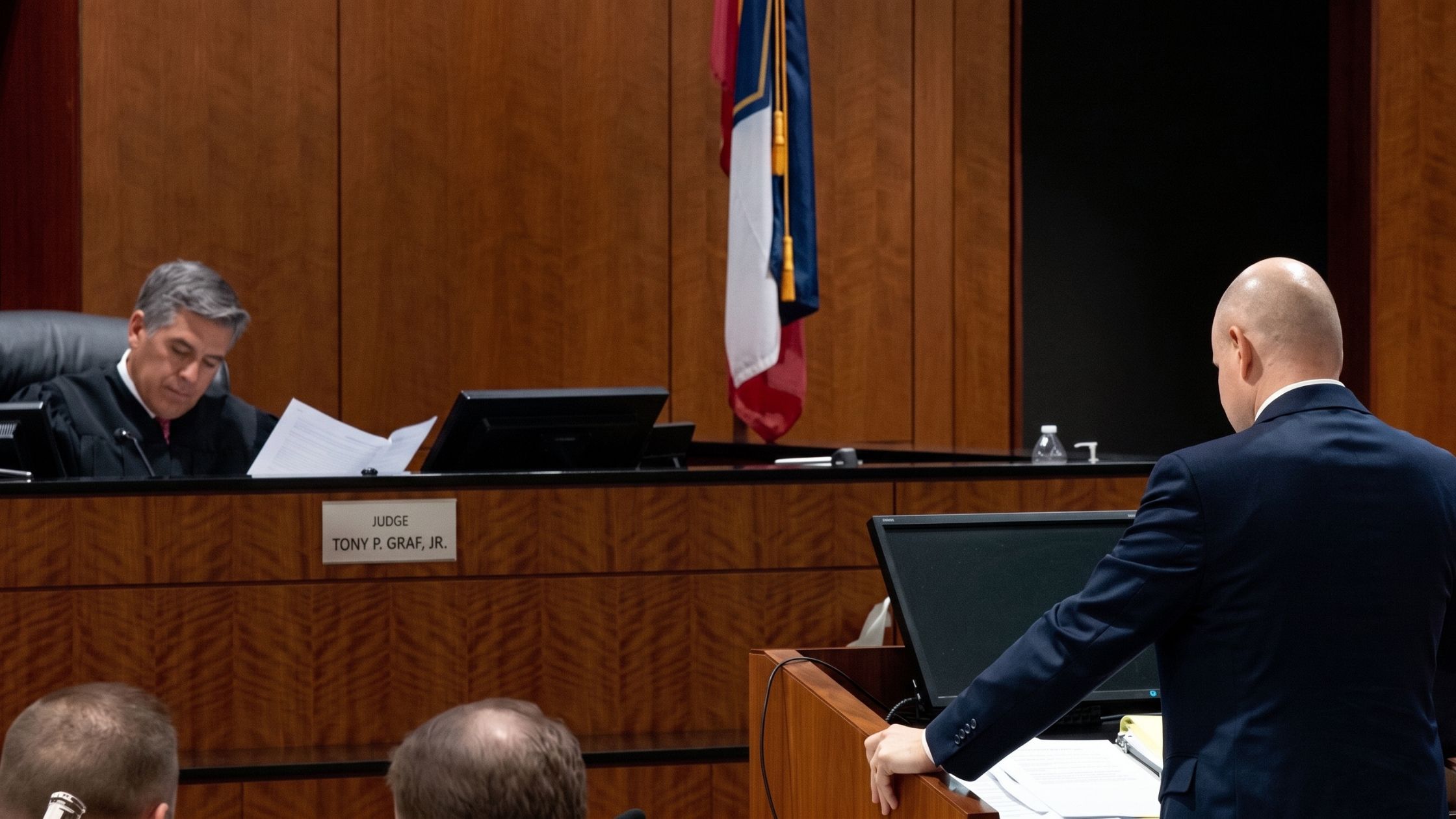
Please be seated. Court is back in session. Calling case 251403576 State of Utah v. Tyler James Robinson. Counsel, if you could please enter your appearances.
Chad Grunander (01:27:57):
Chad Grunander, Chris Ballard, Ryan McBride, Lauren Hunt, and Jeff Gray for the State.
Tony Graf (01:28:03):
Good morning to you.
Chad Grunander (01:28:04):
Good morning, Your Honor.
Kathy Nester (01:28:10):
Good morning, Your Honor. Kathy Nester, Richard Novak, Staci Visser, and Michael Burt here on behalf of Mr. Robinson, who is seated at counsel table.
Tony Graf (01:28:18):
Good morning, Counsel, and to you all. And Mr. Robinson, good morning to you.
Jeff Hunt (01:28:30):
Good morning, Your Honor. Jeff Hunt on behalf of the news media.
Tony Graf (01:28:34):
Good morning.
Jeffrey Neiman (01:28:45):
Good morning, Your Honor. Jeffrey Neiman on behalf of Mrs. Kirk, who's also present in the courtroom.
Tony Graf (01:28:50):
Good morning. All right, Counsel, first with respect to courtroom protocol, to maintain security and decorum, any individual who exits the courtroom during the proceedings will not be permitted to reenter until recess. All counsel are expected to take reasonable measures to safeguard confidential communication. Such measures may include the use of screen protections on electronic devices, and care to avoid the inadvertent capture of privileged or private discussions by recording equipment, or by those present in the courtroom. Second, the Court will address the still photographer and camera operator. If you wouldn't mind coming forward, please. And if you wouldn't mind each stating full name for the record.
Josh Demick (01:29:54):
Josh Demick with KUTV 2News.
Francisco Kjolseth (01:29:57):
Francisco Kjolseth, The Salt Lake Tribune.
Tony Graf (01:30:00):
Good morning. And could you state your roles for today's hearing? What you're assigned to do?
Josh Demick (01:30:08):
To provide coverage for the hearing today.
Tony Graf (01:30:10):
And through... What are you using?
Josh Demick (01:30:13):
Through video.
Tony Graf (01:30:15):
All right.
Francisco Kjolseth (01:30:16):
Still photography, pull photography.
Tony Graf (01:30:18):
Thank you. Have you both reviewed the Court's Amended Standing Decorum Order?
Josh Demick (01:30:24):
Yes, Your Honor.
Francisco Kjolseth (01:30:25):
Yes.
Tony Graf (01:30:26):
Yes. Do you understand the requirements set forth in that order as they apply to your activities today?
Josh Demick (01:30:31):
Yes.
Francisco Kjolseth (01:30:31):
Yes.
Tony Graf (01:30:32):
Do you require additional time to review the order, or to adjust your equipment to ensure compliance?
Josh Demick (01:30:39):
No.
Tony Graf (01:30:40):
Do you anticipate any difficulty complying with the order?
Josh Demick (01:30:44):
No.
Tony Graf (01:30:45):
All right. Thank you both. I appreciate your cooperation today. Before we begin this morning, the Court wishes to acknowledge the importance of safety, dignity, and well-being of all those present, or who may be present during these proceedings, including the parties, counsel, court staff, and members of the public. The Court is also mindful of its obligation to protect and uphold the constitutional rights of both Mr. Robinson and Ms. Kirk. In furtherance of those important interests, all persons attending these proceedings are reminded that portable electronic devices are not permitted in the courtroom, and the Court also expects that every person in attendance will be treated with the dignity and respect to which they are entitled.
(01:31:42)
Consistent with the Court's Amended Standing Decorum Order, all spectators shall remain quiet, civil, and orderly at all times. The Court recognizes that these proceedings later on today may have an impact upon them, and understands that there are human reactions, but I ask you to do the best that you can today. Spectators shall not engage in conduct that is distracting, disruptive, provocative, disrespectful, uncivil, or threatening in any manner, and shall not make any audible comments of any kind, shall not shake or nod their heads, shall not make gestures, or other visible reactions during the hearing. Spectators shall also not wear or display pins, buttons, signs, clothing, photographs, or other items expressing support for or opposition to any person connected with this case, or expressing any position concerning the status of this case as a capital offense. The Court appreciates the cooperation of all present in maintaining a courtroom environment that is safe, respectful, orderly, and faithful to the rights and dignity of every person involved.
(01:32:57)
All right, turning now to counsel. Before, we began today with live broadcast, we were in a sealed closure hearing dealing with a request to classify one of defense's motions, and we conducted that hearing, and present were counsel, and Mr. Robinson, and counsel for Ms. Kirk, as well as the media. We're now going to turn to counsel to... I believe there was a request prior to the Court making its ruling as it relates to the motion to classify an electronic media coverage as it relates to today's hearing. Ms. Nester.
Kathy Nester (01:33:49):
Thank you, Your Honor. Your Honor, as we discussed, based on the Court's decision to unredact our opposition to the electronic media, we are asking to withdraw from the Court's consideration the actual website identifier, and the name of the website that we refer to that is redacted. We would like to just remove that from the Court's consideration, and make the argument generally without providing you with a specific website to back up our argument, just due to our concern that it will create a reasonable likelihood we would not receive a fair proceeding. So we would just ask the Court allow us to supplement our motion. We will refile it without the actual website, or the name of the web provider... The site provider, I guess I should say, but the argument still stands without those two pieces of information for the Court to consider.
Tony Graf (01:34:58):
Thank you, Ms. Nester.
Kathy Nester (01:34:58):
Yes, sir.
Tony Graf (01:34:59):
To the other parties, do you wish to be heard?
Jeff Hunt (01:35:10):
Your Honor, Jeff Hunt on behalf of the news media. We object to the motion. I really don't see any difference between what we just heard and what the original motion was to classify as non-public. The redacted material is the same argument. We've already had over 45 minutes of argument on that. Once the defense files a motion, and they determine what evidence they want to put in front of Your Honor to decide that motion, which the defense counsel did, once you argue that evidence, and the Court makes a ruling on it, you're not able to withdraw that. You've waived the ability to withdraw that motion and that material from the court record.
(01:35:58)
You may appeal it, you may file a motion for reconsideration, but you can't put the toothpaste back in the tube. They submitted it. They made a calculated decision about what evidence they wanted to put in front of the Court, and you don't get to say after the Court has made a decision on that, "Nevermind." And that's essentially what the argument is. And there's good reason for that, because if that were allowed, you can imagine what would happen every time a party lost an access issue, or other motion before the Court, they would simply try to recreate the record by withdrawing the motion. That's not the way the litigation process works. They made the decision to proceed the way they did, and put their chips in, and they have to keep their chips in once the decision is made.
Tony Graf (01:36:53):
Thank you. Ms. Nester, I failed to inquire. Is there any authority that you would cite to that would allow this under this specific scenario?
Kathy Nester (01:37:04):
Your Honor, first of all, Mr. Hunt is incorrect. You have not ruled yet on the EMC opposition. That's what we're here to do right now in open court. The only thing you ruled on in the closed proceeding was whether you would agree to remove a section from public consumption. That is all that's been ruled on. So Mr. Hunt's entire argument is incorrect. You haven't ruled on it. To have the media suggest to us what we can or cannot argue before you've decided is outrageous. We will decide what we submit to the Court.
(01:37:37)
We have decided that it is not worth... For all the reasons we discussed in the closed proceeding, we are going to withdraw that support for our motion. That's completely within our ability. The Court has utter authority to decide when to allow parties to amend pleadings at any time. There's no restriction on that. I don't know what he's talking about. So as far as that goes, we are just asking... We don't want the Court to consider it, we are removing it as support for our argument. That's what we're here to argue right now, is the EMC opposition, and we are just not using that as one of the reasons. And that's absolutely within the Court's authority, and that's what we're asking for all the reasons. And we can supplement and file a written amended version after court today. That's not a problem.
Tony Graf (01:38:26):
Thank you, Ms. Nester.
Kathy Nester (01:38:27):
Thank you.
Tony Graf (01:38:30):
All right. The Court is going to deny the request to withdraw for consideration, what was argued in the sealed closure hearing in the interest of transparency, and taking in consideration the constitutional rights of both Mr. Robinson and Ms. Kirk. As such, the Court is going to issue its ruling on the defendant's motion to classify as is presently before the Court and the electronic media coverage. The Court recognizes that it is allowing the cameras in the courtroom prior to making the ruling, and it's done in the interest of transparency. Given the Court knows its ruling, the Court wants the ruling to be transparent, so those parties, the attorneys, and any watching can understand the reasoning behind the order today. All right, the Court will begin. Before the Court are three related pretrial matters in the capital prosecution of Defendant Tyler James Robinson. Defendant's motion to classify, defendant's unredacted oppositions to the EMC orders for September 1st, 2026 hearing, KUTV's August 17th, 2026 request for electronic media coverage, seeking permission to conduct live-streaming and still photography, and the Salt Lake Tribune's August 14th, 2026 EMC request, seeking permission to conduct newspaper still photography during the upcoming preliminary hearing oral arguments. On August 22nd, 2026, defendant filed timely opposition to both EMC requests, raising substantial constitutional and statutory concerns regarding pretrial bias, courtroom physical capacity, and witness privacy.
(01:40:44)
On August 27th, a broad coalition of news organizations collectively referred to as news media filed a timely consolidated opposition to defendant's motion to classify, and a consolidated response to defendant's EMC oppositions, asserting a presumptive constitutional and administrative right of public access to both courtroom proceedings and record filings. The State of Utah has not filed any motions or pleadings addressing these issues as of court today. Under Rule 4-202.04 of the Utah Rules of Judicial Administration, court records are presumptively open, but a party may move to reclassify records. Because defendant's motion to restrict access was contested, Rule 4-202.04 Sub 4 requires a closure hearing. The Court conducted that hearing this morning at approximately 10:00 AM, wherein counsel for the defense, prosecution, news media, as well as the attorney for victim representative, Erika Kirk, were present, and given an opportunity to be heard on the record.
Tony Graf (01:42:00):
And given an opportunity to be heard on the record, the court limited access to the closure hearing only to the extent necessary to avoid disclosing the information whose classification remained unresolved. Having considered the party's submissions, the arguments presented at the closure hearing, the relevant portions of the existing evidentiary record and the governing authorities, the court denies defendant's motion to classify and grants the EMC request in part subject to the limitations set below.
(01:42:40)
The defendant is charged with aggravated murder, a capital offense for which the state of Utah is seeking the death penalty due to the nature of the charges and the prominent public profiles of the individuals involved. This case has received extensive and continuous publicity. On May 8th, 2026, the court entered an order establishing specific procedures for resolving challenges to electronic media requests, including a four-page limit for objections, a prohibition on oral argument, and a timeline for filing.
(01:43:15)
On June 30th, 2026, the court issued a comprehensive ruling and order on the defendant's objections to electronic media requests, overruling defendant's blanket objections to cameras and microphones for the preliminary hearing held on July 6th through July 10th of this year. The preliminary hearing was open to the public and was subject to electronic media coverage under the terms of the court's standing decorum order.
(01:43:42)
In support of his current opposition and his motion to classify, defendant incorporates the extensive evidentiary record developed at the April 17th, 2026 hearing on his prior motion to exclude. During that hearing, defendant presented expert testimony from Dr. Bryan Edelman, a trial consultant, and Dr. Christina Ruva, a cognitive psychologist to demonstrate the prejudicial impact of pretrial publicity. Dr. Edelman conducted a survey of 200 residents in Utah County and prepared a report concluding that 99% of the community recognized the case, and 64% had already formed an opinion that defendant is guilty.
(01:44:25)
Dr. Edelman testified only about 25% of the viewers watch court live streams directly while the majority consume a sensationalized social media commentary or new snippets, which typically reinforce the prosecution's narrative and spread misinformation. Dr. Ruva testified regarding source, primacy, and cognitive bias, explaining that exposure to negative pretrial publicity causes potential jurors to unconsciously distort trial evidence to align with preexisting biases. She concluded that video and audio coverage generates stronger emotional responses than print media and that traditional venue remedies or juror instructions are less effective against implicit biases.
(01:45:14)
On August 22nd, 2026, defendant filed the timely oppositions to both EMC requests. In his opposition, defendant raised substantial constitutional concerns regarding pretrial publicity, courtroom congestion, and witness harassment. In support of his claims, defendant pointed to Polymarket, a popular online prediction and betting website, which hosted an active betting pool titled Tyler Robinson convicted of homicide? as of August 22nd, 2026.
(01:45:51)
At the time of the filing, over 300,000 in shares had been traded on the question of whether defendant will be convicted of capital homicide. Defendant represented that the betting odds and market volume fluctuated significantly during the evidentiary portion of the preliminary hearing in July of this year. Defendant argues that the pervasiveness of online betting represents a morally dubious enterprise that commodifies capital litigation and that continuing to broadcast legal arguments would exasperate this commercial gambling.
(01:46:26)
Simultaneously on August 22nd, 2026, defendant filed the present motion to classify requesting that the unredacted versions of his opposition containing specific Polymarket links, web addresses, transaction volumes, and active betting identifiers be classified as protected under Utah Rule of Judicial Administration 4-202.04 sub 3. Defendant argued that publishing these precise URLs on the court's public docket would move markets, draw speculative interest to his capital case and jeopardize the integrity of the jury pool. Defendant submitted public redacted versions of both oppositions shielding only the precise external betting links. Furthermore, defendant raised substantial concerns regarding courtroom congestion on September 1st, 2026.
(01:47:18)
Defendant notes that the Fourth District Court's facilities are highly congested with the audience gallery at capacity, media representatives filling the jury box adjacent to defense tables and counsel tables tightly packed with defense and prosecution teams. Defendant argues that introducing two separate still photographers with a respective equipment in addition to KUTV's live streaming camera operator will severely disrupt the court's physical space, threaten attorney-client confidentiality and interfere with the effective administration of justice.
(01:47:58)
Finally, defendant alleges that the witness safety and privacy has been compromised. Defendant represents that following the preliminary hearing in July 2026, several individuals who provided 1102 statements and whose information was introduced into the public record were subjected to harassment with media representatives and interested third parties appearing at their private residences.
(01:48:24)
Defendant contends that continuing to live stream these proceedings where hearsay evidence is discussed exasperates these privacy concerns. The news media's consolidated response argues that defendant's objections are merely repetitive of generalized policy arguments against cameras that the court has already rejected. The news media points out that the evidentiary portion of the preliminary hearing was open and broadcasted, meaning the evidence discussed on September 1st is already fully in the public arena.
(01:48:59)
Regarding external online speculation and witness concerns, the news media contends that these are generalized societal phenomena that exists independently of whether a camera is permitted in the courtroom and that public discussion will continue regardless of court regulated EMC. The court does not reject Dr. Edelman's or Dr. Ruva's testimony concerning the potential effects of pretrial publicity. Their testimony supports the conclusion that publicity may create genuine risk to jury impartiality. The narrower issue presented by these EMC requests, however, is whether broadcasting legal argument concerning previously presented evidence creates sufficient incremental prejudice to overcome the rule 4-401.01 presumption. On the present record, defendant has not made that showing.
(01:49:54)
The public and the press enjoy presumptive common law and constitutional right of access to criminal proceedings under the First and Fourteenth Amendments to the United States Constitution in Article I, Section 15 of the Utah Constitution. And I'm not going to read the citations that will be in the written ruling, which will be uploaded today. This presumption of openness is central to the fair administration of justice, ensuring transparency, public accountability and confidence in the integrity of the judicial system. Under rule 4-202.02 sub 1 of the Utah Rules of Judicial Administration, court records are presumptively open to the public unless a record is classified as private, protected or sealed.
(01:50:40)
Under rule 4-401.01 of the Utah Rules of Judicial and Administration, there is a rule-based presumption in favor of electronic media coverage by a news reporter in public court proceedings quoting, "There is a presumption that electronic media coverage by a news reporter shall be permitted in public proceedings where the predominant purpose of the electronic media coverage request is journalism or dissemination of news to the public. The judge may prohibit or restrict electronic media coverage in those cases only if the judge finds that the reasons for doing so are sufficiently compelling to outweigh the presumption."
(01:51:20)
When determining whether this presumption has been overcome, the court must consider some or all of the nine factors set forth in rule 4-401.01 sub 2B, including whether there is a reasonable likelihood of prejudice to a fair proceeding, whether coverage will jeopardize safety or wellbeing, whether it constitutes an unwarranted invasion of personal privacy, whether it will create adverse effects greater than coverage without recording, the adequacy of the physical facilities and the public interest. Any order restricting coverage must be related to the specific circumstances of the proceeding rather than generalized preferences and must be supported by particularized oral or written findings on the record. The constitutional and common right of public access is distinct from rule-based presumption governing electronic media coverage.
(01:52:18)
In resolving the EMC requests, the court must apply rule 4-401.01 while also safeguarding defendant's fundamental rights to a fair trial, due process of law and the impartial jury under the Fifth, Sixth, and Fourteenth amendments to the United States Constitution in Article I, Sections 7 and 12 of the Utah Constitution. The right of public access does not itself establish a constitutional right to photograph or broadcast a proceeding. Electronic media coverage is instead governed here by rule 4-401.01 and it specified presumption factors and limitations.
(01:53:02)
The United States Supreme Court has made clear that the trial court has an affirmative duty to safeguard these rights from the toxic effects of prejudicial publicity quoting, "Due process requires that the accused receive a trial by an impartial jury free from outside influences. Given the pervasiveness of modern communications and the difficulty of facing prejudicial publicity from the minds of the jurors, the trial courts must take strong measures to ensure that the balance is never weighed against the accused. Of course, there is nothing that proscribes the press from reporting events that transpire in the courtroom, but where there is a reasonable likelihood that prejudicial news prior to trial will prevent a fair trial, the judge should continue the case until the threat abates or transfer it to another county not so permeated with publicity." While the Supreme Court has held that the presence of cameras in a courtroom is not a per se violation of due process, trial courts must exercise rational skepticism and apply strict safeguards to maintain decorum and prevent a carnival atmosphere.
(01:54:17)
Finally, rule 4-202.04 governs defendant's request to restrict access to the unredacted filings. Subsection 3A permits a person with an interest in a record associated with the case over which the court retains jurisdiction to seek classification or redaction. Subsection 4 requires a closure hearing when such a motion is contested. Subsection five identifies the circumstances in which a record or information may be classified or redacted.
(01:54:51)
In ruling on the motion, subsection 6 requires the court to make findings and conclusions concerning specific records and to identify and balance the interests favoring opening and closing them. If the court orders a record closed, it must also determine that no reasonable alternative to closure sufficiently protects the interest favoring closure. The presumption of access is substantial but qualified. Thus, the question is not whether the openness or fair trial interests categorically prevail, but how those interests apply to the particular information at issue here. These record specific findings and balancing requirements govern defendant's motion to classify.
(01:55:35)
As it relates to defendant's procedural due process objections, defendant reiterates his continuing objections to challenge procedures set forth in this court's May 8th, 2026 order. Specifically, defendant contends that the four-page limit for objections, the prohibition on oral argument, the absence of an evidentiary hearing and the lack of a formal appeal mechanism violate his federal and constitutional rights to due process.
(01:56:03)
Defendant has not demonstrated that the procedures governing EMC objections deprived him of a meaningful opportunity to present the particular objections at issue here. Due process is a flexible concept that requires such procedural protections as a particular situation demands. In this case, the defendant has been afforded multiple opportunities to submit written objections, present expert testimony at the April 17th, 2026 hearing and establish a comprehensive record. The present objections identify the asserted risks of prejudice, physical congestion and participant privacy, and the court has considered those arguments together with the incorporated evidentiary record. Defendant identifies no material argument or non-cumulative evidence concerning these requests that the filing limitation prevented him from presenting.
(01:56:59)
On that record, the court finds no procedural deprivation requiring different treatment of the pending EMC requests. Accordingly, defendant's procedural objections are overruled. Defendant argues that electronic media coverage of the September 1st, 2026 hearing will prejudice his right to a fair trial by disseminating hearsay-based evidence introduced under Utah Rule of Evidence 1102.
(01:57:25)
Defendant contends that Dr. Edelman's and Dr. Ruva's expert testimonies established that such broadcast publicity will deepen public bias and make the selection of an impartial jury impossible. The court recognizes that defendant's constitutional concerns are substantial, particularly given that this is a capital murder case where the state is seeking the death penalty. Nevertheless, the court's analysis is guided by the specific procedural posture of this proceeding. The evidentiary portion of the preliminary hearing was conducted in open court in July 2026.
(01:58:05)
The evidence in rule 1102 material relevant to the September 1st legal arguments were presented during those open proceedings and were available for public reporting. The September 1st, 2026 hearing involves oral arguments by counsel on whether the state has met its threshold of burden of probable cause. No new evidence, hearsay based or otherwise, will be introduced during this hearing. Thus, the present EMC requests concern the incremental effects of broadcasting legal arguments about previously presented material rather than first public disclosure of underlying evidence.
(01:58:45)
Furthermore, Utah law recognizes that prejudicial publicity may threaten a defendant's fair trial rights while recognizing careful jury selection procedures as potential safeguards. Recognized jury selection safeguards remain available and their adequacy may be reassessed as the case progresses. These tools are available to identify prospective jurors who have developed fixed pre-judgments or disqualifying financial interests and their adequacy can be reassessed during jury selection. Because the relevant evidence was previously presented in open court, the public interest and access to legal argument outweighs the incremental prejudice established on the present record. Defendant's objection on this basis is overruled.
(01:59:34)
Defendant objects to the court's previous order which allowed both KUTV and The Salt Lake Tribune to obtain newspaper still photography at the hearing. Defendant points to the extreme physical limitations of the Fourth District Court's courtroom, noting that the gallery is at capacity. The jury box is filled with the media and the counsel tables are congested. Defendant argues that the presence of multiple still photographers, their associated lenses, tripods, and movements will create a highly distractive and disruptive environment. Defendant's objection concerning physical facilities is sustained in part.
(02:00:16)
Rule 4-401.01 directs the court to consider the adequacy of the courtroom facilities and ordinarily limits coverage to one video camera and one still camera unless otherwise approved. The record before this court reflects that the public gallery is at capacity. Media representatives occupy the jury box and the area surrounding counsel table is confined. Additional camera operators would increase movement and equipment in that limited space without materially increasing public access to the proceedings. Accordingly, KUTV may operate one stationary video camera and provide pool video coverage and The Salt Lake Tribune may operate one stationary still camera and provide pool photography. KUTV's additional request for a separate still photographer is denied. The pooling requirements of rule 4-401.01 apply.
(02:01:18)
As it relates to witness and participant privacy decorum and protective measures, the court takes very seriously defendant's representations concerning unwanted contacts involving individuals whose information become public following the July preliminary hearing.
(02:01:37)
The present record does not require the court to determine the precise nature, source or extent of those contacts because no witness will testify at the September 1st hearing. This hearing proceeding is limited to legal argument by counsel and will involve no live testimony. While the court cannot regulate the behavior of reporters or the public outside the courthouse, the court has both the authority and responsibility to protect the privacy, safety and dignity of the participants inside the courtroom. This duty is addressed to the strict enforcement of the court's amended standing decorum order effective August 28th, 2026 and the limitations in rule 4-401.01 sub 6. To reduce the identified risks of distraction or privacy invasion, the court enforces the following mandatory conditions on all electronic media coverage of the September 1st hearing. There shall be no audio recording, filming or photography of any confidential communications between counsel and client, between clients or between counsel at counsel table or during bench conferences.
(02:02:52)
There shall be no electronic media coverage of any juror, prospective juror, or the face of any minor. KUTV's video camera and operator must be positioned in the rear southeast corner of the courtroom, what must remain stationary and must utilize a wide angle shot of the courtroom. The camera shall not zoom in on any writings, computer screens or sensitive documents at counsel table. Still photography by The Salt Lake Tribune must be conducted from a stationary position behind the bar and the camera must operate silently without the use of flash or strobe lights. Still photographers shall not move around the courtroom while court is in session. Any restriction on photographing identifiable family members shall be governed by the rules, by the court's amended standing decorum order and the court's authority under rule 4-401.01. Nothing in this order extends those restrictions beyond the areas or circumstances authorized by the applicable rule or order.
(02:03:56)
There shall be no video recording, audio recording, or still photography inside the courtroom before the judge enters or after court is in recess or adjourned. Failure to comply with any of these conditions may result in the termination of electronic media privileges, removal from the courtroom, contempt proceedings, or other appropriate sanctions under rule 4-401.01 sub 5 and the decorum order. A willful or material violation may result in immediate termination of electronic media privileges, removal from the courtroom, contempt proceedings, or other appropriate sanctions. Turning to the defendant's motion to classify and presumption of public access to court records.
(02:04:39)
Defendant moves this court pursuant to Utah Rule of Judicial Administration 4-202. 4 sub three to permanently classify the under redacted versions of his oppositions to KUTV and The Salt Lake Tribune's EMC requests as protected. Defendant argues that the unredacted filings publicly identify and link to specific online prediction and betting markets that reference these proceedings and that publishing this information in the public court records would move markets, draw speculative interest to his capital case and jeopardize the integrity of the jury pool. The news media opposes this motion citing the presumptive public right of access to criminal records.
(02:05:26)
Following the closure hearing required by rule 4-202.04 sub 4 and after considering the party submissions and arguments presented at the hearing and the unredacted filings, the court denies defendant's motion to classify. Rule 4-202.04 sub 5 identifies the circumstances in which a court may classify or redact information. The defendant has not demonstrated that specific URLs, market identifiers or transaction information at issue fall within one of those categories that provides an independent basis for denying the requested classification.
(02:06:05)
Even assuming for the purpose of analysis that subsection five could be satisfied, the court further concludes that the balancing required by subsection 6 favors public access. While the court filings can be restricted when competing interests outweigh the public interest in access, defendant bears the burden associated with relief requested. Applying rule 4-202.04 to the specific information identified in the motion, the court concludes that the asserted interests do not justify the requested classification or redaction on the present record.
(02:06:43)
First, rule 4-202.02 sub 1 presumes public access to court records and Archuleta recognizes a presumptive right of access to documents filed in connection with a criminal preliminary hearing. The presumption is qualified. In Archuleta, does the Utah Supreme Court recognize presumptive access, but nevertheless affirmed non-disclosure where the particular documents contained sensitive and inflammatory information and disclosure posed a realistic likelihood of prejudice. The present record is materially different. The information defendant seeks to redact consists principally of publicly accessible market links and associated market data rather than previously undisclosed inflammatory allegations exceeding what was revealed in the open proceeding.
(02:07:34)
Second, the information the defendant seeks to shield, namely the existence of specific online prediction market and betting pool targeting his homicide case is already widely available and easily accessible to the general public on the internet. The prior public availability of the information does not itself eliminates the court's authority to classify or redact a court record.
(02:08:04)
It does however substantially reduce the practical protections that classification would provide and therefore diminishes the weight of that interest in rule 4-202.04 sub 6 balance. Here restricting access to the URLs would not remove the underlying market or previously disseminated information from public availability. Third, the court credits defendant's concerns concerning jury contamination and prediction markets active activity as genuine. The present record, however, does not establish a sufficient particularized casual connection, causal connection between public access to these specific filings and the material incremental prejudice beyond the extensive publicity that already exists. Fourth, because the court concludes that rule 4-202.04 sub 6 balance favors access, I'm sorry, subsection 6C does not require a separate finding concerning alternatives to closure.
(02:09:12)
Nevertheless, the availability of recognized jury selection safeguards further supports the court's conclusion that classification is unwarranted on the present record. Such safeguards may include an expanded veneer individualized jury questionnaires and individualized voir dire addressing exposure to publicity, prediction markets and any financial interest in the outcome.
(02:09:35)
The adequacy of those measures remains subject to reassessment as jury selection approaches and the record develops. Considering the particular information at issue, its existing public availability, the incremental rather the initial disclosure involved and the fair trial interest identified by the defendant, the court concludes that the interest favoring access outweigh the interest favoring classification on the present record. The defendant's motion to classify must therefore be denied and the unredacted versions of his oppositions must be made part of the public record.
(02:10:11)
In conclusion, based off the foregoing particularized findings, the procedural record, the oral arguments presented at the September 1st hearing, closure hearing, and the procedural mandates of the Utah Rules of Judicial Administration is hereby ordered that defendant's motion to classify defendant Tyler James Robinson's unredacted oppositions to EMC orders is denied. The unredacted versions of defendant's opposition shall be unsealed and made publicly accessible in accordance with this order on the public docket.
(02:10:46)
KUTV's request for electronic media coverage of court proceedings is granted in part and denied in part. KUTV is permitted to provide live streaming of the September 1st oral arguments. KUTV's request for separate still photography is denied. The Salt Lake Tribune's request for electronic media coverage of the court proceedings is granted. The Salt Lake Tribune is permitted to provide still photography of the September 1st oral arguments. Defendant's objections to KUTV and The Salt Lake Tribune's EMC requests are sustained in part and overruled in part. Still photography of the September 1st hearing is strictly limited to a single photographer from The Salt Lake Tribune who shall provide pool coverage and to all other participating media agencies in accordance to UCJA Rule 4-401.01 sub 4.
(02:11:50)
KUTV is prohibited from operating still cameras in the courtroom. KUTV and The Salt Lake Tribune shall strictly comply with the pooling positioning and decorum conditions Set forth in this order in the court's amended standing decorum order. Based off the privacy, confidentiality and courtroom management findings set forth above, the electronic media coverage shall not include confidential attorney-client communications, bench conferences, jury or prospective jurors or the faces of minors. The camera operator shall remain in the positions designated above and shall comply with the applicable polling requirements. Any additional restrictions concerning identifiable family members shall apply only to the extent authorized by the court's amended standing decorum order and applicable rule 4-401.01.
(02:12:41)
Following the entry of this order, the court will separately resolve preliminary hearing issues after the completion of argument. Nothing in this order addresses or anticipates those determinations. I'm sorry, the clerk shall thereafter make publicly accessible the unredacted filings, the transcripts of the closure hearing and the audio recording of the closure hearing. It is so ordered and that is the order of this court.
(02:13:13)
All right, counsel, I appreciate your patience as the court put that on the record. Let's go ahead and proceed to oral arguments for the preliminary hearing. The court recognizes that the court could have issued, we could have had oral arguments at the conclusion of the preliminary hearing. I'm going to take off these glasses.
(02:13:41)
However, given the time and effort put in by counsel, the evidence presented, the court granted the request for a supplemental briefing and separate oral argument. The court also relied upon that time to examine the record again and again to ensure after oral arguments that the court renders a bind over decision that balances the constitutional rights of the parties, takes in consideration the oral arguments and issues an appropriate bind over ruling on each of the counts.
(02:14:19)
As we proceed, I did state up to two hours per side. You are all very experienced and competent attorneys and I believe that perhaps two hours for each side may not be necessary, but you are afforded that time. Just for housekeeping, we are now at almost the 12 o'clock hour. Let's address this so we know how we're moving forward. And essentially each side will have up to two hours. We can take a break between the parties and then the court is going to take up to an hour recess because I want to take in consideration your oral arguments prior to making my bind over decision. I find oral arguments helpful as what you communicate to me is insightful and it is important to me that I take full consideration of the arguments you present to me. With that in mind, counsel, how would we like to break up the next period?
(02:15:27)
Mr. Grunander.
Mr. Grunander (02:15:29):
Thank you, Judge. Ryan McBride is going to provide the first argument on behalf of the state. I believe he may take upwards of about 40, 45 minutes or so. It's not entirely known. That might be a good point to break for lunch if the court anticipates that works for Your Honor's schedule. And then we would hear from the defense and then I will have the final word on behalf of the state.
Tony Graf (02:15:56):
And not to bind you to it, how much time are you anticipating? I mean, it may depend on what's argued, but-
Tony Graf (02:16:00):
... [inaudible 02:16:00] I mean, it may depend on what's argued, but-
Chad Grunander (02:16:03):
It will depend on what's argued, but upwards of probably a half hour maximum.
Tony Graf (02:16:09):
Okay. Thank you. To you defense. Ms. Visser.
Staci A. Visser (02:16:20):
Thank you, Your Honor. We anticipate probably about an hour, hour and 15 minutes in total for our argument. Just so the court is aware, I'll be handling most of that regarding the aggravator. Mr. Burt is available to answer questions as necessary about some of the evidence, the forensic evidence. And then Mr. Novak does have some commentary about some of the issues later in our brief. So that's the plan for the defense.
Tony Graf (02:16:48):
All right. Thank you. And I'm sorry, Ms. Visser, in regards to breaking for lunch, does that work well with how you're anticipating moving forward as well?
Staci A. Visser (02:16:58):
Yeah, that's great.
Tony Graf (02:16:59):
All right. So we'll go for 40 minutes on state's argument, and then we will break for one hour. Whenever Mr. McBride breaks, we'll break for a one-hour lunch, come back on the record and hear from defense, and then finally the state. After which time the court will take up to an hour recess to weigh the oral arguments and then issue the bind over decisions on the record today. Counsel.
Ryan McBride (02:17:36):
Your Honor, I wish I could launch into my argument now, but there's one more thing to address. If I can approach, Your Honor.
Tony Graf (02:17:42):
You may.
Ryan McBride (02:17:49):
I intend to publish some of the exhibits that were introduced at the preliminary hearing. I've given you our notice of exhibits for use in preliminary hearing oral argument. As you see on page two there, I've provided a table there that lists the exhibits I intend to use. Some of them were not published at all. I think it'd be helpful to go through those and then get the court's ruling on whether or not those may be published and to what extent, whether they may be recorded by the media or not. Looking at page three, state's exhibit six, this was a video that was taken that included depicting some minors as well as the crowd.
(02:18:27)
It was not published for that reason, not to the media, not to the courtroom. I'm not going to play any of these videos. These are still shots that I have taken from that video, exhibit six. I don't think that there's any reason not to publish this. The minors' faces are obscured as well as the person who recorded it is obscured by that white box, which has an exhibit sticker in the actual exhibit I'll publish. Do you want me to go through these one? Should we rule on these one at a time or should I go through them?
Tony Graf (02:18:56):
Let's do it one at a time just so we don't get caught up. First, I do wish to, and I appreciate you bringing that up, and for both sides, there is a monitor in the courtroom and to prevent the inadvertent publication of exhibits, the court's going to adopt about as rudimentary approach as it can, which is when the monitor is turned around, it can't be published. When I turn it facing so you can see the screen, only the exhibits which have been authorized may be published and I caution both sides and I know technology is tricky, but please do not shift to a different exhibit. Ask the court, put the court on record that we are switching to a different exhibit because again, I'm trying to balance the constitutional rights of all parties and while still trying to maintain transparency and safeguarding what should or should not be published. So please ask permission, both sides, before publishing. And if you're going to go to a different exhibit, ask before you put it up. Don't simply put it up. Again, I'm trying to prevent any inadvertent publication. To the camera operator, as you may see, when it is faced toward you, the monitor and you hear the court saying, "It may be broadcast," you can broadcast it. There may be exhibits depending on what's requested from the parties that is displayed only to the gallery, at which point the monitor, Jeff, if we could move those chairs temporarily when we get there, the monitor will be flush against the wall to prevent the inadvertent capture so that the gallery can see what's here, but it's not published through the video.
(02:20:57)
Again, the court is trying to do everything it can to ensure transparency, allowing the parties to do what they need to do while balancing those constitutional rights. So thank you for letting me put that spiel on. I just want to let you all know that's the procedure and I wish I would've had that at the last hearing to prevent any inadvertent transfer. All right. So as it relates to, is this proposed as state's exhibit six for the purposes of this hearing?
Ryan McBride (02:21:26):
Yeah, this was admitted as state's exhibit six. It was admitted as a video. These five images are screen captures or still frames taken from that video. I do not intend to play the video. I intend to present these five images.
Tony Graf (02:21:39):
And again, just to be clear and thorough, the court's going to implement that same procedure. Is it going to go to the court? Are you requesting it only to be played in the courtroom gallery or the third is published so it's captured on camera? So as you're addressing each of these for both sides, indicate what your preference is. I'll turn to the opposing party and then make a ruling to state's exhibit six.
Ryan McBride (02:22:10):
As to exhibit six, the rationale for not publishing this to the media in the past was that it recorded the faces of minors. The images here don't actually include the face of the minors. Therefore, I believe this can be published to the media as well as to the courtroom.
Tony Graf (02:22:26):
All right. Defense.
Kathy Nester (02:22:38):
Your Honor, just for efficiency purposes, so the court has already, you ruled on all of these at the prelim, what could be displayed and to whom. And I guess it's my understanding he's not asking you to reconsider your previous rulings. So my suggestion is we just stand by the way we did it at the prelim so we don't have to waste time arguing about 15 pages of exhibits and the court's already made your ruling. So for example, in this one, you made a ruling it shouldn't be published to the media or the courtroom, so it should stand here. Just only you see it. There's several ones in here that were published to the courtroom, but not to media.
(02:23:23)
Same, we just ask you to keep your same ruling on everything. Otherwise, this is going to be another hour-long argument if we're asking to reconsider all the reasons that you already decided. And then the vast majority of these were published to the media. So I would just submit to the court that we should stand by the rulings you made for all the reasons you made at the prelim, handle them the exact same way they were handled at the prelim, and then we can just move forward and not have to readdress or reconsider all your previous rulings.
Tony Graf (02:23:53):
All right. Thank you. As it relates to exhibit six, I will grant the request to publish it to the courtroom only. And the reasons why are there are faces of other individuals on there. I realize they're not minors, but for those reasons, exhibit six for the state may be published only in courtroom.
Ryan McBride (02:24:17):
Okay. Going on to exhibit seven. This exhibit is on the next page. This was a video that showed the bullet strike, Charlie Kirk. This is a still frame. This of course is used with regard to the great risk of death factor as well as exhibit eight that you see on that page as well. But again, this is a still frame. It's not the video. I think the reasons that it was not played for the media was because, or the courtroom is because it showed the bullet strike, Mr. Kirk, that is not going to be displayed in the courts or in the state's argument.
Tony Graf (02:24:52):
All right. So just the stills?
Ryan McBride (02:24:53):
Just stills.
Tony Graf (02:24:54):
And what are you requesting? What level of publication?
Ryan McBride (02:24:56):
All three levels.
Tony Graf (02:24:59):
Ms. Nester, and if you have a standing objection to all of it, I just ... But I want to give you that opportunity so I don't deprive you of that.
Kathy Nester (02:25:08):
Thanks. I would just make the standing objection we made at the prelim to everything being displayed to the media. I would just reiterate that you ruled on already, not in support of our objection. I do agree that exhibit seven, the reason it wasn't shown was because it was part of a video that did show Mr. Kirk's death. So I do think that's accurate, what he's saying. It does appear to show faces of other individuals as do the other pictures in exhibit eight. But again, the reason they weren't showed is because it was part of the video that showed the actual incident, so ...
Tony Graf (02:25:56):
All right. Thank you. As it relates to exhibit seven, it may be published only in the courtroom and taking a note to the Utah Constitution Article One, Section 28 as it relates to victim rights 1A and dealing with to be treated with fairness, respect, and dignity. Before you publish that, please make us aware. And if the victim representative and her family chooses to remain in the courtroom, they may, but I want to give them fair notice if they choose not to be in the courtroom. I don't want it to come up as a surprise, so please give that notice. And to anyone else in the courtroom that wishes not to see that, that applies as well. So that's the conditions for state's exhibit seven published only to the courtroom, not to be broadcast. Going to exhibit nine.
Ryan McBride (02:26:54):
Thank you. And exhibit seven, to be clear, that does not show the impact.
Tony Graf (02:26:57):
No, I'm aware, but just-
Ryan McBride (02:26:58):
I understand.
Tony Graf (02:27:00):
... given the sensitive nature and I-
Ryan McBride (02:27:01):
I understand.
Tony Graf (02:27:01):
... appreciate the differentiation and Ms. Nester also addressed that as well, which I appreciate. But given the nature of what it is, the court is taking that stance.
Ryan McBride (02:27:13):
Okay. Exhibit eight, I'll submit you can see that exhibit there. This is a video that's taken behind Mr. Kirk before the shooting. And this again is a still shot. This is not a video.
Tony Graf (02:27:26):
All right. And I'm assuming exhibit nine as well.
Ryan McBride (02:27:31):
Correct.
Tony Graf (02:27:31):
Are you making a similar request?
Ryan McBride (02:27:33):
Yes.
Tony Graf (02:27:34):
To broadcast to?
Ryan McBride (02:27:37):
To all three levels.
Tony Graf (02:27:38):
All right. Ms. Nester, as it, eight and nine, as stills.
Kathy Nester (02:27:43):
Well, the objection that we would have about this going out to the media is that it's taken out of context. So it actually precedes the shooting, so it's misleading if it goes out to the media, but that's just our standing objection as to everything. So that's all we would have, Your Honor.
Tony Graf (02:28:04):
Thank you. As it relates to State's exhibit eight and nine, for the reasons mentioned in State's exhibit seven, it may be published to the courtroom and as well, please to the State, give us fair notice so that the parties who do not wish to remain in the courtroom have an opportunity to exit and then we can proceed accordingly. So it may be published only to the courtroom, State's exhibit eight and nine. Okay. Mr. McBride?
Ryan McBride (02:28:36):
Yes. We have, I think three more and then we're done. And then we're into the ones that were published to everyone at the preliminary hearing. Exhibit 14, this was Mike Mitchell's 1102 statement. This is a snip of the relevant portion as it relates to one of the elements of one of the offenses. It was not published to the media or the courtroom. This is not the entirety of the exhibit. It's three lines of that or four lines of that statement.
Tony Graf (02:29:04):
All right. And to publication level?
Ryan McBride (02:29:06):
All three levels.
Tony Graf (02:29:07):
All right. Ms. Nester?
Kathy Nester (02:29:09):
Your Honor, this one is hearsay. We argued this fairly extensively in front of the court and the court ruled it should not come out and we would ask the court to stand by that ruling.
Tony Graf (02:29:20):
All right. I'm going to deny the publication as state's exhibit 14. All right. 16.2.
Ryan McBride (02:29:28):
16. 2. This is communications between the defendant and his gaming friends on the Discord chat, and I'll submit it at that.
Tony Graf (02:29:42):
Ms. Nester-
Ryan McBride (02:29:43):
Same, all three levels.
Tony Graf (02:29:44):
All right.
Kathy Nester (02:29:45):
And again, we had a pretty robust argument on these as well on both 16.2 and 16.3 purported statements coming from the defendant that we felt impeded the ability to seat a fair jury and get an impartial trial. And the court agreed. And we would ask the court to stand by your ruling that they should be published in the courtroom only, not televised.
Tony Graf (02:30:11):
And so for clarification, was this presented verbatim in evidence in open court? Like, the text itself, not the screenshots, but these statements, were they published in court?
Ryan McBride (02:30:30):
I don't recall.
Tony Graf (02:30:32):
Okay. All right. I'm going to deny the request for 16.2 and 16.3 to publish to the courtroom. Again-
Ryan McBride (02:30:42):
Excuse me. Both of these were published to the courtroom. I'm sorry, but I thought you were asking if the media recorded them verbatim through testimony. So 16.2 and 16.3 were both published to the courtroom only. I misunderstood you. Excuse me.
Tony Graf (02:30:57):
I see what you're saying. All right. So I'll grant the request to publish it in the courtroom only.
Ryan McBride (02:31:05):
Okay. That does it, Your Honor. The remainder of the exhibits were published at all three levels at the preliminary hearing and granted Ms. Nester's position on those, I think that we don't need to re-litigate that issue. They've already been published to the media, so I don't see any reason they wouldn't be published in the media here.
Tony Graf (02:31:27):
All right. So those may be published and broadcast through the media, the remainder of it. And just for the benefit of the record, would you put those on the record, what numbers they are?
Ryan McBride (02:31:39):
Yes. 3.2, 5.1, 10.1, 12.4, 16.1, 19, 20, 21, 22, 25, 30, and 32. Your Honor, it's 12:06 right now. I did plan for some contingencies and had a separate presentation ready to go in case the rulings went against me here as far as publication to the media. I didn't foresee all of this. I think now's a good time to take lunch. I can adjust my presentation to make sure there's no inadvertent publication to the media-
Tony Graf (02:32:33):
All right. Defense-
Ryan McBride (02:32:33):
... during lunch.
Tony Graf (02:32:35):
... any objection?
Kathy Nester (02:32:36):
No objection. Thank you, Your Honor.
Tony Graf (02:32:37):
All right. It's 12:10. We'll come back at 1:10 and begin with the state's ... The court is in recess.
Speaker 5 (02:32:45):
All rise.
Speaker 6 (02:50:00):
(silence)
Judge (03:42:38):
Noting the presence of counsel, we left off. Before we begin, does either side need the benefit of the record?
Ryan McBride (03:42:43):
[inaudible 03:42:44]
Speaker 7 (03:42:43):
No, Your Honor.
Judge (03:42:45):
All right. Thank you. All right, Mr. McBride, we'll turn to you. Like the press, I'm going to be using pen and paper today, so Mr. McBride.
Ryan McBride (03:43:49):
Your Honor, on September 10th of 2025, the defendant, this man, Tyler James Robinson, shot and killed Charlie Kirk because he disagreed with him. And he did it by firing a high-powered rifle into a crowd of over 3,000 people, which created a great risk of death that anyone would know about.
(03:44:20)
Your Honor, turning to count one, starting with aggravated murder. We know that the defendant, Tyler James Robinson, is the shooter. There is a mountain of evidence that proves that he is the shooter. As I look at the evidence, I see four categories of evidence that prove that the defendant, Tyler Robinson, is the man who shot Charlie Kirk.
(03:44:48)
In any case, any one of those four categories of evidence would provide evidence, certainly probable cause and possibly proof beyond a reasonable doubt that the defendant is the man who shot Charlie Kirk. And in this case, we have all four categories of evidence.
(03:45:04)
First, we know that the defendant is the shooter because we have video evidence. Exhibit 12.4 is on the screen in front of you. Your Honor, I noticed that the television is not facing the gallery.
Judge (03:45:19):
All right. So 12.4 is one that I did authorize to be published to the courtroom and I believe on video. Is that correct?
Ryan McBride (03:45:29):
That's correct.
Judge (03:45:30):
All right.
Ryan McBride (03:45:30):
And Your Honor, I have edited my presentation so that every exhibit that is not authorized to be published outside of the courtroom has a slide before it expressly states as much.
Judge (03:45:41):
Thank you, Mr. McBride.
Ryan McBride (03:45:43):
We know that the defendant killed Charlie Kirk because of the video evidence. 12.4 shows the defendant arriving at 8:29 AM, driving that distinctive gray Dodge Challenger onto campus into the UVU parking lot. We have video evidence of the defendant walking through campus with no effort to disguise himself. He's wearing the same Hurley hat, maroon t-shirt, Converse shoes that he was later wearing when he turned himself in.
(03:46:14)
He walked through campus, scouting campus that morning from approximately 8:30 until 9:30. We know that he was on video looking at the courtyard where the Turning Point event took place. We know he spoke with members of the Turning Point USA organization, and we know he laughed out after this first scouting mission at about 9:33, driving again his distinctive gray Dodge Challenger.
(03:46:43)
He went off campus, parked his car somewhere off campus, and returned at 10:09 AM, wearing the same hat, same shirt, same shorts, and same Converse shoes. This time he came in through the north parking lot, the same route he would later take when he came back in different clothing. Once again, he scouted campus. He came through the tunnel underneath campus drive, went up the stairs and out into campus.
(03:47:10)
And we know in this visit, he once again gathered information, looked at the scene, looked at possible vantage points. He had Chick-fil-A for lunch. The Chick-fil-A, the testimony was that is bordering right on the courtyard where the Turning Point USA event took place. He then went and scouted his drop point in the trees northeast of campus where the rifle was later found, and then he made his way up onto the Losee Center roof where he scouted the vantage point from the shooter's perch.
Judge (03:47:46):
All right. Jeff, are you going to still... I just want to make sure that since we're... Are we just doing to the gallery the next?
Ryan McBride (03:47:55):
Yeah. You'll see the slides that say where the next slide is not to be published outside of-
Judge (03:48:01):
I see. Thank you, Mr. McBride. I appreciate that information. Yes, we'll leave it like this. And then Mr. McBride, if you'll let us know before.
Ryan McBride (03:48:11):
In fact, Your Honor, there are no exhibits. I took the exhibit out that was not allowed to be published even to the courtroom.
Judge (03:48:16):
Okay..
Ryan McBride (03:48:16):
So all exhibits are permitted to be published to the courtroom. Some of them cannot be recorded by the camera, and there's a note on the slides before those exhibits.
Judge (03:48:24):
Thank you.
Ryan McBride (03:48:26):
The defendant then returned at 11:54 AM, this time dressed to kill. Black shirt, long pants to obscure the rifle he had concealed down his pants, and he made his way through campus the same route of ingress into campus that he had taken during his second scouting mission, coming through the north parking lot, making his way through that tunnel, and then going up the stairs.
(03:48:50)
We know that he then made his way, and he's recorded on camera, making his way up to the Losee Center roof where he comes to the railing, does a Fosbury flop over the railing, and is out of the camera view for about five minutes. That time period, he removes the rifle from his pants, uses the screwdriver that he left behind with his DNA on it to reassemble a portion of that rifle, and then he made his way to the edge of the Losee Center roof.
(03:49:19)
There, he laid down in a prone position and he would've seen this mass of people, of 3,000 plus people there for the event. Took aim, put his crosshairs on Charlie Kirk, and fired at 12:23 and 28 seconds. We know that's the moment that he fired because several different cameras record the bullet striking Charlie Kirk at that moment.
(03:49:44)
From the autopsy, we know that that bullet entered Charlie Kirk slightly at a downward angle, slightly left to right, consistent with the vantage point that the defendant had on the Losee Center rooftop. The bullet struck Charlie Kirk's spine and fragmented, killing him as we know from the medical examiner's report.
(03:50:05)
At that precise moment, 12:23 and 28 seconds after firing a shot, the defendant gets up and is recorded running to the northeast of the Losee Center's rooftop, dropping down from the Losee Center and making his way into his predetermined drop point in the wooded area where we later find the gun. The defendant is then next recorded on camera returning to campus, to Campus Drive at 12:36 AM. We know he was returning from his text messages to his lover, Lance Twiggs, to recover the gun. Campus Drive borders that wooded area.
(03:50:47)
When the defendant approached Campus Drive again in that distinctive gray Dodge Challenger, he tried to turn right there, but Officer Goforth with the Spanish Fork Police Department was on a watch there and stopped him and told him he could not drive down that street because it was closed. That interaction with the defendant at 12:36 in the morning was so unusual to Officer Goforth that he took note of the car's partial license plate, looked that up and found that it was registered to the defendant and his mother.
(03:51:20)
He looked up the defendant's driver's license from that registration and determined it was the same man he had interacted with. Not to be deterred, the defendant then entered the residential area, the residential side of that wooded area and was recorded on doorbell camera, parking again his gray Dodge Challenger, leaving his car to look for that gun and returning.
(03:51:41)
We know that the defendant is the shooter, first because of all the video evidence. Second, we know the defendant is the shooter because of the DNA evidence. The defendant's DNA was found all over that gun. It was on the scope, the grips, the stock, and even the trigger. It was on the cartridge cases found within the gun. And make no mistake, Your Honor, this was the murder weapon. This was the rifle that killed Charlie Kirk.
(03:52:13)
We know that because it was found in the woods right to the area where that shooter ran after taking the shot and dropping off of the Losee Center. We know it because that rifle contained four rounds in it. Only one had been spent. Only one had been fired consistent with what we know happened at the amphitheater. A single shot was fired.
(03:52:34)
In addition, we know from the ballistics testimony from Samantha Carner from the ATF that that weapon or that round that was recovered from Charlie Kirk was consistent with having been fired from that gun. Our report shows that Exhibit 6, the recovered jacket fragment from autopsy consists of a 30 caliber class round consistent with having been fired with a .30-06. We know it had the same rifling pattern of six right as this rifle had as she compared the damaged fragment with a test fire that she conducted. And she also walked us through many of the consistencies that she saw.
(03:53:14)
We were able to see those photographs of the comparisons between the damaged fragment that was recovered from Charlie Kirk, and the test fire that she conducted. And she showed us many of those consistencies. In addition, we know that this was the firearm because the defendant admitted it.
(03:53:33)
Exhibit 16.1, he texted his lover, "Judging from today, I'd say grandpa's gun does just fine IDK." And that leads me to the third reason why we know the defendant is the shooter.
Judge (03:53:48):
Jeff, if you wouldn't mind flipping the monitor against the wall?
Ryan McBride (03:53:53):
And Your Honor, I think-
Judge (03:53:54):
I'm sorry. Flipping it so it's viewable, but it's flush against the wall so the camera can't pick it up.
Ryan McBride (03:54:01):
And I would make a record. I see the camera is faced away from the gallery right now.
Judge (03:54:06):
Okay. Give me one moment. I just have a staff issue that I need to address.
(03:54:10)
Attention on that matter, and it looks like we're just taking diligence to ensure that it's not inadvertently broadcast for exhibits that aren't to be broadcast. Mr. McBride, thank you for your patience. You may continue.
Ryan McBride (03:57:12):
Sure. The first reason we know the defendant is the shooter is because of video evidence. The second reason we know is because of the DNA on the firearm. And make no mistake, Your Honor, this is the firearm that killed Charlie Kirk. And we know that because of the evidence I've gone through, including the single round that was fired from that firearm, the ballistics testing that is consistent with being fired from that firearm, as well as the defendant's admission that he fired that firearm to kill Charlie Kirk.
(03:57:47)
In addition, we know that the defendant, the third reason we know that the defendant is the shooter is because he admitted to it. That morning before he left, he left a note for his boyfriend stating that he left on a mission.
Ryan McBride (03:58:00):
... note for his boyfriend stating that he left on a mission. He had the opportunity to take out Charlie Kirk. And then after he had shot and killed Charlie Kirk, the defendant texted that same boyfriend in exhibit 16.3 and admitted to doing this. "You weren't the one who did it, right?" "I am. Sorry." And then after that, he also claimed credit to all of his friends on the Discord app. Exhibit 16.2, you have seen this. "It was me at UVU yesterday." When his friends were incredulous, "No, it wasn't." The defendant did the same thing that I have asked you to do, Your Honor, is he pointed his friends to the surveillance evidence and said, "Look at it. It was me." Fourth, we know that the defendant is the shooter, again, first because of the video evidence, second because of the DNA, third, because of his admissions, and fourth, because of the circumstantial evidence.
(03:59:11)
We have in this case the classic circumstantial evidence of motive, means, and opportunity, and then some. First motive, and I'll talk about this later when we talk about the victim targeting enhancement, but Charlie Kirk was an outspoken critic of homosexuality and transgenderism and was an outspoken advocate for traditional conservative values, including traditional families and marriage. The defendant was living in a homosexual relationship with a man who was considering transgender or transitioning his gender and who went by the name of Luna. It's not difficult to understand the motive here. The defendant's views were repugnant to the positions that Charlie Kirk famously took. Means-
Tony Graf (04:00:01):
Let me stop you right there, Mr. McBride. And just so there's clarity, the camera can broadcast. I believe all the attorneys have taken measures to ensure that we broadcast on the monitors. And I'm assuming that monitor to my right is not visible on camera. Is that correct? All right. So you can continue. Counsel, if any time you have concerns about the camera or want to be extra cautious, please let me know. Mr. McBride, I apologize to interrupt you. I just wanted to clarify that. So continue.
Ryan McBride (04:00:38):
Understood. Motive means an opportunity. I've talked about motive means we know that the defendant had his grandfather's hunting rifle. In exhibit 16.1, the defendant and his boyfriend, to a great extent, went over the defendant's worries about that hunting rifle and not being able to return that to his father or his grandfather. Motive means an opportunity. We know that the defendant left his home in St. George early the morning of September 10th, early enough to arrive at the campus of Utah Valley University by 8:30. And then he didn't return until the next morning, September 11th. In addition to the classic circumstantial evidence of motive, means and opportunity, there's significant other evidence. For example, the rifle had four rounds in it. Those rounds had some very weird etchings. Those etchings were consistent with another round that was found in the defendant's apartment. And that round, the evidence had an etching in it that said test shot. Police also found the very Dremel tool that they were able to determine through tool marks analysis that etched those rounds found in the gun.
(04:01:54)
And finally, when it comes to circumstantial evidence, after the images of the shooter had been published, the defendant turned himself in. Your Honor, as to identity, there is a mountain of evidence here. The evidence is overwhelming. Any one of these four categories that I've talked about is adequate, certainly for probable cause and likely for proof beyond a reasonable doubt. There can be no doubt that the defendant is the man who shot and killed Charlie Kirk, and the evidence clearly surpasses the hurdle of probable cause at this stage of the proceeding. I now want to turn to the aggravating circumstance, great risk of death. Before I get into the evidence here though, Your Honor, it's worth taking a moment and talking about the standard.
(04:02:46)
The standard first I want to talk about is common sense. We tell juries before they go into deliberations, don't check your common sense at the door. It's the greatest asset any of us have, is our minds, our common sense, our common human experience, bringing the knowledge and experience we have into our judgments. And certainly that's true here for Your Honor, for this court. Common sense is the first standard. When we talk about mental state, the jury instruction and the case law makes clear we don't read each other's minds. We don't know what someone is thinking. As a result, we have to rely on things like what a person says, what a person does, and other circumstantial evidence to determine what someone's mental state is. And finally, I want to talk about the legal standards that apply to this hearing. The standard is probable cause. That means a reasonable belief that the defendant committed the crime. In this circumstance, that he knowingly created a great risk of death to another besides himself or Charlie Kirk.
(04:03:55)
And when determining probable cause, the law is very clear on this. There are very few standards in the law that are more clear, frankly. You are required as the magistrate to view all evidence in the light most favorable to the state. This court is required to draw all inferences in the state's favor. I know you know that, Judge. I know that you handle multiple preliminary hearings every single week. None of these standards is new to you, but I emphasize those because defense counsel has cited to an antiquated old standard that has been explicitly overruled in the case law, which is that drawing inferences is no more than speculation. They take this position by citing the 2010 Court of Appeals case, State v. Cristobal.
(04:04:48)
The Supreme Court of Utah in Ashcraft overturned the logic that drawing one inference over another is speculation. And the Utah Court of Appeals has explicitly stated, "We no longer view Cristobal's statement regarding equally plausible inferences as valid." That's State v. Law, 2020 Utah Appellate Court decision. I know you know the standard, but it's important that you apply the correct standard here and not the standard that has been repudiated explicitly and which the defense asks you to use. In addition to misrepresenting the standard, the defense also misrepresents the law on great risk of death. He states that there is a requirement of a minimum set of factual circumstances and also states, "As a factual matter, the defendant must actually discharge multiple rounds hitting and/or killing individuals other than the murder victim." And that's from the defendant's motion at page five. Your Honor, that's not what the statute says.
(04:05:51)
In fact, killing a second victim is a separate aggravating factor under the statute. And Sosa-Hurtado footnote nine makes clear that the court is not establishing a multi-factoring balancing test. And I'm quoting. We are simply identifying a range of factors of possible relevance to the statutory inquiry as elaborated in our case law. The ultimate test is the statutory test, right? That's what we're looking at is what are the statutory elements meant. As you synthesize the case law out there, you can synthesize it into one statement. It is that when a person other than the target is in the zone of danger, which includes the line of fire as well as within the reach of ricochets, errant shots and pass-through shots, it's sufficient to establish a great risk of death.
(04:06:46)
That's the takeaway of all those cases. Now, Your Honor, I want to turn to the facts of this case and starting with the first, and I think the most obvious and most important standard in the law, which is common sense. You can't shoot a rifle into a crowd of 3,000 people without knowing that you create a great risk of death to all those around your target. Just can't do it. It's common sense. Shooting ranges have a line of fire. You can't go in front of the line of fire. And there's a reason for that. And we all understand the reason for that because you create a great risk of death to anyone who crosses in front of you when you're shooting a rifle or any gun for that matter. Remember, the testimony was that Charlie Kirk was approximately 400 feet away from the defendant. At that distance, a variance of simply one degree, if the defendant is one degree off, that's a matter of millimeters for the barrel of his gun, that bullet would've struck seven feet away from his target. Your Honor, going to what the defendant actually saw, looking here at exhibit 3.2, the defendant was only a football field away. He was not miles away. He could clearly see as he approached the edge of the Losee Center, he clearly could see this mass of people. He could clearly see Charlie Kirk. He could clearly see not only Charlie Kirk, but the people behind his tent, and of course all the people in front of him. He would've seen all these people. Following exhibit is for courtroom publication only. We know what that event looked like, what that venue looked like on that day. There were people everywhere, people on the railings, people in that amphitheater, people in front of Charlie Kirk and people behind Charlie Kirk. As he laid down and as he approached that rooftop on the Losee Center roof, as he approached the edge of that rooftop, he would've seen this mass of thousands of people. As he laid down and took up aim, he would've seen all of those people. As he looked through that scope, his scope likely passed over the faces and heads and bodies of multiple people before it rested on Charlie Kirk.
(04:09:37)
Not withstanding all of the people around Charlie Kirk, the defendant chose to fire. He knew, as anybody would know, that that creates a great risk of death, not only to Charlie Kirk, but the people around Charlie Kirk. And this is what the scene looked like. There were people everywhere. There are people moving around behind Charlie Kirk. You see in the minutes leading up to the shooting, there are people moving behind Charlie Kirk, moving in front of the pop-up tent there from behind, from in front, moving around freely. Just five seconds before the shot, there was a woman directly behind Charlie Kirk in the line of fire. And we know the defendant would've seen all these people, and of course the people in front of Charlie Kirk, and especially that questioner who is only feet away, as well as the security detail immediately to Charlie Kirk's right.
(04:10:45)
Looking at that image, probably two feet away, but the defendant chose to take that shot anyway. What do we know about the defendant's mental state? We all know people can miss, right? Michael Jordan didn't hit every single three pointer he took, right? Major league pitchers don't throw strikes every time. And the defendant knew he could miss two. Exhibit 25, I count 28 rounds that are fired through these targets and only one, two, three, four of those 28 rounds hit the red. The defendant knew he could miss. Not only did he know he could miss, he planned for it. He planned for it because he came loaded with four rounds in that magazine, not just the round that he shot. He knew he could miss and the only reason he took other rounds is because he knew he could miss and he came prepared to shoot again. Now, Your Honor, in all the case law, we don't see appellate cases anywhere, frankly, throughout the country of assassinations like this, of public assassinations.
(04:11:58)
And so the cases are only as helpful as the applicability of the facts that they deal with. But we do have factual precedent. In addition to common sense, you know that if you shoot into a crowd, if you miss, you're going to hit someone else. And that's not just a possibility, that's a great risk of death to someone else when we're talking about firing a high-powered rifle. We remember Butler, Pennsylvania when President Trump was shot. His life was saved because he turned his head and the bullet went through his ear. And what happened in that miss and other misses? Well, three of those errant shots hit people, one of which fatally. Not only is there common sense, but there's recent precedent. You shoot at someone in a public assassination attempt, you have a great risk of killing someone else.
(04:12:48)
Now, Your Honor, these are not just possibilities, but known risks. What are the consequences of missing? Death. It's not that the defendant didn't see all these people. He obviously did. He had to. It's that he didn't care. He came on a mission to kill Charlie Kirk, and if he missed, so be it. And he was prepared to take other shots and let the casualties be what they may. The evidence that the defendant is of probable cause in this case, that the defendant is the shooter and knowingly created a great risk of death is overwhelming. And we'd ask the court to bind over count one. As to count two, felony discharge of a firearm. Your Honor, it's the same evidence that applies. I'm not going to go over that evidence again here for count two. Count three, obstruction of justice. This involves hiding the rifle. We know that the defendant hid the rifle, one, because we see him after he jumps off the Losee Center, run into the woods.
(04:13:50)
The rifle was found hidden under a bush, and the defendant admitted to his boyfriend that he had to leave it in a bush. Count four deals with disposing of the clothing. In exhibit 14, which is the written statement of Mike Mitchell, Mike Mitchell recounts his conversation with the defendant where the defendant stated he had disposed of the clothing. Count five, witness tampering. This deals with the defendant telling Lance Twiggs to delete the text messages after the defendant had admitted to killing Charlie Kirk. Count six, witness tampering. This is telling Twiggs to stay silent. Now, defense counsel in their pleadings states that, "No, this is altruistic. This is not witness tampering because it's not telling Lance Twiggs to avoid giving information or testimony for the defendant's benefit. It's just telling him his rights, in essence." Well, that requires you to draw the inferences in the defendant's favor, which is improper at this stage.
(04:14:56)
Moreover, it requires you to ignore the circumstances here. You have to remember, the defendant had just shot and killed someone. He'd just hidden the rifle. He'd just gotten rid of his clothing. He just asked Lance Twiggs to delete the text messages and incriminating messages. And of course, so he told Lance Twiggs also to avoid giving him up. Don't talk to police when they come to ask you questions. Furthermore, as it relates to the Fifth Amendment, Lance Twiggs did not have a Fifth Amendment right against incriminating the defendant. The Fifth Amendment right only applies to incriminating himself, and there's no evidence that Lance Twiggs would have incriminated himself by speaking with the police. Finally, Your Honor, we get to count seven.
(04:15:41)
Now at this juncture, I want to talk a little bit about the aggravating and enhancers, right? So counts one and two have an aggravating factor of committing homicide in the presence of a child and a victim targeting enhancement for the motive. With regard to counts one and two, the court does not need to enter any order binding over those allegations. Apprendi states that any fact that increases the penalty for a crime beyond the prescribed statutory maximum, the prescribed statutory maximum, what appears in the law, that must be submitted to a jury and proved beyond a reasonable doubt. Defense counsel misstates the law here and says anything that increases the punishment. That's not what Apprendi says. It says what I've quoted here on the screen, anything that enhances the penalty beyond the prescribed statutory maximum. And so let's look. Do these aggravating factors do so? 76 3203.9 says this, "The sentencing judge or the board of pardons and parole shall consider as an aggravating factor in their deliberations that the defendant committed the violent offense in the presence of the child as an aggravating factor, right?
(04:16:54)
That does not increase the statutory maximum penalty, so you don't have to bind it over. Victim targeting, now victim targeting can under certain circumstance enhance the statutory maximum, and it does with count seven, by the way. But with regards to count one and counts two, it does not. Under 203.14 sub 3B, it states the sentencing judge or the barter pardons and parole shall consider defendant selection of the victim as an aggravating factor. An aggravating factor does not increase the statutory maximum. It's considered just like the aggravating circumstances on the PSI that we're so used to dealing with. Now, with regard to count seven, it does, right? Going back to the statute, a class B is enhanced to a class A if there's victim targeting. Count seven is violence in the presence of a child. It's a class B misdemeanor. It's increased to a class A because of the victim targeting enhancement. Now, regardless if you agree with me on any of these things, as far as the aggravator and enhancing circumstance go, the facts still satisfy both of these elements.
(04:18:17)
And I have to address them both anyway because the evidence that supports count seven is the same evidence that supports the enhancing circumstance. That is that the defendant knew children were present, right? That's count seven and also the aggravating circumstance. How do we know the defendant knew that children were present? Defense counsel is right. We don't have any direct evidence of what the defendant saw, but we do know several things. One thing we know is that Orem City's motto is Family City USA. You can't go anywhere in Orem and you can't go anywhere in Utah County without seeing kids all over the place. And UVU on September 10th, that morning was no different. There were children around and no one was hiding the children. It's a reasonable inference to believe that the defendant would've seen these children in one of two of his scouting missions or when he was on the roof.
(04:19:15)
In looking at the evidence, I stopped the video in exhibit eight at one spot where that panning video slows down enough to have a clear view. And in one frame, I'm able to find three babies in arms, right? They're circled there on count eight. In addition to that, we know there were other children who were present. Through exhibit six, we know there were two children present with their mother here. Your Honor, the inference is the defendant would've known that children were present when he shot and killed Charlie Kirk. Was he focusing on them? No, of course not. He was focusing on his target, but he would've known and he didn't care and he committed the offense in their presence anyway. Finally, to enhance count seven to a class A misdemeanor, you also have to find probable cause that the defendant targeted Charlie Kirk because of his political views. Charlie Kirk was famous. He was a famous political activist.
(04:20:22)
And in exhibit 5.1, we learn a little bit about what he stood for and what his organization stood for. Charlie Kirk would engage attendees, most often students in civil debates and discussion on traditional family values, Orthodox Christian views on sexuality, marriage and gender and sex, as well as other political doctrines. Charlie Kirk and TPUSA speakers often specifically attempted to persuade attendees to follow a mindset rooted in Orthodox, Christian and politically conservative values. We know what Charlie Kirk stood for, and those ideas were repugnant to the defendant who was in a homosexual relationship with a man who was considering transitioning genders. It doesn't take a lot to connect the dots. We know what the defendant's mental state was and why he did what he did because of what he said, right?
(04:21:16)
Remember the note to his boyfriend, Luna, where he says, let me make sure I get this right. " I went on a mission to take out Charlie Kirk. I wish we could have lived in a place where this was not necessary. I wish I could have stayed for you and lived our lives together." We've got to think about the context there. When he was asked by his boyfriend, "Why? Why did I do it? Yeah, I had enough of his hatred. Some hate can't be negotiated out." And then most clearly we have the etchings on the rounds found in the gun. Exhibit 19, Twiggs explained what this means. Notices bulge, O-W-O, surprise face. What's this? This is a furry meme of the surprise someone has in discovering that another individual unexpectedly has male genitalia. Exhibit 20 is probably the most clear political statement here. "Hey, fascist, catch." We know what that means from just knowledge of current events. Fascist is a common derogatory label that those on the left give to those on the right to try and categorize them and group them with the famous evil dictators and fascists of the 20th century.
(04:22:58)
And then exhibit 2022, if you read this, you are gay, LMAO. So these etchings show a clear political and sexual motivation connected with a political stance that Charlie Kirk took. Your Honor, in summary, on September 10th, 2025, the defendant, Tyler James Robinson, shot and killed Charlie Kirk because he disagreed with him. And he did it by firing a high-powered rifle into a group of thousands who surrounded Charlie Kirk literally on all sides. And he, like any rational person, knew that that would create a great risk of death to all those around Charlie Kirk in the event of any one of a number of likely possibilities that he created a great risk of death that he could miss, a ricochet, a pass through, or any number of things could happen and kill any other of those people around Charlie Kirk. We'd ask the court to bind over the defendant on all charges.
Tony Graf (04:24:20):
All right. So defense, do you want to take a break, move forward and then take a break in the middle or what's your preference?
Staci A. Visser (04:24:31):
Let's do it.
Tony Graf (04:24:33):
All right. We move forward.
Staci A. Visser (04:24:55):
Thank you, Your Honor. As I stated before, we're going to split this up a little bit, the defense presentation, and kind of focus on three potential areas depending on the court's questions. So if the court does have questions about the aggravator specifically, I would be the one to ask those questions too. As I stated before, Mr. Burt is available to answer questions about the forensic evidence should the court have questions about that. And then Mr. Novak will comment upon count six, seven, and the enhancement issues there at the end. I want to start out by stating, Your Honor, that my focus is primarily on the legal framework and the constitutional issue that's been presented. I will at times discuss the state's evidence, of course. These are not concessions of facts. This is the evidence that's before the court. We do understand we're in a probable cause hearing.
(04:25:57)
We understand what the standard is. We understand the law. We're all on the same page about that there. And I do want to address briefly the error that I made in the briefing about Cristobal and not citing the additional law that came after it. I do want to provide a little context to the court about that case in particular that is cited by other cases. It's really just that one sentence that was overruled, and I absolutely should have put that into the brief, and I apologize to the court for that mistake. These cases deal with the standard of review and reviewing a jury verdict for sufficiency of the evidence on direct appeal. It is a different scenario, and the discussion of speculation in Cristobal is still endorsed by the Supreme Court and State v. Prisby in particular. They do not cite to that specific sentence to be very clear, but the rest of it is still good law and it's still cited by Prisby.
(04:27:06)
So with that clarification, I'm going to address one more issue before I get into this too much, and that is the state's effort in the briefing and here now in oral argument to add to the evidence. In the reply brief, for example, the state cites to standards like safety standards of a Provo shooting range. That wasn't evidence at the prelim. The state had five days to present evidence. The state had ample opportunity to present evidence about guns, gun safety, specifics about physics, about probabilities, about whatever it wanted to admit. It did not. It cannot now add to that, both in argument and in its briefing. So we would ask the court to stick to the evidence in making its determination.
(04:28:13)
So turning to the aggravator, there is a tendency when we talk about the aggravator to kind of use synonyms and maybe get caught up in semantics. So I'm going to start with the standard and I'm going to end with the standard. And the standard is the actor knowingly created a great risk of death to another individual other than the deceased individual here, Mr. Kirk, and the actor. The question before the court is whether Utah's aggravator, as interpreted by the Utah Supreme Court, applies to the circumstances as presented to the state. And as we've argued in our brief, it does not. So I'm going to address this in three, kind of bleeding into four parts. The first is the constitutional framework. That is a fundamental issue here that's going to follow this case, frankly, discussing how Utah has defined the aggravator and how the state is trying to shoehorn this case into that aggravator by discussing some of the evidence that it relies on, particularly as to knowledge.
(04:29:28)
So the constitutional base that we're talking about here is going back to the cases we cited in our brief, Gregg and Proffitt. These cases looked at the statutory schemes in Georgia and Florida to determine if they met the requirements to be constitutional after Furman. And they looked specifically at the aggravator, knowingly created great risk of death to more than one person. And in Gregg, United States Supreme Court said explicitly, "While such a phrase might be susceptible of an overly broad interpretation, the Supreme Court of Georgia has not so construed it." So the state's claim in its brief that the legislature narrowed the circumstances adequately just by adding knowing to this aggravator is simply not true. This is a phrase that is susceptible to overly broad interpretations. And we know that because the state is trying to apply it here. Similarly, in Proffitt, the United States Supreme Court found the Florida Supreme Court properly construed the aggravator narrowly.
(04:30:51)
That statute also had a knowing requirement. It was still reviewed and it wasn't upheld based off of the knowing requirement. It was based off of how the courts construed it narrowly. So that's the foundation, that's the floor for the aggravator. Now we look at how the Utah courts have applied it and there are three cases that are really on point here that we have to look at. We look at Pierre, we look at Johnson and we look at Sosa-Hurtado. And in these cases, there is discussion of three factors. Those are well spelled out in the brief, but I will again state them here. This is from paragraph two, which is where the court will find the actual finding ruling from Sosa-Hurtado, "The temporal relationship between the murderous act and any acts endangering a third person. The spatial relationship between the third party, the murder victim and the defendant at the time of the acts constituting the murder, and whether and to what extent the third party was actually threatened by the assailant." These are the three-
Staci A. Visser (04:32:00):
... actually threatened by the assailant. These are the three factors that inform the question that was identified in Johnson, which is zone of danger. So examining these three factors here, they're clearly not met. There is no temporal relationship for this Court to evaluate because there is one act. There is one shot. There is one bullet. There is one victim. There is no temporal relationship for this Court to evaluate. This factor is not met. There were no actual threats by the assailant to the third party. There was no evidence that would suggest that anyone else was threatened. In the other cases talking about threats to the third party, we're looking at multiple gunshots. We're looking at verbal threats. We're looking at pointing a firearm at someone. We're looking at using a device that is more likely to cause injury to multiple people. For example, in Florida, there was a case involving a sawed-off shotgun that was found to be more likely to cause injury to people in surrounding areas, bombs. Those are the types of weapons that would cause injury to more people than the actual victim. We acknowledge that the Sosa-Hurtado court was careful to say that these are not a checklist, right? These are factors for this Court to consider in deciding whether or not the conduct here falls within the statute. And the fact that maybe one of these factors is met, but the other two are not, should be something that this Court weighs. It's interesting in Sosa-Hurtado, when I was rereading it in preparation, they describe Johnson itself, the Johnson case, as like a single-act case. So although most of the cases talk about the series of events and the issue in Sosa-Hurtado was essentially whether or not Johnson overruled Pierre, that's one of the issues that it raised. And the court explicitly found no, no because Johnson was a single-act case. So the court looked closely at those factors in examining whether in that single-act case, the statute was met.
(04:34:57)
And that's also why we spent quite a bit of time in the briefing talking about the cases that were relied upon in the Johnson decision. These cases are Chenault v. State, a Georgia case. This is a case of a mass shooting in a church. State v. McMurtrey in Arizona, multiple shots fired in a bar full of patrons. State v. Sonnier, Louisiana, victims made to lie down side by side on the ground and shot them rapid fire with a rifle. State v. Doss, Arizona, defendant fired multiple shots into a crowded auditorium killing the victim and hitting another. State v. Price, a case relied on heavily by the court in Johnson. The defendant unloaded six rounds of his Colt .38 revolver at the intended murder victim while the other person was sitting close to the victim on the couch. Several of the bullets struck the victim on the side next to which the other person was sitting.
(04:36:04)
The Utah Supreme Court in Johnson emphasized the language from State v. Price. And Price is an interesting case because it actually grapples with the constitutional question of how do we construe this aggravator? And they state, "The facts must include a knowing or purposeful state of mind vis-a-vis the creation of great risk of death and that there be a likelihood or high probability of great risk of death created, not just a mere possibility, and that there be at least one person within the zone of danger created by the defendant's conduct." Price goes on to talk about the various circumstances under which this may apply, and it specifically states, "Certainly, constitutional concern would arise where the aggravating factor construed to apply where only one person, the murder victim, is murdered."
(04:37:09)
And that's what we have here. That's the crux of the issue, right? Expanding the aggravator to conduct involving one person, the murder victim, and no other conduct is alleged endangering anyone. And that's why the Court cannot adopt the State's interpretation without running afoul of the constitution. And what's interesting about the State's position on this is if the State really believed that Sosa-Hurtado was enough, if these factors were enough, it wouldn't need to pull case law from another jurisdiction and ask this Court to adopt language that no Utah court has ever adopted before. The anyone near argument similarly relies only on one factor, right? Spatial proximity. Now, we can get into the nitty-gritty of the spatial proximity issue.
(04:38:27)
Here, the State didn't really provide a lot of evidence about the spatial proximity issue, and I don't want to get into this tit-for-tat about feet, about measurements that don't exist in the record. I think the videos speak for themselves. I think the State's reliance on some videos over other videos is a little misleading. For example, the State's emphasis on Exhibit 8, which is a camera angle pointed downward is perhaps not appropriate when calculating distance or estimating distance for the purpose, excuse me, of a probable cause finding. But the fundamental idea that the State is propounding here is that presence alone is enough. But if the Court adopts that reasoning, the Court is unconstitutionally expanding the aggravator. This is how we run into the Eighth Amendment in Utah Constitution Article I, Section 7 issue.
(04:39:45)
I do want to briefly mention the issues in the evidence about the State's speculating. The State asks the Court to draw inferences from evidence that appear to have been admitted primarily for the purpose of establishing identity, but is now trying to construe it in such a way that it shows knowledge, for example, the screwdriver on the roof. The screwdriver on the roof, according to the State's evidence, has a DNA that is similar to Mr. Robinson's. I would imagine that is intended to show that it was allegedly Mr. Robinson on the roof. Now, we're going to deal with that evidence in the future. We're going to have hearings about the DNA evidence, for sure. But the State goes on to ask this Court to infer that the rifle was taken apart and put back together with the screwdriver. The State didn't show actually how that would happen with the screwdriver. The rifle wasn't even here. This is just speculation.
(04:41:09)
But on top of that speculation, the State is also asking the Court to speculate that with this configuration of gun, that would impact the reliability of the shot, the accuracy of the shot, and then speculate that this individual, the shooter, knew about that. These are not inferences. This is speculation. This is a prime example of speculation. The same is true of the targets. The State provided very little evidence about the targets other than they were found in Mr. Robinson's shared apartment in a closet on the first floor. They provided evidence through testimony that the perforations in the targets are from a gun. They didn't say what kind of gun. We don't know when those were shot. We don't know who shot them, and we don't know the conditions under which those were shot at. They are just targets. The State didn't provide any other evidence from this Court to draw an inference. Anything else is just speculation. The four bullets in the gun is an interesting argument that I think ultimately cuts against the State's position because we know this was a bolt-action rifle. In order to reload it, the spent cartridge had to be removed, and it wasn't. So it actually cuts against this idea that maybe other people were in danger, that there was an intent or knowledge that other people might be killed. There is zero evidence that there was any action taken towards other people. Zero evidence.
(04:43:27)
When we talk about the spatial proximity issue, I think it's important to look at what that means in other contexts, for example, the State v. Price case, where it talks about how this individual was next to the victim on the couch and the bullets were fired on the same side. So when the Court evaluates the evidence here, examining who was present in the presence of Mr. Kirk when he was shot, the Court should pay attention to that. This bullet entered the left side of the neck at a downward angle. That's what the State just told you. The only other individual you really see is the individual to Mr. Kirk's right, not the same side. But even if spatial proximity, even if presence is established, again, that is simply not enough because enveloping all of these factors, all of this analysis that we see from the Utah Supreme Court is the issue of intent.
(04:44:43)
The other acts committed by the defendant in the course of committing the murder inform knowledge. So like in Sosa-Hurtado, the court found it was strong evidence of intent, of knowledge, that the individual shot at the other prior to shooting at the victim. We don't have any other acts to inform knowledge. That's why the State is pulling, is grasping at these facts, asking the Court to speculate about pieces of evidence it just picked because there's nothing from the facts to inform this knowledge question. And that's where we come back to this issue, knowingly creating a great risk of death to another.
(04:45:41)
The State has not met its burden as to the aggravator here. We are asking the Court to strike the aggravator. The facts at their core are that the shooter shot a high-powered rifle from a roof at a downward angle, hitting the victim in the left side of the neck at a distance of 415 feet. The angle is 415 feet. It's not 410 feet. It had a telescopic scope on it. The shooter did not fire any more shots and, in fact, did not even reload. The shooter is not alleged to have engaged with anyone else, is not alleged to have pointed the rifle at anyone else, threatened anyone else, or done anything other than shoot that gun and run away. There was no ricochet. The only other individual under the tent, excuse me, with Mr. Kirk, like I described, was on the opposite side of him.
(04:46:47)
This was an open air environment. This was not an enclosed space. And contrary to the screenshots that the State pulled from Exhibit 9, no one was behind the tent when Mr. Kirk was shot. Even assuming that the shooter might have some knowledge about that, which I think is a real stretch because it's not like the tent was see-through, no one was behind Mr. Kirk when that shot was fired. And Mr. Kirk was seated in an elevated position. This is clearly visible in Exhibit 7. He is above those closest. So there's nothing in this evidence showing that there was a great risk that someone else was going to be killed, let alone that the shooter would have knowledge of that risk. It's not just the shot fired, it's what happened around it. That's what we know from Pierre, Johnson, and Sosa-Hurtado.
(04:47:54)
And my final comment, Your Honor, is we did spill much ink in our briefing about other cases describing the circumstances. We did discuss in some depth the Pennsylvania cases upon which the State relied, and we did that for a reason. We did that to show the Court that the Court, first of all, shouldn't be adopting standards from another jurisdiction that hasn't already been adopted by the Utah Supreme Court, but also that that standard in that state is fuzzy. It's not clear based off of their own case law. And there are a plenary of jurisdictions that have interpreted this aggravator the way that Utah does, considering these factors. So this Court isn't doing something revolutionary. Striking the aggravator is the only conclusion supported by Utah law and by the Constitution. Does the Court have any questions for me?
The Court (04:49:07):
Not at this time. Thank you, Ms. Visser.
Staci A. Visser (04:49:20):
Thank you.
The Court (04:49:25):
Mr. Burt.
Mr. Grunander (04:49:33):
Judge, with the Court's permission, I'm going to be narrowly focused on the comments that were made in the State's pleading and just by Mr. McBride about the forensic evidence in the case and specifically the DNA and firearms evidence. And the pleadings say very little about either one of those topics. There's a sentence about the firearm evidence, and there's, I think, one or two sentences about the DNA reports. Nothing is said about the testimony of the three experts who testified here in front of the Court. And that focus, I think, is consistent with the State's position throughout this hearing, which is that the Court shouldn't look underneath the reports that the State chose to put in front of you, the expert reports, and specifically Exhibits 30 through 34. And their position as they argued to you during the hearing was that by law, those reports constitute reliable hearsay evidence that this Court must credit.
(04:50:52)
And pursuant to that theory, they attempted throughout the preliminary examination to cut off any questions about the reliability of the evidence that was offered through those reports. And as the Court knows, the Court rejected that theory in its ruling on our challenge to the admissibility of the hearsay evidence in the case. And I want to just remind the Court of what the Court said in its ruling. This is document 631, the Court's ruling on the admissibility of the hearsay challenge that we brought. And I'm quoting here, "The presumption of reliability is confined to the presumption that the hearsay evidence is admissible. The presumption does not require the magistrate to find the evidence credible or that it supports a finding of probable cause. The magistrate still retains the ultimate decision-making authority on whether probable cause has been established. Admissibility and evidentiary weight remain distinct concepts. Although Article I, Section 12 and Rule 1102 permit the admission of reliable hearsay, they do not require the magistrate to accept that evidence as credible or sufficient to establish probable cause." And that's the Court's ruling, and that's the law of this case.
(04:52:33)
And so, when the State, in its pleading and here before you, gets up and argues that the defendant's DNA was all over the weapon, I think it ignores the Court's ruling on this issue because the Court has to consider not just the report, which they're relying on to make those assertions, but it also has to consider the evidence that the defense was able to elicit over the State's objection that the Court shouldn't even consider that. And if the Court looks at the totality of the evidence that was submitted from the DNA experts and the ballistic experts, I think that the Court will and should conclude that the State's reliance on the DNA evidence and the ballistic evidence is not well taken.
(04:53:28)
Mr. McBride, in his argument, said the defendant's DNA was all over the weapon, but the weapon was tested by Ms. Oliver from the ATF. And in her report, if you just look at the report and not her testimony, what the report says, and this is Exhibit 30, her ultimate conclusion was, "Based on this calculation, there is evidentiary support for the inclusion of Tyler Robinson as a possible contributor." And that's State's Exhibit 30, a possible contributor. And she, as well as Ms. Baker from the FBI, went out of their way to explain to the Court that based on the current state of the science, there is no basis to conclude that based on the DNA testing that was done in this case, that a particular piece of DNA can be traced back to a source based on any of the testing that was done in this case.
(04:54:47)
And that point is made not only in the testimony, but in the exhibits that were submitted to the Court, specifically Karner, I'm sorry, Oliver Exhibit Number 4, which is the DNA policy by the Department of Justice stating that an analyst shall not make a source attribution as to any piece of DNA, and also in Ms. Baker's Exhibit 7, the DOJ policy, again, stating the same thing. And the long and short of it, I think, was summed up by Ms. Oliver when she was asked... This is at Page 51 of her testimony. I'll just read this to the Court. "Question: So from a scientific standpoint, you couldn't read the paragraph that sets out the likelihood ratio in your report, whatever the number, and then blast the headline in the media, 'Mr. Robinson's DNA is found on this item.' That's a source attribution, is it not?" "Answer: Correct. Yes." "And that would not be scientifically defensible, would it?" "Answer: Correct." And she was consistent throughout her testimony on that point, as was Ms. Baker from the FBI. So the State is overreading the DNA evidence in this case when it asserts to the Court that Mr. Robinson's DNA was found all over the weapon. What Ms. Oliver and Ms. Baker said was that Mr. Robinson was a possible contributor to the DNA, not that he was a contributor. And there's a good quote from a Utah case, State versus Rogers, 2020 Utah App 78. And in paragraph 35, the court says, "The fact that something is possible does not make it probable." It's a simple common sense proposition. Mr. McBride urge you to apply common sense, and here's a good common sense proposition. The fact that something is possible does not make it probable. The standard is probable cause, not possible cause. And the DNA evidence in this case goes to the issue of possibilities, not probabilities. And both experts were consistent in saying to the Court that they couldn't reach a source attribution opinion.
(04:57:49)
It was consistent in stating that they could not state with any reasonable degree of scientific certainty that Mr. Robinson's DNA or anybody else's DNA was found on any of the items they tested. And so, it simply is not the case that the Court can leap to the conclusion based on the evidence as opposed to speculation that Mr. Robinson's DNA was all over the weapon or the screwdriver or anything else. Again, the expert spoke possibilities, not probabilities, and certainly not in any way saying that they could identify DNA as coming from anybody, Mr. Robinson or anybody else in this case. In terms of the firearm and Dremel testing, Mr. McBride said that the determination was made that the Dremel tool made markings on the cartridge case. Again, he's attempting a source attribution there. And it's true that Ms. Karner's report reads that way, but it also says that the conclusions she's reaching were made in compliance with the DOJ policy, which in her case was in Karner Exhibit Number 11.
(04:59:18)
And that policy, like the DOJ's policy on DNA evidence, says that an examiner, based on the science, cannot identify a tool mark as having made a particular mark or a cartridge case as coming from a particular weapon. And she was clear that she subscribed to that policy and was doing so in this case. He also said that, Mr. McBride, that the bullet was consistent with the rifle that they are trying to connect to Mr. Robinson. And actually, what Ms. Karner testified to was that, and this is at Page 177, there were several different .30 caliber class firearms that could have fired this bullet. And at Page 47 of Exhibit Karner Number 6, she lists a dozen or more firearms, including rifles and pistols, that she says could have fired this bullet.
(05:00:37)
So again, the State is overreading that evidence when they say to the Court that the ballistics evidence in this case shows that the bullet was fired from the rifle that they want to connect to Mr. Robinson. There is no such evidence. So unless the Court has any questions about the forensic evidence, that's all I had to say.
The Court (05:01:01):
Thank you, Mr. Burt.
Mr. Grunander (05:01:02):
Thank you.
The Court (05:01:10):
Mr. Novak.
Mr. Novak (05:01:11):
Thank you, Your Honor. Your Honor, as Ms. Visser previewed, I'm going to address Count VI. I'm going to address Count VII, and I'm going to address the two alleged enhancements. I know the Court has read our briefing on this, and so I'm going to highlight the factual and legal principles that we think compel this Court to find that the State has not produced sufficient evidence to bind Mr. Robinson over on those two counts and that the enhancements also lack sufficient evidence to proceed in this prosecution. I want to talk first about Count VI. And I'm going to be very, if I may, focused on the text of the allegation because the allegation itself is really what we have to compare to the evidence. Count VI charges Mr. Robinson with the felony offense of tampering with a witness. The information specifically says that the conduct he engaged in that constitutes tampering with a witness was, now, I'm quoting, "to wit directing his roommate to stay silent if police questioned the roommate." Now, Mr. McBride sort of very casually suggests that what Mr. Robinson was doing in that specific moment was trying to protect himself and not trying to protect Mr. Twiggs from what the State is now accusing Mr. Robinson of having done. And we need to look very, very specifically at the statement attributed to Mr. Robinson that forms the basis for that specific allegation, again, to wit, directing his roommate to stay silent if police question the roommate.
(05:04:29)
The State's Exhibit 16.1 is what the State presents as text messages between Mr. Robinson and Lance Twiggs. And if the Court looks at Exhibit 16.1, it is a series of screenshots of text messages. The testimony was that Lance Twiggs was showing law enforcement the text messages, and law enforcement officers took screenshots of the phone that Lance Twiggs was holding when showing law enforcement officers these text messages. The specific words that the information alleges constitute the violation in Count VI are, and now, I'm quoting from Exhibit 16.1, "If any police ask you questions, ask for a lawyer and stay silent. Make sure the police follow the right procedures, proper warrants and stuff, be polite and respectful, of course." So the first thing I want to point out is that this text message-
Mr. Novak (05:06:00):
... that this text message occurred... Excuse me, this text message was sent... Give me a second, please. This is on page 18 of 18 of Exhibit 16.1. The nearest timestamp on this text message is on page 10, which says, "Yesterday at 5:55 PM." So that would've been the day before Mr. Twiggs was speaking with law enforcement, but at 5:55 PM. If the court looks at the text messages that come just before it, what the court sees is somebody who the state alleges is Mr. Robinson saying to Mr. Twiggs, "I'm going to turn myself in willingly. One of my neighbors here is a deputy for the sheriff." And then the text message goes on. Why is that important? That is important because what this court knows from the preliminary hearing testimony is that the person that the state says is Mr. Robinson had left Orem, had returned all the way to St. George, and the court knows this through Mr. Mitchell's 1102, had spoken with Mr. Robinson's father and had arranged for Mr. Mitchell to help Mr. Robinson surrender to the Washington County Sheriff. That has already occurred when Mr. Robinson, according to Mr. Twiggs, is saying, "If any police ask you questions, ask for a lawyer and stay silent." Just before that, he says, "You are all I worry about, love." So the case law which we present basically requires this court to determine whether Mr. Robinson's statements to Mr. Twiggs were intended to obstruct justice or were altruistic. What is more clear in terms of altruism than having already decided to surrender and saying, "You are all I worry about, love. If any police ask you questions, ask for a lawyer and stay silent." That is actually a demonstration of altruism. That is a demonstration of caring for another person.
(05:09:50)
That is a demonstration of what Mr. Robinson said to Mr. Twiggs, "You are all I worry about, love." But he also tells him, "Make sure that the police follow the right procedures, proper warrants and stuff. Be polite and respectful, of course." So I don't see how the court can accept Mr. McBride's suggestion that this is an effort to obstruct an investigation. There is a separate charge concerning what the state refers to as destruction of evidence. That's not what this charge is about. This charge is to wit directing his roommate to stay silent if police question the roommate.
(05:10:42)
Now, Mr. McBride tries to say that, "Oh, it's not a Fifth Amendment issue because Mr. Robinson's the only person who has any Fifth Amendment issues." And that actually ignores this concept in the law that was embodied in Miranda v. Arizona. I think everybody in this courtroom who has a law degree knows that Miranda v. Arizona says that every person in this country has the right to remain silent and the right to ask for an attorney. And it's not just the Fifth Amendment, it's also the Sixth Amendment. That's the essence of that Supreme Court decision.
(05:11:22)
So not only is Mr. McBride misstating the law, but he's misapplying it. What Mr. Robinson is saying to Mr. Twiggs is, "You don't have to answer any questions. You have the right to ask for an attorney. You are all I worry about, love." We cannot allow the state to make that statement in this context a criminal offense because it completely undermines well established constitutional law that applies here and everywhere else. Again, it's after Mr. Robinson has said to Mr. Twiggs, "I'm going to turn myself in willingly." Mr. Twiggs asks, before Mr. Robinson said that, "Is there any way you don't go to prison?" Mr. Robinson doesn't say, "Well, as long as you keep your mouth shut, I won't go to prison." He says, "I highly doubt it. You are all I worry about, love." So I think it's clear that this court needs to strike Count Six because what Mr. Robinson said to his roommate was not for the purpose of obstructing an investigation or a proceeding. It was, as the case law says, altruistic, altruistic.
(05:12:48)
And now we'd like to move on to Count Seven which alleges a misdemeanor subject to the enhancement, but it alleges initially a misdemeanor committing the charged homicide in the physical presence of a child younger than 14 with knowledge that a child was present and may have seen or heard the commission of the criminal homicide.
(05:13:20)
The evidence, now I'm going to echo what Ms. Visser said. The evidence that was actually presented at the preliminary hearing and not the evidence that Mr. McBride tried to testify about today, which wasn't presented at the hearing and has some inferential problems as well, which I address, was a single video taken by a single woman, we have her 1102 in evidence, showing that her child was present. That is not evidence upon which this court can reasonably infer that Mr. Robinson knew that that child or any other child was present. Mr. McBride's comments about Orem and UVU welcoming children and being the center of families, that's nice, but that's not evidence. And it's certainly not evidence that Mr. Robinson, if he was the shooter, knew that there were children present at this rally.
(05:14:25)
What Mr. McBride showed this court was his careful analysis of photographs that had been previously introduced into evidence. And we don't know how long it took Mr. McBride, but he eventually found and was able to circle for this court the three children that he could find in a photograph that he studied in his office as he was preparing his opening statement. The evidence presented at the preliminary hearing was that the shooter was on the edge of that roof from 30 to 43 seconds. So one cannot take Mr. McBride's careful analysis of photographs after the fact and import that into what somebody on the edge of the roof saw. The fact that somebody saw Mr. Robinson wandering around the campus before the rally occurred doesn't mean that Mr. Robinson knew that there were children present at the time of what the state says he did, which was to fire his weapon from the roof. So I don't think every inference has to be treated as a reasonable inference by the court just because the state says you can infer.
(05:15:47)
That's not the same as reasonable inferences being weighed against the defendant or in favor of the state's case. This court needs to decide what inferences are or not reasonable. And I think that the state is stretching considerably the difference between evidence and inferences. So I think that Count 7 suffers from the same problem. And of course, that would therefore apply to all of the victim targeting... I'm sorry, not the victim targeting enhancements, but in the presence of the child enhancements. The argument that this court doesn't need to determine whether or not there's any evidence, let alone probable cause, to support enhancements because they don't increase the punishment is actually not true.
(05:16:43)
There is a difference in the language between Apprendi and what the Utah statute says, but the effect is the same. What the Utah statute says is if you prove a certain fact, the court shall consider that an aggravating circumstance. That means that the court shall create on the scales as to whether or not there should be an enhanced sentence, an aggravator, it's proven. The court is now told, "Here's an aggravator." And if there are no mitigators, then the sentence is enhanced. So I don't think it's as clear cut as Mr. McBride would like the court to conclude. And I think that this court needs to determine whether or not there's probable cause as to that enhancement and then the last enhancement, which I will address. And that of course is whether or not Mr. Kirk was targeted because of his political expressions from Mr. Robinson's perspective.
(05:17:55)
And I think the question here really, which the state can't answer with reasonable inferences from evidence, is there's no evidence as to really what was in Mr. Robinson's mind, if in fact he was the shooter, about Charlie Kirk, because we have no testimony that Mr. Robinson had ever spoken about Charlie Kirk, that he'd ever heard anything he'd said, that he'd ever discussed anything. Mr. Twiggs was asked during his recorded interview whether he'd ever discussed Mr. Kirk with Mr. Robinson. The answer was no. There is no evidence of Mr. Robinson having heard or seen anything specific from Mr. Kirk or having expressed anything about Mr. Kirk until the statement which basically says some hatred can't be negotiated out. So what is it? Is it political expression? Which political expression?
(05:19:06)
It is true that Mr. Kirk spoke hatefully of certain groups of people. He spoke hatefully of people who don't have traditional norm conforming gender identities. He spoke hatefully of people who are not strictly heterosexual. He spoke hatefully of people who have sexual relationships out of marriage. And yes, it is true that the evidence from Mr. Twiggs is that he identified in a non-gender conforming way to his friends and that he was in a romantic relationship with Mr. Robinson. But that doesn't mean that those personal choices by Mr. Twiggs and by Mr. Robinson equate with the hate that at least Mr. Robinson says he had toward Mr. Kirk.
(05:20:12)
So we don't know what that is. We don't know there's a gap between what it is that Mr. Kirk said and stood for, the phrase in the statute is political expression, and what it is that Mr. Robinson felt about him. And it's a significant gap because what it allows the state to do is to make it up. "Oh, it must be about this relationship. It must be. It can't be about foreign policy. It can't be about immigration. It can't be about taxation or economics. It must be about this because look at these two young people and the way they live." And that's an inference without evidence. And it's a very inflammatory inference. And what makes it even more inflammatory is that the state chose to wrap it in religion because now we can't really talk about it because we can't criticize somebody's religious views. But the real problem is that there's this gap between the way in which Mr. Robinson and Lance Twiggs have a relationship and what it is about Mr. Kirk's political expression. And we don't really understand. The state didn't present any evidence as to what the etchings really mean.
(05:21:45)
They are memes. They are something that comes from some digital games. There's some slightly immature expressions, but none of that really is explained by... I mean, as Ms. Visser said, the state had a week to put on any evidence they wanted. The court didn't exclude any proffered witness to explain what those things mean and how they may link up between something Mr. Kirk had said and something in Mr. Robinson's state of mind. And I think they didn't do it. And so I think that the state has utterly failed to prove that there's a particular political expression that Mr. Robinson took issue with.
(05:22:29)
We all know because we live in the real world, the kinds of things that Mr. Kirk said, which some people find hateful, but that's not the same as the state producing evidence about what Mr. Robinson thought, because it's about Mr. Robinson's state of mind as to the political expression. So I'm going to conclude by saying that both enhancements and Count Six and Count Seven cannot go forward in this case because in addition to what Ms. Visser has argued and what Mr. Burt has argued with respect to the aggravator, because the state has failed to produce sufficient evidence. Thank you.
Judge (05:23:14):
Thank you, Mr. Novak. All right, let's take a 15-minute break just so everyone can stretch and we'll then return to the state's final argument and take it from there. Court is in a brief recess.
Speaker 8 (05:23:30):
All rise.
Tony Graf (05:44:01):
... During the presence of all the parties, we just finished with defense's oral arguments turning to the state for rebuttal. Mr. Grunander.
Mr. Grunander (05:44:17):
Thank you, Your Honor. Judge, the law does not protect or better reward an assassin who shoots into a crowd of people and happens to hit his target. The question of whether the aggravating factor applies here is not whether a third party was actually injured. It's a question of risk. And firing a gun into a crowd creates a zone of danger beyond that of a single intended target. Tyler Robinson doesn't get to hide behind the fact that on September 10th, 2025, he was true to his aim. Not when he shot into a crowd of people and shot and killed Mr. Kirk with a person immediately to his right, within a couple of feet, the evidence speaks for itself, with people to his left, with people who were behind him, and certainly people in front of him, especially the questioner, a few feet away from Charlie Kirk standing between Mr. Kirk and the assassin.
(05:45:29)
I want to talk briefly about the margin of error, Judge. The defendant's margin of error when he took that shot was occupied almost entirely by human lives. Innocent people that were there to either protect Mr. Kirk, debate Mr. Kirk, or watch and attend this event. Firing at someone in a crowd at a distance of approximately, or at a distance of 415 feet is rife with peril, not only for the target, which it obviously was because Mr. Kirk was assassinated, but others as well in the immediate area surrounding him. At that distance, a micro movement of the barrel, a fraction of an inch caused by maybe a gust of wind, a nervous breath or a flinch translates into a difference of potentially several feet at the target point. Mr. McBride talked a little bit about what might happen if he had flinched and he was off by one degree.
(05:46:38)
I'm going to talk a little bit more about that, but I'm going to talk about it in terms of inches, Judge. And as attorneys, we get to talk about the evidence. We get to talk about the inferences of what would happen, and that's exactly what we're doing here. 139 yards or 138.33 yards is 415 feet. If the defendant had flinched even a quarter of an inch at that distance, math tells us at the target point it would've been a difference of 41.7 inches, approximately three-and-a-half feet. That would've more than covered the security to Mr. Kirk's right. If he had flinched even a half an inch, that would've resulted in a difference of 83.4 inches at the target point, a seven-foot difference, and that could have impacted a number of people there.
(05:47:39)
Also, Judge, the defendant's target, Mr. Kirk, as well as this zone of danger, this area around Mr. Kirk, it was fluid. It was full of people. People move, they shift, they step forward, they lean. And if Your Honor watches the videos that were submitted as part of evidence, you can see Mr. Kirk moving, others moving, shifting, turning, stepping forward, stepping back. This was a fluid target and that adds to the danger, the great risk of death here.
(05:48:15)
The risk of a stray or ricocheting bullet, firing a weapon from an elevated rooftop into a courtyard full of people filled with concrete, there was a lot of concrete there as well in the steps in the amphitheater, as well as temporary metal fencing, it's incredibly dangerous. If the bullet fired from the defendant's gun had struck a hard surface, it's reasonable to infer that it would've changed directions and/or broken into unpredictable fragments of dangerous, even lethal shrapnel. I'd like to refer the court to state's exhibit number two, and I'm going to bring this up on the screen. And the exhibits I'm going to show, Judge, were all admitted into evidence and shown on all three levels. This is an overhead drone photo. Can we bring that up, Kimberly?
Tony Graf (05:49:13):
And so you requested, do you want it captured on all three levels here in court?
Mr. Grunander (05:49:18):
That's correct, Judge. That is correct.
Tony Graf (05:49:19):
Let's go ahead and position. Well, before I do that, Ms. Nestor, first, any objection or do you have a different recollection about the evidence being played in court?
Ms. Nester (05:49:32):
No, I think it was, but we just would like to stand on the standing objection we made during the preliminary hearing as well, Your Honor.
Tony Graf (05:49:38):
Thank you, Ms. Nestor. All right, let's go ahead and position the monitor so it can be viewed by the camera. And Mr. Grunander, I'll leave it to you as it relates to to double check the exhibit that's being-
Mr. Grunander (05:49:53):
And I have, Judge. And just for the record, the three exhibits I will be showing are State's Exhibit Number Two, which was a drone photo of UVU; state's Exhibit 3.2, which was previously shown by Mr. McBride. That was the shooter's perch looking down into the courtyard. And then State's Exhibit Number Four, I may have that one shown as well, which is a photograph of the perch at the nighttime where you can see the disturbance better in the gravel.
Tony Graf (05:50:23):
All right. [inaudible 05:50:26] Nester as it relates to those remaining exhibits being shown in court and on all three levels.
Ms. Nester (05:50:33):
I agree they were, Your Honor, and we just would reiterate our standing objection.
Tony Graf (05:50:37):
Thank you. I'm going to overrule the standing objection as they were played in court, an open court, to the media and everyone in court and obviously to myself. So they are admitted over the objections cited today. I want to make sure if the media can see, do we need to angle it a little bit so you can see it or can you see it okay? Just to angle a little bit. But I'm assuming that now you guys can see it. Well, let's do it just a little bit, maybe just a little bit more and we'll just have to call it good. Yeah. All right. All right. Mr. Grunander, I'm turning to you.
Mr. Grunander (05:51:24):
Thank you, Judge. So if we could publish State's Exhibit Number Two. And again, this is for the purpose of helping Your Honor orient yourself to the scene.
Speaker 9 (05:51:31):
[inaudible 05:51:36]?
Mr. Grunander (05:51:35):
Right here.
Speaker 9 (05:51:36):
Thank you.
Mr. Grunander (05:51:43):
So just to help the court, and I'm going to approach, Judge, do we have a microphone by chance. Thank you. So we're looking at State's Exhibit Number Two, and Judge, you may recall from the testimony, but we're looking at the Losee building, which is the largest rooftop here in the center of the photograph. So that corner just to the left of the atrium area, that was where the shooter's perch was. If we can move to State's Exhibit 3.2 that was previously shown. So this was the shooter's perch right here, Judge. Can we go to Number Four really quickly, just to orient the court? So we can see the evidence marker number two. You can see the disturbed gravel. That's the shooter's perch looking down into the courtyard, which is to the west, which is up on the photograph.
(05:52:40)
So we can go back to 3.2, Kimberly. So in addition to the concrete that's down, Your Honor, in the courtyard, as well as the metal fencing that a bullet could have ricocheted off, he is firing in between the rooftop overhang of the Sorenson building to the right, as well as a light pole right there. Those are two additional obstructions in the general line of fire that if there was a stray bullet, it could have impacted one of those hard surfaces and ricocheted into the crowd.
(05:53:11)
I would also say, Judge, fortunately for others, not Mr. Kirk, of course, because he was assassinated, but fortunately for others, that 30 caliber bullet did not pass through Mr. Kirk's neck or it didn't ricochet off of his spine and splinter and break into pieces and injure other people. But that is another risk that we're talking about here. The defendant, frankly, Your Honor, was gambling with innocent lives when he took that shot. He gambled on himself that he would make that shot, that he would be true to his aim, but in the process was gambling with the lives of others. He was playing, in effect, a game of ballistic roulette. When he pointed that weapon, that .30-06, in the direction of Mr. Kirk and that crowd, he placed all of them at risk of death. And when he put his finger on that trigger and he pulled that trigger, firing that gun, he put those people at great risk of death, especially the questioner, especially the security detail to Mr. Kirk's right, the people to his left as well.
(05:54:39)
Everyone knows you don't point a loaded weapon in the direction of others, especially you don't fire it. And that's exactly what he did. Those folks were at great risk of death. Knowing what we know now, Judge, what rational person would dare stand within a few feet of Mr. Kirk that day when Tyler Robinson took that shot? I believe that rhetorical question speaks volumes about the risk here. Also, the video that was shown during the preliminary hearing of the homicide, you see the crowd scream and drop immediately. That speaks volumes about what was happening in that courtyard that day.
(05:55:28)
Before we continue, I just want to remind the court, and the court doesn't really need any reminding, but I feel like I need to because of the defense's arguments. This is a probable cause hearing. All reasonable inferences are required to be viewed in the light most favorable to the state. The defense doesn't get to pick apart a case here and there and make all these nuanced arguments. They can do it, but it's not persuasive. It's not legally compelling at a preliminary hearing because of the stage we're at. To the extent there are questions, those are questions for a trier of fact at the time of trial, not your honor, to make rulings based upon as a matter of law and not bind these charges over.
(05:56:16)
I want to talk a little bit about Sosa-Hurtado, which is a controlling case here in Utah, which tells us, which emphasizes the test for the aggravating factor. It's the statute. Did the defendant knowingly create a great risk of death to another individual other than the deceased individual and the actor, of course the defendant. And Sosa-Hurtado identifies some factors and indicates they are considerations. They're not exhaustive and the ultimate test is in fact the statute itself. Speaking of the Sosa- Hurtado factors, Ms. Vissar talked about these, and I obviously have a different opinion because all three factors help the State, Judge.
(05:57:10)
The first factor is the temporal relationship between the actions and the third party. Here, we only have one shot, unlike some of these other cases, but that's significant because we don't have one shot and then a significant break in time and a second shot or another break in time and a third shot and a fourth shot. That would all be taken into consideration if there were breaks in time. We have one shot that killed Mr. Kirk and put others at great risk of death. So that's factor number one.
(05:57:42)
Number two, the spatial relationship between the actions and the third party. There in Sosa-Hurtado, Isabel, the surviving victim, was only a few feet away when the defendant took a shot at the victim that ultimately died. And the court found that Isabel was at great risk of death because of his proximity to the target at that point, and it was within a few feet. Here we have the same thing. We have a number of people within a few feet of Mr. Kirk, and especially security detail to Mr. Kirk's right within probably a couple of feet.
(05:58:26)
The third factor, and I'm quoting this directly from Sosa- Hurtado, because this speaks to the threat, whether it's direct or indirect towards others, towards a third party or third parties, "Whether and to what extent the third party was actually threatened either by direct or indirect threats, such as the risk of stray or ricocheting bullets, the risk of a stray bullet, the risk of a ricocheting bullet." And that is clear here, as I've argued and talked about, and as the reasonable inferences amount to. I would also point out that Sosa-Hurtado, Judge, it took place in a smoke shot, excuse me, a smoke shop. So the firearm when it was fired was in pretty close proximity to the victims there. We're talking 415 feet here, and there is a lot of things that can happen in that space, in that distance that I've already talked about, especially when you fire into a crowd of 3000 people or so.
(05:59:38)
The defense has talked about, well, a likelihood or high probability. First of all, that is not the test. The test is the statute in question, but here we have a likelihood, we have a high probability that others would be injured if just one little thing goes wrong. Again, we're talking about risks, Judge. This is a public policy determination. It doesn't require that that third party or third party actually be injured. It's one of risks. And again, to the extent there's questions, it's for a jury to resolve the fact finder at trial.
(06:00:21)
Defense counsel has cited to a number of cases and argued those facts and compared those facts to our facts here. Most of those cases involve firing more than one shot, but whether the facts of other cases where a defendant has been found to have created a great risk of death to another when he commits murder precisely fit the facts of ours, it doesn't matter. The question is whether the evidence together with reasonable inferences viewed in the light most favorable to the State supports a reasonable belief that the defendant here knowingly created a great risk of death to at least one other person beyond Mr. Kirk and himself.
(06:01:09)
And of course, we do have the case law from other jurisdictions where one shot did it, created a great risk to others. And it's very important to look carefully at the language of Sosa-Hurtado and look at what the court found there. Because the Utah Supreme Court, the controlling court here, found that the defendant there, "Perpetrated two separate acts that created a great risk of death to Isabel, who was the survivor." The first shot was actually directed at Isabel, but missed him shattering some glass, throwing some glass and wood into his leg. And the second shot when the defendant "fired a shot at Stephen, which hit Stephen's hand when Isabel was only a few feet away." The court found that "A reasonable jury could conclude that both of these acts created a great risk of death to Isabel."
(06:02:10)
So in other words, our high court here in the state of Utah has held that even one shot can create, that one shot that kills someone, that injures someone, intended for a target, can create a great risk of death to a third party. And that's exactly what we have here. And we talk about the zone of danger that's reiterated in Sosa-Hurtado. The Johnson case talks about this zone of danger.
(06:02:41)
The Cristobal case, Ms. Vissar spoke a little bit about Cristobal and the state appreciates her candor, but what's important is that the part that the defense relied on in Cristobal is bad law, Judge. The fact that other parts of that opinion may be fine, it's irrelevant for our purposes in this case because of the Ashcraft case, because of State vs. Wall. The defense has accused the state of speculating, Judge. Speculation is a mere guess or a theory formed without firm evidence or supporting facts, whereas a reasonable inference is a logical conclusion based on known evidence or facts. Speculation skips the evidence and jumps to possibility. A reasonable inference bridges the gap between what is seen and known and what is logically true.
(06:03:39)
The state is not stretching in this case. Our arguments are based on reasonable inferences, Judge. And as Mr. McBride argued, he categorized the evidence in four different parts. Even one satisfies probable cause and in all likelihood can satisfy proof beyond a reasonable doubt as well when it's taken to a jury. Apprendi, the United States Supreme Court held that, "Any fact that increases the penalty for a crime beyond the prescribed statutory maximum must be submitted to a jury and proved beyond a reasonable doubt." So it actually has to increase the penalty for Apprendi to apply when we're talking about the enhancements here. One point with respect to Sosa-Hurtado, I want to circle back on that I just noticed that I forgot. Judge, we're at a preliminary hearing where, and I've indicated this twice now, the reasonable inferences go in favor of the state. Sosa-Hurtado was reviewing a conviction where proof beyond a reasonable doubt is required, where those same inferences are not required to fall in favor of the state. I want to talk a little bit about Judge, some of the other counts and then also the enhancements here, once again, reminding the court that we're at a preliminary hearing. This victim targeting aggravator that's based upon Mr. Robinson's motive for taking out Charlie Kirk, for assassinating him because of his political expression. First of all, the state takes great exception with Mr. Novak attributing all of this hate to Mr. Kirk during his argument today. None of that was presented during the preliminary hearing, that he is hateful towards this group or hateful towards that group. He had an opinion that he would express on politics and religion. That doesn't make it hate, but the fact that Mr. Novak even considered it as hate makes the case for the State. In his client's own words, he hated what Mr. Kirk stood for.
(06:06:16)
On the shell casing that was found in the .30-06, the defendant's gun, grandpa's gun, the murder weapon, "Hey fascist, catch." He's calling him a fascist. And of course in the text, which has been talked about twice already today, State's Exhibit 16.1, when the defendant texted Mr. Twiggs, "I had enough of his hatred. Some hate can't be negotiated out." He hated Charlie Kirk. He hated what he stood for and he took him out because of it. And we presented evidence in State's Exhibit 5.1 about who Charlie Kirk was, what he did as the leader of TPUSA. Tyler Robinson, the reasonable inference clearly from these facts, given his own words, was that he hated him because of his political expression.
(06:07:16)
I want to talk a little bit about how the defendant knew, Judge, the reasonable inference is that he knew that he was creating a great risk of death to at least one other person. Mr. McBride talked about common sense. Common sense is incredibly important. Like he said, we ask our juries to not check their common sense at the door when they come into a trial and ultimately when they deliberate. The record clearly establishes, especially for probable cause purposes, that Tyler Robinson knew that his actions were creating a great risk of death to others. First, when Mr. Robinson was crawling towards and settling into his shooter's perch that day on top of the Losee building and then set his sights on Charlie Kirk, he was looking down into a crowd of people, thousands of people.
(06:08:13)
He not only could see the crowd, but also the people standing within a short distance to Mr. Kirk. He was looking at Mr. Kirk through a scope that magnified the area. He could see Mr. Kirk and he could see those standing right next to him. That's the reasonable inference. It is more than fair to infer that Robinson knew and that he knew he was shooting into a crowd and that his margin of error that I've talked about was very tight, very tight. And this was a very purposeful act on his part. He knew what he was walking into. He had scoped the place out that day. He knew that Charlie Kirk was going to be speaking to a group of people that were going to be assembling right around him. And that's exactly what he saw when he got up onto that shooter's perch. He nonetheless purposefully pulled out that weapon and fired it, killing Mr. Kirk and putting others at great risk of death.
(06:09:19)
Third, as I stated before, his target, Mr. Kirk, as well as those around him were fluid. They were moving targets. They were shifting. They were leaning. And the defendant knew that because he saw it happening as he was looking through his scope, zeroing in on Mr. Kirk. That's the reasonable inference, Judge.
(06:09:42)
Fourth, as we've talked about, Tyler Robinson was no expert marksman and he knew it. And we know it because as Mr. McBride talked about earlier today, his target practice, law enforcement served a search warrant on his place a day or so after his arrest and seized those targets. And very few hit the bullseye, Judge. Very few. And presumably, Judge, those shots when he was taking target practice were not taken under the stress that he was likely feeling when he was about to take the life of an innocent man and shoot into a crowd of people. That's a reasonable inference. And I've already talked about what a flinch of maybe a quarter of an inch would've amounted to or maybe a half of an inch. It could have been a much, much different story had that happened.
(06:10:41)
When they searched his residence, law enforcement, when they searched Mr. Robinson's residence, they found the test shot casing where he had inscribed "test shot". And then there were the unspent rounds. And we can't minimize the significance of those unspent rounds, Judge, that all had inscriptions on them. He was prepared for and planning on taking more than one shot. And just because he didn't eject the first shell that remained there, to take that second shot, he would've had to have ejected it. The inference is that he didn't need to. He watched as he took the life, watching through the scope, as he took the life of Charlie Kirk, he knew he hit him in the neck. He knew he had taken out his target. He didn't need to shoot anymore. So he didn't need to eject the one and shoot the others, but he was prepared to do it. Why? Because he knew he wasn't an expert marksman. And we know that from the target practice and the test shot that he left behind.
(06:11:51)
Your Honor, it's reasonable to infer that Tyler knew he was putting others at great risk of death when he killed Charlie Kirk. The obstruction of justice, I think there was some brief discussion about that today, but he concealed the rifle in the towel and hid both of those in the woods. He admitted to concealing it to his boyfriend, Twiggs, in texts. He admitted to changing his clothes in the wooded area. And he likely knew that there was going to be incriminating evidence all over that towel and that rifle, which there was. And he hid it and he went back to try and retrieve it and was unsuccessful.
(06:12:36)
He admitted to Mike Mitchell, the deputy sheriff friend that helped Mr. Robinson turn himself in, that he had discarded the clothing that he wore during the incident. He admitted to Twiggs that he was hoping his crime would be kept secret if he were able to retrieve his rifle. In some he concealed and/or removed evidence for the purpose of hindering or delaying a criminal investigation.
(06:13:05)
Tampering with the witness. Again, I would remind the court that we are here at a preliminary hearing, a probable cause hearing where all reasonable inferences are to be viewed in the light most favorable to the state. Mr. Novak got up and tried to provide context and explain away Mr. Robinson's direction to Twiggs to not speak to the police. But earlier on, there was the text of "delete this exchange," after he had made several incriminating statements. That provides a lot of context about what they were talking about. It's a reasonable inference to believe that when he directed him not to speak to the police, that it was part of a coverup here. Proof has been provided that there were a few children, at least, younger than 14 years old, that were physically present when the defendant shot and killed ...
Mr. Grunander (06:14:00):
... 14 years old that were physically present when the defendant shot and killed Charlie Kirk. Again, Mr. Robinson was looking down into the crowd. He had scouted out the place before, making at least a couple of visits there, having lunch at the Sorensen Center, which boarded the courtyard. It's therefore reasonable to infer that he would've seen children at that event. But beyond that, the fact that he was looking down into a crowd of thousands of people and there were children there, we know there were children there, but it's reasonable to infer that among those thousands of people would at least be one, if not more, children under the age of 14. And of course there were. It's reasonable to infer that he knew that.
(06:14:53)
I want to talk a little bit about the identity evidence here. It's very interesting that on the night of September 10th, 2025, just a mere few hours after he assassinated Charlie Kirk, he texted his boyfriend, Tyler did. He texted Lance Twiggs, quote, "If I am able to grab my rifle unseen, I will have left no evidence," close quote. The defendant thought he had committed an almost perfect murder, but Judge, nothing could be further from the truth. There is overwhelming and devastating evidence of his guilt. We've talked about the admissions he made. I'm just going to mention a few more. Of course, there was the letter that he left under the keyboard where he admitted to having the opportunity to take out Charlie Kirk and he took it. Again, you ask why? Because he hated him. He hated what he stood for. He hated his political expression. And he's asked by Lance Twiggs, "You weren't the one who did it, right?" "I am. I'm sorry," he texted back.
(06:16:03)
And then he adds this, "Why did I do it? I had enough of his hatred. Some hate can't be negotiated out." Mr. Twiggs then asked him, "How long have you been planning this?" And Robinson replied, "A bit over a week, I believe." So again, we have a premeditated killing here. And then he goes on to talk about, "I'm going to turn myself in willingly. One of my neighbors here is a deputy for the sheriff." And that's exactly what he did, turning himself in. And I'll talk about the significance of that in just a moment. There were the Discord messages to his other friends. So it's not only admissions to Lance Twiggs, his boyfriend, but he makes admissions to other friends on Discord, referring directly to the surveillance video footage that Mr. McBride talked about.
(06:16:52)
He also admitted in person to Lance Twiggs that what he had said the night before was in fact true. And that came out in Mr. Twiggs's interview that was played as part of the evidence in this case. And of course we have the admission to Mike Mitchell that he had discarded the clothing.
All of those are admissions, some amount to straight up confessions to what he did. And then the defendant turned himself into the police, Judge, for shooting Charlie Kirk.
(06:17:24)
Actions speak louder than words. He actually turned himself in. Why? Because he did it. We've talked about the video surveillance. Let's talk a little bit about the DNA. Mr. Burke took exception with how some of the DNA was characterized. And so I'm going to characterize the DNA as it actually is in the reports, Judge. I'm looking at State's Exhibit 31. This is the FBI report and the FBI did the analysis on the towel and the screwdriver. When it comes to the towel, page 3 of the six-page report reads, "The DNA results from this item are 1.7 octillion times more likely if Twiggs and Tyler Robinson are contributors than if Twiggs and an unknown unrelated person are contributors." 1 octillion, 1.7 octillion, an octillion is a 1 followed by 27 zeros. To get to an octillion, it requires 15 quadrillion trillions to just get to an octillion.
(06:18:43)
We're talking about numbers that are just astronomical. We're talking about inferences, reasonable inferences that fall in favor of the state. The inference is that Tyler Robinson was a contributor to that DNA sample. Turning to the screwdriver, the DNA results from this item are 30 quintillion times more likely if Twiggs and Tyler Robinson are contributors than if Twiggs and an unknown unrelated person are contributors. 30 quintillion. 1 quintillion is a 1 followed by 18 zeros and it takes 1 million trillions to even equal 1 quintillion.
(06:19:27)
State's Exhibit 30, this is the ATF report with respect to the DNA analysis on the gun as well as the cartridges. And this is what the report says. This is what the hard evidence received by this court says. Speaking to exhibits 1.1 and 1.4, which were the stock and grips of the rifle and the bolt of the rifle, the DNA profiles are at least 1 trillion times more likely if they originated from Tyler Robinson as a contributor to the major components and three unrelated unknown individuals than if they originated from four unrelated unknown individuals. 1 trillion times more likely. The butt plate of the rifle. The DNA profile is at least 1 trillion times more likely if it originated from Tyler Robinson as the major component and four unrelated unknown individuals than if it originated from five unrelated unknown individuals. Again, 1 trillion times more likely.
(06:20:38)
The trigger, the actual trigger to the gun and the trigger guard of the rifle, the DNA profile is at least one trillion times more likely if it originated from Tyler Robinson as the major component and three unrelated unknown individuals than if it originated from four unrelated unknown individuals. Again, 1 trillion times more likely. And the report goes on and on and speaks to the fore end of the rifle, one of the .30-06 cartridges. The barrel of the rifle, another .30-06 cartridge. The optical accessory or the scope, that one is slightly different. For the record, the DNA profile is 6.28 billion times more likely on that item if it originated from Tyler Robinson as a contributor to the major component and three unrelated unknown individuals than if it originated from four unrelated unknown individuals.
(06:21:35)
And then the report speaks to the underside of the receiver of the rifle after disassembly and another one of the .30-06 cartridges. On those two items, the DNA profiles are at least 1 trillion times more likely if they originated from Tyler Robinson as the major components and an unrelated unknown individual than if they originated from the two unrelated unknown individuals. Again, 1 trillion times more likely. On an area of the rifle that they didn't get to until after it was disassembled, Judge. We can understand better what a trillion means, I believe, Judge, compared to octillion and quintillions, but it's still an incredibly large number.
(06:22:25)
To give context to that likelihood, to that 1 trillion number, our world population is approximately 8.3 billion people. To equal a trillion would require replicating our world with the current population 120.48 times to get to that 1 trillion number. Reasonable inference? The defendant's DNA was found all over that rifle, that towel, those cartridges, the screwdriver in question. We're asking this court to stick to the evidence that was presented at the preliminary hearing. We're asking this court to make reasonable inferences based on the evidence. We're not trying to shoehorn the evidence into the aggravator. The defendant knowingly created a great risk of death to at least one other person. It was more than just one other person. The Sosa Hurtado case supports the state's case. The factors help the state's case. Ms. Visser took exception that the state uses one piece of evidence for identity and now is trying to use it for knowledge. A piece of evidence can speak to both identity and knowledge. It's important also that the court look at the totality of the evidence. That's important. We don't get to just pick one piece of evidence and try and attack it and render that meaningless from a certain perspective. It doesn't color everything else. We're asking the court to look at the totality of it.
(06:24:29)
Judge, the evidence and the clues the defendant left behind that day and his actions over the next day or so amount to overwhelming and devastating proof of his guilt. The evidence presented at the preliminary hearing not only establishes probable cause that he committed the offenses, that he killed Charlie Kirk in cold blood, that he put others at great risk of death and committed the other offenses. It also satisfies proof beyond a reasonable doubt. The state would take this case to trial tomorrow if we could, Judge. To the extent, again, that there remains any questions with respect to the charges, the facts that support these charges, the aggravating circumstance, the sentencing aggravators or enhancements, those are questions for the jury to resolve, not for this court as a matter of law to resolve by not binding over each and every count.
(06:25:21)
It's been 356 days since Tyler Robinson assassinated Charlie Kirk. It's time for him, the defendant, to be bound over for trial and arraigned today. Thank you, Your Honor.
Tony Graf (06:25:38):
Thank you, Mr. Grunander. All right. Either party need the benefit of the record before the court would go into a recess? As the court previously indicated, I want to take my 24 pages of notes that I've taken while I've listened to arguments today and integrate that into my ruling. I realize that we are going to come back after five o'clock and that's unfortunate, but the court is committed to rendering that decision today and needs this hour to integrate the notes and the thoughts that were brought up by both sides and integrating that to the final bind over ruling to determine what the status is. With that in mind, again, either side need the benefit of the record before we break? All right.
Mr. Grunander (06:26:36):
Not the state.
Speaker 10 (06:26:36):
No, Your Honor.
Tony Graf (06:26:38):
All right. Thank you to the parties. We will come back at five o'clock. Court is in recess.
Speaker 11 (06:48:00):
(silence)
Tony Graf (07:40:04):
You're in the presence of all parties and Mr. Robinson, Ms. Kirk as well. I appreciate your patience with this court. This court takes this responsibility very seriously. And going into today's hearing, I read the briefs, looked at the evidence time and time again and came in with a basic format of my ruling, but I saved, I felt it was important not to reach ultimate conclusions until after the oral argument. And so, that's what's taking additional time to keep an open mind even up until this point. With that in mind, I just remind the parties that I understand that this can affect all sides, Mr. Robinson and those associated with him, Ms. Kirk, and those associated with her. So, I ask you to do your best as we move forward and the court will begin reading its ruling.
(07:41:21)
Before the court is state's motion to bind defendant Tyler James Robinson over in trial in district court and all seven counts charged in the information. The charges include count one, aggravated murder, a capital offense, together with the state's victim targeting notice. Count two, felony discharge of a firearm causing serious bodily injury, a first degree felony, counts three and four, obstruction of justice, second degree felonies, counts five and six, tampering with a witness, third degree felonies, and count seven, a violent offense committed in the presence of a child, a class B misdemeanor, which the state alleges is reclassified as a class A misdemeanor under 76-3-203. 14. And I'm going to admit reading the citations just in the interest of time. I will be filing this within 24 hours, so that will be there. The court acting as a magistrate conducted a five-day preliminary hearing from July 6th to July 10th of this year.
(07:42:28)
The court received testimony from several witnesses, including Utah State Bureau of Investigations Agents Brian Davis and David Hull, FBI forensic DNA examiner, Amanda Baker, and Bureau of Alcohol, Tobacco, Firearms and Explosives, Samantha Karner. The court also provisionally admitted and reviewed extensive video and other exhibits. Following the evidentiary hearing, the court ordered post- hearing briefing. The state filed its memorandum in support of a preliminary hearing bind over on July 28th, 2026. Defendant filed his preliminary hearing briefing on August 11th, 2026, and the state filed its reply memorandum on August 18th, 2026. Oral argument was heard today. Having considered the party's written submissions, the evidence admitted at the preliminary hearing, the arguments of counsel, and governing authorities, the court enters this ruling and order.
(07:43:36)
The findings and conclusions in this ruling and order are preliminary and apply only under the standards governing a Utah preliminary hearing. They do not determine defendant's guilt, the ultimate credibility of witnesses, the weight of the evidence, or the admissibility of evidence at trial. On September 10th, 2025, Turning Point USA hosted an event at Utah Valley University in Orem, Utah. The event included public discussion of political, social, cultural, and religious issues. Charlie Kirk, the founder of Turning Point USA, was the headline speaker and was scheduled to speak to participants and answer the questions. The event took place in the campus courtyard, an outdoor amphitheater located in the middle of several campus buildings. Thousands of participants gathered in the courtyard and surrounding areas, including at least two children.
(07:44:38)
A white canopy tent was set up on the west side of the courtyard adjacent to the Hall of Flags, a raised walkway that runs north-south through campus. Mr. Kirk entered the courtyard by walking underneath the Hall of Flags to the white tent. At approximately 12:20, Mr. Kirk was seated on the raised chair under the middle of the tent behind a U-shaped table, a man standing to the right of and behind Mr. Kirk, southwest, at an unknown distance from Mr. Kirk. The man was close enough that his body is positioned underneath the tent. Another man was standing to the left of and in front of Mr. Kirk and the tent northeast at an unknown distance from Mr. Kirk. Another man was standing to the right and in front of Mr. Kirk and the tent southeast. A participant was standing at the microphone positioned in front of the tent, east, at an unknown distance from Mr. Kirk. The front row of the crowd of participants was located east of the microphone at an unknown distance from Mr. Kirk. The participant at the microphone and the crowd were separated from Mr. Kirk's tent by a patch of grass of unknown dimensions and barriers. At approximately 12:23 that afternoon, Mr. Kirk was answering a question from a participant standing at the microphone. Officer Christopher Bailey with the Utah Valley University Campus Police heard a rifle shot from the east. He saw Mr. Kirk lean and fall to his left. The man standing to Mr. Kirk's right took more than two steps to reach Mr. Kirk's side. Mr. Kirk's security team carried him out of the courtyard under the hall of flags and to the hospital where he was pronounced dead.
(07:46:29)
Mr. Kirk died by a gunshot wound to his neck. Forensic examination of bullet fragments found in Mr. Kirk's body revealed the bullet to be a 30 caliber class round. The trajectory of the bullet was anatomically from front to back, slightly left to right and downward. The bullet did not exit Mr. Kirk's body, but came to rest and tissues in his upper back left of the middle line. Officer Bagley searched the roof of the Losee Center, a campus building east of but not directly adjacent to the courtyard. The top of the Losee Center is made up of two shades of gravel, a dark gray and lighter gray. It has four storeys, including an atrium on the roof. There is a public outside stairway attached to the building that leads to the pathway going east. A guardrail protects the roof of the Losee Center from the pathway, but the guardrail is short enough to be jumped over.
(07:47:33)
When persons stand on the southwest corner of the roof of the Losee Center, there is a clear line of sight to the white canopy tent where Charlie Kirk was sitting. Officer Bagley found a red and black screwdriver approximately 10 to 15 feet west of the guardrail on the roof of the Losee Center. He saw disturbances in the rooftop gravel on the southwest corner of the building. The disturbances were described by Officer Bagley as consistent with a sniper pad, meaning a place where a person was lying in a prone position with a line of sight to where Mr. Kirk had been seated. The distance from the perch area to the tent was approximately 415 feet angled downward. The elevation difference between the perch and the tent is approximately 68 feet. Around 6:00 PM that day, investigators located a rifle wrapped in black towel in a wooded area on the north side of campus drive, an area to the northeast of the Losee Center.
(07:48:35)
The rifle was a Mauser Model 98 bolt action that had been retrofitted to a 30-aught six barrel and was in operable condition. It contained an optical accessory. A bolt action rifle requires a user to manipulate the bolt to load it, lock it, and extract anything that is in it, including a spent shell casing. When investigators located the rifle, they found one 36 fired cartridge casing as well as three unfired cartridges. The casing and unfired cartridges had engravings on them. The towel, rifle, casing, and cartridges were sent to the FBI for testing. Further investigation revealed that in the early morning hours of September 10th, 2025, Mr. Robinson left his apartment in St. George, Utah and traveled to Utah Valley Campus in Orem, Utah. At 8:30 AM, a gray or silver Dodge Charger entered the parking garage on campus. The Charger, including its distinctive wheels, is consistent with a car owned by Mr. Robinson.
(07:49:47)
A person identified as Mr. Robinson exited the Charger and walked on foot out of the parking garage toward the outdoor amphitheater on campus. He was wearing a maroon short sleeve shirt, shorts, a hat, and a backpack. He spoke with representatives from Turning Point USA, then returned to his vehicle at approximately 9:25 AM. He drove out of the parking garage. Video surveillance captured a person identified as Mr. Robinson returning to campus on foot from the northeast just after 10:00 AM. He ate at Chick-fil-A in the Sorenson Center, one of the buildings adjacent to the outdoor amphitheater. He then walked to the northeast of campus to a wooded area and on the north side of campus drive. Just prior to 11:00 AM, he returned to campus, walked up the exterior stairway of the Losee Center building to the guardrail that if climbed over could give access to the roof of the building.
(07:50:48)
He then walked back down the stairs and off campus. At 11:53 AM, a person identified as Mr. Robinson then returned to campus wearing the same shoes, but different clothing, a dark long sleeved shirt, jeans, and a backpack. He walked with a gait or limp, his right leg stiff. He had nothing in his hands. Video surveillance just afternoon captured a person wearing a dark clothing and a backpack slowly walking and limping down the sidewalk in front of the Losee Center toward the exterior staircase that leads to the roof. At approximately 12:15 PM, video surveillance captured a person wearing a dark long sleeved shirt and pants at the top of the exterior staircase of the Losee Center.
(07:51:41)
The person climbs or rolls over the guardrail separating the walkway from the roof of the building. At approximately 12:22 PM, the same person is seen running toward the southwest corner of the rooftop of the Losee Center. He crouches down, crawls and stops in a prone position for approximately Only 45 seconds. He then gets up and runs from the southwest corner of the roof to the northeast corner of the roof. He is holding a long, skinny, dark object in his hand. He lowers himself off the roof and lands on the grass. He walks towards campus drive, crosses the street and enters the wooded area. At approximately 11:00 PM, Mr. Lance Twiggs, Mr. Robinson's roommate, whom he had been dating, received a text from Mr. Robinson's phone number. The text told Mr. Twiggs to look under his keyboard. Under the keyboard was a note purportedly written by Robinson explaining that he had left the house that morning on a mission.
(07:52:46)
It states, "I had the opportunity to take out Charlie Kirk, and I took it." The note further states, "I wish we could have lived in a world where this did not feel necessary." Mr. Twiggs took a picture of the note. Mr. Twiggs responded to the text from Mr. Robinson's phone and asked, "You're joking, right?" The texter explained that he was still in Orem because he had left his rifle wrapped in a towel in a bush where he changed outfits. The texter explains, "If I am able to grab my rifle unseen, I will have left no evidence." IDEK if it had a serial number, but it wouldn't trace to me. "I worry about prints. I might have to abandon it and hope they don't find prints." He continues, "Judging from today, I would say grandpa's gun does just fine. IDK. "I think it was a $2,000 scope or a 2K scope.
(07:53:54)
When Mr. Twiggs asked, "You weren't the one who did it, right?" The texter responded, " I am. I'm sorry." When Mr. Twiggs asked why he did it, the texter responded, "I had enough of his hatred. Some hate can't be negotiated out." When asked how long he had been planning this, the texter responded, "A bit over a week, I believe." The texter directed Mr. Twiggs to delete this exchange. Near the end of the text exchange, the texter directs, "If any police ask you questions, ask for a lawyer and stay silent." The texter also told Mr. Twiggs he was going to willingly turn himself in. At approximately 12:30 AM on September 11th, 2025, Mr. Robinson had an interaction with Officer Goforth while his vehicle was stopped on campus drive. Nest video obtained from a home located in Orem shows a car matching Mr. Robinson's Dodge Charger parked out front at approximately 12:38 AM on September 11th.
(07:55:06)
On the morning of September 11th, 2025, Mr. Twiggs asked Mr. Robinson in person if what he had said the night before was true. Mr. Robinson responded that it was and that he had wished he had not done it. Just before 8:00 PM on September 11th, a message was sent from Mr. Robinson's account to his Discord group stating, " Hey guys, I have some bad news for you all. It was me at UVU yesterday. I'm sorry for all of this. I'm surrendering through a sheriff friend in a few moments." At approximately 8:30 PM, a family friend went to pick up Mr. Robinson and take him to the sheriff's office. He asked Mr. Robinson if he had any property or clothes that he used during the incident. Mr. Robinson responded that he had discarded those items. At approximately 9:00 PM...
Tony Graf (07:56:00):
... discarded those items. At approximately 9:00 PM, Mr. Robinson arrived at the Washington County Sheriff's Office. He was wearing a maroon shirt and jeans. Investigators searched Mr. Robinson's home. They collected a Dremel tool, its bits container, two boxes of .30-06 ammunition, some .30-06 cartridge cases, and a burned paper that had markings consistent with the note Mr. Robinson left for Mr. Twiggs. Investigators also found shooting targets in a closet with preparations in them consistent with bullet holes. The FBI performed DNA testing on the screwdriver, towel, rifle, spent casings, and three unfired cartridges found near the scene. The testing provided support for inclusion of Mr. Robinson's DNA on each item.
(07:56:56)
Turning to the evidentiary standards at the preliminary hearing stage, the primary purpose of the preliminary hearing is the ferreting out of groundless and improvident prosecutions. Before a defendant may be bound over for trial in district court, the magistrate must find probable cause to believe the crime charge has been committed and that the defendant has committed it.
(07:57:20)
The prosecution's burden is light and merely requires the State to produce believable evidence of all elements of the crime charged. This is the same standard that applies on review of an arrest warrant. The Court must view all evidence in the light most favorable to the prosecution and must draw all reasonable inferences in favor of the prosecution. Magistrates may disregard evidence as incredible only where it is so contradictory, inconsistent, or unbelievable that it is unreasonable to base belief of an element of the prosecutor's claim on that evidence. It is not appropriate for a magistrate to weigh credibility, but conflicting evidence at a preliminary hearing because such a hearing is not a trial on the merits. Rather, magistrates must leave all the weighing of credibility but conflicting evidence to the trier of fact.
(07:58:22)
Nevertheless, magistrates are free to decline bind over where the facts presented by the prosecution provide no more than a basis for speculation as opposed to providing a basis for a reasonable belief.
(07:58:36)
To be sure, the line separating speculation from reasonable inference can at times be faint. An inference is a conclusion reached by considering other facts and deducing a logical consequence from them. On the other hand, speculation is the act or practice of theorizing about matters over which there is no certain knowledge at hand. In short, the difference between an inference and speculation depends on whether the underlining facts support the conclusion.
(07:59:12)
Turning to the constitutional and statutory validity of hearsay evidence under Rule 1102, throughout the preliminary hearing, defendant Tyler James Robinson raised and maintained a continuing objection to the State's reliance on out-of-court hearsay statements. Specifically, defendant challenges the constitutional and statutory validity of admitting out-of-court witness statements, medical examiner autopsies, and digital communications under Utah Rule of Evidence 1102.
(07:59:43)
Defendant asserts the State's reliance on such hearsay evidence, one, violates his rights under the confrontation clause of the Sixth Amendment to the United States Constitution; two, deprives him of the effective assistance of counsel under the Sixth Amendment; three, violates his 14th Amendment due process rights; and, four, infringes upon the separation of powers under the Utah Constitution by delegating judicial authority to define admissible evidence to legislative or rule-based bodies. The Court addresses each objection in turn.
(08:00:22)
The admissibility of reliable hearsay at a criminal preliminary examination is governed by the plain text of the Utah Constitution and Rule 1102 of the Utah Rules of Evidence. The 1995 Victim's Rights Amendment to the Utah Constitution expressly provides nothing in this Constitution shall preclude the use of reliable hearsay evidence as defined by statute or rule in whole or in part at any preliminary examination to determine probable cause, or at any pretrial proceeding, with respect to the release of a defendant if appropriate discovery is allowed as defined by statute or rule.
(08:01:08)
Pursuant to this explicit constitutional authorization, Utah Rule of Evidence 1102(a) codifies that reliable hearsay is admissible at criminal preliminary examinations. Under Rule 1102(b), the law defines specific structured categories of out-of-court assertions that constitute reliable hearsay, including evidence establishing the foundation for or the authenticity of any exhibit under subsection (b)(3), medical and autopsy reports and records under subsection (b)(5), and a declarant statement that is written, recorded, or transcribed verbatim and that is made under oath or affirmation or after notification that a false statement is punishable under subsection (b)( 8).
(08:02:01)
Confrontation clause. Defendant argues that the State's reliance on testimonial hearsay without an opportunity for cross-examination violates the Sixth Amendment. The Court recognizes the significance of that protection at trial.
(08:02:17)
Under State v. Timmerman, however, the federal confrontational clause does not apply to a Utah preliminary hearing in the same manner because the proceeding determines probable cause rather than guilt. Accordingly, defendant's confrontation clause objection does not provide a basis at this stage to exclude hearsay that otherwise satisfies Rule 1102, nor does Crawford v. Washington require a different result. Timmerman explains that Crawford addresses the testimonial hearsay at trial and does not extend to the trial level confrontation right to a Utah preliminary examination.
(08:02:58)
Assistance of counsel and due process. Defendant also argues that admitting out-of-court statements without an opportunity to cross-examine the declarants renders his right to counsel ineffective. The Court is not persuaded that the right to counsel provides a broader right to cross-examination and out-of-court declarant when the confrontation clause itself does not apply at the preliminary hearing.
(08:03:26)
Defendant was represented by counsel who challenged the State's probable cause showing and cross-examined the witnesses who testified. On this record, the Court finds no independent violation a defendant's right to counsel arising from the consideration of hearsay that otherwise satisfies Rule 1102.
(08:03:48)
Defendant's due process argument likewise does not establish a constitutional violation. The admission of reliable hearsay at this stage does not violate the 14th Amendment's due process clause. Gerstein v. Pugh holds that full adversarial proceedings, including cross-examination of adverse witnesses, is not constitutionally required for a pretrial probable cause determination. A Utah preliminary hearing likewise determines whether the State has established probable cause. It does not adjudicate guilt.
(08:04:24)
Because defendant retains the full trial level protections applicable to the adjudication of guilt, consideration of reliable hearsay at this preliminary stage does not independently violate due process.
(08:04:38)
Separations of power and application to evidence. Finally, the Court considers defendant's separations of power argument and concludes it does not establish a constitutional violation. Article 1, Section 12 expressly permits reliable hearsay at a preliminary examination when that hearsay is defined by statute or rule.
(08:05:02)
Rule 1102 implements that constitutional authorization. The rule does not displace the magistrate's judicial function. The Court remains responsible for determining whether the evidence satisfies the governing evidentiary rule and whether the State has established probable cause under Rule 7B.
(08:05:22)
The Court therefore concludes that the application of Rule 1102 in this proceeding does not violate the separation of powers. Rule 1102 does not render all hearsay admissible. Agents Davis and Hull, Examiner Baker, and Examiner Carner testified at the preliminary hearing and satisfied the witness requirement of Rule 1102(e) and Rule 7B(d)(2).
(08:05:49)
The medical examiner's report falls within Rule 1102(b)(5) and the evidence establishing foundation or authenticity falls within subsection (b)(3). The Twiggs statement may be considered under subsection (b)(8), only to the extent the record establishes that the subsections required .. That it establishes that subsection's required predicate. Any other hearsay in which the Court relies must independently satisfy subsection (b)(9), including its reliability requirement. The Court relies only on hearsay satisfying these requirements. An analysis of charges and probable cause determinations. Having resolved the defendant's threshold constitutional objections, the Court now turns to a count-by-count review of the evidence admitted at the preliminary hearing to determine whether the State has met its burden of establishing probable cause.
(08:06:54)
Count one, aggravated murder, capital felony. To bind Mr. Robinson over for trial for count one, aggravated murder, the State must first present sufficient evidence to sustain a reasonable belief that he intentionally or knowingly caused the death of Charlie Kirk. A person engages in conduct intentionally or with intent or willfully with respect to a result of his conduct when it is his conscious objective or desire to cause the result. A person acts knowingly or with knowledge with respect to the result of his conduct when he is aware that his conduct is reasonably certain to cause a result.
(08:07:39)
To bind defendant over for trial on count one, aggravated murder, the State must establish probable cause that, one, Mr. Robinson, two, intentionally or knowingly, three, caused the death of Charlie Kirk, four, under circumstances in which defendant knowingly created a great risk of death to another individual other than Charlie Kirk and the defendant.
(08:08:07)
The State's evidence of identity is substantial, combining forensic DNA matching with statements attributed to defendant admitting responsibility for the shooting. First, the DNA profiles obtained from the Mauser .30-06 caliber bolt action rifle, the suspected murder weapon, provide forensic evidence connecting defendant to the firearm.
(08:08:34)
Defendant's DNA was identified as a major contributor on multiple key components of the firearm, including the stock, grips, butt plate, the trigger, and trigger guard. This physical evidence is corroborated by the tool mark analysis which matches the engraving cutter recovered from defendant's residence to the cartridge casing and live ammunition found within the Mauser rifle. Furthermore, the FBI DNA analysis places defendant's DNA on a screwdriver recovered at the crime scene with a likelihood ratio exceeding 30 quintrillion.
(08:09:14)
Second, the surveillance tracking evidence provides additional corroboration. Agent Hull's review of this campus surveillance footage tracked a suspect matching defendant's physical attributes, clothing, shoes, and distinct gait from the parking structure to the rooftop on the Losee building, associated with the shooting and then fleeing the scene immediately following the shooting. This physical tracking is reinforced by Miss Noble's Ring doorbell camera footage which captured defendant's vehicle, identified by its unique wheels and custom styling, parking near the location shortly after midnight on September 11th, 2025.
(08:10:02)
Third, defendant's own statements provide direct evidence of his alleged responsibility for the shooting. In text messages sent to his roommate, Lance Twiggs, shortly after the shooting, defendant allegedly stated, "I had the opportunity to take out Charlie Kirk and I took it." He followed this with a second text message addressing why he acted. "Why did I do it? I had enough of his hatred. Some hate can't be negotiated out."
(08:10:31)
These electronic statements are further corroborated by the alleged in-person confirmation to Twiggs the following morning and subsequent message from defendant's Discord account stating, "It was me at UVU yesterday."
(08:10:47)
Viewed in the light most favorable to the prosecution, this evidence is sufficient at this stage to support a reasonable belief that defendant is the individual who shot and killed Charlie Kirk. Accordingly, the State has demonstrated probable cause as to the identity and homicide elements of count one.
(08:11:10)
Turning to the legal framework, aggravating circumstances under State v. Sosa-Huerto, the central legal dispute concerning the aggravating circumstance alleged under Utah Code 76-5-202(2)(a)( iii), which requires probable cause that the defendant knowingly created a great risk of death to another individual other than the deceased individual and defendant.
(08:11:43)
This case provides the controlling Utah Supreme Court analysis. The Court explained that the relevant circumstances are not necessarily confined to the precise act causing death. A risk-creating act occurring within a brief span of time may qualify when it forms part of a sufficient connected series of events surrounding the murder.
(08:12:06)
The Court identified several non-exclusive considerations bearing on the inquiry, including the temporal relationship between the act and conduct endangering a third party, the spatial relationship among the defendant, victim, and third party, and to what extent the third party was actually threatened. Those considerations guide the statutory inquiry. They do not replace it. The ultimate question remains whether the circumstances support a reasonable belief that defendant knowingly created a great risk of death to another individual within the relevant zone of danger, one involving a likelihood or high probability rather than a mere possibility.
(08:12:57)
Unlike Sosa-Huerto, the State does not allege here that defendant fired a separate shot at a third party immediately before or during the killing. The alleged aggravator therefore depends principally on whether the circumstances of a single shot directed at Mr. Kirk placed at least one other individual within a zone of danger and whether the defendant knew of the circumstances creating that risk. That factual distinction does not make Sosa-Huerto inapplicable, but it requires the application of its governing principles to the evidence presented here rather than treatment of its particular facts as dispositive.
(08:13:40)
Defendant emphasizes that Sosa-Huerto involved conduct materially different from conduct alleged here. There the defendant fired at a third party shortly before firing the shots that killed the murder victim. Here, by contrast, the State alleges a single shot fired from approximately 415 feet away that struck the intended victim.
(08:14:06)
Defendant argues that because the shot struck Mr. Kirk and no additional shot was fired, the evidence establishes only a theoretical possibility rather than a high probability of death to another person. The distinction is material but not dispositive. Sosa-Huerto does not require a separate shot directed at a third party in every case.
(08:14:31)
At the same time, the statute requires more than the abstract possibility that any discharge of a firearm might injure a bystander, nor does the Court conclude that firing toward a crowded event without more necessarily satisfies 76-5-202(2)(a)(iii). The Court therefore considers the actual spatial circumstances surrounding the shot, the proximity of other individuals to Mr. Kirk, and the evidence bearing on defendant's knowledge of those circumstances.
(08:15:05)
First, the record places several individuals in positions around Mr. Kirk and the canopy when the shot was fired. Mr. Kirk was seated beneath the canopy. One member of his security team was sufficiently close that his body was beneath the tent. Another was positioned to the left and in front of Mr. Kirk and another to the right and in front, although the record does not establish their precise distance from him.
(08:15:32)
A participant stood at a microphone east of and in front of Mr. Kirk, although the precise distance between the participant and Mr. Kirk was likewise not established. The Losee Center was east of the courtyard and the southwest rooftop area provided a clear line of sight to the canopy where Mr. Kirk was seated. The Court relies on those documented positions rather than assuming measurements not established by the record.
(08:16:02)
Second, the physical evidence established the shot was fired from an elevated position approximately 415 feet from the canopy and approximately 68 feet above it, and that the bullet traveled anatomically from front to back and downward after striking Mr. Kirk. The projectile did not exit his body.
(08:16:23)
The Court therefore does not assign a quantitative probability to ricochet over penetration or a hypothetical deviation in aim that the evidence does not itself quantify. Rather, the relevant evidence is the defendant allegedly discharged a .30-06 rifle toward a seated victim while several other individuals occupied positions in and around the canopy area.
(08:16:50)
Viewed favorably to the State, their documented positions in relation to the intended target, considered together with the elevated location and downward direction of the shot, permit a reasonable inference at the preliminary hearing stage that at least one third party was within the relevant zone of danger and that the risk was more than an abstract possibility.
(08:17:16)
Third, the State has presented evidence supporting probable cause as to the defendant's knowledge of those circumstances. Defendant was present in and around the event before the shooting. Earlier that morning, he walked through the amphitheater area and interacted with Turning Point representatives.
(08:17:34)
He later approached the Losee Center rooftop area before returning shortly before the shooting. The evidence therefore supports an inference that defendant had opportunities to observe the event area, its configuration, and the gathering attendees.
(08:17:52)
From the southwest roof area, there was a clear line of sight to Mr. Kirk's canopy. The rifle also contained an optical accessory. Without making findings of fact about the degree of magnification or precisely what the defendant saw through the optic, these circumstances support a reasonable inference that defendant was aware that other individuals were positioned near Mr. Kirk when he fired.
(08:18:22)
The Court distinguishes between the objective circumstances creating the alleged risk and the defendant's knowledge of those circumstances. The State need not establish at this stage that the defendant calculated a particular ballistic probability. It must, however, present evidence permitting a reasonable inference, both that another person was exposed to the statutorily required degree of risk and that the defendant was aware of the circumstances giving rise to that risk. The evidence described above is sufficient under the preliminary hearing standard as to both inquiries.
(08:18:59)
Defendant's contrary argument is substantial. Unlike Sosa-Huerto, the evidence described here does not include a separate shot directed at the alleged endangered third party. The Court therefore does not treat Sosa-Huerto as factually equivalent to this case.
(08:19:18)
The question at this stage, however, is not whether the State proved the aggravator beyond a reasonable doubt or whether defendant's competing interpretation is ultimately more persuasive. It is whether believable evidence and reasonable inferences support probable cause as to each element. Under that limited standard, the State has met its burden.
(08:19:40)
The Court's determination does not rest on crowd size alone or an assumed probability of wind, ricochet, overpenetration, or bullet deflection. It rests on the evidence concerning the location and manner of the shot, the documented position of several individuals in and around the canopy area, defendant's opportunity to observe those circumstances, and the preliminary hearing requirement that reasonable inferences be drawn in the State's favor. Whether the State can prove the aggravating circumstance beyond a reasonable doubt remains for trial.
(08:20:18)
Count one is bound over for trial. This conclusion is limited to the circumstances reflected in this record and does not establish a categorical rule that a shooting committed in a populated location necessarily satisfies 76-5-202(2)(a)(iii).
(08:20:41)
The State also alleges that the defendant intentionally selected Mr. Kirk because of Mr. Kirk's political expression under Utah Code 76-3-203.14. Defendant disputes whether the evidence establishes the required motive. For the reason set forth below in the Court's analysis of the sentencing enhancements, the Court concludes that the State has established probable cause as to the victim targeting allegation.
(08:21:15)
The Court does not rely on defendant's political associations, beliefs, or personal relationships standing alone. The relevant inquiry is whether the evidence reasonably supports an inference that defendant selected Mr. Kirk because of defendant's perception of Mr. Kirk's protected political expression.
(08:21:35)
As explained below, 76-3-203.14 does not expressly identify an additional penalty consequence for the capital felony conviction. The Court therefore preserves the State's notice without deciding that the allegation independently alters the penalty applicable to count one.
(08:21:57)
Count two, felony discharge of a firearm causing serious bodily injury, first degree felony. To bind defendant over on count two, felony discharge of a firearm causing serious bodily injury, a first degree felony under Utah Code 76-11-210(2) and (3)(c), the State must establish probable cause that defendant, one, discharged the firearm, two, in the direction of Charlie Kirk, three, knowing or having reason to believe that Charlie Kirk may be endangered by the discharge, and, four, that the act caused serious bodily injury to Charlie Kirk.
(08:22:41)
The evidence described above supports a reasonable belief that defendant positioned himself on the roof of the Losee building and discharged a Mauser .30-06 rifle in the direction of Charlie Kirk. The medical examiner determined that Mr. Kirk died from a gunshot wound to the neck and classified the manner of death as homicide. The fatal gunshot wound constitutes serious bodily injury. Accordingly, count two is bound over for trial.
(08:23:11)
Count three, obstruction of justice, second degree felony. To bind defendant over on count three, obstruction of justice, a second degree felony under Utah Code 76-8-306(2), the State must demonstrate probable cause that the defendant, one, acted with the intent to hinder, delay, or prevent the investigation, apprehension, prosecution, conviction, or punishment of any person; two, regarding conduct that constitutes a criminal offense; and, three, conduct concealed or removed the firearm allegedly used in the shooting.
(08:23:53)
Under the statute, the offense is a second degree felony if the underlining conduct constitutes a capital or first degree felony. The underlying charged homicide constitutes a capital or first degree felony for purposes of 76-8-306(2)(c).
(08:24:13)
Following the shooting, the Mauser .30-06 rifle was concealed in a dense wooded area on UVU's campus, wrapped inside a dark towel. Defendant's alleged intent to hinder the investigation is supported by text messages attributed to him in which he stated he had concealed his rifle by leaving it in a bush where he changed outfits.
(08:24:38)
The alleged concealment of the rifle in a wooded area after the shooting, together with the attributed messages concerning its concealment and possible recovery, supports a reasonable inference that defendant acted with intent to conceal physical evidence and hinder his apprehension. Count three is bound over for trial.
(08:24:59)
Count four, obstruction of justice, a second degree felony. To bind defendant over on count four, obstruction of justice, a second degree felony under Utah Code 76-8-306(2), the State must establish probable cause that defendant, one, acted with the intent to hinder, delay, or prevent the investigation, apprehension, prosecution, conviction, or punishment of any person; two, regarding conduct that constitutes a criminal offense; and, three, destroyed, concealed, or removed the clothing allegedly worn during the shooting.
(08:25:42)
The State has presented sufficient evidence to establish probable cause as to count four. The UVU surveillance video depicts the shooter wearing a specific outfit as he moved toward the rooftop of the Losee building. The communications attributed to defendant state that he had changed outfits in the wooded area where the rifle was left. The clothing depicted on the alleged shooter was not recovered.
(08:26:10)
Those circumstances viewed together support a reasonable inference for the purposes of this preliminary hearing that defendant concealed or destroyed the clothing with the intent required by the statute. Count four is bound over for trial.
(08:26:28)
Count five, tampering with a witness, a third degree felony. To bind defendant over on count five, tampering with a witness, a third degree felony under Utah Code 76-8-508, the State must demonstrate probable cause that defendant, one, believing an official proceeding or investigation was pending or about to be instituted or intended to prevent an official proceeding or investigation and, two, attempted to induce or otherwise cause another individual to withhold testimony, information, a document, or an item.
(08:27:07)
An instruction to delete communications may constitute an attempt to cause another person to withhold information or a document when made with the intent required by Utah Code 76-8-508. After the shooting, defendant allegedly sent Twiggs text messages in which he stated he had shot the victim and concealed the rifle. At the end of this text exchange, defendant texted Twiggs, "Delete this exchange."
(08:27:40)
The surrounding circumstances support an inference that defendant knew law enforcement was investigating the shooting and searching for the person responsible. The instruction to delete this exchange, considered in context, supports a reasonable inference that defendant attempted to cause Twiggs to withhold those communications from investigators by deleting them. Count five is bound over for trial.
(08:28:06)
Count six, tampering with a witness, a third degree felony. To bind defendant over on count six, tampering with a witness, a third degree felony under Utah code 76-8-508, the State must demonstrate probable cause that the defendant, one, believed an official proceeding or investigation was pending or about to be instituted or intended to prevent an official proceeding or investigation and, two, attempted to induce or otherwise cause another individual to withhold testimony, information, a document, or an item.
(08:28:42)
The State alleges that the defendant committed this offense by directing his roommate to stay silent if police questioned him. The evidence shows that on September 11th, 2025, defendant sent a text message to Lance Twiggs stating, "If any police ask you questions, ask for a lawyer and stay silent."
(08:29:04)
Defendant argues that count six must be stricken as a matter of law. He contends that this message was merely advising a loved one to exercise constitutional rights to remain silent and seek counsel, which cannot, standing alone, constitute a criminal offense. Defendant therefore argues that the record does not support the required obstructive intent. The Court considers this a meaningful distinction because the words ask for a lawyer and stay silent viewed in isolation describe a lawful advice concerning constitutional rights and do not themselves establish criminal intent. Standing alone, advising another person to request counsel and remain silent is lawful and does not establish witness tampering.
(08:29:56)
The State relies, however, on the context of the communication, including defendant's earlier alleged ...
Tony Graf (08:30:00):
... communication, including Defendant's earlier alleged instruction to delete this exchange. Viewed together in the light most favorable to the State, those communications permit a reasonable inference that Defendant intended to cause Twiggs to withhold information from investigators. The Court does not determine at this stage whether that inference is ultimately more persuasive than Defendant's lawful advice explanation, and it does not treat the exercise of legal rights or advice concerning those rights as criminal conduct standing alone. Although, Defendant's lawful advice interpretation remains a reasonable competing interpretation, the surrounding communications permit the State's proposed inferences as well.
(08:30:46)
Because the Court may not choose between reasonable competing inferences at this preliminary stage, probable cause supports count 6. Count 6 is bound over for trial. Count 7, violent offense committed in the presence of a child, class B misdemeanor reclassified as a class A misdemeanor. To bind Defendant over on count 7, violent offense committed in the presence of a child, a class B misdemeanor under Utah Code 76-3-203.10 Sub 2 and 3, the State must demonstrate probable cause that Defendant, (i) Committed criminal homicide (ii) In the physical presence of a child younger than 14 years old, and (iii) with knowledge that the child was present and may have seen or heard the commission of the criminal homicide.
(08:31:41)
The State further alleges that the defense is reclassified as a class A misdemeanor under 76-3-203.14 Sub (3)(a)(ii) because of the victim targeting allegation. The first two elements are supported by the evidence of the charged homicide and evidence that children younger than 14 were physically present at the event. The disputed and closer issue is knowledge. Defendant argues that State has not shown that from a distance of approximately 415 feet he knew a child younger than 14 was present and might see or hear the offense. Knowledge may be established circumstantially, but it cannot rest solely on the general proposition that children sometimes attend public events.
(08:32:33)
The relevant question is whether the circumstances described in this record permit a reasonable inference that Defendant knew a child was present. The State relies on several circumstances specific to this event. Defendant allegedly had planned the shooting for more than a week. He visited the event area twice before the shooting and had an opportunity to observe the venue in preparations. The State's evidence places him at an elevated location with a clear line of sight toward the event area, where thousands of participants were present, and the rifle contained an optical scope. The event videos also depict young children and infants within the event area.
(08:33:20)
The Court recognizes the force of Defendant's argument that an opportunity to observe a large crowd does not necessarily establish knowledge that a child younger than 14 was present, the Court therefore does not infer knowledge from crowd size alone. The combined circumstances permit but do not compel an inference that Defendant knew a child was present and might see or hear the shooting. The Court does not equate familiarity with the venue, an opportunity to observe the crowd or the presence of an optical scope with actual knowledge. Rather, the Court considers the circumstances collectively, and under the preliminary hearing requirement that reasonable inferences be drawn in the State's favor. Taken together, these circumstances are sufficient at this stage to establish probable cause as to the knowledge element. Whether Defendant actually observed a child and whether the State's inference is ultimately persuasive remains a question for the trier of fact. Count 7 is bound over for trial.
(08:34:27)
Analysis of merger double jeopardy objections. Defendant argues that count 2 must merge with count 1, because both arise from a single gunshot directed at a single victim. Utah code 76-1-402 limits multiple convictions when one offense is included within another. But merger ordinarily concerns convictions and punishment and a fact dependent merger determination may be premature before the charges have been presented to the trier of fact. At this stage, the Court determines only whether probable cause independently supports the charged Defendant offenses. The Court does not decide whether either offense is ultimately a lesser included offense of the other. If convictions are returned on both counts, the merger issue may be addressed at that time under 76-1-402.
(08:35:24)
Analysis of the sentencing enhancements. The information presents three related but legally distinct matters. The separate offense charged in count 7 under Utah Code 76-3-203.10, the presence of a child sentencing consideration under 76-3-203.9, and the victim targeting allegation under 76-3-203.14. Because these provisions have different legal effects, the Court addresses them separately. Because the victim targeting allegation would classify count 7 from a class B to a class A misdemeanor under Utah Code 76-3-203.14 Sub (3)(a)(ii), that allegation is subject to the probable cause determination. The Court also considers whether the remaining sentencing allegations have factual support without deciding that each constitute a separate element of an offense. As it relates to presence of a child allegations, for reasons stated in the analysis of count 7, the records provide probable cause for the factual allegation that the charged conduct occurred in the presence of children. Under 76-3-203.9, that circumstance operates as a sentencing consideration rather than a reclassification of the underlying felony.
(08:36:54)
Victim targeting allegation. Utah Rule of Evidence 417 limits the use of Defendant's expressions or associations in providing a victim targeting allegation. The evidence must otherwise be admissible and must specifically relate to the Defendant's selection of the victim. Pastor Englehart's statement may establish the nature of Mr. Kirk's public expression, but does not independently establish the Defendant's motive, knowledge or state of mind. Defendant argues that the State has not established probable cause that he selected Mr. Kirk because of a qualifying personal attribute, identified here as political expression. The Court therefore considers Englehart's Statement only for the limited purpose described above and looks to other evidence to determine Defendant's alleged reason for selecting Mr. Kirk.
(08:37:48)
When asked why he shot Mr. Kirk, Defendant allegedly responded, "I had enough of his hatred. Some hate can't be negotiated out." The word hatred standing alone is ambiguous and does not establish the statutory motive. The State also presented evidence that the Defendant identified Mr. Kirk by name and communications concerning the planned shooting, allegedly planned the shooting in advance and carried it out during a public event associated with Mr. Kirk's political expression. Viewed together in the light most favorable to the State, those circumstances support a reasonable, though not compelled inference that Defendant selected Mr. Kirk because of his perception of Mr. Kirk's political expression.
(08:38:37)
The Court does not determine whether that inference will ultimately prove more persuasive than other interpretations of Defendant's statement. At this stage, the targeting allegation satisfies the probable cause standard. Its legal consequence differs by count. For count 7, 76-3-203.14 Sub (3)( a)(ii) reclassifies the offense from a class B to a class A misdemeanor. For count 2, a first degree felony, the statute makes the victim selection an aggravating sentencing consideration, rather than reclassifying the offense. Section 76-3-203.14 does not expressly identify a penalty consequence for a capital felony. The Court therefore, does not decide that the statute authorizes an additional penalty for count 1. The State's notice remains preserved, but any asserted consequence for capital felony convictions must rest on a separately identified legal authority. This ruling does not affect the targeting allegation as applied to counts 2 and 7.
(08:39:48)
For the foregoing reasons and based off the record and party's submissions, it is hereby ordered that the Defendant Tyler James Robinson is bound over for trial in the Fourth Judicial District Court on the following counts in sentencing allegations. Count 1, aggravated murder, a capital felony in violation of Utah Code Annotated 76-5-202, including the capital aggravating circumstance under section 76-5-202 (2)(a)(iii). Count 2, felony discharge of a firearm causing serious bodily injury, a first degree felony in violation of Utah Code Annotated 76-11-210 Sub (2) and Sub (3)(c), including the victim targeting allegation under 76-3-203.14 Sub (2), subject to the sentencing treatment described in 76-3-203.14 (3)(b), and the presence of a child aggravating factor under 76-3-203.9.
(08:40:58)
Count 3, obstruction of justice, a second degree felony in violation of Utah Code Annotated 76-8-306 Sub (2). Count 4, obstruction of justice, a second degree felony in violation of Utah Code Annotated 76-8-306 Sub (2). Count 5, tampering with a witness, a third degree felony in violation of Utah Code Annotated 76-8-508. Count 6, tampering with a witness, a third degree felony in violation of Utah Code Annotated 76-8-508. Count 7, violent offense committed in the presence of a child, a Class A misdemeanor under Utah Code Annotated 76-3-203.10 reclassified as a Class A misdemeanor under Section 76-3-203.14 Sub (3)(a)(ii) based on the victim targeting allegation under 76-3-203.14 Sub (2).
(08:42:06)
All evidentiary determinations in this order are limited to the preliminary hearing and do not determine admissibility or the ultimate weight of evidence at trial. Nothing in this order constitutes a final determination of Defendant's guilt or witness credibility. Defendant remains presumed innocent and the State bears the burden at trial of proving each charge offense beyond a reasonable doubt. It is so ordered. And that concludes the ruling of this Court. Turning to Defense, does Mr. Robinson wish to enter into pleas today?
Kathy Nester (08:42:47):
Yes, Your Honor. We'll proceed with the arraignment.
Tony Graf (08:42:49):
All right. And what pleas does he wish to enter into the record?
Kathy Nester (08:42:54):
Your Honor, at this point we would waive reading of the indictment-
Chad Grunander (08:42:59):
Information.
Kathy Nester (08:43:00):
I'm sorry, waive reading of the information and enter pleas of not guilty on Mr. Robinson's behalf to all counts.
Tony Graf (08:43:08):
All right. The Court finds that that is knowingly and voluntarily made and that addresses that issue and we will set this for a pretrial conference. And Counsel, given that we have bind over and the arraignment has been accomplished at the next hearing, I would like to set trial dates. So as whatever time that we need, I ask that both parties look, and I know you're very busy and you have a lot going on, but the constitutional rights of Mr. Robinson are important, as are the constitutional rights afforded to Ms. Erika Kirk. And so when would the parties like to come back for the pretrial conference?
Jeffrey Neiman (08:44:01):
Judge, I've had a brief discussion with defense counsel today about potential trial settings, and so we've started that conversation. We will have that conversation within our office and try and map out how much time we'll need. So we will be prepared when we appear next to the pretrial conference to ask for a trial setting and give the Court an idea of how long we think we'll need. We would like to come back as soon as possible for the next setting, as soon as two weeks, if the Court can accommodate that.
Tony Graf (08:44:30):
All right. Ms. Nestor?
Kathy Nester (08:44:44):
[inaudible 08:44:45] September 24th [inaudible 08:44:51]. Your Honor, this is obviously a complex case that is going to involve some lengthy discussions with the State that involve pretrial motion litigation, that involve expert litigation, that involve discovery litigation, that involve many, many phases of trial before we even get to the trial. So I'm just not sure two weeks is enough to allow us to have that level of conversation with the State. So I would recommend maybe 30 days and that'll give us time to communicate, check our schedules. We have been looking at models in other cases of pretrial scheduling orders to recommend to the Court in terms of mapping out the phases of the case and giving us sufficient time to do each phase. We've been gathering those and we expect to propose a similar model to the State and see how much of it we can agree on and how much of it we can't. And so I just think we do need a little bit of time to do that, and I don't think two weeks is going to be sufficient. So maybe 30 days would be sufficient, Your Honor.
Chad Grunander (08:46:11):
Judge, we can do our best to be ready from our perspective in two weeks, but we'll submit it to the Courtroom.
Tony Graf (08:46:17):
All right. Counsel, I note that.
Jeffrey Neiman (08:46:25):
Your Honor, on behalf of the Kirk family, I want to briefly address the family's speedy trial rights. Charlie devoted his life to building a community of over a million young people rooted in faith and freedom. He had hard conversations others were too afraid to have. Charlie was the opposite of hate, Charlie was the opposite of hate. Firing a bullet into a crowd and assassinating him, that is hate. And the United States Constitution guarantees criminal defendants many rights, the right to delay is not among them. The defendant is entitled to a fair trial and he must be given one, but nothing more is owed. We have no doubt this Court will give the Defendant a fair trial. We ask that it do so swiftly. Delay creates a vacuum and vacuums fill with speculation. That distorts public understanding and erodes confidence in the courts, and that serves nobody, not the defendant, not the State and not the public. So the Kirk family respectfully asks this Court to set the status conference promptly and to set this trial as soon as practically possible.
Tony Graf (08:47:52):
Thank you. All right.
Mr. Novak (08:47:55):
Can I say something?
Tony Graf (08:47:58):
Well, this is not... So under the Utah Constitution, Article 1, Section 8 and other statutory provisions as it relates to victims of crime, they can weigh in on the timing and setting of a trial. And so I have considered what was stated only to that extent, but I'm not opening this up to all parties to respond, just because I'm dealing with scheduling right now.
Mr. Novak (08:48:33):
I did not want to respond, I wanted to explain to the Court why the State's suggestion of two weeks doesn't work for Counsel.
Tony Graf (08:48:40):
I appreciate that.
Mr. Novak (08:48:41):
But if I don't need to do that, then I'll sit down.
Tony Graf (08:48:43):
No, Mr. Novak, I appreciate you. Part of the statute does State if there is a delay that it be put on the record, and it looks like you're satisfying that requirement. So I appreciate that, and if you'd like to put that on the record.
Mr. Novak (08:48:56):
Just very briefly, because I know the hour is late. I am not personally available to meet and confer with the State or even with my own colleagues concerning what we view as a complicated litigation schedule going forward. I am not available over the next 16 days.
Tony Graf (08:49:15):
Okay.
Mr. Novak (08:49:16):
I don't need to explain why.
Tony Graf (08:49:17):
That's fine.
Mr. Novak (08:49:19):
And so we need time to discuss what we will propose to the State. The State will need time to consider our suggestions, and we may need to file something with the Court before the status conference, so the Court knows the views of the parties, okay?
Tony Graf (08:49:36):
Thank you, Mr. Novak.
Mr. Novak (08:49:37):
Thank you.
Tony Graf (08:49:37):
Also, I note that the defense filed a motion as it relates to discovery. I'm going to look for a notice to submit to schedule if it's set for oral argument or what's the intent?
Mr. Novak (08:49:53):
What we filed actually, Your Honor, in Document 728 was a status report that doesn't actually ask the Court for any particular relief. I know that it was filed late last week and the Court's been focused, of course, on the preliminary hearing record. So if the Court has an opportunity to look at it before the next status conference, that's sufficient for us. We wanted to alert the Court to our view about the status of discovery from the defense perspective. However, it does identify what we refer to as forensic discovery disputes and a forthcoming motion concerning that. So maybe at the status conference, that would be the first motion that the Court would consider setting a briefing schedule for.
Tony Graf (08:50:42):
Thank you for that heads up.
Mr. Novak (08:50:43):
But obviously there's more than that.
Tony Graf (08:50:44):
Okay.
Mr. Novak (08:50:44):
Thank you.
Tony Graf (08:50:45):
Thank you, Mr. Novak. What date do we have approximately 30 days out? The Court finds it is reasonable for the parties to confer. Especially, what I don't want to do is set a hearing in two weeks just for the parties to say, we're not ready. Mr. Novak has put it on the record that he's not available. He's a necessary party to that scheduling as well, as is all the attorneys involved in this case. And so I want to take that into account when scheduling it. What dates do we have available, Trina?
Trina (08:51:17):
The first date that we have available is going to be September 24th in the afternoon. The next date after that is October 23rd.
Tony Graf (08:51:35):
All right, September 24th or October 23rd. Looks like October 23rd is pretty open. What do the parties think about time and date?
Mr. Novak (08:51:50):
Your Honor, September 24th in the afternoon is definitely a problem for me, because the next morning at 9:00 AM I have to be in a federal courtroom in San Francisco. And Mr. Burt whispered to me that he's also not available on the 24th of September.
Tony Graf (08:52:06):
Okay.
Mr. Novak (08:52:06):
So we understand that late October is more than the 30 days, but I think it actually gives Counsel for Mr. Robinson and Counsel for the State the opportunity to really do our best to find common ground on a comprehensive, what I'm going to call pretrial litigation schedule with proposed deadlines for disclosures and the different litigation of the various issues. Whether we can actually meaningfully identify a trial date at the end of that, I think is to be determined.
Tony Graf (08:52:39):
Sure.
Mr. Novak (08:52:39):
I heard the State say they want to have trial next week, so they may have a trial date in mind, but we're just going to have to see what we can agree to and what we have to agree to disagree about.
Tony Graf (08:52:51):
I appreciate that heads up.
Mr. Novak (08:52:54):
I'm sorry.
Michael Burt (08:52:55):
No, it's [inaudible 08:52:58].
Mr. Novak (08:52:59):
Okay, so I made a mistake. Mr. Burt's unavailability is October 23rd because the Ninth Circuit has ordered him to appear for an oral argument. So do we have a date, if I may, shortly after that?
Tony Graf (08:53:12):
Well, let's see that, and I'm happy to accomplish it via a virtual setting if that's easier for the parties as well.
Mr. Novak (08:53:19):
Understood.
Tony Graf (08:53:20):
So I want to accommodate all parties while trying to stay within that roughly 30-day window. I'm happy to accommodate your schedule, Mr. Burt. I know being in different courts at the same time is difficult. Is there a setting that would work for you on the 23rd?
Michael Burt (08:53:43):
The order was to be in court on the 23rd to argue. I'm not sure when the argument's going to take place [inaudible 08:53:50].
Tony Graf (08:53:50):
I see. All right.
Michael Burt (08:53:54):
Any other date but the 23rd works.
Tony Graf (08:53:55):
All right. Well, and to the State, just it may be moot given that, but did the-
Chad Grunander (08:54:02):
I was just wondering if we're doing this for scheduling purposes. I wonder co-counsel, if the defense could... I mean, if we have three of the four attorneys available and we're looking at scheduling, I'm wondering if the defense could accommodate that.
Kathy Nester (08:54:16):
[inaudible 08:54:19].
Tony Graf (08:54:19):
All right. And while that's happening, does the State have a motion as it relates to the electronic and physical exhibits that were admitted into evidence at the preliminary hearing?
Chad Grunander (08:54:44):
I'll take that as an encouragement from the Court possibly to move to withdraw those exhibits and take them back into State's custody.
Tony Graf (08:54:52):
All right.
Chad Grunander (08:54:52):
I'll make that motion.
Tony Graf (08:54:55):
I'm assuming defense doesn't object to that. The exhibit-
Mr. Novak (08:55:00):
Object to what, Your Honor?
Tony Graf (08:55:01):
The removal of exhibits from the preliminary hearing and to the State to take custody of them.
Mr. Novak (08:55:06):
No, not at all. And we're going to go back to the date proposed by the Court in October.
Tony Graf (08:55:16):
All right. October 23rd?
Mr. Novak (08:55:17):
Yes.
Tony Graf (08:55:18):
All right. What time, and is there a preference for virtual or in person?
Mr. Novak (08:55:24):
I think if it's going to be that far out, we should do it in person. I think that it would be great if Mr. Burt's available, if it could be hybrid so that he could participate. And since we have no idea when the Ninth Circuit will schedule his oral argument, my guess is it'll be in the morning, Mr. Burt, could we do the afternoon of the 23rd?
Tony Graf (08:55:46):
Absolutely. One o'clock?
Michael Burt (08:55:50):
That's okay with the State, Judge.
Mr. Novak (08:55:51):
That'll work?
Tony Graf (08:55:53):
All right, October 23rd at one o'clock here in person. And Defense, is it your request to have Mr. Robinson appear here in Court on that day?
Mr. Novak (08:56:05):
Yes, Your Honor.
Tony Graf (08:56:07):
All right. And Mr. Robinson, you'll join us on that date, October 23rd at 1:00 PM. Does any of the parties need the banner of the record before we adjourn?
Chad Grunander (08:56:18):
Not the State, Judge.
Kathy Nester (08:56:18):
[inaudible 08:56:22] exhibits as well.
Tony Graf (08:56:21):
All right. And does Defense wish to withdraw your exhibits that were submitted?
Mr. Novak (08:56:26):
Well, yes.
Tony Graf (08:56:26):
All right.
Mr. Novak (08:56:27):
Thank you, Your Honor.
Tony Graf (08:56:27):
That's been granted.
Mr. Novak (08:56:28):
And we appreciate the Court's time this afternoon and this evening.
Tony Graf (08:56:31):
Well, I understand.
Jeffrey Neiman (08:56:32):
Your Honor, just very briefly, the two weeks have turned into seven weeks or six and a half weeks, whatever it is. We just ask that on the 23rd, a trial date be set, so that way at least the family knows that we have a trial date which we can gear towards. We understand there's a lot that the Court needs to consider, but we would ask the Court, if possible, to please set the trial date on the 23rd of October, so that we at least know when this matter is proceeding to trial.
Tony Graf (08:56:57):
Thank you, Counsel. I appreciate you communicating your thoughts on behalf of the victim representative.
Trina (08:57:04):
Judge, [inaudible 08:57:08].
Tony Graf (08:57:07):
Okay. And we'll go ahead and open up a window in case there is a motion and the filing is accomplished. So that is an option. Again, if you don't need it, that's fine. But always, if I have extra time, I want to make that available to the parties. All right, Counsel, anything further?
Speaker 12 (08:57:27):
That would be a window on the 23rd, Judge, of October.
Tony Graf (08:57:30):
Right.
Speaker 12 (08:57:30):
Okay.
Tony Graf (08:57:31):
So we can open up the rest of the day, essentially.
Michael Burt (08:57:36):
Understood.
Tony Graf (08:57:37):
All right. Anything further?
Chad Grunander (08:57:39):
No, Judge. Thank you.
Tony Graf (08:57:40):
All right. Thank you to the parties. I note your professionalism, your preparation throughout these proceedings, and it is appreciated. Court is in recess.