
Speaker 1 (00:00):
[inaudible 00:09:11].
Speaker 2 (00:00):
Yeah. Yeah.
Kris Van Cleave (18:30):
Hi everyone. Testing, hear that? Testing, testing. Everyone, the secretary is about a minute out. If you need a mic, I'll be standing here during questions. Thanks.
Sec. Sean Duffy (18:41):
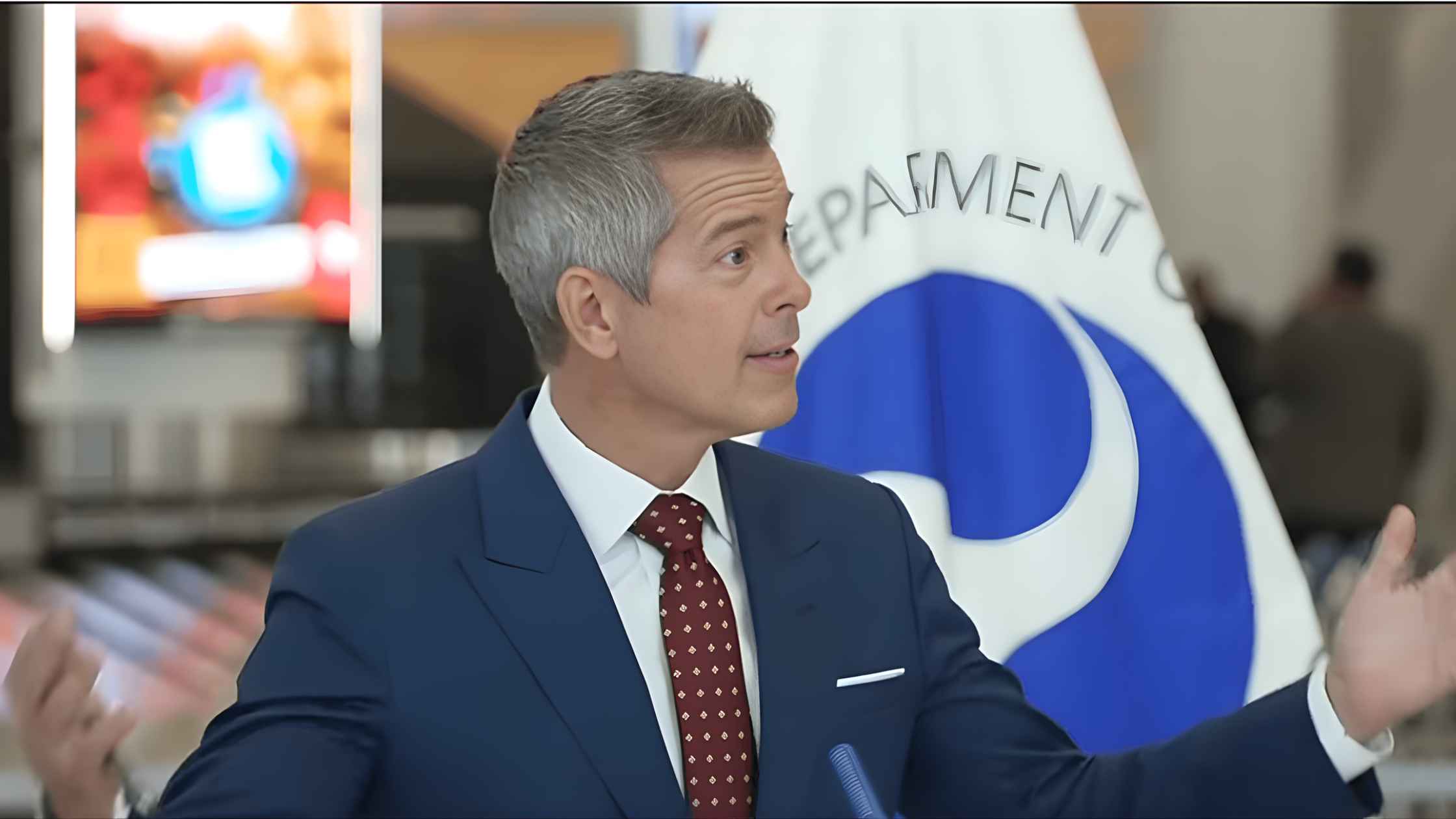
Good afternoon everyone. I'm here with the acting administrator … Acting!, The administrator of the FAA, Bryan Bedford. Sorry about that.
Bryan Bedford (22:28):
That's okay.
Sec. Sean Duffy (22:29):
It was in my head for a while.
Bryan Bedford (22:30):
[inaudible 00:22:30] Sometimes.
Sec. Sean Duffy (22:31):
No, you don't. Always our great administrator. I want to talk about our holiday travel coming up. We're going to have a busy road, rail and air as we come into this Thanksgiving season. Just want to run through some of the numbers that we're seeing and what we expect as we look forward to the next week of travel. So by car per AAA, we anticipate seeing 73 million Americans hitting the road this Thanksgiving season. We anticipate the busiest travel on the road in the afternoon of this coming Tuesday, Wednesday, and Sunday. So if you're planning your travel, think about when you depart, because the afternoons of those days are going to be busier than the rest. This travel season by car, we have incredible gas prices on average, 3.20 cents a gallon. So if you're going to travel by car, you're going to be able to put gas in your vehicle at a very affordable price.
(23:29)
On top of that, if you're flying and you need to rent a car domestically, our car rental prices are down by 15%, so it feels very good where we sit with the president's economy and what he has done with regard to his energy independence push and energy dominance push. In regard to rail, we anticipate there'll be 1.2 million passengers this year by rail, a very big number. In regard to air travel this is going to be the busiest Thanksgiving that we have on record, and I think you all might note that it seems like every Thanksgiving, every Christmas, every 4th of July seems to be an announcement of record travel. I'm going to come to that in a second, but this week there'll be 31 million passengers flying by air as we look to the week, that's per the airline industry.
(24:24)
Tomorrow will be the busiest day. There'll be 52,000 flights tomorrow as Americans board aircraft, fly across the country. Maybe they're going to go to sporting events, they're going on vacation, or hopefully they're going to spend time with their families. Now, we anticipate there's going to be solid staffing in our towers and TRACONs and centers throughout the airspace, and that's different than what we had over the shutdown. But we do have some weather in the forecast. I'm not a weather man, but if you look out to the Seattle area, in the Midwest, the Great Lakes, we are going to have some weather. And so if you are traveling by air, I would just ask that you stay in touch with your airline or update your apps so you know if your flight has been delayed or moved at all as you're planning to come to the airport. Always great to stay in touch with the airline that you've booked with.
(25:19)
Just real quick, I want to touch on a couple of other issues. During the shutdown, 44 very long days. It went pretty well at the start of the shutdown, but in the last couple of weeks of the shutdown, things became very challenging in the airspace. Many of you reported on it. We had significant delays and cancellations. The administrator in consultation with DOT and his safety team, we took historic action to reduce the capacity in the airspace because of what we saw in the staffing in our towers. And that decision was not made lately, but it was based on the stats that we were seeing
Sec. Sean Duffy (26:00):
And what we thought was appropriate to maintain a safe airspace. You've also heard that the president announced that we should reward those great air traffic controllers who didn't miss a beat; they never missed a day. And so Administrator Bedford and I announced last week that we are giving $10,000 bonuses to the air traffic controllers who didn't miss a day. And the technicians--you don't report on the technicians a lot, but the technicians are the ones that come into our facilities and make sure that some of our very old equipment is actually operational. And if they don't come to work, we don't have equipment that works. You can have all the air traffic controllers you want in the tower or TRACON; you're not going to be able to control the airspace because the equipment is down. And so those two working together made sure that we had a very functioning and safe airspace. So at the president's lead, we decided we would give them a $10,000 bonus, a reward for their great action during the shutdown.
(27:08)
I mentioned that this is the most historic travel Thanksgiving we've had, the busiest one. And I don't know if you all know this, but here at Newark, there's a lot of press at Newark by what happened in the spring. We had two outages, 30 seconds each, and then the radar had a reboot. So we didn't have radar in this facility at this airport for a minute and a half, and it was troubling for everybody. And this team, DOT and FAA, worked with the CEOs of the companies that provide services to us, and we very quickly remedied the problem. And so now for the Newark traveling area, so JFK and LaGuardia, this is the most on-time airport that you have in the Newark airspace. That's the kind of dedication and devotion and speed at which the Trump administration, the FAA, and the DOT are working to fix the problems that we face in the airspace.
(28:07)
And I think it's important, again, the busiest, the busiest Thanksgiving--we're going to have a busy Christmas. And as it gets busier, it underscores the point that we need a brand new air traffic control system. Again, we're going to add these eVTOLs, the Ubers in the air, and we have drones that come into the airspace. And so to sit back and think that we're going to not have more delays or more cancellations if we don't build a new system is asinine. So in the big, beautiful bill, we got $12.5 billion to start the process. We need another $19 to $20 billion to complete the process. We can't start that phase of the build until the Congress gives us the money. So we wait, and the longer we wait, the more time it takes. And so I would just encourage all of our House members and senators to look at what the FAA needs to build this system the right way that Americans can be proud of and send that money to us.
(29:09)
And a lot of us have talked about politics, and there's a lot of blame that's sent one way or the other. This is an issue that everybody agrees on; it's not Republican, it's not Democrat, it's not conservative, it's not liberal. Everybody agrees that we need the money to make sure we have the best-in-class air traffic control system. And so I would encourage the Congress to get to work and find that money, and I know when they do, the President's going to sign that bill. But I bring that up because if we want to have less stories about delays in shutdowns, let's actually do the work to fix the system that oftentimes is causing those delays and those cancellations, and that is building a brand-new system, and we can't do it again without Congress's help.
(29:55)
I do want to pass it off to our administrator, who has done an absolutely fantastic job at the FAA, working massive hours with his team as we were navigating the risks in the airspace during the shutdown. And he's hit the ground running; he's confirmed this summer. But I couldn't ask for a better teammate and partner as we've gone through this process. I'm going to give you Bryan Bedford, administrator of the FAA.
Bryan Bedford (30:24):
Thank you, Secretary Duffy. And good afternoon, everyone. Thanks for joining us today. As the secretary's already pointed out, it's going to be a busy week for us. The airlines, the travel sector in general, airports, TSA, FAA--especially for us this week is our Super Bowl. And I'm here to tell you we've got a great plan. We're past the lapse; controllers are back at work. They're excited to be back on the job, they're excited to be compensated to be back on the job. So we're all thrilled, and we're happy to tell you we've got a great plan. The secretary mentioned there's some weather in the forecast, but please be confident that the folks in the towers and in the TRACONs and the en route centers, they have a great plan. Lots of different strategies we run to manage traffic safely and efficiently in all conditions. So again, we're very happy to be back. We're looking forward to an extraordinarily successful week of travel for the literally tens of millions of Americans that will be flying this week.
(31:22)
Safety, of course, is our top priority, and every decision we make is built off of that foundation, and I just want to assure the traveling public that we're ready and we're able to get the job done. So again, please know you should fly with confidence. Of course, I would tell everybody to use some common sense, right? We want to make sure that you're consulting with the TSA website, that you're packing smartly. You don't have to bring everything with you, right? So that you can get efficiently through the airport security. I want to encourage folks to come early; it will be busy. So the earlier you get there, the less stress that you're going to have.
(32:00)
And of course, we hope we have everyone treating one another with respect. So follow the golden rule. I will tell you, however, that we will not hesitate to utilize our enforcement authorities if anyone is causing any problems in the airport or on aircraft. So any intimidation, any threats, any misbehaving onboard aircraft, not listening to the pilots or the flight attendants, that will be pursued vigorously through my office. So again, I want to wish everybody a great Thanksgiving holiday, fly with confidence, and we look forward to serving you this week. Thanks so much.
Sec. Sean Duffy (32:40):
We will take your questions in a second. Just want to reiterate, if you are… I fly a lot, and I've had delays. I've had cancellations like many of you, but if you are delayed or you're canceled, know that it comes from a place of your safety and mind. If it's weather, if it's mechanical, if it's air traffic control, staffing issues, those are the factors that are considered as those decisions are being made. And again, it's strictly based on safety, and again, we want you to get to where you're going, so safety is paramount. The administrator mentioned civility. Some of you might have noticed that we've launched a civility campaign, and I think it's important as we travel that we think about not just ourselves, not just our families, but we think about those who are around us, and we call our better angels. In a busy time, and again, the airports are going to be packed.
(33:36)
TSA lines may be a little longer, and you might not be able to find a seat as you're by your gate because of the number of flights that are going out or coming in, but I think we have to think about how do we do a better job. How do we maintain maybe some of that frustration we have as we travel this Thanksgiving season? Maybe we should say "please" and "thank you" to our pilots and to our flight attendants. I think, again, I call this just maybe dressing with some respect, whether it's a pair of jeans and a decent shirt. I would encourage people to maybe dress a little better, which encourages us to maybe behave all a little better. Let's try not to wear slippers and pajamas as we come to the airport. I think that's positive. If we can help someone as we're getting on the aircraft that might need some help putting their bag in the overhead bin and you're a little stronger, a little buffer, you've been lifting, stand up and offer to grab that bag and put it up for someone who's having a more difficult time.
(34:40)
Common courtesy and civility, I think is going to work well. And I ask you to please be patient with our TSA and our gate agents. And again, they're working their hearts out too to make sure that this is the best experience possible for you and the safest experience possible for you. And again, a little gratitude goes a long way. And if we all do that, I think we're going to have a far better travel season. And by the way, we want to get to our families on Thanksgiving with a lot better attitude. Who couldn't ask for that? You guys can fight about politics when you get home for Thanksgiving. Let's have this be the pre-run that is politic-free and very friendly with pleas and thank-yous and a lot of gratitude for all the work that happens to get you to your final destination. With that, we're happy to take some questions if you have some for us. I appreciate that. I actually almost wore a pair of jeans, and I'm like, "I better not if I'm going to talk about dressing up."
Kris Van Cleave (35:40):
Kris Van Cleave from CBS News, sir. If you'll indulge me, there will be two quick questions. One: every time we have talked to flyers in the last two weeks since the shutdown ended, they've told us the same thing--that they had some apprehension about whether they should keep that Thanksgiving flight, whether they'd be on time, whether it'd be safe. What do you say to flyers who are still a little unnerved after what they saw during the shutdown?
Sec. Sean Duffy (36:00):
So we talked about that as we went through the shutdown. I didn't know when it was going to end. I didn't have a crystal ball, and we saw things getting very bad in regard to on-time flights and cancellations. Well, the shutdown ended soon enough. Our controllers, as the administrator just mentioned, are back at work. And so again, you're seeing more on-time performance in the airspace. And again, our priority is your safety, and it's always been our priority, and that's why there were the level of delays and cancellations. So again, if you can still get a ticket and you can still fly and your family still wants to see you, book that ticket, jump on a flight, and don't be afraid to fly this season. It's again, I can't control the weather, I can't control the mechanics of an airplane, but things look good from the air traffic control side. We are back to staffing levels that we had before the shutdown, I believe.
Kris Van Cleave (36:51):
And on the subject of air traffic. You got some pushback from the union, and I've heard from some controllers who maybe missed a day because of a child care issue or missed a day because of the stomach flu. For the folks that were there working five-day or six-day weeks for the bulk of it but maybe missed a day here or there, is there something you can do to recognize those? Some have said that there were some that were consistently out, and for the most part, everybody else did the best they could.
Sec. Sean Duffy (37:19):
I think you see, the administrator and I have been very grateful through the course of the shutdown and recognizing some of the difficult circumstances our controllers were going through. And we talked about that quite a bit and recognized it. But we have to look and say, "Where's the cutoff?" And if you got 100% on your test, you get the sticker that's a scratch-and-sniff sticker from the administration. Again, I know some people are not pleased with where the cutoff was, but to be clear with regard to our air traffic controllers, even those had unique circumstances come up. Maybe they would've been there before they got sick or a child got sick; all of them received full pay. Even the ones that didn't show up as much as they should have, everybody got paid for every single day they would have worked even though they didn't work.
(38:10)
So there is a benefit that comes, but this is the above and beyond. I mean, $10,000 is a big paycheck. And again, who should get that? I think the ones that had the pure record, and that's the decision that we made. And I think in the future a lot of controllers would think, "Hey, there could be a reward when I show up. And I'm going to do all I can to be there every single day to serve the American people. And I know that I'll get paid at one point, but if I have a perfect attendance record, there could be a reward at the end of that rainbow." You want to add anything to that?
Bryan Bedford (38:47):
I will just say this. I spent the morning over at the Newark Tower, and their focus is on not just running a great air traffic control system for Americans traveling
Bryan Bedford (39:00):
… this week, but they're back focused on modernization. They want to talk about how we get rid of all of the old equipment that's sitting there.
(39:06)
So if we really want to talk about how we can help our controllers be their very best and do the best service, the secretary's right, we've got to keep our eye on the ball, on modernizing the system, getting rid of the floppy disks, getting rid of the analog NAS, getting rid of the 30, 40-year-old equipment.
(39:22)
We've got a ground surface radar here that's got one operable channel on it right now, and we don't have spare parts. So that's what the controllers are focused on, not this distraction of the award levels or participation. They're focused squarely where we want them focused is making sure we have the safest, most reliable NAS in the world.
(39:43)
So again, we're going to work shoulder to shoulder with those men and women to make sure we get them the right equipment, the best equipment to do the best job they can for the American public.
Sec. Sean Duffy (39:56):
Yeah.
Kris Van Cleave (40:02):
[inaudible 00:40:02]. Can you talk about why that's [inaudible 00:40:03]?
Sec. Sean Duffy (40:03):
We've seen an uptick in maybe a degradation in civility in the airspace. And so I thought it is appropriate to… Again, I can't, you can't legislate that, right? You can't mandate it, but I think if you ask people, "Could we do better? Could we be better?"
(40:20)
I think, you won't get a better result unless you make the ask. And so I'm just making the ask, let's all travel better together. And again, I think it honors our country. It honors our families, it honors our fellow passengers. And so I've made the ask, and again, I think we can do a better job.
(40:37)
And by the way, most flights are pretty darn good and people do behave really well with one another. It's just a few of those times where, again, don't take your shoes off and put your feet on the chair ahead of you. That's just… Or maybe don't play your movie without headphones on.
(40:54)
Just some simple things that can annoy the folks around you. I mean, we don't have to do that. And so just be cognizant and courteous. That's the ask.
Kris Van Cleave (41:08):
During the shutdown, you mentioned that 15 to 20 controllers per day were retiring. I'm wondering if that number has leveled out to the normal levels and do you expect that to impact either holiday travel or travel going forward in the future?
Sec. Sean Duffy (41:23):
So I'll kick it to the administrator in just a second. But you all know we're short of air traffic controllers and we were doing both ends.
(41:29)
One, we were trying to bring more air traffic controllers through the academy, get them trained up and get them certified. By the way, we are 20% up year-over-year because of this surge that we've tried in the academy at Oklahoma City. That's the new controller.
(41:46)
The experienced controller can retire after 25 years of service. We asked them to stay on. We said, "Will you please stay? Don't retire. We'll give you a 20% upfront cash bonus per year that you're willing to stay beyond your date of eligible retirement."
(42:01)
And we did see a number of those older, more experienced controllers take the retirement. And again, but that goes to show you how hard we're thinking about how we can make up that difference as fast as possible.
(42:16)
I'm not sure if you have any new numbers on that or not. I know we had the numbers from the shutdown, but any new numbers on that?
Bryan Bedford (42:24):
I don't have any specific numbers to share on that. I will tell you that putting in paperwork to retire isn't the same as leaving the job. So we're more than adequately staffed to get through the holidays.
(42:36)
We are getting more folks through training faster than what we have seen in prior years. That's again, putting incentives for trainers to get guys signed off more quickly and more focused curriculum.
(42:50)
But look, we are understaffed, so we're absolutely moving heaven and earth to continue to move folks into training and through training without reducing standards.
(42:59)
So again, I think we've got a great plan this week to run and hopefully, and we haven't seen any continuation of some of the paperwork inserts we were seeing over the shutdown period.
Kris Van Cleave (43:11):
Of the things that are in your control, Mr. Secretary, you've talked a lot about staffing returning to normal, obviously you want to upgrade the technology. But of the things that are in your control, what are you most concerned about this week with holiday travel or is it simply the weather?
Sec. Sean Duffy (43:25):
Well, listen, I wouldn't say I'm concerned. I just think it's important that we know, as Americans, what we're in for. We're going to have a lot of travelers on the road, a lot on the rail, and we're going to have the busiest Thanksgiving season ever.
(43:38)
And so with that, it's going to be a bit congested. Let's be ready for that. And again, as the administrator said, come a little early, don't be rushing through the airport because the lines might be a little bit longer and then tack on your best attitude. And we're going to get through this and have a great Thanksgiving with our families.
Kris Van Cleave (44:00):
Are we back to normal as far as normal flight capacity as far as the airlines are concerned at this point?
Sec. Sean Duffy (44:06):
So we had, in regard to the 10% announcement that we mentioned during the shutdown, the first tranche of that was a 4% reduction and then we went another two for a total of 6% reduction in flight capacity. Yes, that's all been rolled back and we're at no restrictions in regard to flight capacity.
Kris Van Cleave (44:26):
Following up on that, will the FAA issue enforcement actions against the airlines that don't comply?
Bryan Bedford (44:35):
Yes. The intent is that we will be sending out letters of investigation to any of the airlines who we don't feel lived up to the requirement to reduce capacity. That's going to be an ongoing investigation. When we have something to report, we'll share it with you.
Sec. Sean Duffy (44:52):
And that's important. When we have a directive from the FAA, we need our airlines to comply with it. And through that investigation, if those airlines did not comply, some did not comply, there should be accountability and that'll be an ongoing discussion and investigation. Yes.
Kris Van Cleave (45:09):
I was talking to… Laura Haefeli with MS Now. I was talking to passengers this morning about your civility campaign. They feel like it's putting the onus on passengers to create a more pleasant air travel experience.
(45:22)
I know you're putting billions of dollars into this revamp for ATC to make that better, but can you talk about what you're doing immediately on your end to help with the air travel experience and talk directly to passengers here?
Sec. Sean Duffy (45:35):
Well, so I would just tell you, I mean, yes, can everyone do a better job? Can TSA do a better job? Can we do a better job as we bring more air traffic controllers online and we get a brand new air traffic control system up and working so we have less delays and less cancellations?
(45:50)
Yes, those things… Can our airlines maybe do a better job on their end? But in the end, it's my responsibility to behave well. I can't offload that to anybody else. It's me and how am I going to behave? How I'm going to have my kids behave as we travel together?
(46:11)
How I dress, I can't blame it on anybody else. I made that choice this morning when I came to the airport. So that's just the ask. And I think I'm not trying to put a blame on anybody. I'm just asking us all to be better and do better, and then we'll all have a more pleasant experience.
(46:26)
And no one has to… Again, I can't fine you if you don't comply. I'm not looking to do that, but I'm asking, let's all do this as better Americans. That's it. You had a question?
Kris Van Cleave (46:39):
Yes. You mentioned that there's a significant problem with rail. Obviously a big concern here is the Gateway project. Can you speak to where that project is now that the shutdown is over and the FTA is doing its review and the GDC has said they have suspended all the DBE contracts that were the subject to that review.
Sec. Sean Duffy (47:00):
So I need to get an update from Transit, but I don't know where that review is. And if they've said they've complied, I got to verify that with our team. I haven't done that yet, but look forward to doing that. One more question. Come over here. Yeah.
Kris Van Cleave (47:16):
[inaudible 00:47:16].
Sec. Sean Duffy (47:16):
Want to take that?
Bryan Bedford (47:33):
Oh, sure. So there was a three-year protocol agreement signed with the union to cover the relocation. We're coming up within one more year, a little over a year.
(47:44)
But I think we're looking into the future, creating an opportunity that says we believe Newark will want to grow. We're going to need more controllers there. So if any of the controllers from the N90 facility would like to stay behind, they're welcome to do so.
(47:57)
And again, we're trying to make sure that we've got the rest of the workforce trained up in a way that we can allow those folks to head back home if that's their desire.
Sec. Sean Duffy (48:11):
So just add one last point. Again, this is a great holiday. Americans come together, we eat a little Turkey, I guess in New Jersey they do a little seven fishes. I'm not a part of that, but it's a great time.
(48:25)
Let's all slow down. Let's all buckle up. Let's all drive safe on the roads. Let's all come early to the airports. Let's all put our best attitudes on, and let's have a great Thanksgiving week as we travel to see the ones we love most. Thanks very much.