




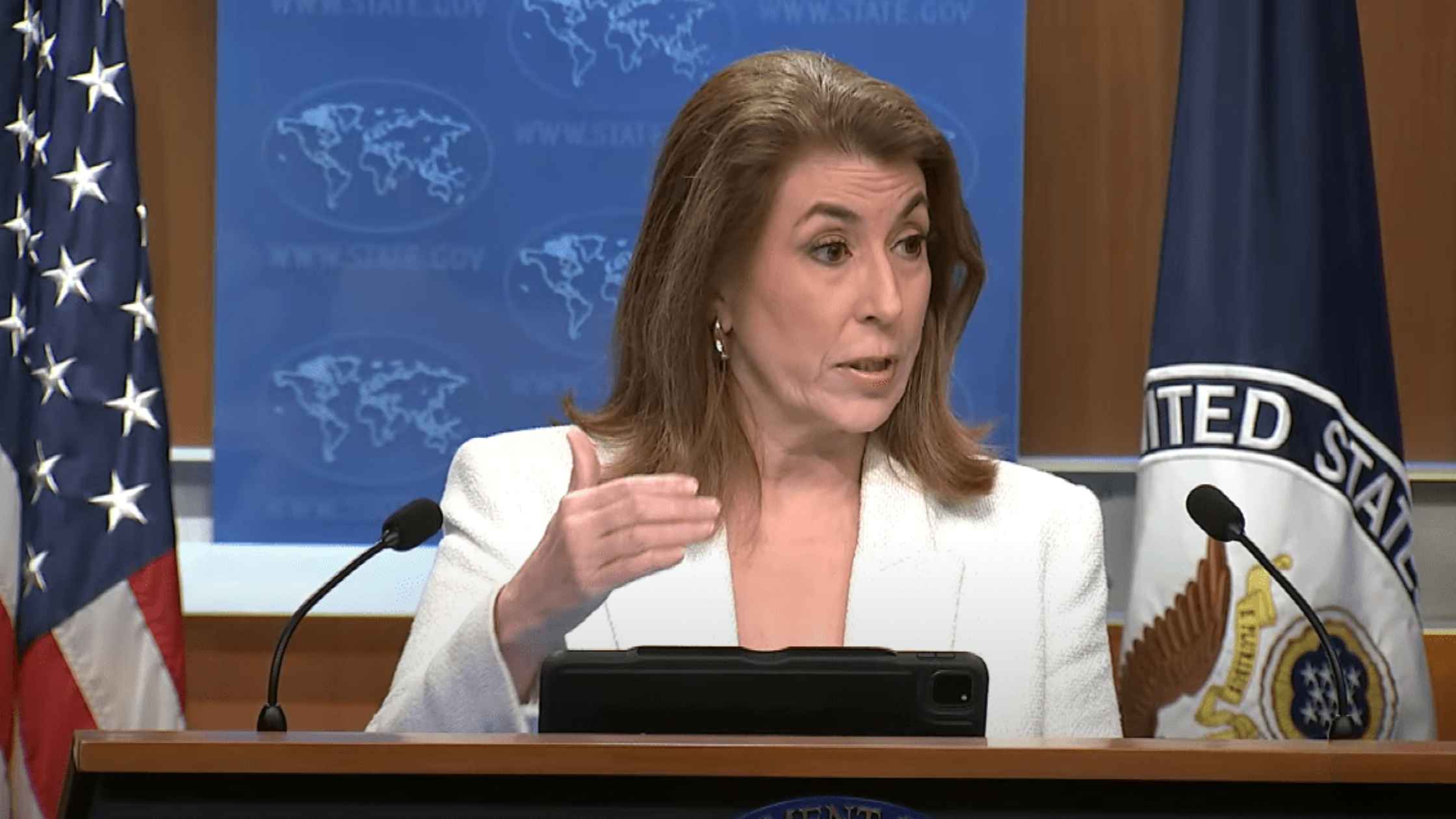


Tammy Bruce (00:00):
… do appreciate it very much.
(00:02)
Of course, we have some announcements. I have a little bit of breaking news I'm going to start with, and then at the end I will have a few remarks about my personal situation and my work. So, if I could ask us to… I don't know if you'd ask any questions, but I don't know if you're going to be able to. But I will have a few things to say about my work and where I'll be doing it, as you all, I think, already know.
(00:29)
Thank you again for being here. First of all, I can confirm for you that Secretary Marco Rubio spoke with Russian Foreign Minister Lavrov. We have the fact that Sergey Lavrov, again in a phone call with the secretary, regarding preparation for the upcoming summit between President Donald Trump and Russian President Vladimir Putin, both sides confirmed their commitment to a successful event. I can also tell you that it was President Putin who called to make this arrangement as well. But of course, I will certainly take your questions as we move forward here.
(01:09)
And now to our announcements. We are deeply saddened to learn of Colombian Senator Uribe's tragic death. Senator Uribe, his leadership and vision for Colombia's future were evident throughout his years of public service to the nation and the Colombian people. His vision and courage and commitment to his country encouraged countless individuals at home, throughout the world and his contributions to Colombia's democratic future, though obscenely halted, will endure and inspire future generations.
(01:42)
As Secretary Marco Rubio has said, "The United States stands in solidarity with Senator Uribe's family and the Colombian people, both in mourning and demanding justice for those responsible." And Deputy Secretary of State Christopher Landau will travel to Bogota today to attend the memorial services for the senator on Wednesday, August 13th.
(02:07)
Also: Further, the declaration of peace between Armenia and Azerbaijan has reaffirmed that President Trump is indeed the president of peace. Last week, he hosted the leaders of Armenia and Azerbaijan at the White House, where they signed a historic joint declaration for peace after decades of bitter conflict and too many lives lost: A landmark achievement for international diplomacy and an end to violence that only President Trump could deliver.
(02:40)
The two leaders also signed bilateral economic agreements with the United States, unlocking the great potential of the South Caucasus region in trade, transit, energy, infrastructure, and technology, and creating new opportunities for the American people and American businesses. This achievement follows negotiated peace arrangements between Cambodia and Thailand, Israel and Iran, Rwanda and the Democratic Republic of the Congo, India and Pakistan, Egypt and Ethiopia, and Serbia and Kosovo. In addition to the remarkable achievement of the Abraham Accords, President Trump continues to prove that nations across the globe can move beyond long-standing conflicts of the past toward a shared future of peace, prosperity, and success.
(03:29)
Now today, the 2024 Human Rights Report has been released publicly on the State Department website, that is at state.gov, where everyone watching from home and around the world can access the report. The Human Rights Report has been restructured in a way that removes redundancy, increases report readability, and is responsive to the legislative mandates that underpin the report, rather than an expansive list of politically biased demands and assertions. The calendar year 2024 individual reports are more readable, objective, true to their statutory origins and more useful than ever before. The report continues to call out the world's repressive actors while also addressing abuses that had not previously been covered.
(04:18)
The United States has long promoted respect for international universal rights, including in our own founding documents, which asserts that human beings are, quote, "endowed by their creator with certain unalienable rights including life, liberty, and the pursuit of happiness." Today, we reaffirm the words of those documents, which have served as a beacon of hope and freedom for people around the world.
(04:43)
And again, at the end now of this briefing, I'll have a few words about some news relating to my own work. But of course now, I am happy to answer your questions.
(04:54)
All right. Yes, sir? And when I call you in the front row, if you could announce your name and your outlet, that would be terrific.
Diyar Kurda (04:59):
Yeah, absolutely. Diyar Kurda with Rudaw Media Network.
Tammy Bruce (05:03):
Right.
Diyar Kurda (05:03):
It's a Kurdish media outlet. First of all, Tammy, congratulations on your nomination by the president for the UN role.
Tammy Bruce (05:11):
Thank you.
Diyar Kurda (05:12):
I'll start with Iraq and Syria. After you raise the concern of the PMF bill at the Iraqi parliament, which you think that it might increase the Iranian influence on Iraq. We saw yesterday the top Iranian security guy, Ali Larijani, he went to Baghdad and he signed a security agreement with Iraq.
(05:34)
Do you have any concern with that agreement? And have you pushed Baghdad to not pass the PMF bill? If they pass, then there will be consequences for Iraq.
Tammy Bruce (05:47):
As I think we've stated before, we oppose any legislation that is inconsistent with the goals of our bilateral security assistance and partnership, and runs counter to strengthening Iraq's existing security institutions. We support genuine Iraqi sovereignty, not legislation that would turn Iraq into an Iranian satellite state.
(06:10)
I think we've been clear in this particular instance certainly and others, that the future of nations should be in the hands of the people of those nations. And certainly our commitment here, as we've made clear, this particular dynamic runs counter to what our commitment has been regarding security in general.
Diyar Kurda (06:31):
And I'll ask one question on Syria, then I'll let my colleague…
Tammy Bruce (06:33):
Sure.
Diyar Kurda (06:34):
… ask their questions. The Syrian interim government has refused to join the meeting with SDF in Paris and the [inaudible 00:06:42] of US and France. Does the United States believe that the Syrian interim government is adequately respecting the rights of minorities like Kurds and Jews who are seeking a decentralized Syria? And have you put any pressure on them to make these meetings happen, especially in Paris?
Tammy Bruce (06:58):
This is why we have special envoys. Again, we're in regions that are unstable, that have had problems, sometimes for generations if not hundreds of years. So, that automatically means that continual work has to be done to bring parties together.
(07:12)
I will read a Tweet from Ambassador Barrack who is our special envoy for Syria. He's noted from… Was it today? "Syria remains steadfastly committed to a united process that honors and protects all its constituencies, fostering a shared future for the Syrian people." I think that that is his work. We know we've seen, of course, skirmishes re-emerge, differences emerge, and that's what negotiators and diplomats are meant to do, which is thread that needle and bring parties together. And that is exactly what Ambassador Barrack is doing and we look forward to his results.
(07:55)
All right. Yes, ma'am?
Kilmeny Duchardt (07:56):
Tammy, Kilmeny Duchardt with Newsmax. Congratulations on your post [inaudible 00:08:00] to the United Nations.
Tammy Bruce (08:00):
Thank you.
Kilmeny Duchardt (08:02):
Two questions for you. The influential Pakistani chief of defense has met with President Trump once and seems to have developed a strong relationship. Do you think that this will lead to more US assistance to Pakistan via an increase in arm sales? And is this being done at the expense of the president's relationship with Modi?
Tammy Bruce (08:23):
Obviously we had a experience with Pakistan and India when there was a conflict, one that could have developed into something quite horrible. I was here at the State Department at the time and there was an immediate concern and immediate movement with the vice president, the president and the secretary of state in addressing the nature of what was happening.
(08:45)
Many of you who were in the room in the days afterward, we described the nature of the phone calls, the work that we did to stop the attacks and to then bring the parties together so we could have something that was enduring. It's a very proud moment and a very good example of what Secretary Rubio was committed to, Vice President Vance in that, of course, case as well. But are the top leaders in this nation involved in stopping that potential catastrophe?
(09:15)
I would say that our relationship with both nations is as it has been, which is good. And that is the benefit of having a president who knows everyone, talks to everyone. And that is how we can bring differences together in this case. It's clear that the diplomats here are committed to both nations.
(09:37)
I can tell you also that there has been a US-Pakistan counterterrorism dialogue that was established. At this dialogue in Islamabad, the United States and Pakistan reaffirmed their shared commitment to combating terrorism in all its forms and manifestations. During this latest round of the talks in Islamabad, the United States and Pakistan discussed ways to enhance cooperation to counter terrorist threats.
(10:04)
I think that for the region and for the world, the United States working with both those nations is good news and will promote a future that's beneficial.
Kilmeny Duchardt (10:13):
Quick follow-up on the subject of relationships: When it comes to the summit with Putin, do you anticipate that Ukraine's Zelensky will be invited?
Tammy Bruce (10:24):
I can tell you a few things the president has said. As I've mentioned when I opened, that it was Putin who suggested this meeting. It is something that also my colleague, Karoline Leavitt, discussed a great deal just a little bit ago on her briefing. I think that that's important to know that the president is viewing this, as she described, as something that was fact-finding in a way to see exactly what was possible.
(10:55)
I do also want to bring to you some of his comments, which you may not have heard, regarding his commitment to our European partners and to Ukraine and President Zelensky. We know at this point, he said that, "This is really a feel-out meeting." He said, "I'm going to meet with President Putin and we're going to see what he has in mind, and if it's a fair deal. I'll reveal it to the European Union leaders and to the NATO leaders and also to President Zelensky. I think out of respect, I'll call him first…", being President Zelensky, "… and then I'll call them afterwards. And if I may say, 'Lots of luck, keep fighting', or I may say, 'We can make a deal.'
(11:42)
I've seen a pull out of Ukraine…", the president said, "… 88% of the people would like to see a deal made." Lastly he noted, as he does, "The death is incredible. It's the worst thing that's happened by far, the worst that's happened since World War II, so I'm going in to speak to Putin and I'm going to be telling him, 'You've got to end this war. You've got to end it.'"
(12:06)
So, we know what his agenda is, which is what it's always been. We know what has bothered him, which is the killing of civilians. We know that he has been not happy with President Putin, with his actions and what's happened in Ukraine. We know that he is going to inform President Zelensky and European leaders about what happens at this meeting. And then we will all find out what happened. And this is what I know the president has been caring about.
(12:34)
Yes, Nadia,
Nadia (12:35):
Thank you, Tammy. Congratulations on the new job. I guess soon we're going to call you Madam Ambassador.
Tammy Bruce (12:40):
Well…
Nadia (12:41):
It's a new title.
Tammy Bruce (12:41):
We'll wait. Just call me Tammy for now. That's a good one. I've been called worse things.
(12:49)
Yes, ma'am?
Nadia (12:50):
I have two questions. First, there is 26 foreign ministers who sign a joint statement calling on Israel to allow unrestricted access to Gaza. The GHF work is not enough by the standard of every organization that works there, and there is no evidence that Hamas actually stealing the food. So considering that international figures, whether it's Madonna who's calling on the Pope to visit Gaza before it's too late, why not allowing other ways, including the UN, to help people who are on the precipice of dying, basically, of starvation?
Tammy Bruce (13:26):
I will remind you… And I know you know, because of your work, everyone here knows… that that situation is rapidly evolving. We've been working from the beginning for a ceasefire, specifically for the reasons that you've noted and that we all care about, which is the aid for the people of Gaza. Hamas has been at war with the people of Gaza. We've seen that through their refusal to stop this war. We know that they are the first victims. And our intention, of course, is to stop that carnage. That's the bottom line.
(13:59)
I can tell you that the aid dynamic, there has been more aid that has flowed in. We know that there is an understanding that this dynamic is changing, but even within the midst of this war zone, more food has arrived. I believe the GHF numbers at this point, I was briefed on this morning, is close to 120 million meals. Of course, also as we've discussed, nothing will ever be enough in a war zone. The war zone has to stop. It has to end.
(14:32)
That is our recognition here. Our posture has not changed. Our actions have not changed. And yet, the situation is fluid more so than in recent days. I would ask you to recognize that, and we are working within that framework.
Nadia (14:49):
The UN and also many of your allies have been asking for an independent commission to investigate the killing of Palestinian journalists in Gaza who reached now at 247, including five of our colleagues who were killed the day before. So, why not supporting an independent commission, considering that Israel has failed every time to investigate the killing of journalists or doctors or teachers in Gaza?
Tammy Bruce (15:12):
I take issue with your premise here. To say that Israel every time has failed to do that is not true. We know that, again, this is a nation fighting a war with a terrorist group that have always used human shields, have used hospitals, have used schools, have… It's been just the worst example of the barbarity of human beings, if you can call them that. It's been shocking.
(15:37)
For Donald Trump to make the commitment to end this would be a tremendous gift to the entire world, as you know. That is our commitment. We call on our ally and partner, Israel, to investigate these situations. I do it from this podium and the United States does it. We expect investigations for a sovereign nation
Tammy Bruce (16:00):
… To engage in that, and then we'll follow up on we see what those results are, but they do investigate. That is one of the things that, unlike other dynamics in war, Israel has done that and they're transparent about it. So I would say that as we are working on all of this to stop, we encourage Israel always, and they do so as one of our, again, stalwart allies. And I think that their background proves that, in fact, look, they were minding their own business on October 7th. They are constantly dealing with those kinds of attacks. This is a chance for everyone to be able to have a future that is different. That's what we're looking for.
Speaker 1 (16:44):
[inaudible 00:16:45] investigation with us?
Tammy Bruce (16:46):
Yeah. Well, clearly, and I can't say for each situation because each one is different, but I know the goal here at the State Department and why I felt very comfortable working with the people in this building, is that information is key, right? Is that knowing what's happening matters. That is your job as journalists, I respect that immensely. It keeps me centered knowing that we have to explain things or talk about them, makes us view the news as it's coming up in a slightly different way, makes us ask questions. That will never end. And so I trust that … Well, I will be in some fashion asking the same questions, I know you will be as too. Andrea Mitchell. Andrea Mitchell please. Andrea Mitchell.
Andrea Mitchell (17:31):
Thank you so much, Tammy, and congratulations on your new adventure.
Tammy Bruce (17:35):
Thank you. That's what it will be, I'm sure.
Andrea Mitchell (17:37):
And I have a couple of things to follow up on that.
Tammy Bruce (17:40):
Yes.
Andrea Mitchell (17:41):
First of all, do we have any update on what Ambassador Huckabee said would be 16 new distribution centers for food in Gaza? And as the U.S. tries to deal with two wars simultaneously, as part of the challenge that the president is facing with this summit, President Zelenskyy said today that after the overnight attacks, which were throughout his country, that there is evidence as far as he's concerned, that President Putin is not committed to peace, but is committed to plans for a new offensive against Ukraine. So going into these negotiations with what President Zelenskyy says is an imbalance in what is going on on the battlefield right now, how does the president hope to try to get President Putin to abandon this commitment that seems obvious from the battlefield through a day-after-day advancing?
Tammy Bruce (18:46):
I'll, let me answer the first question about-
Andrea Mitchell (18:49):
Let me just maybe more precisely say and accept a ceasefire.
Tammy Bruce (18:54):
First of all, we have nothing else to announce regarding the ambassador's remarks about the increase in sites for GHF. Of course, that would be welcome news but when we see that we have more, we'll let you know. I'll remind you also that the president's not calling this a negotiation. He is not the one that asked for it. This is what, as I've equated to you before, his remarks were that this is to see what's happening, to see what's possible. So the negotiation, I think is certainly not the right word. How he expects to get to where he gets, I won't have details for you in that regard, but there's a reason why he's the one there and we aren't. He is clearly … The list that I read out to you regarding being the President of Peace is an astounding one. Perhaps it's situations around the globe that just didn't interest other people.
(19:47)
But for President Trump, everyone matters. He sees these dynamics which his presence and the power of the United States is able to change, and he knows that. He has many tools in his tool chest. We know, of course, that he had remarked about secondary sanctions on those who are buying Russian oil. That's one thing of many that can happen. We know of course of NATO's commitment regarding defensive weapons and helping and assisting Ukraine. There's many things that are moving that should have an impact that President Trump … Again, I don't know what his approach will be. What I do know is that I'm grateful that he's the president, that I'm able to be here read to you a list of ceasefires and peace agreements and know that he's meeting with Putin in regard to one of the most outrageous dynamics that we've experienced. I'll also remind people that he has met alone with President Zelenskyy. He has met alone with European leaders. This is a man who is doing everything possible and fairly, to get an end to this carnage.
Andrea Mitchell (20:51):
Just a quick follow up.
Tammy Bruce (20:52):
Yes, ma'am.
Andrea Mitchell (20:52):
There has been a lot written that by just granting Vladimir Putin, who has been charged with war crimes by people, by other countries around the world, by granting him a summit with the leader of the United States on U.S. soil, it's already a victory for Putin because he's the aggressor here and he has refused to agree to a ceasefire.
Tammy Bruce (21:17):
Andrea, this will be it. The president is not operating on what something might look like. He's operating on how to stop obscene carnage among innocent civilians in Ukraine. And that is … He took some heat when he started talking to Putin because Biden had talked to him for three years. You don't make peace through performative actions or theater. You make it by talking to people and this is what he's committed to. This is the end goal. The end goal is not performance or perception or … It's getting the job done. And I'm honored that I can be here and at least be a part of reminding people because we know him. He's a remarkable achiever, not just in business, but in knowing people and knowing how to get what he wants. And he wants peace and he wants an end to carnage around the world and that this country is in this position now because of him and because of the power of the American people and we're going to use it. And so I'm praying for a good result and with President Trump, we very well may get one. Yes, Daphne.
Daphne (22:33):
Thank you, Tammy. And I'll echo my congratulations on your nomination.
Tammy Bruce (22:37):
Not that anyone knows what I want to mention it at the end of the briefing now, but yes, go ahead. Thank you.
Daphne (22:42):
On the human rights report, the State Department has cut down criticism of some countries that have extensive records of human rights abuse, including in El Salvador where the State Department said there was no credible reports of significant human rights abuses, cutting an entire paragraph from last year's report that mentioned issues such as arbitrary arrests and harsh and life-threatening prison conditions. What is this change based on? Has El Salvador taken any steps to change these issues or how did the State Department determine that these abuses were no longer taking place?
Tammy Bruce (23:15):
Well, I'm not going to speak from country-to-country. This is something that is available. People can go look. Again, Americans, obviously, the reporters here in this room have had it for a little bit of time and have had a chance to take a look at it, which is important. Again, state.gov and you can search for a human rights report and you'll get all the countries, et cetera. First thing I want to mention is that every administration in a transition year has to deal with this particular product, this particular report, for the last calendar year to be released by a new administration. And there's always changes. As you might imagine if someone is the new president, you got a new administration, the American people made a choice, and they clearly are taking over for the previous administration. Each administration, like with President Trump, reflects a value system and an agenda and a vision that convinced the American people to vote for them.
(24:13)
And in this case, President Trump always, as ever, I should say, was clear and obvious about the nature of what he wanted to achieve and the American people agreed with him. This report as a result, because it was also late, and many of you noted that, it was late because we weren't just like with other administrations, we weren't going to release something compiled and written by the previous administration. It needed to change based on the point of view and the vision of the Trump administration. And so those changes were made in addition to the fact that one of the things we're proud of, and what you'll also see next year, is the notion of something being readable by people. Something being a reflection overall of what it is that we're dealing with with certain nations. So the restructuring doesn't reflect a change of any U.S. policy when it comes to human rights.
(25:07)
It certainly promotes, as does our work, a respect for human rights around the globe. It does not reflect on any particular country. We've stopped ranking countries by the way. People can make their own decisions about what nations are doing. So that is one thing also that is over. We also want to mention the notion of how large the report had become in its condemnation of nations and the detailed listing of certain things. But what I can say is, and I think it's pretty clear, that you can issue reports, you can make them giant, but it depends on what we do.
(25:53)
The Trump administration has proven from day one, their commitment to human rights around the globe and to the quality of people's lives. We will have perhaps in this case, smaller reports, but I would suggest that you watch the actions that are taken by an administration and that commitment to human rights. In this case, you could have giant reports from the Biden administration as the world began to collapse into war, into conflicts. And it's a reminder. So reports are important. Transparency about our positions are important. That's what these reports will serve. And I can tell you again for the people who work here at the State Department, these reports do matter and our actions as a nation also back up the nature of our commitment to human rights.
Daphne (26:45):
I understand that this is a narrowed report, but can you explain why this was changed and why an entire paragraph on rights abuses was omitted from this report?
Tammy Bruce (26:54):
Well, again, I won't go into the details of each country. What I do know is that the approach and the attitude of what we expect, and new complaints are added in, complaints regarding censorship of people in various countries has been added in that had not been dealt with before. So I'm not going to speak on the decisions that our diplomats have made in looking at the nature of the data that they're receiving, but I can tell you that the nature of the attitude, the reason for the report hasn't changed. It is to make sure people know what's happening around the world, what our posture is toward that, and our actions show our willingness and our commitment to changing the quality of life and people around the world. Yes, sir.
Speaker 2 (27:42):
Thank you, Tammy. I just want to follow up on Nadia's question. You said that you urge is Israel always to investigate and they do investigate in some incidents, but I want to go back to Sunday's incidents when airstrikes struck a tent of journalists, four of them are my colleagues, killing them. And there is no need for investigation here because the IDF statement was clear, that they targeted Anas al-Sharif, my colleague, claiming that he's a leader of a Hamas cell that fires rockets into Israel, without providing any proof. And this will add to 238 journalists who died in Gaza in two years. 11 of them are my colleagues, 11 of them. And my question is, are you comfortable with all the claims and excuses that Israel made to target those journalists, whether they are my colleagues or the other 200?
Tammy Bruce (28:49):
Well, what I can tell you, and I think what's been apparent from this podium is our concern about the loss of any innocent life. We've made that clear the work of the people in this building is committed to that. And every day, every briefing, certainly we have examples of that. It is difficult for you. Some of you are war reporters and you go into those zones, and I respect that immensely. So I'm not in a position, nor will I discuss my feelings. That's not what I'm here for, whether I'm comfortable or uncomfortable. What I will tell you is that we refer you to Israel for information regarding al-Sharif. Israel has released evidence that Sharif was part of Hamas and was supportive of the Hamas attack on October 7th. They're the ones who have the evidence. They're the ones who can be reached and will hopefully talk with you and certainly talk with others who reach out to them.
(29:45)
I will remind you, and this again as we're dealing with a complicated, horrible situation, is that Hamas, historically, has had members who are embedded in society, including posing as journalists. It is a horrible thing to do for those of you who are committed to finding information for people, to be in that situation. It's horrible in any war. I think some of us, if not most of us, have met someone who's been injured or know of someone who's been killed, who we've worked with because of a war situation. They are a terrorist organization. They launch rockets from near hospitals. They have bases under hospitals and schools. We've seen this happen over and over again. We've become, in some ways inured to the inhumanity of that.
(30:37)
And what I can tell you is what this administration is trying to do is trying to stop it finally once and for all. That's what I can speak to, is Secretary Rubio's focused passion on getting things done in what is a short period of time. And my goodness, it's been seven months and they're doing it. And that's what, again, regarding the specific instance, very big news. But that's my request and my comments on that exclusively. Yes, sir. We're moving on. Go ahead, Tom.
Diyar Kurda (31:13):
I mean, you've said on the killing of these journalists that you refer us to the Government of Israel.
Tammy Bruce (31:18):
Yes.
Diyar Kurda (31:18):
I mean, this is one of the worst, if not the worst single attack on journalists in modern history, this particular incident on Sunday. As of all the journalists being killed, probably many of them by American weapons, that supplied by the-
Tammy Bruce (31:31):
Well, let's not, I'm sorry. I respect you enough to know to not project something that serious and saying probably let's leave that out.
Diyar Kurda (31:40):
… Vast majority,
Tammy Bruce (31:41):
My goodness.
Diyar Kurda (31:41):
… Used have been supplied by the United States, courtesy of the US taxpayers. So there is a very strong accountability issue for the American government. So on this instance, has there been any internal process to look at what happened and to see whether it was within the laws of war?
Tammy Bruce (00:00):
Tammy Bruce (32:00):
Well, obviously there's many internal processes. I'm discussing with you a suggestion about who to reach out to who has the answers for you, and that is due to the fact that more than aware, of course there's internal processes which I will not be discussing with you because of the nature of them and the importance of the diplomatic work that is continuing to this day to stop that carnage.
Diyar Kurda (32:21):
Is there an internal process on this particular incident?
Tammy Bruce (32:25):
I am not going to discuss the details for you. I'm not going to do that and I think you know, and I appreciate you need to ask the question, but we're in the midst of not just any conflict but one that we have stood by and worked on and spoken and dealt with everyone from the beginning of this administration to stop special envoys. The President, the Secretary, food aid, the coverage, my comments here from the podium. Yes. I mean, it's clearly something that the Trump administration has spoken with about directly. It is clearly a major consideration for this administration. That has not stopped and it is not something any of us asked for, let alone the Gazan people. But yes, we're working on and dealing with, well, many things that might not be-
Diyar Kurda (33:18):
Just on the human rights report. Just a quick question. You talked about new issues, new areas of conservative administration, one of which is censorship. On the UK and on countries in Europe, this has been a big theme. In the report you talk about censorship of ordinary Britain's becoming increasingly routine in the last year, and one of the cases relates to the killing of three young girls when there was an online speculation, which was false, that it was carried out by an asylum seeker. There was then very serious incitement to violence against asylum seekers in the UK leading to very, very violent incidents and people were prosecuted for that. It's a criminal offense to incite violence and racial hatred in the UK. Your report seems to be suggesting that it's a human right for people to have the freedom to carry out this incitement on American social media platforms. Is that what is a new principle in this report?
Tammy Bruce (34:11):
I would ask everyone to go and read the reports for themselves and come to their own conclusion about the nature of where we stand. We've been very vocal about the issue of censorship, people being able to speak their mind, but it also can't be distilled into a couple of sentences that project a particular political point of view. I say for context, read the reports yourselves. All right, and now. Yes. Yes ma'am.
Speaker 3 (34:40):
Thank you very much kindly, I appreciate it. I have two questions. Do Russia's Kremlin notice that North Korean troops will continue to be stationed in Russia even if the war between Russia and Ukraine end? Do you think this will be an issue in the upcoming negotiation between President Trump and President Putin?
Tammy Bruce (35:06):
Well first again, we'll answer this specifically is that this is not a negotiation that is happening on Friday, and I do know that there is a very specific… Well, I won't know exactly where the conversation goes. Of course none of us can know that except for the two men involved, but we know that of course the topic is Ukraine. All right, we are going to move on here. Yes, Sean.
Sean (35:30):
Thanks. Best of luck in the future and thanks for doing these briefings.
Tammy Bruce (35:31):
Of course. My pleasure.
Sean (35:32):
Appreciate having them.
Tammy Bruce (35:33):
Most of the time.
Sean (35:34):
Most of the time, well maybe not.
Tammy Bruce (35:34):
Yes.
Sean (35:36):
Can I actually continue with what Tom was asking?
Tammy Bruce (35:37):
Sure.
Sean (35:38):
You mentioned the human rights reports and the human rights report. This is politically biased in the past and censorship is something that you've taken up. Why is this a human rights abuse in your review? I mean, secretary Rubio has himself said that United States is going to monitor social media, people coming to the United States, that they should keep it open. He's revoked visas on accounts of statements that people have made. Why in this case, in the case of the UK, in the case of Germany, in the case of France, why is this a human rights violation?
Tammy Bruce (36:05):
Well, I can tell you that we consider freedom of expression to be a foundational component of a functioning democracy. Societies are strengthened by free expression of opinion, and government censorship is intolerable in a free society. Freedom of expression does remain under threat in many parts of the world. As outlined in the 2024 human rights report, governments continue to use censorship, arbitrary or unlawful surveillance and restrictive laws against disfavored voices, often on political or religious grounds. And no matter really how disagreeable someone's speech may be, criminalizing it or silencing it by force only serves as a catalyst for further hatred, suppression, and polarization. That's why.
Sean (36:53):
Thanks for your response. Can I just pursue that though? In the case of the UK in particular, and in the case of Germany because of its history, incitement is considered something that could be criminally liable. Does the United States see that as absolutely wrong? For example, for the UK to say that this is a public safety issue, people might attack migrants because they falsely-
Tammy Bruce (37:12):
Well, again, as I've said at the start, I'm not going to go into the details of what is found or discussed in each of the country reports. And I'm going to leave it at that. All right. Yes, ma'am. There in the green. Thank you.
Speaker 4 (37:24):
So Israel is recently accused of killing Seifullah Musallet just over a month ago, one of the dozens of Palestinian- American Israel has illegally detained or killed. Mohammed Ibrahim is the most recent case, a Palestinian-American teenager from Florida who now has scabies while in Israeli detention. Mohammed's family is in Palestine right now attempting to free him. What is the Trump administration doing to release him and other US citizens from Israel's illegal detention?
Tammy Bruce (37:51):
Oh, thank you for that. I'm not, as we've had to say before, going into the details of actions we're taking diplomatically, what negotiations might exist. We certainly are aware of those reports and there is really no higher concern for the State Department than the safety and well-being of American citizens. Sayed.
Speaker 4 (38:09):
But how you can let-
Tammy Bruce (38:10):
Yes, Sayed, please. Sayed, go ahead, please.
Sayed (38:12):
Thank you Tammy, and best of luck and maybe we'll run into you in the State… Outside.
Tammy Bruce (38:17):
I would be so lucky-
Sayed (38:18):
… the Security Council.
Tammy Bruce (38:19):
… if I saw you again.
Sayed (38:19):
I'm going to be there.
Tammy Bruce (38:20):
I'm looking forward to it. I will get you on the Amtrak.
Sayed (38:23):
I would love to be there for sure.
Tammy Bruce (38:23):
Thank you, sir.
Sayed (38:26):
My question to you-
Tammy Bruce (38:27):
Yes, sir.
Sayed (38:29):
… regarding the aid. It's been since the 1st of August since Envoy Witkoff went in to survey the situation and basically come up with some sort of a conclusion on the aid situation, how you allow more aid in. One, did he submit, has he submitted yet an assessment on what should be done? And second, I think it was raised just a little while ago here, is there a consensus that the centers should be increased considering that the four centers now came to replace 400 centers? So if you could share with us any new information on this, would appreciate it.
Tammy Bruce (39:10):
Well, I can tell you that Special Envoy Witkoff and Ambassador Huckabee, they did, they spent hours inside Gaza to assess the situation as you've noted. Witkoff and Huckabee saw firsthand the incredible and important work of the GHF, what they're doing to provide assistance to civilians. Again, I think were close to 120 million was the new number for GHF. During the visit, both were briefed on the regrettable dynamic of UN assistance trucks getting looted upon entry into Gaza. Keep in mind they went there, the President wanted firsthand report of what was happening. We're all reliant on, and your work is always very good, mostly, about what's happening on the ground, but getting reports in directly from individuals was important to him. I can also tell you, which is I don't think reported in the news, civilians in Gaza thanked the United States for providing assistance to the GHF, which they receive at no cost, obviously. I think we presume that, but to confirm, at no cost, compared to the UN assistance, which when it is not stolen or looted is then subject, many of you might know or perhaps you do, is subject to extortionary taxes by Hamas authorities.
(40:28)
President Trump wants to alleviate the suffering of the people in Gaza at the hands of Hamas because he's a humanitarian. We're seeing this in him. Frankly, his commitment to the country exposes that to us as well. And he has committed to remaining involved and helping to facilitate the aid situation, to build upon GHF's work and to help Gazans obtain the critical access to food and aid that they need. And I would say that it is GHF and the President and many others, including at this podium, calling for more people to participate in this process.
Sayed (41:08):
Just a quick follow up, if you allow me. The White House said that they inherited this Gaza War from the Biden administration and so on, and that Hamas just refuses whatever suggestion that's been submitted to it. Is this an indication that the administration is actually pulling its hand out of being involved in any future negotiations?
Tammy Bruce (41:29):
No. I think it's an indication of a transparent government that shares things with the American people in the world when it comes to their opinion. President Trump has been the best example of that, and then we're watching the nature of the choices they make. It's clear with Ambassador Huckabee and Special Envoy Witkoff that visit. The nature of the President's continued remarks are remaining in play in that region when it comes to stopping the carnage, getting the ceasefire, ending all of this enough to where people do begin to wonder, all right, what's next?
(42:07)
Now, we are not going to wonder about that until the carnage ends, but the fact that for the first time in generations people are asking, what is next? What can we do? Who will be in charge? How is that going to look? Now again, we're not going to engage in that or answer it, but the fact that it can be asked, tells you how far President Trump has moved this motion. Here. Yes, sir.
Speaker 5 (42:32):
Thank you Madame Bruce first of all, my congratulations on your new job. I believe that your new role at UN will make America great again. I'm not sure-
Tammy Bruce (42:42):
Hopefully make the UN great again.
Speaker 5 (42:43):
Thank you. I'm [inaudible 00:42:44], a journalist-
Tammy Bruce (42:43):
It's a great institution.
Speaker 5 (42:44):
… from Azerbaijan. First of all as an-
Tammy Bruce (42:44):
Thank you.
Speaker 5 (42:45):
Azerbaijani journalist, I want to sincerely thank the United States and its leader to all the efforts they have made to bring peace to the South Caucasus. On August 8 at the White House, the US helped Azerbaijan and Armenia sign historic peace agreement and President Ilham Aliyev has even suggested that President Trump deserves the Nobel Peace Prize for his role in this achievement. Can you please share the state Department's view on this new peace situation in the South Caucasus? Because Russia and Iran have made statements showing they do not support this peace plan and even some Iranian options have said that they will try to stop this Trump corridor, Trump route. What will the United States do if Russia or Iran try to block or sabotage this new piece route?
Tammy Bruce (43:32):
Well, as I think know, I'm not going to speculate on what we may or may not do with certain actions. The world knows to take President Trump seriously. This arrangement, this deal is important to him. They were at the White House. This matters to this administration. It matters to the world. I can say that some people may not even know because it doesn't get coverage, these two neighbors have been in conflict for decades. I think it's over 35 years now, with countless lives lost and generations scarred. While many have tried, we have to say the Europeans, the French and Putin, and even Biden, only President Trump was able to successfully bring these two countries together to agree to this historic piece.
(44:18)
So I think what the world knows is that he's committed to long-standing, durable peace between countries regardless of how long the conflicts have lasted or the hostility has lasted. And that commitment, as we've also seen, he's a realist, it's based in diplomacy, but he'll do what he needs to do to make the most of being the President of the United States and stopping the wars. Yes, sir, in the pink.
Speaker 6 (44:43):
Thank you Ms. Bruce. Regarding the human rights report, for example, Israel has been reduced from last year to this year, 103 pages to nine, for Russia, 101 to 41. And you've mentioned this readability, but some media outlets have claimed that this paints an inadequate picture for some of the countries. So how has the human rights report maintained its mission to educate Americans and the rest of the world that they are getting an accurate picture of these nations?
Tammy Bruce (45:13):
Well, accuracy should not be considered a part of volume. You can have something very, very accurate and have it be with fewer words and fewer pages. It's a matter of the nature of the commentary. This is also about the vision and the point of view. The America first philosophy for the President of the United States. So we went through this a bit with foreign aid. This idea that more foreign aid means more aid. We haven't seen that over the years. The more we give in foreign aid, the more the need increased. If more foreign aid meant it solved a problem, the need for foreign aid would go down. That was never the case.
(45:54)
So this is again the nature of the suggestion that too much government, giant reports, money that goes out that we can't even really track there's so much of it, is not a signal of success. It's a signal of some kind of waste or at least something that could be done better. So I would say when it comes to judging this, it is a very good first experience, even though again, it's reduced from the original report that the Biden administration had crafted. That in my work of course, also, sometimes less is more. And I would say that that's the case here as well.
Speaker 6 (46:37):
Thank you.
Tammy Bruce (46:38):
All right. Yes ma'am.
Speaker 7 (46:39):
Thank you Tammy. Two on Gaza, if I may, they're both related. Correct me if I'm wrong, but there hasn't yet been any US funds that have gone out to the Gaza Humanitarian Foundation, and-
Tammy Bruce (46:53):
I can correct that right now.
Speaker 7 (46:55):
Okay.
Tammy Bruce (46:56):
Over half of the pledged funds have been distributed.
Speaker 7 (47:03):
So 15 million?
Tammy Bruce (47:03):
Oh, I can tell you over half. That's what I can tell you.
Speaker 7 (47:06):
So it was 30 million was pledged. So you're saying-
Tammy Bruce (47:09):
That's correct.
Speaker 7 (47:09):
Okay.
Tammy Bruce (47:10):
And I would also though, as I think we've talked earlier, that the financial commitment, not that we should get stuck in that, but the commitment the United States has made overall is certainly perhaps hundreds of millions of dollars. The nature of special envoys are diplomatic missions. The concentration of the secretary of the President of missions back and forth, the special envoys. There's many moving parts of the commitment of this country. But in that particular instance, certainly tens of millions have been pledged and we know that at least 50%, over half of that initial pledge has been disbursed.
Speaker 7 (47:54):
It's gone out the door, essentially?
Tammy Bruce (47:55):
That is what I have been briefed on. Yes.
Speaker 7 (47:59):
And that's in the wake of
Speaker 7 (48:00):
… of Special Envoy Witkoff's visit to Gaza?
Tammy Bruce (48:02):
I can't tell you the timeline. It was not sudden in that sense. We've mentioned before, for those of you new to the room, is that while there's a pledge, which is important to note, there's still vetting that has to happen, right? Benchmarks have to be met, dynamics that we look at because part of the point of the Trump Administration is how is the money being spent? Is it being spent well? What is it accomplishing? Those benchmarks were in play here. So that started at the beginning. And what I can tell you right now at this moment without telling you about a space of time that's what we have disbursed.
Speaker 7 (48:37):
And just one quickly. Thank you for that.
Tammy Bruce (48:39):
Yeah.
Speaker 7 (48:39):
And one quickly on ready-to-use therapeutic food, which is also known as RUTF. As you know, that's the food that is specialized and used to treat malnourished children. Your deputy, Tommy, had mentioned that the U.S. is giving some $93 million to helping supply that therapeutic food to African countries and Haiti. He mentioned that last week.
(49:06)
Is the U.S. Government doing anything to help the likes of UNICEF and/or other aid organizations get more RUTF food into Gaza? UNICEF had said that RUTF food, their supplies of it are about to run out in Gaza. We've not been able to get an answer from the Gaza Humanitarian Foundation as to whether they even distribute that food for children who need it most in Gaza.
Tammy Bruce (49:30):
Well, I think the evidence of our structure working and having awards be distributed and announced for in this case a particular region, that 93 million, tells you that we are working on those aspects. As I mentioned when we first started the reform regarding our foreign aid that we weren't getting out of the business of helping. That is at our core as Americans in this country. It's a matter of the efficiency of it and the value of it, if it's getting to the people on the ground who need it. We've had problems with how much, when you have an award, actually gets to the people who need it. What is the percentage of that at the local area?
(50:14)
So, while I won't go into the details, of course, I think you know I won't, about other awards that are discussed or what discussions are being had with NGOs or any other nonprofits that are involved, the fact of the matter is this is a part of what matters to the State Department. And as you know, we've had that one description of that one package of aid. And with everything happening in Gaza and our commitment to it, I look forward to seeing how else we're expanding our assistance there.
(50:45)
Yes, ma'am.
Speaker 8 (50:46):
Yeah. Thank you. On Gaza, Israel has been blocking foreign reporters from entering Gaza unless they are under Israeli military escort. Does the U.S. press Israel to allow foreign journalists, including American journalists by the way, to enter Gaza?
Tammy Bruce (51:01):
Well, we're, of course, leaving that to the Government of Israel. We are not going to tell them what to do or inform them how to handle the decisions they've made. Just as, again, a reminder, that it is a war zone and countries are going to make decisions about who they allow in and who they don't, and that's up to Israel.
Speaker 8 (51:21):
And on the killing of Al Jazeera journalists, came as Israel openly prepares to occupy Gaza City. Has the Trump Administration given the Israeli Government a green light for this widely condemned plan? Do you support or oppose it?
Tammy Bruce (51:38):
Well, I would say you should contact the White House regarding their posture and what the President has said or not said in that regard.
(51:44)
All right. Yes, at the end there.
Andrea Mitchell (51:46):
Just a quick question on the Human Rights Report and then on Gaza. What would you, without getting into the specific reports for specific countries, what do you say to the perception that some of the watered-down reports appear to be for countries that have worked closely with the Trump Administration?
Tammy Bruce (52:03):
Well, I think that, obviously, President Trump is someone who's been working with a lot of countries. He's a man who's very active, as is the Secretary. I would ask that people view this as an indication of our point of view in general, that there's no country that is singled out for condemnation or singled out for praise. It's the nature of the consistency of how, of our diplomats, how President Trump and Secretary Rubio view the nature of what's happening in those countries.
(52:37)
It does look different. It is a different approach. Philosophically, the American people voted in an approach that Donald Trump had described to them, and this happens, again, with every administration during the transition year when it comes to what matters to them and how they're going to project their own point of view while also still making sure that Americans see the nature of what's happening around the world, 'cause it's an important issue. And obviously, again, through our actions, I think we've demonstrated, more than perhaps the previous administration with their giant reports, we've demonstrated very clearly President Trump's commitment to a world of peace and a humanitarian future where everyone can enjoy and look forward to the future.
Andrea Mitchell (53:27):
And two more quick questions. The Secretary, when he was a senator-
Tammy Bruce (53:30):
I'll take one more and then we'll move on here.
Andrea Mitchell (53:32):
Sure. When he was a senator he said, in 2017, that for the first time in a long time, the report would not be presented by the Secretary of State, and he says, "I hope they reconsider." Why isn't he now, as Secretary of State, presenting the report to us today?
Tammy Bruce (53:46):
Well, I think what I've discussed here in general is that he cares about this issue. We've seen him, in his Senate career and even his career in Florida and now as Secretary of State, committed to human rights every day. I think that certainly next year's report is going to be a much more distinctive and clear framework of what matters to the Trump Administration.
(54:11)
But when it comes to the kind of rollout or the nature of how we're presenting it, I'm here at the podium discussing it with you; it is released to the American public; it was released to what's known, for friends watching at home, our bullpen, which are reporters who cover State and work from this building, attached to a variety of different platforms in the country and around the world. So I think that Secretary Rubio's approach, his work speaks for itself when it comes to his personal commitment to these issues.
Andrea Mitchell (54:45):
Can I just ask one on Gaza quickly?
Tammy Bruce (54:45):
No, we are going to move on. And let's go to Eric, and then I do have a statement I want to make. This is my last briefing, and I appreciate all of you being so interested in all the issues.
(54:57)
Eric.
Eric (54:58):
Yes. Thank you, Tammy, for the question. Wanted to ask, and not to remove any suspense from your statement at the end of the briefing. But in terms of-
Tammy Bruce (55:08):
You will be. Keep going.
Eric (55:11):
The U.S. view on the United Nations, the role of the United Nations, we just last week passed the 180-day mark for the U.S. review of participation in international institutions. I assume that the announcement you have for the end of the briefing will make clear that the U.S. is not, at this moment, withdrawing from the United Nations. What is the argument or the view that the U.S. is putting forward at this point in the United Nations, in an America First world, the importance of the United Nations and the U.S. participation in it?
Tammy Bruce (55:47):
Well, I'm not going to speak directly to reports that have not been released regarding the review of international organizations from the State Department. But what I can tell you, and I think it is clear, is the President cares about NATO; he cares about the UN. He wants them to be as good as they can be. He wants NATO, as an example, to be the deterrent that it was meant to be. And you can only be a deterrent when you can respond to threats, as opposed to being an entity that gets involved in wars or helps people in wars.
(56:25)
And that's, I think, the nature of what the President is focused on, about making America great again, the potential of this country. It's not a slogan. It's an action plan. And that's what he sees, the world, his commitment to the world, what he's doing on Friday, his commitment of his cabinet, of the Secretary. It's clear what they care about. The United Nations is a part of that, and I'm honored to be mentioned in that context. But I have to say that the President's approach has been very clear about his caring for the country and how the world operates and wanting everything to be the best it can be. And that is what his administration, I think, will stand for.
(57:12)
If I could ask for that little end that I'm going … There it is.
Speaker 9 (57:16):
Follow-up. Follow-up.
Tammy Bruce (57:19):
We're going to close. We've been up here for almost an hour now, and I have a few things to say, which involve all of you to some degree. Put down the hands. There we go. We're good.
(57:32)
So, you have no doubt seen President Trump's Truth Social post announcing his intention to nominate me as his deputy ambassador at the United Nations. His intention was a surprise, as was his request last Christmas asking me to become the spokesperson at the State Department. I was astounded then and remain deeply honored and grateful for the President's trust in me. This is especially moving as it allows me to continue serving the State Department, to which I am now quite attached, I think that's maybe obvious to some of you, and our great country on the global stage at the United Nations.
(58:04)
During my first press briefing, I promised you and the American people that my commitment would be always to speak directly and clearly about President Trump's America First foreign policy agenda and its implementation by Secretary of State Marco Rubio. With the help of the extraordinary men and women who serve the State Department, my team and I worked every day with that promise in mind, and it is a commitment that will continue to inform all of my work. As this remarkable chapter in my life continues, I want to take a moment to thank all of you in the bullpen, and also in this room in general, for your camaraderie, your banter, your professionalism, and yes, even the occasional haranguing, which normally is from the bullpen. Yes, I'm looking at you, Daphne. You've kept me sharp, grounded, and, on more than a few occasions, laughing. The relationship between the spokesperson and the press is a unique one, and I'm grateful that I know all of you.
(58:59)
I also want to thank Secretary Rubio for his faith in me, and people I have mentioned often during these briefings, the men and women of the State Department. From day one, your expertise and deep sense of mission have shaped the way we engage the American people and the world. With your help, we made the daily press briefings relatable, enhancing transparency and giving the American people the foreign policy news and insight they deserve. In just 200 days, we've conducted over 200 interviews, provided daily press briefings every week, managed countless major announcements, and delivered department breaking news, sometimes right in this room, in real time. This success is a testament to your coordination, skill and strategic work, and unshakable commitment to excellence, Foreign Service officers, career officers, civil servants, and political appointees working together for this nation.
(59:57)
I look forward to continuing to serve with you as well as support you from New York and beyond. Thank you, everyone. That's it for today.
(01:00:07)
Appreciate it. Thank you. Thank you. Thank you. And you get Tommy on Thursday. I'll be here for this week, but this is it. Thank you, everyone. It's been an honor and a pleasure.