





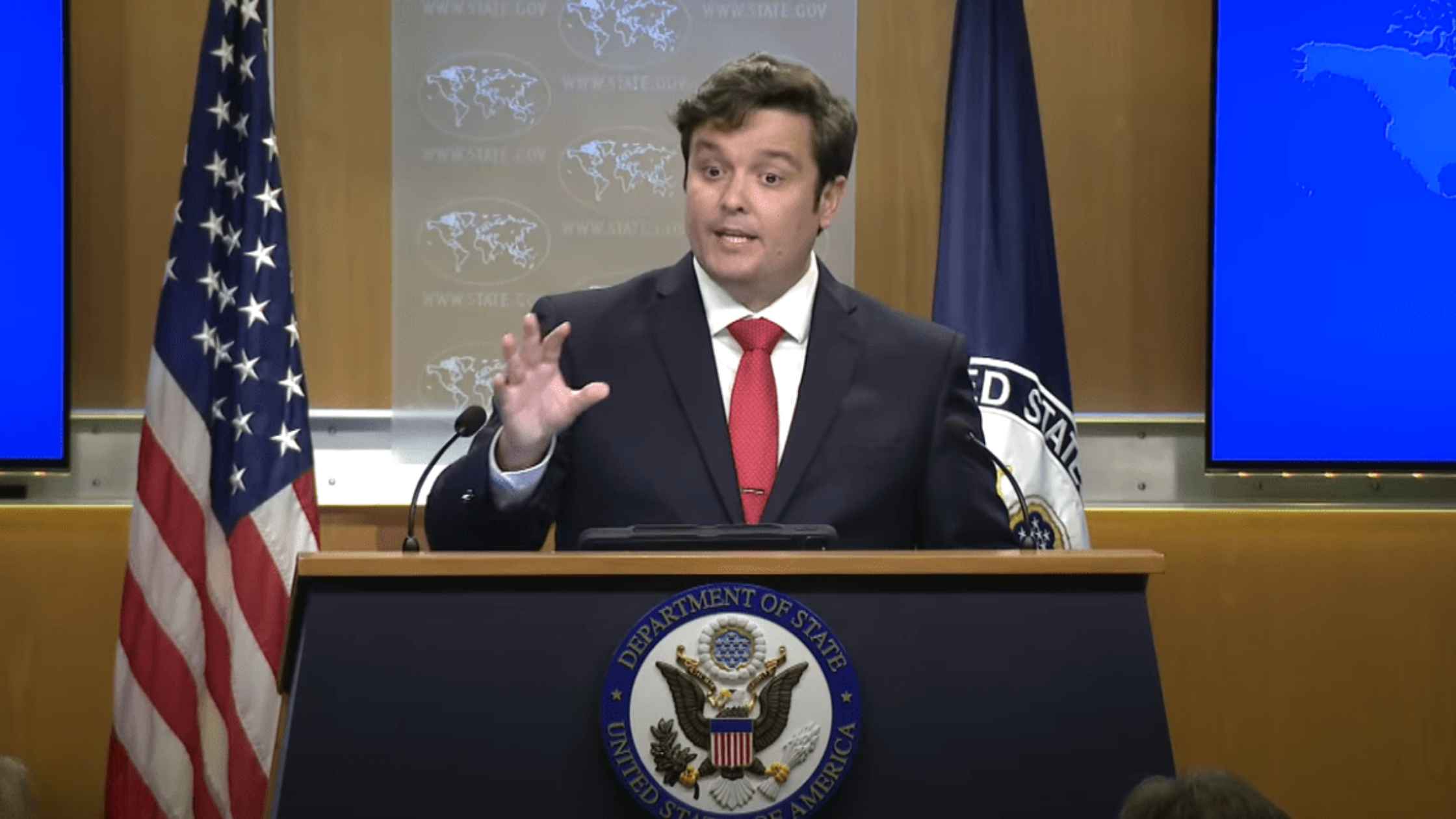


Tommy (00:00):
… Which clearly shows a lack of desire to reach a ceasefire in Gaza. While the mediators have made a great effort, Hamas does not appear to be coordinated or acting in good faith. We will now consider alternative options to bring the hostages home and try to create a more stable environment for the people of Gaza. It is a shame that Hamas has acted in this selfish way. We are resolute in seeking an end to this conflict and a permanent peace in Gaza. This week, the United States is advancing a bold and proactive foreign policy that reflects our enduring commitment to peace and security, and prosperity for the American people. Deputy Secretary of State for Management and Resources, Michael Rigas is traveling to Seoul and Manila to strengthen the department's operational posture, and deepen our partnerships in the Indo-Pacific, a region central to America's strategic and economic interests.
(00:53)
His visit builds on the administration's vision of a free, open, and secure Indo-Pacific. As the White House announced earlier this week, the United States is making significant progress on three major trade initiatives in the Indo-Pacific, reflecting our deep commitment to advancing economic prosperity and long-term security across the region. President Trump announced a landmark economic agreement with Japan, one of our closest allies and one of our most important trading partners. This historic deal underscores the enduring strength of the US-Japan relationship and advances the mutual interests of both nations. The United States and Indonesia also reached a framework for negotiating an agreement on reciprocal trade. This framework is an important step toward expanding bilateral economic ties and will help unlock new opportunities for exporters in both countries.
(01:42)
And on Tuesday, President Trump welcomed President Ferdinand Marcos Jr. of the Philippines to Washington. During the visit the United States and the Philippines concluded a trade agreement that will reduce tariffs and expand market access, further deepening our economic partnerships with a key ally. Together, these agreements highlight the United States' sustained leadership in the region, and our strong partnership with Indo-Pacific Allies and partners. We're also gravely concerned by the escalating violence along with Thailand-Cambodia border, and deeply saddened by reports of harm to civilians. The United States urges an immediate cessation of hostilities, protection of civilians, and a peaceful resolution of the conflict. And with that, I'll take some questions. Yes.
Speaker 1 (02:26):
Thanks, Tommy. The special envoy's statement, does that suggest that the US is pulling out of any sort of negotiating role in the Gaza ceasefire talks? What are these alternatives?
Tommy (02:36):
Well, look, ultimately the statement speaks for itself, but the question has never been our commitment to a ceasefire. The question has been Hamas's commitment to a ceasefire, and that has been made clear by the special envoy's statement, the fact that we have entered in good faith and trying to reach an end to this conflict. And as the special envoy said, we remain dedicated to trying to see an end to this conflict.
Speaker 1 (02:55):
But will you work within the parties, Qatar, Egypt, for example, in the Doha format? Will you return to that or are you pulling out entirely from this format?
Tommy (03:03):
Well, look, again, I refer you back to this statement. This is a very dynamic situation and ultimately, again, to reinforce the question here has never been our commitment to try to get a ceasefire. We've seen that engagement. The question here has always been Hamas's commitment to a ceasefire or willingness to get there.
Speaker 1 (03:17):
And can you give us any examples of the alternative options that Wittkopf references in his statement?
Tommy (03:21):
At this point, I had nothing to preview. Yes.
Speaker 2 (03:24):
Thank you. Just following up on that, what about the response from Hamas specifically made the administration feel that they were not acting in good faith?
Tommy (03:31):
Well, look, these are sensitive diplomatic conversations. We'll see in the days ahead as we proceed here. Ultimately, the special envoy statement speaks for itself, but I think the broader context here is also important. The fact that we have seen Hamas first break that ceasefire that existed on October 7th, then break another ceasefire, and then here, as the special envoy makes clear, not acting in a way in order to achieve a ceasefire again. So to reiterate, the question has never been our commitment to a ceasefire. It has been Hamas's. They have shown that again and again and again, and have just shown it once again.
Speaker 2 (04:01):
This decision comes as dozens of people have started to death in Gaza in the last few weeks, is a wave of hunger is being [inaudible 00:04:08]. The WHO said yesterday that 21 children under the age of five were among those who've died of malnutrition so far this year. And more than a hundred organizations have called for the lifting of all restrictions on the flow of aid, and all land crossings to be opened and the restoration of the UN-led humanitarian response. Given this decision today, is the US considering any other steps to increase the flow of aid to Gaza? Are you talking with Israel about them taking any other steps? How do you move forward with them aid?
Tommy (04:38):
Well, look, ultimately what we have seen us do is delivery of close to 90 million meals into Gaza during a war zone. The ability to deliver that aid in a way where it is not being looted by Hamas. That is what we have seen. We are of course aware, and of course we want to see end, the devastation that has taken place in Gaza. That's why we have seen this commitment to get aid to the people who need it in a way where it is not weaponized by Hamas. That commitment remains. It is a commitment from President Trump and Secretary Rubio. That is why we have supported the Gaza Humanitarian Foundation. That is why we continue supporting the Gaza Humanitarian Foundation. That is why we've seen those 90 million meals being distributed and that commitment, again to making sure that aid is reaching the people of Gaza that need it. And the first victims of Hamas being the people of Gaza, as is demonstrated once again here.
Speaker 2 (05:27):
Is the Gaza Humanitarian Foundation then a sufficient mechanism for delivering aid to Gaza? I mean, people are still starving to death. Is that enough in the US opinion?
Tommy (05:38):
Well, as spokesperson Tammy Bruce has said from this podium before, it is never enough in a war zone. It is never enough. That is why we're committed to trying to get as much aid in as possible. That is why we worked for that ceasefire, because of what we are seeing. But aid needs to be delivered in a way where it's not being looted by Hamas. So of course enough, it is never enough in a war zone, but we're dedicated to getting as much aid into Gaza in a way where it reaches the people that need it as possible. And that's why we were working so hard for a ceasefire.
Speaker 3 (06:08):
Okay. And sorry, I just have one question. On the US citizen that died in Syria, Hossam Saraya. Has the US been able to ascertain any further details around the circumstances of his death?
Tommy (06:20):
So what I can say on this is first, in terms of the circumstance around his death, I have nothing to confirm on this front. What I can say is we have had direct discussions with the Syrian government on this issue and have called for an immediate investigation into the matter. Hossam and his family deserve justice, and those responsible for this atrocity must be held accountable. Yes.
Speaker 4 (06:41):
Hi, Tommy. I have a quick follow up on that and then I have a different subject I want to quickly ask you about, which is very relevant. Doctors Without Borders internationally known and working with the US for decades is urgently calling for help beyond the foundation, because one in four young children and pregnant women, they say are malnourished and that it is a policy of starvation. Acknowledging 90 million meals and the progress, quote unquote, but there is a whole area of Gaza that is not being served by that, people can't get to it. It's only in one region in the South. And internationally, 28 countries, hundreds of eight organizations are calling for something more than that. There's been some acknowledgment from US officials as well that there's real starvation. Now that the talks have collapsed and so that there's no immediate ceasefire that might relieve the pressure, is there any alternative that the State Department would begin looking at? And then I have just one other follow up.
Tommy (07:47):
Well, a couple of points. First, it is progress to see 90 million meals, and that is progress, and I think it is worth applauding, especially given the circumstances under which those meals were able to be delivered. I think another important context of this is that the first victims of Hamas are the people of Gaza. Of course, they're not the only victims-
Speaker 4 (08:07):
But that's what we're talking about.
Tommy (08:07):
… on October 7th, the atrocities that we saw there, many victims of Hamas. We remain dedicated to getting aid into Gaza, to the people that actually need it. And we've called from this podium, other entities to step up and working through this mechanism in order to deliver aid to the people of Gaza without it being subject to looting by Hamas.
Speaker 4 (08:22):
Well, they're volunteering, but they can't get past the border. That's the problem.
Tommy (08:25):
We're calling for conversations with the Gaza Humanitarian Foundation, with under entities. Through this mechanism, we've seen the food being delivered-
Speaker 4 (08:32):
It's also fuel for the hospitals where the incubators are now taking multiple children.
Tommy (08:35):
We are incredibly aware of the humanitarian catastrophe that is happening there. That is the dedication you have seen from the president, the dedication you've seen from Secretary Rubio. Every single day we have conversations here at the State Department. Every single briefing, we have conversations here about getting aid into Gaza is a dedication of this administration. That's why we've seen the 90 million meals, the support of that effort from this administration. So
Tommy (09:00):
Of course, we want to see as much aid getting into Gaza as possible in a way that is not being eluded by Hamas. This mechanism, The Gaza Humanitarian Foundation, has been a way to do that. We're calling for additional support of that foundation to deliver that aid.
Speaker 4 (09:13):
Okay. Let me ask you this other question though, because there is a lot of reporting, New York Times and elsewhere about planned cuts in PEPFAR going forward. Now just last week, Republicans led the way on the Hill in carving out the callback that was proposed in PEPFAR and in continuing the program and expanding it beyond some of the contracts that were frozen under DOGE. Can you give us an update, a status update on where the State Department's thinking is on PEPFAR going forward?
Tommy (09:54):
Well, Secretary Rubio has stated that PEPFAR is an important and lifesaving program that will continue, that dedication continues. That has been clear from the Secretary. The Secretary has made that clear. I will take a step back when we're talking about aid programs in general. Part of the new vision of this administration when it comes to aid is looking at recipients of aid or at least the communities as allies and partners, not those that are dependent on this aid. And in the long-term, working towards a scenario where we have the same needs being provided by local partners or other entities is part of that long-term effort when we're talking about aid in general. So PEPFAR though now is an important and lifesaving program that will continue. Secretary Rubio has made that clear.
Speaker 4 (10:33):
And just to quickly follow up, some countries have moved towards taking ownership. South Africa, for instance, countries that are capable. But in conflict zones like Haiti, like Sudan, like Southern Sudan, like Somalia, and several other countries involved, is there a plan to continue it until countries can stand on their own two feet?
Tommy (11:00):
Well, look, what I can say now is that PEPFAR, as I just said, that important and lifesaving program that will continue, that's what our policy currently is here. Again, talking about that longer term, when we're talking about aid in general is when we're talking about those local institutions being able to fulfill a lot of those needs, looking at people as trade and allies, not as those that are dependent on aid. That's a broader aid vision that is from this administration. But when it comes to PEPFAR, as I said that it will continue. Yes?
Speaker 5 (11:26):
Thanks Tommy. The United Nations Security Council yesterday, the U.S. was isolated in its position when it comes to the humanitarian situation and Gaza's support for the GHF. We've had the UK Prime Minister in the last hour saying the situation in Gaza is unspeakable and indefensible, have more than 100 humanitarian aid agencies saying that this system is creating the conditions of starvation. You have desperate Israeli hostage families who've been for weeks pleading with the prime minister of their country to do this deal. The U.S. is the only power that has the leverage and the pressure to try and make that happen. From the Israeli side, there is clearly a gap between Israel and Hamas. It's been there for a long time and there are Israeli families who will say that this is quibbling over a few meters of territory in Gaza, this is quibbling over a number of Palestinian prisoners to be released. And the U.S. could put the pressure on to move these two sides closer together.
(12:27)
Can you help us understand why at this moment when you see the conditions on the ground in Gaza with now mass starvation, the U.S. is deciding this is the moment to walk away from these talks?
Tommy (12:38):
This is not a question of what the United States is doing. It's a question of what Hamas has done. This is a response to what Hamas has done continually-
Speaker 5 (12:45):
But that's not actually the position of many of the Israeli hostage families, of-
Tommy (12:47):
Israel has long accepted the deal on the table and Hamas has long rejected it. I mean it's never about, been our commitment to a ceasefire. That's never been the question here. We have engaged in good faith to try to achieve a ceasefire. The question has always been with Hamas. That is where the question has been. That is where it remains, and the response we just saw from Special Envoy Witkoff is reflective of that. The question is with Hamas, not with the United States.
Speaker 5 (13:10):
Yes. Sorry, just the statement says, you'll now consider alternative options, I mean to bring the hostages home, what possible alternative options can there be? Israel has tried rescues. Gaza is reduced to rubble. The population is starving. So I mean, if you could help us understand what that statement could possibly be referring to.
Tommy (13:29):
I'm not going to speculate more on terms of what his statement, his statement stands for itself at this time. If we have more to announce, we will announce it.
Speaker 5 (13:36):
Sorry, just one other thing.
Tommy (13:36):
All right, one more.
Speaker 5 (13:36):
I wanted to ask about the two-state solution conference next week. I know the U.S. had said previously when it was postponed that it opposed countries going to this conference in New York. Do you have a position on it this time?
Tommy (13:50):
Nothing further beyond saying that we will not be in attendance of that conference. Yes?
Speaker 6 (13:56):
Just to clarify now, when the Envoy says, "We'll consider alternative options to free the hostages and so on," what is meant by that? Because we have seen that only through negotiations were the hostages released in the past. So what other alternatives the U.S. could be thinking about?
Tommy (14:18):
Well, I refer you to my previous response. I'm not going to expand upon what the Special Envoy has said.
Speaker 6 (14:24):
Okay, so one other thing, and you also say that Hamas has broken the ceasefire. It was in fact the Israeli Prime Minister who broke the ceasefire on the 18th of March, this past March and so on. Hamas said, at least from what we hear by the interlocutors and so on, that Hamas has been more than willing and submitted many concessions and so on. So what is required of Hamas so a ceasefire can take effect as far as the United States is concerned?
Tommy (14:55):
Well, look, there has been conversations on this. I will not go into details of what those private diplomatic conversations have been, but what I can say is it is clear now from our perspective that Hamas does not appear to be coordinated nor acting in good faith. We have approached these conversations with good faith, as has been evident by our comments from this podium and other places, and it is clear now that Hamas has not been acting that way.
Speaker 6 (15:15):
And just lastly, according to news reports and so on, the sticking point was actually the actual entry of aid to Gaza. They apparently did not agree on that. Is that really what broke finally, or what forced the United States team to pull out because they want to maintain this GHF method of allowing aid into Gaza?
Tommy (15:45):
Look, what I can say is what Spokesperson Bruce spoke to just on Tuesday, that discussions of the humanitarian situation in Gaza were part of this, and our effort was to try to get those humanitarian corridors in there. That has been a clear effort by this administration as Spokesperson Bruce described. And again, to reiterate, we are seeing aid being delivered despite the actions of Hamas here, and those 90 million meals are to be applauded in terms of that effort. Of course, it will never be enough until we see an end to this conflict, but the entity that is standing in the way of ending this conflict is Hamas. They can release the hostages, lay down their arms. As we have said repeatedly, it's Hamas that is preventing an end to this conflict. Yes?
Speaker 7 (16:25):
Tommy, a few Middle East questions for you. Number one, with Special Envoy Witkoff's statement, said there's a lack of coordination. Hamas is not coordinated. Can you expand on that? Is it trouble reaching the appropriate leaders? Is it an unclear chain of command? I mean, where is the lack of coordination coming in?
Tommy (16:43):
I'm not going to expand on his statement at this time. So yes next question?
Speaker 7 (16:47):
Second question. Can you give us an update on Tom Barrack's dealings today, reportedly meeting with Syrian and Israeli officials? Any status update?
Tommy (16:55):
I have nothing specific to preview for you, but what I can say is he has of course been in communication as has the Secretary with all sides for many days now, and those efforts continue.
Speaker 7 (17:04):
Last question for you, hopefully I'll drag an answer out of you on this one. I asked in Tuesday's briefing about why Secretary Rubio is not pushing harder for the extradition of Ahmad al-Tamimi from Jordan. I was given a written answer by the State Department on that yesterday after you guys took it back. Basically said, we continue to impress upon the government of Jordan to bring her to justice. President Trump said on day one, his executive order, "American citizens come first in American foreign policy." American citizens. Secretary Rubio put out his three questions. Every dollar spent, every program has to answer in the affirmative one of three questions. Does it make America safer? Does it make America stronger? Does it make America more prosperous? I'm sure you have these memorized by heart. A billion and a half dollars of foreign aid to Jordan. How is it conceivable that Tamimi is still there and any of that falls under these dictates
Speaker 8 (18:00):
… Of what American foreign policy is supposed to be with three dead Americans in Tamimi's hands.
Tommy (18:05):
On your first point, I mean to reiterate what we provided to you, the United States has continually emphasized to the government of Georgia, the importance of holding Ahlam al-Tamimi, the convicted terrorist released by Israel in a 2011 prisoner swap, accountable in a U.S. court for her admitted role in a 2001 bombing in Jerusalem that killed 15 people, including 3 Americans. The United States continues to impress upon the government of Jordan that Tamimi is a brutal murderer who should be brought to justice.
Speaker 8 (18:31):
It's not working.
Tommy (18:31):
Well, and on the point in terms of our foreign policy, the President has made clear, the Secretary has made clear through their actions that America is coming first. We've seen that with the Americans that have been brought home. We see that with the pursuit of peace around the region. We see that with a policy that is about strengthening in our industrial base and making sure that we are advancing those interests wherever possible. We are continually emphasizing to the government of Jordan the importance of this issue, though in terms of the three that you mentioned, safer, stronger, more prosperous, those are not slogans here. They are actions. Those are north stars that we fulfill every single day to the best of our ability, making sure we're advancing the interest of the American people in absolutely every single way that we can. Yes?
Speaker 9 (19:11):
Hi. Thank you. I just want to follow up on Gaza.
Abigail Hauslohner (19:15):
Sorry. Do you want to go? Would that be okay?
Speaker 9 (19:17):
Yeah, sure.
Abigail Hauslohner (19:17):
Thank you so much. Hi.
Tommy (19:18):
Sorry I signaled to you as next there, so I wanted to follow up, but I'll go after.
Abigail Hauslohner (19:23):
Thank you so much. Abigail Hauslohner, Financial Times. So to go back to Gaza, I know you all have said repeatedly that the situation and starvation that we're seeing is because Hamas is blocking progress or you've said because the UN organizations aren't willing to work within the framework of GHF and then that Israel has set for aid distribution. We all acknowledge obviously that Israel controls Gaza's borders completely and it is limiting food to the population because Hamas has not agreed to its terms. I know this question has been asked in many different ways. I'm going to try this way. To be clear, is the U.S. government okay with Israel allowing children and adult civilians to starve so long as Hamas and the UN refuse to play by Israel's rules for aid distribution?
Tommy (20:17):
I reject the premise of that question in terms of how that was set up. This humanitarian catastrophe lies at the feet of Hamas who could end this conflict today by releasing the hostages and laying down their arms. Hamas-
Abigail Hauslohner (20:31):
That suggests that short of Hamas doing that-
Tommy (20:33):
Excuse me.
Speaker 10 (20:34):
These kids are dying, doctors don't have medicine, they don't have fuel.
Tommy (20:39):
This is something that we have dedicated, the President and the Secretary, have been dedicated to getting as much aid as we can-
Abigail Hauslohner (20:45):
No, no, thanks.
Tommy (20:45):
Into Gaza in a way where it's not being looted by Hamas. It is something that we-
Abigail Hauslohner (20:50):
Short of a change by Hamas, the U.S. government will stand by-
Tommy (20:53):
Excuse me, I'm going to answer this question. We have been dedicated to getting those 90 million meals into Gaza in a way where it has not been looted by Hamas. We have been dedicated to getting aid into Gaza. It is something that the Secretary and the President have talked about, worked for. These discussions of getting more aid into Gaza have been part of that ceasefire we are hoping for. But again, the blame of this lies at the feet of Hamas and that is the fact of the matter-
Abigail Hauslohner (21:17):
Short of Hamas doing something, changing its behavior, the U.S. government will allow the situation to proceed as is?
Tommy (21:23):
The U.S. government is supporting an effort to get 90 million meals into Gaza. The U.S. government is supporting an effort to get as much aid as possible to the people that need it without it being looted by Hamas. That is the actions of the U.S. government in terms of supporting that effort and we call on others to support that effort to get as much aid as we possibly can. Of course, it will never be enough. It is something we are continually working for to get more and more aid in what ways we can without being looted by Hamas every single day.
Speaker 8 (21:50):
Last question, has President Trump seen images of the children or other civilians starving recently this week? [inaudible 00:21:57]
Tommy (21:56):
What I can speak to is President Trump's comments before that he has said publicly about wanting to get aid into Gaza. Yes?
Speaker 9 (22:03):
Thank you. The criticism against the Gaza Humanitarian Foundation basically is controlled by Israel. It is designed by Israel, is controlled by Israel and therefore is weaponizing the food against the Palestinians. Where before the creation of the GHF, it was 400 points where people can access the food. Yesterday the Jordanians managed to get 110 aid trucks including baby formula and including flour. They work with WFP and they work with the World Central Kitchen. So there's an alternative to the GHF. Why can't the U.S. allow other countries to use this kind of method, especially in Northern Gaza because the four points where the GHF is concentrated in the south, so people from the north cannot come to the south. So why can you encourage this method?
Tommy (22:53):
I flat-out reject your characterization of Israel weaponizing aid. The only entity that has been weaponizing aid has been Hamas through the looting of aid, the weaponization of this population-
Speaker 9 (23:02):
Can you say both?
Tommy (23:03):
What we have seen is an effort from the United States government, like I said, to get 90 million meals in Gaza during a war zone. We saw efforts-
Speaker 9 (23:10):
But that's not enough
Tommy (23:10):
We saw efforts to get to ceasefire that [inaudible 00:23:14]. We saw efforts to get to a ceasefire that Hamas has decided not to act in good faith to achieve. That is the reality here, and we're continuing to try to get aid into a war zone that exists only because of Hamas. The war zone exists only because of Hamas who could end the conflict tomorrow, who is weaponizing aid against the Gaza population. The first victims, that's what we said, are the Gaza population.
Speaker 9 (23:36):
I have one more question. I want to ask a question on behalf of Janice in Gaza. You and other spokespeople behind this podium, they always talk about the freedom of expression, the value of our work, our correspondents, including my own of Al Arabiya and my colleagues of AFP and every other journalist in Gaza are unable to do their job because they're starving, they don't have food. How can you allow this to happen? And you tell us and tell everybody else that the work of journalists is vital, especially in a war zone, and yet you're now saying that it's Hamas who's controlling the food and therefore we can't do anything about these people? How can you help them? How can you help journalists-
Tommy (24:18):
What I'm saying first on that front in terms of the food is that Hamas through looting the food has led to weaponization. They're weaponizing aid when they're able to. We have a system in place attempting to get as much aid into Gaza as possible in a way where it is not being looted by Hamas. That is the reality that we're seeing. That is the reality that we're pushing for, trying to get as much aid in there as we possibly can. Yes?
Speaker 11 (24:42):
Does the State Department have an official assessment of what the humanitarian or the food situation is? Is it famine? Is it mass starvation that we're seeing? Do you have an assessment?
Tommy (24:55):
Well, I can say that we are acutely aware of the humanitarian situation on the ground. In terms of a specific assessment, I have nothing to preview on that front, but we are acutely aware of humanitarian-
Speaker 11 (25:03):
Is it something you're looking into?
Tommy (25:05):
Well, we are very much aware of the humanitarian disaster that is there. We're very much aware of it. That again goes back to the commitment of why we're trying to get aid into Gaza.
Speaker 11 (25:12):
And quickly because I have something on Syria, but you keep referencing the 90 million meals. That's since May 27th for 2.1 million people. I think assessments suggest that number needs to be closer to 350 million meals in order to get these people the food they need. So that's a big delta obviously. What can be done short of assigning complete blame to Hamas, what can be done to improve GHF's ability to get food?
Tommy (25:42):
Well, from the beginning when this started, we did see a ramp up in terms of the food that they've been able to deliver. We also saw efforts from this administration, support for the Gaza Humanitarian Foundation. And the hope is that we'll have other entities supporting this mechanism as well so that we can deliver as much food as possible. It will never be enough. We're working every day to get as close as possible, but it'll never be enough because of the situation on the ground. That is not an excuse, but that is the reality we are dealing with and we are working every single day to get as much food to support those efforts as we possibly can because of our recognition of the disaster on the ground, because of the humanitarian catastrophe every single day working towards that.
Speaker 11 (26:22):
And just on Syria really quickly, do you think after the recent violence that the administration should perhaps rethink its willingness to lift all sanctions?
Tommy (26:32):
Look, President Trump announced sanctions really for Syria on May 13th to give all Syrians a chance at a peaceful and prosperous country. Syria is at a critical juncture and we are looking to the Syrian government to lead on next steps. Yes?
Speaker 12 (26:49):
Thank you. Just sticking on the Gaza Humanitarian Foundation, quickly, are you able to say whether you know whether the Gaza Humanitarian Foundation distributes food that is high nutrient, high protein, the food
Speaker 12 (27:00):
… That is needed for children in particular that have now reached starvation point. Can you confirm whether the U.S. government knows whether that type of food is being distributed by this organization that you had said a few weeks ago the U.S. government is now going to support?
Tommy (27:12):
Well, I know that we have details in terms of what food they're providing. Let me take that back to get you the exact details on that.
Speaker 12 (27:18):
I just want to check because again, you're reiterating 90 million meals. Is the U.S. government aware of any mechanism that has been used by The Gaza Humanitarian Foundation to make sure any of those meals are getting to those that are now at the starvation point to make sure that it is actually finding its way to the hospitals, to the most critical children that need it, do you have any oversight on that? Does the organization have any control over that? Because it sounds like they only have control over their distribution sites and once the food leaves, that's it, there's no way of telling where that goes.
Tommy (27:53):
Well, in terms of the details, in terms of after at least distribution sites, I'll take that back and see if we can get more details on that. Thank you. Yes?
Speaker 13 (28:04):
Just to switch topics to Ukraine, do you have any reaction to the talks in Istanbul? And it doesn't seem like there was much progress, and separately, have the Russians reached out to you or offered any response to President Trump's 50-day ultimatum?
Tommy (28:23):
Well, nothing to preview in terms of that second question. On your first, we are aware that a third round of direct talks took place between the two parties. We support continued calls for a full unconditional ceasefire, Ukraine's continued calls for a full unconditional ceasefire, including the complete halt of all strikes on civilian and critical infrastructure. And we welcome the news that Russia and Ukraine agreed on a further exchange of prisoners, particularly the severely ill and wounded.
Speaker 13 (28:45):
So do you see this as progress, these talks?
Tommy (28:52):
What I can say is we continue to encourage direct talks between Russia and Ukraine in pursuit of a comprehensive ceasefire and eventually a negotiated peace settlement.
Speaker 14 (29:01):
Just to follow up on that, the fact that there was no ceasefire on the table was overshadowed by Russian attacks, was it a missed opportunity in your opinion?
Tommy (29:10):
Well, look, the President has been clear many times about how he views certain actions by Russia, especially over recent weeks. He has been very clear on that, very transparent on that. He's also been clear that we want to see the parties continue those direct talks to reach that ceasefire, that comprehensive ceasefire, and eventually that negotiated peace settlement. Beyond that, I have nothing further to add.
Speaker 14 (29:29):
Thanks Tommy. Also want to get your reaction to the latest reports about China supplying Russia with drone engines under different names. What kind reaction does it invite from you guys?
Tommy (29:42):
Well, let me take your question back and see if we can get more details there, but in the meantime, [inaudible 00:29:47].
Speaker 14 (29:47):
If I may, one more topic. I asked you a couple of days ago about Azerbaijan and Armenia. The President said that he achieved some magic. Please unpack for us.
Tommy (29:55):
Well, at this point I have nothing to preview. We'll see if we're able … When we have something to announce, we'll announce it. Thank you. That's all for today. Thank you very much.