




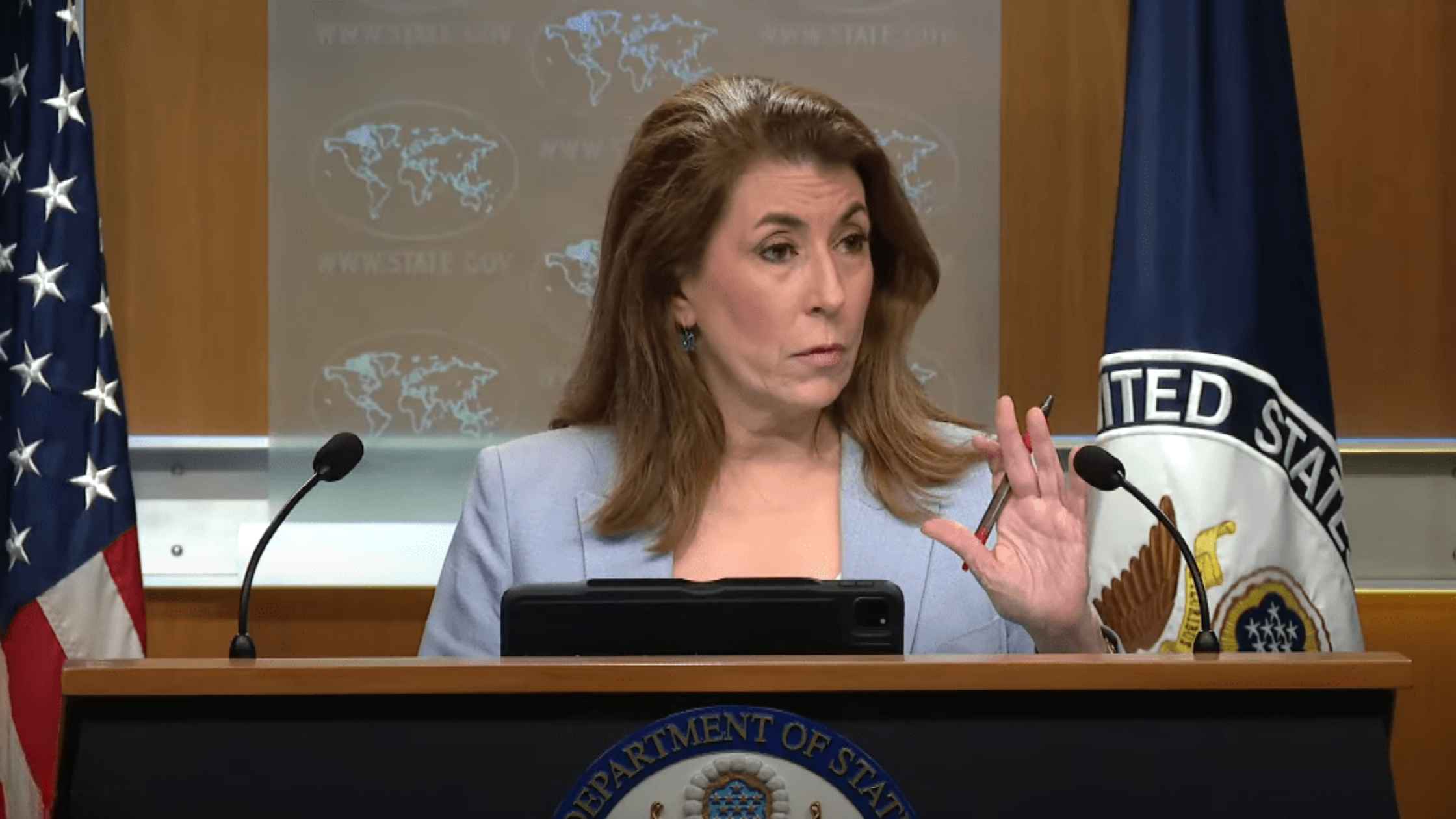


Tammy Bruce (00:00):
Here on this. Is this the last week of July? Is that possible? It's getting close. It's weird. Everyone's saying no. All right. I'm already wrong. All right, everybody. As of Friday evening, there are no wrongfully detained Americans in Venezuela. And we want to keep it that way. We are committed to doing everything we can to prevent one American national from being wrongfully detained by the Venezuelan regime ever again. To this end, I want to reiterate our clear warning. No one should go to Venezuela. We have the risk certainly of wrongful detention of Americans, of dual nationals, of lawful permanent residents. Whoever you are, don't go there. The risk is extremely high. Americans who travel to Venezuela or nearby border regions risk being wrongfully detained for months or even years. And release is never a guarantee. You can stop that yourself by not going to Venezuela. Further, the days of unelected health bureaucrats in Geneva running over the American people are over. It's a good day.
(01:24)
In collaboration with the Department of Health and Human Services, we formally notified the World Health Organization of our rejection of the 2024 International Health Regulations amendments, which were set to become legally binding, regardless of our WHO withdrawal. The 2024 IHR amendments broadened the WHO's mandate to include not only public health emergencies of international concern, but also, quote, "Events or conditions that may have the potential to become emergencies." How nice for them? This allows the WHO to deem what constitutes an international threat. We know from COVID-19 that an expanded international health bureaucracy will use their authority to centralize decision-making, stifle scientific debate, and censor free speech. Rejecting the 2024 IHR amendments reaffirms our position that US public health policy will be shaped by Americans for Americans. And with our HHS colleagues, we are proud on delivering that mandate. And today, the United States informed Director General Audrey Azoulay of the United States' decision to withdraw from the United Nations Educational, Scientific and Cultural Organization, also known, of course, as UNESCO. Continued involvement in UNESCO is not in the national interest of the United States. UNESCO works to advance divisive social and cultural causes and maintains an out-sized focus on the UN's sustainable development goals. A globalist ideological agenda for international development at odds with our America First foreign policy. UNESCO's decision to admit the, quote, "State of Palestine," end quote, as a member state is highly problematic, contrary to US policy, and contributed to the proliferation of anti-Israel rhetoric within the organization. Continued US participation in international organizations will focus on advancing American interests with clarity and conviction based on President Trump's executive order. Continued participation in international organizations is under review. And this is one result of that review, confirming the importance of making sure that all of what we do comports with the America First agenda.
(03:59)
And finally, in today's topper, President Donald Trump met with Philippine President Ferdinand Marcos Jr. in Washington, DC, following Secretary Rubio's meeting with President Marcos yesterday. Both meetings reaffirmed the ironclad United States-Philippines alliance as vital to peace and stability in the Indo-Pacific region, while advancing closer economic ties, including supply chain cooperation. Secretary Rubio announced plans to work with Congress to provide 15 million for private sector development in the Luzon Economic Corridor. Part of a broader, more than $60 million initiative focused on energy, maritime issues, and economic growth. Both sides committed to regular high-level engagement as allies, particularly ahead of the 80th anniversary of the US-Philippines diplomatic relations in 2026. So that is coming up. And I will now take your questions. And we'll go to Nadia.
Nadia (05:08):
Thank you [inaudible 00:05:10]. Two quick questions. The first one is quick. Second is not that quick. The first one is about Syria. It's reported that Ambassador Tom Barrack is going to chair a security meeting between Turkey, sorry, between Israel and Syria. Is this to avoid the scenario we seen last week? Can you elaborate on this potential meeting between them?
Tammy Bruce (05:29):
Well, what I can tell you is that all parties have reached a cessation of hostilities. We are calling on the Syrian government to lead on the next steps and hold all perpetrators of violence accountable for their actions. The United States government supports Syria's national unity and a peaceful and inclusive resolution with its minority constituents. I did speak with the Secretary briefly actually just before coming up here, which is why I was a little bit late. But he expressed his optimism regarding the current situation that there needed … The Syrian government agreed to a boundary to not go in to the Suwayda area, but that there would be a boundary to make sure that jihadists were also not going in to maintain some part of the peace, if you will. And he was enthusiastic about that, that that was unfolding properly and that everyone involved in the atrocities would be held accountable. And that could include people who also may be affiliated with the Syrian government. Obviously, a good opportunity for them to show their commitment to what needs to be achieved there. Yes, one more.
Nadia (06:46):
[inaudible 00:06:46] your colleague said that President Trump, and I want to quote him just to be precise, is she said that President Trump hated seeing pictures of salvation of women and children trying desperately to get to the aid. You want to see it done in a peaceful manner. As you know, there's a thousand people have been killed around the food distribution center. So how can the State Department or the administration fulfill the President's statement of what he said now to make sure that the food amount is increased more than the 80 million that you mentioned to us before and to make sure that people are secure and not killed while they're trying to get the food?
Tammy Bruce (07:23):
Right. That is clearly our North star. It is the thing that is uppermost in mind for the President to still get peace so that these issues are no longer issues. Also, in my conversation with the Secretary, he has noted that Special Envoy Witkoff is heading to the region now, to the Gaza area. And we all have, as the President and the Secretary and the envoy, a strong hope that we will come forward with another ceasefire as well as a humanitarian corridor for aid to flow. That both sides have, in fact, agreed to this. So we are looking forward to that arrangement and to a possible framework, again, regarding a ceasefire. Remember, we had one before, which Hamas broke. But what the Secretary indicated was, again, an aid corridor that needs to be set up that both sides have agreed to. That the humanitarian situation, of course, has been a main focus of what our concern has been, obviously. And so I'm hoping, as I mentioned to some of you earlier in the day in our conversation, that each day has the potential to have this be better. We're working on it constantly. And so I would suggest that we might have some good news, but again, as we know, this can be constantly a changing dynamic. Right.
Nadia (08:49):
[inaudible 00:08:50].
Tammy Bruce (08:51):
Correct. Going to the region. Well, let me just say, was a very quick conversation. It was on the telephone. He said the area, he said Gaza, the area. Now, of course, it could be … We have many, many partners there, many allies. So keep that in mind when it comes to the specific location of the envoy. I do not have that. But it's in a dynamic to where we're looking to finalize this arrangement. Yes, Andrea Mitchell. Hi there.
Andrea Mitchell (09:17):
Thank you very much. Recognizing that, as you've stated many times, as we know, Hamas started this and can finish it.
Tammy Bruce (09:28):
Yes ma'am.
Andrea Mitchell (09:28):
I just want to take it from there, from where you just left.
Tammy Bruce (09:29):
Of course. Yes.
Andrea Mitchell (09:30):
Is there recognition now that it is important to establish aid outside of that southern area in Raqqah so that it is more accessible to people who don't have to travel these distances and deal with the IDF confrontations that inevitably have occurred? And I'd just like to follow up on that as well.
Tammy Bruce (09:53):
Right. It's been always the intention, obviously, to have as many sites as possible. And again, it's been the difficulty of being in a war zone and what you can do and what you can arrange. The fact that we've had three sites up. And I think now it is nearly 85 million meals to date at the distribution centers that do exist. Clearly, it's not just a dynamic of wanting more distribution centers in a war zone. Our goal is to have not a war zone and the aid corridor that the Secretary mentioned to me so that multiple entities can deliver aid and whatever is needed in that region without being looted and hijacked by Hamas.
Andrea Mitchell (10:41):
Now, the initial plan, as it had been described to us, was that the so-called Gaza Humanitarian Foundation would have-
Tammy Bruce (10:49):
Well, it really is called that. It's really called the Gaza Humanitarian Foundation. But go ahead.
Andrea Mitchell (10:53):
They call themselves the Gaza Humanitarian Foundation.
Tammy Bruce (10:56):
Yes, ma'am.
Andrea Mitchell (10:57):
That they would be using American contractors or other contractors for security. As it's turned out, it seems to be more IDF, and that's been possibly one of the causes of the problems. But as was just mentioned, there's been a thousand deaths.
Tammy Bruce (11:12):
There's a lot of supposition there, so I'm-
Andrea Mitchell (11:15):
Doctors have pointed out that people are coming in with heavy wounds from heavy artillery. Is the possibility of having some sort of neutral contractors as the security force rather than the IDF?
Tammy Bruce (11:34):
Well, that, of course, presupposes that IDF soldiers, who are in a mode of defense of their country, are deliberately shooting civilians and children.
Andrea Mitchell (11:45):
I didn't suggest that.
Tammy Bruce (11:46):
Well, that is … The implication that you need someone who's not involved implies that it would be better. It is a dynamic where I think even … A horrible situation over this weekend, regarding a UN convoy in Zikim at a crossing, that more than 30 people were killed in that dynamic trying to access food because that is the focus of every human being. This has got to end. Well, not every human being. Certainly, Hamas is preferring the way things have been. This was at a crossing in Northern Gaza. Certainly, Hamas is injured by the inability to hijack this food and to hijack trucks. And they are injured by the success of GHF and what it's been doing because they have not just looted these trucks, but they've weaponized the money that they make from this food, and then they control the population with it.
(12:44)
The success of GHF has removed … By getting meals in at that number is a tremendous success. But it's removed the power and the influence of Hamas financially and with using aid and food as a weapon itself to control people. So I think that the UN knows this. Everyone else has seen this, that it's not a dynamic. And I've got the GHF statement here as well for you. But I think no matter who has been trying to deliver food, they've known historically and recently that there's going to be … And as long as Hamas is still has its weapons and is still a player in that region, there's still going to be problems. The GHF statement regarding this last massacre, if you will.
(13:30)
"We're deeply saddened by reports that more than 30 people were killed while trying to access food from a UN convoy at the Zikim crossing in Northern Gaza as humanitarian efforts face escalating violence. Like most incidents, this incident is not linked to GHF, despite what was falsely implied by various newspapers. These tragedies deserve visibility. The entire aid system is under immense strain. We hope reporters will cover these incidents with the same scrutiny GHF receives because understanding the full picture is essential to protecting civilians and improving aid delivery."
Andrea Mitchell (14:05):
And have you seen the statement by 28 countries led by some of our closest allies in Europe?
Tammy Bruce (14:13):
Yes. And I think it's nice to know. And many of our … Certainly, it's our allies and friends. It's a demand for the war in Gaza to stop. And we, of course, we've taken actions on that, I think as we've seen. And we wonder why certain things have continued unabated, or at least in a kind of a perpetual loop, is because strongly worded letters don't stop this madness. Strongly worded letters won't stop Hamas. Strongly worded letters wouldn't stop Iran. Strongly worded letters are fine and it's good to know where people stand. I appreciate that very much. The United States, through the leadership of President Trump and the guidance and the hand also of Secretary Rubio and of our remarkable envoys,
Tammy Bruce (15:00):
… put their lives at risk, take action, make decisions, and confront important questions, sometimes when it works, when it doesn't work, but it's more, and sometimes strongly worded tweets and letters in the midst of the actions that we are taking. So we appreciate their sentiment, but I think that the fact of the matter is that we have a history here of recognizing that we've had work to implement what they issue as their desire for the war to stop and we've been taking action on that. So we know that the conflicts which we are trying to end do not end because of letters or even conferences, but because of intense diplomatic efforts, we are leading that effort alongside Egypt and Qatar. And as I've mentioned earlier, we are hoping for some rapid responses coming up soon. Yes sir.
Speaker 1 (15:58):
On that note, I guess if you could talk a little bit about how that progress is progressing towards a resolution, but on a more broader note, is it the department's assessment that the current, I guess policy towards the conflict is working in drawing it to a close? Because when you see 79 people killed waiting for aid, which is one of the highest numbers we've seen over the course of the two years-
Tammy Bruce (16:28):
Horrible, absolutely horrible.
Speaker 1 (16:28):
… it feels like things are going in the wrong direction.
Tammy Bruce (16:31):
Well, what it shows us here is that the enemy, the barbarian framework that started this on October 7th with the mass murder of Jews, the biggest mass murder of Jews since the Holocaust, they are going to be upset and strike back when there appears to be the end to the kind of conflict, this never-ending generational conflict that some of the worst people in the world, state sponsor of terrorism, Iran, and their death squads, have relied on fear, have relied on indecision, have relied on people not wanting to face hard decisions. So of course they're going to act and cause more terror and more death in the hopes that people will retreat.
(17:16)
That's not going to happen. And it means pushing through, making sure you stay on the line, making sure you have the goal in mind, what you're trying to achieve, if it's achievable, the willingness, yes to use diplomacy and as President Trump has indicated other mechanisms in which to get the job done.
(17:35)
So I would argue that Hamas being desperate and doing more horrible things, that's not new for them, that's their hallmark, is something that horribly, it's not a surprise, but that the work to end this from going again and again and again and having the same conversation in a hundred years is obscenely unacceptable. So we see the results. It has been, when you say if there's been progress, the parties have been at the table, there have been agreements, one of which of course is broken. There can be another one, we're determined for that. Certainly their sponsor is on their heels, for lack of a better phrase because they also found out that President Trump is a realist and is serious. So I think that it is clearly shown progress, it's clearly shown a direction and the accomplishment of one of the red lines from President Trump, which is that Iran will never have a nuclear weapon. Well, guess what, they won't. Yes, Humeyra, Reuters. Yes.
Humeyra (18:39):
Just to go back to your conversation with the Secretary, I understand that's what he said, Gaza area, but can we at least say Steve Witkoff is going to the Middle East right now as we speak? The Gaza area is a little bit vague, the Middle East.
Tammy Bruce (18:54):
Yes, yes. Again, based on the… I don't have specifics and I'm sure we have an incredible team that works with Special Envoy Witkoff here in the building are probably now grabbing the television and watching and saying… So I don't have the specifics of exactly where he'll be, but clearly it's in a position where he's going to be able to continue with the negotiations that will lead us to this hopefully ceasefire.
Humeyra (19:22):
Right. And you also said that one of the things that the Secretary indicated an aid corridor that needs to be set up, that both sides have agreed to. So is the United States basically negotiating for an eighth corridor that is going to include other humanitarian implementers like UN and others?
Tammy Bruce (19:42):
Well, you're asking for so much, and I appreciate that about you because you're always a few steps ahead that would require speculation on my part. It would require guessing on your part. What I know is what I said to you based on what the Secretary said to me.
Humeyra (19:54):
One more thing.
Tammy Bruce (19:55):
One more.
Humeyra (19:56):
In your answer to Nadia, are you actually confirming that this meeting is happening with U.S envoy, Tom Barrack and officials from Israel and Syria, and can you tell us where it's happening?
Tammy Bruce (20:07):
No, I can't confirm any of that. Thank you. Yes. Yes ma'am.
Speaker 2 (20:11):
Thanks, Tammy. Going back to the American who was murdered in the West Bank, the president last week indicated there would be a meeting in which the Israeli government would give more information to the US about his murder. Did that meeting take place and what else can you tell us about that?
Tammy Bruce (20:28):
Unfortunately there's not a great deal I can talk to you about the family and the nature of the conversations. Of course, we have confirmed the situation with his death, but the conversations or what has transpired at this point is not something that I'm able to share at this stage.
Speaker 2 (20:54):
And then another American was murdered in Syria last week, his family says that he was murdered by officials with the interim Syrian government. Is the US planning to hold them accountable for this death?
Tammy Bruce (21:06):
Well, again, you are saying something here that everyone hears, that is not something that I would confirm or would know or would say as a matter of fact, because a reporter says it here in the room. We can say, of course, that Secretary Rubio has emphasized the importance of prioritizing the safety and security of US citizens. We can confirm the death of, and this is the Suwayda region, what we're discussing, of Syria last week of US citizen Hosam Saraya. We offer condolences to the family on their loss. We are providing consular assistance to them. But in the midst of the further conversations, I can't give you any more details except what we've already discussed.
Speaker 2 (21:53):
And then quickly on Haiti, the Secretary announced yesterday that he had determined a number of legal permanent residents had ties to what has now been determined to be a Haitian FTO. How many people were affected by this? How did you determine that they had ties?
Tammy Bruce (22:06):
Yes, again, for everyone at home, FTO is a foreign terrorist organization, so it's a very serious dynamic. Last month, Secretary Rubio determined that certain aliens with US lawful permanent resident status, who have supported and collaborated with Haitian gang leaders connected to Viv Ansanm, a US-designated foreign terrorist organization, are deportable due to the potentially serious foreign policy consequences of their continued presence in our nation. Viv Ansanm is a driver of the violence and criminality in Haiti contributing to the island's instability.
(22:43)
The Department of Homeland Security also steps in here, they will pursue the removal of these aliens from the United States pursuant to our laws. The Department of State defers to DHS on any update regarding removal proceedings regarding these aliens. We also will not allow aliens who have facilitated the actions of violent organizations or support criminal terrorist organizations to remain in the country. And of course this demonstrates, I think it's safe to say, the administration's firm commitment to protecting the American people, advancing our national security interests and promoting regional security and stability. There is an authority I want to share with everyone who may not know how this works. These actions are taken pursuant to section 237( a)(4)(C) of the Immigration and Nationality Act. Under this section, also referred to as 4C by many, of the INA, an alien is deportable if the Secretary of State has reasonable grounds to believe that the alien's presence or activities in the United States would have potentially serious adverse foreign policy consequences for the United States. All right. Yes, sir.
Speaker 3 (23:59):
Can I just ask you follow up really to Humeyra's question, when you mentioned these humanitarian corridors, you said it's been agreed between the sides. Is that something that's come from the process in Doha that's been agreed, how should we take that? And just any detail you can give us about [inaudible 00:24:14].
Tammy Bruce (24:15):
The Secretary is a busy man. We're all proud of him, the nature of what he's being able to accomplish by splitting his time between the State Department and the White House. And our conversations sometimes are in person, oftentimes by phone. So when I've got him in a moment, I'll just jotting down what he's saying, what I can't tell you and whether I knew or not is how this came about, where it was decided or who the parties were.
Speaker 3 (24:44):
Is your understanding that these corridors would be in addition to what's happening now? Because we know, for example, the UN says it's 6,000 trucks on the Egyptian side at Rafah. Are we talking about all of that material that hasn't been able to access [inaudible 00:24:59]?
Tammy Bruce (24:58):
I wish I had a specific for you. I know that his comments really ranged into the fact that the humanitarian framework has got to ramp up and has got to get better. And obviously we've known that, it requires the ceasefire, and also then a method within which these convoys can move. He did not give me a specific, but he did use the phrase set up, that they need to be set up. Now that could mean a variety of different things as we know, some of you think about a physicality, others, it could involve arrangements at certain spots. I don't know, and we shouldn't speculate at this point.
Speaker 3 (25:33):
Is there any sort of internal scrutiny within the administration about the results of the Gaza Humanitarian Foundation's entire project, which as you've set out, is intended to displace the United Nations process?
Tammy Bruce (25:46):
Well-
Speaker 3 (25:47):
Because we've seen-
Tammy Bruce (25:49):
I never said that this was to displace a process. I can't speak to-
Speaker 3 (25:56):
But you've been saying that under the previous system Hamas has [inaudible 00:25:58]-
Tammy Bruce (25:58):
Well, yes, it's true. I mean, we know that under the previous dynamics that Hamas was able to loot trucks and to steal material and to sell it and to use it and to weaponize it. But the decisions made since now GHF has been able to get food in and to distribute it, yes, there have been some difficult circumstances, to say the least, because it's a war zone with a terrorist group. We recognize that, it's imperfect and it's difficult, but they've done it in a way that made it possible. I don't know what has made the others so vulnerable to theft and hijacking and everything else that has kept, has really only landed the food with Hamas. And we saw that this weekend and then a few weeks ago, another dynamic where trucks themselves, the entire truck, multiple trucks were hijacked. So I don't know the entire UN plan or their decision-making process, what I do know is that GHF did it differently and the different approach has worked.
Speaker 3 (27:06):
But the result of this system is starvation and everyone can see it, and this is beyond any doubt. A bag of flour costing $70, so the value of those commodities actually to Hamas or other groups [inaudible 00:27:19] has gone up under this system.
Tammy Bruce (27:22):
Well, look, we know without needing to refer you to the Treasury Department, that supply and demand is an issue wherever you are. And of course we're talking about this as though it's like a city in distress, it is an obscene result of obscene mass murder and madness. It is not a normal environment, it's not a human environment. It is a placing, as I've said from the beginning, the first victims of this situation have been the people of Gaza.
(27:51)
And it is time, and President Trump has pointedly made this declaration about his intentions is that this is going to stop and it requires new ideas. The old ideas maybe were well-meaning, and they kept doing it and it was always the same result. Maybe it's well-meaning, I can't speak to that. What everyone needs to recognize is that the current situation works, and yet there is still this bizarre resistance. And look, I'm here because I love the country as are our diplomats and there are other things that go on in the world when it comes to finances and Hamas being able to use a dynamic like this for its own benefit, that's horrible. But what we know is that we had to get food to people in the meantime and then change the dynamic on the ground and that's what we're doing. All right. Saeed. Yes, sir.
Saeed (28:43):
Thank you, Tammy. A quick question. I follow up on [inaudible 00:28:53], between the 20th of January till the 2nd of March upward of 600 trucks were going in a day, there's no evidence of any trucks were being stolen and no evidence of violence around the aid and so on. Doesn't that speak well of the former system that was in place to get aid in?
Tammy Bruce (29:11):
Well, without knowing what you're referring to or having the data or who's reporting those numbers, that would be speculation on my part. What we do know is that in the immediate aftermath of October 7th, the defense that Israel was applying regarding that dynamic, the efforts to get food in to Gaza even recently have failed miserably. We do know that everyone… They had stopped food delivery because of the dangers on the ground. That was the driving force was even for us before GHF was, we want to get material into the region, but we want to be able to do it somewhat safely and without it being looted or taken by Hamas. And no one had ideas about how to make that happen and the GHF plan achieves that.
Tammy Bruce (30:00):
What comes after this, I can't also tell you. That's a different … And there will be a day when we're discussing the redevelopment of Gaza and new issues about the markets of Gaza and the peace of Gaza and who's running Gaza. Those will also be maybe fraught conversations. But boy, I think we both look forward to those days.
Saeed (30:19):
Yeah. Another quick question. Yesterday, the chief of staff of the Israeli Army, General Zamir, said that the current strategy, including storming Deir al-Balah with tanks and so on, and including, apparently, the starvation strategy, is aimed at forcing Hamas to release the hostages. And today, Bazalel Smotrich, the finance minister, said that they have a green light from the Trump administration to basically remove Gazans by force and create a city-
Tammy Bruce (30:51):
I need to stop you right there. I can't have a conspiracy theory, an accusation against President Trump about what someone says-
Saeed (30:58):
No, no, no. His speech in the Knesset.
Tammy Bruce (30:59):
… that they've been allowed to do. You know, Said, we can't have that. And that's not something that belongs in this room with everything at stake, with so many people at risk. And then your answer is to bring up a conspiracy theory about what Donald Trump is saying or not saying.
Saeed (31:18):
It's not a conspiracy theory.
Tammy Bruce (31:19):
It's one thing to hear someone say it. It's another thing to bring it up in a serious room of which I've shown you respect throughout, and that is unacceptable. And so, we're going to move on. Yes, in the back?
Saeed (31:31):
Is that a policy that is unacceptable?
Tammy Bruce (31:32):
Sir. Yes, sir?
Speaker 4 (31:35):
Yeah. Thank you, Tammy. So, about Israel, has anything changed between the relationship between the United States and Israel after the strike in Syria and the killing of all those Palestinians, although the Israelis are defending themselves? So, can you elaborate a little bit?
Tammy Bruce (31:55):
Well, I would say you should ask the White House regarding their posture and what they've been experiencing. What I know is the president and the secretary in their conversations and their attitudes about the world and what needs to happen have been consistent. That they don't view Israel or any one of other our allies or friends, they're not fair-weather friends. These are relationships.
(32:21)
And so, it's not about changing relationships, it's about navigating what happens in the world and working with people who can help us make peace and get to the road that every, I think, it's fair to say, certainly most of the nations that are our allies and partners, want peace in the world, and that is our goal.
Speaker 4 (32:37):
Thank you.
Tammy Bruce (32:37):
Yes?
Speaker 5 (32:38):
Thanks, Tammy. Just a quick clarification question on Special Envoy Witkoff's mission. You said that the humanitarian framework in Gaza's got to ramp up, but that you've been understanding that it requires a ceasefire first.
Tammy Bruce (32:52):
No. No, you've misunderstood me.
Speaker 5 (32:54):
That's why I'm checking.
Tammy Bruce (32:54):
Well, it can be a ramping up as an example, of GHF, who are continually working on how to expand and to have more areas in which to get food delivered. I would consider part of that … But if you're looking at scores of other organizations moving into … That's only going to happen when it's safe. So, when we think of ramping up, you can have that with more distribution sites for GHF or others who perhaps adopt their technique and strategy.
(33:26)
But of course, if we're looking at speaking of a normal environment, that requires a ceasefire. The carnage has got to stop. Hamas has to lay down the weapons that they have and they've got to release the hostages. That was the other note that the secretary made to me was the expectation of the release of hostages. I did not get whether it was a particular number or all of them, but that is something he mentioned. All right.
(33:55)
Yes, Shaun?
Speaker 6 (33:58):
Sure. Just a couple things, but first of all, in your statement about UNESCO, you talked about the, "State of Palestine." In quote marks. Ambassador Huckabee is in the West Bank today. He's in Ramallah. He met with somebody from the Palestine Liberation Organization and he visited a Christian village in the West Bank recently.
(34:11)
Can you talk about his increasing engagement with the Palestinian Authority? Does this show any sort of shift, any sort of new efforts? And what are the asks of the Palestinian Authority?
Tammy Bruce (34:22):
Right. I will not, as I haven't before, I tend to not characterize, I work hard not to, anyone's comments or anyone's activities, whether it's the secretary or an ambassador or an envoy or diplomat. So, I'm not going to characterize his remarks. I think we are led by a group of men and women who pretty clearly speak for themselves, but I wouldn't speak on anything that extends beyond looking to his comments and his activities.
Speaker 6 (34:51):
Could I also just follow up on the situation in Gaza? I feel obliged to mention, AFP, we've had reporters there who say that their situation is so severe now that they're actually - they can no longer work because of the hunger, and the company has been trying to find ways to either provide them with what they need to survive and it's just not possible right now.
(35:09)
Are there any talks that the U.S. government has about how to help? Obviously, it's a broader problem than just the journalists, but to help people that are there? It's not just AFP, it's other outlets. Either help people get out or help people get supplies that they need, and more broadly, whether to facilitate greater access for foreign journalists there?
Tammy Bruce (35:26):
So, you're speaking about Syria?
Speaker 6 (35:27):
Excuse me, with Gaza.
Tammy Bruce (35:28):
Oh, the Gaza Strip.
Speaker 7 (35:29):
This is a widespread problem.
Tammy Bruce (35:30):
Yes. Look, Americans, maybe sometimes we take it for granted when people get reports from an area, and we're interested in what the report is, and we see it with really every outlet in dangerous situations when there's bombing and when there's drones. And it's good to remind people that it's a job that people have committed to knowing where they're going to be going and they're suited for that. And that is starting, of course, it's every journalist's desire to bring up information and to share things that people need to know.
(36:04)
I know that our warnings have been very consistent regarding Americans and people in general not going to Gaza. I think that your outlets and others, no doubt if they have some issues, should bring it up to the U.S. government. But I think that when you go someplace and you know it's a war zone, that's a risk that is taken and accepted. But I know we have, whether it's the embassies with wherever you are in the world, that there are ways to contact the American government if you want to be helped to get out of an arena or whatever it is you're facing. But obviously, there's people there who didn't choose to be there necessarily, who are residents, in all these war-torn areas. And then there's reporters, who we owe a great deal to, who go to these areas and report to Americans for us and the world.
Speaker 6 (37:03):
Just to clarify, we're talking about local reporters. Foreign reporters can't go in. And these people, they have no recourse. But I'll just say that anything that can be done to help the people who are there, I think all of us would be appreciative of that.
Tammy Bruce (37:09):
Well, every single thing we're doing clearly is going to be beneficial for the people and for the people who happen to be reporters, for foreign reporters who want to enter an area. This is an opening that we're looking forward to that the president spoke to a few days ago about his optimism about some news out of the Gaza area.
(37:33)
Every single thing we're doing, it doesn't eclipse anybody, right? The Gazan people, whatever their professions are, and for the people who want to get into Gaza to report, it is, in all honesty, helping to facilitate reporters has not been at the top of our list. The top of our list has been to stop the carnage and to help hostages. But as a side effect, everyone wins when the world is at peace, when a region is at peace, when there isn't a terrorist group controlling a section of a country.
Speaker 6 (38:08):
Thank you.
Tammy Bruce (38:08):
All right. Yes, sir? And then I'll come up to you next.
Speaker 8 (38:11):
Me?
Tammy Bruce (38:11):
Thank you.
Speaker 9 (38:12):
Thank you, Tammy. Two topics for you. Number one, Justice Department officials held a discussion on Thursday with the parents of Malki Roth, the American citizen who was murdered with two others in the Sbarro bombing in Jerusalem back in 2001.
(38:25)
The discussion centered around the possible extradition of Jordanian national Ahlam Tamimi. The Jordanians get a billion and a half dollars a year in foreign aid. Democratic and Republican administrations have skated by on this extradition issue for a decade and a half now at least. What's preventing Secretary Rubio from pushing the Jordanians to finally go through with this extradition?
Tammy Bruce (38:50):
Well, I would reject the premise of your question that nothing stops Secretary Rubio, but secondly, you've said a lot of things that I don't know where you've received that or what the context is, or if it's completely accurate. So, I want to get you an answer. We're going to take that away to see what we can get for you.
Speaker 9 (39:05):
Can I get a second topic?
Tammy Bruce (39:05):
One more.
Speaker 9 (39:13):
In terms of Syria going forward, some of the sanctions obviously have been lifted by the Trump administration and some more on the way, some that were determined by Congress like the Caesar sanctions.
Tammy Bruce (39:20):
Yes.
Speaker 9 (39:20):
There's two competing bills right now in Congress, one to completely lift the Caesar Act sanctions. Another to kind of slow walk it a little bit, make it provisional on Syrian government meeting some parameters. Is there a particular preference that the secretary has here for implementing the lifting of the Caesar Act sanctions?
Tammy Bruce (39:38):
I have nothing to preview for you regarding a choice that the secretary might make, but he's, of course, involved in every dynamic, that the sanctions have been lifted because we want Syria and its government to have a chance to become stable. It has been very clear what the requirements are. We know we have to work for it to become stable because it's instable, it's unstable. And so, that's our focus is a very intense dynamic to see if Syria can become part of the regular crowd of nations.
(40:14)
So, that said, I mean, that's the original commitment, why sanctions were lifted. It couldn't work, sanctions that were on Assad, but we are finding whether or not, these days show us, whether or not the current government is able to act in a way that helps us get that stability. And so, that is what's driving us now. Yes, sir.
Speaker 8 (40:35):
If we could back to, thank you, Tammy, back to the hostages of the discussion you were talking about with Secretary Rubio. Yesterday, the families of the hostages released a statement saying they were concerned about this possible offensive as it gets to the issue of potentially hurting or endangering the hostages as they go forth. And I was wondering if there was any conversation that you can share that would focus or give a message to the families in terms of, as progress is being made in talks and so close, that this potential offensive may endanger the hostages?
Tammy Bruce (41:05):
Well, I think that I don't have anything that I can tell you regarding private conversations or efforts that have been made. Reaching out, of course, to hostage families, that has been a highlight of part of the obscenity of this entire event is that they continue to hold live people and dead bodies. It is an excruciating, barbaric environment, but of course, as you know, our engagement has been with everyone. We will talk with whoever we need to talk with to have peace in the world.
(41:41)
I can't give you details of any conversations with hostage families, but all of us are well aware of the suffering that happens in a war zone, and our focus has been to stop that war, to stop the fighting, to have a ceasefire. And this is obviously, as you know, and all of us know, a conversation the world has, and it is at the top of our mind as we work still to stop this carnage.
(42:12)
Yes, sir?
Speaker 9 (42:12):
Thanks so much, Tammy.
Speaker 10 (42:13):
On Ukraine, if I may, does the secretary have any expectations from upcoming talks in Istanbul, given its timing, its format? Are you guys even part of it?
Tammy Bruce (42:26):
I can't necessarily speak to the secretary's thoughts dynamically, but I know that our ambassador to NATO had a number of remarks to make that he made this morning on television regarding the talks, again, this would be Istanbul. First of all, I can tell you that we're aware of the scheduling of a third round of talks being negotiated between the two parties. We continue to encourage direct talks between Russia and Ukraine in pursuit of a comprehensive ceasefire and eventual negotiated peace settlement.
(43:03)
The ambassador, Ambassador Whitaker in this case said, "I'm encouraged that both sides are going to sit down again and negotiate because that's the only way this is going to be resolved. Getting both sides to the table is going to happen this week. It is an important next step, and I think that's all because of the leverage that the United States of America and President Trump continues to apply." He also noted that, as we've said repeatedly, "Constructive, good faith dialogue is the only path to ending this war." That has been a hallmark of Secretary Rubio's remarks, that only the two parties can make the difference in deciding to stop this. And the president supports any mechanism that leads to a just, durable, and lasting peace.
Speaker 10 (43:54):
We have seen continuous missiles and drone attacks from Russia, even overnight, that have claimed new lives. Yesterday marks one week since the president gave the Russians-
Tammy Bruce (43:59):
I'm sorry, can you say who?
Speaker 10 (43:59):
Russians have been attacking Ukraine and claiming new lives.
Tammy Bruce (44:02):
Yes.
Speaker 10 (44:10):
Yesterday, marked one week since the president gave them seven weeks. Are you guys doing any assessment? At this point, do you think this one-week window already allows you to draw any conclusion about their behavior?
Tammy Bruce (44:25):
I would caution when the president notes a block of time or a window that it could be any time in that window. We've already seen that in one instance. There is at the same time with negotiations, as I've mentioned before, without going into the details, if there's a genuine negotiation happening and it's in motion, then things can change rapidly, that the day you set up a window, two days later it can be different because of the conversations that have been had. So, it's never a static … For most of us, if we make a plan,
Tammy Bruce (45:00):
… plan. It's kind of a static plan for us. We have an appointment and we choose that day for the appointment next month. That's not the case here. These are opportunities that the president speaks about which is part of an important aspect of his leadership, and what the person who we are speaking with should know that there might be some options, but it's not the only thing he's looking at. It's not the only dynamic that matters. And we've seen him give windows before and he's acted very quickly within a block, and I think that's why it matters. He knows, he's said often, many times, he's not happy with what's happening and the choices that Russia is indulging in. Yes, sir, at the end of the row.
Speaker 11 (45:49):
Thank you, Madam [inaudible 00:45:50] from Azerbaijan. Tensions in North Syria are rising and we see conflict of interest between countries like Turkiye and Israel. And recently some Israel voices said that after Iran, Turkiye could be the next threat. And meanwhile in Turkiye there are growing anti-Israel views, some people are even calling for Turkish Army to enter the Gaza. And recently President [inaudible 00:46:14] Erdogan said-
Tammy Bruce (46:15):
And every single thing requires a speculation. It's comments that I've not looked at yet. I-
Speaker 11 (46:22):
My question is that how do you assess the possibility, the race of-
Tammy Bruce (46:26):
Well, what I'll tell you what we think about Turkey and Israel and that region, it's a very heightened environment and many things are going to be said. What we can say is of course that all parties regarding Syria, of course there's a cessation of the violence there, we don't see the activity that people are talking about or musing about. We don't see that. We know in many times recently, the president and the secretary have intervened in what could be horrible situations like the India-Pakistan dynamic, which they were able to stop. Our leaders are very well-versed on the nature of what we need to do to keep peace at hand and how to stop any dynamic that might threaten that peace. So I would point people to what is actually the case right now. The real world is enough to have some anxiety about, but we've got good leaders moving us through it, and to not add in conspiracy theories, gossip, propaganda, for other rhetoric meant to make people afraid.
Speaker 13 (47:35):
Can I ask about-
Tammy Bruce (47:35):
Eric.
Speaker 13 (47:35):
Thank you, Teddy.
Speaker 12 (47:38):
I wanted to ask Secretary Rubio today, or rather he reposted the post from the Bureau of Western Hemisphere Affairs, marking the 13th anniversary of the murder of pro-democracy leaders, Oswaldo Payá and Harold Zafiro in Cuba. We've seen Rosa María Payá recently approved for incorporation as a member of Inter-American Commission on Human Rights.
Tammy Bruce (48:07):
Yes.
Speaker 12 (48:07):
Can you speak to any additional actions or any evaluation by the administration about the human rights situation in Cuba? Any additional actions we might expect in terms of holding that regime to account?
Tammy Bruce (48:19):
Well, I have nothing to preview for you, but with what you've already noted and what we know about Secretary Rubio, is like with every other country that is in some regime-type trouble, he cares about the condition of the people who are there. Of course he understandably cares about Cuba, we've seen him take actions in that regard. But I have no preview for you of anything that might come up later as well. Yes, sir.
Saeed (48:46):
Yes, thank you. Thank you so much. A question on Syria. You said that you are calling the Syrian government to lead to the next step and hold all parties who were involved in the violence accountable.
Tammy Bruce (48:57):
Yes.
Saeed (48:58):
Do you feel confident that the Syrian interim government has the capacity and the will to hold those accountable who were involved into violence in Syria, including those who are affiliated with them?
Tammy Bruce (49:09):
Yes, we know. We're of course aware of those reports and we're aware that some who might be affiliated but not directed by the Syrian government may be a part of that, whether they have the will or the ability to do it, or we're going to find out aren't we? And they have something not everyone has, which is the power and the encouragement of the American people and of the American president. The Ambassador Barrack is one of our best. So they have that, and of course our actions to help facilitate that. And this is where we find out what people are made of and what they can actually accomplish.
Saeed (49:43):
Another question on Iran. Yeah, Iran and the three EU countries will hold nuclear talks in Istanbul later this week in [inaudible 00:49:50].
Tammy Bruce (49:50):
Yes. We discussed that a little bit already.
Saeed (49:51):
Does the US build any hope on it, or have you gave Iran or have you set the end of August as a deadline for Iran…
Tammy Bruce (50:01):
Yes.
Saeed (50:01):
… to come back to the table and make a deal with you?
Tammy Bruce (50:03):
Yes. As the president has said, the Iranian people stand to benefit from negotiating in good faith. The ball is in their court. The Iranian leadership has a window of opportunity to choose a path of peace and prosperity for their people, and we are also ready to talk directly to the Iranians. However, we are also closely coordinated with our E-III partners, and we would refer you to our European partners for more information about what happens in that meeting. All right. Right there. Back, gray suit. Yeah, in the glasses. Yeah.
Speaker 14 (50:36):
Yeah, thank you so much. First of all, thanks. Your press team shared the detailed response of my question regarding violation of the Indus Waters Treaty by India.
Tammy Bruce (50:47):
Excellent, good.
Speaker 14 (50:47):
Your statement says that Pakistan, India, US will encourage direct communication with Pakistan, India, to resolve this issue. I remember President Trump when he was in Saudi Arabia, he asked Secretary Rubio to invite leadership of Pakistan in India to normalize that relation between two countries. After stopping the war between Pakistan, he also offered to mediate on Kashmir. So I was just curious, what are your thoughts, like, okay, the communication on India [inaudible 00:51:15] what is your view about Kashmir and the-
Tammy Bruce (51:18):
No, I like things that make me smile, and not many questions here make me smile. And we have a lot of good news. And I know we talk about the bad news because things need to be fixed and then you have a focus on it and then we know how to move forward. And also the fact that yes, when I say we're going to take a question back and we need more information, you're the proof that in fact we do get back to you. And we have Pakistan who's going to be here for a bilat, and I'll be participating in that., So I'm looking forward to that as well.
Speaker 14 (51:45):
One more question. President Trump, on many occasions, he said that he will knock out ISIS, Daesh threat from all over the world. We have seen some success in Syria, Iraq. But this group is again organizing in Afghanistan, ISIS, Al-Qaeda, TTP, BLA, and many others. So when we are expecting any targeted strikes against these terrorist networks in Pakistan?
Tammy Bruce (52:07):
Well, we know of course from his first term that he obliterated ISIS, and then we had a four-year gap where they had opportunities to regenerate themselves. While I won't get ahead of the president, but we can all look at his previous performance and his commitment, and very often of course that can give us a bit of an idea of how he's going to be moving forward. All right, in the back and the white shirt sir.
Speaker 15 (52:33):
Thank you so much. I would like to ask about-
Tammy Bruce (52:33):
Can you say your name and your outlet please?
Speaker 15 (52:35):
My name is Yavdana from Khabar Agency.
Tammy Bruce (52:37):
All right.
Speaker 15 (52:38):
So according to information from Russian Borders custom service, the main trading partners-
Tammy Bruce (52:44):
I can already tell. Keep going. Yeah, keep going.
Speaker 15 (52:47):
Yeah. Main trading partners of Russia are China, India, Turkey, and Kazakhstan. Do you have any message to those trading partners of the Russia According to the [inaudible 00:52:58]?
Tammy Bruce (52:57):
Well, if we have a message to anyone who's trading with Russia that will come from the president and through actions that we take as a government. And we will use information that we have that we've confirmed here, as opposed to maybe a report from a Russian border agent. But I appreciate that, and we've been very clear about our concern that there are multiple countries who are party to what's happening between Russia and Ukraine. And those who, like with China where there's… Like 80% of dual-use material is from China for Russia. So we understand this, it's an open globe when it comes to trade, but the president and the secretary have many tools in their tool chest when it comes to how to address that issue of supplying regimes that are causing trouble or are certainly affecting our national security. And we do that regularly. And of course that is always open and so no one should be comfortable when it comes to the choices that they make. They should be careful when it comes to who they trade with and who they supply. In the pink jacket in the back. Yes, ma'am.
Speaker 16 (54:06):
Thank you. On UNESCO membership, we are observed what appears to be a broader trend of disengagement from international organizations recently. And specifically. For example, no US representative has been appointed to the organization for security and Cooperation in Europe, OSCE, an institution rooted in Helsinki of course. Another position vacant is the International Atomic Energy Agency seat in Vienna. Can you clarify whether these absences reflect a temporary delay in appointments? When we look at the website, we are seeing many absences. Or is the US signaling a longer-term strategic withdrawal from this institution, particularly the IAEA and OSCE
Tammy Bruce (54:58):
Also your name, and what is your outline?
Speaker 16 (54:59):
Sarah, Halk TV. Turkish.
Tammy Bruce (55:01):
Excellent. Well, welcome aboard. As I've mentioned earlier, in part of, we've been doing a lot of reviews as you know, one of which has just resolved, which is the USAID, and also of course the reorganization here at the department, another executive order that the president issued upon first taking office in the second term was to have a review of the international organizations that we're involved in. To make sure, just like with Foreign aid, are these organizations aligned with the values of the America First framework. Is it in our best interest to be a part of these organizations? And so we are doing a review right now of our international organization participation. And our withdrawal from UNESCO is a reflection of the result of one of those reviews. And I don't know what each entity will experience. I'm not part of this framework. And I would want to check on really the staffing of the others, that you noted.
Speaker 16 (55:56):
[inaudible 00:55:57] corporation [inaudible 00:55:58].
Tammy Bruce (55:58):
But I would say that it is… Any more than when we were doing the Foreign Aid review, to not take that, especially with a reduction in either participation or in spending when it comes to aid, don't take that as an indication of our withdrawal from the world or our participation. It's about a smarter, more strategic involvement that can be faster and more nimble, more effective around the world. It is, we've mistaken because of the size of government, this idea that how big you are, how many people are working, how many organizations you're going to, is a reflection of success or effectiveness of results, when that is not the case.
(56:47)
And this is what, as we do at home, is we look at how are we spending our money, where are we spending our time, is this something that is valuable for in our case, President Trump's vision of America first, but also for the best country in the world, a government that is still, as we are into our 250th birthday, that we want to be that country that people love and want to come to, that can make the difference in the world, that can actually not just help end wars by joining them, but can stop them from starting.
(57:24)
That's the NATO vision. The NATO vision wasn't, get prepared to have to fight back. It was to be a deterrent. So the vision is not withdrawal or turning inward. It's the opposite. How can we do more, faster, with more results and more [inaudible 00:57:43].
Speaker 16 (57:43):
So for now, these are the-
Tammy Bruce (57:45):
And that is where we're going to end today.
Speaker 16 (57:46):
So [inaudible 00:57:47]…
Tammy Bruce (57:48):
So that's where we're going to end.
Speaker 16 (57:49):
… for now?
Tammy Bruce (57:49):
I can tell you that for this Thursday you're going to see Tommy in your briefing, so we will have that, a wonderful experience coming up on Thursday. Thank you everyone, have a great day.
Speaker X (58:01):
Thank you [inaudible 00:58:02].
Tammy Bruce (58:02):
Thank you.
Speaker X (58:02):
[inaudible 00:58:02].
Tammy Bruce (58:02):
Thank you.
Speaker 17 (58:02):
And people, [inaudible 00:58:04]. At least-
Tammy Bruce (58:02):
Well, I hope everyone appreciates me. I don't know [inaudible 00:58:11], but I'm sure some of y'all…