Speaker 1 (00:04):
Good afternoon. Before we start the press … affairs of Russian Federation, I just want [inaudible 00:00:13] on hate … regime, fake news … facts in Ukraine, so please … materials. And now I give the floor to the [inaudible 00:00:27]
Minister Lavrov (00:26):
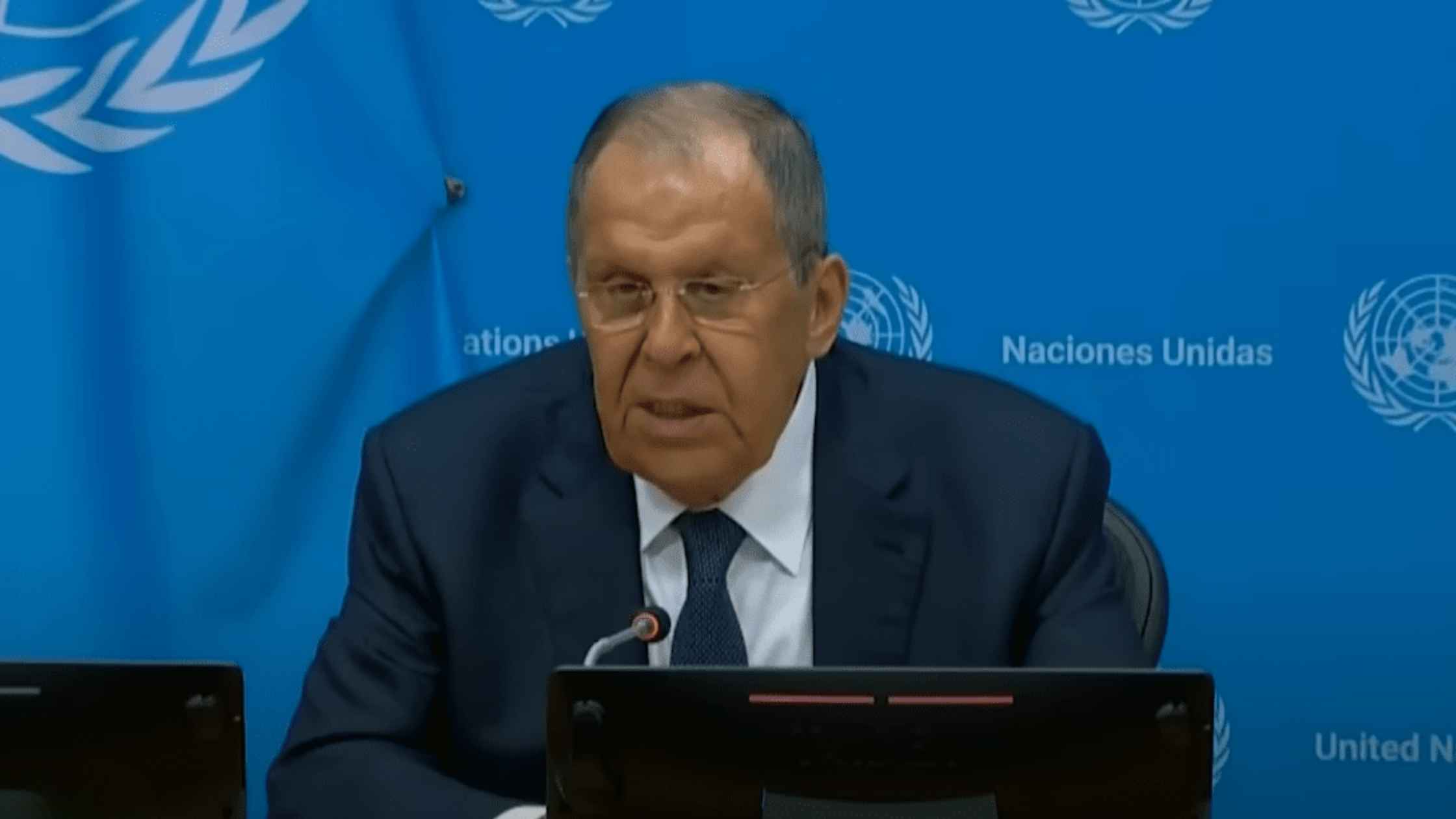
Hello colleagues, old friends and acquaintances. We are finalizing … be very transparent … that you might have. [inaudible 00:00:27] ladies and gentlemen … [inaudible 00:00:27] by those who would like to [inaudible 00:01:53] what we're used to calling the golden bullion. To preserve a [inaudible 00:02:06] world order. [inaudible 00:02:09]. There are plenty of examples and I'm sure that [inaudible 00:02:13] take an interest in what's happening [inaudible 00:02:15] trying to explain their positions … their words … Are they the same or not? [inaudible 00:02:28] and Maria will be …
Speaker 1 (02:34):
Question goes to … [inaudible 00:02:38]
Speaker 2 (02:42):
[inaudible 00:02:41] conference on behalf of … [inaudible 00:02:47] with Russia … relations [inaudible 00:02:59] life … [inaudible 00:03:10]
Minister Lavrov (04:05):
[inaudible 00:03:46] to look at what kind of drones [inaudible 00:03:48] the drones that were [inaudible 00:03:51] being found on the Polish territory … these are the drones that we think we are, then … [inaudible 00:04:00] the Russian Federation to the Polish border. But I'd like to repeat once again, when … shied away from a frank conversation, an honest conversation, they don't want to deal with … that you've started with this question. [inaudible 00:04:26] right at this very table … the way we try to … that was conducted in April … [inaudible 00:04:47] withdrew … [inaudible 00:04:56]
(04:26)
I've been … with the UN Secretary General, and we've … official request to the UN … and we've been … the initial investigation … [inaudible 00:06:01] to do, no one wanted to conduct this … please publish the names of those … on the … UN Secretary General, and I've spoken to … shrugged his shoulders and said … he doesn't want to deal with that. And later he … he was told … [inaudible 00:06:31] We received an answer just … that the lawyers of the Secretary said that it's not reasonable to present data on the victims of Bucha, in order to ensure the security, safety of their relatives. A year ago, when it was stalling just like today, I appealed to you. I appealed to your journalistic interest. Don't you have an interest in learning whose bodies were shown there? Who were they? None of you, [inaudible 00:07:12] no one followed up on that. No one conducted a journalist investigation, though such investigations happen, even on smaller incidents.
(07:15)
Going back to your question, we have nothing to hide. We never attack civilian infrastructure. Incidents happen but we never conduct targeted fire against them. We never target with our UAVs or missiles on the countries in Europe, be that EU members or NATO countries. Once again, if Poles indeed wanted to get to the bottom of that situation, we've proposed a meeting, immediately proposed a meeting, but no one wants to discuss the facts, ever. There are plenty of examples of when we're accused and later it turns out that it was the Ukrainians who targeted the market and other infrastructure, hospitals and so on.
(07:20)
Well, it all follows the same scenario. First, hype happens and later journalists who first initiated this hype, they don't want to deal with that. But we're always open to a frank conversation.
Speaker 3 (08:41):
Good afternoon Minister Lavrov. Yesterday UN Security Council, after the vote, declined the draft by Russia and China to extend the UNSC Resolution 2231. What are the consequences of renewed sanctions against Iran that you see? Do you see that it is possible to solve through diplomatic means, the Iranian nuclear issue? If so, what are the next steps, what is Russia prepared to take?
Minister Lavrov (09:09):
The snapback mechanisms for sanctions is included in the UNSCR that endorsed the Iranian nuclear deal as we call it, in 2015. It was enshrined there after the direct negotiations between the Iranian foreign minister and the United States State Secretary. John Kerry was State Secretary back then. So this so called snapback mechanism is not typical for any other sanctioned regimes. In essence, it allowed any country to put this resolution up for a vote so that the sanctions alleviation regime will continue to be in place. And the country with the veto power, even unilaterally could block such a resolution. That would mean that the expansion and the [inaudible 00:10:24] of sanctions won't happen.
(10:23)
There are two notions here. First, this is not a very succinct wording here but the main idea is to [inaudible 00:10:33] keep the UN and colleagues alert, so they won't take any steps outside of this framework. The second notion is that Iran agreed to this exotic mechanism purely for the fact that it was sure that you would never violate this deal. Therefore, let them have this mechanism. Let it be over their heads, but as something put on the back burner. But Iran is not going to violate it. Therefore, they agreed to it very easily. And the idea that the deal will not be broken by them, but the US in 2017 or '18 or '19, I'm not sure. They couldn't even think about it. But it happened. The US have withdrawn from the deal. They said that they did not recognize this resolution. Europe, instead of demanding that the US would go back to implementation of their obligations, also started to shy away from commitment to the agreement. The number of violations is very well known.
(11:43)
The resolution that the US does not recognize, now the Europeans are cherry picking what they want from that resolution. And what they want is this exotic mechanism for a snapback. It's very hard to explain in an understandable way. This is a trap and that phrase. That [inaudible 00:12:09] was created as a trap for Iran. It's just yet another piece of proof that Iran does not intend to violate the NPT treaty, the commitment to the nuclear deal. Nevertheless, the next Iranian government has fallen into this trap, the trap that they have inherited from 2015.
(11:49)
Together with the People's Republic of China, we've done everything to give diplomacy a chance. Even after the resolution about the snapback of sanctions was adopted, there was a chance to agree that for some time, well, we wanted a three month extension. We wanted to extend the Iranian nuclear deal in the entirety, without adding anything or crossing anything out, in all these aspects, so it would continue to be in place for the time when we hoped we could continue negotiations.
(11:49)
Since the West has torpedoed that and has blackmailed the majority of the UN Security Council members so they would support their destructive position, I don't know what [inaudible 00:13:29] Iran do, how they would respond. This is incapability to negotiate with anyone, not giving two or three months so that Iran would be able to negotiate and find possible conditions of working further with the IAA, with the US as well.
(11:49)
Iran is still prepared to have dialogue, maybe an indirect one, through a mediator, and with the so called E3. Iran was also holding conversations [inaudible 00:14:08]. However, the outcome of those negotiations just proves that from the very beginning, the European trio was trying to find any pretext to bring back sanctions. So any bonafide proposals of [inaudible 00:14:22] to find a compromise, they were all turned down. And something was announced, that there was hope for an agreement, right the very next morning. It turned out there was none. This is a deliberate operation aimed at coming to the next level of choking the Islamic Republic of Iran, in terms of the economy and finance and so on.
(15:37)
What you are writing from time to time and political analysts are also mentioning, that the threat of new strikes against Iran is still in place. As some are reporting, people who know something about that, [inaudible 00:15:37] practical matters. It's very telling. It's all synchronized, the military threat and economic issues as well. It just means that European countries have no qualms about violating resolutions, be that on Iran or Kosovo or the Minsk agreements on Ukraine. There are plenty of examples of that.
Speaker 1 (15:37):
Colleagues, yeah?
Speaker 4 (15:39):
Hi Minister, welcome back to New York, [inaudible 00:15:41] with China Central Television. A couple of days ago, after meeting with President Zelenskyy, US President Trump said that he believed Ukraine can take back all the territory and even went further. And you meet with Mr, Marco Rubio and that's let's say a constructive talk, with this kind of ever changing policies from your US colleagues, how is Russia planning to engage with the US, especially particularly with the Trump administration on this issue? Thank you.
Minister Lavrov (16:18):
You can call it ever changing, you can call it flexible policies. You see, every state, especially every leader, has its own style of dealing in the international arena and domestically as well. Indeed, we appreciate that the United States are aware of one most important thing, that in principle, it is not correct when states are refusing to even talk to each other, the way it was done by the Europeans and Biden during his administration, especially in the times when so many events of historical scale are taking place. Not to talk to each other is simply criminal. Therefore we appreciate that the Trump administration from the very beginning, they proposed to bring back our dialogue. We have rekindled it. We have enshrined it back in February with Marco Rubio, and later during a telephone conversation between President Putin and President Trump, that we acknowledge that Russia and the US and every other country, have their own national interest. And the promotion of such national interest is the right of every state.
(17:49)
When we met with Marco Rubio, we had repeated this philosophy. We have recommitted to it. And in cases when our interests coincide, and there are not many cases in relations between Russia and the US, however, when such interests do coincide, it would be stupid not to use this in order to implement some mutually beneficial projects, be that in space or economy or any other sphere.
(18:22)
The majority of cases when US and Russia interests do not coincide, the most important thing is not to let it result in confrontation or collision, especially a hot confrontation. And we're united in this position. In diplomacy, as you know, primarily in public diplomacy, a lot of things can be spoken out loud, considering the specifics of the moment. There are plenty of moments and sometimes the circumstances change. So we don't see that the US is withdrawing from the policy of holding open, frank dialogue with the Russian Federation, as well as with China, and a number of other countries that the United States are having differences of opinion, contradictions and different vision of the way they should trade further and conduct economic deals.
(18:40)
You see, that's diplomacy per se, when colliding interests have to be reconciled and put in order, in such a way that confrontations could be avoided. Some of our European colleagues have turned diplomacy, either into kissing up to their friends in Washington, so that friends from Washington would continue to play
Sergey Lavrov (20:00):
… in Biden's word, or they're returning a substitution diplomacy with sanctions. This is a path without any promise. You won't succeed. However, frank dialogue, on any matters, well, we see that the US is prepared for that, and we're also prepared to conduct it. As for diplomatic comments, it could be very different.
Betul Yuruk (20:30):
Thank you, Minister Lavrov. Betul Yuruk with CNBC Turkiye. President Trump publicly asked Turkish President, Erdogan, stop buying Russian oil and gas at the White House. Do you expect Turkey to stop or are you confident that Ankara will remain in it?
(20:49)
Secondly, if Turkey were to return S-400 missile defense systems, it's purchased from Russia to rejoin the F35 program, would Russia accept that? When I asked you a similar question last year, you told me that Turkey was the final user and cannot sell it to a third country. What do you have to say this?
Sergey Lavrov (21:12):
So you know the response to the second question. To the first and to the second question, I don't want to guess here. However, I do wish to reaffirm something that I've always did with respect to Turkey and any other of our partners. We respect the position of the Republic of Turkey, Turkiye, and in no way do we doubt the Republic of Turkey's respect for itself and respect for its people.
Speaker 6 (21:39):
Next month, Russia will be presenting over the Security Council. Please what the work of the mission will be focused on.
Sergey Lavrov (21:52):
Every month on the agenda of the Security Council, automatically now, there are questions which arise matters, which are consequence of follow-up to resolutions previously adopted and resolutions as a general rule presuppose a periodic overview of the implementation thereof, and the Secretariat, ahead of time, circulates a list of those topics which during any given month, views need to be listened about. They need to be discussed, and additional instructions may need to be provided vis-a-vis implementation and enforcement of the relevant resolutions.
(22:29)
During the Russian presidency, what will be considered is the implementation of the Dayton Accords on Bosnia and Herzegovina. This is indeed timely because the situation there has reached a critical point. They have adopted a policy of collapsing the Dayton Accords infringing upon the rights of Serbian people, and this is an egregious violation of the Dayton Agreements, which set out the equality of the three constituent peoples, the Serbs, Croats, and Bosniacs. So this will be an interesting event.
(23:03)
However, what is most important probably is that during our presidency, our presidency coincides with an important anniversary, the 24th of October, which is the day of the founding of the United Nations, and on that day, we plan to hold a special meeting, once again, not to extend support for those principles which were enshrined by the founding fathers in the Charter of the United Nations. But rather, to take a look at, today, how these principles need to be upheld, especially given that the overwhelming majority of these principles explicitly, directly pertain to the process of multipolarity.
(23:50)
That includes the sovereign equality of states. This includes non-intervention in the domestic affairs of others. This includes the rights of nations to self-determination, the right of peoples to determine their own fates. This is all enshrined in the Charter of the United Nations and has been the case for all of these eight decades, but far from always has this been applied and implemented.
(24:11)
So the 24th of October will be a meeting with a focus on analysis, and we hope, with practical conclusions being drawn about to further development of the United Nations.
Abdulhamid Sayyem (24:25):
Thank you, Mr. Minister. Abdulhamid Sayyem from the Arabic media, Al- Quds Al-Arabi. Mr. Minister, your ambassador here gives very strong speeches in the Security Council about the genocidal war in Gaza. He's very factual. He's very straightforward. He gives a strong position of Russian Federation. However, can't Russia do more than just giving a strong statement, and factual, and right to the point?
(24:57)
The second related to this question, ICC, the prosecutor issued on May 20th, 2024 the arrest warrant for two Israeli war criminals. From that day until today, the crimes are continuing, genocide is continuing, and yet not one single indictment of any other Israeli general or minister or war criminal. Thank you.
Sergey Lavrov (25:34):
I met with a number of my Arab friends over the recent week. Of course, we discussed Palestine, but we did not just discuss Palestine, discuss the West Bank, the Jordan River. We discussed the south of Lebanon, the south of Syria, Lebanon, and many other issues. The situation is exceedingly volatile. There are many, not slowly, ticking time bombs. There are many mines with fuses that have been detonated, but do you say what can Russia do beyond setting out our position in principle vis-a-vis Palestine during Security Council meetings? You represent an Arab media outlet. I am correct.
(26:18)
Just recently, there was a summit, a League of Arab States summit in the Islamic Organization Cooperation. During the summit, there was a discussion of the atrocities that are being perpetrated in the Gaza Strip. There is an ongoing collective punishment targeting the Palestinian people, and in no way is this any better than the terrorist attacks all condemn, but collective punishment is also prohibited under international humanitarian law.
(26:54)
So is following this summit as an outcome of the summit, our Arab and Muslim friends have been engaged in efforts, and the result of fruit of these efforts will have practical significance in order to attempt to top what has been taking place. Of course, we will join these efforts.
(27:17)
The Arabs are directly bordering Israel and Palestine. This has direct implications for you, first and foremost. You are our close friends, virtually, all Arab countries, all Muslim countries, and of course, we want to help you. But when it comes to taking decisions about their actions, that is something that countries in the region have to do, of course. I'm aware that Egypt, and Saudi Arabia, and Qatar, the United Arab Emirates to one degree or another are all participating in such trust-based confidential negotiations.
(27:53)
The United States is lending a hand in this process, and there are many rumors here about searching agreements, taking shape. Yesterday, I think President Trump mentioned that solution is near. We are not yet aware exactly what was being talked about. Of course, the speculation about the 21-point plan. We read all of that.
(28:15)
Something there looks like a collective governance or management does mention of the former British Prime Minister Tony Blair as a general governor of Gaza somewhere… I'm trying to find the right expression. Reservations. We're in America. Based on the rumors that have surfaced in the media sphere. Somebody wishes to have this noble formula and to paint certain reservations. There are reservations here for Bantustan, as was the case in South Africa during the apartheid era.
(29:02)
I'm commenting here. I'm not signing on to anything, but I'm just talking. I'm just mentioning the rumors that have been circulating. You're talking about Russia. There's a process underway if the participating is in the process of Arab countries and Palestinians. If they see some kind of a role, a possible contribution that the Russian Federation can make, of course, we will be told and we would welcome that.
Viktor Yanukovych (29:31):
Sergey, Viktor Yanukovych. Good afternoon. I represent TASS, and if possible, I wish to put two questions forward. Given the statements or various parties that were delivered and statements made by various parties including here in general assembly, Volodymyr Zelenskyy count on returning to the borders of 2014, what is the situation on the ground in DPR right now, specifically in the so-called strategic triangle?
Sergey Lavrov (29:59):
Well, as regards to the 2022 borders, I don't think anybody is really counting on that because counting on restoration of those borders would be a politically blind and would demonstrate an utter lack of understanding about what is taking place. Russia is upholding our legitimate interests, the legitimate interests of the people whom the Nazis in Kiev after the seizure of power through the coup, the people they labeled terrorists, specimens, non-humans, whose children through the words of Poroshenko, they threaten to put into the basements while the children of Ukrainian elite to eat candy, travel in nice cars and go to nice schools.
(30:57)
I would like to state that there's all this talk about restoration of borders of any certain year, and these discussions have been ongoing for a number of years, and these discussions all have a common link. Ukrainian leaders who seized power after February 2014th illegally consistently lied and derailed all of the agreements that have been arrived at.
(31:29)
If in February 2014, had there been implementation of the agreement that was signed between the president and opposition, this which was guaranteed by Germany, France, and Poland, had this been honored and fulfilled, Ukraine would have been within 1991 borders been. Then there would have been no events. There would've been no uprising in Crimea, those who refused to recognize the illegitimate authorities because illegitimate authorities would not have come about.
(32:06)
The war would not have started. When those who did recognize that illegitimate authorities were bombed by the Kiev regime. They were burned alive in their homes. This was the case in Odessa in the trade building when 50 people were burned alive. The planes were bombing Luhansk. Artillery was targeting all the territories, and this is categorically prohibited. The use of an army in domestic conflict, of course, constitutes a violation of IHL, and then there were the Minsk Agreements.
(32:35)
If the Minsk agreements, which guaranteed that Germany and France yet again had this was sanctioned by security counsel, approved by Security Council, had they been implemented by the upper crust of the Kiev regime, then Ukraine would've been within the 1991 borders minus Crimea because there was a referendum held in Crimea and nobody is contending, disputing that. In 2014, I spoke with John Kerry, this is not secret now. Forget about Crimea. Let's talk about Donbas. This was undermined, derailed, and Ukraine became even a little bit smaller, and had the agreements been implemented that Ukraine itself proposed in April of 2022, which we agreed to, then Ukraine would have also been within the 1991 borders minus Crimea, and now, minus a larger part of Donbas. But Ukraine torpedoed that too, refusing to implement its own initiative. So there's no discussion of the 2022 borders. So we're talking about the borders which are enshrined in the constitution of the Russian Federation.
(33:49)
The second question was?
Viktor Yanukovych (33:52):
Having to do with the situation of DPR, specifically, the strategic triangle, it is called. How would you describe that?
Sergey Lavrov (33:58):
I will not comment on the situation, on the battlefield. First of all, we have been here for a number of days already. But second, this is what the Ministry of Defense has been doing on a regular basis. Military correspondents provide reports about developments, so I'll leave it to them.
Mark Stone (34:20):
Thank you very much, Foreign Minister. Mark Stone from Sky News. I wonder if I could persuade you to answer a question in English perhaps. President Trump has called you a paper called Russia Paper Tiger, has said that European countries should shoot down Russian planes if they violate European airspace. Do you see that as a provocation and what would happen if Russian planes are shot down? Thank you, sir.
Sergey Lavrov (34:47):
First of all, we are the United Nations, and the language is an official language of the United Nations as is the English language. So I'm very grateful to all of you for your respect for our right or opportunity to use this language.
(35:02)
Frankly speaking, you can't necessarily follow all of the statements that were made, but I do remember. A day or so after the statement was uttered, Paper Tiger, the next day, President Trump was asked. Does he continue to think Russia is a paper tiger? The response there was negative. So if each nuance and rhetoric is addressed, well, I already responded to what I think of service state from President Trump.
(35:39)
In public diplomacy, there are various tools being leveraged, various means, various trick, various procedures as if President Trump allowed for the bombing of Russian Federation into something, drones and planes. When a drone flies not over our territory, if it crossed somebody's, but outside of our airspace, probably everybody's right has a right to do what they deem necessary with this drone for providing for their own security.
(36:18)
But if there are attempts to down any flying object, any object over our territory in our airspace, then I think people will very much regret undertaking such an egregious violation of our territory, territorial integrity and sovereignty.
Speaker 5 (36:43):
Good afternoon. If I may, two questions. The first question, German authorities have not concealed the fact that they have been engaging active militarization of their country. What do you think? Why is this being done, and what are they trying to achieve?
(36:56)
The second question, you've already mentioned recently. You talked about privatization of virtually all the leadership of the United Nations by the West. What could Russia do in order to change the situation? Thank you.
Sergey Lavrov (37:12):
On militarization of Germany, we repeatedly set up concerns or very deep concerns. Not only is there a process of militarization underway there. There are blatant indicators of re- Nazification which are being observed. Why is this being done? Probably with the same aim that Hitler for himself to bring all of Europe under his control and to try to inflict a strategic defeat with Hitler, with the Soviet Union, and with the modern-day Germany, and the rest of the chorus, the main soloists in the European Union in NATO. Now, they're trying to inflict a defeat on Russia.
(38:00)
Merz, I think, it was yesterday, mentioned that we are not yet in a state of war. But we are no longer in a state of peace. The militaristic rhetoric is being ratcheted up at each passing day. This statement was reiterated on a number of occasions now, that he pushed through amendments into the Constitution. Now, it is possible to spend more funds on weaponry and development of military infrastructure, military capabilities, and he proudly stated, the chancellor, that his goal is, once again, to make Germany the main military and gene of Europe.
(38:43)
When a person in a country which perpetrated the crimes of Nazism, Fascism, the Holocaust, genocide, when such a person says that Germany again needs to a great military power, of course, he has an atrophied historical memory, and that is exceedingly dangerous.
(39:08)
What was the second question again?
Speaker 7 (39:08):
[foreign language 00:39:09]
Sergey Lavrov (39:09):
So look, I've said this quite frankly. We see this very openly. There are many positions at the ASG, USG level. They seem to be distributed among various continents and countries, but there are a few key positions that directly influence, and in fact, the functioning of the UN Secretariat, that dictate the decisions that the secretariat makes when it comes to accepting member states. When the Secretariat recommends something, member states generally tend to support that. Our Secretary General is the citizen of a NATO member state, the head of the
Minister Lavrov (40:00):
Department of Political and Peacebuilding Affairs, is a citizen of a NATO member state as well. The head of the Department of Peacekeeping operations is also a citizen of a NATO member country. The head of the whole Humanitarian Wing of the UN, which carries out operations all over the world, is a UK citizen, also a NATO member, state citizen, the head of Department Of Security, which is also very key to the work of the organization. The whole system is also a citizen of a NATO member state.
(40:39)
I mentioned that a UK citizen now has inherited essentially the leadership of the Humanitarian Wing of the UN. And Mr. Guterres is currently promoting the UN and AD initiative, which contains a number of fairly radical proposals that require very careful study and analysis. And this analysis must be transparent. It must involve all member states. We put forth an initiative for a resolution to this end, and it was adopted. This process cannot go on in secret.
(41:20)
And to leave this process, António Guterres has appointed another Under-Secretary-General who just happens to be a UK citizen as well. These key posts, they should be the areas of work that should be distributed more evenly between the various member states. I think this is clear, and at the last session of the General Assembly I spoke about the need for reform. Reform of those principles that dictate the composition of the secretariat.
(41:58)
The main principle right now is the size of the population, the GDP per capita. So the bigger you are, the more positions you have. And of course this is logical to some extent, but there is also the principle of the sovereign equality of states, which we've already talked about today. The secretariat needs to have staff members that are appointed based on their professional qualities and not necessarily on their nationality, but this principle of equitable geographical distribution must be upheld. And right now, when it comes to the top ranks of the secretariat, that principle is not being complied with at all.
Susan Tehrani (42:45):
Thank you so much. Thank you. Thank you, Minister Lavrov. My name is Susan Tehrani. I'm from WION, India. And my question is, India has continued purchasing Russian oil even as the United States has pressed countries to reduce such imports. First of all, how do you view this relationship with India in this context? And what does it mean for India-Russia relations more broadly? Thank you.
Minister Lavrov (43:18):
The situations that might arise between India and the United States or India and any other country, I can't consider them a criteria for relations between India and the Russian Federation. We have strategic partnership, as we call it, for a long time, strategic partnership relations. At a certain point, our Indian friends proposed supplementing that term and we now call it a privileged strategic partnership. And a little bit later, our Indian friends proposed another clarification. Now we call it particularly privileged strategic partnership.
(44:04)
We have full respect for the national interests of India, full respect for the foreign policy that Narendra Modi is carrying out to promote these national interests. We hold regular contacts at the highest level. Just recently, Prime Minister Modi and President Putin met in Tianjin at the SCO Summit in China. And in December a visit is being planned to… A visit from Mr. Putin is being planned to New Delhi. We have a very extensive bilateral agenda, trade, military, technical cooperation, finance, humanitarian matters, healthcare, high- tech, artificial intelligence, and of course close coordination at the international level within the SCO, BRICS, and bilaterally.
(45:13)
This year, my colleague, I spoke to him yesterday, Subrahmanyam Jaishankar, while he will visit Russia, I will visit India. We hold regular exchanges. And I heard, I'm not even asking what is going to happen to our trade relations, our oil, I don't ask our Indian colleagues this. They are perfectly capable of making these decisions for themselves. And publicly, my friend who I referenced earlier when he was asked a similar question said, "if the US wants to sell their oil to us, we are prepared to discuss the terms for this, but what we buy from other countries, not the United States, but from Russia or other countries, that's our own business. And that has nothing to do with the Indian-US agenda." And I believe that that is a very worthy response. That shows that India, like Türkiye has self-respect.
Igor Zhdanov (46:28):
Igor Zhdanov, RT, good afternoon. We are increasingly hearing about the difficulties that delegations face when they come to the UN General Assembly. The Russian delegation has repeatedly encountered issues when it comes to obtaining visas. This year, Mahmoud Abbas, the head of Palestine, was unable to personally attend the General Assembly. How do you view the legitimacy of such actions on the part of the United States, given that the headquarters is located in New York? And how would you comment on the increasingly frequent calls to move those headquarters to a different country?
Minister Lavrov (47:08):
Why did you apologize before you said other country?
Igor Zhdanov (47:11):
I just misspoke. Says the journalist.
Minister Lavrov (47:15):
Yes, this is a very serious topic. This is an inconvenience. I wouldn't say that the countries suffer when their delegations encounter problems. But this is a serious violation of the agreement between the United Nations, the headquarters of the United Nations and the host country.
(47:34)
The host country is obligated in a timely fashion without discrimination to issue visas to attend any UN events at the request of a member states before any session, be it the session of the General Assembly or another UN body. And we regularly are unable to send all of the members of our delegation that we would like. We've had representatives of the state, Duma. Sometimes our delegations include members of parliament. And not all of them are issued visas. I mentioned this to Marco Rubio at our meeting on Wednesday here in Manhattan. And another staff member of our ministry, the director of a department, was also deemed unworthy of a visa by our US colleagues.
(48:32)
This isn't the only violation of the Headquarters Agreement. These violations, some of the most egregious violations, include the seizure of our diplomatic property. This was back during the Obama Administration. This was done a couple of weeks before Donald Trump's Inauguration for his first term. It's very unscrupulous, how do I say it? When you just want to mess things up for whoever's lawfully in accordance with the constitution, the will of the constitution, who's going to succeed you in the White House, that's the legacy that he left. And we are still unable to resolve this matter to this day.
(49:25)
There's still a lack of willingness on the part of the US to go back to faithfully implementing the agreement. But our dialogue about visas, about functioning of embassies, about this property and other aspects of the day-to-day functioning of our diplomatic mission is underway. We've already had two rounds, now we're on round three. Marco Rubio and I agreed to hold talks this fall for the talks.
(49:54)
As for moving the headquarters, yes, perhaps many wouldn't mind this. Recently, the President of Ecuador, I believe it was, or Colombia. Colombia, yes, of course. His visa was revoked while he was here and he's a very simple, direct person. Many proposed thinking about this, but I think those proposals were just talk in order to just bring up this topic at the committee for relations with the host country, in order to be a little more persistent about this.
(50:42)
There's a story, a legend that goes that when the first talks were held, during which the need to create a world organization was mentioned between Stalin, Roosevelt and Churchill, there was some proposal to host, to put the headquarters in Sochi. Sochi is proven that it can be a host for major events, the Olympics for example. So we would have excellent sports facilities for all secretariat staff members [inaudible 00:51:18].
Maria (51:18):
Thank you so much.
Rina Bhardwaj (51:19):
Mr. minister, thank you so much for doing this. Rina Bhardwaj from ANI India. Secondary's wave of sanctions is what President Trump has threatened for countries importing oil. I'm wondering if you have any concrete steps for India to save this economic partnership that you have with India, that Russia shares with India. And secondly, in your conversations with Secretary Rubio, were there any discussions on India? Thank you.
Minister Lavrov (51:48):
As for the second question, the answer is no. We do not in general, we're not in the habit of discussing whoever it may be, especially our friends, during our contacts with third states. As for the question about oil, I already answered that question to your colleague who is also representing an Indian media outlet. But I think you've worded your question differently. Is there an opportunity to save the economic partnership between Russia and India? It's not under threat. There is no doubt as to that. There is no threat to this relationship. And if somebody does do something of that nature, the Indian Prime Minister, the Minister of Foreign Affairs have said it loud and clear, India chooses its own partners.
(52:40)
If the US has proposals on how to enrich bilateral trade between the US and India, they're prepared to discuss the terms for that, whatever terms the US might put forth. But when it comes to trade, investment, economic, military, technological. And other relations between India and third states is something that India will discuss only with those states in question.
Maria (53:11):
This is the TV channel. There are reports that Kyiv is preparing another provocation this time on the territory of the EU, attacking NATO country's Romania and Poland under false flag operation, then accusing Russia of this. What could the consequences be in your review? And do we need to work upstream of this in terms of information? Will it work?
Minister Lavrov (53:36):
Well, this isn't the first time and I have no doubts that all of these reports and this information are based on reliable information. Kyiv has special structure, special bodies in the media, as well as in the military and technological sphere that are in charge of false flight provocations. As you said, I've read that they are currently taking drones produced, manufactured in Russia, which they also possess it would seem and equipping them in such a fashion as to make it very convincing that we launched those drones.
(54:18)
But the West, in addition to those that are clamoring and raising hysterics in Poland, the Baltic States and other places, in the serious capitals there are serious people that understand everything full well. However, even in those serious capitals, the elites are committed to the goal of subjugating Russia. They no longer say strategic defeat, they use some other kind of language. But the goal of a strategic defeat remains in their head. Constantly they will keep modifying how that defeat should look. But that's exactly what they're doing.
(54:59)
I know for a fact that they're helping the Ukrainians with all this dirty business. The UK is helping with this as they have been doing for many centuries in our geopolitical space. So we're very well-informed about this. Our military intelligence is working, our intelligence services are from time to time unveiling the true face of those who were behind such provocations.
(55:30)
As for the response that will follow, I think it's premature to say that now, but a response to things like that, especially if they begin to take actual physical steps, well, they will seriously regret it. Our president has said time and time again that we will not allow for any violation of our territory, our airspace, on the part of those in Europe who openly preparing for war against us.
Speaker 8 (56:09):
Thank you, Maria. On Iran, Sir, the snapback has been activated. The sanctions are coming back tonight. How easy or how difficult for the sanction to be reapplied on Iran? And is it easy, for example, to set up the sanctions committee and choose a president for that committee? And on the multilateral system in the UN, which is facing a vicious attack and assault, your thoughts on that? You've served here for a long time and you know the system better than anybody else.
Minister Lavrov (56:48):
I wrote a letter today, I directed a letter to Secretary-General, in which I clearly stated our position. Today, by the way, our Ministry of Foreign Affairs will disseminate a statement for our position regarding the fact that this decision that was inspired and pushed through yesterday is legally null. It is unlawful. And it cannot be implemented.
(57:16)
So the Secretary-General, if he is committed to the UN Charter, including those articles that set out his obligations and powers, if he acknowledges and accepts this unlawful action taken by security counsel on September 26th, and if he launches this procedure and sets up secretariat bodies to this end, it will be a major mistake, and it will deal a major blow to the credibility and the authority of the Secretary-General and the organization.
Speaker 8 (57:56):
Thank you.
Minister Lavrov (57:58):
Yes, that's a figure of speech attack on the multilateral system. That's exactly what it is. There's nothing to comment here. The resolution that was adopted by consensus has been grossly violated by both the United States and France and the UK. That resolution has now been dusted off and they are alleging that it's not them violating the resolution, it's Iran. Of course, this is an attack, not only on the multilateral system as a whole, but on the UN system, on the prerogatives of the Security Council, on basic rules of decency, which include implementing the decisions of the Security Council, rather than reinterpreting them to serve your selfish interests, particularly interests relating to the interference in the internal affairs of others, on unlawful use of force.
Namo Abdullah (59:09):
Thank you so much for coming here for this open and lengthy conversation with reporters. I'm Namo Abdullah with Rudaw Media Network from Iraqi, Kurdistan. We're witnessing a growing wave of recognition of Palestine's right to self-determination. Of course, Palestinians do deserve their own country. I think you would agree with that.
(59:29)
But eight years ago this week, Iraqi Kurds held an independence referendum. You remember, I'm sure, almost no country recognized that referendum. I think the international community was almost unanimously opposed to it. Why do you think their democratic will was ignored and isn't there a double standard at play here? And my second question is on the recent Erbil-Baghdad oil deal. What are your thoughts on that? Thank you.
Minister Lavrov (59:57):
Well,
Sergey Lavrov (01:00:02):
Well, these two questions are closely interconnected, the fact that, yet again, there was an Erbil and Baghdad oil deal that was reached. It means only one thing, that the Kurds and the Arabs in Iraq can deal with each other, can find an agreement. And we're very happy about it. I spoke to the foreign minister of Iraq. We constantly keep in touch with the leadership of the Kurd Autonomous District, and we're very deeply satisfied with the fact that the Kurds and the central authorities are fostering a dialogue.
(01:00:41)
We don't want for the Kurdish issue to blow up in everyone's face, because not all Kurdish structures have peaceful plans, and not all of them harbor peace. And considering that a great number of Kurds live in a whole range of countries in the region, there are those who are willing to blow up this Kurdish issue, and I think that Middle East cannot tolerate yet another major explosion.
(01:01:19)
So, we're advocating for pacification of everyone. There is such a word. However, without building dialogue and finding national concord among the countries in the region, including in the countries of Kurd presence, be that Iraq, Syria, or Iran, without national accord, countries would fall apart. Some would say that this is the right of nations for self-determination. However, you don't have a war ongoing. Therefore, it's possible to find agreement in such conditions. Erbil and Baghdad have proven that, and we're actively supporting this process.
Speaker 10 (01:02:05):
And now, yes, yeah.
Speaker 9 (01:02:16):
Good afternoon. Russia TV channel. On the eve of the high-level week, President Putin made a statement about the New START treaty, that Russia is prepared to observe its conditions for the next year with certain salvos. Did you touch upon this topic with Marco Rubio negotiations? Did you see any response from the international community to this initiative on the margins of the General Assembly?
Sergey Lavrov (01:02:28):
This initiative was announced right on the eve of the General Assembly session, and I've confirmed it yet again during my statement at the plenary session. The full statement of President Putin of the 22nd of September is being circulated as a document of Security Council and General Assembly, and I'm sure when all the fuss of the high-level week will die down, when everyone is dealing with their own high-level delegation from capitals, I think that after that, we'll be getting evaluations of the initiative. We have already seen in response… Official representative of the White House responded, and she said that this is a very interesting statement, and President Trump will comment on it personally. That's what we are thinking about it.
Speaker 10 (01:03:24):
And two last questions. Please give us some.
Speaker 11 (01:03:28):
Minister Lavrov, according to Wall Street Journal, President Trump told Zelensky that he's prepared to lift the ban on the use of long-range weapons to strike against Russia. Did Marco Rubio warn you about that during the negotiations? What would be the response if it is indeed so? Do you think that this could be?
Sergey Lavrov (01:03:52):
I don't like to do guesswork. You've referenced Wall Street Journal, but New York Times wrote that Zelensky was begging to give him Tomahawks. But President Trump did not give him that. Therefore, responding to each and every newspaper line, well, it's a thankless job.
(01:04:04)
We assume that all of our experience of conversations with the American colleagues, at the highest level as well, proves to us that they want to put an end, to help put an end, to this conflict on the basis of consideration and elimination of its root causes. There are no other countries in the Western camp that have the same position.
(01:04:28)
I have no doubt that the US president has a sincere interest in that, while Europeans are trying to impact and have an influence on him, and now it's being said that President Trump understands Zelensky better than President Putin. And there are many people who would like to get the limelight internationally, but I will not comment on the newspaper sentences like that.
Speaker 10 (01:05:16):
Last question. If I may, my personal choice, this beautiful rose color. Yes, please.
Speaker 12 (01:05:23):
[inaudible 01:05:24].
Speaker 10 (01:05:29):
Yes.
Speaker 12 (01:05:30):
Thank you, sir.
Aissa Garcia (01:05:32):
[Russian 01:05:30]. I am Aissa Garcia from teleSURtv. I would like two questions. You said that Ukraine is not seeking, Minister, to negotiate with Russia. In that context, what path do you see to bring the conflict to the end? And the second one is, Minister, how does Russia interpret the US military threats in the Caribbean against Venezuela, and what risk do you see that that pose to regional peace and security? Thank you. [Russian 01:06:11].
Sergey Lavrov (01:06:11):
As for the second question, now it's much more relevant. Naturally, we are very alarmed by the fact that the Americans have now organized in international waters as of now, around the international waters around Venezuela. Yesterday, I spoke to the foreign minister, with Yván Gil, and many other representatives of Latin American region and the Caribbean are very alarmed. Brazil is as well, and the island states such as Saint Vincent and the Grenadines. I met with the foreign minister of Nicaragua today as well. The situation, indeed, is very serious. There is significant naval forces situated there, including a nuclear submarine, and we hear direct threats of military intervention in order to destroy drug cartels, to fight drug trafficking on the whole.
(01:06:55)
I was told one thing today that did not cross my mind before, but during these very days, the Security Council, what's being done there together with Panama, the US colleagues are pushing through a resolution on establish an international force to ensure security in Haiti, international forces to fight banditism. They're asking for a very specific mandate against gangs, and it's a very specific mandate, and in order for the Security Council to establish such an institution and to leave its establishment to those who have interest in that, the mandate would be to use unlimited force on unlimited scale against gangs, as they say, against such gangs. Force could be used against them.
(01:08:25)
There is no timeline for this operation, no accountability system in view. If you compare these two processes, if you put them together, what's happening in the Security Council and what's happening around Venezuela, I cannot rule out that certain creative actors could think of getting the mandate at the Security Council and later say that there are gangs from Haiti harbored in Venezuela. I cannot rule that out. So we have solidarity. We show solidarity the government and people of Venezuela. They have the full right to determine their political, economic policies, as well as social path. And we think that interfering in domestic affairs is unacceptable, just like in domestic affairs of any other country. That's the demand according to the UN Charter.
(01:09:35)
As for negotiations, as for your first part of the question, as for negotiations with Ukraine, I've asked my employees to prepare some documents for me, the way the position of Kyiv evolved regarding the negotiation on the 17th of April 2022. Right after the Ukrainians have derailed the agreement they'd have initiated themselves when the UK banned them from doing that, right after Zelensky is saying that, "We can fight with Russia for 10 years. Our society does not want us to continue negotiations." That was a quote.
(01:10:16)
The 1st of October 2022, all of a sudden, Zelensky is saying, "Ukraine is prepared for negotiations with Russia, but with a different president, not with Putin." 22nd of March 2023, former Foreign Minister Kuleba, when the illegitimate ICC provided an arrest order for President Putin, he is saying, "Long before, we knew that it's useless to talk to Putin. Our security council of Ukraine has adopted a decision where it's said that any negotiations with Putin are impossible." These are the same people that a year later started saying that Putin is avoiding them.
(01:11:14)
4th of May 2023, Zelensky is saying, "For us, a result is a certain indictment, specific indictment against all Russian war criminals, especially the highest leadership of the country." And his advisor in May 2023, called Podolyak, or was, I don't know where he is now, is saying, "Ukraine hates you. We'll always persecute you everywhere. We have nothing to talk to you about. You don't understand human language. Ukraine will get to each and every one of you. It doesn't matter how. Be that legally or physically." So, these guys are telling us that we don't want to talk to that.
(01:11:58)
Zelensky, last year, 2024, is saying, "Russia can start negotiations with us only if they leave our legitimate territories," going back to the topic of the borders of 1991, and so on and so forth. Later, we were always tortured by the topic of unconditional ceasefires. Later, Zelensky held negotiations with Macron and said, "Today, in the media, there was a lot of information about the fact that I came here to talk about ceasefire. It's not so. Ukraine does not view the possibility of a ceasefire in exchange for guarantees of the Western countries. Does not view that. This is not up for discussion. No ceasefires."
(01:12:45)
What are they saying now? That there should be an immediate ceasefire and guarantees of the Western countries. Back then he did not want to have a ceasefire even with guarantees. So, we can judge for ourself what these people are who are being led by such a character as Zelensky. Thank you so much. We do have to leave now.
Speaker 10 (01:13:07):
Yes.
Speaker 13 (01:13:07):
We have questions from Africa.
Speaker 10 (01:13:07):
[Russian 01:13:08].
Sergey Lavrov (01:13:08):
Well, you gave the floor to the lady, but do you want me to stay? No, no.
Speaker 10 (01:13:12):
Next question, please. R.S. Anderson, RT.
R.S. Anderson (01:13:21):
Thank you for the opportunity to ask this question.
Sergey Lavrov (01:13:23):
Thank you so much.
R.S. Anderson (01:13:24):
Here, on the margins of the UN, you held a meeting with Sahel Confederation and Russia. How effective and relevant is this format?
(01:13:31)
And the second question, France has discontinued its cooperation with Mali in their fight against terrorists, against the backdrop of diplomatic crisis, and the French media have materials sympathetic to terrorists and separatists. What do you think, what's the cause for this for this policy of France? Is this a sovereign decision of Bamako or a response to the French policy?
Sergey Lavrov (01:14:02):
You've answered your question yourself. Ukrainian's pressure is also present there. They have provided drones to certain armed groups, and they're training them. Disinformation has been confirmed.
(01:14:17)
As for the meeting with the foreign ministers of Sahel Alliance countries, Mali, Burkina Faso and Niger, it has been the second meeting. We've met before in Moscow and will continue such meetings in the region as well. We were discussing those plans that we have as the outcome of the high-level meetings of our recent visits headed by deputy head of government with representatives from Ministry of Economy and Energy and other economic bloc ministries. There are great plans for joint projects in terms of natural resources, energy, and nuclear energy as well. There are humanitarian cooperation plans, and yes, indeed, military and military technical cooperation as well.
(01:14:57)
These countries need help. We also spoke about the need to build bridges between them and ECOWAS. They are neighbors. They have to coexist. And in our context, with ECOWAS countries and African Union, we're always highlighting the need to ensure fully fledged participation of this trio in the work of the African Union and the relevant regional integrational associations. Thank you so much.