

Mr. Cotton (00:00):
... Worldwide threat assessment hearing. Let me begin by welcoming our esteemed panel of witnesses, the Director of National Intelligence, Tulsi Gabbard, the CIA Director, John Ratcliffe, the FBI Director, Kash Patel, the Acting Director of the National Security Agency and Commander of US Cyber Command, Lieutenant General William Hartman, and the DIA Director, Lieutenant General James Adams. Thank you all for your appearance today and for your service. I also want to offer a special thanks to General Hartman who is about to enter a well-earned and well-deserved retirement. General, on behalf of the committee, thank you for your lifetime of service to our nation.
(00:41)
I'd first like to take this opportunity to commend the thousands of men and women in our intelligence agencies whom our witnesses represent. Our intelligence professionals are second to none. Because of their service, their dedication, and their sacrifice, Americans are safer at home and around the world. But because of the nature of their work, grateful Americans don't buy their lunch at restaurants or even have a chance to say thank you. So on their behalf, let me simply say thank you. I want to make two basic points this morning. First, the world is always a dangerous place, especially for America, but thanks to your agencies and President Trump's leadership, the world isn't quite as dangerous for Americans as it was a year ago. Thanks to the efforts of our military and intelligence personnel, including my fellow Arkansans who are now serving in the Middle East, the Iranian revolutionary regime that terrorized the world for 47 years is finally knocked on its back foot.
(01:39)
Last summer, we devastated Iran's nuclear facilities. In recent weeks, we've eliminated Iran's top leadership, pummeled its military, sunk its navy, destroyed its missiles, neutered its proxies, and left its economy reeling. After 47 years of indecision and timidity, America has finally put our foot down. I'm also pleased to report that things have improved a lot in our own backyard now that Venezuela's illegitimate communist dictator, Nicolas Maduro, is rotting in a New York prison. Only the United States could execute a military and intelligence operation of this difficulty without a single American life lost. Our military is awesome, but these operations wouldn't have succeeded and they probably wouldn't have even been tried without timely, accurate, and fact-based intelligence from your agencies. These successful operations are a testament to our intelligence professionals' ability to expose and uncover critical details about America's enemies.
(02:40)
So let this be a warning to those who wish America harm, we leave no stone unturned, and there's no one or no thing close to you that might not betray you. Today's hearing is an opportunity for the American people to hear an unvarnished and unbiased account of the remaining threats we face from communist China, North Korea and Russia to the East to Narco terrorist cartels here at home, these threats truly do span the globe. And for my second point, your agencies have improved over the last year thanks to reforms that has gotten them back to basics. Of course, my two points are related. When our intelligence agencies return to their core mission, stealing the secrets of our adversaries to deliver timely and needful intelligence, America is safer for it. These efforts are already bearing fruit. For example, last year, the CIA increased its foreign intelligence reporting by 25%. This year, the CIA is on track to hire and deploy more officers than at any point in the last quarter-century.
(03:46)
While I'm greatly encouraged by the progress, more remains to be done. We must always equip our intelligence personnel with the tools they need to do their jobs well and execute their missions. That's why I fully support President Trump's request for a clean reauthorization of FISA Section 702. And it's why I expect a healthy intelligence budget request in the administration's supplemental appropriations request to fund operations against Iran and Narco terrorists. No doubt our military needs supplemental funding, but our intelligence agencies need it just as badly. Moreover, I urge each of you to continue to make personnel and institutional reforms that will cement these changes and foreclose a return in the future to bureaucratic bloat, political bias, and excessive caution within your services. When I became chairman, I promised real reform across the entire intelligence community. Our first Intelligence Authorization Act set the foundation for a more efficient intelligence community by, for example, reorganizing the ODNI, improving the security of CIA installations, and directing resources towards foreign intelligence collection and covert action.
(04:58)
This year, I look forward to going further, namely by growing our cadre of collectors, making generational investments and core capabilities, providing new capabilities to defend our space assets, and further codifying reforms to guard against any future return of bloated and biased bureaucracy. I look forward to working with you towards these ends. I now recognize the vice chairman.
Mr. Warner (05:22):
Thank you, Mr. Chairman. And let me also offer a good morning to our witnesses. Let me also join you, Mr. Chairman, and begin by thanking literally the tens of thousands of men and women across America's intelligence community who work every day to keep our country safe. Their work is, by necessity, secret. That is the nature of intelligence, but that is also why hearings like this one matter so much. Over the past year, we have seen a series of developments that raise serious concerns about the erosion of safeguards that protect both our democracy and our security. And nowhere is that more worrying than when it comes to the integrity of our elections. For decades now, our intelligence community has warned that foreign adversaries, including Russia, China, and Iran, are actively seeking to shape the outcome of American elections. These efforts have included cyber intrusions, disinformation campaigns, and covert influence operations designed to divide Americans and undermine our confidence in our democratic institutions.
(06:38)
Protecting our elections from these threats should be one of the intelligence community's highest priorities. The DNI is supposed to be coordinating intelligence on foreign election interference, warning the American people about adversaries seeking to undermine our democracy, ensuring that federal, state, and local officials have the information they need. Congress even required the creation of a Foreign Malign Influence Center inside the office of the DNI to coordinate the intelligence community's response to foreign election interference and ensure that these threats are properly shared across the government. That is the mission Congress assigned to the DNI. But while foreign adversaries are actively probing our democratic institutions, the DNI has eliminated the Foreign Malign Influence Center and does not have a designated official coordinating the response to election threats. And for months, the committee has repeatedly requested briefings from the IC, briefings that are required by law on legitimate foreign threats to the midterms. We have received no response.
(08:02)
Now, that silence, I believe, should concern every member of the committee because it clearly demonstrates that the DNI is not interested in protecting American democracy by combating foreign influence. Instead, unfortunately, we have seen the DNI involve ourself in purely domestic matters. Last month, we saw Director Gabbard personally participate in a law enforcement raid to seize election ballots and voting machine records in Fulton County, Georgia. A raid tied to an election that the president lost six years ago. When the warrant supporting the raid was unsealed, it showed something deeply troubling, there was no foreign connection to justify the involvement of our nation's top spy. Instead, the predicate for the warrant was a slop of debunked conspiracy theories that had already been rejected repeatedly by courts, by independent investigators, and even by Georgia's own Republican Secretary of State, yet the nation's top intelligence official was personally involved in this operation.
(09:17)
This raises one very serious question, if the intelligence community is not being deployed to mobilize against foreign threats, why is it being deployed at all on a domestic issue? The DNI's appearance at this raid, as well as her involvement in seizing voting machines from Puerto Rico suggests something that should also alarm every American, I believe an organized effort to misuse her national security powers to interfere in domestic politics and potentially provide a pretext for the president's unconstitutional efforts to seize control of the upcoming elections. Don't take my word for it. The president has repeatedly pushed for the nationalization of our elections, calling for federal government to override the state election laws and, quote, "Take over voting while continuing to make false statements about election fraud." And we have heard troubling rhetoric from senior officials that reinforce these concerns. As former Homeland Security Secretary, Kristi Noem, said publicly, and this is a quote, "We've been proactive trying to make sure we have the right people voting, electing the right leaders to lead this country." At the same time, the administration has brought into government individuals promoting conspiracy theories about our elections.
(10:52)
The so called White House Director of Election Security and Integrity, Kurt Olsen, played a key role in efforts to overturn the results of the 2020 election. Now Mr. Olsen holds a position inside the federal government with the authority to refer criminal investigations and access our most sensitive security information, all supposedly doing his witch hunts around elections. As a matter of fact, according to the court filings, he helped trigger the FBI's seizure of the ballots in Fulton County. So it was worth asking, why is someone whose career has been devoted to undermining the legitimate results of a democratic election now operating from inside the federal government with access to law enforcement and intelligence authorities? What exactly has he been empowered to do?
(11:49)
As members know, this committee was created in the aftermath of the unconstitutional abuses exposed after Watergate. The guardrails have been built around our intelligence and law enforcement agencies over the past several decades exists for a reason. Without them, America begins to look more like adversaries emphasized in this year's annual threat assessment, China, Russia, Iran, North Korea, and less like a democracy. Confronting these very clear and present threats to American security requires experienced professionals and intelligence agencies that are focused squarely on their mission. Instead, over the past year, we've seen actions that only serve to weaken them. Politically motivated purges at the FBI has resulted in the exodus of hundreds of agents and the reassignments of hundreds more from key national security areas, like counterintelligence, counter-terrorism, and cyber. And where have they been redeployed to? Immigration enforcement. In one troubling case, agents working on a task force focused on threats from Iran, clearly something that's pretty damn important right now, were dismissed because they had previously participated in the investigation of the president's mishandling of classified information.
(13:23)
Elsewhere, the bureau's budget is being slashed. Last year, it cut over $500 million with the largest decreases from cyber, counter-terrorism, and counterespionage. And the remaining scarce resources are being squandered on things like a $60 million jet for the director's personal travel so he can go golfing in Scotland or partying with athletes in Milan. In fact, according to a whistleblower account, those flights became so frequent they even delayed the bureau's response to major incidents like the Charlie Kirk assassination or the shooting at Brown University. Credible reports also indicate that highly trained FBI agents from elite SWAT units have been reassigned to chauffeur his girlfriend, an unprecedented use of personnel whose training are actually intended for hunting violent criminals and neutralizing terrorists. Unfortunately, this dysfunction has not been limited to the FBI. Both the National Security Agency and the Defense Intelligence Agency, and this is no reflection on the two gentlemen sitting in front of us, were both left leaderless for months after the president fired their directors, one at the behest of a nine eleven conspiracy theorist, and the other for providing a fact-based assessment that contradicted the president's claims about obliterating Iran's nuclear program.
(14:54)
Clearly, if the program had been truly obliterated, the president wouldn't be bombing again right now. And, again, more than one third of the personnel at CISA created by Congress to protect critical infrastructure like power, water, and election systems have been forced out. That seems like a real mistake as we still grapple with the intrusion called Salt Typhoon and the recent Iranian cyber attack on Stryker. And we are now seeing in real time the cost to the state department, thousands of American citizens were trapped in a literal war zone with little assistance from their own government. For a time, those calling the State Department hotline for assistance were greeted with a prerecorded message that said, quote, "Please do not rely on the US government for assisted departure or evacuation." This was a foreseeable security crisis. When you start a war of choice, when there was no imminent threat, you should be able to prepare to make sure you get Americans out of the war zone.
(16:05)
That same attitude, pushing some of our closest friends into the arms of our most capable foes, has profound consequences. Two of our most significant allies, Canada and the UK, are currently working to sign trade deals with China because they no longer believe the United States is a dependable partner. That's a remarkable statement in 2026. And in the president's war of choice with Iran, a war that has already killed 13 service members, cost American taxpayers billions of dollars, and scrambled supply chains from oil to fertilizer to aluminum, nobody answered the call when the president asked our allies to help reopen the Strait of Hormuz. As the president's own counter-terrorism chief acknowledged in his resignation yesterday, Iran posed no imminent threat to the United States.
(17:05)
And unfortunately, our allies have been alienated and distracted by the administration's unilateral threats like invading Greenland, and the result is clear, Americans have been left more exposed in an already dangerous conflict. Now, what I just outlined is quite a list, and it's a partial one at that. Matter of fact, we've got a full list we'd like to share with all the press. So what does this all mean? It matters because I believe the warnings contained in this year's annual threat assessment, I believe our IC when they say the global security environment is becoming more complex and that armed conflict is becoming more global. And I also agree with the assessment when it says that to succeed we must think prudently and prioritize our efforts. On the topic of the annual threat assessment, I want to close where I began, by noting that since the first time since 2017 in the aftermath of Russia's intervention in our 2016 elections, the annual threat assessment includes nothing, nothing about adversary attempts to influence American elections.
(18:25)
Now, I don't believe this omission means that the threat has disappeared. It means that the intelligence community is no longer being allowed to speak honestly about it, and it raises serious questions, and I will be asking about your priorities, Director Gabbard, in terms of what you're choosing to prioritize instead. Thank you, Mr. Chairman. I yield back.
Mr. Cotton (18:47):
Before we go to the witnesses, now that we have a critical mass of members, I would simply like to remind members that we will handle questions as we did last year, seniority at the time of the gavel, and alternating between Democrats and Republicans. We'll have one round of questions, seven minutes per round. I will not entertain questions after seven minute time has expired. Furthermore, I expect to convene the closed session in our usual location promptly 30 minutes after the open session begins. Director Gabbard, the floor is yours.
Tulsi Gabbard (19:20):
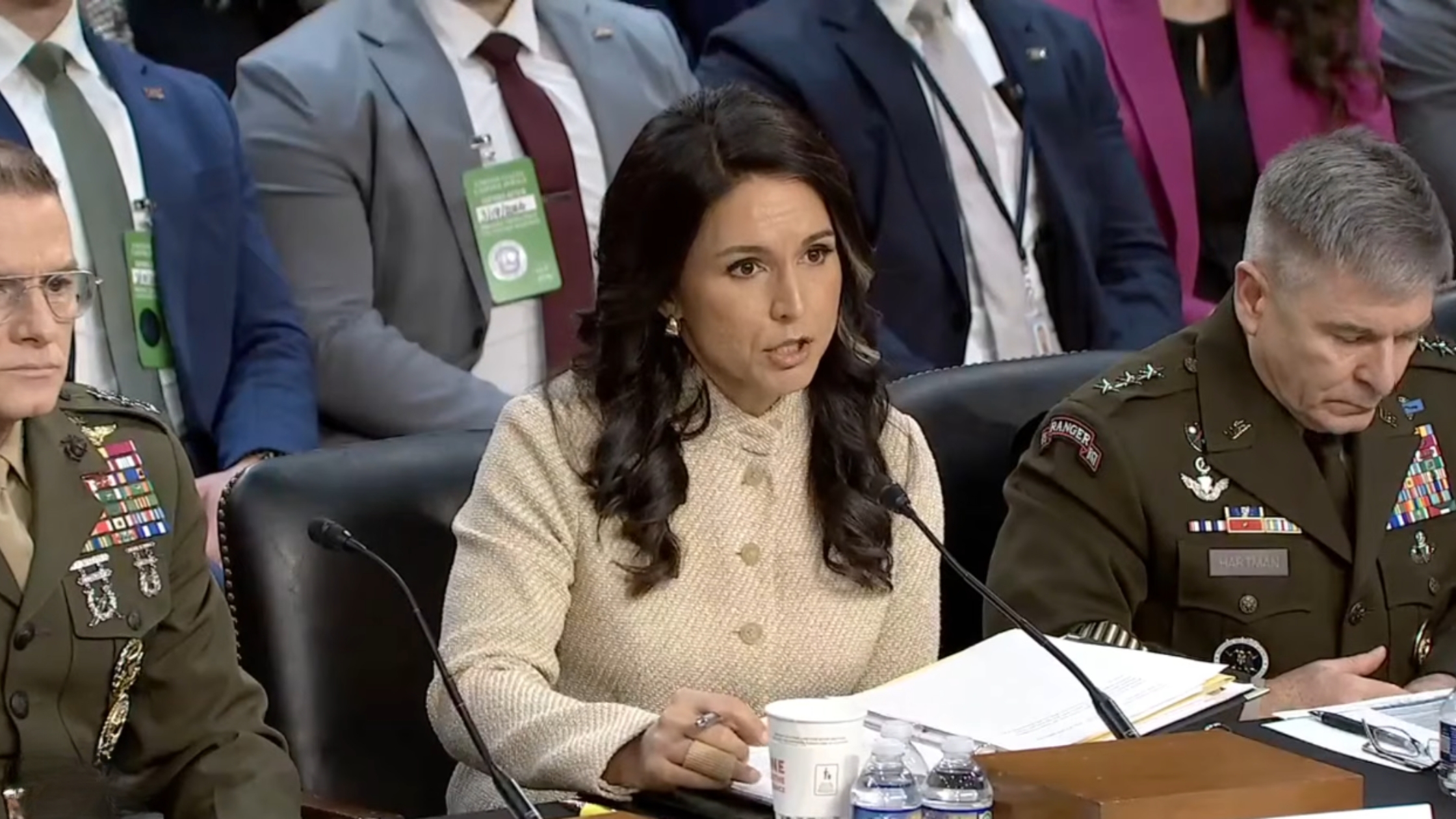
Thank you, Chairman Cotton, Vice Chair Warner. Members of the committee, good morning. I'm here today to present the 2026 annual threat assessment joined by the directors of the CIA, FBI, DIA, and NSA. Before I continue, on behalf of the intelligence community, want to extend our thanks to General Hartman for his 37 years of service in uniform and closing out his 37 years with tremendous leadership of the NSA. This briefing is being provided in accordance with ODNI statutory responsibility. I'd like to remind those who are watching what I am briefing here today conveys the intelligence community's assessment of the threats facing US citizens, our homeland and our interests, not my personal views or opinions. In this assessment, we're following the structure of priorities that were laid out in the president's national security strategy, starting with threats to our homeland and then shifting to global risks. The defense of our homeland is of the utmost importance to the American people, and efforts by this administration have shown over the last year the results of bolstering homeland defense in the security of the American people.
(20:33)
For example, the strict enforcement of US policies at the US-Mexico border and regionally have served as a deterrent, drastically reducing illegal immigration. Based on customs and border patrol data, January 2026's monthly encounters are down 83.8% compared to January 2025. Encounters declined at 79% compared to 2024. The drivers of migration are likely to continue. Potential worsening instability in countries like Cuba and Haiti risk triggering migration surges, and smugglers who have long operated as transnational criminal organizations continue to view chaos as an opportunity for profit and will continue to look to profit from illegal immigration flows. These transnational criminal organizations continue to pose a daily and direct threat to the health and safety of millions of US citizens, primarily and directly by producing and trafficking in illegal drugs. Under President Trump's leadership, fentanyl overdose deaths have seen a 30% decrease from September 2024 to September 2025. President Trump's aggressive efforts to more directly and actively target these transnational criminal organizations and reduce the inflow of fentanyl precursors has already had a significant impact, which is likely to continue.
(21:58)
We've seen fentanyl potency also decrease, likely due to disruptions to the production supply chain. US efforts to work with China and India to halt the flow of fentanyl precursor chemicals to North America are demonstrating some improvement, but there is more work to be done as, sadly, there are still tens of thousands of fentanyl related deaths in America every year. Mexico-based TCOs like the Sinaloa Cartel and Jalisco New Generation cartel dominate the production and smuggling of fentanyl, heroin, meth, and cocaine into the United States. Columbia-based DCOs and illegal arm groups like the Revolutionary Armed Forces of Columbia and the National Liberation Army are responsible for producing and trafficking large volumes of cocaine to the US and European markets, with now some indicators of attempts to expand their market to the Asia-Pacific region. Columbia remains the world's largest producer of cocaine, and Colombian criminal groups have expanded their trafficking relationships with neighboring Ecuadorian and Brazilian gangs.
(23:05)
As you know, MS-13 is well established in cells within the United States and uses violence to intimidate the Salvadorian diaspora, engaging in murder, extortion, retail drug trafficking, firearms offenses, and prostitution, fueling increased violence and instability. These and other TCOs continue to present a very tangible and individualized risk of violent crime to everyday Americans and contribute to regional instability. As the President increases his focus on counterdrug and countercartel pressures, they're likely to seek ways to try to adapt their operations, including shifting production locations and trafficking routes and methods. The United States continues to face a complex and evolving threat landscape with a geographically diverse set of Islamist terrorist actors seeking to propagate their ideology globally and harm Americans, even as Al-Qaeda and ISIS remain weaker today than they were at their respective peaks. The spread of Islamist ideology in some cases led by individuals and organizations associated with the Muslim brotherhood poses a fundamental threat to freedom and the foundational principles that underpin Western civilization.
(24:18)
Islamist groups and individuals use this ideology for recruiting and financial support for terrorist groups and individuals around the world, and to advance their political objectives of establishing an Islamist caliphate, which governs based on Sharia. There are increasing examples of this in various European countries, and President Trump's designation of certain Muslim brotherhood chapters as foreign terrorist organizations is a mechanism to secure Americans against this threat. In response to setbacks to their capabilities of conducting large scale complex attacks, Islamist terrorist groups have shifted toward focusing on executing information operations to spread propaganda and inspire or enable individuals located in or with access to the West.
(25:05)
US counter-terrorism efforts, primarily in Iraq, Somalia, Yemen, and Syria in 2025 were instrumental in removing key terrorist leaders and operatives, degrading the ability of Al-Qaeda and ISIS to quickly reconstitute its leadership and plan large scale attacks against the homeland and US interests abroad. Strict US border enforcement measures and increased deportations of individuals with suspected links to Islamist terrorists have reduced access to the homeland and removed some potential sources of future terrorist attacks. Since January, US officials have only had a handful of encounters at our borders with individuals associated with terrorist groups. This is a positive trend, however our interagency coordinated efforts to continue to identify, locate, and remove known or suspected terrorists who may already be in the United States continues with vigilance. In 2025, there were at least three Islamist terrorist attacks in the United States. Law enforcement disrupted at least 15 US-based Islamist terrorist plotters.
(26:11)
Roughly half of last year's disrupted plotters had some online contact with Islamist terrorists inspired by Islamist foreign terrorist organizations abroad. For example, in the recent attempt to attack a synagogue in Michigan, the shooter had familial ties to a Hezbollah leader. Al-Qaeda and ISIS pose the biggest threat to US interests overseas in parts of Africa, the Middle East, and South Asia where these groups operate. In the Middle East, AQAP in Yemen, ISIS-K in South Asia, and ISIS in Syria are among the most likely groups conducting external plotting. ISIS in Syria is likely seeking to rebuild its ranks, expand support networks, and solicit funds by reengaging with and recruiting from the likely hundreds of ISIS detainees and thousands of ISIS linked women and children who were either released or escaped from prisons and displaced person camps that were previously run by the Syrian democratic forces in Northeast Syria. Meanwhile, state actors present a risk broader in scope by seeking new capabilities in kinetic and cyber warfare.
(27:19)
The United States secure nuclear deterrent continues to ensure safety in the homeland against strategic threats. However, the intelligence community assesses that Russia, China, North Korea, Iran, and Pakistan have been researching and developing an array of novel, advanced or traditional missile delivery systems with nuclear and conventional payloads that put our homeland within range. The IC assesses that threats to the homeland will expand collectively to more than 16,000 missiles by 2035 from the current assessed figure of more than 3,000 missiles. The IC assesses that China and Russia are developing advanced delivery systems meant to be capable of penetrating or bypassing US missile defenses. North Korea's ICBMs can already reach US soil, and the IC assesses that it is committed to expanding its nuclear arsenal. Pakistan's long-range ballistic missile development potentially could include ICBMs with a range capable of striking the homeland. The IC assesses that Iran has previously demonstrated space launch and other technology it could use to begin to develop a militarily viable ICBM before 2035 should Tehran attempt to pursue that capability.
(28:35)
However, these assessments will clearly be updated as the full impact of Operation Epic Fury's devastating strikes on Iran's missile production facilities, stockpiles, and launch capabilities as determined. These nations collectively will likely seek to understand US plans for advanced missile defense for the homeland, probably for the purpose of shaping their own missile development programs and assessing US intentions regarding deterrence.
Tulsi Gabbard (29:00):
Shifting to the cyber domain, the IC assesses that China, Russia, Iran, North Korea and non-state ransomware groups will continue to seek to compromise U.S. government and private sector networks, as well as critical infrastructure to collect intelligence, create options for future disruption and for financial gain. The IC assesses that China and Russia present the most persistent and active threats and are continuing their R&D efforts. North Korea's cyber program is sophisticated and agile. In 2025 alone, North Korea's cryptocurrency heist probably stole $2 billion, which the IC assesses is helping to fund the regime and include further development of its strategic weapons programs. Financially or ideologically motivated non-state actors are becoming more bold, with ransomware groups shifting to faster high volume attacks that are harder to identify and mitigate.
(29:55)
Innovation in the field of artificial intelligence will likely accelerate these threats in the cyber domain. The IC assesses that it will increasingly shape cyber operations with both cyber operators and defenders using these tools to improve their speed and effectiveness. For example, in August of 2025, cyber actors used an AI tool to conduct a data extortion operation against international government, healthcare, and public health emergency service sectors, as well as religious institutions.
(30:26)
Moving to the Arctic, the IC assesses that Russia and to a lesser extent China aim to strengthen their presence in the region through increased maritime trade, natural resource extraction and military activity. Russia, which has the longest coastline in the Arctic, has long sought recognition of its polar great power status and is deploying more military forces and building new permanent infrastructure. China, though not an Arctic country, is engaged in more limited efforts in the region to advance its own strategic and economic interests.
(30:59)
The IC assesses that China is the most capable competitor in the field of artificial intelligence. The IC assesses that AI capabilities are rapidly advancing and changing the threat landscape. As this is a defining technology that enables computers and machines to simulate human learning comprehension, problem solving, creativity and autonomy, it will be critical to ensure that humans remain in control of how AI is used and of the machines that may threaten to autonomously violate the interests of the American people across all domains.
(31:32)
AI adoption at scale across the spectrum of usage poses serious risks. AI has the potential to aid in weapons and systems design and has been used in recent conflicts to influence targeting and streamline decision making, underscoring the risk and likely threats that could manifest on the battlefield. Early developers in quantum computers will give countries an extraordinary technological advantage over others to quickly process national security information and break current encryption methodology used to protect sensitive finance, healthcare, and government information.
(32:11)
The global security landscape is volatile and complex with armed conflict growing more common and posing potential threats against U.S. interests. Strategic competition and regional and smaller powers are becoming more willing to use force to pursue their interests, heightening the risk of conflict. The IC assesses the space domain is becoming increasingly contested, with China and Russia developing counterspace capabilities to challenge U.S. space efforts. The threat of nuclear proliferation and advancing chemical and biological warfare capabilities continues to grow.
(32:47)
I'll turn now to our neighborhood in the Western hemisphere where flagging economies, high crime rates, pervasive organized crime, migration flows, corruption, narcotics trafficking, all of these present a spectrum of risks to U.S. interests and where strategic competitors seek to gain greater influence in the region.
(33:05)
The IC assesses that Latin America and the Caribbean almost certainly will see hotspots of volatility in the coming year. Since Maduro's arrest, the IC assesses a shift in Venezuela's leadership towards cooperating with the U.S. to open its economy, to develop the country's oil and gas extraction capability, and we've seen their movement in releasing political prisoners. The U.S.- Mexico-Canada Agreement Review in 2026 will likely increase uncertainty in many Latin American countries, especially those that rely on Mexico as an export destination for intermediate goods for manufacture and onward export to the U.S.
(33:45)
China, Russia, and Iran are likely seeking to sustain economic, political, and military engagement with Latin America. The IC assesses that China's demand for raw materials is likely to continue to drive its economic outreach, while Russia likely wants to expand its current security and diplomatic ties with Cuba and Nicaragua. The IC assesses that China aims to elevate its own political, economic, military, and technological power to increase its own regional positioning and global influence to fend off threats to their interests. While there are challenging areas where interests diverge, President Trump's diplomatic engagements with President Xi to work towards U.S. interests have enabled progress where those interests align. The IC assesses that China continues to rapidly modernize its military forces across all domains in pursuit of its goal to achieve world-class status by mid-century. This includes building a force with the aim of being capable of deterring U.S. and allied forces in the region, and to achieve their stated objective of developing the ability to seize Taiwan by force if necessary. However, the IC assesses that China likely prefers to set the conditions for an eventual peaceful reunification with Taiwan short of conflict.
(35:02)
The IC assesses that an increasingly confident North Korean regime remains a source of concern regionally and globally. Its weapons of mass destruction, its conventional military capabilities, illicit cyber activities and demonstrated willingness to use asymmetric capabilities poses a threat to U.S. and its allies, particularly South Korea and Japan. North Korea's partnership with Russia is growing and in 2025, Kim took steps to improve ties with China, still North Korea's most important trading partner and economic benefactor.
(35:35)
The IC assesses that North Korea's support for Russia in the war against Ukraine has increased North Korea's capabilities as their forces have gained combat experience in 21st century warfare along with equipment. In 2024, North Korea deployed more than 11,000 troops to Russia to support combat operations in Kursk.
(35:54)
Pyongyang continues to develop and expand its strategic weapons programs, including missiles that can evade U. S. and regional missile defenses. It is continuing to work to increase its nuclear warhead stockpile and maintains biological and chemical weapons capabilities.
(36:12)
Russia retains the capability to selectively challenge U.S. interests globally by military and non-military means. The IC assesses that the most dangerous threat posed by Russia to the U.S. is the potential of an escalatory spiral in an ongoing conflict such as Ukraine, or a new conflict that led to direct hostilities, including the potential deployment of nuclear weapons. The IC assesses that Putin continues to invest in Russia's defense industrial base, as well as novel capabilities that may pose a greater threat to the U.S. homeland and forces abroad than conventional weapons. Russia has advanced systems, hypersonic missiles, and undersea capabilities designed to negate the U.S. military advantage.
(36:54)
Moscow also relies on other tools to exert pressure using gray zone tactics to further its goals and compete below the level of armed conflict. Russia is also building an extensive counter space capabilities to contest U.S. space dominance. Its development of a nuclear counter space weapon poses the greatest single threat to the world's space architecture.
(37:18)
During the past year, the IC assesses that Russia has maintained the upper hand in the war against Ukraine. U.S.-led negotiations between Moscow and Kiev are ongoing. Until such an agreement is met, Moscow is likely to continue fighting a slow war of attrition until they view their objectives have been achieved.
(37:36)
In the Middle East, conflict and instability will shape security, political, and economic dynamics in a variety of ways. The IC assesses that Operation Epic Fury is advancing fundamental change in the region that began with Hamas's attack on Israel on October 7th, 2023, and continued with the 12-day War last year, resulting in weakening Iran and its proxies. The IC assesses the regime in Iran appears to be intact, but largely degraded due to attacks on its leadership and military capabilities. Its conventional military power projection capabilities have largely been destroyed, leaving limited options. Iran's strategic position has been significantly degraded. The U.S.-led maximum pressure campaign and snap back of European sanctions added additional pressure to an already bleak Iranian economy resulting in mass protests earlier this year that Tehran suppressed by killing thousands of protestors. Even if the regime remains intact, the IC assesses that internal tensions are likely to increase as Iran's economy worsens.
(38:45)
Even so, Iran and its proxies continue to attack U.S. and allied interests in the Middle East. The IC assesses that if a hostile regime survives, it will likely seek to begin a years long effort to rebuild its military, missiles and UAV forces. Prior to Operation Epic Fury, the IC assesses Iran was trying to recover from the severe damage to its nuclear infrastructure sustained during the 12-day war and continued to refuse to comply with its nuclear obligations with the IAEA, refusing them access to key facilities.
(39:19)
The IC assesses that China, Russia, and North Korea see the United States as a strategic competitor and potential adversary. Iran has long viewed the U.S. as an adversary and is engaged in active conflict with the U.S. as of today. These four countries, the ICSSs are likely to continue their selective cooperation with each other, which could bolster their individual capabilities and threats to U.S. interests more broadly. However, currently these relationships are primarily bilateral on selective issues and depend on broader circumstances, divergent sovereign interests, and in some cases, concerns over directly confronting the United States. These factors, the IC assesses are likely to constrain their relationships.
(40:04)
Finally, conflicts on the continent of Africa are likely to persist through 2026 due to poor governance, economic demands, and external support. Tensions continue between Ethiopia and Eritrea, which could rapidly accelerate to conflict. Contentious national elections in Somalia could distract the federal government away from counter-terrorism actions against Al-Shabaab, which continues to conduct terror attacks while providing funding and propaganda support to other elements of Al-Qaeda in Yemen. The civil war and Sudan continues even as external negotiations occur. ISIS in West Africa and the Sahel have increased the intensity of their attacks against local security forces, expanding their areas of operation and moving closer to cities with a U.S. presence.
(40:52)
The IC assesses that African governments will likely use their wealth in critical minerals to seek partnerships that deliver them meaningful benefit. Concurrent conflicts and crises across the continent will continue to put U.S. citizens at risk and cause further instability.
(41:08)
In closing, as leaders of the intelligence community, we remain committed to providing the president and policymakers with timely, unbiased, relevant intelligence to inform decision making and to ensure the safety, security, and freedom of the American people. Thank you.
Mr. Cotton (41:25):
Thank you, Director Gabbard. General Adams, Camden, Arkansas is the home of brand new production lines for the Israeli missile defense interceptors. Could you please explain how critical Arrow and Iron Dome systems being built in Camden are for not only Israel's defenses, but the defense of hundreds of thousands of American citizens and troops in the region?
General Adams (41:48):
Chairman Cotton, thank you for that question. And I have to say that the Arrow system and the Iron Dome system are critical defensive systems that prevent adversary power projection from impacting the targets and the friendly areas in Israel. The Arrow system itself is the high altitude primarily against MRBMs, and it's proven to be very, very effective against those systems. The Iron Dome is more of a closer in system, protecting against rockets and things of that nature. But the combination of those two with U.S. systems creates a shield to prevent those attacks from the Iranians impacting key areas in areas where they're protecting.
Mr. Cotton (42:40):
Thank you, General Adams. I was recently in Camden with Secretary Hegseth as part of his Arsenal of Freedom Tour and they are great Arkansan to do great work to keep our nation safe.
(42:49)
General Hartman, we've often spoken about our pressing need for more cybersecurity manpower and part-time formation, such as the Arkansas Air National Guard's 223rd Cyberspace Operations Squadron are a great way to grow the force. What recommendations do you have to grow these cyber protection teams and develop more capacity for local and national missions?
General Hartman (43:13):
Chairman Cotton, thanks for the question. I did hear a little bit about the great team in Arkansas there, and I know 855 CPT operates from that formation. And so, for us, certainly looking at a number of different initiatives, one, ensure that we can share all of the relevant top secret classified information and other sort of indications and warning that the organizations need. But I will tell you, I'm an advocate for an ability to establish some sort of joint reserve cyber organization, and so that at CYBERCOM, we can ensure that those organizations have all of the advanced training that they need to ensure that those organizations have access to all of the intelligence that they need, and to ensure that we control some level of funding at both CYBERCOM and NSA that can be used to mobilize those personnel to handle the most difficult problems that we're faced with.
(44:07)
And we have been working with Congress on some of that language and the department, and we appreciate it, sir.
Mr. Cotton (44:12):
Thank you, General Hartman. As I said in my opening, we only have this one public hearing a year, even though the committee hears from each of you several times throughout the year in classified settings, so we don't often have a chance to tell the American people what great work their intelligence professionals are doing for them. So Director Ratcliffe, could you take the opportunity to maybe join in the excellent briefings that Secretary Hegseth and General Kane have provided on a regular basis over the last couple of months on the military aspects of both the Maduro Raid and Operation Epic Fury to explain the CIA's contributions to those operations?
John Ratcliffe (44:52):
Thank you, Senator. Last year when I was here in my confirmation, I promised you all, and you had all asked for, a more aggressive CIA, one that was focused on core mission, getting back to the business of stealing secrets, to be able to provide our policymakers with a decisive strategic advantage that would allow and advance and contribute to foreign policy and national security successes. To the credit of the CIA workforce, the CIA has delivered. Some of those successes have been very public. As you mentioned, Senator, Operation Midnight Hammer, Operation Absolute Resolve, flawless military operations like that are hostage to a flawless intelligence picture. And the CIA, as you know, from classified briefings, contributed in myriad ways to the success of that.
(45:52)
But what I would say to you is those successes are just emblematic of the phenomenal progress and success really by every measure, every metric, every standard across every national security space with regard to the work of the CIA. Senator, you mentioned some of it in your opening. The increase of our assets stable and our human sources up by 25%, our FI collection across the board, our foreign intelligence collection up by 25% overall. And in important categories like China, for instance, up 100%. In areas like tech and AI, up 45%. On the counter narcotics front, our operations up by 70%. And with regard to counter-terrorism, those are classified numbers that I'll share with you in the classified portion of this hearing, but they're off the charts good.
(46:47)
The best way I can summarize it, Senator, is I had a 32 year veteran of the agency retire this year and he said to me, "I hate to go. I don't know if this is the best year that the CIA's ever had, but it's the best year I can ever remember." And I think that reflects the current morale of the CIA. It's a workforce that knows it's doing a great job. It knows that it's being allowed to do what they signed up to do, which is provide that decisive strategic advantage to our country for great successes that everyone can see. So I thank you for the opportunity to let me recognize the CIA workforce.
Mr. Cotton (47:24):
Thank you. Director Ratcliffe, I want to address one specific threat from Iran, the threat of an intercontinental missile, which is really just the combination of two technologies, one thrust to get something into space and a reentry vehicle to get it back to earth. Iran has always had a space launch program, which is flimsy cover for the first part of that intercontinental missile program. I haven't seen any Iranian astronauts in space lately. And second, they have medium range ballistic missiles, which already have a reentry vehicle. So if you crudely married those two technologies together, I've heard some analysts say that Iran could have had a functioning intercontinental missile to threaten the United States in as few as six months. Would you agree with that assessment?
John Ratcliffe (48:08):
Well, you're right to be concerned about Iran's development of longer range ballistic missiles, Senator. If Iran were allowed to develop at IRBM ranges, which is 3,000 kilometers, it would threaten most of Europe. And yes, as you mentioned, we know that Iran is gaining experience in these larger, more powerful booster technologies through its so called space launch vehicle program. If left unimpeded, yes, Senator, they would have the ability to range missiles to the continental U.S. It's one of the reasons why degrading Iran's missile production capabilities that is taking place right now in Operation Epic Fury is so important to our national security.
Mr. Cotton (48:59):
Thank you. Vice chairman.
Mr. Warner (49:01):
Thank you, Mr. Chairman. Director Gabbard, the whole country knows that you were recently involved in a FBI operation to seize ballots in Fulton County, Georgia. Yet, this was despite the fact that the warrant showed no foreign interference or nexus. Matter of fact, the warrant was based entirely on conspiracy theories that have already been examined and rejected repeatedly. Now, where is the authority for you to involve yourself in a domestic law enforcement activity?
Tulsi Gabbard (49:39):
Thank you, Vice Chairman. I appreciate the question. As you know, I've addressed every issue you've raised in detail in a letter, but I'm grateful for the opportunity to do it in this forum. As you stated, Congress provided by statute ODNI with the responsibility of election security and counterintelligence in 2021. As you also know, ODNI has purview and oversight-
Mr. Warner (50:04):
I know the history very well, but could you just address-
Tulsi Gabbard (50:06):
I'm addressing the question. ODNI also has purview and overview over two domestic related agencies, the Department of Homeland Security and the FBI, both of which have purview over election security responsibilities to ensure the integrity of our elections. I want to correct one of your statements that you've made multiple times, which is false. I did not participate in a law enforcement activity, nor would I, because that does not exist within my authorities.
Mr. Warner (50:36):
You were present on the scene. Are the photos of you on the scene false?
Tulsi Gabbard (50:40):
I was at Fulton County, sir, at the request of the president and to work with the FBI to observe this action that had long been awaited. I was not aware of what was in the warrant or was not in the warrant.
Mr. Warner (50:55):
And what was the President specific request for you to go to? What was the specific request that was made by the President for you to show up in Fulton County?
Tulsi Gabbard (50:59):
To go and observe the FBI's activities on this issue.
Mr. Warner (51:03):
So why-
Tulsi Gabbard (51:03):
When you look at your question, sir-
Mr. Warner (51:06):
Do you have the answer why the President was knowing about this affidavit before it was even served?
Tulsi Gabbard (51:10):
I'm not aware that the President knew about an affidavit before it was served.
Mr. Warner (51:13):
Then why was he sending you to Fulton County?
Tulsi Gabbard (51:15):
This occurred the day that the FBI had it approved, their warrant approved by a local judge, and they began to execute this. To answer your question, sir, about the foreign nexus question. In order for us to better understand the vulnerabilities in our election systems that may exist today as we look to 2026, and yes, we are very focused on trying to make sure that this election is one that the American people have faith-
Mr. Warner (51:41):
Director Gabbard, I've got a number questions. Director Gabbard, I have a number of questions. Let me ask my next question, please. You have not provided any of the required reports or briefings to this committee on foreign interference. This is the first threat assessment since 2017 that didn't even mention foreign interference. Last year when you were already confirmed, it mentioned it at a high level. Are you saying there is no foreign threat to our elections in the midterms this year?
Tulsi Gabbard (52:19):
As I stated in the outset of my remarks, this year's annual threat assessment matches the prioritization of threats and-
Mr. Warner (52:27):
Please answer the question, yes or no. Is there foreign threat interference to our elections this year?
Tulsi Gabbard (52:31):
.. that the President has laid out.
Mr. Warner (52:32):
Are there foreign-
Tulsi Gabbard (52:33):
Please allow me to answer the question, sir. The intelligence community has been and continues to remain focused on any collection and intelligence products that show a potential foreign threat for those who are seeking [inaudible 00:52:45].
Mr. Warner (52:45):
So far, there has been none then because you've made no reports... Excuse me, ma'am. If you want to ask the questions, you should have stayed in Congress. Please answer the questions.
Tulsi Gabbard (52:53):
I didn't ask you a question, sir. I'm trying to answer your questions.
Mr. Warner (52:56):
So you're saying the failure to provide any reports or the failure to have any mention of a foreign threat assessment, I would draw the conclusion there must be no foreign threat to our elections in '26. So that brings me a question that I have for both you, ma'am, and Director Patel. There are reports that in 2020, the President was preparing an executive order to potentially seize ballots or bring in federal forces. There is a published report that there is a similar EO being drafted right now about 2026 citing China. Director Patel, do you have any knowledge of that draft EO?
Kash Patel (53:36):
Thank you, Vice Chairman. I do not, sir.
Mr. Warner (53:38):
Director Gabbard, do you have any?
Tulsi Gabbard (53:39):
I do not.
Mr. Warner (53:40):
Thank you. Let me move to Iran. Now, I understand, and I appreciated Director Gabbard's comments yesterday about agreeing that the President has sole authority, I guess, in his bones to declare whether something is an imminent threat. I didn't agree with your friend, Mr. Kent, but I didn't... again, I agreed with him yesterday on the fact that there was no imminent threat. I guess what I'm concerned about, one thing is, even in your printed testimony today on page 6, in your last paragraph on page 6, "As a result of Operation Midnight Hammer, Iran's nuclear missile program was obliterated. There's been no efforts to try to rebuild their enrichment capability." You omitted that paragraph from your oral opening. Was that because the President said there was an imminent threat two weeks ago?
Tulsi Gabbard (54:36):
No, sir. I recognize that the time was running long and I skipped through some of the portions of my-
Mr. Warner (54:42):
So you chose to you chose to take-
Tulsi Gabbard (54:44):
... my oral delivered remarks.
Mr. Warner (54:45):
... you chose to omit the parts that contradict the President. The President continues to say as well that he had no idea, he was shocked that the Iranians would move to take over the Strait of Hormuz. Did you provide any intelligence that would say that it was not likely that the Iranians would try to move on the Strait?
Tulsi Gabbard (55:08):
I'm not aware of those remarks. And I think those of us here at the table can point to the fact that historically the Iranians have always threatened to leverage their control of the Strait of Hormuz.
Mr. Warner (55:19):
Why would the President say he was amazed or?
Tulsi Gabbard (55:21):
I'm not aware of those remarks.
Mr. Warner (55:22):
What about the comments the President made that thought that he was surprised again, reports that Iran struck the adjacent Gulf States?
Tulsi Gabbard (55:30):
Again, I'm not aware of those remarks. We have been and continue to provide-
Mr. Warner (55:33):
Well, let me ask you this. Did you brief the President if he starts a war of choice, that the likely result would be that Iran would strike adjacent Gulf nations and close the the Strait of Hormuz? Did you brief him on those two facts that I think have been consistently the assumptions of the intelligence community?
Tulsi Gabbard (55:59):
I have not and won't divulge internal conversations. I will say that those of us within the intelligence community continue to provide the President with all of the best objective intelligence available to inform his decisions.
Mr. Cotton (56:13):
Senator Collins.
Susan Collins (56:14):
Thank you, Mr. Chairman. Director Gabbard, you just testified that ISIS and Al-Qaeda are significantly weaker and reflecting that view, you have devoted declining budgets, personnel, and emphasis on countering terrorism. Yet the fact is that ISIS is growing and operating in Somalia, Afghanistan, Syria, Pakistan, and Iraq. Al-Qaeda is surging in Afghanistan, the Arabian Peninsula, and throughout Central Africa. The Houthis in Yemen and the rest of the Iranian proxies remain a serious threat. Focusing, as you have done, on great power competitors seems to have diverted resources from the fight against terrorism, a fight that's very much still going on. As I have said repeatedly, it is terrorists who want and can kill Americans today. We've just seen the terrorists in Michigan attacking the synagogue. In addition, it appears that a more stove-piped effort in the intelligence committee has returned.
(57:58)
How are you ensuring
Susan Collins (58:00):
... ensuring that Americans are safe. And that you are countering counter-terrorism threats to our homeland and to US citizens abroad.
Tulsi Gabbard (58:15):
Thank you, Senator Collins, for your question and the opportunity to clarify the comments in my opening statement. My reference to the size of ISIS and Al-Qaeda organizationally is smaller and weaker than it was during its peak over a decade ago. However, I completely concur with your remarks about the threat of ISIS, Al-Qaeda, and other Islamist terrorist groups around the world. And the threat that they pose to US interest service members and directly to the homeland. Our ODNI National Counter-Terrorism Center has been at the forefront of ramping up. And I believe is more active today than it has been certainly in a long time. We are dedicating every resource that they ask for, as well as the counter-terrorism elements across the IC, to make sure that we are never taking our eye off of this persistent threat to the American people.
(59:09)
The change in tactics based on the current environment is something we continue to be most concerned about. Increasingly, we are seeing less indicators of large scale organized complex threats or attacks. And instead, efforts focused on individuals, either who have been radicalized by Islamist propaganda and may not have ever had contact with ISIS or Al-Qaeda, for example, and others who have had contact of which we are able to have more indications of. This remains and will be, and as we come to present our budgets to you, a foremost and primary priority. The integration across the intelligence community on the counter-terrorism threat occurs every single day, with our teams working very effectively together to thwart terrorist attacks as we have over the last year.
Susan Collins (01:00:04):
Director Patel, I'm going to follow up on this issue with you. ISIS targets potential recruits online through social media, gaming platforms, encrypted messaging apps. ISIS even have facilitated a network online to smuggle illegal immigrants into the United States. Since April 2021, there have been more than 52 jihadist-inspired cases across 30 states. What measures is the FBI taking to prevent foreign terrorist organizations from recruiting or influencing Americans, while also ensuring the protection of individuals' right to privacy?
Patel (01:01:02):
Thank you, Senator. And I think you said it best. They have transferred their capabilities in terms of personal recruitment to online recruitment, which makes any terrorist organization, including ISIS, all the more powerful. What we have done is extended and expanded resources to environments like the Threat Screening Center, which allows us to collect biometric capabilities from all over the world. We've had a double-digit increase in that and a double-digit increase in intelligence production. But what we've also done in the CT space specifically is expanse that, go online, and detect based on our biometric capabilities and intelligence that we have from the inter-agency.
(01:01:41)
And what that leads us to is what we saw in December of last year, Senator, where we at the FBI stopped four terrorist attacks. Four, in California, Texas, North Carolina, and Pennsylvania, three of which were ISIS-inspired. We were able to detect these individuals both online and in-person, using our covert platforms. And we shuttered a bombing campaign in Southern California and two mass casualty events for New Year's Eve.
Susan Collins (01:02:09):
Director Gabbard, the intelligence community did not detect an extremely serious breach affecting our telecommunications industry, due to the Chinese salt typhoon incursions for a very long time. In addition, the Chinese vault typhoon threat poses a terrible threat to US critical infrastructure. Specific sectors throughout the United States have been overlooked and under-protected. What are you doing to deal with the threat to critical infrastructure, our electric grid, our communication systems, given this huge miss by our talented intelligence community?
Tulsi Gabbard (01:03:07):
Thank you, Senator Collins, for the question. Working with our partners at NSA and others to detect these threats and how they maybe evolve or developing is something we're continuing to work on. Building strong partnerships with the private sector, whether it be in the telecom industry, the financial sector, the healthcare sector, the energy sector, is something that I'm rebuilding. We've seen some of these ongoing relationships falter over previous years. I've personally been astounded by some of the conversations I've had with leaders from these industries, who are just as concerned as we are about these threats to our critical infrastructure. And yet, don't feel that they have the connectivity or the information to be able to secure their own infrastructure. So, in short, building those stronger partnerships, integrating, and being able to share information intelligence where we can is critical for us to be able to secure our country from these threats.
Mr. Cotton (01:04:08):
Thank you, Senator Collins. Senator Wyden.
Wyden (01:04:09):
Thank you, Mr. Chairman. Director Gabbard, last year your agencies testified, and I quote, "Iran's large conventional forces are capable of inflicting substantial damage to an attacker, executing regional strikes and disrupting shipping, particularly energy supplies through the Strait of Hormuz. In other words, every problem we're seeing now was not only foreseeable, but was actually predicted by the intelligence agencies." So, Director, in the lead up to the start of this war three weeks ago, did the intelligence agencies stick to their assessment, that in response to an attack, the Iranians had the capability to shut down the Strait of Hormuz?
Tulsi Gabbard (01:04:58):
Thank you, Senator Wyden. The intelligence community has continued to provide the president and his team with the intelligence related to this operation in Iran, before and on an ongoing basis.
Wyden (01:05:11):
So, right now, we're in a global energy crisis. We're paying more for gas. The economy is in danger. And it seems to me, and I heard you discuss this with Senator Warner too, that there's a lot of hedging going on with respect to entirely foreseen consequences of the war. And that strikes me, Madam Director, as what amounts to a historic mistake. Now, my second question is, did the intelligence agencies assess that the Iranians could respond to a regime change attack from us by attacking US forces and other Americans in the region?
Tulsi Gabbard (01:05:49):
The IC assessment has always taken very seriously the threat of the Iranian regime's missile capabilities and how our American troops within the region may be put at risk.
Wyden (01:06:02):
Again, it seems to me, with Americans dying in the war, it's hard to see how you can sit here and say that the intelligence agencies couldn't provide a clear warning, that if attacked, the Iranians would respond by attacking our people. Now, on Monday, Madam Director, Donald Trump was asked about Iranian strikes on the Gulf States. He said, and I quote, "Nobody, nobody, no, no, no. The greatest experts, nobody thought they were going to hit the Gulf States. You all are supposed to be the greatest experts. That's what we have you there for." Director Gabbard, did the intelligence agencies assess that Iran could conduct strikes on our own partners in the region if it was attacked.
Tulsi Gabbard (01:06:46):
The intelligence community has continued to assess the potential threats to the region, the existing threats to the region, and providing those assessments to the policymakers and decision makers.
Wyden (01:06:58):
Let me move on to several others of you with respect to 702 of FISA. And I'm just going to start with you, General Hartman. When Congress last reauthorized Section 702 of FISA, it included a provision that expanded the type of companies and individuals who could be forced to assist the government in its spying. Has this expansion resulted in any intelligence, General Hartman?
General Hartman (01:07:24):
Senator, thanks for the question. Just to be clear, this provision provided us an ability to collect foreign intelligence on personnel outside of the United States.
Wyden (01:07:37):
This is the major 702 issue in terms of expansion. What was the effect of what was done?
General Hartman (01:07:45):
Senator, I would prefer to talk to you about exact specifics in the closed session.
Wyden (01:07:50):
I'm happy to do that. Let's understand, though, this is a dangerously broad provision that could be used to rope in anybody with access to a cable box, a wifi router or a server. It was jammed into the 2024 reauthorization bill at the last minute. Senators were told they had no choice but to support it. And now, two years later, we've just had testimony from a very respected individual who's saying, "So far it has had no value." So, colleagues, we are getting ready to have another discussion on this. And this ought to be a warning to every senator that not every new spying power that is sold as urgent and critical actually is.
General Hartman (01:08:34):
Senator, could I please respond to that?
Wyden (01:08:36):
Of course.
General Hartman (01:08:37):
So, Senator, I just want to be clear. It provided us no additional authority that doesn't involve collecting intelligence on foreigners that are outside of the United States of America.
Wyden (01:08:49):
Fine. Director Patel, a question for you. In 2023, your predecessor testified that, and I quote, "To my knowledge, we do not currently purchase commercial database information that includes location data derived from internet advertising." Is that the case still? And if so, can you commit this morning to not buying Americans' location data?
Patel (01:09:14):
Thank you. The FBI uses all tools, Senator, thank you for the question, to do our mission. We do purchase commercially available information that's consistent with the Constitution and the laws, under the Electronic Communications Privacy Act. And it has led to some valuable intelligence for us to be utilized with our private and partner sectors.
Wyden (01:09:35):
So, you're saying that the agency will buy Americans' location data. I believe that that's what you've said in kind of intelligence lingo. And I just want to say, as we start this debate, doing that without a warrant is an outrageous end run around the Fourth Amendment. It's particularly dangerous, given the use of artificial intelligence to comb through massive amounts of private information. This is Exhibit A for why Congress needs to pass our bipartisan bicameral bill, the Government Surveillance Reform Act. I have time, I believe, for one more question. Director Patel, you three weeks ago indicated you were dissatisfied about having your phone records subpoenaed. Do you think the government ought to get a court order to collect phone records?
Patel (01:10:23):
Senator, in my experience, the government does get court orders to obtain phone records.
Wyden (01:10:30):
One last question. General Adams, for you. In 2021, your agency confirmed that it had purchased and searched domestic location data. It is still your agency's position that you can buy Americans' location data without a warrant. And if so, are you still doing it?
General Adams (01:10:47):
Senator, thanks for the question. With regards to commercially available information and publicly available information, the purchases that this agency, that my agency makes is in alignment with the constitution and protects US persons' information.
Wyden (01:11:01):
But you're buying location data, correct? I mean, we've now had that referred to twice and I don't think there's any question that you're doing it.
General Adams (01:11:11):
All of the purchasing of commercially available information by the agency is passed through legal channels and is in complete compliance with laws.
Wyden (01:11:20):
Thank you, Mr. Chairman.
Mr. Cotton (01:11:21):
General Hartman, I want to give you a chance to answer more specifically what Senator Wyden said. You did answer it indirectly. Does anything in Section 702 give the government the authority to target any American with a cable box or a wifi router?
General Hartman (01:11:39):
Chairman, nothing in 702 gives us the authority to target an American with a cable router or a wifi device.
Mr. Cotton (01:11:46):
Thank you. And I would observe about commercially available data, that the keywords are commercially available. If any other person can buy it, and the FBI can buy it, and it helps them locate a depraved child molester or savage cartel leader, I would certainly hope the FBI is doing anything they can to keep Americans safe. It's not much different from longstanding Supreme Court precedent that for instance says law enforcement can go through trash that you put on the side of the curb, because you no longer have a privacy interest in it. Senator Cornyn.
Cornyn (01:12:25):
Thank you all for your service to our country and the people you represent. We are in debt to all of you. I want to ask you, Director Ratcliffe, yesterday, the head of the National Counter-Terrorism Center resigned, saying that Iran did not represent an imminent threat to the United States. Is there anything to indicate that Iran had ceased in its nuclear ambitions or in its desire to continue to build ballistic missiles capable of threatening American troops and allies in the Middle East?
John Ratcliffe (01:13:04):
Senator, no. In fact, the intelligence reflects the contrary.
Cornyn (01:13:08):
So, you disagree with Mr. Kent?
John Ratcliffe (01:13:12):
I do.
Cornyn (01:13:13):
I would think any fair-minded assessment of the situation, even based on open sources, would reflect the danger Iran regime poses to the United States. Isn't it true they've basically been at war with the West since 1979 during the Iranian Revolution to have American blood on their hands?
John Ratcliffe (01:13:33):
That's absolutely correct. I think Iran has been a constant threat to the United States for an extended period of time and posed an immediate threat at this time.
Cornyn (01:13:45):
The threat assessment says that Al-Qaeda and ISIS maintain the intent to launch operations targeting the US, but it's most likely to occur through US-based loan offenders. I want to ask you, Director Patel, it seems like there's been a raft of incidents recently on March the 1st in Austin, Texas, where I live. A lone gunman wearing a sweatshirt saying property of Allah, and who the T-shirt he wore underneath had an Iranian flag, killed three innocent people and injured 12 more. And then we know in Virginia, the Old Dominion shooting, somebody who unbelievably was sentenced to 11 years in federal prison for attempting to support ISIS, but then was released only to commit another terrorist attack.
(01:14:43)
We all are familiar with what's happened in Michigan and New York. And I applaud the important role that the FBI has played in stopping some terrorist attacks, but obviously the FBI can't be everywhere all the time. Would you please talk about your cooperation and collaboration with Homeland Security investigations in countering terrorist attacks against the United States?
Patel (01:15:16):
Thank you, Senator. Absolutely. It is essential that the FBI cooperates with the entire inner agency. But as to your question about DHS specifically, what we have stood up around the country are 59 Homeland Security Task Forces in 59 separate locations.
Cornyn (01:15:30):
These are joint terrorism task forces?
Patel (01:15:32):
Essentially, the JTTF model was expanded. So, the FBI owns 56 joint terrorism task forces in each of our field offices. On top of that, we have 59 HSTFs, which are co-led by the FBI and DHS. And what that allows us to do is things like we did down in New Orleans, just over the holiday period, where we surged for a six-week period of time and where we dropped the murder rate by double-digit points. And also, it's the first time that Mardi Gras in its entire history had not one homicide. So, when you bring the powers of the Homeland Security folks, DHS and the FBI together, this is the purpose of it, to get after not just the terrorism threat, but the violence and the criminal activity in our cities. And that's why we're in 59 cities across the country. And it's working in places like Memphis and every other city we have it.
Cornyn (01:16:20):
Are you aware of the fact that Homeland Security Investigation is a major directorate within immigration and customs enforcement?
Patel (01:16:28):
Yes, sir. Yes, sir.
Cornyn (01:16:30):
And are you aware that Senate Democrats have uniformly voted not to fund the Department of Homeland Security, including Homeland Security Investigations, TSA, FEMA, and other functions of the Department of Homeland Security?
Patel (01:16:50):
Senator, I'm aware that employees of DHS are one month without pay.
Cornyn (01:16:55):
They're not being paid, right?
Patel (01:16:56):
Yes, sir.
Cornyn (01:16:58):
And we're all seeing what's happening at airports, where people are having to wait hours at a time because of the fact that these TSA agents are overburdened. But what I wanted to focus on with you is, is the refusal to fund the functions of the Department of Homeland Security, including Homeland Security Investigations, making Americans less safe?
Patel (01:17:24):
Absolutely.
Cornyn (01:17:33):
So, give us an example of some of the cooperation that you all have engaged in with... The FBI has engaged in with the Homeland Security Investigations. I'm looking at an article here that talks about the 190,000 Afghan nationals that were admitted to the United States, literally unvetted. And there are examples of individuals within that 190,000, who have committed a terrorist attacks against the United States and against American citizens. Is that the sort of thing that you are investigating with HSI?
Patel (01:18:16):
Senator, that's one of the many things we're investigating with HSI, DHS, CBP, ICE.
Cornyn (01:18:21):
Give me some other examples of the collaboration on what other topics, including in addition to terrorism attacks.
Patel (01:18:28):
What we're allowed to do with our DHS partners, Senator, is enable their massive workforce to supplement ours. And what they're allowed to do is share intelligence on things that you just talked about, about the hundred plus thousand illegals that came in from Afghanistan during the Afghanistan withdrawal. Unfortunately, they weren't vetted thoroughly. So, what we're doing is going back with our DHS partners and vetting absolutely every single one of them to the best that we can. But unfortunately, we're not able to go out into the country and find every single one of these individuals. But we need more than 12,000 FBI agents to do that job, which is why we are utilizing the 100,000 or so 1811s at the Department of Homeland Security to give us the information they have from their immigration records, from their travel records, from their travel logs overseas and within the country.
(01:19:17)
And what we're able to do is remove these individuals off the streets in every single state across the country to include violent gang members, to include Tren de Aragua, to include ISIS affiliated individuals, to include Al-Qaeda related affiliated individuals. And hopefully, we do it before and not after, like the tragedy that we witnessed in Washington, D.C., where an individual from Afghanistan was allowed to enter into our country and shot multiple members of our uniformed military service.
Mr. Cotton (01:19:44):
Thank you. Senator King.
King (01:19:46):
Thank you, Mr. Chairman. I do need to point out in response to some of the previous comments. Twice in the last two weeks, as recently as last Thursday, Senator Patty Murray, the appropriations committee put a bill on the floor that would've fully funded TSA, FEMA, CISA, and the Coast Guard for the rest of the year, leaving the focus on the dispute that we have with the conduct of ICE as separately. So, inexplicably to me, that bill was blocked by my Republican colleagues. It would've, as I say, fully funded TSA, FEMA, CISA, Coast Guard and then focused the attention on the situation with ICE.
(01:20:29)
So, I just want to be clear on who's blocking funding for those four agencies. I'd like to ask Ms. Gabbard and Director Ratcliffe, director, both of you. Were either of you in the room or your designees when the president was making the final decision about taking this action against Iran on February 27th, 28th? Was there an intelligence community present in those deliberations? Mr. Ratcliffe, your response?
John Ratcliffe (01:21:08):
Senator King, probably in dozens and dozens of briefings with the president, I don't know that there was a single meeting where there was a single time where a decision was made.
King (01:21:21):
Were those dozens of meetings right during the lead up to this war? I know you've met many times, but I'm talking about it in the two weeks or so before the decision to go into Iran, this meeting.
John Ratcliffe (01:21:34):
Again, countless meetings with the president.
King (01:21:39):
During that period?
John Ratcliffe (01:21:40):
During that period.
King (01:21:42):
Director Gabbard, were you present in those discussions?
Tulsi Gabbard (01:21:46):
Likewise, yes.
King (01:21:47):
The reason I'm asking the question is there seems to be a discrepancy between what the intelligence community has reported over the years and what the president has said in terms of this action. For example, Senator Wyden read the report from a year ago that strikes against neighboring states and action to close the Strait of Hormuz was predicted by the intelligence community, and yet the president says nobody knew. And my question is, did you tell him? Anybody want to answer that question?
John Ratcliffe (01:22:23):
Senator, I'll answer the question. So, with regard to briefings, the president gets briefings constantly about intelligence. Now, the comments that you talked about, I had not heard. But what I can tell you is that Iran had specific plans to hit US interests in energy sites across the region. And that's why the Department of War and the Department of State took measures for force protection and personnel protection in advance of Operation Epic Fury. I think that's what's most important.
King (01:22:58):
Any predictions to the president about the Strait of Hormuz? All you got to do is look at a map and you'll see the vulnerability of the Strait of Hormuz. Was that part of the briefing, Director Gabbard?
Tulsi Gabbard (01:23:12):
I think Director Ratcliffe made the point here is that this has long been an assessment of the IC, that Iran would likely hold the Strait of Hormuz as leverage.
King (01:23:23):
And my question is, was that communicated to the president in the lead up to this action?
Tulsi Gabbard (01:23:26):
And it's because of that longstanding assessment that the IC has continued to report that the Department of War took the preemptive planning measures that it did.
King (01:23:37):
Well, they've stated that they did not plan for the Strait of Hormuz. The president said, "Who knew that was going to happen?" Anyway, let's move on. Does the president take a daily brief from the intelligence community? This is a yes or no question, I think.
John Ratcliffe (01:23:55):
Yeah. I would say, Senator, in my estimation, on average, I brief the President of the United States on intelligence probably on average 10 to 15 times a week, where I have conversations with him about specific discreet issues. Sometimes there are dedicated sessions that last hours in length. Sometimes I'm briefing him on specific issues, sometimes three or four times a day. But I would say on average, my interactions where I'm briefing the president on important national security matters happens probably on average 10 to 15 times per week.
King (01:24:35):
Thank you. Could you update us on the intelligence on Russian intelligent, sharing with Iran in the current conflict? What do we know?
Tulsi Gabbard (01:24:46):