


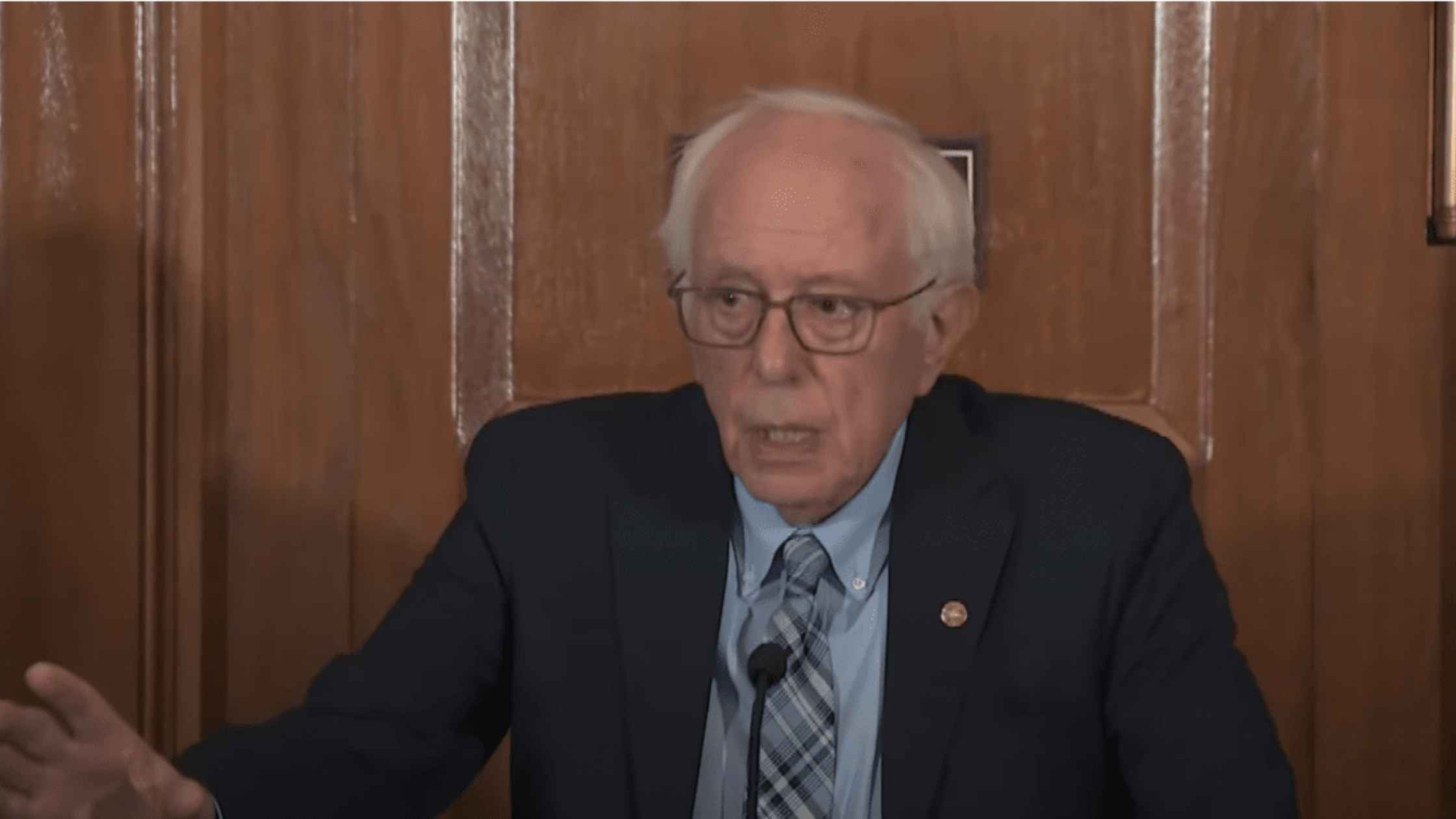
Bernie Sanders (00:00):
And I want to thank Heather Turbyne-Pollard, who is with the Center Circle Adult Day Services in Richmond, Virginia. Thank them all for the enormously important work they do for our seniors, and thank them for being with us today. And thank all of you for being here. It is no secret, I think to anyone, that the American healthcare system is broken. It is dysfunctional, and it is cruel. Today, we have 85 million Americans in the wealthiest country on earth who are uninsured or underinsured. One out of four Americans cannot afford to fill the prescriptions that their doctors prescribe. Our life expectancy is significantly lower than other wealthy nations. Some 60,000 Americans die each year because they can't afford to get to a doctor on time. And in fact, we don't have enough doctors, nurses, dentists, and other healthcare professionals. Meanwhile, because of the greed of the insurance companies and the drug companies, we are spending far, far more per person on healthcare than the people of any other country.
(01:14)
We are now over $14,000 for every man, woman, and child, which is an insane number and totally unsustainable. So what we have is a crisis in healthcare, and Trump's big horrific bill will make that crisis much worse. It will throw 15 million Americans off of the healthcare they presently have. So instead of providing healthcare to all people, throwing 15 million people off of healthcare, it will raise insurance premiums for millions of people all over the country, already paying sky-high prices. It could well cause the closure of many rural hospitals and community health centers all across our country, all of whom are significantly dependent on Medicaid funding. It will also, and the point of our discussion today, it will also have a major impact on nursing homes in this country. And that is an issue that has not gotten the kind of attention that it needs. And that's why we are holding this event today.
(02:32)
According to a study commissioned by the Department of Health and Human Services, 70% of seniors in an aging country, we are an aging country, will need some kind of long-term care during their lifetimes. This can include assistance with activities of daily life like eating, bathing, and dressing. In some cases, family members can provide this type of care, but it requires from that family member enormous time, effort, and skill. And when you are dealing with horrific illnesses like dementia or Alzheimer's, it is also terrible stress on that family member. And that is why families throughout the country seek our support through home healthcare providers, through senior centers or nursing homes. And let's be clear, even before the implementation of Trump's horrendous bill, nursing homes and long-term healthcare providers were already struggling. All right? So it's not like we had a great situation. We have a very bad situation, which is only going to be made worse.
(03:55)
When you cut Medicaid by over $900 billion, as this bill does, nursing homes and long-term healthcare providers will be losing a major source of their revenue. In other words, you have institutions all across this country that are struggling today, and now there's going to be a significant decline in their revenue. We're going to be talking in a moment from our guests about what those cuts will mean. According to a recent survey, as a result of this legislation, some 27% of nursing homes have indicated that they will be forced to close their doors, and 58% will be forced to substantially reduce staff at a time when many nursing homes are already grossly understaffed and under-resourced. When it comes to home and community-based care, the problem may be even worse because states aren't legally required to cover these services on the Medicaid. States could cut benefits for long-term home care altogether. And what does that mean for families across the country?
(05:08)
It means that people who need long-term care will probably rely on a family member to care for them. And what that will do is put enormous stress on family members. So right now, I want people to appreciate this. If you have a mom or a dad or somebody in your family who is in a nursing home or a home daycare center, if that person can no longer be in that facility and has to be at home, how does it impact you? Well, guess what? You're not going to work anymore. You're going to stay home, taking care of that family member. And if you don't go to work anymore, you're not having any income coming into your house. And how does that impact people in our country, 60% of whom are living paycheck to paycheck? So this bill is a disaster in general, it will be a disaster for nursing homes. And I want to introduce now people who know more about it than I do. And let's begin with Katie Smith Sloan, the CEO of LeadingAge. Katie, thanks so much for being with us.
Katie Smith Sloan (06:20):
Thank you, Senator. Thanks so much. So I want to start by acknowledging the significance of today, the 60th anniversary of the Medicare and Medicaid programs. So over these 60 years, both programs have supported the services, supports and care of literally millions of older persons. They are a lifeline. Medicaid is the primary payer of long-term services and supports. There is simply no other public option for the services provided in a range of care settings including nursing homes. So now let's talk about need. At present, older adults over age 65 represent nearly 20% of our population, and that percentage is steadily increasing. And as it does, the demand for services and care will grow. At LeadingAge, our nonprofit and mission-driven community-based member organizations are committed every day as they have been for decades to meet that demand, whether it be for care in a nursing home, home care in a private home, through PACE programs, or adult day centers.
(07:43)
Our members depend on Medicaid payments to deliver care and services, payments that even before the cuts did not cover the full costs of care. The undeniable fact is America's infrastructure of services and supports for older people was inadequate and unsustainable before passage of the 2025 Budget Reconciliation Act. The changes called for in the act and now law will weaken the existing system at a time when demand for services and supports is growing. Who will older adults and their families turn to when the services they need are not available because the funding has been cut, and when providers of services can no longer deliver them and have to shutter their doors? What will happen to the staff who are employed in many of these settings and who may themselves be on Medicaid or have family members who rely on it, who are now at risk of losing their healthcare coverage or possibly seeing their wages reduced? Here's the truth. The Medicaid provisions in this bill plain and simply erode
Katie Smith Sloan (09:00):
… road, an essential program, truly a safety net for millions of older people. As states respond to H.R.1, the changes will create craters in their budgets due to reduced federal Medicaid contributions and the effects will be felt by older adults and their families.
(09:22)
And here too, demographics don't lie. As the number of people over the age of 80 increases, the number of people of caregiving age, 24 to 65, shrinks. The supply of available caregivers is not keeping up with the growth of the older population. This is not a math problem. This is a reality that directly impacts our families financially, emotionally, and practically. Out-of-pocket costs, time away from work, or even lost jobs.
(09:59)
Medicaid cuts, which have been framed as a cost savings will result in an enormous expense to America's families. Today I'm joined by two leading-age members who will share the impact of H.R.1 on their services. While aspects of the impact are yet to be discovered, what we do know is that this legislation will establish more hurdles for providers whether through shortened retroactive eligibility or limits on the provider taxes states rely on to fund Medicaid or by the financial decisions states are forced to make. We can only look to history to understand this.
(10:42)
Historically, states' response to budgetary pressures have been to cut Medicaid eligibility, to shave benefits, or to cut provider payments to cover the costs of delivering care, which means fewer dollars to pay staff. Workforce challenges, for a variety of reasons, are long-standing in our sector. These cuts will only make it harder for our nonprofit mission-driven members to be competitive in the employment marketplace.
(11:13)
Most of us, I imagine, hopefully will never have to rely on services, supports, and care as we age. But the reality is most of us will. At LeadingAge, it's our belief that we have a moral and a practical responsibility as a nation to ensure everyone can access services, supports, and care that they need when they need it. Medicaid exists for this purpose. With the changes in the recent bill, the fundamental purpose has been shattered. The protection, not the destruction, of our nation's safety net infrastructure and the services it supports must be our priority. Thank you.
Bernie Sanders (12:05):
Katie, Thank you very much. Our next speaker is Deke Cato with AG Rhodes Nursing Homes in Atlanta, Georgia. Thank you.
Deke Cato (12:16):
Thank you, Senator Sanders. My name is Deke Cato and I'm the CEO of AG Rhodes. The story of AG Rhodes, which I'm going to tell you all a little bit about, is I think very interesting. We're a non-profit organization. And we serve mainly these individuals that are on Medicaid, and we've done that for 121 years. So 70% of who we care for are on Medicaid.
(12:44)
Medicaid has become and is the backbone of our healthcare system. For aging and senior services, it is the healthcare system. It is the only payer or the only real payer of long-term care. So that's 70% that I told you about that are on Medicaid. Medicaid is the only payer for them. And we are already vastly underpaid from Medicaid for taking care of them.
(13:14)
So any cuts, any changes, whether you disguise it as adjustments, is going to have a very immediate impact, and it's an impact that I cannot imagine what we're going to see in a few months from now, if these individuals are in any way displaced. If services have to be adjusted, services that are not now required, but that good providers, like LeadingAge providers go above and beyond to do, if these changes go to play, think about the staff that care for these individuals. Many, many of them do that for a love for caring for other individuals. They are going to be impacted by this as well.
(14:04)
I hear a lot of misnomers out there. One very big one is that individuals living in nursing homes who were not working before, they choose to come to a nursing home, they were not productive working citizens. Totally untrue. We serve about 1,300 individuals a year. I don't know not one of them that wasn't a teacher, that wasn't a nurse, that wasn't an engineer. They have worked most of their lives and now they're sick. Quite frankly, they're ill and they've spent their money down because of that illness. So Medicaid in the nursing home setting has become not only who pays for them to live with us, but who cares for them medically, who takes care of their medical needs.
(14:52)
So my purpose today is just that, hopefully to speak from my heart and hopefully speak to other people's hearts. This is certainly not about politics. It is about policy and what is and should be sound policy in a society that is aging, that we should be preparing for more of those on the rolls. And coming from a sector, coming from an industry that I think we've been beaten up recently. Whether it was the threats of a staffing mandate, I'm glad they have at least been postponed. Whether it's the threats of immigration now, which in my case 35% of my staff are immigrants. And then now on top of that, I would say the threat to our main payor source that keeps nursing homes open. So that's my appeal. And I hope, again, it falls on some hearts that can listen to it as well. Thank you.
Bernie Sanders (15:47):
Deke, thank you very much. Our next speaker is Heather Turbyne-Pollard with Center Circle Adult Day Services in Richmond. Heather, thanks.
Heather Turbyne-Pollard (16:02):
Thank you. Heather Turbyne-Pollard with Circle Center Adult Day Services in Richmond, Virginia. We are a non-profit and a proud member of LeadingAge. And really I'd like to talk about the unique niche that places like Adult Day and In-Home and other support services that fall outside of nursing homes, but other community-based. So these are home and community-based services. As the senator alluded to, these are electional and optional services for states then to dole out to local communities like me. It's a critical component.
(16:38)
Our non-profit, which is 50 years old, has been caring for largely moderate to severe dementia, those who are living with dementia and Alzheimer's, but are choosing to stay home, right? They're a community-based model that lets all of us, which is what I want and what you want probably, to age home as long as we possibly can. And so we serve 130 older adults at our facility. Medicaid is a large part of that. And currently, the reimbursement rate for the state of Virginia for Medicaid is $64.17. It is $150 a day for me to deliver that care. That is a math problem. And it's critical. And we're working with LeadingAge on increasing that state reimbursement. But now when we're faced with the chance of it getting reduced or eliminated, you can see, if you do the math along with me, how it may put home and community-based care folks like me on a business who grew up from community, started by five churches in Richmond, Virginia, and have evolved into a center in that's well-known in supportive services.
(17:52)
Senator Sanders talks about the caregiver, and it's so important. I could probably ask you to raise your hand or think to yourselves as you're watching,
Heather Turbyne-Pollard (18:00):
… watching, who of us knows somebody with dementia or Alzheimer's who we've cared for, right? We all have been touched by that. And so these caregivers are burdened with that. They're also working. 60% of our caregivers work and they need a community-based option by which to send their loved one. So adult day though it's a little known in the long-term care services continuum is a social model that offers health monitoring, a very important part of a staff that's well qualified to deal with dementia-friendly practices and education. We are an extended member of that family. Community-based care models like ours are extended care for families. So a very critical part of the component at a time when some others in front of me said we should all be turning up the dial on all the services across our continuum that can support older adults and their caregivers caring for them as they age. It's not the time to take that away from folks. So thank you for the opportunity.
Bernie Sanders (19:11):
Heather, thanks. First, let me start off, I think we'll have some questions coming. I want to start off with a question myself because I can't imagine that there are too many jobs more difficult than taking care of people with dementia or Alzheimer's. Can somebody say a word? What does that take out of… What does that require out of a caregiver?
Heather Turbyne-Pollard (19:37):
Thank you for the opportunity to speak on behalf of our caregivers. We talk with them every day. It is a joy, they would want me to say that. But it's also a heck of a burden. But psychological toll it takes when your husband no longer remembers your wedding day or your children's names. It is very, very heart-wrenching for them on a daily basis. And you can imagine sitting in that space with what am I doing? Am I doing the right thing? In addition to some of the behaviors, once you've met someone living with Alzheimer's, you've met one person living with Alzheimer's, right? My grandmother resorted to German, her tongue, which she never spoke to us and completely forgot English. So that's what it looked like for her. For others it looks very different.
(20:35)
So thank you for the opportunity, and I hope I've represented caregivers. It is a joyful job at times, but soul wrenching at many other times and they don't know how to deal with the disease as well. Like some of our staff people, long-term care service staff, we get trained to do that work and families don't.
Bernie Sanders (21:00):
Okay. Any questions from media? Yes.
Speaker 1 (21:04):
Excuse me. My name is Vivian with InsideHealthPolicy. I'm curious, you talked a lot about how these cuts are going to be negatively impacting senior care. I'm curious what cuts, specifically, what provisions in the bill are you most concerned about when it comes to…
Bernie Sanders (21:24):
Nursing homes receive what percentage of their revenue from Medicaid?
Speaker 2 (21:28):
70.
Bernie Sanders (21:30):
70%. That's what I'm concerned about. All right. Does anybody want specifically answer what these cuts will mean?
Deke Cato (21:39):
So in the nursing home setting, and I'm actually from the state of Georgia, that has not been as impacted particularly in the provider tax side, but the retroactive Medicaid provision, which we call Medicaid pending in the industry, is a huge, it's going from 90 days to 60 days, a 60-day period. We barely get someone approved now in a 90-day period, so going to 60 days, I can't see how that happens, during that period of time we are actually giving free care. So if that person's not approved.
(22:16)
The other huge concern I have is the bill obviously is pushing the responsibility straight onto the states, inside the states. And again, I come from a state that I think has been on the right side and will continue to be on the right side of aging. Nationwide we don't have many states that even have that fiscal position that Georgia has to be able to fill in those gaps. So again, any adjustments may not necessarily be cuts, but these are adjustments that would be extremely difficult. Even that retroactive process, we, the nursing home, is who is applying or assisting the individual to apply. That takes time. Most of these individuals, many living with dementia, they're not the best historians. We have to check their finances. We have to see if there are any other bank accounts. So it's a process that we do on behalf of the elder. So very, very onerous indeed.
Speaker 1 (23:15):
Thank you.
Bernie Sanders (23:15):
And all of this, once again, starts at a moment when nursing homes are struggling today, struggling to get staff, struggling to pay staff, the wages you would like to pay, et cetera. All right, other questions? Anybody else? All right, well let me thank our guests today. I want to thank them. We've heard the word moral and it's right. It seems to me, and I think to all of you, that in the richest country in the world we should take care of our most vulnerable citizens with the respect and compassion and dignity that they are entitled to often, as you've indicated, after working their entire lives, helping our society. And that is not the case today. So I want to thank you all for what you've done and let's go forward together. Thank you all.
Speaker 3 (27:00):
(silence)