
Speaker 1 (00:00):
(silence)
Tom McClintock (55:31):
... to watch these proceedings. Without objection, Ms. Miller and Mr. Lawler will be permitted to participate in today's hearing for the purpose of introducing witnesses. Hearing none, so ordered and without objection, Mr. Baumgartner will be permitted to participate in today's hearing for the purpose of questioning the witnesses if a member yields him time for that purpose. Without objection, so ordered. I'll now recognize myself for an opening statement. During this session, this subcommittee is focused on so-called sanctuary laws that put criminal illegal aliens back on the streets rather than turning them over to federal authorities for deportation as the law requires. The sole effect of these laws is not to impede general immigration enforcement, it is specifically to prevent deporting criminals. The toll of death and destruction caused by these policies is heartbreaking. As the death toll of innocent Americans continues to mount, Republicans will continue to avail victims' families the opportunity to describe the catastrophic impact that these policies have caused them.
(56:41)
Two of those families will address us shortly. One is the mother of Sheridan Gorman. On March 19th of this year, Sheridan Gorman, an 18-year-old freshman at Loyola University, went to a Chicago park with friends to watch the northern lights. Instead, she was shot by an illegal alien from Venezuela, allowed into this country by the Biden administration. Within months of the illegal alien's release at the border, he was arrested for shoplifting. Now, he should have been turned over to authorities for deportation then. Instead, Chicago's sanctuary law released him back into the community where he had no legal right to be and Sheridan Gorman is dead as a result. A few weeks ago, we heard from the mother of Stephanie Minter, murdered by an illegal alien with dozens of prior arrests, each time returned into the community by Fairfax County officials. Their excuse was that despite an $83 million annual budget for the county sheriff, they just didn't have the resources to pick up the phone and inform ICE that they had custody of an illegal alien so that alien could be deported.
(57:53)
When I asked them how much it would cost to make a simple phone call to ICE and whether Stephanie Minter's life was worth the cost of that phone call, I got no response. The murderer's multiple releases were also enabled by a far-left prosecutor who crafts sweetheart deals for illegal aliens so that they can avoid immigration consequences for their criminality. None of this makes any sense. Last year, these sanctuary jurisdictions refused to honor at least 17,864 ICE detainer requests of illegal aliens accused of committing other crimes. Instead, these aliens who had no right to be in this country were released onto our streets to re-offend at will. Illinois and California are just two examples of these renegade jurisdictions. Their refusal to cooperate with federal immigration officials terrorizes communities, incentivizes crime, and undermines the rule of law. In Illinois alone, 1 state in just 11 months, authorities blew off 1,768 ICE detainers and instead released these criminals back onto the streets despite crimes ranging from weapons offenses to burglaries to homicides.
(59:09)
According to documents detained by this committee, the Cook County Sheriff's Office alone released 408 criminal aliens from its custody in 2025 instead of honoring act of ICE detainers. Now the Democrats complain bitterly that we're focused on this tragedy. Well, I can assure them that the Republican majority will continue to expose the human toll of their policies until they are rectified. I'm sure we'll rehear their complaints that ICE arrests and communities have led to confrontations with violent demonstrators. But those arrests that require squads of officers and that put both officers and bystanders in danger would not be necessary if those aliens were turned over to ICE while in the custody of local law enforcement. They also tell us that refusing to cooperate with ICE fosters trust with the illegal alien population. Well, this begs the obvious question, can legal residents trust sanctuary jurisdictions to protect them and their families?
(01:00:11)
And by the way, a U visa is already available to illegal aliens who are witnesses or victims to crime. Early this year the Judiciary Committee passed the Shutdown Sanctuary Policies Act. It prohibits sanctuary jurisdictions from restricting communications with ICE about criminal aliens, it empowers local authorities and sanctuary jurisdictions to work with federal immigration officials, it forbids local jurisdictions from shielding criminals from ICE, it restricts certain federal grant funding to sanctuary jurisdictions that thwart federal law and it provides a private right of action for the victims of these sanctuary policies. All of that is simple common sense. We shouldn't need a bill to force state and local officials to protect American citizens over dangerous foreign nationals, yet not a single Democrat on this committee voted for that legislation. And in addition to the grieving families of Sheridan Gorman and Katie Abraham, who are here today, we are also joined by Sheriff Gary Redmond of Amador County, California, from my district.
(01:01:14)
He's dealing with an epidemic of illegal alien crimes centered on illegal marijuana grows and yet forbidden by state law from cooperating or even communicating with ICE to protect his citizens from this scourge. The Shutdown Sanctuary Policies Act would free him from these constraints. It's inconceivable that such a reckless and dangerous policy as these so-called sanctuary laws could be supported by a major political party. But as we will see again today, that's the current position of the Democratic Socialist Party, not a fringe element, but the actual elected representatives of that party. I look forward to hearing from our witnesses and I now yield to the ranking member for her opening statement.
Pramila Jayapal (01:01:56):
Thank you so much, Mr. Chairman. Let me start by offering my deepest condolences to you, Mrs. Gorman, and to you, Mr-
Ms. Jayapal (01:02:00):
... Bring my deepest condolences to you, Mrs. Gorman, and to you, Mr. Abraham, for the loss of your children. As a parent myself, I can think of no greater loss and I appreciate you being here to share their stories and their lives with us. Unfortunately, this hearing is the fourth time in this committee that we've had a hearing on sanctuary cities, the fourth time. And there's many other things that we could be doing other than this. I would've loved to have had some hearings on the unconstitutionality of the president's executive order on eliminating birthright citizenship. This is something that the Supreme Court just ruled today in a six three majority was unconstitutional and yet this was an executive order that caused so much fear and trauma across the country. We could have been discussing that, but we haven't. Instead, we have had this series of hearings that are designed to attack the very trust policies that research has shown over and over again have actually saved lives and kept communities safer by maintaining the necessary and important division between the enforcement of federal civil immigration laws and the enforcement of local criminal laws.
(01:03:21)
This division ensures that people don't fear law enforcement who try to enforce immigration law and that community members will actually come forward and be witnesses in these prosecutions to report crimes when they happen. The Trump administration, however, has ignored decades of research and has done the exact opposite. They've blurred the lines between immigration enforcement and law enforcement so much that they essentially no longer exist. They've destroyed trust in communities and created fear and even deported witnesses to important crimes so that then those crimes cannot be effectively prosecuted.
(01:04:02)
On top of that, the Trump administration has diverted over 28,000 officers from their critical law enforcement activities to work on immigration enforcement instead. This has led to non-immigration criminal prosecutions falling to their lowest point in decades. Gun prosecutions have fallen more than 10%. Investigators worked 33% fewer hours on child exploitation cases. Nearly one in every five FBI agents has been reassigned to arrest immigrants instead of conducting complex criminal investigations of corruption, espionage, terrorism, cyber attacks, and transnational gangs, all things that are necessary to keep Americans safe.
(01:04:53)
Similarly, around on every two drug enforcement agency agents, two and three Bureau of Alcohol, Tobacco, Firearms and Explosives Agents, and one in five US Marshals have all been reassigned to immigration enforcement. From within ICE, thousands of Homeland Security investigations, HSI agents are focused on immigration enforcement instead of their state admission of combating transnational crimes such as drug and weapons smuggling, child exploitation, and human trafficking. During the immigration enforcement surge in Minnesota, federal prosecutions of gun and drug offenses dropped by nearly 90%, 90%. DHS's former chief of staff says that as a result of all of this, our government is "asleep at the wheel and less prepared to stop terrorist attacks than at any point since 9/11." For what? For what? What are the results of that? Arrests of immigrants without a single criminal conviction surged by 770% and these immigrants of all immigration statuses get locked up or deported or disappeared at tremendous costs to you, the taxpayers and to the traumatized communities that are left behind.
(01:06:14)
That's not a public safety agenda. That's a public safety disaster. So let's just remind people about what this immigration enforcement strategy of this administration has led to. Under Donald Trump, ICE doubled in size. Instead of funding Americans' healthcare or housing or childcare, Republicans poured over $210 billion, $210 billion into ICE and CBP. DHS officers killed two US citizens in cold blood in Minnesota. Have we had a hearing on that? No, we haven't. They beat and detained countless US citizens for exercising First Amendment rights and broke down doors without a warrant in violation of the Fourth Amendment. ICE has imprisoned 400,000 people just in the interior of this country since Trump came in. Parents, children, military veterans, US citizens, people on valid visas and people who have never committed a single crime. The private prison companies who incarcerate these people get massive profits. They turn around and then contribute to Republicans and Trump's campaigns while maintaining the most horrific conditions inside the prisons that have led to a record 51 deaths in ICE detention just since President Trump took office.
(01:07:36)
So what does all this do for Americans? It hurts them. Their communities get torn apart. Their kids lose friends. Their businesses suffer from lack of workers and guess what? Americans actually lose jobs due to harsh immigration enforcement. The Brookings Institution looked at increased ICE enforcement in 86 metro areas in red and blue states and found that up to 297,000 American-born workers have lost their jobs as a result of ICE's increased enforcement. That all needs to stop. Our hearings should be on how public safety has been hurt thanks to this administration's policies or on holding people who killed and detained American citizens accountable or on the numerous times that this administration denies due process in violation of our constitution. That is what the American people want, not more of what we're doing today. More than 60% of Americans now disapprove of Donald Trump's immigration policies.
(01:08:36)
Americans want Trump and Republicans to focus on lowering grocery prices, stop giving tax breaks to billionaires while stripping healthcare from tens of millions of Americans. But just like Trump has insulted Americans by refusing to sign the most consequential bipartisan housing bill in a generation, calling it unimportant and a "yawn", he's insulting Americans by continuing these harsh immigration policies that hurt safety and hurt opportunity for all Americans. Republicans instead want to coerce states and localities into doing the federal government's job despite numerous court orders that have declared immigration detainers unlawful violations of the Fourth Amendment.
(01:09:20)
They want to force local police departments to prioritize their limited resources on immigration enforcement instead of encouraging all community members to come forward and report crimes without worrying about theirs or loved one's immigration status. I hope that this committee does hold hearings on the unconstitutionality of this administration's policies, but certainly when Republicans are no longer in office after November, we will do just that in the majority. I look forward to hearing from all of our witnesses today and I yield back.
Thomas McClintock (01:09:51):
Appreciate the warning. The general lady yields back. The chairs now please do recognize the chairman of the House Judiciary Committee for an opening statement.
Mr. Jordan (01:09:59):
Thank you, Mr. Chairman. We don't want to coerce anyone. We just want to stop the stupid policy of sanctuary jurisdiction that led to the tragedies that these families are going to testify and talk about today. Gentle lady from Washington, the ranking members said this is the fourth hearing on sanctuary jurisdiction. I'll have five, six, seven, eight. I'll have whatever amount of hearings it takes to stop a policy that is so ridiculous because understand, never forget what sanctuary jurisdiction is in the simplest of terms. Politicians tell local law enforcement, like Sheriff Redmond, "Don't work with federal law enforcement in enforcing federal law." That is dumb. And it's not only dumb, it results in bad things happening to families. That's why we're having the fourth hearing. And like I said, we'll do whatever, and my guess is the chairman is willing to do whatever amount of hearings it takes to get our legislation across the finish line.
(01:10:54)
Our sanctuary jurisdiction shutdown act of 2026. And understand this as well. It is a systematic ... I've said this every single hearing, all four times. It is a systematic plan of the lefts. Step one, they let in 10 million illegal migrants during the Biden administration. No border. Just let in 10 million people. Step two, create sanctuary jurisdictions all over this country. 18 cities, 11 states, three large counties like Fairfax County where the prosecutor there gives special deals to migrants who commit crimes, unequal treatment to Americans, frankly. Let in 10 million, create sanctuary jurisdictions, 18 cities, 11 states, three counties and the District of Columbia. And then step three, don't pay the guys who do the enforcement, don't pay ICE. They did that for 110 days. They wouldn't fund the guys who do the enforcement. That is their systematic plan. And you add the fourth step in these crazy prosecutors, soft unkind prosecutors who when an illegal migrant commits a crime, they won't work with federal law enforcement, let the guy back out and he does bad things. Just ask Mrs. Gorman. She's going to talk about that.
(01:12:08)
Again, I just cannot fathom why a party would embrace that mindset, that approach. So God bless Chairman McClintock. He's the sponsor of that bill. It's a good piece of legislation. We needed to pass the House, get to the Senate, get to the president and sign it so we can stop this nonsense that has led to such tragic things. With that, I will yield back. And again, I want to thank our witnesses for the share of the work you do. The families who've lost, god bless you. Thank you for being here. It's not easy, I know, but thank you for coming. And I know your member appreciates it, particularly Ms. Gorman, for you being here as well. And with that, I'll yield back to the chairman of the committee.
Thomas McClintock (01:12:49):
The gentleman yields back. I now recognize the ranking member of the full committee, Mr. Raskin, for his opening statement.
Mr. Raskin (01:12:54):
Well, thank you, Mr. Chairman, and thanks to all of our witnesses for being with us today. I especially want to thank Mr. Abraham and Mrs. Gorman for coming to speak about their beloved daughters who were criminally and savagely stolen away from their families. As a father, I too know the pain and devastation of losing a child and my heart goes out to you and to your families. Anyone who commits a crime must be held accountable swiftly and completely. And immigrants, whether lawful or undocumented who commit violent crimes must be deported at the end of their criminal sentences. Furthermore, we must end the polarization and dysfunction in Congress so we can pass comprehensive common sense immigration reform. We need to make it a whole lot harder for people to enter the United States unlawfully and a whole lot easier to enter the United States legally. Can we agree to an agenda around that?
(01:13:50)
And yet instead of working with us on basic common sense reforms to make dreamers, lawful residents, to fortify the border, to expand the categories for admission of lawful immigrants and to make sure DHS and ICE are properly focused on following the law and pursuing their basic self-proclaimed mission of keeping us safe from the worst of the worst, our colleagues are conducting an endless series of hearings on sanctuary cities. This is our fourth such hearing. And I'm not sure Republicans have even come to any agreement on what they mean when they use that spooky term. Last year, Trump's Department of Homeland Security published a list of nearly 400 counties that it classified as sanctuary jurisdictions. This caused an uproar with dozens of conservative sheriffs across the country. Their counties were named sanctuary jurisdictions simply because they had strong policies on upholding state's rights and rejecting unfunded federal mandates and strong policies against conscripting state and local officers to execute federal duties.
(01:14:57)
Stunned by this response, DHS removed the list days after it was published because a list of sanctuary jurisdictions defying the Feds could not possibly include so many conservative sheriffs from red counties who drew a strict line around on how much of their locally raised tax revenues and resources they should have to spend carrying out the federal government's immigration enforcement agenda and other constitutional responsibilities when the federal government has a budget far larger than they do.
(01:15:29)
Well, this was a telling collision between Republicans and Republicans for decades. Conservatives argued that the federal government could not impose unfunded federal mandates on localities or boss around state and local officials to force them to do the work of federal officers charged with enforcing federal laws. They even succeeded in the Prince case in 1977 to convince a conservative Supreme Court majority to hold that the 10th Amendment invalidated a provision in the Brady Handgun Control Act, which purported to compel sheriffs and police chiefs to conduct background searches on prospective gun buyers.
(01:16:10)
Justice Antonin Scalia found for the majority, a five-four majority that this provision violated the 10th Amendment, which prevents the federal government, he said, from commandeering state and local officers to use their official time and their local resources to implement unfunded federal mandates under the direction of federal officers. Justice Scalia asserted that this constitutional prohibition in the 10th Amendment was categorical.
(01:16:40)
He was unmoved by the heartfelt claims that the failure to integrate local sheriffs and local police into the federal machinery of gun policy enforcement would result in more gun violence, more death and more injury. The feds must enforce their own laws, Justice Scalia said. So this is precisely the same mistake which I think our friends across the aisle are making here. We've heard from some of the jurisdictions dragooned into Congress on their official time and their official salaries to participate in this endless sequence of repetitive hearings that they would notify and they do notify federal authorities of when any immigrant prisoner is set to be released from local jail.
(01:17:27)
And if asked, they arrange for them to be picked up and handed over right away to immigration authorities. No jurisdiction has given them a problem about that, but what the ones who've appeared before say they cannot do is hold such prisoners beyond the length of their judicial sentences for the convenience of federal officials, both because this practice turns state and local officials into de facto federal workers as Justice Scalia said you can't do reporting to ICE or the Department of Homeland Security instead of reporting to their own courts and also because they say. And certainly the people from Virginia who showed up at the last such hearing said they have no constitutional authority under due process or habeas corpus law to hold prisoners without arrest, prosecution and conviction. So the position they've taken, which doesn't seem at least to be unreasonable or deranged, simply they're very happy to work with the Feds to turn people over before their sentences are completed, but after their sentences are completed, they can't hold them.
(01:18:32)
So why are our colleagues so desperate to keep pulling this boogeyman of the sanctuary jurisdictions out of the closet? Well, perhaps it has to do with the fact that they voted to give DHS more than a quarter of a trillion dollars to improve immigration enforcement. And America has watched as the Department of Homeland Security has used this staggering pile of money to waste on luxurious private jets for the secretary complete with bedrooms and bars on overpriced and ultimately useless industrial warehouses to detain human beings that are now being sold off at a massive loss to the taxpayers on a glitzy $220 million public relations horseback photo shoot and ad campaign for a glamorous Department of Homeland Security Secretary who called the slain citizens Alex Pretti and Renee Good terrorists. MAGA Rubins have done nothing as ICE has abused hundreds of billions of dollars to arrest, beat up, shoot and even kill American citizens for exercising their First and Second Amendment rights.
(01:19:42)
They've allowed ICE to ignore its duty to keep us safe from the worst of the worst and instead gone after kids and parents coming home from kindergarten, rape survivors who just finished testifying in court and volunteers at Catholic Church soup kitchens. ICE's indiscriminate and chaotic immigration enforcement has also undermined the ability of state and local prosecutors and law enforcement to keep their own communities safe and to deliver justice to victims of crime. They are deporting crime victims as well as key witnesses and informants without any notice to state or local police and prosecutors. As a result, investigations are being thwarted, criminal trials are being thrown into disarray and American communities are less safe. House Judiciary Democrats put out a report called Acquitted By Removal: How Trump's mass deportation agenda abandons crime victims and allows the perpetrators to void justice, which I recommend that all of you check out.
(01:20:40)
Not only is DHS not making our community safer, it's making us worse off. A recent study found that the metro areas most targeted by ICE in both red and blue states had suffered losses of nearly 670,000 jobs, up to 44% of which were held by American citizens. The immigration Roundup is profoundly costly to our communities. The administration's attacks on so-called sanctuary jurisdictions are hurting Americans from all walks of life. One can only regard with amazement the fact that rather than own up to this disastrous record, my colleagues are trying to change the subject and blame the failures of the Department of Homeland Security not on Kristi Noem and her dysfunctional accomplices and successors, but on the state and local jurisdictions, which did not create the problem, have no real power to address it and are constitutionally protected from being impressed into service, as Justice Scalia said, by an illegal commandeering policy passed by Congress.
(01:21:40)
DHS has a quarter of a million employees and a budget larger than that of 150 countries on earth. It has over 80,000 sworn law enforcement officers, more than the number of officers in New York, Chicago, LA, Houston, DC, Las Vegas and Dallas combined. But despite all of that, our colleagues think that state and local jurisdictions should be using their money and their funds to do the Department of Homeland Security job for them. If our colleagues are serious about public safety, they should join us in imposing guardrails on ICE to refocus their energy on going after the worst of the worst and to ensure that they respect the fundamental rights of every US citizen.
(01:22:18)
They should reinvest in public safety programs that the administration has cut that supported local law enforcement, assisted victims of crime and gone after organized crime drug traffickers and they should push back on the president's shocking abuse of the pardon power, which has allowed drug traffickers and international narco dealers and criminal fraudsters to walk free depriving victims and taxpayers of nearly $2 billion in unmet restitution.
(01:22:46)
Last Congress, we came together to craft a bipartisan border security bill. President Biden agreed to sign it, but then candidate Trump blew up the deal because he wanted a crisis to run on more than he wanted an actual solution. Sadly, since then, our colleagues have been doing more of the same, holding hearing after hearing on the same topic, failing to pass their signature border bill or even their bill to coerce and commandeer sanctuary cities to do their bidding. I look forward to hearing from our witnesses today and hope that we can rejoin together in doing the work of the American people. Thank you, Mr. Chairman.
Thomas McClintock (01:23:19):
Without objection, all other opening statements will be included in the record and we'll now introduce today's witnesses. By the way, I'll note that permitting off committee members to introduce witnesses is not something our committee normally allows. I'd ask the members please folks their remarks on introducing the witness and refrain from making a broader speech on the topic of today's hearing. I'll begin by recognizing Ms. Miller to introduce Mr. Abraham.
Ms. Miller (01:23:43):
Thank you, Mr. Chairman. I'm honored to introduce my friend and fellow Illinois resident, Joe Abraham. One year ago, Mr. Abraham sat in the House Oversight Committee hearing as Illinois Governor JB Pritzker defended his administration sanctuary policies. I had the opportunity to address that committee and question the governor. I will never forget seeing Mr. Abraham in the room, a grieving father seeking answers after losing his daughter to a tragedy that was entirely preventable. As he will share with this committee, the Illinois governor's refusal to enforce our nation's immigration laws contributed to the death of his youngest child. Katie Abraham, who has been described by her father as having a beautiful soul and a large personality, was killed in the early hours of January 19th, 2025 by an intoxicated illegal alien who crashed into the car carrying Katie and her friends.
(01:24:48)
Despite unimaginable grief, Joe Abraham chose courage over silence. He has become a powerful advocate not just for Katie, but for families across America who believe their voices are being ignored and for the victims whose stories deserve to be heard and for Americans who expect their government to fulfill the most fundamental responsibility to protect its own citizens. You could not have picked a better witness, Mr. Chairman. Joe will provide this committee with a firsthand account of the consequences of the left sanctuary policies and why we must never forget its victims. Mr. Chairman, thank you.
Thomas McClintock (01:25:33):
Gentlelady yields back. I now recognize Mr. Lawler to introduce Mrs. Gorman.
Mr. Lawler (01:25:40):
Thank you, Mr. Chairman, and thank you for having me at this important hearing. I'm here today to introduce Jessica Gorman. Jessica should not be here today. She should not be testifying before Congress. She should be back in New York with her daughters, Madeline and Sheridan enjoying a quiet Tuesday afternoon in the summer. But unfortunately, Jessica is here with us today and she's here because just a few short months ago, her beautiful daughter, Sheridan, was shot and killed in Chicago by an illegal immigrant. I cannot say it loud enough or clear enough, but this nation and this Congress owes you an apology. We are sorry to you, to Tom and to Madeline.
(01:26:37)
I didn't know Sheridan personally and that's a tragedy, but I know her family and I know the Yorktown community. I know that she was a kind and compassionate young woman who cared about her community and had a bright future ahead of us. And I know without a doubt in my mind the incredible things she would've done with her life should she had been given the chance. Her murder was senseless. It should not have happened. Our immigration policies exist for a reason and they should have been enforced. Sheridan would still be with us today and Jessica would not have to testify before this panel. Our immigration laws facilitate legal immigration processes to ensure that good, smart people can come into this country, assimilate and contribute to our communities while also ensuring that criminals who break the law do not get to stay. Their jobs are made infinitely harder when places like New York and Chicago blatantly disregard existing law and provide safe harbor to criminals. Sanctuary policies are the reason-
Ms. Jayapal (01:27:56):
Mr. Chairman, point of order. This is a statement. Not an introduction.
Thomas McClintock (01:27:58):
Gentleladies point is well taken. Gentlemen, please confine his remarks to the introduction.
Ms. Jayapal (01:28:03):
Thank you.
Mr. Lawler (01:28:05):
Back in May of 2023, over three years ago, Sheridan's murderer illegally entered the United States. Border Patrol caught him. They apprehended him. But then because of the Biden administration's ludicrous open border policies, he was released into our country. A month later, he was arrested for shoplifting in Chicago. Under existing law and the law at the time, he should have been deported right then and there.
Mr. Jordan (01:28:36):
Point of order, this is not an introduction.
Mr. Lawler (01:28:38):
And if Chicago were abiding by our federal laws-
Mr. Jordan (01:28:41):
Point of order, this is not an introduction. It's a speech.
Mr. Lawler (01:28:43):
You should be ashamed of yourselves. This is disgraceful.
Ms. Jayapal (01:28:47):
Mr. Chairman, we had-
Mr. Lawler (01:28:48):
This mother is here precisely because you have failed to do your job. Wonder why we had four hearings? It's because you don't understand the consequence of sanctuary policy.
Ms. Jayapal (01:29:00):
Mr. Chairman, unfortunately we won't give our approval for people to introduce their constituents if people don't stick to the rules. So I appreciate the chairman's insistence that we stick to the rules and that you have the opportunity to introduce your constituent, which I think you have done.
Mr. Lawler (01:29:17):
Right. And introducing my constituent is-
Ms. Jayapal (01:29:17):
So thank you very much, Mr. Lawler and Mr. Chairman.
Mr. Lawler (01:29:19):
... sharing the details of her death. You may not want to hear the details. It may be an inconvenience to you but these details matter.
Thomas McClintock (01:29:28):
The gentlemen will suspend. We have an agreement with the minority that the introductions will be introductory only. So if I could just ask for the gentlemen to make that introduction and conclude.
Mr. Lawler (01:29:40):
Sure. When you send your kid to college, you should be worried about making sure they go to class or hopefully that they have a nice roommate or how to help them get a summer internship. Not worry that illegal immigrants are shooting them while they're out with their friends looking at the northern lights. It is shameful that we are here, not because this is the fourth hearing, but because we need to have four hearings to make people understand the real life consequences of the disastrous sanctuary city policies. So while some of my colleagues may not want to hear the truth, the same outrage you feel about Renee Good and Alex Pretti you should feel about Sheridan Gorman-
Ms. Jayapal (01:30:35):
Mr. Chairman, would you please end this.
Mr. Lawler (01:30:36):
... and Laken Riley and every angel family in this country.
Mr. Raskin (01:30:40):
I do feel that outrage.
Mr. Lawler (01:30:42):
You do not because if you did, you would not support sanctuary jurisdiction.
Mr. Raskin (01:30:45):
Do you feel the outrage about Alex Pretti and Renee Good? You should be ashamed of yourself. If you don't belong in this committee, you should get the hell out of here.
Mr. Lawler (01:30:52):
You should be ashamed of yourself. You're a disgrace.
Mr. Raskin (01:30:52):
You don't understand the rules of committee. You don't understand the constitution.
Mr. Lawler (01:30:55):
You're a disgrace.
Mr. Raskin (01:30:56):
You're full of it.
Thomas McClintock (01:30:56):
Mr. Raskin-
Mr. Lawler (01:30:57):
You're an absolute disgrace supporting sanctuary policies.
Mr. Raskin (01:31:00):
Say one word about Alex-
Mr. Lawler (01:31:01):
Get rid of sanctuary policies.
Mr. Raskin (01:31:03):
Say one word about Alex Pretti and Renee Good.
Mr. Lawler (01:31:03):
I did. I wrote a whole New York Times [inaudible 01:31:06] about it. You should be absolutely ashamed of yourself-
Mr. Raskin (01:31:10):
Okay, then follow the rules of the committee.
Mr. Lawler (01:31:10):
... for not opposing sanctuary policies that resulted in their daughter's death.
Thomas McClintock (01:31:14):
The committee will be in order.
Ms. Jayapal (01:31:15):
Mr. Chairman, I just want to say we will not allow, thanks to Mr. Lawler's outrageous outbursts, we will not allow this to happen again. This was an agreement between the chair and the ranking member and unfortunately, you're not able to control your members, so it is time for us to proceed.
Mr. Lawler (01:31:31):
Your opening statement was outrageous. You should be ashamed of yourself. I yield back.
Ms. Jayapal (01:31:37):
[inaudible 01:31:37]. Get off of it.
Thomas McClintock (01:31:39):
Let's try to conduct ourselves in a civil manner.
Ms. Jayapal (01:31:42):
Speak that to your member, Mr. Chairman.
Thomas McClintock (01:31:44):
We have two other introductions to make, which I think will go a little more smoothly. One is Ms. Sarah Pierce, who's the director of social policy at Third Way. She previously worked at US Citizenship and Immigration Services and has served as senior counsel for the Senate Committee on Homeland Security and Governmental Affairs. Ms. Pierce has a bachelor's degree from Grinnell College, a master's degree from the Elliott School of International Affairs and a law degree from the University of Iowa College of Law. And finally, we have Sherif Gary Redmond, who's been the Sheriff of Amador County, California since 2021. He's a veteran of the US Air Force.
(01:32:25)
Sheriff Redmond's career includes service with the Los Angeles Police Department and nearly three decades with the Amador County Sheriff's Office. He's a graduate of the Sherman Block Supervisory Leadership Institute and the Federal Bureau of Investigations National Academy held in Quantico, Virginia. On a personal note, I'll add that Sheriff Redmond has been a leading advocate in California to sound the alarm over California sanctuary laws as we'll hear. Sheriff Redmond and many of his fellow sheriffs want desperately to cooperate and coordinate with ICE but are forbidden from doing so by state law. With those introductions, we'll now-
Thomas McClintock (01:33:00):
... so by state law. With those introductions, we'll now welcome our witnesses, thank them for appearing today and we'll begin by swearing you in. Would you please raise and raise your right hand?
(01:33:14)
Do you swear or affirm under penalty of perjury that the testimony you're about to give is true and correct to the best of your knowledge, information, and belief so help you God?
(01:33:23)
Let the record reflect the witnesses have answered in the affirmative. Please be seated.
(01:33:28)
Please know that your written testimony will be entered into the record in its entirety. Accordingly, we ask that you summarize your testimony in five minutes and we'll begin with Mr. Abraham.
Joe Abraham (01:33:40):
Chairman, ranking members, and members of the committee, thank you for the opportunity to testify. For most Americans, January 19th, 2025 was just an ordinary day. For my family, it was a day that our lives were permanently altered. That night, my 20-year-old daughter, Katie, was riding with friends in Urbana, Illinois, visiting University of Illinois friends going to that college. The vehicle was stopped at a red light. They were exactly where they were supposed to be. They were obeying laws and posed a danger to no one. In a matter of seconds, an intoxicated illegal immigrant driving nearly 80 miles an hour crashed into the back of their idle vehicle. Katie was killed. Another young woman was killed. Three other young people suffered serious injuries.
(01:34:39)
My daughter's future ended in that intersection. Katie was bright, compassionate, athletic, and deeply loved. Today, instead of watching her graduate from college this year, begin a career, build a family of her own, we visit and tend to her grave.
(01:35:03)
The individual responsible, Julio Cucul-Bol, a Guatemala national who was previously deported and reentered illegally in the United States in 2022. After the crash, he fled, leaving the death and destruction behind him, but was later apprehended in Texas.
(01:35:26)
As devastating as Katie's death is, what brings me here before Congress is not what happened that night. It's everything that happened before it. A previously deported individual illegally returned to the United States, remained here, obtained a Illinois driver's license, and ultimately killed two women. Those are not my opinions, those are facts. During court proceedings, Bol testified through an interpreter that he could not read, write, or speak English or Spanish. He communicated primarily with K'iche, an indigenous Mayan Guatemalan language. Imagine the struggles of translators there.
(01:36:15)
Yet he was issued a Illinois driver's license, which raises serious questions. How was competency evaluated? Whether public safety was even a concern, any protocols followed. Accountability cannot change what happened to Katie, but it can help prevent similar tragedies.
(01:36:49)
My parents came to America legally more than 60 years ago from a developing country. Like millions of lawful immigrants, they believed America was a nation governed by laws rather than political convenience. They respected the process because they respected the country. They taught me citizenship carries obligations, the laws exist for a reason, and that government has fundamental responsibilities to the people it serves. When government fails in that responsibilities, real people bear the consequences. My daughter was one of them.
(01:37:29)
The central question before this committee to me is straightforward. Did failures in immigration enforcement, government coordination, public policy, increase preventable risks to American citizens? These are not partisan questions. They are oversight questions. They are public safety questions. Too often, immigration debates become about systems and policies while victims fade into the background.
(01:37:58)
Katie was not a statistic. She was my daughter. She should still be alive today.
(01:38:07)
Congress can't undo what happened to Katie, but it can examine what failed, demand transparency from government agencies and public officials, insist that policies be judged not by their intentions, by their outcomes. Katie lost her future January 19th, 2025, my family lost ours with her. I ask this committee to demand full transparency, identify the failures that allowed a previously deported individual to illegally return, remain in this country, obtain a driver's license, and ultimately kill two young women. Hold government accountable, strengthen coordination between federal, state, and local authorities, and judge every policy by one simple question. Would this better protect the next Americans stopped at a red light? Thank you.
Thomas McClintock (01:39:05):
Thank you for your testimony. We'll next hear from Ms. Pierce.
Sarah Pierce (01:39:11):
Chairman McClintock, Ranking Member Jayapal, thank you for the opportunity to speak today. I'd like to start by saying Mr. Abraham and Mrs. Gorman, I'm incredibly sorry for your losses. No one should suffer like your families have suffered and I honor and admire your bravery in being here today. My name is Sarah Pierce. I'm director of social policy at Third Way. Third Way has a long history of saying things that both Democrats and Republicans dislike, so let me start there. The Biden administration's border policies were inexcusable. The Trump administration's interior enforcement policies are also inexcusable. My testimony today focuses on why. I have three main points.
(01:39:53)
First, sanctuary policies do not prevent ICE from enforcing federal law. Every jurisdiction, including self-proclaimed sanctuaries, participates in immigration enforcement. When someone is booked, fingerprints are checked against federal databases and ICE has access to that. ICE has federal authority, agents, databases, and now extraordinary funding, 113.5 billion in supplemental funding through 2029. This is more than the combined operating budgets of every local law enforcement jurisdiction in America.
(01:40:29)
Meanwhile, state and local law enforcement are starved for resources. Three quarters of local police departments have fewer than 25 officers. They handle crime, overdoses, sensitive community calls. Asking them to absorb federal duties pulls them away from their local obligations. The focus should be on how cooperation can advance public safety and support local policing.
(01:40:52)
Second, this administration is making cooperation harder not easier. Local jurisdictions need to trust federal partners before they lend them local resources, yet this administration has treated skeptical jurisdictions as adversaries to be punished, not partners to be persuaded. This administration has threatened funding, filed lawsuits, and accused entire jurisdictions of protecting criminals. ICE's tactics have deepened this trust deficit. The public cannot distinguish between police and ICE, especially when ICE is wearing police markings. When federal operations are chaotic, abusive, or deadly, local police are left to repair the damage.
(01:41:35)
Third, this administration's own decisions are making Americans more vulnerable to crime. Federal law enforcement are abandoning serious work in favor of immigration enforcement. In San Francisco, federal drug dealing prosecutions fell by more than half after federal agents were redirected to immigration enforcement. In Minnesota, Hennepin County's top prosecutor said federal agents were bringing criminal cases to her because they were too busy with immigration work. In addition, tens of thousands of federal agents with specialized experience in child exploitation, human trafficking, arms trafficking, and violent crime have been diverted from their primary public safety missions to instead focus on immigration enforcement.
(01:42:18)
That's especially dangerous for child exploitation cases which require specialized resources and personnel. When those agents get reassigned, children wait longer to be found and predators get more time to harm them.
(01:42:31)
The Department of Justice is also weakening public safety infrastructure by delaying and canceling grants. Each year, the Department of Justice grants billions for police hiring prosecutors and victim services across the United States. Congress provided more than 4.5 billion for fiscal year 2025 grants from the Department of Justice's Office of Justice Programs. But now, nine months later, less than half of that has gone out the door.
(01:42:59)
Notably, for the majority on this committee, the states you represent are missing 163 million in congressionally authorized public safety funding from last year. That money still has not gone out to Alabama, Arizona, California, Kansas, Missouri, New Jersey, North Carolina, South Carolina, Texas, and Wisconsin.
(01:43:20)
The administration has also terminated more than 820 million in public safety grants, cutting initiatives on rural crime, officer safety and wellness, anti-terrorism training, and more than half of federal gun violence prevention funding. For grants that are going out, new ideological conditions related to political priorities like vaccines, gender ideology, and protection of public monuments are discouraging applicants from even applying.
(01:43:49)
I urge this subcommittee to broaden its oversight and stop treating sanctuary fights as a substitute for all public safety oversight. Demand a course correction, restore the grants to your own states. Stop diverting specialized agents from serious crime and rebuild trust that local law enforcement need. Thank you and I look forward to your questions.
Thomas McClintock (01:44:08):
Thank you for your testimony. We'll next hear from Sheriff Redman.
Gary Redman (01:44:14):
Distinguished members of the committee, today I would like to share my perspective on the impacts illegal immigration has had on a small rural counties such as Amador. Located in California's gold country east of Sacramento, Amador covers 594 square miles and is served by just 54 sworn deputies and approximately 40 correctional deputies. Providing public safety services across such a large geographic area presents unique challenges.
(01:44:40)
From 1999 through 2015, I served eight years as a SWAT operator and another eight years as a SWAT team leader responsible for high-risk search warrants and tactical operations. During that time, many large scale illegal marijuana cultivation operations in Amador and neighboring counties were controlled by the Mexican drug cartels. These organizations frequently utilize individuals who had been smuggled into the United States to work at cultivation sites. Many of these individuals were armed and on occasion have engaged law enforcement officers.
(01:45:12)
These operations pose significant risks not only to law enforcement personnel but also to the public. Amador attracts more than 20,000 visitors annually to it streams, rivers, lakes, hiking trails, and campgrounds. Hikers and outdoor enthusiasts have encountered illegal cultivation sites and armed individuals. Cartels also smuggled banned pesticides into the region, causing substantial environmental damage and harming local wildlife.
(01:45:42)
Between 2015 and 2025, Amador County investigated 73 illegal marijuana cultivation operations involving individuals to be believed unlawfully present in the United States. Arrest or charges resulting from those investigations include 173 individuals, Asian origin, persons from China, Thailand, Cambodia, Laos, Vietnam, 53 Mexican nationals, one Venezuelan national, two Ukrainian nationals, two South African nationals, and one Guatemala national.
(01:46:15)
Since President Trump returned to office and federal immigration enforcement priorities have changed, we have cooperated with ICE to the fullest extent permitted under California's SB 54 sanctuary law. As sheriff, my highest priority is protecting public safety. In early 2025, I made the decision that I would not knowingly release an undocumented criminal offender who posed a significant public safety risk back into the community even if doing so placed me at odds with SB 54.
(01:46:47)
On September 2nd, 2024, my office received a report involving a 14-year-old girl who disclosed to her cousin that her uncle, Diaz Mendoza, age 48, had been touching her over her clothing in the vaginal area. A deputy responded to the lake where she was present, interviewed the visibly distraught victim. She reported the abuse had been occurring for approximately five months outside of Amador County. My deputy interviewed the suspect and established probable cause to arrest him for felony lewd acts involving a minor. Two days later, the suspect appeared in court and was released by the judge.
(01:47:23)
In 2025, I was informed by our probation department that Diaz Mendoza had entered into a plea agreement negotiated by an Amador County Deputy District Attorney. The agreement reduced the case to a misdemeanor offense with credit time served and suspended probation sentence. I was advised that the plea agreement was structured at least in part because of my publicly stated position regarding cooperation with ICE and the likelihood that ICE would be notified upon his release. Upon learning of the plea agreement, I immediately contacted ICE and requested the agents take him into custody upon his release from court. Due to the limited notice, ICE was unable to respond that day. However, agents did locate and arrest him approximately two weeks later. We subsequently informed the victim and her mother, both of whom expressed appreciation for our efforts and relief, that he would no longer have access to this 14-year-old victim.
(01:48:20)
Since 2025, I have contacted ICE eight times regarding removals authorized under SB 54 within my jail. Additionally, under SB 54, I have been required to release 16 individuals arrested for low-level offenses that did not meet the requirements of SB 54. My greatest concern as sheriff is that one of these individuals may re-offend and cause another preventable tragedy such as Laken Riley and the people that are here with me to my right and my left, preventable. In my view, public policy should prioritize accountability for criminal offenders, protection for victims, and the safety of law-abiding citizens. I believe it is long overdue that we place greater emphasis on victims' rights, hold offenders accountable, and ensure that public safety remains our highest priority. Thank you.
Thomas McClintock (01:49:19):
Thank you for your testimony, Sheriff. And finally, we'll hear from Mrs. Gorman.
Jessica Gorman (01:49:23):
Hi, my name is Jessica Gorman. I'm the mother-
Thomas McClintock (01:49:26):
Can you turn on your microphone?
Jessica Gorman (01:49:28):
Oh. Hi, my name is Sheridan Gorman. I'm sorry. My name is Jessica Gorman. I'm the mother of Sheridan Grace Gorman. Sheridan was 18 years old. She was a freshman at Loyola University Chicago. She was beautiful, she was funny, faithful, loving, full of plans to build something with her life. On March 19th, Sheridan went with friends to the lakefront in Chicago because they hoped they might see the Northern Lights. She never saw those lights. The man accused of murdering my daughter is Jose Medina, an illegal immigrant from Venezuela who should not have even been in this country. And even after committing a crime and having an outstanding warrant, he was left on the streets of Chicago to murder my innocent American child.
(01:50:11)
But this story, it's not about him. This story is about my Sheridan. It's about how failed border policies, sanctuary city laws, and twisted leaders refused to cooperate with ICE. They sent her to her grave. It's about a government and politicians that forgot their first priority. And the question before this committee is painfully simple. When did protecting our American citizens stop being your first priority? And even more important, why did protecting our American citizens stop being your first priority? I want an explanation, I need one and I deserve one.
(01:50:46)
But first, I want you to know who my Sheridan was. I want you to understand what we all lost because of your mismatched priorities. My husband and I have always joked that our older daughter, Madeline, is our pride. Well, Sheridan was our joy. From the moment she was born, Sheridan was pure energy, enthusiasm, laughter, fun. She was the kind of person who made every room brighter and usually a little louder, which is why when Sheridan was in kindergarten, I remember going to her first parent-teacher conference. I was a little nervous because while she was the sweetest little girl you could possibly imagine, she was also the chattiest. I remember sitting down across from her teacher, bracing myself and asking with bated breath. "So how's my Sheridan?"
(01:51:35)
I'll never forget when the teacher looked at me very seriously and said, "I only have one thing to say to you." My stomach dropped. Then she said, "Your Sheridan stalks the buddy bench." I remember blinking at her. "I'm sorry, what?" She said, "Your Sheridan stalks the buddy bench." I was totally confused and I asked, "Is that a good thing or is that a bad thing? And what exactly is a buddy bench?" And the teacher smiled and said, "It's a beautiful thing."
(01:52:05)
She explained that they had a bench in the play yard. She said that, "Not all kids are as outgoing and confident as your Sheridan, so the children were told that if they wanted to play or if they felt lonely, left out, shy, they could sit on that bench. And then the other children were told that if they saw someone sitting there, they should go over, talk to them, ask them to play." And apparently Sheridan, my tiny kindergartner, had appointed herself the guardian of that bench. Every day at recess, instead of heading straight to the swings or joining in a game of kickball, my daughter hung back and hovered by the nearby tree, just watching that bench, just waiting just in case someone might need her.
(01:52:45)
Kids didn't even have a chance to fully sit down on the bench before Sheridan was rushing over to take them, to take their hand, pull them away. Girls, boys, first-graders, kindergartners, it really didn't matter to her. If a child looked lonely, Sheridan went over. If someone had no one to play with, Sheridan was there. If someone felt invisible, Sheridan saw them. That was my daughter and that is who she was until the day she was stolen from us.
(01:53:15)
And I honestly can't make sense of it. I cannot make peace with it. And in what world does the child who spent her life making sure no one was lonely died terrified and alone on a pier in Chicago? In what world does the girl who saw everyone become invisible to the people and power responsible for protecting her? This cannot be explained away and it cannot be buried beneath the list of unrelated issues that you all paraded before us.
(01:53:41)
Thanks for telling me without telling me that you're here but you don't want to be. This is the fourth. This is the fourth time you had angel families. Thanks for telling me you don't care. This cannot be buried under your slogans, your statistics or excuses, and this just can't stand. So today I bring this back to the buddy bench. I think Congress needs one. I think every governor, every mayor, every sanctuary city official, and politician shifting blame and interest, hiding behind their slogans and talking points should have to all sit on one. And I challenge you all to sit down with me, take my hand, look me in the eye and then explain to me because I just don't understand. Explain why people here illegally matter more than your American citizens. Explain why sanctuary policies matter more than my Sheridan's life. Explain why cooperation with ICE was too much to ask for, but asking our American parents to bury our children is somehow acceptable. Ask me. I need you to tell me.
(01:54:46)
I want you to imagine that that little girl on the buddy bench, that innocent college freshman with a heart full of compassion and a head full of dreams that was gunned down by an illegal immigrant, I want you to imagine that was your daughter, not mine. What if she was yours? Would you even hesitate for one second to act or to make changes? My Sheridan spent her whole life choosing others. Today I'm just asking this committee, this committee and our Congress and our country to choose her. She was worth protecting, she was worth saving, and she was worth your brave vote.
(01:55:24)
To all of those who have supported us, who've prayed for us, who have cried with us and to those who have had the courage to speak out and say Sheridan's name, thank you. Because every time you say her name, you give a piece of her back to us. You remind the world that Sheridan was not a talking point. She wasn't a statistic or a headline. She was our daughter. She will always be my sweet sunshine. And if the people who failed her would rather look away then I'm asking the rest of you to look right at her. Here she is, there's she and I. Here she is, this is taken the day before she died.
(01:56:03)
Say her name, tell her story and demand better because my Sheridan Grace Gorman should still be alive and no mother should have to stand where I am standing, begging, begging elected leaders to value my child's life after it's already too late.
(01:56:24)
I cried when I came into the room. I saw this poster that you made. It says, "At every stop, the system had a chance to stop him." At every step, it failed and my daughter paid for those failures, your failures with her life. No family should ever have to bury a child because public officials fail to put American lives first. I'm just asking you to choose us. We choose you. We choose you. Choose us. Why does my child matter less than an illegal immigrant? Why?
(01:56:56)
Listen, I have a heart. I love immigrants. Two of my best friends in this whole world are immigrants. They came here the right way. I absolutely think they make America beautiful, but my daughter's beautiful too. I need you to think about what these policies are and I need you to imagine this is your daughter because I'm very sure you won't be cutting off anyone when they're speaking. I'd be very sure you won't call this a political stunt. The grief is real. Every day I wake up with unimaginable pain. You know what I wake up in the middle of the night and I think? Did my daughter cry for me? She made it 40 feet. She made it 40 feet, running for her life. Did she cry out for me? She died on that pavement all by herself, lonely, bleeding on that pavement. And I will never, ever rest. I actually have to say that I am devastated, my husband and I. We're only a couple years away from retirement, I've worked my whole life so hard. All I wanted to do was just enjoy our children, just wanted to enjoy my Sheridan, my Madeline.
(01:58:07)
And now I'm bitter. I'm bitter because I'm a lover, not a fighter. I'm a lover. I love children, I love pumping people up and making them feel good about themselves. I'm not racist, I'm not xenophobic. We've done everything right, my husband and I. We taught our daughter to be wonderful, beautiful person. Her love was extravagant. And now I'm going to have to spend my last waking moment I'm going to have to spend fighting, fighting against these policies, fighting for people to say her name.
(01:58:42)
So if you have the courage, please come talk to me. Come sit on that bench. I'll buy Congress a bench. Talk to each other. Talk to each other. We shouldn't be screaming across the room. I mean, we also shouldn't say but, because I have to just say, and I understand that you're here for a reason. I don't understand why it's only the Republican side that cares about our American children. And I know that you're a mother, I know that you're a father. I deeply value that.
(01:59:12)
But basically what you just did, what you said was, "I'm so sorry for your loss. I have a daughter too. I have a son. I feel your pain." You don't. You don't feel my pain because the next words out of your mouth were but. There's no but. When your child is in a coffin, there's no but. And I need you to understand that. And if you ever want to talk about it, I'm here. I'm going to buy you a bench. I'm going to buy, I can put that on the record, I'm going to buy Congress a bench and they can come and sit and hold my hand and look me in the eye and explain to me why illegal immigrants are more important than my daughter. I really want to know because I don't understand. Please, I welcome you. I will listen. I will listen. I care. I care. I just need you to explain it to me because I don't and I fear I will never understand. Thank you.
Thomas McClintock (02:00:05):
Thank you for your testimony. I can't imagine how difficult this appearance is for you and we thank you for being here today.
Jessica Gorman (02:00:12):
Thank you for listening.
Thomas McClintock (02:00:14):
And we'll now proceed under the five-minute rule with questions and we'll begin with Mr. Tiffany.
Thomas Tiffany (02:00:19):
Thank you, Mr. Chairman. Thank you, Mr. Abraham and Mrs. Gorman for being here. We are proud to cite the names of Sheridan and Katie here before this Judiciary Committee hearing. And Mrs. Gorman, would you say you, your neighbors, and your community are safer when a government protects violent criminals and illegal aliens over Americans?
Jessica Gorman (02:00:49):
No.
Thomas Tiffany (02:00:51):
Same question, Mr. Abraham.
Joe Abraham (02:00:53):
No, they're not.
Thomas Tiffany (02:00:55):
Mrs. Gorman, do you believe that your state or this country is safer when criminal illegal aliens are released into our streets?
Jessica Gorman (02:01:03):
No.
Thomas Tiffany (02:01:05):
Mr. Abraham?
Joe Abraham (02:01:05):
No, not at all.
Thomas Tiffany (02:01:08):
So in my home state of Wisconsin, we had a terrible situation, not unlike what you're experiencing, where there's a sanctuary community in Dane County that allowed an illegal immigrant from Venezuela, let him free and he was arrested over 100 miles away in a little community, Prairie du Chien, Wisconsin. The charges were domestic violence, sexual assault, child abuse, and strangulation. Fortunately, the woman did not die, but it had to be horrific.
(02:01:48)
So when thinking about that, that we should be concerned with neighboring communities, should places like Missouri and Indiana and Iowa and Wisconsin be concerned when there's sanctuary policies that are on our borders that may affect us, when we see it happen in our own state 100 miles away from a sanctuary jurisdiction? Should we be concerned, Mr. Abraham, with those policies being carried out in the state of Illinois?
Joe Abraham (02:02:22):
If you care about your citizens, you should be concerned.
Thomas Tiffany (02:02:25):
Mrs. Gorman.
Jessica Gorman (02:02:30):
I sent my daughter to Chicago because I thought it was safe. You hear all the rhetoric and the politics. I sent her there because I thought she was safe. No, she wasn't safe. It never would even occur to me that this could have happened. Yes. Mr. Abraham talked about, as a parent, you worry. I worry about car accidents. You worry that they'll drink too much. You never even conceive that she would be murdered, shot in the back of the head by an illegal immigrant on a pier going to see the Northern Lights with their friends. It's not even something you can even conceive.
(02:03:06)
And I just have to say one thing because it's been plaguing me and this is how messed up the situation is. This is why I'm sorry, I get so upset with your buts and you don't want to talk about this. This is the fourth hearing. Do you know what I'm thankful for? And this is so messed up. I'm going to say I'm thankful, after hearing, I didn't even know what an angel family was, had no idea, never even heard about it. There's so many out here. You know what I'm thankful for? I'm thankful that my daughter was just shot in the back of the head, not raped, murdered, dismembered, put in a garbage can like Megan Bos with bleach poured on her and they didn't find her for 50 days. And you can actually dismiss the angel families, you can say but. You don't want to hear four sessions on angel families. I'm sorry, you need to. You need to.
(02:03:56)
I'm actually thankful that my daughter wasn't raped. How messed up is that, that I'm thankful every day that she was just murdered-
Jessica Gorman (02:04:00):
How messed up is that that I'm thankful every day that she was just murdered, not raped and dismembered? Think about that. How messed up is that?
(02:04:09)
Do you know what I thought of this morning when I got up? Anyone have a baby here? The joy of picking out their first outfit that they're going to wear on their ride home from the hospital. I had to pick out my daughter's last outfit, and she was a fabulous dresser. We had 100 people come to our home, 100 friends and family came to her home. We had her cremated actually after, and they all decorated her urn with rhinestones. All of them put it on there, "She's fabulous even in death."
(02:04:40)
But the first time, all the excitement of having a child and then having people make excuses and buts. I'm sorry, this is unacceptable. There are so many angel families out here, and the day that I have to wake up and be thankful that my daughter was only shot and not raped should tell you something. It's crazy.
Speaker 2 (02:05:02):
Thank you, Mrs. Gorman. And by the way, you used the term sorry early on when you answered that question. You never have to apologize. Never apologize for the story that you are delivering to the American people.
Jessica Gorman (02:05:15):
I have-
Speaker 2 (02:05:17):
Mr. Chairman, I yield back.
Jessica Gorman (02:05:18):
Sorry.
Mr. Chairman (02:05:19):
Gentleman yields back.
Jessica Gorman (02:05:20):
Can I just say one thing? I am sorry. I'm sorry I have to be here. I'm sorry. I'm actually, like I said, I'm a lover. I'm a lover, not a fighter. I'm not a public speaker. I'm not someone who ever speaks out about things. I actually am very bitter that I have to be here, number one, but now I'm going to have to fight for my daughter. I'm sorry that I have to be here and that I have to even oppose anyone.
Mr. Chairman (02:05:44):
Ms., thank you.
Jessica Gorman (02:05:45):
It's crazy.
Mr. Chairman (02:05:46):
Ms. Jayapal.
Jessica Gorman (02:05:47):
Sorry.
Ms. Jayapal (02:05:48):
Thank you. Thank you, Mr. Chairman. I think I want to go to a statement that you ended with, Sheriff Redmond, that I agree with, and I believe this is how you said it as well, it's in your written testimony. " Public policy should prioritize accountability for criminal offenders, protection for victims, and the safety of law-abiding citizens." I agree with that and I think everybody on this side agrees with that.
(02:06:11)
I think the question really is what creates that environment most effectively? And I spent some time in my opening statement, and I know you did as well, Ms. Pierce, talking about how resources are getting taken from different parts of Department of Homeland Security, other law enforcement, federal law enforcement agencies in order to do a immigration enforcement that has really focused largely on people who don't have any convictions, but more importantly, in this context of sanctuary jurisdictions, has actually hurt law enforcement's ability to do its job at the local level.
(02:06:53)
And so I wanted to go to this question about, the central question here is not about whether there should be justice for Mrs. Gorman and Mr. Abraham's daughter's murderers. There absolutely should be. I don't think there's any disagreement about that anywhere on this bench, Democrat or Republican. The central question is what gets us that accountability across the board for everybody?
(02:07:19)
And so the Trump administration's approach has been to force every state, city, and locality to use their resources, precious resources, quite small in many jurisdictions, to enforce federal immigration law.
(02:07:35)
In Mr. Abraham's case, that sounds like a State of Illinois issue, but the whole question of where local law enforcement prioritizes resources and what keeps us safer, my question for you is does the Trump administration's approach to immigration enforcement, which is forcing local jurisdictions to enforce immigration law, is that what keeps us most safe and prevents the kinds of things we're hearing about today?
Sarah Pierce (02:08:07):
No, it does not. And I agree. The central question here is not only just about accountability, right? It's about public safety. What can keep us all the safest? And so there's a few different problems with what the Trump administration is doing and how they're approaching that, and I'll touch on two of them.
(02:08:23)
The first is the redirection of federal resources to immigration enforcement above violent crimes. This administration has moved tens of thousands of federal law enforcement officers away from their primary duties of going after human trafficking, of going after child sexual exploitation, of going after cyber crimes, terrorism, violent crime, and instead focus them on immigration enforcement.
(02:08:48)
And that immigration enforcement work unfortunately is not focused on the worst of the worst, rather it's focused on rounding up as many individuals as possible. So we're neglecting terrorists and we're instead focusing on individuals who have violated civil immigration law.
(02:09:05)
The second issue is that this administration is bullying jurisdictions to fully cooperate with immigration enforcement despite those jurisdictions' considerations about their own resources.
(02:09:17)
Police departments have limited resources and they use those to decide how much and what level of cooperation they're going to give to the Trump administration. Not only that, they need to look at their relationships with their communities.
(02:09:31)
Is a certain level of cooperation with ICE going to harm the trust that they have established with their local communities? Is it going to redirect the priorities that they've decided are best to keep safety in their communities? Those are the things that these local jurisdictions need to decide before they decide what level of cooperation they'll give ICE. And unfortunately, this administration doesn't seem to want to acknowledge that, they would rather bully these jurisdictions into that full cooperation.
Ms. Jayapal (02:09:56):
As well as concerns about how much they would have to pay in lawsuits if what they do is actually unconstitutional.
(02:10:02)
Why is it dangerous to have policies in place? This gets at the community trust piece. Why is it dangerous to have policies in place that prevent huge swaths of the community, both undocumented folks as well as family members or friends of undocumented people who may live in the same household, from feeling secure and calling 911? What happens in that situation to the safety of all community members?
Sarah Pierce (02:10:27):
So police can't be everywhere, right? They rely on community members to be their eyes and ears, to report crimes, to be witnesses, to provide testimony. And when those individuals are no longer willing to cooperate with the police, when they think that a call to 911 is going to make their lives worse, that means that those police, their reach into that network, into the community is then limited.
Ms. Jayapal (02:10:53):
Thank you. My time has expired. I yield back.
Mr. Chairman (02:10:56):
Mr. Biggs.
Mr. Biggs (02:10:57):
Thank you, Mr. Chairman. I thank the witnesses for being here today. Mrs. Gorman, thank you. Particularly Mr. Abraham, thank you. And I appreciate, Ms. Gorman, the way you called folks across the aisle out.
(02:11:09)
I want to tell you that this isn't just the fourth hearing. We actually had a field hearing in Phoenix, Arizona on this where we had angel families come in and testify. Do you know how many from Democrats came? Not one. Zero. No one came. They didn't care enough to come to that field hearing. What a shame. What is it? It's really too bad. They needed to hear what has gone on. I think we had seven families at that one.
(02:11:39)
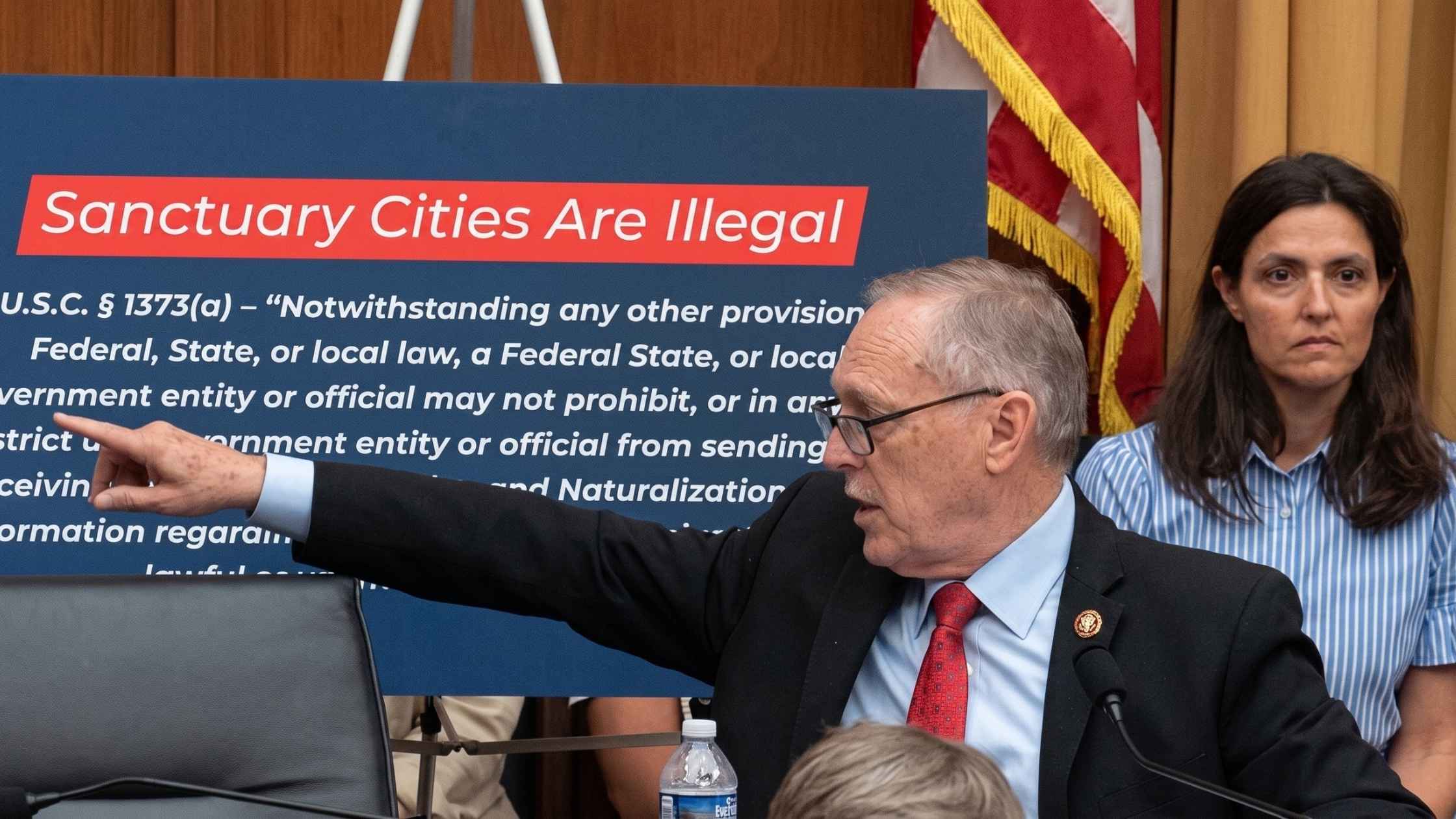
Well, so federal law, we got it up here, right here, a little bit low behind me here, it says, "Clearly no city, county, or state can block its officers from sharing immigration information with the federal government." It's not complicated.
(02:11:51)
Ms. Pierce, Illinois TRUST Act tells local officers they cannot share information with ICE. Is that a direct violation of federal law?
Sarah Pierce (02:12:03):
It is not. 8 U.S.C. 1373 directs that local officials cannot restrict officials within their jurisdiction from sharing information about immigration status.
Mr. Biggs (02:12:17):
So if Illinois' law, their TRUST Act, which says they cannot provide information in response to any immigration agent's inquiry or request for information regarding any individual in the agency's custody, they can't provide that, you don't think that's a violation of 1373(a)? And I guess that's why things are so screwed up.
(02:12:38)
And let me just tell you that we're going to go along here and talk about Sheridan Gorman and Katie Abraham because I'm telling you and I'm asserting that this has not been settled by any court. Your statement's not been settled by any court, and it's under review still, and I don't believe that the families of Sheridan or Katie or any other angel family would say, "Yeah, you should be allowed to withhold information."
(02:13:09)
That's what you saw in this particular case. Sheriff Redman. You ever see that your state, they're trying to prevent you from providing this information to ICE or other federal authorities?
Gary Redman (02:13:20):
Yes, sir.
Mr. Biggs (02:13:21):
Give us an example, please.
Gary Redman (02:13:24):
So we're able to share some limited information. The gentleman that I call them gentlemen, the suspect that was arrested in my jurisdiction for the lewd acts with a child, that information under SB 54 that I provided to them, I was not legally able to provide that information.
Mr. Biggs (02:13:48):
So we've got a set of facts here. Jose Medina-Medina entered this country illegally. He had no address, no ID, and no legal status. Went to Chicago, he was arrested for shoplifting. Chicago had him in custody. ICE was never notified.
(02:14:08)
He walked out the door, got an OR if I understand right. Never showed back up for his court date. Nobody went looking for him because that's the way it is, it's a shoplifting case. Nobody's going to go look for a shoplifter.
(02:14:24)
Less than three years later, he shot Sheridan Gorman in the head in a Chicago park. Now, you got 8 U.S.C. 1324 makes it a federal crime to knowingly conceal, harbor, or shield an illegal alien from detection.
(02:14:40)
Were those facts met, do you think, Ms. Pierce? When Chicago took Medina-Medina into custody, they knew he was in the country illegally, they knew he had a criminal charge pending, they released him back onto the street. Did they shield? Do you think that was shielding?
Sarah Pierce (02:14:54):
No, sir. When Medina was booked into custody, those fingerprints were shared with the Department of Homeland Security and with ICE. ICE had access to that information.
Mr. Biggs (02:15:04):
Did they transfer him to ICE? The answer is no.
(02:15:08)
So the question would be at what point does systematically refusing to notify ICE, knowing an individual is unlawfully present, has a criminal record, cross into shielding someone from detection? That's really the question here.
(02:15:22)
And you can take that position and say, "Well, you know what? We just don't think that's right." And that's what a sanctuary jurisdiction does. They say, "We're not going to provide that information. If ICE has a detainer, we're not going to transfer them to them," because they want only a criminal arrest warrant. They don't want an ICE hold, they don't want ICE detainer, they want an actual criminal arrest warrant. Those are two distinctive things. But what you do is, is you allow a very dangerous illegal alien back on the street, wreaking havoc in our communities. And that's the piss and shame of it all.
Mr. Chairman (02:16:06):
Gentleman's time has expired. Mr. Raskin.
Mr. Raskin (02:16:09):
Thank you, Mr. Chairman. Ms. Pierce, I remember when we started this term of Congress and Elon Musk and DOGE wiped out about $500 million of grants that were going to victim assistance groups, crime fighting groups, local police departments. Nobody could quite explain why the particular DOGE employee did that, but they wiped out about a half a billion dollars of grants going to help the families of victims and to try to stop crime.
(02:16:41)
Can you discuss what happened there? What were those grants? Why did that happen and what kind of effect does that have when money that we've appropriated from Congress for this purpose and the grants or program, they're wiped out, what effect does that have?
Sarah Pierce (02:16:56):
Sure. So it was actually 820 million in Department of Justice grants that they canceled, 500 of million of which had already been granted. So that means the organizations that were receiving those grants had already started hiring staff, renting spaces. The communities that were going to receive those public safety grants had already started relying on that money coming in, and all of that was wiped away.
(02:17:18)
I've recently been working with the Victim Rights Law Center, which is an amazing non-profit organization in Massachusetts. They have lost three attorneys so far because of the way that the Department of Justice is messing with these public safety grants. That means victims, hundreds of victims of sexual assault and rape no longer have attorneys because that public safety funding has disappeared.
Mr. Raskin (02:17:39):
But it's not just victim assistance groups, it's also crime fighting groups and police departments had millions of dollars of grants that were canceled, correct?
Sarah Pierce (02:17:47):
Absolutely.
Mr. Raskin (02:17:48):
Is my recollection.
Sarah Pierce (02:17:50):
Yes.
Mr. Raskin (02:17:50):
So have the Office of Justice Programs grants from fiscal year 2025 been reinstated and distributed?
Sarah Pierce (02:18:01):
So we were talking about earlier about canceled grants, right? There's another problem with the Department of Justice grants in that they have significantly slowed down the amount of grants that are growing across the United States, not only for organizations, but also for police departments. And the fiscal year 2025 Department of Justice grants that go through the Office of Justice programs have not been fully granted.
Mr. Raskin (02:18:24):
But why is that happening?
Sarah Pierce (02:18:25):
I don't know. The Department of Justice has not spoken to why this has happened. This is an unprecedented thing that has caused disruption across our country, and the Department of Justice is not telling anyone why they have been delaying this. It's more than $2 billion in grants that have not gone-
Mr. Raskin (02:18:41):
2 billion, did you say?
Sarah Pierce (02:18:43):
2 billion.
Mr. Raskin (02:18:44):
So what would that $2 billion have been able to do for local police forces around the country?
Sarah Pierce (02:18:50):
It would be used to hire officers, it would be used to train officers, it would be used to support officer wellness programs. It would be used to support resources for law enforcement, such as body cameras, different things that they desperately need.
Mr. Raskin (02:19:08):
Our system is complex because it's a federal system. So we have national government, Department of Justice, federal policies, and then we have state and local policies. And you described this tension, this hostility that's creating problems. Can you discuss how jurisdictions normally cooperate with the federal government in different ways and how does it best work?
Sarah Pierce (02:19:34):
Sure. So, I mean, talking specifically about immigration enforcement, like I said during my testimony, every single law enforcement jurisdiction across the United States cooperates with immigration enforcement. Every time someone is booked, that information is sent to the Department of Homeland Security and to ICE, and then jurisdictions from there need to decide how much more of their local resources they will lend to ICE and immigration enforcement to help ICE do its job.
Mr. Raskin (02:20:02):
Okay. Will you just help us understand the different resources that are available to the federal government and then to local government police forces?
Sarah Pierce (02:20:11):
Sure. So as I said during my testimony, this Congress has provided ICE with 113.5 billion to do their job to enforce immigration law in the United States, and that is more than the combined annual operating budget of every single local law enforcement jurisdiction in America.
(02:20:31)
So we're talking about local police departments that have limited amount of resources, and their primary duty is public safety, their primary duty is not immigration enforcement. Meanwhile, we have a federal agency who has a budget larger than all but four militaries in the world, and their primary duty is civil immigration enforcement.
Mr. Raskin (02:20:52):
So what would you suggest we work on on a bipartisan basis in Congress in order to reduce criminal violence by undocumented immigrants? But in general, because there are people suffering these tragedies generally across the country, what can we do to bring down the crime rate generally and all of the violence?
Sarah Pierce (02:21:14):
Those resources that ICE receive should be targeted at the biggest public safety threats, right? We shouldn't have a federal agency that is running amuck across the United States trying to fulfill a quota to get as many people into detention and deportation as possible. That's not making us safer.
(02:21:31)
In addition, we need a federal government that's willing to work with local law enforcement jurisdictions. We have had ICE in the past have compromise and communication be their primary driver when they're working with local jurisdictions. That goes a lot farther than the bullying that we're seeing from this administration. That only increases the distrust that we're seeing at the federal level between the federal level and the state and local level.
Mr. Raskin (02:21:56):
Thank you. Yield back, Mr. Chairman.
Mr. Chairman (02:21:58):
Mr. Roy.
Mr. Roy (02:22:00):
Thank you, Chairman. Thank you for holding this hearing. Mr. Redman, thank you for your service in law enforcement. Ms. Gorman, Mr. Abraham, sorry for your loss.
(02:22:08)
I've gotten to know all too often too many angel families, too many people in my home state of Texas who have lost loved ones due to the absolute abject failure of leaders in both parties, to be very clear, but I'll be a little partisan here, and very specifically, the previous administration in particular and my colleagues on the other side of the aisle and their absolute refusal to secure the border.
(02:22:28)
And Ms. Gorman, it struck me that you noted that we had this poster, and it alluded to the extent to which the federal government in particular and law enforcement in this country failed you and failed your daughter, more importantly, at multiple levels across the board.
(02:22:46)
And I think that's really important, especially in light of the questioning we just heard from the ranking member of the full committee with Ms. Pierce, who's appearing before us here today.
(02:22:54)
Ms. Pierce, now, you've worked previously for USCIS in the previous administration, is that correct?
Sarah Pierce (02:23:01):
During both the previous administration and this administration, yes.
Mr. Roy (02:23:03):
And you have been testifying here at the questioning about the resources and the lack of resources for local law enforcement and grants not being given out, but then dollars that have been set aside for ICE.
(02:23:15)
The question here is how much taxpayer funds should have to be spent right now? How many taxpayer dollars of current American taxpayers should have to be spent to go round up illegal aliens?
Sarah Pierce (02:23:28):
I think unfortunately the better question is how that money should be spent, not how much.
Mr. Roy (02:23:33):
Wait a minute. Wait a minute, no, no, I actually think it matters how much, because with all due respect, Ms. Pierce, you were working under the previous administration, if I remember correctly, with safe mobility offices. Safe mobility offices.
(02:23:46)
Now, these were offices that were directed and designated towards helping people move through our security system to get to the United States, to end-run the processes along the way, to exploit asylum laws, to exploit parole laws in order to funnel people into the United States. That was precisely what was happening in the previous administration. We know this to be true.
(02:24:09)
And then to sit here and listen to this exchange about what we're doing with our resources really strikes me as pretty hypocritical, given the extent to which we have dangerous people in the United States that have been killing innocent Americans because the previous administration and the people who worked for it were working directly, specifically to end-run the laws of the United States, putting the dangerous people on the streets that resulted in the death of Ms. Gorman's daughter and Mr. Abraham's family.
(02:24:40)
I've gotten to know Jocelyn Nungaray as a dear friend, or her mother, Alexis Nungaray, as a dear friend for the loss of her daughter, Jocelyn. We're well advised of Lake and Riley, we're well advised of those who have lost [inaudible 02:24:54] Kayla Hamilton, and many others, and we're hearing more here.
(02:24:57)
And you're right, Ms. Gorman, we can't have enough. We can keep having hearings and keep allowing these people to put the pictures up of the people who have been murdered because we allowed our borders to be used as some sort of plaything.
(02:25:11)
And now today the United States Supreme Court manufacturing out of thin air a complete abomination of a ruling by the Chief Justice suggesting that you can simply become a citizen from being born on dirt, thereby validating the abhorrent practice of baby factories and moving people here to be born to be able to become a citizen, leaving us under no choice but to do what we must do to say pause immigration, just stop it, stop all immigration.
(02:25:44)
Because if it's going to be exploited for people to come here when they're pregnant, if it would allow somebody who's working for the Chinese Communist Party and to come here and have children to become American citizens and then have our laws exploited like they were under the previous administration, it is why this Congress should act to pause all immigration.
(02:26:03)
This Congress should act immediately to codify what the president has been doing to close the loopholes under asylum and parole, the catch and release policies, and to codify those that a future Biden and Mayorkas administration cannot do to the American people what these radical leftists did to the American people, and then dare sit here and testify under questioning by my colleagues that we need to have more taxpayer money going to the local jurisdictions to make up for what they caused. And then criticize the administration in this Congress for putting money aside for ICE and Border Patrol to do the job that administration wouldn't do.
(02:26:45)
And by the way, get that funding by having to figure out how to use reconciliation to do it, because Democrats refuse to appropriate money to secure our communities and to make sure that our people would not be murdered.
(02:26:59)
It's the absolute chutzpah to be here testifying, having had a hand in South America, working to end-run our laws and put people into the United States that resulted in the deaths of the American people. I yield back.
Mr. Chairman (02:27:14):
[inaudible 02:27:14] yields back. Mr. Nadler.
Mr. Nadler (02:27:18):
Mr. Chairman, let me begin by offering my deepest condolences to Ms. Gorman and Mr. Abraham. The loss of a child is unimaginable and is something no parent should ever face.
Mr. Chairman (02:27:30):
Yeah. [inaudible 02:27:30].
Mr. Nadler (02:27:31):
Mr. Chairman, Republicans want to coerce states and localities into furthering the Trump administration's extreme anti-immigrant agenda. But with masked agents murdering American citizens in the streets and tearing children away from their parents, and detention facilities that have their highest death rate in decades and fail to meet the basic medical and sanitary needs of detainees, it is no wonder that many states and localities have chosen not to use their limited resources to aid and abet the Trump administration's reckless, chaotic, and inhumane mass deportation campaign.
(02:28:05)
Some communities have concluded that certain forms of cooperation with federal immigration authorities such as detaining immigrants past their sentences without a judicial order raise constitutional concerns and can even put them at risk of legal liability.
(02:28:20)
In many cases, states and localities have determined that taking on the federal responsibility to enforce immigration laws would destroy trust between immigrants and local law enforcement, which would make everyone less safe.
(02:28:33)
They believe that their communities are at greater risk when a victim of domestic violence is afraid to ask the police for protection from her abuser for fear of deportation. Or when witnesses to a murder refuse to assist law enforcement in tracking down the perpetrator because they're afraid their immigration status will be discovered. But Republicans actually want to punish these communities by denying them billions of dollars in funding that they need to protect public safety.
(02:28:59)
And federal immigration authorities are perfectly capable of enforcing federal law on their own. In fact, they are swimming in money. Congress has given them $240 billion in little more than a year with no guardrails attached.
(02:29:15)
With this money, these agencies have assembled a massive force consisting of tens of thousands of agents who have flooded our streets to carry out Donald Trump's brutal and reckless campaign to strike fear in immigrant communities across the country. That is what the committee should be examining today.
(02:29:33)
Ms. Pierce, immigration enforcement is the responsibility of the federal government, and DHS has unprecedented resources and historic levels of funding. Does the federal government have the resources and personnel necessary to enforce immigration law or does it need to usurp state resources?
Sarah Pierce (02:29:53):
As you said, sir, ICE has unprecedented resources. I think at the moment we should assess what they can do with those resources before we have them usurp local resources.
Mr. Nadler (02:30:04):
Thank you. Ms. Pierce, the Trump administration claims that it's only going after the worst of the worst and targeting criminals, but according to ICE's own data, the majority of immigrants they have detained have no criminal record. In fact, this administration's mass deportation agenda is wreaking havoc on communities across the country, and now Republicans want to force state, cities, and localities to participate in this lawless and dangerous scheme. Is the-
Speaker 3 (02:30:32):
Will the gentleman yield?
Mr. Nadler (02:30:32):
No. Is the Trump administration really going after the worst of the worst?
Sarah Pierce (02:30:36):
No, sir. According to ICE's own data, more than 70% of individuals in detention have no criminal records, and another recent analysis said only 3% of those individuals in detention have violent criminal convictions.
Mr. Nadler (02:30:49):
Ms. Pierce, can you explain why administrative ICE detainers often raise constitutional concerns and can create liability for states, cities, and localities?
Sarah Pierce (02:31:00):
Because they don't create new legal authority for a new detention. If an individual is done with their criminal custody, then the local law enforcement agency needs a new authority to continue detaining that individual.
(02:31:12)
A detainer is just a suggestion from ICE or a request from ICE that that local jurisdiction continue to hold that individual. It doesn't create a new legal authority, and as a result, some jurisdictions have had to pay hundreds of millions of dollars in civil liabilities and settlements for holding individuals beyond the time that they were supposed to be released from custody.
Mr. Nadler (02:31:32):
Thank you, Ms. Pierce.