

Robert F. Kennedy Jr. (00:00):
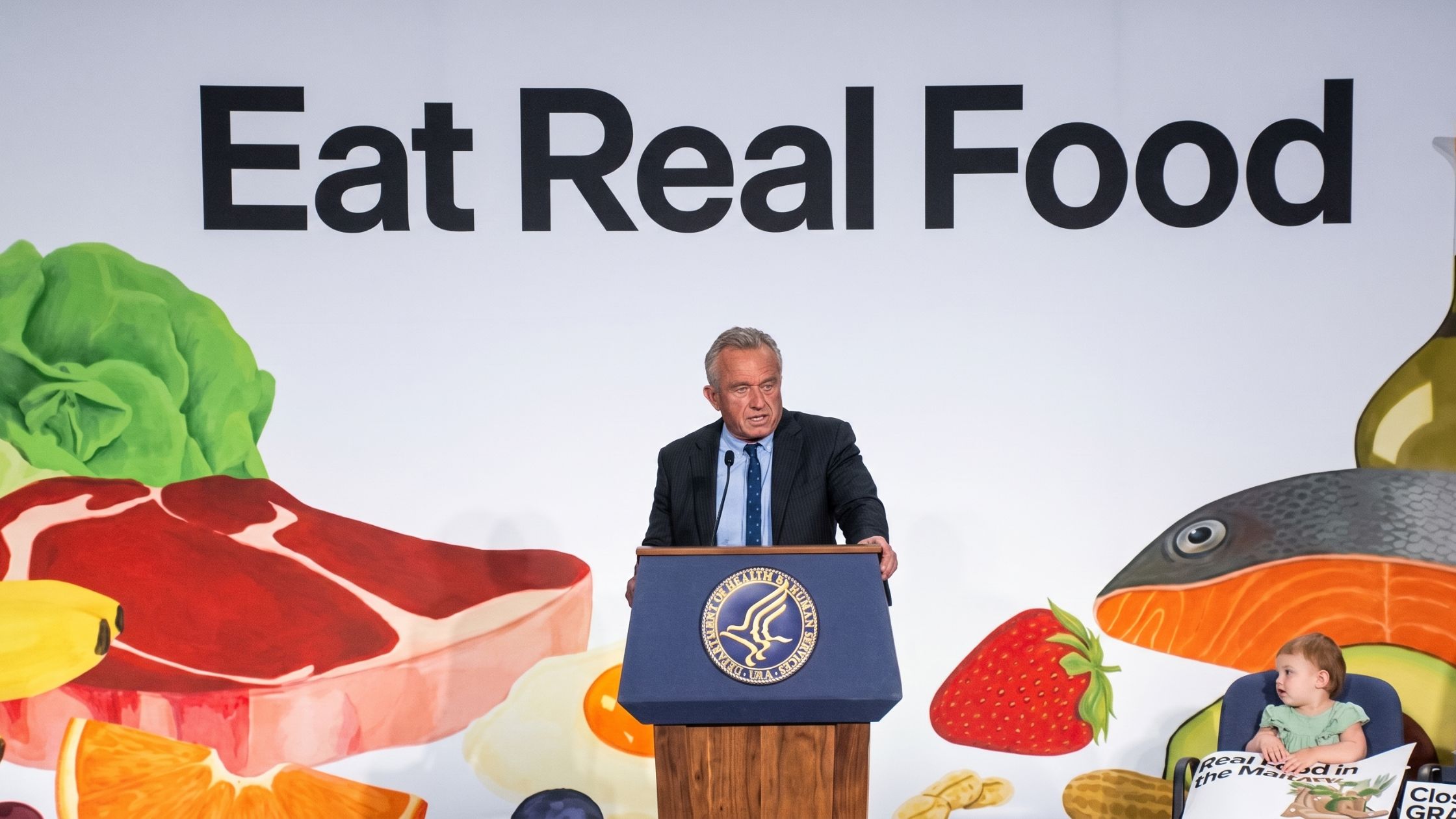
Hello, everybody. Thank you all for being here. I know that many of you remember August 23rd, 2024. On that day, President Trump and I promised that we would make America healthy again. We promised to transform our food systems and confront one of the most powerful drivers of America's chronic disease crisis. Almost exactly two years later, we're here celebrating the most transformative 18 months of food reform in modern American history.
Audience (00:37):
Whoo.
Robert F. Kennedy Jr. (00:41):
Today we're taking two more historic steps to deliver on that promise that we made two years ago. First, we're overhauling the generally recognized as safe GRAS standards for that and the entire GRAS framework. We're proposing a rule that would end the practice of companies making grass determinations without notifying the FDA. The proposal will give the agency greater visibility into the substances that are entering our food supply. Second, alongside my friend and colleague, Agricultural Secretary Brooke Rollins, we submitted for final review the federal government's first definition of ultra-processed foods.
Audience (01:30):
Whoo, whoo.
Robert F. Kennedy Jr. (01:33):
These two actions will change how the federal government oversees what's in our food and how we understand the foods that Americans eat. Nearly 60% of American diet is made up of ultra-processed foods. For our kids, it can be up to 70%. Obesity now affects more than one in five American children. More than 70% of American adults are obese or overweight. The costs are spiritual, physical, and financial. America spends nearly $5 trillion a year on health care, far more than any nation in the world, and we have the worst health outcomes. We remain the world's sickest country. 90% of those expenditures are for people with chronic disease and mental health conditions, many of them food-induced.
(02:28)
We cannot spend our way out of a chronic disease epidemic while ignoring the things that are making Americans sick. Food is the most powerful weapon that we have in our arsenal to change the trajectory of the chronic disease epidemic. Parents should not need a chemistry degree to understand what their children are eating. Americans deserve real transparency. They deserve real food. And that brings me back to GRAS. When I came to HHS, I asked the FDA, "How many ingredients do we have in our food?" And they said that they didn't know. They said it could be 4,000. It could be 12,000. It's probably somewhere around 10,000. Think about that. We don't even know exactly how many chemicals are in the food that Americans eat every day.
(03:26)
The food industry continues to develop novel compounds and chemical combinations that do not exist in nature. Our bodies did not evolve consuming many of these substances. And that makes rigorous science and transparent safety review even more important, especially as we learn more and more about the role of ultra-processed food in triggering chronic inflammation and the role of chronic inflammation in the chronic disease epidemic. Yet under the current system, the FDA does not even have a complete picture of what is entering the food supply and neither of course do the American people. Our reason is the way that the GRAS system evolved.
(04:18)
Congress created GRAS in 1958 to allow ingredients that were generally recognized safe, that were well characterized, were well understood ingredients like salt and vinegar to be used by companies without having to go through expensive or long-duration safety studies. But over time, that narrow exemption became a massive loophole. The companies can make their own GRAS determinations and put substances into the food supply without even notifying the FDA. That's why the FDA staff could not tell me how many ingredients are in our food. Industry hijacked the loophole and drove a convoy of chemical trucks through it, straight into the American food supply. The FDA was left with a major blind spot.
(05:19)
Administration after administration allowed that system to persist. And Congress has not fixed it either. But this administration has repeatedly demonstrated that it will confront entrenched interests when they stand in the way of public health. And that's why President Trump today are taking action that should have been taken decades ago to fix this broken system and to close the GRAS loophole once and for all.
Audience (05:54):
Whoo. Whoo.
Robert F. Kennedy Jr. (05:57):
Our action starts with a basic principle. If you can't define a problem, you can't solve it. Research is linked to high consumption of ultra-processed food to inflammation and to chronic diseases, including type 2 diabetes and heart disease and Alzheimer's disease. Researchers and federal agencies still lack a common definition, federal definition of ultra-processed foods. Brooke and I are changing that. Together we have developed the federal government's first proposed definition of ultra-processed foods.
(06:31)
Thousands of Americans, researchers, consumer organizations, and members of industry provided input to this process over the past 10 months. The first time we will have a consistent federal framework to study these foods, to understand their effects on human health, and to build a stronger and lasting nutrition policy. These actions build on 18 months of sweeping changes to federal nutrition policy. We updated the dietary guidelines around gold standard science with one simple message: eat real food. We moved to eliminate petroleum-based synthetic dyes from our food supply. Nearly 80% of medical schools across 36 states committed to expanding nutrition education to more than 40 hours. We're working to ensure that federal food dollars support healthier meals in our schools, in our hospitals, in our military installations, in veterans' facilities and other institutions.
(07:39)
We're changing how the federal government approaches nutrition by putting prevention at the center of American health policy, and we are changing the dietary culture in our country. And we're seeing those results already. Over the past year, sales growth of real food outpaced ultra-processed food for the first time by approximately 7%. Industry is responding. Food companies across the country have made extraordinary commitments to reformulate their products and remove artificial dyes. Just last week, Kellogg announced that it will eliminate artificial colors from all of its cereals. By the end of 2026, a full year ahead of schedule. Kraft Heinz, General Mills, Nestle, Conagra, J.M. Smucker, and Utz are all among the companies that have also made major commitments to remove artificial colors and many other additives from their products.
(08:42)
This is a fundamental shift. We are changing federal nutrition policy. Americans are changing the way that they eat, and companies are changing what they put on our store's shelves. But HHS cannot complete this work through administrative action alone. We are doing everything that we can do within our legal power. We're using the authority that Congress has given HHS and FDA to strengthen oversight and protect the American food supply. But Congress must build on these actions through legislation. Congress needs to give FDA the additional tools that it needs to keep pace with a changing food supply and protect the American people.
(09:33)
Nearly two years ago, President Trump and I promised to take on big food, overhaul outdated food regulations, to tell the American people the truth about what's in their food. I thank President Trump for his courage and resolve to make the health of the American people a national priority. And thank you to the MAHA Movement and to the millions of Americans across the political spectrum who believe that our children deserve to eat real food. You built this movement from the ground up. You demanded change. And today we are transforming our food system because of you.
(10:16)
Before I leave, I want to recognize two people who helped drive this work forward and without whom we couldn't have accomplished these things. One of those you all know, Calley Means, thank you for your persistence, your conviction, your relentless commitment to transforming our food system. And then there is a man who helped turn much of his vision into a reality. Kyle Diamantas has been one of the most important driving forces behind our food policy reforms from the beginning. He led the FDA's human food programs with professionalism, discipline, and unwavering focused on the health of the American people. Now, as acting FDA commissioner, he is-
Robert F. Kennedy Jr. (11:00):
And now as acting FDA commissioner, he is leading the entire agency at one of the most consequential moments in American history. Kyle is thoughtful, he's steady, he's respected by everyone who works with him, and he gets things done. Please join me in giving a huge welcome to our acting FDA commissioner, Kyle Diamantas.
Kyle Diamantas, J.D (11:37):
Thank you, Secretary Kennedy. Good morning, everyone. It's always difficult to follow the secretary, particularly when I don't have a walkout video like that. That was really something, wasn't it? So, look, instead this morning, I'm going to talk about the nuts and bolts of today's GRAS announcement, which alongside the dietary guidelines and all of the other accomplishments you see on these signs across this room, reflects yet another historic achievement accomplished during this administration. As Secretary Kennedy rightly said, all Americans deserve confidence that the ingredients in their food are subject to transparent science-based oversight, and today's actions strengthen both sides of that equation. By proposing mandatory GRAS notifications, we are closing critical information gaps and giving FDA greater visibility into the substances in our food supply. By advancing a proposed definition of ultra-processed foods, HHS and USDA seek to establish a stronger foundation for future nutrition research.
(12:38)
Together, these reforms represent a significant step toward a more transparent and modern food safety system. To understand GRAS reform, you really have to first go back 70 years to 1958, when Congress passed and President Eisenhower signed what's now known as the Food Additive Amendments, which was driven largely by concerns at that time, not dissimilar to today, over increasing use of chemicals in food processing. This 1958 law mandated that the use of certain substances in food must be approved by FDA via pre-market review and approval process. That process intended by Congress to be the primary pathway for ingredients to enter our food supply requires that entities submit a formal petition for FDA approval before the ingredient can be added to the food supply. At the same time, however, Congress curated an exemption from this pre-market approval process for certain substances that Congress believed were generally recognized as safe, either through scientific procedures or their common use.
(13:40)
Now, at this time in 1958, Congress largely had in mind common ingredients like salt, vinegar, and flour, as the secretary mentioned, that had been used safely for generations and thus did not require further federal approval to ensure safety. This pathway, this GRAS exemption pathway, was intended to be just that, an exemption from the otherwise required pre-market approval process. Over time, however, the GRAS pathway became the primary pathway by which ingredients now enter the US food supply far exceeding the actual pre-market approval process. And because the framework for GRAS has allowed manufacturers to self-affirm or self-grasp the status of ingredients without notifying FDA, the agency continues to operate with a lack of comprehensive knowledge of the substances present in the food supply. While voluntary GRAS frameworks were informative to the agency in the past, our experience has highlighted significant challenges, which combined with rapidly evolving food supply demonstrates a clear need to modernize.
(14:44)
Under Secretary Kennedy and President Trump's leadership, this administration is committed to taking action to provide greater transparency and oversight to the consumers who demand it, and that starts with today's announcement. Today's proposed rule seeks to formally update FDA regulations to require any person introducing a new GRAS substance or use into the food supply to notify the agency of the basis for that GRAS conclusion, unless an exemption applies. Prospectively, this transition from a voluntary to a mandatory notification program would close a decades old information gap. It would give FDA greater visibility into the substances used in human and animal food, enabling us to more efficiently, knowledgeably, and timely regulate the safety of our nation's food supply. For ingredients already on the market, we are proposing a practical time limited and streamlined submission pathway that provides a predictable regulatory landscape while expanding a public-facing inventory of submitted GRAS notices, again, aimed at driving transparency.
(15:46)
Because this is a proposed rule, we want to be clear that we are laying out a blueprint for public review. One designed to work effectively for FDA oversight, as well as for responsible industry and consumer safety advocates alike. This proposed rule will soon be available for public comment, I actually think it went live at 11:15 this morning, and we strongly encourage all stakeholders to weigh in by submitting comments to help shape the final outcome. I want to be clear, this proposed rule advances and improves the agency's oversight of food safety via regulation, while respecting the limitations of our authority under the statute. We know there is bipartisan support for GRAS reform on the Hill, and this administration will continue working with Congress on legislative options to further address and advance GRAS reform and other important nutritional policies.
(16:33)
I want to again express my gratitude to President Trump for his commitment to advancing public health, as well as to Secretary Kennedy for his leadership on this and many other issues. With that, I will now turn it over to my colleague, Calley Means. Thank you.
Calley Means (16:56):
Can we get one more round of applause for the man who has reminded the world that there's an F in FDA, Kyle Diamantas? And I think the kids on the stage who are behaving very well deserve an amazing round of applause. This is a big day for every kid in America, every mom that cares about food safety. It's an emotional day for a lot of us here at HHS because about two years ago after the election, Secretary Kennedy tasked his team with coming up with a list of the boldest, most aggressive set of food reforms we could possibly accomplish in the first two years of the Trump administration. He asked us to engage with leading advocates and academics on the left and the right and to ignore conventional political wisdom about what was feasible. At the time, as we pursued and investigated these policies, we were told by everybody that removing soda and candy from SNAP was impossible. There's no way we were told that we'd win this battle with special interest when they received tens of billions of dollars of subsidies from this program. Well, ladies and gentlemen, as we sit here today, the majority of states in the country have removed soda or candy from SNAP. We were told by everyone that it would be impossible to flip the food pyramid and advise against, for the first time, advise against highly processed food, refined carbohydrates, and added sugars. Today, the food pyramid is flipped and we are currently working to shift hundreds of billions of dollars from military to school meals to dozens of other programs towards real food.
(18:48)
We were told that ridding the food supply of artificial dyes was a quixotic goal. 60% of children's food has these ingredients, and advocates have tried for decades to get them out of food. As Secretary Kennedy mentioned last week, Kellogg's said that they are a year ahead of schedule of getting the dyes out of food, joining the majority of the US food supply. We were advised that GRAS reform has been one of the top objectives for food advocates for decades and would be impossible to enshrine in regulation. And today we are celebrating transformative GRAS regulations in a post-market review framework. In total, history, we'll remember the first two years of the Trump administration as the most significant period of food reform in modern history, where we have made more progress on every single item, every item that Secretary Kennedy laid out in that initial list that many said were impossible.
(19:45)
During the transition, we also talked with Secretary Kennedy about what the ultimate goals of our work here would be, what the ultimate goals of the MAHA movement would be, and he was very clear. Lower chronic disease rates. And throughout the inevitable toxicity in the political climate and snarky political articles, we recently learned that after decades of unabated increasing, the American obesity rate has seen a 7.3% relative decline in just the past couple years. Now, some of our friends might like to give GLP-1s credit, and maybe they are due some, but I think all of us can agree there is something cultural, there is something spiritual happening around every kitchen table in America today. People are reading food labels more and becoming more conscious about what we put in our body.
(20:37)
And we just learned that real food purchases are up 7% last year, the greatest increase on record. Additionally, ultra-processed food is seeing their lowest growth ever in recorded history. The American diet is shifting. And there is clearly something happening in the market, and it is a good thing that every boardroom in America is grappling with the stark consumer shift away from ultra-processed food. These MAHA policies are impossible to argue against. I've heard every argument, there's not a good argument against them. They're supported by 90% of Americans, and there really isn't any argument why we can't do these things to have a better food system.
(21:24)
The truth is we must eat less ultra-processed food. As Secretary Kennedy mentioned, it's 70% of our child's diet, it's 10 to 20% in other countries. There's something clearly wrong happening. We must fix regulations that have been perverted by decades of corporate capture, and we must have transparency about what is in our kids' food. Transparency is crucial to a free market and food transparency has been gutted over previous decades, which the Trump administration is fixing. And we must ensure our children's cells are not poisoned by thousands of unknown chemicals, which set our kids up, at scale, for a guaranteed life worsened ensured by obesity...
Calley Means (22:00):
... scale for guaranteed life worsened and ensured by obesity, diabetes, and mental health challenges, not to mention high healthcare costs that are threatening to bankrupt our country. They want us divided on these issues. They want partisan infighting. But as this event demonstrates today, that's not happening on the Trump administration's food agenda. Right now, Bernie Sanders is working with Republican lawmakers to develop food transparency bills. States around the country, left and right, are passing MAHA food legislation. And this administration is collaborating with medical groups like the American Medical Association, the American Heart Association, the American Academy of Pediatrics, many of whom are suing us on other issues, to advance these policies. In attendance today, we have left-wing groups who are in bitter disagreement with us on other issues, but are joining arms on these initiatives today. All of us agree there is a unique political and cultural moment where we can change the incentives of our food system and improve transparency, and the Trump administration is working with everyone that is interested in that objective.
(23:12)
This moment was made possible by President Trump and RFK and frankly, the decades long work of leaders across the political aisle that have been fighting on these issues. Can we get a bipartisan round of applause for Secretary Kennedy and the diverse group of medical and advocacy groups who are working together to combat special interests and deliver transformational food reform?
(23:41)
On the topic of great partners, I want to introduce one of the most respected and one of the most cited nutrition researchers in the world, Dariush Mozaffarian.
Dariush Mozaffarian (24:04):
It's great to be here on the stage. I have three teenagers, so to see all the kids up here on the stage, and this one is alert, really paying attention, is really amazing. So thank you for being here and showing how important this is. I'm really pleased to give my remarks about the announcement that there will be an ultra-processed food definition and GRAS reform. Our food is the top driver of disease, disability, and death in the United States. Let me just say that again. Our food is the top driver of disease, disability, and death in the United States. Each week, our food kills 10,000 Americans. Each week causes 1,500 new cases of cancer and causes 16,000 new cases of diabetes. Each year, the resulting healthcare costs and lost productivity drain $1.5 trillion from the economy. We can no longer sit idly by while our health and our treasure and that of our children are stolen.
(25:04)
Americans demand and deserve action. As a cardiologist who studied food, health, and policy for my entire career, I'm deeply gratified by the actions the FDA is announcing today. I've studied ultra-processed food for years, published more than 650 scientific papers, and just written a book on these topics. These two policies defining ultra-processed food and closing the grass GRAS loophole rank among the FDA's most consequential food and nutrition actions in 50 years. The history is relevant. The widespread infiltration of these products into our food is not a standing part of our country's history or our family traditions. It was just a few decades at the close of the 20th century that led us to radically transform our food. Advances in agriculture, manufacturing, and nutrition science brought extraordinary confidence, really hubris, that we could engineer our food better than nature. But the cheap ingredients in the industrial production, as well as the focus on lowering fat, created problems with taste, texture, and appearance.
(26:09)
Industries fonded with an ever-expanding arsenal of sweeteners, flavors, colors, thickeners, texturizers, preservatives, emulsifiers, stabilizers, and chemically-modified proteins, sugars, and fats. At the same time, the tobacco giants, R.J. Reynolds and Philip Morris aggressively acquired food companies, eventually controlling a large share of the US food market. They brought with them a well-rehearsed playbook to engineer products that are irresistible or even addictive. About 15 years ago, researchers recognized a paradox. Many packaged foods were being reformulated to meet conventional targets for fat, sugar, salt, and vitamins, yet Americans and hundreds of millions more around the world were eating these products and getting sicker. A hypothesis emerged. Perhaps the industrial processing itself mattered. Since then, more than 100 studies have shown this to be true. Ultra-processed foods are linked to obesity, diabetes, hypertension, heart disease, depression, anxiety, poor gut health, cancer, dementia, asthma, and premature death. The harms operate through several pathways, excess starch, sugar, and salt, loss of natural food structure, prebiotic fibers, and bioactives, harmful additives and contaminants, the illusion of flavor and satisfaction that encourages overconsumption. Importantly, this is really important, the concept of ultra processing is not intended to replace everything else we know about nutrition. It's not the only thing that matters, but it does represent a distinct and important new dimension of food, one that the consumer doesn't know about, that has powerful effects on health. Critics note there's variation in the healthfulness of ultra-processed foods. That's true. There's variation in the healthfulness of foods that are higher or lower in sugar, higher or lower in salt. There's variation in lots of foods. That's why any definition should include exemptions for foods that meet clearly established criteria for being healthy.
(28:06)
But just because something is not the only thing that matters, it doesn't mean that it doesn't matter. This is exactly what the research shows. Even after accounting for all the other conventional nutritional factors we study, ultra processing independently influences health. We recently showed this in a nationally representative study of 50,000 adults showing that even after we adjusted for every other factor we could think of in nutrition, ultra-processed foods were linked to significantly worse metabolic health, more chronic disease, and higher mortality. To address these harms, America needs a standard national definition. The FDA's definition of ultra-processed food will be pragmatic, sensible, and grounded in science, built on how these foods have been characterized and the evidence demonstrating their health harms. This definition will inform purchasing by consumers as well as by schools, hospitals, work sites, the military, jails, and other institutions. It will also create an incentive for industry to reformulate existing products and create new ones that are healthier, and it should inform the front of pack labeling goals, giving Americans a new piece of information when choosing food for themselves and their children.
(29:13)
I'm also excited about the proposed rule to close the GRAS loophole. Americans shouldn't have to wonder whether their food is safe. Most people assume that when a new substance is added to their food, the FDA knows about it and has reviewed its safety. As you've heard, shockingly, this is not the reality. My patients often ask me, "Why do we have all these additives in this country that have been banned in Europe, in the United Kingdom, in Canada, Australia, and New Zealand?" The answer is just the GRAS loophole. When Congress enacted the Food Additives Amendment in 1958, that exemption, generally recognized as safe, was intended for things like paprika and garlic and vanilla and things that were generally regarded as safe. But over time, that exemption has become the loophole. And the vast majority of substance have been submitted via that loophole without public disclosure of the information or the safety. The exception has become the rule. We have studied this problem and found that we've returned to the very problem that Congress tried to fix in 1958.
(30:11)
New substances are entering our food supply without transparency or federal oversight, but the scale is even greater than it was at that time. This proposed will finally close that loophole. Scientists and public health advocates have asked for this for decades. It is truly a landmark advance. Notification means transparency. A public database means scrutiny. Stronger post-market review means that signals of harm can trigger action. I also hope the FDA updates its Redbook safety criteria for both additives and GRAS, adding studies to test effects on the gut microbiome and neurodevelopment and behavior in children to modernize this outdated testing framework to be in line with the science. None of these needs to impede innovation. It will simply make innovation worthy of the public's trust. Make no mistake. These actions are sending shockwaves through the food industry, threatening some of its most profitable products. Expect aggressive efforts to confuse the public and undermine the science.
(31:10)
Big food will say that this will raise food prices and cost jobs, but any of these effects will be pennies on the dollar, indeed, fractions of pennies on the dollar compared to the human and economic suffering currently brought by ultra-processed foods and additives. This is the moment for researchers, clinicians, public health leaders, and policymakers across the aisle to stand together behind the science and the implementation of these FDA actions. Government, scientists, clinicians, and consumers will have the information they need while industry will have a powerful incentive to develop safer, healthier foods. The fundamental principle remains simple. Americans shouldn't have to wonder whether their food is safe. Thank you.
Speaker 1 (31:55):
Ladies and gentlemen, welcome to the stage, Bonnie Hardy.
Bonnie Hardy (32:08):
Hi, everybody. Wow. It is so exciting to be here today. When I was growing up, my parents were very trusting of the American food supply. If it's on the grocery store shelf, it's safe. If it's advertised to children, somebody made sure it was okay. And if the government allows it, somebody tested it, right? Well, that's what millions of American families still believe today. Today should be a wake-up call for every food company making an ultra-processed food because now, the government is fixing the food system that is so disturbingly broken that our food supply has been flooded with unnecessary synthetic chemicals and industrial additives that are destroying our health. Chemicals that are banned or restricted in other countries. Chemicals-
Bonnie Hardy (33:00):
... or restricted in other countries. Chemicals that are engineered to be more addictive. Chemicals that allow the food industry to manufacture seemingly cheaper products to maximize profits and not our health. Chemicals that poison ourselves.
(33:19)
For more than 60 years, we have been part of one of the most uncontrolled experiments in American history. The test subjects weren't lab rats. They were us. They were our children. They were me. I used to be addicted to ultra-processed food. I was sick, overweight, depressed. I had two surgeries by my early 20s. I didn't volunteer for this experiment and nobody asked for our consent. While corporate profits grew, we watched as the people around us got sicker, our friends, our family, our children, and we kept asking why. We were told to stop asking questions. Just trust the experts. Just trust the system. But the system failed us. The system allowed the food industry to police itself. Four little words got us into this mess, generally regarded as safe. Safe according to who? According to the very companies making billions of it? Big Food hired their own experts. They wrote their own safety reports. They declared all by themselves what they were selling American families was safe, and then they didn't have to tell anyone about it, and we have been paying the cost.
(34:49)
To protect our families, parents had to become food detectives researching ingredients that should have been proven safe. And when we demanded better, we were mocked, we were dismissed, we were called fear mongerers. And for the last 15 years, I have stood beside millions of Americans who have simply wanted food that wouldn't harm their families. And today is a turning point because from this day forward, the rules for the food industry are changing. Everyone will finally know what's hidden in ultra-processed food. And if your products still contain these chemicals, you're going to be targeted, not just by consumers like me that are not going to buy your products, but you're going to be targeted by procurement, by distributors, by suppliers, by regulators, maybe even lawsuits. Those are already happening, right? And definitely labeling.
(35:52)
Thank goodness 50% of the food industry is in the process of, or already removing, artificial food dyes. One of the defining qualities of ultra-processed food. I look forward to the candy industry and my two favorite food giants, Pepsi and Mars, to finally make the commitment. I just wonder, what are you waiting for? You already make these products for so many other countries. Us moms are watching. Please don't ignore us.
(36:26)
I want to thank every parent, advocate, an American citizen who refused to stop speaking up. And I especially want to thank President Trump, Secretary Kennedy, Callie Means, Stephanie Spear, and Kyle Diamantas for working tirelessly to encourage Americans to eat more real food. For the first time, our government is highlighting the loopholes that allowed these companies and chemicals, these companies to put chemicals in our food supply. This is a major step forward, but don't let this be all there is. We have so much work to do to get this done. We have to keep pushing for more. We have to keep pushing until every family can walk into the grocery store and buy real food without worrying about the chemicals inside them. Every American should know what ultra-processed food really is.
(37:27)
Let's reverse the mass experiment that has been carried out on our bodies for decades because when we know what's in our food, we start demanding better. And when we demand better, companies have two choices, either change or lose our business. Moms, I will keep fighting for you and I will keep fighting for you no matter who is in office. Thank you so much, Secretary Kennedy and his entire team for making this possible here today.
Speaker 2 (38:01):
Ladies and gentlemen, please welcome to the stage HHS Chief Counselor and nominee for Deputy Secretary Chris Klomp.
Chris Klomp (38:14):
All right, team. It's my pleasure to close this out. Patience, we're almost there, little ones. We've got this. So last year, my wife and four children were sitting in an airport waiting for a flight and across from them was a gentleman in his mid 60s. He was a bricklayer. And at some point he struck up a conversation with her. And he was sitting there notably with a bag of potato chips and a soda in his hand and having no idea who she was or what her husband does. And said, "Hey, have you heard about this MAHA thing people are talking about?" And before she could answer, he followed and said, "I think there's something to it. I just don't know what I'm supposed to do. I wish somebody, the government, anyone, would just tell me what I should be eating so I can feel better."
(39:02)
She told me about this conversation and I've thought about it many times since that moment. And there are good reasons for that. There are millions of Americans like this gentleman. They want to be healthier. They want to feel better. They're looking for a system that gives them honest information, clear guidance, and a fair shot at making healthy choices. And yet for too long, we have a system that has focused and been exceptionally good at treating disease after it develops and far less focused on understanding why people became sick in the first place. Too often we've regarded and rewarded treatment over prevention, management more than health, and complexity more than transparency. But that's beginning to change. And it's driven by the historic alignment of interests under President Trump and Secretary Kennedy's leadership of these efforts.
(39:53)
At HHS, we're building what we think about as a 10-year bridge from a system that reacts to chronic disease to one that increasingly understands root causes, that prevents disease before it develops and delivers care tailored to the individual. And the announcements today are part of that, and I'm going to summarize three pillars quickly. The first is transparency in and healthier food. Americans deserve to know what's in the food that they feed their families. They deserve rules that make healthy choices, easier to understand, not harder. And our work on GRAS and on ultra-processed food is part of the effort. So our initiatives around regenerative agriculture, better hospital food, medical nutrition, things that you see on the signs around this room. And we'll keep taking a simple message around the country. Eat real food. Get active.
(40:46)
Some people say that's overly simplistic. We could not disagree more strongly. We have to do this. That bricklayer in the airport wasn't looking for a 200-page report. He wanted to know what he could do tomorrow to feel better, to feel healthier. The second part is science. The third part is personalized and preventive healthcare. That means better incentives for outcomes and prevention, more transparency, better information following the patient, more control for Americans over their healthcare decisions. Ultimately, our success will not be measured by how many regulations we write or how many programs we launch. It will be measured by outcomes and those outcomes will be answered by simple questions. Are fewer Americans developing chronic disease? Are Americans living healthier, longer lives? Are patients receiving care that is increasingly tailored to them? Are healthcare costs becoming more manageable for American families? Those are the measures that matter and that's the direction we're taking American healthcare on this 10-year bridge.
(41:50)
More transparency, more prevention. And so that's where we're moving. We're so grateful for you being here today. We're so grateful for your support. Thank you for your support. Thank you for being here. We'd like to ask you to stay seated for a moment. We're going to take a picture with the group. We'd invite all the speakers to come up. Just a moment. Thank you.
Speaker 3 (42:41):
Great. All right everyone right here. Three, two, one. Great. [inaudible 00:42:55]. Yep [inaudible 00:42:59].
Speaker 4 (42:49):
Mr. Secretary, any update on cyclospora and salmonella?
Speaker 5 (42:49):
[inaudible 00:43:06] so we can get all the speaker and everybody.
Speaker 6 (43:11):
I'm going to have you guys come in front of this podium.