




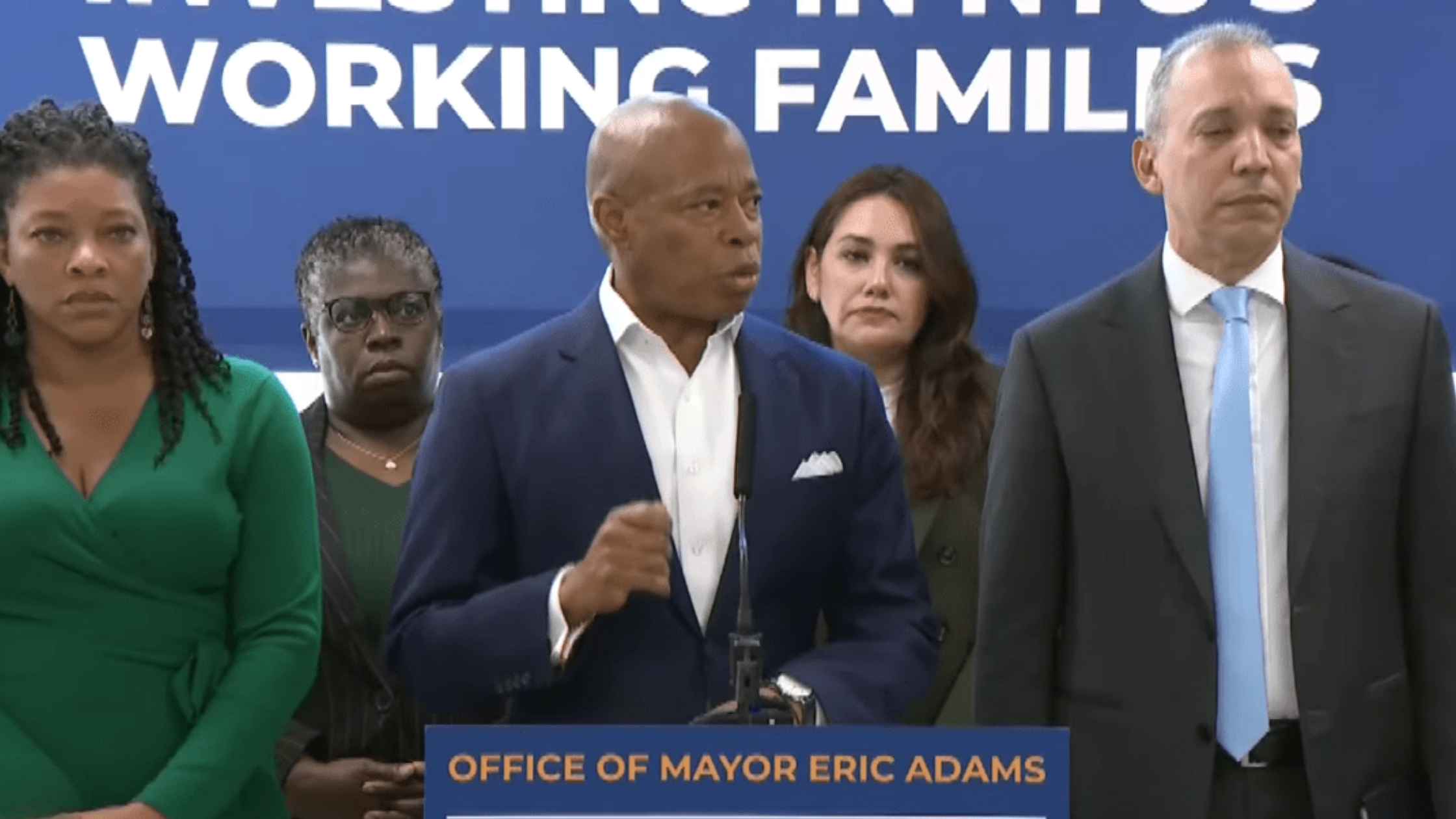


Camille Varlack (00:00):
… to thank Mayor Adams and Commissioner Molinas for their unwavering commitment to our city workforce. I'm also grateful to my fellow Deputy Mayors for their vision and leadership in expanding access to equitable and affordable child care for New Yorkers under this administration. And now it's my privilege to introduce the leader of the greatest city of the world, the 110th Mayor of New York City, Eric Adams.
Eric Adams (00:32):
Thank you. Thanks so much, DM, and for really Commissioner Molina and Commissioner Campion, I like to say the champion for what she has done and when you look at the leadership of our administration, each one of the men and women who are at the top helm would tell you their personal stories. And I think about sitting down, speaking with Camille, Deputy Mayor, my chief of staff and her personal story, what her mom had to do and how she had to deal with child care. And I think about Sandra, my sister, who raised the five of us because mommy was working three jobs. This journey has been amazing these three years and 10 months, and you're not going to fully feel it yet, but there was a clear mission.
(01:40)
There was a mission, one, to dispel the myth that Black and brown people can't lead the most sophisticated city on the globe, that women can't lead being the first mayor to have five women Deputy Mayors. First Filipino Deputy Mayor, first Trinidadian Deputy Mayor, first Trinidadian Chief of Staff, first Spanish speaker to be the Commissioner of New York City Police Department. First woman to be Police Commissioner, first, first, first, first, first. No one can ever say again that Black, brown, and women cannot lead complicated cities and organizations because of what we've done in the city.
(02:24)
This first that we're doing right now, child care, it is part of the $30 billion we put back in the pockets of working-class people. If you're a mother making $55,000 a year or father or family, we drop the cost of child care from $220 a month to less than $20 a month. No low-income New York is paying income tax in this city anymore. Free high-speed broadband for NYCHA residents, that's over $150 a month is back in their pockets. Foster care children paying their college tuition and not allowing them to age out at 18, now they're having life coaches until they're 21 years old. Student loan debt of what we have done and what we have done with your salaries. No mayor has given contract to civil service workers the way I've given those contracts. So people talk about affordability. We did it in this administration and we're going to continue to do it until the last day.
(03:40)
We are building a platform that others can build upon. So we're starting out with DCAS, but we need to retrofit every city office in New York so that when you come to work, you could drop your babies off and when you go to lunch, you could go down and interact with them. Jordan's mom was able to stay home for a year when he was born, and that bond is important and being able to bond with your children while you are providing for them is the foundation that stops the cycle of poverty that we are witnessing in our city.
(04:18)
Far too often, and this is such a significant announcement because the team was given a mission, go in and find ways to reinvent government so that we can be more friendly to raise healthy children and families, particularly those who are in an economically challenging situation. Because if you are living on the Upper East Side, you don't have to worry about child care like young people who are living in East New York. It's a different city folks, and don't let anyone kid you, the city was actually addressing the needs of certain parts of the city and not the entire city. You had a mayor that went through a lot, and so I was here to help people who are going through a lot, and this is one of those initiatives that we're doing now.
(05:14)
Family members all the time deal with the concerns of child care, mothers leave work and have to stay home and not handle their child care concerns. So today, we're making our city more family friendly by launching the city's first ever municipal child care pilot program, first ever. It's going to provide on-site affordable child care for DCAS employees beginning in September 2026, putting some of the city workers on the path to free child care for their families. And we are turning underutilized city owned space into on-site affordable child care for our workers. Same thing we did with housing. Underutilized city spaces were vacant and we turned it into housing like the Flushing Airport project, vacant since 1984, and now we are turning it into housing, turning it into housing.
(06:20)
City employees we all know are the engine. Everyone talks about that that allows the city to move forward, but we need to find more ways than just improving your salaries. We have to find ways to really remove those barriers that are preventing our city employees from enjoying the quality of life that they deserve. With this child care facility, we are giving back to the workers who gave so much to our city. We saw you during COVID and during other circumstances, and we're delivering both peace of mind and money back into the pockets of working class New Yorkers. No one works harder than those civil service that are in our city. I know it far too well because I've been one for 40 years.
(07:04)
The $10 billion investment investment also means DCAS employees can have work-family balance. Imagine coming down here in this space and being with your child if you have children and just hanging out with them and talking to them and allowing them to come up and see what you do so that you could start building that bond so families no longer have to choose between using the iPad as a babysitter or earning a living. A successful childhood education system is crucial to making New York City more affordable, particularly for working class families. And we know that when a mother leaves the workforce, it impacts her approximately $145,000 through the lifetime of her employment. When parents are forced to leave the workforce, families struggle, and our economy is weakened.
(07:57)
And today's announcement is welcome news for our city employees and this is the first office and we wanted to expand even further. We know what it is and we know the challenges that we are facing and I want to thank our team that ensures that we are going to look after our city workforce over 320,000 of them. We know how important it is. We've done it over and over again, including wiping out $360 million in student loan debt for hundred thousand of hard-working employees in civil service and invest in $70 million in our best budget evidence towards pre-K special education students who require occupational therapy, speech therapy, and other related services as well as $10 million we put into groundbreaking pilot program to provide free child care for children age two and under. We also have work to make child care funding permanent in our city's budget, adding $170 million in funding in early childhood education.
(09:10)
And so it's one thing to say how important civil servants are and what they do, but it's another thing to act on it, and we've done that. From contracts to child care to other forms, and this is the right team to do it and I want to thank them for what they have done. Commissioner Molina had the vision of making sure that we utilize these spaces and we're going to continue to do just that. I want to turn it over to my amazing Commissioner, Commissioner of DCAS, Commissioner Louis Molina.
Louis Molina (09:45):
Thank you, sir.
(09:51)
Good morning, everyone. Thank you, Mayor Adams. Thank you, Deputy Mayor Varlack, not just for being here this morning, but for your continued support and advocacy for our city's workforce. This is truly an exciting moment, a historical moment as we launch a pilot for affordable, high quality on-site child care for DCAS employees. Today, we are showing up for the people who dedicate their lives to the caring of over 8 million New Yorkers Day in and day out. We're investing in our workforce and in their families, and the return on that kind of investment is simply priceless. Just a few days ago, this space was filled with metal detectors and scanners. It was cold, unfeeling, and underutilized. But next fall, it will be filled with color, wonder, and the magic that happens when municipal employees advocate for one another and inspire real lasting change. Up to 40 children as young as six weeks will spend their days here bringing with them laughter, curiosity, and joy and their parents.
(10:56)
Our DCAS team members will walk into their jobs upstairs with little more peace of mind and a lot more support. This pilot is personal, it's practical, and it's powerful. Many of us can attest to the superpowers of parents, not just at the home, but here in the fabric of our DCAS team. Their ability to juggle the needs of their families while showing up with excellence for New Yorkers is nothing short of heroic, and it's their tenacity and grit that sparked this pilot. As we modernize our employment landscape, our approach to workforce support must evolve too. That means investing in our people. That means recognizing that care work is infrastructure, and it means doing what we can to position the city of New York as not just a good place to work, but an employer of preferred choice. This pilot is one of the many. We're working to strengthen recruitment and retention at DCAS.
(11:57)
It offers increased flexibility, financial relief, and most importantly, a safe nurturing environment for our children to grow and thrive. And we hope that this can be a model for the future, but it is also a win for our economy By inviting local licensed child care providers to operate this site, we're creating new opportunities for small businesses, especially women and minority-owned businesses, to be part of this mission. This is economic development that is centered on families, a better, more equitable, more human-centered workforce. It's possible and we're building it one initiative at a time. Before I close, I must acknowledge the entire DCAS team who breathed light into this pilot and enthusiastically laid the foundation. Our DCAS parents are unstoppable.
(12:54)
Most notably, I'd like to thank one of our fiercest advocates and architects behind this project, Catalina Chavez, our First Deputy Commissioner. Catalina's vision, persistence, and deep understanding of how significant this supports our team members has been the life force of this pilot and we thank her. I also like to thank our Mayor, our Deputy Mayors, the City Hall teams for their leadership in making this possible. I want to thank our partners in Labor DC 37, but the Office of Labor Relations, the Office of Management and Budget, Small Business Services, Mayor's Office of Contract Services, the Corp Counsel's office. Everyone had a part in making today possible. So to every parent, every worker, and every child whose lives will be touched by this pilot. This is for you and to any employee, whoever questioned if their city saw them, not just as a worker but as a whole person, we do, and today we're proving it. Thank you.
Camille Varlack (13:56):
Thank you Commissioner, and I couldn't have said it better. Let's invite up your First Deputy Commissioner Catalina Chavez.
Carolina Chavez (14:15):
I'm going to try not to choke up. Good morning. Thank you, Deputy Mayor Varlack. Thank you Mayor Adams for your support as DCAS launches this important effort to bring free child care to our workforce. And of course, thank you Commissioner Molina for your leadership and recognizing that preserving a competitive, diverse, and talented workforce requires us to address the real challenges that are facing today's working families.
(14:43)
I've been a proud public servant in New York City for 17 years. I'm also a mom of two. I have an eight-year-old girl who thinks she's 35 and I have a three-year-old who any day now will stop using his head as a weapon, I hope. That duality as both a public servant and as a parent has often informed my approach to solving complex problems in government, and none of them are as universally significant as what we are striving to do here with this pilot. Just six months ago in a routine meeting, one of our borough supervisors in facilities management asked us for help. She said she was seeing high attrition, not because of the job, but because her staff couldn't find or afford child care. She didn't know it then, but that ask set in motion this pilot to provide care that works for the very city employees who tirelessly care for New Yorkers.
(15:41)
Like so many working parents, I have felt the weight of wearing two hats. And I've learned over the years that it doesn't matter your title, your training, your skill set, this is hard for all of us. I've seen colleagues get the dreaded middle of the day text message from the school, "Your child is sick, come get them now."
(16:02)
I've juggled early arrival and last-minute exits so I could manage school pick up and drop off when my husband couldn't. I've battled the chaos of snow days with no backup plan, and like so many of us who are still here today, I'm still dealing with the exhaustion that was parenting through COVID, and I know I'm not alone.
(16:22)
I've watched engineers, custodians, lawyers, project managers, researchers, administrative professionals, IT professionals, and then some navigate these same challenges, so this initiative came together quickly because the need is loud and clear. We enter a career in public service because we care deeply. But as life gets fuller and more complex, the mission alone isn't enough to recruit or keep great talent. If we want a diverse workforce that reflects the city we love and serve, then we must support our workforce as their lives evolve and change. That's why this childcare pilot, while a first step is such a big step, it's not just a service being offered. It's a signal to say, we see you, we hear you. We value you.
(17:09)
Come work with us and stay. So with that, I'll say thank you again on behalf of our top-notch DCAS team. I know I'm not supposed to do that, but our top-notch DCAS team who worked so, so hard across this agency to get us to this moment. We're excited for what's ahead and we're here for the hard work that must be done between now and September. Mostly though we are fully prepared and so looking forward to getting stuck behind a caravan of toddlers and strollers when we make our way into the building next fall, we can't wait. Thank you.
Camille Varlack (17:44):
Thank you, Carolina. We'll now take some on-topic questions.
Eric Adams (17:53):
And on-topic. I'll be with Andrew later today, but right now we're talking about this, and if we mix the two, you won't cover this because it's good. So if you don't have an on-topic, I'm going to bounce.
Speaker 5 (18:09):
I'm curious, I haven't seen the details, how many children will this work at? How many seats? I guess I know they're in different kinds of seats in the classroom, but how many children and how soon will it begin?
Louis Molina (18:20):
September 2026 is our target opening day so we can align with school schedules and parents making plans, and it's for 40 children.
Speaker 5 (18:27):
And is it just here one center street or is there plans to do it in other DCAS facilities?
Louis Molina (18:31):
Right now, the pilot is focused on 1 Centre Street in this very room where we're in right now.
Speaker 5 (18:36):
And can you explain a little bit the process? I would guess there's more than 40 parents working here in DCAS. Is it a lottery system or how will children be selected?
Louis Molina (18:44):
Yeah, so we're refining that out now. I mean, we have a request for expression of interest that we're going to get from child care providers. We're going to work with other stakeholders and city government to figure out how we would do that selection process.
Speaker 5 (18:55):
And just one question, I mean, is it 9:00 to 6:00 or what's the hours of operation?
Louis Molina (18:58):
Right now, it's daytime business hours. That could change, but we're looking at a window from 8:00 AM to 6:00 being the window of time.
Speaker 6 (19:11):
The city of New York has liked its children for a long time, city employees liked their children. What were some of the institutional resistance that you got? I mean, this is visionary, but what was the resistance that folks that were driving this had? Do you remember a point where somebody turned the corner and finally said yes? I mean, why did it take so long to have this happen?
Eric Adams (19:31):
Because this is a city of yes on our administration. It took a long time before people to build more housing than we've built. Took a long time before people took out income tax for low-income New Yorkers like we've had. It took a long time before people gave free high-speed broadband to NYCHA and other low-income. It took a long time before people took people who were living on our streets into the support that they need. It took a long time for people to give good contracts through civil services because we never had a mayor that was a civil service until I came into office. So it took a long time for all the things that we've done, and so let's hope what we've done, whoever comes next would make sure it doesn't take a long time. So I don't know why. It seems strange to everyone that we've been a transformative administration. So it took a long time for a lot of things. Took 110 mayors before we got the first Dominican Deputy Mayor for God's sake. So yes, it takes a long time, but we got it done in three years and 10 months.
Speaker 7 (20:31):
The way you're designing these offices into day cares and early childhood centers and the money you're putting in with it, do you think you could ever scale it up so that people who aren't civil servants and private citizens could avail themselves maybe some kind of universal program?
Eric Adams (20:48):
Child care is crucial, and I think you need to do it based on who is in need. I don't need to have subsidized child care with my salary. We could expand more if we have our resources go to those who are in need. Everyone did not need to have their income taxes removed, low income New Yorkers needed it. We need to start taking our resources, going to the population that is in need so we don't continue to have systemic poverty. And so, yes, we would like to scale it up, but it should not be scaled up to those who don't need the support. New York tax dollars should go to those who need the support.
(21:34)
That is why you do need millionaires in this city because we want their dollars to go to pay for those who are in support. I don't want them leaving our city, I want them to stay here. The person who drives the limousine should make a good salary, and the person in the back seat of the limousine should use his dollars to help the city move forward. So yes, we would love to scale it up, but that's the next mayor to make that determination.
Speaker 7 (21:56):
And it's free for civil servants.
Louis Molina (22:00):
The pilot, yes.
Eric Adams (22:01):
The pilot that we have is using New York's favorite word: free. Okay, thank you.
Speaker 8 (22:11):
How long is the pilot?
MUSIC (22:15):
New York.
Eric Adams (22:16):
Right. Yes, how are you? No, go ahead. Yes, go ahead.
Speaker 9 (22:26):
So I'm a grandmother of a two year old. If my son and his wife don't have daycare for the day and they need to, could Leah be dropped off for the day or?
Eric Adams (22:40):
Well, the goal here is to make sure that whether the process that this pilot is going to put in place, then we will learn from that pilot, learn the expansion. How do we go about case studies that you're giving us? We want to grow from here and that's up to the next administration to do. The next administration may not be as kind and as gentle and as attractive as I am, but we got to go with what we have.
MUSIC (23:05):
New York.
(23:05)
Uh-huh. Yeah.
(23:05)
Concrete jungle where dreams are made of.
(23:05)
There's nothin' you can't do.
(23:05)
Yeah.
(23:05)
Now you're in New York.
(23:05)
Uh-huh, uh-huh, uh-huh.
(23:05)
These streets will make you feel brand-new.
(23:05)
You.
(23:05)
Big lights will inspire you.
(23:05)
Come on.
(23:05)
Let's hear it for New York.
(23:05)
Hey. Uh-huh.
(23:05)
Concrete jungle where dreams are made of.
(23:05)
Yeah.
(23:05)
There's nothin' you can't do.
(23:05)
Now you're in New York.
(23:05)
Uh-huh, uh-huh, uh-huh.
(23:05)
These streets will make you feel brand-new.