


Speaker 1 (00:00):
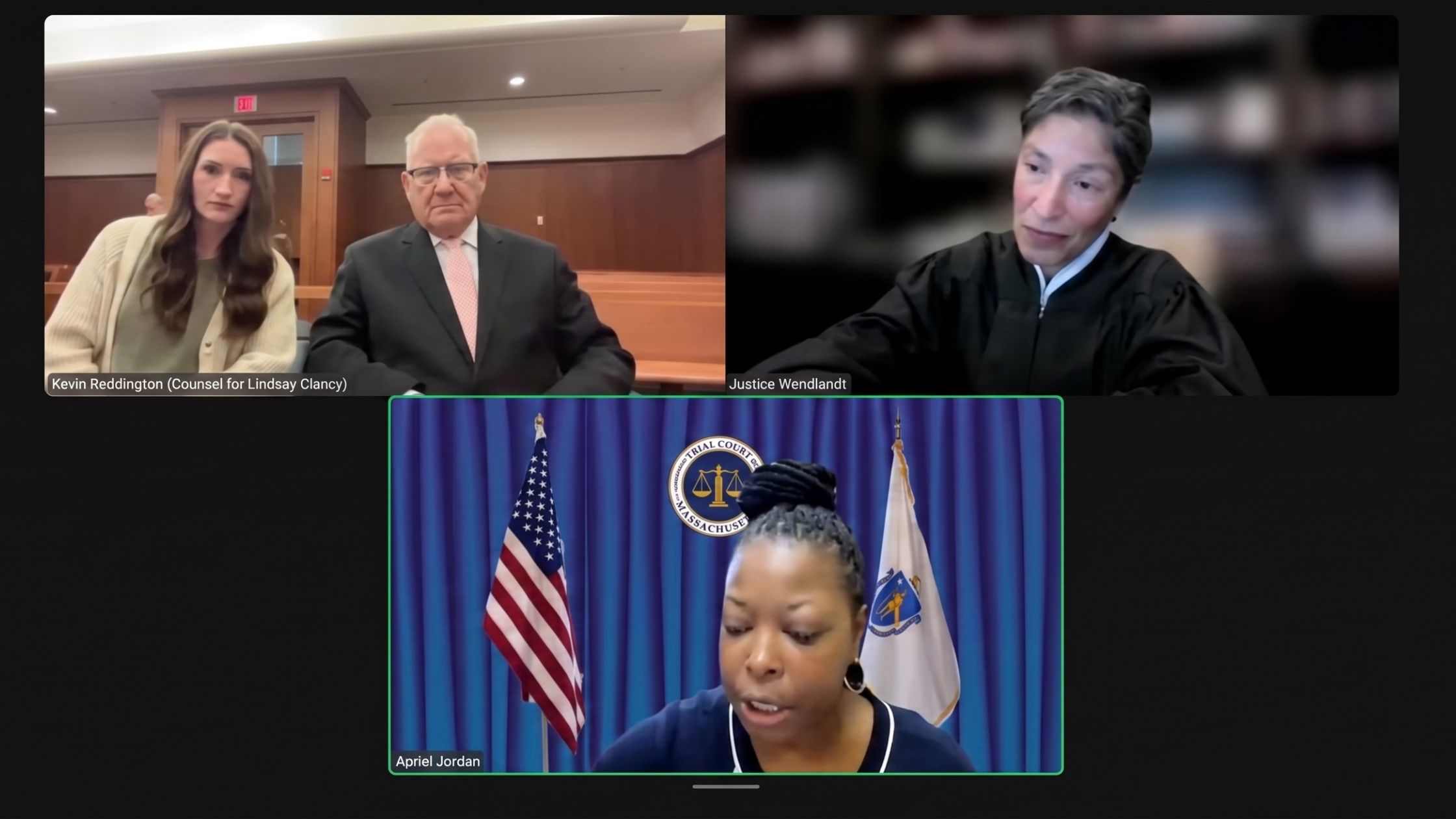
Before the court, Your Honor, is Commonwealth versus Lindsay Clancy, docket SJ2026-042. Representing the Commonwealth, we have Jennifer Sprague, and representing the petitioner, Lindsay Clancy, we have Kevin Reddington. Good afternoon, Your Honor.
Kevin Reddington (00:18):
Dana Goldblatt
Speaker 1 (00:19):
I'm sorry, and Dana Goldblatt. One person at a time, please.
Kevin Reddington (00:23):
Right.
Speaker 3 (00:24):
Good afternoon. I have before me an emergency request for relief by the petitioner, Lindsay Clancy, and I would like somebody to give me an update on where things are vis-a-vis jury deliberations, Tuey-Rodriguez instructions, et cetera. And I think, well, I will let you decide who should go first. I would suggest that ADA Sprague give me just sort of a general idea of where we are.
Jennifer Sprague (01:03):
Yes, Your Honor. So, on August 27th, the jury was sent out after closing arguments and instruction. On September 1st, they sent in a note saying that they were deadlocked. Judge Sullivan brought them back into the courtroom, advised them to keep deliberating, and they were sent out again. The following day, on September 2nd-
Speaker 3 (01:24):
I'm going to ask you to slow down because I can't listen as fast as you can talk. So-
Jennifer Sprague (01:29):
I apologize.
Speaker 3 (01:30):
... on September 1st, a note from the jury indicating they were deadlocked. That same day, Judge Sullivan asked them to keep deliberating.
Jennifer Sprague (01:39):
And sent them out again to deliberate. The next day on September 2nd, they again sent out a note saying that they were deadlocked.
Speaker 3 (01:47):
Okay.
Jennifer Sprague (01:52):
After receiving that note, the judge brought the jurors back into the courtroom and gave them the Tuey-Rodriguez instruction.
Speaker 3 (01:59):
Okay.
Jennifer Sprague (02:00):
The next day, September 3rd, they sent in a note stating a member of the jury is unable to follow the instructions regarding reasonable doubt. How should we proceed? Judge Sullivan brought each juror in individually for an individual voir dire and asked them-
Speaker 3 (02:21):
I'm sorry. So, the note said a member of the jury is not able to follow the instructions on reasonable doubt.
Jennifer Sprague (02:27):
Reasonable doubt. Yes.
Speaker 3 (02:28):
Okay.
Jennifer Sprague (02:28):
And said, "How should we proceed?" So, then Judge Sullivan brought them in for individual voir dire, asking each individual juror if they were still able to follow his instructions. Each juror answered in the affirmative that they were. The judge credited those answers and then brought the entire jury back into the courtroom together and reinstructed on reasonable doubt. Later that day-
Speaker 3 (02:56):
That was on September 3rd?
Jennifer Sprague (02:58):
Correct.
Speaker 3 (02:59):
Okay.
Jennifer Sprague (02:59):
Later that day-
Speaker 3 (03:01):
Reinstructed on reasonable doubt and then later that day, sorry.
Jennifer Sprague (03:03):
That's okay. Later that day, they sent another note. This one identified the juror, so I won't give the juror number, but it says that the juror has made statements acknowledging doubt but refuses to apply it to the verdict as the law states. This is why we cannot come to a unanimous decision.
Speaker 3 (03:26):
Okay.
Jennifer Sprague (03:33):
And then after receiving that note, the judge sent the jurors home for the day. That brings us to today, September 4th. This morning, Judge Sullivan sent the jurors out again to deliberate and advised them or instructed them not to include any vote counts or things like that into any further questions that they had. They left the courtroom and deliberated for several hours and then returned a note stating that they were still deadlocked and they would not be able to reach a verdict based on their current state.
(04:15)
One thing I did forget to mention that this morning prior to sending out the jurors, Judge Sullivan instructed them that they are required to follow his instructions on the law, whether they agree with them or not. So, after instructing them on that, he sent them out. They were out for a few hours and then they returned that final note stating that they were deadlocked and would not be able to reach a verdict.
Speaker 3 (04:41):
Okay. And I'm sorry, after he sent them out, he instructed them to not include something?
Jennifer Sprague (04:50):
Oh, this morning, yes. So, he instructed them not to include any information and any questions they may have about their deliberation or the count, what the numbers were in terms of guilty, not guilty. That's not an exact quote, but that was the content of what he told them this morning. And then at the same time, he also instructed them to follow the law, whether they agreed with it or not.
Speaker 3 (05:19):
Okay. Thank you for that timeline. Attorney Reddington, this is your motion. I don't know if it's you or Attorney Goldblatt who will be speaking, but I will give you the opportunity now to address the specific issue of this particular timeline.
Kevin Reddington (05:39):
Thank you, Your Honor. I will defer to Attorney Goldblatt on this.
Dana Goldblatt (05:44):
Thank you, Judge. Justice. I would just add that this morning on the 4th, when before the judge gave the instruction to follow all his instructions, Attorney Reddington on behalf of Ms. Clancy asked that the judge inquire of the jury individually through voir dire to determine whether this juror was following instructions, and the judge declined to do that. So, that was when this petition was filed, based on that. It was filed before the jury sent in their second... I guess their third notice of deadlock. So, there's an intervening... Attorney Reddington requested an individual voir dire of the jurors.
(06:38)
That request was denied. I filed this motion, the petition with Attorney Reddington, and then the jury came back... Sometime after I filed it, the jury came back saying they were in fact deadlocked. The goal was to avoid a mistrial by filing this and getting superintendents.
Speaker 3 (06:58):
I'm sorry, you filed this.
Dana Goldblatt (07:03):
At 12:29.
Speaker 3 (07:06):
At 12:29, although I don't see that, but I defer to you. Okay. And then afterwards, just like in the last hour, the jury came back with their final note?
Dana Goldblatt (07:18):
At some point, I think it was after the... I don't know because I was writing the filing, but when I sent in the filing, the jury had not come back with the final note, and therefore you will not see that in the fact pattern. I don't know whether maybe the final note actually came back while I was writing the petition, but it came back.
Speaker 3 (07:34):
I appreciate that.
Dana Goldblatt (07:35):
And so, you won't see the mention of that final note in the facts of the petition because when I was writing it, it either hadn't happened yet or I didn't know about it because I'm in a different room than Attorney Reddington while I'm writing this and he's in trial.
Speaker 3 (07:48):
I appreciate that. Okay. So, in addition to what's in the emergency request for relief, is there any other argument that you have for me?
Dana Goldblatt (07:55):
No additional arguments, Judge. I'm available to obviously answer questions or to clarify.
Speaker 3 (08:01):
I think you're frozen. I can hear you though. Can you hear me?
Dana Goldblatt (08:13):
Something just happened.
Speaker 3 (08:14):
Yeah, something just happened. I'm glad. So, we're back.
Dana Goldblatt (08:17):
Yeah.
Speaker 3 (08:17):
So, I asked if you had additional argument and then either I froze or you froze.
Dana Goldblatt (08:23):
No additional argument. It's what's in the brief. It's the two arguments that are there. I think, and in general, I would just frame it really briefly, one sentence as I don't think there's a lot of doubt that this was error. The question is under what authority, if any, can the SJC intervene? And those are the two areas where I tried to outline it under section 2113 and as a complaint for mandamus. So, those are the two areas I'm trying to argue to the court to help the court.
Speaker 3 (08:50):
Okay. Attorney Sprague, do you have a response?
Jennifer Sprague (08:53):
Yes, Your Honor. Just a slight dispute in the timeline. The juror came back with the note saying they were deadlocked prior to 12:30, if this was filed at 12:30. And at that time, Judge Sullivan stated that he was going to declare a mistrial after arguments by counsel. At that time, Attorney Reddington did ask for an individual voir dire. Again, that was denied based on the Ronchi case and that case line. Then Attorney Reddington stated that he was going to seek review of declaring a mistrial.
(09:30)
So, that's what I thought this was about, but we did receive the petition and we understand now that it's not based on the judge's authority to declare a mistrial, but rather on the voir dire issue, which I think based on the timeline and the case law, this is covered under Commonwealth versus Ronchi 491 Mass 284 from 2023, where we have nothing in these notes or anything from the deliberating jurors that indicate a lack of impartiality, bias, extraneous influence, or inability to deliberate regarding this one juror.
(10:08)
What we seem to have is a dispute amongst the deliberating jurors as to how to apply the law, but that's their deliberation and which the judge I think correctly decided not to inquire into. And by questioning the jurors the prior day about whether they could follow the instructions and all of them saying yes and that Judge Sullivan crediting those statements, I think that it's a judicial discretion issue and Judge Sullivan has discretion to not conduct the voir dire and to issue a mistrial.
Speaker 3 (10:41):
Okay. Unless Attorney Goldblatt, you have something else to say, I will take the matter under advisement.
Dana Goldblatt (10:50):
Thank you. I do. Thank you for that. The statement that this is just about deliberations or about a disagreement, I think is entirely refuted by the substance of the note in which the jurors report not we disagree about conclusions, but this one juror is refusing to apply doubt as the law states. So, the refusal to apply something as the law states is different than a problem with deliberation. So, the juror is acknowledging some kind of doubt and then refusing to follow the instruction about it, which is I think when they refer to refusing to follow the instruction, they just refer to it as refusing to follow what the law states.
(11:40)
So, this note that says, "I'm not going to follow, this juror won't follow what the law states," I just want to clarify that that's different than we disagree about what constitutes reasonable or something like that, that there is a clear statement that this one juror is not following what the law states. And because of that, there is not discretion for the court to just let this continue. And that's where I think the issue comes in for the SJC's ability to issue an order either under its general superintendent's powers to preserve the integrity of the petty jury or of just the mandamus requiring the court to exercise this discretion, which requires at this point an inquiry or-
Speaker 3 (12:24):
I think I understand your argument. Although it was quick papers, it was good papers, and I understand the distinction that you're making. And at this point, I think I need to make a decision. So, I will leave you, make that decision, and thank you very much for quickly getting on this call.