
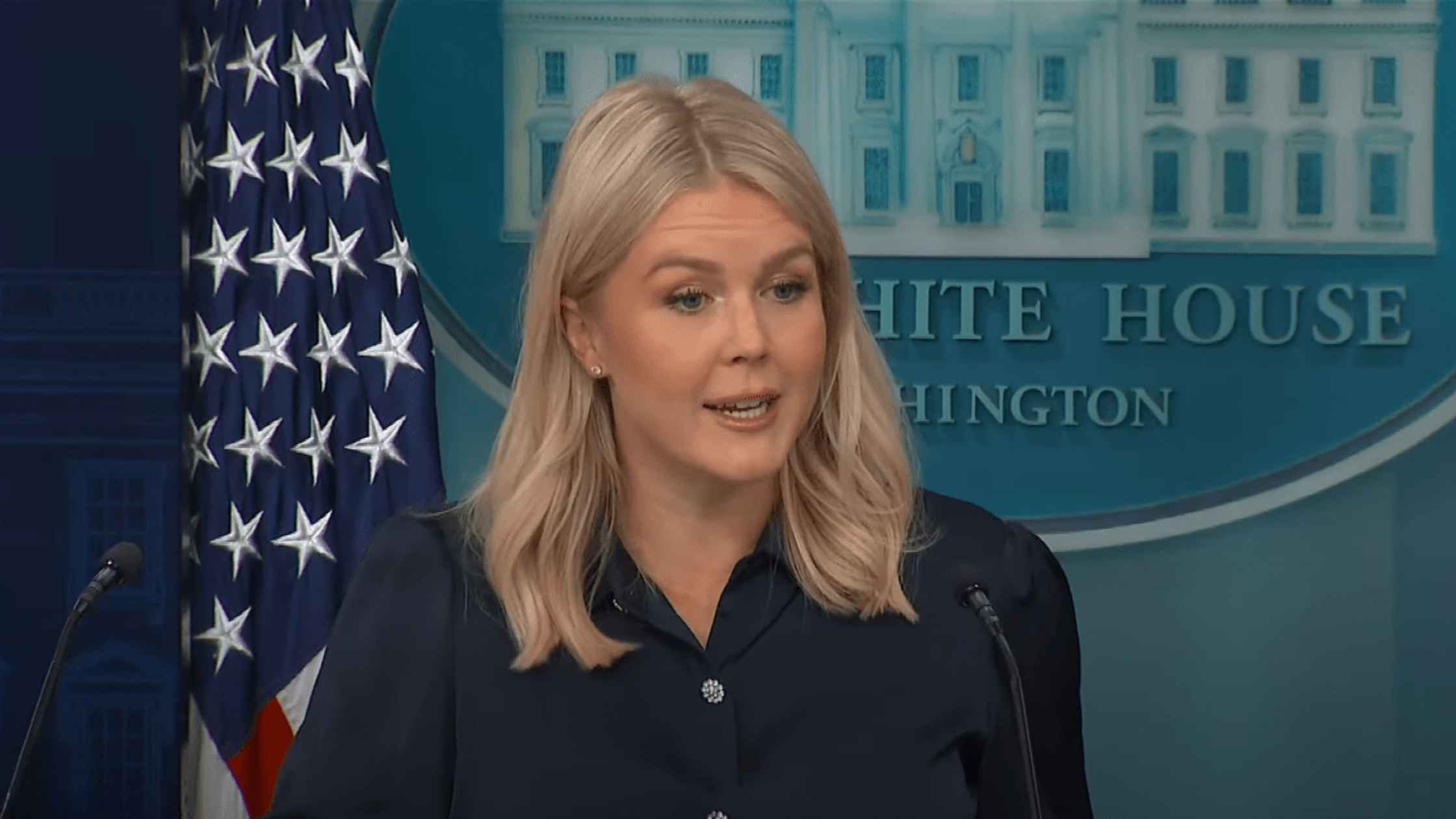
Karoline Leavitt (00:00):
Good afternoon everyone.
Speaker 1 (00:00):
Good afternoon.
Karoline Leavitt (03:04):
We have a lot of news today and I have quite a few announcements for you, so let's get to it. First, on behalf of the President and the White House, we express our deepest condolences to the family of New York Police Officer Islam, who made the ultimate sacrifice in defense of his fellow New Yorkers. As the funeral services are held in New York City today, everyone at the White House is keeping the officer's family, friends, and fellow NYPD law enforcement officers in our thoughts and prayers. The President has always and will always proudly stand with our men and women in blue. May God bless Officer Islam and the other individuals who were tragically killed in this senseless act of violence.
(03:45)
In other news, President Trump's working visit to Scotland was a huge success. In less than 48 hours, President Trump brokered the biggest, most impactful trade deal in history and prevented a war in Asia for the second time since he took office. We have never had a president who wields the full power of the United States to negotiate good deals for our country, and its people like President Trump. This is what maximum leverage looks like. On the peace front, President Trump helped deliver an immediate and unconditional ceasefire between Thailand and Cambodia. The 2 countries were engaged in a deadly conflict that had displaced more than 300,000 people until President Trump stepped in to put an end to it. The President spoke directly on the phone with the acting Prime Minister of Thailand and the Prime Minister of Cambodia to inform both leaders that unless they brought their conflict to an end, there would be no trade discussions or agreements with the United States. Almost immediately afterward, a peace was brokered that will save thousands of lives and allowed for trade negotiations with these countries to resume, and they have.
(04:52)
The President has now ended conflicts between Thailand and Cambodia, Israel and Iran, Rwanda and the Democratic Republic of the Congo, India and Pakistan, Serbia and Kosovo, and Egypt and Ethiopia. This means President Trump has brokered on average about one peace deal or ceasefire per month during his six months in office. It's well past time that President Trump was awarded the Nobel Peace Prize.
(05:18)
I know the topic of Israel is on everyone's mind. I have an update from Special Envoy Steve Witkoff, who I got off the phone with this morning. Special Envoy Witkoff and Ambassador Huckabee had a very productive meeting with Prime Minister Netanyahu and other officials today in Israel on the topic of delivering much needed food and aid to Gaza. President Trump is a humanitarian with a big heart, and that's why he sent Special Envoy Witkoff to the region in an effort to save lives and end this crisis. Tomorrow, Special Envoy Witkoff and Ambassador Huckabee will be traveling into Gaza to inspect the current distribution sites and secure a plan to deliver more food and meet with local Gazans to hear firsthand about this dire situation on the ground. The Special Envoy and the Ambassador will brief the president immediately after their visit to approve a final plan for food and aid distribution into the region, and we will provide more details for all of you once that plan is approved and agreed on by the President of the United States.
(06:19)
On the trade front, the President secured a historic trade agreement with the European Union that puts America first and fundamentally strengthens the economic relationship between the two largest economies in the world. This deal delivers on two of President Trump's core promises on trade: supercharging America's manufacturing capacity and opening up foreign market access to American businesses. The deal guarantees that American businesses will have unprecedented levels of access to the European Union markets to export our American-made goods.
(06:52)
Also, as part of this agreement, the EU will purchase $750 billion in U.S. energy to strengthen our energy dominance, reduce European reliance on adversarial sources, and narrow our trade deficit with the EU. The EU will also make new investments of $60 billion in the United States, in addition to the more than 100 billion the EU companies already invest in the U.S. every year. All of these massive purchases and investments will happen by the end of 2028.
(07:24)
What we are watching is President Trump rebuilding the greatest economy in the history of the world in turn, and simultaneously proving the so-called economic experts wrong at every turn. Media pundits said a trade deal with the EU this monumental and beneficial to America would be impossible, but President Trump made it happen. The so-called economic experts repeatedly said that the American economy would be in a recession this summer. Well summer is here. It's almost over, and that recession does not exist. Yesterday, in fact, real GDP growth in the second quarter increased at a 3.0% annual rate, significantly above expectations. President Trump's America first policies are driving economic growth, as he always said they would. And this growth is being driven by the private sector, not the government. Federal government spending fell for a second straight quarter, while real business, fixed investment rose by nearly 2% following its first quarter surge. President Trump is right-sizing government spending, reversing the damage done by the Biden administration and allowing the private sector to flourish.
(08:32)
The same so-called experts claimed that President Trump's tariffs would spike inflation and hurt American consumers, but consumer spending growth just accelerated and inflation remains right on track. For the past five straight months, core inflation has come in below market expectation and remains in line with the Fed's 2% inflation target.
(08:53)
Meanwhile, customs and tariff revenues have already totaled more than 150 billion since President Trump took office leading to the first June budget surplus in nearly a decade. Those revenues will skyrocket even further starting tomorrow when new reciprocal tariff rates take effect. President Trump is restoring America's economic sovereignty by reducing our reliance on foreign countries, boosting investment in the U.S. to the tune of trillions of dollars, and creating hundreds of thousands of high-paying jobs for the American people.
(09:27)
With America finally put first on trade and the largest middle-class tax cuts in history and other pro-growth provisions of the One Big Beautiful Bill beginning to take effect. The American economy will boom like never before over the course of the next three and a half years, thanks to the President's vision.
(09:44)
Finally, as you all know, the President signed an executive order earlier this year to solve the problem of exorbitant pharmaceutical pricing. According to recent data, the prices that Americans have been paying for brand-name drugs are more than three times the price other similarly developed nations pay. The President is determined to solve this problem and took further action today. He has signed 17 letters to pharmaceutical company CEOs, and I would like to read you one of these letters to the CEO of Eli Lilly. All of these letters will be provided to you following this briefing. This is to the CEO of Eli Lilly from the President of the United States.
(10:22)
"On May 12th, 2025, I signed an executive order delivering most favored nation prescription drug pricing to American patients to stop global freeloading and guarantee that Americans pay the same prices enjoyed by other developed nations. Right now, brand-name drugs in the United States are up to three times higher on average than anywhere else for the identical medicines. This unacceptable burden on hardworking American families ends with my administration. Most proposals the Trump administration has received to resolve this critical issue promised more of the same, shifting blame and requesting
Karoline Leavitt (11:00):
"Requesting policy changes that would result in billions of dollars in handouts to industry. Moving forward, the only thing I will accept from drug manufacturers is a commitment that provides American families immediate relief from the vastly inflated drug prices and an end to the free ride of American innovation by European and other developed nations. Accordingly, I'm calling on Eli Lilly and company and every manufacturer doing business in our great country to take the following actions within the next 60 days. Extend the most favored nation pricing to Medicaid, guarantee most favored nation pricing for newly launched drugs, return increased revenues abroad to American patients and taxpayers, provide for direct purchasing at most favored nation pricing. The President's team, including Secretary Kennedy and Administrator Oz, stand ready to implement these terms. The President expects to further engage with them immediately in good faith to deliver relief for American families.
(11:59)
Make no mistake, a collaborative effort towards achieving global pricing parity would be the most effective path for companies, the government and American patients. But if you refuse to step up, we will deploy every tool in our arsenal to protect American families from continued abusive drug pricing practices. Americans are demanding lower drug prices and they need them today. Other nations have been freeloading on U.S. innovation for far too long, and it is time they pay their fair share. I look forward to your binding commitments to each of these goals by September 29th, 2025, and my team stands ready to assist with implementation questions. Thank you for your immediate attention to this vital National priority," signed President Donald J. Trump, again to the CEO of Eli Lilly, this letter in its form has been designed for each of the 17 major drug and pharmaceutical companies in the United States, and we're happy to provide you the full list. And I believe you'll see all 17 letters popping on Truth Social very shortly, so you can look out for those and I'm happy to take any further questions.
(13:04)
Before we get to questions, I do have one other announcement from the White House and from the President. We are proud to announce that the construction of the new White House Ballroom will begin. For 150 years, presidents, administrations and White House staff have longed for a large event space on the White House complex that can hold substantially more guests than currently allowed. President Trump has expressed his commitment to solving this problem on behalf of future administrations and the American people. The White House is one of the most beautiful and historic buildings in the world, yet the White House is currently unable to host major functions, honoring world leaders in other countries without having to install a large and unsightly tent approximately 100 yards away from the main building's entrance. The White House State Ballroom will be a much-needed and exquisite addition of approximately 90,000 total square feet of innately designed and carefully crafted space with a seated capacity of 650 people, which is a significant increase from the 200 person seated capacity in the East Room of the White House.
(14:10)
In recent weeks, President Trump has held several meetings with members of the White House staff, the National Park Service, the White House Military Office, and the United States Secret Service to discuss design features and planning. President Trump has chosen McCrery Architects as the lead architect, which is well known for their classical architectural design and based right here in our nation's capital. The construction team will be headed by Clark Construction and the engineering team will be led by ACOM. The project will begin in September, 2025, and it is expected to be completed long before the end of President Trump's term. President Trump and other donors have generously committed to donating the funds necessary to build this approximately $200 million structure. The United States Secret Service will provide the necessary security enhancements and modifications. The White House Ballroom will be substantially separated from the main building of the White House, but at the same time, its theme and architectural heritage will be almost identical.
(15:13)
The site of the new ballroom will be where the small heavily changed and reconstructed East Wing currently sits. The East Wing was constructed in 1902 and has been renovated and changed many times with a second story added in 1942. White House Chief of Staff Susie Wiles has provided the following statement. "President Trump is a builder at heart and has an extraordinary eye for detail. The President and the Trump White House are fully committed to working with the appropriate organizations to preserve the special history of the White House while building a beautiful ballroom that can be enjoyed by future administrations and generations of Americans to come. In the White House, we will continue to provide the American public and all of you in the press with updates on this project at whitehouse.gov/visit." And if you go there shortly, you will be able to see renderings and visuals of what this ballroom will look like, both the exterior and the interior.
(16:06)
I have provided some photos for all of you in the room today. This is the interior of the ballroom space. It's quite beautiful. And then this is the exterior of the ballroom space. As you can see, it will come off of the executive mansion as it sits today, and the East Wing will be modernized and renovated.
Jennifer (16:24):
But nothing will be torn down?
Karoline Leavitt (16:24):
We're happy to answer any further questions on that. Jennifer, since you're so eager, I will go to you. But first as always, I want to start with our new media seat, Ben Weingarten. Why don't you go ahead, Ben.
Ben Weingarten (16:35):
Thank you. In light of the release, the declassification of the annex to the Durham Report today, beyond any potential prosecutions, the outcomes of which will likely be uncertain, what does the President believe justice for Russiagate ought to entail? Might it include restitution for those whose lives were upended as a consequence of Russiagate and perhaps a major reorganization of the national security apparatus?
Karoline Leavitt (17:02):
Well, I think a major organization of the national security apparatus, at least here at the White House within the National Security Council, has indeed taken place. And the President entrusts his current CIA Director John Ratcliffe, and our DNI Director, Tulsi Gabbard, to make the necessary changes to ensure classified intelligence, especially that could implement or hurt the national security of our country, does not make its way into the hands of irresponsible actors who want to politicize that intelligence for their own end.
(17:31)
Since you brought up the declassification report that was put out by Senator Grassley today, I'm glad you brought it up because this should be a story every outlet in this room should be covering. This is further evidence that Hillary Clinton approved the Russia hoax against President Trump. Her campaign financed it. Again, she approved it, and the FBI and the CIA were both weaponized to as our director of CIA has said, accelerate this hoax against then candidate and former President Trump. To answer the heart of your question, the President wants to see Justice served and he trusts the Attorney General and the Department of Justice to implement that justice and hold these people accountable.
Ben Weingarten (18:09):
One more question briefly, if I may. On a totally different topic. There's been legislation reintroduced in the House and Senate on designating the Muslim Brotherhood as a terrorist organization. The Muslim Brotherhood is considered by many to be the fountainhead of Sunni Islamic supremacism from which Hamas and other groups have spawned with a nexus to domestic organizations as well. Does the President support designating the Muslim Brotherhood as a terrorist organization?
Karoline Leavitt (18:34):
Frankly, I'm not sure because I haven't talked to him and I would never want to get ahead of the National Security Council on specific designations. It sounds like something this administration would support, but we can get a firm answer for you. How's that?
Ben Weingarten (18:46):
Thank you.
Karoline Leavitt (18:46):
Thanks for being here. Jennifer, go ahead. Eager beaver today.
Jennifer (18:48):
How much of the East Wing will be torn down? The entire East Wing or just parts of it?
Karoline Leavitt (18:52):
So the East Wing is going to be modernized. The necessary construction will take place and for those who are housed in the East Wing, including the Office of the First Lady, the White House Military Office, the White House Visitors Offices, those offices will be temporarily relocated while the East Wing is being modernized.
Jennifer (19:09):
And then on Israel-Gaza, there are some reports that negotiations with Hamas might not be continuing. Did you get any updates from Steve Witkoff on that?
Karoline Leavitt (19:18):
I did. Special Envoy Witkoff is actively talking with our counterparts in Israel about that, and he wants to give some grace to the President so he can fully brief the President on what he's learning on the ground in both Israel and Gaza. But the President put out a very strong statement on Truth Social this morning, which I'm sure you saw. And he said the quickest way to end this entire conflict, the humanitarian crisis that we've seen and the crisis in Israel, that of course started on October 7th when Hamas brutally kidnapped and raped innocent Israelis, that terrible terrorist attack is for Hamas to surrender, to release all of the hostages and to end this conflict. And that's what the President wants to see. He's made that very clear. But the Special Envoy will be in Gaza tomorrow, as I shared with you previously. Josh?
Josh (20:06):
Can you give us a little more clarity on the tariff timing? You said that the reciprocals will take effect tomorrow?
Karoline Leavitt (20:08):
Yes.
Josh (20:09):
Does that include the new auto rates, for instance, on Japan, Korea, the EU? Is this all coming effective tomorrow?
Karoline Leavitt (20:16):
So some of the countries you just mentioned, Japan, South Korea, they have bespoke trade deals that the President cut, which, just to backtrack for a second, Josh, we promised that the President would negotiate with countries all around the world to cut tailor-made trade deals depending on those country's challenges, how badly they've ripped off the United States of America and our manufacturing industry and our workforce in the past. And he has done that. Of our 18 major trading partners, two-thirds of those trading partners have a deal. We've sent out 17 letters to countries around the world and the rest of those countries that either do not have a deal or have a letter, they will be hearing from this administration by the midnight deadline tonight.
(20:59)
So yes, tomorrow, August 1st, the reciprocal rates will be going into effect. If more deals are cut between now and midnight, I will never count out the president. You've seen him do it before. He cut three deals in one day very recently. So we'll see what happened. I do know foreign leaders are ringing his phone realizing this deadline is a real thing for them tomorrow, and they're bringing offers to the table.
Josh (21:27):
We were reporting that President must meet David Solomon of Goldman Sachs today. Can you say what they'll discuss, if anything, at that meeting?
Karoline Leavitt (21:28):
I won't discuss the President's private meetings from this podium, and it hasn't taken place yet unless he gives me liberty to do so.
Josh (21:33):
And finally, have you talked with the President on his position on the stock trading ban bill for Congress? He obviously had pretty loaded comments about Senator Hawley. There's some reporting that they've since spoken. What is his position on the current status of that [inaudible 00:21:47]?
Karoline Leavitt (21:46):
The President has spoken to Senator Hawley who called him, and the President took that call. As the President said in the Roosevelt Room yesterday, conceptually, he of course supports the idea of ensuring that members of Congress and United States
Karoline Leavitt (22:00):
… senators who are here for public service cannot enrich themselves. And the reason that this idea to put a ban on stock trading for members of Congress is even a thing is because of Nancy Pelosi. I mean, she is rightfully criticized because she makes, I think, 174,000 dollars a year, yet she has a net worth of approximately 413 million. In 2024, Nancy Pelosi's stock portfolio, this was a fascinating statistic to me, grew 70% in one year in 2024, and her portfolio outperformed every single large hedge fund in that same year and even more than doubled the returns of Warren Buffett's Berkshire Hathaway. So I think the President stands with the American people on this. He doesn't want to see people like Nancy Pelosi enriching themselves off of public service and ripping off their constituents in the process. As for the mechanics of the legislation and how it will move forward, the White House continues to be in discussions with our friends on Capitol Hill. Emily. In a new seat today.
Emily (22:59):
Thanks, Caroline. I wanted to ask about this report that the president wants to host the G20 meeting at Trump Doral. How is he going to do that, considering all the preparations that have been going on in South Africa, and also would that be seen as his businesses possibly profiting from hosting this kind of meeting?
Karoline Leavitt (23:15):
I would reject that premise entirely. We have announcements and details forthcoming on the G20, but my understanding is no firm announcement is ready to be made at this time. I did see the report, but we're not in a place to confirm it just yet. Michelle.
Michelle (23:29):
Just on the tariffs, what are the logistics for imposing those? Does the President have to sign an executive order tonight? What's the timing of that?
Karoline Leavitt (23:35):
Yes, and he will be signing an executive order at some point this afternoon or later this evening. And, as always, we'll keep you posted when that happens and it will be released from our office.
Michelle (23:43):
And are there's some of these countries that have had… have they all had contact with US officials or are there some countries that are going to get letters that have had no opportunity to negotiate with the United States?
Karoline Leavitt (23:52):
Well, there's a lot of countries that I know have reached out. I believe it's upwards of 200 countries around the world have reached out to the trade and tariff team. Of course, as I said previously, and the President said, we're going to prioritize our key trading partners, which we have done, like I said, of the 18, two-thirds of those we have cut these tailor-made deals with. But I do know that the trade team has been working around the clock to try to be in correspondence with as many countries as possible. But if they haven't heard from us yet, they will in the form of a letter or an executive order by midnight tonight. We'll go to the back. Sure, go ahead. In the back left. Amanda, yes.
Speaker 2 (24:29):
Thank you. Thank you very much. [inaudible 00:24:33] ask about the-
Karoline Leavitt (24:29):
Amanda, you can go after.
Speaker 2 (24:35):
… US and South Korea trading negotiations and the trading negotiation between South Korea and the United States [inaudible 00:24:43] yesterday, President Trump state on his SNS to [inaudible 00:24:49] that he would announce the specific details of the investment in the United State at the South Korea-United States Summit in two weeks. My question is this third negotiation of final agreement or is further negotiation necessary? Thank you.
Karoline Leavitt (25:11):
Well, yes, as you know, the President met with representatives of the Republic of South Korea here at the White House yesterday, and they did, in fact, reach a deal. And South Korea will pay a 15% tariff rate, including 15% on autos, while providing historic market access to American goods like autos and rice. Korea will purchase a hundred billion dollars in American energy by 2028. And the centerpiece of this deal is that South Korea has agreed to invest 350 billion dollars at the President's direction to revitalize American industry. 90% of those profits will go to the United States Government to help pay down our debt and for other matters at the President's choosing. So it was a very successful meeting yesterday.
Speaker 2 (25:54):
And when is further US-South Korea summit, hey?
Karoline Leavitt (25:59):
I'll get you something on that. I don't have it at my fingertips. Okay, Amanda.
Amanda (26:02):
Thank you, Caroline. There are a number of congressional Republicans who have raised the alarm about the fact that roughly 80% of pharmaceuticals are either manufactured or their precursors are manufactured in either China or India. There are some pieces of legislation, some recommendations which include either on-shoring, near-shoring or friend-shoring, those components of that. Do you know if the President intends to throw the weight of the executive behind that?
Karoline Leavitt (26:29):
I don't have any updates for you at this time. I do have an update on our EU trade deal. I stand corrected. It's not 60 billion in investments, it's 600 billion dollars in investments. I want to make that very clear, and I personally watched the President behind closed doors with the European President in Scotland negotiating this deal, and he got the most juice out of that squeeze that he could, and he was constantly looking out for America's interest. So I just wanted to clarify that one point. Deanna.
Deanna (26:57):
Thanks, Caroline. For the countries that don't have a deal yet, should we be looking at the April 2nd chart at all or is he negotiating and talking about having a set tariff rate, 10%, 20%?
Karoline Leavitt (27:11):
Those discussions are taking place with the trade team today, and, again, we'll provide further guidance with that executive order once it is signed and the answer to that question will be in that executive order.
Deanna (27:21):
And is he looking to provide any more extensions today after his phone call with Mexico? Is there any other conversations like that?
Karoline Leavitt (27:29):
I do know that other foreign leaders around the world have reached out, and if the President decides to share the conclusions of those calls with all of you, he will do so himself. But I do want to reiterate what the President said about Mexico. Mexico is still paying tariffs. They're paying a 25% tariff on fentanyl, 25% tariff on cars, a 50% tariff on steel, aluminum, and copper and additionally, Mexico has agreed to immediately terminate its non-tariff trade barriers of which there are many. And as the President said, we will continue to talk to Mexico over the next 90 days with the goal of signing a larger trade deal. The key to this, again, is Mexico has agreed to terminate those non-tariff barriers and to continue to work with us in good faith.
(28:10)
Mexico is a very unique situation of all the other countries around the world because, of course, we share our southern border with Mexico, which we've seen an increase in cooperation between Mexico's President, Claudia Sheinbaum, and our administration on clamping down on drug trafficking and human trafficking at the southern border. We appreciate those efforts and we'll continue to work in good faith and to continue to have these trade discussions as well. Joey.
Joey (28:33):
Yeah, thanks Caroline. Just clarifying of a previous question. President Trump has indicated he's been looking at either 15% or 20% baseline universal tariff. Has he landed on one of those yet?
Karoline Leavitt (28:46):
I won't get ahead of the President on that baseline announcement.
Joey (28:48):
Okay. And then secondly, what did Treasury Secretary Bessent mean yesterday, what he called the new Trump accounts for newborns a, "Backdoor to privatizing Social Security."? Does the administration view this new Trump accounts as a way to, in the long term, perhaps privatize Social Security?
Karoline Leavitt (29:07):
What the Secretary of Treasury was saying, and what this administration believes is that these Trump newborn accounts, which is an incredibly creative and great provision that was in the One Big Beautiful Bill for newborn babies and families and future generations of Americans will help supplement, not substitute, Social Security. The Trump Administration is wholeheartedly committed to protecting Social Security. The President did it in his first term, he's doing it again in this term. But these newborn accounts are another revenue stream for young people to watch their money grow throughout their lives and to one day be able to access those funds so they can hopefully build a home and live the American dream. Jake?
Jake (29:46):
Just one follow up on the tariffs one and one not. Is the President at all considering extending the August 12th to China deadline at all. Is that in consideration?
Karoline Leavitt (29:54):
So look on China, you heard from the president on Air Force One when we were returning from Scotland, you've heard from the Treasury Secretary as well, Ambassador Jamieson Greer. They just spent two days in Geneva for their third round of talks with China, and the current policy, the current trade program that we have going with China right now, as it stands, will decrease our deficit by 5 billion dollars this year. So we are moving in the right direction when it comes to China and Secretary Bessent and Ambassador Greer continue to be in direct communication with our Chinese counterparts.
Jake (30:27):
Is it an extension on the table potentially from the August 12th deadline as stands?
Karoline Leavitt (30:30):
I don't think so, but I'll let the Secretary of Treasury speak on that because he's leading these negotiations. Reagan, go ahead.
Reagan (30:36):
Thanks, Caroline. There's growing frustration that more of Trump's nominees haven't been confirmed. Why does the president think said Republicans are so behind and has he had any further conversations with Leader Thune about it?
Karoline Leavitt (30:48):
The President has had many conversations with his friends in the United States Senate about advancing his nominees, his judicial nominees through this process. It is critical that we get these good attorneys in these positions so that we can end the weaponization of justice so we can have true law and order in our country. It's unfortunate the Democrats are playing political games, but the President has made it clear to Senate Republicans they need to do everything in their power to advance the President's nominees as well. Kelly, go ahead.
Kelly (31:19):
Caroline, thank you. Two questions real quickly.
Karoline Leavitt (31:22):
Sure.
Kelly (31:22):
Nigeria. Congressman Chris Smith, Republican from New Jersey, is calling upon the President of the United States to do something in terms of imposing perhaps sanctions on Nigeria for the persecution of Christians living in the northern part of Nigeria by radical Islamic groups. Has he contacted the President yet and do you know if there's any action that the President will take?
Karoline Leavitt (31:45):
I'm not tracking a call between the President and the head of Nigeria. I know the President wholeheartedly condemns the persecution of Christians or, frankly, of people of any faith all over the world. But I don't have any updates for you in terms of sanctions in this part of the world.
Kelly (32:03):
My second question, Caroline, deals with immigration here in America. As you know, a lot of deportation has been going on. ICE has been going after violent criminals that are here illegally and rightly so. In the midst of that, there are some evangelical pastors who are stating that it may have gone to a point of being indiscriminate and actually getting innocent people like members of the clergy. Has the President and has ICE looked at that to see how they can actually go after those violent criminals, but also make sure that members of the clergy are still not being deported?
Karoline Leavitt (32:38):
Well, look, the administration has always maintained the position that anyone who illegally crosses our nation's borders is subject to deportation. That's just the law of the land and we must be a nation that enforces our laws. But the priority from ICE, of course, is to deport, detain, arrest, and remove violent illegal
Karoline Leavitt (33:00):
… illegal aliens and criminals from our country. And they have been doing that at the rate of thousands of illegal, violent criminals every single week, especially in Democrat-run sanctuary cities where these illegal, violent criminals have been given a safe haven and have essentially been immune from our nation's laws under the previous administration.
(33:18)
That's not happening any more because of this President and Secretary Noem in the Department of Homeland Security. And we are going to be a nation of laws. And as we've said repeatedly, if you came here illegally, you are subject to deportation, but the priority are those public safety threats that we must remove from our communities.
Speaker 3 (33:36):
Thank you so much, Karoline. Two questions. So what Hamas harness its position in Israel provides aid. Do you have any new information on the hostages that needs aid too? And second question, we heard President Trump criticize President Macron and Prime Minister Stormer for their statement about recognizing a Palestinian state. What is the President's position on recognizing a Palestinian state and will he recognize Israeli sovereignty in Judea and Samaria?
Karoline Leavitt (34:02):
I can answer both of those questions for you. On the second question about a Palestinian state, the President expressed his displeasure and his disagreement with the leaders of France, the United Kingdom and Canada. He feels as though that's rewarding Hamas at a time where Hamas is the true impediment to a ceasefire and to the release of all of the hostages.
(34:21)
So to your first question, the President wants to see all of the hostages released. He cares deeply about this. He has met with many of the former hostages, many of the families of those who have loved ones who are still being held hostage in Gaza. I have met with them, too. It is absolutely devastating what these poor people have been through, and the President is always thinking about them, and that's why he's designated his special envoy, Steve Witkoff, who's doing a tremendous job to release the hostages and to end this conflict.
(34:50)
But the President has always said the last remaining hostages, now there are 20 living hostages in Gaza will always be the hardest because Hamas is unfortunately using these innocent people as bargaining chips. But nevertheless, we are committed to seeing this come to an end.
Speaker 3 (35:07):
Thank you, Karoline.
Speaker 4 (35:07):
Thanks, Karoline. Part of the settlement with Brown prohibits it from performing transgender procedures or prescribing hormone puberty blockers, that type of thing. Will eliminating these types of procedures be a priority for the Trump administration in negotiations with other universities?
Karoline Leavitt (35:23):
I can tell you that ending the chemical castration of children in our country is a priority of this administration. We've talked to many of these universities about it, but we've also, the President has also taken very strong action to cut off the funding for any medical institution in this country that provides those barbaric procedures. And the Brown University agreement, since you brought it up, is yet another win to root out anti-Semitic behavior on our nation's college campuses and unlawful racial discrimination.
(35:53)
Brown has agreed to no longer allow unlawful racial discrimination in admissions or university programming. They have agreed to provide access to all relevant data and information to rigorously assess compliance with its commitment to merit-based admissions. And they will pay 50 million over 10 years to state workforce development organizations that comply with anti-discrimination laws supporting regional economic growth and career opportunities.
(36:22)
Brown will also adopt the definitions of male and female from President Trump's executive order defending women in gender ideology extremism for women's sports, programming, facilities, and housing.
(36:33)
Brown will no longer perform gender reassignment surgeries on minors or prescribe them puberty blockers or cross-sex hormones. And Brown will take steps to improve the campus climate for Jewish students and combat anti-Semitism on their campus. This is yet another huge win for American students and for those who love our country and want to abide by our country's laws.
(36:55)
On the topic of defending women from gender ideology, extremism, and helping women's sports, the President will be signing an executive order at four o'clock today with some very famous professional athletes, whom I'm sure you all know. And that executive order will be focused on strengthening athletics in our country and making America healthy again. And we are going to re-implement the presidential fitness test in America's schools, which is I think something all Americans can get behind. So you'll hear from the President in two hours and we will see you all there. Thank you.