Phillippe Bolopiang (00:00):
... Risking a new human rights disaster. Trump announced an alarming US plan to transform Gaza into a real era of the Middle East, free of Palestinian, effectively urging ethnic cleansing. Trump's peace efforts have downplayed serious violations by Russia in Ukraine and have done nothing to stop atrocities in Sudan. While politicizing the US Annual Human Rights Report, he has embraced autocrats in Hungary, El Salvador, and Saudi Arabia. Trump has also withdrawn the US from 66 international organizations, undermined the rulings of international courts and slashed eight programs that helped save millions of lives. So who will rise to the defense of an already struggling global human rights system? Many Western allies have chosen to stay silent on US actions, because they fear increasing tariffs and weakening alliances. What we urgently need now is a strong global alliance of countries promoting human rights and the world-based world order. No country on its own can match the global influence of the US, Russia, or China, but together they could present a powerful economic and diplomatic force to defend rights.
Speaker 1 (16:18):
I love our campus now.
Phillippe Bolopiang (16:24):
Civil society can play a crucial role in mobilizing people and governments to work together to resist rights violations, despite Trump's attacks on non-governmental organizations.
Speaker 1 (16:38):
What do we do? [inaudible 00:01:48].
Phillippe Bolopiang (16:38):
Breaking the authoritarian wave and standing up for human rights is a generational challenge. In 2026, the fight for the future of human rights will play out most sharply in the US with consequences for the rest of the world. We've already seen Gen Z protests rock governments in Nepal, Morocco, and Bangladesh. These actions show the power of protest to hold abusive governments to account. Harnessing that same determination will help us survive in a world in which human rights are under continual resort.
Sarah Yeager (17:13):
Also, you didn't have a latte. Philippe did not have a latte. We are not supporting our executive director.
(17:13)
Yeah, sure. So I don't know what to say now. This is awkward. Getting to this Jim Wormington. Hi. Oh, counting. What? Should I count by threes? One, four, seven. Good?
Phillippe Bolopiang (17:13):
The world order is breaking apart. Democracy has dropped to 1985 levels, with 72% of the world's population now living in autocracy. Russia and China are less free today than they were 20 years ago, and so is the United States.
Speaker 1 (17:13):
We are the majority.
Phillippe Bolopiang (17:13):
Democratic ideals are crucial to represent the will of the people and keep power in check. Whenever democracy is undermined, rights are too.
Donald J. Trump (17:13):
I, Donald John Trump can solemnly swear.
Phillippe Bolopiang (17:13):
In just 12 months, the Trump administration has attacked the pillars of US democracy and the rules-based international order, threatening the systems that protect freedoms worldwide. In a well-functioning democracy, human rights protections are essential. In the US, Trump has targeted immigrants and asylum seekers, punished free speech, threatened voting rights, reduced access to government accountability and oversight, attacked judicial independence, rolled back rights of women and LGBT people, and eliminated remedies for racial discrimination. But the violations have not stopped at the US border.
(17:13)
On top of detaining thousands of immigrants in the US, Trump sent hundreds to a notorious prison in El Salvador, where they were tortured and abused. Prior to the US military assault on Venezuela, his administration committed more than a 100 extra judicial killings by destroying boats claimed to be carrying drugs. After US military forces took President Nicholas Maduro into custody, Trump turned the country's government over to Maduro's deputy, risking a new human rights disaster. Trump announced an alarming US plan to transform Gaza into a real era of the Middle East, free of Palestinian, effectively urging ethnic cleansing. Trump's peace efforts have downplayed serious violations by Russia in Ukraine and have done nothing to stop atrocities in Sudan. While politicizing the US Annual Human Rights Report, he has embraced autocrats in Hungary, El Salvador, and Saudi Arabia. Trump has also withdrawn the US from 66 international organizations, undermined the rulings of international courts and slashed eight programs that helped save millions of lives.
(17:13)
So who will rise to the defense of an already struggling global human rights system? Many Western allies have chosen to stay silent on US actions, because they fear increasing tariffs and weakening alliances. What we urgently need now is a strong global alliance of countries promoting human rights and the world's-based world order. No country on its own can match the global influence of the US, Russia, or China, but together they could present a powerful economic and diplomatic force to defend rights.
Speaker 1 (17:13):
Hands off our campus now.
Phillippe Bolopiang (17:13):
Civil society can play a crucial role in mobilizing people and governments to work together to resist rights violations, despite Trump's attacks on non-governmental organizations.
Speaker 1 (17:13):
What do we do? [inaudible 00:17:14].
Phillippe Bolopiang (17:13):
Breaking the authoritarian way and standing up for human rights is a generational challenge. In 2026, the fight for the future of human rights will play out most sharply in the US with consequences of the rest of the world. We've already seen Gen Z protests rock governments in Nepal, Morocco, and Bangladesh. These actions show the power of protest to hold abusing governments to account. Harnessing that same determination will help us survive in a world in which human rights are under continuum also.
Sarah Yeager (17:20):
Okay. Hi, everyone. Good morning, everyone. Can you hear me all right? Okay. I'm Sarah Yeager, Washington Director of Human Rights Watch. I'm so pleased to welcome you here in person and online to our launch of the world report. Thank you for enduring the awkward silence. We wanted to create some drama and tension around the report. A few things to say that are housekeeping. So there's a couple functions for those of you who are online on the Zoom, one of which is interpretation. If you need French, Spanish, or Arabic, you'll see the interpretation function that you can press. And after we have some short presentations, we're going to do a question and answer. You'll see the Q&A function. You can ask questions there. I will get them here and I'll be able to pass them to our panelists. For those in the room, you will also be able to ask questions.
(18:16)
You simply raise your hand. We will have microphones that will come around. If you need a transcript or audio of today's event, you can talk to any one of us in the room or email hrwpress, P-R-E-S-S, @hrw.org. I want to say a quick word about why this report is so important in this moment. When President Trump took away foreign aid around the world last year, he decimated nonprofits that are reporting and monitoring and documenting human rights abuses around the world. In addition to that, many of you know about the State Department's annual human rights report, which used to be a fairly good representation of abuses around the world and has now become politicized. That is why I am so proud to sit here today with my colleagues and put out this world report, which is our annual reporting on human rights abuses around the world. And now let's get to it.
(19:21)
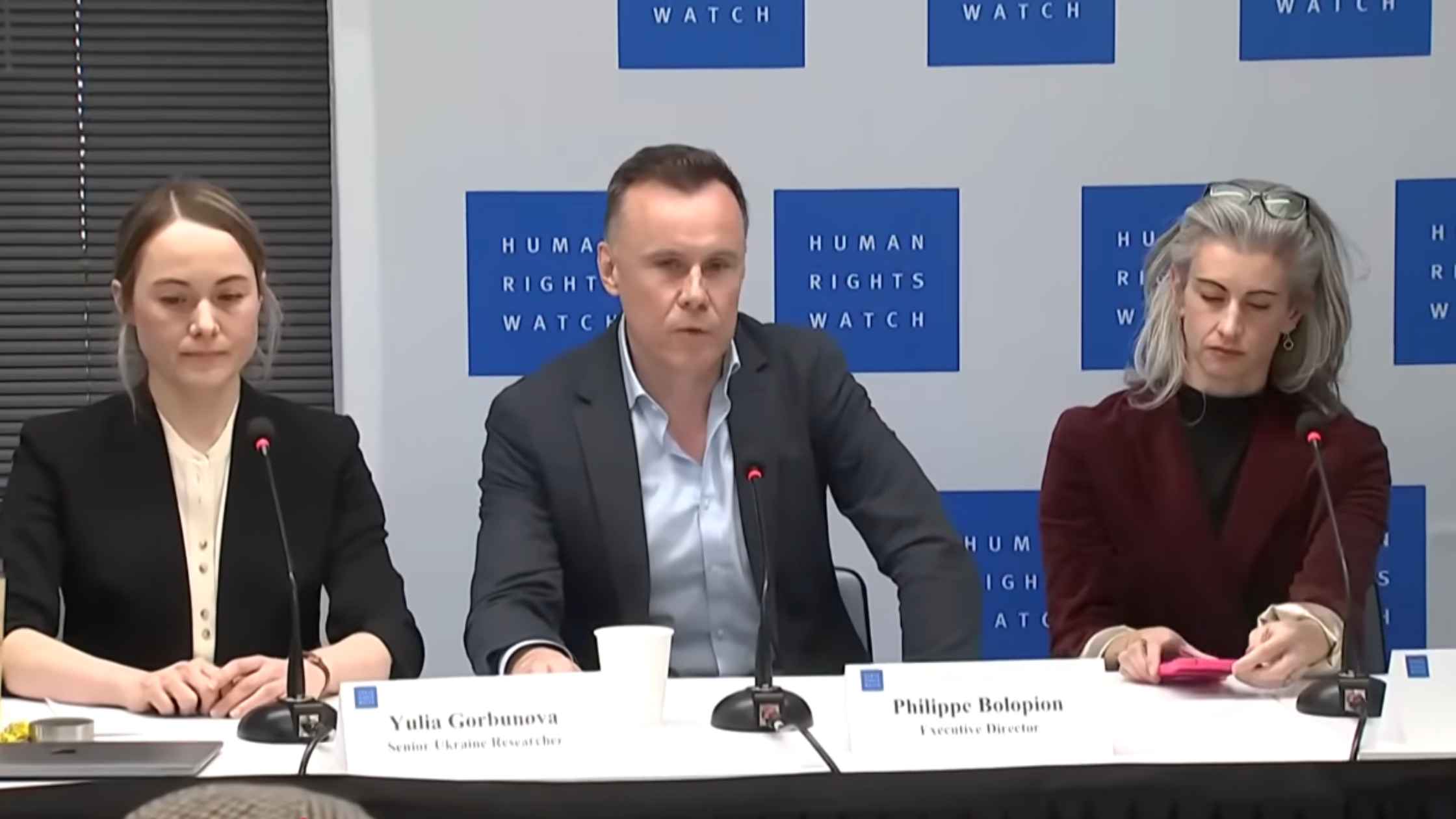
So I have to my right, Phillippe Bolopiang, who is our new executive director. Over to my left, I have Juan Papier, who is our Deputy America's director. Also to my left, I have Mauci Sugun, who is our director of the Africa division. And over to my far right, Yulia Gorbanova, who is our senior Ukraine researcher. And I'll pass it to Philippe first for some opening remarks.
Phillippe Bolopiang (19:49):
Thank you so much, Sarah. Thank you. And thanks to everyone for joining us in the room and online. So these news conferences are rarely good news for the world, but I would say that this one is particularly important for us, because 2025 in many ways felt like a tipping point and a particularly dangerous moment, I would say, for human rights organizations, for the human rights movement. We feel that over the last year, the human rights have been under attack, that the project of human rights itself is imperial in some ways, and that we are at least these days at risk of losing ground. So this is a bit what I want to cover, but also how we are planning on fighting back. So first, the environment, very hostile for human rights. I would say almost a perfect storm of several factors that are combining together to create this dangerous moment for us.
(20:51)
One of them is a long-term element. It didn't wait for the Trump administration to come back in power, and that's what experts call the democratic recession. The fact that in the world for the last 20 years, democracy has been receding steadily. And every time democracy recedes, it's bad for human rights. It's bad for the full range of human rights. So we've had an adverse environment, I would say, for the last 20 years with many countries becoming less free. China is less free today than 20 years ago. Russia is less free. India is less democratic. The US is less democratic. It's a global factor. The second one, which is also extremely dangerous and a sort of strategic issue for the human rights movement is the rise of China and Russia as illiberal forces around the world. They have attacked democracy or human rights at home, but also globally in other countries around the world and in multilateral institutions and they are making progress.
(21:53)
And that's a very dangerous trend. And then the third one, which is newer, a year old, and that's the Trump administration,
Philippe (22:00):
... eruption on the world scene and quickly turning into potentially an adversary of the human rights movement.
(22:09)
So I would say with the Trump administration, it started at home. People in this room are very aware, in just one year, it's actually incredible to see how the Trump administration has really undermined all the pillars of US democracy, all the checks and balances on power, these days still undermining the trust in elections, the sanctity of elections, going after the judiciary and judges, going after journalists, going after political opponents, going after universities, going after big law firms, going after civil society foundations that are quick to be labeled domestic terrorists. And so, we see a very hostile environment in the US and a very rapid decline of, I would say, the quality of democracy in this country.
(23:06)
But it didn't stop at home. This project is also now playing out over the last few months in the world. The US government has been very proudly blowing up boats of alleged drug traffickers in the Caribbean, in the Pacific, extra-judicial executions, no founding in international law, unlawful, and yet it's ongoing. The torture of Venezuelan migrants that were sent from the US to a mega prison in El Salvador, where many of them were tortured and some sexually abused, and Juan will talk a bit more about that. And then, more recently, threats to invade Greenland, and the world realizing suddenly that the US is maybe no longer supportive of the global rules- based world order, the world order that has been developed for decades and that has really helped advance human rights, human rights treaties, norms, institutions, the Human Rights Council, the International Criminal Courts. The entire architecture is now under threat.
(24:17)
So it's a new world that I think everybody is trying to cope with, and it's, I would say, a dangerous world for human rights. The UN secretary general, Antonio Guterres, sometimes describes a world on fire, and it feels very much like that. And in this world on fire, atrocity crimes are back. That's a major factor for our work. The kind of atrocities that 20 years ago, the world said we would no longer tolerate, that the international community would step in to stop what we called at the time the responsibility to protect, all of that today is almost disappearing. And so, we have raging situations of mass atrocities.
(24:58)
One of them, of course, is the situation in Gaza and the West Bank, where the Israeli government has been committing acts of genocide, crimes against humanity, ethnic cleansing, more than 70,000 people killed since the October 7 attack, very little international reaction. And instead of pressuring the Israeli government to stop these crimes, the Trump administration is almost cheering on, in some cases. He even mentioned the possibility of turning Gaza into a riviera of the Middle East, free of Palestinians, which is essentially encouraging the continued ethnic cleansing.
(25:39)
Ukraine is another situation of mass atrocities, and Yulia will talk about it, of war crimes on a massive level, where the Trump administration is minimizing the responsibility of the Russian government instead of addressing the abusers head on. And then, there is the situation in Darfur, which to me is revealing of the moment in which we are, and Mausi will talk about this. But 20 years ago, when I was a young journalist at the UN, Darfur was a huge cause and the international community was involved, the US was trying to get the International Criminal Court to investigate, was trying to get to deploy peacekeepers. Today, very, very little international reaction. In fact, the Trump administration and the Trump family is conducting mega deals, crypto deals, with the UAE, the United Arab Emirates, who are actually known, or there is increasing evidence, that they are harming the rapists and the killers in Darfur.
(26:41)
So Brave New World, mass atrocities are backed. The international community is on the back foot. The UN is not doing much, it's being defunded, undermined by the Trump administration who withdrew from the Human Rights Council. The International Criminal Court that was actually created more than 20 years ago to address these type of situations is under sanctions from the Trump administration, is under attack by the Russian government, so it's a pretty bleak picture. Now, for us, it shouldn't be cause for despair, it should really be cause for action and for reaction, and we see that people actually around the world rising up to really demand their rights. We see that in this country, in Minneapolis. We see people risking their lives on the streets in Iran to demand what's theirs, their rights. We see Gen Z demonstrators in Nepal, in Morocco, in Bangladesh, in other countries. But we also need governments to step up and take stock of this new world.
(27:51)
And for us, the way to fight back in a world that's now dominated by superpowers, the US, Russia and China, who are, in many ways, adversaries strategically, but when it comes to undermining the rules-based world order, they have actually a joint interest in weakening that entire infrastructure, weakening these institutions, the International Criminal Court, the UN, the Human Rights Council, because it's designed to be a check on their power. So we think that democratic countries, middle powers around the world, should bend together and fight back and protect this ecosystem and protect these rights. But to be effective, it shouldn't be short-term alliances. It should be an alliance that's really glued around values, around common respect for democracy, common respect for human rights, and that's the only way it will be durable and powerful.
(28:46)
You can think about countries like Canada, the Prime Minister of Canada made a very well-received speech at the World Economic Forum, capturing the mood of the moment and calling on democratic countries to come together and form an alliance to protect the rules-based world order. There are many other countries that could join an effort like that, middle powers, of course, in the European Union, but also in the Global South, South Africa, Brazil, would be good candidates to do that, Japan, South Korea, Australia, the UK. So if all of these countries were to band together, they can provide benefits for one another in terms of trade, resisting tariffs. They can also protect each other through defense. And they have a big voting power, diplomatic power, in international institutions, like the Human Rights Council, the UN General Assembly. So 2025 was the tipping point potentially, a bad year for human rights and democracy, but we are actually hopeful that 2026 could be the year of resistance and could be the year where the world fights back.
Sarah Yeager (29:55):
Thank you, Philippe. Juan, over to you.
Juan (29:59):
Thank you, Sarah. As we have seen, the Trump administration has revived the 19th century Monroe Doctrine, and in doing so, the influence of the United States over Latin America has been undeniable, and it has been undeniably, by and large, negative for human rights and democracy across the hemisphere. In 2025, we saw Latin American governments violate the rights of migrants and asylum seekers at the behest of the Trump administration. Costa Rica and Panama arbitrarily detained Afghan women fleeing the Taliban, Iranian asylum seekers, Russian dissidents and others who had been deported by the Trump administration, and El Salvador systematically tortured and sometimes sexually abused Venezuelan migrants deported by Trump. We have also seen governments in Latin America use Trump's policies and rhetoric as cover to violate the rights of their own nationals.
(31:06)
As the Trump administration executes alleged drug traffickers at sea, several governments in the region have suspended rights, and Ecuador and El Salvador have continued their campaign of arbitrary arrests. And as the Trump administration gutted foreign aid for human rights groups and media outlets, governments like Peru, Ecuador and El Salvador passed legislation to arbitrarily shut down these media and human rights organizations. And El Salvador increased repression against critics, including with the arrest of the prominent human rights lawyer, Ruth Lopez.
(31:50)
In the meantime, the longstanding human rights problems of Latin America remain poorly addressed. Organized crime continues to be a major threat for human rights across the continent, with Haiti being the most extreme case, as criminal groups control 90% of the capital of Port-au-Prince and have killed thousands of people and committed multiple massacres. Democratic backsliding has continued, with Mexico cynically using elections to dismantle judicial independence. Instead of creating a more democratic and efficient justice system, Mexico is creating a justice system that is only loyal to the governing party, to Morena. And importantly, the dictatorships in Cuba, Venezuela and Nicaragua continue to repress virtually all forms of dissent, arresting hundreds of critics and forcing many into exile. We welcome the release of approximately 350 political prisoners in Venezuela, but 700 others remain behind bars, and we have yet to see the administration of now interim president, Delcy Rodriguez, take any meaningful steps towards a democratic transition.
(33:19)
We believe that following the brazen assault on Venezuela on January 3rd, the Trump administration risks helping consolidate an authoritarian government in Venezuela only to serve American business and political interests. The human rights situation in Latin America is dire, but it's not inevitable. We are still seeing brave human rights defenders and journalists defending democracy, exposing corruption, exposing abuse of power, and they often do so at grave risk. Latin Americans have no reason to accept these longstanding human rights problems or the abusive policies influenced or sometimes imposed by Trump. Regardless of who sits in the White House, we want to see Latin American governments take responsibility to defend democracy and make sure it delivers for their people. Thank you.
Sarah Yeager (34:25):
Thank you, Juan. I'm going to turn to Mausi now to look at the continent of Africa.
Mausi (34:31):
Human rights in Africa, once again, is only downward trend, and I would start with the crisis situation we have on the continent with Sudan, where with over 1,000 days of fighting, what we are seeing, the crisis we are seeing in Sudan is of a staggering proportion. It has more than 13 million people displaced, the world's largest humanitarian crisis, as we speak. The forces of the Sudan Armed Forces and its rival, the Rapid Support Forces, have killed thousands of people in mass attacks, they have gang raped and raped individual women and girls, and the RSF in particular has been carrying out a campaign of ethnic cleansing.
(35:26)
Now, the United States government, the Biden administration, to be clear, in January 2025, accused the RSF of carrying out genocide of non-Arab-speaking people in Darfur. Now, following that accusation, the Trump administration in the US has made very little progress in addressing this crisis in Sudan. It has instead focused on mediating a ceasefire. This attempt has been ongoing for the past one year. It is using the platform of what is called the court of a number of countries for countries, including the United States itself, Saudi Arabia, United Arab Emirates and Egypt.
(36:19)
The problem with that is that the United Arab Emirates, as Philippe mentioned, is not just in support of one side of the fighting, it is actively funding and supplying arms to the RSF, which is carrying out atrocities and this ethnic cleansing, as I mentioned. Now, this supply of arms and its engagement in the fighting in Darfur in particular is a violation of the UN Security Council embargo on arms in Darfur, which we're hoping would extend to the rest of the country. Now, without the support of the United Arab Emirates, the RSF would not have been able to continue to commit these atrocities and to cease control of all of Darfur, with the most recent example being the brutal takeover of El Fasher, the capital of North Darfur, in October.
(37:18)
Now, the other crisis where the US has been engaged in Africa is the conflict going on in Eastern DRC between the forces of the government and the rebel group called the M23. Now, M23 and the forces of the government of the DRC have been carrying out their own atrocities and war crimes, including massive killings of thousands of people, forced displacement, forced recruitment, including of children. Now, since the takeover of Goma, the biggest city in Eastern DRC, in North Kivu, in January 2025, the M23 has gone on to take over almost all of North and South Kivu. Again, it would not have been able to do this on its own, if not for the active support, and by support, I mean direct supervision, training of recruits, and the supply of advanced military equipment, by the Rwandan government next door.
(38:27)
Now, what the US government has done, again, in this case is to try and attempt to bring about a meeting of the minds between Rwanda and the DRC, which is important, but it leaves out M23, the group that's actively fighting on the ground. Also, all of the action is happening here in Washington, D.C., the signing of the agreement is here. The reality on the ground in Congo is starkly different from what is being presented here in the US. Now, the last signature ceremony between those two governments here in D.C. was happening just about the same time that the forces of M23, with the leadership of Rwandan Defense Forces, were taking over the town of Uvira.
(39:23)
So in essence, the effort the US government is making to bring about some resolution to the crisis in Africa and to intervene in situations is inconsistent at best. It has largely ignored bigger issues and crises, for example, in the Sahel and the repression of protesters in East Africa, in Tanzania, Uganda, Kenya. But it has a very narrow focus and [inaudible 00:39:58] really restrictive and controversial issues, like granting asylum to white South African farmers in the US, intervening through air strikes in Nigeria to protect Nigerian Christians from a so-called genocide. Now, while these efforts on their own could be protective and could be progressive and positive, they have been very meaningless for the people on the ground. The atrocities continue, the abuses continue, its continued alliance with the UAE, the efforts is trying to make in Sudan, for these efforts to be meaningful, the ceasefire agreement must be monitored very closely. Otherwise, it means nothing. It must include efforts to protect civilians, and it should prioritize accountability for the abuses suffered by people caught amid the fighting. I'll leave it there.
Sarah Yeager (41:00):
Thank you, Mausi. Before I go to our last speaker, I just want to prompt everyone in the room to get your questions ready. And for those online, you can enter your questions into the Q&A function. And now, over to Yulia.
Yulia (41:12):
Thank you, Sarah. Thank you, colleagues, for these devastating accounts. For Ukrainian civilians, 2025 was the deadliest year since the start of Russia's full scale invasion in 2022. Russian forces, throughout the year, intensified both indiscriminate and targeted attacks, which resulted in a significant surge in civilian casualties. Russian forces used explosive weapons in populated areas. They also used short-range drones to deliberately target Ukrainian civilians. So we're not talking long-range weapons, we're talking commercial drones, where drone operators, in real-time, look through a camera lands and choose to drop an explosive on a woman riding her bike or a man walking a dog or an ambulance. So the first-person view capability is being used effectively with clinical precision to target civilians. Human Rights Watch published a report on these attacks in Southern Ukraine, in Kherson and Kherson region, last year, where our researchers documented a number of these attacks in detail, and the International Commission of Inquiry on Ukraine also published its findings, where they concluded that these attacks amount to crimes against humanity, as they're widespread, they're systematic, and they're part of wide state policy to terrorize civilians.
(42:56)
As we move into 2026, there really has been no respite. Ukrainian cities are being attacked by Russian ballistic missiles, and these attacks target energy grid, the very infrastructure that civilians depend on for survival. At present, over a million Ukrainians across the country have interrupted access, or no access in some places, to electricity, heat, water, in sub-zero temperatures. So women with young children, people with disabilities, older people, are trapped in freezing apartments. And this latest wave of attacks on energy infrastructure, which started in October, has been going on for months now, seems designed to terrorize
Yulia (44:00):
... civilians. And if so, it is a grave violation of international law because if you target energy grid in January, this is not about hitting military targets. This is hitting grandmother in a high rise that cannot use the elevator or warm up or food. And beyond the front lines, millions of Ukrainians remain displaced. They're struggling to access basic services. In occupied areas, Russia occupied areas, we continue to see Russian authorities efforts to erase Ukrainian identity, culture, language, including by imposing Russian as the only language of instruction in schools, by imposing Russian curriculum, by banning kids from studying in Ukrainian even online. Russian authorities, occupying authorities, use threats and restrict employment, healthcare, freedom of movement to coerce Ukrainian residents in these areas to obtain Russian passports. Russian authorities also continue to conscript Ukrainians into Russian armed forces, which is a war crime. The human rights situation in Russia occupied Crimea remains very dire.
(45:27)
Russian authorities continue to hold thousands of Ukrainian prisoners of war and conflict related civilian detainees in horrendous conditions, subjecting them to torture and ill-treatment. And their immediate and unconditional release should be an absolute priority for any peace talks going forward. It should be at the center of these talks because the conditions that these people are being held in mean that any day, every day could be their last. As peace negotiations progress or not progress, it's difficult to say these days. Throughout last year, we heard less and less the mention of justice and accountability. That's disturbing. And in the peace plan that was proposed in October of last year, there was a provision granting amnesty for acts committed during this war. This is not permitted by international law, and justice and accountability cannot be compromised. They cannot be sidelined because without justice for victims of this war, for their families, there will not be a sustainable peace. It's not possible to achieve sustainable peace without that. Thank you.
Sarah Yeager (47:02):
Thank you, Julia. Let's go to questions. So again, you can use the online Q&A function to ask a question. I will get them up here. You can raise your hand in the audience. Please identify yourself by name and by outlet. We have mics that can come around. Also, you can see that we have deep expertise up here around the world and on the panel. We also have experts in the audience. So we have John Sifton and others from the Asia Division. We have Korean Nantulia from the Africa Division. Tanya Green, who is our US program director and Michael Page from the Middle East and North Africa division. Please, sir, go ahead.
Speaker 2 (47:43):
Identify yourself. Yeah. Yeah.
Abraham Ahmed (47:45):
Hello. Hello. My name is Abraham Ahmed with Al Arab TV. My question is, have you observed any Israeli attempts to abstract and prevent the Palestinian right on return, a right that organization is known to support? And have you observed any obstruction of United Nation efforts to establish a Palestinian state on the June 4th, 1967 borders? Thank you.
Sarah Yeager (48:16):
Thank you for that question. Philippe.
Philippe (48:19):
Yeah, thank you. Yeah, I would say there is no question that the Israeli government for decades has obstructed and prevented the right of return of Palestinian refugees. So it's an ongoing issue. It affects a huge part of the Palestinian population. Millions of people, many of whom are living in neighboring countries, are unable to come back to the places that they came from or that their ancestors came from. And so yeah, I would say it's part of the Israeli government's playbook to deny Palestinian their rights. We are doing a lot of work on these issues I've done for many years. Only a few weeks ago, we published a report on the displacement of Palestinians in the West Bank, three refugee camps that were emptied from their population. So the displacement crisis is ongoing. We came to the conclusion that this displacement was a crime against humanity.
(49:22)
One of many other crimes against humanity that we have documented targeting the Israeli government in addition, as I said, to acts of genocide that is a situation that is ongoing. The crime of apartheid that has been going on for many years, which on which we did a seminal report. So it's one of the most urgent crisis I would say in the world today on which we are working.
Sarah Yeager (49:50):
Philippe, I'm going to stick with this line of questioning. We have a question online. The Israel-Palestine team at Human Rights Watch reportedly just stepped down after new leadership delayed a report concluding Israel's denial of the Palestinian right of return, following expulsions in 1948 and 1967, as well as present day displacement constitutes a crime against humanity. Given that Human Rights Watch has long affirmed the right of return as grounded in international law, on what basis did leadership determine that its denial does not meet the threshold for crimes against humanity, and is Human Rights Watch planning to publish the report prepared by the team that has now stepped down?
Philippe (50:26):
Okay. So I would say we have researchers who are passionate advocates who work on difficult issues, feel strongly about those issues. We have also famously high standards in the quality of our reports, a very demanding and rigorous review process. And I would say sometimes in the course of reviewing these type of products, people will have professional disagreements. Most of the time we work it out. We find a way forward. In this case, we have not yet. So we are still working on this report. It's an ongoing process. I would say, as we mentioned, that we are very dedicated to working on the right of return of all Palestinians, and we want to get it right. We want to do it the right way, the HRW way, and I'm actually confident that we'll get to that place.
Sarah Yeager (51:26):
Thank you. Any more questions in the room?
Michael Lavers (51:35):
Thank you. Michael Lavers with the Washington Blade. Thank you for having us here today. Quick broader question, just talking broadly about what's going on around the world. Can folks offer a little bit more insight about how the Trump fans administration's foreign policy over the last year has adversely impacted LGBTQ rights, not only here in the United States, but around the world, especially in countries like Uganda, Indonesia, Russia, and Hungary. Thank you.
Philippe (52:04):
Thank you. Yeah, I think that's a good example of how corrosive the positions of the Trump administration are to many of the issues on which we work. I was in a meeting at the UN with LGBT group of countries that are trying to advance these rights, and they were actually openly discussing how the US has retreated from that scene. The US used to actually be a government that was advancing the rights of LGBT people around the world and making sure that it was finding its way in resolutions in UN documents. Now we see the opposite movement. Only a couple of months ago, a resolution was passed with language that was withdrawn from... That was sort of asserting the rights of LGBT people. It's also, I would say, a casualty of this global recession of democracy. Whenever many countries experience illiberal forces, a democratic decline, and attacking LGBT populations is almost always part of the playbook.
(53:16)
We've seen that in Hungary. We see that in the US today. We've seen it in Turkey. We've seen it in Russia. When democracy is retreating, it's the rights of everyone, the LGBT people, women, people with disability, racial minorities, ethnic minorities, religious minorities. So it's actually a really good example of how this global retreat from the US as an actor that used to be very imperfectly with a lot of double standards, but used to be part of this global effort to advance rights and norms for everyone. And now not only has retreated, which many people expected, but in fact is now working against it, is working to undermine the system, is working to undermine at times the very idea of human rights. And so that's definitely something we are acutely aware of and that we are pushing back against.
Sarah Yeager (54:12):
Let me also briefly note that LGBTQ rights are not just a casualty of the Trump foreign policy. It is the intent of the Trump foreign policy. So this administration, very much like China and Russia have been doing for decades, is trying to redefine human rights around the world to be conditional, for entire groups of people to be left out of them. And that is really worrisome, especially when they are trying to change UN texts, changing security agreements, changing human rights agreements with other countries, Uganda included. Let's do... Yes, Minke has another question over there.
Gary Fields (54:53):
Yeah. Sorry about that. Gary Fields from AP. So looking at Gaza, Darfur Ukraine, where did the collective changes in US policies in 2025 kind of rate in terms of who's the biggest violator of human rights on this planet right now?
Sarah Yeager (55:10):
Good question. Philippe.
Philippe (55:12):
Sorry, I didn't catch the end of the question.
Gary Fields (55:15):
Who's the biggest violator of human rights when you collectively look at what the report says, what your own report actually said about what the US has been doing as opposed to... I mean, obviously we've got Gaza, we've got Darfur, we've got Ukraine. So where's the US kind of rate in this? Who's the person that you look at first?
Philippe (55:37):
Yeah. Yeah. Thank you for this. So usually we sort of abstain from these ranking countries according to the severity of their human rights violations. There are many ways on which you can look at it. There is no question that a government like China is violating rights on a massive scale with the Uyghur populations in Tibet, but also empowering and supporting autocratic governments around the world. So we look at big trends. I would say that over the last year, the US retreat from the global rules-based world order and the US effort to undermine the system pose a unique threat. It doesn't mean that the US is the biggest human rights violator. The US society and democratic institutions are still strong. They are certainly under stress. They are under attack, but they could resist. And the US is still a country in which you have a free press, a political opposition, a vibrant civil society.
(56:42)
You could not say that of many, many other countries around the world. In fact, almost 75% of the world population is living in autocracy. So I wouldn't rank which is the worst country on human rights, but I would say that over the last year, the Trump administration turning against the international rules-based world order has been extremely corrosive to the very idea of human rights and to the human rights movement.
Sarah Yeager (57:12):
Let me go to a question online. This is a two-part question. I'm going to turn the first part over to Minke Warden and the second part to Michael Page. Minke, can we get a comment on the US's suitability to co-host the 2026 World Cup under the current administration? And Michael, can we get a comment on Iranian football players and athletes facing imprisonment, torture, and death sentences in the country?
Minke Warden (57:36):
Hi, I'm Minke Warden. I oversee our work on sport and human rights. So the question is about the US, Canada and Mexico hosting the World Cup, which begins June 11 this year. The United States committed to a human rights framework on the basis of hosting this World Cup back in 2018. So far, the evidence is that the Trump administration is not upholding this framework. The world is not welcome at the World Cup. There is a visa ban that is in place for dozens of countries, and with the ICE killings in Minnesota and the detentions, Human Rights Watch has a new report that documents that more than 90,000 people have been deported from the 11 World Cup host cities in the United States. So that's obviously not a trend going in the correct direction for the World Cup.
(58:29)
And it's very important that fans who are fans, players, journalists, and others, the World Cup does not happen without them. So it'll be very important that fans and others speak out about the human rights violations in the US and other countries and be heard between now and June 11th.
Sarah Yeager (58:48):
Thank you. Michael, athletes in Iran.
Michael Page (58:53):
Hi, thank you very much. Michael Page, Deputy Director at Human Rights Watch. It's a hard question to answer on athletes. I mean, what we've documented so far in Iran is mass killings that the Iranian authorities have perpetrated across the country. The number is in the thousands and it's still something that we're actively documenting. Those protests essentially included people from all walks of life, musicians, actors, laborers, and athletes. And in the past, athletes, musicians, other prominent figures have been directly intimidated, threatened, imprisoned by Iranian authorities. They've faced the death penalty. So I would just say it's something that we are actively investigating now. And unfortunately, the scale of violations is so immense is that I think that what we'll be seeing in the coming weeks and months is more documentation of mass killings and individuals. Thank you.
Sarah Yeager (59:50):
Thank you. Let's go back to the room. Questions in the room? Yes, sir.
Ansa Sabod (59:53):
Yes. Thank you. Okay. So thank you, Ansa Sabod with Al Jazeera. I wanted to ask, how has your presence in the occupied Palestinian territories been affected after October 7 when it comes to getting information from there and also being used as a reference from the decision maker level, whether in Israel or Palestinian authority, have you seen any changes, especially some claims say that your data is being cherry-picked by those who make decisions when it's on their side. They consider you very reasonable organizations, but when it's against them, they decline whatever comes in your airports. Thank you.
Sarah Yeager (01:00:47):
Thank you. Philippe, do you want to take that one?
Philippe (01:00:49):
Yeah. I mean, the work is increasingly difficult, especially in Gaza. Obviously, the Israeli government is keeping outside observers out of Gaza on design. They don't want witness for the atrocities that are being committed there. So I would say the work is really challenging. I don't know in how much detail I want to go into that. We want to preserve our ability to report and do the hard human rights work that we are doing. But I would say that to me, the intentions of the Israeli government are quite clear. They do not want outside witnesses, objective witnesses. And I would say it's a trend that we see in many other countries when you're committing very serious, massive human rights violations. You don't want the world to know. You don't want organizations like our to operate freely. It's happening in Iran these days with an internet blackout that's making the work of verifying that the violations are very difficult.
(01:01:54)
And I would say it's a global trend, sadly. As I mentioned, as democracy is retreating around the world, the places in which we can operate freely are shrinking and our work is becoming more difficult. Only a couple of weeks ago, as I started as the executive director, we were made an undesirable organization in Russia, in a clear effort to make our work more difficult there. In the last few years, we've had to close down offices in Hong Kong or in Egypt. Our Israel-Palestine director was kicked out of Israel. So the world in which we and other human rights organizations operate freely is becoming smaller, which is why I think the call to action is important there. If we don't protect the system and that space, it could one day disappear.
Sarah Yeager (01:02:51):
I have another question about the system coming from online. A reporter asks the new start treaty terminates tomorrow. What are the main concerns for the rules-based international order once this treaty is no longer in effect? And maybe Philippe, just taking it broader than just the start treaty, there are a lot of treaties that are fragile at the moment, and the Trump administration has withdrawn from 66 international organizations at this point.
Philippe (01:03:18):
Yeah. It's really the attack on the system that's really concerning for us rather than one individual treaty. But the Trump administration almost from day one withdrew from the Human Rights Council, all the organizations that you're mentioning, defunded large parts of the UN or large part of the ecosystems of news organizations or civil society organizations that are meant to advance rights. One of the most obvious attacks against that ecosystem, that infrastructure I think are the US sanctions against the international criminal courts that are clearly designed to chill efforts to cooperate with the court, especially when it comes to holding Israel accountable for the very severe violations that they have committed over the last couple of years in the West Bank and in Gaza, that the court issued an arrest warrant against Israeli Prime Minister Benjamin Netanyahu. And a lot of these sanctions seem to be designed to prevent organizations like ours, but other countries, civil society, from actually cooperating with this arrest warrant.
(01:04:33)
So over the last year, to me, it's one of the most concerning trends in the world, and it seems to be accelerating in the last couple of months.
Sarah Yeager (01:04:44):
Thank you. Other questions in the room? Yes.
Benjamin Alvarez (01:04:49):
Thank you so much. Benjamin Alvarez from Deutsche [inaudible 01:04:52]. I have a follow-up question on the report. There was a poll that was accusing Israel of committing crimes against humanity in this denial of Palestinian refugees rights of return. You briefly mentioned it. Made it sound like it's just a difference of opinion, but the former head of Israel and Palestine that resigned, he said this was finalized seven month and reviewed, signed off. Five different specialists, program office, law and police officers looked into it, coded to the website translated. There was a press release that was drafted, vetted, and partners were briefed. What needs to be done with this report that you said it still needs some further analysis and further review because it seemed like it was pulled once it was actually ready to be published.
Philippe (01:05:39):
Yeah. Thank you for this. So until a report is published, it's still subjected to reviews. We want to make sure that anything we put out in the world is rock solid. We'll have the impact that we want is up to our organizational standards, which as I mentioned, are quite demanding. That's
Philippe (01:06:00):
That's why we have the reputation that we have and the ability to impact human rights violations around the world. So that's our most precious asset, and it's an asset that we do everything to protect. In this case, we are still working on this report. I don't want to go too deep into the weeds in terms of our review processes, but I'm confident that we'll get it right and that when we publish it will have the impact that it deserves and that we want it to have.
Sarah Yeager (01:06:30):
Thanks, Philippe. We have time for maybe one or two more questions, depending. Okay, let me go to one online, which is for one. Can you discuss what is happening in Venezuela? What does Human Rights Watch want to see now, given the events of the last couple of months?
Juan (01:06:52):
We want to see a free and democratic Venezuela where Venezuelans are allowed to freely and fairly elect their leaders and decide how their natural resources are being used. We welcome the release of 300 political prisoners, but too many political prisoners still remain behind bars. Freddy Superlano remains behind bars. Perkins Rocha remains behind bars. Nahuel Gallo remains behind bars. [inaudible 01:07:21] remains behind bars, and many others. We want to see the dismantling of the repressive apparatus that is still in place in Venezuela that makes it impossible for Venezuelans to exercise their freedom to expression, their freedom of association.
(01:07:36)
These are all necessary steps to the democratization of the country, including the reestablishment of judicial independence of separation of powers. We are very focused on the rights of Venezuelans, so making sure that there is a transition to democracy, and so far, sadly, we have not seen meaningful indications that that's the direction the country's heading.
Sarah Yeager (01:07:59):
Thank you. Any questions in the room? Yes. Last question.
Lok Darjee (01:08:04):
Hi, my name is Lok Darjee from the Guardian. Trump administration is deporting a lot of refugee rendering stateless right away, which is the violations of human rights. Have you guys specifically conveyed a message to the Trump administrations, and what was their response to that?
Sarah Yeager (01:08:22):
Thank you. I have Bill and Tanya both here. Can either one take that question?
Tanya Greene (01:08:40):
Tanya Greene, the US Program Director. I need you to repeat the question because it seemed pretty specific. I want to make sure I answer directly.
Lok Darjee (01:08:57):
Okay. So the Trump administration has been reporting [inaudible 01:08:58], which is the auto violations of human rights. Has there been any communications between Human Rights Watch to the Trump administration specifically, and what has been the response to that?
Tanya Greene (01:09:07):
Thank you. We've done quite a bit of work on the deportations that have happened over the first year of the second term of the Trump administration, and we've made specific demands and recommendations of the various agencies and entities that are part of the Trump administration. If Bill has more specific to this question, we can add it.
Bill Frelick (01:09:29):
I didn't hear the question.
Speaker 3 (01:09:30):
[inaudible 01:09:32].
Sarah Yeager (01:09:41):
The last question three times.
Bill Frelick (01:09:43):
[inaudible 01:09:43] the question.
Lok Darjee (01:09:44):
Okay, so I'm writing a stories about refugees being deported back to the country that was ethnically claims them in the first place. That is auto violations of human rights in the first place. Trump administrations know this. Have you guys specifically demand the answer from the Trump administration, and what has been their response to the finding of Human Rights Watch? Or at least.
Bill Frelick (01:10:09):
Well, I mean, the convention against tortures... Oh, sorry. Convention against... I'm Bill Frelick, the Director of the Refugee and Migrant Rights Division. It's a categorical prohibition to return anyone to a country that commits torture. On that, we have categorical objection. What we've seen in the Trump administration has been a lot of the transfers of people to third countries, to which they have no connection whatsoever, sometimes to evade the prohibition from returning people to the countries of origin where they would be tortured. But in doing so, they also have not screened people for protection concerns in the countries to which they're sending them.
(01:10:52)
So people have been sent to Eswatini to maximum security prison, to the CECOT prison in El Salvador, the Venezuelans we mentioned earlier, 252 that were sent there. And we have done multiple reports on the transfers to Guantanamo, to El Salvador. I researched and wrote the report on the third country transfers to Panama and Costa Rica, and we're continuing to monitor and to respond in the case by case transfers of people to these third countries.
(01:11:29)
Of course, the next question that you broach from your question is returning people directly to countries where they would fear persecution. This just came up yesterday with the Trump administration having announced the termination of temporary protective status for Haitians. And there was a district court ruling, as you probably know, that paused that termination of temporary protected status. But the fundamental question there, and we've done a great deal of documentation on human rights violations in Haiti, as Juan mentioned, is that Haiti is a country where there are blanket dangers, where the rule of law is really on the wane, and where returning anyone at this point, especially without any thorough screening, subjects them to serious exposure to serious harms.
Sarah Yeager (01:12:23):
And Bill, can we-
Bill Frelick (01:12:24):
We absolutely oppose that.
Sarah Yeager (01:12:25):
I just want to be clear that every time we publish research, we do give the government that we're publishing about a right to respond, and we give them enough time to do so. Can I just confirm that we have not heard anything from the Trump administration with regard to these third country deportations? Right. We have not heard a response.
(01:12:46)
Thank you all so much for coming. Thank you for your questions. I know this was a very bleak picture of human rights in 2025. Again, if you need a transcript or an audio recording, hrwpress@hrw. org, and our experts will stick around here in the room for those of you in person to talk further. Thank you again.