


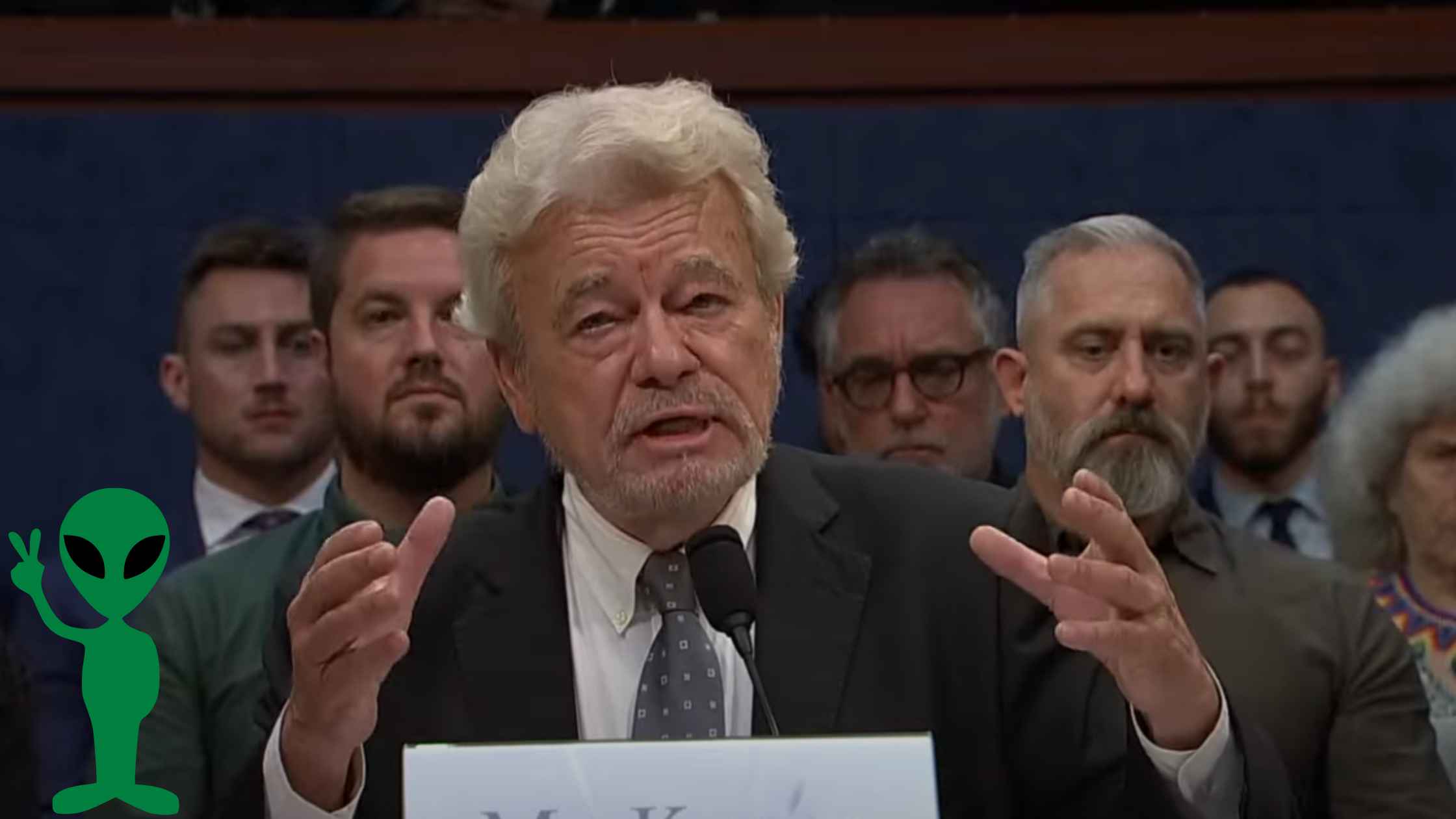
Ms. Luna (00:01):
Good morning and welcome to the hearing regarding UAP disclosures.
(00:05)
For too long, the issue of unidentified anomalous phenomena, commonly known as UAPs, has been shrouded in secrecy, stigma, and in some case, outright dismissal. Today, I want to state clearly that this is not science fiction or creating speculation, this is about national security, government accountability, and the American people's right to the truth. I have spoken now to a number of whistleblowers from the military to include the infamous Eglin Air Force Base incident that occurred when myself and former Representative Matt Gaetz, as well as Representative Burchett, followed up on a lead from multiple active duty Air Force pilot whistleblowers that alleged that the United States Air Force was covering up UAP activity at Eglin Air Force Base. We have heard from a number of whistleblowers, specifically military pilots, that the reason for not coming forward publicly is out of fear that speaking out would cost them their flight status and potentially their careers. This is unacceptable. We cannot protect our air spaces if our best trained observers are silenced, we cannot advance science if we refuse to ask questions, and we cannot maintain trust in government if we keep the American people in the dark.
(01:09)
Now, Congress has tried to fix this problem. Congress tried to create formal channels through the All-domain Anomaly Resolution Office, also known as AARO, and the Intelligence Community Inspector General for service members and officials to make disclosures. But the reality, the reports come in are often too brushed aside, slow-walked or met with skepticism rather than serious investigation. Recently, the former AARO director, known as Sean Kirkpatrick, attacked our witnesses and members on this committee. It should be noted that he's a documented liar and brings into question what his purpose at AARO really was if it was not to follow up on investigations and disclose his findings to members of Congress.
(01:46)
A former Deputy Assistant Secretary of Defense for Intelligence, Chris Mellon, described a report published by AARO that found no evidence that any USG investigation, academic-sponsored research or official review panel has confirmed any sighting of UAP-represented extraterrestrial technology. As the most error-ridden and unsatisfactory government report I can recall reading during after decades of government service, Mellon further noted that this was the first AARO report submitted to Congress without the Director of National Intelligence's sign-off, and seemingly excluded input from any scholars or experts who have studied or written extensively about this topic, as would normally be in any other case in this field. Mellon determined that this report failed to fulfill the congressional mandate under which it was required, omitted entire agencies with known investigations or activities related to UAPs, and omitted any discussion of efforts to hide classified or unclassified information about UAP. Such efforts were unaddressed by the report, despite the existence of agency records and investigations concurring with them, including those at U.S. Customs and Border Protection.
(02:59)
If we set up offices and oversight bodies only to let them become graveyards for testimony, or worse yet, ruses for pretending to investigate, when in actuality, there was no follow-up, then we are not doing our jobs. In recent months, Congress has also been presented with evidence that points to technologies that to our knowledge are beyond our current capabilities. It is our duty as elected representatives to follow the facts wherever they lead and to ensure that those facts are not buried under classification stamps or bureaucratic excuses. Let me be clear, whether UAPs represent adversarial technology, natural phenomena or something beyond current human understanding, Congress has a responsibility to investigate. If these objects are foreign in origin, then they pose a direct threat to our national security, and if they represent something unknown, they demand rigorous scientific inquiry, not ridicule, not secrecy and not silence. The stakes are very high.
(03:49)
Adversarial nations are not waiting for us to catch up, they are studying these phenomena as well aggressively, as multiple nations have also announced their own parliamentary investigations into this very topic. If we are to continue to hide information from ourselves, we risk strategic surprise. If we continue to ignore pilots and service members, as well as countless government whistleblowers, we risk losing their trust, and if we continue to shield the truth from the public, we risk eroding the very foundation of democratic accountability. This is why this hearing matters. This is not about fueling speculation, this is about demanding the basic transparency from the Department of Defense and the Intelligence Community and other military contractors. It is about asking the questions every American has the right to ask, what do we know, what don't we know, and why in a free society are we being told so little?
(04:40)
A major barrier to this committee's inquiry into UAPs has been the lack of cooperation and transparency from the Department of Defense and the Intelligence Community. In preparation for previous UAP hearings, the committee repeatedly asked the Department of Defense to allow members to view videos and files related to UAP incidences. Unfortunately, the Department of Defense notified the committee staff that due to the department's special access program rules, only members of the House Armed Service Committee, as well as the Defense Subcommittee on House Appropriations, also known as HACD, were allowed to be read in onto such programs. For a non-committee member to be allowed to view these documents and videos, individual members must be approved by the chairman and ranking member of both HASC and HACD. Independent SAP oversight has presented a consistent problem for Congress, as well as program budgets are classified. Additionally, oversight reporting to Congress is classified and only provided to the Authorizing and Appropriations Committees of Jurisdiction.
(05:37)
The American people are not fragile, they do need to be shielded like children from reality. What they cannot tolerate and what they will not forgive is a government that withholds the truth and punishes those who dare to speak up. I want to close with this. Future generations will look back at this moment and ask what we did when presented with the unknown. Did we look away, embarrassed or afraid, or did we pursue the truth with courage? I intend to be on the side of the truth, transparency and accountability, and I hope my colleagues on this task force will be able to do the same. To quote a few elected officials, Senator Schumer has stated, "Multiple credible sources allege a constitutional crisis over UFOs." Senator Rounds has stated that these are "brilliant individuals" and they're "not making this stuff up." And our current Secretary of State, Marco Rubio, has stated, "very high clearances and high positions within our government" in regards to these whistleblowers. Senator McConnell also described these whistleblowers as "sane" and "credible."
(06:33)
And the witnesses today are not alone. In fact, they're far from it. In fact, 34 senior military government and intelligence officials have broken their silence. This includes now-Secretary of State, Marco Rubio, Senator Rounds, Senator Gillibrand, General Jim Clapper, the former director of the government's UAP task force, the former Head of Aviation Security for the White House National Security Council, the former Secretary of Defense, and many more. Again to quote Secretary of State Rubio in an upcoming documentary, known as The Age of Disclosure, "Even presidents have been operating on a need-to-know basis that begins to spin out of control." And to quote Senator Gillibrand, who also went public in this documentary, "It's not acceptable to have secret parts of this government that no one ever sees." It's time for the fundamental truths of UAP to be revealed to our nations, leaders and the public. It's time for the US government to exercise transparency. And with that, I yield to Ranking Member Crockett for the opening statement.
Ms. Crockett (07:30):
Thank you so much, Madam Chair.
(07:33)
At a time of increasing distrust in government, it is important for Congress to take action to restore the government's credibility. Bringing transparency to an issue of great public interest is a step toward doing just that. So I thank Chairwoman Luna for calling this bipartisan hearing to discuss unidentified anomalous phenomena, or UAP, which is today's term for what was commonly known as UFOs, unidentified flying objects. And while some people think of flying saucers when they hear these terms, it is vital that we focus on the real-world impact of UAPs on critical infrastructure, civilian safety and national security. There is good reason to believe that most UAPs have origins far closer to home. Currently, NASA has not found any evidence that any UAPs have an extraterrestrial origin. Our adversaries are working to develop new capabilities to gain military advantages, and those efforts are likely explanation for the mysteries that we have observed.
(08:43)
Nevertheless, the federal government has a responsibility to the American people to investigate and provide transparent disclosures about every incident. The federal government is equally obligated to protect those who report what they've seen, especially to commanding officers and supervisors, and Congress should do everything in its power to protect whistleblowers and conduct oversight of agencies that are failing to provide that protection. Democracy depends on transparency, and transparency often relies on the courage of individuals willing to risk their careers, reputations, and in some cases, their personal safety, to tell the truth. So I look forward to hearing from the witnesses today, we should welcome their accounts and acknowledge the bravery they have shown to come before us. We must ensure that all whistleblowers feel that they can come to Congress to tell their stories without fear of retaliation or professional consequences. We need transparency not just to make better policy, but also to ensure that information flows between all those who need it.
(09:51)
There are too many tragic examples in our history where information lapses and a lack of cross-agency coordination led to disaster. Just this year, failure to communicate between FAA and the Department of Defense led to tragedy over the Potomac. The Biden-Harris administration sought to eliminate some of these lapses when it established the All-domain Anomaly Resolution Office at the Department of Defense. AARO can convene sources from all branches of military, the FAA and NASA to combine forces to create a comprehensive picture of what is happening in our skies. Some UAP reports have perfectly normal explanations, satellites, consumer drones, weather balloons, even pranks. But we need to track down each and every single UAP. The United States has millions of eyes in the sky, both electronic and human, but only the combination of civilian, commercial and military sources can begin to create a complete picture. So we need to ensure that people can come forward and report what they have seen to the relevant authorities, and they have to have the right to do so without fear of retaliation.
(11:10)
This country has a history of dedicated public servants standing up for what is right, even in the face of potential consequences. From the Pentagon Papers to Watergate to torture programs, whistleblowers have not only informed the public, but also empowered Congress to fulfill its constitutional duty of oversight. Past Congresses have written laws to grant legal protection for whistleblowers, and it is up to us to work responsibly with all sources to hold the executive branch accountable. We are here today to listen to the stories of those who have witnessed events of interest to the American people, and to support the policies that cultivate an environment that welcomes and protects whistleblowers. I hope this hearing will be an example of the respect and protection whistleblowers deserve, and the importance of conducting oversight of the federal government. I yield back.
Ms. Luna (12:09):
I am pleased to welcome the panel of witnesses for today's hearing. I'd first like to welcome Mr. Jeffrey Nuccetelli. He's a United States Air Force veteran and a career federal employee, with more than 20 years of experience in national security, law enforcement and public administration. Next, we have Mr. Alexandro Wiggins. Mr. Wiggins is currently serving as a senior chief operations specialist in the United States Navy. Mr. Wiggins is testifying in his personal capacity today and not on behalf of the United States Navy. Next, I would like to recognize the gentlewoman from Nevada, Representative Titus.
Ms. Titus (12:47):
Thank you very much, Madam Chairman, ranking members, for allowing me to sit with you on this panel today. I'm honored to be able to introduce a witness here who is from my district, George Knapp, who has been the definitive expert and reporter on this topic that you're exploring today, UAPs or UFOs. George is a long time friend, I'll say that upfront, but a very respected journalist and a recognized expert in this field nationally and internationally.
(13:20)
Just a little something about George, he came to Las Vegas in 1979 and joined KLAS television station as a general assignment reporter in 1981. Since 1995, he's been the chief investigative reporter for that channel. He also hosts a national radio show you can listen to on Coast to Coast AM, which covers many of the paranormal topics that y'all are discussing. Over the years, George has been, as I said, recognized for his work. He's been honored with the Peabody Award, the DuPont Award, the Edward Murrow Award, and 27 different regional Emmys for his investigative reporting. Indeed, he has told Nevada's story with clarity, with objectivity and with integrity, so I know that his testimony today is going to be of great interest and value to this committee, so thank you very much.
Ms. Luna (14:23):
Next, we have Mr. Dylan Borland. Mr. Borland is a United States Air Force veteran and has a long career in federal service. And finally, I'd like to introduce Mr. Joe Spielberger, a senior policy counsel at the Project of Government Oversight.
(14:38)
Pursuant to committee rule 9G, The witnesses will please stand and raise their right hand. Do you solemnly swear or affirm that the testimony that you're about to give is the truth, the whole truth, and the nothing but the truth, so help you God? Let the record show that the witnesses answered in affirmative. Thank you, you may take your seat.
(15:05)
We appreciate you being here today, and I look forward to hearing your testimony. Let me remind the witnesses that we have read your written statements, and it will appear in full in the hearing record. Please limit your oral statements to five minutes, but I understand you have a lot to get through, so if it goes a little over, don't worry about it. As a reminder, please press the button on the microphone in front of you so that it is on and the members can hear you. When you begin to speak, the light in front of you will turn green. After four minutes, the light will turn yellow, and when the red light comes on, your five minutes have expired and we will ask you to please wrap it up. I now recognize Mr. Nuccetelli for his opening statement.
Mr. Nuccetelli (15:43):
Good morning. Thank you, Chairwoman Luna, Ranking Member Crockett, and members of the task force for giving us the opportunity to testify today.
(15:54)
My name is Jeffrey Nuccetelli. I'm a former military police officer with 16 years of active duty service in the US Air Force. I'm here today because the American people have both the right and the responsibility to know the truth about unidentified aerial phenomenon. That truth remains hidden, classified and silenced by fear, retaliation, stigma and confusion. Today, we are here to help break that silence.
(16:22)
Between 2003 and 2005, five UAP incidents occurred at Vandenberg Air Force Base, home to the National Missile Defense Project, a top national security priority. At the time, we were conducting launches deemed by the National Reconnaissance Office as the most important in 25 years. These were historic launches. These facilities were vital, and they were repeatedly visited by UAP. Each incident was witnessed by multiple personnel, documented, investigated and reported up the chain of command. We sent information up, but we got no guidance down on how to handle these events. I personally witnessed one of these events and investigated others as they occurred. Six other service members have provided me with the information that I will share with you today.
(17:18)
The incursions began on October 14th, 2003, when Boeing contractors reported a massive glowing red square silently hovering over two missile defense sites. After several minutes, it drifted further east onto the base and vanished over the hills. This event, now known as the Vandenberg Red Square, was referenced by Representative Luna at the first hearing on this topic. Official Air Force records of this event are in possession by AARO and the FBI. Later that night, while I was on duty, security guards at a critical launch site reported a bright fast-moving object over the ocean. I responded to the incident. Chaos ensued over the radio as the object approached rapidly. I heard my friend screaming, "It's coming right at us, it's coming right for us, and now it's right here." Moments later, I heard them say that it had shot off and was gone. When I arrived on scene, I talked to five shaken witnesses who described a massive triangular craft, larger than a football field, that hovered silently for about 45 seconds over their entry control point before shooting away at impossible speed.
(18:34)
About a week later, another patrol reported a light over the ocean behaving erratically. Believing it might be an unannounced aircraft, they declared an emergency and an armed response force responded. Before the forces could arrive, the object descended and either landed or hovered on our flight line, and then took off again at impossible speed. The witnesses to this event were threatened and intimidated afterward. They were told to keep quiet and think about what they were reporting. After that, things did get quiet, until about 2005, when another patrol reported a massive triangular craft, larger than a C-130, silently floating over the installation. He watched it for a few minutes, it traveled west and disappeared into the night.
(19:31)
And then, I had my own encounter, again in 2005. I was off-duty, sitting in my backyard with two other police officers, when we noticed what first appeared to be a satellite in orbit. But it wasn't acting like a satellite. The light was strange, it was pulsing, and then it started to maneuver. It dropped in elevation. At times, it would vanish from view and reappear in a different location in the sky. And eventually, it reappeared 200 feet over my house. It was a 30-foot diameter sphere of light. My friends and I watched it for a moment, and then it gently accelerated and traveled up and disappeared into the stars. These events profoundly changed my life and the lives of my friends.
(20:18)
We stand at a pivotal moment in history. The question is no longer whether these events are real, but whether we have the courage to face them. True leadership requires vision, a willingness to confront the unknown with transparency and resolve. So I ask the Congress to help we, the people, enact this vision. There are three goals, fund independent research and treat UAP study with the same seriousness as we would any other scientific field. Two, end secrecy and over-classification. Transparency is the foundation of truth. Without it, witnesses like us are dismissed. Three, protect the witnesses. Many stayed silent out of fear for their careers, reputations and the safety of their families. Protect them, and you will embolden others to join this cause. These phenomenon challenge our deepest assumptions about reality, consciousness and our place in the universe. Exploring them can unlock transformative breakthroughs in technology, biology and human understanding. Let this be the moment when America chooses courage over fear, transparency over secrecy, and progress over stagnation. Let's show the world that our nation leads not only through strength, but through fearless pursuit of the truth. Thank you.
Ms. Luna (21:46):
Thank you, Mr. Nuccetelli. I now recognize Chief Wiggins for his opening statement. Please press your button. Thank you.
Chief Wiggins (22:04):
Good morning, Chairwoman Luna, Ranking Member Crockett and members of the task force and the committee. Thank you for the opportunity to testify today. My name is Alexandro Wiggins. I'm an active duty US Navy operations specialist senior chief petty officer, father of three and dedicated American, testifying today in my personal capacity. The views I share are my own and I do not represent the official positions of the department of the Navy or any subordinate organization.
(22:37)
On the evening of February 15th, 2023, at approximately 19:15 PST in the Whiskey-291 warning area off the coast of Southern California, I was serving on board USS Jackson. During that period, I moved between the interior communication center, ICC-1, and the bridge wing, correlating the sensor picture with visual observations, part of my routine responsibilities for surface and air picture management. What I observed and what our crew recorded was not consistent with conventional aircraft or drones as they appear on our system. A self-luminous Tic Tac-shaped object emerged from the ocean before linking up with three other similar objects. The four then disappeared simultaneously, with a high synchronized, near instantaneous acceleration. I observed no sonic boom and no conventional propulsion signatures, no exhaust plume, no control surface articulation on the Sapphire image system. Shortly after the synchronized departure, radar tracks dropped. These observations were multi-sensor and recorded inside of ICC-1, with time location overlay visible in our source frames that have been made public by journalists. From my experience operating in this region over many years, and consistent with our public characterized encounters, unidentified objects reoccur in United States operation areas off Southern California. That fact alone does not tell us what they are, but it does argue the systematic stigma-free reporting and for the preservation of sensor data so analysts can evaluate safe and intelligence implications with rigor.
(24:44)
I want to underscore three points for the task force and the committee. Aviation and maritime safety. When crews and watchstanders observe objects that maneuver or accelerate in ways that does not match known profiles, and do so near our ships and aircraft, that is first and foremost a safety issue. Standardized checklist and training should ensure we capture the best possible sensor data in real-time, including IR settings, slant range estimates, and bearing and range altitude snapshots, and immediate chain of custody for any recordings. Reporting without stigma, protection without retribution. Sailors need to know that reporting UAP encounters will not harm their careers. Congress can help by reinforcing witness protection and by directing the relevant office to maintain confidential de-stigmatized channels for service members who step forward with data. Declassification and transparency where possible. The task force declassification mission is directly relevant here, where operational security permits releasing metadata-preserved sensor excerpts, or at least technical summaries, would improve public trust and accelerate outside scientific scrutiny. That includes, when feasible, the time/geo reference IR frames and radar parameters needed for independent analysis.
(26:26)
To be clear, I'm not here to make claims beyond my lane. I'm here to provide a first-hand account of what I saw, what our systems recorded, and why it matters for safety, for intelligence and public confidence. My request to you is practical, help us capture, protect, fairly evaluate the evidence, and provide a safe pathway for those in uniform to report it. In closing, I want to thank the committee and the task force for holding this hearing and for placing this discussion in a forum where evidence can be examined carefully and openly. I appreciate your attention, and stand ready to answer your questions. Thank you.
Ms. Luna (27:13):
Thank you, Chief. I now recognize Mr. Knapp for his opening statement.
Mr. Knapp (27:24):
Good morning, Chairwoman Luna, Ranking Member, Ms. Crockett, and members of the task force, and Dina Titus, I just knew we were going to get you involved in this topic at one point, great to see you here.
(27:35)
I'm George Knapp, chief investigative reporter at KLAS-TV in Las Vegas. I began my pursuit of this weird mystery way back in 1987, and for 38 years, I've always approached this as a news story. It's not a matter of faith or belief to me, it's a story and it's an important one. I'm proud to be here alongside these witnesses today, men who have seen strange things and stepped forward to tell the world about it. Whistleblowers and witnesses who step up are routinely insulted, belittled or worse. They risk their reputations, their careers, their clearances, their livelihoods, and sometimes much more than that, even their freedom. I know that one of the goals of the task force here is to figure out ways to protect whistleblowers and witnesses, and it's a tall order, because so many of the things that happen to witnesses like these are extra-legal. They're carried out by persons unknown, as Mr. Dave Grusch, sitting up at the top of the room, knows all too well, including events in recent days that have happened to him.
(28:40)
I want to share a couple of things that I've learned along the way on this long journey, and I submitted most of that in written form, because I estimate that my statement here today would take about four and a half hours, so I'm going to try to jump over and touch on the more important, salient points. I submitted the detailed written statement for the record, and we'll go into a lot of that here. But the public has been told over and over since the late '40s, there's nothing to worry about here. These mysterious craft seen by millions of people in the skies, in the oceans, over the land, are not real, they're not a threat. The witnesses are wrong, they're crackpots, don't believe it.
(29:18)
That changed for me. What got me hooked is the paper trail, documents that were squeezed out of the US government after the FOIA, Freedom of Information Act, became the law of the land, and those documents paint a much different picture than what the public, the press and Congress have been told over many years. The documents from military and intelligence personnel behind closed doors admit that, quote, "These things are real. They're not fictitious. They can fly in formation, they're evasive, and they outperform any aircraft known to exist, including ours." The public, of course, as I said, has been told something much different.
(29:54)
Back in 1989, I reported about a guy named Bob Lazar, who claimed that he worked at a facility dubbed S4 out in the Nevada desert, very near to Area 51. He said he was part of a reverse engineering program. He said there are alien craft that were being taken apart to figure out how they operated out there, and that was a pretty tall order, I had clearly taken a dive into the deep end of the pool there. But in the years since then, I've interviewed dozens of other people and I've detailed what their testimony has been in the written statement.
(30:24)
They include Senator Harry Reid, Senator Howard Cannon, also of Nevada, a guy named Al O'Donnell, who was the first general manager of EG&G in Nevada, which managed the Nevada test site which blew up hundreds of nuclear weapons. There was a guy named Dr. James Lacatski, who was a career scientist with the Defense Intelligence Agency, who was the guy who initiated a program called AAWSAP, Advanced Aerospace Weapon Systems Applications Program, which is, as far as we know, the largest acknowledged UFO program ever funded by the US government, which put together an amazing pile of information that members
Mr. Knapp (31:00):
Members of this committee and the world, most of which they have never seen, the DIA still hasn't released 95% of what was prepared by that program at a cost of millions and millions of dollars. The one name I do want to bring up in this session though is Robert Bigelow. So looking into the idea of crash retrievals and reverse engineering while OSAP that program was active, the DIA's contractor, Robert Bigelow of Las Vegas made a bold attempt to acquire physical proof of UFO crashes. It's been widely reported and suspected that Lockheed Martin is one of the contractors, the defense contractors that has held this stuff, stored it away in secrecy and tried to figure out how it works.
(31:46)
I have confirmed on the record that Robert Bigelow and a trusted colleague from OSAP met with and negotiated with senior executives at Lockheed Martin and hammered out a deal wherein Bigelow's company [inaudible 00:32:00] would receive a quantity of unusual material that had been stashed away and protected at a facility in California. That material was not made here.
(32:10)
I want to move on now to the Russia files because that was going to be the central impetus of what I was going to talk to you about today. Back in the early '90s, I got into Russia, met with a number of their defense officials, Ministry of Defense, and others who confirmed for me that Russia had been doing the same thing that the United States had been doing. That is secretly studying UFOs while publicly saying something completely different. The documents and interviews that I obtained and have now shared with this task force show that the USSR launched what is almost certainly the largest UFO UAP investigation in the world.
(32:45)
The first phase of that was an order was sent out to the entire USSR military empire that every unit, you see anything strange in the sky, a craft, an orb, something unusual, you had to gather all the evidence, collect testimony from the witnesses, look for physical evidence, and all of that information went into one program at the Ministry of Defense. Thousands and thousands of these reports came in.
(33:10)
A lot of them were first routed to the KGB, but then back to another program that came after this collection effort called Thread Three. And Thread Three was an analysis program we provided to the committee the documents of what they were trying to do and essentially they were trying to build their own UFOs. They were using the information from their observations and studies to try to figure out that technology. The guy who was in charge of that program, Colonel Boris Sokolov, told me that their goal was to basically develop technology that would be superior to anything we had based on what they learned from UFOs.
Ms. Luna (33:45):
Mr. Knapp, just in the name of time-
Mr. Knapp (33:47):
Sure.
Ms. Luna (33:48):
… to my understanding, did you have anything you wanted to submit for Congress to see in this committee?
Mr. Knapp (33:53):
I have submitted those documents. There's-
Ms. Luna (33:55):
Would you like to play any videos? Do you have a video that you would like to play?
Mr. Knapp (33:59):
I don't think it's for me to play it.
Mr. Spielberger (34:01):
No, that was for Alexander.
Mr. Knapp (34:04):
Alexander's video. You can play it. He could narrate it.
Ms. Luna (34:09):
Okay. We can in the name of showing that video to everyone on the task force, we'd like to play that video at this time.
Mr. Knapp (34:12):
Sure.
Speaker 1 (34:37):
[inaudible 00:34:29] You call it the BVSS team.
Speaker 2 (34:38):
20,008 feet.
Speaker 3 (34:50):
That ship took off earlier.
Ms. Luna (34:56):
If we can get rid of the audio real quick. Mr. Wiggins and Mr. Knapp, we'll get back to what that video was in a moment, but we just want to make sure that it was entered into the record as well as all the documents. Those will be able to be publicly found for everyone in the country to view.
(35:11)
If we could Mr. Knapp, we'll continue on the line of questioning, but I'm going to move on to Mr. Borland's opening statements.
Mr. Borland (35:19):
Good morning members of the task force on the committee. I would like to express my gratitude for being invited to testify to the current task force created under the people's chamber and the American public. As an American citizen veteran and intelligence community professional, it is an honor and a privilege to serve under oath before you on behalf of our country. I speak for myself and no former agency or company I have been previously affiliated with. My name is Dylan Borland, a former 1N1 Geospatial Intelligence Specialist for the United States Air Force and in active duty in listed capacity from 2010 to 2013. I've also been employed with BAE Systems and Intrepid Solutions as a senior analyst, expert in analyzing video radar and advanced electro-optical imagery for official identification of aerial order of battle, as well as naval and ground order of battle.
(36:09)
I'm a federal whistleblower having testified to both the ICIG and AARO with direct firsthand knowledge of and experience with craft and technologies that are not ours and are reportedly operating without congressional oversight. Because of my direct knowledge of the reality of certain legacy UAP programs, my professional career was deliberately obstructed and I have endured sustained reprisals from government agencies for over a decade. From 2011 to 2013, I was stationed at Langley Air Force Base Virginia conducting 24-hour operations via manned and unmanned aerial vehicles for Special Operations Forces in the global war on terror.
(36:47)
During the summer of 2012, my team was on standby for weather and I returned to my barracks on base and at approximately 01:30 I saw an approximately 100 foot equilateral triangle take off from near the NASA hangar on the base. The craft interfered with my telephone, did not have any sound, and the material it was made of appeared fluid or dynamic. I was under this triangular craft for a few minutes and then it rapidly ascended to commercial jet level in seconds displaying zero kinetic disturbance sound or wind displacement.
(37:20)
Some years after that experience, I was further exposed to classified information from the UAP Legacy Crash Retrieval programs through a sensitive position I held within a special access program. During this time, intelligence officers approached me in fear for their own careers, citing misconduct within these programs and similar retaliation that I was already enduring at this time.
(37:42)
These issues include medical malpractice committed by Veterans Affairs staff, denial of work I performed while enlisted in the United States Air Force, forged and manipulated employment documents, workplace harassment, including colleagues being directed to not speak with me, manipulation of my security clearance by certain agencies blocking, delaying, and ultimately removing my ability to be employed within the IC. The retaliation I faced and the retaliation against individuals I know who worked in these programs is what convinced me in March, 2023 to become a whistleblower. I came forward out of concern for people's lives and to ensure I did everything I could to let our elected representatives know the truth about what is really happening in the Executive Branch.
(38:24)
At the end of March, 2023, I agreed to meet with AARO following the suggestion of other federal officials believing it was what our nation required of me. I had reservations with AARO due to assessments they were reporting publicly at the time as a misrepresentation of the truth. Because of these concerns, I did not share sources and methods information in order to protect current and formal federal personnel who had firsthand exposure to technologies of unknown origin. I did not want anyone to face further retaliation beyond what they had already endured. And unfortunately a staff member ended up getting in some trouble because of that.
(39:02)
After David Grusch testified under oath in the summer of 2023 and provided historic disclosure, I was then asked to go to the ICIG and did so in August, 2023. It was very clear early on during my intake interview, which was video recorded under oath that the objective was to solely assess how much I know and not move forward with an investigation with new information I provided them.
(39:24)
The aftermath of that IG complaint still troubles me to this day. Since my ICIG complaint, I've been prevented from assuming prior employment and can confirm I'm still blacklisted from certain agencies within the intelligence community. In addition, multiple agencies attempted phishing attacks to assess what I had divulged to the Inspector General, including being asked to disclose details of my ICIG complaint during a CI polygraph or a position unrelated to UFO UAP matters as recently as November, 2024.
(39:54)
As I sit before today, I and many other whistleblowers have no job prospects, no foreseeable professional future in a nation every single one of us came forward to defend. Numerous individuals have come forward in various ways to reveal the truth of the UAP reality as patriots and defenders of our nation, yet many feel discarded, isolated, hopeless, separated from the country they serve. Efforts to rectify this situation for all whistleblowers have been difficult and troubling, and to my fellow whistleblowers and officials who know this information I offer you my apology, something that I have never gotten and I'm giving it to you.
(40:33)
I swore an oath to the Constitution of the United States, an oath that demands truth and transparency for our democratic republic to function. Each day, these truths remain hidden from our citizens, humanity drifts further from the principles our nation was founded to uphold. Each day victims of crimes committed by agencies and companies maintaining the secrecy are denied justice is another day our constitution is shredded.
(40:57)
In 2023, patriots provided this committee and the executive branch with undeniable proof of the UAP reality, and I commend your continued commitment. The future of humanity is one which we either travel to the stars or regress to the Stone Age with this technology. My career has been to deliver critical information to decision makers. Your role as elected by your representatives is to act on it. The time to act is now. Thank you.
Ms. Luna (41:44):
Mr. Borland, thank you for your service to our country and we appreciate you. And we are sorry about how you've been treated and we will make sure that we try to rectify that situation.
Mr. Borland (41:53):
Thank you ma'am.
Ms. Luna (41:54):
Mr. Spielberger, please your opening remarks.
Mr. Spielberger (41:59):
Chairwoman Luna, Ranking Member Crockett and Task Force members, thank you for the opportunity to testify here today about the importance of strengthening whistleblower protections, especially in the context of national security. I'm a senior policy counsel at the Project on Government Oversight, a nonpartisan, independent watchdog organization that investigates and exposes waste, corruption, abuse of power, and when the government fails to serve the public or silences those who report wrongdoing.
(42:28)
Whistleblowers are the first line of defense to root out waste, fraud, abuse of power and corruption in our government. Congress relies on whistleblowers so that it can fully exercise its oversight and legislative authorities. It's understandable that former presidents of both parties have often taken a hostile approach toward whistleblowers. Their disclosures can embarrass the president and their political party or even lead to a national scandal, but whistleblowers continue to play a vital role during both Democratic and Republican administrations. They help Congress and the public identify and understand what government corruption looks like, their disclosures, fuel investigations, and allow us to address wrongdoing and hold those responsible to account. That's why historically there's been a strong bipartisan consensus in Congress to support and protect whistleblowers. Doing so protects the country and ensures our government is more responsive and accountable to the people.
(43:28)
National security whistleblowing in particular is a tradition going back to the founding of our country. And over time national security whistleblowers and their disclosures have impacted some of the most fundamental issues and questions about how we wish to be governed and how our government can better serve its people. From the role the U.S. plays around the world to holding powerful actors accountable, government ethics and transparency, human rights and civil liberties, Executive Branch authority, First Amendment Freedom of Speech and Dissent, Freedom of the Press and the public's interest and right to know.
(44:04)
Despite this invaluable public service blowing the whistle comes at great personal risk, whistleblowers risk losing their jobs, careers, livelihoods, and reputations. They can face retaliatory investigations, lawsuits, and even serious criminal charges, and they can endure deep, mental, emotional, and psychological harm. All of that risk to speak the truth, to ensure that agencies fulfill their core missions and that they serve the best interests of the people.
(44:32)
Those who retaliate against whistleblowers don't just violate their legal rights, they inflict real harm on our government and betray the public's trust. Targeting whistleblowers instead of the corruption they expose wastes agency resources and further allows that corruption to continue unaddressed. It can instill a chilling effect across an agency, fostering a climate of fear and distrust, quieting dissent and Free Speech and deterring potential whistleblowers from coming forward in the future.
(45:06)
Whistleblowers are often some of the most dedicated and principled public servants we have because of their willingness to put themselves on the line to do what's right, and Congress has historically supported them again on a bipartisan basis, but unfortunately, whistleblowing has increasingly become more politicized with support for whistleblowers often hinging on which party is in power and which party is politically inconvenienced by the misconduct being exposed. But to be clear, targeting whistleblowers individually risks undermining whistleblowing period.
(45:41)
POGO advises members of Congress on both sides of the aisle to focus on the evidence, not the individual. We will always need whistleblowers to achieve the government that best serves its people because when people of conscience, integrity and good character refuse to speak up out of fear, complacency or self-preservation and leave corruption to fester behind closed doors, that is probably the most dangerous risk of all. If we are serious about increase in government transparency and restoring the public's trust, we need public servants committed to the truth.
(46:17)
Whistleblowers need safe and effective channels to make lawful disclosures. They need stronger protections against retaliation, and when they do face retaliation, they need a fair shot to be made whole. Congress has made strides to pass whistleblower legislation and these laws need to be updated and expanded so that whistleblowers truly receive the protections they need, retaliators are held accountable and we can achieve the type of government that people deserve. We strongly urge Congress to continue its historic tradition of championing the rights and protections of all whistleblowers.
(46:52)
Thank you again for the opportunity to testify here this morning. POGO is committed to working with you and the Oversight committee to address these critical issues. I look forward to any questions.
Ms. Luna (47:02):
Thank you, sir very much. Additionally, without objection, the following members are waved onto the task force for the purpose of questioning witnesses at today's hearing, Representative Perry of Pennsylvania and Representative Grothman of Wisconsin. Sorry, what did the… Representative Biggs from Arizona. I already got you, but yeah, we're good. Without objection so ordered I now recognize myself for five minutes of questioning. Also as my friend Mr. Moskowitz might have to go, would you like to go now? Okay. All right.
(47:43)
Mr. Borland, in your testimony you describe witnessing large triangular craft while stationed at Langley Air Force Base in 2012. Can you explain what you observed in terms of size, behavior and why you're confident it was not conventional technology?
Mr. Borland (47:56):
Great question, ma'am. On barracks on the base, I lived in the barracks, there was a little smoke pit outside. I was there on the telephone and looking across to the flight line and I see a white light pop up and stop about 100 feet in the air. I thought it was a weather balloon. I've seen tests from there before. Weeknight, normal thing, not surprising. I actually finished my cigarette and I began walking up towards the flight line. There is a track, and because I was on three months of night work, I would walk the track at night when we were weathered down. And as I began walking towards the light towards the flight line and the track, the light then flies across the base across the flight line and as it flies to me, a triangle manifests around the light. I can't tell you if it's active camouflage, I can't tell you if it appeared around the light, but I can tell you that it was a white light and then it was a triangle.
(48:53)
It stopped about 100 feet in front of me and approximately 100 feet above me. My telephone got extremely hot, completely froze dead. I remember how thick it was. It was between one to two stories thick, equilateral triangle. I could never see the top of it. And the edges were 90 degrees. There were four lights in total, one light on each corner and a larger light in the center, two to three times the size of the corner lights. But what was really odd was the outside, the best way to describe it is looking at a James Webb Telescope picture where you have the colors and then the black background. So the craft itself was this black metallic flake paint, but on top of the craft was this gold, lava plasma, some type of fluid going over and around the craft.
(49:48)
I'm under this for about two to three minutes, and then the center light flashes two to three times, no sound. Immediately shoots up to commercial jet level minimum in my opinion, and I immediately feel static electricity all over my body. And then I smell the smell of after a thunderstorm or lightning storm, that really strong summer thunderstorm smell. Gets up to flight level, I'm trying to get my phone reset and I can only see the center light at this point. If I didn't actually see it take off, I would've thought it was a star. And then it hovers up there and it begins to slowly move due east out over the Atlantic Ocean. I finally got my phone reset. The entire thing was about from the time I saw the light pop up near the hangar until it took off out over the ocean was about 15 minutes.
Ms. Luna (50:38):
And following up to that question, after you disclosed this information to the intelligence community Inspector General, you're subject to phishing attempts and job blacklisting. How widespread do you think this is across the intelligence community for those who raise concerns regarding UAP programs?
Mr. Borland (50:53):
It's a difficult question to answer. I think prior to David Grusch and people beginning this process of bringing people into awareness of the reality of these programs and certain things people have witnessed probably extremely widespread. I think today there's still an issue, but because people are able to come before you and people are speaking out, I think it has been somewhat less. I would hope though that people would, because if this goes back into closed doors, this is going to get really ugly.
Ms. Luna (51:27):
What type of behavior have you witnessed from former AARO director Sean Kirkpatrick as well as his staff, and related to this information you provided to them? Did they ever try to classify this information as non-human technology?
Mr. Borland (51:40):
A good question. The problem with this is that I know what I experienced firsthand, I know other things. I think the staff at AARO that I had met with in March of 2023, I think they were good people doing the job they were told to do. I did not meet with Kirkpatrick. He was either not present or did not want to meet me that day. However, they did classify information about the reality of this subject, and it was very concerning because in my AARO MFR, they had actually referenced a former staff member that was the one who told me to go there, and they probably shouldn't have done that.
Ms. Luna (52:24):
And real quick, before my time is up and we might go to a second round of questioning, just so you're all aware, how important, given everything that you've seen and experienced, is the UAP Disclosure Act of 2025 in restoring both public accountability and trust?
Mr. Borland (52:37):
I think very important. I would hope though that the seven-year window could be shrunk, my opinion, but very important that the truth needs to be known.
Ms. Luna (52:47):
Thank you very much. I now recognize Jared Moskowitz of Florida.
Mr. Moskowitz (52:53):
Thank you Madam Chairwoman. Thank you for allowing me to wave on to the committee. I remember the last committee when we had a bunch of former military personnel folks that either served on bases were pilots or were in different programs experiencing knowledge. It made me recognize that the narrative has changed, it's politically convenient for the government if you all weren't military folks in suits, it would be much better if you pulled up in Winnebago's and were wearing hats. And so the picture of this, because that's important for the American people on how you tell a story, what the message looks like and who the messenger is.
(53:41)
So this is now the second or third committee where we have former military folks with impeccable records with information and knowledge, and it's definitely clear on a bipartisan basis that we have to protect our whistleblowers. There's no doubt. And in a day in which it's really hard to tell what's true or not from a political standpoint. And so I don't really know what is true. I don't know on this subject, but I do know when we're being lied to. And we are definitely being lied to. There's just no doubt about that.
(54:17)
Mr. Wiggins, I want to talk to you. I find your background and testimony compelling. When you first saw what you were looking at, what were your first thoughts?
Chief Wiggins (54:33):
My first thoughts were, I think everything that I was told and taught as a kid and that growing adult no longer was applicable if I'm able to see something that I thought defies gravity in such a way, then what else could be possible? That was my first thought.
Mr. Moskowitz (54:52):
Did you think what you were looking at was a weapons program that you were unaware of? Or did you think what you were looking at was obviously some extraterrestrial piece of technology?
Chief Wiggins (55:06):
Neither one of those crossed my mind. It was just-
Mr. Moskowitz (55:09):
How about now? What do you think it is now?
Chief Wiggins (55:13):
I'm not the expert. I think I want to be as skeptical as everyone else and just hope to know the information.
Mr. Moskowitz (55:20):
Anyone in the U.S. government tell you what you were looking at to try to dissuade you from what you thought it was?
Chief Wiggins (55:26):
No.
Mr. Moskowitz (55:27):
So no one was like, "Oh, there was some anomaly with the technology." No one from the government did that?
Chief Wiggins (55:32):
No one.
Mr. Moskowitz (55:34):
How do you think you were treated when you reported this information or have talked about, the TikTok video is well out there. It's well reported. How were you treated?
Chief Wiggins (55:46):
I've had no pushback at all. I haven't had anyone reach out to me or try to dissuade me in either direction, militarily speaking, so I was treated fair. And I appreciate the Navy itself with assisting me with coming here to being able to testify.
Mr. Moskowitz (56:04):
That's good. So what do you think the American people should take away from watching your video? Because when we watch it, obviously, we've never seen anything like that. It defies what we know to be technologically possible. What are we supposed to think? Someone's lying about something. Someone's hiding something, right? That's not normal what you looked at.
Chief Wiggins (56:26):
I think what the American people should think when seeing that video along with others before me, is that there is something out there and we should know as the people what it is.
Mr. Moskowitz (56:38):
And so let's eliminate possibility. So they didn't come to you and say there was a technological error with what you were looking at. So we put that aside, they didn't say it was broken. We look at that and we see something. So it's either a weapons program being reverse engineered by our governments or other governments or it's nobody's government, and it's not from here. Those are it. You agree with that assessment?
Chief Wiggins (57:01):
I agree. One or the other.
Mr. Moskowitz (57:04):
Mr. Borland, when you first experienced what you were looking at, what did you do next, what was your next step after it had passed and you were done?
Mr. Borland (57:18):
I actually kind of laughed to myself and said, "Okay, so this exists as well." Worked in enough programs, been exposed to enough that I was like, "Okay, so this is a real thing." I went back, walked the track, talked with a couple of my friends about it. I did talk with some of my coworkers, one in particular, which I thought was a joke, and it definitely wasn't, was like, "You probably should never say this to anybody." And then what happened to me happened.
Mr. Moskowitz (57:48):
What about you Mr… How do you pronounce your last name?
Mr. Nuccetelli (57:53):
Nuccetelli.
Mr. Moskowitz (57:54):
Nuccetelli. And sorry, I know I'm running out of time, Madam Chairwoman. So obviously your incident happened well before we could record things on cell phones and things of that nature, right? What did you do when you first experienced, because what you saw, you saw it happen right out of your base.
Mr. Nuccetelli (58:16):
Correct.
Mr. Moskowitz (58:17):
So tell me what you did after you saw that. What was your next move? And I want to hear what your experience was.
Mr. Nuccetelli (58:22):
My next move, I went into my house after it left, I made sure no one had been abducted and I picked up the landline. I called the Security Forces Command Center. I reported it. I requested that they give me a call back and make notifications up the chain of command. I got a call back in about 15 minutes. They reported that the weather station reported no balloons or aircraft, nothing on radar, no aircraft inbound or outbound. I got that notification. And then within the following day or two, me and the other witnesses wrote statements. We prepared a report and then we filed all that information.
Mr. Moskowitz (59:04):
Madam Chairman, thank you for your indulgence in my questioning, and thank you for continuing to lead on this subject. What do you and your friends think about it today? You all have talked about it. I mean, so what do you think about your experience as a collective group? That'll be my last question, Madam Chairwoman.
Mr. Nuccetelli (59:21):
I mean, we've been talking about this for 20 years. We don't know what we saw. What we saw changed our lives and the way we think about everything. It was incredibly profound. The object I saw, I don't even know if it was an object, it was a light, it was an orb. It didn't look like a craft, but it did look solid. And that's what we talk about. We noticed the object. And this was a pattern across all the encounters. Someone would see a light, they would pay attention to the light, and then the object responds. It performs for you, and then they come down and they investigate you. So it's almost like they're curious. So that's the thing we primarily talk about. Why did it come after we noticed it? Maybe it noticed us after we noticed it. You're welcome.
Ms. Luna (01:00:19):
I now recognize Representative Mace for five minutes.
Mrs. Mace (01:00:23):
Thank you, Madam Chair. And I want to thank all of our witnesses for being here today. Mr. Borland, I'd like to start with you and ask a few questions. Were there any other witnesses? When you saw the Equilateral Triangle, were there other witnesses that saw the same thing?
Mr. Borland (01:00:37):
Not to my knowledge, ma'am. At that point, the only people that would be awake is those of us that were doing operations for the GWAT and then Security Forces. So not to my knowledge.
Mrs. Mace (01:00:48):
And do you think that in your opinion, that the equilateral triangle was the U.S. government's technology?
Mr. Borland (01:00:56):
I did once upon a time, but knowing what I know now, I'll have to answer that question in a skiff probably.
Mrs. Mace (01:01:03):
Well, my next question is you teased us. So knowing what you know now means what?
Mr. Borland (01:01:09):
I know enough to know that if you want an answer to that question, go to AARO. They have the answer.
Mrs. Mace (01:01:14):
Do you think it was a foreign government?
Mr. Borland (01:01:17):
I do not, no.
Mrs. Mace (01:01:20):
And AARO is supposed to be disclosing, the last time I was in a skiff with AARO, they said they were going to be doing disclosures. Had they been doing much of that?
Mr. Borland (01:01:29):
I don't have an answer for you. I don't know. I know what AARO reports publicly, and I know what I've been through.
Mrs. Mace (01:01:37):
And some of this stuff can be, I think, debunked. There are sometimes there are weather balloons that look a little funky or drones or whatever, depending on the angle, direction, speed, et cetera. Are you scared for your safety?
Mr. Borland (01:01:54):
That's a complicated question. Being here today, if I say the wrong word, technically I can be charged with
Mr. Borland (01:02:00):
The Espionage. Espionage is a death penalty. Whistleblowers have faced it. John Kiriakou, for example. I am not scared for my physical safety in the sense of a agency or company coming to kill me, but I have no job. My career has been tarnished. I'm unemployed. Living off of unemployment for the next three, four weeks until that's gone. So it's a complicated question.
Mrs. Mace (01:02:26):
Have there been stories leaked about your life to try to discredit you in the public eye?
Mr. Borland (01:02:31):
As of now, I don't know. Up until now-
Mrs. Mace (01:02:33):
We know they did that to Mr. Grusch.
Mr. Borland (01:02:35):
I am aware. Yes ma'am.
Mrs. Mace (01:02:36):
They leaked his medical, private medical information. Horrific things.
Mr. Borland (01:02:40):
It is.
Mrs. Mace (01:02:42):
Okay. You said in your testimony earlier with the chairwoman you know other things. I guess it has to be mentioned in a SCIF, the other things.
Mr. Borland (01:02:52):
It would, pending I'm even legally allowed to speak on, and the people in the room are even legally allowed to hear it.
Mrs. Mace (01:02:57):
And would we need to know the compartmentalized word, what the code word is or the name of the program, the special access program in order to even hear it? You have to know the word, right?
Mr. Borland (01:03:09):
I would suggest-
Mrs. Mace (01:03:10):
The name of it, right?
Mr. Borland (01:03:11):
I would suggest that to be asked to DNI Gabbard and work with her for that, because I can't give you the answer on what is the requirement.
Mrs. Mace (01:03:19):
But this is what the US government does, right? They compartmentalize the information. Only certain people know the name of the program, and if you don't know it, you can't get the information. If you don't have the name, you don't know what to ask for. Even when we're reviewing the budget, we go into a SCIF, we look at DoD budget and the budget of black box programs and we don't know what we're looking at because we don't know what these programs are. Is it a way for the government to hide from Congress what's really going on and where the money's going?
Mr. Borland (01:03:43):
In my opinion, absolutely. Yes.
Mrs. Mace (01:03:46):
You mentioned too in your testimony earlier that you went to speak with the government and they said somebody's name, a colleague's name, and you said they shouldn't have mentioned that staff person's name. What does that mean?
Mr. Borland (01:03:59):
A senate staffer who is the one who helped me get to AARO, recommended me I go there, gave me the email and the phone number because I could not find that information at all at the time. In fact, I believe you guys have talked about how AARO didn't even have a website for quite a period of time.
Mrs. Mace (01:04:12):
We were told they were going to do disclosures, both what they've debunked, because some of it can be debunked, and then what they haven't been able to debunk. And to my knowledge, it hasn't been a thing. I only have one minute left. So Mr. Knapp, we're definitely going to watch every documentary you guys have done. You and Jeremy have done a terrific job. I usually have more questions than I have answers. I think we all do, and you guys are doing a terrific job to bring information to the public. Do you think that any of this is a psyop by the US government?
Mr. Knapp (01:04:39):
Entirely possible. I mean, our government and other governments have admitted that they've tried to use UFOs to cover secret projects, but I think they also do some reverse engineering of those claims. So years after people start seeing UFOs over Area 51 for example, they come up with a story. Oh yeah, that was, we planted that story. So I read in a major newspaper just a couple of weeks ago, they planted this story, an Air Force colonel went out into the desert, went to a bar at Rachel and gave them some fake UFO photos, and that's how the whole story about Area 51 started, which is preposterous.
Mrs. Mace (01:05:16):
Yeah. And I didn't even get to the crash retrieval program stuff yet, Ms. Chairwoman. There's just so much. Okay. Thank you so much for your time today. I wish we had more time. Thank you, Madam Chair.
Speaker 4 (01:05:29):
I now recognize Ms. Crockett for five minutes.
Ms. Crockett (01:05:37):
Thank you so much, Madam Chair, and thank you so much to each of the witnesses that have come before us today. The federal government has had a long-standing over-classification issue in general. We all know that from the assassinations of MLK and Malcolm X, to the COINTELPRO and torture programs to now UAPs. The federal government has kept the American public in the dark about issues of immense public interest. The federal government has routinely made excuses for failing to provide transparency to the public, the most common of which is national security concerns. Mr. Spielberger, can you provide an example of when national security was inappropriately used as a pretext for classification?
Mr. Spielberger (01:06:26):
Congresswoman, probably one of the most infamous examples of that is the 9/11 commission that found that over-classification was a key factor in the failure to adequately prevent the attacks of that day.
Ms. Crockett (01:06:42):
In addition to that, what lessons from these oversight failures should guide Congress in approaching UAP oversight?
Mr. Spielberger (01:06:52):
Generally speaking, we would advise this Congress to ensure that agencies adopt general policy in favor of disclosure instead of knee-jerk needing to over-classify information and documents. We should ensure that when information is classified or deemed sensitive, it's only for legitimate national security and privacy concerns. And we would recommend adding additional factors to the considerations of cost value and certainly to the extent that it's critical for the public interest and the public's right to know, especially when we are talking about these very serious national security concerns and implications.
Ms. Crockett (01:07:42):
Can you speak to how whistleblowers have historically helped Congress uncover the truth in other areas and how that might apply here?
Mr. Spielberger (01:07:53):
Absolutely. So again, Congress has always relied on coming forward and making disclosures in a number of different issues across different agencies. Anything from national security to airline safety, railway safety, environmental concerns, workplace health and safety, a lot of issues coming out of the COVID pandemic, for example. Whistleblowers have come forward with important disclosures on just about any critical issue affecting our government and affecting the American people, all of which have grave implications for the rights and protections that we have and how we live our lives in communities across the country.
Ms. Crockett (01:08:41):
How important is it for whistleblowers to have strong protections when it comes to UAP-related disclosures or disclosures of other topics of excessive government secrecy?
Mr. Spielberger (01:08:53):
It's absolutely vital. This has been one of the disappointing failures of doing this work, of advocating for stronger whistleblower protections. We recognize the invaluable public service that brave whistleblowers play in coming forward. Again, taking all of these risks that we've heard about just to speak the truth, to get important information out in the public consciousness, but they can only do so when we have safe and secure channels for reporting. When there is trust in the independence of agency watchdogs like Inspectors General, like the Office of Special Counsel, like the Merit Systems Protection Board that play critical roles in investigating whistleblower disclosures and enforcing the protections of whistleblowers. All of that is essential to allow whistleblowers to keep coming forward and playing these incredibly important public roles.
Ms. Crockett (01:09:56):
Thank you so much. Let me just say this. People look at Congress, especially now, and they see a lack of unity. They don't see the ability for us to come together really on much of anything. I will say that I do applaud the chairwoman and the work of this committee because for once, I feel like we are focusing on governing, which should be about transparency. The reality is that we cause more harm than good when we allow a lack of transparency to fester. It allows for all types of conspiracy theories instead of us actually making the investments that we need to make to get the information and actually provide it to the American people.
(01:10:41)
The reason that I wanted to focus on making sure that we answer some questions specifically around the protections of those that are willing to come forward is because the only way that we can make this government actually work for all of us is if no matter where you are in this federal government, you feel as if you are safe when you come forward with information of any issue. And so I do want to thank you for all of your stories. The reality is that we only get five minutes, and the vast majority of everything that you have to say cannot be contextualized within five minutes. But I know that my colleagues are going to get to kind of pulling some more of that out. But again, I really just want to thank you for your courage in this moment, and thank you for your service to our country.
Speaker 4 (01:11:32):
I now recognize Mr. Burchett from Tennessee for five minutes.
Tim Burchett (01:11:41):
Thank you, Chairlady, and thank you Ranking Member Crockett. I see a lot of friends out there and I see a couple enemies, so I'll remember that. But it's a pleasure being here. I want to remind people too, this thing is an ongoing deal. We're not going to get this overnight. We've been fighting this battle, some of y'all for 30 years and maybe longer. I hope we just keep focused on what we're trying to get to is total disclosure. We get a little wrapped up in a lot of things, but the government has something and they need to turn it over to us. We pay their dadgum salary, you pay our salary, and you ought to get more out of us than you do. And that's what disgusts me about this whole thing.
(01:12:28)
I think they're just trying to run the clock out on us, really. They'll poke us a little and they'll make jokes to us and try to pull us off the target, but I think we know where we're at and that's why they're firing at us, because we are over the target. My first question is, Mr. Knapp, I recently introduced the UAP Whistleblower Protection Act to help provide whistleblower protection to federal personnel for disclosing the use of federal taxpayer funds to investigate UFOs. I still don't want to say UAPs. How can Congress further increase whistleblower protections?
Mr. Knapp (01:13:09):
I think you got to unleash the dogs and go track down the money and where it goes, because a lot of this stuff has been moved out of government, as you know, Rep Burchett. It's been given to private contractors who stashed it away. They've had it for so long that there's nobody left inside government, or very few who know where it is.
Tim Burchett (01:13:27):
And they do that to keep us from FOIA, correct?
Mr. Knapp (01:13:30):
Sure. Yeah. It's to keep it from FOIA, and I think that the contractors who've had this stuff for a very long time set their own standards about who is allowed to know what. And it's a very small group that ever cracks that. I think Representative Luna has been looking at the use of classifications to hide things. I'm not sure that even this committee getting security clearances that should allow you to see this stuff would allow you to follow where it really goes.
Tim Burchett (01:13:58):
I worry about the people that are looking at it don't even know what they're looking at. I mean, it's gone through so many, I mean, since Roswell for instance, I mean, do you think, there's nobody even alive that was around any of that stuff, so-
Mr. Knapp (01:14:11):
Yeah. I don't think they've made much progress, from the people that I've talked to. I don't think they've made much progress in learning that technology. Might've made some, but you wonder. The implication is Tic-Tac. Oh yeah, that's ours. What flew over Washington DC in '52, is that ours too? When are you going to break that out? You guys authorized tens of billions, hundreds of billions of dollars on weapons systems that can't do half of what we've seen UFOs do. So when do they break this out if it's really a classified project could, change the world? I don't think they've made much progress, and I think they've been lying to us and to you and the rest of the world and they're still doing it.
Tim Burchett (01:14:47):
Yes, sir. I agree with you. How did you manage to obtain the classified Russian UAP documents, and how did you get them back in the United States?
Mr. Knapp (01:14:56):
Well, I met this Russian physicist who was in the United States lecturing.
Tim Burchett (01:15:00):
And I want to clarify that. I can't even take a thing of honey home on my airplane when I fly back to Tennessee.
Mr. Knapp (01:15:07):
Yeah. I did something pretty dumb-
Tim Burchett (01:15:09):
And I'm bitter about it, but go ahead.
Mr. Knapp (01:15:11):
I did something kind of dumb. I met with these officials who during that time period, Glasnost, Perestroika, the Russians were trying to open up to the world, and I saw it as a window of opportunity, and it was. And we were able to talk these folks into providing us information that otherwise we would never have seen some of that was classified. I found out that they only stamped the top pages of these documents that were classified, so I just removed them. I removed those pages and I carried them out. And if they'd caught me, I'd be in a gulag still.
Tim Burchett (01:15:40):
Yeah. We'd be saying, "What happened to George Knapp?" Oh, yeah. What happened to the Russians that came forward to you in 1993, and were there any repercussions for them?
Mr. Knapp (01:15:52):
Well, there were. The first thing that happened when I talked about this after getting back and going through the files and things and sifting through it, the Russian physicist who had helped us be introduced to all these people wrote back and said there was a huge eruption, that there was, the real right far autocratic forces that wanted a return of the USSR had really go after these guys. They described him as traitors. Nikolai Kapranov, the physicist friend of mine, said, "Look, if this had happened five years earlier, we would be in prison. If it had happened 10 years earlier, we would've been shot." Luckily, at that point, Putin was not in power, but none of those people that we talked to on that trip in 1993 would ever talk to me again. I went back in 1996 and it was like I had the plague. I spoke to different people, but they were scared.
(01:16:43)
And eventually, the story was spun where the Ministry of Defense officials who gave us this information were described as ufologists who said there was nothing really significant to these files. They didn't really find anything a big deal. And I can tell you, you'll see those files that I shared with you. They did find stuff. There was an incident in October of 1982 over an ICBM base where UFOs popped up, was observed over this base where the missiles are pointed at us, United States. These UFOs perform incredible maneuvers. They split apart, they fuse back together, they'd appear and disappear. And right at the end of this four-hour period, the launch control codes for the ICBMs lit up.
(01:17:26)
Something entered the correct codes, the missiles were fired up and ready to launch, and they could not shut it down. The Russian officers were panicking. The UFOs go, they disappeared. The launch control system goes back to normal. Colonel Sokolov and his team came in, took the thing apart, could not figure out what it was. It wasn't a power surge or EMPs or some of the baloney excuses that our country has given for similar events involving our nuclear missiles. They thought it was a message from wherever the UFOs were from. And that's a chilling thing. I mean, we were a couple of seconds away from World War III starting, and the UFOs were responsible for it.
Tim Burchett (01:18:01):
All right. I'm out of time, but real quick, who are the contractors that have this material, the corporations?
Mr. Knapp (01:18:07):
Well, one of them is Lockheed. And I'll tell you, I mean, I'm not saying Lockheed's the bad guys. They're doing what they were asked to do. They have lied about this because that's what they're supposed to do. But Lockheed would be one. There's a list I can give you, Congressman, some of the big ones, the usual suspects.
Tim Burchett (01:18:25):
Okay, thank you. I yield back, Chairlady. Sorry for going over.
Speaker 4 (01:18:26):
It's all good.
Tim Burchett (01:18:27):
It's all George Knapp's fault.
Speaker 4 (01:18:29):
I now recognize Ms. Boebert for five minutes.
Lauren Boebert (01:18:34):
Thank you, Madam Chair. Chief Wiggins, based on your training and operational experience, could the behavior that you witnessed, a transmedium object vanishing without a sound be explained by any known technology that we possess or other governments possess?
Chief Wiggins (01:18:53):
It cannot, no.
Lauren Boebert (01:18:53):
And has any government agency debriefed you or any of your shipmates regarding the EOIR and radar-confirmed UAP encounter aboard USS Jackson?
Chief Wiggins (01:19:07):
No one has. No, ma'am.
Lauren Boebert (01:19:09):
What was that encounter like when you brought that up? If you want to briefly summarize that, when you brought that to their attention and then you were not provided any follow-up, who was told and how did you feel when there was no contact back to you?
Chief Wiggins (01:19:27):
As far as the actual incident happening or the reporting level?
Lauren Boebert (01:19:31):
Yes, sir. Yes, chief.
Chief Wiggins (01:19:32):
It was, within the event happening, my duties are to report to the Tactical Action Officer on watch while we're standing watch. So Tactical Action Officer was there. I made my report. I've not had any discussion outside of that day. There's been no communication to me or requests from me within inside of the military. But speaking of that actual incident itself, once the report was made to the Tactical Action Officer, that's when I made the decision to ask the individual watchstander that was controlling Sapphire to be able to slew into the location. And that's what you see in the video itself is when the watchstander is slewing in and kind of showing us what we're looking at. But outside of that, that's as far as the reporting went that I know of.
Lauren Boebert (01:20:34):
Thank you, Chief. Just for the sake of time, Mr. Nuccetelli, Has AARO, the Air Force, or the FBI ever followed up with you personally about the Red Square event?
Mr. Nuccetelli (01:20:45):
I did have follow up by AARO. Nothing with the Air Force. The AARO office updated me I think at least two times. They let me know that they were unable to locate any records, that the records had been destroyed by the Air Force. The Air Force is destroying all their police records every three years on a schedule. So-
Lauren Boebert (01:21:07):
You were informed that these documents were destroyed?
Mr. Nuccetelli (01:21:11):
Well, I have a Freedom of Information Act from the Air Force that states clearly that they destroy all police records on a three-year schedule.
Lauren Boebert (01:21:19):
Okay. So they were sitting on documentation, destroyed it, refused to question any of the lead investigators, anything leading into this investigation?
Mr. Nuccetelli (01:21:33):
Yeah, basically they destroyed all the police records. So you couldn't even call the Air Force and ask them if there was a vehicle accident in that timeframe. So that's a big problem. We're losing data in real time, so we'll never be able to go back and track-
Lauren Boebert (01:21:49):
I think our federal government has a history of destroying records. Thank you. Thank you very much, Mr. Nuccetelli. Dr. Borland, as a geospatial intelligence officer, have you seen classified data indicating UAPs operate in restricted US airspace, and has that information been withheld from Congress?
Mr. Borland (01:22:17):
I have not in US airspace. That is intelligence oversight, so I did not have domestic authorities.
Lauren Boebert (01:22:18):
After filing your Inspector General complaint over retaliation inside the Pentagon's UAP office, did you receive any kind of protection or just more retaliation?
Mr. Borland (01:22:29):
Within the IG or AARO, ma'am?
Lauren Boebert (01:22:30):
Either.
Mr. Borland (01:22:31):
AARO, they went after the staff member and classified everything, shut that down. The IG, to this day, I don't even know if my complaint's active. I know my attorney that represented me was very, very, very concerned. And the best of my understanding, I was determined credible, not urgent.
Lauren Boebert (01:22:51):
And do you think that that experience would suggest that the internal UAP investigations may be compromised?
Mr. Borland (01:23:02):
Possibly. I mean, it's so hard because this goes back to people doing the job they're told to do, and very few people are going to want to give up their careers, 20, 30-year pension, get rid of their kids' healthcare, get rid of their house. It's possible. Yes.
Lauren Boebert (01:23:18):
Yes. Thank you very much, Dr. Borland. Mr. Spielberger, do National Security whistleblowers currently have any external appeals processes to challenge retaliation, or are they just stuck relying on the same agencies that they're accusing?
Mr. Spielberger (01:23:36):
Congresswoman, this is one of the biggest concerns that we at POGO have, basically around the independence of investigations and accountability for retaliation. Basically, yes, National Security whistleblowers have to rely on internal administrative processes that go through Agency Inspector Generals. There are some differentiations, but the bottom line is that they are forced to rely on protection from the same agencies and people who they are alleging retaliated against them.
Lauren Boebert (01:24:10):
Yes. Well, I thank you all for your bravery. We are out of time here. Thank you so much for coming forward, and we will do everything that we can to ensure that you are all protected. Thank you for trying to bring truth and transparency to the American people. Madam Chair, I yield.
Speaker 4 (01:24:24):
I now recognize Mr. Burlison for about five minutes.
Eric Burlison (01:24:27):
Thank you, everyone. It takes such great courage to come forward, and we acknowledge that and I hope that you see that we are taking that seriously, and so very thankful for what you're doing today. I'm also very thankful for previous witnesses that have come forward. I see Matthew Brown in the audience. He courageously stepped forward as a witness. I encourage everybody to look and seek his testimony. I want to thank the people that came in our first hearing. Ryan Graves, David Grusch, David Fravor. And in our second hearing, Admiral Gallaudet, Lue Elizondo and Mr. Gold, and the many others that have come forward. We hear you, and enough is enough. It's time that we take action. Look, I'm not jumped to the conclusion that I believe that there are aliens coming from another planet, but I'm open to that, and I think that it's our responsibility, especially when we're seeing that we have a government that is actively blocking information from us.
(01:25:31)
Just last night, I tried to get an amendment onto the National Defense Authorization Act that fit in the germaneness of that bill to have UAP disclosure. And conveniently, it was named non-germane, mostly deemed by staff, not even an elected official. This is the kind of stuff that we repeatedly see. Last year, we were blocked by someone in House administration from being able to receive a full briefing from AARO. So not an elected official, but someone in staff blocked us. And I've had it. Enough is enough. I want to cue up a video that I've been given, and before it starts, I'm going to describe. This was taken October 30th, 2024. This video is of an MQ-9 drone tracking an orb, or this object, off the coast of Yemen. You'll see that another MQ-9 launched a Hellfire missile that you cannot see that drone, and I'm not going to explain it to you. You'll see exactly what it does. This is when it zoomed out, so you can still see it traveling.
Mr. Nuccetelli (01:27:20):
Declassified?
Eric Burlison (01:27:23):
So Mr. Knapp, have you heard about events like this occurring? And what information might you have?
Mr. Knapp (01:27:35):
I have heard about events like this. I have heard about this event. Jeremy Corbell and I talked about it in one of our episodes a while back. We did not have the video though. There are servers where there's a whole bank of these kind of videos that Congress has not been allowed to see, that public hasn't been allowed to see. Occasionally some of that stuff gets out in the wild and it comes our way. It should be going to you. The public should be seeing this stuff, and why you're not allowed to, I don't know. But that's a Hellfire missile smacking into that UFO and just bounced right off, and it kept going.
Eric Burlison (01:28:09):
It kept going. And it looks like the debris was taken with it.
Mr. Knapp (01:28:12):
Yeah. What the hell is that? What flies like that?
Eric Burlison (01:28:14):
So again, I'm not going to speculate what it is, but the question is, why are we being blocked from this information consistently? I want to ask this question. How in the world, this is the document. I want to enter this in for the record if it hasn't already been entered, Madam Chair. The document-
Speaker 4 (01:28:33):
So ordered.
Eric Burlison (01:28:33):
… that you provided on thread three, this is a huge file. How in the world did you smuggle this out of Russia?
Mr. Knapp (01:28:41):
Carefully.
Eric Burlison (01:28:42):
In your socks?
Mr. Knapp (01:28:44):
I don't think I want to be really specific about it, because I might have to go back there and get some more sometime, although-
Eric Burlison (01:28:49):
Okay.
Mr. Knapp (01:28:50):
No, I'd be crazy to do that. Well, again, I took the top pages off that were stamped with the security signature and I carried them out on my person. But the rest of them, I just threw in my suitcase and threw some caviar in there as a distraction as well and hoped for the best. Otherwise, I'd be a citizen of Siberia right now.
Eric Burlison (01:29:10):
And you reported James Lukatsky came to you with government possession of NHI craft and how they ultimately gained entry. Can you testify to the veracity of that claim?
Mr. Knapp (01:29:25):
Dr. Lukatsky is an honorable man who served most of his career with the DIA, a very trusted high-level rocket scientist and intelligence analyst who inspired the OSAP program, as I said earlier. And in full disclosure, I've co-written two books with him. He dropped this on myself and our other co-author out of the blue, and it took 14 months for us to get DOPSR approval for him to release two sentences on that. He said this craft, we had managed to get inside of it. It had no wings, no rotor, no tail. It had no fuel. No fuel tanks. They didn't know how it flew or how it was operated. It clearly looked like it was aerodynamic, but he would not go further. He's a by-the-book guy, and until he gets clearance to say more about that, I don't think we're going to hear much more. But it's not ours. It wasn't ours. We didn't make it. We didn't know who made it and how it was built and how it operated. We've got at least one, and I don't know. I think that's enough confirmation that we do have recovered discs and materials.
Eric Burlison (01:30:29):
And lastly, Mr. Borland, in the classified realm, have you been exposed to undeniable confirmation of NHI technology? And then my second question is, is BAE Systems involved in any way with reverse engineering exploitation of non-human intelligence craft?
Mr. Borland (01:30:49):
Yeah, we're going to have to have a conversation in SCIF for that, whether I'm legally even allowed to answer that and whether you're even allowed to hear it, sir.
Eric Burlison (01:30:58):
Okay. Again, you can sense our frustration, and so I just want to thank you for coming forward. We will continue to fight, because look, this is about making sure that this government belongs to the people and restoring the republic the way it was intended to be. Madam Chair, I also have further witnesses of courageous individuals that was given to me by Dr. Steven Greer, including Michael Herrera and his testimony. We have Roderick Castle and his testimony, Randy Anderson, his testimony, Stephen Digna, and others, three others, all saying similar things to what the witnesses today have said. And I would like to enter that into the record as well.
Speaker 4 (01:31:41):
No objection.
Eric Burlison (01:31:42):
Thank you.
Speaker 4 (01:31:42):
I now recognize Representative Lee for five minutes.
Summer Lee (01:31:47):
Thank you, Madam Chair. I think we need to make sure that we don't get distracted by sensational stories only of unidentified anomalous phenomena and lose track of what the core of this hearing is about. This is all a perfect example of why whistleblowers are so important and why it's so important that we step up and protect them. With Trump, RFK Jr., EPA Administrator Lee Zeldin and others committed to dismantling government and firing professionals who do dare to speak out against the threats this administration's disastrous policies create, we have to focus on protecting all whistleblowers, not only the ones who are reporting on UAP.
(01:32:29)
I'd like to thank the whistleblowers who have agreed to come before the committee today and speak their truth. This administration's claims to care about waste, fraud, and abuse, and so often it is the whistleblowers who care and who are the tip of the sword fighting against the real waste, fraud, and abuse. One study found that whistleblowers expose fraud at more than twice the rate of third party auditors. So Mr. Spielberger, what are some of the best examples of whistleblowers exposing fraud and abuse in the federal government?
Mr. Spielberger (00:00):
Mr. Spielberger (01:33:02):
Thank you, Congresswoman.
(01:33:03)
Again, whistleblowers have played such a vital role across so many different issues. One prominent example goes back to the 2014 VA wait-list scandal. POGO actually played a very instrumental role coordinating with Iraq and Afghanistan Veterans of America.
(01:33:21)
At that time we received tips and whistleblower disclosures from over 800 different individuals talking about the VA subjecting veterans to extensive wait times in order to get the basic standard of care that they deserve. It's certainly prolonged serious illnesses, even contributing to hasten deaths, and we were able to help shed more light on that issue, which I think just emphasizes the importance, even outside of the national security context, we are often still talking about serious issues and even life-and-death concerns.
Summer Lee (01:34:11):
And, unfortunately, whistleblowers can, whistleblowing can lead to serious repercussions and retaliation, especially in this vindictive and lawless administration.
(01:34:21)
Mr. Spielberger, in the past, what kinds of retaliation have they faced, and what are we seeing today under the Trump administration?
Mr. Spielberger (01:34:30):
So we've certainly heard about a number of different examples of retaliation. One that I'd like to highlight that Mr. Borland referenced previously is retaliation through abuse of the security clearance process that can have grave implications not just for a whistleblower, but also their ability to seek legal counsel and defend themselves against retaliation.
(01:34:52)
And when we look at the past several months of this administration, unfortunately, we've seen a really systematic approach toward dismantling the nonpartisan civil service. We've seen the mass firings, we've seen undermining of independent agency watchdogs, mass firings of inspectors general, undermining the Office of Special Counsel, the Merit Systems Protection Board. Again, these entities that are meant to be independent and play a critical role in investigating whistleblower disclosures and ensuring that their rights are protected.
Summer Lee (01:35:26):
Yeah. Thank you.
(01:35:28)
In 1989, Congress passed the Whistleblower Protection Act and then broadened it again in 2012 to ensure that federal workers could feel free to come forward to their elected officials. And it's a good thing we did because whistleblowers have played a more important role than ever since Trump has taken office.
(01:35:44)
It was thanks to a whistleblower that we learned that Doge allegedly put every single American's personal security information at risk by bypassing safeguards and copying all this data to an unsecure server. I ask unanimous consent to enter into the record a New York Times article titled, quote, Doge Put Critical Social Security Data at Risk, Whistleblower Says.
Ms. Luna (01:36:03):
Good to go.
Summer Lee (01:36:04):
Thanks. We've had whistleblowers at the National Labor Relations Board reveal that Doge minions may have shipped case files outside of the agency, possibly to help then co-president Elon Musk continue to exploit his workers. And last week whistleblowers at the National Institute of Health came forward to say that RFK Junior's vaccine and misinformation campaign had pervaded even the highest levels of the agency.
(01:36:24)
Typically, whistleblowers have an inspector general they can rely on to investigate their claims and register issues with agency leadership. But President Trump has fired or demoted over 20 inspectors general.
(01:36:33)
If I may ask one more question, Mr. Spielberger, can you explain how eroding the independence and capabilities of inspectors general further endanger these whistleblowers?
Mr. Spielberger (01:36:43):
Absolutely. So again, whistleblowers already face incredibly great challenges in coming forward under normal circumstances, and when we erode these entities that are expected and required to enforce whistleblower protections fairly investigate their disclosures, it calls into question the integrity of their investigations and findings, whether they'll take whistleblowers seriously when they come forward, and whether we can trust that they will use their authority to enforce the protections of whistleblowers who do come forward. Essentially, whether they will continue in their role as an independent watchdog or basically become a lapdog for a current or future president.
Summer Lee (01:37:28):
Thank you, and I will note… I will take no longer, no more liberties, I yield back.
Ms. Luna (01:37:33):
Thank you. I now recognize Mr. Crane for five minutes.
Mr. Crane (01:37:38):
Thank you, Ms. Chairwoman, for holding this hearing. Thank you to the witnesses for appearing in the effort of transparency here. I got to admit to the witnesses that, growing up, I really never believed in UFOs or any of this stuff. I always thought it was a little kooky and whatnot. But after hearing your testimony from honorable service members watching videos like my colleague Mr. Burleson just presented, I got to admit I've become a believer, not that I know where these things come from or what they really are up to.
(01:38:14)
But I'd like to start with asking the witnesses. Mr. Nuccetelli, you were in the Air Force, right?
Mr. Nuccetelli (01:38:23):
Yes.
Mr. Crane (01:38:24):
Did you believe in UFOs prior to your encounter?
Mr. Nuccetelli (01:38:27):
I've always been interested. Yes.
Mr. Crane (01:38:29):
Okay. Chief Wiggins, you're currently in the Navy, is that correct?
Chief Wiggins (01:38:33):
Correct.
Mr. Crane (01:38:34):
Did you believe in UFOs before your encounter?
Chief Wiggins (01:38:37):
I did. I'm from Las Vegas, and I've watched George Knapp my whole life.
Mr. Crane (01:38:41):
Okay. What about you, Mr. Borland?
Mr. Borland (01:38:45):
I have always been open to where facts go, so-
Mr. Crane (01:38:50):
Were you guys scared or hesitant to come forward and tell your story because of fear and believing that you might be reprimanded or ostracized from society because of your stories? Mr. Nuccetelli?
Mr. Nuccetelli (01:39:05):
Yes, absolutely. I probably would not have come forward if I didn't have documentation to prove some of my story. And I also wouldn't have come forward without the people that paved the way for us in the first congressional hearing, so-
Mr. Crane (01:39:20):
Chief, what about you?
Chief Wiggins (01:39:22):
Once I got the okay from the Navy from top down, that gave me a level of relief. Prior to that I didn't have any thought, left or right, of that. But I thank the Navy to give me the go-ahead and that gave me the relief that I would not have any level of reprisal or anything happen to me.
Mr. Crane (01:39:41):
Mr. Borland, how about you?
Mr. Borland (01:39:44):
Absolutely. I mean, after I went through everything, it was pretty clear that I caused a major issue in the executive branch. So I did what I was supposed to do, and that's why I haven't spoken publicly. That's why I'm happy to be here. This is how I wanted this to be done in regards to me.
Mr. Crane (01:40:02):
Mr. Borland, why do you think that you faced reprimand and discipline for your effort to come forward and be transparent about what you saw?
Mr. Borland (01:40:14):
About what I saw is the reason why I got into what I know and has been disclosed to AARO and the IG and I think that information, well, it was. It was labeled an extremely sensitive national security issue.
Mr. Crane (01:40:28):
Thank you. Mr. Knapp, I've watched many of your videos on Joe Rogan and other places. One of the big questions, I think for many of us, is why do you believe that the federal government refused to be transparent about this issue?
Mr. Knapp (01:40:44):
I think there's probably multiple reasons at the start, when these things first started invading our skies in large numbers, we were scared. It was right after World War II, and we didn't know what they were, and they didn't want to panic the public, and that was probably a good call.
(01:40:57)
Over time, I think the lying sort of became institutionalized. Flights over Washington, DC in 1952, they're seen, they're captured on radar, jets are chased after these objects, and then we get an explanation. It was a temperature inversion, and those kind of lies have been told for a long time.
(01:41:16)
What was told to me by an investigator from Congress, a guy named Richard D'Amato who was sent after this story by Robert Byrd and Harry Reid. He came out to Nevada, tried to get into Area 51, did get in there, looked around, talked to people trying to get to the bottom of it. He believed that this program, reverse engineering, et cetera, had been moved inside these corporations and he said, "When this comes out, people are going to go to prison." And he meant people who were basically misusing legitimate national security funds, tens of billions of dollars in order to keep this cover-up going.
(01:41:49)
I also believe there's a legitimate reason for the cover-up in that there is undeniable connection of national security involved in this technology. If we are racing for it to master that technology against the Russians and the Chinese, which is what I have been told by Senator Reid and many others, then it is a race that's critical to our survival.
(01:42:10)
There could be a form of disclosure, I think. Yes, it's real. It's from somewhere else, without revealing all the details that would allow someone else to have an advantage in the race for this technology.
Mr. Crane (01:42:21):
Thank you. Finally, I'd like to enter into the testimony a letter I sent to the DOD regarding the case of Major David Charles Grusch, a UAP whistleblower who's been extremely helpful to this committee.
(01:42:36)
Unfortunately, due to his participation in the disclosure of UAP, he suffered reprisal like the removal of his clearance, denial of promotion and loss of medical retirement. I wrote the DOD on July 24th, 2025 on behalf of Major Grusch and I'm still waiting for a reply. I appreciate any help the committee can offer to get a response.
(01:42:57)
Thank you. I yield back.
Ms. Luna (01:42:58):
Without objection, we'll be following up with the DOD after this hearing. Thank you, Representative Crane.
(01:43:03)
Next, I'd like to recognize Representative Gill for five minutes.
Mr. Gill (01:43:09):
Thank you, Chairwoman Luna, for holding this hearing, and I'd like to yield a minute of my time to you.
Ms. Luna (01:43:15):
Perfect. My first question is to Mr. Knapp.
(01:43:17)
Mr. Knapp, how do we know that the files that you obtained from the former Soviet government are not BS and just given to you as a disinformation campaign against US government?
Mr. Knapp (01:43:26):
That's a good question. So I shared some of them with the Senate Intelligence Committee when I first got back because that was requested by the Russians who shared some of that information with me.
(01:43:35)
Secondly, I gave all of that material to the DIA, through BAS, the AWWSAP program. Sorry for the acronyms.
Ms. Luna (01:43:42):
Can you name names real quick? Sorry.
Mr. Knapp (01:43:45):
At BAS or AWWSAP?
Ms. Luna (01:43:45):
Who did you give them to directly?
Mr. Knapp (01:43:47):
I gave them to Robert Bigelow and to Jim Lukatsky. And they hired a whole team to go through them and retranslate them and analyze it, then they created a structure of how the UFO programs in the USSR, in Russia were put together. They said they were real.
(01:44:04)
The other person who said they are real is David Grusch.
Ms. Luna (01:44:07):
Noted. Thank you. Representative Gill.
Mr. Gill (01:44:10):
And thank you. I'd like to yield the remainder of my time to Eric Burleson.
Eric Burlison (01:44:17):
Thank you, Representative Gill.
(01:44:19)
Mr. Wiggins, Chief Wiggins, in your view, what mechanisms such as internal protocols, witness debriefings or cross-agency documentation should be better established in order to ensure that such a credible sighting, like the one that you have given, are preserved and made available to oversight bodies like this?
Chief Wiggins (01:44:43):
Thank you, sir. As a active duty Navy member, our mission is to carry out the ship's mission or the command's mission, and we, on a general basis, don't have knowledge of what to do when we see things like this. We just don't. We're there to do our mission and do what's told of us, right?
(01:45:06)
So I think what would be important is giving active duty members a clear way of being able to report things like this to where it gets to this point and ensuring that we have a standard level of understanding that there wouldn't be any level of reprisal or anything happening. Because, you know, I've been in the Navy for almost 24 years, but what about the sailors that have been in for two years that experienced things like this? They're not going to have the knowledge or they'll probably be a little bit more fearful to speak up being that their career is just starting.
Eric Burlison (01:45:46):
Yeah, I want to commend you. You're the first witness to come forward that is currently serving, and it's recognized. So I thank you. And your testimony is unbelievable.
(01:45:57)
Let me ask this question. Are you familiar with the Witness Protection Act that Representative Burchett has filed?
Chief Wiggins (01:46:05):
I'm not too familiar, sir.
Eric Burlison (01:46:07):
Anyone on the committee familiar with it? It's fantastic. It's the language that we need. It's language that will protect whistleblowers from any kind of reprisal, and yet it's, again and again blocked, by this body in some way. Many a times it's being blocked not by elected officials, but by staff behind the scenes.
(01:46:32)
And the other bill, the UAP Disclosure Act, which was filed last year. Senator Schumer, who I cannot believe that there's a topic that he and I agree on, but he and I agree on this topic. He is sponsored in the Senate. He put it on the National Defense Authorization Act last year. Remarkably, I can't get it on the… It was stripped out by the house last year, and I can't get it onto the bill leaving the house this year. Mr. Knapp, how far would that bill go to actually getting the answers that we need?
Mr. Knapp (01:47:08):
Pretty far. I think that you're still going to have roadblocks. The keepers of the secrets, the private companies that have been doing this job for intelligence agencies for a long time, are not going to cough it up. You'd have to force it out of them. And whether you can get them to admit that they have it or not, I mean, they're supposed to lie about it. They've been lying about it.
(01:47:28)
More power to you. I hope it works. I hope it passes this time, but it's a daunting challenge to get them to open up after lying about it for more than 75 years.
Eric Burlison (01:47:39):
Yeah. And then finally, Mr. Borland, when you engaged with AARO in 2023, you noted that their public statements did not match the reality that you and others had witnessed. In your assessment, what were the key limitations of AARO?
Mr. Borland (01:47:56):
You know, I would put it to you this way. The statement AARO has made is scientific evidence of extraterrestrials. Scientific evidence requires a scientific control. Extraterrestrial is an entity on another planet. The only way to scientifically prove extraterrestrial is we have to go to that planet, acquire technology, bring it back and compare it to what we have here.
Eric Burlison (01:48:17):
So that you're saying they won't let anything out because, or they won't come forward unless they confirm that it, unless they go to the planet and confirm where its origin is?
Mr. Borland (01:48:28):
That would be scientific evidence, yes. And by that statement, AARO found no scientific evidence of extraterrestrials is basically, I don't want to call it a psyop, but a misrepresentation because we do have things. But making that statement is not technically a lie. It's a misrepresentation of the full truth.
Eric Burlison (01:48:47):
Thank you.
Ms. Boebert (01:48:49):
Madam Chair, may I, just since we're on that topic real quick, how do we get to these other planets? How do we pass the Van Allen radiation belt safely?
Mr. Borland (01:49:00):
Good question for you. I cannot answer that for you.
Ms. Boebert (01:49:01):
Thank you.
Ms. Luna (01:49:05):
I would now like to recognize Mr. Perry for five minutes.
Mr. Perry (01:49:10):
Thanks, Madam Chair. I think I'll start with maybe Mr. Borland.
(01:49:15)
So you have a clearance, right? You're in uniform, you have a clearance. When did you leave at service? What year?
Mr. Borland (01:49:21):
I left in 2013, February '13.
Mr. Perry (01:49:24):
2013. Who was the president, if you recall?
Mr. Borland (01:49:26):
2013 would've been President Obama, sir.
Mr. Perry (01:49:28):
Wasn't President Trump, right?
Mr. Borland (01:49:29):
No, sir.
Mr. Perry (01:49:30):
Okay, so you have a clearance, right? You're certainly in uniform, you have a clearance?
Mr. Borland (01:49:33):
Yes, sir.
Mr. Perry (01:49:34):
Your story, I think many of us are kind of picturing the scene. You walk out in the flight line, having a smoke, this event occurs. Do you have the perception, at least I do, based on your story that this involves the US government? Whatever you saw involves the US government?
Mr. Borland (01:49:54):
That is 100% my opinion then and now.
Mr. Perry (01:49:59):
And was there an after action? Did you do a daily debrief of the activities of the day? Was any of that recorded? Was there a conversation with the command? Was there any documentation that you know of at the time?
Mr. Borland (01:50:13):
Not to my knowledge. I mean, like I said, I talked about it on the ops floor and a couple of people had pulled me aside, some older enlisted and were like, "You probably want to keep that to yourself."
Mr. Perry (01:50:24):
Did you get the impression that they knew what you were talking about, just didn't want you to harm your career or seem crazy or that they didn't really witness? Did you know anybody else that witnessed what you saw?
Mr. Borland (01:50:37):
Again, not that night. Like I said, the only people that would've been out there would've been security forces. And then those of us that were doing ops.
Mr. Perry (01:50:43):
Security forces in uniform or contract?
Mr. Borland (01:50:46):
Probably both.
Mr. Perry (01:50:47):
Did you talk to them? Did anybody talk to them in an after-action?
Mr. Borland (01:50:50):
Not to my knowledge, sir.
Mr. Perry (01:50:51):
Was there any interest in the command to determine and verify what you saw?
Mr. Borland (01:50:56):
Not to my knowledge, sir.
Mr. Perry (01:50:58):
It's unfortunate. Chief Wiggins, thank you for your service, gentlemen. Thanks, all of you for your courage to be here.
(01:51:07)
Your story's a little bit different. Sounds like it… Well, for both of you guys, and also Mr. Nuccetelli, if this were sanctioned by the US government, even though you have a clearance, but it's classified above the clearance level, do you see any reason why they would allow you access being present, viewing it, hearing it, being around it? Is this an accident? Like does the US government make these kind of, they make accidents, mistakes like this where, oh, oh, we're doing this test of this new system and we forgot these guys were standing here. Does that sound like something that the US government would do?
Mr. Nuccetelli (01:51:55):
No, sir. Some of the launches we were doing were like $5 billion projects that had taken like 10 years to develop the technology, and these objects were coming right up to the launchpad. So any kind of mistake, I mean, it could cause a catastrophe.
Mr. Perry (01:52:12):
Right.
Mr. Nuccetelli (01:52:12):
So it's very confusing why these objects would be operating in and around our bases or during training exercises.
Mr. Perry (01:52:21):
So would lend you to believe that the US government had nothing to do with whatever it is you saw?
Mr. Nuccetelli (01:52:28):
Correct.
Mr. Perry (01:52:29):
They wouldn't want it there because it would potentially interrupt the proceedings at the time. Was there an after action? Was there a discussion by your command? Where was there an investigation? It's pretty significant activities that you were involved in. Was there an investigation that you know of?
Mr. Nuccetelli (01:52:45):
We conducted investigations in real time, and we document all the evidence. But as far as anything from higher up, I don't know if there was an investigation done. No information came down on what we should do-
Mr. Perry (01:52:56):
Were you ever interviewed at someone else's request?
Mr. Nuccetelli (01:53:00):
About that incident?
Mr. Perry (01:53:01):
Yeah, about the incident?
Mr. Nuccetelli (01:53:02):
I don't believe so.
Mr. Perry (01:53:04):
Do you think that's, you find that odd if something happens, you're around multimillion, maybe billion-dollar operations and launches of national security interest, very sensitive, there's an anomaly in the operation?
Mr. Nuccetelli (01:53:20):
The only person witness that saw UAP at Vandenberg at the time frame that was interviewed was the one that witnessed the thing land. They called him-
Mr. Perry (01:53:31):
Well, I don't know why I'm asking you, but it seems to me that we would want to interview everybody associated, even not associated, to find out if they were associated.
(01:53:39)
Chief Wiggins, how about you? Was there an investigation? Was there an after action? Was there documentation on the incident that you were privy to?
Chief Wiggins (01:53:48):
No, sir. Not that I know of. And in my previous experience as an operation specialist, all operations that I've been a part of have been deliberate. So there-
Mr. Perry (01:54:01):
Yeah. And deliberate operations, after the operations, you conduct an after-action review or that's what the Army calls it, I don't know what, imagine the Navy had something similar to determine your weaknesses, your successes. Did you do that in regard to this incident?
Chief Wiggins (01:54:16):
No, sir. The Navy calls it after-action reports and not to my knowledge was there an after-action report of this incident, sir.
Mr. Perry (01:54:25):
It's unfortunate. Thank you, Chair. I yield.
Ms. Luna (01:54:28):
I now recognize Mr. Biggs for five minutes.
Mr. Biggs (01:54:31):
Thank you, Madam Chair. Thank you to the witnesses for being here today. I'll tell you that today's testimony should alarm every American no matter their views on UAPs. This isn't simply about UAPs. It's about government integrity, responsible use of taxpayer funds and Congress's constitutional duty to oversee the executive branch.
(01:54:49)
Heard evidence of critical information hidden in special access programs, off limits to virtually every elected representative and certainly to the public. Credible witnesses report retaliation for speaking out. These are clear attempts to silence those who are exposing the truth. We must protect the whistleblowers, and decades of government disinformation have eviscerated public trust.
(01:55:13)
So this isn't a partisan matter. It's a constitutional matter. And when you talk about the VAs, Mr. Spielberger and all the problems that they had, the hub of that was Phoenix and they went after the whistleblowers there, and that was under the Obama administration. So it doesn't matter which administration, which party. Both parties have got to come clean particularly on this. So the government thinks you can hide the truth and punish those who speak out. Congress has to keep pushing until the facts, whatever they are, wherever they lead, come to light.
(01:55:46)
Let me go to you, Mr. Knapp, first. You've interviewed numerous UAP whistleblowers over the years. Question is how do you verify their claims before deciding they're credible enough to report on?
Mr. Knapp (01:55:57):
It's a combination of factors. First, you check their credentials. Did they really serve where they said they did, and did they work where they said they did? Are there any other witnesses? Is there visual proof, film footage, things of that sort? You ask the people around them that know them, that used to work with them if they're credible people. That's one way.
(01:56:15)
You know, I think about AARO, the organization that this body created to deal with witnesses and whistleblowers. I hope I'm not taking too much of your time here, but they invited people to come forward, service members who knew, saw things and had experiences. And I can tell you that the people that I have talked to who went through that are deeply disappointed. There was a guy named Bob Jacobs, who was a lieutenant attached to Vandenberg in 1964. His unit would record missile tests. They recorded all of them.
(01:56:45)
On one of this particular tests, a UFO comes out of nowhere, zaps what looks like a laser beam at what would've been a nuclear dummy, a nuclear weapon, and disabled it. And he is called into the commander's office. Two guys in suits clip that film footage out that shows the UFO, and he's ordered to never talk about it.
(01:57:05)
He comes forward to AARO, he heeds the call thinking he's doing his duty as an American to tell that story, and they completely dismissed him. They made up a story that they had tracked down the original footage and there was nothing like that in it.
(01:57:19)
Well, there was no original footage. It had been taken away the day the footage was recorded. He's deeply disappointed.
(01:57:25)
People like Bob Salas, who had worked at a nuclear ICBM base who saw UFOs flying over the base, and these missile silos were taken down. He went to AARO two and was completely disregarded. It almost looks like AARO operated as a counterintelligence operation to get people to come in, tell their stories and then discredit all of them.
(01:57:43)
I can't imagine that any whistleblower or witness will ever go to AARO again because of what happened under the first director who's now long gone, but still seems to act as the spokesperson for that organization.
Mr. Biggs (01:57:55):
And I would say, Madam Chair, maybe at some point we need to really dig deep into AARO, and I would encourage us-
Ms. Luna (01:58:02):
Oh, I'd be happy to send maybe a subpoena to Mr. Kilpatrick.
Mr. Biggs (01:58:09):
[inaudible 01:58:06]
(01:58:09)
Mr. Nuccetelli, Mr. Nuccetelli, you've testified that official Air Force records of the red square incident are now held by AARO and the FBI. Has Congress or you been denied access to those records, and on what grounds would we be denied access, you or us?
Mr. Nuccetelli (01:58:31):
No, the records were unclassified, so-
Mr. Biggs (01:58:35):
Okay.
Mr. Nuccetelli (01:58:35):
… provide them to.
Mr. Biggs (01:58:37):
In the 2003 to 2005 incidents you described, were any physical effects, electromagnetic interference, radio anomalies or security system disruptions documented in base logs or any reports, official reports?
Mr. Nuccetelli (01:58:51):
Not to my knowledge, no.
Mr. Biggs (01:58:53):
Mr. Wiggins, has the full resolution, unedited footage of your incident been provided to Congress?
Chief Wiggins (01:59:03):
Yes.
Mr. Biggs (01:59:04):
Okay. Were you or your crew ever instructed formally or informally not to document or discuss the event ever?
Chief Wiggins (01:59:11):
No.
Mr. Biggs (01:59:12):
Okay. Mr. Borland, you've talked about manipulation of your security clearance records. Can you identify which agencies or offices were responsible and whether they provided any written justification?
Mr. Borland (01:59:24):
I can do that in a SCIF, sir, 100%. Because of being a part of a multi-agency special access program, I cannot give those publicly.
Mr. Biggs (01:59:33):
So I had encourage us, Madam Chair, to have that SCIF meeting if we can.
(01:59:37)
And then, Mr. Borland, again for you. You testified that you withheld certain sources and methods from AARO due to mistrust. Can you give us some specifics that led you to believe they were misrepresenting the truth?
Mr. Borland (01:59:50):
Well, as I said already, what I said about scientific methods, scientific control, extraterrestrials, I mean, I know what I've seen. I know what I know, and I know it's true. So any agency that's going to go public and try and manipulate the public perception of this subject in such a way that is negative when I know the truth about it is why I had extreme reservations with it. And also what I've been in through and other whistleblowers and people and to know about this subject have been through.
Mr. Biggs (02:00:22):
So Madam Chair, thank you for letting me wave on. I think the key thing there you talked about was manipulation of message, manipulation of narrative. That is really the problem with this entire, the system that we've seen since you've started these wonderful hearings, Madam Chair, and I thank you so much.
Ms. Luna (02:00:43):
Thank you, Governor Biggs, I mean, Representative Biggs.
(02:00:47)
The chair would now like to represent or recognize Mr. Begich for five minutes.
Mr. Begich (02:00:52):
Thank you, Madam Chair.
(02:00:54)
First question, Mr. Borland. Earlier today you mentioned that in a SCIF you would be able to discuss whether a member of Congress is actually legally able to access certain information. Under what authority would a member of Congress be restricted from accessing information on this topic even within a SCIF?
Mr. Borland (02:01:13):
I would suggest reaching out to Director Gabbard and speaking with her about that. I'm hopeful that this goes back to the executive branch and who even has authority.
(02:01:23)
Unfortunately, I can't give you a 100% solid answer because I don't even have that knowledge.
Mr. Begich (02:01:29):
Next question to George Knapp, what is the estimated annual budget, your view, for the program for investigating or reverse engineering UAP-related technology, including official misappropriated or black budget funds?
Mr. Knapp (02:01:43):
I wouldn't have a clue. I don't know of any person that's ever seen it.
Mr. Begich (02:01:47):
Does anyone on this panel wish to address that question? Okay. Moving on. Are any of you willing to name specific gatekeepers within the root cell of the UAP-SAP Federation?
Mr. Knapp (02:02:06):
You mean specific people and contractors that have dealt with this and kept it secret?
Mr. Begich (02:02:10):
Specific individuals?
Mr. Knapp (02:02:15):
Well, one of them was named Dr. James Ryder at Lockheed. But again, to emphasize, I don't fault these contractors for doing what they were asked to do by our government. They're supposed to lie if people ask about it. And the intelligence agencies who gave this stuff to them, CIA think primarily, told them to keep it quiet. And they've done that, and I suspect that they'd like an off-ramp, that they'd like some help with figuring out this technology at some point.
Mr. Begich (02:02:45):
And this is again available to anyone, is there a security classification guide for UAP or NHI?
Mr. Nuccetelli (02:02:58):
I remember in the 2003 or 2023 hearing, it was stated that all UAP-related material is classified secret or above.
Mr. Knapp (02:03:12):
I have a name for you.
Mr. Begich (02:03:13):
Go ahead.
Mr. Knapp (02:03:14):
Glenn Gaffney, CIA.
Mr. Begich (02:03:16):
Glenn Gaffney, CIA.
(02:03:18)
All right. Another question for you, Mr. Knapp. What is, in your view, having investigated this issue for so many years, what is the long game with respect to disclosure of this information to the public? Because with the advent of essentially a video camera and a high megapixel phone in everybody's pocket, at some point, this information is going to be impossible to withhold from the public. What do you think is the long game here?
Mr. Knapp (02:03:48):
Well, the secret's out. I mean, how many videos have there been already? Videos that are leaked from within the military and intelligence agencies and contractors and sensor platforms. It's out there. But they have the high ground. The people
Mr. Knapp (02:04:00):
… people that don't want us to take it seriously dismiss it, discredit the witnesses, come up with a cover story. It's been out there a long time. The public senses that it's real, and the people in authority dismiss them. It's a game that's been going on a long time, and I don't think they're ever going to release it.
(02:04:19)
I think that there's an attitude among the people that have been involved in this for a long time that the public doesn't deserve to know, and that the public probably can't handle it, but they can.
Mr. Begich (02:04:29):
Final question. Again, this one's open to anyone who's like to answer it. Describe your understanding of the org chart, or lines of control within the executive branch with respect to these topics. And if you'd like to address that in a SCIF, feel free to say so.
Speaker 5 (02:04:49):
That could work, as long as I'm legally allowed to, and you are legally allowed to receive it.
Mr. Knapp (02:04:52):
I think these programs are in the executive branch, a national security council, and over on that side. That seems to be what some of our witnesses have told us over the years.
(02:05:09)
So, Congress can file all kinds of requests, the FOIAs can be filed, or the Department of Defense, Department of War now, and they can, honestly, say, "Well, we don't have it," because they don't have it.
Mr. Begich (02:05:22):
Thank you. Is there anything in my remaining 30 seconds that you'd like to share on any of these questions that I've asked you today?
Mr. Knapp (02:05:34):
I applaud the committee for trying to tackle this monster of an issue. I really appreciate that it might be the only bipartisan issue in Washington where everybody can agree. We've watched the multiple hearings now. Everyone is asking the same kind of questions, whether right or left, and, honestly want the answers.
(02:05:52)
Chairman Luna, I appreciate your dedication to this, Tim Burchett, and the other members for sticking with it, because it's come up in Congress before, and they had hearings, and then they dropped it for 50 years.
(02:06:05)
So, it's going to take a lot of time to get to the bottom of this, and I applaud your commitment to getting to the truth.
Ms. Luna (02:06:13):
Thank you, Mr. Knapp. Pursuant to committee rule 9C-
Eric Burlison (02:06:15):
Madam Chair, can I ask a parliamentary question of you?
Ms. Luna (02:06:19):
Yeah. Sure.
Eric Burlison (02:06:21):
Does this subcommittee have the authority to do subpoenas?
Ms. Luna (02:06:25):
Taskforce … So, the taskforce to answer that question has to do it through full committee.
Eric Burlison (02:06:30):
Okay.
Ms. Luna (02:06:30):
And also in regards to immunity, which to Mr. Borland's point, we are going to be doing a motion to ask for immunity for you and a few other people to come into a SCIF, and tell us what you know without being subject to the Espionage Act, et cetera.
Mr. Borland (02:06:46):
Thank you, ma'am.
Ms. Luna (02:06:47):
So, that's just an update, but as a taskforce, because we are not a full subcommittee, and there are certain authorities that haven't been granted to us, probably because they don't want us to have it, but there are ways to work around it. So, we're figuring that out.
(02:07:01)
Pursuant to committee rule 9C, the majority and minority will have an additional 30 minutes each to ask questions of the witnesses without objection. So, ordered. With that being said, if you guys want to jump in the queue, I know Representative Crane, Burlinson, and likely Burchett have a few more questions.
(02:07:17)
I'll just start out with two, and then I'll pass the buck to Burlinson. Burchett, do you have anything?
Tim Burchett (02:07:23):
Yeah. [inaudible 02:07:24].
Ms. Luna (02:07:23):
Burchett and then Crane. Just real quick, Mr. Knapp, and short answers, please, because of time, how much of these alleged Russian crash retrieval documents have already been physically out there? So, percentage-wise of the documents that you submitted to Congress, what was public already and what was not-
Mr. Knapp (02:07:39):
Maybe 1%.
Ms. Luna (02:07:40):
Okay. So, the rest of it should be predominantly new information?
Mr. Knapp (02:07:44):
Yup.
Ms. Luna (02:07:44):
Also can you just elaborate real quick? I know you had I think mentioned a Threat Three program, but also alleged in those documents, I got through maybe half of them last night. There's a lot, and I don't speak Russian, contrary to what people might allege. What does the Threat Three … Was there any specific programs that existed within the Soviet government or groups to specifically investigate this by name? Real quick.
Mr. Knapp (02:08:07):
It's a number. There's a number in those documents I gave you. There was a larger program that actually had three sub-programs that was … Threat Three was the name I got, and then the DIA guys who looked at it figured out there was a much larger organization that-
Ms. Luna (02:08:20):
But it's listed in those documents?
Mr. Knapp (02:08:22):
Yes.
Ms. Luna (02:08:22):
Okay. Thank you. Real quick, I'd like to ask the committee to replay that video that Burlinson had played earlier. I want to ask every witness here, specifically, ones that have censor training, or have been able to recognize some of this movement real quick. So, if you guys can please roll that real quick.
(02:08:36)
Okay. While this is still rolling, Mr. Nuccetelli, real quick, yes or no answers, are you aware of anything in the United States government arsenal that can split a hellfire missile like this?
Mr. Nuccetelli (02:09:15):
No.
Ms. Luna (02:09:15):
And do whatever blob thing it did and then keep going? Nothing?
Mr. Nuccetelli (02:09:18):
Nothing.
Ms. Luna (02:09:19):
All right. How about you, Chief Wiggins?
Chief Wiggins (02:09:22):
Nothing to my knowledge, ma'am.
Ms. Luna (02:09:23):
Okay. And how about you, Mr. Borland?
Mr. Borland (02:09:25):
I'd prefer to answer that in a SCIF.
Ms. Luna (02:09:28):
Okay. Does this video scare you guys? Yes or no?
Mr. Nuccetelli (02:09:35):
Yes.
Ms. Luna (02:09:36):
Wiggins?
Chief Wiggins (02:09:36):
Yes.
Ms. Luna (02:09:37):
Knapp?
Mr. Knapp (02:09:39):
I had a different reaction. I was really happy that it got out. Thanks for providing-
Ms. Luna (02:09:44):
Curiosity killed the cat. All right. Mr. Borland?
Mr. Borland (02:09:48):
Yes. For-
Ms. Luna (02:09:49):
Okay. All right. That is the end of my questioning. I'd like to now recognize Mr. Crane.
Mr. Crane (02:09:57):
Thank you. Chief, I was on a ship for a little bit. I was a gunner's mate on the USS Gettysburg for a couple of years. My question to you is when you had your encounter, and you saw it on the screen, you were in the CIC. Is that correct?
Chief Wiggins (02:10:15):
That's correct. On a LCS ship. The CIC is on the bridge. So, it's called ICC 1, but, yes. The same.
Mr. Crane (02:10:23):
Did a bunch of the other folks in the CIC come and check out what you were looking at?
Chief Wiggins (02:10:29):
Yes. We all did. The tax collection officer, myself, the RCO, and two others that were on watch. We were all in the same space. So, we were all looking at the Sapphire screen all at the same time.
Mr. Crane (02:10:43):
Because in the other couple instances with the witnesses, you guys just saw it by yourself. Is that correct? Mr. Borland, you saw it by yourself?
Mr. Borland (02:10:52):
Yes, sir.
Mr. Crane (02:10:53):
Mr. Nuccetelli, you saw this by yourself?
Mr. Nuccetelli (02:10:56):
No. There were multiple witnesses in every case at [inaudible 02:10:59].
Mr. Crane (02:10:59):
Okay. So, Chief, did that spread like wildfire throughout the ship in the next day or two? What you guys had seen.
Chief Wiggins (02:11:07):
No, sir. It didn't spread throughout the ship, but it spread throughout ICC 1 conversation. As you do your turnover, we'd talk about it. But it didn't go further than just the watch standers that stood watch on the bridge, and an ICC 1. So, it did move around there throughout a few days.
Mr. Crane (02:11:25):
I'm surprised. Stuff usually spreads around the ship pretty fast. Why do you think the rest of your fellow sailors on the boat didn't hear about it?
Chief Wiggins (02:11:35):
Potentially uninterest, possibly with engineers, or combat systems, like yourself, don't make their way up to the bridge enough to get with inside of the circle of talk about the incident.
Mr. Crane (02:11:48):
Was it hard for you to get permission from the Navy to bring that video?
Chief Wiggins (02:11:53):
I, myself, didn't bring the video. I just saw the video. When I saw the video, I got in touch with Admiral Gallaudet. That's how I wound up knowing about the video itself when I first talked to the admiral. And you can hear my voice at the backend of the video, and that's … I was like, "Hey. That's my voice," and I wanted to talk about it.
Mr. Crane (02:12:13):
How long did that encounter take place, Chief?
Chief Wiggins (02:12:17):
So, the encounter itself from the time I recognized on my radar to the time after the video ends was probably about five to seven minutes.
Mr. Crane (02:12:30):
What speed was the object moving at?
Chief Wiggins (02:12:34):
When I first witnessed off the port bridge wing, the object moving out of the water … What I thought was originally just a light on the water, something on the horizon, and surfacing and going into the air, I then knew it was an air contact. But as an air controller myself, I started thinking and going through my checklist in my mind, "Could it be a helo?" But it's not blinking lights.
(02:13:01)
So, I then realized this is something I've never seen before. So, the speed itself just going from the horizon to about maybe 3000, 4000 feet in the air was very slow, slowly rising.
(02:13:16)
And then it sped up … I'm not an expert at knowing specific speeds of aircraft just by visual eye, but I would say probably one, two mach instantly into the rest of the formation.
(02:13:31)
I didn't notice visually, with my own eyes, the other three objects until I went back to my radar, and also utilized Sapphire to see that, in fact, there were four total.
(02:13:43)
And then, again, when they all left after a certain amount of time, it was nearly instantaneous.
Mr. Crane (02:13:50):
So, you spotted it visually first, Chief, and then went back to your radar, or did you guys spot it on the radar first?
Chief Wiggins (02:13:56):
Radar first, because that was my watch station was-
Mr. Crane (02:13:59):
And then you went out to the port bridge wing. Is that correct?
Chief Wiggins (02:14:01):
Correct to verify what I saw on my radar.
Mr. Crane (02:14:03):
What range was it at, Chief, when you were able to see it visibly?
Chief Wiggins (02:14:08):
I would say about seven nautical miles, seven to eight nautical miles of a light from the ship.
Mr. Crane (02:14:17):
Wow. Thank you. I yield back.
Ms. Luna (02:14:20):
I now recognize Mr. Burlinson.
Eric Burlison (02:14:23):
Thank you, Madam Chair. Mr. Chief Wiggins, you said that it emerged from the ocean. Is that right?
Chief Wiggins (02:14:30):
Yes, sir.
Eric Burlison (02:14:31):
And before it did, it was a glowing object under the water?
Chief Wiggins (02:14:37):
That part I couldn't tell, because it was nighttime, 19:15 approximately, and it was also at a distance. So, it's very hard to tell the difference between something on the horizon and something surfacing from the water. My personal thoughts after seeing what I saw was that it did, in fact, come from the water, but I don't have visual evidence showing exactly that it did, in fact, come from the water, but, again, I had to go through my process of elimination, and try to figure out, "Was this a ship on the horizon just showing its lights at night?" But to see it surface, then it made me question, "Okay. Where did this come from if it's flying and it's not a drone, or anything like that? Where was its origin? Where did it start?"
Eric Burlison (02:15:29):
Mr. Knapp, in your testimony, and in this document, you detail an event that happened in Russia where their nuclear missiles were activated. We were close to a World War Three at that time, which is startling to hear. It's also good to know that as we have investigated the JFK files as well, that we're learning that there was a document that was sent between Russia … There was an agreement between Russia and the United States that if they were to see some unidentified objects over sensitive sites, that they would report it to each other. Are you familiar with that document?
Mr. Knapp (02:16:12):
Yes. I'm also familiar with the public rhetoric between President Reagan and Gorbachev at the time too, that they traded statements about, "Wouldn't it be something if we were threatened by something from way outside? How we might work together."
(02:16:27)
I know for sure that they had conversations about it, and I know we did reach an agreement to try to lessen the possibility that us detecting a UFO, or group of UFOs, would not be mistaken for a bunch of Russian missiles.
(02:16:40)
There were exchanges of that sort back and forth.
Eric Burlison (02:16:43):
Yeah, and I can imagine this is … To me, the validity of this document is underscored by the fact that Russia would not want this to be known. They absolutely would not want the public to know, or the United States to know that there was a vulnerability in their missile systems. Would you agree?
Mr. Knapp (02:16:59):
Absolutely. And we had similar incidents at our nuclear weapons facilities here that have all been swept under the rug, but it's pretty scary when you take down 10 missile silos during tense times, and you don't have a better explanation for it than it was a special test of security mechanisms, or using EMPs, which is a preposterous explanation.
Ms. Luna (02:17:23):
Real quick, we're going to cut to Mr. Ogles. He just got back. So, we're in a special lightning round. So, five minutes. And then we'll go back to line of questioning.
Speaker 6 (02:17:32):
Thank you, Madam Chair. At this point, I think it's clear from the hearing that there is advanced technologies that are taking place in airspace. The question is, and I posed it in one of the previous hearings, "Is it ours? Is it theirs? Or is it otherworldly?"
(02:17:51)
There may not be a silver bullet at the moment, but when you look back through the hearing, and the evidence that's been presented, if you were going to point the American people to one piece of evidence to start their journey on this topic, what would you suggest, sir?
Mr. Nuccetelli (02:18:11):
One piece of evidence? I would start with this hearing, and the first hearing. There is no evidence-
Speaker 6 (02:18:24):
But is there a specific … Exactly. But is there a specific evidence or footage or document that you think lends extremely credibility to what we're discussing today?
Mr. Nuccetelli (02:18:34):
I would say this new video we're seeing today is exceptional evidence that we're dealing with something-
Speaker 6 (02:18:39):
With the kinetic?
Mr. Nuccetelli (02:18:40):
Yes, sir.
Speaker 6 (02:18:41):
Mr. Wiggins?
Chief Wiggins (02:18:42):
Sir, I'd have to say that if just the average person here in America looked at absolutely everything that has come across television, the internet, et cetera, you can't tell yourself that 100% of what's being recorded is fake, or false. You have to, at some point, understand that there is something else out there.
Speaker 6 (02:19:05):
And you bring an interesting point, the law enforcement community, any time you're conducting an investigation, you're always looking at the totality of the circumstances. You're looking at all the evidence and how they piece together.
(02:19:15)
And so, that would be my advice to the American people, that this is a journey that is just beginning from a Congressional perspective, but you have decades of data, some of it not real, much of it is, but thanks to Chairwoman Luna, we're now presenting this to the American people, and I think this latest video from Mr. Burlinson is something that should give everyone pause. When you see the three orbs that drop, was that in a defensive posture? Was that in an offensive posture? And what capabilities did those orbs have that we, quite frankly, may not have? Mr. Knapp?
Mr. Knapp (02:19:55):
As I mentioned at the beginning of my remarks, what hooked me on the story was the paper trail, these documents that shouldn't exist. We've been told for decades over and over, "There's nothing to it. It's not a threat. You can go about your business," and then when FOIA becomes the law of the land, thousands of pages to the contrary leak out.
(02:20:13)
There's a memo by General Nathan Twining in 1947 when the country was being overflown by dozens of UFOs, hundreds of UFOs, in which he said, "Look, this is not visionary or fictitious. It's real. These things are craft. They're not ours. They outperform anything we've got."
(02:20:31)
If you follow the paper trail of documents that they wrote before the military got wise and realized that FOIA really exists, and changed their tune, and not put things in writing, it spells it out pretty clearly.
(02:20:44)
I'll refer back to Russia. One incident I did not mention to Representative Burlinson is there a … Colonel Sokolov in that Ministry of Defense program said there were 40 incidents where Russian warplanes were sent to intercept UFOs, and they were ordered to fire on them. And for the most part, the UFOs would zip away. Three of the pilots, though, did fire at these things. Those three planes stalled out, crashed. Two of those pilots died. And after that, the Russians changed the standing order. "If you see a UFO, leave them alone."
(02:21:14)
No country in the world wants to say, and admit that these objects are flying around in our airspace, and there's nothing we can do about it. Who wants to say that? The U.S. certainly doesn't, and Russians didn't either.
Speaker 6 (02:21:24):
And I've got to be almost out of time, but Mr. Borland, and you, sir, real quickly.
Mr. Borland (02:21:29):
Yeah. To be honest with you, I think Bob Lazar, and not for the reasons that most would talk about, mainly, because Bob Lazar was immediately discredited. They said he never worked where he worked. They said he never did what he did.
(02:21:41)
But yet Bob Lazar showed up with a bunch of friends and a video camera, and was filming these test flights in the middle of the desert. So, clearly, he knew something.
Speaker 6 (02:21:51):
Madam Chairwoman, if I'm out of time, I yield back.
Ms. Luna (02:21:53):
Thank you very much, Representative Ogles. I'd like to go back now on our lightning round of questioning to Representative Burchett, and then Burlinson. Burchett, always number one.
Tim Burchett (02:22:05):
As well I should be. Number one in your heart, number 435 on the chart. That's me. [inaudible 02:22:15]. Knowing you testified to Arrow, are they obfuscating when they claimed to have discovered no evidence of extraterrestrial beings, activity, or technology? And are they lying to the American public?
Mr. Borland (02:22:29):
As I said before, it's a manipulation of the public perception. The statement, "Scientific evidence of extraterrestrials" is a true statement. It is not the truest about what is happening and what we have.
Tim Burchett (02:22:41):
Would any of y'all like to comment on that further? Mr. Knapp, you're edgy.
Mr. Knapp (02:22:48):
It's splitting hairs. No proof that there are extraterrestrials. What would that proof look like? A piece of kryptonite? What would it be? We could be talking about different forms of non-human intelligence. I think the dominant paradigm is that they come from outer space, somewhere else, and they have some way that they can cross those vast distances that we can't even imagine doing.
(02:23:08)
But that's not necessarily the answer. So, asking for proof of extraterrestrials might not be the answer at all. It's splitting hairs. We don't know where they're from. I don't know anyone who knows the answer for sure. They call them aliens just as a place keeper kind of a word, but no one in all these programs, who have studied this stuff for years, people with much bigger brains than mine, knows the answer for sure.
Tim Burchett (02:23:30):
Yeah. I've talked to Navy folks at some of the deep sea areas. They think there might be something there, that they're here, and don't know when they got here. And the other point that needs to be made is every time we say we're going to back-engineer, or whatever you want to call it, these craft, I always say it'd be like if you took … I ride motorcycles, but if you took, like, an Indian, or a Harley to the people that came over here on the Mayflower, they'd see a bright shiny object, they might polish it. They might get it started. I doubt they could. They couldn't work on it, they couldn't put fuel … They wouldn't have the capability of putting fuel in it.
(02:24:10)
I just think that that's … We're scratching at something that we don't have any knowledge of, and that's why it's just taken so danggone long. But they do know, the first one that cracks that code, it's over. It's energy, it's power, it's everything.
(02:24:29)
And I worry too, that in the wrong hands if they do that, they keep it from the rest of us, because they're so invested in whatever energy sources we have here, that their billionaire bodies are going to profit, and they can't retool, because they know once it's out on the internet, it's over.
(02:24:47)
And so, I think there's a lot of things going after … And I think that's why the move to discredit folks is so rampant too. I think they just point to them, and they put the dogs on them, and it disgusts me.
Mr. Knapp (02:25:00):
There's a price to be paid for that too. The Russians and Chinese are trying to figure this out as well, but they don't have the same kind of stigma. They tell their best scientists and engineers, "Get in there and work on it." And they've been doing it for a very long time. Might have a headstart on us.
(02:25:13)
Here, we don't have our best scientists and engineers working on it, because they've been told it's nonsense. The stigma is very real for people like that.
Tim Burchett (02:25:21):
I agree. Yield back, Chair Lady.
Ms. Luna (02:25:23):
Thank you. I'd now like to recognize Representative Burlinson.
Eric Burlison (02:25:28):
Mr. Nuccetelli, when you heard the testimony of Mr. Knapp talking about these missiles were shutdown, or turned on in Russia, does that remind you … When you hear these stories, it's got to remind you of the event that happened on your base.
Mr. Nuccetelli (02:25:51):
Absolutely. There are many, many accounts of incursions of this taking place. I believe in the '60s, we had a similar incursion in New England. And same thing happened. There were these objects coming over the base at low altitude, 200 feet over the base security police, and they were scrambling fighters. And then the objects would just fly off, and that went on for weeks.
(02:26:15)
So, the historical record has laid out that there's a pattern, that our installations are visited by these craft, they come in and do whatever they're doing, and then they leave. And we don't know how to respond. We don't know how to protect the installation. So, that's why we're here.
Eric Burlison (02:26:34):
When you first heard, and were having to report on these incidents that were being witnessed by other individuals, did you believe them? Did you, yourself, believe it would be true until you saw it?
Mr. Nuccetelli (02:26:47):
These are people I've worked with for years, deployed with. I was in some of their weddings. These are people that I work with every day of my life. Usually, when the events were occurring, we were all together. There'd be 40, 60, 100 people on duty during these encounters.
Eric Burlison (02:27:03):
Really?
Mr. Nuccetelli (02:27:04):
Yeah.
Eric Burlison (02:27:04):
All seeing it at the same time?
Mr. Nuccetelli (02:27:06):
Yes. These encounters were playing out while we were on duty, and we were responding and investigating in real time as they occurred.
Eric Burlison (02:27:17):
And as you said, the importance of your operation was highly important, because they said it's the most important in 25 years.
Mr. Nuccetelli (02:27:25):
Right.
Eric Burlison (02:27:26):
The research you were conducting.
Mr. Nuccetelli (02:27:27):
For that particular launch, we had 500 Air Force police officers guarding the launch. 500 people. It was that critical.
Eric Burlison (02:27:36):
Wow.
Mr. Nuccetelli (02:27:37):
And had this thing shown up, we wouldn't have been able to do anything to prevent it showing up.
Ms. Luna (02:27:42):
Real quickly, can you just re-describe size and whether or not you heard anything? It was how big-wise?
Mr. Nuccetelli (02:27:48):
The two square objects were, at least, as large as a football field. The second encounter, they think it was much larger than a football field. We're talking, like, flying buildings. The object I saw was about 30 feet in diameter-
Ms. Luna (02:28:03):
And to confirm, you were not the only person that saw this?
Mr. Nuccetelli (02:28:05):
Correct.
Ms. Luna (02:28:06):
I think I was also told that there was also reports of this in a police blotter in the area. Can you confirm that?
Mr. Nuccetelli (02:28:12):
Yes. That's the documentation that I maintained from the original event, and turned into Arrow and the FBI.
Ms. Luna (02:28:21):
Okay. Do you have any more, Burlinson?
Eric Burlison (02:28:24):
No. Madam Chair, I just want to reiterate to the American people that if you're frustrated, so are we. We're extremely frustrated. The two, three years, I can only imagine how frustrated Mr. Knapp is, or Danny Sheehan is, and the amount of time that you guys have poured into this to try to get answers. Haim Eshed is back there. He's been pouring to try to get answers into this.
(02:28:49)
I hope that you all see that we are committed to this, and we're going to be scrappy about it. We may not have the direct authority, but I can assure you, Representative Luna is about as scrappy as it gets. I wouldn't want to scrap with her.
(02:29:04)
But with that being said, I think that if the American people want to see answers, we need to action. We've had the hearings. It's time to take action. It's time that we passed Tim Burchett's Whistleblower Act. It's time that we pass the UAP Disclosure Act. And I think that we've had a lot of talk about this. It's time for action.
Ms. Luna (02:29:26):
Thank you, Burlinson. I would now like to yield 30 minutes to Representative Crockett.
Ms. Crockett (02:29:42):
I'll reserve.
Ms. Luna (02:29:43):
Thank you. In closing, I want to thank our witnesses once again for their testimony today. I now yield to Ranking Member Crockett for closing remarks.
Ms. Crockett (02:29:53):
I'll pass. No. I just want to say thank you so much to each and every one of you for being here today, for staying committed to this, and for your courage. I truly believe that courage is contagious, and right now we need more courage than ever, whether it's UAPs, or whether we're dealing with any other form of government where people are afraid to come out, and speak their truth.
(02:30:19)
The American people are relying on amazing public servants like you to speak up on their behalf, to be the watchdog, and to make sure that we are as safe as possible. And so, thank you so much again for conducting a bipartisan hearing on such an important matter.
Ms. Luna (02:30:39):
Thank you. I'd now like to recognize myself for some closing remarks. This is, obviously, something that doesn't just affect everyone in this room. I can tell you that, specifically, for where I represent in Pinellas County, Tampa Bay, and Florida, as a whole, there is many sightings, many questions, people reporting this. But I'm not the only one.
(02:30:56)
I was also told by Representative Biggs as well as our great representative from Alaska that these are not isolated instances. And so, it does give reasoning to provide investigative inquiry into these topics, but also to … I would also like Mr. Spielberger, if you could actually review, and see if your organization would endorse the Whistleblower Protection Act that Representative Burchett has. I can tell you that I will be signing onto a letter, as well as I'm sure many other members of this taskforce. And we hope that the Ranking Chairwoman, or my colleague here, Representative Crockett as well as our Democrats that were here today consider also signing onto that as we do feel that it is time to ensure that our whistleblowers are given adequate protections, and that people like Mr. Borland are not facing retribution in the way that they have been.
(02:31:44)
With that being said, with all of that, and without objection, all members have five legislative days within to submit materials, and additional written questions for the witnesses, and which will be also forwarded to those witnesses. If there are no further business, without objection-
Tim Burchett (02:31:58):
Chairwoman, can I say one quick thing?
Ms. Luna (02:32:00):
I'd like to now recognize Representative Burchett for closing remarks.
Tim Burchett (02:32:03):
I would just like to thank the Ranking Member and the Chair Lady for their courage. This is a tough issue. We all catch hell for it. But it's gratifying that we're here in a bipartisan nature, and the way this meeting was conducted. And I want to thank you all for your courage. Thank y'all.
Ms. Luna (02:32:32):
Without objection, the taskforce stands adjourned.