
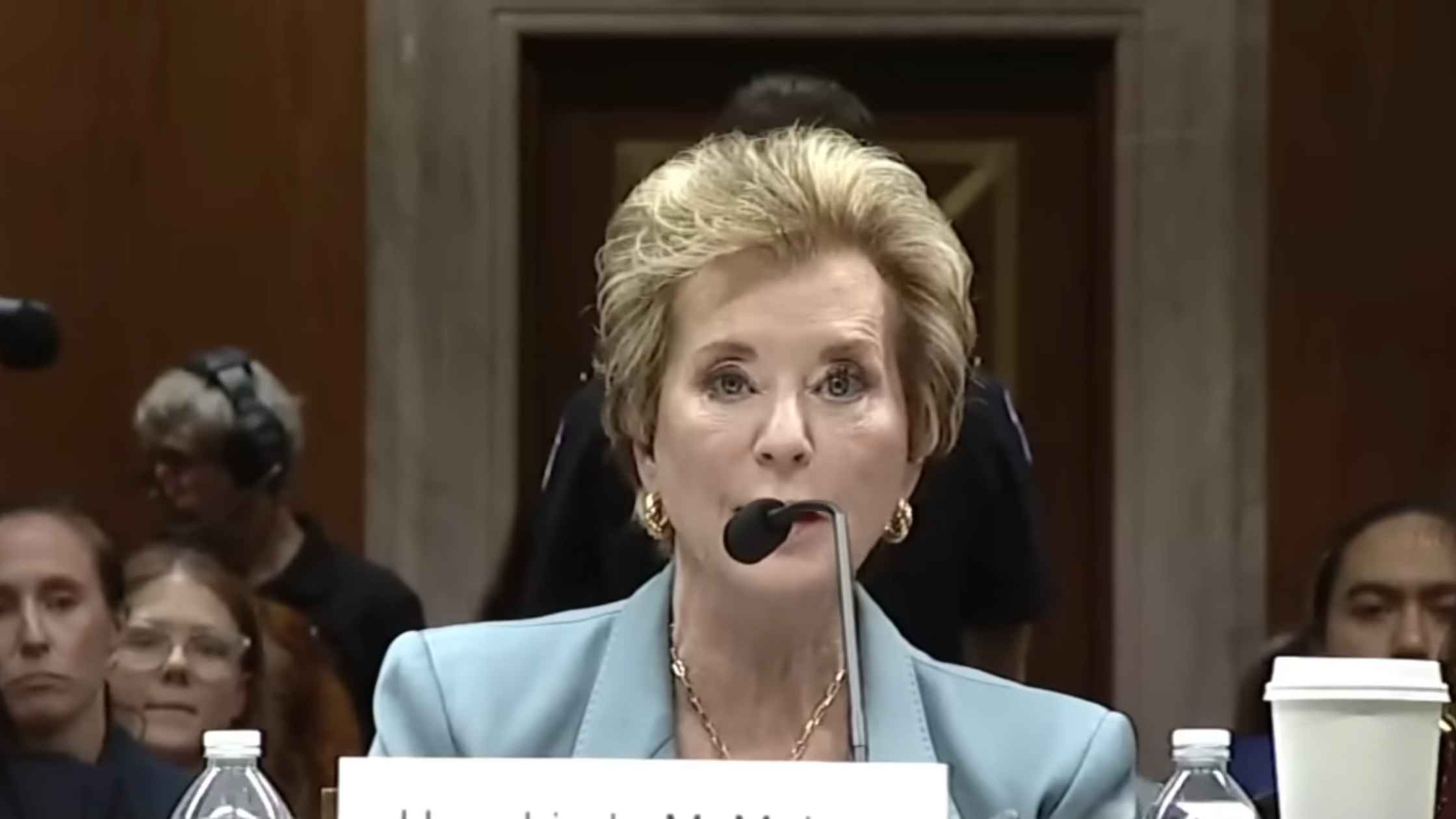
Shelley Capito (17:42):
Yeah. Well, good morning, everyone, and good morning to you, Secretary McMahon. Thank you for being here today to discuss the president's budget for 2027, the request, and your priorities for the Department of Education. I'm pleased to be joined this morning, as always, by my friend and ranking member, Senator Baldwin. It is our fourth year atop the subcommittee together. I think later on, we will be joined by our full committee chairs, Senator Collins, and the Vice Chair, Senator Murray. I know we're all eager to build upon successful bipartisan work that we completed this last fiscal year, and would love to see it continue through the year.
(18:16)
Secretary McMahon, you're entering your second year at the helm of the Department of Education. Much like the last time we are all gathered in this room, we find ourselves at a crossroads. Do we stay this course with our education system as it is hoping that more money and federal intervention will solve our problems, or do we, as you have suggested, ask the difficult questions and consider innovative solutions that can actually turn the tide?
(18:43)
Madam Secretary, I think we both believe that all Americans, from our earliest learners to our post-secondary students, should have the opportunity to access a high-quality education, and it is our responsibility to make that possible, but our nation's students are struggling. We know from last year's National Assessment of Educational Progress that students are still scoring below pre-pandemic levels on all tested grades and subjects. 35%, a full one-third, of our nation's eighth graders are not reading at the NAEP Basic level. This is a greater percentage than ever before. We must remain focused on improving outcomes for students. That means ensuring students can read at grade level, are prepared for colleges and career, and have opportunities to succeed in a rapidly-changing environment. It's a time for the United States to stand on the global stage as a leader in education and reverse the troubling trends that we have seen for far too long.
(19:43)
Where do we begin? Your leadership has shown that perhaps we need to start by turning to those who know our students best: our local schools, our local teachers, and the parents of the students. Federal education spending should be tailored to support states and policies that are responsive to the needs of each student. I'm pleased to see that your budget supports formula grant programs like Title I and IDEA that bring crucial investments to each of our states. These programs provide the much-needed flexibility for our local communities to meet individual needs for their students.
(20:17)
Similarly, I'm pleased to see your budget maintains your support for Charter Schools Program. West Virginia is fairly new to offering charter schools, yet we are already seeing exciting results in the expanded school choice opportunities for our public school students. I know that the department's continuing investment in the Charter School Program will benefit many more students across the nation, much like we have seen in my state.
(20:40)
I would also like to touch on post-secondary education. I'll note that I began my professional career as a college counselor and advisor. In this role, I saw firsthand how education provides students with life-changing opportunities, so I was glad to see that your budget requests funding to address the Pell shortage and to maintain the Pell Grant Maximum Award. Pell is critical to help provide financial access to post-secondary education for our students in West Virginia and across the nation who need it the most.
(21:14)
I'm also encouraged by the steps the department has taken to return student loan borrowers to repayment and remind them of the responsibility that they take on when taking out a loan. However, after years of borrowers not being required to pay their loans by the prior administration, there is more work that needs to be done. Currently, more than one out of four student loan borrowers are delinquent or in default. I look forward to the work your department will do to clearly and efficiently correct the unprecedented confusion that our student loan borrowers have faced for years, and importantly, put borrowers back on a thoughtful track to repayment.
(21:55)
As we move through the fiscal year 2027 appropriations process, I look forward to continued partnership with your department to find a responsible balance between our limited taxpayer resources and supporting the best opportunities for a high-quality education. I anticipate the road ahead will be challenging, as it always has been, but we must forge ahead together to deliver our students who are the future of our great nation.
(22:19)
Thank you again for being here, and I look forward to your testimony. I'll turn to my ranking member, Senator Baldwin, for opening statement.
Tammy Baldwin (22:27):
Good morning, and thank you, Chair Capito. Secretary McMahon, thank you as well for being here today. Look, it's been deeply disheartening to see the focus of this administration when it comes to education issues facing our students and our families. Experts have been clear that the steady improvement in student achievement stopped roughly a decade ago, and it has been in decline since. This has been hardest on precisely the students federal law is intended to help. Secretary McMahon, instead of working collaboratively towards solutions to help our students and families, you've undertaken a politically motivated campaign to undermine the work of the Department of Education. This has been to the detriment of our students, and if allowed to continue, will have consequences long into the future. This includes the termination of $2 billion in grants in the middle of last school year, including grants to expand school-based mental health and special education staff in the state of Wisconsin, my home state. It includes illegally withholding more than $7 billion in formula grant funds, which states were forced to sue in order to access. It includes the abrupt end of $800 million in investments in education, research, and data that support the work of our states and schools. It includes the elimination of funding to address teacher shortages, international education, and eliminating funding for minority serving institutions. It also includes the continued focus on illegally dismantling the entire Department of Education.
(24:20)
None of this is about returning education to the states. The things you claim to have returned through waivers and flexibility, federal law already allowed. At the same time, you are asserting an unprecedented level of control over state and local education decisions. You are using the full power of the federal government to require states, school districts, and institutions of higher education to bend to the will of the Trump administration or face a loss of federal funding.
(24:55)
What the department is doing is transferring the vast majority of its programs to other federal departments, agencies with little experience or expertise or capacity to administer them. This includes moving programs that support elementary schools to the Department of Labor. This isn't reducing bureaucracy. It's creating more of it, another layer of it. Where states previously primarily dealt with the Department of Education, they will now have to deal with multiple federal agencies.
(25:28)
The department claimed without evidence success in transferring career and technical education and adult education programs to the Department of Labor. That transfer has not gone smoothly, and it has, in fact, cost taxpayers even more. The programs your department next plans to move are orders of magnitude larger and more complex, including programs like Title I, Impact Aid, and TRIO. You are moving those programs at an unknown cost to the Department of Labor onto a grant system administered by yet another agency, the Department of Health and Human Services, a grant system that has experienced significant technical difficulties and issues last year that created delays for programs like Head Start and community health centers, a system the Department of Health and Human Services has described itself as antiquated.
(26:33)
This is a waste of taxpayer resources that creates additional complexity and significant risks for our states and schools, particularly rural schools. It also fundamentally misses the point about the role of the Department of Education, which is in large part about supporting states and schools, and ensuring all students have access to a high-quality public education.
(26:58)
The recent decline in student test scores is very concerning, but it follows steady progress over decades and does not provide evidence that we should eliminate the Department of Education. To the contrary, the Department of Education has helped some states buck those recent trends. It has helped states and school districts adopt evidence-based approaches through funding, research, and technical assistance to improve student outcomes. Instead of building on this work, the department is taking away important support while making everything more complicated, and that is not what our states, schools, families, and students need.
(27:40)
Now we have before us a budget that proposes massive cuts to public education. This budget would raise the cost for families. State and local taxpayers would have to make up for the $6 billion cut to programs supporting 50 million K-12 students served in our nation's public schools. I will not support a proposal to cut funding to Wisconsin for public elementary and secondary education. Your budget request would also make higher education more expensive and harder to access for working families. While increased funding for the Pell Grant program is important, that just maintains current benefits. At the same time, the budget eliminates nearly every other program to help students pursue and afford higher education.
(28:35)
Chair Capito, I appreciate the work we were able to do together on last year's budget with the support of Chair Collins and Vice Chair Murray. I'm committed to working with any member who is serious about developing a fiscal year 2027 appropriations bill that supports our schools and funds the Department of Education so it can do what the law
Tammy Baldwin (29:00):
... requires for our students and families. Thank you.
Shelley Capito (29:04):
Thank you, Senator Baldwin. And now we'll turn to our witness. Our witness today is Linda McMahon, who is the secretary of the Department of Education. Welcome, Madam Secretary, and we look forward to your opening statement.
Linda McMahon (29:20):
Thank you. And good morning, Chair Capito, Ranking Member Baldwin, distinguished members of this subcommittee. Thank you so much for having me today. Americans reelected President Trump with a clear mandate to sunset a 46-year-old $3 trillion failed educational bureaucracy in DC and return authority to where it belongs: to parents, teachers, and local leaders.
(29:43)
Amid record low test scores and record high numbers of students buried in debt, Americans want results. Today, I can confidently attest that we are delivering on the vision of educational renewal for decades many promised, but none have delivered. In the past year, I've traveled to over 30 states, seeing firsthand the successes and challenges our education systems face, has reinforced my conviction that empowering local leaders and targeting federal dollars toward evidence-based programs are the force multipliers driving our educational renaissance.
(30:21)
To that end, my department has carefully scrutinized every dollar of taxpayer investment to ensure that it supports clear pathways to success for our students and families. We've cut unproductive program funding and redirected those resources to revitalize literacy, invigorate workforce development, and support our most vulnerable students. We've conducted an honest assessment of our operational efficacy, shrunk our bloated bureaucracy, and to date have secured 10 partnerships with federal agencies well-equipped to co-administer Department of Education programs.
(30:58)
We've stopped burdening local leaders with one- size-fits-all mandates and are now empowering them to design solutions that best support their students. For example, we awarded Iowa the first ever returning education to the state's waiver, which frees millions of dollars in compliance costs. This allows Iowa to devote more resources to proven interventions, like those that led to their double-digit reading gains. And we continue to work closely with other states to help them realize their potential for innovation. We're also expanding affordable, high quality education options and restoring parents to their rightful role as the primary decision makers in their child's education.
(31:40)
Thanks to President Trump and Republicans in Congress, the Education Freedom Tax Credit gifts parents access to critical resources like scholarships, tutoring, and specialized services for students with disabilities, whether their child attends public or private school. In K through 12 and higher education alike, the Trump administration is restoring safety, fairness, and equal opportunity for our students. In this administration, we have secured seven historic deals with universities to right the wrongs of their pervasive civil rights violations. We've returned integrity to the broken federal student aid system for the 43 million Americans holding an astounding $1.7 trillion in federal student loan debt.
(32:27)
Our simplified free application for federal student aid or the FAFSA form launched on the earliest timeline in program history, leading to a record 11 million submissions to date. We introduced a new earnings indicator so students no longer take on significant debt without clear, reliable information. And thanks to our strengthened security measures, we have prevented over $1 billion in federal student aid fraud so far. We're also hard at work implementing the Work and Families Tax Cuts Act, which simplifies federal student loan repayment, launches a new workforce Pell program and will make post-secondary education more affordable.
(33:10)
And today we're putting forward a request that accelerates these reforms. This year's budget request maintains full funding for the Title IA grants to local education agency's programs, devoting over $18 billion to serve children from low income families. It includes $33 billion for the Pell Grant Program, which supports low income students representing an increase of over $10 billion. It provides $2 billion in new Make Education Great Again grants, historic investment to improve numeracy and literacy and remediate our decades long academic proficiency crisis.
(33:49)
And for our students with disabilities and their families, the Trump Administration requests $16 billion for IDEA programs, which is an increase of more than half a billion dollars. We've been clear. Shifting authority back to the states will not come at the expense of essential federal programs for support, much of which predate the department itself. When the Trump Administration makes promises, we keep them, and with your partnership, we will unleash momentous opportunity for every child to realize their God-given potential. Thank you, and I look forward to taking your questions.
Shelley Capito (34:25):
Thank you. Thank you, Madam Secretary. And I want to turn to the chair of the full committee, Senator Collins. We're happy to have her here always, and she will lead off with the questions. Thank you.
Senator Collins (34:37):
Thank you very much, Chair Capito. Welcome, Madam Secretary. Madam Secretary, the administration's proposing to consolidate important K through 12 education programs into one big block grant, the Make Education Great Again Grant. Many of these programs are extremely important to our students, including the Rural Education Achievement Program that I authored more than two decades ago to help rural school districts overcome the unique challenges that they face. For one, small rural schools don't have grant writers to apply for grants, and they lack those resources. REAP helps schools by giving them additional funding and flexibility.
(35:40)
Eliminating REAP as a separate program puts schools in rural states at a real disadvantage. From my perspective, consolidating 18 programs funded previously at $ 6.5 billion into one grant program funded at only $2 billion will undermine the goals of helping our K through 12 schools. Protecting rural schools and rural communities has always been one of my top priorities. So it's critical that we evaluate the impact that the administration's proposal would have on rural schools. How would providing much less funding going from $6.5 billion to $2 billion and consolidating all of these programs help rural schools?
Linda McMahon (36:47):
Well, thank you, Senator. Thank you, Senator, very much for your question. And I know your passion for rural schools as is much throughout Maine. One of the points that you made about a lot of rural schools don't have grant writers and can't bring in those resources that other states might have or other cities might have is part of the program of this consolidation because there are a lot of states who never participated in any of the grant funding. Under this proposal with consolidation, all states will participate in a formulate distribution of this consolidated grant.
(37:25)
While I acknowledge it is not as much money coming into a lot of the different programs, our assessment of many of these programs have been they have lost their efficacy and they're really not giving the returns that we had hoped to see for our rural schools. So I really believe that in this consolidation effort, we have the opportunity for many more schools to take advantage of dollars and to be spent in the areas where they need them. Governors, local school boards, superintendents of these states can take a look at these dollars that are coming in. If they need to be spent more in rural areas, they can direct that funding to rural areas. If they have adequate school funds in their city or less rural areas, then they'll have the opportunity to take that money and put it where they need it. So the goal is to provide more dollars to be spent where governors and state superintendents and even parents participating in local school boards see the need for these dollars to be spent.
Senator Collins (38:30):
Well, I hope we can work further on this. The Rural Education Achievement Program has been enormously successful and I'm worried it's going to be lost in the consolidation. You and I have discussed many times my passion for the TRIO program, which has changed the lives of countless first generation and low income students in Maine and across the country. Three of my own staff members are TRIO alums and likely would not have attended college without TRIO. So I want to go on record that I oppose the administration's proposal to once again eliminate a program that enjoys robust support and has made such a difference in the lives of children.
(39:26)
I do want to ask you about a specific part of TRIO. Along with 11 of my colleagues, I've recently sent you a letter that expresses concerns about the recently published applications for the TRIO Talent Search and Educational Opportunity Centers Grant competitions. The grant structure outlined in the applications reflects a dramatic shift in the mission, and it would redirect funds from the core purpose of the Talent Search and EOC programs. Now, I'm a very strong supporter of apprenticeship programs and other workforce training programs. TRIO is designed for higher education. Ultimately, that leads to workforce improvements and opportunities, but it's designed to promote college awareness, preparation, and completion for low-income and first-generation students.
(40:41)
So in my judgment, the partnership that the Department of Education has entered into with the Department of Labor negatively affects these competitions and current grantees in my state, like the University of Maine and the University of Maine at Presque Isle are going to be hurt by the change in focus. Why alter congressional intent for the Education Opportunity Centers and the Talent Search Grant competitions? And my second related question is, were the new criteria written by the Department of Labor staff rather than the Department of Education?
Linda McMahon (41:32):
Well, in very limited time, I have left-
Senator Collins (41:35):
Sorry about that.
Linda McMahon (41:36):
... the Department of Labor did not write this criteria. And I understand your passion for TRIO, and we have had many talks about this. I think what we are looking at at the Department of Education is looking at TRIO differently, giving it some opportunity to be reformed because under TRIO's own metrics, it has not achieved its own goals. And as we look at it across the country, we looked at, okay, how can TRIO then be reformed if in fact we could provide a different kind of opportunity for higher education? Would it necessarily have to be a college degree or could there be students who would want to proceed after high school into apprenticeship programs or a skilled workforce?
(42:22)
So this latest is kind of, if you will, experiment with TRIO to look at it to see if it has different results. I think in this bidding process, it was worth taking an opportunity of reform to show that there might be alternatives to higher education other than college, given that we do have a lack of our skilled workforce in the country. So I appreciate your commitment to TRIO. I want you to know that we are spending about $2.1 million doing research for the programs to see how the efficacy of them can be improved by their own admission and their own self-reported data. They're not meeting their own goals.
Senator Collins (43:04):
Well, my time has expired, so we'll continue this discussion. Thank you.
Shelley Capito (43:10):
Thank you. Senator Baldwin.
Tammy Baldwin (43:11):
Thank you, Madam Chair. Secretary McMahon, it's a central tenant of yours that you are quote "returning education to the states." So I would ask, what specifically have you returned to Wisconsin through your efforts to dismantle the Department of Education?
Linda McMahon (43:31):
Well, Senator, I've been touring states all around the country. I've been now to, I think, about 34 states. I have looked at micro schools, middle schools, high schools, private schools, public schools, religious schools. I've visited institutions of higher education-
Tammy Baldwin (43:49):
And so-
Linda McMahon (43:49):
... and what we are trying to do is to really evaluate what the need is for our education across the country and to provide my legacy hopefully is going to be toolkits for different universities.
Tammy Baldwin (44:01):
Madam Secretary, you've not returned anything to the states and local school districts that they didn't already have. They have been able to always seek waivers under federal law. They have always had primary authority over education decisions like hiring teachers and choosing curriculum. And they have always had the flexibility noted in your reminders. So how does requiring states and school districts to interact now with multiple federal agencies, the Department of Labor, indirectly the Department of Health and Human Services, Department of Education, instead of just one agency, how does any of that do anything to return education to the states?
Linda McMahon (44:46):
Well, first of all, let's look at the first inter-agency agreement that we've signed with the Department of Labor. We are co-administering that program with the Department of Labor. And so now the management of WIOA and Perkins grants, which typically would be two applications from a state, you can go to one place now, and it is the same people from the Department of Education that are at the Department of Labor.
Tammy Baldwin (45:12):
And I want to just emphasize that.
Linda McMahon (45:14):
This is important. This is important, if I may, because it is not going to various and sundry different agencies. It's dealing with the same people that you've known at the Department of Education that are located somewhere else.
Tammy Baldwin (45:26):
So you are sending-
Linda McMahon (45:27):
And as the Department of Education is a pass through for funding which you will continue to appropriate-
Tammy Baldwin (45:33):
Look-
Linda McMahon (45:33):
... then that will be absolutely-
Tammy Baldwin (45:35):
I'm going to cut you off there. You are sending Department of Education employees to work at other agencies to administer the same programs from different buildings. At best, this will prove nothing about what the Department of Education does. It's making everything more complicated for states and local school districts in the meantime. Secretary, you also abruptly terminated funding for schools in Wisconsin and other states during the middle of last school year, including funding for teacher training and student mental health programs, and you delayed funding for things like after school programs just weeks before the start of the school year. There is simply nothing about this that is quote "returning education to the states." Secretary McMahon, the Department of Labor provides employment and job training services, enforces our federal labor laws, and protects retirement and healthcare benefits of workers. Why are you sending programs that support elementary schools and elementary school students to the Department of Labor?
Linda McMahon (46:47):
I certainly do think that as we look at how education should be viewed in our country, clearly there are many aspects of education. It's enrichment of minds, it's development of thought, but it is also to provide an opportunity for children once they have finished their education, to enter into the workforce and have an opportunity-
Tammy Baldwin (47:09):
We're talking about elementary K through 12, and the grants that you're transferring to Department of Labor are much larger and much more complex than what the Department of Labor currently administers. Were you aware that the Department of Labor's Office of Inspector General has consistently found the Department of Labor is challenged in effectively managing its grant portfolio?
Linda McMahon (47:33):
Well, here's what I think, that we-
Tammy Baldwin (47:36):
Were you aware of that?
Linda McMahon (47:38):
Yes.
Tammy Baldwin (47:39):
Okay.
Linda McMahon (47:40):
So I believe that there are opportunities in every agency to improve their grant programs.
Tammy Baldwin (47:46):
So you'll transfer education department grant programs to a department that is challenged in its current administration of grants.
Linda McMahon (47:56):
Senator, in any time that you were looking to make, let's call it, if you were looking at the business world, a merger, when you bring two factions together, do you believe in the end are going to be better serving the population that you are looking to serve? There's some hiccups along the way at the beginning, but in the end, this is a program that I believe will help our students as they go from K through 12 into higher education, be prepared for the workforce of today and the demands of the workforce of tomorrow.
Tammy Baldwin (48:24):
And I would note in closing of our time-
Linda McMahon (48:25):
And that is why I think labor is an appropriate place-
Tammy Baldwin (48:28):
I would not, in the closing of our time-
Linda McMahon (48:29):
... to co-administer these programs.
Tammy Baldwin (48:29):
... that not only are we talking about deficiencies in the Department of Labor's management of its grant portfolio, but the Department of Labor contracts with the Department of Health and Human Services to use their grants management system. And there were technical issues with one of those systems last year, which resulted in significant delays of Head Start and other funding.
Linda McMahon (48:53):
Well, I can tell you that our programs have gone out. Our grant programs have gone out on time from Labor. We have processed requests from over 56 states over, I think it's $30 million, I think it's $30 billion at this particular point. We've gotten those grants out on time, merging with the two systems. And actually the Department of Labor has a more advanced system of grant dissemination than does the Department of Education.
Tammy Baldwin (49:20):
I think the timeliness of Department of Education grants is much in dispute, Madam Secretary.
Linda McMahon (49:24):
Well, we can stand to agree to disagree on that point. Thank you.
Shelley Capito (49:29):
I'm going to stay on that on the Department of Labor and the career and technical education aspect because I think I'd like to hear from you. You mentioned how many states have been gotten their money through the Department of Labor. And what are the metrics that you're using to determine whether this is a successful merger? Is it how many students are more self-aware when they come out of school? Do they want to go into apprenticeship? Do they want to go into a skill? Do they want to go to higher ed?
(50:04)
Because I think, we have so many workforce programs throughout the whole government and all different aspects of it that I do think consolidating these and matching it with education is a natural fit. So I'm going to assume you said 56 state or 56 entities that you'd looked at. You said that in your last answer, I think obviously not 56 states because we only have 50.
Linda McMahon (50:27):
And territories.
Shelley Capito (50:29):
So are you getting complaints about this from the states? I'm asking what are your metrics that you're going to use to see if this success and are you getting complaints from the states that this is not working for them? Because I'm not hearing that from my state.
Linda McMahon (50:42):
We haven't gotten complaints. I think there were concerns at first, were the grants going to go out on time? Were there going to be issues? And in merging two systems and in having co-administering this program, these programs at Labor, clearly there were some hiccups to begin with, which I think would be natural to work out, but we have worked them out. So I'm really pleased that in terms of the WIOA programs and the Perkins grants, those mergers have gone incredibly well getting those grants out the door on time and states have not issued any kind of complaints. And so I'm really satisfied now with how this is working as we move-
Shelley Capito (51:24):
What were your metrics? Not to interrupt you, but the second part of my question was, what kind of metrics are you all looking at in the research to see whether this is successful?
Linda McMahon (51:31):
The metrics, were they going out on time and getting to where they needed to go without complaints, just as it would have been at the Department of Education.
Shelley Capito (51:38):
All right. Let me ask you about student loan repayment. Obviously, a lot of student loan borrowers were put into the SAVE program, which was deemed illegal by a federal appeals court and lots of legal disputes. So I mean, total confusion from student borrowers as to do they owe, do they have to pay? So many borrowers are currently enrolled in a forbearance plan, but they're going to get instructed that they need to get into a legal repayment plan. How is that going? Is it eliminating the confusion? And I'm wondering, that's a big thing to tackle, but what is it, trillion dollars or something that is owed on this plan?
Linda McMahon (52:23):
It is a huge portfolio. $1.7 trillion in outstanding debt, and only about 40% of those payers are now trying any kind of repayment at all. And who can blame them? Over the last administration, trying to put into place the SAVE Act, talking about not having to repay loans, there were seven or eight different kinds of loan repayment programs, income pay based deferments, et cetera. So what happened under the Family's Tax Cuts Act and the Working Families Tax Cuts Act is the consolidation now of loans so that there would be two repayment plans put in place. So what we're trying to do now is to move those who had entered into the SAVE program, which was declared unconstitutional and not be allowed, to move them into other repayment programs.
(53:16)
Under the new bill, there will be two, the RAP Program standard repayment. However, till that is in effect in 2028, someone could move out of the current system they're in into a different repayment plan, which is, I think, confusing. I'd rather see them move into the RAP, R-A-P, plan of repayment, which gives better terms than some of the current repayment plans. And also, if you're making your payments on time, you can get credit towards principal. The government will even match some of those payments toward principle. It's going to be, I believe, a much better system for repayment if we can move them into it. Is it confusing for a minute? Of course, it would have to be, when you have millions of borrowers who were moving into the SAVE program and hoping they weren't going to have to repay. That got stopped during COVID. Then it didn't get restarted after COVID. And it is quite complicated to sort through, but I believe we are making really good progress.
Shelley Capito (54:24):
Well, I wish you luck and we'll give you support on that. I think everybody is confused and certainly the borrowers. And I'm with you, I mean, if you didn't think you had to repay or if you thought you were going to get a year forbearance, why wouldn't you do that? Yeah.
Linda McMahon (54:40):
There are people since 2020-
Shelley Capito (54:42):
Yeah.
Linda McMahon (54:42):
... who've borrowed money who've made no payments-
Shelley Capito (54:44):
Right.
Linda McMahon (54:44):
... for over six years.
Shelley Capito (54:45):
Right. All right. Thank you. Senator Shaheen.
Senator Shaheen (54:50):
Thank you, Madam Chair and Ranking Member Baldwin for holding this hearing today. And welcome Secretary McMahon. Thank you for the opportunity to talk to you last week. I want to start by following up on Senator Collins' questions about the TRIO and the GEAR UP programs as we discussed last week. Now, you said that you have metrics that show that those programs are not successful, but I have metrics that say, according to the evaluators, the Pell Institute and the Institute of College Success and Access, that in evaluating TRIO, that there are higher rates of retention for students in higher education. They have higher rates of graduation. They have Upward Bound students who earn a bachelor degree at twice the rate of non TRIO first generation students.
(55:40)
So I would hope that you would share with this committee the metrics that you have that show that these programs are not successful. And I would just point out anecdotally, we heard from one TRIO alum, Heather from Berlin, New Hampshire. She writes, "My childhood," and I quote, "My childhood was a gauntlet of domestic violence, alcoholism and poverty. My Upward Bound summer literally pulled me out of a toxic environment and showed me that a different life was possible. My TRIO mentors stayed by my side, helping me navigate the applications and fees that would have otherwise been impossible barriers. I went from a kid stealing food to survive to creator of knowledge conducting high level research."
(56:25)
Since her TRIO experiences, Heather has earned two bachelor's degrees, two master's degrees, and a PhD. And she finishes her story with this statement, "TRIO transforms public investment into long-term economic and civic return. I am living proof and I am forever grateful." Madam Secretary, is it the intent of this administration to eliminate the TRIO and GEAR UP programs and other programs that help students who are at risk from accessing higher education?
Linda McMahon (57:01):
Senator Shaheen, thank you very much for relaying that, and that is a great success story for a TRIO program, and I'm sure there are many of those around the country. However-
Senator Shaheen (57:12):
As I pointed out, the evaluation of this program shows that they have been very successful.
Linda McMahon (57:21):
Well, the metrics that I get, which they're the self-reported metrics from TRIO, as we look at their percentage of graduation rates, et cetera, they are falling short of their own metrics.
Senator Shaheen (57:34):
Well, again, would you please share those with the committee?
Linda McMahon (57:36):
I'll be happy to do that.
Senator Shaheen (57:37):
Thank you. So can you answer, is it the intent to get rid of this program?
Linda McMahon (57:42):
As I mentioned before, we are spending about $2.1 million evaluating TRIO and looking to see if it should be revised. And I am sure that the appropriations committee, as they did last year, if Congress chooses to fund
Linda McMahon (58:00):
... TRIO, then we will work very closely with you to see what reforms we can do to make it better, if in fact it's better. But right now, it is costing, it is a high cost to have TRIO programs.
Senator Shaheen (58:13):
Well, it may be a high cost, but this Congress passed the president's One Big Beautiful Bill, that provided a tax cut for people with an annual income over $1 million, and it's now costing the taxpayers over $1 trillion. It's added $4.6 trillion to the federal deficit. So I think comparing that to the cost of TRIO and GEAR UP programs, which each cost $1.2 billion annually, and provide opportunities for thousands of young people to better themselves is a much better balance of payments.
(58:46)
I would like to go on to another question, however. One of the topics you talked about, your effort to respond better to address challenges with various programs in the department. And one of the topics that my office gets a lot of calls about is the Public Service Loan Forgiveness Buyback Program, which is administered by the Department of Education. What we hear from applicants is that they have heard from your department that they will get their applications answered within 45 days. But my staff tells me that it's often nine months to a year before my constituents get a substantive response. We currently have over 70 constituents waiting just in our office for answers about their applications. Nationally, there are over 88,000 applicants waiting to hear from the department, and that number has grown by 4,000 just since February.
(59:47)
So can you talk about how you intend to deal with this backlog? And I understand that part of your plan is to have the Treasury Department take over these responsibilities, and yet the Treasury Department doesn't seem to have the personnel, resources, and expertise to administer the program. So how are you expecting to address that?
Linda McMahon (01:00:12):
Well, Treasury's really down the road for dealing with this. And we've been looking at this buyback program, which was established really under the prior administration with a lot of regulations involved, and it was not established by law. There is an 88,000 backlog, and it's very complex to verify the employment of all of the people that are writing in. It's tedious to do. We are addressing this backlog, and want to make sure that we can have a long-term solution to fix it.
Senator Shaheen (01:00:43):
I think a long-term solution would be great. I think this program has been, however, been around longer than just the previous administration. Thank you, Madam Chair.
Susan Collins (01:00:54):
Thank you. Senator Kennedy.
John Neely Kennedy (01:00:59):
Madam Secretary, first I want to make it clear that my remarks do not refer to my good friend, Senator Shaheen. I want to start by saying, one person's opinion, you are so cool, literally and figuratively. They call you names, and you just ignore them. I also want to say from the record, I don't think we ought to mislead the American people. This isn't your budget. This budget was put together by OMB and the White House. Every White House does it, sends us a budget. We take a look at it. Some of it we adopt, most of it we ignore. So all this play-acting for the cameras is just that, play-acting.
(01:01:52)
I want to take you down memory lane. I'm going to come back to the extraordinary job you've done at the Department of Education, which was when you took it over, was the poster child, the poster child for excess federal government, chock full of a bunch of woke race-baiters, whose job was to get in the way of our teachers and our teacher's age. But I want to take you down memory lane because you've done this despite all of the obstacles. Do you remember when my colleague, Senator Schumer, said the following, I'm going to quote, "Americans don't want a radical out of touch billionaire slashing funding for public schools. Linda McMahon is not qualified to lead America's public education, but that's why Trump nominated her. She's the perfect choice to burn our public education system to the ground." Remember that?
Linda McMahon (01:03:01):
I do.
John Neely Kennedy (01:03:02):
Do you remember when Congressman Mark Pocan, I could be mispronouncing his name, so I apologize, said, "Linda McMahon should stick to wrestling." You remember that?
Linda McMahon (01:03:20):
I actually don't remember that one.
John Neely Kennedy (01:03:24):
Boy, you can only be young once.
Linda McMahon (01:03:26):
Did pretty well with that, though.
John Neely Kennedy (01:03:29):
You can only be young once, but boy, you can always be immature, can't you? Do you remember when the Nation Magazine, very Democratic magazine published an article entitled, Linda McMahon's Only Qualification as Education Secretary is a History of Spreading Hate, and this is what they said. "She is 76 years old and wants her legacy to be turning the bigotry that made her so obscenely rich into public policy." She's a Simpleton. My God.
(01:04:14)
I want you to spend ... I want extra time, Madam Chair. Everybody else has gotten it. I have been so impressed with the work that you have done in lifting up elementary and secondary education, and trying to whittle down that giant rogue beast that we called the Department of Education, the work you've done on school choice, and returning authority back to the states and local government, and fighting antisemitism, and fighting for women's sports. And in a couple of minutes, tell me about your accomplishments. I know you can't do it in two minutes.
Linda McMahon (01:04:54):
Well, thank you very much. And I'm glad I really don't remember a lot of those quotes.
John Neely Kennedy (01:04:59):
Oh, there's more. They hit you with everything but a chair. It's disgusting.
Linda McMahon (01:05:05):
Well, I can tell you what I believe are ... We've accomplished a lot. As I mentioned, prior to visiting so many states and to see what kinds of education systems many of those states have, from classical education that I saw in Florida and other states, to states that have really accepted returning their reading programs to evidence-based phonics. And we've seen the response to that from many states who are looking now to take those same programs into numeracy, to make sure that the math scores are coming up. When you walk into a department and you look across the country, and the President of the United States has told you that he was embarrassed and ashamed by the state of education in our country and not only across the country, but in its place in the world, and he expects you to do something to make a difference in that, because what we've been doing is not working.
(01:06:03)
The innovations that we've seen to bring the level of schools reading and math programs up is be innovations in the states. They don't come from the bureaucracy in Washington DC. So what I hope to do is to put together a toolkit to leave behind and to share with these states, "This is what is working." These are some of the things that we have seen, the Mississippi Miracle. Mississippi was next to last in reading. You know that very well, Senator. And they threw their own invention. It took about 10 years, but they didn't give up, and they kept doing it. And the steps that they took and made, Louisiana adopted, Florida adopted, Tennessee, other states. And so we have seen through the state's innovation and continued funding, which will continue to come through government programs, they have made a difference.
(01:06:55)
And that's why states are the center of what's going to be successful for them, whether it is looking at their children with disabilities. That is why in our budget proposal, we have asked for the largest increase, $500 million to go into IDEA funding because there are more students who need these. So I think that we've made some incredibly significant accomplishments and we've just begun. I've only been here just a little bit over a year, but we're on the road to continue to look at the states and what we need to help them with their funding to take on more of these programs. And those programs that are federal will stay in the federal government. Title A stays in the federal government, IDEA stays in the federal government to make that funding, but to send it directly to the state. So I'm pleased with where we've come so far, but we clearly have a lot of work yet to do. Thank you for the.
John Neely Kennedy (01:07:54):
Thank you for your service.
Susan Collins (01:07:54):
Thank you, Senator Merkley.
Jeff Merkley (01:07:58):
Well, thank you very much, Madam Chair. And thank you, Madam Secretary. A year ago when you gave testimony about the TRIO program not working, I asked you if you had read the department's own studies on it. You told me you had not. Have you now read those studies?
Linda McMahon (01:08:12):
I'm sorry, sir. Which program?
Jeff Merkley (01:08:14):
The TRIO programs.
Linda McMahon (01:08:15):
The TRIO program. I have read many of the studies which were self-reported by TRIO.
Jeff Merkley (01:08:21):
Great. Well, I'm glad you have.
Linda McMahon (01:08:23):
Because there is no audit capability that we have.
Jeff Merkley (01:08:27):
Well, thank you, because the department's own studies show an extraordinary record of success. When I think about the fact that you have the Talent Search students, 33% more likely to enroll in college, that you have the Upward Bound students twice as likely to earn a bachelor's degree, that you have the Veterans Upward Bound, 42% more likely to earn a bachelor's degree, et cetera. And I believe you were the first in your family to go to college.
Linda McMahon (01:08:56):
That's correct.
Jeff Merkley (01:08:57):
As was I. I come from a very blue collar frontier homesteading timber background, and I knew nothing about the world of college. I stumbled into someone mentioning a deadline for college applications. I then stumbled into an assistant superintendent who advised me to apply to some colleges that had those early deadlines.
(01:09:24)
But it's from that perspective that I believe that having conscious programs to help people overcome the cultural chasm that exists between blue collar kids like myself and that college world that you have very little contact on is enormously valuable in America. And the stats from these programs are pretty impressive. I did want to draw your attention to the letter that Senator Collins and Senator Warnock sent about making this point, and encouraging you to keep and increase and improve these programs. Six Republican senators, Collins, Crapo, Rish, Langford, Tillis, and Murkowski, six Democrats. That's as bipartisan it gets. Folks from extraordinarily different backgrounds, all saying this program bears [inaudible 01:10:13], and I would like to submit this letter for the record, please.
Susan Collins (01:10:16):
Without objection.
Jeff Merkley (01:10:17):
Thank you very much. So I just want to emphasize the point that Senator Collins was making and Senator Shaheen was making. Look at your own studies, talk to the TRIO kids who come from these different backgrounds, had no idea, like I had no idea what college was all about, who found a pathway. And I got lucky. I stumbled into folks who gave me insight, but getting lucky shouldn't be the necessary way to bridge the chasm in between the blue collar non-college communities like I grew up in and the college community and that opportunity. And I do understand, and I support passionately the career technical education programs, but we already have those programs. Let's enhance those programs that are working, not convert this program, which serves a very different function.
(01:11:06)
Second, I wanted to address the nursing education and student loans, and in OBA, I created a new federal loan limit for graduate and professional borrowers, and this is for federal loans. And in the rule that you've put forward, you've created distinction for postgraduate nursing students and said basically, "They're going to be capped at $20, 500 annually." And there's a tremendous concern that those caps are going to decimate the ability for folks to be able to get post-baccalaureate nursing degrees. There's 150 members of Congress who signed a letter pointing this out. It's a very bipartisan letter as well. So I will submit for the record, that letter.
Susan Collins (01:11:58):
Without objection.
Jeff Merkley (01:12:00):
Thank you very much, Madam Chairman. Given our shortage of healthcare workers, given how few general practitioners we have, why are you targeting nurses as we face these dire healthcare, and trying to prevent people from getting these graduate degrees?
Linda McMahon (01:12:18):
Thank you for that question. Certainly nurses are not being targeted, and this is part of a rulemaking regulation that's still in the process of rulemaking, not quite finished. But this is not in any way to cast any kind of aspersions or any kind of review of the nursing programs or other of health service programs that have come under regulation for postgraduate degrees. It is simply by the definition that Congress itself wrote into the regulation is what considered a professional degree. And so by putting caps on some of those professions that don't fall into the category that has been absolutely determined by Congress under the regulatory environment, we hope to bring down the cost of college.
Jeff Merkley (01:13:08):
So Madam Secretary-
Linda McMahon (01:13:09):
This is important.
Jeff Merkley (01:13:10):
I only have a few seconds.
Linda McMahon (01:13:11):
$100,000 cap for graduates for those two [inaudible 01:13:15].
Jeff Merkley (01:13:15):
Thank you. I hear your point.
Linda McMahon (01:13:16):
And $200,000 for others.
Jeff Merkley (01:13:18):
But here's the thing. The OBA bill did not make these distinctions. It's your rule that is proposing this distinction for nurses. So I'd encourage you to look at the actual OBA language. Second of all, the argument is that if I was making your case for you, that by reducing the loans, somehow people will get their degree for cheaper. That's not what happens. What happens is they have to go from the federal loans that have a lower interest rate to the private loans that have a much higher interest rate, and that makes it much less affordable and much less appealing to pursue these degrees. So it really has a devastating impact. The only people who are helped by that strategy are the private loan companies that make a lot more money. That is not helping our healthcare system. Thank you, Madam Chair.
Susan Collins (01:14:06):
Thank you.
Linda McMahon (01:14:06):
Sir, I can tell you that our research has showed that over 90% of the nursing graduate programs in our country can be achieved for less than $100,000. $100,000 under this bill is the cap for the graduate program as it is defined by Congress. And so therefore, one of the goals, hopefully, hopefully, is to help colleges see these incredible costs of colleges, that 10% that's not doing it, and help bring college costs down. When you can go to one college and get a degree that the nursing program is going to cost $200,000 and another well-qualified college can deliver the same degree for $85,000, then it gives the consumers an opportunity to choose and making them aware of what these different costs of these programs are. And as I say, we're still in rulemaking. It's not final, but the final rulemaking will be soon.
Jeff Merkley (01:15:02):
Madam Chair, can I just make a note on that? So there's also a semester limit. These nursing graduate programs are three semesters, so it doesn't become ... It becomes the annual limit that you might be thinking applies to two semesters. It covers three semesters. That annual limit, virtually no nursing programs in the private and sector apart from the public programs meets that, actually. So I think your analysis is completely wrong. This is completely damaging. And I encourage you to take a look before you do the final rule.
Susan Collins (01:15:31):
Thank you. Senator Boozman.
John Boozman (01:15:34):
Thank you. Thank you so much for being here. We appreciate all of your hard work.
Linda McMahon (01:15:40):
Yeah.
John Boozman (01:15:41):
I do want to associate myself with those that are in support of TRIO. The TRIO programs in Arkansas have been a game changer in helping low income and first generation students not only access higher education, but also succeed once they are there. I appreciate the conversations that we've had regarding and surrounding and strengthening TRIO. And I hope that we can continue to collaborate to ensure these programs continue to effectively serve students who need the most. I also want to thank you for being in Little Rock and doing a round table. That was very much appreciated. And I think that everyone really enjoyed it.
(01:16:26)
Across the country, too many students are not proficient in reading and math. Arkansas has made a strong commitment to the science of reading to ensure students are reading on grade level by third grade, and we appreciate the department's recognition of that work. Can you outline how the department's plans to support states implementing evidence-based literacy strategies, particularly in rural communities, and help drive a return to fundamentals that improve student outcomes?
Linda McMahon (01:17:00):
Well, sir, as you know, the Department of Education really does not control curriculum in different states, but what our support is as part of the $2 billion block grant that we have talked about under our budget proposal, we are asking and requiring that 25% of that grant for the states who receive that money be reserved for literacy education, another 25% for numeracy, encouraging them to adopt their programs and to be able to do the research. So I think that that is showing the department's focus on making sure that these programs can be looked at and developed, because there's so much science now that has proved the success and efficacy of these programs. Many states are adopting them, putting them into place. Governors are competitive and superintendent of schools are competitive. They don't want other states to succeed and get ahead of them, especially with programs that are working, and how can they be incorporated into their states, and how can they ... They can have their teachers participate in programs to learn how to teach these new systems.
(01:18:14)
And I have now, in my opportunity of visiting schools, I have been in schools where teachers are actually, again, teaching phonetic sounding of words and so that students can decode these words and are really learning to read faster. Many of them reading now proficiently at end of first grade and not waiting till third grade to be proficient. So we know the system works. We want to encourage states to adopt these. We want to help through the grant process and with these caveats of reserving these amounts of money, emphasize the importance of states accepting these programs.
John Boozman (01:18:49):
Very good. We frequently hear from advocacy groups representing vulnerable populations like students with disability and low-income students. I want to give you the opportunity to share with everyone how your budget proposal prioritizes and protects those students.
Linda McMahon (01:19:07):
The students from low income?
John Boozman (01:19:09):
Yes. Low income.
Linda McMahon (01:19:10):
Well, Title A funding-
John Boozman (01:19:12):
Disabilities.
Linda McMahon (01:19:13):
Yeah. Well, let's look at Title A funding first. That's unchanged in our budget proposal, it's level funded, so that folks can understand that we're not in any way impacting that or asking for any kind of reduction. We have historic recommendation for IDA funding, which is a half a billion dollars more for students with disabilities. And also in the One Big Beautiful Bill or the Working Families Tax Cut Program, as we look in the adoption of the tax-free portion of granting states the opportunity to opt into the programs whereby the private sector can contribute money to scholarship-granting organizations. That's money that comes in that's from the private sector, not from taxpayer dollars. Those scholarship branding organizations can also then give money to families who are applying for those loans and students that have disabilities can get special services, additional equipment that they need. Governors have to opt into these programs. I can't imagine why a governor wouldn't, but there are opportunities for our children with disabilities to have improvements.
John Boozman (01:20:43):
Very good. Thank you, Madam Chair.
Senator Shaheen (01:20:44):
Now we have Senator Murray.
Patty Murray (01:20:46):
Thank you very much. And thank you, Secretary McMahon. I don't think the solution to helping kids who are falling behind is to destroy the Department of Education, but I know you and the president seem to think that that is a solution. I think that's kind of stunning because I hear from teachers and parents in my state, "Hey, you know what I really need? Less funding." I just don't hear people saying that. I don't hear people saying, "I really wish the federal government would do less to help student borrowers." But that is what you are proposing in this budget, tearing down the Department of Education even more. Why? So we have more money to throw at the Pentagon, trillions of dollars, half a trillion dollars.
(01:21:27)
I just have to say as a former preschool teacher, maybe I'm biased, but I think that giving all kids, every one of them, a brighter future is really more important than shoveling money at defense contractors, but that is what's being proposed. So let me just start with this. Look, I am really concerned you're not listening to parents of children with disabilities and their profound objections to moving IDEA and Rehab Rehabilitation Act programs out of the Department of Education. I've gotten a petition from thousands of parents, educators, advocates who are concerned that that will really undermine 50 years of progress in making sure the rights of children and students with disabilities are met. So I wanted to ask you today, what is the status of moving programs for children and students with disabilities out of the Department of Education?
Linda McMahon (01:22:21):
Currently, we are still evaluating where those programs would best be located, and we have not made that determination yet. We are looking at the Department of Labor for some of its programs. We're also looking at HHS for a potential home for some of those programs. I can assure you that the intent of this administration is not to put these students at risk in any way whatsoever. I have met ... I've not received thousands of applications as you have, but I have met with parent groups all over the country who have children with disabilities. We have talked about what they need, and I have said to each of them, "Who is better positioned to know what your children need than you, working with them, and then working with your local school boards and your superintendents and your teachers-"
Patty Murray (01:23:12):
Madam Secretary, that is exactly why these parents and advocates are spitting mad, because what they want to make sure is that their child with disability has an education. And moving it out of the Department of Education is not only undermining that, but it's a direct message to them that their health is more important than their education. Their parents are taking care of their health. They know how important that is. But they want their kids to get a good education, and that's why I am hearing from so many parents. So I am deeply concerned that your answer sounds like you're still moving ahead. Just let's make it clear, that will break the law, and it will make it a lot harder for these students with disabilities to get the education, and understanding that their country will stand behind them with that.