

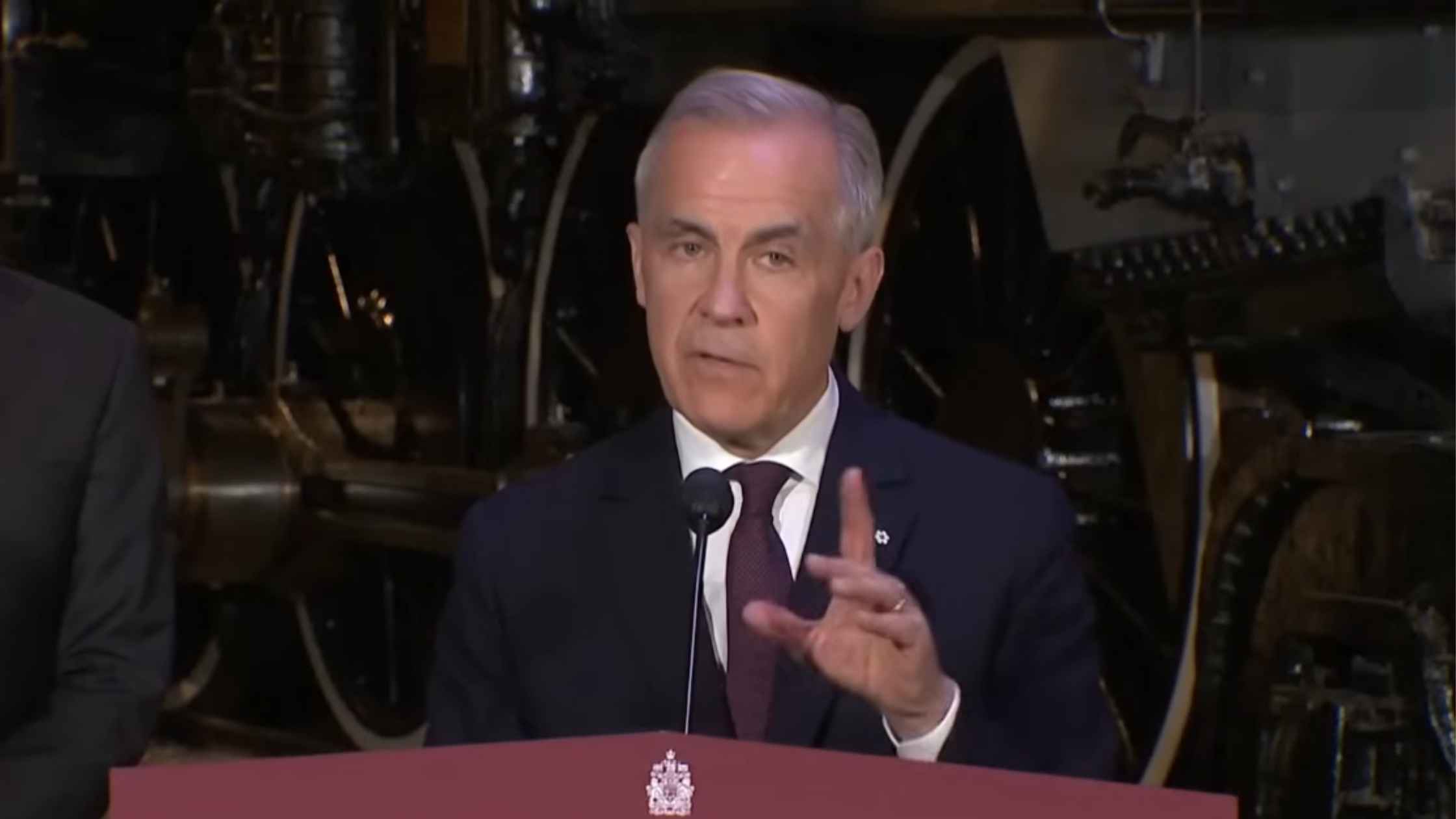
Mark Carney (00:00):
... where prosperity reaches every region, every community, and every family. So today, we're proud to announce a new pillar of our plan, the Canada Strong Fund, Canada's first national sovereign wealth fund. This will be a government of Canada fund, but more importantly, this will be a people's fund. It will be your fund. [foreign language 00:00:30] So here's how it works. A sovereign wealth fund is essentially a national savings and investment account. It's designed to grow wealth for future generations of Canadians. Many countries, many countries that are blessed with natural resources, like Norway, have sovereign wealth funds. Canada hasn't had one until now. The new Canada Strong Fund will give all Canadians a direct stake in building Canada strong.
(01:56)
Now, to be clear, just like with the construction of the Canadian Pacific Railway 150 years ago, Canada's major projects will mostly be built by private companies, and just as in the 1870s, the federal government will support these projects through loans, grants, and other incentives. And we do this because these projects have wider benefits to our economies, benefits that exceed the private returns. I'll give an example. Expanding the Port of Montreal, the Contrecœur, will unlock new markets for thousands of Canadian businesses and create hundreds of thousands of jobs for Canadian workers. So until now, while those wider benefits flowed to the Canadian economy, flowed to our country, the financial returns of the projects themselves flowed only to those who built and ran them. That changes today.
(03:03)
When the CPR was built, the government of the day granted a private monopoly to the company. Today, to create wealth for Canadians today and our kids tomorrow, the Canada Strong Fund will invest alongside the private sector in nation-building projects on a fully commercial basis. We will begin with an initial endowment of $25 billion. Over time, the fund will grow, through asset recycling and reinvestment, creating even greater opportunities for future generations. We will also do something else that's new and important. For those Canadians who want to participate in an even more direct way, we will make it easy for individual Canadians to invest in the fund and therefore own a small piece of nation-building projects and share in their returns.
(04:02)
The fund will be professionally managed and operate as an arms-length, independent Crown corporation, and we'll consult over the coming months on the specific aspects of the fund. But one thing is sure, it will be accessible to everyone, not just a few, because the Canada Strong Fund is about solidarity amongst Canadians, no matter where they live. So whether a project is in Alberta, Quebec, or in the Far North, High North, all Canadians will have a stake. Because this is about ensuring that you, and your children, and your children's children benefit from the prosperity that we are creating today.
(04:46)
You know, in many ways, we're walking today the same path as our predecessors did. We have the same conviction, that ambition and drive can change the course of a nation. We have the same catalytic role for government to make nation-building projects happen. We have the same reliance on private enterprise to build and run these businesses. But at the same time, we've also learned from our past. The Canadian Pacific Railway transformed Canada, but it did so in a way that also left deep scars. Indigenous peoples were displaced from their lands, thousands of workers toiled in appalling conditions, and the wealth that was created accrued to the few, not the many.
(05:39)
Three things are different this time. This time, we are building with indigenous peoples as full partners, ensuring meaningful indigenous ownership and major economic benefits. This time, we are building in solidarity with Canadian workers, creating hundreds of thousands of high-paying union jobs. And this time, for the first time in our history, every Canadian will hold a direct stake in what's built, because we know that nation-building is not just about what we build. It's also about how we build. We are building together, with all Canadians and for all Canadians. [foreign language 00:06:26]
(06:24)
It's our country. It's your future. We're building by Canadians for all Canadians. We are building Canada Strong for All. Thank you very much, merci beaucoup, and I look forward to your questions.
Speaker 1 (08:04):
[inaudible 00:07:59] Thank you, Prime Minister. We'll now take questions. [inaudible 00:08:02] First question, go ahead.
Stephanie Levitz (08:05):
Good morning, Prime Minister.
Mark Carney (08:06):
Morning.
Stephanie Levitz (08:06):
Stephanie Levitz from The Globe and Mail. The government's running deficits and cutting spending across the board, so where is this $25 billion going to come from?
Mark Carney (08:15):
Well, the first thing, I won't front run the minister of finance too much, too much, tomorrow, but there will be good news tomorrow with the spring update on the fiscal situation. The government's performance against our deficit targets, the government performance on getting spending under control, and the government's performance at the main time, and this has been core to our strategy, which is to spend less, get spending under control, so that Canada can invest more. And what today is about is ensuring that as Canada invests more, Canada is a country, the Canadian private sector, foreign investors in Canada, that all Canadians share in the benefits of that. We have ample resources in order to do so alongside, and remember, last point and I'll hand because, is that there's a series... And this is what governments have done over the years, series of measures that governments are taking to create the possibility of these projects. We're doing that on a different scale now, and now we're making sure, at the same time, that all Canadians benefit.
Stephanie Levitz (09:18):
Follow up, you keep referencing the Canadian Pacific Railway as a benchmark here, and that was funded by private investment.
Mark Carney (09:26):
Yeah.
Stephanie Levitz (09:27):
But a lack of transparency around that financing led to one of the earliest political scandals in confederation.
Mark Carney (09:32):
Yeah.
Stephanie Levitz (09:33):
So I'd like to know about the transparency on this fund. Who is going to manage it?
Mark Carney (09:37):
Yeah, absolutely. Look, and I'm glad you raised it, because there are lessons in all respects from our past and from the specific example, and I drew out some of the most important ones, about partnership with indigenous peoples, full partnership with workers, and full participation of Canadians alongside. This'll
Mark Carney (10:00):
This will be a independent Crown corporation, reports to Parliament, arms length, as I say, independent, full disclosure, professionally managed, and the investments that are made will be clear. The objective is to grow wealth for Canadians over the long term.
Speaker 2 (10:22):
Next question.
Speaker 3 (10:22):
[foreign language 00:10:25].
Mark Carney (10:22):
[foreign language 00:10:44].
Speaker 2 (10:22):
[foreign language 00:11:48].
Speaker 3 (10:22):
[foreign language 00:11:51].
Mark Carney (10:22):
[foreign language 00:12:04].
Speaker 3 (10:22):
[foreign language 00:12:06].
Mark Carney (10:22):
[foreign language 00:12:10].
(10:22)
[foreign language 00:13:27].
Speaker 2 (13:54):
Next questions. [foreign language 00:13:55] Tonda?
Tonda MacCharles (13:55):
Tonda MacCharles, Toronto Star. Just following up on that line of questioning, in terms of the individuals that you want to be able to enable investment in this fund, could you elaborate on what you envisaged that as? Because not everyone obviously has the means to invest, and so does this stand to benefit richer people than others?
Mark Carney (14:21):
Well, I think this ... Thank you, Mr. MacCharles, for the question. There's several aspects here. One is the design of the fund, all Canadians will benefit because it's a sovereign fund of Canada. It's the people's fund. We all benefit, and the question, what we're proposing to do on top of that, on top of that, is to provide all Canadians the opportunity if they have a little bit of money. We're not talking big money, but a little bit of money to invest alongside, to put into the fund alongside, and that increases the participation. I will tell you that one of the things that is striking going across the country over the past year is Canadians want to get involved. They want to get involved in building the country. In some cases, they can be directly involved in their business or their day-to-day lives. In other cases, it's in consumer choices or where they travel, where they vacation, what they choose to eat or drink.
(15:19)
That's a way to get involved, but if there's a way to align with what is a very exciting time for the country where we're really building, we'll make that available to people. It is not something for... I'm going to use the term from your question, rich people. It's something for Canadians, for all Canadians, everyday Canadians and on that scale to provide it, and we'll provide it in a way... Again, we'll consult and we'll go through the details, so I don't want to overly finalize it, but we intend to provide it in a way where the investment itself, the actual amount of money is protected. It's something consistent to buying a government bond, but has the upside, the additional return when these projects realize their potential.
Speaker 2 (16:07):
Follow up.
Tonda MacCharles (16:08):
And you said the goal of it is to grow wealth, and so I'm wondering to what extent though you have already coordinated or consulted with the provinces that really have control over. There is a lot of the oil and gas, for example, generating sectors, Alberta, Saskatchewan and Newfoundland. How can you persuade them? It's not ultimately a resource wealth grab?
Mark Carney (16:33):
Well, it's not. There's a series ... Sometimes, if I may, the discussion of how we're building the country, how Canadians are building the country gets reduced to one sector or one type of infrastructure in one sector. There is a very broad range of things that Canadians are doing to grow Canada strong. That involves entirely new ports in the Arctic. It involves a host of critical minerals. It involves data infrastructure and other infrastructure that will be necessary. It involves a series of investments above and beyond the TG, the high speed rail and others. Where there is at the heart of all of these projects, including in resources, provincial jurisdiction, including resources, where the federal government is catalyzing, helping to make the project happen through a tax incentive, through some other support, regulatory or other support, and at the core, there is a commercial business, a commercial project that is making a profit.
(17:48)
It is fair, right, just smart for Canadians to have a share directly of those profits, and that's what the fund is going to make possible, and this is a great thing for Canadians today and very much tomorrow, because it's going to spread the benefit over time.
Speaker 2 (18:05):
Next question.
Jillian Piper (18:07):
Hi, Prime Minister. Jillian Piper with Global News. It's asking Canadians to invest in these projects an admission that we don't have a good enough business climate for the private sector to step up and finance major projects?
Mark Carney (18:18):
Nope. Absolutely not. It's exact opposite. We have a great climate. We have a great business climate, and it's getting better every day, and this government's committed to make sure that it continues to improve for business investment. You only have to look, and again, I won't front run my finance minister, but I would suggest a careful study during that five-hour lockup tomorrow, if you're going to attend, of the update will detail just the scale to which foreign direct investment has increased in Canada, how it's outpacing all other major economies right now. We intend to that continue, and so the question is, the capital is there. The interest is there. Yes, certain things have to be done for each project to get the move forward, and the question we asked ourselves, as the government of Canada is, as all that capital comes in from abroad or is invested from domestically, why shouldn't Canadians invest alongside, not with preferential treatment, not with different things, but alongside the private sector and get the same reserves so that Canadians themselves, but our kids and our grandkids benefit from this transformation of the economy?
(19:27)
That's what we're doing. So capital foreign investment, we can always get better. This is not the issue we have. Making sure that this transformation benefits as many Canadians, all Canadians. That's what we're focused on, and that's what this is going to help to do.
Speaker 2 (19:45):
Follow up.
Jillian Piper (19:45):
Thank you, and will this fund only be able to invest in projects that your government has deemed are in the national interest?
Mark Carney (19:52):
We'll consult ... I don't think that it will be that restricted, but it'll be a focus on investing in Canada.
Speaker 2 (19:58):
Next question.
Mark Carney (00:00):
Mark Carney (20:00):
... Investing candidates. So it doesn't have to be... Your question, I'm going to interpret it even more specifically, which is under the Build Canada Act. There are certain requirements for projects of national interest, a designation and others. So it wouldn't be restricted to that in my judgment. We'll consult on the specifics of that. So it's a broader range than would be just specifically C5 to be specific national interest projects.
Speaker 4 (20:26):
Next question. Kate.
Kate McKenna (20:27):
Good morning, Prime Minister. Kate McKenna, CBC News. Just to follow up on my colleague's question, it sounds like this fund will be for Canadian investments. I believe that puts it at odds with other similar funds around the world. Could you explain why you made that-
Mark Carney (20:40):
Well, there's a couple of things. One is partly we're taking lessons from our history, which is that a lot of wealth has been created in these transformative projects, including catalyzed and supported by government action. That's appropriate because the broader economic benefits, but also it creates an opportunity to invest alongside for Canadians and spread that wealth over time. That's the first thing.
(21:04)
Secondly, we take a lesson from other jurisdictions that had the foresight many decades ago to start sovereign wealth funds and benefit from their broader resources.
(21:16)
The third thing is, and in some cases, they began with a domestic focus, then outgrew the scale of the domestic focus. You can think of Temasek in Singapore, would be an example of that. You hear this and you're going to continue to hear this, and this is one of the demonstrations of it. We're focused on generational investments on a scale not seen for generations. A huge range of that. It creates a tremendous opportunity for the country. And this is one way, one way, many others, but it's one way that we can ensure that all Canadians benefit from what's happening, including today, but very much tomorrow in terms of the next generations to come, younger Canadians. This, in many respects is a fund, in terms of the ultimate impact will be felt by younger Canadians and their kids.
Speaker 4 (22:14):
Follow up.
Kate McKenna (22:16):
Could you elaborate a little bit about why the deficit is set to be less than was projected?
Mark Carney (22:22):
Because we're good fiscal managers.
Kate McKenna (22:25):
Thanks.
Mark Carney (22:25):
We're focused on... And that's not, like, the Minister of Finance, myself, the government, the cabinet. We focus on the numbers. And we were determined to get spending down with a lot of very difficult... My colleagues have participated in some of these difficult decisions that you can't do everything at the same time. The Minister of National Defense is here and we have a need to build up and to secure Canada. So we're making decisions in order to create room for that.
(22:59)
We're making decisions, the question earlier about affordability, you will see that the decisions we make, a very large number of them, proportion of them, are to address the affordability challenges that Canadians are facing today. But in order for the numbers to be better, you have to be on top of them and we're on top of them.
Speaker 4 (23:18):
Next question. Question. Yes, Sarah.
Sarah Richie (23:20):
Sarah Richie with the Canadian press. Can you help us understand how this is going to be in its goals different from the Canada Infrastructure Bank that was launched at the previous government, and why you need an entirely new agency to do what you're doing?
Mark Carney (23:32):
Yeah. Well, thank you for the question because it's a crucial one. So the Canadian Infrastructure Bank ... I mean, I'll start. There's multiple levels of this, but the Canadian Infrastructure Bank provides debt. It lends, and in lending, it helps make projects possible. And this is an effective institution. It's got real traction, and we'll see the Canada Infrastructure Bank increasingly involved in a series of financings. I'm leaning a bit on Contrecoeur, but I'll use another... They lent a billion something into Contrecoeur. There's lots of other examples of that.
(24:08)
But that's debt. And when you invest, when you lend money, you hope to get it paid back and then you move on. That's what the Canada Infrastructure Bank does. You don't get the returns that the underlying business or project gets, the equity returns, the returns to the owner, which are substantially, if it's well run, substantially higher than the returns for debt.
(24:32)
That's what this does. This comes in on a commercial basis. It gets those returns alongside the private sector, and it will spread the benefits of those returns over a much longer horizon. It's good to have the Canada Infrastructure Bank. It's good to have Export Development Canada, which helps with export finance. BDC, which helps for small, medium-sized enterprises. But all of those entities are helping underlying businesses, at the core, to move forward. And what we're doing is getting returns, because we're helping them, getting returns alongside them.
Sarah Richie (25:09):
Follow up. Between this initiative we're announcing today, the Infrastructure Bank, the Major Projects Office, is your government getting too involved in picking winners and losers in the economy?
Mark Carney (25:21):
No, is the short answer, because what you're still driving on all of these cases is private proponents who are making the decisions whether or not to move forward. And the scale of investment, even if it's a small amount, there's the discipline of the private sector. But the scale of investment is tens, hundreds of billions of dollars that is only going to happen if the project, the underlying project itself makes sense. And it's when it gets to that point that the people of Canada deserve a share alongside.
Speaker 4 (25:55):
Next question. We're just about at time, so this will be the last question to follow up.
Mark Carney (25:58):
Sorry.
Graham Richardson (25:58):
Prime Minister. Graham Richardson, CTV. This all feels very macro, and I appreciate that it's important, it's impactful, but you go out on St. Laurent Boulevard right now and you ask people, "Hey, sovereign wealth fund's been created." They don't understand that, but they do understand where the grocery prices-
Mark Carney (26:18):
Well, I mean, I'm looking forward to CTV explaining it to them. Right, right.
Graham Richardson (26:23):
To my point, it feels up here. And for people, groceries, gas, all those real life things. And recent polls have shown that while Canadians appreciate where the country's standing is macro now and give you credit for it, or your government credit for it, they say it's been failing on affordability issues in the first year. So is there a connection here from this to those affordability issues? Can you make that argument?
Mark Carney (26:56):
Well, I think... So a couple of things, Graham, and thanks for the question. The one is, good government has to do several things at one time. You need to defend the country. You need to make communities safe. We've got the toughest crime legislation just now, finally making it through the House, the reinforcements of the RCMP and the border guards alongside that.
(27:22)
You need to build for the future, what we're doing with Canada Strong, that core element, and you need to help people where they are today. Your question goes to the heart of that, which is the very real challenges on affordability. Affordability, the fact that the country has not built enough affordable homes for decades, Build Canada Homes focused on that.
(27:44)
Shorter term measures on housing affordability, and by the way, we're in Ottawa. We were together on Thursday, I guess, Thursday or Friday, announcing 1100 new rental properties, Build Canada Homes catalyzing, alongside 2000 from the city of Ottawa. Big shift for an agency that was only set up six months ago.
(28:07)
Now, do I expect everyone on San Laurent Boulevard to know about Build Canada Homes? No. They're busy people. They don't have to know about that, but they will notice the new homes in Sandy Hill, the new homes in Nepean, the new homes across Ottawa, that are starting construction this summer and will be on that market. As well, they will, if they're in a position and not everyone is, and I'll come to other elements of affordability, they will notice that we, in the province of Ontario, combined, have removed GST and HST on new home purchases and cut development charges in half, which mean up to $200,000 off the cost of a home in Ottawa, in Ottawa. Okay? That's real affordability.
(28:52)
They will notice on June 5th, 12 million Canadians, three and a half million plus in Ontario, will notice... More than that, actually, I'll check that number and get back to you. They will notice on June 5th when they get a check for more than $500 for the groceries and essential benefit. They may not notice, but they are getting in their account the benefits of the middle class tax cut that 22 million Canadian taxpayers benefit from, which was the first thing this government did.
(29:22)
They will notice, and they did notice, the day after we cut the federal fuel excise tax that the price of the pump here in Ottawa went down 12 cents. So all of these things, and they may not notice or associate with them, but they certainly would notice if they benefit from childcare, the Canada child benefit, the dental care program, Pharma Care. All of these programs that this government is absolutely dedicated to has either enhanced national school food program, 800 plus dollars for families. All of
Mark Carney (30:00):
... these programs that we put in place were reinforced, and it's the reason we burn the midnight oil on the numbers for spending, is to ensure that we continue to deliver those, and we're dedicated. So, yes, Graham, the day-to-day is hard, and this government is doing more than one thing at one time. Getting up in the morning, thinking about affordability, how do we preserve the benefits Canadians have? How can we enhance them? How can we give that boost today and a bridge to a better tomorrow? But at the same time, we have to be thinking about how to build a better tomorrow, and in building a better tomorrow, building Canada strong, how do we ensure that all Canadians benefit? Today's announcement, Canada Strong Fund, it's another mechanism by which all Canadians, not just some... Because lesson of the CPR, you go across this country, there's a lot of things named after Strathcona. Right? Edmonton, old Strathcona district, all that stuff. These CP hotels, these palaces they built, it was pretty nice. Not sure there was the benefits of the profits of the CPR were broadly shared amongst Canadians. We're going to change that with nation-building projects now.
Speaker 5 (31:15):
Last follow up.
Speaker 6 (31:16):
Follow up. You said you're good fiscal managers, but inflation and energy prices have helped the books too, have they not?
Mark Carney (31:25):
Well, I'd remind that inflation in this country, for the entire life of this government, has been in the Bank of Canada's target range. Okay? So, there's not been a shift in overall inflation. I understand grocery prices, fuel prices, that's why we've taken targeted action.
Speaker 6 (31:45):
[inaudible 00:31:45] these things off the books, I guess is my-
Mark Carney (31:49):
Well, I'm pushing inflation out of your pretext, because that's not factually correct. I'm sorry. If you can ask a factual question, you'll get a factual answer. Do we have some revenue improvements? We have some revenue improvements, but you will see, and the minister of finance will go through in detail and I would encourage to go through the annexes and look at the spending, that we're on top of the spending, we're delivering on our spending commitments, and that's what's necessary in this environment.
(32:20)
One last thing. This country and Canadians have made sacrifices over the years and decisions made over the years, we are the strongest fiscal position of all the major economies. This government is not just preserving that, we're reinforcing it, and we're doing it in a way that's building a country that's more independent, fairer, stronger, more resilient, and today's announcement is part of ensuring that all of that happens. Thank you very much.
Speaker 5 (32:50):
Thank you. This puts an end to our press conference. [inaudible 00:32:53]
Speaker 7 (32:50):
Well done.
Speaker 8 (32:50):
Thank you, [inaudible 00:32:56].
Speaker 9 (32:50):
Amazing. [inaudible 00:33:02].
Speaker X (32:50):
[inaudible 00:33:04].
Mark Carney (32:50):
No, I can't. Because I can't [inaudible 00:33:06].
Speaker X (32:50):
No, of course not.
(32:50)
[inaudible 00:33:09].
Mark Carney (32:50):
Yes, actually, [inaudible 00:33:16].
Speaker X (32:50):
Yeah, yeah. No it's ...
Mark Carney (32:50):
This is really good.
Speaker X (32:50):
Your ....
Speaker 10 (32:50):
Thanks guys.
Speaker 11 (32:50):
Yeah, yeah. Cheers. Thank you, man.