Rob Bonta (02:10):
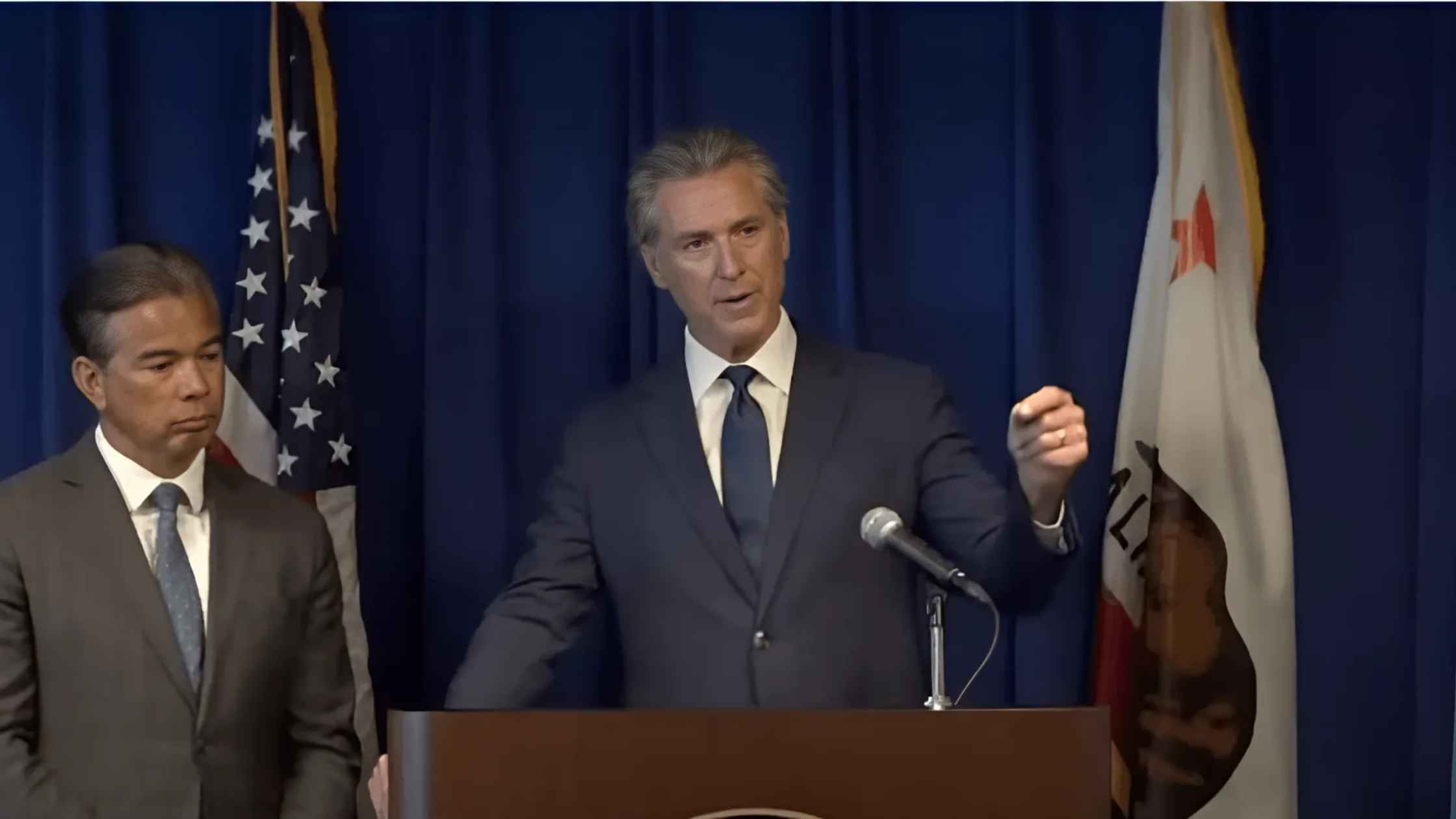
… everybody. Thank you for being here. Rob Bonta, California attorney general. I first want to start by welcoming our incredible governor. Wonderful to have him at the California Department of Justice as always, and want to thank him for his courage, his conviction, his inimitable leadership. And it's always a pleasure to stand with the governor, literally and also in our work here. And that's what we're here to talk about. We're standing together in our shared mission to protect and defend California and Californians. The report my office is putting out today is proof of that mission in action. And this is the report as required by the legislation, to report back to the legislature on how we're using the special session funding. It sets forth how we've used the $5 million so far and goes through the different cases and other efforts and actions that we've taken to date. And as I like to say, as others say as well, we are bringing the receipts. And so let me talk about what we've accomplished.
(03:08)
Since President Trump took office on January 20th, the federal administration has led a sweeping campaign to illegally withhold funding and services to dismantle the federal government and to strip Californians of their constitutional rights. In return, California DOJ has had to file 37 lawsuits against the federal administration in just 28 weeks, more than one lawsuit per week.
(03:37)
We've successfully secured early relief in 17 of 19 cases where we've asked for it and where the court has ruled. So out of 19 times where we've gone to court and asked for a temporary restraining order or a preliminary injunction, 17 of those times we've gotten it. Today we have 13 court orders blocking President Trump's illegal actions. On top of that, there have been other instances where the administration has conceded and reversed course outside of a court ruling, without a court ruling to a document and affirm that fact. So there's other metrics for victory as well.
(04:18)
One example of that is just recently when days after we filed a lawsuit, the Department of Education restored funding it had illegally frozen and that we had made a subject of our lawsuit. We've also brought more than 40 amicus briefs, filed more than 40 amicus briefs in support of other related cases that are aligned with our mission and our work. In just the first six months, California DOJ's actions have restored, protected, and defended over $168 billion in federal funding that our state, that our communities, that our families rely on. So $5 million of special session money to fund the work to support attorneys and paralegals in my office. $168 billion protected. That means that for every $1 we've been given by the legislature and the governor from special session funding to do this work, and we are very grateful for that funding. We've returned $33,600 for the state, $1 for 33,600 in return. And just to put it in perspective, if you told the Wall Street investor they'd get a $33,000 return on every $1 invested, they would trip over themselves to get in on that deal.
(05:40)
In its first week, the Trump administration tried to freeze 3 trillion, with a T, dollars, nationwide funding. Less than 24 hours later, we were in court to freeze him in his tracks, saving $168 billion for California alone, 1/3 of our state's annual budget.
(05:58)
When the administration's initial attempt at a wide net cut failed, it changed course and it flooded the zone with near-constant attempts to cut off funding anywhere and everywhere, they saw an opening, like a dangerous and unruly game of whack-a-mole. They kept coming for the same funding to cut it off, to impound it. We've been ready to strike back at every turn, securing early court wins to protect a total of $11 billion from the onslaught of successive attacks, some of which were repeated attempts to claw back the same funding sources we'd already protected from in our first effort in week one. So we protected it once in week one. They came after it again, we defended it, that funding again.
(06:40)
Through those lawsuits, we saved approximately $7 billion in grants to upkeep the roads, railways, and airways, and bridges that connect our communities, that ensure our people can safely get to work, get to school, and return home at the end of the day. We saved $939 million for California schools just weeks before classes started again. Funds for before, after, and summer learning programs, teacher preparation programs, and to support students learning English.
(07:11)
We saved $972 million in critical public health funding for the state, funding that ensures access to immunizations, that identifies tracks and addresses infectious diseases, and that modernizes our public health system.
(07:26)
And we save more than $300 million for electric vehicle infrastructure to ensure our state is ready and able to move into a future-driven by electric vehicles.
(07:36)
Those are just some of the examples of the savings that we've had, the successes that we've secured. California isn't even asking for its fair share of federal funding. After all, we are the biggest donor state in the country paying more in federal taxes than we get back in return. What we're demanding is that we get the funding that's already been legally approved and appropriated to our state, funding that comes from our tax dollars to support our schools, healthcare, transportation, and much more.
(08:09)
The money is critical and it touches every corner of California. But our work goes far beyond dollars and cents. It's also about stopping the federal administration from senselessly tearing down the federal government and the services Americans count on it to provide, paid for by our tax dollars. Is our government perfect? No. No institution is, but lighting it on fire and walking away is not the answer. That only stands to hurt our people and set our nation back for generations to come.
(08:43)
We blocked the administration's attack on the Department of Health and Human Services because we need it to continue protecting the health and safety of millions of Americans, to combat infectious diseases, reduce smoking-related deaths, and ensure all families have access to early childhood programs. We blocked its attempt to dismantle AmeriCorps so volunteers can continue to answer the call to serve their country and their fellow American by tutoring students, serving veterans and older adults, fighting the opioid epidemic, and rebuilding our communities in the wake of disaster.
(09:18)
We're also working to defend our constitutional rights, hard-fought rights the president cannot rewrite with the stroke of a pen, though he's tried. We are fighting for birthright citizenship and the more than 24,000 babies born in California each year who are rightfully U.S citizens. So far, we've won multiple court orders blocking implementation of the executive order while our case proceeds.
(09:43)
And we're working to safeguard Californians personal and private data from government misuse, specifically from protecting it from DOGE and from private citizen billionaire, Elon Musk. Not elected to anything, by the way.
(09:57)
We blocked the poorly named Department of Government Efficiency from accessing your financial data, sued the administration for illegally sharing Medicaid data with ICE, and challenge demands that we turn over the sensitive and personal data of SNAP recipients.
(10:13)
When you add it all up, you see the totality of what's at stake, the California dream, the idea that every Californian, no matter how they look, where they live or how much money they have, can send their kid to school, go to the doctor when they're sick, and put food on the table and a roof over their heads, can work hard, support their families and give back to their communities, can rely on their federal and state government to have their back.
(10:42)
I want to be very clear. I don't want to have to file these lawsuits. I'd much rather work with the federal government to serve, protect, and uplift our people and our state. In fact, the moment the Trump administration stops breaking the law and violating the Constitution, we'll stop suing.
Rob Bonta (11:00):
… simple. Until then, we have no choice but to take legal action. No one is above the law, not even the President of the United States. When you break the law, you need to be held accountable, plain and simple. The irony is, the president has an enormous amount of lawful power at his fingertips. There's so much he can actually do legally. If he'd just stick to that, we wouldn't have a case against him. Instead, President Trump and his allies continue to abuse their power, break the law, violate the constitution, and harm our people. Be it threats to our schools, research for our future, medical care for our sick or infrastructure that keeps our communities working, there's too much at stake to sit idly by and allow the president to continue unchecked. So you've got my word. Every time the president or his allies break the law, my incredible team of public servants at the California DOJ and I will be here to take them in court. Just like we have 37 times already.
(12:07)
As Attorney General, it's my job and my honor to protect California's people, resources, and values. I've got your back. I've got California's back. I'll protect your rights, your freedoms, your funding, and our values. And fortunately, I don't stand alone. I have a great team at the California DOJ. And I'm grateful to be able to stand with our great governor and our colleagues in the Legislature. We're one team. The federal government might be content to forego its duty to serve the people, but the State of California never will. And now it's my great pleasure to welcome up my partner in this incredible work, Governor Gavin Newsom.
Gavin Newsom (12:46):
Thank you. Thank you to the Attorney General. Thank you for the comprehensive overview and thank you for putting together this report in a transparent way.
(12:52)
You may recall this report came out of legislative process that began during the transition of the Trump Administration. We called a special session. We did so in the spirit that defines, I think, the closing comments of the Attorney General, with an open hand, not a closed fist. With the intention not to litigate, with intention, not to initiate, but with the intention to defend, to stand tall, to hold the line. In terms of our values, the things we hold dear, to advance the rule of law and do so in a fair way. We were mindful that past is prologue, that we were involved in over 122, arguably 123 lawsuits in the Trump Administration 1.0, and inevitably we would be faced with many similar lawsuits and efforts in the second administration. Though I think none of us imagined, in the process of putting together a special session, that just in seven or so months, 37 lawsuits would be filed.
(13:57)
None of us are surprised that so many of them have been successful. Nothing about what Trump is doing should come as a surprise, save the scope, the scale, the "shock and awe" as it's been described, of the totality of his efforts. Thankfully, we have an outstanding leader in our attorney general. Someone didn't need to be convinced to fortify, to provide a bridge. That was the idea of the special session after all, a bridge to the budget. To make sure he had the resources so that he could move forward quickly. Whether it was internal efforts or to the extent he needed to find counsel outside, he would have the luxury, he would have the resources to do so.
(14:43)
With the support of the legislature, we not only advanced the $25 million in the special session, but with the support of the legislature just a few weeks ago, we also were able to significantly increase the ongoing support for our litigation posture here at the DOJ.
(15:00)
I'm grateful to the attorney general. I'm grateful to the leadership in both the Senate and the Assembly for supporting new positions and supporting additional resources that will supplement the resources that were set aside. Those one-time resources, the $25 million in the special session. It was never the intention to quote-unquote "Trump-proof," your words not mine, during the special session. But undoubtedly, those resources have come to bear great fruit. And I'm grateful again to your leadership, to your team's leadership, to your stewardship, to the partnerships that you've formed with other states. And I think this closing is a critical point. It's the old African proverb, "If you want to go fast, you can go alone. But if you want to go far, go together."
(15:53)
And the partnerships that have been formed with other attorney generals all across this country have been formidable and have had tremendous impact, in terms of the success with these preliminary injunctions, success so far in this process. But none of us are naive about what's next, and none of us are naive about the imperative of making sure that we're resourced and we have a resourceful mindset as we move forward. Tremendous return on investment.
(16:25)
But again, this is just seven months into a new administration, and there's no question in my mind that the most vexing challenges are in front of us, not behind us. So I'm here just to support and amplify the work that was done in putting together this report. But also extend gratitude not just to the attorney general, but again to the legislature for approving this appropriation. For supporting that special session and setting up this strategy, first of its type in the country. We took this next administration, the new Trump Administration seriously, and thankfully we did. And I'm very, very proud of you and your team and grateful for the opportunity just to highlight and reinforce the success that's laid out today in this report.
Rob Bonta (17:20):
Thank you. Thank you, Governor. I appreciate the partnership. Again, the kind words, the ability to talk about in a transparent way what we've accomplished so far. And with clear eyes and a sober outlook, ready for whatever happens next. We will continue to do what we've already done. And I think what we've accomplished has proof positive of what we hope we can continue to accomplish on behalf of California, our people, our values, and our future. So with that, happy to answer any questions that you might have.
Reporter 1 (17:50):
For both of you. [inaudible 00:17:52]. Just redistricting, which I know is separate from a lot of this, but still kind of focused off of being the same. Republican representative Kevin Kiley today came out with a proposal that he plans to introduce tomorrow that would prohibit states like Texas and California from redistricting in this decade. Is that something that you two could support?
Rob Bonta (18:17):
Let me turn it over to the governor, who's been leading on this issue.
Gavin Newsom (18:20):
Well, I've long supported independent redistricting. I was Mayor of San Francisco supporting the efforts at the state level, very proud of Governor Schwarzenegger's leadership. I'm proud of those that supported that effort. I was one of the few elected Democrats at the time that publicly stated my support for the independent redistricting. So absolutely, I support a national framework. In fact, the work we're advancing with the legislature does just that. It reinforces the framework, the policy, through a constitutional framework. To advance as policy support for a independent national independent redistricting commission. That's absolutely the goal. I'm appreciative that this member of Congress is waking up to the realities of what has occurred in Texas. I haven't heard much from him as it relates to the condemnation of their efforts, but I'm grateful that he recognizes the importance of a national framework.
Reporter 1 (19:16):
Sorry, just to be clear. His legislation prohibits a mid-decade redraw. Is that something that you'd be okay with? That way he wouldn't-
Gavin Newsom (19:22):
Well, this whole thing is in response to. And in many ways it's the spirit, and I appreciate your question, and I'll build off it. It's the spirit of the special session, this special session, as it relates to putting ourselves in a position to respond to the assault on the rule of law and our democratic principles, principles of federalism, 10th amendment, that so often are brought to bear in light with the litigation that we've advanced. The proposal that we're advancing with the legislature has a trigger. Only if they move forward to dismantling the protocols that are well established would the state of California move forward in kind. Fighting, yes, fire with fire. So in that light, I believe there's consistency.
Monica Mattingly (20:23):
Governor. Monica Mattingly, Houston Seven News. Last night, California state Democrats and congressional Democrats had a meeting to discuss this ongoing redistricting plan. And we're hearing that California Democrats have a draft, or almost are done with the draft of these maps. Have you been in conversations with leadership about this? Have you seen the maps? And of course this would end up going through the legislature.
Gavin Newsom (20:43):
I haven't seen the maps, but we helped initiate those conversations, part of those conversations last night. They've been an ongoing series of conversations that continued into the evening, continued this morning, and will continue until we land on a process. That process has to have the concurrence, the support, of two-thirds of the legislature.
(21:08)
The maps, we believe, should be transparent. They should be provided in a transparent way to the public. And as a consequence, those maps are being processed and will be brought to light. I have not had the opportunity, nor am I getting any of the details of what those maps look like. I'll allow more objective minds to do just that. But the ultimate determination will be by the people of the state of California. And we will offer them the opportunity to make judgment for themselves. Again, only if Texas moves forward. We would maintain the framework of the Independent Redistricting Commission that I support, that I believe in. We would just allow for this mid-census redistricting to occur just for Congressional maps in '26, '28, and '30. It would also
Gavin Newsom (22:00):
Also, state as I said a moment ago and I'll reinforce, that we believe it should be national model, independent national redistricting, and it would revert back to its original form, but it's done in response to the existential realities that we're now facing. Things have changed, facts have changed, so we must change. In the spirit of Lincoln's infamous second inaugural, "We have to dis- enthrall ourselves so we can save this country. We've got to think anew. We've got to act anew." Things have changed. We're reacting to that change. They've triggered this response and we're not going to roll over. We're going to fight fire with fire, but we're going to do so not just punching with the weight of the fourth-largest economy, the most populous state in our union, the size of 21 state populations combined, but we also will punch above our weight in terms of the impact of what we're doing. I think that should be absorbed by those in the Texas delegation.
(23:12)
Whatever they are doing will be neutered here in the state of California and they will pay that price, and we believe public opinion is with our approach and I appreciate the growing recognition in other states of other governors of like mind and the people of this country recognizing what's at stake. These folks don't play by the rules. If they can't win playing the game with the existing set of rules, they'll change the rules. That's what Donald Trump has done. He's dialing for seats, familiar because he dialed for votes in the last election. Here's someone who tried to break this country, tried to light democracy on fire on January 6th. He recognizes he's going to lose in the midterms and we have the opportunity to de facto end the Trump presidency in less than 18 months. That's what's at stake and that's why we're putting a stake in the ground. We're not drawing lines to draw lines. We're holding the line on democracy, on the rule of law, co-equal branches of government, popular sovereignty. That's what this is about.
Reporter 1 (24:29):
Did you invite Texas Democrats who were breaking form to come to California?
Gavin Newsom (24:34):
They were told we would support them in any way, and I was with them, as you know, last week at the Governor's Mansion.
Speaker 1 (24:39):
Governor, separately from what you're doing here in California, are you planning on making any investments in Texas to stop the mess?
Gavin Newsom (24:49):
Well, we are going to do what we can to resource and support them, but our focus is here on California.
Speaker 2 (24:53):
Should Californians be prepared to go to the poll in November for a special [inaudible 00:24:59]?
Gavin Newsom (24:59):
It's cause and effect. It's triggered on the basis of what occurs or doesn't occur in Texas. I hope they do the right thing, and if they do the right thing then there'll be no cause for us to have to move forward. Again, we're working with the legislature on a trigger that if they do move forward, California will not sit by idly and watch this democracy waste away. We'll fight fire with fire. We'll assert ourselves and we'll punch above our weight, and it will have profound impacts on the national outcome, not just here in the state of California. I appreciate it's already led to some members of our delegation now calling for independent redistricting. That's an encouraging sign.
(25:38)
So already perhaps people are waking up to the reality of California entering into this conversation. We're not a small state. Again, we punch above our weight. It will have profound national implications if we move forward, and I'm confident if we move forward, the people of this great state will support this effort.
Speaker 3 (25:59):
If California moves forward with a special election for the mid-decade redistricting effort, can you talk about how realistic it is with such a tight timeline if you're helping to put this on the ballot in November, on November 4th, there have to be 45 days that's needed for mail-out ballots and things like that. How confident are you in getting this done with such a tight timeline?
Gavin Newsom (26:26):
Very, and we'll get it done. The goal is to get it on the November 4th ballot where other municipal elections are already occurring.
Speaker 4 (26:36):
So governor, I mean, you basically have to act by the end of this month to meet those timelines. What if Texas hasn't actually done anything by then? Are you just going to move ahead with it anyway as a backup plan?
Gavin Newsom (26:48):
I'll repeat what I said earlier because it's important and I appreciate the opportunity to clarify it on the basis of your question. We have trigger component of this effort, so it only goes in effect if it's triggered by action that occurs in Texas.
Reporter 1 (27:07):
To be clear, the ballot language says this would not go into effect with Texas or any other state? Is that-
Gavin Newsom (27:16):
I want to make something clear. The ballot language says nothing at the moment. The ballot language is being worked on at the moment in a process that began a few weeks ago. That process, and I appreciate you highlighting last night, there were a series of additional meetings and they continue today and they'll continue over the course of the next few weeks. We're very mindful of the calendar, mindful of what is required. The legislative leaders are deeply mindful of that as well, working with respective caucuses.
(27:49)
The language is being worked on, it's being negotiated, it's being debated within the caucus. It will be made available in very transparent terms to the people of the state of California that will ultimately make the determination for themselves what they want for themselves. That I think is what distinguishes our efforts from the efforts in states like Texas.
Speaker 4 (28:17):
Will we see that language before the legislature of the [inaudible 00:28:17]?
Gavin Newsom (28:17):
We have a process that's well established here in the state to engage the legislature in a deliberative process to advance legislation and we'll maintain the core tenets of that process an open and transparent way. It's well established in this state that we have rules that distinguish us from other states, including the 72-hour rule for full transparency. And so we'll make things available as quickly as we can on the basis the consensus that we're drafting.
Speaker 1 (28:46):
Some of the super majority though indicated they're not convinced that this is a good idea yet. Are you confident they're going to be able to get them on board with that?
Gavin Newsom (28:55):
Deeply confident.
Reporter 1 (28:58):
But on such a tight timeline, you promised California voters, these maps wouldn't be drawn in the back room. It'd be available for people to see, but how can you guarantee that and the ballot language isn't done behind closed doors? Which as we've acknowledged and we've reported, there's already been at least one, two, three closed door meetings so far on this. I mean, Texas's process was done behind closed doors and then people got to see those maps within days and there was public outrage, there was a ton of public comment. I mean, how can you guarantee the process here won't be exactly the same as it was in that state?
Gavin Newsom (29:35):
One has nothing to do with the other. Forgive me. The ultimate test of transparency is what's in the voting pamphlet. The ultimate test of transparency is what voters will decide on. Full light of day, completely public. They will have the opportunity to review those maps. They'll have ample opportunity to do just that, and it will be in their ballot box and they'll make that determination. That is in stark contrast to the example that you just did ask.
Speaker 2 (30:06):
[inaudible 00:30:07] is confident the Independent Redistricting Office, like coming back to that, if we're just going to go around at this time, how can we think of it as an independent one, given that power, so to speak?
Gavin Newsom (30:25):
Well, we believe in the core principles. Things have changed. I mean, again, the word disenthrall is the operative word here. When things change, facts change, you've got to change. And this is serious stuff. I mean, I can just remind you just some tactical points. I mean, you want more warrantless arrests of people that look more like the attorney general than me? You want to continue to sit back as we have aid to people that are desperate and in need to get their lives back on track because of one of the most significant disasters, natural disasters in American history that happened in Southern California? You want that aid conditioned on a political whim of someone in 1600 Pennsylvania Avenue? I go down the list.
(31:17)
All of that is on the line here. It's not a gross exaggeration. Not an exaggeration at all. Remember the origin story here is Donald Trump made a phone call so familiar, just out in the open corruption at a whole nother level. Do not allow this to be normalized. Told Greg Abbott, "I need you to find me, in this case, five representatives." These guys aren't screwing around. It's not an intellectual exercise. I'm not here to be a member of some think tank. We're here as pragmatists practitioners and I've got kids. I care deeply about the 250th anniversary of this great country that we'll celebrate next year. It's all at risk. This sky's not screwing around and nor are we.
Speaker 1 (32:13):
You said you haven't seen any maps yet. So who is drawing those maps and what is the target number of Democratic seats that you're asking for on that map?
Gavin Newsom (32:24):
I'm not asking specifically for anything except a process to unfold with congressional legislation, the congressional delegation and members of the California State Assembly and State Senate. And that's a process that they're engaging in and it's a process that's very familiar, redistricting is very familiar to all of us, and these are maps that I'm told are relatively familiar as well. The Independent Redistricting puts out maps all the time, have seen many maps over the years, and some are approved, some are not. And those processes
Gavin Newsom (33:00):
… process is unfolding as we speak, but it is not a process that I, as governor of the state of California, am advancing in any detail. It is a process that's happening with the delegations. It's a process that will be made transparent, fully transparent, and the ultimate determination of this approach will be made by the people of the state. And we hope that occurs with a special election that will coincide with municipal elections, many, not all, LA city is one, others, as early as November 4th.
Speaker 5 (33:32):
Do you have the target number of take up Democratic-
Gavin Newsom (33:35):
As I said, we will punch above our weight and we will more than address the concerns that have been expressed by actions in other states.
Speaker 6 (33:53):
Can I ask one question about this actual report?
Speaker 8 (33:53):
Sure.
Gavin Newsom (33:53):
Unbelievable. I would like to have a [inaudible 00:33:54] as you ask.
Rob Bonta (33:53):
A question about this report? Yes, please.
Speaker 6 (33:57):
[inaudible 00:33:57] my colleague. First of all, for both of you, is there one win that has been especially meaningful to you [inaudible 00:34:03] represents the California values?
(34:06)
And second, and in the week's financial question, 25 million is hard for people to understand. Is it being spent on outside counsel? You've drawn down 5 million, 10 million being drawn down. How do you explain where it's going to the general public?
Rob Bonta (34:19):
Sure, thanks. The first two cases, they were first in time and they kind of represent the body of 37 cases, in some ways. They cover two main buckets that the cases can be put in broadly. First case was the attempt to, with the stroke of the pen, amend the Constitution and end birthright citizenship. That was our first case.
(34:40)
And that one, it is very meaningful. We've had other cases attacking constitutional rights, like voting rights, and we got an injunction in that case as well. The idea that you can timely cast a ballot and it should still be counted. Not a lot to ask for in this amazing country, but the president has attacked that.
(34:59)
So, protecting rights and freedoms, core constitutional rights, like the right to vote, the right from which all of the rights flow, and birthright citizenship, right on there 14th Amendment, the Citizenship Clause, that was case one. That one super meaningful, remains super meaningful.
(35:14)
The second one represents the attacks on congressionally-appropriated funding. It was the OMB memo case, Office of Management and Budget, $3 trillion at risk, nation-wide 168 billion for the state of California. We were able to block that, stop that, make sure that that $168 billion continued to flow, things that it funded housing and healthcare, and food, and child care, and college, and emergency and disaster relief, and response. So very important.
(35:43)
I think those cases, they were the first two in time, but they remain the most important in terms of what they represent, the amount at issue. Nothing has been higher in terms of what was at stake in terms of financially than 168 billion in the OMB case. And this core constitutional right being attacked by the president on day one. The day he raised his hand and took the oath to follow the laws in the Constitution, he breaks it later that day and tries to amend the Constitution in a way that's unlawful. I think those two cases remain really important and defining as we continue the work.
(36:17)
25 million is a lot of money. We're grateful to have it. $168 billion is a lot more money than $25 million. We've spent $5 million. What do we spend it on? We spent it on attorneys and paralegals, the people who bring the cases, who file the complaint, who go to court, who argue the motions, who secure the restraining order, who secure the preliminary injunction, who write the briefs, who respond to the court, who protect the trial court victory at the appellate level.
(36:42)
So it's mostly all attorneys, with some paralegals all inside. All inside. We have not spent any money on outside counsel in our litigation. We hope to internalize it. We think we have an incredible team. I think the success and the metrics that we've laid out today are proof positive of that. So we want to continue to support the great men and women at the California Department of Justice who do this work, our attorneys and our paralegals, and their support teams.
Speaker 6 (37:10):
The National Guard lawsuit is expected to go to trial in Judge Breyer's court next week. Are you anticipating the Trump administration to try and get this lawsuit, since it had been tossed, now that they have been withdrawing slowly and maturely the number of members on the ground in Southern California?
Rob Bonta (37:23):
We are very aware of that potential strategy. They signaled it to us earlier, and their slow withdrawal of Marines and National Guard people suggests that they might be coming to an end. They're not there yet. This is, by the way, far too slow and not soon enough. They should never have had people there.
(37:46)
The Marines and the National Guard's people arrive to quiet streets in LA the day they arrived. And the President has been incredibly, in my view, disrespectful to these patriots. He's treated them as political pawns. And they're sitting on federal buildings, they're sleeping over each other, they're not having appropriate support, and they should be doing other things. They were doing other things.
(38:09)
The governor had the National Guard people doing important things, fighting fentanyl and wildfires, and they were brought to LA as a political stunt, unfortunately. But we're aware of that possibility. It might be that by the time of the preliminary injunction hearing there's no National Guards people or Marines on the streets of LA. And Judge Breyer would have to look at that and determine if the issue is still ripe and one that deserves a ruling, or if it's now moot because there's no more troops on the ground.
Gavin Newsom (38:36):
But it reinforces the litigation strategy. Those things are not coincidental. Had we not positioned ourselves, had we not postured with that litigation approach, we would not be in this position with that withdrawal.
Rob Bonta (38:47):
That's right. We pushed for the preliminary injunction hearing. They were aware of the hearing. The timing of their withdrawal is very cognizant of the hearing. And so, our goal was to not have the troops there, and to the extent that they were there, have them removed as soon as possible. That is happening.
(39:03)
So I mentioned earlier, there's different ways to measure victory here, and some are with orders that we secure, some are with the actions that the federal government takes in response to our actions in court. This is another example of that.
Speaker 7 (39:16):
Given the rate of litigation, do you anticipate what [inaudible 00:39:32]?
Rob Bonta (39:31):
We're on ongoing discussions about how much is appropriate and needed to fund our successful lawsuits to defend California's rights, freedoms and funding. So, we're having those discussions with the governor's office, with the legislature. We're making it clear what we think we need.
(39:48)
We're grateful for the 25 million and the ability to draw down that 5 million so far. We do think we will need more going into the future, and I'm hopeful that through the conversations that we have talking about what we would use it for, our success so far, what the continuing threats are down the road, that we'll get to a place that will work for everybody.
Gavin Newsom (40:07):
And let me assure you, he will not be in need of resources to do his job. And this report only highlights why I feel very confident in his ability to execute and to deliver results for the people of this state.
Rob Bonta (40:21):
Thank you.
Reporter 1 (40:25):
Just [inaudible 00:40:26] the $25 million as of the legislation. And I want to acknowledge that you make yourself constantly available here, always have been with us, almost daily it seems like. But a part of the legislation directs you to also create a website that updates these cases, provides documents just so that everyone's on the same.
(40:42)
I have a [inaudible 00:40:43] request actually for your office that I haven't received a response to. You have a website right now that just has your press releases, but there's no organized way to look at the status of each, so you can't see what's pending. And this was helpful before, but do you plan to have that kind of website moving forward?
Rob Bonta (41:03):
We always want to improve and we want to always give the most updated information. Sometimes things change on a daily basis, but we expect and hope that people can go onto our website, look at what we're doing, look at the posture of those cases, what decisions have been made, has an appellate court gotten involved or not? And so, I think we're interested in sharing more and being as transparent as possible.
Speaker 9 (41:30):
Thank you, and that's all the time we have for questions.
Rob Bonta (41:31):
Thank you all.
Speaker 10 (41:42):
Have you ever seen the magic glasses that can see clearly without glasses? These glasses can not only see far away, but also see near. These smart zoom glasses from Japan are really great. No need wear lenses. The degree can be used from 100 degrees to 700 degrees. The glasses will automatically adapt to your vision, can see clearly far away and near, and are very comfortable to use.
(42:08)
It also has the function of blocking blue light. Even if you watch TV or mobile phone for a long time, your eyes will not feel tired. If your vision is not very good or blurry, you might as well try these glasses. I believe you will love it. The lowest price on the market, click the link to buy now.