
43+ Workplace Investigation Questions That Hold Up In Court
Use these 43+ workplace investigation questions for complainants, witnesses, and accused employees, plus tips for creating a clearer record.



A workplace investigation can turn on one sentence nobody thought mattered at the time.
Months later, that sentence may show up in a demand letter, deposition, agency charge, or lawsuit. Suddenly, “I think it happened after lunch” and “It happened at 2:15 pm, after the team meeting” are very different answers.
That’s why good workplace investigation questions do more than help HR understand what happened. They create a clear, neutral record of what each person remembers, what they personally observed, and where the accounts don’t line up.
Below, we cover 43+ workplace investigation questions for every stage of your investigation. Though remember, these questions are starting points, not a script. Adapt them to the allegation, your policies, applicable law, and advice from counsel.
Questions To Ask The Complainant
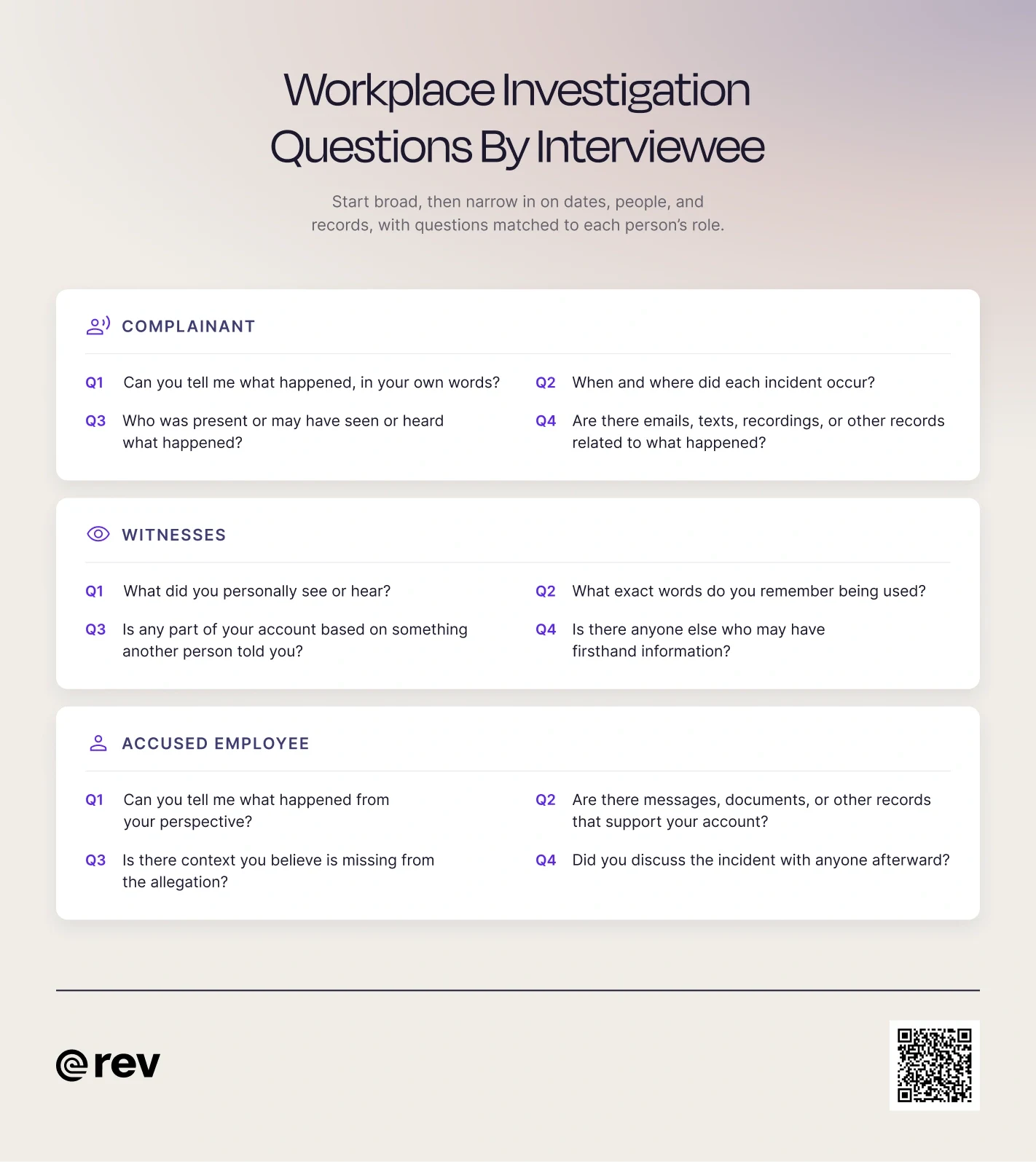
Start broad. Give the employee who made the complaint room to describe events in their own words before narrowing in on dates, people, documents, and specific statements. The goal is to understand the allegation and build a rapport without supplying details or pushing the interviewee toward a particular answer.
- Can you tell me what happened, in your own words?
- When and where did each incident occur?
- Who was present or may have seen or heard what happened?
- What exactly was said or done?
- How did you respond at the time?
- Did you tell anyone about the incident afterward?
- What did you tell them?
- Are there emails, texts, messages, recordings, documents, or other records related to what happened?
- Has anything similar happened before?
- If so, when?
- How has this affected your work or working conditions?
- Is there anything else you think we should know, or anyone else we should speak with?
“The most common flaw that I’ve seen is conducting interviews in a way that leads to foregone conclusions,” explains Michael Corwin, a Workplace Violence Prevention Consultant.
“For example, interviewing the respondent before interviewing the complainant and failing to interview witnesses suggested by one party but interviewing those suggested by the other party.”
Questions To Ask Witnesses
Witness interviews should separate firsthand knowledge from office rumors. Ask what the witness personally saw, heard, or received, then establish how they know it.
Avoid leading questions, and never tell a witness what another employee said. These can undermine your investigation and even harm the involved parties. Instead, your workplace investigation process should use prior interviews to identify gaps, then ask a neutral question about those gaps.
- What did you personally see or hear?
- When and where did that happen?
- Who else was present?
- What happened immediately before and after the event?
- What exact words do you remember being used?
- Did you discuss the event with anyone afterward?
- What did you say?
- Did you make any notes, send messages, or receive communications about it?
- Is any part of your account based on something another person told you?
- Have you observed similar conduct involving either person before?
- Is there anyone else who may have firsthand information?
Questions To Ask The Accused
Workplace harassment investigation questions for an accused employee should give that person a fair chance to respond to the allegations. Begin with an open invitation to explain their version, then move into specific events, statements, records, and witnesses.
Do not treat disputed details as settled facts. “What happened during your meeting on Tuesday?” leaves room for an account. “Why did you threaten her on Tuesday?” assumes the central allegation is true before the answer is given.
- Can you tell me what happened from your perspective?
- What is your response to the allegation that [describe allegation neutrally]?
- When and where did the relevant interaction occur?
- Who else was present or may have observed it?
- What do you remember saying or doing?
- How did the other person respond?
- Are there messages, emails, documents, recordings, or other records that support your account?
- Did you discuss the incident with anyone afterward?
- Is there context you believe is missing from the allegation?
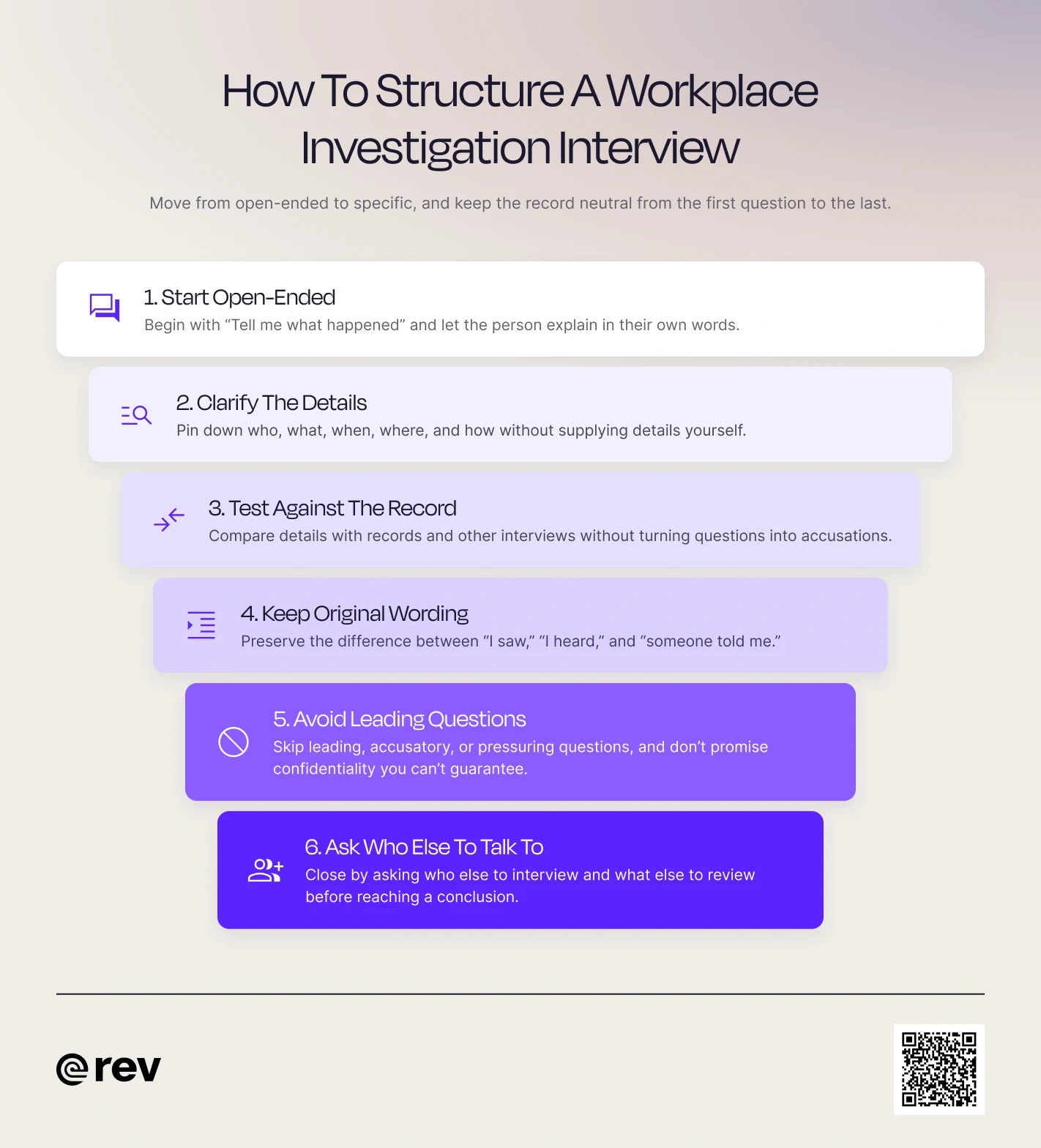
- Who else should we interview or what else should we review before reaching a conclusion?
Other Questions To Consider
Not every investigation fits neatly into a harassment or misconduct template. Your investigation questioning may need to change based on the allegation and evidence already collected. Consider asking:
For retaliation concerns:
- What changed after the complaint, report, or protected activity?
- Who made the decision, and when?
For discrimination allegations:
- Who was involved in the employment decision?
- What reasons were given?
- How were comparable situations handled?
For threatening behavior:
- What words, gestures, actions, or communications caused concern?
- Was there an immediate safety risk?
For digital conduct:
- Which account, device, channel, or platform was used?
- Is the original message or file still available?
For timeline disputes:
- What helps you place the event at that date or time?
For credibility questions:
- Is there anything that could affect your ability to remember this event accurately?
What Not To Ask During A Workplace Investigation
Do not ask questions that are leading, accusatory, irrelevant, vindictive, or framed to pressure an employee into a preferred answer.
That means avoiding questions such as “You were probably joking, right?” or “Why didn’t you report this sooner if it was serious?” Questions like these can introduce assumptions instead of collecting facts.
Also be careful with promises of absolute confidentiality. The EEOC notes that employers may need to share information with people who need it to investigate and respond to a complaint. A better approach is to explain how information will be handled and avoid promising secrecy you cannot guarantee.
If the workplace is unionized, investigatory interviews may also trigger representation rights in some circumstances. Under the NLRB’s Weingarten framework, a represented employee may have a right to request union representation during an investigatory interview the employee reasonably believes could result in discipline.
Advanced Interview Tips For HR Teams
A strong investigative question format usually moves from open-ended to specific. Start with “Tell me what happened.” Then clarify the who, what, when, where, and how. Finally, test details against records and other interviews without turning the question into an accusation.
“Start with a clear scope and identify the allegations that need to be investigated, then follow the evidence wherever it leads. Interview the complainant, the accused employee, and relevant witnesses separately, and ask open-ended questions rather than questions designed to confirm management's theory,” Thomas Ricotta, Founder and Employment Attorney at Ricotta & Marks, told Rev.
“I also recommend saving any form of communication or personal records and at the same time, don't promise employees a guaranteed outcome because the goal is to conduct a fair and well-documented investigation and take appropriate action based on what the evidence shows.”
Keep the original wording whenever possible. A polished summary can accidentally flatten an important distinction between “I saw,” “I heard,” and “someone told me.” Recording and transcription, when permitted by applicable law and company policy, can give the investigation team a searchable record to return to later.
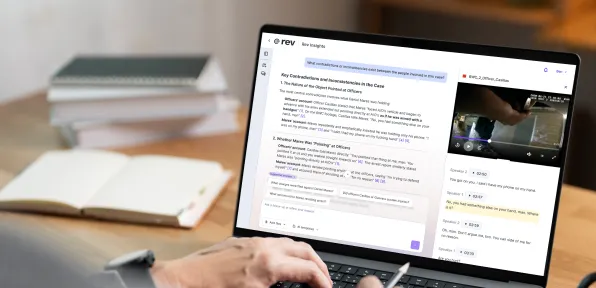
That is where Rev can help. Transcribe interviews, search names and events across accounts, and compare relevant statements without relying on memory or scattered notes. Rev’s workflows are built around searchable transcripts and source-linked analysis, so teams can return to the underlying record when a detail becomes important later.
Creating An Investigation Tech Toolbelt
Your investigation stack does not need to be complicated. A practical setup might include a secure case-management system, approved interview recording tools, transcription, document storage, and a way to search across interview records.
The important part is consistency. Preserve originals, control access, document where information came from, and keep your working notes separate from source evidence. Rev can handle the audio-to-searchable-text layer, while your existing HR, legal, or matter-management systems remain the home for the broader investigation.
You can also use Rev’s investigation resources for more on investigation workflows, review an investigation report example and template, or see how transcripts can support investigations.
Build A Record You Can Return To
The best workplace investigation questions are not the cleverest ones. They are the ones that let people explain what they know, make uncertainty visible, and leave you with a record that still makes sense months later.
With Rev, recorded interviews can become searchable transcripts your team can revisit when a name, date, quote, or inconsistency suddenly matters. That means less reconstruction from memory and more time working from the actual record.