

Effective Evidence Management For Audits & Investigations
Discover proven evidence management strategies that simplify audits and investigations. Learn how to organize, protect, and retrieve audit evidence when it counts.


.webp)
Did you know that over half of the cases that land on a lawyer's desk involve at least 50 hours of digital evidence? And 28% of them have 100+ hours? Our survey on the hidden costs of digital evidence found that this issue has been skyrocketing in recent years and will only continue to accelerate.
And while more evidence may ultimately lead to more opportunities to prove your case, if you don’t have everything properly organized, you might not be able to find what you need when it matters most.
This guide covers the most effective evidence management strategies for audits and investigations: what they are, how they work, and what happens when they're missing. Consider this your one-stop shop for finally getting that mess of paperwork off your desk and into an organized digital filing system.
Understanding Evidence Categories
Before you can manage evidence well, you need to know what you're working with. Evidence doesn't come in one form. It spans physical items, digital files, recorded statements, and documents — each with different handling and chain-of-custody requirements. For a deeper look at how these categories break down, see our overview on types of evidence.
In audit and compliance contexts, evidence typically falls into several buckets: documentary evidence (contracts, invoices, policies), testimonial evidence (statements, depositions, recorded interviews), physical evidence (original objects or materials), and digital evidence (recordings, logs, electronic files). Knowing which type you're dealing with shapes how you collect it, store it, and prove it hasn't been altered.
The Evidence Auditing Process
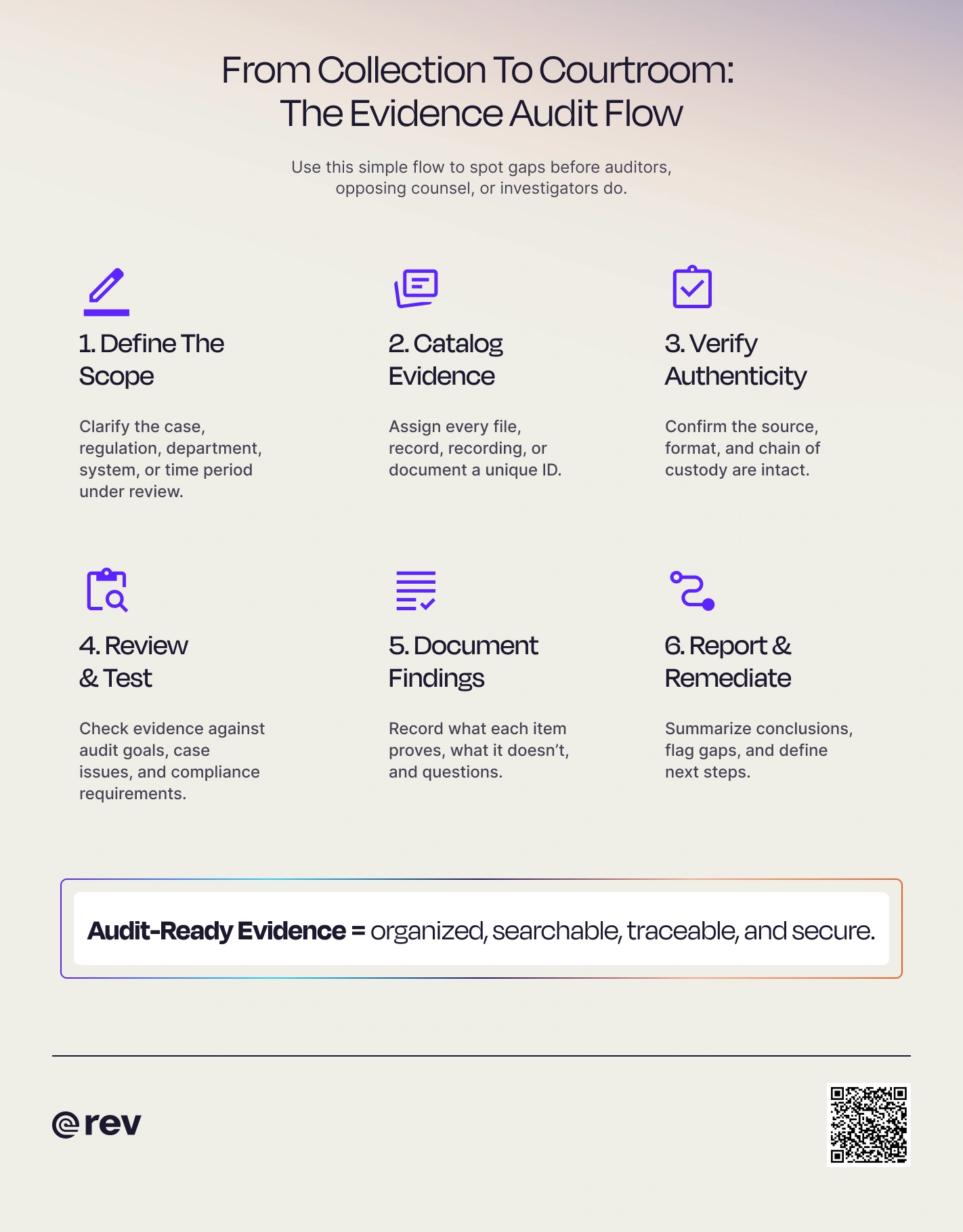
Effective evidence auditing follows a structured sequence. Skip a step, and you risk gaps that auditors or opposing counsel might find. A typical evidence audit process looks like this:
- Define The Scope: Clarify which regulations, time periods, systems, or departments are under review before collecting anything.
- Catalog Evidence: Collect all relevant documents, recordings, and additional evidence. Assign each item a unique ID and log intake details.
- Verify Authenticity: Confirm that evidence hasn't been altered, and that the chain of custody is completely intact.
- Review & Test: Examine evidence against the audit's objectives. Look for inconsistencies, missing records, or control failures.
- Document Findings: Record what the evidence does and doesn’t show, and any questions it raises. Everything needs to be traceable back to the source.
- Report & Remediate: Summarize conclusions, flag any compliance gaps, and outline any next steps.
Why It's Crucial To Audit All Your Evidence
A broken or incomplete audit trail is one of the most common reasons otherwise credible evidence gets challenged or dismissed. Courts demand proper documentation of evidence throughout the entire case, meaning who accessed it, when, and what changed. And when the evidence piles up, manual logging and spreadsheets simply can’t keep pace.
The stakes extend beyond the courtroom. Compliance audits for frameworks like SOC 2, ISO 27001, and others require organizations to prove their internal control across an entire audit report.
Teams that only focus on compliance at certification time end up scrambling to reconstruct months of evidence at the last minute, creating a lot of risk and unnecessary costs. Auditing evidence continuously, throughout the year, is what makes audits and continuous compliance actually manageable.
7 Evidence Management Strategies For Audits
Strong evidence management isn't about following a checklist once a year. It's a set of ongoing practices that make audits and investigations faster, more defensible, and less stressful. Here are the seven strategies that matter most.
1. Build An Evidence Repository
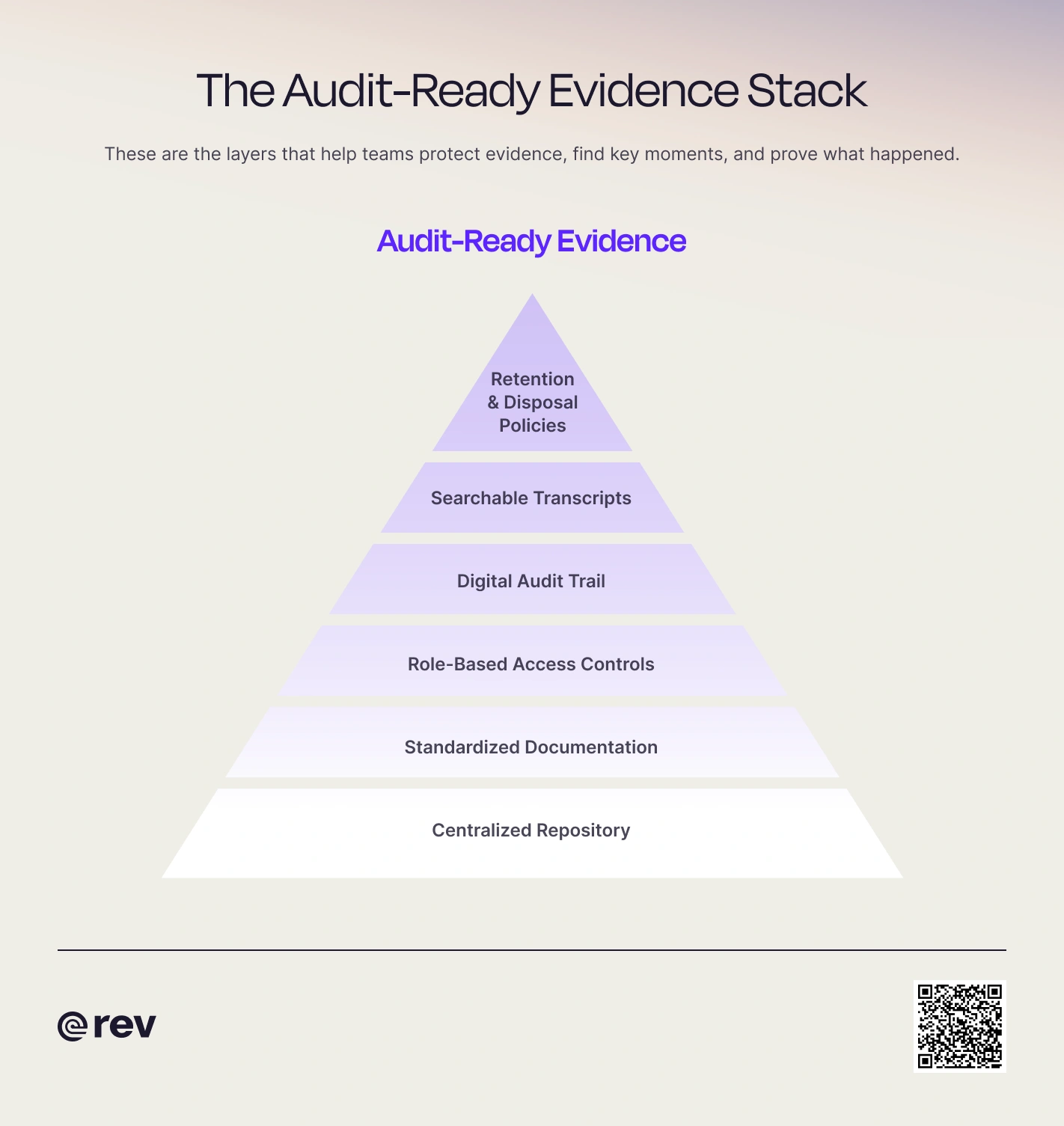
If your evidence lives across shared drives, email threads, local desktops, and physical filing cabinets, you likely know the panic that can set in when you have trouble finding the right file at the right time. A centralized repository helps solve for this, bringing everything into one secure, searchable location.
This matters for audits because auditors work faster when evidence is organized and accessible. It matters for investigations because you can't identify what's missing if you don't know what you have. A centralized system also makes it easier to assign ownership — every piece of evidence should have a responsible party, not just a folder it lives in.
2. Maintain A Digital Audit Trail
A digital audit trail is an automated, tamper-evident record of every action taken on evidence throughout its lifecycle: who collected it, who accessed it, what changed, and when. It answers the critical "who, what, when, and where" questions that come up during any serious review.
Manual logs can't do this at scale. They rely on people remembering to document each action, and a single undocumented transfer or access can create grounds to challenge evidence's admissibility. Automated audit trails remove that vulnerability.
“The biggest leap in audit readiness comes from using tools and workflows that preserve a provable master copy from the start, then keep every later step traceable,” says Robert Montanez, Founding Partner at Montanez Yu Personal Injury Lawyers.
“In practice that means forensic-grade acquisition for phones and computers where possible, followed by an evidence management layer that records who collected what, when, from which source, and what changed during processing. Mobile collections often benefit from specialist tools, not because they are magic, but because they can capture richer artefacts and structure than manual exports, and they support repeatable reporting that stands up better to scrutiny.”
For more on how digital evidence systems work in practice, see our guides on investigation report templates and digital evidence management.
3. Standardize Evidence Documentation
The hardest evidence to audit is evidence that was never properly documented in the first place. Standardizing how evidence is collected, such as the format, the required fields, the naming conventions, eliminates ambiguity before it starts.
This means defining what information must be captured at intake: collection date and time, the name of the person who collected it, the source, the condition or format, and a unique identifier. When every item enters the system the same way, retrieval is faster, and documentation gaps are easier to spot.
4. Implement Role-Based Access Controls
Not everyone who touches a case needs access to every piece of evidence. Access controls limit who can view, modify, or export evidence. They also create a log of every access attempt, whether successful or not.
This is both a security and an audit measure. It reduces the risk of unauthorized changes, and it makes it easier to demonstrate that evidence was only handled by authorized personnel. In compliance audits, access control logs are often required. In investigations, they're a chain of custody safeguard.
5. Create Transcripts Of Recorded Evidence
Recorded evidence is some of the most valuable evidence in an investigation. It's also some of the hardest to review quickly.
Transcribing recordings and making them searchable transforms hours of audio or video into a record you can actually interrogate. Timestamped transcripts let you jump directly to a specific moment, confirm the exact wording of a statement, and cite specific lines when preparing reports or making arguments. For compliance purposes, a transcript also serves as documentation of what was said and when.
6. Conduct Internal Evidence Audits
Don't wait for an external audit to find out your evidence management has gaps. Regular internal audits catch problems while there's still time to fix them.
An internal audit should check that all evidence is where it's supposed to be, chain of custody records are complete, access logs are intact, and any scheduled disposals have been handled properly. Think of it as preventive maintenance: the teams that do this consistently are never the ones scrambling the week before a compliance deadline.
7. Establish Retention & Disposal Policies
Evidence doesn't (and shouldn’t) live forever. Retaining evidence longer than necessary creates storage risk, compliance exposure, and audit complexity. But disposing of evidence before it's legally safe to do so is worse.
A written retention policy defines how long each category of evidence must be kept, who's responsible for flagging items for disposal, and what the approved disposal process is. It also needs to account for legal holds: when evidence is relevant to active or anticipated litigation, normal retention schedules are paused until the matter is resolved.
Potential Challenges When Auditing Evidence
Even well-run organizations run into evidence management problems. Most of them come down to the same root issues.
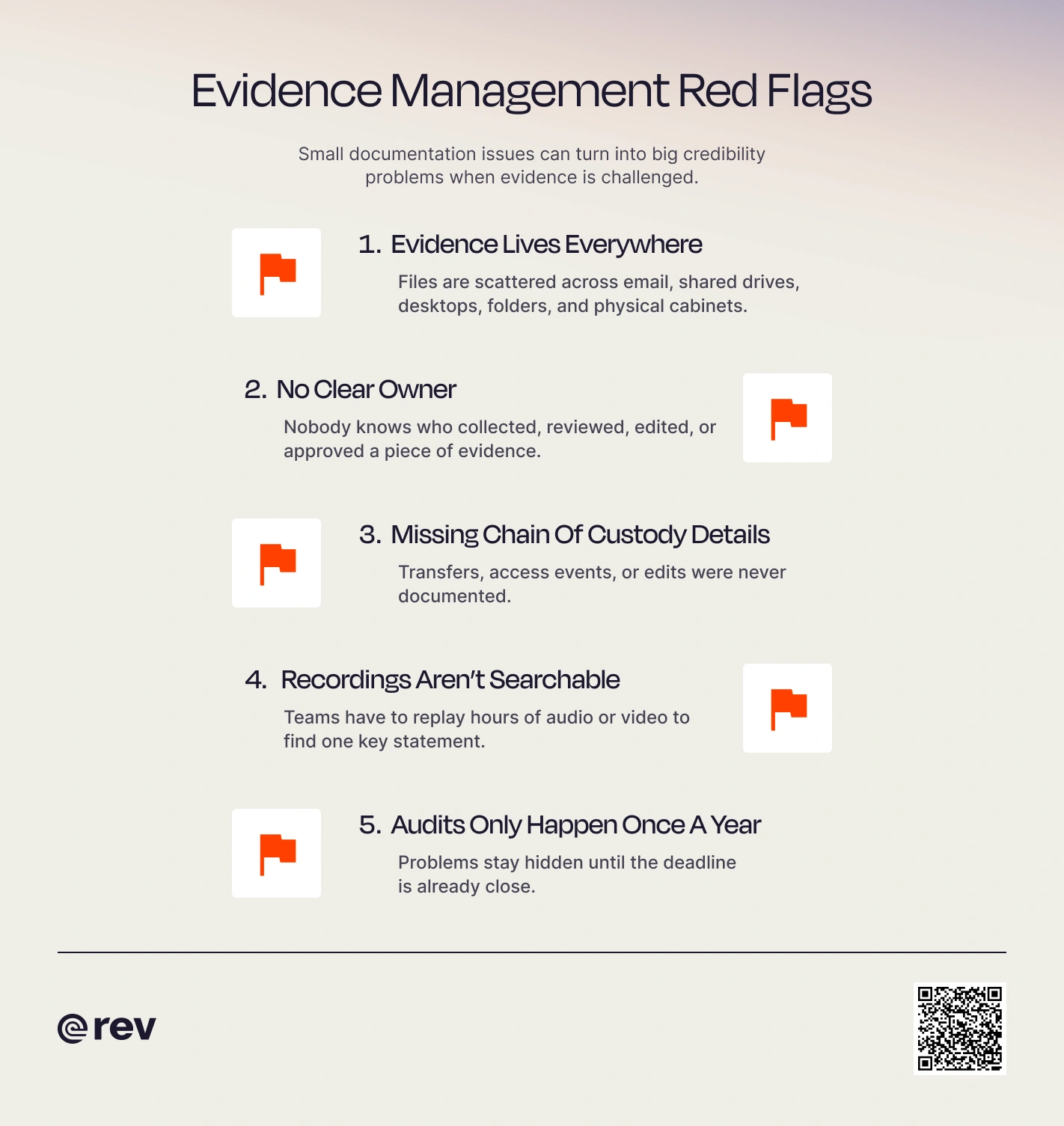
- Volume
- Body-worn cameras, surveillance footage, recorded calls, and electronic records can add up to hundreds of hours of material per case. Manual review processes simply can't keep pace.
- Fragmentation
- When evidence is spread across multiple platforms, systems, and departments, retrieval becomes a research project. This gets worse in multi-agency investigations, where different organizations use different tools and terms.
- Documentation Gaps
- Missing intake records, incomplete chain of custody logs, and unrecorded access events create legal exposure. A single undocumented handoff can give opposing counsel grounds to challenge evidence that would otherwise be airtight.
- Infrequent Audits
- Organizations that treat audits as annual events rather than ongoing processes tend to face the most pressure. Continuous documentation is the only way to avoid that crunch.
Tech That Simplifies Evidence Management
Modern digital forensics tools and evidence management platforms can automate the repetitive parts of documentation, reduce the risk of human error, and create the audit-ready records that investigations and compliance teams need.
Key capabilities to look for in your evidence management tech include centralized storage with role-based access controls, automated audit trail logging, version control, configurable retention policies, cited sources, and search functionality.
Rev helps investigators, attorneys, and compliance teams move faster through recorded evidence. Our platform combines industry-leading transcription accuracy with searchable, timestamped records that tie every finding back to its source file.
You can search across all your evidence simultaneously, surfacing relevant moments without sitting through hours of recordings. And because Rev operates in a closed-loop environment with zero third-party data sharing, your evidence stays protected throughout.
Get Ahead Of Your Next Audit
Evidence management is what separates investigations that hold up from those that fall apart at the wrong moment. The strategies explained above aren't that complicated, but they do require consistency.
Rev gives you the tools to build that consistency around your recorded evidence. Start building a more defensible evidence workflow today.

.webp)
.webp)
.webp)