
Finding Prior Inconsistent Statements In Real Time
Take a deep dive into the current strategies for finding witness inconsistencies during trial, and learn how tech like Rev is streamlining the review process.


Witnesses lie. They forget. And sometimes, they’ll even change their story.
When that happens in a courtroom, the attorney who catches it (and catches it quickly) often controls the outcome. But spotting a prior inconsistent statement mid-testimony is harder than it sounds. You’re listening, thinking ahead, managing exhibits, and watching the jury all at once.
In short, court is a juggling act, but luckily, tech is finally starting to catch up. Below, we cover what prior inconsistent statements are, the rules that govern them, and how attorneys can use technology to find contradictions before the witness leaves the stand.
What Is A Prior Inconsistent Statement?
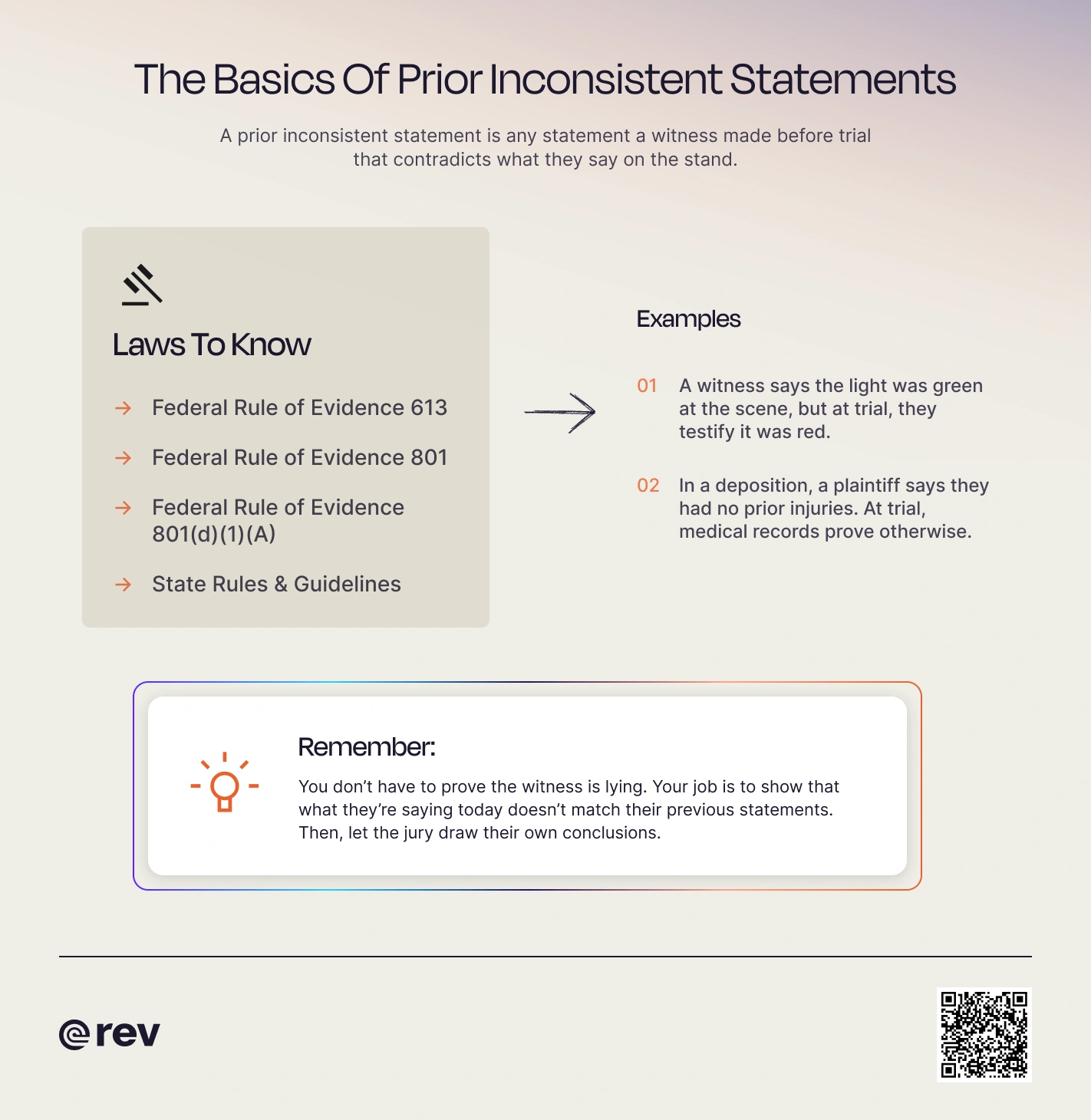
A prior inconsistent statement is any statement a witness made before trial that contradicts what they say on the stand. It can be written or oral, and can come from a variety of sources, such as a police report, a deposition, a recorded phone call, or an interview with investigators.
The inconsistency doesn’t have to be dramatic. A witness who said “I wasn’t sure” in a pre-trial interview but testifies with certainty at trial has just made a prior inconsistent statement. Small shifts in detail, timing, or confidence can matter as much as outright contradictions.
Rules Around Witness Statements and Evidence
Federal Rule of Evidence 613 governs how attorneys can use prior inconsistent statements during cross-examination. Under FRE 613, you can question a witness about any statement they made before trial without first showing them the statement.
However, if the statement is extrinsic — meaning you’re introducing it through another source rather than getting the witness to admit it — the opposing party must be able to question the witness about it.
Federal Rule of Evidence 801 adds another layer. Statements that qualify as prior inconsistent statements under FRE 801(d)(1)(A) include statements given under oath at a prior proceeding. In addition to being used for impeachment, they can also be introduced as substantive evidence, which can go a long way in diminishing the credibility of the witness.
It’s also important to note that state rules vary. Utah, for example, follows Rule 613 of the Utah Rules of Evidence, which mirrors the federal framework closely but has its own procedural nuances. Pennsylvania courts have also addressed the limits of extrinsic evidence in unique ways. Attorneys practicing in state court should always verify rulings for their specific location.
The hearsay rule also comes up often. A prior inconsistent statement is hearsay if offered to prove the truth of what it asserts. But if it’s offered only to show that the witness said something different, it’s generally not hearsay. The distinction matters, and judges scrutinize it.
Examples Of Prior Inconsistent Statements
These situations come up across every type of case. Some examples drawn from reported decisions and common practice:
- A witness tells police at the scene that the light was green. At trial, they testified it was red.
- In a deposition, a plaintiff says they had no prior knee injuries. At trial, medical records surface showing otherwise.
- An eyewitness initially says they couldn’t identify the suspect due to poor lighting. At trial, they offer a confident identification.
- A plaintiff tells police that he hadn’t consumed any alcohol that night. However, at trial, the opposing counsel presents a social media video from that same night of the plaintiff drinking beer.
“Social media profiles have become a valuable source of evidence,” explains K.C. Williams, III, managing partner at Williams Law Association.
“It's common for a witness to make claims in a lawsuit that don't line up with photographs, posts, comments, or other information they've shared publicly. Jurors understand social media because they use it themselves, which can make those contradictions particularly powerful.”
Why Prior Inconsistent Statements Matter
A witness’s credibility is often a major part of a case. While physical evidence can be explained away, and timelines can be disputed, when a witness can’t keep their story straight, juries notice.
Impeachment by prior inconsistent statements is one of the most effective tools a trial attorney has. It doesn’t require proving the witness is lying. It just requires showing that what they’re saying today doesn’t match what they said before, so the jury can draw their own conclusions.
“The most powerful contradictions are the ones that clearly clash with physical reality or common sense. One [example] is when a story is impossible [in] the real world, such as timing that does not fit distances, road layout, visibility, or recorded travel data,” explains Carl Nagle, Founder and Lead Attorney at Nagle & Associates.
“The contradictions that matter most are usually the simple ones that are easy to prove and directly linked to the key issue in the case.”
For criminal defense attorneys, this matters especially when the case turns on eyewitness testimony, a category known for being unreliable. For prosecutors, identifying inconsistencies in their own witnesses’ prior statements before trial is equally important: after all, no one wants to be surprised on cross.
There’s also reasonable doubt to consider. In criminal cases, a single credible inconsistency can be enough to create doubt where none existed before. Defense attorneys who catch a contradiction in real time and act on it immediately — rather than flagging it for the closing argument — give the jury something to hold onto in deliberation.
How Attorneys Can Use Prior Inconsistent Statements to Impeach Witnesses
The mechanics of impeachment by prior inconsistent statements follow a classic structure, but execution depends heavily on timing, preparation, and how much of your hand you want to show. Here are a few common ways attorneys highlight inconsistencies:
The Commit-Credit-Confront Method
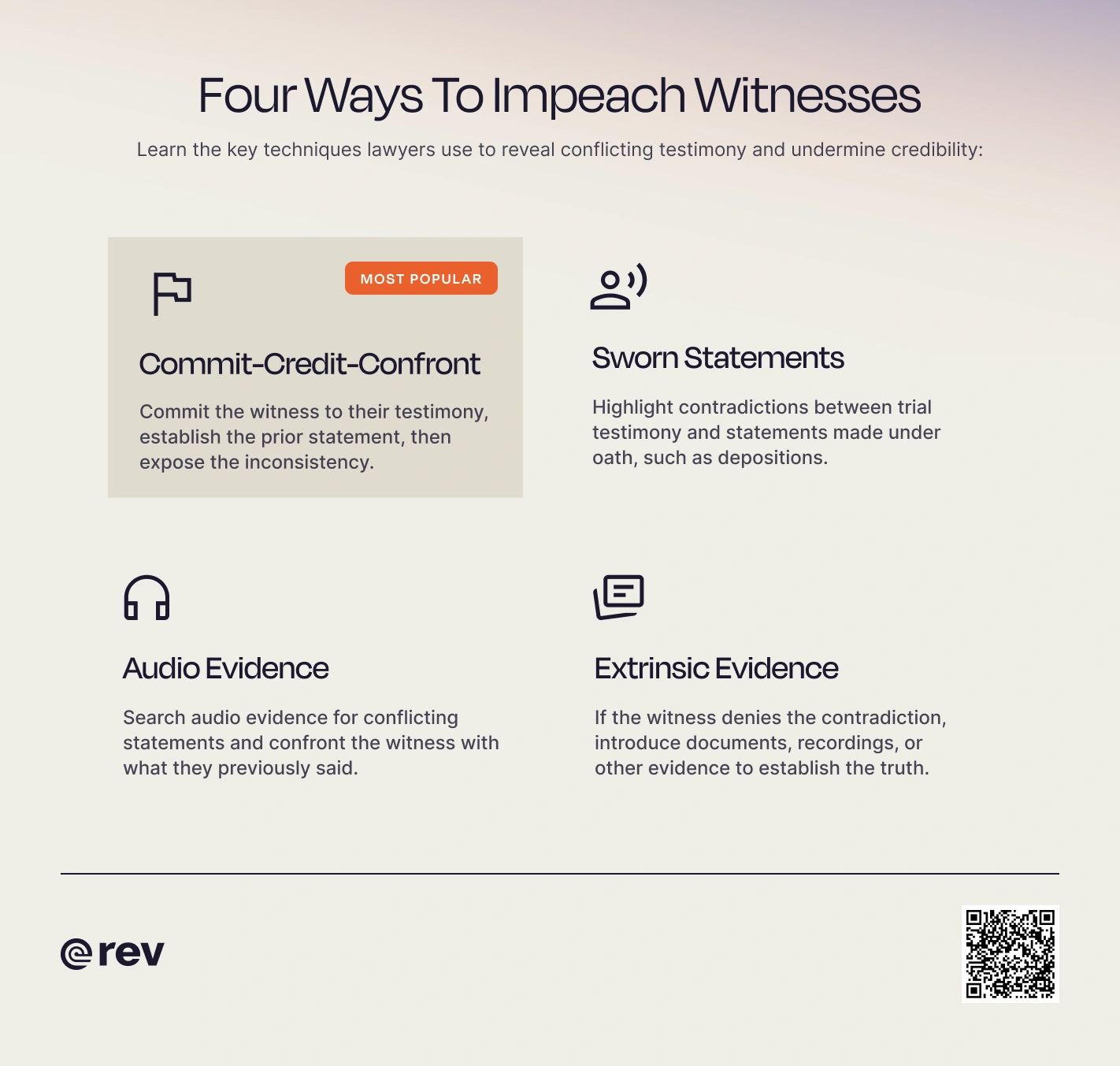
The most common approach: commit the witness to their current testimony, credit the prior statement, then confront them with the contradiction. Below is an example of this in action:
- Commit
- “So you’re telling this jury the light was red?”
- Credit
- “You spoke with Detective Morrison at the scene, correct? Under oath?”
- Confront
- “You told Detective Morrison the light was green, didn’t you?”
Done well, the witness either admits the inconsistency or digs in — either way, they’ve lost credibility, and you’ve gained an edge.
Using Depositions And Sworn Statements
Statements made under oath carry extra weight. Under FRE 801(d)(1)(A), they can come in as substantive evidence, not just for impeachment. That makes deposition transcripts some of the most valuable impeachment material in civil litigation.
For criminal cases, grand jury testimony functions the same way. A witness who testified before the grand jury and tells a different story at trial gives the prosecution or defense a powerful tool.
Technology can help immensely here. Tech that allows you to search, flag, and ask your evidence questions means you can find the exact statement you need in seconds.
Recorded Statements And Audio Evidence
Recorded phone calls, jail calls, body camera footage, and recorded interviews can all contain prior inconsistent statements. The challenge is finding the specific moment when the testimony on the stand diverges from what’s on tape. With hours of recordings in complex cases, that’s not always easy to do manually.
Similar to depositions and sworn statements, finding the needle in the haystack of records is made easy with Rev’s legal intelligence platform. Simply ask your evidence a question, and get inconsistent statements surfaced immediately (with links to the source).
Extrinsic Evidence
If a witness won’t concede the inconsistency, you may be able to introduce extrinsic evidence — the original recording, document, or third-party testimony — to prove the prior statement was made. Under FRE 613(b), the witness must be given an opportunity to explain themselves before the evidence is introduced. Keep in mind that allowing evidence is at the judge's discretion, and there may be certain state laws around this, too. Make sure to do your research before presenting extrinsic evidence.
The Traditional Challenge: Finding Contradictions Before It’s Too Late
Here’s the problem every trial attorney knows: you can only impeach a witness if you know the contradiction exists at the moment it matters.
Traditionally, that meant reading every deposition transcript, every police report, every recorded interview — and then trying to remember enough of it that you can spot when a witness deviates. But that process breaks down fast in complex cases with dozens of witnesses, hundreds of hours of recordings, and evidence spread across multiple files.
That’s not to say there aren’t workarounds. Experienced attorneys have used cross-examination outlines, paralegal support during trial, and tabbed binders for years with success. But these systems are fragile, time-intensive, and still require someone to have read everything and remembered it correctly.
“When I first started practicing, uncovering a witness inconsistency was often a slow process. Lawyers and paralegals would spend hours digging through deposition transcripts, prior court filings, and boxes of documents looking for a statement you remembered seeing months earlier. Sometimes finding the contradiction was as much about persistence as it was preparation,” notes Williams III.
“Technology has changed that dramatically. Today, we can search thousands of pages of testimony, documents, emails, and records in a matter of seconds. When a witness changes their story, modern technology makes it far more difficult for that change to go unnoticed.”
How To Find Prior Inconsistent Statements Faster
Modern legal AI tools are transforming this process by doing the retrieval work that used to eat up attorney hours (hours that could have been used for more important tasks).
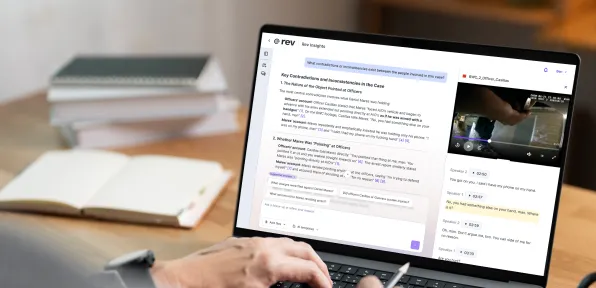
Rev’s multi-file insights feature lets attorneys upload transcripts, recordings, PDFs, images, and other case files and then interrogate all of your files at once. You can ask a direct question — “what did this witness say about the timeline?” — and get timestamped results pulling from every relevant file. No manual scanning, and no relying on memory.
The clip-sharing feature takes it a step further: when a witness says something on the stand, you can pull the exact moment from a prior recording and play it in court.
"There was a witness that appeared during the trial that we weren't really expecting to testify because they also had criminal charges pending. So we were kind of scrambling in the middle of trial,” explains Craig Greening, a trial attorney and Rev customer.
"I remember[ed] that Rev has Insights, and I took every statement that he had ever made and put it through the AI filter and it listed all of [the inconsistencies] out…and it created a cross-examination template for me."
AI-powered inconsistency detection is also an emerging trend. Rather than waiting for an attorney to ask the right question, Rev surfaces contradictions across recorded witness statements proactively — flagging where accounts diverge without requiring someone to know what to look for. If you want to record in real-time with Rev, make sure to get permission from the court first.
For criminal defense and prosecution alike, this means going into cross-examination with a complete picture of where a witness’s story has shifted, not just the contradictions you already knew about.
Find The Contradiction. Win The Moment.
Prior inconsistent statements can flip a case. But only if you can find them at the right time. Criminal defense attorneys who want to move faster — and stay ahead of what witnesses will say — should see what Rev can do for their practice.
Take it from Craig Greening: “Buy back your time and buy Rev.”