


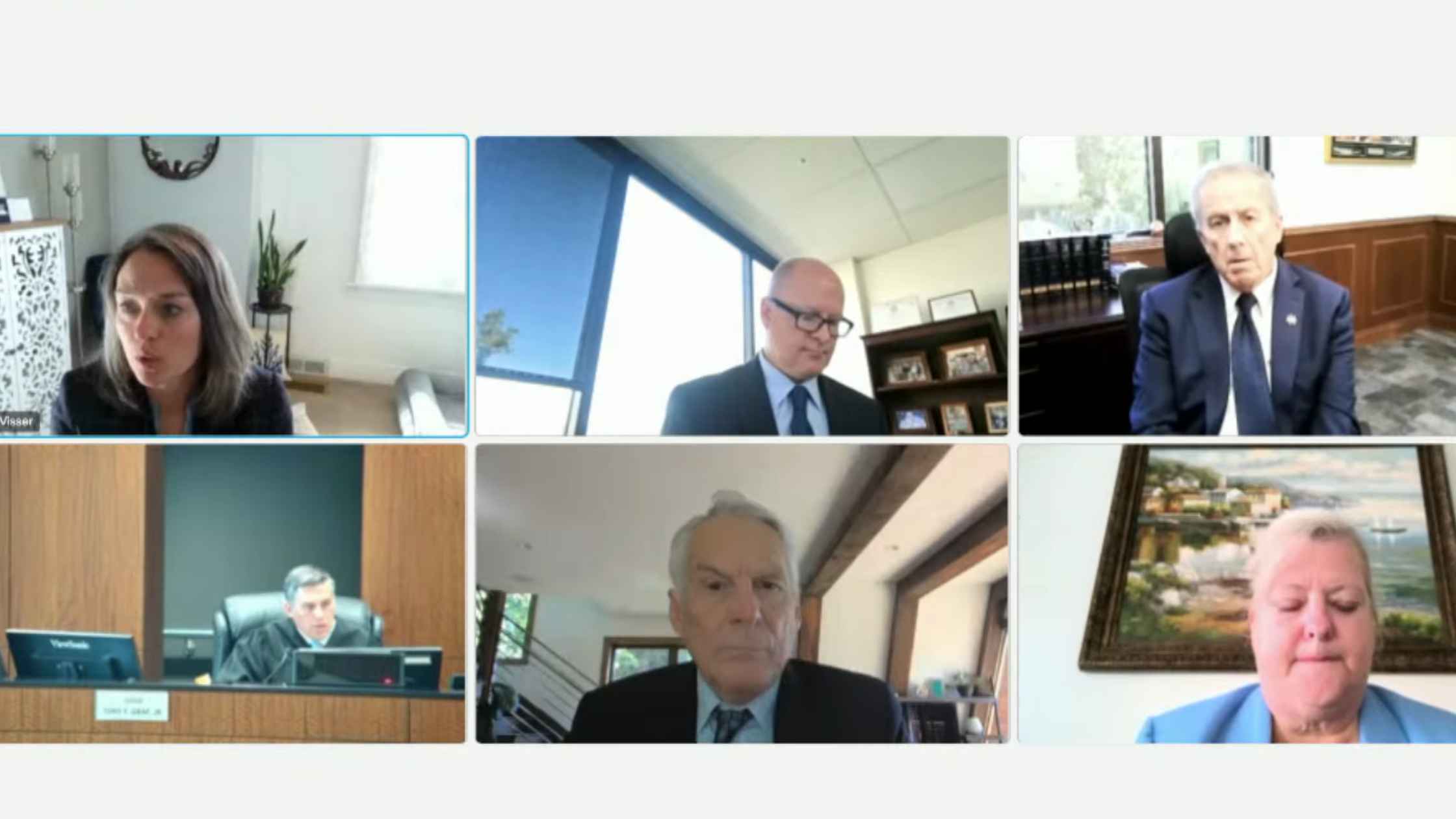
Judge Tony Graf Jr. (14:44):
Good morning. [inaudible 00:14:45] This court is now in session. Calling case number 251403576, State of Utah versus Tyler James Robinson. Counsel, please enter your appearances.
Chad Grunander (14:59):
Good morning, judge. Chad Grunander. Ryan McBride, Jeff-
Chad Grunander (15:00):
... Judge. Chad Grunander, Ryan McBride, Jeff Gray, and Chris Ballard for the State.
Judge Tony Graf Jr. (15:07):
Good morning.
Kathryn Nester (15:09):
Good morning, Your Honor. Kathy Nester, Staci Visser, Michael Burt here on behalf of Mr. Robinson. And if maybe we could just check and make sure he can hear us?
Judge Tony Graf Jr. (15:20):
Mr. Robinson, can you hear us? All right. Good morning to you all. All right. I apologize for the slight delay. There was a couple of last minute things I needed to do as it relates to this case, so I appreciate your patience. I know your time is important and the Court respects that. And before we begin, Counsel for the state, could you provide a brief status update regarding discovery?
Chad Grunander (15:53):
Yes, Judge. I'll ask Ryan McBride to do that for the State.
Ryan McBride (15:59):
I think it was just late last week we provided 12 additional files. I think that's a duplicate share. That was reports from the ATF labs. That brings our total back up to approximately 100% of what we have has been shared.
Judge Tony Graf Jr. (16:17):
All right. Thank you. All right. Does the defense need the benefit of the record as it relates to that issue?
Kathryn Nester (16:26):
No, Your Honor.
Judge Tony Graf Jr. (16:27):
All right. Turning to Defense's motion for order to show cause. The parties submitted additional briefing on June 17th and June 18th with the most recent filing being received at approximately 9:21 on June 18th. The Court intends to consider all briefing and arguments submitted by the parties before rendering its decision in the interest of justice and to ensure the constitutional rights of all parties upheld. Because the most recent submissions were filed shortly before the anticipated ruling, the Court requires additional time to complete its thorough review. The Court recognizes the importance of the issues presented and will issue its decision on a schedule that will be announced at the conclusion of today's proceedings on the remaining matters.
(17:17)
And those remaining matters are the defendant's motion in limine to preclude the utilization of Article 1, Section 12 of the Utah Constitution and Rule 1102 of the Utah Rules of Evidence to sanction the admissibility of hearsay evidence to establish probable cause at the preliminary hearing, and Defendant's application for certification for attendance of an out of state witness, and State's motion to quash subpoenas. And so the Court will issue its ruling first on its motion in limine, and I'll be reading from the order that I intend to upload on the docket later today.
(17:59)
In his motion in limine to preclude the utilization of Article 1, Section 12 of the Utah Constitution and Rule 1102 of the Utah Rules of Evidence, defendant Tyler James Robinson seeks an order preventing the State of Utah from relying on hearsay to establish probable cause at his upcoming preliminary hearing. The motion was fully briefed. The Court heard oral arguments on June 12th, 2026. Now, being fully advised of the premises and relevant legal authorities, the Court hereby respectfully denies the defendant's motion for the reasons set forth below. In Utah, the primary purpose of preliminary hearing is limited to determining whether probable cause exists. And Counsel, as I have done in the past, I will omit the citations, and that will be in the full order that's uploaded.
(18:54)
Although the preliminary hearing is a critical stage of the criminal process, it is not a trial and does not involve a determination of guilt or innocence. Let's see, I'm sorry, I lost my place. The Court does not understand this principle to mean that constitutional protections are categorically inapplicable at a preliminary hearing, rather because a preliminary hearing serves the limited purposes of determining whether probable cause exists, the scope and operation of a particular constitutional protections must be evaluated in light of that purpose. Accordingly, the Court addresses Defendant's constitutional arguments individually while recognizing that the procedural safeguards required at a probable cause determination need not mirror those required at trial. Defendant raises several constitutional objections to that conclusion. Defendant argues that permitting the State to establish probable cause through hearsay evidence violates his rights under the 4th, 6th, 8th, and 14th amendments to the United States Constitution as well as separation of powers principles. Of the constitutional rights Defendant seeks to fully invoke at the preliminary hearing, Utah courts have directly addressed the application of only one, the right to confrontation. The Court recognizes that Defendant's constitutional concerns are substantial and warrant careful consideration. Nevertheless, the Court's analysis is guided by a limited function of the preliminary hearing, and the governing precedent interpreted in Article 1, Section 12.
(20:55)
In State v. Timmerman, the Utah Supreme Court determined that full application of a defendant's right to confrontation is necessary at trial, but not at the preliminary hearing. The Timmerman court reached this conclusion after comparing the different purposes of the two proceedings. That court recognized under the amended language of Article 1, Section 12 of Utah's Constitution, a defendant at a preliminary hearing faces only a probable cause determination that is subject to a significantly lower burden of proof, whereas at trial, that same defendant faces a determination of his guilt or innocence that must be established beyond a reasonable doubt. Considering the distinction between the issues and the purposes of the two proceedings, the Timmerman court believed a relaxed application of the defendant's constitutional right to confrontation at the preliminary hearing was entirely appropriate.
(21:48)
Although Utah courts have not addressed what is the appropriate application of other constitutional rights at a preliminary hearing, this court follows the Timmerman court's reasoning in concluding that a relaxed application of Defendant's constitutional rights at the upcoming preliminary hearing is likewise appropriate because of the limited purpose of the proceeding. For example, Defendant argues that permitting the State to rely on hearsay evidence, reliable hearsay evidence, deprives him of his 6th Amendment right to effective counsel before it prevents his counsel from utilizing all the tools of effective advocacy, naming ... Can't speak today. Namely, the right to cross-examine any hearsay declarants. Defendant's arguments rest on the premise that effective assistance of counsel requires access to the full range of adversarial tools, including cross-examination at every stage of the criminal proceeding. The Court is not persuaded by defendant's argument. The full application of a defendant's right to counsel at a preliminary hearing, which is limited to a probable cause determination, need not be as exhaustive as it must be at trial. The right to counsel may be tailored to the proceeding at hand.
(23:13)
The same can be said for the protections under the 14 Amendment's due process clause. At minimum, due process requires notice and an opportunity to be heard in a meaningful manner. The specific procedures require, however ... Sorry, I'm just ... I note some things that I need to ... Minor issues I need to change, so I'm making those changes right now. However, depend upon the nature and purpose of the proceeding at issue. Because a preliminary hearing is limited to determining probable cause rather than guilt or innocence, due process does not necessarily require all the evidentiary safeguards applicable at trial. The Court is likewise unpersuaded that the 8th Amendment is implicated by the challenged procedures. The 8th Amendment authority cited by defendant concerned the reliability required in the proceedings that determine guilt or authorized punishment, particularly capital punishment. A preliminary hearing performs neither function. It serves only to determine whether probable cause exists to believe the charged defenses were committed. Because Defendant's guilt, innocence, and punishment are not at issue during the preliminary hearing, the Court concludes the 8th Amendment concerns identified by Defendant are not implicated at this stage of the proceedings.
(24:38)
As for the defendant's argument that Article 1, Section 12 of the Utah Constitution and Rule 1102 of the Utah Rules of Evidence create an unconstitutional mandatory presumption of reliability, and results in inappropriate burden shifting, the Court does not find this argument persuasive. The presumption of reliability is confined to the presumption that the hearsay evidence is admissible. The presumption does not require the magistrate to find the evidence credible or that it supports a finding of probable cause. The magistrate still retains the ultimate decision making authority on whether probable cause has been established. Admissibility and evidentiary weight remain distinct concepts. Although Article 1, Section 12 and Rule 1102 permit the admission of reliable hearsay, they do not require the magistrate to accept that evidence as credible or sufficient to establish probable cause. And as probable cause determination remains in the hands of a magistrate, a judicial officer, Article 1, Section 12 and Rule 1102 have not violated the separation of powers principles.
(25:50)
Based off the foregoing analysis and findings, the Court issues the following order. Having carefully considered Defendant's constitutional objections, the governing provisions of Article 1, Section 12 of the Utah Constitution and Rule 1102, and the applicable authorities, the Court concludes that the challenge provisions may constitutionally be applied at Defendant's preliminary hearing. Accordingly, Defendant's motion is respectfully denied. And that concludes the order as it relates to reliable hearsay in 1102.
(26:26)
The Court now turns to the second ruling, order regarding Defendant's application for a certificate of attendance of out of state witness in State's motion to quash subpoena. Give me one moment here. I just need to get a drink of water. And again, I will omit the citations, but it will be included in the full order that is uploaded with the Court. This matter comes before the Court on defendant Tyler James Robinson's application for certificate of attendance of out of-state witness under Utah Code Section 77-21-3. Defendant seeks to compel the live testimony of Lance Twiggs at the upcoming preliminary hearing. The State opposes the application and seeks to quash the subpoena.
(27:18)
Having reviewed the briefing and the pertinent legal authorities, the Court issues the following decision, an order. Defendant is charged with aggravated murder, felony discharge of a firearm, obstruction of justice, tampering with a witness, and violent offense committed in the presence of a child. Lance Twiggs allegedly resided with and was in a romantic relationship with Defendant at the time of the alleged defenses. The State does not intend to call Mr. Twiggs to testify live at the preliminary hearing. Instead, the State plans to establish probable cause through reliable hearsay, specifically a video recorded interview of Mr. Twiggs conducted pursuant to Utah Rule of Evidence 1102. The State will also rely on electronic messages, a handwritten note, and other corroborating evidence.
(28:09)
According to the record before the Court, Mr. Twiggs allegedly made statements to investigators indicating that Defendant confessed to the crimes, concealed the weapon, disposed of clothing, and directed Mr. Twiggs not to contact law enforcement. Defendant seeks to compel Mr. Twiggs' attendance from Texas to provide live testimony. Defendant asserts that he intends to cross-examine Mr. Twiggs extensively concerning the reliability and credibility of his statements, his immunity agreements with the State and federal prosecutors, his state of mind, and the surrounding circumstances of the alleged defenses. When Mr. Twiggs' counsel declined to accept service of a subpoena, Defendant sought this Court's intervention to certify the out of state subpoena.
(28:56)
The preliminary hearing is a fundamental procedural right under Article 1, Section 13 of the Utah Constitution, but its purpose is strictly limited to determining whether probable cause exists to bind a defendant over for trial. To prevail, the State must present sufficient evidence to support a reasonable belief that an offense has been committed and that the defendant committed it. Under Rule 7B of the Utah Rules of Criminal Procedure, the probable cause determination may be based in whole or in part on reliable hearsay. While Rule 7B(a) states that a defendant may call witnesses and cross-examine adverse witnesses, the right to subpoena witnesses is not absolute. Under Rule 14A(2), the Court may quash or modify the subpoena if compliance would be unreasonable. The Utah Supreme Court has repeatedly emphasized that a preliminary hearing is not a trial on the merit but a gateway to the finder of fact. Consequently, the magistrate's role is not to weigh credible but conflicting evidence-
Judge Tony Graf Jr. (30:00):
... ability. Not to weigh credible but conflicting evidence nor to eliminate alternative inferences favoring the defense. Such tasks are reserved for the jury at a trial. A magistrate may only disregard evidence if it is wholly lacking and incapable of creating a reasonable inference. Recently, in State v. Lopez, the Utah Supreme Court clarified the intersection between the defendant's right to call witnesses at a preliminary hearing and the court's authority to quash subpoenas. The court held that a subpoena compelling an alleged victim to testify at a preliminary hearing is unreasonable and should be quashed, unless defendant demonstrates the subpoena is necessary to present specific evidence that is reasonably likely to defeat the showing of probable cause.
(30:48)
Defendant argues that he has a constitutional right to compulsory process. Under the Sixth Amendment in Article 1, Section 12 of the Utah Constitution, as well as a right to call witnesses under Rule 7B, defendant contends that Mr. Twiggs is central, highly material witness whose testimony touches on nearly every charge and enhancement. Defense counsel argues that Lopez was specifically tailored to protect the constitutional rights of victims pursuant to the victim's rights amendment. Because Mr. Twiggs is not a victim, Lopez does not directly apply. Defendant asserts that he must be permitted to test Mr. Twigg's credibility, the circumstances of his immunity, and the reliability of his statement through a live cross-examination.
(31:33)
The State opposes the certification and moves to quash the subpoena. The State argues that the preliminary hearing are no longer discovery devices having been strictly limited to probable cause determinations. Furthermore, the State argues that the Utah Constitution expressly permits the use of reliable hearsay at preliminary hearings, a practice which would be eviscerated if defendants could routinely subpoena the hearsay defendants. The State relies on State v. Schmidt and State v. Robinson to assert that credibility weighing at this stage is extremely limited. Rendering defendant's stated goal of testing credibility immaterial to the probable cause analysis. Thus, the State argues the subpoena is unreasonable under Rule 14A2.
(32:20)
The court expresses no opinion regarding whether the State ultimately will establish probable cause. The court addresses only whether the subpoena should be enforced based upon the party's current proffers. The proffered evidence, including statements that the defendant confessed to shooting, hid a rifle, changed clothing and directed Twiggs to withhold information is directly material to the elements of aggravated murder, obstruction of justice, and witness tampering. If this evidence is presented at the hearing and evaluated under the governing preliminary hearing standard, which requires the court to view it in the light most favorable to the prosecution as required by State v. Schmidt, it would constitute evidence from which a magistrate could find probable cause if credited under the standards governing preliminary hearings.
(33:10)
A central dispute is whether the standard established in State v. Lopez applies to Mr. Twiggs, who is a non-victim witness. Defendant correctly argues that Lopez arose in the context of a subpoena directed to an alleged victim and that the Utah Supreme Court's analysis was informed in part by the protections afforded under the Utah Victim's Rights Amendment. The court agrees that Lopez cannot be read without attention to that context. Victim status mattered in Lopez because a subpoena imposed burdens upon persons whom Utah law independently protects from unnecessary harassment, delay, and retraumatization.
(33:52)
Although Lopez arose in the context of a victim subpoena, its discussion of Rule 14A2 provides guidance concerning how courts evaluate reasonableness in light of the limited purpose of a preliminary hearing. The court may not decide whether Lopez's precise holdings extend to all non-victim witnesses. Even assuming it does not, the same Rule 14, reasonableness considerations identified in Lopez, support denial of the requested certification under the circumstances presented here. The Lopez court emphasized several principles that are not dependent upon victim status. One, a preliminary hearing is not a discovery device. Two, the Utah Constitution permits the state to establish probable cause through reliable hearsay.
(34:44)
Three, the magistrate's role is limited to determining whether probable cause exists, not to resolve ordinary credibility disputes or weighing competing evidence. Those structural principles apply regardless of whether the subpoenaed witness is a victim, an eyewitness, a cooperating witness, or other hearsay declarant. Accordingly, the court relies primarily on Rule 14A2 and the limited purpose of a preliminary hearing. The court references Lopez only because of its discussion of reasonableness informs that analysis. Whether Lopez formally governs subpoenas directed to non-victim witnesses may not be resolved to decide the present motion. The court's ruling does not depend upon extending Lopez beyond its facts. Rather, Lopez's persuasive authority regarding the application of Rule 14A2's reasonableness requirement, while the court's holding rests independently upon Rule 14A2, Rule 7B, and the limited functions of a preliminary hearing. The court also considers defendant's constitutional arguments. The Sixth Amendment in Article 1, Section 12 of the Utah Constitution protected defendant's right to compulsory process for obtaining witnesses in his favor. That right remains important at the preliminary hearing stage, but operates within the procedural framework governing probable cause determinations. Accordingly, the relevant question is not whether defendant may compel Mr. Twigg's testimony at trial, but whether the proposed testimony is necessary to present evidence reasonably likely defeat probable cause at this preliminary hearing stage.
(36:25)
The court recognizes that compulsory processors interest distinct from confrontation and discovery. Nevertheless, at the preliminary hearing stage, those interests must be evaluated within the procedural frameworks governing probable cause determinations and the limitations imposed by Utah law upon that proceeding. The court determines that compulsory process does not automatically require life testimony from a hearsay declarant at a preliminary hearing merely because the defendant seeks impeachment. Whether compulsory process requires live testimony depends upon the relationship between the proposed testimony and the probable cause determination at issue.
(37:10)
Under the circumstances presented here, defendant has not identified testimony reasonably likely to negate probable cause, and the court therefore concludes that compulsory process does not require certification of the subpoena. For these reasons, the court may not determine whether Lopez formally governs subpoenas directed to non-victim witnesses. Even assuming it does not, Rule 14A2 reasonable and its principles discussed in Lopez supports the result here. The question remains whether defendant has demonstrated that the proposed testimony is necessary to present specific evidence reasonably likely to defeat probable cause rather than merely impeach the credibility of the state's evidence. Even under the framework discussed in Lopez, a subpoena survives a motion to quash only if the defendant demonstrates that the testimony is necessary to present specific evidence that is reasonably likely to defeat the showing of probable cause. Defendant asserts he wishes to cross-examine Mr. Twiggs on his reliability, credibility, immunity, state of mind in the surrounding circumstances. Under Utah law, this does not establish a basis to require live testimony at a preliminary hearing. As established in State v. Ramirez and State v. Schmidt, a magistrate may not weigh credibility but conflicting evidence. Even if the defendant's cross-examination successfully exposes inconsistencies in Mr. Twigg's statements or highlights his motives to lie due to his immunity agreements.
(38:53)
The magistrate is required to draw all reasonable inferences in favor of the State. Evidence demonstrating bias, motive, immunity benefits, or inconsistent statements may be highly relevant at trial and may provide fertile grounds for cross-examination before the ultimate trier of fact. The court does not minimize the significance of immunity agreements as potential sources of bias. Rather under the governing preliminary hearing standard, such evidence affects the probable cause determination only if it eliminates a reasonable inference arising from the state's proffered evidence. However, under the limited function of a preliminary hearing, such evidence defeats probable cause only if it would render the state's evidence incapable of supporting a reasonable inference that the defendant committed the charged defenses.
(39:41)
Absence such as showing in the court may not resolve competing credibility determinations or weigh conflicting inferences against the State. Even assuming defendant successfully elicited the anticipated impeachment evidence regarding bias, immunity, motive, or inconsistent statements, the court cannot conclude on the present record that the State's proffer would become wholly lacking or incapable of supporting a reasonable inference of probable cause under the standards governing preliminary hearings. The court recognizes impeachment evidence may, in an appropriate case, undermine probable cause where it demonstrates the State's evidence is so unreliable, internally inconsistent, or otherwise deficient that no reasonable inference supporting probable cause remains.
(40:28)
In such circumstances, impeachment evidence may do more than merely challenge credibility. It may negate the evidentiary foundation necessary to support bind over. Defendant has not made that showing here. The anticipated examination concerns matters that would generate competing credibility inferences rather than eliminating the reasonable inferences supporting the State's showing. Nothing in this ruling should be understood as creating a categorical prohibitation against subpoenas directed to non-victim witnesses at preliminary hearings. The court concludes only that the defendant's present proffer does not identify testimony reasonably likely to negate probable cause under the circumstances presently before the court.
(41:12)
The court also notes that defendant seeks compulsory process through the interstate witness certification procedure, which imposes burdens upon a non-resident witness and a sister State court. While not dispositive, those considerations further inform the Rule 14 reasonableness analysis. Under the record presently before the court, defendant has identified anticipated impeachment and credibility evidence, but has not identified specific testimony reasonably likely to negate probable cause. Given the limited purpose of the preliminary hearing and the State's ability to proceed through reliable hearsay, the court concludes that an enforcement of the subpoena would be unreasonable under Rule 14A2.
(41:55)
This ruling rests on defendant's present proffer and the record currently before the court. The court may not decide whether different circumstances, a definite evidentiary showing, or a different category of witness would warrant a different result under Rule 14A2. The court's ruling is procedural rather than evidentiary. Nothing in the decision and the order should be construed as a determination regarding the credibility, reliability, weight, or ultimate admissibility of any witness, statement, or item of evidence that may be later presented. Those matters remain for determination under the governing standards applicable at the subsequent stage of the proceedings.
(42:40)
Under findings, the preliminary hearing is limited to determining probable cause and is not under a discovery device. The State is constitutionally permitted to rely on reliable hearsay to establish probable cause. The record presently before the court that the proposed examination is directed primarily toward credibility, bias, reliability, and impeachment rather than toward evidence likely to negate probable cause. Applying Rule 14A2's reasonableness requirement in light of the limited purpose of a preliminary hearing and the authorities discussed above, defendant has failed to identify specific anticipated testimony that is reasonably likely to negate probable cause as distinguished from anticipated impeachment that would merely create competing credibility inferences.
(43:33)
Therefore, enforcement of the subpoena is not warranted on the present record. Based off the foregoing analysis and findings, the court issues the following order. It is hereby ordered that the defendant's application for certificate of attendance of out-of-state witness is respectfully denied and the State's motion to quash the subpoena is granted. It is further ordered that this denial is without prejudice and subject to renewal because probable cause determinations necessarily depend upon evidence actually presented. This denial is without prejudice. If the State's presentation materially differs from the proffer presented before the court, or if defendant can identify specific testimony reasonably likely to negate probable cause, defendant may renew the request, and that is the order of the court.
(44:27)
Again, the court anticipates filing that, both of these today, and the filed order will be the controlling order in both of those issues. Now, I understand that there is another outstanding motion that was filed around the same time, I believe it was Thursday evening, regarding the EMC, electronic media in the courtroom. Does the parties anticipate when briefing will be completed?
Judge Tony Graf Jr. (45:00):
... And will be completed.
Chad Grunander (45:04):
Anticipates rely on his previous arguments with respect to the media's presence and the openness of this proceeding. Again, we encourage an open and transparent process that the citizens can follow and so they can trust the process. So, we do not anticipate filing a written response to that, and we'll rely on our prior arguments and submit it to the court.
Judge Tony Graf Jr. (45:30):
All right. Does defense want to be heard on that issue?
Speaker 1 (45:34):
Your Honor, we filed our objection yesterday, so that is before the court.
Judge Tony Graf Jr. (45:40):
All right. Well, what I hope to do is issue a ruling on that, as well as the order to show cause issue. And again, the parties, and namely the defendant, is entitled to that ruling before the hearing in order to properly prepare. And the court respects the time necessary to prepare from both sides and wishes to issue a timely order. Let's see if we can find a hearing date between now and the prelim. And again, in regards to the order to show cause, just to help give some guidance, the court prioritized the motions that would affect the preliminary hearing. Not to say that the order to show cause isn't important, but that does not weigh upon issues that could result in a delay of the preliminary hearing. So, I just wanted to offer that background in regards to the delay of that ruling.
(46:36)
All right. Let's see. Today is the 22nd, and how quickly this month is passing. Let's see. Availability on... and I know my staff isn't aware of this date, but availability of the parties on this Friday at 8:30. Again, I'm trying to get a quick turnaround for you in respect of your time and preparation, on a ruling on both of these issues. The order to show cause and the motion filed yesterday.
Chad Grunander (47:21):
That date is available, Your Honor.
Judge Tony Graf Jr. (47:25):
All right. And so I see Ms. Visser nodding her head.
Kathryn Nester (47:28):
Yes, the defense... I'm sorry, I was trying to unmute. I was having trouble unmuting. The defense will be available, Your Honor.
Judge Tony Graf Jr. (47:36):
All right. So, June 26th at 8:30 in the morning, and the court anticipates starting promptly. Again, I apologize for today. There's always last minute edits that one has to make, and I'd rather be concise and on point than come in not exactly where I want to be. All right, so we'll plan on June 26th at 8:30 in the morning.
(48:02)
And that leaves one last issue, and the court wants to put all parties on notice and because this preliminary hearing will be open to the public, that the court is not allowing any electronics into the courtroom. Not laptops, electronic devices, electronic watches, electronic or Google glasses or Android glasses or however they want to be determined. The court is stating that for only the preliminary hearing, that any and all electronic devices must be left outside the courtroom, not just in your pocket. So no cell phones, laptops, tablets, electronic watches, any electronic recording device or electronic glasses will not be permitted at the courtroom. And if you have it, you will be turned away. And the reason for that, is the court wishes to uphold the dignity and the civility and uphold the constitutional rights of all parties in this courtroom, and that is the best way the court sees to be able to do so.
(49:10)
There will be a unique seating arrangement at the preliminary hearing to accommodate as much as the press and public that can be safely admitted and for an orderly courtroom. And the court will advise all the parties as we begin those proceedings on what's in the decorum order, highlighting a few points, because all parties are entitled to be treated with dignity and respect within those proceedings, and the court will exercise all of its powers to ensure that that is done. So, I just want to put that on the record. This does not apply to the attorney. So if you're worried like, "Oh no, I can't bring my laptop." Absolutely. You can bring your laptop and your cell phones because I know that communication and your reliance upon that is necessary in order to properly do your job.
(49:59)
So as it relates to the public, to the press who are excluded, obviously is counsel on record for the parties, and necessary court staff. And so, I just wanted to put that on the record well ahead of the prelim so there's no questions or concerns that may arise.
(50:18)
Counsel, with that, is there anything else that this court can address today? And Mr. Burt, your mic is muted. All right, give it a try.
Michael Burt (50:39):
How's that?
Judge Tony Graf Jr. (50:40):
That's perfect. I do that once a day, so I know how that feels.
Michael Burt (50:44):
Michael Burt for Mr. Robinson. Judge, in light of the court's rulings today, I do have on logistical issue I'd like to raise with the court, if I might.
Judge Tony Graf Jr. (50:53):
Yes.
Michael Burt (50:54):
As the court might be aware, we have arranged to bring to the hearing seven forensic witnesses. The state has identified a number of hearsay reports. I think they are exhibits 30 through 34 that they intend to introduce, and we in turn have arranged with the federal authorities to fly out from the East Coast six of those forensic examiners, and then we have a seventh examiner who resides in state.
(51:29)
And in light of the court's ruling, I'm wondering if the court... and the state has been kept abreast of our attempts to subpoena these people. No objection to that testimony has been lodged so far by the state, but in light of the court's rulings today, I anticipate that there will be objections to the admissibility of those seven forensic experts. And what I think would be in the interest of everybody, including the court's schedule, is if we could resolve the issue of whether those witnesses are going to be permitted, either before the preliminary hearing or at the very latest after the state presents its prima facie case. Because we will have those people ready to fly out and if we can get a ruling from the court before that actually happens, we could perhaps shorten the hearing considerably, and also alleviate the expense and inconvenience of flying six people from the East Coast.
(52:39)
I have not had time to discuss this with the state, and I know the state had not heard the court's ruling until this morning, but in light of that ruling, I'm wondering whether the court could take up either on Friday or at some date before the preliminary hearing, any objections the state might have to calling those seven forensic experts.
Judge Tony Graf Jr. (53:03):
All right. I appreciate you bringing that up. And to all parties, anything that we can bring up prior to the prelim serves us well in regards to time management. Turning to the state.
Chad Grunander (53:16):
Judge, we're two weeks out today from the preliminary hearing. Obviously, I haven't consulted with co-counsel on this, but I think we could have any objections that we may file. We haven't discussed this, but we could have those filed by Friday, if not, maybe Thursday. I'm not sure what the defense would do with respect to responding, but I think we could hear this prior to the preliminary hearing.
Judge Tony Graf Jr. (53:42):
All right. Well, and I realize the position of both parties. I realize Mr. Burt need to wait till the ruling of the court and I realize I understand the state's response. Let's see what we can do to address that Friday if briefing is completed or if the defense needs time to respond to the state's briefing whenever that comes in, the court will be sympathetic to that, and we'll adjust accordingly.
(54:09)
So tentatively, we'll plan on addressing that on the 26th at 8:30, but again, I respect and I want the parties to be able to fully respond. So, we'll adjust to ensure that both sides have an equal opportunity to respond to this request and the court will take it up and address it before the preliminary hearing as soon as you can, and the court will be flexible. If it can't be heard Friday, the court will find time to hear it the following week, well before the preliminary hearing, because I understand and I respect that you need time to prepare and make best use of your time in order to do your duty and uphold the constitutional rights of all parties. So, that's the best answer I can give. Mr. Burt, any thoughts?
Michael Burt (54:59):
No, Your Honor. Thank you for that accommodation. I appreciate that.
Judge Tony Graf Jr. (55:03):
All right. Any final matters before we conclude today?
Kathryn Nester (55:07):
No, Your Honor. Not from the defense.
Chad Grunander (55:08):
Not from the state.
Judge Tony Graf Jr. (55:10):
All right. Thank you to all parties, and we'll see you on... And just to clarify, on WebEx and for Mr. Robinson to defense, what's your request as it relates to him?
Kathryn Nester (55:22):
Same, Your Honor. If he could just be listening with no video, that would be great. Thank you.
Judge Tony Graf Jr. (55:28):
All right, and we'll go ahead and put that into place. Thank you to all for your time, and I wish you a good rest of your day. Court is now in recess.