
Donald Trump (00:00):
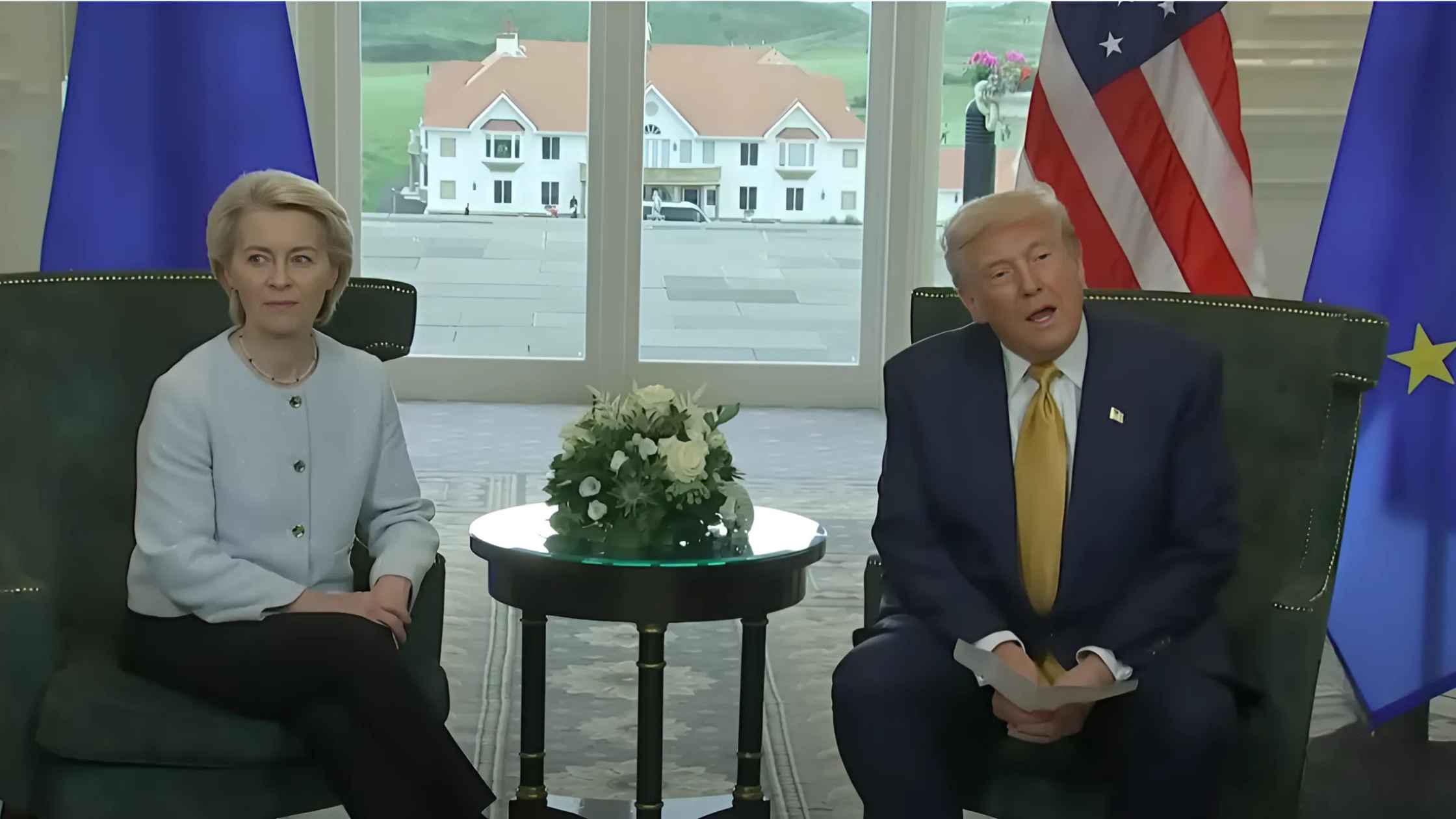
Thank you very much. So we have good news. We've reached a deal. It's a good deal for everybody, I believe. And it's, I think you were saying this is probably the biggest deal ever reached in any capacity, trade or beyond trade.
Ursula von der Leyen (00:18):
It is.
Donald Trump (00:20):
It's a giant deal with lots of countries because as you know, Ursula represents a lot of countries, not one country. It's not easy for you. It's a lot of very different countries, great countries. But some are strong with cars, some are strong with agriculture, some are strong with both. Right? You have a lot of different factors. So we're going to do the following. The European Union is going to agree to purchase from the United States $750 billion worth of energy, $750 billion worth of energy. They are going to agree to invest into the United States $600 billion more than they're investing already. So they're investing a large amount of money. You know what that amount of money is. It's very substantial. But they're going to invest an additional $600 billion.
(01:28)
They're agreeing to open up their countries to trade at zero tariff, so that's a very big factor, opening up their countries. All of the countries will be opened up to trade with the United States at zero tariff. And they're agreeing to purchase a vast amount of military equipment. We don't know what that number is but it's… The good news is we make the best military equipment in the world, so you have to do that, I mean, until somebody tops us, which is not going to happen. We're way ahead of every other country in terms of the quality of the military equipment. You saw that recently in Iran. And you see that, unfortunately you see that often for all the wrong reasons. So those things are 750 billion, 600 billion, opening up the country.
(02:23)
We are agreeing that the tariff straight across for automobiles and everything else will be a straight across tariff of 15%. So we have a tariff of 15%. We have the opening up of all of the European countries, which I think I could say were essentially closed. I mean, you weren't exactly taking our autos, you weren't exactly taking our agriculture. And then you would have smaller things, but for the most part it was closed. And now it's open. It's open for our companies to go in and do a good job with it. I think you'll like them. I think you'll like it. And we will, very importantly, they'll be investing a lot of money, but the military is a big number, but that's one number we're not determining. It's going to be whatever it is, but they're going to be purchasing hundreds of billions of dollars worth of military equipment.
(03:23)
They're, very importantly, they're going to purchase $750 billion worth of energy, so that's going to be great, and $600 billion worth of investments into the United States over and above what they have. And I think that basically concludes the deal. Those are the main factors. I don't think there are too many other factors, other than we're going to get along great. We have a great relationship now with NATO, which is largely the same. Not exactly, but pretty close, largely. And with NATO, as you know, they're going up to 5% from 2%. And the relationship is very strong with NATO. So I just want to congratulate you. I think it's great that we made a deal today instead of playing games and maybe not making a deal at all. I think it's, I'm going to let you say, but I think it's the biggest deal ever made. Thank you very much. Congratulations.
Ursula von der Leyen (04:25):
Thank you very much. Thank you. Yeah, thank you. We have a deal. We have a trade deal between the two largest economies in the world. And it's a big deal. It's a huge deal. It will bring stability, it will bring predictability. That's very important for our businesses on both sides of the Atlantic. It's 15% tariffs across the board, all-inclusive. The investments Mr. President just described that going to go to the United States and the purchases over there. Indeed, basically the European market is open. It's 450 million people. So it's a good deal. It's a huge deal with tough negotiations. I knew it at the beginning and it was indeed very tough, but we came to good conclusions for both sides. So again, congratulations and many thanks.
Donald Trump (05:28):
Thank you very much.
Ursula von der Leyen (05:28):
Thank you.
Donald Trump (05:29):
Do you have any questions please?
Speaker 3 (05:29):
How did you come to a deal so quickly? Did the European Union come bearing gifts?
Donald Trump (05:39):
I think we both wanted to make a deal. You said something that is very important. It's going to bring us closer together. I think this deal will bring us very close together actually. It's a partnership in a sense. But it's a very good point and it's something that's very important.
Speaker 4 (05:59):
But was there one issue that you needed to get over the hurdle, one, pharmaceuticals, metals?
Donald Trump (06:03):
No. We had four or five. No, no, not pharmaceuticals. I mean, we're going to be, as you know, a lot of companies are coming into the US and that's unrelated to this deal. But I think this didn't just start today. We had a meeting. I wasn't sure. I said 50/50. I think you probably felt the same thing.
Ursula von der Leyen (06:24):
Yeah.
Donald Trump (06:24):
But this started months ago, this negotiation. So we knew pretty much what we were getting into. And we were able to make a deal that's very satisfactory to both sides. So tremendously it's a very powerful deal. It's a very big deal. It's the biggest of all the deals. It will be the biggest of all the deals. We're very honored to have done so. And your staff has been fantastic, and they've worked together very long and hard.
Ursula von der Leyen (06:54):
They worked hard and long. And many thanks to the teams on both sides. There was, as I said at the beginning, a heavy lifting we had to do. But many thanks also for the talks we had many times on the way to our goal. And now we made it, and that's good.
Donald Trump (07:14):
We made it.
Ursula von der Leyen (07:14):
That's really good.
Donald Trump (07:17):
We made it. Anybody else? Yes, ma'am.
Speaker 5 (07:25):
I have a question for the EU president. What are the US concessions? What is the US giving up in the deal, if anything?
Ursula von der Leyen (07:27):
So as the starting point was an imbalance, a surplus on our side and a deficit on the US side. And we wanted to rebalance the trade relation and we wanted to do it in a way that trade goes on between the two of us across the Atlantic, because the two biggest economies should have a good trade flow between us. And I think we hit exactly the point we wanted to find, rebalance but enable trade on both sides, which means good jobs on both sides of the Atlantic, means prosperity on both sides of the Atlantic. And that was important for us.
Donald Trump (08:06):
And again, the energy is a very important component because we have more energy than anybody else in that sense. And I think it was very wise. They buy a lot of energy. And it's great stuff and it solves a lot of problems. So that was a great decision, I think.
Speaker 6 (08:32):
What about steel, what have you done for [inaudible 00:08:33]?
Donald Trump (08:33):
On what?
Speaker 6 (08:33):
Steel.
Donald Trump (08:34):
Steel is saying the way it is. The steel and aluminum, et cetera, et cetera, that's a worldwide thing, that stays the way it is.
Ursula von der Leyen (08:43):
We have-
Speaker 7 (08:43):
How about chips? Did you discuss that as part of the agreement? Chips?
Donald Trump (08:48):
Chips is… Howard, you might want to describe the chips, please, if you would.
Howard Lutnick (08:54):
Well, the expectation is in two weeks time, we're going to come out with our chips 232, and that was one of the key reasons that the European Union came to talk to the President, to try to resolve all things at one time. And well, I'll let you wait for the two weeks until you get to announce your plan. But we are going to be bringing chip manufacturing back to the United States of America.
Donald Trump (09:23):
We'll be doing a lot of chips. A lot of companies are coming in from Taiwan and from other places into the US, and they're doing that in order to avoid tariffs. The President really avoided the tariffs in a better way for them, much better way, much more conclusive, I think probably much more profitable, definitely much more profitable, and got a lot of benefit from it. It was a very interesting negotiation. I think it's going to be great for both parties.
Ursula von der Leyen (09:59):
Yeah. Absolutely.
Donald Trump (10:00):
I think your various countries are very happy about this.
Speaker 4 (10:03):
Is there an industry in the US that you see maybe having the first impact of getting into this market that was not accessible before, whether it's auto? What's the first call you made?
Donald Trump (10:13):
Yeah, I think cars. Cars basically were not invited, were not, I don't know if the word is not allowed or you just kept them out somehow. But cars will be. We have some cars that do terrific business and we do really well with the pickup trucks, with the SUVs. We have some great things. And I think the people of Europe will have some diversification. I think that'll make them happy. So I think maybe cars would be the one that would go the biggest. And the second would be agriculture, the farmers. And we'll do it in very strict conjunction with the President and the European Union. And they're coming into, likewise, they're coming into our country with great vigor. And I think they're going to make a lot of money with this. I think everybody is. And again, it's going to bring a lot of unity and friendship. It's going to work out really well. Okay.
Speaker 5 (11:24):
What's the next deal you're focused on now?
Donald Trump (11:26):
Say it.
Speaker 5 (11:26):
What's the next deal you're focused on now?
Donald Trump (11:30):
That's an interesting question. This was the big one. This is the biggest of them all. We're looking at deals with three or four other countries. But for the most part, I can't get them to understand that it's the letter. We just sent that letter and that letter is very universal for most. I mean most, you wouldn't be able to do this. You wouldn't have the time or the patience to be able to do a deal like this. Most of the others are going to be a certain tariff and we're going to keep it as low as we can, either generally smaller countries or countries we don't do much business with. But they've already received, to a large extent, they've received a letter. They'll probably receive a letter of clarification or a confirmation type letter, which will go out sometime during this week prior to August 1st. And the tariffs will start being paid by those countries prior to August, on August 1st and beyond. Okay.
Speaker 3 (12:30):
Mr. President, was part of the rush to get this deal done to knock the Jeffrey Epstein's story out [inaudible 00:12:36]?
Donald Trump (12:35):
Oh, you got to be kidding with that. No, had nothing to do with it. Only you would think that.
Howard Lutnick (12:42):
Oh my God.
Donald Trump (12:42):
That had nothing to do with it.
Speaker 9 (12:43):
On the language it's good for European business and American business, businesses in this country, particularly small businesses are closing at record rates. And you'll speak to the Prime Minister tomorrow, Keir Starmer. What does he need to do to help British business in his country?
Donald Trump (12:59):
I think everybody's going to be happy with this. The Prime Minister of the UK, while he's not involved in this, will be very happy because there's a certain unity that's been brought there too. We have a separate deal with them, but I think everybody's going to, he's going to be very happy to know. Look, he's friendly with all of you. I think he's a very good man. And he's going to be very happy to see what we did. I think UK is going to be very, very happy. Thank you all very much. Appreciate it. Thank you. Thank you very much.
Speaker 10 (13:31):
Thank you, guys. Thanks. Thank you. Thank you, guys. That's it.
Speaker 11 (13:34):
[inaudible 00:13:35] or spirits or airplanes?
Donald Trump (13:38):
Essentially not, not that we can think of. Thank you.
Speaker 10 (13:41):
Thanks, guys.