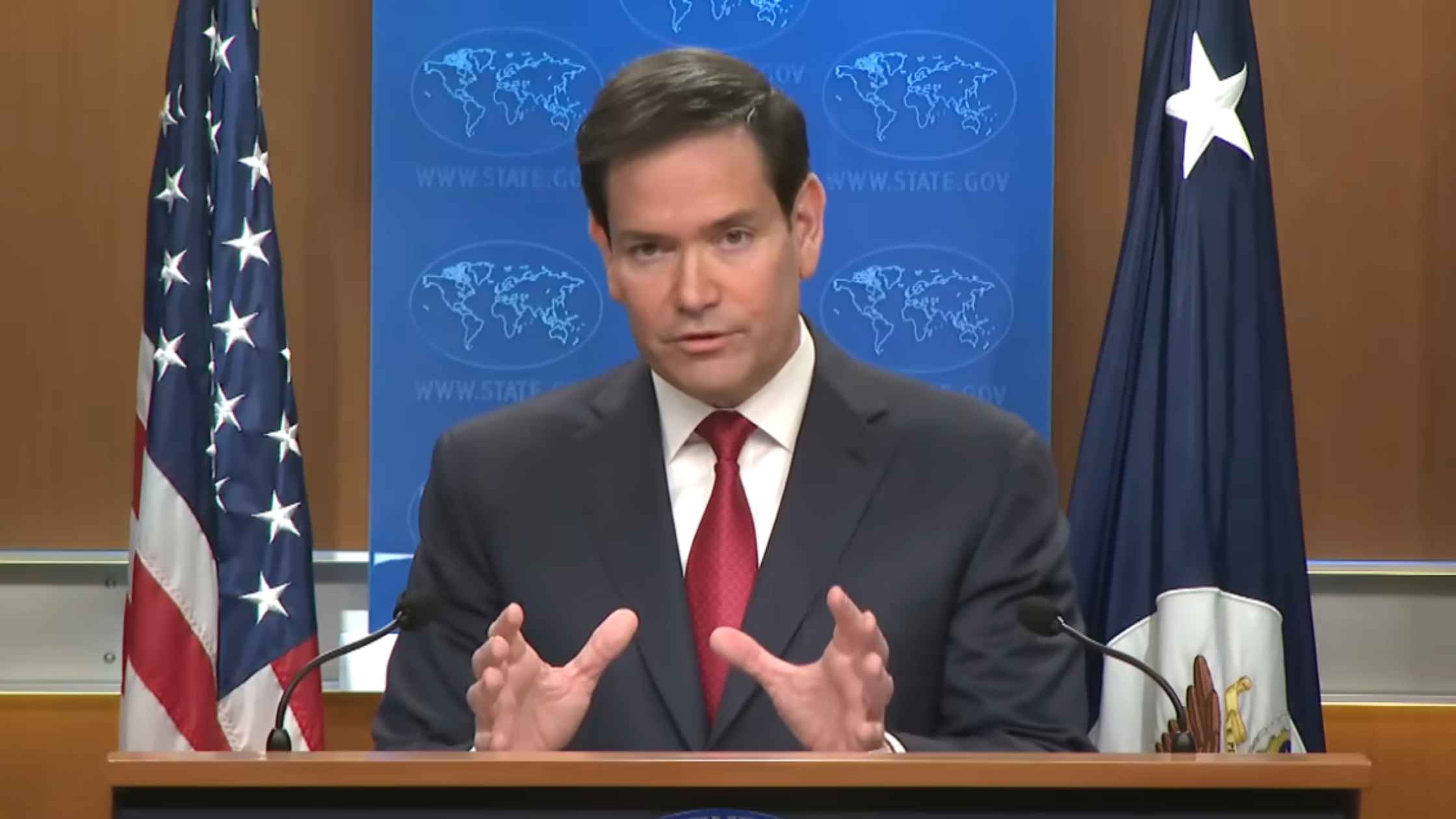
Marco Rubio (00:00):
… and then.
(00:01)
Look, when I took over Secretary of State, I'll refer you back to the hearings we had in the Senate in January about the role I hope to play. I believe very strongly this president was elected, one of the reasons why he was elected, very specific things, but one of the reasons why President Trump was elected is sort of an understanding among the American people that our foreign policy was in need of a complete recalibration. A recalibration 'cause the world had dramatically changed. Many of the institutions, policies, assumptions that our foreign policy was operating under were built upon a world that no longer existed. And it required us to reexamine that.
(00:36)
One of the assumptions that I think we had lost during this period of time, and I don't mean to make this an academic lecture, but I wanted to give you some insight into the broader thinking, as I highlighted at that hearing less than a year, almost a year ago now, is one of the assumptions was the loss of the notion of the national interest in our foreign policy. At the core, foreign policy needs to be the national interest of the United States.
(00:57)
Now that doesn't mean that there aren't issues and things we care about in the world, but at its core, the core principle of the national interest, the core principle behind our foreign policy needs to be our national interests. So you have to first of all define what is the national interest and then you have to apply it.
(01:13)
We defined it as we are in favor of foreign policies that make America safer or stronger or more prosperous, hopefully all three, but at least one of those three. And then it requires you to prioritize. Even the richest, most powerful and influential country on earth has limited resources, has limited time. And it has to be able to dedicate those resources and time through a process of prioritization. That includes geographic prioritization. It also includes issue prioritization. And that's what we intend to do here.
(01:41)
Then you have to have the mechanisms of foreign policy to deliver on it. In essence, you have to have a Department of State and a National Security Council and all the elements of US foreign policy influence and power to deliver, to identify and then deliver on those priorities. And that's what we've attempted to do here. And I think we're well on our way to doing it.
(01:58)
There's more work to be done. There's things we will improve upon. But generally speaking, it was the genesis behind the reorganization of the department, oftentimes applying reforms that secretaries of states of both parties, appointed by presidents of both parties have long sought to do. And we're very proud of that going into effect and continuing to work forward.
(02:20)
I think we generally avoided massive disruptions to our operation, although any transition involves some disruption, but we're very happy with the way we empowered our regional bureaus. Meaning our embassies and the folks at the desks here behind the regions have become more empowered and having influence over every element of our foreign policy, particularly how it's applied tactically.
(02:40)
At the same time, one of the things we looked at is foreign aid. Foreign aid is not a separate activity of the United States government. It is an element and a tool of our foreign policy, and it should be used for the purpose of furthering the national interest. That doesn't mean we don't care about human rights. That doesn't mean we don't care about starvation. That doesn't mean we don't care about hunger. That doesn't mean we don't care about humanitarian need.
(03:00)
What it does mean, however, is that even foreign aid, which is not charity, it is an act of the US taxpayer. American charities are free to give their money to whoever they want, as long as it's not a sanctioned entity. But the United States and the taxpayer money should be spent in furtherance of our foreign policy, should be spent in places and on things that further our foreign policy. And even that is not unlimited.
(03:19)
We have a limited amount of money that we can dedicate to foreign aid and humanitarian assistance, and that has to be applied in a way that furthers our national interests. And that's what we have sought to do as well. And in that endeavor as well, we have empowered the regional bureaus and our embassies to play a dramatic role. In fact, they are not just the implementers of this. They, in many cases, are the ones that are suggesting and are leading the response.
(03:41)
And so bringing the tools of foreign aid underneath the umbrella of our broader foreign policy has been an important and dramatic reform.
(03:48)
Even in the midst of all that, we remain engaged around the world, including in conflicts that perhaps are not central to everyday life in America, but the president has made it a priority to be a peacemaker. And so you've seen us engaged, whether it's Russia, Ukraine, or India and Pakistan, or Thailand and Cambodia, which is an ongoing challenge, or the tragedy we see now in Sudan, or the potential for further strife in South Sudan and that falling apart. I mean, no matter our … Armenia and Azerbaijan, we are always looking for opportunities, if possible, to play the role of a mediator that brings about the avoidance of war or the ending of conflicts. And obviously in many of these cases, you can get people to the table and agree, and then there's the implementation process. And so we've made progress in many of these, particularly in getting them to agree to certain conditions. Obviously, it's ongoing work to make sure that those are implemented and applied, and some of these conflicts have deep roots that go back many, many years. But we are prepared to be engaged and helpful in ways that perhaps other nations can't. We've been viewed as indispensable in that regard, and it's a role the President takes great pride in, in the promotion of peace around the world and something he deserves a lot of credit for. He has personally engaged in all of this.
(04:55)
Obviously the big one was the situation with Gaza, which again is ongoing. There is now a ceasefire. There's that war is no longer going on at the scale and scope and all the things that were going on before, but obviously there's more work to remain. We are still through the process of trying to implement phase one and lead to phase two and phase three. That is a long-term project, some of which will extend beyond the four years of this administration, but I thought was a very important achievement as well.
(05:19)
So we have a lot to be proud about. I know you probably have some specific questions and we can get to those, but I wanted to lay that out as the preface and predicate for everything we're going to do today.
(05:28)
So I'm going to start. How do I start? I'm going to start from the back row forward and then I'll just juggle in between. I'll be here pretty long, so we'll get to everybody. Don't get desperate. Don't get wild.
(05:39)
All right. I'll start with this gentleman with the white hair in the back. Yes, sir.
Speaker 1 (05:42):
Thank you, Mr. Secretary. I wanted to ask you about Gaza. US wants Pakistan troops to be in Gaza. Has US got a consent from Pakistan that they'll be sending their troops in Gaza for peace building and peacemaking?
Marco Rubio (05:54):
Yeah. Well, look, in fairness to all the countries we've talked to about being and having a presence on the ground, I think they want to know specifically what the mandate, what the specific mandate, what the funding mechanism looks like.
(06:04)
So we're very grateful to Pakistan for their offer to be a part of it, or at least their offer to consider being a part of it. I think we owe them a few more answers before we can ask anybody to firmly commit. But I feel very confident that we have a number of nation states acceptable to all sides in this who are willing to step forward and be a part of that stabilization force. And certainly Pakistan is key if they agree to do so, but I think we owe them a few more answers before we get there.
(06:29)
We're trying to make a lot of progress here with the … I think the next step here is announcing the Board of Peace, announcing the Palestinian technocratic group that will help provide daily governance. And then once that's in place, I think that will allow us to firm up the stabilization force, including how it's going to be paid for, what the rules of engagement are, what their role will be in demilitarization and so forth.
Speaker 1 (06:50):
Thank you.
Marco Rubio (06:50):
Next to you in the back.
Speaker 2 (06:52):
Mr. Secretary, thanks so much for doing this. I want to start with Russia-Ukraine. You mentioned that …
Marco Rubio (06:57):
Easy stuff. Yeah.
Speaker 2 (06:58):
You mentioned your efforts. There are talks going on right now, starting today and this weekend in Miami. What are your expectations from those talks? And the President yesterday made it clear that he expects Ukraine to basically step up before Russia walks away. If you wake up in Odessa, if Ukrainian this morning seeing Russians are bombing your city or if you turn on TV and listen to Putin, what he says, why would the Ukrainians ignore what the Russians are saying publicly and believe in what they're hearing from mediators?
Marco Rubio (07:32):
Yeah. There's a reason why this war hasn't ended, and that is because there's complex factors at play. I know that sounds like a throwaway line, but it's true.
(07:40)
What we have tried to do in this entire process, and let's be clear about this. I mean, the United States is engaged in this. The President says this, and I'll translate what I think he's trying to say to you in all of this, and I think he's been pretty clear about it, is it's not our war. It's a war in another continent. We have equities, we have engagement in this war, but it's not our war per se. But we are been told by everybody. I think everybody would agree that there's only one nation on earth, there's only one entity on earth that can actually talk to both sides and figure out whether there's a way to end this war peacefully. And that's the United States. And we've invested a lot of time, a lot of energy at the highest levels of our government.
(08:12)
I believe President Trump has had more meetings with foreign leaders and others on the war in Ukraine than on any other subject, including trade. He's invested a lot of time. Steve and Jared have invested time. I've invested time. The Vice President, the Secretary of War, others, Secretary of Treasury and more have invested a tremendous amount of time and energy in this. And what we're trying to figure out here is what can Ukraine live with and what can Russia live with? Sort of identify what both sides' positions are and see if we can sort of drive them towards each other to some agreement.
(08:43)
Wars end generally in one of two ways. Surrender by one side for another or a negotiated settlement. We don't see surrender anytime in the near future by either side, and so only a negotiated settlement gives us the opportunity to end this war.
(08:56)
A negotiated settlement requires two things. Both sides to get something out of it and both sides to give something. And we're trying to figure out what can Russia give and what do they expect to get, what can Ukraine give, and what can Ukraine expect to get. In the end, the decision will be up to Ukraine and up to Russia, will not be up to the United States.
(09:13)
So that's the role we are trying to play in this, and that's why you see so many meetings going on. This is not about imposing a deal on anybody. It is about determining what both sides expect and need to have and what both sides are prepared to give in return for it and figuring out whether we can have those two overlap. And of course, that takes a lot of time and a lot of hard work. It can't generally be done in the media or in press conferences.
(09:35)
I think we've made progress, but we have ways to go. And obviously the hardest issues are always the last issues.
(09:40)
Yes. All right. I'm going to go to the next row, that gentleman right there with the glasses.
Speaker 3 (09:45):
Me?
Marco Rubio (09:45):
Well, right behind you, because you're not the next row, that's the next row right there. Yes.
Speaker 4 (09:48):
Thank you. I'd like to ask how you-
Marco Rubio (09:51):
Oh, I'm sorry. Okay, go ahead. You can start. I hadn't seen you. I'd seen him, but you can go because you're first on that row.
Speaker 4 (09:56):
Okay, great. Thank you so much.
Marco Rubio (09:57):
As a well oiled machine, ladies and gentlemen. So go ahead. I'm sorry, ma'am.
Speaker 4 (10:00):
Thanks. I'd like to ask how you view recent escalation of tensions between Japan and China. You've been known for your tough rhetoric towards China over the years. Do you condemn China's recent provocative actions against Japan?
Marco Rubio (10:13):
Yeah, no, I think I've been nice to China in terms of the work we have to do with them. I mean, I had another job. My job now is to … I represent the President of the United States and the United States in foreign diplomacy. And I think we've made good progress with the Chinese.
(10:27)
The Japanese are a very close ally of the United States. I think these tensions are preexisting. We understand that's one of the dynamics that has to be balanced in that region. And I believe that we feel very strongly that we can continue with our strong firm partnership and alliance with Japan and do so in a way that continues to allow us to find productive ways to work together with the Chinese Communist Party and the Chinese government.
(10:50)
Look, there'll be tensions. There's no doubt about it. I mean, at the end of the day, China is, and will continue to be a rich and powerful country and a factor in geopolitics. We have to have relations with them. We have to deal with them. We have to find the things we are able to work together on. And I think both sides are mature enough to recognize that there will be points of tension now and for the foreseeable future.
(11:08)
Our job as part of responsible statecraft is to find opportunities to work together 'cause I think if there's a global challenge that China and the US can work together on, I mean, I think we can solve it.
(11:19)
And there'll be points of tension. We all recognize that and our job is to balance these two things. I think both sides understand that. And I think we can do that without imperiling or in any way undermining our very firm commitment to our partners in the Indo-Pacific that includes not just Japan, but South Korea. And obviously if you extend further out, I don't want to leave anybody out, but India and Australia and New Zealand and all the other countries.
(11:43)
And we also have growing and burgeoning relationships with countries like Vietnam and even Cambodia that we really haven't had very close contacts with historically. But we've talked to them a lot lately, obviously through the context of the conflict going on with Thailand, but also to figure out opportunities to work together strategically. And I say Thailand, of course, we've had a very long and strong strategic alliance with them for many years.
(12:07)
All right now, yes, sir.
Speaker 5 (12:08):
Thank you. [Spanish 00:12:10]
Marco Rubio (12:14):
I'm going to answer in Spanish if that's okay guys. And then I'll do it in English as well. And does somebody do close caption on this? Can they do it? It doesn't matter 'cause I'm going to say the same thing in English. [Spanish 00:12:47]
(12:44)
The question and it's a question many of you might have as well is when it comes to the Western hemisphere, the single most serious threat to the United States from the Western hemisphere is from transnational terrorist criminal groups, primarily focused on narco trafficking, but they're in all sides businesses as well.
(16:08)
The good news is we have a lot of countries in the region that openly cooperate and work with us to confront these challenges. Mexico, their level of cooperation with us is the highest it's ever been in their history. Throughout Central America, for the most part, except for maybe Nicaragua and to some extent Honduras, we've had great cooperation from Ecuador, from El Salvador, from Ecuador being in South America, but across the Pacific Coast, we're also undertaking efforts.
(16:32)
Guatemala, Costa Rica, Panama, these are all nations that cooperate with us openly in search of stability in the region. You move to the Caribbean basin in Trinidad, in Guyana, in Jamaica, and the Dominican Republic, countries that openly cooperate with us. Even Columbia, despite its unusual president, has institutions in that country that work very closely with us, and those ties remain unimpeded and unaffected.
(16:56)
So all of this is very positive. There's one place that doesn't cooperate, and it's the illegitimate regime in Venezuela. Not only do they not cooperate with us, they openly cooperate with terrorist and criminal elements. For example, they invite Hezbollah and Iran to operate from their territory, but they also allow the ELN and the FARC dissidents, not just to operate from inside of Venezuelan territory, to control Venezuelan territory, unencumbered, unimpeded. On top of that, we know that they are in cahoots with drug trafficking organizations.
(17:25)
It's not just that they don't work with us against these organizations, okay? It's that they openly cooperate with these guys and allow them to operate. So these guys are marching in and out doing whatever they want from Venezuelan territory, and it's a challenge. And so that's why that's received so much attention.
(17:43)
But I would urge you to not just focus on that, but also focus on all the other things we're doing in the region, including, for example, standing up this gang suppression force in Haiti, which we were looking for 5,500 forces. We already have pledges of up to 7,500 forces from a variety of countries. We've seen donors step up to fund that effort. That's a very important effort. It all ties together cohesively, but the goal here is to bring security and stability to the hemisphere, to the region, the region we live in, which has not received enough attention, to bring the elements of American power to achieve that, to do it in partnership with as many countries as are willing to work with us in that regard, that's the goal here.
(18:20)
And it's comprehensive and involves more than just one place. What makes Venezuela stand out is that the regime there actually cooperates with the terrorists.
(18:27)
Yes, sir. In that row right there. Yeah, right there in …
Speaker 6 (18:31):
On the hemisphere, you recently, the White House recently put out the national security strategy, essentially reorienting towards the Western hemisphere. How is the strategy-
Marco Rubio (18:40):
It was good, right? I wrote that myself.
Speaker 6 (18:40):
Yeah.
Marco Rubio (18:40):
Well, I was involved in writing it, but yeah, exactly.
Speaker 6 (18:43):
So you can answer from both hats. But how is that strategy going to dictate your relationship with other hemispheric powers like Canada and Mexico?
Marco Rubio (18:52):
No, I mean, we want to partner with as many people. I mean, they face the same threats that we do. I mean, it's Mexican mayors that are being assassinated in public squares. It's Mexican journalists that are being assassinated. It's parts of Mexico and institutions in Mexico that in some cases are compromised, usually through threat by these elements. They recognize it, which is why they're partnering with us. Of course, we want to work with other governments in the region to confront this challenge. And in most cases, we have cooperative places.
(19:17)
Now, we don't have that from Nicaragua or Cuba. Obviously didn't have it historically from Bolivia. We hope and expect that that will change. And we certainly don't have that from the regime in Venezuela who actually don't just not cooperate with us. They openly cooperate with narco trafficking elements that use Venezuela as a transshipment point.
(19:36)
Yes, ma'am.
Speaker 7 (19:37):
Yes. Thank you, Mr. Secretary. Today, you had the second round of direct negotiations between Lebanon and Israel. Do you foresee a potential deal between these two countries without another round of war? And the second question, if I may, on Sudan. We know, Mr. Secretary, it's a civil war, but also there's a regional factor here. Where the US-
Marco Rubio (20:00):
A regional what? I'm sorry.
Speaker 7 (20:00):
Factor in this war. Where the US stands here and what's a red line for you? Is a divided Sudan is a red line for the US?
Marco Rubio (20:09):
Yeah, let's separate the two because they're both easy questions, right? So the first one is we're hopeful. Look, at the end of the day, the goal everybody shares is a strong Lebanese government that controls the country and Hezbollah is disarmed. They're no longer an armed element that can threaten Israel security. That's the goal here. And we have tried, in a cooperative way, to do everything we can to empower the Lebanese government to have the ability to do that. And so I hope that's what these talks are aimed towards and we'll be supportive in every way we can to achieve that outcome.
(20:35)
What I think is abundantly clear to everybody is no one is in favor of a Hezbollah that can once again threaten the region, act as a direct Iranian proxy. And obviously, if they threaten Israel, we're not going to have peace. So we are hopeful that the talks between Lebanese authorities and the Israelis will create outlines and a way forward that prevents further conflict.
(20:56)
I think I don't speak for the Israeli government. I can only tell you and echo what they've said publicly, and that is that if they feel threatened by Hezbollah, they will take actions in their defense against them. So we all would hope that we could avoid that, right? We would all hope that in order to have peace, you have to avoid that. And the best way to avoid it is to have a strong Lebanese government that can actually control the country and that Hezbollah is no longer an armed threat to Israel or to the Lebanese state. And that's what we're committed to hoping to achieve. And we hope that … I can't speculate on what the talks will lead to, but we'll do everything we can to make them productive.
(21:26)
On Sudan, you've rightfully outlined. I mean, there are regional elements to this. I mean, there are clearly both sides, the SAF and the RSF have supporters from outside of Sudan's borders that are involved, and we've been engaging with those countries.
(21:41)
It's not just countries that are providing them weaponry and equipment. It's also countries that are providing transshipment, particularly to the RSF to receive weapons, in some cases, advanced weaponry.
(21:52)
Our goal right now in the short term, and what we've emphasized to everybody, including in my calls with leaders in the UAE, leaders in Saudi Arabia, we're very engaged in that. Our special envoy Massad Boulos, just returned from the region meeting with the Egyptians, with the Saudis, with the UAE and others. We've also been in collaboration with the UK on some of this.
(22:11)
Our goal, the immediate goal we have is a cessation of hostilities, a humanitarian truce going into the New Year that allows humanitarian organizations to be able to deliver aid to the people in great distress. Right now, that's not possible. We are hearing and continue to see reports of humanitarian convoys actually being struck on their way in. And so you can just imagine what's amazing to us is these convoys are struck and the rest of the convoy continues. That's how committed these groups are.
(22:39)
But what we said to everybody on it is that what's happening there is horrifying. It's atrocious. That one day the story of what's actually happened there is going to be known and everyone involved is going to look bad. And the role we have played is a convening role in bringing the parties to the table. So I think we will know more very soon about whether this is possible.
(22:57)
One of the challenges and frustrations in Sudan has been that one side or the other will commit to certain things, and then they won't live up to those commitments. They'll agree to anything and implement nothing. And oftentimes what happens is when one side feels like they're making advances in the battlefield, they don't necessarily see the need to concede at that point because they believe they're on the verge of achieving some success on the ground and a truce would set them back.
(23:20)
But what we've emphasized is none of these groups can operate without the support they're receiving externally. So we have been engaging with the countries involved from the outside to ensure that they are at the table and that they are pushing for the same outcome that we want, which is phase one, a humanitarian truce that at a minimum allows us to deal with the humanitarian calamity that occurs there. And obviously we hope that while that truce is ongoing, we can focus on the other elements that led to this conflict and help to resolve some of those.
(23:47)
But our number one priority we're focused on, 99% of our focus is this humanitarian truce and achieving that as soon as possible. And we think that the new year and the upcoming holidays are a great opportunity for both sides to agree to that. And we're really pushing very hard on that regard. Yes, sir. Right there, because I missed it.
Speaker 8 (25:37):
[Spanish 00:24:03]
Marco Rubio (25:37):
[Spanish 00:24:12]
Speaker 8 (25:37):
[Spanish 00:24:14]
Marco Rubio (25:37):
[Spanish 00:24:15]
Speaker 8 (25:37):
[Spanish 00:24:16]
Marco Rubio (25:43):
[Spanish 00:24:34]
(25:43)
The question is again about Columbia. I said, look, we're not going to let sort of the pronouncements of an unstable individual over there to impact. We don't want to let it impact our broader relationship with Columbia. It's an important relationship, an important alliance. It extends through commercial, people to people, cultural, obviously security and stability, all of these things. And our job is to try to the extent possible, maintain those strong ties between Columbia and the United States and not allow them to be imperiled by the pronouncements of one person.
(26:15)
We would hope to see a day soon in which we have better relations with the leader of that country, but we're not going to let the fact that that doesn't exist now. We're going to do everything possible to not let that impact the relationships we have with the people of Columbia, with the nation, with their economy, with their security forces, which are very important.
(26:31)
This is a very important alliance, a very important strategic partnership, which we've built up through a lot of hard work over decades. We're not going to let that fall apart because of one person. If that changes and he changes, that would be great. And obviously, in May, there'll be a new president there and there'll be elections and we'll work hopefully more cooperatively with whoever replaces the current president, but that's up to the people of Columbia.
(26:51)
Did I not get your question? Go ahead.
Speaker 9 (26:53):
Thank you. Returning to Gaza, what is the US understanding of what Hamas is willing to concede on disarmament? Reports suggests that Hamas might hand over its heavy weapons, but retain its smaller arms. Is the US prepared to accept partial disarmament as sufficient?
Marco Rubio (27:09):
Yeah. I'm not going to get into the details of those types of negotiations. Let me just couch it to you this way. Everyone wants peace. No one wants a return to a war. If Hamas is ever in a position in the future that they can threaten or attack Israel, you're not going to have peace, okay? You're not going to convince anyone to invest money in Gaza if they believe another war is going to happen in two to three years.
(27:29)
So I would just ask everyone to focus on what are the kind of weaponries and capabilities that Hamas would need in order to threaten or attack Israel as a baseline for what disarmament needs to look like, because you're not going to have peace. If two years from now, Hamas is launching rockets or killing Israelis or carrying out, God forbid, another 7th of October type terrorist attack and so forth, you're not going to have peace. So who's going to invest in a peace, who's going to invest in rebuilding a place that's going to get destroyed again in a future war? So that's why disarmament is so critical.
(27:59)
Now, what that entails, we're going to leave that to the technical teams to work on. It would have to be something obviously that they're willing to agree to, that our partners can push them and pressure them to agree to. It also has to be something that Israel agrees to. In order for that to work, both sides have to agree on it and we need the space to do it, but that's the way to think about it, okay? You cannot have a Hamas that can threaten Israel in the future. If they can, you won't have peace. So that's the goal.
(28:21)
All right, who's left in that row? Right there with the mustache or the …
Speaker 10 (28:26):
Thank you, Mr. Secretary. Does the US have the goal of removing Maduro from power? Do you expect any regime change this 2026? I would appreciate if you could answer both in English and in Spanish.
Marco Rubio (28:37):
In Spanish.
Speaker 10 (28:38):
Yeah.
Marco Rubio (28:38):
It sounds so much better in Spanish when I answer that question.
Speaker 10 (28:39):
Yeah. No, but for my colleagues.
Marco Rubio (28:40):
So I'll start in English. Look, our goal is regional stability and security and the national interest to the United States. The national interest of the United States, specifically when it comes to Venezuela is as follows. We have a regime that's illegitimate, that cooperates with Iran, that cooperates with Hezbollah, that cooperates with narco trafficking and narco terrorist organizations, inclusive, not just protecting their shipments and allowing them to operate with impunity, but also allows some of them to control territory, the ELN and the FARC-D. The ELN and the FARC dissidents operate openly. They have open camps that they control territory inside of Venezuela.
(29:14)
That is our national interest and that is what this is focused on. And that's what the President's been focused on, and that's what we're conducting, and that's what we have been focused on the entire time because that is the threat to the national interest of the United States.
(29:28)
Now, do we consider Maduro legitimate? No. And by the way, guys, when I say these things about Maduro and his role in narco trafficking, it's not … I hear your reports Marco Rubio says. It's not me. A grand jury in New York, in the Southern District of New York, okay? A grand jury in the Southern District of New York was presented evidence and came back with an indictment, not just against Maduro, by the way, but against a bunch of people in his government for narco trafficking, a bunch. He had his nephews or the nephews of his wife indicted, convicted in the United States for narco trafficking.
(29:59)
Until
Marco Rubio (30:00):
… President Trump started doing something about these narco trafficking links. Nobody disputed that Maduro and his regime was in cahoots with narcotraffickers. Not to mention the fact that they unleashed Tren de Aragua gangs on the United States. They've unleashed a mass migration event, perhaps the largest in history. Eight million people have left Venezuela since 2014, so also destabilizing all the countries in the region who had to assume people that are fleeing this illegitimate regime.
(30:29)
But nobody disputed the drug links. So that's what the president's been focused on. And that's the problem. And that's the problem of Venezuela. [Spanish 00:30:36]
(30:36)
Okay, next row, right there. You. Yeah.
Speaker 11 (31:12):
Thank you. Thank you. Mr. Secretary.
Speaker 12 (31:14):
Okay. With all due respect for my colleagues, I'm going to ask this one in Spanish.
Marco Rubio (33:21):
Okay.
Speaker 12 (33:21):
[Spanish 00:31:18]
Marco Rubio (33:23):
[Spanish 00:32:02]
(33:23)
The question was about whether the US relations to Colombia is dependent on whether they elect a leader that's center right or center left.
(33:31)
It has nothing to do with left or right. It has to do very simply with whether or not we have a leader there that we can work with. The US-Colombian relationship, especially our security relationship, but also our economic one with a free trade agreement is a model. It was a model for the region. We tried to replicate that. Everybody would use Plan Colombia as an example of what you need to do in these other places, and we want to continue that.
(33:50)
Now, no doubt, when you have the president of a country saying some of the things and ordering some of the things that he's ordered, it's going to have an impact on some of that relationship. Our job is to try to preserve and protect as much of that relationship as possible, but it will be impacted.
(34:04)
But it doesn't matter whether with the United States and restart these relations. That's what we seek. And if President Petro changes in his stance, perhaps that could change as well. But if he doesn't, obviously it'll be up to the people of Colombia to elect their next president.
(34:16)
Yes, ma'am. Right there in the middle.
Speaker 13 (34:18):
Secretary Rubio-
Marco Rubio (34:19):
I don't want you guys to think I'm only picking the Spanish ones, okay? I actually don't know who any… Well, there's a list here, but I can't even read it because without these glasses. All right. Go ahead. I'm sorry. [Spanish 00:34:27]
Speaker 13 (34:26):
Secretary Rubio, [Spanish 00:34:29]
Marco Rubio (36:13):
[Spanish 00:35:48] It's the same question, guys, and that is the bottom line is very simple. Our interest in Venezuela and in the region is the national interest of the United States. And in Venezuela, we have an illegitimate regime that not only does not cooperate with the United States, but openly cooperates with narcoterrorists and others who threaten the national security of our country.
(36:31)
The gentleman in the middle. I'm going to try to get to everybody, I promise. But you guys, by then, your questions will be even more specific.
Speaker 14 (36:37):
Thank you, Mr. Secretary.
(36:38)
You said a few moments ago that everyone wants peace for Gaza, and yet by any metric, the Israelis are flouting the ceasefire that President Trump negotiated by killing an average of two children a day, not allowing the agreed-upon humanitarian aid into Gaza.
(36:54)
How long can this continue? How long can the Israelis be allowed to show such disrespect to President Trump?
Marco Rubio (37:00):
Well, that's your characterization of it about the term disrespect.
(37:04)
What I would say is this. First of all, it was a miracle that had happened in the first place. We all understand how difficult it was for that to come to the conclusion that it did, where the actual, the bombing and everything else with the scale and scope of what we saw ended, all the hostages were released and we have relative peace right now, for the most part, despite the things you're pointing to.
(37:23)
That was very difficult, but this is not easy. Peace is a verb. It's an action. It's not a sentiment. Every single day will bring challenges. Every single day. We also have had instances, for example, over the last couple weeks where Hamas elements emerged from a tunnel, attached an explosive device to the side of a vehicle and injured and almost killed Israeli soldiers. We still have this threat. We still have and see every single day Hamas openly taking steps to strengthen themselves with inside of those places in Gaza that they still control. We saw early on the atrocities they were committing in the streets against people as they were trying to show people how strong they were.
(37:59)
So I don't think I'm standing here to tell you this is going to be easy. This is an hour-by-hour, day-by-day challenge. It's one of the reasons why we have stood up the center there in operating in Israel in partnership as well with another cell that exists in a regional country. It's why every single day there are leading, there are meetings among both intelligence, diplomatic and military officials of multiple countries that help bring about this deal to manage this.
(38:22)
And that's why it is so critical, it is so critical and so key that we move to complete this first phase, that we move to put in place the border piece, get everybody agree to be a part of it, move to put in place this Palestinian technocratic organization so that they can begin to provide some governance structure and move to put in place the stabilization force.
(38:41)
That's the goal here, but it's not going to be easy. Every day will bring new challenges to that, and we recognize those challenges are coming from all sides.
Speaker 14 (38:48):
Very quick follow-up there, but who's going to want to be a part of a stabilization force if Israel is effectively using Gaza as a free fire zone?
Marco Rubio (38:55):
Well, these are the things that we're working through right now. Again, that's why it didn't happen yesterday. That's why we didn't… I don't mean yesterday, literally. That means why we're not there yet.
(39:03)
This is the hard work of diplomacy and peacemaking. Peacemaking isn't just signing a piece of paper. It's actually complying with it. And compliance oftentimes requires, in many cases, in most cases, requires daily, constant follow up and nurturing.
(39:17)
So that is why we are in such a hurry, and I say as a priority, to get to this point where we have the stabilization force in place overseen by the border piece and ultimately a Palestinian technocratic entity that can increase in its capability to provide governance. The stronger they are, the weaker Hamas will be in terms of threatening Israel. And I think the more security Israel should feel and the less need for some of these things to happen.
(39:39)
But no one's claiming this is going to be easy. We have to work on this every single day. We have people in this building and deployed abroad, this is all they do, 24 hours a day, day after day, elements of the State Department, the Department of War and all other agencies, including Jared and Steve and even myself who talk or do something about… There isn't a day in the last, since this was signed two months ago, that I haven't had to do something with regards to making progress on the phases of the ceasefire.
(40:06)
Yes, ma'am. Right next.
Caroline Lumetta (40:07):
Thank you, Mr. Secretary.
Marco Rubio (40:08):
I'm sorry, [inaudible 00:40:09]. I'm going to get to you. See, I'm going down the rows like this.
Speaker 15 (40:11):
Thank you.
Marco Rubio (40:11):
So right behind you, because I'm still in that row.
Caroline Lumetta (40:15):
Thank you, Mr. Secretary, and thank you for having the briefing.
Marco Rubio (40:16):
Has anyone ever done this where they go like all the rows?
Speaker 15 (40:16):
No.
Caroline Lumetta (40:16):
No.
Marco Rubio (40:20):
You're going to look so good to your editors. All right, go ahead.
Caroline Lumetta (40:23):
Caroline Lumetta with World News Group.
(40:26)
Several faith-based organizations have been calling on the administration to reopen the US Refugee Admissions Program, particularly for religious minorities facing persecution that includes Afghanistan, Syria, Iran.
(40:40)
Is it going to be a goal in 2026 to expand that program again beyond South Afrikaners?
Marco Rubio (40:48):
Yeah. So here's the problem, okay? In the last four years, we had a flood of people enter this country through a variety of means. So that's what we confronted. We have to stop that, and we did. We've been successful. You see the border secure, the number of illegal entries, it's completely collapsed.
(41:02)
And now we're facing a second challenges, and that is we've admitted a lot of people into the United States. And perhaps the overwhelming majority of them are not bad people and so forth. This is all true. But there are people we know, okay, for a fact, there are people in this country who got in through some form of vetting that was wholly insufficient. And we've seen tragic evidence of that very recently, including people that we claim to have vetted.
(41:24)
Why does that happen? Because there are some places where you can't vet people. You can only vet people on the basis of information you have about them, but that information is oftentimes dependent on whether there's some local authority that actually has any information about them, okay?
(41:38)
So that is the challenge we're facing, which is why the president sort of put a stop to all of these things until these systems for admitting people into our country can be improved.
(41:46)
But I think everyone would understand that after a flood of 15 to 20 million people into our country, almost unrestrained in some extent, over the last four years before in January of this year, there's a desire in our country to put a stop to that until we can fix these processes to ensure that not only do we know who's in the country now, but in the future, we're not going to face some of these challenges that we faced in the past.
(42:07)
So look, the United States remains the most generous country in the world when it comes to legal immigration. This year alone, close to a million people will enter this country legally and have their green card and go to work. But we do have a right, like every sovereign country does, to know who you are, why you're coming, what you've done in the past, and what we think you might or might not do in the future. We have a right. We have a right to make sure that you're not going to come to this country and pose a burden on our social safety network.
(42:32)
All of these things are rights of sovereign countries. A bunch of sovereign countries in the world do it. Most of the countries in the world have far more restrictive immigration policies than the United States has ever had, but we are in a special period right now. This is not like business as usual. This is right now, we are less than a year removed from the most reckless migratory incompetence in American history where a flood of people in mass migration events entered the United States.
(42:56)
And they can claim all they want that they vetted people. This is just not true. Some of them were cursory vetting and in some cases, you couldn't vet them because the countries or places they came from had no documents upon which they could be vetted on.
(43:07)
So that program will be studied and it will not be restarted at the scale and scope it was until we are comfortable that it is one that we are not… We know everyone who's coming in and who they are and whether they meet the criteria for admission to the United States.
(43:21)
Yes, ma'am.
Caroline Lumetta (43:21):
But do you have any sort of timeline for that?
Speaker 15 (43:23):
Thank you so much, Mr. Secretary.
(43:24)
A follow-up on the conversation between President Trump and Maduro, because the day after the conversation, the president said he was going to be meeting that gentleman very soon.
(43:34)
Is this still being considered? Is the president still considering that? Is still a chance for diplomacy on Venezuela?
(43:42)
And also any role that you see Brazil could play because just a few weeks ago, President Lula spoke with President Trump and Nicolas Maduro, and he offered to help to mediate the conversation. And-
Marco Rubio (43:54):
Yeah. I'm not going to comment on any… As I said, I'm not going to comment on the president's talks.
(43:58)
I will just point you to the fact that the thing about this president, that I think you've seen, is he's willing to talk to anybody. He's willing, he doesn't view talks as a concession.
(44:06)
But I don't have any update to you on what comes next in that regard. I have no reason to express skepticism or optimism about it. I'm just not going to comment on what the president has available to him as options across the range of options that include diplomatic options.
Speaker 15 (44:22):
And how about the conversation with Lula? [inaudible 00:44:26]
Marco Rubio (44:25):
I mean, I think he said to us what he has said publicly, and that he has a willing to play a positive role in that regard. The president's had two phone conversations and one meeting with President Lula. I think we've made progress on some things, including on trade. We have more work to be done. The two presidents got along. We felt that was important in terms of those conversations.
(44:45)
I've talked to Mauro Vieira, their foreign minister on it, including earlier this week, and we have a lot of issues in common with Brazil that we'd like to work together on and strong links. Being from Florida as an example, I know how important Brazil has been to us as a partner. We've had some disagreements on a couple things over the years as well, but I feel like that relationship is on a positive trajectory.
(45:05)
But as far as its role in Venezuela, I don't have anything to provide you on that today of any specificity.
(45:11)
Yes, sir.
Speaker 15 (45:11):
Just a quick follow-up on the tariffs-
Speaker 16 (45:14):
Thank you.
Speaker 15 (45:14):
… political tariffs on Bolivia.
Marco Rubio (45:14):
No, no, no. I've got to get to him, okay?
Speaker 16 (45:15):
Okay. Thank you, Mr. Secretary, and thank you very much for doing this.
(45:18)
On phase two in Gaza, when is the soonest that we could see that being implemented?
(45:22)
And then separately, you said at the top that you want the US to play the role of mediator that brings about the avoidance of war and ending conflicts. How do you square that position with a possible military intervention in Venezuela? Thank you.
Marco Rubio (45:33):
Well, first of all, a couple things. Wanting to pursue peace and secure peace does not necessarily come at the expense of your national interests. We reserve the right and retain the option of defending our national interests.
(45:44)
Now, in the case, again, we're going to talk about Venezuela. Let's be clear. Maduro has made multiple deals with elements around the world, including with the Biden administration, okay? Maduro made a deal with the Biden administration, and here's the deal he made.
(45:57)
And I only say this to you, not because we want to get back to that deal, but just as an example of why the guy cannot be trusted to keep deals. It's a problem, okay? Somebody breaks deals multiple times, you have a right to be skeptical they're ever going to keep the deal.
(46:08)
He made a deal. And as part of that deal, they lifted sanctions. They released his two nephews from federal custody after their conviction. They sent back his bag man, Alex Saab and all these sorts of things. He released political prisoners, and he promised to have free and fair elections. He didn't have free and fair elections. He rearrested or exiled most of those political prisoners. So he pocketed all the benefits and lived none of those commitments. So look, it's hard to have and do a deal with someone who never keeps a deal.
(46:36)
Now, on the broader perspective of what you're asking about, let's be mature here. Yes, there are issues where we want to pursue peace if that is possible, but we also have our national interests. Look, we're not going to reach a peace deal with narcotrafficking bans. We're not. We can't reach a peace deal with MS-13. We can't reach a peace deal with Tren de Aragua. We can't reach a peace deal with the ELN or the FARC that are still pumping drugs into the United States or any of their cartels in Mexico. You can't do a peace deal with these people any more than you could do a peace deal with the Mafia.
(47:05)
So I think it's important to understand there that's a different between warring factions and nation states around the world where we feel like maybe we could act as a bridge to bringing about the differences. But when you're talking about things that directly implicate the national interests of the United States, and no one can argue that transnational criminality and terrorism in our hemisphere is not a threat to the national interests of the United States, we have to use, we reserve the right and have the right to utilize every element of national power to defend the national interests of the United States.
(47:35)
And no one can dispute that. And every country in the world reserves the same option. We just simply have more power than some of them do.
Speaker 16 (47:41):
And phase two, Gaza?
Marco Rubio (47:42):
Oh, phase two Gaza. Yeah. I mean, we like, we got to complete phase one to get to phase two. That's why we're working every day to get there. Look, guys, if this stuff was easy, it would've been done already a long time ago. This is a complex situation. No one would dispute it, but it's important.
(47:56)
What we achieved already, what the president achieved ending that war already was something no one thought was possible. Everyone thought that the last episode was going to be an Israeli incursion into Gaza City that would lead to massive loss of life and the hostages would never be reunited with their families. And today, as we speak, all the hostages that we're living are back, all but I believe one of the bodies has been returned. No one would have believed that six months ago.
(48:20)
So that, in and of itself, but we're not, that is not the end of the story. We want to continue on this, but what we're talking about is dealing with something that no one has been able to solve in 30 or 40 years. No one. And it's going to take some time, but I feel generally optimistic that we have the right people at the table with the right motivations to make it happen. But no one is claiming to you that this is going to be just a straight-up trajectory. It's going to have its ups and downs. It's going to have its good days and bad days.
(48:46)
The important point is that the momentum and the trajectory on it is a positive trajectory, and we're investing high levels of our government every day and trying to make that happen, but we can't do it alone. We have all these other partners that we have to include. So I would focus you on, let's get the border peace in place and announced, let's get the technocratic Palestinian group in place, and then let's get the stabilization force in place.
(49:08)
And then we can move on to the other elements, the phase two and phase three of the plan that hopefully will be what will be enduring. And the work of putting phase two and phase three in place is going to extend far beyond the next three years. I mean, this is a generational commitment, but we want to leave those pieces in place for the next administration to continue to build upon, even as we achieve phase one and parts of phase two during this administration.
(49:28)
Yes, ma'am.
Speaker 17 (49:29):
Yeah. Mr. Secretary, some of your former, Democratic former Senate colleagues who considered you one of their most trusted bipartisan partners have, since you joined the Trump administration, accused you of abandoning some of your former principles and positions, and three or four have said they regret voting for you. What's your-
Marco Rubio (49:46):
Well, I had 99 votes. I could spare four.
Speaker 17 (49:48):
What's your response to that?
(49:50)
And more importantly, how do you think about building and maintaining bipartisan consensus and cooperation on foreign policy at this moment, especially because that will be necessary to sustain President Trump's legacy after he leaves office?
Marco Rubio (50:04):
I mean, we live in a very different time, unfortunately. I engage with senators, for example, from both parties. We saw a bunch of them the other day, all the time and obviously.
(50:11)
But politics today is very different than it was 10 or 20 years ago. It just is. I'm not in that anymore. I'm no longer in a political office, but I know political offices. I served 14 years in the Senate and politics is real, right? I mean, there's also not a lot of benefit to a Democratic senator saying what a great guy Marco Rubio is in this current political environment, or anyone in the Trump administration for that matter.
(50:31)
So all I will tell you is I get up every day, we go to work, we get work done, we do cooperate and work with. They don't always agree with everything we're doing, but I have a lot of people in the Senate, particularly chairman of key committees that we interact with.
(50:42)
There's things people can say and do in the public that because of politic and private that they can't say or do in public. But I don't know what else to comment on that, other than one more point and that is, and I think this is important. I think people have lost sort of their mindset here a little bit, okay?
(50:58)
The foreign policy, the State Department is not its own government, okay? The Secretary of State is not its own government. I'm appointed by the president, confirmed by the Senate and then… or nominated by the president, confirmed by the Senate and then appointed by the president.
(51:10)
But at the end of the day, the person the people of the United States elected to be the President of the United States and the commander in chief is Donald J. Trump. That's who they elected. And my job, and the job of the people in our administration is to implement the president's foreign policy. We provide advice, we provide counsel, but ultimately our job is to take what the president wants to do, take his vision and implement it, come up with options for implementing the president's vision. That's my job today. When I was a senator, I represented the state of Florida. Today, I am the Secretary of State for Donald J. Trump, the President of the United States, and my job is to implement the president's foreign policy, provide advice, provide counsel, provide ideas, provide for opportunities and ways in which his foreign policy can be implemented.
(51:52)
But in the end, our job is to implement that. And why people think that somehow foreign policy can be divorced from our republic? That's not the way our constitution works. The constitution does not say you elect the president of the United States, and then you put in place a State Department to undermine the president if the person who's the Secretary of State doesn't agree with him. That's ridiculous. That's stupid, really. And I don't know why anybody would think that.
(52:14)
So that's the job I have and that's a job I'm proud to do. I think we've made a lot of progress. We have a lot more work to do.
(52:20)
All right. On our row right there from Italy, right?
Speaker 18 (52:21):
Yeah. Yes.
Marco Rubio (52:22):
I know you from The View. Do you cover us now, or are you on Capitol Hill still?
Speaker 18 (52:27):
No, everything.
Marco Rubio (52:27):
Both.
Speaker 18 (52:27):
Capitol Hill and as well as here.
Marco Rubio (52:27):
So you're like a one-man bureau for the whole thing. All right.
Speaker 18 (52:29):
[inaudible 00:52:29] Yeah.
Marco Rubio (52:29):
You're like me, you have two jobs. Good.
Speaker 18 (52:34):
All right. Thank you, Mr. Secretary.
(52:35)
So the United States, on one hand, are mediating with Russia to end the war in Ukraine, but on the other hand, the Russian foreign minister yesterday, or the day before, said it would be a fatal mistake from the US to block the oil tanks from Venezuela and trying to overturn the Maduro regime. So what's the assess that you're doing, and are there any safeguard in place to avoid the escalation with Russia?
(53:06)
And then I have another question about the Hezbollah, sir.
Marco Rubio (53:09):
Yeah. We're not concerned about an escalation with Russia with regards to Venezuela. I mean, we've always expected them to provide rhetorical support for the Maduro regime. I think they have their hands full in Ukraine and if he's watching, Sergey, Merry Christmas, but at the end of the day, I expected them to say what they were going to say.
(53:29)
The rhetorical support, we understand what that… It's not a factor in how we consider this whole thing.
Speaker 18 (53:33):
And then if I may, about the Hezbollah, I know you already answered, but I wanted to ask you if this administration is considering a broader military support involving also potential Arab partners, not only in providing weapons, but also going into the field to disarm the Hezbollah if the diplomatic talks will fail.
Marco Rubio (53:54):
Well, I don't, I've not heard anyone sort of suggest that at the level of detail that you've talked about. I think regionally, for example, if you talk to the Syrian authorities, they're very concerned about Hezbollah. I think most of the countries in the Gulf region view Hezbollah as an agent of Iranian influence and Iranian action.
(54:11)
But as far as what you're discussing, which is sort of a coalition of armed units going into Lebanon to disarm Hezbollah, I've not heard that proposed by anybody. Perhaps you have, but I haven't. And that's not certainly something we've been-
Speaker 18 (54:23):
Senator Graham-
Marco Rubio (54:24):
Oh, okay. Well, he's talking about Lindsay, one of my former colleagues, yeah.
Speaker 18 (54:27):
… was talking about this at the Congress, yeah.
Marco Rubio (54:27):
Well, you should ask Lindsey about how he's going to put that together, but we just haven't heard it. I'm not saying you may not hear that one day in the future.
(54:35)
But I think what is clear, and I think maybe perhaps what Lindsey is speaking to is that it is clear that if you talk to leaders in the region and all of these countries, they all have the same goal, perhaps not, which is to ensure that Hezbollah can no longer play the role that they've played in the past, not just threatening Israel, but being an agent, an open agent, really a proxy of Iranian influence in the region.
Speaker 18 (54:56):
Thank you.
Marco Rubio (54:56):
All right. Next. I didn't get to you. Oh, I'm in the new row. Okay, go ahead.
Speaker 19 (55:00):
Okay. Thank you so much, sir.
(55:02)
You have previously said in the past that you and the administration are committed to fixing the backlog of visas for foreign-born priests and other religious workers, whether that be through the Workforce Religious Act or excuse me, Religious Workforce Act or through maybe a standalone process.
(55:18)
Is there any update you can give on the status of that, and what's being done to hopefully fix this issue?
Marco Rubio (55:22):
Yeah, I think we'll have more to announce on that early next month. Yeah, early next month.
Speaker 19 (55:26):
Okay.
Marco Rubio (55:27):
We've worked closely with a lot of the religious authorities to do that, obviously, depending on the denomination. We're not in favor of one versus another. Some denominations are more professionalized in terms of what they're able to provide us with and sort of information versus others.
(55:40)
Some of it depends the country they're coming from because we have to be careful not to be waving… We have country-specific requirements depending on the country they're coming from, but I think we have a good plan in place to put that into effect. And I know we've worked with a number of denominations in that process.
(55:57)
Obviously one of the big users of that system is the Catholic Church in the US, and so we've worked with the Conference of Bishops, and I think we're going to get to a good place. We don't have it ready yet. All this takes time to put together, but we're moving quickly, and I think we'll have something positive about that at some point next month, hopefully in the early part of next month.
Speaker 19 (56:14):
Thank you so much.
Marco Rubio (56:15):
Yes, sir.
Speaker 20 (56:15):
Thanks, Mr. Secretary.
(56:16)
White House Chief of Staff Susie Wiles said that the US would need congressional approval to conduct ground strikes in Venezuela. Do you share that view? And in your response today on regime change, Wiles already acknowledged that the point of the boat strikes was to pressure Maduro, i.e., have him leave. Why not just acknowledge that this is a regime change-
Marco Rubio (56:36):
Do you have the quote she said?
Speaker 18 (56:36):
That this is a-
Marco Rubio (56:36):
No, no, but do you have the quote?
Speaker 18 (56:36):
To "cry uncle" was the quote.
Marco Rubio (56:37):
Yeah. So, okay, so cry uncle, all right. I guess in Spanish you would have to say Tio.
(56:52)
No, I don't know how that… I mean, you can interpret any way you want, but at the end of the day, it is clear that the current status quo with the Venezuelan regime is intolerable for the United States. The status quo, that they operate and cooperate with terrorist organizations against the national interests of the United States, not just cooperate, but partner with and participate in activities that threaten the national interest of the United States.
(57:16)
So yes, our goal is to change that dynamic, and that's why the president's doing what he's doing. Change that dynamic by ensuring that no one wants to get on drug boats anymore. People were just going out there openly without any fear of the Reaper, and now I think people understand like it's not a good idea.
(57:32)
By the way, we haven't had a strike in the Caribbean Basin in almost five weeks. Do you know why? It's not because we stopped looking. It's because no one wants to get on a boat anymore and do that. So it's been effective at cutting that down. Now there's been strikes in the Pacific. So the bottom line is that, sure, our goal is to… I mean, what's the point of doing something unless, but to change. People want to focus on regime this and this and that.
(57:53)
The goal here is very simple, the national interests of the United States. The President of the United States was elected to protect the American people, to protect America. That's what he was elected to do. It's one of his fundamental promises that Donald J. Trump made when he was elected President of the United States is, "I am going to protect this country."
(58:08)
Protect us from what? From the threat of terrorism, from threats to our economy, and from threats these drug organizations and these terrorist organizations pose against the United States. And if you are an ally, a friend, a partner, or cooperate or participate in activities that threaten the United States, you're going to have a problem with President Trump.
(58:26)
I think the only shocking thing here is that a lot of people say that. People run all the time for office, "I'm going to take on the cartels. I'm going to do this." He's actually doing it. He's not doing anything he didn't say he was not going to do during this campaign. He said he was going to go after the cartels, and now he's going after the cartels, and everybody's shocked.
(58:42)
Don't be shocked. This is a man who was elected president because he says, and then he does. He doesn't just say and then forget about it.
Speaker 20 (58:49):
And congressional approval on land strikes, do you think that the United States does need to go to Congress in order to conduct land strikes in Venezuela?
Marco Rubio (58:56):
Well, look, I'm not going to speculate about things that haven't happened and may never happen. I'm not going to speculate on that.
(59:02)
All I'm going to tell you is that two things. And I remind Congress all the time. By the way, I was very consistent on this position because it was my position when I was in the Senate.
(59:09)
Number one, no administration, Republican or Democrat, has ever accepted the War Powers Act as being constitutional. That said, multiple administrations, including this one, have sought congressional approval and/or certainly congressional notification of actions taken. Why? Because American action is always strongest when it has the buy-in and the participation of a broad set of actors. Now, given our current political climate, that's not always easy because we do have people today in politics that are against everything that President Trump is for. It doesn't matter what it is. It doesn't matter if they themselves had the same position. If it's President Trump's idea, they're against it reflexively, okay? That's the nature of the current climate in our politics.
(59:46)
But I can tell you that to this point, nothing has happened that requires us to notify Congress or get congressional approval or cross the threshold into war. We have very strong legal opinions. We have now briefed Capitol Hill 23 times, 23
Marco Rubio (01:00:00):
… briefings, bipartisan briefings on Capitol Hill. I have personally participated in six of those 23 at the highest levels of the committee, but then the full house and then the full Senate, which by the way, are always interesting. Okay, get it. I've been there before. I was part of this thing in the past as well. But you do this briefing, you answer all their questions, then they go out and tell people, we heard nothing. We saw nothing that we were pleased with. They already had their answer before they went in, but we do them anyways. And we continue to do them. Not to mention the individual calls I've had with leaders in Congress, and I'm not going to disclose what those are. So everybody over there does know what we're doing, they know why we're doing it. And we've kept Congress fully apprised and we'll continue to do so.
(01:00:37)
Yes.
Speaker 21 (01:00:38):
Thank you, Mr. Secretary. The settler's violence is rampant in the West Bank.
Marco Rubio (01:00:42):
The what? I'm sorry?
Speaker 21 (01:00:43):
The settlers, the Israeli settlers violence in the West Bank is being escalating, it's increasing. Also, Israel is building around 20 settlements unit. Doesn't this undermine your own effort in the peace process?
(01:00:57)
And also if I may on Gaza, the humanitarian situation is dire. The babies have been frozen to death because of the weather. Tents have been flooded. Is this anything that United States can do to alleviate the suffering of the civilians in Gaza?
Marco Rubio (01:01:11):
In the case of the West Bank, we have, and you've seen our embassy even has put out statements and comments about specific incidents there that we're concerned about that we do think create a point of strong friction in the broader effort and our own embassy. And Ambassador Huckabee has spoken to this as recently as a couple weeks ago. Very firmly, I believe. And so we'll continue to communicate that as we have and make our opinion known in regards to its impact on the broader challenges.
(01:01:36)
In the case of humanitarian, absolutely. I mean, this is the reason why that group is set up there every single day. We've been successful at opening new corridors. We want to continue to see that increase. We want to continue to see the flow of aid increase into those parts of Gaza that are still under Hamas control.
(01:01:52)
But it also goes back, not to sound like a broken record, to why it is so critical to have the border peace put in place and the Palestinian technocratic group put in place because that allows us now, when you have this technocratic Palestinian group in place and a stabilization force to provide security, it now allows us to have someone we can work with to turn over the humanitarian aid to and have them be the ones that help distribute it along with these international partners. That's the point we're trying to get to, that we can get to a point where that is …
(01:02:20)
And part of the thing with humanitarian aid is also security. Someone has to provide security for these convoys as they go in because oftentimes they have been attacked. They've been looted, they've been so forth. We don't have a force that can do that right now unless the Israelis are going to go in and that would violate the ceasefire. But if we have a stabilization force on the ground, they could provide security. And then the technical side of it, the logistical side of it, along with the international partners, is what the Palestinian technocratic organization can do.
(01:02:46)
That is why we are in such a hurry to finalize that phase of this deal so that the aid can flow and not just aid. Then we can move from aid to reconstruction, which is the goal everybody has. You want to reach a point at which you're not providing aid because Gaza has an economy, and it's not an economy controlled by Hamas. But we can't get to that stage until we can secure the place. And that's why we're in such a hurry to finalize that phase of the deal.
(01:03:10)
Yes, sir.
Nick Schifrin (01:03:11):
Vladimir Putin today has-
Marco Rubio (01:03:13):
I thought you were introducing yourself. I'm Vladimir.
Nick Schifrin (01:03:16):
Definitely not. Definitely not. Vladimir Putin-
Marco Rubio (01:03:18):
What are you doing here? Go ahead. I'm sorry.
Nick Schifrin (01:03:20):
Nick Schifrin, PBS NewsHour. Vladimir Putin had his own end of year press conference.
Marco Rubio (01:03:24):
Today?
Nick Schifrin (01:03:25):
Today.
Marco Rubio (01:03:25):
Oh, he's trying to step on my message.
Nick Schifrin (01:03:27):
His went, I think, four hours. So we got at least three hours-
Marco Rubio (01:03:30):
Oh, don't worry about that.
Nick Schifrin (01:03:32):
And he said he was willing to end the war in Ukraine-
Marco Rubio (01:03:34):
I bet you he didn't do it in Spanish.
Nick Schifrin (01:03:35):
He did not.
Marco Rubio (01:03:36):
All right. Go ahead. I'm sorry. I'm sorry.
Nick Schifrin (01:03:38):
No, no, that's all right. He said he was willing to end the war in Ukraine based on principles he had outlined last summer. And that included a complete Ukrainian withdrawal from four regions, most of which are not occupied by Russia. Recognition of occupied Russian territory in Ukraine and the complete lifting of sanctions. That goes beyond some of the recent conversations you've been having. So do you think Putin is serious about peace and is the US willing to recognize occupied Russian territory in Ukraine?
Marco Rubio (01:04:05):
Look, I think ultimately there is what people say, and I'm not claiming that that's not his position. I'm just saying there's what people say and then what people do. In the end, we're not going to base our approach to finding peace here on the basis simply of what people are saying. We're going to base it on what people are willing to agree to, what countries are willing to agree to. Our role is very simple. We try to understand what the Russian position, how much can they give and what do they have to have. We understand the Ukrainian position and we try to find whether those two things can overlap. Maybe that happens this week. Maybe that happens next month. Maybe that's not ready for a few months. That's not up to us. That's up to the two sides.
(01:04:40)
In the end, it's up to them to make a deal. We can't force Ukraine to make a deal. We can't force Russia to make a deal. They have to want to make a deal. The role we're trying to play is a role of figuring out whether there's any overlap here that they can agree to. And that's what we've invested a lot of time and energy and continue to do so. That may not be possible. I hope it is. I hope it can get done this month before the end of the year. I want it to end as soon as possible. I know the President is deeply committed to helping it end.
(01:05:03)
I know this though. We're the only ones that can do it. If we were not involved, no one would be talking to both sides. The UN can't do it. Who else is going to do it? Nobody in Europe can do it. So I think to those, I think the one thing people should have is an expression of gratitude that President Trump is willing to continue to engage in this despite the fact that we haven't yet gotten the outcome that he hopes to have because no one else could do it. So that's what we're trying to do here. So this whole narrative that we're trying to force something on Ukraine is silly. There is no peace deal unless Ukraine agrees to it, but there's also no peace deal unless Russia agrees to it. We are just trying to find whether there's common ground that we can make happen. And maybe that's not possible. Maybe it is. Maybe that's not possible right now. But we don't think … Our work could potentially serve as a baseline for that in the future. Maybe it is possible now. We're going to continue to test it and see what we can get to.
Nick Schifrin (01:05:55):
Is the US willing to recognize occupied territory?
Marco Rubio (01:05:57):
I'm not going to speak on any specifics of any deal because we're not going to be able to negotiate a peace deal, especially one like this in the media. Suffice it to say, let me just put it to you this way. There can't be a peace deal unless Ukraine agrees to it. And there can't be a peace deal, of course, unless Russia agrees to. But remember that. Any peace deals one that Ukraine has to agree to because they're a combatant. Ukraine says we don't agree to it, there won't be peace. So our job is not to force thing on anything on anyone. It is to try to figure out if we can nudge both sides to a common place.
(01:06:24)
And guys, in a conflict like this, in a war like this, that's not easy. It takes a lot of time. We're going to have to have some patience with it, unfortunately, it's already gone longer. But understand why the President cares about this. Okay. Because let's be honest here, and I'm not trying to diminish this. It's an interesting position to be in. The United States only provides … We don't provide weapons to Russia. We only provide weapons to Ukraine. The United States doesn't sanction Ukraine. It's only sanctioned Russia. And yet we are still the only country in the world that can talk to both sides. So let's be clear about the role we've played in this so far, and we're the only ones that can.
(01:06:57)
So I don't mean to be dismissive of why this matters or it's important because this is going on in another continent. We've got issues in our own hemisphere we need to be dealing with that from a … If you were to ask prioritization, I would argue that something in our hemisphere from our national interest is more important than something in another continent, but it doesn't make Ukraine and Russia unimportant. We care about it, that's why we're involved in it.
(01:07:17)
But by the same token, why does the President care? I'll tell you why. This week, eight, 9,000 people will die, including like five or 6,000 weekly Russian casualties, in a war, this is a bloody, nasty conflict. In the same time, the entire electorate grid, the entire infrastructure of Ukraine is being destroyed almost as fast as it's being rebuilt. Every week that goes by, the cost of rebuilding that country gets exponentially higher. It is now becoming generational reconstruction. This is a very damaging war that's going to have incredible implications. There are now hundreds of thousands of Ukrainians, probably maybe in millions, who have not lived in Ukraine in years. They've been displaced to other countries. The implications of this long term for Ukraine are dramatic, and for Russia too, but for Ukraine, and we're focused on them.
(01:08:05)
This is why the President wants to end it. He thinks it's a bloody, nasty, horrifying war, and he doesn't like wars. He really doesn't like wars. He thinks they're a waste of money, time, and talent. And he wants this one to end. And we're doing everything we can to end it. And it may or may not be possible, but we're certainly going to keep trying.
(01:08:25)
Yes, sir.
Speaker 29 (01:08:25):
Mr. Secretary [inaudible 01:08:26]-
Marco Rubio (01:08:26):
Thank you. I promise you we're going to go through here. I promise. Do you have a deadline or something?
Speaker 29 (01:08:30):
I have a [inaudible 01:08:32] question.
Marco Rubio (01:08:31):
I know, but let me get to the rows because if not, if I break up the row thing, you're going to screw up the whole plan.
(01:08:36)
Go ahead.
Speaker 22 (01:08:36):
Thanks, Mr. Secretary. If I can turn internally for a moment. A recent survey by the American Foreign Service Association found strikingly low morale among career diplomats in the US, some of whom reported that they feel like they can't freely express their opinions, that their candidate input is not welcome. And many of them are saying that they're actually thinking about career changes. I know you talked at the top about how change can be disruptive, but I wonder how much does this concern you? Do you possibly see this as a feature, not a bug, or would you be happy to see people leave so that you can bring in a new crop of people?
(01:09:09)
And then just briefly on your own role, you have two jobs right now. Your travel schedule seems a bit lighter than your recent predecessors. You didn't attend the last NATO foreign minister's gathering and had your deputy go. Are you fully performing the job of Secretary of State? Are you more of a national security advisor than a secretary of state? Can you talk about that?
Marco Rubio (01:09:30):
No. Well, first of all, on the travel schedule, we have a lot of leaders keep coming here too. So you talk about NATO, great example on NATO. I already went to a NATO meeting this year with all the foreign ministers. Then I went to the leaders meeting, which not all the foreign ministers were at. And then on top of that, that week is the week we had Rwanda and the DRC coming to the United States on a deal that I was working in. So as far as the travel schedule is concerning, we have a lot of leaders constantly coming here. We have leader meetings every single week for the most part up until last week. So there's a lot of work to be done.
(01:10:00)
On the foreign service, we have very talented people here. I'm not going to … I saw that report somewhere that's from the union. It's from a union survey. All I can tell you is that today, foreign service officers are more empowered at the regional bureau than they've ever been. I get the sent cables. I get cables every day from all over the world to provide the baseline for a lot of the ideas that we pursue. There isn't a week that goes by that I don't send back two or three cables with notes about, let's turn this into a policy proposal. We are changing this place so that it is our missions in the field that are not just driving directives from the top down, but also ideas from the bottom up. And I'm very proud of that, and I think that's going to lead and pay huge dividends for future secretaries of state long after I'm gone.
(01:10:40)
So yes, sir.
Speaker 23 (01:10:41):
Thank you, Secretary. Human rights organizations report that 2025 has seen a highest number of execution in the Islamic Republic of Iran in over two decades. What specific new measures is the State Department taking to ensure that human rights abuses, specifically this surge of state sanction execution, do not become a secondary priority in your dealings with Tehran?
Marco Rubio (01:11:08):
Well, ultimately, look, we have very deep systemic disagreements with the regime in Iran and it's part of the … If not the most sanctioned country in the world, one of the most sanctioned countries in the world, there isn't a week that goes by or at least two, three times a month, I'm authorizing some new sanction on some new entity related to Iran. I don't think anyone could argue that this administration's been friendly towards them. So we continue to feature these things because it tells us about who they are. In the case of some of these executions that you're talking about, some of them, by the way, were in the aftermath of the war with Israel, where they went through and have jailed people and accused people of being informants and spies and things of that nature.
(01:11:47)
But we're under no illusion and every year we put out a report that outlines this and we've been pretty consistent in our messaging. Our problem with the Iranian regime isn't simply … I mean, obviously it's predominantly their desire to acquire nuclear weapons, their sponsorship of terrorism, but it's ultimately the treatment of their own people. I mean, I have said, I said it in my hearing a year ago in the Senate, I say it now, I know of no nation on earth where there is such a difference between a regime that governs the country and the people who live there every single day. That regime is not reflective of the people who live in Iran, who are the inheritors of a proud and long cultural legacy and a proud, proud history.
(01:12:24)
And then you've got a clerical radical regime that has driven that and taken the wealth of that country and used it not to enrich and secure their people and their future, not to make sure they have enough water and electricity. They've used their money to sponsor terrorist organizations all over the world. That's what they've used their money for. So we're going to continue to consistently point that out. Thanks.
Speaker 23 (01:12:43):
Secretary-
Marco Rubio (01:12:45):
Sorry, I got to go because I'm getting everybody today.
Speaker 24 (01:12:46):
Regarding Europe, you said that Europe was not going to be able to mediate between Russia and Ukraine. There's been some disengagement. There's some push within the European Union to either not comply with the increase in defense spending that the United States has been promoting, or also some European countries like Spain promoting closer ties to China or going to China, or inviting more investment from China, or even Chinese technology in critical infrastructure. Are you concerned at all about this path and-
Marco Rubio (01:13:22):
No, I mean, the country's made a commitment in NATO at a meeting I was at where they made the 5% pledge, which is a dramatic and historic pledge, with the exception of Spain, of course, who didn't make that pledge. And we've had no indication from any of the countries that agreed to that, that they're not going to do it because it's in their own interest. I mean, it's in their own interest. The bottom line is, increasing their defense capacity is in their interest because it's their defense.
(01:13:46)
As far as like opening up the China … Look, one of the biggest problem Europe faces is they're being flooded with cheapest Chinese goods, including Chinese cars, they're being flooded. Their own industrial base is under attack by unfair Chinese practices economically. So, I don't know about the rhetoric you're pointing to or the examples, but I mean, that's a threat that Europe faces and they need a rebalancing as well. They're also, like we are, experiencing disruptions to supply chains and things at the economic realm that are very problematic and dangerous for national security. So we would expect them to act at their national interests both continentally and individually as their own countries.
(01:14:21)
All right, we got to speed it up. Yes, ma'am.
Annelise Nielsen (01:14:22):
Hi. Annelise Nielsen from Sky News Australia. In your national security strategy, you've warned Europe about civilizational erasure. When you've been watching what's been happening in Australia with the rise of antisemitism and our government's response to the Bondi massacre, our prime minister dodged direct questions on Islamic extremism, but then unprompted evoked right wing extremism as a threat. Do you have any message to Australia about civilizational erasure and why is America watching-
Marco Rubio (01:14:49):
Look, I just think it's very simple and that is that any mass migration is highly disruptive to any country. We talked about it here in the United States. When you experience mass migration … I'm not talking about immigration, talking about mass migration. Mass migration is a negative thing, it's not positive and it's very difficult for any society to absorb and assume hundreds of thousands, if not millions of people over a short period of time, especially if they come from halfway around the world, there are cultural and assimilations, issues related to that, et cetera.
(01:15:16)
And so these are concerns that I don't … It's concerns I have about our own country, primarily. It's been a priority of this administration to address this, but I think it's a growing concern in Europe. I mean, there are other voices in Europe and obviously in Australia as well that have expressed concern about this. These are facts. This doesn't make you anti anybody. What it makes is you do have, as a sovereign country, the right to control how many people you absorb, how many people you allow in, and who those people are. This is a very basic sovereign right. Okay. It doesn't mean you don't allow any people in. There are people coming into this country every day to visit, to work, to live permanently, but you have to know who they are and you have to have some limits and controls over what those numbers are.
(01:15:54)
And obviously because of some of the things we've seen, mass migration over the last decade has been highly disruptive, not just to the United States, but also to continental Europe and in some cases in the Indo-Pacific as well. So I just think this is a real challenge that multiple Western advanced industrialized countries are facing. And I think it's pronounced in parts of Europe as well. And obviously, at least on the basis of your question, appear to be a challenge as well in Australia. All right to the next row.
(01:16:19)
Yes, ma'am. Are you not … Hold on, Andrea, right behind you. I'm going to get to everybody. Go. Yeah.
Speaker 25 (01:16:23):
Oh, I just wanted to ask-
Marco Rubio (01:16:26):
You don't have a question? Okay. No, go ahead.
Speaker 25 (01:16:26):
On Ukraine this weekend, the meetings with the Ukrainian delegation and the US delegation, are you planning to participate in this-
Marco Rubio (01:16:32):
It's in Miami. They're starting today and tomorrow. I may be there tomorrow for a portion of it. There's another one happening today, but that one is with the Turks and the Qataris and the UAE on the Gaza plan. So if I'm not there because I have things we have to do here today, like talk to you guys, I think tomorrow since that it's in Miami as well. So yeah, go ahead. Yes, sir.
Timothy Nerozzi (01:16:54):
Thank you, Mr. Secretary. Timothy Nerozzi, the Washington Examiner. Going back to the previous question about Europe, and I believe the Sky News reporter referenced civilizational erasure, which is a term that has been used by both the White House and the State Department. Both the Whites and the State Department have made kind of recurring overtures to Europe as a civilization that is in some sort of danger and that should join with the United States as a sort of Western civilizational block. And it seems to be a recurring priority. However, with the release of the national security strategy, many European leaders, leader of Germany, members of the European Parliament have found it totally unacceptable or offensive or question the allyship of the United States with the rhetoric that was used.
(01:17:38)
So I just wonder if the United States is correct in that these policies like mass migration will lead to civilizational erasure. Is it possible to save European civilization if the governments simply don't want to be saved?
Marco Rubio (01:17:51):
How has this alliance long been described? As the Western Alliance, right? What is it that … And it's not just me saying you go to these NATO meetings, you meet with people, what they will tell you is our shared history, our shared legacy, our shared values, our shared priorities. That's what they talk about as the reason for this alliance. Well, if you erase your shared history, your shared culture, your shared ideology, your shared priorities, your shared principles, then you just have a straight up defense agreement.
(01:18:14)
That's all you have. So what I'm trying to point to, and what we've tried to point to is very simple, that is at the bedrock and at the cornerstone of our relationship, with example with Europe, is the fact that we do have a shared culture, a shared civilization, a shared experience, and shared values and principles on things like human rights, on freedom, on liberty, on democracy, on the rights of the individual, all these sorts of things that we in this nation are the inheritors of in many cases, because many of these ideas that led to the founding of our country found their genesis in some of these places in the Western alliance.
(01:18:45)
If you take that away, if that's wiped out because for whatever reason it's no longer a priority, I do think it puts a strain and threatens the alliance in the long term and in the big picture. Now, whatever internal politic causes people to dispute this, I'm not going to comment on, other than to tell you that I do think, I do think that at the core of these special relationships we have is the fact that we have shared history, shared values, shared civilizational principles that we should be unapologetic about. This is a nation that was founded on Western principles, founded on Western principles like liberty, the value and the right of the individual, the right of self-governance. These are all Western values.
(01:19:23)
Now others may have adopted it in different parts of the world, but they emanate from Western history and it's something that we should be unapologetic about. Why would be apologetic about it? Anyone who doesn't recognize, for example, that many of the features of our system of government find their root in Roman and Greek history is a fool, is a fool. It's just not true. And so I think that we need to understand and embrace that, not negate it. And I think that's what we're pointing to here is that we are concerned that particularly in parts of Western Europe, those things that underpin our alliance and our tie to them could be under threat in the long term. And by the way, there are leaders in those countries that recognize that as well. Some say it openly, some say it privately.
(01:20:06)
In the Eastern and Southern part of Europe, they're much more open about it. Nonetheless, it is a factor that needs to be addressed.
(01:20:12)
Yes, ma'am.
Caitlin Doornbos (01:20:13):
Caitlin Doornbos, the New York Post. So you said earlier that you don't see a surrender happening anytime soon when it comes to Ukraine and Russia, Putin says he will accept nothing less than an unconditional surrender, but if this latest intensive push for peace talks fails, is there anything that the US can do to make Russia want to end its war?
(01:20:34)
And then secondly, some of the most major foreign policy issues from Venezuela, Iran, Ukraine, Israel have been assigned special envoys who do not report directly to the State Department, which obviously has a larger view of how these conflicts affect each other. How intimately has state been involved with these envoy strategies and actions this year? And do you see state taking a larger role in these kind of day to day negotiations?
Marco Rubio (01:21:01):
Yeah. Well, I disagree with the premise of your question. I mean, every envoy that's been involved in all these critical issues, I personally work with very closely. I talk to them four or five times a day or meet with them, or they're in the White House, or they're here, primarily in the White House, or they're involved in the same meetings we're involved in. I mean, that's just not factual. No one is out there doing independent action. All of it is strongly coordinated. It's one of the benefits of also being the national security advisor is it allows us to also organize the inner agency. Every single one of these envoys, I speak about Steve Witkoff in particular, who's a phenomenal person, very smart, very talented, who dedicates … He doesn't get paid to do this job. He does it for free, and he invests a tremendous amount of time, full-time on this thing, traveling all over the world, doing all kinds of things.
(01:21:44)
Okay, but Steve doesn't do anything independently. He relies on the inner agency. He gets support from Treasury, sometimes from Commerce, certainly from the Department of War, and from the State Department. In fact, he's staffed in many of these visits by State Department folks, including the ones in Miami, especially as we get to the technical parts of these agreements. So the synergy there is very tight across the board. And so I think that this is not factual.
Caitlin Doornbos (01:22:08):
I was referring to Envoy Grenell with Venezuela and some of those conflicts earlier this year that really kind of weren't helpful in getting towards the release of the
Marco Rubio (01:22:18):
Personnel. Yeah. Look, everything that's been done in this administration has been coordinated in some form or fashion. Now, you guys don't see it all because we … Look, I know everybody wants foreign policy to be 100% transparent, but sometimes it really can't be because there are sensitivities, because there are diplomatic sensitivities, because things people are willing to agree to in private, they may not be willing to do so in public. There's all kinds of things that have to happen in order to achieve outcomes. Sometimes they work, sometimes certain approaches work, sometimes they don't. But that's not new to this administration. That's been true throughout history. But at the end of the day, I mean, I feel like we have a very good team of people that work very closely together on all of this. And the key is every single one of these conflicts, every single one of these issues are all multidisciplinary. There is no such thing as … Any one of these things that we're dealing with. Again, going back to the case, let's just use Ukraine as an example. In the case of Ukraine, it involved treasury with regards to the minerals deal. It involves commerce to some extent. It most certainly involves the Department of War in terms of not just battlefield assessments, but the sale of weaponry through PEARL, et cetera. It involves the Department of State in terms of everything from interpreters to the technical work of actually putting words to paper that would make sense in an agreement and supporting these visits. We had a very important meeting in Geneva hosted at our embassy, supported by diplomatic personnel that were involved in doing that. And a lot of the follow up as well that has to happen with some of these things.
(01:23:42)
Peace deals aren't just … In the case of Gaza, strongly supported. We actually, we took our ambassador in Yemen who can't be in Yemen, Fagin and assigned him for eight weeks on that portfolio so that we could have someone there to help navigate and coordinate all the technical aspects. You can reach a peace agreement and concept, but then someone's got to sit down and write down the technical language and the specificity and they rely on the professionals in this department and other government agencies depending on the subject matter.
(01:24:10)
So look, I think in any new administration, there's a learning curve early on. People are still getting onboarded. You may not even have people senate confirmed yet in these positions. Maybe you haven't even hired some unfilled spots, but I think certainly in the second half of last year, I'm very proud and very pleased at the synergy that we've established on all of these things and that continue to establish it.
(01:24:30)
Another one that's doing a great job is Massad Boulos. I mean, he's out there every day working with our Africa Bureau. They're very involved in this on trying to deal with Sudan, on trying to deal with the Rwanda DRC. So we have a good team of people that work very well together and very collaboratively, and we're going to build on that in a new year.
(01:24:46)
Yes, ma'am.
Shelby Talcott (01:24:47):
Thanks. Shelby Talcott with Semafor. Vanity Fair quoted you as wondering whether Putin just wants the entirety of Ukraine. I'm curious if that's still a question for you and how confident are you in being able to reach a peace agreement, if that is a question? And then along those lines, is there a deadline for Russia and Ukraine to come to an agreement before this administration walks away?
Marco Rubio (01:25:10):
Yeah. I'm not in any position to give you deadlines on anything. And as far as that quote, that's a quote the President has said publicly, which is he has said three things. I thought it was going to be the easiest one and it's turned out to be the hardest. I don't know if Putin wants to do a deal or if Putin wants to take the whole country. These are things he has said openly. And I think that's … I don't even remember when I talked to the guy from that magazine, but for much of the early part of this year, one of the things we were trying to deduce is exactly what is it that Russia wants to achieve. We know what they wanted to achieve initially when the war began. They haven't achieved those objectives. There's a new set of objectives now. I mean, part of reaching an agreement is trying to understand, I've already said this, what both sides want or need and what they're willing to give.
(01:25:54)
And so I think that was a question that many of the administration had early on is defining what the Russian position, what exactly do they really … Not what they say they publicly want, but what they publicly want and privately want are the same thing. And the same is true on the Ukrainian side, by the way. What could they actually live with, what's acceptable, what's not acceptable, what are their red lines? That's how you put a deal together. You have to sort of figure out if the two sides overlap at some point. Sometimes some deals are just not ready. Sometimes the timing is perfect, you had to put it together. If you look at what happened with Gaza, that looked intractable. And then a series of events occurred that made it possible. For example, the strike inside a Qatar that the Israelis took at the time was sort of a dramatic thing, but in some ways it sort of set in motion a sense of urgency to bring this thing to an end before it spread. So sometimes you just have to be ready for a change in circumstances or conditions that allow progress to be made, but these things are hard to do. They take a lot of time. Sometimes it takes some patience. It's just unfortunate that every day that goes by more people die and more things are destroyed.
(01:26:59)
Yes, sir.
Speaker 26 (01:26:59):
And to come back to your comments earlier on Sudan, you mentioned this concern about transshipment and weapons coming from overseas to Sudan. Could you sort of put a slightly finer point on it? Have you even raised this with the UAE in your meetings that they need to stop providing support to the RSF? And have you got any commitment or any kind of [inaudible 01:27:23]-
Marco Rubio (01:27:22):
Look, neither side has their own factories for the most part, right? All these weapons are acquired from abroad. They have to come from somewhere else and they have to come through somewhere else. So someone is allowing it to be shipped in and someone is actually shipping it. So we've had the right and appropriate conversations with all sides of this conflict because that is their leverage. Without their support, neither side can continue. So that's why we need to engage and that's why we've engaged the parties involved in all of this.
(01:27:47)
I don't want to find myself here in a position of picking on anybody other than to say that we think, and we're hopeful that we can make some progress on this, but we know that in order to make progress on this, it will require outside actors to use their leverage and their pressure to make that come about, particularly this humanitarian truce, which is the first thing we want to achieve.
(01:28:05)
We think that outside actors have the leverage and the influence over the players on the ground to bring about this humanitarian truce. And we are very focused on it. I had conversation on it yesterday. We have spoken to the UAE, we've spoken to Saudi, we've spoken to Egypt, and this is not new. We've been talking to them. We signed a document with them in September at the UN, at the UN gatherings. We had previous meetings with them before that. So this is not a new engagement. It's just one that's had a higher sense of urgency given recent events there.
(01:28:32)
But yet we're involved every single day trying to work through this because we do understand that the … And this is not new to this conflict. It is in many ways similar to what happened to Happen in Gaza. What brought Hamas to the table, among other things, was the fact that some of the countries that had relationships with Hamas, like Qatar, like Türkiye, played a very constructive role in bringing them to the table and pressuring them to sign an agreement. And we played a similar role on the other side. So it's not unusual that you would involve outside actors in using leverage to bring parties to the table to agree on something.
(01:29:04)
Yes, ma'am.
Speaker 27 (01:29:05):
Thank you, Mr. Secretary. On Venezuela, what is the US willing to commit if Maduro is asked from power to ensure that the country doesn't plunge further into instability in sort of Yeah,
Marco Rubio (01:29:14):
I don't have any announcements on that right now too.
Speaker 27 (01:29:16):
And do you see María Corina Machado and Edmundo González as the heir apparents for power?
Marco Rubio (01:29:21):
Well, we don't believe … Maduro's not legit. We've been pretty clear. We didn't recognize him as a legitimate president. The previous administration didn't as well. The first Trump administration didn't either. He's not the legitimately elected president. They had an election last year that was stolen and everyone knows it. Even all the countries in the region know it. But I don't really have anything to add other than what I've said today with regards to Venezuela.
Speaker 28 (01:29:44):
Thank you, Mr. Secretary for doing this. According to a poll by the Reagan Institute, 62% of all Americans support the use of military force against suspected drug traffickers in the Caribbean, and
Speaker 28 (01:30:00):
… and among MAGA Republicans, 90% support the military use against suspected drug traffickers in the Caribbean. So, how does the state department view or analyze these figures?
Marco Rubio (01:30:17):
Yeah. We don't do foreign policy by poll and our job is to carry out the directives of the president. The president was elected. Donald J. Trump was elected to the President of the United States and he promised that if elected, he would go after drug cartels and that's what he's doing. He is keeping a promise he made to the American people upon which they elected him to be president. He told him he would protect this country and that's what he's doing. And he told him he would go after drug cartels and that's what he's doing. It doesn't surprise me if that poll is accurate because the president is simply living up to the promises that he made when he ran for office. Yes, ma'am.
Shelby Talcott (01:30:52):
Mr. Secretary, on Gaza, you've said repeatedly in this room now that this is pieces of process that phase two could take two the next two to three years. Is there a possibility-
Marco Rubio (01:31:05):
To fully implement.
Shelby Talcott (01:31:06):
To fully implement.
Marco Rubio (01:31:07):
You can't build buildings in one day, right?
Shelby Talcott (01:31:08):
Is there a possibility in your mind that the status quo, more or less as we see it now, with this insufficient flow of aid, periodic violations of the ceasefire by each side, a lack of reconstruction, and of course, the absence of an international security force, that this could potentially continue, more or less, through the rest of the president's term. And if not, I'm not asking for a date, but I think we'd all like to know, we've heard from the president and yourself that there are all these countries that want to join the international security force. When will they deploy? Are we talking in the next year, in the next couple of years? And is there a certain amount of time that could pass at which point the administration without an ISF, at which point the administration would green light or will green light Israel to resume its war?
Marco Rubio (01:32:07):
The way to answer that question is this way. No one is arguing that the status quo is sustainable in the long term nor desirable. And that's why we have a sense of urgency about bringing phase one to its full completion, which is the establishment of the border peace and the Palestinian technocratic authority or organization that's going to be on the ground. And then the stabilization force comes closely thereafter. Once we've established that, we have a lot of confidence that we are going to have the donors for the reconstruction effort and for all the humanitarian support in the long-term building in phases two and phases three. We just don't think that we're going to get to phase two or phase three. We don't believe that we can have a successful donor conference, just as a real example, until people know… They want to know who's in charge and they want to know that there's security.
(01:32:51)
They want to make sure that whatever… Who's going to pledge billions of dollars to build things that are going to get blown up again because a war starts? So, they want to know who's in charge and they want to know that there's security and that there'll be long-term stability. So, no one would argue that what we have in place now is sustainable in the long term. We have to get to the completion of phase one. I am confident we will within the timeframe necessary to make it successful. It's just not today, but hopefully very, very soon. We've made real progress. We made progress as late as yesterday in additional names for this Palestinian organization that's going to be the technocratic organization. So, I think we're very close. I think we're going to get there. I'm optimistic that we're going to be able to get through phase one.
(01:33:33)
And then what I meant about taking years for phase two or phase three is not years to start it. To rebuild a place, to put buildings and rebuild an economy, it takes time. You have the donors, but you still have to have the equipment, you got to build, you have to do all that sort of thing. This is a long-term project. Phase one is not a long-term project. It has to happen. I'm confident it'll happen within a timeframe that makes it successful. We're very committed to it. And so is everybody else. Everybody else in the region understands that there is no plan B. If this doesn't work, plan B or what's going to happen is a new war and no one wants that. No one wants that.
Shelby Talcott (01:34:05):
So, Mr. Secretary, are you going to be able to tell us in the next year who is going to secure Gaza and who is going to disarm-
Marco Rubio (01:34:12):
Are you talking about the stabilization force?
Shelby Talcott (01:34:14):
Yes.
Marco Rubio (01:34:14):
Yeah. Oh, that'll have to happen much more than a year from now. That is the completion of phase one. When we get through the establishment of the stabilization force border… border peace, Palestinian group, stabilization force. All those thing happen, boom, boom, boom, one, two, three. They have to happen very quickly, not a year from now. This is something we're aiming at very soon. It's what we're focused on right now like a laser. All right. Yes, sir.
Speaker 30 (01:34:37):
Mr. Secretary, thanks for all the time and-
Marco Rubio (01:34:39):
It's not going to be four hours, I promise.
Speaker 31 (01:34:41):
We're good.
Speaker 32 (01:34:41):
You're good.
Marco Rubio (01:34:44):
It's an hour and a half.
Speaker 30 (01:34:45):
You see the press corps hungry for engagement here. I hope the state department will return to regular press briefing soon. You got a great spokesperson's unit over there that's more than capable of handling it. A couple quick questions. The president directed you through executive order to explore sanctions of sectors and chapters of the Muslim Brotherhood. Qatar is ground zero for the Muslim Brotherhood. This administration obviously has a very close relationship with the Qataris. How do you confront the Muslim Brotherhood without confronting the Qataris? That's my first question. Second question is on UNRWA. There's a report that the state department is in deep discussions about possibly sanctioning UNRWA. What's your mindset on that? And do you feel there is any role for UNRWA absent humanitarian aid delivery in the future?
Marco Rubio (01:35:29):
I think we can deliver humanitarian aid without UNRWA. I think UNRWA is a corrupted organization that's unsalvageable, period. And I think our policies reflect that. On the first point that you talked about, I think we'll have some announcements, if not today, early next week on Muslim Brotherhood. Designating groups require… There's a series of internal steps despite what people may or may not perceive. There are things we have to meet, criteria we have to meet, information we have to have, boxes we have to check, legal reviews that have to happen, and that takes time. But I think there'll be announcements very soon on that. Probably as early, if not today, early this next week.
Speaker 30 (01:36:03):
Do you expect pushback from the Qataris?
Marco Rubio (01:36:05):
Well, I'm not going to comment on which segments of the Muslim Brotherhood. As you know, there are different chapters, for lack of a better term, and individuals spread throughout the world. But the president has issued this executive order and we're working through the execution of it. And we'll get to what we need to get to. A lot of this obviously depends… From a legal review standpoint. You have to have certain information that you can cite in order to justify the designation. So, we're working through that. We'll have some announcements next week and they won't be the last ones, announcements that we have.
Speaker 30 (01:36:32):
Thank you, Mr. Secretary.
Marco Rubio (01:36:32):
Yes, sir.
Speaker 16 (01:36:33):
Mr. Secretary, thank you for doing this today. This conversation between my colleagues and yourself paints a seemingly chaotic and hostile world at times. So, very simply and generally put, what do you believe is the biggest threat facing the United States today?
Marco Rubio (01:36:45):
I don't know we live in a world where we have a single threat that we can identify. I think there are multiple things that you look, both short term and long term. As I pointed to in the hemisphere, in our own hemisphere, closest to home geographically, it's the growing the rise and the power of transnational criminal terrorist group who are destabilizing nation states throughout the region and pose a direct threat to the United States through overthrowing governments, destabilizing these governments, leading to mass migration and certainly, the trafficking of drugs, and also providing fertile ground for potential outside of hemisphere actors to act within our hemisphere in the long term. That's a major threat. I think we face some challenges. We know the United States industrial base, the United States supply chains become dangerously dependent on other countries for many of the things that are elemental and critical to our not just sustaining what we have but building the economy of the 21st century.
(01:37:37)
So, building up our industrial base and diversifying our supply chains are a critical threat that the United States needs to confront. I think related to that, not directly related to the Department of State, but somewhat related to the United States is building of our defense industrial base as well. One of the challenges that we face and so does much of the world in the West is the ability to build weaponry at a scale and scope necessary, not just to deal with the threats of today, but to innovate and develop those tomorrow. It simply just takes too long to build up defense articles, get them to market in a timely fashion. And not only do we complain about that, but we have allies who want to buy things from us that we just haven't been able to produce fast enough, and so the president's made that a priority to confront.
(01:38:18)
I think beyond that, I think you would argue that in the big picture long term, we have to understand that the United States has interests in every part of the world that are related to these two threats. In the case of Africa, we see countries that have extraordinary opportunity to develop economically, the youngest population in the world, and the United States wants to have relationships both commercial and personal with many of these nations as they emerge in their own right into an era of prosperity. We want to be there to help assist in that if possible. We want to make sure that American interests are taken into account. Unfortunately, there are many countries around the world that in the past have had to rely on predatory practices of other countries to receive funds necessary, to build infrastructure or what have you. We want to make sure that American businesses are at the table offering alternatives, be it in telecommunication, be it in artificial intelligence and technology, be it in basic infrastructure.
(01:39:08)
So, there's a lot of things to uncover and unpack and I think in the long term as well, and I think our national security strategy reflects a lot of this. So, I wish we lived in a world where we had one major threat. Many of these are interrelated. Yes, sir.
Speaker 33 (01:39:22):
Thank you, Mr. Secretary. I was going to ask my questions in Calibri, but since you do not communicate in that anymore-
Marco Rubio (01:39:28):
I speak Times New Roman.
Speaker 33 (01:39:30):
I'm going to ask in Times New Roman instead. Sorry about the dolphins.
Marco Rubio (01:39:35):
That's all right.
Speaker 33 (01:39:38):
I know that you don't want to predict anything, but whether you're at these meetings in Miami, obviously not today, but maybe tomorrow, do you think that any chance of having some kind of announceable progress before New Year? In other words, are we going to be working on New Year's Eve on a [inaudible 01:39:57]-
Marco Rubio (01:39:57):
We might be if it's necessary and productive. We're going to work as long as it takes.
Speaker 33 (01:40:02):
Okay.
Marco Rubio (01:40:02):
And by the way, these are the meetings you know about, but there's talks going on every single day. There was a meeting earlier this week in Berlin. There's phone calls every day. There's phone calls every day, be it with my counterparts that are national security advisors or my counterparts that are foreign ministers or what Steve is engaged in or what Jared's been engaged in or even at the diplomatic level. There are days where it's Matt Whitaker, our ambassador to NATO, that's involved in a conversation or one of our ambassadors, the ones in the nation states that are relaying back a conversation or involved in one. So, there's work happening every day, all the time, probably around the clock, not just on Ukraine, but on all these other things. These are the meetings you know about and everybody focuses on them as big events, but there's work happening all the time that lead up to those meetings and follow those meetings.
(01:40:44)
As far as predicting a timeline, look, I'm not going to do that. This is a difficult task. It's an important one. We're focused on it. We want to get there as soon as possible.
Speaker 33 (01:40:52):
Okay. Obviously, Gaza and Ukraine are still works in progress, but of the peace agreements that have been reached so far, two of them are in obvious trouble. We know obviously which ones they are, Cambodia, Thailand, DRC, Rwanda. And I know that work is being done to try and resuscitate these, but in retrospect, do you think that the administration, the president, but also others declared victory on these too early?
Marco Rubio (01:41:17):
This fighting, for example, with Thailand and Cambodia did stop. Both sides have made commitments in writing that they signed. Those commitments today are not being kept as a result of both sides claim grievances against one another. So, the work now is to bring them back to the table. The ASEAN ministers will be meeting on Monday. I had a call yesterday with my Thai counterpart and intend to do the same. And we've been involved, the president, in conversations this weekend. And our hope is between now and Monday to work to bring everybody back to compliance with the agreements that were made.
(01:41:47)
In the case of the DRC and Rwanda, we have signed commitments from both sides. Those commitments are not being met, but at least we have the signed commitments. We now can hold people to something and we can push them. In that case, by the way, for example, in the case of Rwanda, DRC, as a good example, not only have we been engaged, but we have asked our friends on the Hill, both Republicans and Democrats to also engage in conversations of their own with these leaders so they understand this is a bipartisan multi-branch of government interest in this topic. But the good news about both of those is we have signed agreements. At least we have something we can push them towards compliance on. But as I said, in many of these cases with peace, you sign a peace deal, there's compliance, something happens, they fall out of compliance, you got to bring them back, and you got to try to push. Instead of negotiating something new, you're simply trying to now push people back to compliance with what they already agreed on. So, I think these were achievements.
(01:42:40)
In the case of Cambodia and Thailand, it actually did stop fighting. It has now restarted, and we are working hard to push everybody back to compliance and we are cautiously optimistic that we can get there by Monday or Tuesday of next week. We're hopeful, but there's more work to be done to that point. All right.
Speaker 33 (01:42:55):
Thank you.
Speaker 34 (01:42:56):
Mr. Secretary, you've said, including here today, that Maduro doesn't honor deals. How can the U.S. achieve the goal that you're describing of stopping the drug traffickers and the terrorists without Maduro leaving, number one. And number two, a topic that hasn't been asked about yet. State Department officials have recently met with visiting AFD officials from Germany and we're hearing from AFD members as well as analysts who see the national security strategy as an effort by the administration to endorse the AFD. Can you share anything about your views or the views of the administration on the AFD and Germany?
Marco Rubio (01:43:33):
On the case of Venezuela, I've answered it repeatedly now. I can only tell you, our national interest is ending the flow of drugs towards the United States and these terrorist activities that are occurring that include cooperation with these gangs. Beyond that, I'm not going to speculate on what leads us to that outcome other than to say that we're very committed to reaching that outcome. We meet with a broad array of political actors in multiple countries all over the world. They come, they visit the United States. We want to know who they are. We want to meet with them. We want to hear them out. As I told you, we have a president who generally does not view meeting anyone as a concession. So, there are broad political actors. We've met with broad political actors from different parts of the Western hemisphere as well, and broad political actors from different parts of the world.
(01:44:14)
So, I think it's important and part of our job is to understand the full political spectrum of countries around the world, including countries we have alliances with. I would say that many of our allied countries, they meet with Democrats and Republicans and sometimes libertarians or whoever. Political figures that travel overseas, they also have meetings with them. So, part of the job of the State Department is to inform the administration about the internal political dynamics of the countries that we have alliances and partnerships with because in the end, we don't know what the outcomes of elections are, but understanding that the internal political climate of individual countries is a key part of determining how we approach and pursue public policy and partnership with them. And that's why we've met… We've had recent elections here in the Western hemisphere and we've met with multiple people that are running.
(01:45:01)
Meeting with them does not mean we're endorsing them for president of Bolivia or president of Chile, but we do want to know who these people are and what they're about and what they're thinking because it informs our work. And by the way, we do that from the embassy as well. A lot of the cables I have is a meeting they met with someone who's going to run for president in two years. That doesn't mean we're endorsing the person, but we should probably know a little bit about them in case they win. And even if they don't win, if their party has votes in the parliament or votes in their legislative branch, that's an important factor to consider. Yes.
Speaker 35 (01:45:30):
Thank you. Some key European and regional allies say they're limiting intelligence sharing with the United States because they're worried that the boat strikes violate international law and they don't want to be involved. Doesn't that strain these relations with key partners that you say you need in order to do these broader security efforts in the region?
Marco Rubio (01:45:46):
No. No, it doesn't. Ultimately at the end of the day, I'm not going to comment on intelligence matters. Look, every day I read stuff that's just not true. Every day. You guys are being lied to sometimes. Sources will come to you and tell you things. Just because they have a government email doesn't mean that they know what they're saying. Maybe they just want to sound important. Maybe they have other incentives. I'm not opining about your question in particular, I'm just… writ large, but I'm not going to talk about intelligence matters. Suffice it to say that the United States, every boat strike we've conducted, okay? This is not people seeing a boat and say, okay, let the drummer get wicked and blow them up. We're not talking about that stuff. We're presenting… Every single one of these is justified.
(01:46:28)
We know who's on those boats. We've been tracking them from the very beginning. We know everything about them, okay? There are boat strikes we don't take because they don't meet the legal criteria. We have everything we need. And it's one of the reasons why you've seen this massive deployment in the region, is to be able to gather intelligence and paint a picture that we can justify to lawyers based on the law. So, I'm very confident about that effort. It's been very successful.
Speaker 36 (01:46:51):
Thank you, sir. Back to terrorist designations. Last month, the state department designated for European groups aligned with Antifa as foreign terrorist organizations. Could we see more designations like that in the works for left wing extremist groups and what could the scope of that look like?
Marco Rubio (01:47:06):
Yeah. If the group is involved in firebombing. If there's anybody involved in activities such as that, that could potentially inspire or lead to violence in the United States, we're going to designate them. So, sure, if you have anything you want to suggest, I will look at them. Okay. You go, I told you we'd get to you. Go ahead.
Speaker 37 (01:47:21):
Thank you very much. Thanks for your patience. Mr. Secretary, I wanted to drill down on the way you and the administration see America's national interests because you said that Ukraine is not on our continent, not our war. You said something in our own hemisphere is more important. So, this involves both our commitment to the negotiations in Ukraine, which the president is passionately committed to for ending the rising numbers of deaths, he says. Russian President Putin told my colleague, Kier Simmons today at the news conference in Moscow, " We do not consider ourselves responsible for the loss of life because it was not us who started this war." Does the administration, does the president, you, the administration, believe that Putin was not the aggressor here? And if so, how can you reach an agreement between two parties when the aggressor will not acknowledge that he invaded a sovereign country?
Marco Rubio (01:48:27):
Yeah.
Speaker 37 (01:48:27):
If just may follow up. So, how do you reach any kind of compromise or ceasefire when Vladimir Putin repeatedly says, and you say that may not be what he really believes, but he has never said that he would make concessions publicly. And he's never said that he invaded Ukraine. He's always said that that is Russian territory. So, why is that not in our national interest when also in our hemisphere, if it's impossible to eliminate the threat of narco-terrorism as you describe it with Maduro in charge, you've described the extent beyond narco-terrorism and drug trafficking of his threat. You've described it today as a threat to the region. Doesn't that mean there will have to be regime change? And is it in America's national interest to get involved in regime change in our hemisphere given what's happened before? And why is Maduro this overriding… He is an overriding threat by all acknowledgement, but why is the former president of Honduras not a regional threat who was personally involved in hundreds of tons-
Marco Rubio (01:49:48):
All right. Let me take the first one on. The president of Honduras, I'm not involved in the pardon process, which is what that was. He's no longer in office. So, that might be an-
Speaker 37 (01:49:57):
He was in a U.S. prison.
Marco Rubio (01:49:58):
No, I understand. But I can't comment on our pardon's process because that's not an area that… I have many jobs, but that ain't one of them. I'm not hiding from it. I'm just telling you, I don't know. I can't give you an informed answer on that because I wasn't involved in that process. As far as the question of Maduro and his impediment, look, I've just made the observation that it's hard to make a deal with someone… Everybody says we should go to negotiation. I'm just saying all I'm observing is he's never kept any of the deals he's made in the past, which makes it difficult to consider making one in the future. Beyond that, I'm not going to speculate about what might or may not happen. Ultimately, I can tell you what our goals are and what our interests are and that's how we've defined them.
Speaker 37 (01:50:33):
Well, in 2019, didn't he get bailed out by Cuban military, Cuban intelligence, outside forces? And so, ultimately, with this blockade, is this partly, yes, Maduro, but partly to get at Cuba and Iran and the recipients of the sanctioned oil?
Marco Rubio (01:50:49):
No, this action on the boats, these are enforcement actions. That's what they are. They are existing sanctions, and therefore 80% of their oil is shipped through ghost fleets. We understand what we're talking about here. We are talking about boats that are basically privateers that are flying under false flags, that turn off the transponders, that spoof their true location. They are hired to evade sanctions. We are simply enforcing sanctions. Every one of these has a court order attached to it. We go to a judge, the judge issues the warrant, we're executing. These are enforcement actions. The fact that they happen to impact a terrorist regime is a good thing, but they are enforcement actions and we are conducting enforcement actions.
(01:51:29)
On the case of Ukraine, no one has said that Ukraine is a zero in terms of our national interests. We have sold them billions of dollars' worth of weaponry. We've provided them in previous… billions of dollars' worth of weaponry. We continue to provide them intelligence support and we have sanctioned. The president has sanctioned the Russian Federation. He issued oil sanctions. All the oil sanctions everybody wanted him to do, he did them. He did them a month and a half ago. Now you point to all this stuff about, well, does Putin say this, does… That's why this issue said is difficult. I'm not claiming anything other than the fact that we understand it's difficult. We understand that you're not going to have a deal unless both sides have to give and both sides have to get. Both sides will have to make concessions if you're going to have a deal. You may not have a deal. It's unfortunate.
Speaker 37 (01:52:12):
Is there a point where the U.S. should walk away from that if it is not a prime region interest because it's not in our continent, as you said today.
Marco Rubio (01:52:19):
That's not my decision to make. Ultimately, the president will make a determination if and when he feels like further U.S. engagement is no longer productive or serves the national interests. That's a decision the president will have to make. I can't speculate about that. All right. Yes.
Speaker 38 (01:52:34):
Mr. Secretary, a question for you on Venezuela and the quickly on Ukraine. You mentioned Maduro was not the only one indicted by the United States in the Southern district. Does that mean it is U.S. policy that not just Maduro, but his top regime, lieutenants, cabinet members, that they all must exit?
Marco Rubio (01:52:51):
Yeah. No, I point to the indictment simply as when people say, we are alleging that he is… And I guess you can describe it any way you want. I just want to make clear, this is not something we came up with. We're basing it on a federal indictment and a superseding indictment.
Speaker 38 (01:53:05):
Cabello is in there.
Marco Rubio (01:53:06):
Yeah, a bunch of people are. But what it proves is, and the reason why I raised the indictments is because the indictments are the point of the $50 million award, and I believe the 25 or 10 million dollar award for Cabello and for others. My point is that this allegation, this claim that the Maduro regime is a narco-terrorist organization is not on the basis of political talk or speculation. It is on the basis of evidence provided to a grand jury in the Southern District of New York that returned an indictment. And that's why I point to those indictments.
Speaker 38 (01:53:37):
Can I ask you on Ukraine quickly because Russia has deployed its latest nuclear capable missile system to Belarus according to that country's leadership. We've heard from a number of European leaders, the chancellor of Germany himself, that they think this era of Pax Americana is gone, that they are needing to prepare to be on a war footing because of the threat from Putin. Do you believe, does this administration believe today that Vladimir Putin will end his march on the eastern flank of Ukraine? And do you stand by our European allies against any kind of attack?
Marco Rubio (01:54:09):
Look, we have heard the same concerns from our allies in NATO. It's why we are in NATO. It's why we meet with them. It's why we talk to them all the time. I've spoken to Mark Rutte this year probably 40 times and he's spoken to multiple people in our administration as well, multiple times. He's been here multiple times. He speaks to the president directly. It's why the United States basically is over 50% of NATO, both in troop commitments and in financial commitments as well. It's why we remain in NATO. It's why the president had a very positive visit in NATO. In the end, that's why we're in this alliance. And that's why Article five in the NATO Alliance is important and the president has reiterated that we think it's a very strong deterrent against any of these fears or concerns that any of our allies in the region may have.
(01:54:51)
And the president has been clear that we are committed to NATO, we're committed to the alliance, and our commitment isn't just rhetorical. Our commitment is in action, in the troops that have been deployed, in the monies that have been spent, and the capabilities that are located in the cooperation and the work that we do every single day with our NATO allies. The only thing we're asking for, which is not unfair, is for our partners in the alliance to improve their own capabilities, because the more capable our allies in NATO are, the more capable NATO is.
Speaker 38 (01:55:16):
Are you saying these allies are-
Marco Rubio (01:55:17):
We're going to keep doing our part. We just want them to do more, and they've committed to do more.
Speaker 38 (01:55:21):
These allies are saying that they are concerned now.
Marco Rubio (01:55:24):
Sure. And that's why we have NATO.
Speaker 38 (01:55:26):
So, nothing has changed? What the Chancellor of Germany said-
Marco Rubio (01:55:30):
I don't know why he's saying that. You'll have to ask him why he's saying that. The truth of the matter is that NATO is the key defense alliance and agreement that has provided stability on the European continent. We believe it is stronger today than it's ever been because our allies have committed to increase their own defense spending. The more capable our allies are… We've already made our commitment. We've been spending billions and billions and billions. It's the single biggest part of the largest government budget in the world is defense spending in the United States. So, we've already done our part and our part isn't just rhetorical, it's real. We have troop station there. We have capabilities there. We have weapons we've provided our partners in the region as well. We believe that if you want a strong NATO, you want your allies in NATO to be stronger.
(01:56:11)
The more capable our allies in NATO are, the stronger NATO is collectively. And that's why we're very pleased to see them make that commitment of 5% with the exception of Spain. And that's why the president left our NATO gathering earlier this year, so enthusiastic about the future of NATO and about our role in it. In fact, that's why the president's been working with NATO countries on the pearl program, which is what's providing weaponry to the Ukrainians today. Go ahead.
Speaker 39 (01:56:34):
[foreign language 01:56:35].
Marco Rubio (01:58:06):
[foreign language 01:57:25]. The three points that he asked about, one had to do with Maduro calling on the Colombian armed forces to join ranks with him and any… We're not really focused on that rhetoric. We're also not concerned about… There were four boats yesterday that were escorted by so called naval vessels. Those were not sanctioned boats to begin with, but there's nothing that's going to impede our ability to enforce U.S. law when it comes to sanctions. We're not concerned about that. Sanctioned boats, we have the capabilities necessary to enforce our laws. We'll have a judicial order, we'll execute on those orders, and there's nothing that will impede us from being able to do that. And on the first point, the question was something about President Trump had said that Maduro's days are numbered. I didn't hear that. Was that a recent quote? [foreign language 01:58:49].
Speaker 39 (01:58:48):
[foreign language 01:58:50].
Marco Rubio (01:58:51):
Yeah. Ultimately, look, our observation is the same I've made here repeatedly, which is that the fundamental challenge we have here is that the Maduro regime isn't just illegitimate, they openly cooperate in terrorism against the United States, and that's a problem, and it remains a problem, and it's at the core of this.
Speaker 39 (01:59:05):
[foreign language 01:59:07].
Marco Rubio (01:59:16):
[foreign language 01:59:10].
(01:59:16)
Go ahead.
Speaker 40 (01:59:17):
Are you going to tell us in English?
Marco Rubio (01:59:19):
He asked about Maria Corina Machado. I believe she's still in Norway. I'm sure there'll be a meet. She'll come to the U.S. at some point and we'll… I've obviously spoken to her many, many times over the years.
Speaker 40 (01:59:28):
Thank you, sir, for taking so much time with us today. How many visas has the State Department revoked under your leadership so far in the last year? And how many of those are student visas?
Marco Rubio (01:59:40):
Do I have that number her? I forgot the exact number or the breakdown of them. It's over 60 or 70,000 for different and variety of reasons. Some are students, some are people that were not in the country, but we denied them reentry. I can get you the exact numbers. I don't want to be misquoted because that's a rolling number, an average number. But look, this is not a punitive thing. We're going out to try to make examples of it. Our visa
Marco Rubio (02:00:00):
… a system, okay? Who you allow to visit your country should reflect the national interest. We said that from the very beginning. It was one of the directives that we got from the president. It's one of the things he ran on. And so our visa process basically is… And there are sometimes we'll deny people visas because of activities they've undertaken overseas. Other times, it's people that have visas that are in the United States doing things that run counter to our national interests. And the law gives us the right, and in fact, I would argue the obligation to remove people like that from our country. And we're going to continue to do it. I mean, it's as simple as that. I mean, sometimes somebody comes in and says, "Oh, I want to come in as a student." They're here as a student. And then once they're here, they're involved in nefarious activity. We're going to remove them from the country. But maybe they're here as a researcher, maybe they're here as a…
(02:00:42)
I don't want to say journalists because you guys will get upset, but it could be anything. These are visitors to the country. A visa is a visitor. It's not a right. By the way, we deny visas every day all over the world. People will go to an embassy, they'll sit for an interview, and the council or officer will deny them a visa because of something that came up in the record, because of something that came up in their interview, whatever it may be. So if you have the power to deny someone a visa before they get one, you most certainly have the power to revoke it once they get one and then do something they shouldn't be doing. So there's a variety of reason why visas are denied, but all of them are because it implicates our national interest or national security in some way.
Speaker 41 (02:01:17):
You began the briefing by talking about your confirmation hearing, and one of the core commitments or goals you set for yourself in that hearing was to rid the State Department of antisemitism and what the president calls DEI ideology. When you look back at the last year, have you done that, sir?
Marco Rubio (02:01:40):
Have we done what? I'm sorry.
Speaker 41 (02:01:41):
Rid the State Department of antisemitism…
Marco Rubio (02:01:44):
No, no, no.
Speaker 41 (02:01:44):
… and DEI ideology.
Marco Rubio (02:01:45):
Yeah. Well, look, I think there were actions that were being taken that were very concerned about in terms of statements that were made from some missions around the world or actions that were taken. Ultimately, what the president asked for is a government based on merit where people were being promoted up because of merit, irrespective of their background, their ethnicity, the color of their skin, the first language they spoke, where they were born. We want to promote people on the basis of merit. We have redone the whole process by which we do promotions in the career foreign service. We've redone it in a way that prioritizes the right things. There were people not being promoted in the state department because even though they were exemplar foreign officers, their DEI score under the previous administration was too low. There were people that were being because they weren't committed enough to the DEI cause.
(02:02:28)
So we have very talented people that did not get promoted, that did not get promoted in the State Department because they did a great job, but they had a low DEI score. We got rid of that. That's not going to exist anymore. We are going to judge people on how good they are at the job that they do. And by the way, we're also opening to promoting people, not just based on seniority. We have some very talented. And I say junior officers. 10 years, 15 years is considered junior around here. They're very talented. If we don't promote some of these people, we're going to lose them because there's a lot of money to be made in the private sector, and people want to pursue in life. If people don't see upward mobility where they work, if they don't see the opportunity that by working hard and being successful, I'm going to be able to get ahead, they think they're reading roadblocks, they may leave and go work for another agency or outside of government.
(02:03:14)
So we want to promote good people on the basis of merit. And I do think we have made changes. In fact, I just today approved a list of foreign service promotions for the president to submit to Congress, and it's on that new basis. So I'm really happy with that program. And look, we'll tinker with it, we'll improve it as time goes on, but we thought it was critically important that people be promoted on the basis of merit and skill and not on all these other things, and certainly not on a DEI score. Thank you.
Speaker 42 (02:03:40):
Thank you, Mr. Secretary. Given that the Brown University and MIT shooter entered the US with a diversity visa and Secretary Noem has since paused the program, is the State Department looking into considering pursuing permanent changes to the green card system like changes to eligibility rules?
Marco Rubio (02:03:56):
Well, I haven't had a chance to talk to her. I know they suspended that program because they want this… And the reason why you suspend this program is not because you argue everybody who came in under that visa is a bad person and is going to shoot a place up. It's because you want to determine whether there's something in the vetting of that program that's insufficient. Is there a systemic problem in how those decisions are made that needs to be addressed? So I think it's wise to suspend a program until you understand whether there's a deficiency in the program. So you just had a guy that came in through a certain route. You suspend the program to figure out whether something that came up in the interview process should've been a red flag but wasn't identified so you can fix that before you restart the program. So I would imagine that's the process we're going to go through as well.
(02:04:36)
Okay. Yes, sir.
Speaker 43 (02:04:37):
Thanks, Mr. Secretary. Thanks for all your time here today. An issue I believe is close to your heart, Cuba. Is it the policy of the United States to seek regime change in Havana? I'm sure we see the developments that are going on right now with Venezuela, the US policies, as part of an effort to bring down the communist [inaudible 02:04:53]. And if I may briefly, do you stand by your statement earlier this year that nobody has died from USAID cuts?
Marco Rubio (02:04:59):
On your first point, I think it's not just a policy of this administration. I think every administration would love to see a different type of situation in Cuba. Cuba is a disaster. It's a disaster. It's not just because they're Marxists and because they're terrorists. They're incompetent. These are incompetent people, and they've destroyed that country. On the second point, I'm very proud of the changes we've made in foreign aid. Just yesterday, the day before… We are, I think before the end of this year, going to enter into over 50 compacts, health compacts with different countries around the world. Understand the way this used to work. We used to go to a country and say, "We're going to give you a bunch of money for your healthcare programs." And then we would go out and hire some NGO in Northern Virginia or whatever. They would take their 60% cut off the top for administrative aid. They would take another 20%.
(02:05:42)
Before you knew it, just a portion of that money was even reaching these countries. In many cases, many of those countries, it is true. I heard somebody whisper that's not true. It is true. And many of these countries, and many of these countries, the governments didn't even know how much money was being spent. We are now entering into government to government compacts with these governments. And the compacts are the following. Not only are they provided assistance, but they are being provided a plan to build up their own self-sustainment and their own abilities internally so that in the long term, these countries need less aid because they can now do it for themselves. Some countries may take five years, some countries may take longer, but we're very proud of that. And the countries are very excited about that. I'm also very excited about humanitarian aid.
(02:06:21)
It's interesting. You guys didn't pay a lot of attention to this, but this happened. In Jamaica, got hit by this hurricane. I saw some articles. Oh, this is going to be a disaster. The US humanitarian response is not going to be good. It was excellent. Perhaps one of the best humanitarian responses and recent memory in terms of what we were able to bring very quickly to bear in assistance to them, led by our embassy, but also led by the region. And by the way, it was also very helpful that we had a lot of military assets in the region that were able to assist in that as well.
(02:06:50)
We recently had an event in Sri Lanka. Again, we were able to very quickly provide assistance, the assistance they needed. It's still a work in progress. We're still building this out, but I think in the big picture and in the long term, when people look back at this, they're going to say that we redid foreign aid in a way that actually delivered aid more effectively and in a way that furthered our national interests, both, and a lot of it driven from the embassy level. The amount of control and power and influence that our ambassadors and our embassies will now have to help shape how foreign aid looks like in those individual countries is much greater today than it was when you had USAID sitting alongside them almost as an… well, as an independent branch that oftentimes took actions, completely divorced, completely separated from our broader foreign policy.
(02:07:36)
Yes, sir.
Speaker 44 (02:07:37):
Thank you, Mr. Secretary. First, I want to ask a clarifying question regarding Venezuela. You mentioned you've spoken with the opposition leader repeatedly over the years. When was the last time you spoke with her?
Marco Rubio (02:07:47):
I don't recall. I mean, she was not in a place where talking was very easy.
Speaker 44 (02:07:50):
Okay.
Marco Rubio (02:07:50):
She was in hiding in Venezuela.
Speaker 44 (02:07:51):
Do you think there's a possibility we could be seeing a White House summit with her on any sort of future?
Marco Rubio (02:07:56):
I mean, maybe. I don't know. Nothing's been planned.
Speaker 44 (02:08:00):
And then shifting gears a little bit, the State Department mentioned earlier this year, some free speech concerns, particularly in Europe. What are some goals you have in regards to that in 2026? Any countries or certain efforts that you have [inaudible 02:08:13]?
Marco Rubio (02:08:12):
Well, broadly, we're concerned about any place, first and foremost, where American free speech could be implicated, right? Are we going to live in a world where some American puts up a social media posts, and then gets to some airport somewhere and is arrested? We're also concerned about the impact that some of their policies are having on our social media platforms. As you recently saw, X is facing this massive multimillion dollar fine that they're going to have to pay, I guess, if they want to continue to operate. But I think more importantly, I think it touches on the broader question that was asked a little bit earlier. We all talk about how these alliances, in many cases, our alliances with our European partners are built on our common principles, our common values, as much as anything else. These aren't just a geopolitical arrangement. It is an alliance with like minded countries with whom we share values and principles.
(02:08:57)
And one of those values and principles, we hope, is freedom and the freedom of expression, and we're concerned that that is eroding. Okay. Thank you guys.