


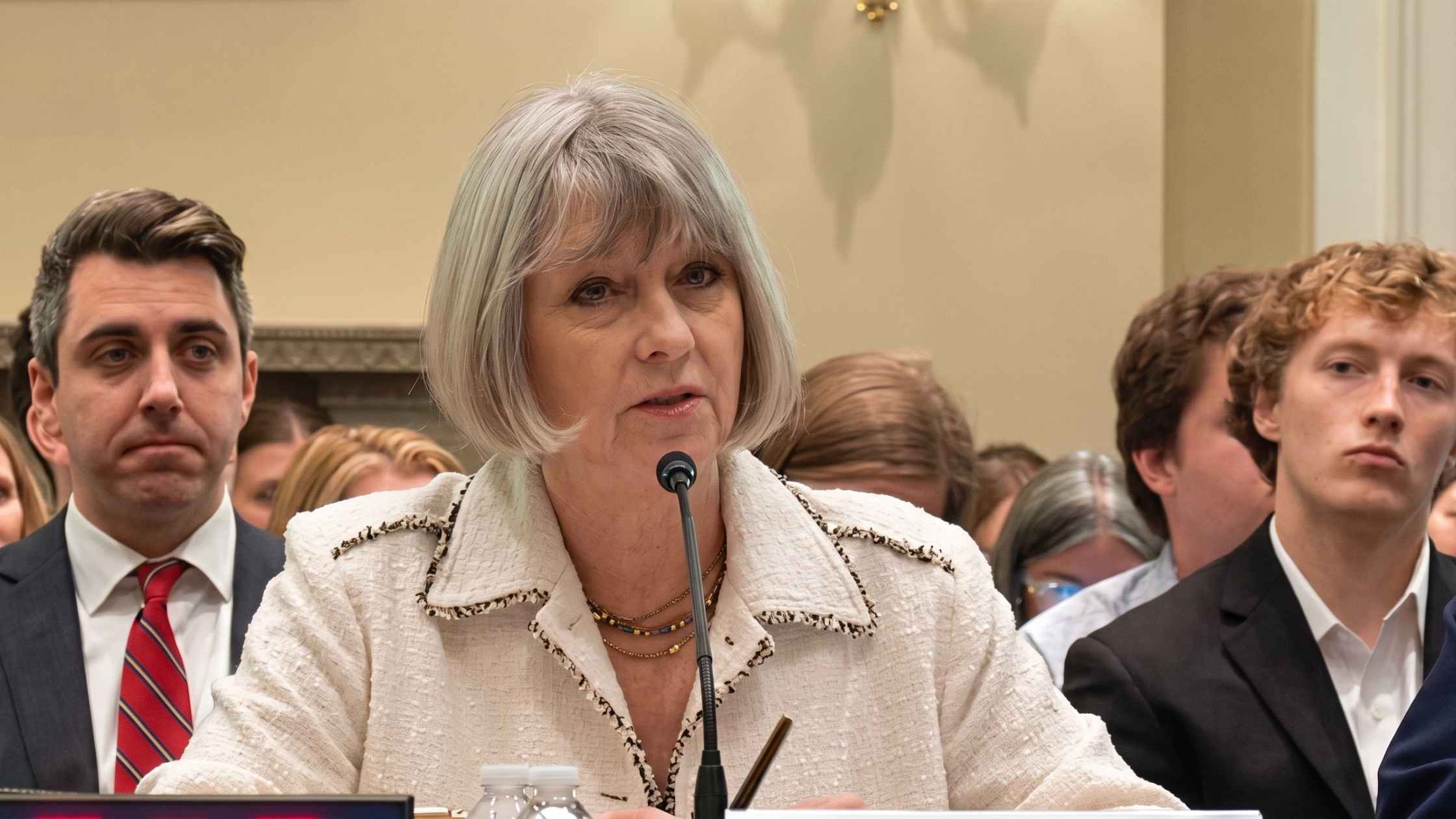
Bryan Steil (15:33):
The Committee on House Administration will come to order. The title of today's hearing is Oversight of the Smithsonian: Radical Revisionism at the National Museum of American History. I note that a quorum is present without objection. The chair may declare recess at any time. Also, that objection on the record will remain open for five legislative days so members may submit any additional materials they wish to be included therein. I now recognize myself for five minutes for the purpose of giving an opening statement. America has an incredible story to tell. 250 years ago, our forefathers declared independence from the British Empire and we won. We launched into world history the first civilization dedicated to the proposition that all men are created equal. Our constitution established a republican form of government with checks and balances that protect that proposition. We fought a civil war to preserve our union and finally free those in bondage.
(16:36)
Since then, we've revolutionized technology, liberated Europe, we planted the American flag on the moon. The Smithsonian National Museum of American History was established by Congress to champion our story. In 1953, the Smithsonian told Congress the National American History Museum would commemorate our heritage of freedom. At the museum's dedication in 1964, then President Johnson said the museum would foster patriotism. Unfortunately today, the museum has shifted its focus to political activism, but don't take my word for it. One of our witnesses today, our witness, Dr. Anthea Hartig, the director of the museum. Dr. Hartig, you said, "History is a prime tool of social justice." You believe your role as a historian is to connect "Research and scholarship to activism and advocacy." Your words. You have said, "Loving America is complicated. Sadly, it's not just rhetoric." You've built that into the museum's exhibits. You built it into the website to convey an ideological narrative that denigrates our founders, diminishes our achievements and seeks to divide American people.
(18:01)
The authors of the Domestic Policy Council Report argued that museum visitors should be warned and they said, "The exhibits in this museum were prepared by people who don't want you to love our country." If you read the full detailed report as you should, or if you just walk into the museum, it's hard not to agree with that conclusion, but I'll conclude this. It's not only okay to love America, it is great to love America. It's true our history isn't perfect. We continue to strive to create a more perfect union, but throughout our American history, we have striven, people have died as our nation continues to move forward to our founding father's goals to create that more perfect union. It does require introspection and honesty, but it also requires gratitude, appreciation and celebration of how revolutionary the American experience has been and continues to be.
(19:04)
The current focus of activism by leadership at the museum undermines that. It's unacceptable that American tax dollars are supporting divisive work. It's time to allow the United States to speak for itself. When it's America that speaks for itself, not the elites or NPR, the world loves America. Its success, our uniqueness, its exceptionalism. When the American story speaks for itself without ideological bias, political advocacy, or woke talking points, America is loved and admired. It's time the American History Museum returned to its core founding mission when it was created: fostering patriotism and telling our story of achievement. Unfortunately, the museum has strayed from that mission and that is the focus of today's hearing. I yield back and recognize the ranking member for five minutes for his opening statement.
Joe Morelle (19:58):
Good morning. Thank you, Mr. Chairman, and thank you to our witnesses for being here this morning. Let's not kid ourselves. We're here for one single reason. Because the President of the United States believes he is entitled to determine what is true about America's past. He is not. To understand what is happening at the Smithsonian Institution, we need to step back because this is not where it started. The President has spent his term reaching into the institutions that keep our national memory trying to bend them to his will. He fired the archivist of the United States, the keeper of the nation's records without a stated reason. He fired the librarian of Congress claiming she put "Inappropriate books in children's hands" at a research library that doesn't even lend books to the public. He purged the Kennedy Center's board, made himself Chairman and renamed it for himself until a court deemed it illegal. He ordered exhibits about the horrors of slavery, the horrors of slavery, people owning other people as property and stripped them from the national parks.
(21:09)
Each time, the same move. Take a best in class institution built to serve the public and corrupt it into one that serves him. The Smithsonian is just the latest in that long line. In March of 2025, he issued a directive ordering the Vice President to remove improper ideology from the Smithsonian. And this month, his White House issued a hyperpartisan report portraying a museum beloved by millions of Americans who come as annual visitors into one that he says, "Hates America." Perhaps some actual history would be useful here. Actual history. The Smithsonian is not part of the executive branch. Congress created it in 1846. Its 17-member Board of Regents is chaired by the Chief Justice of the United States Supreme Court. The President can neither appoint nor remove a single regent. The Organization of American Historians called the report that the White House produced, "An effort to coerce the Smithsonian into telling an inaccurate story that fits the President's political agenda." They're absolutely right.
(22:16)
When Orwell wrote, "Whoever controls the past controls the future," he meant it as a warning. The President took it as a mission statement. We have seen this before. The Soviet Union airbrushed, purged officials out of photographs until they vanished. The Tiananmen Square massacre appears nowhere in China's textbooks and is scrubbed from its internet. In Hungary, the recently ousted Viktor Orbán, the man Vice President Vance called, "A model for the United States" dictated the history taught in its schools. And we don't need to look abroad. We don't even need to leave this room. This committee has developed a pattern. Donald Trump reaches a conclusion unmoored from reality, the majority concocts a record to match, and he uses that record as proof that Congress agreed.
(23:06)
Take January 6th. Last Congress, this committee told the country the real wrongdoing wasn't the attack. It was the investigation. A month later, the President pardoned nearly 1,600 people, including those convicted of assaulting police officers. Today, the White House website cites this committee's report on a page blaming Capitol Police for the violence occurred during an effort to have an insurrection and stop the peaceful transfer of power in the United States. It's shocking. It's beyond shocking.
(23:42)
Or take elections. This committee built a record on voter fraud that virtually does not exist. Witnesses without evidence, findings without proof, which the President uses to undermine confidence in elections with claims that crumble each day in our courts, which brings us to today. Once again, this committee is attempting to put the congressional stamp of approval on one man's manufactured grievances. In reality, the Smithsonian already has the safeguards the President claims to be imposing.
(24:13)
A year ago, the Board of Regents reaffirmed the Smithsonian would remain "Free from political or partisan influence." The secretary issued a binding policy requiring all exhibits to be grounded in scholarship, balanced and nonpartisan. The White House report never mentions that. Before we appoint Donald Trump, the defacto curator of American history, remember this is a man who looked at the world's preeminent museum complex and concluded its problem is dwelling too much on, I quote again, "How bad slavery was." Really, Mr. President? The owning of other people as property? And you're concerned that we're going to talk about how bad that was? That's the problem. A president who still cannot admit that he lost the 2020 election. A president whose White House issued a self-contradictory report claiming the founders were erased from a museum displaying Jefferson's desk, Washington's uniform and the star-spangled banner. A report that condemns exhibits about people, I quote, "Foreign to the United States," then names those foreigners, Mexican Americans, Filipino Americans. In other words, Americans.
(25:33)
The Smithsonian is where a free nation tells its full story, triumphs and struggles. This story belongs to no president. It does not need saving from the historians who tell it. It needs saving from the ignorant ill-informed man on the other side of Pennsylvania Avenue. And with that, Mr. Chair, before I yield back, I would ask unanimous consent to enter the following into the record. A copy of the report issued yesterday by the committee Democrats responding to the White House report. A series of objects currently on display in the American History Museum's 250th anniversary exhibit, including a 2024 Trump campaign MAGA hat, a pro-gun rights button for the National Rifle Association, and an anti-abortion sign from a rally in Washington D.C. And also enter into the record a photo from the American History Museum gift shop taken yesterday featuring various busts of President Trump and multiple books written by or about President Trump.
(26:28)
A statement from the Organization of American Historians condemning the White House report, a statement from the American Alliance of Museums about Smithsonian independence. And finally, an NBC News article dated August 19th, 2025 titled "Trump Says The Smithsonian Focus is Too Much on How Bad Slavery Was." I'd ask unanimous consent to enter those into the record. And with that, sir, I yield back.
Bryan Steil (26:50):
Without objection and without objection, all other members' opening statements will be made part of the hearing record if they're submitted to the committee clerk by 5:00 PM today. Today we have a four witness panel. We have Dr. Anthea Hartig, Director of the National Museum of American History of the Smithsonian Institution. Next we have Mike Gonzalez of the Heritage Foundation, followed by Jeff Anderson of the American Main Street Initiative. And finally, David Blight, the Sterling Professor of American History at Yale University. Dr. Hartig, you're recognized for five minutes to provide an opening statement.
Dr. Anthea Hartig (27:30):
Good morning, Chairman Steil, Ranking Member Morelle and members of the committee. Thank you for the opportunity to be with you here today. I welcome the chance to answer your questions about the National Museum of American History and the Smithsonian Institution. And I appreciate the committee's important oversight role.
(27:52)
As an historian, I have spent my career studying, teaching and preserving the history of the United States. My family has served this nation since the Revolutionary War, and I was raised with a deep sense of obligation to this country and to the democratic ideals that it asks each generation to uphold. Since 2019, I have been honored to serve as the Elizabeth MacMillan Director of your National Museum of American History, home of the Star-Spangled Banner. It is a true honor to serve alongside my devoted fellow public servants who staffed the museum, and I'm immensely proud of our work.
(28:33)
Of course, Congress created the Smithsonian Institution in 1846 with an aspirational mission for the increase and diffusion of knowledge for all. And as you know, it's an independent trust instrumentality outside the executive branch and governed by a board of regents that of course includes all three branches and the nine citizens appointed by a joint resolution.
(28:59)
The Smithsonian takes the concerns raised in the White House Domestic Policy ...
Dr. Anthea Hartig (29:00):
The Smithsonian takes the concerns raised in the White House Domestic Policy Council's report seriously. And as we continue to fact check the report, we unwaveringly attest that it does not fairly or accurately characterize the full body of work at the museum. There is always room for improvement, but I also know the beauty, the inspiration, and the expertise that exists in our collections and our exhibitions and our programming. When a family walks through our doors free of charge as two million people did last year, they find the desk on which Thomas Jefferson drafted the Declaration of Independence. Horatio Greenauer's magnificent statue of George Washington, Abraham Lincoln's top hat, the Greensboro lunch counter, the gowns of the first ladies, and the stories of Americans in uniform. They find the inventions that changed the world and the ordinary Americans who built it. I have watched 10-year-olds with their families stand in front of the Star Spangled Banner with their hands over their hearts. No one told them to. That is the National Museum of American History at its most powerful, patriotism not instructed but inspired. Our work is governed by the Smithsonian standards of scholarship, accuracy, independence and non-partisanship. The museum does not take sides in America's political debates. We preserve and document the evidence of American life in all its breadth so that the public can encounter the past and draw their own conclusions.
(31:11)
We are also always learning. When visitors, scholars, members of Congress, veterans, teachers tell us we've gotten something wrong or only half right, we take it seriously and we make changes when the evidence supports it. And when historians talk about reframing a traditional narrative, we do not mean erasing it. We mean adding the evidence, the voices, the objects that earlier tellings left out so that more Americans can see American people and a commitment to constantly being in pursuit of that perfect union.
(31:48)
I hope that you will judge the museum the way the American people do, by what's on its walls and what's in its care. Please accept our sincere invitation to come visit. Walk the building with me, stand in front of the Star Spangled Banner in awe. I believe what you shall find is not an institution that has forgotten its country, but one that loves it enough to tell the full sweep of our history, the triumphs and the struggles. I love the United States of America, I consider it the privilege of my career to help preserve its treasures and to serve the American people. I'm very grateful for the committee's work and happy to be here with you today. Thank you, sir.
Bryan Steil (32:34):
Thank you very much. Mr. Gonzalez, you're recognized for five minutes.
Mr. Gonzalez (32:39):
Chairman, Ranking Member, members of this committee, thank you for the opportunity to testify. I'm a Senior Fellow at the Heritage Foundation, the views I express in this testimony are my own. In 1964, as you mentioned Chairman Steil, at the opening of what was later to be renamed the National Museum of American History, President Johnson said the purpose of the museum was to, "Foster patriotism." Director Kellogg noted that the museum would, "Awaken a clear understanding of this inspiring story of the United States." 62 years later, the History Museum is failing to do any of this. Instead of highlighting important parts of American history such as the founding, the current leadership of the History Museum chooses to focus on showcasing American history as one that is problematic, destructive, and oppressive. The museum leaders use this institution to promote a Marxist and Gremsion view of the world that sees everything as a battle between oppressors and the oppressed. This is why it has an entire center devoted to something called restorative history. The History Museum even has education plans that target students in pre-K through third grade to indoctrinate them on open borders and LGBTQ matters. Pre-K.
(33:53)
I'll cut to the chase. Yesterday in a separate hearing, also on the Smithsonian, I called for you and Congress to work with the Board of Regents to dismiss the entire leadership of the Smithsonian. I also called and do so again now for you to de-authorize the yet to be built Latino Museum, which will also become an incubator for anti-American grievances. Present leadership cannot make the changes that are needed to correct course. Secretary Lonnie Bunch III, Anthea Hartig, the director of the History Museum and one of today's witnesses, and other museum leaders have commandeered the world's largest museum complex and tell us themselves that they intend to use it as a tool for societal transformation.
(34:32)
This is not why America's entrusted these institutions to them. National museums are repositories of a nation's collective inheritance so that it can be transmitted to future generations. The leadership is the entity at fault here. It is they who set the standards and guide the staff. In one example, the leadership of the History Museum for years made staff take part in a reading group to discuss the museum as a site for social action toolkit, also called a mass to action toolkit, that alleges that objectivity, I'm quoting here, "Objectivity, individualism, perfectionism, worship of the written word, and other traits are characteristics of white supremacy culture."
(35:13)
This is revolting. In fact, the Smithsonian itself publicly agreed it was. It apologized in 2020 after the National Museum of African American History and Culture exhibited a chart with its nonsense, outraging the public. The museum leadership issued a statement saying we erred in including the chart, we have removed it, and we apologize. At yesterday's hearing, Director Hartig said the Smithsonian didn't develop the toolkit, but the toolkit was co-authored by half a dozen current and former Smithsonian employees. And Dr. Hartig's museum kept surreptitiously indoctrinating staff with this trash for three years after the museum apologized for using it, which shows the promises of reform are written in sand.
(35:54)
But wait, there's more. It just so happens that it was Lonnie Bunch who called for these trainings when he was co-chair of the Excellence in DEI Task Force. This 2022 report by a task force co-chaired by Secretary Bunch in which bears his name, calls for staff to receive formal education on DEAI and calls for leadership to create training forums, it praises the mass action toolkit as offering, "Good resources to start this work." But wait, there's more. Lonnie Bunch himself agrees with this racist nonsense. The report calls to, "Shift leaders and museum professionals away from white dominant characteristics of perfection, risk aversion, and conflict avoidance." Does anyone in this committee believe that perfection is a white characteristic? The man who runs the museum apparently does. This insanity has gone on long enough.
(36:52)
Once again, I call on Congress to do its duty and take back the Smithsonian from a rogue leadership that now uses it as their own play thing for dangerous ideological games. Loving America is not complicated, Mr. Chairman. Thank you.
Bryan Steil (37:07):
Thank you. Dr. Anderson, you're recognized for five minutes.
Dr. Anderson (37:12):
Chairman Style, Ranking Member Morelle, and members of the committee, thank you for the opportunity to testify today. The National Museum of American History is perhaps the most important museum in America. Yet rather than depicting American history traditionally and conventionally as the glorious and inspiring though imperfect story of a nation conceived in liberty, it depicts it as a history of oppressors versus the oppressed with most traditional American heroes portrayed as oppressors. When not condemning our history, it simply ignores huge swaths of it. As Chairman Steil and Mr. Gonzalez noted, at the museum's dedication, President Johnson said its artifacts should be used to foster patriotism. Director Anthea Hartig seems like a very nice lady, we just met a moment ago in the waiting room, but in marked contrast to Johnson, she has said at the National Museum of American History, "We want to reframe the traditional celebratory narrative of U.S. history." She's also spoken of the need to problematize the 250th anniversary of the Declaration of Independence, and as Chairman Steil noted, has opined that loving America is very complicated.
(38:21)
Increasingly, the National Museum of American History isn't a museum about American history, but rather about activists' attempts to shape the future. Indeed, Smithsonian Secretary Lonnie Bunch has said museums should be used to inspire new generations of activists. The newer exhibits at the American History Museum are not nuanced but simplistic, viewing our rich history through the narrow lens of oppression. The exhibits open under Director Hartig are heavy-handed, artless, agenda-driven, and dumbed down. Worse, they're anti-American, anti-historical, and dis-unifying. They focus on group identity at the expense of the shared national identity that Lincoln said should be built around a common belief in our founding documents and principles. Further dividing Americans in the museum's newer displays, every sign in English is paired with one in Spanish. As a result, exhibits are cluttered with words with no additional information conveyed.
(39:16)
The museum says little about the colonial period, the American founding, the Louisiana Purchase, the Lewis and Clark Expedition, the Lincoln-Douglas debates on slavery, the pioneers and settlers of the American West, the Roaring '20s, the Great Depression, the Cold War, and much else. Instead, it features exhibits on such matters as really big money, which discusses large, almost entirely foreign currency. Here we learn that the tail feather of a male quetzel bird is 21 inches long and those living in Mexico and Central America once used quetzel tail feathers to make payments. In a large exhibit on low riding culture, we learn as the song Low Rider plays on a loop, that low riding is more than blinged out cars, it's a way of life. Another exhibit opened during this 250th year of American independence is called Piro Ripmo: The Musical Journey of Salsa. It's actually a close call whether more of the museum square footage is devoted to salsa music or to the American founding, but salsa is presented a lot more favorably.
(40:13)
In the American Democracy exhibit, the museum presents two ways to view our nation's founding. Was it a complete, perfect, sacred event led by a great patriot who as American children would learn never told a lie? Presumably not, so that leaves this. Or was it part of a wider, unfinished movement that was deeply imperfect? Across the hall, 1492 to 1776 is referred to as the time of unsettling the continent. Meanwhile, the entire east wing of the second floor, roughly one sixth of the museum, contains no exhibits whatsoever. It's essentially empty. Visitors can vote with their feet, and many have. The American Alliance of Museums says 2024 attendance at a majority of U.S. museums matched or surpassed pre-COVID levels. But at the American History Museum, according to the Smithsonian's own published statistics, there were 4.1 million visits in 2018, but just 1.8 million in 2025, a 56% drop in visits on Director Hartig's watch.
(41:10)
Last fall, John Fonte and I had the chance to interview Ken Burns. When I asked who came off as the greatest hero in his documentary, The American Revolution, Burns replied, "Oh, without a question, it's George Washington. We don't have a country without him." None of that sentiment appears in the newer exhibits of the National Museum of American History. That's because such exhibits aren't designed by old school liberals, by centrists, or by conservatives. They're designed by woke activists, woke revolutionaries who don't believe in the ideals of the American Revolution. Such activists want to fundamentally transform the nation and are using the museum to that end. China, Iran, or Russia would happily finance such anti-Americanism in our national museums, but they don't have to because American taxpayers are unwittingly footing the bill. It's past time for change of leadership at the Smithsonian. Thank you.
Bryan Steil (42:01):
Thank you. Dr. Blight, you're recognized for five minutes.
Dr. Blight (42:07):
Thank you, Mr. Chairman and Ranking Member and members of the committee. It's a rare chance for a lowly historian to be invited to defend his craft before Congress, and it's also a great privilege to sit next to my predecessor as president of the Organization of American Historians, which Anthea Hartig was. As historians, we often dwell in the past. Professionally, we should. In spring 2025 with the president's executive order restoring truth and sanity to American history and now with the White House report saving America's story, the present has come storming into our work lives with a vengeance, and we welcome the challenge. The present is inherently interwoven with the past, like it or not. The White House now believes it should pronounce on the nature of history and the presentation of the nation's treasures at the Smithsonian. The recent report by the White House Domestic Policy Council is nothing less than a declaration of political war on the historian's profession, as well as on the freedom and curiosity of anyone who reads or visits museums. In other words, President Trump has declared war on free minds and free education.
(43:36)
Historians are not voices for the state, we are keepers of memory. At our best, we are storytellers with trained imaginations. That White House Council contains not a single person trained in history, and yet they declare with such certainty what forms of, and these are their words, heritage, destiny, settled truths, and indeed stories that the Smithsonian should, in one of their favorite verbs, instill in the minds of the public. Historians are now fighting back in the interest of scholarly history well told for the broadest possible public. Ours is a beautiful and ancient craft. It's essential for any society's need for self-understanding. We are equipped with a host of modern methods, but guided ethically by some very old rules that no authoritarian political movement ought to ever be allowed to profane.
(44:42)
A historian reads and listens, searches, measures, imagines his or her way into and through all manner of evidence, facts sometimes clear and sometimes slanted every which way. We examine and we read and we accumulate and sift and study all these modes of evidence with hopefully empathy and humility. Then we rise from all of our data and our sources and all manner of context and we fashion it into a story in order to inspire and take our audiences somewhere. And once we get them there, we are bound by our craft to make an argument about why this all happened and why it matters.
(45:32)
People often comment about how Trumpism would like to return us to some version of the 1950s when America was deemed great. In this report, they have transparently done exactly that. The report is rooted explicitly in the founding of the National Museum of American History in the Cold War of the 1950s in its dedication speeches and so forth. The founding words and sentiments are quite understandably breathing a kind of rhetoric of Cold War triumphalism. How could it not have? The report offers no context for what might have invoked such expressions. The Soviet achievement of the hydrogen bomb, Sputnik, the Korean War, the Cuban Missile Crisis, the March on Washington, and the assassination of President Kennedy. Had the Domestic Policy Council consulted trained historians, they might have provided such context. They might also have consulted Edward R. Murrow's famous commentary in 1954 on Joseph McCarthy and his assaults on free speech. "We can deny our heritage and our history," said Morrow, "But we cannot escape responsibility for its results. Erase McCarthyism and it will come back. Triumphalous history cannot tolerate nuance, ambiguity, complexity, but they are the lifeblood for real historians."
(47:03)
Also in a deep Cold War context, James Baldwin wrote in 1962 in an essay entitled As Much Truth as One Can Bear, that the problem of the way Americans approach history is that, his words, "Words are mostly used to cover the sleeper, but not to wake him up."
Bryan Steil (47:25):
Mr. Blight, your time has expired. Your full testimony will be inserted into the record. We thank you.
Dr. Blight (47:30):
May I finish that sentence?
Bryan Steil (47:32):
But we'll let you finish your sentence.
Dr. Blight (47:34):
Thank you. We do not write woke history, whatever that is, but we do try to awaken citizens. In recent decades we sowed a wind and now we're reaping the whirlwind. Thank you.
Bryan Steil (47:49):
Thank you, Mr. Blight. Thank you all for your testimony today. I'll begin questions followed by the ranking member. I now recognize myself for five minutes. Director Hartig, do you believe that the American History Museum should be politically neutral?
Dr. Anthea Hartig (48:11):
Yes, sir. I do.
Bryan Steil (48:13):
Do you believe that the American History Museum should advocate for contemporary political or social causes?
Dr. Anthea Hartig (48:22):
No, sir, the American History Museum does not advocate.
Bryan Steil (48:25):
Do you think the American History Museum should avoid the appearance of bias?
Dr. Anthea Hartig (48:30):
Absolutely.
Bryan Steil (48:31):
Do you believe that one of your roles is connecting research and scholarship to advocacy and activism?
Dr. Anthea Hartig (48:42):
No, sir, I do not.
Bryan Steil (48:45):
I want to be clear on this, you don't believe that one of your roles is connecting research and scholarship to activism and advocacy?
Dr. Anthea Hartig (48:52):
I believe perhaps you're quoting from some of my public speeches.
Bryan Steil (48:56):
Yeah, 2020 University of California Riverside virtual lecture, which you said that one of your roles is connecting research and scholarship to activism and advocacy. You said that in 2020, and so I just want to be clear on the record that in the video that I watched, this 2020 online, and you can watch it on YouTube, everybody at home, we'll put it up for folks, but you're now saying that you don't believe that that is one of your roles. Has your position changed on this topic?
Dr. Anthea Hartig (49:27):
Thank you, I better understand your line of querying. I think what's important for me is that-
Bryan Steil (49:34):
I only have five minutes, I just want to be direct. Just real clear, you just answered my question differently than you answered it five years ago, which positions can change so I just want to understand. In 2020, did you believe that one of your roles is connecting research and scholarship to activism and advocacy? In 2020, did you believe that?
Dr. Anthea Hartig (49:56):
So one of the roles of an historian is-
Bryan Steil (49:58):
Just yes or no. I mean in 2020, just real straightforward and for the record, you said this, so it should be an easy yes. It shouldn't be complicated on my side, but maybe it's complicated on your side. In 2020, I'm not even asking what you believe today, in 2020, did you believe that one of your roles is connecting research and scholarship with advocacy and activism? Yes?
Dr. Anthea Hartig (50:19):
One of the key things a historian does, especially at the National Museum of American History, is to tie threads together.
Bryan Steil (50:27):
I'm going to just note your filibustering on the answer. You said it. In 2020, you said it, so I'm going to assume in 2020 you believed it, unless you said things you don't believe. So in 2026, as we sit here today, I'll ask you for the record one additional time, today, do you believe that one of your roles is connecting research and scholarship to activism and advocacy?
Dr. Anthea Hartig (50:50):
As a historian, I believe that intellectually we can connect those two together. Absolutely.
Bryan Steil (50:57):
So it is one of your roles to -
Dr. Anthea Hartig (51:03):
As a historian, absolutely.
Bryan Steil (51:03):
To be an activist?
Dr. Anthea Hartig (51:05):
No, sir, to-
Bryan Steil (51:05):
One of your roles as a historian is to ... Go ahead.
Dr. Anthea Hartig (51:11):
One of my roles as a historian and the Director of the National Museum of American History is to help connect the long history of activism and advocacy on all topics from gun rights to identity to immigration. That is a connection that I make.
Bryan Steil (51:29):
And do you think that that is important to show that advocacy and activism at the National History Museum?
Dr. Anthea Hartig (51:35):
I believe our work is grounded in rigorous scholarship and that we often will connect both our objects and two million that we share with the American people to the major-
Bryan Steil (51:46):
I'm just trying to ... Help me square this. You think that the American History Museum should not advocate for political or social causes, you just said that. You think it should be politically neutral, but you also are stating that one of your core roles is connecting research and scholarship to activism and advocacy.
Dr. Anthea Hartig (52:09):
One of the core roles-
Bryan Steil (52:11):
I mean do you support activism and advocacy or do you think your goal at the museum should be neutral?
Dr. Anthea Hartig (52:17):
Our goal at the museum is to educate all Americans and everyone who comes through our door free of charge.
Bryan Steil (52:23):
To persuade them?
Dr. Anthea Hartig (52:25):
Our goal is to educate them about the history of the United States.
Bryan Steil (52:28):
In a neutral way?
Dr. Anthea Hartig (52:30):
Absolutely.
Bryan Steil (52:31):
Do you think ... You noted in your statement that you love America. I love America too. For me, that's not complicated. Do you believe loving America is complicated?
Dr. Anthea Hartig (52:41):
My personal belief is that loving America is not complicated. But as an historian, I can tell you that over time it has been very complicated for many people.
Bryan Steil (52:51):
So for you, loving America is not complicated.
Dr. Anthea Hartig (52:54):
It's unconditional.
Bryan Steil (52:55):
I appreciate your testimony here today. I yield back. I'll recognize the Ranking Member for five minutes.
Dr. Anthea Hartig (53:01):
Thank you.
Joe Morelle (53:08):
I'm not sure ... My mic is on, sorry. The microphone, don't take this off my five minutes, the microphones here are awful. Anyway, thank you, Mr. Chair, for yielding. I want to just, before I get to my question, just make an observation.
(53:26)
Mr. Gonzalez talked about George Washington, who I consider the greatest American and set precedence in his presidency. His decision to relinquish his command after the Revolutionary War some of the greatest acts not only of history, but set enormous precedents for this country. But you know what? In 1754, George Washington, under his first command, led an ill-fated command that was disastrous, that ended up in defeat and surrendered at Fort Necessity. I didn't really learn that until much later in my life. By the way, that didn't change my view of George Washington, it just reminded me that we're all humans, that we have successes and failures, and actually that lets us recognize that we're all multidimensional.
(54:13)
By the same token, I think about the dual nature of our founding, and I may get this wrong from memory. "We hold these truths to be self-evident that all men are created equal, that they are endowed by their creator with certain inalienable rights, that among these are life, liberty, and the pursuit of happiness." One of the greatest, Walter Isaacson wrote a book, The Greatest Sentence Ever Written. But the dual nature of it is while we're talking about rights that are inalienable, given to us by God our creator, we still denied them to Black Americans who were enslaved and owned by other people. That at the same time, all of my counterparts, many on both sides, had no rights at all as women. So it's a dual nature. Yes, we celebrate, it's extraordinary, but boy, how could we not call that complicated? I love America unconditionally, but I recognize we have our challenges. That is actually what history is about.
(55:08)
And by the way, I think we learn more and do better by our failures and what we learn from them than by our successes. That's true in baseball, it's true in legislating, it's true in just about everything. That is the nature of what history teaches us. It's fundamental to what we do. And by the way, I love my wife unconditionally. I don't always agree with her shockingly, and I hope she's not watching this because I'll get in trouble. But unconditional love is like that. And our understanding of where we've been and where we should go should be informed by the entire complete history. That's what I love about the Smithsonian, you do something extraordinary, world-class extraordinary. And I'm biased, I'm also biased by the work of Dr. Blight for his incredible biography of Frederick Douglas who did much of his work in the city of Rochester, New York, for which I'm incredibly proud.
(56:05)
But I do want to give you a moment just to clarify to the chairman's question, Dr. Hartig. To be clear, I don't think you said you were promoting social activism. I thought the point you were trying to make was tying together the elements of our history so that you better understand social activism in all of its forms. I don't want to put words in your mouth, but I do want to give you a moment to just fully answer that and at least make me believe if what you were saying is the way I interpret what you said.
Dr. Anthea Hartig (56:39):
Thank you for that opportunity, sir. You are correct. And I think that one of the key roles that the museum can do is to connect those tissues. I would also offer that my words five years ago are not museum policy, they are my spoken words as would any of us be lecturing or sharing comments to audiences. So I think that when you look at the depth of the collection, we started kind of contemporarily collecting all social movements starting with Dr. King's march on Washington, so we have a phenomenal collection. Thank you.
Joe Morelle (57:21):
Yeah, I don't mean to cut you short, but I appreciate that. I cannot ask Dr. Blight a question that doesn't relate to Frederick Douglas, so thank you for your work and I talked about his connection to Rochester, which I'm incredibly proud of. What would he say about this report that it strucks the National Museum of American History, which parts of the story it's permitted to tell? Can you channel having spent so much time on him?
Dr. Blight (57:46):
Well, I can try.
Joe Morelle (57:47):
And do it in 30 seconds, sorry.
Dr. Blight (57:50):
Oh, he would cut to the chase. He might go to the middle of his 4th of July speech where he took his audience through a litany of all of the horrors from the hold of a slave-
Dr. Blight (58:00):
All of the horrors from the hold of a slave ship through a slave auction to the slave's experience on plantations where he, through language and words, made his audience feel that experience in their senses. And then he would say, "If you erase this, there is no country left."
Joe Morelle (58:22):
Thank you. And I appreciate that. And as I yield back, I just-
Dr. Blight (58:27):
But I wasn't able to ask him. I'm not sure.
Joe Morelle (58:29):
No, no. But I appreciate your scholarship on the subject. And as I said, we only learn by learning the entire truth, not the parts that make us feel good about ourselves. So anyway, I yield back. Thank you.
Speaker 1 (58:42):
Gentleman yields back, the gentlewoman from Florida. Representative Lee is recognized for five minutes.
Representative Lee (58:48):
Thank you, Mr. Chairman, and thank you to our witnesses for being here today. This is indeed an important hearing. I want to start with this. It was said earlier today that President Trump wants our parks and museums to tell an inaccurate story of American history. So I believe it's incumbent upon us to begin by actually thinking about the story of American history and whether what we pursue here today is in fact in any way inaccurate. We've learned that the museum has a number of directives, goals, things that we've heard about this morning, one of which in our materials is the interpretive plan to frame exhibits and curate exhibits, whatever the topic, to include a discussion of things such as race and identity, gender and sexuality, environmental change, immigration, economic inequality. So I'd like to start with you, Mr. Gonzalez, and get back to the idea of what is an accurate or inaccurate story of American history.
(01:00:11)
Would it be an inaccurate presentation of American history if our museum instead made an effort to present to those who came to see it an interpretation that involved our founding documents like the Declaration of Independence, the Constitution, the Separation of Powers? Would that be an inaccurate telling of American history to focus on those things?
Mr. Gonzalez (01:00:39):
Representative Lee, no, it wouldn't. I actually agreed with almost everything Representative Morelle said, except until the party got to the Smithsonian. I think all of history should be presented. The horrors of slavery, the absolute blight that this was in our history, but also the fact that the founders created this system to deal with it, that men marched to the tune in the Battle Hymn of the republic saying "As he died to make men holy, we shall let us die to make them free." That inspiring story also needs to be part of the horrors of slavery.
Representative Lee (01:01:15):
Correct. Not just our failures in our shortcomings, but also the efforts that were made to correct them. And now what about this? Would it also be an important part of American history to celebrate American innovation, enterprise, scientific achievement and economic opportunity?
Mr. Gonzalez (01:01:32):
Absolutely, yes.
Representative Lee (01:01:32):
And would it also be an appropriate thing for our institutions and our museums to be focusing on the military service, sacrifice and defensive freedom that we have seen in our country throughout history?
Mr. Gonzalez (01:01:44):
They should be presented as well. The triumphs and the curators of the museum should not go out of its way every time to smear every one of these triumphs.
Representative Lee (01:01:54):
And a note on the curators, I note in your written testimony that one of the things that you presented for our consideration was an assessment of the political party affiliation of museum directors and curators in America. Would it be accurate to say that not just the majority, the vast majority of museum directors, curators, conservatorists, historians and administrators are actually Democrats?
Mr. Gonzalez (01:02:19):
Yeah, that is a [inaudible 01:02:21] lab study which shows quite how much to the left all the professions related to museums are, but it's the job of leadership to guide them, to check their biases. And in fact, the leadership at the has been doing exactly the opposite, has been training them not to check their bias, but to act on their biases.
Representative Lee (01:02:40):
And to your knowledge, is there any objective metrics standard audit outside group that is considering the presentation of these exhibits and whether, in fact, bias exists?
Mr. Gonzalez (01:02:52):
Yes, I believe private individuals have tried to do-
Representative Lee (01:02:56):
Private individuals, but not within the museum.
Mr. Gonzalez (01:02:58):
Well, the administration did ask the Smithsonian to cooperate with an audit and the Smithsonian pretty much refused. It refused to hand over the materials that had been asked for. It handed some things, but not to the degree that Rose Vogt, at OMB and Vince Haley at the Domestic Policy Council had asked for.
Representative Lee (01:03:18):
Now a question for you, Dr. Hartig. Since 2019, you have donated to political advocacy groups and campaigns over 350 times according to information pulled from the FEC. Is that correct?
Dr. Anthea Hartig (01:03:37):
Ma'am, I am not here. Oops. Is that on?
Speaker 1 (01:03:39):
We hear you.
Dr. Anthea Hartig (01:03:44):
Ma'am, my political beliefs or my political contributions are not relevant to this conversation.
Representative Lee (01:03:49):
And of these hundreds of donations since you've been leading the museum, have all of them occurred while you were off duty and off of government premises, in your private time?
Dr. Anthea Hartig (01:03:57):
I adhere completely to the Hatch Act, so the answer is yes.
Representative Lee (01:04:00):
All right. Thank you, Mr. Chairman. I yield back.
Speaker 1 (01:04:02):
The gentlewoman yields back. Representative Sewell is recognized for five minutes.
Representative Sewell (01:04:05):
Thank you, Mr. Chairman. I want to thank our witnesses for being here today. Our country has a remarkable history of unparalleled accomplishments, not because our past is exempt from injustice, but because the people of this country have remained committed to our founding ideals of liberty, equality and democracy despite extraordinary struggles to achieve full rights. No one understands that better than the people of my district, Alabama's Seventh Congressional District, which includes the historic cities of Birmingham, Tuscaloosa, my hometown of Selma, Alabama. The valiant efforts of foremothers and forefathers of my district gave rise to the civil rights movement, the voting rights movement. Their protest and direct political action brought this country much closer to living up to its creed of liberty, life and the pursuit of happiness. Their sacrifices led to the enactment of both the Civil Rights Act of 1964 and the Voting Rights Act of 1965.
(01:05:08)
We're incredibly proud of that, but we also know that this country, according to its own preamble in the Constitution, is in pursuit of a more perfect union. Our founding fathers acknowledge that we were not there. And I think that today we can acknowledge that we're still not there. But I can tell you that the arc of the moral universe does bend towards justice. It just doesn't bend by itself. It takes the courage of Americans to live up, to make this nation live up to its highest ideals of equality and justice for all. These are cherished values of America. I too love this country unconditionally, but I can tell you that that is hard sometimes when you hear and read about how we treated the forefounders of this country who were Indians. When you read about and understand that our history is very complicated. And as historians, I think that the fact of the matter is the Smithsonian and other historians, as Dr. Blight just said, they do an incredible job of trying to tell the truth. And the truth is the whole truth, not just the parts that make us feel good.
(01:06:25)
I'm proud of the work that is being done by the Smithsonian Institute to preserve our nation's history. In my district, I appreciate that the Smithsonian affiliate, the Birmingham Civil Rights Institute, which keeps the stories of Birmingham and the civil rights movement alive for future generations to learn and enrich from. These are important institutions. Now this administration's crusade to take control of the "American History Museum" I think is not only dangerous, it's perilous. On March 27th, 2025, the president issued his executive order entitled "Restoring Truth and Sanity to the American History." However, this administration is not restoring truth and sanity to American history. On the contrary, it's creating an untruth sanitation of American history.
(01:07:17)
Now, Professor Blight, in a guest essay that you published in The New York Times, you mentioned how the White House Domestic Policy Report is not a document about history, it is a product of a racial and political ideology and search of history that no longer bears sanity, I mean scrutiny, that no longer bears scrutiny. Can you please espouse on that statement a bit more for us? And can you explain why this administration by tampering with history is risking a historical record that is not correct?
Dr. Blight (01:07:52):
As in other places in the past where governments and states have tried to control history, what they are really doing is trying to control thought, free speech.
Representative Sewell (01:08:03):
That sounds reminiscent of fascism.
Dr. Blight (01:08:06):
Well, you use that word, that's fine. There've been plenty other examples. What do authoritarian regimes do first? They assault libraries, archives, schools, universities, cultural institutions. This is an old, old record and we don't have to just go to the 1930s to find it. This hearing indeed has the word revisionism in its title. I wonder if you understand what a fat pitch that is for historians. All history is revision. The first revisionist was Herodotus.
Representative Sewell (01:08:45):
Yes.
Dr. Blight (01:08:46):
2,500 years ago. Would you prefer your doctors not to be revisionist? Do you want to go to a pediatrician who's not a revisionist, who hasn't learned anything new since his or her first training? We revise because it's our job. It always will be. Thank you for putting that word in your title.
Representative Sewell (01:09:11):
Thank you for all the work that you do to make sure that this country's history is not just the history of what makes us feel good, but is a complete history of the wonderfulness that is American.
Speaker 1 (01:09:25):
Gentlewoman yields back. Gentleman from Georgia, Representative Loudermilk is recognized.
Bryan Steil (01:09:30):
Thank you, Mr. Chairman. Very important hearing, more important than a lot of other things that we do up here. Mr. Gonzalez, you mentioned something that Mr. Morelle said, and I agree with, that it's important to reveal all aspects of our past, good, bad, indifferent, and allow individuals to really draw their own inspiration and conclusion of that. Do you agree with that?
Mr. Gonzalez (01:09:57):
Oh yeah, absolutely. Yeah.
Bryan Steil (01:09:58):
Okay. Let me ask you this. Is it possible to reshape or as the word we've heard here, reframe, the truth of our past by only highlighting one aspect or displaying one aspect of it and not the entirety?
Mr. Gonzalez (01:10:18):
Yes, it is. And I believe that's what the leadership of the Smithsonian is doing and they telling us they're doing it.
Bryan Steil (01:10:23):
Okay, thank you. Mr. Anderson, we've heard my colleague over here and friend Mr. Morelle adequately quoted the second line of the Declaration of Independence and we've heard how that has been a focus, especially during the 250 anniversary and that is incredible. There's other aspects of that incredible document that are important too to our past. And one of that is the last line of the declaration that says, "And in support of this declaration, with a firm reliance on the protection of divine providence." Faith played a huge role in the beliefs and the founding of our nation. Do you agree with that?
Dr. Anderson (01:11:04):
Absolutely.
Bryan Steil (01:11:05):
Do you see that that aspect of our founding and through various aspects of our past is also adequately displayed within our museums?
Dr. Anderson (01:11:15):
No, it's essentially invisible by the stone copy of the Declaration of Independence, a very valuable object in the museum, the words endowed by their creator are taken out of the reference to the Declaration of Independence. Key part, the freedom of religion, such a huge aspect of our constitution of the First Amendment, not discussed at all in that relatively paltry section of the museum-
Bryan Steil (01:11:40):
Who's also published books on American history. Today we go to the archives and we're going to see the original copy of the declaration that was passed by Congress in 1776 and there's 27 grievances. However, true history is there were 28 grievances listed in the original draft of the declaration, the 28th grievance being a harsh condemnation of slavery in the slave trade. It's hard to find that in any of the museums that I have been going to. Have you seen that that aspect of the efforts to abolish the evils of slavery actually began in the very beginning of our nation?
Dr. Anderson (01:12:23):
No, I have not seen that represented and it is hugely important, I agree. In Jefferson's draft of the Declaration of Independence, he talks about he leaves his harshest condemnation for the King. He accuses him of keeping open the slave trade, keeping the colonists from limiting it. And he talks about how he's determined to keep open a market where men should be bought and sold. And he puts men in all caps, MEN, making no question of the fact that he views the slaves as men, as human beings, obviously including female slaves as well. This is a huge aspect of our history and our thought. And to go beyond that, I would argue that as much as... I mean, I agree with everything that's been said about the need to tell the good and the bad about our history, but I would also say that our founding generation probably did more to overcome and eliminate slavery in this country than any other one except for the one that spilled blood during the Civil War.
Bryan Steil (01:13:14):
Wouldn't that be an important story I think to tell, especially our children?
Dr. Anderson (01:13:18):
I think it's a hugely important story.
Bryan Steil (01:13:20):
All right, thank you. Dr. Hartig, do you believe it is the role of the museum to objectively display the history of the United States or subjectively interpret our past to shape the thoughts, beliefs and understanding of future generations?
Dr. Anthea Hartig (01:13:34):
Thank you, sir. I believe that the role of the National Museum of American History joined by many other history museums, is to present scholarly evidence based on objects, interpretation, and share those stories with the American people.
Bryan Steil (01:13:49):
Do you believe it's important to show the entire story, the whole story, to present all sides?
Dr. Anthea Hartig (01:13:59):
I think especially about the revolution, if I may, we have a dozen exhibitions that include the founding era right now. 368 objects, 340 labels. George Washington is mentioned 54 times. You have to walk by a whole section on George Washington in a Kenneth Baring Hall of Military History to get to a 15-foot tall reproduction of the Declaration of Independence.
Bryan Steil (01:14:24):
My time is expired. I yield back.
Speaker 1 (01:14:26):
Chairman Yields, Representative Johnson is recognized for five minutes.
Representative Johnson (01:14:30):
Thank you, Mr. Chairman. We must all ensure that our history is not rewritten by one political party or an administration. American history belongs to all of us. It belongs to indigenous communities across this country striving for self-determination. It belongs to the abolitionists who challenged slavery, to the suffragists who fought for women's rights to vote, and to the immigrants whose contributions have shaped our nation's greatest achievements and to so many more. History's not meant to fit a political narrative. A history of a record of who we are and what we continue to strive for, it only belongs to the American people. While American history includes extraordinary achievements, remarkable innovation, and tremendous courage, it is every generation's responsibility to ensure that our nation's darkest chapters are not rewritten, but instead inspire honest discussion, reflection, and a deep commitment to self-correction. Our institutions, museums, archives, and historical records have an obligation to the truth and to ensure that every American understands that this country and what we are inheriting.
(01:15:37)
The promise of America, the promise of freedom is our willingness to learn from our darkest moments. Right now, we are seeing an unprecedented level of attacks from Republicans in the Trump administration towards independent institutions, challenging historians, educators, archivists, and those who are entrusted to protect our democracy. Beginning in January 2025 with Trump's executive orders that closed diversity offices, promoted language and content changes on government, websites with states like Texas following along, removals of references to Trump's impeachments in the American History Museum. Published White House reviews of Smithsonian exhibits, including lists of what it finds objectionable. And lastly, accusations that the American History Museum is denigrating white male Christian history. This administration is obsessed with ideologically influencing historically accurate interpretations of American history. Let me set the record straight. American history should be interpreted, analyzed differently over time and debated endlessly. The importance of these museums is to invoke a sense of curiosity or debate, perhaps most importantly, a reckoning of what history means to us, especially when we disagree.
(01:16:50)
But this president has sought to erase from history the contributions and strengths of women, of Black people, Hispanic people, of Indigenous people, and basically imposing a racist sense of historical impact on the evolution of our country. There is a long list of concerns about this administration's executive overreach, but today we're focusing on the American History Museum. And I am deeply offended by some of the comments that some of the panelists have said today. That, for example, Mr. Gonzalez, just to imply that the Congress needs to deauthorize the Latino Museum because it will become an incubator of anti-American forces. That is the most outrageous statement I have ever heard by a witness in a panel in this building, that to celebrate the Latino history of this country becomes anti-American. That is ridiculous. And to state that the museums have a Marxist view of the world and restructive history, that is just not accurate.
(01:17:58)
And I think that your attempts to come into this building and say these statements to the American people is outrageous and it is offensive on history and it's offensive on what this proceeding is all about. You know, the reality of it is this administration doesn't like the fact that history is portraying him. He was impeached by the Congress and that is part of our history. That truth is there. And it's unfortunate that he doesn't like it.
(01:18:36)
Ms. Hartig, I am sorry you're facing such attacks. The American History Museum brings delight to families all across this country. I've taken my own kids there. The exhibits are fantastic. And it's unfortunate that we're having this attack in this history, but what are the risks to our democracy when historical institutions lose their independence and the public confidence?
Dr. Anthea Hartig (01:19:06):
Thank you, ma'am. I think that this committee, especially with its oversight duties, which I appreciate greatly, understands intimately that for the last 180 years, the structure of the Smithsonian as an independent agency dedicated to scholarship, interpretation, education in science and history and the arts, is such that the structure is working. And I think that the fear certainly is that to change that dynamic and to lessen that independence-
Representative Johnson (01:19:43):
Unfortunately I ran out of time. I agree with you that the independence is paramount. Mr. Chairman, I yield back.
Speaker 1 (01:19:49):
General woman yields. Representative Griffith is recognized for five minutes.
Representative Griffith (01:19:54):
Let me say, Mr. Chairman, from the get - go that I always tell folks I'm for additive history, not subtractive history. Put more out there, not less. But you do need to tell the main story. But before I get into some questions I had on that, Mr. Gonzalez, you were mentioned by name by the previous questioner. Did you want to respond in any way?
Mr. Gonzalez (01:20:15):
Yes. Thank you for the opportunity. I agree with Senator Johnson wholeheartedly, that history is not meant to fit a political narrative. It is doing that now and we need to address that and that's the reason why I welcome this hearing. Thank you for letting me answer.
Representative Griffith (01:20:28):
Absolutely. Thank you. Dr. Anderson, I was shocked, quite frankly shocked. And I want you to explain a little bit, if you could, in your written testimony and in your oral testimony, you said the National Museum of American History says little to nothing to say about a wide range of major events in American history. The colonial period, they don't have much on the colonial period?
Dr. Anderson (01:20:50):
No, sir.
Representative Griffith (01:20:51):
Because one of my complaints is that in the murals in the Capitol, they get it wrong. They've got Pocahontas marrying John Rolfe after the Pilgrims are landing at Plymouth Rock and Pocahontas was dead, had gone to Great Britain, got a fever, had a baby and was dead before the Plymouth Puritans ever showed up. And they don't have any of that discussed in any way? That Jamestown and all that was there? And note, I come from the Western part of Virginia, but we're still proud of Virginia history. But I probably represent the largest number of descendants of Pocahontas because they moved west.
Dr. Anderson (01:21:33):
There's very little. I mean, you really have to hunt for it.
Representative Griffith (01:21:35):
Yeah. You've already talked about the American founding, but the Louisiana Purchase and the explorations by Lewis and Clark. Very little on that?
Dr. Anderson (01:21:44):
There's one wall, partial wall. That's all I've seen on that. It says next to nothing. And to go back to the founding for a second, Dr. Hartig spoke about how there were a dozen exhibits to deal with the founding. I mean, you could put everything in the museum that's talked about, that mentions the founding into the rooms that feature the lowrider exhibit and the salsa music exhibit and you'd have space left over. There's very little on the founding. A lot of it is not very colorful or interesting. For example, even in the exhibit on the Price of Freedom, I think it's called about our wars where it talks about the Revolutionary War, which is a pretty good exhibit, somehow it doesn't even mention the crossing of the Delaware or the Winter of Valley Forge. The more colorful aspects, the more stirring aspects of our history.
Representative Griffith (01:22:34):
I bet it doesn't get into Lord Dunmore's war either. That's another story. I'm really concerned about the Lewis and Clark expedition because while Mr. Smithson's donation was relatively vague, he was what would've maybe been referred to at the time as a natural philosopher, a mineralogist, et cetera. And there's not a display on all the different new animals and creatures and things that Lewis and Clark saw when they went west, the first time it was documented for the people in the Eastern United States. Are you telling me that's not in there?
Dr. Anderson (01:23:11):
Not to my knowledge.
Representative Griffith (01:23:12):
And you talk about the salsa museum or the salsa display, and I don't have any problem with going through various genres, but you said in your testimony that there's nothing on big bands, jazz, the American Songbook. Is that correct?
Dr. Anderson (01:23:28):
Yeah, except for, I mean, there may be a mention or two that would qualify for that in the Entertainment Nation exhibit, but nothing devoted to that in particular.
Representative Griffith (01:23:36):
Because I think that music traces through and tells a story about American history, whether you're talking about the origins of the banjo, which came over in my district recently. The banjo's not from my district per se, but a lot of influence there. And then I think about the March on Washington. Is there much on the March on Washington there, Dr. Anderson?
Dr. Anderson (01:24:00):
I believe there is on the March on Washington.
Representative Griffith (01:24:01):
Okay. And do they go through the fact that Peter Paul and Mary sang and actually put pictures on their biggest album ever, had pictures of them at the March on Washington? Is that in the music display?
Dr. Anderson (01:24:14):
I don't-
Representative Griffith (01:24:14):
Because to me that's a big part of the history of the country and a big part of the history of Washington DC was the March on Washington for so much that it did so much good.
Dr. Anderson (01:24:26):
I mean, anything that has anything to do with activism you can bet is represented. I mean, when you first walk into the museum from the National Mall side, which until recently was closed, the first thing you encounter, the only thing you encounter in the open space there is wall panels talking about activism.
Representative Griffith (01:24:41):
African history. So I was disturbed to hear about the quetzal as a birder. I think it's a fabulous bird. I think that the natural science folks ought to have that, but they ought not have it necessarily in a money display in the American Museum or the History Museum for America. I yield back.
Speaker 1 (01:24:59):
Gentlemen Yields, Representative Murphy is recognized for five minutes.
Representative Murphy (01:25:03):
Thank you, Mr. Chairman. When I was prefaced with the subject matter of this hearing, I kind of said, "Really? Are we really doing this?" And then when you get to read it, I just become enraged. Why you guys feel that it is your personal arena to have your political beliefs espoused upon the American people in the guise that it is objective American history is beyond me. I've been a surgeon my entire life and we don't revise things. We adapt. We don't make up the spleen as being a different organ by the way. Why people do this, I don't know. I was on a board for my college and the president of that college decided it was her particular mission to turn a balanced college into her political playground. Sadly enough, she's now the President of the National Trust for Historic Preservation so God only knows what's going to happen with this.
(01:26:03)
It is just beyond me why you feel you have the right to make your political opinions history. And you can't understand that your job is to present balance to the American people. Your job is not to be an activist. I don't understand that. I don't understand that. And how you can sit there and tell us that you're not doing this in any manner that you're trying to be truthful is beyond me. I don't understand that. I just don't have that type of calculus in my brain. What you are doing, the examples that you see time and time again, there are absolute political activism. You're not trying to tell a balanced story of America. You're trying to tell it from a leftist progressive viewpoint. Period. Period. Mr. Blight, I was looking at your CV, you've written a lot on slavery. Who is the first person to own a slave in the United States?
Representative Murphy (01:27:00):
Who is the first person to own a slave in the United States?
Speaker 2 (01:27:05):
The first person?
Representative Murphy (01:27:06):
The first person to legally own a slave in the United States.
Speaker 2 (01:27:09):
I'm not sure I can give you a name.
Representative Murphy (01:27:12):
Well, you should know this. You're the scholar that has researched all this. Anthony Johnson. Why would you not know that?
Speaker 2 (01:27:18):
Oh, I know about Anthony Johnson.
Representative Murphy (01:27:20):
Have you ever written on him? I don't think you have.
Speaker 2 (01:27:23):
Excuse me-
Representative Murphy (01:27:23):
I looked up and I don't think you have. I don't know why not. If we're going to tell a real history-
Speaker 2 (01:27:28):
Anthony Johnson is in a textbook I'm a co-author on, so I have written about him.
Representative Murphy (01:27:31):
If we're going to tell real history and not be revisionists, you said we aren't woke, we want to awaken. Well, they all mean the same damn thing. Give me a break. I just, beyond me, I don't understand this. And Ms. Hartig, you said you want us to do research, but you've removed... It's my understanding, did you remove rigorous research from the mission statement with the American History Museum? That's what I have down here.
Dr. Anthea Hartig (01:27:54):
When I-
Representative Murphy (01:27:57):
Yes or no? Not hard.
Dr. Anthea Hartig (01:27:59):
When I came to the museum in 2019, we started on a new strategic plan.
Representative Murphy (01:28:03):
All right. So you removed rigorous research, which is what we're supposed to do, and rigorous research-
Dr. Anthea Hartig (01:28:06):
Well, we believe in-
Representative Murphy (01:28:07):
... at least in my field is something that's balanced. Sadly enough, we even have now the pollution of wokeism in medicine. One of the former heads of the Smithsonian is now the head of the AAMC and he's decided it's his political mission to poison medical school, where people's lives are at stake. They're not writing little storybooks. They're not enlightening little history books. It's people's lives are at stake where political activism has to be. So you talked about gun rights earlier. There's an exhibit talking about the ills of guns. Is there one about gun rights?
Dr. Anthea Hartig (01:28:41):
I'm not aware of an exhibit talking about the ills of guns, sir. We hold the National Armament Collection and Gun Collection. I'd be honored to give you a tour. And we have George Washington's sword on display-
Representative Murphy (01:28:51):
Honestly guys, I'd have to take a lot of Fenergan before I went on a tour of this place, given what I've had.
Dr. Anthea Hartig (01:28:56):
Oh, we'd be honored to have you, sir.
Representative Murphy (01:28:56):
I don't understand why you guys in your academic circles... Look, I've been in academics and I'm not a dummy, why you feel you have to... Yeah, I know, that's why I brought it up, but he didn't admit it, but anyway. Why you feel you have to be politically active in this? Can you honestly say right in front of this whole committee and to the American public that what you're doing in your museum is not political activism?
Dr. Anthea Hartig (01:29:22):
Sir?
Representative Murphy (01:29:23):
Yes or no?
Dr. Anthea Hartig (01:29:24):
I can honestly say to the American people and to this august committee that I am not engaged in political activism-
Representative Murphy (01:29:32):
Well, the absolute facts smack us in the face otherwise. And I would agree with Mr. Gonzalez. Some rebalancing needs to occur and we don't need political activists in charge of this nonsense. And yes, there are certain books that are not right for kids to have, and that's not burning books, that's not suppressing the press, it's not suppressing free speech. It's called being an adult and actually trying to make sure that our kids get the right material and we don't pollute their minds too early. Mr. Chairman, I'll yield back.
Chairman Style (01:30:09):
Gentleman yields. Representative Bice is recognized for five minutes.
Representative Bice (01:30:12):
Thank you, Mr. Chairman, and thank you to all of the witnesses for being here this morning. Dr. Hartig, I think I'm bothered by the fact that you don't recognize that there's a problem. You think that the exhibits that you're putting forward in the museum are wholly acceptable, even though you're being questioned about many of them. I want to read a statement, actually a comment that was posted on an AP article about your testimony yesterday to the oversight committee. This is UserMan5312, and the comment is this. "Interesting timing related to this article. I took my family to Washington, DC a week ago and we spent three hours at this particular museum. We can attest that it was very engaging, but there were times when we had to chuckle at some of the overt attempts to engage and shine light on the personal failings of the founding fathers. Basically overcorrections in both subtle and obtuse ways. As a common sense person, we could clearly see the hand of liberal politics at work, so to claim that executive leadership is focused on delivering an unbiased presentation, my family would disagree."
(01:31:32)
This is not a committee, a partisan committee. This is somebody that has been to your museum in the last couple of weeks and has pointed out the failings of some of the exhibits that you claim to be unbiased on. Director, yesterday you refused to answer a question from my colleague about whether or not you think it is appropriate for the museum to display sexually suggestive imagery near youth content. I want to give you another chance to answer that question. Is it appropriate to house this type of material near youth content? Yes or no? The answer is yes or no.
Dr. Anthea Hartig (01:32:13):
I understand your question, ma'am-
Representative Bice (01:32:15):
And your response is?
Dr. Anthea Hartig (01:32:17):
... especially the issue of gender-
Representative Bice (01:32:19):
So you can't answer the question.
Dr. Anthea Hartig (01:32:22):
I can absolutely answer the question.
Representative Bice (01:32:24):
It's a yes or no answer.
Dr. Anthea Hartig (01:32:25):
The issue of gender is at the front of many Americans today-
Representative Bice (01:32:32):
Sexually explicit material should never be near youth content. The answer should be no.
Dr. Anthea Hartig (01:32:39):
Ma'am.
Representative Bice (01:32:40):
The Smithsonian has hosted drag shows with some specifically targeted intellectual disabilities in the past. Were you engaged in the planning of any of this programming? Yes or no?
Dr. Anthea Hartig (01:32:51):
We have not held, to the best of my knowledge, at the National Museum of American History-
Representative Bice (01:32:55):
So no.
Dr. Anthea Hartig (01:32:57):
... a drag, what was it? A drag show? A drag story time? What were you asking me?
Representative Bice (01:33:03):
It was a drag show. Are you saying yes or no? Okay, let me move on. I'm limited in time. Yesterday you told the committee that you needed to consult with your general counsel about 603 processes. This is a review process that you go through for individual exhibits. Why can't you be transparent, not only with the committee here, but with your own board about what the 603 process is and how many exhibits you have reviewed and how many that you have actually revised content for? Why are you unwilling to give us that information?
Dr. Anthea Hartig (01:33:38):
Oh ma'am, I'm very willing. Would you like me to proceed?
Representative Bice (01:33:41):
I would like you to answer why you need a general counsel to review that before you provide that information to your own board.
Dr. Anthea Hartig (01:33:48):
So ma'am, I believe yesterday that I shared kind of the quick outlines of the 603 process and I'm happy to go into them again.
Representative Bice (01:33:55):
I would like you to submit to this committee a list of all of the 603 reviews that have happened in the past two years of all of the exhibits in your museum and the revisions that have been made to any of the exhibits per the requirements of the 603 review.
Dr. Anthea Hartig (01:34:10):
Absolutely, ma'am. We adhere to the 603 process that was outlined first in 1995, revised in 2021-
Representative Bice (01:34:19):
Which is why I'm confused as to why the answer to your question yesterday would not have been, "Sure, I'm happy to provide that information," rather than, "No, I need to get my general counsel, legal, to look at the information before I provide it to the board or to a committee."
Dr. Anthea Hartig (01:34:34):
To the Board of Regents or to the committee?
Representative Bice (01:34:37):
The board that oversees your museum.
Dr. Anthea Hartig (01:34:41):
The board that oversees my museum-
Representative Bice (01:34:43):
Has asked you for the 603 process and has been unable to get that information. Lastly, I just want to say the OIG recommended tightening committee procedures and mandatory periodic training for personnel involved in content development. Have you instituted that change?
Dr. Anthea Hartig (01:34:59):
Are you speaking of the June 30th [inaudible 01:35:02] report, ma'am?
Representative Bice (01:35:02):
That is correct.
Dr. Anthea Hartig (01:35:03):
Yes.
Representative Bice (01:35:04):
I would like a list of the changes that have been implemented based on that OIG's recommendation report.
Dr. Anthea Hartig (01:35:10):
We're happy to get back to you, ma'am.
Representative Bice (01:35:12):
Thank you. And with that, I yield Mr. Chairman.
Chairman Style (01:35:13):
Gentleman yields, Representative Carey is recognized for five minutes.
Representative Carey (01:35:19):
Thank you, Mr. Chairman. I want to thank the ranking member and I'm delighted to have all of you witnesses here today, and there's a wonderful book that's out. It's called Strength to Strength. If you ever have the opportunity, as somebody that enjoys history and studies history, vice chair of the or co-chair of the Humanities Caucus, one of the interesting points is the two professions that actually reached their zenith after the normal between 40-year limit is actually historians and college professors. So I take great pride in that fact, as a novel historist myself.
(01:35:53)
Just a couple things. First off, welcome to Jenkins Hill, which was originally Carroll Hill because it was owned by the Carroll and then we later changed it, Lafonte, to what is now Capitol Hill. But just a few things that I was looking through the testimony and unfortunately we had to miss part of this because we're in the Ways of Means Committee. I do want to touch on just a couple things and then I'm going to ask some questions to you, doctor, regarding some of your statements according to the Domestic Policy Council's report, in June 2024 presentation to undergraduate and graduate history students, you explained that the museum removed the phrase, quote, end of quote, "American history" from the mission statement in order to help people, quote and then end of quite, "to get out of the American first mentality," end of quote, adding it's a big challenge, especially going into 2026, which will be the 250th anniversary of the signing of the Declaration of Independence.
(01:36:56)
Now we'll touch on that in just a minute. Now, if I'm not mistaken, the goal of the museum, the American History was open obviously in 1964, but the goal of the museum was to showcase American's heritage of freedom, install faith in our country's destiny, illuminate our heritage, and impromise an inspiring story for the nation. I'm going to read just a few quotes and paraphrase some of them, one that is often.. Because I do believe that we have a rush to an Orwellian justification of the history today, but one of the often misquoted but often related to the most effective way to destroy people is to deny and obliterate their own understanding of their history." This is a direct quote, of course, from Orwell. "Every record has been destroyed or falsified. Every book has been rewritten. Every picture has been repainted. Every statue, street, building has been renamed. Every date has been altered. And that process is continuing day by day and minute by minute. History has stopped. Nothing exists except the endless present in which the party is always right."
(01:38:11)
And also in 1984, quoting Orville, and I quote, "The past was erased, an insurer was forgotten, and the lie became the truth." Also, Orwell in his writings facing the unpleasant facts wrote, and I quote, "However much you deny the truth, the truth does go on in existing." So in your statement, I just want you to, maybe in two words because I'm running out of time, what did you mean by America first? Okay, I'm going to just go ahead-
Dr. Anthea Hartig (01:38:48):
No, I'm sorry-
Representative Carey (01:38:48):
You don't want to answer, but I'm going to give you five seconds.
Dr. Anthea Hartig (01:38:51):
Thank you, sir. I'm happy to answer.
Representative Carey (01:38:52):
What time period?
Dr. Anthea Hartig (01:38:53):
I'm happy to answer. I would argue that the American History Museum-
Representative Carey (01:38:57):
Okay, you didn't answer my question, so I'm going to reclaim my time, reclaiming my time, Mr. Chairman. I am reclaiming my time because you don't want to answer the question. I just want to know, are you referring to the American first time period as it related to the early 1900s when it was actually a very liberal movement? Or are you talking about when Warren McKinley used it as his mantra? Are we talking about Ronald Reagan? Or are we just focusing on the now? What time period are you looking at in the American first that you're trying to make sure is not part of the 250th anniversary?
Dr. Anthea Hartig (01:39:27):
I believe I was saying to open the aperture of inquiry, to examine the richest-
Representative Carey (01:39:33):
Well, that's not what you said. No, no, no, no, no, no. You said, this is what you said, "get out of the American first mentality." What is the American first mentality? Enlighten me.
Dr. Anthea Hartig (01:39:42):
So the revolution was a global one and I think the more we add nuance-
Representative Carey (01:39:46):
So wait a minute, to that point, you said it's global. Now let's focus on that because it was Jefferson who actually wrote, in his inauguration, he said in his first inaugural address that the United States was the world's best hope. The world's, you're correct. It is the world's best hope. Lincoln, who then liked to paraphrase Jefferson, as you would know, in the declaration, "Giving liberty not alone to the people of this country, but to the world for all future times." So let me go back to my original questions. Why do you think that American history should be erased from the mission statement of the National American History Museum? In three seconds. I'm over. Well, with that, Mr. Chairman, I yield back.
Chairman Style (01:40:28):
The gentleman yields back. Representative Miller of Illinois is recognized for five minutes.
Representative Miller (01:40:36):
Thank you, Chairman Style, for holding this important hearing to examine how the Smithsonian Institution has abandoned its mission to remain unbiased in preserving and telling our proud American history. Each year approximately four million people walk through the doors of the National Museum of American History. Instead of inspiring pride in our nation, the museum teaches visitors to be ashamed of their history and to hate the institutions that made America the greatest country on earth. The museum portrays our founding fathers as villains and not as courageous and heroic leaders who sacrificed everything. Instead, the museum condemns them, rather than celebrating the indispensable role they played in securing our independence.
(01:41:26)
We know this is a deliberate agenda. Most recently, the museum has decided to fill its exhibits with sexually explicit content by displaying drag queens and nude women on magazine covers. It even featured a diary in which a little girl writes, and I quote, "I pray to God every night for my penis to grow. I know it won't, but I still pray." Families bring their children to the Smithsonian expecting a lesson on American history. Instead, they're confronted with this indecency. Who honestly believes that this belongs in a museum of American history? Nobody.
(01:42:08)
Yesterday, Director Hartpig, you testified before a separate committee in the house and were questioned about sexually explicit material on display at the museum in a former exhibit titled Girlhood: It's Complicated. Twice you told members of Congress that the exhibit was never designed for children. Yet in a video you published online when the exhibit first opened, you explicitly say, and I quote, "We look forward to welcoming girls and boys to this exhibition." Okay, we have a clip here. Video clip?
Chairman Style (01:42:45):
Without objection.
Representative Miller (01:42:47):
Okay. Is it going to play?
Speaker 2 (01:42:50):
I'm not sure without objection. I think I object because I think we have tried to have videos played here, the committee before, and been denied the opportunity to do it,. So I do object.
Chairman Style (01:42:59):
I'll suspend.
Speaker 2 (01:43:02):
We have tried to play videos in the past.
Representative Miller (01:43:05):
Can you stop my clock?
Chairman Style (01:43:08):
We'll stop [inaudible 01:43:10]. The objection is withdrawn. The video will be played, and the clock we'll restart. Is there sound on your video? The committee will suspend. We'll give one moment here to see if we can work the tech out.
Speaker 3 (01:44:36):
[inaudible 01:46:07]. Is it okay if we continue without the audio?
Representative Miller (01:44:36):
Yeah, but it did eat up at least some of 15 seconds, maybe 20 seconds.
Speaker 3 (01:46:16):
So I can ask if you can replay about 15, 20 seconds for the chairman.
Chairman Style (01:47:02):
All right. All right, apparently technical difficulties, not the success of the ranking member's objection. I say in jest. Technical difficulties. The video can be inserted into the record. The gentlewoman is recognized, credited back with 30 seconds. We'll hold the clock for you.
Representative Miller (01:47:29):
Okay, thank you. Continuing on. Well, obviously there's explicit video to prove that you welcome children to an exhibit that features sexually explicit material. I cannot even imagine why you would do that. Does it make sense to you that sexual material would be on display in the National Museum of American History in the first place?
Dr. Anthea Hartig (01:47:56):
Thank you, ma'am. So just a quick bit on the policy of the museum, please. So we encourage parents-
Representative Miller (01:48:01):
No, just answer my question.
Dr. Anthea Hartig (01:48:03):
I shall. We encourage parents and caregivers to engage with content and topics they feel appropriate for their children, and all children under 18 who come to the museum need to be accompanied by an adult.
Representative Miller (01:48:15):
Okay. That's not answering my question. You actually welcomed children to an exhibit with sexually explicit material. And so a lot of times-
Dr. Anthea Hartig (01:48:25):
Correct, and that exhibit, girlhood-
Representative Miller (01:48:26):
[inaudible 01:48:27], can you tell us what a crotch harness is? We brought a picture. Tell the audience what a crotch harness is.
Dr. Anthea Hartig (01:48:31):
So ma'am, if I may answer your question about Girlhood: It's Complicated and the questions that you had.
Representative Miller (01:48:37):
No, just tell us now, I'm moving on, what is a crotch harness? You chose to make a display of it.
Dr. Anthea Hartig (01:48:44):
Girlhood: It's Complicated was designed to help celebrate the centennial-
Representative Miller (01:48:48):
Okay, you approve the display of a crotch harness in a public museum. You chose to display the fetish attire of a very small subset of Americans with weird sexual proclivities and you welcome children to these exhibits.
Dr. Anthea Hartig (01:49:04):
So ma'am, if I can answer your question-
Representative Miller (01:49:04):
Millions of American families and school children visit your taxpayer funded museum every year coming to learn about the nation's history. They deserve a straightforward explanation for why they are being exposed to this kind of garbage. The American History Museum educational material asserts that there are more than two genders and imply that biological males should be permitted to compete in women's sports. I don't know why or on what scientific basis the museum decided to approve that material. Yesterday you could not answer the question can a man become a woman? You've been able to sleep on it. Can you tell us, can a man become a woman?
Dr. Anthea Hartig (01:49:48):
So to answer your question about the two-piece garment that is to your right.
Representative Miller (01:49:52):
You slept all night. Can a man become a woman.
Dr. Anthea Hartig (01:49:53):
It was in an exhibition called Illegal to be You-
Representative Miller (01:49:57):
You have decided to put up exhibits-
Dr. Anthea Hartig (01:49:58):
... closed in 2021, ma'am, that explored gay liberation since Stonewall.
Representative Miller (01:50:05):
Okay, tell us.
Dr. Anthea Hartig (01:50:05):
In that small exhibit that closed in 2021 where that two-piece garment was presented was entitled Illegal to be You: Gay Liberation Since Stonewall.
Representative Miller (01:50:18):
So are you saying that topics on sexuality are suitable for kids?
Dr. Anthea Hartig (01:50:24):
All the people who came by that display case-
Representative Miller (01:50:25):
And they come to learn about American history. They come to learn about the most free, prosperous, stable, and benevolent nation in the history of the world. They come to learn about American exceptionalism, and I yield my time.
Chairman Style (01:50:44):
The gentlewoman yields back. This concludes our questions. We thank all of our witnesses for appearing before us today. Members of the committee may have some additional questions and we ask that you please respond to those questions in writing. Without objection, each member will have five legislative days to insert additional materials into the record or to revise and extend their remarks. There being no further business, I thank the members for their participation. Without objection, the committee stands adjourned.