
Thomas Perlmann (00:00):
Hello, everybody. It's so nice to see you all here. Very welcome to the Nobel Forum for the announcement of this year's Nobel Prize in Physiology or Medicine.
(00:13)
My name is Thomas Perlmann. I'm the Secretary General of the Nobel Assembly and the Nobel Committee. I will first read the announcement in Swedish and then immediately followed in English. And we will then present the background to the price and open up for questions.
(01:04)
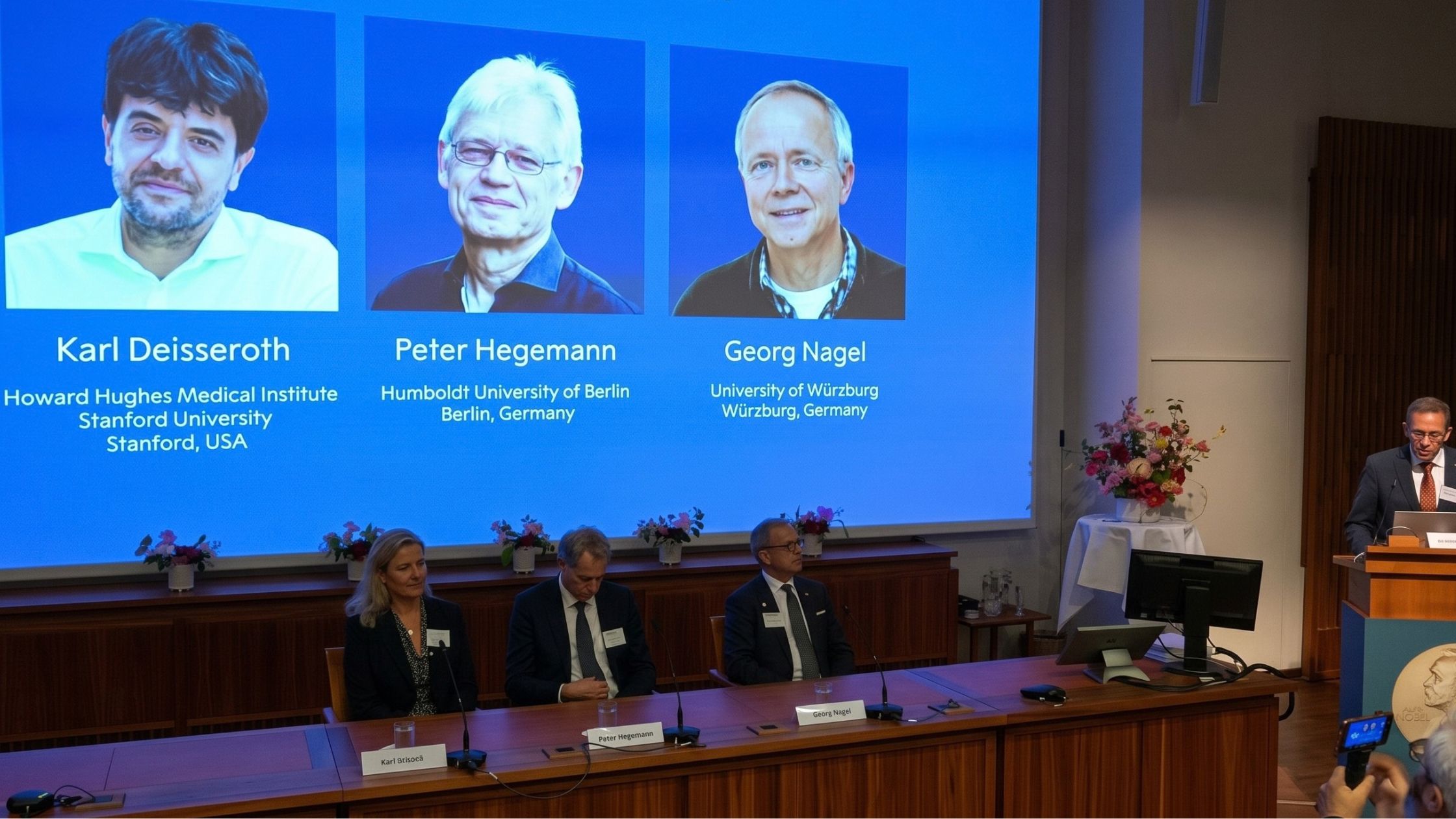
The Nobel Assembly at Karolinska Institutet has today decided to award the 2026 Nobel Prize in Physiology or Medicine jointly to Karl Deisseroth, Peter Hegemann and Georg Nagel for their discoveries concerning light-gated ion channels and optogenetics.
(01:28)
Here are the three laureates. Karl Deisseroth was born in 1971 and received a PhD and an MD from Stanford University. The work for which he's awarded was also performed at Stanford University. He's currently an investigator of the Howard Hughes Medical Institute and a professor at Stanford.
(01:51)
Peter Hegemann was born in 1954 and received a PhD in 1984 at the Max Planck Institute for in Martinsried in Germany. The work for which he's awarded was performed at the Max Plank Institute for Biochemistry in Martinsried. He's now a professor at Humboldt University in Berlin in Germany.
(02:18)
Georg Nagel was born in 1953 and received a PhD in 1988 at the University of Frankfurt in Germany. The work for which he's awarded was performed at the Max Plank Institute for Biophysics in Frankfurt. He's currently at professor at the University of Wurzburg in Germany.
(02:41)
So now I turn to Professor Abdel El Manira, member of the Nobel Committee who will now describe this year's Nobel Prize discoveries. Please, Abdel.
Abdel El Manira (02:52):
The mysteries of the brain have intrigued humanity for centuries. Consider a chess player facing the board, evaluating the position of each piece, recalling patterns from past games, anticipating an opponent and weighing all the consequences of [inaudible 00:03:29]. Vast networks in the brain of neurons in the brain integrate perception, memory, prediction and planning. Remarkably diverse neurons connected through vast circuits transform this complex interplay of perception, memory, prediction and decision making into a single purposeful behavior. Answering this question requires more than simply observing the brain and correlating patterns of activity with behavior. It requires establishing cause and effect.
(04:30)
To be able to establish cause and effect, neuroscientists dreamed of a neuronal switch, a tool to turn specific neurons on or off with great precision. Francis Crick, who in 1953 who discovered the DNA double helix, famously suggested in the late '90s that light might provide the speed and precision needed to control selected neurons. This was a brilliant idea, but it seemed entirely farfetched.
(05:14)
The solution didn't come from studying the brain. It came from a pond with a humble green algae as an unlikely hero. Researchers studying a single cell green algae called chlamydomonas discovered that it could sense light through a primitive eye spot, allowing it to swim towards light. How could this simple organism transform light into action?
(05:47)
In the 1990s, Peter Hegemann was intrigued by this problem. Through a series of pioneering experiment using electrical recordings, he finally uncovered the secret. He discovered that the eye spot contains a light sensitive protein that converts light almost instantly into an electrical signal, allowing the algae to move, but the identity of this protein remained unknown.
(06:24)
The pivotal moment came when Peter Hegemann identified the gene for this protein. He teamed up with Georg Nagel who has a long experience in studying ion channels. Nagel used the gene provided by Hegemann to produce the protein in frog egg cells to study its function. The result was astonishing.
(06:55)
They discovered that the protein itself was a light gated ion channel. When exposed to light, the channel opens, allowing positively charged ions to rush in and rapidly generate an electrical signal. Nagel and Hegemann realized exactly what they had found. They had just discovered the switch neuroscientists had long dreamt of, a light gated ion channel, they named channelrhodopsin.
(07:31)
The discovery of channelrhodopsin was a major breakthrough, but could it actually be used as a switch to control the activity of neurons with light? In the early 2000s, Karl Deisseroth was beginning to establish his own laboratory, a trained psychiatrist who was fascinated by how the brain can generate behaviors and eager to find ways to establish causal links between specific brain circuits and behavior. Realizing the potential of Nagel and Hegemann's discovery of channelrhodopsin, Deisseroth decided to test if this protein could be used as a switch to control the activity of neurons. Deisseroth and his team introduced channelrhodopsin into mammalian neurons. When they eliminated the neurons with light, the result was remarkable. The neurons reacted on command instantaneously with millisecond precision. This was a major milestone, but the real test was whether channelrhodopsin could control neurons in living animals and directly link specific circuits to behavior.
(09:05)
Deisseroth and his colleagues managed to introduce channelrhodopsin in a selected group of neurons, and to be able to activate these neurons, they developed tiny optical fibers to deliver light deep into the brain. By turning on the light, they succeeded in activating a selected group of neurons and elicited a distinct behavior such as exploring unfamiliar objects. For the first time, causal links between specific brain circuits and behavior had been achieved. The technology, which soon became known as optogenetics, transformed neuroscience. Optogenetics was rapidly and widely adopted all over the world. Researchers are now able to establish causal links between the activity of specific neuronal populations and the wide range of complex behaviors from parental behavior and aggression to anxiety and fear, as well as fundamental physiological drives such as thirst and water intake.
(10:34)
The impact of optogenetics extends far beyond understanding the healthy brain. It has also helped reveal how specific brain circuits are disrupted with implications for conditions such as blindness, depression, addiction and dementia. Yet despite these extraordinary advances, the brain still holds countless mysteries with much more left to learn and discover. And optogenetics has given us a powerful means to take on these challenges. As we take another glimpse at this year's Nobel Laureates, I will now hand the stage back to the Secretary General, Professor Perlmann.
Thomas Perlmann (11:28):
Thanks, [inaudible 00:11:35] Abdel. Thank you for that. We're ready to take questions. So let's start with the first one here. Go ahead. Yes.
Per Snaprud (11:52):
In the speculations that we mentioned, Gero Miesenböck who as I gather also developed a similar technique before. Why was he not awarded the prize today? And my name is, Per Snaprud I'm from, Forskning & Framsteg. Should I repeat the question?
Thomas Perlmann (12:12):
Yes, please.
Per Snaprud (12:13):
So I wonder why Gero Miesenböck, who has been developing a similar technique, was not awarded the prize today?
Thomas Perlmann (12:26):
Yeah, I could take that question quickly. I mean, essentially, we are writing a very thorough description of the background to the prize, also in the science behind it and we mention other work that is leading up to this discovery that we awarded. So it's very clear from that writing how we reasoned. We don't comment on people who didn't get the prize or why they didn't get the prize, but you're welcome to read the information there.
Per Snaprud (12:59):
If there were four people being awarded, would he be considered?
Thomas Perlmann (13:03):
Who knows? Maybe. I can't speculate. Okay. So here's another question. And please, if you could state your name also. I should just before answering that question then, I should say that in addition to Professor Abdel El Manira, we have Professor Anna Wedell. She's professor of clinical genetics and an adjunct member of the Nobel Committee. And we also have Professor Per Svenningsson, who is the chair of the Nobel Committee to help us with answers. Please, if you could go ahead and state your name and the question. [inaudible 00:13:44]... Okay, we'll start with you.
Speaker 4 (13:46):
Hi, I have a question from AP. We saw right before the announcement that you made a call to one of the laureates. Could you share who did you manage to reach and what was the reaction of the laureates? Thank you.
Thomas Perlmann (13:57):
Yeah, I was actually able to reach all three of them, so that was great to talk to them. First, Karl Deisseroth, he was very tired when he answered. He was definitely asleep, but he woke up. And I should say that all three, they were very surprised. All three said the same thing, that they thought it was absolutely wonderful to receive the prize with other two. And they called them, my friends, it's such an honor to receive them together. So that's something they conveyed. Should we go ahead to... Up there. Yeah. Okay.
Booker Radoesky (14:43):
Hello. Booker Radoesky from the Polish Television. I wanted to ask about optogenetic therapies. Obviously this discovery is very important in terms of neuroscience, but what are the possibilities of developing new therapies for diseases using that discovery? Thank you very much.
Thomas Perlmann (15:01):
So I'll hand it over to Professor Per Svenningsson.
Per Svenningsson (15:05):
Yes, so optogenetics have been used to partially restore vision in the blind patients with a disease called retinitis pigmentosa. So in this disorder, retinitis pigmentosa, the patients lose their photoreceptors, the rods and cons in the retina, but there are still healthy cells in the retina, and then researchers have used optogenetics to stimulate these healthy cells in the retina and thereby activate optic nerve and they generate the visual perception in the brain. It's a little bit special treatment because the patients need to wear special goggles that record the environment and then transmit these recordings into light that is projected to the retina and activating the optogenetic system. So this has been done and there are several clinical trials ongoing with this approach.
Thomas Perlmann (16:13):
Right. Anyone else who wants to comment on something? No, or... One could mention that, I mean, this is primarily a tool for basic research that will prove immensely important for disease and understanding of disease, but this is obviously an excellent example of something ongoing. More questions?
Speaker 7 (16:40):
[inaudible 00:16:41].
Thomas Perlmann (16:41):
[inaudible 00:16:41]. Okay, please.
Francois Borey (16:43):
Francois Borey From Swedish EFN. Maybe you already answered that question, but I would like elaborate a little bit about the benefit for humanity maybe in the future.
Thomas Perlmann (17:05):
Yeah, there's lots of such benefit. Maybe Professor Wedell, could you expand on that?
Anna Wedell (17:12):
Yes. One can say that it's a tremendous step forward to be able to link nerve cells and their function to specific behaviors. Before we had maps and we can also understand how different cells speak to each other across the brain. So it's a completely new dimension of understanding of the function of the brain. And most work, a lot of work is now done in animal models and to understand the healthy brain, but also in disease models because mammalian brains are quite similar. And of course the human brain is very special, but still there are many underlying mechanisms that are similar across species.
(17:56)
So a lot is being done in disease models in mice, for example, who have epilepsy or dementia or depression or addiction, so you can understand which nerve cells and circuits are affected and how perhaps modifying other circuits can modify disease presentations. That is the giant leap. And then we know where to look in humans based on this knowledge.
Thomas Perlmann (18:23):
Yeah. Okay, so it's really a new era in neuroscience thanks to this methodology. [inaudible 00:18:28], yeah.
Per Snaprud (18:37):
[inaudible 00:18:38]. So, this is-
Speaker 7 (18:37):
[inaudible 00:18:42].
Per Snaprud (18:44):
This is Per Snaprud, Forskning & Framsteg. This is a research tool for basic science and obviously a very big question about the brain is how it creates consciousness. And of course this tool has already said a lot about many functions on locomotion and aggression and all that, but can anyone speculate if this tool can help us understand how our inner subjective world in the brain appears from neuronal activity?
Thomas Perlmann (19:15):
See that's a perfect question for Professor Abdel El Manira.
Abdel El Manira (19:23):
I think what we are having, just mapping the functions that we can relate to and we can measure with our experimental tools to be able to link the activity of specific neuron specific circuits to a specific output or a sensory perception. So we are in the process and there are studies that are ongoing on how we transform this perception into long-lasting memories and how we can access those memories to be able to have a representation of reality in our brains. But we are far from understanding that and hopefully this tool will help developing some at least conceptual models how we can tackle these big questions in the future. But for now, this tool does not help us as for now understand what conscious is.
Per Snaprud (20:22):
So no progress on consciousness in the near future from this?
Thomas Perlmann (20:27):
Well, maybe in the future, but I think we have to be humble about those ground questions. It will be a Nobel Prize some years ahead, I'm sure. Maybe 100.
Per Snaprud (20:40):
Yeah, okay.
Speaker 10 (20:52):
Hi, this is Sanlian Lifeweekly from China. We would like to ask a question about this technology. Would it be possible to use the brain computer interface? And this is the first question. The other question is that, so when people see the price, they may have some misconception about that light can control our brain. So would you clarify this misconception for the public?
Thomas Perlmann (21:26):
Who wants to take the first question about the brain interface? Could you do that?
Abdel El Manira (21:36):
I think this will lead the way to have some brain machine interface development because we would clarify which circuits controls which function and by having exactly which type of neurons, which circuits control specific functions, maybe in the future we can have some kind of closed loop systems using brain machine interface to restore some of those functions. There are some ongoing research that is being done, but we are not there in the full development of it. And the fact that how do we use light to control the brain? I think as for now, this technology has been mainly used in experimental animal models and has been used in the retina. But hopefully in the future, I don't know, there will be specific options that can be very sensitive that one can apply light outside the skull rather than going inside the skull. But these are things that are being developed and this is a major first leap towards those developments.
Thomas Perlmann (22:45):
Right. So any more final question. I know a lot of everyone, or many wants to have specific interviews, but if there is any more? One final question up here. Yes.
Chen Mai (23:09):
Hello, this is Chen Mai from Sanlian Lifeweek, China, Beijing. My question is, we understand there are so many active interplays between the human brain and AI. So my question is, could their findings and breakthroughs help us potentially understand what is going on in the neural network in AI, the neural network, what is happening in the black box?
Thomas Perlmann (23:47):
My guess is that this will not help us to get an immediate understanding of that, but I'm not sure if anyone wants to add anything to that. And of course, I mean, we're not computer scientists, so we may not be the right individuals to answer, but anyone of you who wants to say comment on that?
Chen Mai (24:10):
People are talking about the similarities between human brains and the neuron network. So my question is it possible parallel transport between these kind of technique into the neuron network used in AI?
Thomas Perlmann (24:25):
Probably the similarities between the neural networks used in AI and the human brain shouldn't be exaggerated. I mean, there are definitely relationships there, but probably one shouldn't exaggerate the similarities. But Anna, Abdel, do you want to comment?
Anna Wedell (24:42):
Well, I'm not like you, a computer scientist, but of course there are parallels. I think the computer scientists and the AI developers are learning a lot from the brain, so you should ask them. Probably they would have more to say going in that direction rather than the other. So you should ask the AI developers. They will probably eager look at all the data coming out of neuroscience.
Thomas Perlmann (25:05):
Absolutely.
Chen Mai (25:07):
Thank you.
Thomas Perlmann (25:07):
Okay. So thank you very much for coming this morning. We will do our very best to respond to questions afterwards and give interviews. So thanks so much. Good morning.
Group (25:22):
[inaudible 00:25:25].