


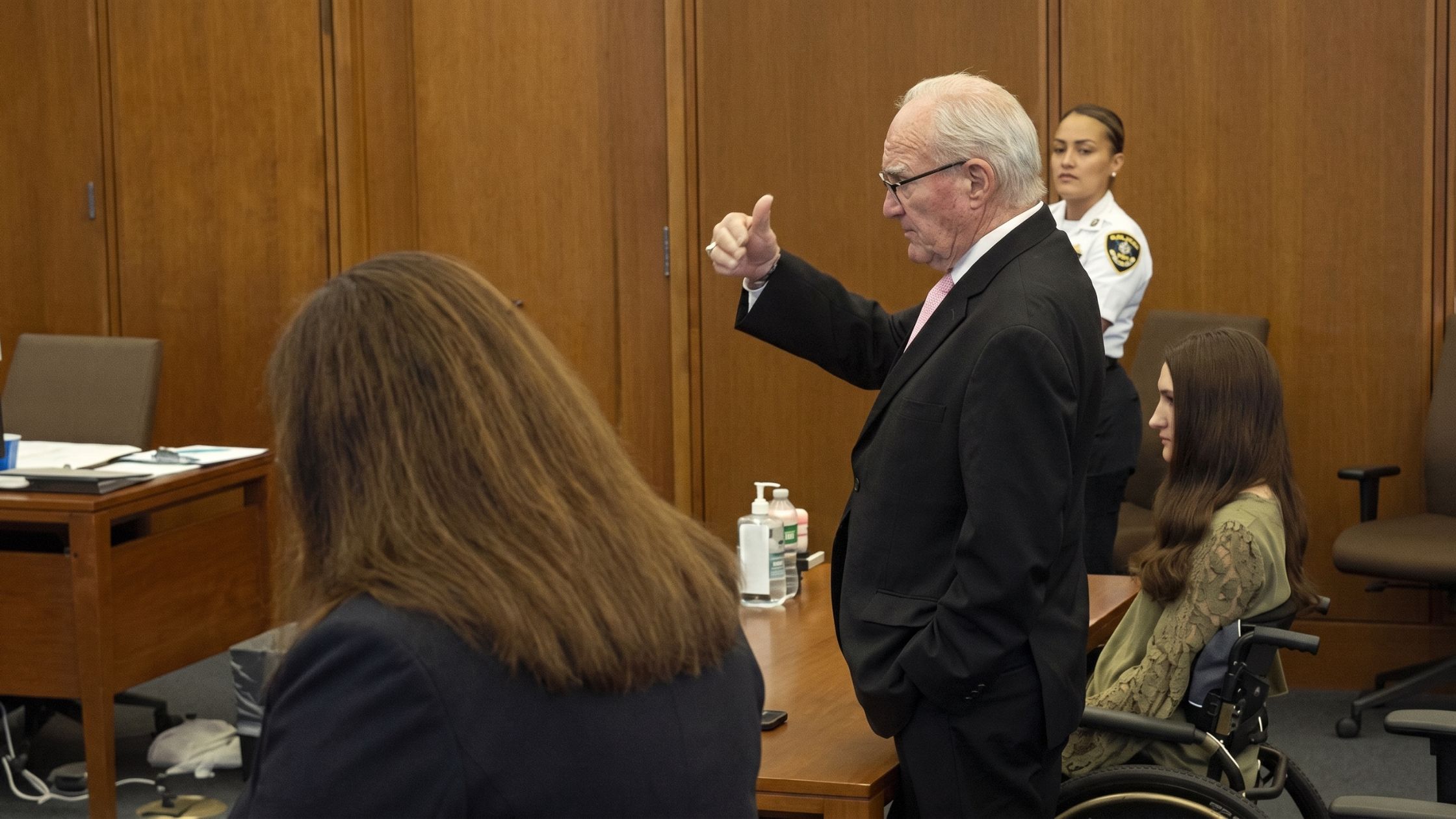
Speaker 2 (00:10):
This court is now in session. Please be seated.
Speaker 1 (00:13):
Good morning, Your Honor. May I proceed?
Judge William Sullivan (00:14):
Yes, please.
Speaker 1 (00:14):
Your Honor, before the court, we have the matter of Commonwealth versus Lindsay Clancy. Ms. Clancy is present. She is represented by attorney Kevin Reddington. The Commonwealth is represented by Assistant District Attorney, Jennifer Sprague and Assistant District Attorney, Shannon Buckingham.
Judge William Sullivan (00:27):
All right. Well, good morning everyone. Good morning, counsel.
Jennifer Sprague (00:30):
Morning.
Judge William Sullivan (00:30):
Hi, good morning Ms. Clancy.
Lindsay Clancy (00:31):
Morning, Your Honor.
Judge William Sullivan (00:34):
All right. So, at the end of the day yesterday, there was a note that was sent in from the jury and we put over to today to address it. Commonwealth, you had the opportunity to review that note?
Jennifer Sprague (00:52):
Yes, Your Honor.
Judge William Sullivan (00:52):
All right. Defendant, you had an opportunity?
Kevin Reddington (00:54):
Yes, Your Honor.
Judge William Sullivan (00:55):
All right. And so, I will hear from the parties as to how each party suggests or requests I deal with that note. So, I want to hear from the Commonwealth first.
Jennifer Sprague (01:18):
Thank you, Your Honor. I apologize for my voice. So, Commonwealth's suggestion is that the jurors be instructed to return to their deliberations without any further instruction of voir dire. The basis for that request is Commonwealth versus Ronchi, R-O-N-C-H-I, 491 Mass 284 from 2023. In that case, it's a similar situation where it's reported one juror is having issues with the other jurors. And it says in that case where reliable information comes to a judge suggesting a lack of impartiality, bias, extraneous influence, or inability to deliberate, that there should be an individual voir dire hearing regarding that. We don't have any of those circumstances here.
(02:05)
There's no indication of a lack of impartiality or bias or extraneous influence and no indication of inability to deliberate. In fact, they've deliberated for a very long time in this case and very conscientiously. So, what we have here is a note that indicates a disagreement about how to weigh the evidence and that's deliberation. So, it's the commonwealth's position, especially considering the fact that Your Honor voir dired each of the jurors yesterday, and they all said that they could follow your instructions. So, when you couple that with the requirements of Ronchi, I don't think an individual voir dire is necessary.
(02:38)
If Your Honor does determine to do one, we would just ask along the lines of all the case law in this area, Ronchi, Williams, Torres, the whole string of cases that the juror be instructed not to comment on the deliberations and that the juror be told that he or she cannot be discharged unless a personal problem unrelated to their relationship with the jurors or their views on the case and that any attempt or any comments by the juror that tend to get into deliberations that Your Honor interrupt and remind the juror that we're not to get into that and that questioning be ceased of the juror unless he or she indicates that there is a personal problem unrelated to the case or the relationships.
Judge William Sullivan (03:24):
All right. Thank you. Defendant?
Kevin Reddington (03:30):
Thank you very much, Your Honor. Appreciate the opportunity to argue this to you. A couple of points that occur to me. First of all, as Your Honor is well aware, a defendant, any defendant in this courtroom or any courtroom in our country is entitled to have a juror who is true to their oath, who will agree that they will apply the facts as they determine them to be proven beyond a reasonable doubt to the law as given to them by you as a judge or any other judge. If a jury consists of people and there's one person who is refusing to actually apply the law to the facts as determined for reasons that are not arising out of the case, but are personal to the juror's position regarding their review of their oath and how they should apply their oath. In other words, if it's personal to this individual, which I believe it is based on the first question that you had, and I have never seen a situation like this where a foreperson on the jury is so courageous as to speak on behalf of 11 jurors and indicate that juror number, which I will not mention, and I quote, "Has made statements acknowledging doubt, but refuses to apply it to the verdict as the law states." Clearly, Judge, we have a person who under their oath stood in front of you yesterday when you did the individual voir dire and according to this information under oath looked you in the eye and lied.
(05:28)
That juror told you that he would be able to apply the law to the facts as you asked him. And based on this note from this juror, it clearly and unequivocally indicates that they are basically 11 to one and this person will not apply reasonable doubt to the evidence to return a not guilty verdict. I would ask that the court would, and I know it's awkward, I'm familiar with the law. I know that we try to protect and preserve the sanctity, if you will, of the jury. We don't want to invade their deliberations. We want to keep that private. Obviously, that's a good thing to do.
(06:10)
But when you have a situation where you have not one but two notes that clearly indicates that this individual has acknowledged doubt but refuses to apply it to the verdict, as the law states, he is not being honest with you at the sidebar. I would go so far as to reluctantly say that the individual has made a false statement under oath to this court. There has to be an issue that is not arising out of deliberations in the facts of this case, but the individual is refusing to apply your instructions on proof beyond a reasonable doubt to allow that jury to return a verdict of not guilty.
Judge William Sullivan (06:56):
All right.
Jennifer Sprague (06:56):
If I may, Your Honor-
Judge William Sullivan (06:56):
Sure.
Jennifer Sprague (06:59):
... I just wanted to put on the record that the note does not indicate that this juror lied to Your Honor when responding. The note indicates that the parties disagree on what is reasonable doubt or what doubt is and how it should be applied. And we are in no position to judge if the 11 are right or the one is right, but there's no indication that the juror is intentionally trying to mislead the court or lie to the court.
Judge William Sullivan (07:23):
All right, thank you. Well, as all three counsel are aware, the case law spells out the concerns that everybody has in a situation like this, where it says the discharge of a deliberating juror is sensitive undertaking, fraught with potential error. It's to be done only in special circumstances with special precautions. A judge must take the utmost caution to avoid invading the province of the jury. And that's what I'm concerned with at this point. And as even under the statute, during deliberations, a juror properly may be discharged only for reasons personal to that juror, having nothing whatever, I'm sorry, to do with the issues of the case or with the juror's relationship with their fellow jurors.
(08:10)
In this case here, I see no showing of the need for an inquiry of this particular juror. The note that we were referring to, the one from late yesterday afternoon, indicates that the juror says acknowledged doubt but refuses to apply it to the verdict. Well, the instruction that the SJC has suggested we give in regards to reasonable doubt and that both parties agreed to, says that reasonable doubt does not mean proof beyond all possible doubt. And so, in reading that note carefully and strictly in the way that I have to before I possibly invade the province of the jury, that note does not indicate that this is a person who has refused to follow the law.
(09:05)
And in addition, as the parties recognized yesterday, we brought all the jurors in, including the juror who is at issue here and I asked whether or not those jurors could follow the instructions, including the instruction I just referred to. And all the jurors indicated that they could. This is not a case that there's any indication that the juror has refused to deliberate or has any reason has indicated that they would not follow the law or that they're physically suffering or there's no note from the juror that indicates that the juror cannot or will not be able to continue deliberating as some of the other cases talk about. So, for reasons for that, I'm not going to do a further...
Judge William Sullivan (10:00):
For that, I'm not going to do a further inquiry of this juror over the Defendant's objection. And at that point, my inclination would be to bring the jury back. My thought would be though to remind them that it's their duty to accept the law as I give it to them and that they have to follow that law. And I think this is what I told them a week ago. They have to follow it whether they like it or not. So I'm going to give them that instruction and remind them of that. So with that-
Kevin Reddington (10:39):
Your Honor ... Go ahead.
Jennifer Sprague (10:41):
Oh, I was just going to ask that the court also instruct the jurors or remind them that any future notes should not contain any information about deliberation.
Judge William Sullivan (10:49):
Oh yeah. Well, here's what I was going to say. If there's any notes or any future notes, if there are any, you should refrain from detailing any of the actual deliberations and do not indicate where they stand numerically.
Kevin Reddington (11:00):
A couple of things.
Judge William Sullivan (11:01):
Sure.
Kevin Reddington (11:03):
First of all, Your Honor acknowledges that I have an objection, which I appreciate, and I do have an objection. And I am again citing Article 12 of the Sixth Amendment of the United States Constitution. This goes beyond Massachusetts law. This is constitutional. It's a structural, I suggest, respectfully, defect in the procedure that we're engaged in. We're elevating form over substance and that's Your Honor's ruling. I understand. I've objected.
(11:25)
But I would ask that you not instruct the jury that they cannot indicate anything. And I understand why. Traditionally we tell jurors, "Don't let us know what your division is or what your split is." But in this case, I'm concerned that if you do that, that foreperson is going to feel that that is some type of ... That she violated something and might feel that Your Honor is kind of coming down on her not to do that. And I think it's too delicate right now a situation. And in addition, and finally, I would ask that you not just give them, as I described it yesterday, a soft inquiry where you listen to my instructions. I would ask that you specifically direct their attention to proof beyond a reasonable doubt and reinstruct them on that forcefully.
Judge William Sullivan (12:13):
I think I did that yesterday, didn't I?
Jennifer Sprague (12:15):
Yes.
Kevin Reddington (12:16):
You did it yesterday. You did it soft. You didn't do it forcefully. And I'm asking that you do it forcefully.
Judge William Sullivan (12:20):
What do you want me to do, get a brass band?
Kevin Reddington (12:23):
I want you to tell-
Judge William Sullivan (12:23):
I read the instruction as written by the SJC.
Kevin Reddington (12:27):
Right.
Judge William Sullivan (12:28):
The fact that I perhaps didn't give it my full inflection, I'm sorry about that. I'm not an actor. I've just given the instructions.
Kevin Reddington (12:36):
Well, my point, Judge, simply is that you're kind of glossing over the issue. The issue is this juror will not, according to that note, apply the law of reasonable doubt. And that's why I've requested, you know what I've requested. So I note my objection.
Judge William Sullivan (12:55):
But just in case the record's clear, I am specifically not glossing over this issue. I have thought about this issue long and hard. I know the defendant objects, but the characterization that I'm glossing over it, trust me, that's not the situation. I've been thinking about this for quite a while. So that's what I'm going to do. I'm going to just give that instruction, as I said, that they have to follow my instructions. I'm not going to reiterate the reasonable doubt at this point. It may come to that again as we go through it. And I'll try and give this with more pizazz than I gave yesterday, I suppose. So with that, we'll bring the jury back in and I'll ask the questions. I'll give those ... Kind of that instruction and we'll send them back out. Okay.
Bailiff (14:38):
Court, all rise, jurors entering.
(14:47)
Hear ye, hear ye, hear ye. [inaudible 00:14:47] to do before the honorable. William Sullivan, Justice of the Superior Court now sitting at Plymouth within and for the commonwealth. [inaudible 00:14:47] give your attendance and you shall be heard. God save the Commonwealth of Massachusetts. This court is now in session. Please be seated.
Madam Clerk (14:53):
Good morning, Your Honor. May I proceed?
Judge William Sullivan (14:56):
Yes, please.
Madam Clerk (14:57):
Your Honor, present before the court, we have 12 deliberating jurors and 6 alternates in the matter of Commonwealth v. Lindsay Clancy. Ms. Clancy is present. She is represented by attorney Kevin Reddington. The Commonwealth is represented by Assistant District Attorney Jennifer Sprague and Assistant District Attorney Shanan Buckingham.
Judge William Sullivan (15:14):
All right. Thank you, Madam Clerk. Good morning, everyone.
Crowd (15:17):
Good morning, Judge.
Judge William Sullivan (15:18):
What I want to do is first ask you those questions and then move on from there. So the first question, as we all know, is going to be, has any member of the jury read, seen, heard or overheard anything from any source about this case that would affect your ability to be a fair and impartial juror?
Crowd (15:37):
No.
Judge William Sullivan (15:37):
The last of these questions is, is there any other serious matter or concern bearing on your service as a juror in this case that anybody needs to bring to my attention at this time?
Crowd (15:46):
No.
Judge William Sullivan (15:47):
Thank you. All right. So I did get the note yesterday. And one thing I would say, if there are any notes in the future, and I'm not saying there are, but if there are, just make sure we don't put down where everybody is numerically. But what I wanted to do was go over one thing. I wanted to remind you, as I instructed you earlier, it's your duty as jurors to accept the law as I stated to you. You should consider all of my instructions as a whole. You may not ignore any instruction or give special attention to any one instruction. You must follow the law as I give it to you, whether you agree with it or not. The law that I'm instructing you on is the law that's been established by our legislature and our appellate courts, and it applies to everyone. And you must apply the law as I have instructed you, and you have a copy of the instructions that I gave you. You should still have them back there with the jury room. And with that, you may now resume your deliberations.
Bailiff (16:49):
Court, all rise. [inaudible 00:16:53].
Madam Clerk (17:21):
The jurors have exited the courtroom, this court's in session. Please be seated.
Judge William Sullivan (17:24):
All right. Counsel, anything we need to address at this time?
Jennifer Sprague (17:26):
No, Your Honor.
Judge William Sullivan (17:27):
Defendant?
Kevin Reddington (17:28):
One second, Your Honor, please. No, thank you.
Judge William Sullivan (17:32):
Okay. All right. So we'll be in recess on this matter. Thank you, everyone.
Bailiff (17:35):
Court all rise.
(17:35)
This court is back in session. You may be seated.
Madam Clerk (17:55):
Your Honor, for the purpose of the record, we've returned back to the matter of Commonwealth v. Lindsay Clancy. All parties are present, excluding the jury.
Judge William Sullivan (18:02):
All right. Counsel, have you seen the question?
Jennifer Sprague (18:05):
Yes, Your Honor.
Kevin Reddington (18:06):
Yes.
Judge William Sullivan (18:08):
All right. And the question is, it is with a heavy heart that we report we are unable to come to a unanimous decision and will not be able to. Well, let me ask what is the party's position in regards to that question?
Jennifer Sprague (18:30):
Your Honor, from the Commonwealth's perspective, since the Tuey instruction has already been given and then there was lengthy deliberation after that, I think that it would require a mistrial at this point.
Judge William Sullivan (18:41):
Attorney Reddington?
Kevin Reddington (18:43):
Your Honor, my understanding is that this court has the discretion to have the jury sent back for the second time. The first time that there was a report, we did not treat it as a report of deadlock. We did not instruct them under Tuey. We did not give them soft Tuey. We didn't give them anything. We just sent them back to deliberate. So technically we have one report of deadlock that Your Honor gave the Tuey-Rodriguez charge to, I believe under the statute as well as the case law. This court has the ability to send the jury back. The fact that that jury foreperson wrote very unusually, "It is with a heavy heart that we are unable to come to a decision," based on the earlier questions that we have, I think that it would be a sound and a wise decision for this court to send it back under the law.
Judge William Sullivan (19:37):
Well, I would find that under Massachusetts case law and statutory law, the jury did not ask to be sent back, which would be a possibility if they had requested it to be sent back to them. But under the statute and the case law, I don't feel I have any choice but to declare a mistrial at this time.
Kevin Reddington (20:00):
Well, before you do, I'd like to be heard, Your Honor.
Judge William Sullivan (20:02):
Well, that's why I asked you before, but go ahead.
Kevin Reddington (20:00):
Before you do, I'd like to be heard, Your Honor.
Judge William Sullivan (20:02):
Well, that's why I asked you before, but go ahead.
Kevin Reddington (20:04):
Well, I just got to that first one. I didn't get to the other one.
Judge William Sullivan (20:06):
All right.
Kevin Reddington (20:08):
Your Honor, I would suggest to the court that as we are pretty much all familiar with under Karen Read versus the Commonwealth, the Supreme Judicial Court through Justice Georges back in February of 25 held that under Rule 27(b) of the Massachusetts Rules of Criminal Procedure, "Gives a trial judge discretion to require a jury to return a verdict for charges on which they have agreed before declaring a mistrial as it relates to," and again they continue, "Judge may first require the jury to return verdicts on those charges upon which the jury can agree and direct that such verdicts be received and recorded."
(20:50)
It goes on furtherance, and I quote, "Rule 27(d) also permits the judge to poll the jury when a verdict is returned and before the verdict is recorded. However, a judge is not required to accept a partial verdict before declaring a mistrial." So I'm asking that the court would entertain a poll of the jurors as to whether or not there has been a decision on murder one, murder two, manslaughter, anything like that. And if that's the case, then I certainly would argue that double jeopardy is attached and those charges cannot be prosecuted again.
Judge William Sullivan (21:21):
All right. Commonwealth?
Jennifer Sprague (21:22):
I would object to that, Your Honor. It would go into the deliberations. I think we're in a different scenario here than the Read case where I believe in that case they did reach a verdict on certain charges and not on others. But I think here where we've had a jury who's been deliberating for six and a half days, who's come back on multiple occasions saying that they're deadlocked, who have been given [inaudible 00:21:44], I don't think anything else is required at this point other than the declaration of a mistrial, unfortunately.
Judge William Sullivan (21:51):
Over the defendant's objection, I'm going to declare a mistrial at this point. All right. All right. If we bring the jury in.
Kevin Reddington (24:02):
Your Honor, while we're waiting for the jury, forgive me for raising this issue. I would ask that before you formally declare a mistrial that the court afford us the opportunity to take a 211-3 appeal direct to the Supreme Judicial Court Single Justice on this issue because of any number of issues that are of concern, others that have been addressed in the motions, the objections. But I further raise the issue of the American with Disabilities Act. I believe that this is a situation where there is a clear and present danger that this individual, for some reason, what it is, we don't know, but is taking a position that's intractable, regardless of proof beyond a reasonable doubt. So I want an opportunity to take an appeal to the Single Justice if the court will afford us that opportunity.
Judge William Sullivan (24:52):
How much time do you need to do that?
Kevin Reddington (24:56):
I'd have it filed today and argue tomorrow.
Judge William Sullivan (25:00):
Saturday?
Kevin Reddington (25:01):
They would do it on an emergency, yeah. I mean I can try-
Judge William Sullivan (25:04):
So what are you going to tell this jury to come back tomorrow? I'm just trying to-
Kevin Reddington (25:10):
I understand that, yes. I don't care if they come back on a Sunday.
Judge William Sullivan (25:12):
The reason I'm asking it... I know, but as they're walking in, you're asking for this. I'm just trying to find out what it is that you're asking for. That's all.
Kevin Reddington (25:22):
What I'm asking for is time to file a Single Justice appeal for this travesty. That's what I'm asking for.
Judge William Sullivan (25:27):
So you're asking for an emergency stay at this point?
Kevin Reddington (25:30):
Yes. Yes. And the jurors don't have to come back tomorrow. They can be told... They don't even have to come back if I lose the motion. But if I win the motion, then obviously they would have to come back Tuesday.
Judge William Sullivan (25:43):
If you want to go up and petition to the SJC for a stay, I'll give you an hour before we bring the jury back down. I think you could... It's just a request for the stay of the declaration of the mistrial. So I'll hold off for an hour and then we'll come back in regards to that.
Kevin Reddington (26:02):
Okay.
Judge William Sullivan (26:06):
All right?
Bailiff (26:06):
Court, all rise.
(26:06)
Court stands in-
(26:06)
This court is now in session. Will you please be seated.
Madam Clerk (26:34):
Your Honor, for the purpose of the record, we return back to the matter of Commonwealth versus Lindsay Clancy. All parties are present, excluding the jury.
Judge William Sullivan (26:40):
All right. Counsel, it's my understanding that the SJC issued their order that the emergency request for relief was denied and that the temporary stay is lifted. And so it would be my intention at this time to call the jurors back in, and as I indicated to you before, to declare a mistrial.
Kevin Reddington (27:03):
I understand, Your Honor. And at the risk of incurring the wrath of the court, I'd like to raise an additional issue just for purposes of the federal law, because this, I believe, constitutes a violation of the United States Constitution and Federal issue. In our circuit, which is the First Circuit, when a jury reports through a foreperson that in mid-deliberation that a juror refuses to follow the law, the issue is handled under Federal Rules of Criminal Procedure 23(b), but the law itself that we're dealing with clearly indicates that a judge has the authority to excuse a deliberating juror for "good cause" and allow the remaining 11 jurors to return a valid verdict and/or with the substitution of one of the jurors that have been waiting obviously as alternates. While the First Circuit acknowledges that a juror's refusal to follow the law or instructions constitutes good cause for dismissal, it does impose procedural issues as to how the court would navigate and which would require a hearing. The core standard is United States versus Sepulveda, S-E-P-U-L-V-E-D-A, First Circuit, 1993. And in that case, Your Honor, which is significant precedent, the First Circuit addressed the underlying concept of nullification where a juror refuses to follow the court's instructions. In the Sepulveda case, the court held that while jurors possess a raw power to acquit for any reason, they have a significant duty and their duty requires them to apply the law as given to them by the court.
(28:48)
If a juror abdicates this duty, it triggers the court's authority to intervene and the court would then have a procedure where you would inquire just like a hearing like we were suggesting that the court should have a hearing. So I would suggest, Your Honor, that clearly under the First Circuit law, Federal law as well as argument to the court, Massachusetts law, that we have a juror who has, according to the foreperson, is the only person who is basically holding out, so to speak.
(29:19)
And unfortunately they're not holding out based on a good faith issue with the facts or with the law, but they're holding out as a result that even though they have agreed and expressed doubt, they are refusing to apply the law as you've given it. So I would ask again that you conduct a hearing and understand that you're probably going to deny that.
Judge William Sullivan (29:37):
For reasons, as I stated earlier this morning, that request will be denied. All right. So are we ready to bring the jury in?
Bailiff (30:08):
Court, all rise. Jurors entering. This court's now in session. Please be seated.
Madam Clerk (30:37):
Your Honor, for the purpose of the record, present for the court are 12 deliberating jurors and six alternates in the matter of Commonwealth versus Lindsay Clancy. All other parties are present.
Judge William Sullivan (30:46):
All right. Thank you, Madam Clerk.
Madam Clerk (30:48):
You're welcome.
Judge William Sullivan (30:49):
All right. Members of the jury, at this point, I'm going to declare that the jury is deadlocked and I'm going to declare a mistrial. All right? I just wanted to make a comment. I'm kind of a history buff. And during World War II, Winston Churchill was the prime minister for England when England pretty much stood against Nazi Germany alone. And so Churchill oftentimes had to talk to the citizens and say, "Let us brace for our duties." I always liked that phrase. And I thought of that phrase when all of you were agreeing to be on this jury, that you agreed to brace for that duty. And each one of you knew how long the case was going to go, you knew how difficult the case was going to be to listen to facts-wise, but still you braced for that duty.
(31:51)
And I just kind of wanted to also let you know, I watched every day, day after day, week after week, all of you performing that duty that you braced for. And I just kind of wanted to let you know I understood how hard everybody worked in this case. I understood that you all gave everything you could and probably more than you thought you could. And so on behalf of myself, I just want to thank you so much that you should be proud for what you did. You braced for that duty, you performed that duty. And I just kind of wanted to thank you on behalf of myself and behalf of the Commonwealth of Massachusetts. Thank you so much. The only thing I am going to ask one more thing is that what I'd like to do is be able to come back and thank you personally.
(32:44)
I'm going to have to talk to the counsel for just a couple of minutes. So if you could stay just for a couple of minutes, not to go over the deliberations or anything like that, but just to thank you personally, again, for just an incredible commitment and dedication that each and every one of you showed here. So I just want to thank you so much. And with that, you're discharged. Thank you.
Bailiff (33:07):
Court, all rise. [inaudible 00:33:08] The jurors have exited the courtroom. This court's in session. Please be seated.
Judge William Sullivan (33:45):
All right. And I think what I had said at the end of the evidence, I just kind of wanted to echo again, I wanted to compliment all three counsel, a trial like this so hard, so difficult. And so I just kind of wanted to thank the three of you for your efforts in regards to this. And so with that, if you talked, I think we should probably pick a status date and where we are, a trial assignment date so we can talk about where we are.
Kevin Reddington (34:17):
I would ask, Judge, sorry I didn't mean to interrupt. I know I would like to argue a 25(b)(2) and that has to be done within five days. So I mean, I would like if possible to have this on for a hearing on a motion for required finding reconsideration 25(b)(2) on Tuesday. And my request, assuming that you deny that motion would be that we impanel the following Monday.
Judge William Sullivan (34:42):
That would require, I'm going to have to check my schedule and also, so what I'm going to suggest, I understand that's the request. And my thinking is to try it sooner rather than later, but I'm not sure that's sooner. And it's a situation I also have to check the trial court schedule, counsel schedule, witness's schedule. But my thought would be to try this if we could do it maybe sometime later in the fall, but why don't we pick a date maybe a couple of weeks down the road so everybody could get their calendars together and kind of see where we go. All right?
Kevin Reddington (35:24):
What about the 25(b)(2) the motion for required finding reconsideration within five days?
Judge William Sullivan (35:30):
You can file it. Do we have to have a hearing within the five days?
Kevin Reddington (35:34):
I'd like to, but I mean-
Judge William Sullivan (35:35):
I know you'd like to, but maybe we could do it later in the week. Maybe not Tuesday.
Kevin Reddington (35:42):
Okay.
Judge William Sullivan (35:43):
Maybe Thursday or so.
Kevin Reddington (35:44):
Sure.
Speaker 3 (35:44):
Your Honor, I'm going to be out of the state until the 22nd.
Judge William Sullivan (35:50):
All right. Well, as long as it's filed, what we could do is pick that status date, trial assignment date and actual then do the argument for the rule 25.
Kevin Reddington (36:04):
Okay.
Judge William Sullivan (36:10):
Maybe that week of the 28th.
Kevin Reddington (36:21):
I'm supposed to start a murder in Pittsfield. I'm hoping that that's going to be continued. So I would ask if it's agreeable with the court and counsel, if we could have Tuesday the 29th.
Judge William Sullivan (36:37):
Commonwealth?
Speaker 3 (36:38):
That's fine.
Kevin Reddington (36:39):
Thank you.
Judge William Sullivan (36:40):
So why don't we do that? 29th?
Speaker 3 (36:41):
Would that be at 2:00 or 9:00?
Kevin Reddington (36:49):
Doesn't matter to me.
Judge William Sullivan (36:51):
Let's see 9:00. Why don't we see 9:00? We come in. We'll have the defendant brought in.
Kevin Reddington (37:01):
Yes, please.
Judge William Sullivan (37:07):
All set.
Madam Clerk (37:08):
In the matter of Commonwealth versus Lindsay Clancy, the court declares a mistrial. All prior bail orders remain in full force and effect. This matter is continued to September 29th, 2026 at 9:00 a.m. for status, trial assignment and the rule 25 motion in Plymouth.
Judge William Sullivan (37:24):
All right. Counsel, thank you.
Speaker 3 (37:25):
Thank you.
Bailiff (37:25):
Court, all rise.
Madam Clerk (37:25):
Can I give you [inaudible 00:37:25]
Speaker 3 (37:25):
Yes.