
Speaker 1 (00:00):
In sponsors, think maybe he-
President Trump (00:01):
John Rose, yes.
Speaker 1 (00:01):
Can say more about it than I can.
President Trump (00:04):
John, please.
John Rose (00:05):
Well, it's difficult for Americans to buy a home, particularly after the last four years, sir, but with the President's signature today, we're going to make it easy for people to buy a home without getting hassled. For years, their private, personal information has been bought and sold in the open market, resulting in them getting innumerable phone calls and text messages. But with your signature today, we're going to put an end to that, so that when Americans try to realize the American dream of owning a home, they're able to do so without being harassed.
President Trump (00:35):
Good job. Good. It's a great honor, John. Okay, there it is. And that's going to help a lot of the homeowners of our great country. John, want to hold that?
John Rose (01:01):
Sure.
President Trump (01:05):
Thank you, John, very much.
John Rose (01:07):
Thank you very much.
President Trump (01:08):
Thank you very much. Okay. Well, you go ahead.
John Rose (01:09):
I'd like to leave you with this gift from a constituent back in Tennessee.
President Trump (01:14):
Oh, I could use that at night.
John Rose (01:17):
That's an American flag.
President Trump (01:18):
That's very nice. I like that.
John Rose (01:18):
Thank you Mr. president.
President Trump (01:18):
Thank you very much. That's very nice.
Speaker 1 (01:23):
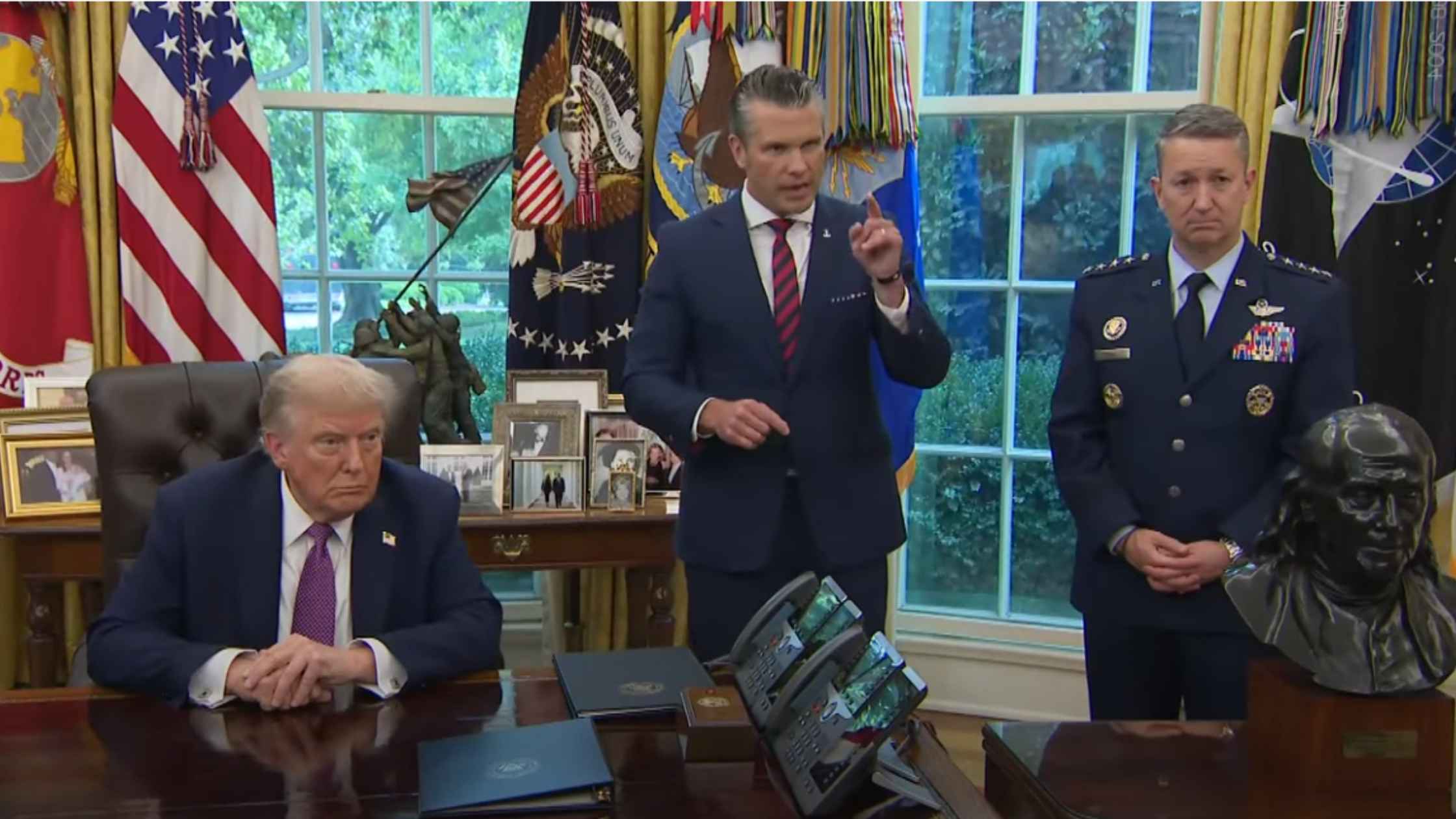
Next, we have a number of executive orders for your attention, sir, from 1789 until 1947, our nation won some of its greatest military victories under the direction of a Secretary of War operating within a Department of War. Today, with this executive order, you'll authorize the current Secretary of Defense and the current Department of Defense to once again embrace this great lineage, and once again, be named the Secretary of War and the Department of War.
President Trump (01:55):
So this is something we thought long and hard about. We've been talking about it for months, Pete and I, and Dan. Dan came into the fold, by the way, a great general. He headed up the, I wouldn't call it an attack, I'd almost call that one maybe even more than an attack, what he did with Iran. You saw the success of that operation. It was perfect.
(02:18)
In fact, we have… This was sent to me by the great company that makes that particular B-2 bomber, and it was flawless. It was actually flawless. They flew for 37 hours back and forth, and there wasn't a bolt that was out of condition. There wasn't an engine failure, there was no problem. It was a perfect attack and it knocked out any possible nuclear capability for Iran, which nobody wanted to see, and we weren't going to put up with.
(02:47)
So great job, Dan, and we've been talking about this Department of War. So we won the First World War, we won the Second World War, we won everything before that and in-between, and then we decided to go woke and we changed the name to Department of Defense. So we're going Department of War, and I'd like to ask our Secretary of War to say a few words, Pete Hegseth.
(03:12)
I think it's a much more appropriate name, especially in light of where the world is right now. We have the strongest military in the world. We have the greatest equipment in the world. We have the greatest manufacturers of equipment by far. There's nobody to even compete. And you see that with this and so many other things. The Patriots are the best. Every element of the military, we make the best by far. So Pete, I'd like to ask you and maybe Dan. Dan Razin came to say a few words, please.
Pete Hegseth (03:42):
Mr. President. Thank you. After winning a war for Independence in 1789, George Washington established the War Department, and Henry Knox was his first Secretary of War, and this country won every major war after that, to include World War I and World War II. Total victory, Mr. President, as you said.
(04:02)
Then 150 years after that, we changed the name after World War II, from the Department of War to the Department of Defense in 1947. And as you pointed out, Mr. President, we haven't won a major war since. And that's not to disparage our war fighters, whether it's the Korean War or the Vietnam War or our generation of Iraq and Afghanistan, that's to recognize that this name change is not just about renaming, it's about restoring. Words matter, it's restoring as you've guided us to, Mr. President, restoring the warrior ethos, restoring victory and clarity as an end state, restoring intentionality to the use of force.
(04:44)
So at your direction, Mr. President, the War Department, is going to fight decisively, not endless conflicts. It's going to fight to win, not to lose. We're going to go on offense, not just on defense, maximum lethality, not tepid legality, violent effect, not politically correct. We're going to raise up warriors, not just defenders. So this War Department, Mr. President, just like America, is back. Thank you for your leadership and your clarity. We're going to set the tone for this country, America first, peace through strength, brought to you by the War Department. We're back.
President Trump (05:23):
All right, thank you very much. Very well stated. And really it has to do with winning. We should have won every war. We could have won every war, but we really chose to be a very politically correct or wokey. And we just fight forever, and then we win, lose. We wouldn't lose really. We just fight to sort of tie. We never wanted to win. Wars that every one of them, we would've won easily with just a couple of little changes or a couple of little…
(05:56)
I was told that ISIS would take five years to win. And Dan Caine, when I told him how long would it take? He said, "I think about four weeks, sir." I said, "what do you mean four weeks? I was told five years by the people in Washington, you know who they were. "Five years," I said, "you can't do it in four weeks."
(06:13)
I actually flew to Iraq to meet with him and I met him at a big air base. Remember that famous day, right? It turned out to be a famous day for our country because you're now the head of the Joint Chiefs of Staff, which is the biggest deal. And he is because he did things that everybody said he couldn't do. So they said it was going to be five years and he knocked them out in about four weeks total, 100%. We took over and ISIS was gone and pretty amazing.
(06:44)
But we never fought to win. And now if we have to fight it all, we solved seven wars, we have the one that I thought was going to be probably one of the easier ones, and that's with President Putin and Ukraine. And that turned out to be one that's a little bit more difficult, but the seven are done. They were supposed to be much more difficult to solve. I solved every one of them, and we're going to get the other one done too. But it turned out to be a little bit more difficult than I thought. And it'll get done or there'll be hell to pay.
(07:15)
Because they're losing six to seven, it used to be five, I used to tell you five, now it's almost seven. I guess 7,000 people last week, 7,813 people, young soldiers died. Russian and Ukrainian, not American soldiers. But it's a shame. It's just the human lives… And I want to see it stop. But General Caine's done a fantastic job And again, defeated ISIS, which they said would take a long time, and it didn't take a long time at all. And did other things that people said really couldn't happen. We have the greatest equipment in the world. We have the greatest soldiers in the world. Dan, say a few words, please.
Dan Caine (07:56):
Yes, sir. Thank you, Mr. President. It's a true honor for me today to represent the incredible men and women of America's joint force, today and every day the 2.8 million service men and women stand ready to fulfill our sacred duty to protect America at home and abroad. As the President said, America's military is the single most powerful fighting force in the world. The mission you and the secretary have given us is clear and unambiguous to deliver peace through overwhelming strength.
(08:34)
And I remind everyone that the US Military can reach any adversary at the time and place of our choosing. Service to this nation is an incredible gift and we're grateful and honored every day to do so. Thank you, Mr. President.
President Trump (08:49):
Thank you. And it's an honor to sign this. And we will do that right now. I think that's a big one, I'll be honest. That's a big one.
Pete Hegseth (09:17):
It's a big one, Mr. President.
President Trump (09:18):
Do you have any questions on this subject? We're going to be discussing the G20 in a couple of minutes, but… Yes, please. Right there.
Speaker 2 (09:24):
Mr President, what gave you the idea for this rebrand? And a question for you and the newly minted Secretary of War, what message does this send to our enemies, to our allies, to the American people? And again, what gave you the idea for this rebrand at this moment [inaudible 00:09:38]?
President Trump (09:38):
I think it sends a message of victory. I think it sends really a message of strength. We're very strong, we're much stronger than anyone would really understand. And again, having the great equipment, we have just so much better. You look at all of the… Just any of it. Submarines as an example, we're 20 years ahead of anyone else. Nobody even compares. And I let a lot of this happen in my first term. We totally rebuilt our military.
(10:07)
Then of course you had that catastrophe in Afghanistan, where they gave up a lot of the equipment. But a relatively small amount, but a lot. It was a lot in Afghanistan. I think it was the most… General, I'd say it was the most embarrassing day in the history of our country. The way that happened, the way they went to the wrong airport, they should have gone to Bagram, not the local little airport with no security, with tight quarters, et cetera. You know what happened. I think it was the most embarrassing moment in the history of our country, frankly, that was under the Biden Administration. That was terrible.
(10:42)
And we were going to be leaving, but we were leaving with strength and dignity. We were going to keep Bagram, because Bagram is one hour away from where China makes its nuclear weapons. We're going to have that all to ourselves. A big beautiful place built many years ago from money that today would be the equivalent of many, many billions of dollars. You couldn't build it. The longest runways, the most powerful runways in terms of load capacity. And we just walked away from it. So stupid. And they were fools. The people were fools.
(11:14)
No, we have the strongest military. And I think that indicates we have the strongest military. And we had it and we won World War I, we won World War II. We won everything before, and as I said, we won everything in-between. And we were very strong, but we never fought to win. We just didn't fight to win. We didn't lose anything, but we didn't fight to win. We could have won every one of those wars quickly, but they went a route that I think was probably politically correct, but not correct for our nation. So I think the Department of War sends a signal. Yeah, please?
Speaker 3 (11:52):
Mr. President, you alluded to this a little while ago, but you said that this rename is, "a good reflection of where the world is at right now." How do you square naming it to the Department of War when you've been pursuing peace in so many different parts of the world?
President Trump (12:08):
Well, I think I've gotten peace because of the fact that we're strong. If we weren't strong, those seven deals I told you about, the seven wars, a majority of them wouldn't have happened. They happened for two reasons, trade and our strength. Those are the two reasons. And probably strength may be more important than trade.
(12:27)
So if we… I was very proud of all those wars. Those were wars that could not be settled. And I settled all of them and we'll get the other one settled also. That'll get settled. But without the strength, we wouldn't have settled any of them. Yeah, please?
Speaker 4 (12:39):
Mr. President, is it your expectation that Congress will quantify this name change in the law?
President Trump (12:44):
I don't know, but we're going to find out. But I'm not sure they have to. We're signing an executive order today. But we're going to find out. I'm going to see if they do. We're going with it, and we're going with it very strongly. There's a question as to whether or not they have to, but we'll put it before Congress.
Speaker 5 (13:02):
Do you know how much this rebrand will actually cost? And are there any concerns about the Pentagon's mission of actually cutting back on spending?
President Trump (13:09):
Not a lot. We know how to rebrand without having to go crazy. We don't have to recarve a mountain or anything. We're going to be doing it not in the most expensive, we're going to start changing the stationery as it comes due. And lots of things like that. We're not going to be doing things like have been done in the past, when they changed the name of forts that shouldn't have been changed. Those names of the forts should not have been changed, at least for the most part.
(13:35)
And as you know, many of them have been changed back already, at the request of the communities. Every one of those communities said, we want our name back. Like Fort Bragg as an example, the people in that community wanted that name back. They refused to call it anything else but Fort Bragg. So we're not going to be spending very much money on that. Yes?
Speaker 6 (13:56):
When you spoke with the Europeans and Zelenskyy earlier this week, did you preview this for them and did you say what security guarantees they might be involved in?
President Trump (14:03):
This is nothing to do with anybody but the United States of America, the people of America, this is who I talk to about changing a name. This is a very important change, because it's an attitude, and we know how to win. We've been winning and we're going to win like you've never seen. Wait till these factories start to open up that are being built all over the country, you're going to see things happen in this country that nobody expects. We have over $ 17 trillion in investment coming into the country. We never did anything even remotely close to that. We've never, no other country has either, by the way. So you're going to see things that are pretty amazing. But it's really about winning.
Speaker 6 (14:47):
And what about the security guarantees aspect of that with Ukraine, sir?
President Trump (14:49):
Well, we'll work that out. We'll help them. Look, we want to save a lot of lives, so we'll do something with that. I think people expect that we'll help them. Europe will be first in, by far. And they want to be first in, and they want to see it end. Europe wants to see it end. And it'll end. It'll end, all of a sudden it's going to come together, you watch. Yeah, did you want something?
Speaker 7 (15:11):
Right here?
President Trump (15:11):
Yeah, behind you, please. Yes.
Speaker 2 (15:13):
Yes, sir. You haven't been shy about taking bold, decisive, offensive action to protect American values, strikes in Iran, the strikes this past Tuesday and the positively-ID-trended, Iraqi narco-terrorists. Is that going to be a critical function of the Department of War moving forward?
President Trump (15:28):
It depends on the individual instance. We don't want drugs coming in from Venezuela or anybody else or any place else. And we'll be tough on that. And we don't want human trafficking. We don't want to see people coming in where they opened their prisons from all over the world and they dump their prisoners into our country, which is what they did in the Biden Administration. Where they took insane asylums and places that held people that were seriously mentally ill, mentally incompetent, mentally dangerous, and they dumped those people into our country. And we are trying to get them out now.
(16:07)
What they've done, what the Democrats and Biden have done to this country will go down in infamy. What they have done to our country, and especially that, they created the worst inflation we've ever had. That's nothing compared to what they did with the people in our country right now. And we're getting them out. And it's not easy when you have the liberal judges destroying our country. But we've won them all. We've won it all, ultimately won it all. Hard process. It should be easier. We know who it is. We know exactly who we're looking for. We had 11,000 murderers dropped into our country. We've gotten a lot of them out. Or in some cases they're so dangerous we were afraid to get them out because they'd come back in.
(16:53)
But for the last 120 days, zero people came in. Can you imagine? This is me speaking, but these are figures developed by, they say a pretty liberal group of people, they admit that zero people came into our country. Think of that. A year ago it was millions of people were coming in. Millions. They were coming in. You could look at them and you could say big trouble. And that's what we have in our country. But we're getting them out. And despite that, we're doing really well. Yeah, please?
Speaker 8 (17:28):
Can you comment on the recruitment levels across the [inaudible 00:17:32]?
President Trump (17:32):
Well, the recruitment's the most exciting thing. So when I was campaigning for the office, numbers were coming out that the recruitment numbers… Generally, you could speak to it better than anybody, the recruitment into the military. All branches of the military and police and firemen and everything else. Anything having to do with a public service, the numbers were horrible. Record-setting bad. And now they're record-setting good.
(17:57)
We're setting every record every month for recruitment. We're packed in the Army, Navy, Air Force, Marines, Coast Guard, my beautiful, I love Space Command, I love space. I see Space Command. But Space Force has been… We've got a waiting list of people wanting to go in. A year ago, especially a year and a half ago, when I took the lead in the polls, which was very early, it really helped with the recruiting. And when I won, from November 5th on it's been amazing. And over the last four or five months it's been, we're just packed. It was very hard to get police officers. Now the departments are loaded up. Everyone wants to be a policeman or a woman. So it's been a great thing. General, do you want to talk about that?
Dan Caine (18:43):
Sure. As you said, serving our nation is an incredible gift that we give. And the reward on that gift pays back exponentially year over year. And I think the young people of America are seeing the importance of service and whether it's in any of our armed services or in local police, fire and rescue services. An important thing that I personally encourage, and I know everyone else in government service sees that same reward.
President Trump (19:09):
And Pete on recruitment?
Pete Hegseth (19:11):
I was down at Fort Benning, the newly properly renamed Fort Benning yesterday, watching Army Basic training. And they're so full, they can't barely handle the throughput. It is truly historic across all the services. As you said, it's been a surge into the, I was going to say the Defense Department, but I'll say the War Department. And that you might almost call it a vibe shift, an attitude shift, a feeling that the country is back, that services is back.
(19:37)
And there were military families last year, Mr. President, that said, "I don't know if I can recommend…" I wrote a book on this. "I don't know if I can recommend service to my son or daughter given what's been done to our military." You heard it over and over and over again. And I hear from those same military families right now, sir, and they're saying, "I recommend to my kids that they go into this department, this Pentagon, under this commander-in- chief," who they know you'll have their back, and they want to serve. So it is historic and it's the biggest reflection of how motivated Americans are by your leadership, sir.
President Trump (20:08):
Really, it's nothing more than spirit, love for the country. I guess the esprit de corps, as they say, you have more of that than we've had maybe ever, frankly. But to see it turn over a period of less than a year, I would say. But to see a turn… Nobody wanted to go into the military. Now everybody wants to go into the military. Jennifer, you wanted?
Jennifer (20:30):
Yeah, there's some new reporting on North Korea in this Navy SEAL incident in 2019. Can you say if the administration has engaged with North Korea on that incident since it happened recently? And then can you share some record-
President Trump (20:49):
I don't know anything about it, no. I could look, but I know nothing about it.
Jennifer (20:50):
Can you confirm that it happened?
President Trump (20:51):
I don't know anything about it. I'm hearing it now for the first time.
Jennifer (20:53):
Okay, great. And then on the Hyundai incident in Georgia with the arrests of some workers, construction workers at the plant, have you heard any feedback from Hyundai, from-
President Trump (21:03):
I just heard about that a little while before the news conference, and I would say that they were illegal aliens, and ICE was just doing its job. But I know nothing about the instance that happened a little while ago. Okay.
Jennifer (21:17):
There has been some pushback on that though, from South Korea already. And of course they pledged to invest 150 billion in the US and they were just here last week. Are you concerned at all?
President Trump (21:27):
And they have the right to sell cars and things in our country. It's not like a one-sided deal.
Jennifer (21:31):
Are you concerned at all about your immigration agenda potentially clashing with these economic goals?
President Trump (21:39):
Well, we want to get along with other countries and we want to have a great stable workforce. And we had, as I understand it, a lot of illegal aliens. Some not the best of people. But we had a lot of illegal aliens working there. So look, they're doing their job. That's what they have to do. These are people that came through with Biden, they came through illegally.
President Trump (22:00):
They came into our country, so we have to do our job.
Speaker 9 (22:03):
The now Department of War has been involved in the crime cleanup in DC. You've tasked Congress with proposing and passing a crime bill. What are some things that you would really like to see codified in that crime bill?
President Trump (22:14):
Well, I think one of the things, the cashless bail, it's killing it. When that came out, originally, when that came out the first time, that's when you saw the real big crime start to happen. Cashless bail. What a disaster that is. You murder somebody, you don't have to put up bail. And you go out in the street, and you murder somebody else. That's what's happened. It happens so often, and that's one of the things.
(22:36)
And other of the things you're reading about is this standard, but just a certain toughness. I have to say one of the elements of fascination for people over the last period of time has been what's happened to DC. So, we've gone from one of the most dangerous cities in our country to what they call a safe city. It's a totally safe city. In fact, I set up dinner in Washington DC next week. I wouldn't have done that, to be honest. I would've had an obligation not to do it before I came into office, or even at the very beginning when things were so corrupt and so dangerous out on the streets. So, Washington DC has had virtually no crime. We even have a mayor that's admitting to it, and she's a liberal Democrat, in all fairness. She's a person that hasn't gotten exactly along with Republicans over the years. And she said she's never seen anything like it.
(23:37)
So, Washington DC is a totally safe city. We have virtually no crime. It's gone from the most unsafe city in the United States, almost, just about, to one of the safest cities, maybe the safest city in the United States. That's a tremendous compliment to our military, what we did. The National Guard's done a fantastic job. Yeah, please?
Speaker 10 (23:59):
Mr. President, can I ask about Florida real quick? Florida House speaker Daniel Perez was at the White House yesterday as part of a leadership summit.
President Trump (24:08):
Yes.
Speaker 10 (24:08):
We understand you met with him separately. Mr. President, what did you do talk about? And also did you explore him running for Florida [inaudible 00:24:13]?
President Trump (24:14):
I didn't. We didn't talk about that, but he's done a fantastic job. He's respected all over the country, really. He's a leader. And he has done just a fantastic job. We didn't discuss anything having to do with his future. I'm sure he'd be very good at that.
Speaker 10 (24:28):
My second question, Alligator Alcatraz, sticking with Florida. A major ruling appeals, court blocked the federal judge's order to close it, and if you remain open for now, your reactions?
President Trump (24:37):
I think they've done a fantastic job in building it, the governor and everybody else that's been involved. It's an incredible facility. It's housing people for usually a very short period of time before they get brought back to their countries. As you know, we focus on criminals before we focus on anybody else, and we're taking thousands and thousands of criminals out every month out of our country, some of them murderers.
(25:04)
And I think Florida has done a great job by building it. And whether it's Alligator Alcatraz or anything else you want to call it, I was there. I visited with the governor, with other people. I guess Nikki was there. Tom Homan has been there a lot. A lot of people have been there from, it's an amazing facility for what it is. It's not a hotel. It's not supposed to be a hotel, but they've done a great job with it, and I'm very happy with the judge's decision.
Speaker 10 (25:31):
You also mentioned Venezuela. I want to ask one more follow-up question on that. On the US strike on [inaudible 00:25:37] the Venezuelan drug cartel, the Maduro regime is pushing back today. In fact, they say the US sees regime changed through military threat. Your reaction to those words, and also would you like to see regime change in Venezuela?
President Trump (25:47):
Well, we're not talking about that, but we are talking about the fact that you had an election, which was a very strange election, to put it mildly. I'm being very nice when I say that. I can only say that billions of dollars of drugs are pouring into our country from Venezuela.
(26:06)
The prisons of Venezuela have been opened up to our country. They've taken their prisoners, the worst prisoners, murderers, Tren de Uragua, the worst prisoners that you can ever imagine are now happily living in the United States of America. Now, many of them we've gotten out. It's not easy to get them out because of the liberal system that we're working with. In many cases, not in all cases, but millions and millions of dollars and billions of dollars of drugs are pouring out of Venezuela and other countries.
(26:39)
Look, China, what they're doing with fentanyl is a terrible thing. It comes through Canada, and it comes through Mexico. But a lot of it's coming through Venezuela. Venezuela has been a very bad actor, and we understand that. And when you look at that boat, you see the bags of whatever it is there, those bags were, you know what those bags represent? Hundreds of thousands of dead people in the United States. That's what they represent. Yeah, please?
Speaker 11 (27:08):
Mr. President, your reaction to the jobs report this morning?
President Trump (27:11):
Well, I'm going to talk about that in a minute. We have our great people here, so I'll talk that in a minute. Let's talk about this. We'll give a couple of the, because these two people want to get to work on the Department of War, so let's keep them first.
Speaker 9 (27:23):
Mr. President, the DOJ is reportedly considering a ban on transgender people owning guns after the Minneapolis shooting. Do you think this is-
President Trump (27:31):
Are we talking in the military?
Speaker 9 (27:31):
In general.
President Trump (27:31):
Okay. I thought you were talking about in the military. I'll refer to that then differently because it's not a military question. I'll be able to pass on that very nicely unless you'd like to talk about it. Pete doesn't want any part of that question. Yes, please?
Speaker 12 (27:49):
Mr. President. Who do you blame for losing India to China in your post earlier today in the morning? You did put that out.
President Trump (27:56):
I don't think we have. I've been very disappointed that India would be buying so much oil, as you know, from Russia. And I let them know that. We put a very big tariff on India, 50% tariff, very high tariff. I get along very well with Modi, as you know. He's great. He was here a couple of months ago.
(28:19)
In fact, we went to the Rose Garden, and the grass was so soaking wet. It was so… Such a terrible place to have a news conference. I said, "Well, let's use a beautiful white stone emblematic of the White House," okay? And it's been very well received.
(28:35)
But we had a news conference on the grass. That was my last news conference I had on the grass because everybody sunk in. You probably sunk in. Every reporter out there, they ruined their shoes. We made that change. It's been a really well-received change. Yeah, please, go?
Speaker 13 (28:50):
I'm Venezuelan. You've sent F35s down to Puerto Rico. You've sent naval vessels in the Caribbean. You're concerned about drugs being legally sent into [inaudible 00:29:02].
President Trump (29:02):
Yeah.
Speaker 13 (29:02):
How do you describe this buildup, this situation? [inaudible 00:29:06]
President Trump (29:06):
Well, I just think it's strong. We're strong on drugs. We don't want drugs killing our people. I believe we lost 300,000. They always say 95, 100,000. I believe they've been saying that for 20 years. I believe we lost 300,000 people last year. I know families that lost their son. Those families will never be the same.
(29:22)
I know a family lost a daughter, a beautiful daughter. In fact, it was she took something that she thought was a minor deal, and it turned out to be riddled out with fentanyl. The size of the head of a pin, and you're dead.
(29:38)
And no, we are stopping the drugs. We're going to save a lot of people. Look, whether it's 100,000, but it's not, it's 300, 350,000 people died last year from drugs. And we're not going to let that happen to this country.
(29:51)
Think of that. Think if you're in a war, and you lose 300,000. We lost 600,000 in the pretty much between Gettysburg and all of that. In the Civil War, we lost what? 600,000. So, we're losing half of that every year to drugs. We're not going to do it. We're not going to allow it to happen. You think of the wars. If we lost 600,000 people in a war, but we lose that every two years. More than that.
(30:19)
So, it's 300 to 350,000 people. And when I see boats coming in like loaded up the other day with all sorts of drugs, probably fentanyl mostly, but all sorts of drugs, and we're going to take them out. And if people want to have fun going on the high seas or the low seas, they're going to be in trouble.
(30:38)
I will tell you. Boat traffic is substantially down in the area that happened. They called it the runway. It's a runway to the United States. And boat traffic is very substantially down on the runway. You can imagine why. I think anybody that saw that is going to say, "I'll take a pass."
(30:57)
I don't even know about fishermen. They may say, "I'm not getting on the boat."
Speaker 13 (31:00):
What happens to-
President Trump (31:01):
"I'm not going to take a chance."
Speaker 13 (31:02):
What happens if Venezuela flies jets over US naval vessels again?
President Trump (31:06):
Well, I would say they're going to be in trouble. We'll let them know about that. We heard that happen, but it wasn't really over. Not like they described. But I would say general, if they do that, you have a choice of doing anything you want. Okay? If they fly in a dangerous position, I would say that you or your captains can make the decision as to what they want to do. All right?
Speaker 14 (31:28):
Sure. Sir, we have one more-
Speaker 15 (31:31):
How close did they get, Mr. President? You said they didn't go over.
President Trump (31:33):
Say it?
Speaker 15 (31:33):
How close did they get? You said the planes did not go over [inaudible 00:31:36].
President Trump (31:35):
Well, I don't want to talk about that, but if they do put us in a dangerous position, they'll be shut down. Thank you very much, everybody. So, we're going to now cover the G20, and I'm going to let these people go back to the Department of War and figure out how to maintain peace. Okay?
Speaker 16 (31:51):
Thanks, Mr. President.
President Trump (31:52):
Thank you very much, thank you very much. Congratulations.
Speaker 16 (31:54):
Yes, sir.
President Trump (31:54):
General, thank you. Great job.
Speaker 1 (31:58):
Sir, just before G20, we do have one more EO for you today.
President Trump (32:00):
Okay.
Speaker 1 (32:00):
And I should also say that the Department of War EO that you signed was actually your 200th EO since you came back into office on January 20th. That's more than Joe Biden did in his entire term in office, more than Obama did in either of his two terms in office. So, it's a momentous accomplishment, and congratulations.
President Trump (32:18):
That's good. But Biden never signed one.
Speaker 1 (32:21):
No, you've done every one up in here.
President Trump (32:23):
They've been signed by the auto pen, right? Didn't he? So, we really beat him by much more than you think.
Speaker 1 (32:28):
The 201st executive order, sir, this relates to hostages and wrongfully detained Americans. This provides a new legal mechanism to declare foreign countries to be countries that engage in those sorts of practices and gives your administration powerful tools to get American hostages out. This has been a focus of your administration this time around. Adam Boehler's here, and he's done incredible work already. This will give him even more [inaudible 00:32:54].
President Trump (32:53):
I think it's great. And Adam's amazing. So, Adam, do you want to describe how many hostages we've gotten out together, you and I? And you and a couple of other people that we know?
Adam Boehler (33:02):
Yes.
President Trump (33:02):
And me and a couple of other people that you don't know, but we've gotten a lot of hostages. Do you want to describe it?
Adam Boehler (33:07):
Mr. President, you brought back 72 hostages since your term. If we compare that to President Biden, he has gotten 20 taken. So, he is negative 20.
President Trump (33:17):
20 taken.
Adam Boehler (33:18):
20 taken.
President Trump (33:20):
They don't take our people so often.
Adam Boehler (33:22):
So, Mr. President-
President Trump (33:23):
That's good.
Adam Boehler (33:23):
When we spoke, you said that that was a primary focus. And I'll tell you, the job is easy because of you.
President Trump (33:29):
And we paid nothing too.
Adam Boehler (33:31):
We paid nothing. We don't exchange.
President Trump (33:32):
They paid 6 billion. They always paid 6 billion for five people, 6 billion. It was just a number I kept hearing. Not only that, 6 billion plus we'd get like one person, and they'd get six. They got one, the Prince of Doom, they called him. He was the number one arms merchant anywhere in the world, ever. And they got him out. And on top of that, we paid money.
(33:58)
So, no, we don't do that. Once you pay money, then a lot of people start disappearing. They start grabbing reporters too. They think the reporter is going to get a lot of money. And to me they would. You'll be well taken care of. I better stress that because otherwise we have headlines, "He said this or he said that."
(34:18)
No, I'm not smiling about it. But they would. They'd be grabbing reporters. They'd be grabbing everybody. And especially when you pay the kind of money that Biden and Obama, they used to pay money that was crazy. We don't pay. And if you don't pay, they find it to be not a lucrative business anymore. That's fantastic. Would you like to say something?
Sebastian (34:39):
So, it's really SPEHA, Special Envoy Boehler. It's Rick Grenell. It's Steve Witkoff who brought Americans home. But with this EO you are signing today, you are drawing a line in the sand that US citizens will not be used as bargaining chips. And it provides your Secretary of State, Marco Rubio, the same toolset to punish states who take our citizens wrongfully the same way that we can punish those who sponsor terrorists. This is a very significant EO you are signing today, sir.
President Trump (35:13):
Thank you, Sebastian. Very good. You're doing a great job too.
Sebastian (35:15):
And this is your Director for Hostage Affairs at the NSC.
President Trump (35:17):
Yes, and I hear.
Sebastian (35:19):
So, Julie was seminal as well to all of this.
President Trump (35:21):
I heard you're doing unbelievable. Would you like to say something?
Julie (35:24):
Absolutely. It's an outstanding EO, absolutely unprecedented action against those foreign adversaries who would take our people. They now know they are on notice, and it's not acceptable. And if you take our people now, you will pay.
President Trump (35:41):
Adam gave up a job where he was making tremendous amounts of money, big, big stuff, top-of-the-line, Wall Street. And he wanted to do this. He wanted to do hostages. I offered him other jobs too. Very big jobs. I was shocked actually he didn't want them. He wanted to do hostage negotiation. And pretty amazing. Thank you very much. Appreciate it.
Adam Boehler (36:04):
Thank you, Mr. President. [inaudible 00:36:05] Thank you, sir.
President Trump (36:05):
Thank you all. Do you have any questions for them on this very important subject?
Speaker 10 (36:10):
I think it shows a lot of your leadership as far as fighting for America and fighting for humans. And to think that Joe Biden went into negative territory.
President Trump (36:22):
Oh, he went way negative, way negative.
Speaker 10 (36:24):
And you're actually making progress on this. I think this does send a message to the world that we don't negotiate. We're going to stay strong in that type of what they call business.
President Trump (36:36):
Yeah.
Sebastian (36:36):
One little anecdote that may be of interest. We were told by numerous families who had missing loved ones during the Biden administration that this building, Biden's National Security Council, told those families not to talk about their missing loved ones. To be quiet. Not to create any pressure on Biden and on Drake Sullivan, the key propagator of the Russia hoax.
(37:05)
This administration has met with those families on a weekly basis. People like Adam, yourself, sir, your envoys, are doing everything to get every single American home. Not to tell them not to talk about their loved ones, but bring them home.
President Trump (37:22):
Well, I can tell you one story that was amazing, a few weeks ago. Very little written about it, but there should have been. But it was a very nice gesture. The head of Belarus, who's a very respected man, strong person, strong leader, he released 16 hostages. And John Cole, lawyer who works for me, great lawyer, actually, one of the greatest lawyers. But John Cole was over there, and he heard that they had hostages. And you know about this, 16 people he released. And I just want to thank the head of Belarus. But while John was over there, they had, I believe another 1,400 hostages. Now, not from us, from places all over the world. And just pretty tough place, in all fairness. But they had 1,400. And I believe they're going to be releasing a lot of those 1,400. They're not, I think very few of any, we got pretty much hours back.
(38:23)
And we didn't pay anything. But I very much gave my respects to the leader of the country. Again, he's a very strong man, but he's got 1,400 or 1,500 or a large number, and we're talking about releasing them. Some are political. I guess a lot of them are political. And looks like they're going to be released at some point in the pretty near future.
(38:48)
So, it's a great thing. They have to respect the country. If they respect you and they respect your country, they release. If they don't, then you have to pay $6 billion. I mean, 6 billion. Can you imagine that paying $6 billion?
Speaker 17 (39:01):
Kind of related, but not really. But could you comment on Tina Peters, who's been locked up behind bars from Colorado defending the election? I think you put out a Truth a couple days ago about it.
President Trump (39:17):
We have a wonderful woman, who was an election official, and she saw cheating in Colorado. And she viewed it as horrible. And she said, "What's going on here?"
(39:30)
And she went to the machine, and she tried to open to find out whether or not it was cheating. And they went to her and they said, "Did you touch this machine?"
(39:37)
"Yes."
(39:38)
And they arrested her. They arrested her instead of the people that did the cheating. It's a state charge, so it's hard to do anything with, but we're going to do something. What they did in Colorado. Look, Colorado just went to all mail-in voting. That means they cheat. That's why they lost. That's one of the reasons. But that's a big reason why they just lost the whole space command situation that is going to Alabama.
(40:03)
But when you have mail-in voting, you have nothing but cheating. But this woman is a real patriot. And they put her in jail for a long time. She's 72-years-old, 73-years-old, and she wanted to find out. She didn't do anything. She touched the machine, she looked at the machine, she's trying to find out what was going on. And they went and arrested her for doing that. And it was supposed to be the other way around.
(40:27)
I'm glad you brought that up. They should let her go. Let her out. Thank you. Yeah, please?
Speaker 18 (40:35):
This is a limited subject that gets talked about, Mr. President, but what about your team's strategy has made them so effective getting a record about these hostages? Many of them have been forgotten about at home.
President Trump (40:46):
I think they respect us. I think they respect us. They know we're not going to pay. Adam is a great negotiator. Steve Witkoff is a great negotiator. Seb is a great negotiator. They're all smart people. They're a little bit natural negotiators. Some people aren't good negotiators. Nothing you can do about it.
Sebastian (41:05):
And they're afraid of you, sir.
President Trump (41:07):
Well, maybe, I don't know. I hope so. Or whatever.
Speaker 14 (41:10):
We have the best [inaudible 00:41:11].
President Trump (41:11):
I'd like to say respect. Whatever it takes. I actually say whatever it takes, but we've got a lot of people out. And we'll continue. We don't have too many in. How many are you working on right now?
Speaker 14 (41:23):
There's not a lot left, a handful.
President Trump (41:24):
We got most of our people out. We got them mostly back.
Speaker 10 (41:28):
Mr. President, do you have an update on the negotiations to release the rest of the hostages in Gaza?
President Trump (41:34):
We're in very deep negotiation with Hamas. We said, "Let them all out right now. Let them all out," and much better things will happen for them. But if you don't let them all out, it's going to be a tough situation. It's going to be nasty. That's my opinion. Israel's choice, but that's my opinion. They've got to let them out.
(41:56)
You've got twenty-plus. You have about 38 dead people. Young, beautiful, dead people. And I'll tell you, the parents want them every bit as much, almost more than as if their son or daughter were alive. But you have many dead people that are coming out as part of the deal. It's 20 people. But I think of the 20, there could be some that have recently died, is what I'm hearing. I hope that's wrong. But you have over 30 bodies in this negotiation. Can you believe?
(42:30)
I mean, we negotiate for people that are living. Here we know that at least 30 people are dead, and we're negotiating to get them out. The parents want them back so badly. So badly. As if they were alive, every bit as much. It's really pretty amazing. It's very sad. I'm in the middle of it.
(42:51)
And I put out the other day, I said, "We want all 20." We don't want two. I was the one with myself and my people, Steve Witkoff, and Jared Kushner was great on this, but they got a lot of people out. We got almost all of them out. They're down to 20.
(43:09)
But Adam, we got a tremendous number out. But I always said when you get down to the final 10 or 20, you're not going to get them out unless you're going to do a lot, and doing a lot means capitulation. That's no good either. It's a very tough situation. But I put out the other day, "Let them all out." Every single one. No more twos and ones, "We'll give you one this week and in two months we'll give you two more." And there's negotiation going on right now. Okay?
Speaker 10 (43:40):
And [inaudible 00:43:41], what is the biggest challenge negotiating with Hamas right now? 10 to 20, what do they want to let them free?
President Trump (43:46):
Well, they're asking for some things that are fine. Look, you have to understand. You have to remember October 7th. People forget October 7th. It's not an easy thing to forget, right? But people forget or they may be
President Trump (44:00):
You purposely forget October 7th. So you have to put that into the equation very strongly. It's amazing. Some people even deny it. They deny it, they're crazy. But I've seen tape that's as violent as anything that you can imagine. Many of you have seen those same tapes, so you have to put that into the equation too. So it's not an easy situation. It's a tough one, but there are 20 people, maybe a little less, but there are 20 people that we want out. We want the bodies of… These parents, I've never seen anything like it. The level of love that they have. They want their children back. And I see demonstrations, big demonstrations in Israel about the hostages, not about the war, about the hostages, which puts Israel in a tough position because it's tough to prosecute a war when you have people wanting… They want the 20 people back. They just want them back very badly, and everything that goes with it. So it's very sad.
(45:05)
Thank you very much. We're going to talk now about the G20. I figured we could wrap two or three up. The last time I took a day off, everybody said bad things happened to me. You know that, Seb?
Seb (45:14):
Yeah.
President Trump (45:15):
I took one day off. I didn't take it off, I was working. In fact, I was here, but I didn't do a news conference and they said bad things happened to the President.
Seb (45:24):
That's why they're fake news, Mr. President.
President Trump (45:26):
It's fake news. If you look, Biden, he had a press conference. He missed it for about a year, right? About a year. And I never saw any stories like that about him. And when he had one, they'd ask him, "What flavor ice cream do you like?" He'd say, "Vanilla." How many times have they asked him that question? It's, "What's your favorite ice cream, sir?" "Vanilla. Okay, that's enough. Thank you ladies and gentlemen.
(45:54)
You don't have to go through this, but we all have a good time. I only do it for one reason. I think it's good for the country and we are very transparent. There's never been transparency like we have, there's nothing to hide. So thank you very much on this, Will, great job.
Will (46:10):
Thank you, Mr. President.
President Trump (46:10):
Appreciate it.
Will (46:10):
Appreciate it.
President Trump (46:11):
So we're going to talk about Florida, the great state of Florida now because it's going to be a very exciting thing to host the G20. And as we celebrate our Nation's 250th anniversary next year, the United States will have the honor of hosting exactly that, the G20 Summit right here in America for the first time in nearly 20 years. This afternoon, I'm thrilled to announce that the 2026 G20 Conference, which will be, I could read off the countries that we're talking about, but you know who they are, I think. Does anybody want me to list them specifically? Jennifer, you're okay? Okay. But we'll be held in one of our country's greatest cities, beautiful Miami, Florida, where we have the mayor with us, Mayor Suarez. And I want to thank Francis for being here. I thought he might be in this office. He almost got there. There was a couple of votes or him, right? A couple of them.
(47:12)
It's not as easy as they think, right?
Speaker 19 (47:14):
It's not as easy as it looks.
President Trump (47:14):
It's not that easy, but he's amazing guy. Very popular and very popular in Florida. The agenda for next year's Summit is being organized by Treasury Secretary Scott Bessent, who is right here. Hi Scott. I saw him standing over there. Nice, tall, good-looking guy, but he moved very quickly. Caroline, you did a good job. Does Caroline do a good job, would you say?
Dan Caine (47:39):
Excellent.
President Trump (47:39):
Is she a star?
Dan Caine (47:41):
She's the best.
President Trump (47:41):
How do you compare with the last administration's person? No? You don't want to get into that. Yeah, I think we're very happy with Caroline, but Scott Bessent is talking about a good job. He's done a fantastic job and we're very proud of him. He's very much involved with the G20. And the NEC, Director Kevin Hassett, who's truly a talented guy and he's certainly being thought of to go to a different position, and we'll find out about that pretty soon.
(48:12)
I don't know. Would you like to be that… I won't ask you that. I think who wouldn't want? I think it's the greatest position in the world. You come out, you make a speech, and then you go away for 30 days or 40 days and you come out, make another speech, the market goes up or down depending on what you want to say. I've never seen an easier position than that. Unfortunately, you need good instincts. So we have somebody in there now that doesn't have them. We call them too late. But it will focus on unleashing economic prosperity by eliminating the burdensome regulations, unlocking affordable energy and pioneering new technologies. And it's going to be very important. The United States is already leading by example, and America is the hottest country anywhere on earth. We have more being built under construction now than they think anybody that they've ever seen.
(49:02)
I mean, literally some of these places are just really unbelievable what they're building, the size. If you spent $50 million on a shopping center someplace, it's a big building. Pretty big building. But when you spend $50 billion on essentially a building, I have buildings gone up for 50 billion. They're going to be building their own electricity. And many of them have been given permits already to go and they're starting construction. Some have started construction quite a while ago, very early in the administration. We let them do that. We have a grid that's obviously an old grid. It's been around for a long time. Could never handle the kind of numbers that you're talking about in terms of electricity, and we're letting them build their own plants. They build their own plants with their structures. So they build their structure, they build their buildings and they build an electric-producing plant with it like Con Edison in New York that I grew up with, and like others that make electricity, they make it for New York. These plants will make it for their building, for AI.
(50:08)
Then you have a lot of the car plants going up. Most of them won't need that kind of electricity, but they have the right to do that also. So we're allowing companies to build electric plants. Essentially, Scott, I guess they become utilities, right?
Dan Caine (50:23):
Yes, sir.
President Trump (50:23):
If you think about it. And it's very exciting. We're going to end up with more electricity than China, and it's going to be built at no cost to us. And I'm telling them, build more than you need and you'll sell it back into the grid. So they'll be able to sell it back into the grid on top of everything else at no cost to the American taxpayers. Very exciting. And frankly, if we didn't do that, we wouldn't be leading with AI. We wouldn't be probably even doing any AI. It would be 20 years to get an approval. So they're building massive amounts of electricity as we speak.
(50:56)
We've eliminated $5 trillion worth of federal regulations. Another big thing since I took office. And if you remember the first term, we took out more regulation than any other president in history times. You could add the top four and they wouldn't come anywhere close to what we were. That's one of the reasons we had such economic… The most successful four years of any president economically. This is blowing it away. I think this will blow it away. When these plants start to even getting close to opening, I think you're going to see numbers that we've not seen before.
(51:29)
We've increased oil production by more than 300 barrels a day. That's a lot. Blue collar wages are rising at the fastest rate in 60 years, and trillions of dollars of investment is pouring into the USA. It's going to be over $17 trillion very shortly. And nobody ever thought a thing like that was possible. What made it possible were number one, they were happy with November 5th. They were happy with the election. And number two, the tariffs are bringing countries in. I mean, it's so vital to our country. It's before the courts now, and I hope we're going to do very well. We had four great opinions just come out as you know from judges. In a couple of cases there were Obama-appointed judges that felt they had to do what was right for the country. So I respect that greatly. I respect them for doing it, but we have very strong opinions and it'll end up going to the Supreme Court, and it's just vital for the country. Vital. Absolutely. We're at a level that we've never thought we'd be at, and it's because of the tariffs.
(52:32)
Countries are pouring into our country because of the, you avoid tariffs if you build here. If you don't build here, you pay a lot of money. So what people are doing is they're coming in, they're building here. No different than what other countries have done to us, but we have a big advantage over other countries. We have a market that we built up during our four years that was amazing. We took a commanding lead during that four-year period. So it's a very exciting thing. But I look forward to showing our incredible success to the world when we visit Miami next year. And I'd like to ask, Mayor Suarez, truly a highly respected gentleman who's loved in his city, and we're going to do a great job. We're going to work together and do a fantastic job. Mayor, would you say a few words, please?
Mayor Suarez (53:21):
Of course. Thank you, Mr. President. It's a tremendous honor to be with you here today in the Oval Office to make this historic announcement. Just looking at the sign, which is so beautiful.
President Trump (53:29):
Good job?
Mayor Suarez (53:29):
Yeah, it's a great job. As you know, Mr. President, you were elected by double digits. You were the first Republican president over 30 years to win Miami-Dade County.
President Trump (53:38):
Thank you.
Mayor Suarez (53:38):
And you did it because you followed through on your promises. And in Miami, what we're doing is we are following through on those promises as well. We've kept taxes low, we've kept people safe. We've leaned into innovation. We've grown 150% in the last 10 years. We've created one of the most intriguing ecosystems in the world. And this decision is not only generationally important for the city, but it puts the city on the map as one of the truly great global cities. So on behalf of all of the workers of Miami, those that work in the hospitality industry, I know you own many hospitality assets and properties. All of the small business owners who are going to benefit economically from having the G20 in Miami. And-
President Trump (54:16):
Tremendous, tremendous benefit. It's going to bring in millions and millions of dollars.
Mayor Suarez (54:21):
We just say thank you. We thank you for believing in us. We thank you for highlighting our city in a time where we have a lowest homeless rate in 11 years, we're on the precipice of having the lowest homicide rate in history with the lowest taxes. So we're following your America first agenda and we're creating success in, Miami's the greatest city in the world, we believe.
President Trump (54:43):
Thank you, Mayor.
Mayor Suarez (54:43):
We'll be highlighting it.
President Trump (54:44):
We'll see you down there before then, but we'll see you then.
Mayor Suarez (54:46):
Of course.
President Trump (54:47):
Scott, would you like to say a few words?
Dan Caine (54:48):
Yes, sir. So we're excited to have the G20, and what's important about the G20, President Trump's America first initiative does not mean America alone, it means America leads. So we will be holding the G20 in the capital of world, Miami, next year to showcase the beginning of President Trump's second term, we'll be a year and a half into it. We will have done peace deals, tax deals, trade deals. We've made the best place to come start a business, have tax certainty, energy certainty, and regulatory certainty. And it's going to be an exciting event.
(55:25)
And the US, just as the President was saying earlier, about the Defense Department of War, the US is back on the international stage as a leader. We have whittled down the G20 back to basics. We are making it work for the American people better than ever. The G20 have become basically the G100 this past year. So it will be a concentrated group in Miami seeing the best America has to offer with American leadership, thanks to President Trump.
President Trump (56:00):
Thank you very much. Great job and a great job you're doing. Kevin, would you like to say a few words?
Kevin Hassett (56:07):
Oh, sure. Mr. President, I think this G-twenty meeting where the world leaders will come to the great city of Miami is going to be viewed as one of the most important meetings in global history. Because what's going to happen is the golden age is going to be documented so well in the data by next summer that you're going to have one of the best speeches written for you that you've ever seen. Because we're just going to be talking about the accomplishments of the next year.
President Trump (56:28):
I think. So a lot of these plants are going to be opened by then.
Kevin Hassett (56:31):
Yeah, exactly.
President Trump (56:31):
And a lot of jobs are coming in like I think we've never seen before. It's going to be great. Monica, would you like to say something?
Monica (56:38):
Thank you, Mr. President. We're so looking forward to having the United States of America host the G20 in Miami in December of next year. And we're also looking forward to having this as a showcase of American strength, vision, innovation, and power, under your bold leadership Mr. President. It is going to be the G20 in the Trumpian golden age.
President Trump (57:01):
Okay, thank you very much. Any questions on the G20?
Speaker 20 (57:03):
Sir, could I just-
President Trump (57:04):
G20.
Speaker 20 (57:05):
You just said a moment ago that you were very complimentary of Kevin's work, and I was just wondering if he's your man for the Fed?
President Trump (57:12):
Of Kevin?
Speaker 20 (57:13):
Yes.
President Trump (57:13):
Oh, I am very complimentary. I think he's fantastic.
Speaker 20 (57:16):
And for the Fed, he's your man?
President Trump (57:19):
I didn't say that. I said he's fantastic, but no. I sort of know who I'm going to pick. But no, I didn't say anybody in particular. But Kevin is certainly one of the three. They say four, but probably three. That he's a highly respected person. He's great. He's great. He believes in low interest rates and we all do, but sometimes you have to raise them to stop inflation. We had the worst inflation, I guess, essentially that we've ever had in the Biden administration, and it really hurt people. Costs are way down. Our energy costs are way down. And when energy comes down, everything comes down. And we brought down the price of groceries and specifically the price of eggs. You remember that first week when you were screaming about eggs? I said, "I know nothing about them. I just got here. That's Biden's problem." But we got the cost of eggs down to really low numbers.
(58:07)
So we brought costs down for people. And it's something I said. And the Democrats have this false narrative. They say, "Oh, costs what up?" They just say things that it's just like incredible. If you look at energy, I think you're going to be at $2 a gallon with cars very shortly. $2. It was $4, $5 under the Democrats. That's like a massive tax cut. And speaking of tax cuts, we gave you the largest tax cut in history in the bill that we just approved. The largest tax cut in history. And there'll be no tax on tips, no tax on social security, no tax on overtime. One of the big things you get is you buy a car and you borrow money to buy the car, you're allowed to deduct your interest, which, Scott has never happened before. Rich people like to talk about deductions, middle income, they never gave him deductions. I got him one of the best deductions, an interest deduction. So it's great. Jennifer, please.
Speaker 21 (59:04):
Yeah, a couple questions on the G20, sir. Is there any update on your plans to attend this G20? And then, are you saying for next year-
President Trump (59:12):
I won't be going this year? It's in South Africa. I won't be going. JD will be going. Great Vice President, and he looks forward to it, but no, I won't be going to that.
Speaker 21 (59:23):
And then on the guests for 2026, are you saying it'll just be exclusively the 19 countries, the two blocs? There won't be any countries-
President Trump (59:30):
No. We're going to invite other countries as observers. They call them observers, but they'll have something to say. But we're going to invite Poland. Already I've issued them an invitation. They're great. They were just here as you know. Great leader, great new leader. One of the big surprises, I was so happy. I endorsed him actually, and he won, and he's going to be a great leader of Poland. But I've invited Poland already.
Speaker 22 (59:56):
What about Russia?
Speaker 23 (59:58):
Mr. President?
Speaker 22 (59:59):
What about Russia?
President Trump (59:59):
Oh, that's… I haven't thought of that. No, I haven't thought of that. That's an interesting question. I'm going to think about that for a little while.
Speaker 24 (01:00:05):
And Brazil?
Speaker 23 (01:00:06):
Mr. President, you just mentioned that the tax cut bill, why the rebrand from One Big Beautiful Bill?
President Trump (01:00:12):
Well, I just save words. I said the bill. I actually call it the Great Big Beautiful Bill. But it's a lot of words.
Speaker 23 (01:00:20):
Does you actually want Republicans to talk about it when [inaudible 01:00:23]?
President Trump (01:00:24):
I just want them to say what's in it. It's an incredible bill for the middle class, for the working person. You know, we are a party of the working. It used to be the opposite. The Democrats were for the working people and the Republicans were supposedly for the rich. The Republican Party has taken in millions of people, and the Democrats have lost millions of people. They've gone crazy. Honestly, I think they're crazy. What's happened to them? I don't know. They suffer major Trump derangement syndrome and it's turned out to be actually a disease. But it's a disease of weak people and stupid people, because all we do is we cut taxes, we create great policy. Their policy is so terrible, they refuse to acknowledge. As an example, I see today it's a big debate again. The women, they don't want men playing in their sports. They don't want it. The Democrats want men to play in women's sports.
(01:01:22)
I saw the great governor, we have Governor Youngkin talking about it today. That the woman who's running against our Republican candidate, who's excellent, is so much into the men being able to use women's bathrooms. Okay, what's that all about? Men playing in women's sports. Wants open borders again. Actually after what we've gone through with millions, I think 25 million people came in from prisons, from mental institutions, drug dealers, drug addicts, they're pouring in, they poured in. Now we have none coming in. The border has been sealed for a long time, actually almost since I got into office. Remember when the Democrats said, "We need legislation." I didn't have any legislation. I said, "Close the borders." And now the borders for the last four months, not one person has been allowed to come into this country illegally. Not one. Done by people that would normally like to see you look bad. Those are the numbers. So it's been an amazing job. Yeah, please.
Speaker 25 (01:02:30):
Mr. President, this is going to be a major event and a major meeting for South Florida for you, for Mayor Suarez. I know this is not until next year in Miami, but do preparations begin today? And if so, what is being done?
Mayor Suarez (01:02:42):
We've already begun. We first had to de-conflict our boss with the dates. And so we have already started doing that. And so thanks to the President's team-
President Trump (01:02:54):
He started a long time ago, actually. If you knew him, he was working on this long before this press conference.
Mayor Suarez (01:02:57):
Yes, sir.
President Trump (01:02:57):
It's in good shape. Going to be great.
Speaker 26 (01:03:00):
Mr. President, we learned this morning that we've lost 78,000 manufacturing jobs this year. How do you explain about that?
President Trump (01:03:08):
Well, one thing we have is you know we have the interest rates are too high. That was a matter of the Fed. But the other thing is so many different elements aren't included yet. And one of the things we've learned, and we've learned that the hard way, watching over the last few months, are the corrections that people have been making. They'll say, "You're losing jobs." And then they'll say, " By the way, we have a correction." A month later of a 100,000 jobs are missing. They actually had a correction once of 850,000 jobs. But I'll let Kevin just speak about that a little bit. I heard him speaking about it this morning. I thought he did very well. Please.
Kevin Hassett (01:03:44):
Thank you very much, sir. Well, I think that if you look at the indicators, there's capital spending boom, industrial production at an all time high. The Atlanta Fed says GDP now is north of 3%. And so all the indicators are saying that things are really strong. And what we've also seen is that Goldman Sachs put out a study yesterday that said that the August number tends to be really messed up because of seasonal adjustment things and they tend to be revised way up. And so I think if they were revised up, which has happened on average over the last 15 years by about 60,000, then everything else would make sense. But right now we're puzzled about the BLS numbers and looking forward for new leadership there to make it so that the numbers are more reliable.
President Trump (01:04:24):
And again, they've started building all of these factories and plants, including car factories. Car factories are coming back. We lost more than 50% of our car production over the years, and I think we're going to get all of it back. It's coming back in, really rapidly. Really. We're building a lot of car plants, Indiana, places that you don't think of it so much are taken, but also Detroit. Lots of places it's coming in where I think we're going to get… Everything, we've lost it over a period of 40 years, and I think we're going to get it all back in a very short period of time. And big ones, big plants, incredible plants, that we're never going to come back. Without the tariffs, they wouldn't have come back. And I think without the election on November 5th, they wouldn't come back either.
Speaker 27 (01:05:10):
Mr. President?
President Trump (01:05:11):
The election was very important also. Yeah, please.
Speaker 27 (01:05:14):
As we've been here, Mayor Adams of New York has announced that he's staying in the mayoral race there. Can you react to that, but also tell us what-
President Trump (01:05:21):
No, I mean he has to do what he wants.
Speaker 27 (01:05:22):
… your [inaudible 01:05:23].
President Trump (01:05:22):
No. Yeah, I mean, he's free to do what he wants. It would seem to me, and everybody in this room, including you, that the only way you're going to beat the communists, because you have a communist running, which is fine. I'll have to deal with a communist in New York City. I never thought that was going to happen. This is something I didn't think was going to happen, Scott. You're going to have to explain this one because we're going to have a communist mayor. It would seem to me that if he stays in, if you have more than one candidate running against him, it can't be won. If you have one candidate, if he's the right candidate, I would say
President Trump (01:06:00):
… say that Cuomo might have a chance of winning if it was a one-on-one. If it's not one-on-one, it's going to be a hard race. And we'll get used to a communist and he's going to have to go through the White House and get approvals for everything and we're going to make sure that New York is not hurt. We want to make sure that New York is cherished and taken care of. And so I didn't know he was running or not running.
Speaker 28 (01:06:25):
But you didn't offer him an ambassador [inaudible 01:06:26]?
President Trump (01:06:26):
No, I didn't do that. No, I wouldn't do that. There's nothing wrong with doing it, but I didn't do that.
Speaker 31 (01:06:29):
If anyone's here, just raise your-
Speaker 28 (01:06:32):
And as for the G20, we understand that it'll be held at Doral.
President Trump (01:06:32):
Yes, it's going to be at Doral.
Speaker 28 (01:06:37):
You considered that with the G7 last time, you decided against it. Why go forward with it now?
President Trump (01:06:40):
Well, I think that everybody wants it there because it's right next to the airport. It's the best location. It's beautiful everything. They actually requested that it be there because the location is the best and we will not make any money on it. We're doing a deal where it's not going to be money. There's no money in it. I just want it to go well. And it's going to be, each country will have its own building. I think it'll be really a beautiful thing. And Doral has been very, very successful. One of the most successful properties in the country.
(01:07:12)
And frankly, the problem is in December, that's the biggest month in Florida, so using it for… You can't get a room in Florida in December, January, et cetera, that area. And that's the time we're talking about. So from that standpoint, it's not good, but we want to make sure it's good. I think Doral would be the best location. And again, they'll have their own buildings. It'll be incredible for them. And being like 10 minutes, less than 10 minutes from the airport and it's the big airport, international, all of the plans will be able to land, go right into their quarters. So I think it'll work out.
Speaker 28 (01:07:50):
And earlier on in your Fed answer sir you said that you're looking at maybe three candidates or four-
President Trump (01:07:53):
Three candidates.
Speaker 28 (01:07:54):
… should we interpret that that you like Secretary Bessent in his current role?
President Trump (01:07:58):
Well, I like him too, but I had him as a fourth. No, I had four. You were talking about four now I'm talking about three. He told me "I'm not leaving." He wants to be doing… And if he was leaving, he would certainly be one of the people I'd want. But I asked him specifically, I could ask him right now. Would you rather stay where you are as Treasury or would you rather go to the-
Scott Bessent (01:08:20):
Sir, I'm the only person on the planet who does not want the job.
President Trump (01:08:24):
Okay. He really told me. He said, "I love what I'm doing."
Speaker 28 (01:08:26):
Should we assume-
President Trump (01:08:27):
I wouldn't want to really take him because he is doing a great job.
Speaker 28 (01:08:29):
Are the top three still then Mr. Warsh and Mr. Waller?
President Trump (01:08:33):
I am looking at Kevin also and I'm looking at… Yeah, I would say you could say those are the top three. Good job. That's very good.
Speaker 28 (01:08:44):
If you're saying you believe Andrew Cuomo would be the best one-on-one candidate against [inaudible 01:08:48].
President Trump (01:08:47):
Well, I think if I'm going, I'm only going by the polls. It's not an endorsement or anything. It just seems that he's second. And what you do to win is you take the guy who's second and you hopefully add one or two. But maybe if the one isn't getting out, then he's not getting out and that's okay. I think the mayor's a very nice person. I helped him. He got caught up in a scam by the Biden administration, what they did. So I helped him out a little bit, but I would understand why he doesn't do it. I do think this, I think if you have more than one candidate, we've got ourselves a communist mayor in New York. And I don't like communist mayors. I don't like them. Yeah.
Speaker 28 (01:09:29):
You passed the One Big Beautiful Bill sir, five months, all these school events next to the World Cup, G20, America250. Given what's your economic outlook for the year 2026? How much growth do you think is reasonable for us to expect economically next year?
President Trump (01:09:46):
Well, I heard, and we were on a very downward path with Biden, and I heard that the most we could do is we're 1% GDP and now I'm hearing 3.2% and three and a half percent. And our big year won't be really next year, I think it'll be the year after. Because when these plants start opening up, it takes a period of time to build them. We're going to have tremendous job growth. It's unprecedented. In history there's never been anything like it because we're going to have more than $17 trillion invested. There's never been anything like that. If we did $1 trillion in one year, and this is six months, seven months, because we really focused on it over the last six months. But we're going to be doing… Nobody has ever seen numbers like this.
(01:10:34)
When this stuff starts opening up, our country's being rebuilt. And by the way, Washington DC is being rebuilt. In addition to the fact that we have a safe city now, and our National Guard was fantastic and worked with the mayor, worked with everybody, we're also doing a refurbishing of Washington. We're going to redo some of the roads, the surfaces. We're going to redo the medians. We're going to take the broken tiles off the tunnels and put brand-new tiles up. And we're regrass all the parks. They're going to be regrassed by people that build world-class golf courses. And not necessarily people that work for me because I don't care about that. I just want to, I'm very good at grass. Grass is a life just like you have a life, right? Has a life. Well, this grass has been up longer than it's like four lives. That's why there's a lot of areas where there's just no grass. But we're going to regrass all of the parks.
(01:11:29)
In a year from now you won't even recognize it. Graffiti is gone. The tents are gone. The medians falling into the roads are gone. The potholes will be gone. The marble is going to be polished and beautiful. It's all going to be beautiful. We're working with Clark Construction, who's one of the, well definitely the biggest here, one of the biggest in the country. And they've been great. And we're going to do about a ten-mile radius from the White House, from the Capitol. Looking sort of at both of them, go right in the middle of both of them and start drawing circles. And everything is going to be spit-shined.
(01:12:06)
When the head of Poland came here last week and when other leaders came here, a lot of them have been here over the last eight months. I say, "What do you think?" And they said that, "We're a little surprised at the look, the filth on the road." Now it's much better. We've got it much better. But we have to do some construction things. You have medians that are all broken and rotted and rusty and disgusting and they're all going to be changed. You're going to have a very different look. You're going to have the look of prosperity, not the look of poverty.
(01:12:41)
But the big thing right now initially is we have no crime in Washington. We literally have no crime. They said it's down 87%. It's not down 87, it's down like 100%. We have almost no crime. People are going to restaurants that wouldn't have even thought about it. And I know families that have gone 4, 5, 6 times to restaurants over the last few weeks and you people are in the same category. I mean, yes-
Speaker 29 (01:13:07):
I agree on that.
President Trump (01:13:08):
Thank you. It's a whole different place, right?
Speaker 29 (01:13:11):
Yes.
President Trump (01:13:11):
No, that's very nice. And you're so tough. Usually I like her now, right? No, because she was truthful. Is that a correct statement, Brad?
Speaker 10 (01:13:19):
Yes, sir, it is.
President Trump (01:13:20):
I heard you were actually mugged. You're a big strong guy.
Speaker 10 (01:13:22):
I can't do anything when he hasn't gone this [inaudible 01:13:24].
President Trump (01:13:24):
No, no, you can't. You know, you say thank you very much, right?
Speaker 10 (01:13:29):
Can I follow up on the beautification of DC making [inaudible 01:13:32]?
President Trump (01:13:32):
Yeah.
Speaker 10 (01:13:33):
Just out front of the White House is a blue tent that originally was put there to be an anti-nuclear tent for nuclear arms. It's kind of morphed into more of an anti-American sometimes, anti-Trump at many times.
President Trump (01:13:48):
Where is this blue tent?
Speaker 10 (01:13:49):
Right in front of the White House in the north and the other side of the black gate in Lafayette.
President Trump (01:13:53):
I haven't noticed.
Speaker 10 (01:13:55):
All of us in here walk right by it every day. It is an eyesore.
President Trump (01:13:58):
Oh, I didn't know that. Take it down. Take it down today, right now. Nobody told me that. So you're saying there's a blue tent?
Speaker 10 (01:14:10):
It's been there for 30-plus years. It was originally a peace tent, but it's kind of morphed into something-
President Trump (01:14:14):
Yeah, morphed into Radical left. Okay.
Speaker 10 (01:14:16):
But I've heard-
President Trump (01:14:16):
Is it in the ellipse? Where is it?
Speaker 10 (01:14:18):
No, it's in Lafayette Park. It's actually-
President Trump (01:14:21):
Lafayette Park. Take it down. Okay?
Speaker 10 (01:14:23):
What's interesting about it is that how people tell me public house health hazard because people sleep in there, they eat, there's rats, but also it could be a national security risk because people can hide things in there. There can be weapons in there.
President Trump (01:14:36):
We're going to look into it right now.
Speaker 10 (01:14:36):
Yes sir.
President Trump (01:14:38):
And we have removed over 50 tent sites. Not 50 tents, hundreds and hundred, maybe a thousand. I think it's over a thousand tents, but 50 sites. So I'm a little surprised to hear that, but we're going to look into it right now.
Speaker 10 (01:14:51):
Yes sir.
President Trump (01:14:51):
Lafayette.
Speaker 29 (01:14:52):
On the National Guard, DC Mayor has of course on board with your cleanup of DC, but the DC Attorney General has said that he's suing you for your federalization of police. What's your response to that?
President Trump (01:15:03):
Can you imagine, we have an Attorney General who's not related at all to the mayor, by the way, it's a totally separate department. We've got so many separate departments. You have the district attorney has nothing to do with the mayor. The whole thing is crazy. But how about this? We just set a record on low crime in Washington, DC and we have a man suing us to let us go back to high crime. We're going to have to be here for a little while to make this really work long term after we're gone. And so we're going to meet that head on and I suspect we'll be very successful. And I can always declare a national emergency because this was a national emergency. But right now we have the safest city. We have now one of the safe cities in the country. We had almost the worst. A city that was as bad as some of the horror shows that you've heard about for years. And we're going to fix some of those horror shows too.
Speaker 28 (01:15:55):
President, say court ruling today that you posted on truth Social about? The Europeans fining Google. Can you address that?
President Trump (01:16:02):
So Google is a great company. Yeah, Google is a great company, American company. Apple is a great American company and so many others. And the European Union, I don't know why they do it, but they have been fining them numbers that have been astronomical, more so before I got here. But Apple paid $17 billion of fine in the last year. Apple, $17 billion on a case that a lot of people think they weren't guilty of. And no, I'm going to be speaking to the European Union, but it's not fair.
(01:16:36)
Google just got fined three and a half billion dollars and they've already paid 13 billion. They're up to 16 and a half billion dollars. And people say there was nothing wrong with what they did. It's almost a source of income to run Europe. It's become a source of income. And many other companies too, mostly tech companies. But we can't let that happen.
Speaker 28 (01:16:59):
What are you seeking from the Europeans, and by when?
President Trump (01:17:02):
No, I can just say you can't do that. They respect us now. They didn't respect us a year ago. European Union respects us. Look, they're paying us $950 billion. You got to respect us. They were very disrespectful of our country. I have great respect for Ursula, I've gotten to know her very well. I just don't think it's fair that they're taxing and really it's almost become like a tax. It's become so regular.
(01:17:32)
And I've gone to lawyers and I've asked them, "What do you think?" They said "They didn't do anything wrong." We can't do that. It's not fair. And it's interesting. I don't hear that about China and I don't hear that about other places. I hear it about the European Union.
(01:17:46)
We were talking about it last night. I think we had a gathering, that was the highest IQ group of people I think any room has ever had last night. It was about as high as you can have. All the tech geniuses were there. They loved their computers. They would tell me more about chips than I want to know.
Speaker 28 (01:18:06):
Did this come up last night?
President Trump (01:18:06):
Yeah, it did come up. A couple of companies said that they were taxed by the European Union. It's interesting. They weren't complaining about in that regard, China, they weren't complaining about other places. It's the European Union. And they have. Apple was again forced to pay $17 billion last year. So I think we're going to change that around. It's just not fair. We don't want that to happen to our companies. And if somebody does that, we should be doing it to them. They've got to pay, let him pay us. But he just can't do that to our companies. Yes.
Speaker 10 (01:18:41):
Was Elon Musk invited to the dinner last night?
(01:18:43)
I wanted to go back to the G20 real quick in Miami. You know South Florida very well, many cities were being considered for the G20. Was this a hard decision or did Miami just stand out to you?
President Trump (01:18:54):
It wasn't a hard really. Look, it's got the weather. We're in December, so it's cold in some places and that's beautiful too. Cold weather's nice. It's all nice depending on the city. But no, Miami really wanted it. The mayor really wanted it. The people down there really wanted it. You might just address that for a second, Mr. Mayor.
Mayor Suarez (01:19:17):
Yeah, as I said, a conference of this kind does two things. Number one is it puts us on the global map with the great global cities. And I think that's something that we've been trying to achieve for a generation. And I think number two, it's a tremendous boom for your economy. As the president knows, he has multiple hospitality assets and the working people of Miami, the small business owners are going to benefit tremendously from the economic impact of a conference like this in our city. So it's an image thing, but it's also benefiting working people in our community.
Speaker 28 (01:19:46):
Do you think Xi and Putin will attend the G20 [inaudible 01:19:49]?
President Trump (01:19:49):
That's an interesting question. I'd love them to if they want to. They can as observers, they'd be observers. So I'm not sure they want to be an observer. If they want to, we can certainly talk.
Speaker 10 (01:20:02):
Can I ask you another Florida question? The vaccine mandates that were rolled back for school children, what do you think about that?
President Trump (01:20:09):
Well, I think we have to be very careful. Look, you have some vaccines that are so amazing. The polio vaccine I happen to think is amazing. A lot of people think that COVID is amazing. There are many people that believe strongly in that. But you have some vaccines that are so incredible. And I think you have to be very careful when you say that some people don't have to be vaccinated. It's a very tough position. So I'd give you an answer. I'll give you a feeling.
(01:20:41)
But just initially, I heard about it yesterday and it's a tough stance. Look, you have vaccines that work. They just pure simple work. They're not controversial at all. And I think those vaccines should be used, otherwise some people are going to catch it and they endanger other people. And when you don't have controversy at all, I think people should take it.
Speaker 30 (01:21:06):
One more follow up on your comments on the taxes. On the upcoming tax bill are you discussing, do you want that new tax bill to eliminate inflation from calculating capital [inaudible 01:21:18]?
President Trump (01:21:18):
When you say the upcoming tax bill, because when you have an upcoming, we just passed the biggest tax cut in the history of our country, so there's nothing upcoming. There's something that we just passed. So we passed the biggest tax cut in the history of our country for the middle class, for the worker. And that's the only bill that we're really talking about. We did a good job.
(01:21:43)
It's very comprehensive. And I will say the Democrats, if you gave them every point that they wanted, every point that they've dreamt of all their lives, you wouldn't get one Democrat vote. They really are, they've become deranged, sick. It's crazy. If you gave them a list of the top 10 things that the Democrats wanted and you put them in a bill to get passed, you wouldn't get one vote.
(01:22:10)
It's the only thing they have. They stick together, but they're dying. Down to 16% approval rating, the lowest rating in history for either party. And we have the highest rating we've ever had. The Republicans have the highest rating we've ever had.
Speaker 32 (01:22:27):
On the National Guard, have you decided which city that you want to go into next?
President Trump (01:22:31):
Yeah, I have. I'm not going to say it now, but yeah, I have.
Speaker 32 (01:22:34):
So it's not Chicago?
President Trump (01:22:35):
We're going to go into another place and straighten it out. And I will say this. I watched today, I didn't know that was continuing to go on, but Portland is unbelievable what's going on in Portland. The destruction of the city.
Speaker 32 (01:22:53):
Are you going into Portland?
President Trump (01:22:53):
Well, I'm going to look at it now because I didn't know that was still going on. This has been going on for years, so we'll be able to stop that very easily. We'll be able to stop. But that was not on my list, Portland. But when I watched television last night, this has been going on. You wouldn't be standing… If you were the mayor, can you imagine what they're doing? They're walking and throwing smoke bombs into the store.
Mayor Suarez (01:23:16):
No, we don't tolerate that.
President Trump (01:23:17):
These are paid terrorists, okay? These are paid agitators. These are professionals. I watched that last night. I'm very good at this stuff. These are paid agitators. They get paid money by radical left groups. Not radical right groups, radical left groups, and they get paid a lot of money. And you see it with the signs. They all have perfect signs that are printed. They look as good as that sign. Those signs that aren't made in basements, they're made in professional printing office and they cost a lot of money.
(01:23:46)
These are paid agitators and they're very dangerous for our country. And when we go there, if we go to Portland, we're going to wipe them out. They're going to be gone and they're going to be gone fast. They won't even stand the fight. They will not stay there. They've ruined that city. I have people that used to live in Portland, they've left. Most of them have left. But what they've done to that place is just, it's like living in hell. Yeah. Go ahead. Thank you for your statement before.
Speaker 33 (01:24:16):
AP is reporting that you would be banning visas of the delegation who will be attending the UN General Assembly, including Brazil. Your reaction on that, sir?
President Trump (01:24:27):
That who's banning them?
Speaker 33 (01:24:28):
The Trump administration.
President Trump (01:24:29):
Well, we are talking about things. We're very upset with Brazil. We tariff them very high because of the fact that they're doing something that's very unfortunate. I love the people of Brazil. We have a great relationship with the people of Brazil, but the government of Brazil has changed radically. It's gotten very left, it's gotten very radical left and it's hurting Brazil very badly and they're doing very poorly. Very, very poorly. So we'll see.
Speaker 33 (01:24:55):
And are you ready to reset relations with India at this point?
President Trump (01:24:59):
I always will. I'll always be friends with Modi. He's great. Prime minister, he's great. I'll always be friends, but I just don't like what he's doing at this particular moment. But India and the United States have a special relationship. There's nothing to worry about. We just have moments on occasion.
Speaker 28 (01:25:24):
How are trade talks going with India, with other countries that you haven't reached a trade deal with?
President Trump (01:25:24):
They're going great, other countries are doing great. We're doing great with all of them. We're upset with the European Union because of what's happening with not just Google, but with all of our big companies. They just hit them with these unbelievable fines. $17 billion and $14 billion, and they use that money to run Europe. It's almost become like common. It's almost become a yearly occurrence, like it's a tax. So it's very unfair. I want to thank you all very much and we'll see you around. We're going to see you in Florida, but we'll see you a little bit before that, I suspect. Okay.
Speaker 28 (01:26:00):
What are you having for dinner?
Speaker 31 (01:26:01):
Thanks guys.
(01:26:01)
Thank you guys.
President Trump (01:26:02):
Well, I'll be having something good here. I'll be at the White House.
Speaker 30 (01:26:07):
Thank you.
President Trump (01:26:07):
Thank you very much.
Speaker 31 (01:26:15):
Thank you guys.
President Trump (01:26:15):
Thank you guys.
Speaker 31 (01:26:16):
Thanks guys.
(01:26:17)
Keep moving.
(01:26:17)
Thank you guys. Thank you press.