

The Court (19:18):
Court is now in session calling case, State of Utah versus Tyler James Robinson, case 251403576. Can I have the parties enter their appearances, please?
Chad Grunander (19:35):
Good afternoon, Your Honor. Chad Grunander, Ryan McBride, Lauren Hunt, Chris Ballard, and Jeff Gray for the State.
The Court (19:47):
Good afternoon.
Kathy Nester (19:48):
Good afternoon, Your Honor. Kathy Nester, Michael Burt, Staci Visser, and Richard Novak here on behalf of Mr. Robinson, who is seated at the table.
The Court (19:56):
Thank you, and good afternoon. Mr. Robinson, good afternoon to you. And who do we have online?
Chad Grunander (20:08):
Judge, can we approach counsel?
The Court (20:11):
Yes, you may. Give me one second. Give me one second, the bench conference-
(20:21)
All right, the persons online is solely Mr. Neiman, are you present and can you hear us? And if you want to chat through the chat feature, I just want to confirm that you can hear us and are present. Mr. Neiman, are you present online and can you hear us?
Chad Grunander (22:22):
He cannot. I'm being told, Your Honor.
The Court (22:25):
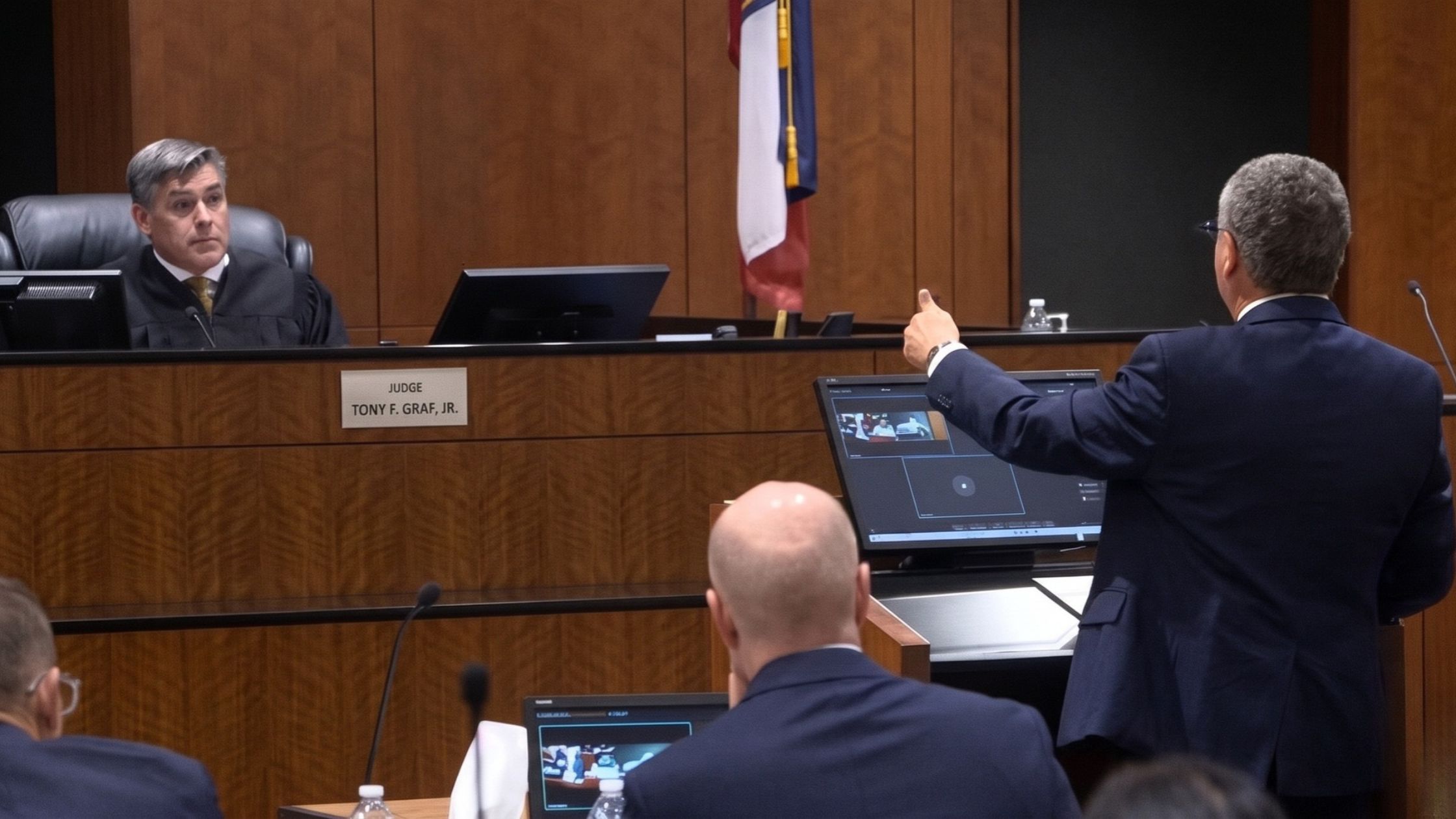
All right. Well, it's necessary for him as the attorney for the victim representative to be able to hear, so. Appreciate the parties' patience, we're just trying to ensure that Mr. Neiman is able to hear the proceedings today. And could we not broadcast that? Well, just turn on... Jeff, could you just turn off that monitor right there? Thank you.
Judge (25:00):
Thank you.
Speaker 1 (25:36):
Okay. He apparently can hear now, Judge. We're being told.
Judge (25:41):
All right. Mr. Nyman, I'm not sure if you can ... Give me a thumbs up if you can hear us.
Mr. Nyman (25:48):
I can hear you.
Judge (25:49):
All right. Thank you. I appreciate it. I just want to make sure that you were present and able to participate as needed. All right. With that, we'll proceed. Before we begin, could I have the camera operator approach the lectern? All right. If you just want to come up to that microphone right there, and if you wouldn't mind just stating your name for the record.
Darren Bailey (26:19):
I'm Darren Bailey.
Judge (26:20):
All right, Mr. Bailey, and what's your role for today?
Darren Bailey (26:24):
The pool camera.
Judge (26:25):
All right. And have you had a chance to review the amended decorum order and the guidelines set therein?
Darren Bailey (26:32):
I did.
Judge (26:33):
Do you need additional time to adjust equipment in order to comply with that order?
Darren Bailey (26:37):
No, sir.
Judge (26:38):
All right. Thank you. All right. Before I begin, I want to address one scheduling issue that came up this morning. And Mr. Burt, I'll be turning to you. This is dealing with People v. Smothers. Up until today, I'm trying to inquire, is there an actual trial date set on the calendar in the People v. Smothers?
The Court (27:06):
Yes, Your Honor. We provided the court with a minute order reflecting the trial date of April 12th.
Judge (27:19):
But my understanding is that that date from your email is the date we'll begin to consider the 27 motions, not the trial date, the actual trial starting. Am I missing something?
The Court (27:32):
The local practice in this county is that they designate the trial date as the date when everything moves forward, including the motions. So on their record, that's the trial date.
Judge (27:46):
But when is the first day that jurors are picked?
The Court (27:49):
When the motions are complete and as I indicated to the court, we estimate two to three months. So probably a July 1st jury selection would begin.
Judge (28:07):
And how long do you anticipate that trial going?
The Court (28:09):
I indicated to the court that it would be ... The first trial, this is a retrial, went from July through September. I think it'll be a longer period because there was no defense put on in the first trial. So I'm estimating 10 weeks, which would mean we'd end probably first or second week in September.
Judge (28:34):
Mr. Burt, the reason why I ask is when we had previous hearings, I asked specifically for trial dates and what I understood was conveyed was that motions would be heard on ... Or the appellate court would make a decision this past Friday and at some point trial dates would be set. Did I understand that correctly?
The Court (28:56):
Yes. The appellate court did reach a decision and we appeared in the trial court and the trial court set the trial date.
Judge (29:03):
All right. Thank you, Mr-
The Court (29:04):
That all took place after we were here.
Judge (29:07):
Thank you. All right. At this time, the court will issue its ruling on the trial setting and case management order, and I'm going to read from the order which will be uploaded later today. Before this court are the Defense's scheduling memorandum and discovery reports, the State's memorandum and proposed scheduling order and Mrs. Kirk's motion for speedy disposition. This trial setting and case management order's intent is to ensure that the constitutional rights of Mr. Robinson and Mrs. Kirk are upheld at every junction, each party is treated with the dignity and respect they are due as they are human beings and that the Sixth Amendment right is protected. As it relates to the jury, the juries are not commodities to be consumed, but human beings to be considered with the end goal that the jury may render a true and just verdict in this case.
(30:19)
The October 23rd, 2026 hearing showed how each proposed date would affect Counsel's preparation, Mrs. Kirk's interest in a timely resolution, and the jurors who would serve. After weighing those considerations, the court selects a different date and reserves 105 court days for trial. The jury selection will begin June 21st, 2028 at 9:30 in the morning in courtroom 4B of the Fourth District Courthouse in Provo, subject to further order. The court will hold monthly pretrial status conferences to protect the constitutional rights at stake. At those conferences, it will review both sides' preparation, address obstacles to a fair and timely trial for Mr. Robinson and give effect to Mrs. Kirk's rights to participation and speedy disposition as provided by the law. Addendum A sets the schedule. The court addresses the three proposals in turn, then explains the June setting and how it will review readiness.
(31:27)
At the April 11th, 2028 hearing, the court will decide whether Counsel can complete the essential work before jury selection. Mrs. Kirk must have an opportunity to be heard before the court changes the trial date under part four. The State filed the information on September 16th, 2025, charging Tyler James Robinson with aggravated murder and six related offenses and gave notice it would seek the death penalty. The court signed its ruling sending the case to trial on September 1st, 2026. It was filed the next day. That ruling found probable cause, not guilt. Mr. Robinson has pleaded not guilty. The Defense proposes nine motion stages and quarterly review. It asks the court to begin pretrial litigation now and defer a firm trial date until more is known about discovery and Counsel's other trials. It proposes trial period ... Its proposed trial period is July through September 2029. At argument, Mr. Novak described that period as a tentative target. The written discovery report lists 49 productions, 30,983 files and about 3.3 terabytes of data.
(32:54)
At the hearing, Ms. Visser distinguished the roughly 31,000 files from a separate collection of about 8 million digital artifacts. Some devices could not be accessed and some data was corrupted. About a quarter of the first collection had been coded for trial. That figure excluded the forensic collection. The State proposes July 31st, 2028. Its written estimate is 85 court days, including 20 for jury selection. At argument, it described a 17-week trial and asked for a firm date to secure witnesses and experts. The Defense estimates six to seven months. Mrs. Kirk through Counsel requests trial by October 4th, 2027. She described the cost of another year of uncertainty to her family and asked the court to give the case a definite setting. The court heard the parties and Mrs. Kirk's counsel on October 23rd, 2026. It reserved its ruling, invited update scheduling information and set a further hearing for November 9th, 2026 today.
(34:07)
The court also considers Counsel's later scheduling submissions and the Defense's November 4th, 2026 correction concerning jury selection in another case. Two points drew agreement at the hearing. The State proposed 3,000 questionnaires and Mr. Novak accepted that estimate for planning. Both sides asked the court to avoid a lengthy trial across Thanksgiving and year-end holidays. Rules 12 and 13 of the Utah Rules of Criminal Procedure govern pretrial motions and case management. Continuous decisions are reviewed for abuse of discretion. That discretion has constitutional limits. Whether denying more time violates due process depends on the circumstances and reasons presented, not a mechanical test. An unjustified insistence on speed can also impair the right to counsel.
(35:03)
These decisions set no minimum preparation period for capital trials. Here, the court must assess the missing evidence, expert in mitigation work and Counsel's trial commitments against time available and the harm from further delay to Mr. Robinson and Mrs. Kirk. The 6th and 14th Amendments to the United States Constitution in articles 1, Sections 7 and 12 of the Utah Constitution protect Mr. Robinson's right to prepare and present a defense with effective counsel. A reasonable investigation is one a competent lawyer would undertake based on the facts known at the time. Counsel must investigate relevant facts and plausible defenses or have a sound professional reason to limit inquiry. Here, the schedule must give Counsel time to review missing records, consult experts and assess meaningful leads before making those choices. For capital mitigation, Counsel must assess whether records and interviews reveal significant leads requiring further inquiry before choosing a defense or sentencing strategy. Counsel need not pursue every conceivable lead regardless of likely value. These effective assistant decisions guide whether the schedule permits Counsel to obtain records, interview witnesses, consult experts and follow material leads. They set no fixed preparation period.
(36:35)
A reporting deadline cannot replace that work. Scheduling relief turns on the applicable continuance standards without requiring counsel to prove an ineffective assistance claim, which this order does not decide. Article 1, Section 28 of the Utah Constitution protects victim's rights to fair and dignified treatment and upon request, participation in important hearings as provided by law. Utah Code Section 77-38-7 sub 1 directs the court to consider the victim's interest in a prompt resolution under the same standards governing the Defendant's speedy trial right. Subsections two and three address unwarranted defense cause delay and require inquiry into a defendant's request to postpone trial. Sections 77-38- 2 sub 5C, 77-38-3 and 77-38-4 govern notice and participation. These protections require meaningful consideration. They do not displace the accused constitutional rights. A constitutional speedy trial claim requires consideration of the length and reason for delay, assertions of the right and prejudice to the accused.
(37:59)
Given Mr. Robinson's current status, unnecessary delay remains a serious concern. This record does not resolve responsibility for each period of delay or the effect on a particular evidence. Those matters require a developed claim and response. This order sets a schedule. It does not decide a past violation or treat any date as unconstitutional by itself. The court now turns to the proposed October 2027 date. Ms. Kirk asked for trial by October 4th, 2027. Her counsel described what another year of uncertainty would mean for her family. That hardship weighs in favor of an earlier setting under Utah Code 77-38-7. The State said it could be ready in early October if pressed. That estimate encompasses October 7th, 2027. Although the State also warned that a trial beginning then could put deliberations over Christmas, the court must also consider what the Defense could reasonably complete by early October.
(39:11)
Ms. Visser estimated at least nine months to finish processing and forensic review if the work went as planned in about a year for digital forensics under the conditions she described. A single file might contain hours of video or hundreds of pages. Even the shorter estimate would leave limited time for an expert to assess the evidence, disclose an opinion and allow Counsel to challenge it before October. Mr. McBride reported reviewing about 1,000 files a week. He explained that most were short reports and that a specialist handled digital forensics. Agency audits occasionally uncovered new material. The parties also anticipated disputes about UVU records and scientific testing. The State's experience explains its readiness estimate. Applying its review rate to Defense's forensic work would overlook the different materials and tasks. Mitigation work began when Counsel entered the case. It requires records, interviews and decisions about expert assistance as leads develop.
(40:22)
Under Wiggins v. Smith, Counsel need enough information to make a reasoned decision about further investigation. The State acknowledged that Mr. Robinson must have a reasonable opportunity to investigate and present mitigation. Part 8B requires a scheduling update that preserves counsel ability to pursue those leads. An October start would also overlap Ms. Nestor's reported Anderson trial. Mr. Grunander explained that school closures, childcare and travel could prevent qualified jurors from serving. Even a faster trial could place deliberations over Christmas. Mr. Novak added that an extended break could impair jurors' recall and make instructions against discussing the case harder to follow at family gatherings. An early October start would overlap with Ms. Nestor's scheduled Anderson trial. If review took the year Ms. Visser anticipated, Counsel would still be examining digital evidence as jury selection began. Even if that work finished sooner, deliberations could fall over Christmas. On this record, the court cannot reasonably set a trial for early October. Part five gives Mrs. Kirk the right to object if a later request would delay trial further.
(41:48)
Turning to the January 2028 proposal, January 31st, 2028 would avoid the year-end holidays and give the State a firm date for witnesses and experts. Mr. Grunander explained why he preferred late January to the first week of the month. An earlier start would put final witness preparation in December when Counsel and witnesses also have family obligations. January 31st, 2028 would fall during Mr. Novak's federal trial in San Jose. He reported that the federal court set January 10th, 2028 on September 29th, 2026, cleared its calendar and adopted a motion schedule. He estimated 2 to 3 months of trial and identified April 10th, 2028 as a possible endpoint. Morris v. Slappy illustrates why the court must examine the practical alternatives. Replacement counsel there had reviewed the investigation and ensured the trial court he was ready.
(42:53)
Here, no comparable showing identifies a lawyer who could take over Mr. Novak's work in time for January 31st, 2028. Counsel must report any change in federal setting so the court can reassess its effects. The evidence deadline presents a separate difficulty. Ms. Visser explained that counsel needs the State's expert and witness disclosures to decide whom to call in response. The venue survey must be recent enough to measure local opinion and early enough for the State to test its methods and present evidence. A January trial would compress that work into a year already occupied by trials identified in addendum B. January 31st, 2028 avoids the year-end holidays. It falls however within the period Mr. Novak expects to spend trying the San Jose case. Even if that setting changed, Counsel would still need expert disclosures and time to prepare responses and enough time to litigate venue before questionnaires are mailed. Applying Ungar v. Sarafite, the court finds the record supports more preparation time than January setting allows. Turning to the July through September 29, 2029 proposal, the Defense asked for active case management now and a tentative third quarter 2029 trial. Mr. Novak explained that a premature firm date could raise expectations the court could not meet, particularly for Mrs. Kirk. He expected mitigation work to proceed while Counsel litigated the proposed motion stages. The court adopts the subjects of the Defense's nine stage plan. Stage seven includes separate dates for the penalty experts and for other penalty evidence. Some work must proceed in sequence. The State must disclose an expert opinion before Defense can prepare a response to it. Other work can begin now. Counsel have already started mitigation interviews and the groundwork for a venue study. The reports in part 4B must identify who can do that work and which tasks depend on missing records, expert opinions or a ruling. The court will address any reported obstacle before enforcing the affected deadline.
(45:22)
The proposed 2029 setting would place the trial about 46 to 48 months after charging. Counsel gave sound reasons for taking some motions in sequence. They also reported that mitigation and venue work had begun. The defense has not identified a task that requires the court to reserve the additional year now. If missing evidence or expert work changes that assessment, Counsel can identify the task, its effect on trial and the time needed under parts 4B and part 5. Defense Exhibit D gives useful context, not a preparation deadline. Its five completed capital trials reports intervals of 21 months for Nelson, 39 months for Maestas, 40 for Griffin and 43 each for Clark and Lovell, a 40-month medium. The June setting here is 33 months and 5 days after charging, shorter than 4 of the examples. The comparison warrants close readiness review, but different starting events and unknown workloads limit its value. The exhibit also includes pleas, unfinished cases and non-capital cases. This case's schedule therefore rests on its remaining work and Counsel's commitment tested under part 4B.
(46:48)
The current trial date. Jury selection will begin June 21st, 2028 at 9:30. This date allows for hearings after Mr. Novak's expected federal trial, gives Counsel 49 calendar days, 7 weeks after questionnaires are due on May 3rd, 2028 and gives the parties a date for securing witnesses and experts. Waiting to set the trial could also allow other cases to occupy the months needed here. Mr. Grunander expected a trial setting in another capital case. Mr. Sturgill anticipated further briefing before his other capital case could be set. The supplemental information identifies State v. Jane and State v. Erickson. Mr. Grunander later identified December 1st, 2026 as the Jane conference date after reporting December 2nd at argument. The supplement identified a November 4th status hearing in Erickson. Counsel must report any trial date actually set. Further overlapping settings could delay this case without advancing its preparation. That delay would implicate Mr. Robinson's interest in a speedy trial and effective counsel and Mrs. Kirk's interest in a speedy disposition. Setting a date now permits the courts and Counsel to coordinate their calendars. Part five provides for review if a later conflict threatens fair preparation.
(48:19)
Readiness review. By December 14th, 2026, the State and Defense must each file an initial conflict and progress report addressing their ability to meet this order's deadlines. Either side may file earlier. Part 10 governs later monthly reports. Use the November 3rd, 2026 defense counsel scheduling memo and addendum B as the starting point. The memorandum identifies the April 20, 2027 setting in United States v. Gonzales and the January 10th, 2028 setting in United States v. Vasquez. It also supplies individual trial dates for Ms. Nestor and Ms. Visser. For each case, distinguish the confirmed dates from any estimated end date. If a setting is still pending, identify the next event likely to resolve it.
(49:09)
For example, report the anticipated December 1st, 2026 Jane conference and supplement the report promptly when its outcome is known. Cite earlier submissions for information that remains accurate, identify corrections, new settings and material information the court has not received. For each unfinished task, state who will perform it, what is still needed and when Counsel expects to finish. If an addendum A deadline is at risk, identify the entry by date and stage and propose a workable date for that step and any response it affects. A short confirmation suffices if existing filings cover every required item and remain current. Counsel may explain the scheduling need without disclosing privileged communications or protected strategy. The March 24th, 2028 joint report must identify ...
Judge (50:00):
... March 24th, 2028 joint report must identify obstacles to the April 12th, 2028 questionnaire mailing. At the March 31st, 2028 conference, the clerk will report whether forms, addresses, and access to returns are ready for mailing upon approval. At the April 11th, 2028 readiness hearing, counsel will update the court on trial commitments, essential work, and outstanding rulings. The court will then decide whether mailing can proceed and whether the time remaining permits fair preparation. Part five governs any requests to move trial. Requests for more time must connect the remaining work, its importance, the obstacle, and a supported completion estimate. General descriptions may establish a scheduling need. If a protected detail is necessary, the court will determine an authorized procedure before requiring it. Reporting neither waives privilege or work product protection nor ends the investigation. The reasonable investigation and continuance standard stated above governs.
(51:08)
At the May 26th, 2028 conference, the clerk must report how many questionnaires were returned, how many both sides could review, and when counsel first had access to each group of returns. Each side must estimate the time needed for an individual questioning, the guilt phase, and any penalty phase. Counsel may explain unfinished work without disclosing protected information. The court will decide whether review can be completed by the start of jury selection on June 21st, 2028. If the estimates exceed the reserve time, the court will first consider adding trial days while keeping jury selection on June 21st, 2028. Before ruling on a continuance, the court will give Mrs. Kirk an opportunity to be heard under part five. The court will identify the estimates it relied upon and explain on the record why the remaining time is sufficient or what adjustment is needed.
(52:07)
Turning to venue and jury pool. The defense proposed a venue study and anticipates a motion concerning where to select jurors. That proposal raises the question whether publicity and community connections could affect the selection of an impartial jury. Under Rule 29(c) of the Utah Rules of Criminal Procedure and State v. Nielsen, the court may consider a different jury pool or trial location on a supported record. Federal law presumes prejudice only in extreme circumstances. News exposure alone is not enough, citing to Skilling v. United States. The court will assess the community coverage, elapsed time, and propose safeguards under the applicable Utah and federal standards. Updated publicity and jury responses will help determine whether further evidence or safeguards are needed. Ms. Visser reported that counsel were interviewing experts and had begun work on venue. They needed a trial date to time the polling. Ms. Nester described about six weeks for a survey in another county, additional time for expert declarations and two days of testimony. She estimated five to six months through submission if the other side contested the study.
(53:29)
Those figures explain why venue work must begin well before mailing. The venue hearing is targeted for December 22nd, 2027. Counsel must report promptly if polling, rebuttal, or testimony cannot be completed by then and explain whether the delay would affect questionnaire approval or mailing. The state proposed 3,000 questionnaires. Mr. Novak agreed that the estimate was reasonable given the publicity and the number of people connected with connections to UVU officers or witnesses. The June 26th, 2026 contempt ruling reserved additional juror questionnaires as a possible remedy. The court sets a planning pool of 3,600. The additional 600 broadened the group available for questioning after non-responsive hardship requests and inquiry into publicity or personal connections. Each juror's answer will determine what further inquiry is needed.
(54:34)
Before approval, the clerk must report expected return and qualification rates, the basis of those estimates, and processing capacity. Counsel may respond before the court confirms the pool. The court targets December 22nd, 2027 for venue argument, December 29th, 2027 for questionnaire argument, and January 6th, 2028 for initial decisions. At the April 11th, 2028 date readiness hearing, the court will confirm venue ruling, approved form, distribution capacity, and access to returns. If any item is missing, the clerk must notify the court and hold mailing. The clerk will mail approved questionnaires on April 12th, 2028. Prospective jurors must return them by May 3rd, 2028, 21 calendar days after mailing. Clerk must state the due date and permitted return methods in the mailing. If mailing is delayed, the clerk must promptly report the actual or expected mailing date. The court will hear counsel before setting new dates to preserve 21 days for responses and seven weeks for review.
(55:47)
Questionnaire review. At the October 23rd, 2026 hearing, counsel discussed the time for the entire questionnaire process. The state separately described an example allowing about six weeks after return. Here, 49 days or 7 weeks separate the May 3rd, 2028 return deadline and the June 21st, 2028 jury selection. Counsel can begin reviewing usable answers as they arrive. Their first priority is to identify agreed exclusions and the questions that require individual follow up. At the March 31st, 2028 status conference, the clerk must confirm that both sides can open and review a sample in the plan format, identify any obstacle, who will address it, and when it will be checked. The clerk must give both sides access to usable returns at the same time. In the May 19th, 2028 joint report, identify the number received, how many both sides can use and how many each side still must review.
(56:53)
The clerk will provide the return and access counts. Counsel must identify any material backlog, its cause and the time needed to resolve it. The defense's written correction gives a more plausible basis for planning individual questioning. In United States v. Gendron, 1,074 people completed questionnaires. The court later questioned 128 people over 13 court days and excused 72 of those 128 for cause. Counsel must estimate separately the time needed to review forms, the number of jurors likely to need interviews. In the May 19th, 2028 report, identified agreed exclusions, disputed questions, and any obstacle to complete review by June 21st, 2028. The court will hear disputed challenges as jury selection begins before individual questioning. Report a shortfall sooner if it becomes apparent. Only the court may shorten review after hearing both sides. Individual juror availability. Some prospective jurors will have summer commitments. The questionnaire should identify the dates of any conflict and whether it affects only the interview or the prospective juror's ability to serve through the trial.
(58:13)
Either party may propose an accommodation and the parties may submit an agreed proposal. The court will decide after notice, consistent with the selection method announced before trial, the applicable random order of calling of jurors and the opportunity to examine jurors and raise challenges. If relief requires postponing jury service, good cause must be shown. Excusal requires a statutory ground supported by an affidavit, sworn testimony or other competent evidence. Counsel must have an adequate opportunity to learn the facts needed to evaluate each juror. The clerk will record and give counsel notice of the court's decision. Victim participation. Mr. Neiman described anxiety, grief, and the effect of continued uncertainty on Mrs. Kirk's family.
(59:01)
Utah Code 77-38-7(1) requires the court to consider the victim's interest in a speedy resolution under the same governing defendant's speedy trial right. The court waives counsel's submission under the standard alongside Mr. Robinson's right to prepare and present his case. Part five gives Mrs. Kirk notice and an opportunity to respond before the court decides whether to change the setting. Serve any request to move trial on Mrs. Kirk's lawyer when filing it, even if both parties agree. Ordinarily, file at least 21 days before the requested ruling. Mrs. Kirk may respond or object within 14 days after service and speak through counsel at the hearing. The parties may answer new matters as she raises. If the court proposes a change, the clerk must notify her lawyer and allow a meaningful response. If urgency requires shorter notice, the court will explain why and allow as much participation as circumstances permit. Court sets these periods to implement Article 1, Section 28 and Utah Code 77-38-25C and the remainder applicable statutes.
(01:00:22)
Turning to reasons for delay, Utah Code 77-38-7(2) protects Mrs. Kirk against unwarranted delay caused by or at the behest of the defendant. Counsel identified specific work supporting their proposed schedule and the court recognized its duty to weigh that work against the effects of delay. On a defense motion to continue trial, the court will inquire into circumstances, consider Mrs. Kirk's interests, and any timely objection and address reasonable alternatives. If it grants the motion, it will state on the record the specific reason and steps taken to avoid further delay as subsection three requires. If it denies additional time, it will explain how counsel can complete the necessary work within the available time.
(01:01:13)
Trial conflicts. Addendum B protects only the listed defense dates and reported trial periods without added days. Estimated end dates remain subject to confirmation. Except for the limited monthly conferences and status reports in part 10, no hearing, filing or response required by this order may be due during those periods. Overlapping periods are treated as one. This states August 2nd, 2027 through August 6th, 2027 conference bars hearings but not filing deadlines. The Erickson and Jane hearings do not establish future trial conflicts. These scheduling protections apply to both parties' obligations in this case. Addendum B lists the reporting settings in Gonzalez and Vasquez, counsel must confer operative Gonzalez orders because a minute entry and proposed schedule differ on the year of the April conference. The May 18th, 2022 entry records when the trial was sent. Defense counsel's scheduling memo and it cites to the defense counsel's scheduling memo. The court will reserve additional time if a firm setting or their specific conflict warrants it. Counsel must also report actual settings in Jane and Erickson.
(01:02:35)
If a calculated filing deadline falls within a protected defense period, it moves to the first available business day afterward, including any overlapping exclusion. The state's hearing only conflict do not move filings. If this creates crowded deadlines or too little time for the next task, counsel must propose a coordinated schedule. Related response periods and later deadlines change only by court order. Statutory duties remain controlling. Seek relief under the applicable law. A continuous request must identify affected work governing standards and resulting prejudice. Request to move the trial must also follow part five. Request for more time does not suspend a deadline. If a ruling is needed beforehand, request a prompt decision or temporary extension. Counsel for both sides must keep the reserve trial period available before seeking or accepting an overlapping setting. Notify this court and other court and identify the dates and work affected. If conflict is discovered later, report it promptly, explain when it became known, and propose a workable alternative.
(01:03:45)
Include the other court's setting order if available. If either side reports a trial conflict after the schedule is set, identify when counsel learned of it and which work it affects. The court will consider diligence, the reason for admission, actual prejudice, available alternatives, and the effective delay on Mr. Robinson and Mrs. Kirk. Rule 13(a) authorizes pretrial management for fair and expedited trials. Rule 2(b) and 12 govern relief from applicable motion deadlines. Continuous decisions require attention to the particular circumstances. For a defense continuance under common law, counsel must explain how the denial would prejudice the defense. The court will preserve constitutionally adequate preparation, apply Utah code 77-38-7 when trial is at issue and give its reasons on the record.
(01:04:39)
Deadline rules and counting days. The first day of jury selection is June 21st, 2028. Addendum A pairs each date with a number of calendar days before or after that date. For example, T49 is May 3rd, 2028 and T+9 is June 30th, 2028. The 180- day point falls on Friday, December 24th, 2027, an observed legal holiday. The mitigation update is therefore due Thursday, December 23rd, 2027. The December 14th, 2026 initial report date is fixed regardless of the trial date offset, listed dates, control subjects to parts 6 and 10.
(01:05:25)
Changes to the trial date. Only the court may reset the first day of the jury trial stated in part 7A. Unexpired deadlines ordinarily retain their stated intervals subject to the new addendum A and any transition order. A continuance does not reopen missed deadlines, undo completed work or alter responses and reply periods for motions already filed. Continuing duties and deadlines independently set by law remain in force. Upon setting a new trial date, the court will issue a new addendum A. The parties will have seven days after its issuance to identify conflicts requiring a ruling, including lost response time or a ruling scheduled after work that depends on it. An earlier start that places a deadline in the past requires a transition order. Recalculation alone neither shortens response time nor displaces a protected period.
(01:06:19)
Turning to motion procedure, extensions and rulings. The stages group the subjects in defense exhibit A without requiring all work to proceed sequentially. An extension request must identify the task, efforts to complete it, relief sought, and effects on later dates. Rule 2(b) permits timely extension for good cause and where applicable requires excusable neglect after expiration. Its limits for specified post-trial and appeal deadlines remain controlling. Rule 12(f) separates governing waivers of covered untimely motions and relief for cause shown. The court will apply the standard for the particular request. In pretrial status reports identified each undecided motion, the briefing or hearing still needed and any work that awaits a ruling, counsel must bring fully briefed motions to the court's attention under Rule 12(b). Rule 12(e) requires the court to decide a pretrial motion before trial unless it finds good cause to defer the decision. When deciding a motion involves factual issues, the court must state its findings on the record. If the court cannot meet an addendum A ruling target, it will explain the delay, set a new target, and decide whether the parties need more time for work that depends on the ruling.
(01:07:39)
For example, if the discovery is ordered late, the court will consider the time needed to obtain and examine it before enforcing the deadline for a suppression motion. Existing deadlines remain in force until the court changes them by order. Motion subjects. The defense identifies nine pretrial phases in exhibit A to docket 773. Phase one intermediate motions include a motion to quash portions of the bind-over decision, a constitutional request to present the felony charges to a grand jury, and review of the ruling on pretrial shackling and enforcement of the subpoena for the sheriff's security assessment. Counsel also identify a possible request for records used to compile the jury pool to assess a fair cross section claim and other motions as needed. Addendum A sets filing dates without deciding the merits of any proposed motion.
(01:08:36)
Phase two covers the discovery motions identified in exhibit A. They concern access to materials for forensic review, additional social media records, missing law enforcement material, UVU and other subpoenaed records, and safeguards for destructive ballistics testing, including observation or video recording. The state asks for a one-day January 2027 hearing on pending discovery including proposed microscopy, I can't speak, testing, identify ready motions, witnesses and time needed in the initial report, raise urgent preservation or access issues promptly. Phase three covers motions to suppress evidence obtained through subpoenas, warrants, consent searches or other means and to exclude DNA evidence based on the alleged destruction of samples. Phase four covers facial and as applied challenges to the Utah death penalty laws, challenges to the process by which the state elects to seek death. Legal questions may proceed while factual reviews continue. The court will reserve separate hearings for complex motions and review affected deadlines if late discovery prevents meaningful briefing. Phase five addresses disclosure and admissibility of the state's proposed guilt phase expert testimony. Phase six addresses timely disclosure of the state's guilt phase witnesses and exhibits and motions to limit their use at trial.
(01:10:07)
Reciprocal disclosures shown in addendum A implement the court's schedule for a challenge under the Utah Rule of Evidence 702, identify the opinion, the disputed requirement concerning qualifications, helpfulness or reliability. An objection to expert notice and objection to admissibility raises different questions. A substantial failure to comply with Utah Code 77-17-13 requires a continuance if necessary to prevent substantial prejudice. Exclusion for a notice violation requires a finding that the violation was deliberate. Rule 702 separately governs whether the opinion has a required foundation. State v., and then citing to State v. Peraza. For motions under this order, counsel must identify the basis for the objection and the relief requested so the court can apply the governing standard. Both sides must exchange the required expert reports or opinion summary, supporting materials, qualifications, and compensation agreements, raising complete discovery promptly. The exchanges concern expected trial witnesses, privileged communications, protected work product, and consulting experts retain the protections provided by law, identify the legal basis for additional materials and request any needed protective order under Rule 16.
(01:11:33)
Exhibit A uses 7 for both categories of penalty phase motions. This order labels them as 7A and 7B. 7A addresses disclosure and admissibility of the state's penalty expert opinions. 7B addresses the state's penalty witnesses and exhibits its informational outline and motions to limit proposed penalty evidence, including evidence of uncharged violent conduct. By December 23rd, 2027, the defense must file a mitigation investigation status report under part 7A. It may be filed with the status report due that day. Describe in general terms the work completed, the work remaining and any material obstacle and a supported estimate of time needed. Counsel explained that new leads may require further interviews or expert consultation through trial. The report requires neither a certification of readiness nor disclosure of confidential, privileged or protected information. Counsel may request a protective procedure if more detail is necessary.
(01:12:44)
Phase eight covers where the trial will take place and where jurors will be selected. Counsel proposing studying publicity in Utah County and a comparison county after a significant pretrial litigation and resolving venue before questionnaires are sent. Under Rule 29 (c)(3) a venue motion is due within 14 days after a party learns or with reasonable care should learn its grounds. Addendum A, November 10th, 2027. Date does not extend that deadline or decide whether grounds are already known. File known grounds on time and ask for later evidence when needed. Counsel must use the initial progress report to work back from the December 22nd, 2027 hearing, allowing time for the survey, expert review, rebuttal, and testimony as described in part 4C. Report promptly if the work cannot be completed on that schedule.
(01:13:39)
Phase nine addresses preparation, court review and distribution of questionnaires, review of returns, agree and disputed challenges for cause, the procedure for individual questioning, peremptory challenges, capital jury issues, and instructions for both phases. This order also sets deadlines for hardship requests, sequestration motions, and alternate jurors. Planning begins with at least four alternatives. The court will decide the number after the parties file their motion. Exhibit A labels trial itself as 10.
(01:14:15)
Continuing disclosure. Addendum A does not allow a party to hold back evidence that is due sooner. Both sides must promptly update required disclosure and identify newly found witnesses. Duties to disclose favorable evidence under Brady Rule 16, separate statutory notices and protective orders remain [inaudible 01:14:36] force.
(01:14:39)
Media requests. Under the court's May 8th, 2026 order on electronic media coverage, a media outlet seeking to photograph, record, or stream the jury trial must file the approved request through the court's... Sorry, there's a typo here. Must file that request through the court at least 14...
Judge (01:15:00):
... the request through the court at least 14 calendar days before jury selection. Requests are due Wednesday, June 7th, 2028. Either party may file an objection or request oral argument at least 10 calendar days before jury selection. The 10th day is June 11th, 2028. Under part 7A, the filing deadline is Friday, June 9th, 2028. A request may cover 105 court days from jury selection through evidence and a possible penalty phase. Given the length and nature of this trial, the court will schedule oral argument if either party timely requests it. Immediate applicant may reply by June 13th, 2028.
(01:15:48)
The court reserves time at the June 15th, 2028 final pretrial conference for argument and targets June 16th, 2028 for a ruling so the clerk can arrange coverage before jury selection. Rule 4-401.01 sub 2 and sub 6 of the Utah Code of Judicial Administration governs coverage and safeguards for jurors and confidential communications. Coverage requires court authorization. Existing coverage orders otherwise remain in effect. Late requests require good cause.
(01:16:24)
Calendar addenda. Use addendum A to find a filing date, hearing date or ruling target. Use addendum B to check counsel's reported conflicts. The court will separately notice hearings. Proposed instructions and final exhibits are due May 30th, 2028. Objections and responses are due June 13th, 2028. If a later ruling affects a submission, identify the change promptly so the court can set time for a supplement and response. At the final pretrial conference on June 15th, 2028, identify arrangements that depend on the June 16th, 2028 media ruling. The court will hear disputed questionnaire challenges on June 21st, 2028.
(01:17:08)
Pretrial status conferences beginning January 2027. Pretrial status conference occur on the last Friday of each month, including protected trial months. Because March 26th and December 31st are legal holidays, those conferences will be held March 25th, 2027 and December 30th, 2027. During another trial, the conference will address scheduling and progress. The clerk will give separate notice. If a need for remote attendance is requested at the proceeding pretrial conference, state who wishes to appear remotely, the reason and whether the request concerns one participant or the whole hearing. Counsel must make the request for a represented participant. For the first conference or if the need arises later, use a method authorized by the Utah Rules of Criminal Procedure 17.5C. Requests made outside of a hearing must be submitted at least seven days beforehand, except that exigent circumstances or shorter hearing notice require request as soon as reasonably possible.
(01:18:15)
The court will accommodate a timely request unless it finds good cause on the record to require the noticed format. Approval for one participant changes another format only by court order. If approved, the court will provide the participant with a leak for a judicial counsel approved platform. The court will confirm the remote participants can hear and be heard, follow the proceeding and participate as needed. It will pause if a connection failure prevents participation or confidential consultation before Mr. Robinson and counsel.
(01:18:49)
Utah Code 77-1-6 sub 1A protects Mr. Robinson's right to appear in person and defend in person or by counsel. Remote attendance requires court approval in compliance with applicable presence and waiver requirements. The parties must file a joint report seven days before each pretrial status conference. If the report date is a holiday, file on the proceeding business day, identify work still needed, missing evidence, expert in jury preparation and deadline risks. For other trials, give the court case dates or estimated duration, counsel's role and the effects here. Counsel may state separate views and protect privilege strategy, report new conflicts promptly. The final report is due May 19th, 2028 for the May 26th conference. Reoccurring reports and conferences end before jury selection.
(01:19:47)
Trial hours and argument days. The court will normally meet Monday through Friday from 9:30 AM to 4:30 PM, excluding observed Utah holidays. The start time allows for school drop-offs, rush hour traffic, courthouse entry and Utah winter weather. The afternoon stopping time limits fatigue and leaves time to prepare for the next day's witnesses. A one-hour lunch and two 15 minute breaks leave five and a half hours of proceedings. This schedule gives the jurors regular breaks and predictable stopping times so they can follow the evidence and the court's instruction throughout the lengthy trial. Their oath is to render a true verdict on the record. The Sixth Amendment protects Mr. Robinson's right to an impartial jury and its verdict must rest on the evidence presented at trial. Jurors will be excused for legal arguments on June 30th, 2028, July 28th, 2028, August 25th, 2028, September 29th, 2028, and October 27th, 2028, subject to advanced notice if used time is converted to jury proceedings. At the June 15th, 2028 final conference, counsel should identify any argument needed for June 30th, 2028 so jurors receive timely instructions about attendance.
(01:21:13)
Reserved trial time. The state estimates 85 court days, including 20 for jury selection. It expects agreed challenges based on the questionnaires to reduce the number of interviews. The defense estimates up to two months for in-court jury selection, six weeks to two months for each evidentiary phase and up to two weeks for each period of deliberations. Counsel based those estimates on a five and one half hour days and a monthly motions day. The memorandum estimates six to seven months overall. Exhibit A, trial row lists four to six months. The court considers the detailed phase estimates in the memorandum. The court reserves 105 full days. Five are reserved for legal argument. The 100 jury days provide approximately 550 hours for selection, evidence and deliberation. Compared with the state's estimate, the 20 additional days allow five for legal argument and 15 more jury days for individual questioning, contested evidence or any penalty phase.
(01:22:23)
Defense's correction shows that even after the questionnaires and agreed strikes, individual questioning in [inaudible 01:22:32] show that even proceed in groups of 7 to 12 per day, defense... Sorry, that's the citation. Relying on the state's faster selection estimate alone would leave too little allowance for those risks. If selection takes the state's estimated 20 jury days, 80 of the 100 jury days remain. If it takes 40 days, 60 remain. The defense estimates six weeks to two months for evidence in each applicable phase. At five days per week, six weeks of evidence in each of the two phases would require about 60 jury days before deliberations. On the 40-day selection assumption, even that shorter evidence estimate would use all 60 remaining days if both phases occur, leaving no time for deliberations. October 21st, 2028 is the last reserved day. The court will allow additional time if the parties need it to present evidence or the jury needs it to deliberate. Counsel must report a projected shortfall as soon as they identify it.
(01:23:40)
For the April 11th, 2028 review, each side must update its estimates for witnesses, examinations, challenges, legal arguments and deliberations. The court will revisit those estimates in the report part 4B when questionnaire returns are available. The parties may present admissible evidence and the jury will have time it needs to deliberate. The reservation runs from June 21st, 2028 through November 21st, 2028, a span of 154 calendar days. It excludes weekends and the observed holidays of July 4th, July 24th, September 4th, October 9th and November 10th, November 21st and November 10th. November 21st, 2028 is 105th reserve court day. Part 13 governs any proceedings that are needed after that date. If the trial continues beyond October 21st, 2028, the court will recess and resume proceedings on November 28th, 2028. The parties raise concerns about holiday travel, jurors recall and discussions of the case at the gatherings. At argument on October 27th, 2028, the counsel must identify testimony likely to be interrupted in proposed instructions for the break. If proceedings extend into the year-end holidays, the court will recess after December 22nd, 2028 and resume January 3rd, 2029. Utah Code 63G-1-301 and court closure orders govern observed holidays.
(01:25:11)
In conclusion, the court orders as follows. The jury selection will begin June 21st, 2028 at 9:30 in courtroom 4B of the Fourth District Court in Provo, subject to further order. The court reserves 105 days through June 21st, 2028. The court does not adopt the proposed October 27th, January 31st or July through September 2029 settings and will not defer setting a trial date. Mrs. Kirk's request for 2027 trial is not granted. Her request for prompt disposition is granted to the extent of the firm setting, participation and review provided by this order. Other speedy disposition claims remain open. Addendum A sets the deadlines and conference dates. Addendum B identifies counsel's protected dates. Parts six through eight governs scheduling and motion procedure with limited conference and status reports except in part 10.
(01:26:08)
The planning pool is 3,600 questionnaires subject to part 4C. The clerk must mail approved questionnaires April 12th, 2028. Returns are due May 3rd, 2028. Counsel must report review progress under part 4D before jury selection begins June 21st, 2028. Request to move trial must follow part 4, including notice to Mrs. Kirk's counsel and an opportunity to respond. If trial is reset, the court will issue a new addendum A. The parties have seven days to identify conflicts under part 7B. Monthly conferences and status reports begin in January 2027. The final report's due May 19th, 2028. The final reoccurring conference is May 26th, 2028. Part 10 governs limited exceptions for protected trial months. Report other trial commitments and their effect on the work here. Legal argument days in part 11 remain reserved.
(01:27:11)
By December 14th, 2026, each side must file the report described in part 4B. At the first pretrial conference, the clerk must report available hearing time and jury staffing. This order sets no deadline to assert speedy trial or speedy disposition rights and does not decide or waive other claims based on delay, requests based on new evidence or materially changed circumstances must be raised promptly under the governing law. It is so ordered. And that is the ruling of the court and that will be made available as well as addendum A, which outlines the deadlines and addendum B, which are the conflict dates reported by counsel prior to today. Counsel, with that, my understanding is you wish to set a date in January to address motions. Is that correct?
Speaker 2 (01:28:04):
That is correct from the state's perspective.
Judge (01:28:07):
To defense?
Speaker 5 (01:28:11):
Just one second, Your Honor. Sorry.
Richard Novak (01:28:19):
Thank you, Your Honor. Richard Novak.
Judge (01:28:21):
Good afternoon, Mr. Novak.
Richard Novak (01:28:22):
Thank you, Your Honor. On behalf of my colleagues who are all here, of course, on behalf of Mr. Robinson, we do intend, without having seen the addenda that the court has referred to, we do intend to file all of the motions we described in phase one, and that actually does include other motions to be determined, as the court noted. I don't know that all of them can be fully briefed in time for an early January hearing, but I do know that counsel for the state and Mr. Burt discussed a particular motion that maybe would be ready by early January. Mr. Burt is nodding. So I guess the question is, what does the court need from us for purposes of its calendaring? We still would like the other phase one motions to be fully briefed and heard in the first quarter.
Judge (01:29:25):
And I appreciate it. And I know that you don't have the benefit of the addendum, but those roughly are due in March. So the remainder of phase one is due in March. So I'm not anticipating that-
Richard Novak (01:29:38):
Okay, understood.
Judge (01:29:39):
Whatever you want to do in January, let's get on it. But the expectation is not that all phase one will be done.
Richard Novak (01:29:46):
Okay. And we will not wait until March to file all of them.
Judge (01:29:50):
Right.
Richard Novak (01:29:51):
We're going to file them on a rolling basis and the court will set hearing dates.
Judge (01:29:57):
And I wanted to see if you had any questions about the monthly status conference before we start scheduling it. So essentially what I'm trying to do is set a monthly status conference and it can be as long or as short as we need it or it can be converted into a motions hearing date. What I'm trying to do is capture a date. We have a lot of motions that we need to address and I want to keep us on track so we make measurable progress and that the parties have an expectation. I've taken all the dates that you've put in and addressed for any conflicts. So no motion deadline or hearing date falls on any of your protected trial settings. The exception is Mr. Burt's, as I just learned of that final date today. And so I'll wait till we'll hear on that December 14th date. That's when you're going to give your input based on reviewing this order and the addenda of the calendar and the deadlines, because I want to see if I missed anything that you wanted me to consider or something wasn't brought to my attention.
(01:31:03)
With that in mind, the first date in January, I'm going to leave it open since you didn't have an expectation of when that would be set. And of course my staff, how much time is needed and when would we like to set this hearing?
Speaker 3 (01:31:26):
Mr. Burt might see things differently, but I expect this to be an oral argument based on affidavits as the evidentiary basis. The purpose of the motion is to ask the court to allow us to proceed with metallurgy and virtual comparison microscopy testing on some of the evidence, the bullets. So we expect just an oral argument and I would ask for three hours.
Judge (01:31:55):
Now, is it the anticipation that you are filing complete motions and then having oral argument?
Speaker 3 (01:32:01):
Yes, that's my intention. I've got affidavits and motion and the motion should be filed by the end of the week. I expect the defense to file theirs in response and we have our argument about those motions at that time and we would expect or hope for an order that day or soon thereafter.
Judge (01:32:19):
I see. Thank you. Mr. Burt or defense, I'll hear from you about that proposal three hours dealing with those two subjects, motions filed before them and oral argument on that day.
Speaker 4 (01:32:31):
I think that's acceptable, Your Honor. The motion would be submitted on declarations or affidavits and no evidence would be needed.
Judge (01:32:38):
All right. And so we'll start the motion cutoff date as soon as the state files it. And it sounds like you'll be filing that within...
Speaker 3 (01:32:47):
By Friday.
Judge (01:32:48):
All right. We'll set the deadline this coming Monday just to allow for that. Two weeks for response and one week for reply. That's still within the timeframe before a January setting. What do we have for a three-hour setting in January?
(01:33:12)
And as they're looking at that date, the other purpose of the scheduling hearing on a monthly basis is to address what's coming up because there is a lot. And so I want to give the parties that opportunity to file a pre-status report so you can give the court a heads-up, "Here's what we're looking at. Here are some of the conflicts." You don't have to agree, you can file your own section, but I want to be fully prepared for that hearing and that at the next hearing we're going to confer what happens in a month so everyone's on the same page and we're making meaningful progress and hopefully that provides a little bit of guidance to the parties on why the court is setting monthly status hearings given time is so precious.
Speaker 5 (01:33:53):
Judge, first date we have available is going to be January 14th.
Judge (01:33:59):
How does January 14th look?
Speaker 2 (01:34:02):
Works for the state, Judge.
Speaker 5 (01:34:05):
[inaudible 01:34:06] Your Honor.
Richard Novak (01:34:05):
That's fine with Mr. Robinson's counsel. Thank you, Your Honor.
Judge (01:34:09):
All right. So January 14th is a Thursday at... Did you say one o'clock?
Speaker 5 (01:34:15):
Morning or afternoon?
Judge (01:34:16):
1:00 or the morning setting?
Speaker 4 (01:34:20):
No.
Speaker 5 (01:34:21):
Could we do the morning, Your Honor?
Judge (01:34:22):
All right. Let's say 9:00 AM, January 14th for oral argument and status update. That will be the first one. And then the court will also take into consideration anything that the parties file addressing this order and the deadlines. So that's due, I believe I stated on December 14th. And so the court will address those issues at that hearing as well, starting at 9:00 AM going for the three hours and I'll block off the rest of the day just in case things come up and I want to make best use of our time so we're not cut short and need to continue. All right, counsel, is there anything else that I can address today?
Richard Novak (01:35:09):
My quick question, Your Honor. So is the court using January 14th as what it referred to as the monthly status hearing as well?
Judge (01:35:17):
It is. I didn't want to commit you to something that you had no idea. And again, address in that December 14th order if the last Friday works. I want to set something that we all can be like, "Okay, this is the date. We can all shoot accordingly for that." And so it just makes things a little bit easier.
Richard Novak (01:35:36):
Understood. Thank you.
Speaker 2 (01:35:37):
And the December 14th is reports are due.
Judge (01:35:40):
Yes.
Speaker 2 (01:35:41):
There's no hearing that day.
Judge (01:35:42):
There is no hearing.
Speaker 2 (01:35:43):
And for the court's information, we anticipate rolling motions to be filed as well.
Judge (01:35:47):
Of course.
Speaker 2 (01:35:48):
So when we come in January, we can set some further dates.
Judge (01:35:51):
All right. Anything further? All right. I appreciate the parties-
Mr. Neiman (01:35:57):
Your Honor, if I could just speak very quickly.
Judge (01:35:59):
Yes, Mr. Neiman,
Mr. Neiman (01:36:02):
Yes. Look, Your Honor, look, the Kirk family obviously has the right to speedy disposition of this case. A trial in the summer of 2028, three years after Charlie's assassination, does not feel very speedy to the Kirk family. We understand that the court is balancing a lot of competing interests and we have no choice but obviously to accept the schedule that the court's put forward. We only ask that the court hold to the schedule. I know the order lays out a lot of detail in order to kind of get us on that path, but we just ask on behalf of the family, issues always come up as a trial gets closer. They're going to come up here and the Kirk family strongly asks the court that the schedule not move unless something truly significant requires it to be moved. The family has waited long enough already. They should not have to wait any longer for this. And with that, we will let the process play out.
Judge (01:37:00):
Thank you, Mr. Neiman. All right. Unless there's anything else, we will be adjourned. Court is adjourned.
Speaker 6 (01:37:06):
All rise.