Shilo Brooks (00:00):
Live now to a conversation with former President George W. Bush and former Secretary of State Condoleezza Rice on the 25th anniversary of the September 11th attacks. Historic evening. Before we get started, I want to offer my sincere thanks to NextPoint for endowing the series. We're grateful for your support and for the support of all of our donors who are here with us tonight. I also want to thank the members of our board who are here for their support of me and also this great organization. I'd be remiss if I didn't also acknowledge the members of the Bush Cheney administration who are here with us today. I want to thank you for your civic service in our government, your leadership when America was under attack. On 9/11, courageous first responders raced toward danger to save as many lives as they could. And after 9/11, selfless Americans from all walks of life raised their hands to volunteer to protect our country, no matter the cost. To those of you here and watching at home online, thank you. And to those of you who lost a loved one, you should know that we will never forget.
(01:12)
Tonight, we reflect on the events of September 11th, 2001, a day that 25 years later weighs as heavily on our hearts and minds as it did in the days immediately following the attacks on our nation. As I prepared for this evening, a quote from President Bush kept running through my mind. On the evening of 9/11, after returning to Washington DC, he sat in the Oval Office to address his fellow citizens and he said, "America was targeted for attack because we're the brightest beacon for freedom and opportunity in the world and no one will keep that light from shining."
(02:03)
I want to take you back to September 9th, 2001, 25 years ago today, two days before 9/11. That day in 2001, Lleyton Hewitt beat Pete Sampras at the US Men's Tennis Open. Band of Brothers premiered on HBO. J.Lo was at the top of the charts. The weather in Washington DC and New York City was typical of late summer, warm and clear. Across our country, children were doing their homework. Parents were getting ready for the week ahead. Families and friends were sitting down for dinner and Americans were gathering in restaurants, auditoriums and theaters just like we are here tonight. None of this is especially or particularly remarkable, which is why I bring it up.
(02:59)
On September 9th, 2001, none of us knew that less than 48 hours later, we'd be targeted in the most deadly attack ever to occur on American soil. The terrorists, who took more than 3,000 lives that day, aimed to take away the rhythms of American life. They wanted those who live under the light of the brightest beacon of freedom in human history to be shackled by fear. They wanted to plunge our great nation into darkness. They failed. 25 years later on September 9th, 2026, children are doing their homework. Parents are planning for the week ahead. Families and friends are sitting down for dinner. People are gathering in restaurants and auditoriums and we remain the brightest beacon for freedom and opportunity that the world has ever known. We are still a great nation, a nation that when met with grave challenges, rises to overcome them with courage and determination.
(04:05)
The people who are going to be on this stage tonight are examples of what one of our founders, James Madison, called America's national character. They led our nation's response to terror after 9/11 and we are grateful for their steadfastness, their bravery, their patriotism, their wisdom and their compassionate hearts. It's now my honor to introduce Jared Lyon, a longtime leader who has dedicated his life to serving in the military and the military community. Jared enlisted in the US Navy in 2001 and served as a submariner and diver in the Navy submarine force aboard the USS Alexandria from 2001 to 2005 during the opening years of the global war on terrorism. Please join me in welcoming Jared Lyon to the Bush Center stage.
Jared Lyon (04:58):
25 years ago this week, I was a 19-year-old, five weeks into the US Navy's bootcamp in Great Lakes, Illinois. And I though the attack on America on 9/11 was a training exercise. On the evening of September 11th, our recruit division commanders or RDCs as we call them, sat two divisions of recruits down in our compartment and they rolled out a television. Now think middle school. This is on a cart. It's got the big straps on it and a VHS and somebody put in a VHS tape and went ahead and played some news clips from the day.
(05:50)
You see, the day before for us was September 10th and we had had classroom instruction on a session called Counter Terrorism. They used the attack footage of the USS coal incident to prepare us as new sailors for when we entered the fleet. So when we were first watching those moments of news clips because we had been isolated in bootcamp all day on September 11th, the first time we saw those clips was at night, some of us actually began to get a little bit excited. We didn't think what we were watching was real, but that's kind of this weird thing in basic training. It was also to us almost unimaginable that an attack on American soil could be real. And we honestly thought that it was a training simulation.
(06:45)
It would then be our senior chief, our senior recruit division commander, Senior Chief Gregory turned off the television and he said, "Listen up gentlemen, this is real. Our nation is under attack. Up to this point, we've been shining our shoes, polishing our boots, learning how to march. From this day forward, we are now preparing you all for war." He then told us that he was leaving as our senior RDC to deploy and we never saw him again. This is Division 407. This is my division in bootcamp. These are the guys that I was in bootcamp with and we would go on to receive the Chief of Naval Operations Division Honor Division as a recognition for our time.
(07:32)
All of us in this photo had volunteered in a peacetime military. Then overnight, history rewrote the terms. A few weeks later, I graduated from bootcamp and me and six brand new sailors went into Chicago, Illinois. We were all in our dressed whites. When we got there, we had the idea we'd go see a movie. I know it sounds weird, but we're getting out of bootcamp, wanted steak and to see a movie. And a stranger came up behind us and sort of cut us in line and actually paid for our tickets, which shocked us. Then he turned around and he thanked all of us for our service. I remember being really uncomfortable with being thanked. We hadn't done anything yet.
(08:18)
So everywhere we walked that day in Chicago were American flags. They were displayed proudly and prominently throughout the entirety of Chicago. We stopped in front of one of them and took this picture. For years, I thought that stranger was thanking us for what we had done. I understand him a little bit differently now. He was recognizing us for what we had agreed to do. And that was honestly my impression of what service is, a promise. It's a promise to show up, to go where you're needed, to stand beside people that you barely know and put something bigger than yourself in front of your own needs.
(09:02)
My generation of post 9/11 veterans has lived inside that promise for 25 years, and not all of us have reached the same conclusions about the wars that followed. I served on active duty as a submariner and a diver and I deployed around the world in support of the global war on terrorism. After our service and deployments in the post 9/11 era, some of us carry pride, some of us carry anger, some of us even carry grief. Many of us carry all three. And some of us have wondered whether or not it mattered. I can't answer this for every veteran. I can only answer it for one.
(09:42)
I know my service mattered. But what history ultimately says about my generation is not yet settled. I know that because of two generations that came before me. My grandfather and my wife's grandfather both served in World War II. Their war ended in 1945 and we would not start calling the World War II veterans the greatest generation until 1998 when Tom Brokaw wrote a book by the same title. It took us 53 years to decide that they were the greatest generation. My father-in-law was a Marine and he served in Vietnam. His generation came home to a country that was divided over their war, but they did not accept that last story of their service. You see, Vietnam veterans spent the next 50 years when they came home building their legacy, their advocacy, the institutions, and the promise that never again would one generation of veterans abandon another.
(10:41)
When I later began my work in veteran advocacy, many of the people who mentored me and showed me the ropes in Washington DC were Vietnam veterans. They taught my generation something as well. Vietnam veterans taught us that service does not end when the war does. To be with you here today, I had to leave my two young sons behind in Florida. They're three years old and six. They're so young that they still believe in everything that America could be, more perfect. As they grow up, 9/11 will never be a memory for them. For them, it'll be a chapter in a history book and something that makes them remember their dad. So the question I sit with today is this. 25 years from now, my boys will be 28 and 31 year old men. When they read about the history of our generation of post 9/11 veterans, what are they going to find? Did we keep serving? Did we keep building? Did we leave them a country more united than the country we inherited?
(11:45)
The constitution did not promise us a perfect union. It asked us to form a more perfect one. Every generation gets that assignment. Ours isn't over yet. History will be the judge of our wars, but it hasn't finished judging us and we still have a say in that, not by what we say ourselves, but what we build together. 25 years ago, a stranger thanked a 19-year-old for a promise that I hadn't yet kept. Today, I'm trying to keep it. The story of post 9/11 veterans is a story that is still being written. So if you're a veteran, I would encourage you to reach out to a post 9/11 veteran on this anniversary and check in with them and see how they're doing. If you never wore the cloth of our nation, I'd ask you to reach out to somebody who did, and in this way, we can all write the story of the next generation and we can do it together. Thank you.
(12:59)
Ladies and gentlemen, please join me in welcoming to the stage the chairman of the Joint Chiefs of Staff, General Dan "Razin" Caine and also Ambassador J.D. Crouch as well. Hold on, sir. Thank you.
J.D. Crouch (13:25):
Well.
General Dan Caine (13:26):
Hey, sir.
J.D. Crouch (13:27):
Tough act to follow, huh?
General Dan Caine (13:28):
Yes, sir. Those words were amazing.
J.D. Crouch (13:30):
Yeah, absolutely.
General Dan Caine (13:30):
Jared, thank you.
J.D. Crouch (13:31):
Thank you-
General Dan Caine (13:32):
Thanks for your service.
J.D. Crouch (13:33):
... for your service. Yeah, exactly. And I want to welcome everybody here. And if I can, I would like to say a particular thank you to President Bush and his lovely wife for all that you've done to keep the sacrifices of this generation of young Americans who fought on behalf of their country ever present in our minds, but also that you contributed to our understanding of what they have gone through. So thank you very much for that. So thank you General Caine for being here. We know that you can be a little busy at times. There's stuff going on in the world, right?
General Dan Caine (14:24):
Yes, sir.
J.D. Crouch (14:26):
But I'd like to start by taking us back to September 11th. I think you were a F-16 fighter pilot, your squadron stationed on Andrews Air Force Base. Take off your Chairman of the Joint Chiefs of Staff hat and put on how I felt at the time when you learned about the attacks on the Twin Towers and the Pentagon and as our nation transitioned rapidly from a country at peace to a country at war.
General Dan Caine (14:59):
Well, for sure I'll do that in a second, but let me say thank you for doing this with me. And President and Mrs. Bush, thank you for allowing me to be here, especially 25 years after that absolutely historic day. And along with you, Secretary, it's an honor to be here. On September 11th, 2001, I was lucky enough and fortunate enough to be stationed at Andrews Air Force Base. At the time, I was serving as the Chief of Weapons and Tactics for the 121st Fighter Squadron in the DC Air National Guard. A unit at the time that didn't do alert operations, was sort of a general purpose F-16 squadron. I was lucky enough to go through the Air Force's Top Gun School where we play no volleyball and we play no beach football. We just focus on execution. So for any Navy Top Gun grads out there, I'm sorry. But that morning, like everybody here in the audience, I'm sure is filled with a series of Polaroids that will never go away in our memories. And for me, that morning started having just returned from Las Vegas where we were actually getting ready to deploy. I was running, in charge of the flying operation at Andrews that morning, a beautiful crystal and clear blue day in Washington DC. We're sitting in a meeting, a scheduling meeting, sort of talking about the week's flying schedule when a young enlisted intelligence professional came in and said to me, "An airplane has just hit the World Trade Center." Having looked at the weather, I thought, "Well, gosh, I really got the weather wrong," but something didn't feel right. And so I got up and went out into our squadron lounge. Most fighter squadrons have a lounge where we hang out and solve the world's problems after we fly.
(17:14)
I still remember to this day, this is sort of the first of a few Polaroids that I'll share with you, that news helicopter video feed with the first tower burning when out of the corner of that camera shot came the second airplane. In our squadron, you could have heard a pin drop. In what seemed like an eternity, and I think it was probably just a few seconds, we instantly knew that the United States of America was under attack. So I went back to our operations desk where all the computers and phones are and picked up the phone and called over to the other side of Andrews Air Force Base over where Air Force One used to be parked. We had a weapon storage area there that had contingency and emergency missiles that were only to be brought out in the time of war. I spoke to the enlisted great leader over there and I said, "Uncrate the live missiles and bring them over. America's under attack."
(18:25)
Shortly thereafter, sort of chaos is erupting in the squadron, there's reports of various airplanes flying around, and we had a very close relationship with the Washington field office of the US Secret Service because we operated out of the same base that Air Force One flew. I called this special agent in charge, a great American named Ken Beauchamp who had flown in my back seat of an F-16 and I said, "What can we do to help you?" And he said, "I don't know. I'll call you back." And he hung the phone up. Then the second Polaroid sort of comes into my memory and that's the phone ringing at the desk where I'm at and picking it up and it's the Secret Service Joint Operations Center in the White House complex and, "They've moved your vice president down into there." There was pretty quickly thereafter a conversation about getting airplanes airborne to protect and defend the National Command Authority.
(19:26)
At the perfect time, my boss at the time, a one star named Dave Wherley walked in and I handed him the phone and said, "This is for you, sir." Grabbed a wingman and another two of us, and we went down into a flight briefing room and sort of quickly, very, very quickly sketched out the plan that we would execute to defend the National Command Authority and got our G-suits on and our harnesses and the first two jets, first two flyers went out the door really quickly. I had made the decision that I was going to wait the extra few minutes for live missiles because we sort of knew airplanes were tragically being used as weapons. Then comes the third Polaroid. Going back to step out the door to go fly a combat air patrol mission over Washington DC, my own hometown, our nation's capitol.
(20:36)
Standing there is that boss of mine, Brigadier General Dave Wherley, with a piece of fax paper, curly as it was at the time. Some of us remember what faxes were, and he'd been faxed the rules of engagement from the White House jock where in the background on that phone call, I could hear the vice president talking to his military aid as we got ready to go fly. In one of the moments that stuck with me over these last 25 years, General Wherley read us the rules of engagement that had been issued by the president through the jock out to us at the squadron that put the decision on whether to ram or shoot an airliner on us. There was no AWACs, there was no command and control. It was simply us going out there to figure it out and having been the beneficiary of great training through the Air Force Weapons School.
(21:36)
But at the end of those rules of engagement, General Wherley, and these were again, all the pressure was going to be on us, General Wherley in a moment I will never forget, a leadership moment I will never forget, looked me straight in the eye and he said, "Dan, I don't know what you're going to face out there. I think you're going to have to do some incredibly difficult things. No matter what, I trust you, you will do the right thing and I have your back." You want to talk about a leader who is about ready to send a bunch of young fighter pilots out there to do decision making that could have unbelievably indescribable ramifications. For him to have the leadership ability to see what we needed to hear at that point in time stuck with me and has stuck with me forever.
(22:40)
Tragically, a few years later after he retired, General Wherley and his wife would volunteer at Walter Reed for wounded veterans that were coming home from the wars in Afghanistan and Iraq. And for those of you that live in DC, if there's anybody here, you remember the tragic day when two metro trains collided with each other and both General Wherley and his wife were tragically lost that day. But that leadership moment sticks with me to this day, and I often go to Arlington and see the Wherleys there and just thank them for that.
(23:18)
The next Polaroid was just minutes after getting that briefing when we exited out of the back of our fighter squadron and what was normally this beautiful ramp out there surrounded by these gorgeous green trees and F-16s sitting out there and in the evening you'd walk out there and hear the birds chirping. It was awesome to shut down your jet after flying and walk back to the squadron and just see and be in that environment, except this time down that long sidewalk that ran down to the flight line as we came out the back door, just four and a half, five miles away rising over those same green trees was the acred black smoke rising from the western side of the...
General Dan Caine (24:00):
... was the acrid black smoke rising from the western side of the Pentagon. We ran to our jets. I climbed in the airplane. And the next Polaroid comes into my mind today as I remember it just like it was yesterday, and that was me strapping into this fighter to go do this and looking down at our enlisted crew chiefs and weapons loaders and seeing courage, tenacity, grit, dedication, while just over their shoulder, they could see the building burning. America was responding already in an amazing and an extraordinary way.
(24:45)
The jet cranked up and as soon as the generators came online, the radios were going absolutely crazy, "Attention in Washington, anybody in the area, you will be shot down." And I thought, "Gosh, I don't want to go taxi out there." And I realize it's me that's potentially doing the shooting. No flight plan, no ground control, taxied out and took off. And as soon as an F-16's landing gear retract, the radar starts to sweep, and my first radar contact for an unknown aircraft, sort of in and around the Mall area, was detected. And I went over the Capitol at about 500 miles an hour at about 150 feet to try to get to that aircraft before that aircraft could get to whatever they were doing. And of course, most of the aircraft that day were medevac helicopters and marine forces who were executing our plans that we have in case of a national emergency.
(25:59)
There are many other Polaroids, but the one that most sticks out for me, and I think about this every single day, is those passengers on Flight 93. Who just like those firefighters and first responders who climbed buildings in New York, knowing what they were climbing into, the passengers on Flight 93 who knew what was going on, who did not, like myself and the other military members here in the audience... We take an oath to protect and defend the Constitution of the United States against all enemies foreign, domestic. We bear true faith and allegiance to the same and we take that obligation freely. We know it. We know what we're signing up for... they just got on an airplane and yet they had the courage, the American spirit, to go forward in that airplane and do what needed to be done to prevent those of us that were in the CAP, the Combat Air Patrol, over Washington, DC, from making what would have been an incredibly difficult decision. They made all the difference that day and I think of them daily and I certainly think about them at this time of the year.
(27:27)
So 9/11 for us at Andrews was a series of Polaroids, and we flew for 60 rough on days after that. I deployed not long after that as the United States began to undertake our efforts in Afghanistan. But I'm really struck by, not by what we did, we just did our jobs that day, we simply went out and did our jobs, it's those Americans that stepped up who didn't have to, who knew what was going on, who thus had the courage to go do the things that the nation needed them to do. It's extraordinary to this day. And when I talk to young people, I remind them of the gifts that we got out of September 11th. A tragic day for the nation with 2,977 Americans losing their life, but a day that is also filled with beautiful examples of selfless courage over and over again.
J.D. Crouch (28:35):
Thank you.
(28:43)
We were talking earlier... Let me bookend this a little bit, everyone remembers where they were. I was in the Kremlin on September 11th, and I was a newly minted assistant secretary of defense working in President Bush's administration. I was in the middle of a press conference actually at the end of the day, because remember we were eight hours ahead. So the Russians were very good. They got us back to the airport. We took Lufthansa into Frankfurt, crossed over to Rhine-Main. All of the Americans who were scattered over Europe from the Department of Defense came together, got on a small aircraft, flew up to Mildenhall in the UK, which is another air base, got on a tanker, and then flew that tanker into Andrews Air Force Base.
(29:36)
Before we got there, we flew right over Ground Zero in New York. And I remember seeing that burning white-hot, blue-hot, smoldering thing, and realizing not only we were at war, but every one of us was steeled by that. That this was going to change everything obviously, but that we had to be prepared to execute whatever the president decided to do. We flew into Andrews, and I just discovered this today, he may well have been the fighter cover.
General Dan Caine (30:11):
No, I was at that point at [inaudible 00:30:13]-
J.D. Crouch (30:13):
That brought us in there.
General Dan Caine (30:16):
So I was not flying at that point.
J.D. Crouch (30:18):
So an amazing connection.
General Dan Caine (30:19):
I got to tell you a tanker story. So tankers air refueling aircraft. And I was up there for seven and a half, eight hours and we have this emergency frequency that everybody listens to when you're flying airplanes. And at one point I had moved over to the emergency frequency and said, "Hey, I need a tanker over Washington, DC, right now." I was very directive that morning, a lot. And these two young captains, so pretty young aviators and a boom operator, had the courage to not check in with their bosses and come up over DC. And we started taking gas right over downtown DC. And we cycled fighters across this tanker for a while. And at the end of that, they said, "What do you want us to do?" I said, "Land and get more gas, get up here." And they did.
(31:16)
About a month, maybe a month and a half later, I find myself in Afghanistan protecting the ground force who is engaged in a firefight, and I cannot leave. I cannot leave the ground force. And I go back and I start sort of screaming for a tanker again. And a tanker comes up and there's an inter-phone, an intercom when you plug in a fighter to a tanker and you can talk to the crews up front. And sure enough, you know what I'm about to say, it was that same crew who saved me once again. So needless to say, I still believe that there's no kicking... without tanker gas.
J.D. Crouch (32:07):
For sure.
General Dan Caine (32:10):
I'm still grateful to that Seymour Johnson Air Force Base crew that bailed us out not once, but twice.
J.D. Crouch (32:19):
Let's talk about that generation of young people. I mean, I think that every generation that wears the nation's cloth is special in their way. Jared talked a little about the greatest generation of Vietnam. But so many of these young Americans raised their hand knowing they were going to war, knowing that initially Afghanistan and obviously the global war on terror was really all over the world as you well know. What would you say about that generation? What inspired them? What was the thing that caused that to happen in that very moment?
General Dan Caine (33:04):
Ambassador, I remain speechlessly humbled by the gifts that the generation that you're talking about gives this country. Just like those passengers on Flight 93, just like people like Jared and others, that saw a chance to do something important. That saw the chance to serve something greater than themselves, knowing full well that they were signing up to go into combat to defend this nation, our values, our virtues, our interests. The gifts that that generation, of which I'm incredibly blessed and humbled to be a part of, has given this country are unlimited. And the gift of service that they have given and get from that service, as we all know, a great human pursuit is doing something greater than yourself, and the return on that investment always pays a return. But when I think of the roughly 7,000 Americans who've given the ultimate sacrifice in the wars that we've had since that day 25 years ago, I struggle sometimes to find the words to say thanks.
(34:26)
Gratitude is something that is just a word that doesn't capture what the gifts that they've given to us. And it's an all-volunteer force. There's 2.8 million members of the United States military in the all-volunteer force who could go do something else with their lives, but they choose to do something extraordinary every single day.
J.D. Crouch (34:58):
Yeah. I mean, certainly they inspired me to do what I did at the USO for 11 years.
General Dan Caine (35:04):
Absolutely.
J.D. Crouch (35:05):
I mean, it really was not what I would've expected, but it was the greatest thing to be able to do to give back to them. I think Jared's right. We're going to have to wait another 25 years for them to really be understood and appreciated, which is why I think events like this is so important so we keep that memory alive until the time comes when we can look objectively at it.
General Dan Caine (35:28):
Well, the gift of being an American and the honor and privilege of that, despite all of the turbulence that the history of our great country has had, in the end, the gift of being an American with all of the things that are contained in this amazing country, this experiment that our founders set out to design. I still carry the copy of the Constitution in my pocket and I have since I was a baby lieutenant. It's beat up and taped together and torn. It's in my back pocket, I'm not going to pull it out here. But we live in the greatest country in the world and it's worth fighting for. It's worth defending the values, virtues, the vision that our founders had to deliver on that great promise on the hill.
(36:20)
But I'll tell you, and I remember one of your favorite statues, Mr. President, in your office, I think was A Charge to Keep. And that statement I think captures what we owe the nation when we sign up to serve. It's a charge to keep, to protect and defend, I'm looking at your painting, to protect and defend the flag, and to make the country better for those who follow us than what we had when we grew up.
J.D. Crouch (36:57):
You mentioned the 2.8 million who serve in the uniform. Let's talk about the one and a half million who also serve as family members.
General Dan Caine (37:07):
Oh yeah.
J.D. Crouch (37:09):
Because their lives were completely disrupted by this. Deployments are sometimes extended, lots of obviously, in some cases, the worst days of their lives. But even on the normal days, not home for Christmases and Thanksgivings and that sort of thing. Talk a little bit about their sacrifice and also about how they stood up during this time, because I really think they did.
General Dan Caine (37:40):
It's extraordinary. Raise your hand if you're a military family member here in the audience. Pretty good, pretty few out there. I mean, the gifts that wives and husbands and sons and daughters give to the country, for me, when I'm getting the honor and privilege of retiring or graduating somebody out of the military, I spend the large majority of that time talking to their family. It is in so many ways easier to be the military service member who goes and does the business of the nation. Inevitably, as soon as you go, the washer's going to break down, the kid's going to wreck the car, the house is going to burn down, whatever the things are going to happen.
(38:29)
But there's also this level of uncertainty. When your loved one deploys to go into combat, you don't know whether or not they're going to come home. But you sign up to serve this country when you take those vows or your sons or daughters or whatever it may be. And the weight, the heavy rucksack that families have carried over these last 25 years is in many ways much, much harder than what the servicemen and women do. And so it's just an incredible amount of gratitude that I have for military families, and talk about it a lot. They are the strength of the nation. Between our military families and our military enlisted service members, they are the real strength of this nation. And it's extraordinary what they've given us over these last 25 years.
J.D. Crouch (39:24):
Absolutely. And those military spouses who managed to do it all, right?
General Dan Caine (39:29):
Yeah.
J.D. Crouch (39:30):
When every aspect of their lives are falling in their laps, and keep the family strong while their service member was overseas, just an amazing thing.
General Dan Caine (39:41):
Absolutely, Ambassador.
J.D. Crouch (39:44):
Okay. Let's fast-forward. So one of the things that's a little frightening for me is that the 18, 19 and 20-year-olds who are coming into the service now were not born when 9/11 happened.
General Dan Caine (39:58):
Yeah.
J.D. Crouch (39:58):
Okay. So talk about them.
General Dan Caine (40:01):
Well, 24-year-olds weren't either.
J.D. Crouch (40:05):
24-year-olds, exactly. Yeah, that's right. But talk about them a little bit. Tell us a little bit about, and your confidence in them, how has that evolved? They've learned about 9/11, obviously, through their training and the like, but they didn't live through it like we did.
General Dan Caine (40:24):
In so many ways. First of all, all of you should rest well tonight knowing that that 18 and 19 and 20- year-old young American is going to do just fine, if you can get them away from their phone. But my favorite leadership question in the world, I've asked it probably thousands of times, is, "What's your story?" And the best stories... I ask so many people and the team members who I'm blessed to serve for here are probably sick and tired of hearing it, but the best stories come from those young men and women from all over this great nation who decide that they want to live a life of purpose, that they want to have passion for what they're doing, and they want to join an incredible team to go do something greater than themselves.
(41:19)
And the trust and confidence that I have in those young 18, 19, 20-year-olds is unlimited. I would trust them with my life. I trust them to do the things that we ask them to do. They are great AmeriCANS, not AmeriCANTS. And you would be incredibly, incredibly proud of all of them. They do the right thing when nobody's looking, and they've come into our services to do incredibly difficult things. But that is really what makes the United States military the best military in the world. Of course, there's a component of what kind of weapons we have and what kind of training we have. In the end, what makes our military better than anybody else is the humans, the Americans, who sign up to do something of extraordinary purpose, and you'd be incredibly proud of them all.
J.D. Crouch (42:29):
One of my strongest memories of September 11th and the days after it... And thank you Mr. President, for being the inspiration for this, I think... is that the way the country came together, and the way that people set aside their differences. People said it's time for us to focus on getting America's job done. And it wasn't just people in the military, it was people outside the military. It was granny sewing stuff for people who were deploying overseas. It was all those things together that kind of bound us together. We wouldn't want to recreate that event so we could have that kind of unity, but what is it about that kind of moment, and how does the military help kind of contribute to that unity that America so badly needs?
General Dan Caine (43:26):
Well, I want to first echo your appreciation for the president. Sir, you didn't sign up to be a wartime president, but you became one. And leadership starts at the top, so thank you for stepping in and doing what we needed to do then.
(43:49)
This is who we are as Americans. When the country is in trouble, we are going to come together. I think we all wish at times everybody would come together all the time anyway, but that's just also not our system. When the founders designed what our system was going to be, they designed it to bang together and be noisy and clank, and that's why the branches of government exist to balance each other out. But when the nation is in trouble, we come together. That is just who we are. It's woven into our DNA as a nation. It's woven into the way we grow up no matter where you are around the country.
(44:38)
And while we never want another September 11th or December 7th, if it ever happens again, we will respond. We will react that way. That is why we are who we are. And while we don't want another tragedy like that, I rest well knowing at night that the American military is a part of that cohesive effect. But in the end, it's the mom and pop machine shops, it's the restaurants, it's the grandparents that you talked about. It's every single person in this room who, if the nation needed you to do something, if you were given a charge to keep, you would deliver on it, because that is who we are as a country. And while we don't ever want September 11th to happen again, if it does, we will respond and we will get through it as a country. We always have, and I believe we always will.
J.D. Crouch (45:44):
It's easy to look out there... I don't know who said it, it's easy to look out there and see there's too much pluribus and not enough unum, right? But I think the unum is really part of our DNA, as you said.
General Dan Caine (45:56):
Yes, Sir.
J.D. Crouch (45:57):
So let me ask you one last question. There'll be young people who will see this, maybe they're in the audience, who weren't alive when this happened, didn't live through it, maybe they were very young. There were young people who come after. What's the main message that you would like to leave with them in terms of the impact of 9/11, not only at the time, but more importantly, the impact on the country as we see it today and going forward? What's the message that you really took from it and that you think you would like to pass on to the next generation?
General Dan Caine (46:37):
Well, thank you for that question. I think for me, just personally, I'll open up and share a little bit about how I thought about September 11th and the days and weeks that came after that. On September 10th, I think I thought it was really cool to be an F-16 fighter pilot that had gone to Top Gun and got to do all these things. On September 12th, I realized what it meant to serve the country, what it meant to truly understand the importance of that purpose as an American citizen. The responsibility that I had as a military officer, as a leader, as a war fighter, and then a fighter pilot. And I think I would tell the young people today as we look back at the gifts of September 11th, is to find that purpose and that passion in your life. To never forget the history of this great country. To learn the lessons that are there for us to learn, but never forget what we do. And to go do something important with your life, no matter what it is.
(47:58)
And I encourage all of you to go serve, whether it's in the United States military...
General Dan Caine (48:00):
... of you to go serve, whether it's in the United States military, within our joint force, whether it's as a firefighter, a police officer, a member of the clergy, a school teacher, a lawyer, whatever it is that you're going to go do, volunteer, do something. But that is something that you will remember and appreciate for your entire life. So thanks for letting me spend some time with you.
Speaker 1 (48:28):
It was our pleasure. Thank you, gentlemen.
General Dan Caine (48:45):
Thank you, Mr. President. Thank you, Secretary.
General Dan Caine (48:50):
Please welcome Purple Heart and Bronze Star recipient, First Lieutenant Melissa Stockwell, US Army retired.
Melissa Stockwell (49:05):
I'd like to say that I was born a patriot, a lover of our country from a very young age. And as I grew older, I saw military personnel. They were in their uniform. They had that flag patch on their shoulder, and I wanted to wear that uniform. My story led me out to the University of Colorado, and I joined the Army ROTC Corps of Cadets. And when I put that uniform on, I knew that that's what I was meant to do.
(49:34)
Senior year of college, the fateful day of September 11th, 2001, came up on the calendar. I had woken up early as I did. I was putting my uniform on as my roommate called me into her room to watch the TV as we saw the towers fall. I went into campus that day and I sat in a room with my fellow cadets, future Army officers as we watched this horrific news unfold on TV. It was a day that changed the world. It was also a day that changed the trajectory of my own life.
(50:13)
A few years later, as part of the 1st Cavalry Division, I was deployed in early 2004 over to Iraq as part of Operation Iraqi Freedom. Three weeks into my time there, I was on a routine convoy through Central Baghdad, and my vehicle, my Humvee, was hit by a roadside bomb, and I lost my left leg above the knee. And April 13th of 2004 became the last day I would ever stand on my own two legs.
(50:44)
I went to Walter Reed Army Medical Center and I learned really quickly that I was one of the lucky ones. I had three good limbs. I had my life and I vowed to live my life for those that no longer could. I also learned at Walter Reed that a lot of soldiers have what they call their alive day. So every year on the day that they were injured, instead of mourning what they've lost, they celebrate what they still have. And I love the idea. I affectionately named my leg, what's left of it, Little Leg, and decided that every year we were going to have a birthday party for Little Leg, and we were going to celebrate all the living that she had done.
(51:26)
But back at Walter Reed, getting fit with my first prosthetic leg, and then learning I would be independent, my life would go on and falling into a life of sports. And first qualifying for my first Paralympic games in the sport of swimming and competing in the 2008 Beijing Paralympics, and then turning to triathlon where I swam, bike and ran my way around three additional Paralympic games. And one of the most meaningful days of my life was September 11th of 2016 in Rio de Janeiro, Brazil, coming across the finish line, getting a bronze medal that felt like a personal gold on September 11th, standing on the podium and showing the world the power of the American spirit.
(52:13)
Looking back on my years, I think service is answering the call of something that is greater than yourself. It is not defined by a uniform. It's not defined by a mission or a title. It is commitment, it is sacrifice, it is responsibility of putting others above yourself. I am so proud to have served our country post-9/11 and to have given back to a country that I feel has given me so much.
(52:57)
About three years ago, I had the honor of speaking at an event with President Bush. It was the night before my 20th alive day, Little Leg's 20th birthday, and a few months before the Paris Paralympic Games. And I wrote a letter to the president that I would like to share with you today.
(53:21)
"Mr. President, tomorrow is 20 years since today I lost my leg in Iraq, and it's amazing that they had been some of the best years of my life. I wake up every morning grateful for the life I have, the people I've met, and the opportunities I've had. As my former commander-in-chief, you understand the impact of a war more than anyone. It is drastic and consequential, and I will forever be proud of wearing the uniform in that moment under your command. I call my leg Little Leg, and tomorrow we will celebrate Little Leg's 20th birthday and all the living she's done. Your support through it all means a world and moments we've shared on a dance floor at your presidential library, riding bikes, introducing you to my son Dallas at five days old. They are some of the moments I will never forget. Thank you for giving me a life I've only dreamed of. And if you happen to be in Paris for the Paralympics on September 1st, I promise to make it a good one. Your former soldier, Melissa Stockwell." Well, spoiler alert, I got fifth at that Paralympic Games, but I was the proudest fifth place finisher as my kids were there yelling, "Go, Mommy, go."
(54:39)
So 25 years later, we remember. What I remember is the Americans that rushed into those burning buildings to save Americans, to save people that they didn't even know. It was the patriotism from a tragic event that brought the world together. Today, we honor, we always remember, and we continue to proudly serve. Thank you.
(55:30)
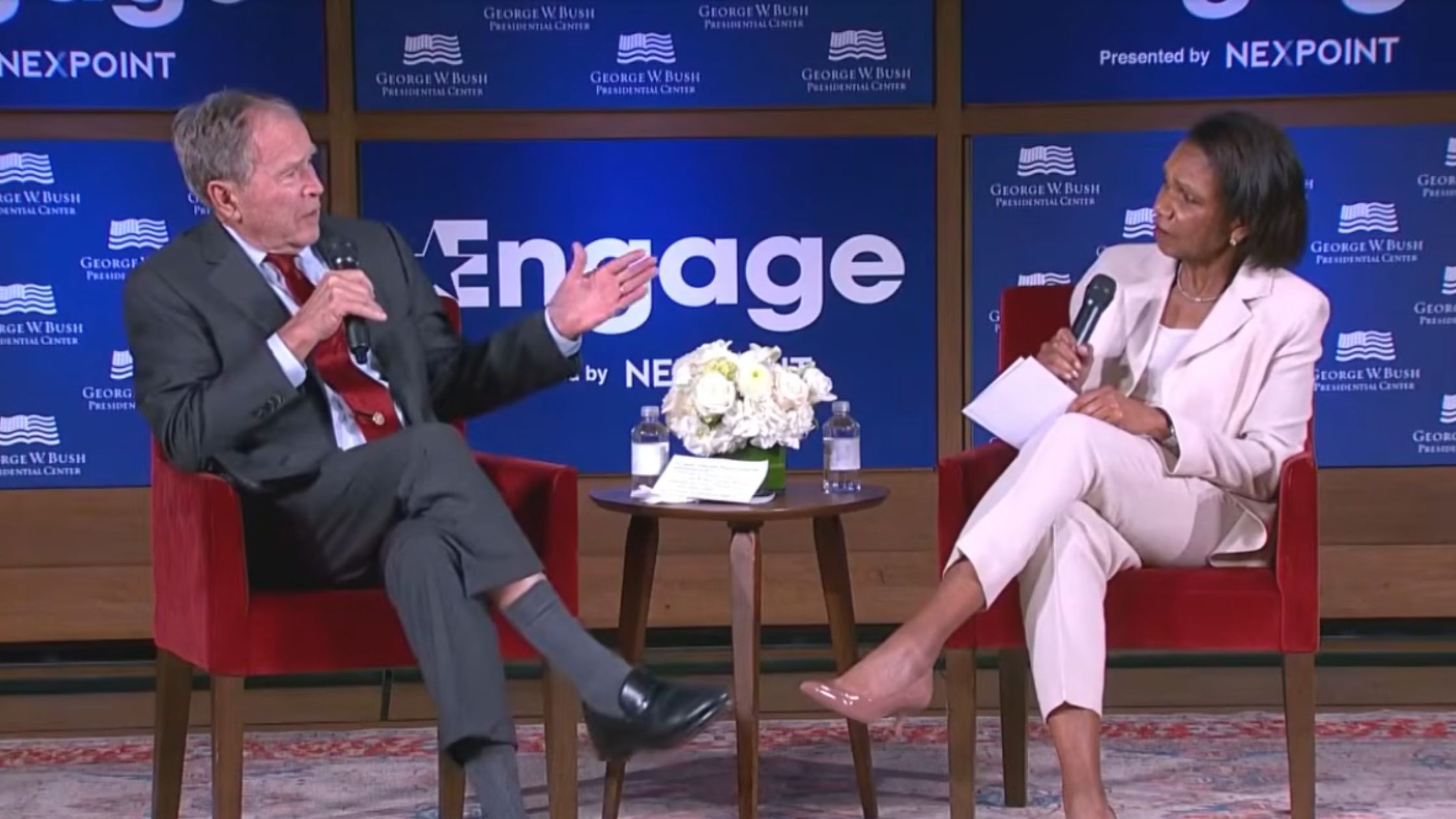
And now it is my privilege to welcome to the stage the 66th Secretary of State, Dr. Condoleezza Rice and the 43rd President of the United States, George W. Bush.
George W. Bush (56:11):
Wow.
Condoleezza Rice (56:12):
Wow. You think that was for Melissa or for you?
George W. Bush (56:17):
Melissa. Let me start off by thanking Shiloh and the team here. I also want to thank Dan Caine, General Caine for being here. Thank God you are where you are, and we appreciate it. JD, you forgot he was Ambassador Romania, but he was only there for about six months. It wasn't because of lack of skill. It was because we had another job-
Condoleezza Rice (56:45):
We needed him. We needed him back.
George W. Bush (56:46):
Yeah. And Jared Lyon, he's always been a beauty, and today he really shined. And so it's great to see you again, buddy. Thank you for being here. Connie, thanks for joining. And I love Melissa Stockwell.
Condoleezza Rice (56:59):
Absolutely.
George W. Bush (57:03):
Okay.
Condoleezza Rice (57:03):
Okay.
George W. Bush (57:06):
Are you the A man or the Q man?
Condoleezza Rice (57:07):
I'm the person who's going to start us off.
George W. Bush (57:09):
You're the A man. Okay.
Condoleezza Rice (57:10):
I'm the A man, right. We all remember the moment when we heard, and I remember that my young assistant told me that a plane hit the World Trade Center. I called you.
George W. Bush (57:23):
Yes, you did.
Condoleezza Rice (57:24):
You were in Florida, and we both initially thought it was an accident.
George W. Bush (57:28):
Correct.
Condoleezza Rice (57:29):
Because how could this actually be happening? But then we talked a second time after we knew that a second plane had gone into the World Trade Center and it was indeed a terrorist attack. I actually did something, I don't even know if you noticed, I did something I never would do again. I raised my voice to you because you said, "I'm coming back." And I said, "Stay where you are. The United States of America is under attack. It's not safe here."
George W. Bush (57:55):
Yeah.
Condoleezza Rice (57:55):
And that was the first time that I articulated to myself that the country was under attack. How did you process those first moments once you actually knew that the United States was under attack? What was your mindset? What were you thinking?
George W. Bush (58:11):
Well, first of all, I was in a classroom listening to a little child read and Andy Card whispered in my ear, second plane said... I knew the first plane hit the tower. Like you, I though it was an accident. "Second plane has hit a tower and America is now under attack." I didn't have much time to process that, but it was pretty clear to me that if we were under attack, then my job was to defend the child that was reading to me and her family and her country. And so it was a moment of clarity. I knew we had to gather evidence and gather the facts, but I assumed we were under attack.
(58:58)
Life's interesting because things happen to you that you don't want to have happen to you. And the challenge of life is how do you deal with it when it happens? And in this case, as Dan Caine mentioned, I became a wartime president. There are no doubt in my mind that this was not a law enforcement event, this was a war and that the job of the president and the country and his team is to rally the nation to do what's necessary to protect our people.
Condoleezza Rice (59:30):
But you had a long journey home because they kept trying-
George W. Bush (59:34):
Thanks to you.
Condoleezza Rice (59:35):
Yeah. Well, we didn't want you to come back prematurely, but you were, let's see, you were in Louisiana and you were in all kinds of places trying to get to a safe location.
George W. Bush (59:46):
Right.
Condoleezza Rice (59:46):
And some people say there was a little frustration in your voice.
George W. Bush (59:51):
Yeah, I was hot. Yeah. I mean, if you're a wartime president, you need to be in command in the nation's capital. So yeah, you people there in Washington. Anyway, I ended up in Omaha, Nebraska. Nothing wrong with that, but I remember we had a civics call and the national security team was there and somebody said, "You got to give a speech to the nation." And I said, "You're right, I do, but I'm sure not going to give it from a bunker in Omaha, Nebraska." I thought that would be a psychological victory for those who attacked us. And so I flew back.
Condoleezza Rice (01:00:34):
You flew back and you arrived on the White House Lawn, the South Lawn. Do you know the first thing you said to me?
George W. Bush (01:00:43):
No.
Condoleezza Rice (01:00:44):
Where's Laura?
George W. Bush (01:00:45):
Okay. Yeah. Well, that's good. Thank you for saying that. Yeah, of course I remember that. Yeah.
Condoleezza Rice (01:00:56):
Because actually Mrs. Bush was at the Capitol when this happened and I said, "She's here," and you went and you had your moment with her. We're not going to ask any more about that, but the sense of family, it really, really stuck with me that that was the very first thing that you thought.
(01:01:18)
I do want to say one thing to General Caine because something in what you said, our paths crossed in a strange way. You mentioned that you heard that the president... You have to understand the hard decisions that this man had to make just like that. And one of them was what would happen if a plane was not properly identifying itself because every plane had become a missile. And so we were trying to land. I remember Norm Mineta, the transportation secretary, trying to land planes on a legal pad, yellow pad, legal pad, but you'd given the order through the vice president that should a plane not squawk properly, it should be shot down.
(01:02:01)
General Caine, we thought initially standing in that bunker that flight 93 had been shot down by the American.
George W. Bush (01:02:08):
Yeah, I thought the same thing.
Condoleezza Rice (01:02:10):
And there was this horrible moment where the vice president kept trying to get confirmation as to what had happened. And for about 10 minutes, we though we'd shot down a civilian aircraft. That always to me represented just how hard the decisions were that you had to take under a lot of pressure.
George W. Bush (01:02:29):
I got back to the White House. I did find Laura. I gave the speech. And was upstairs asleep and the Secret Service guy came charging into the bedroom and said, "We got to go. We're under attack." And I said, "Okay." I grabbed Barney and-
Condoleezza Rice (01:02:44):
Always Barney.
George W. Bush (01:02:45):
Yeah, Lara's robe. And go down to the bowels of the White House and a young airman standing there said, "Oh, don't worry, sir. It's one of ours." So Dan Caine was flying back to Andrews Air Force Base, but he had the wrong transponder signal on and the whole mechanism said final attack. Anyway, thank you, Dan.
Condoleezza Rice (01:03:09):
But then we got down there and the Secret Service told you that you should stay there.
George W. Bush (01:03:14):
Yeah, I know it. Harry Truman bought the bed.
Condoleezza Rice (01:03:19):
It was a sofa bed that had not been open since the Cuban missile crisis, so he decided not to stay.
George W. Bush (01:03:26):
Anyway, it was a weird day.
Condoleezza Rice (01:03:29):
Yeah. But I want to talk about, we talk a lot about September 11th. Indeed, that was a searing experience, a lot of uncertainty as what was going on, a lot of sadness. But September 12th, talk about waking up on September 12th. I don't think any of us got very much sleep that night, but we got up early. I got up, by the way, to a phone call from Nick Burns, who was our ambassador to NATO.
George W. Bush (01:03:54):
Right.
Condoleezza Rice (01:03:55):
And these days when we have our questions about NATO and about our allies, what Nick said to me is the allies have decided to vote Article 5, an attack upon one is an attack upon all. We had always assumed that Article 5 would be used in the defense of Europe by the United States, and the only time it has actually been used was in our defense. So that was my morning memory. What about yours?
George W. Bush (01:04:23):
Well, my morning memory was all these world leaders calling in, starting with Koizumi, the Japanese prime minister. It was an ironic phone call since our fathers fought each other, and this guy's calling to tell me that we're going to stand in mutual defense of our countries and defend our freedoms. But yeah, no, step one is to find out who did it. It became pretty clear pretty early. Unfortunately, we had leaks in our administration at the time, and somebody told the New York Times or somebody that... It's easy to know who did it because they were talking on Torio phones, which is easy to listen to. And all of a sudden the next day they were not talking on Torio phones, but we discovered who it was.
(01:05:06)
But my main concern was as comforter in chief, because I had a sense that there was a lot of trauma, obviously with the families of 9/11. I hadn't had a chance to go there yet, so I knew it was bad. I just didn't realize how bad until I went there. But how does one help America have the confidence that we can go forward as a nation? And during that period of time, the banks were closed, the airplanes weren't flying, people weren't going to stores. I mean, the economy was totally shut down. And so we planned at our cabinet meeting to how do we get this going again?
Condoleezza Rice (01:05:52):
And that's the thing I remember most about that next morning in the cabinet meeting was you kept saying, "I want the country to get back to normal. How can I get Americans back to normal? Because if we don't get back to normal, the terrorists would have won."
George W. Bush (01:06:06):
Exactly.
Condoleezza Rice (01:06:06):
And so you were very focused on with the treasury secretary, how do we get the banks open again? With transportation, how do we get people to fly again? We came up with some unusual ideas, like maybe people would fly again if we put police dogs in the airports. Not a great idea, by the way.
George W. Bush (01:06:23):
That wasn't my idea.
Condoleezza Rice (01:06:27):
But we were just trying to do something to get people back to normal.
George W. Bush (01:06:31):
That's right.
Condoleezza Rice (01:06:31):
Why was that so important to you?
George W. Bush (01:06:33):
Well, because I didn't want us to lose our soul. As we defended our freedoms, I wanted people to remember how precious they are. So one of the things that I did, and I think you were very much involved in this decision shortly thereafter, was to go to a mosque. And I did so because I was deeply concerned about stories of women of color being harassed at shopping centers, particularly in Michigan. It became clear to me that if this is an ideological struggle, which is what I viewed it as, and we forego one of the most important parts of our ideology, which is the freedom to worship the way you want to worship, all of a sudden the enemy has won a victory. And so that was part of my thinking.
(01:07:14)
Laura and I did a lot of... We went and saw people who got hurt at the Pentagon. We went to hospitals. We did the very best we could to try to let people know that we cared about them.
Condoleezza Rice (01:07:24):
I want you to talk about a couple of those events. You talked about going to the Islamic Center and trying to make sure that our Muslim American citizens knew that we didn't blame them for what had happened.
George W. Bush (01:07:39):
I also made it clear that Islam was a religion of peace, not a religion of war, and that these people subverted their religion.
Condoleezza Rice (01:07:46):
Yes. A second kind of vignette, a Polaroid as the general will call it... Although General, I have to say, if you think people don't know what a fax is, I'm pretty sure they don't know what a Polaroid is either. I'm not going to use that with my freshman at Stanford, but let me use it with you. Let me go to one of those Polaroids.
George W. Bush (01:08:09):
Aren't you glad you came? Anyway.
Condoleezza Rice (01:08:12):
I'm going to go to two. One is, we went out to the Pentagon and walked among the first responders, and they'd been up for 36 hours working constantly. What did that do for you? How did you feel with them?
George W. Bush (01:08:31):
Well, as you know, I'm not much of a touchy-feely guy. I wasn't surprised because like General Caine said, when America's in trouble, Americans respond. And I got to see it firsthand. It's an amazing country. I remember seeing the recruitment numbers or the volunteer numbers. I mean, it was unbelievable how many people joined our military, like flooding the military with people saying, "I want to serve." It was a remarkable moment. As Dan said, it's deep in our core, and I believe that going in, I saw it firsthand. And so yeah, the firefighters were tired. It's like going to ground zero, seeing those firefighters and policemen. It's just unbelievable what they did. The sad thing is a third of our nation has no clue what we're talking about. They never witnessed this sacrifice and the courage and the dedication to serve a neighbor in need.
Condoleezza Rice (01:09:36):
We'll come back to that toward the end, but I want to go to one other vignette, the Friday service.
George W. Bush (01:09:44):
Yeah.
Condoleezza Rice (01:09:46):
We had a cabinet... Among here, among some of your best friends, we can tell the story, that morning we had a cabinet meeting. You want to tell the story?
George W. Bush (01:09:55):
No, you tell it because I'm 80 years old.
Condoleezza Rice (01:09:57):
Yeah. We're sitting in the cabinet meeting. The president is going to give the... It almost feels like a homily at the church that day. And we were going around and all of a sudden you became really emotional.
George W. Bush (01:10:17):
Yeah.
Condoleezza Rice (01:10:18):
And Colin Powell, who was sitting next to him, put his hand on you and he said, "It's all right to do it here." But in his voice was a little bit, "But don't do it in front of the whole country."
George W. Bush (01:10:29):
Exactly. Yeah. Yeah. Yeah.
Condoleezza Rice (01:10:31):
And so you did. You got there to the church and this great soprano did the Lord's Prayer. I couldn't keep a dry eye. How in the world did you get up and then deliver the remarks?
George W. Bush (01:10:47):
First of all, I didn't look at my mother and father. I stared straight ahead at this fantastic window at the National Cathedral. Yeah, it was a tough speech to give. I mean, there's a lot of emotion in that room, but Colin was right. The nation didn't need a blubbering president. The nation needed someone to show some strength and I gave it my best shot. Yeah, it was a memorable moment.
Condoleezza Rice (01:11:13):
It was a memorable moment. One other memorable moment, and then I'm going to come to the next chapter of the Bush doctrine. Another memorable moment was that baseball game.
George W. Bush (01:11:25):
Yeah, you were there.
Condoleezza Rice (01:11:26):
I was there. I was there.
George W. Bush (01:11:28):
Yeah.
Condoleezza Rice (01:11:29):
And I guess Derek Jeter had told you not to bounce it. Is that true?
George W. Bush (01:11:34):
Yeah, he said, "Don't bounce it. They'll boo you." So I go on the mound and that's all I'm thinking about. Don't bounce it, they'll boo you. I mean, it was an amazing feeling. I mean, New York City was just beginning to recover and the emotions were still very raw, and you could sense it in the stadium. I looked at the catcher. He looked really tiny.
George W. Bush (01:12:00):
... Looked at the catcher, he looked really tiny, and the ball felt really heavy. I flung it, it went over. My last memory of the presidency will be Yankee Stadium's reaction. It was like the city, the people in that stadium were saying, "You can knock down our buildings, but you damn sure not going to touch our soul." It was a memorable moment.
Condoleezza Rice (01:12:26):
It was a memorable moment. I actually remember sitting there and thinking the American people need their president to throw a strike, and you did, and you did.
George W. Bush (01:12:40):
It went over. Yeah.
Condoleezza Rice (01:12:40):
Yeah.
George W. Bush (01:12:40):
The guy caught it barehanded, but nevertheless.
Condoleezza Rice (01:12:47):
I want to go to another part of being president in those days. Everybody thinks about what happened on 9/11, thinks about the war in Afghanistan of course. There was another part of this, which was that we weren't so sure that this was the last attack.
George W. Bush (01:13:02):
Yeah, exactly.
Condoleezza Rice (01:13:03):
The fear of the follow-on attack. So every day after September 11th feels like September 12th. On the day after the attack, we're sitting in the Oval Office and because the FBI and the CIA had not really been able to talk to each other because of civil liberties and the like, for the first time we had to forge intelligence between them by having Bob Mueller and George Tenet come into the Oval Office every morning and show the president what they saw in the threat matrix.
George W. Bush (01:13:35):
Right.
Condoleezza Rice (01:13:36):
A threat matrix that had been this big on September 10th was like a phone book on September 12th.
George W. Bush (01:13:43):
Yeah. There were a lot of threats coming in.
Condoleezza Rice (01:13:44):
Lot of threats coming in. Tell us about that, how you were thinking about the following... We had some real near misses.
George W. Bush (01:13:52):
Yeah, we sure did. Well, my view was that we needed to go on the offense, that we couldn't hope that there weren't another attack, that we needed to chase down those who would do us harm and bring them to justice. That was the whole planning that you led with the Pentagon.
(01:14:18)
At the time we weren't on the offensive and therefore the only thing you could do is just hope that the intelligence was wrong. There were a lot of threats. A lot. Remember the anthrax attacks hit and that scared a lot of people. There was a Malaysian plot. There was all kinds of stuff.
Condoleezza Rice (01:14:36):
Yeah. There was a smallpox threat.
George W. Bush (01:14:38):
Yeah, smallpox, right.
Condoleezza Rice (01:14:40):
That's one that I will never forget because you had the CDC to come in. We had not vaccinated against smallpox since the 1950s. The director of CDC, Julie Gerberding, said to the president, "If you try to vaccinate the whole country, 5% of the population will have an adverse reaction."
(01:15:03)
You said, "What is an adverse reaction?" She said, "They'll die." I'm saying this because I think you don't understand, people now don't understand the heaviness of the days after 9/11 in trying to protect the country. You want to tell them about the botulinum toxin?
George W. Bush (01:15:21):
Yeah. I mean, you tell it. There was all kinds of stuff going on. Of course, a lot of it was new. So if you look back, you say we overreacted. At the time, I don't think we overreacted. We were very wise about how we dealt with these threats that were coming. I don't exactly remember. I can't even spell botulism toxin.
Condoleezza Rice (01:15:49):
Well, this is the one when we were in China.
George W. Bush (01:15:51):
That's right.
Condoleezza Rice (01:15:52):
Yes. So we had now invaded Afghanistan, but we were in Shanghai for the Asia Pacific Economic Council. Every morning the President, Colin Powell, Andy Card, and I would have a video conference with the vice president and Steve Hadley, the deputy in Washington. This particular morning, the vice president came on and he was just gray. He looked awful. The president said, "Dick, what's wrong?"
(01:16:19)
The vice president said, "Mr. President, the White House detectors have detected botulinum toxin. There is no known antidote, and we are going to die." At that point, you asked me to go call Steve Hadley because this was serious. Steve Hadley, you have to understand, had a kind of Midwestern sense of humor. He said, "We've sent the samples to the CDC. If the mice are feet up, we are toast. If the mice are feet down, we're fine."
(01:16:49)
The next day, you were with Zhang Shengmin at a lunch, and I got a call from Hadley and Hadley said, "Thank God the mice are feet down. It was a false alarm." I went by and I said to the president, "Thank God the mice are feet down." At which point they translated it for the Chinese. I'm quite sure Zhang Shengmin wondered what code were we talking in. So there was sometimes these things that you look back on now and you think, how could that have happened? We did manage to avoid another attack.
George W. Bush (01:17:23):
Yeah, that was the mission. Thanks to a lot of really good people and some smart people, there wasn't another attack.
Condoleezza Rice (01:17:30):
Yeah. I want to talk about the other...
George W. Bush (01:17:32):
One reason why is we went on the offense, and we just weren't going to sit back and let it happen again.
Condoleezza Rice (01:17:38):
I want to go on to the other part of the Bush doctrine because another piece in my Polaroids or my vignettes with the president are, we're going to get the American people back to normal. We're going on the offense because we are not going to sit here and allow another attack to take place. We're going to remember who we are with the Muslim women and the like. I can't let the American people be fearful. I'm going to take that on myself. I remember all of that.
(01:18:08)
Then there was something of a leap, which was, we also have to stand for something. We can't just say that the men who attacked us stood for something as perverted as it was, we have to stand for something. That became what became known as the Freedom Agenda.
George W. Bush (01:18:28):
Yeah, I know it. Yeah. Believe it or not, quite controversial as if spreading freedom was a bad thing. No. Yeah. See, in other words, we saw this as an ideological conflict. For people to have no idea what we're talking about, just understand there are people in the world who can't stand America because of our freedoms. What changed on that day of September the 11th was that those who can't stand what we stand for had the capacity to come and kill. That's what really changed the whole strategic equation for a president and the country.
(01:19:13)
Yeah, my view is that freedom is necessary for peace. I said all the time, it's not America's gift to the world. I happen to believe it's an Almighty's gift to every soul. The idea of giving people a chance to live in freedom makes sense not only from a national security perspective, but it makes sense for helping establish peace. The irony is during our time in Washington, there were certain people who said, "How dare you try to promote freedom," as if it's only available for certain kind of people. Anyway, I meant it and as did you.
Condoleezza Rice (01:19:55):
You really started out, of course, making the case about Afghanistan and the plight of women in Afghanistan.
George W. Bush (01:20:03):
Absolutely.
Condoleezza Rice (01:20:04):
Did you make that case or did somebody else make that case?
George W. Bush (01:20:07):
Well, I was trying to give a radio address and Laura elbowed me out of the way. She gave a radio address that spoke to the Afghan women and had a huge impact by the way.
Condoleezza Rice (01:20:15):
Huge impact. Huge impact. Do you think that we are falling away from that understanding that part of the challenge that we faced on September 11th still is with us and that there are free and unfree? Are we falling away from that?
George W. Bush (01:20:31):
Yeah, absolutely. It seems to me. Our nation occasionally goes through isolationist periods where the attitude is we've got too many problems at home, therefore who cares what happens overseas? Which really means to me they just don't pay attention to the lesson of 9/11 because what happens overseas matter to our national security at home.
(01:20:55)
Yes, I'm afraid so. To the extent that people are struggling against tyranny, it makes sense. We don't have to send troops, but we ought at least stand with them and stand beside them because this is what we went through 250 years ago. Again, it's a belief that everybody wants to be free. We saw that in Afghanistan. People said, "Well, they don't want to be free. They don't know the difference."
(01:21:28)
Of course they know the difference. Young girls going to school for the first time in their lives knew the difference. Women becoming doctors and professors know the difference between a free society and a tyrannical society. Sadly, those women who began to realize their full potential no longer have a chance to realize their full potential.
Condoleezza Rice (01:21:51):
In your second inaugural, you said that no man, woman, or child should have to live in tyranny. It was the theme of the second inaugural address.
George W. Bush (01:21:59):
That is correct.
Condoleezza Rice (01:22:00):
Do you think that you would have given that address had we not experienced 9/11?
George W. Bush (01:22:07):
Probably not because we weren't engaged in ideological conflict at that point in time. If we were, it wasn't evident. It wasn't on our TV screens. 9/11 was a clarifying moment for me, and you, and others in our administration because they realized that we were vulnerable to attack based upon what we believe, based upon a belief system. That phone call from Koizumi proved to me in my mind that free societies can work together, and yet we fought each other 40 years prior to that.
(01:22:46)
So the question is if you're interested in laying the foundation for peace, how best to do so. It's in our self-interest to do that. That's the lesson of 9/11. People say, "Well, you're imposing your values." I'm not imposing our values. These are universal values. So I don't think I would've given that speech because it wasn't our national interest to give it at that point in time.
Condoleezza Rice (01:23:09):
9/11 was in that way clarifying. Again, [inaudible 01:23:13] talked about one of the gifts perhaps of 9/11 was that clarifying moment that our values had to be defended, not just our buildings.
George W. Bush (01:23:21):
Our territory. Exactly right.
Condoleezza Rice (01:23:24):
So I want to go for a moment to the generation that will not remember 9/11. So I'm a university professor, and I walk into the classroom and not a single one of my students was born at the time of 9/11. What would you say to them about those days, about what you did, how you thought about it? What was it like when you walked into the Congress that night to give that speech to the nation?
(01:23:51)
By the way, Tony Blair, the British prime minister came to that speech. The president asked him if he wanted to speak and he said, "No, I just want to be here." It was really quite a moment to walk into that chamber. How would you tell these young people, how would you relay to them the feelings of that time, the anxieties and the sense that we were coming together in an extraordinary time or extraordinary way?
George W. Bush (01:24:23):
Yeah. I remember that speech well. I don't remember the words well, but I remember giving that speech. It was a pretty high drama speech. It was one really meant to rally the nation, but also make the case as to what we intended to do. I can't remember if in that speech, if I said if you harbor a terrorist, you're equally as guilty as terrorists, we're sending the word to Afghanistan. They cough up Al-Qaeda. The thing is when a president says something, he's got to mean it. I meant it. Evidently the Taliban didn't think I meant it.
(01:25:06)
Look, like World War II, my dad fought in World War II. For me, it was just a date. I mean, it had no emotional attachment whatsoever, but the danger of that is if there's no emotional attachment to the fact that our country can be attacked, there's a listlessness that can take place. People can say, "Oh, it's not going to happen. It'll never happen again." That's a dangerous attitude to have in a dangerous world.
Condoleezza Rice (01:25:35):
So you would say to them, what, be vigilant? Would you say to them try to...
George W. Bush (01:25:39):
Learn to read, for starters.
Condoleezza Rice (01:25:41):
Pardon me? What was that?
George W. Bush (01:25:42):
Learn to read.
Condoleezza Rice (01:25:46):
Yeah. Well, to be fair, most of my students can read. I'm not sure what it is they're reading, but...
George W. Bush (01:25:53):
I'm sure. Well, you're at Stanford, of course. Anyway, SMU, they read a lot. Anyway, study history. I worry about the fact that kids don't have a real understanding of our nation's history.
(01:26:09)
Not only the history of 250 years ago, but recent history, September 11th, 2001. There's a lot of stuff written about it. To me, I would hope these civic courses teach the lessons of 9/11 so another generation can understand what we all went through, but why it's important that what we went through was necessary to safeguard what we believe.
Condoleezza Rice (01:26:37):
Well, in some ways we're fighting a little bit of an uphill battle. There's a lot of disinformation, misinformation, conspiracy theories about what happened and trying to set that record straight, not just because we need to set the record straight, but also to honor those.
George W. Bush (01:26:54):
I agree.
Condoleezza Rice (01:26:55):
So talk about that piece of it.
George W. Bush (01:26:58):
Well, I try not to pay attention to the conspiracy nuts.
Condoleezza Rice (01:27:00):
I'm not surprised at that. Yes.
George W. Bush (01:27:03):
They are spreading all kinds of stuff that's just not true. I don't really go on the internet that much you'd be happy to hear.
Condoleezza Rice (01:27:14):
I didn't expect that you did, but that actually wasn't the question.
George W. Bush (01:27:19):
That's why I'm going to ask you.
Condoleezza Rice (01:27:25):
Yeah. How do you keep alive the real story? That's really the point.
George W. Bush (01:27:29):
Well, events like this. Hopefully, Laura and I are going to go to New York two days from now, and hopefully that'll cause people to take a serious look at what happened. It's a great museum there. We've got a good one here.
(01:27:46)
You're right. The danger, of course, the farther it gets away from September 11th, 2001, the more likely it is people will not remember A, the importance, B, the surface, C, the sacrifice, and what it meant. I don't know. That's a good question.
Condoleezza Rice (01:28:05):
Well, you're doing your part right here. So let me ask you about three groups of people and how you think about them at the time of 9/11. First and foremost, how do you think about the families of the victims in everybody's heart? There are brothers and sisters and hole in the hearts of a lot of people. How do you think about that?
George W. Bush (01:28:29):
Well, I think about them with a sense of sadness. I run into people all the time that say, "I had a loved one die in 9/11." My answer is, "Well, I hope you're doing okay." Most people are able to recover. Laura and I are going to meet some families of firefighters and people like that when we go to New York.
(01:28:54)
I guess the only thing you can do is just hug them and tell them you care about them. I think they hurt, but the loss of life unfortunately happens a lot in our country. I think about those people who've lost a loved one as well. The families that we... Remember I went to Javits Center?
Condoleezza Rice (01:29:22):
Yes. I do.
George W. Bush (01:29:23):
Were you with me there?
Condoleezza Rice (01:29:23):
I was, yeah.
George W. Bush (01:29:23):
Yeah. Okay. So I went to the Javits Center. This is where there were a bunch of people there that were hoping that their loved one would come out of the building, but we had just been to the building and there was no chance that no one was coming out of there. It was a tough assignment because... Particularly dealing with the young kids.
(01:29:45)
I remember passing out presidential tie clips and said, "Make sure you show your father this. He won't believe you met the president," knowing full well they'd never see the president. I mean, they'd never see the father. So I thought about them a lot during that period of time. I felt like bringing Al-Qaeda to justice was honoring the families of the fallen and...
Condoleezza Rice (01:30:16):
Yeah, and protecting the country. So how did you get through it? Now I'm often asked that question. They were really long days.
George W. Bush (01:30:25):
Yeah, they were.
Condoleezza Rice (01:30:27):
They were troubled days because as we've been discussing, we just knew there was going to be a follow-on attack.
George W. Bush (01:30:33):
Yeah. Well, my faith helped a lot. I didn't exactly have a... My faith wasn't exactly a straight line, by the way. A few stumbles. Yeah, I relied a lot upon the good book during that period of time. Plus I had a heck of a team. I mean, you were by my side. I was lucky to have you there, and we had some very competent people.
(01:31:02)
People ask, "Well, how do you deal with pressure?" Well, step one is to listen to people and know what they're talking about. Surround yourself with people who are smart. Not be afraid of smart people, but welcome them and listen to their voices. I had a lot of smart people around me, a lot.
(01:31:20)
The team itself was comforting. None of them were there to make me look good, which was a near impossible task, but all of them were there to serve the country. Therefore, our culture was such that we worked together. Yeah, it was tough, but when you have good people around, it's a lot less tough, I guess what I'm trying to say.
Condoleezza Rice (01:31:42):
I want to take a minute in that regard to just have you reflect on the memory of three of those team members who've passed on.
George W. Bush (01:31:52):
Yeah. Yeah. We're the only ones left.
Condoleezza Rice (01:31:53):
Yeah, we're it. So vice president...
George W. Bush (01:31:58):
You can say anything you want. Nobody can contradict you.
Condoleezza Rice (01:32:02):
Vice President Cheney, Secretary Powell, Secretary Rumsfeld.
George W. Bush (01:32:06):
Yeah. Well, I don't want to say wise enough, but I was aware that a president would have to deal with the unexpected. Therefore, when it happened, I had no idea what it was going to be, but you wanted people who had a lot of experience to be able to give you good advice. So these were... I put you in a tough job though, because you had to deal with Powell, and Rumsfeld, and Cheney. Oh my God. You did a heck of a job.
(01:32:37)
No, I'd had the benefit of watching a really great man be president. He taught me a good lesson that a leader must be humble enough to know what they don't know and find people who do and listen to them. I wisely did that.
Condoleezza Rice (01:33:03):
On September 11th, we were one fortunate nation in so many ways, but no way were we more fortunate than in having you as our president.
George W. Bush (01:33:12):
Well, thank you very much.
Condoleezza Rice (01:33:13):
So thank you very much. Please join me in thanking President Bush.
George W. Bush (01:33:43):
[inaudible 01:33:44].
Speaker 2 (01:33:51):
25 years ago, America changed forever. On September 11th, 2001, nearly 3,000 people lost their lives in the attacks on the World Trade Center, the Pentagon, and near Shanksville, Pennsylvania. Friday, September 11th, the C-SPAN networks present live day-long coverage marking the 25th anniversary of 9/11.
(01:34:11)
Beginning at 6:00 AM Eastern, revisit powerful archival coverage from September 11th, 2001. Then live coverage from the 9/11 memorials in New York, the Pentagon, and the National Flight 93 Memorial in Shanksville, Pennsylvania, plus events from across the country and Canada. Throughout the day, hear from historians, eyewitnesses, and newsmakers with viewer calls continuing into the evening.
(01:34:37)
Remembering September 11th, 25 years later. Watch live coverage Friday, September 11th from 6:00 AM to 10:00 PM Eastern on the C-SPAN Networks.