


Speaker 1 (00:00):
That's C-H-I-H-O-O-N, S-H-I-N. And then Chairwoman Homendy will take some questions.
Jennifer Homendy (00:20):
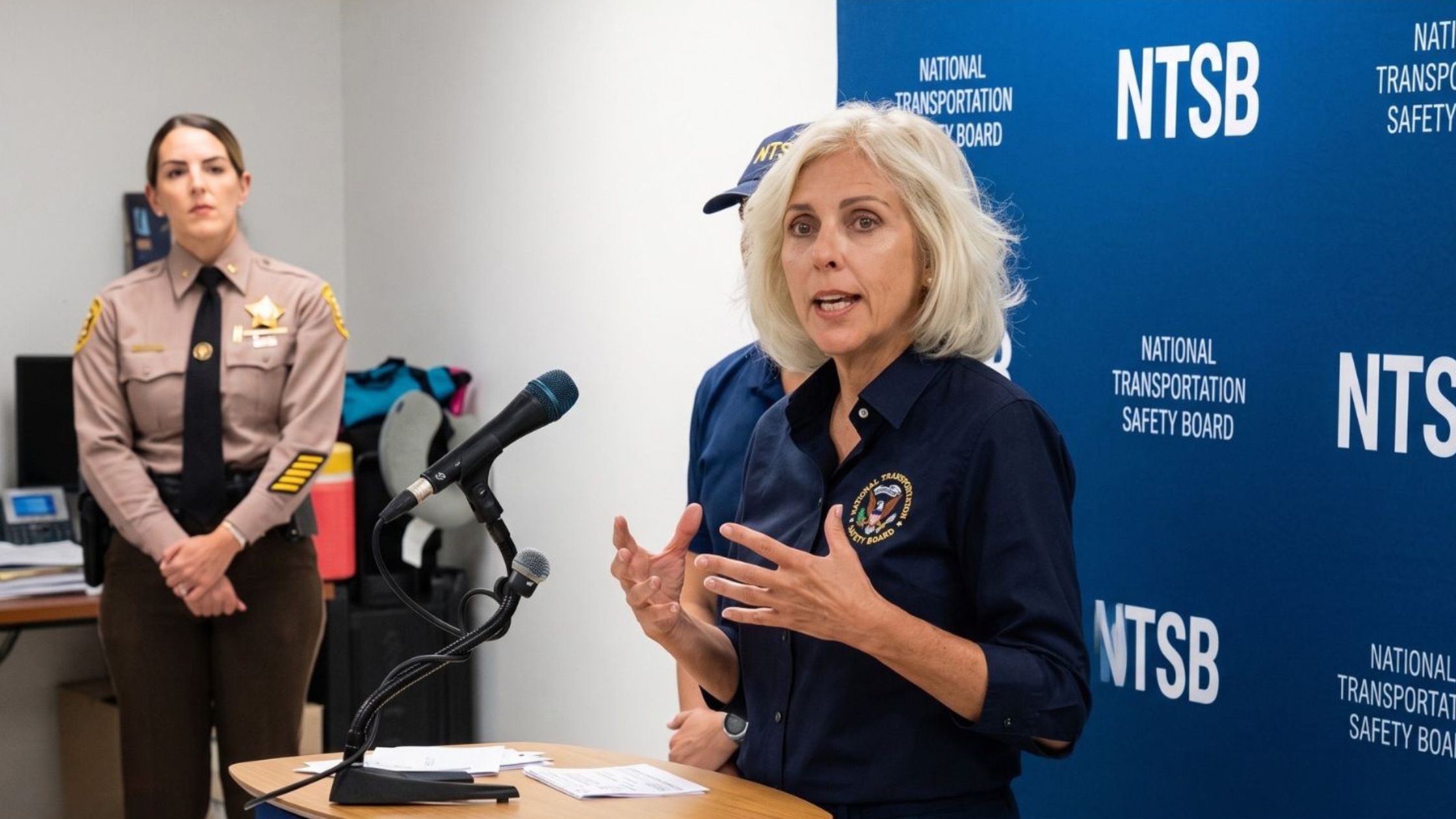
Thank you for joining us. My name's Jennifer Homendy and I'm Chairwoman of the National Transportation Safety Board. With me tonight is our investigator in charge, or IIC as we refer to them, Mr. Chihoon Shin. If you are not familiar with the National Transportation Safety Board or NTSB, we are an independent federal agency that's charged by Congress with investigating every civil aviation accident in the United States, and significant events, accidents and incidents in all other modes of transportation.
(01:03)
We're here with a pretty large team and I'll talk about the team and our process in a second, but we're here at Miami International Airport to investigate an accident that occurred yesterday at 1:53 PM Eastern Daylight Time involving Amazon Air Flight 7598, a Boeing 767-33 Alpha, which was operated by 21 Air LLC based in Miami.
(01:42)
Can you turn that off? Let's turn it off.
(01:48)
I want to pause for a moment before I continue on and talk about the investigation and extend our deepest condolences to the families who lost loved ones in this terrible tragedy and to the families of those who suffered serious or minor injuries. We can only imagine all that you're going through. Please know that our hearts go out to all of you and know that we are deeply, deeply committed to our duty, our responsibilities as an investigative agency to determine how this accident occurred, why it happened with one goal in mind, safety. And that's to prevent it from happening again.
(02:47)
We do that by issuing safety recommendations in our final report at the end of the investigation along with probable cause and findings. Those safety recommendations are aimed at preventing the next tragedy. And then we work diligently to make sure those recommendations are implemented and lives are saved.
(03:13)
Speaking of saving lives, I want to thank the work of all the first responders on scene and those who continue to be on scene. Specifically Miami Airport, Miami-Dade Sheriff's Department, Miami-Dade Fire Rescue, and the local FBI. Now the local FBI, who many of you may have seen, is a force multiplier for the NTSB. We have a memorandum of agreement with them. They have been extremely supportive over the years in helping us collect evidence in investigations. So they are here.
(03:55)
I also want to thank the numerous federal, state and local officials, including the mayor, Mayor Cava, who offered support, significant support, for the NTSB. Thank you, Mayor. Thank you, Commissioner. And to others, Deputy Mayor, for offering your support. Certainly we could never do what we do at the NTSB without your help. And so thank you for that.
(04:29)
What we know so far is the flight was arriving from San Juan, Puerto Rico with two crew members on board. This was the third flight for that aircraft yesterday went from Cincinnati to Miami, Miami to San Juan and San Juan back to Miami. It overran runway 3-0 on landing, struck navigational aids and equipment, then impacted a 2012 white Ford Econoline van that was owned by Professional Ocean Service Corporation, which is a contract cleaning company for the airlines. In the van were seven persons on board.
(05:21)
The aircraft then traveled through a perimeter fence and impacted a Toyota Corolla Cross LE, which was traveling on Northwest 67th Avenue. And then continued into the grass and impacted another fence line which separated an area where Tesla Robotaxis were stationed. In total, it was about 1300 feet past the paved surface.
(06:04)
Now I want to set expectations for providing investigative information tonight. I'm really only going to talk about our process, what we did today, what we're going to do tomorrow. And there's a reason for that. We have a very large team. We have a team of 32 people here, that includes us. We began arriving on scene at 6:00 PM last night that continued through the night with many of our personnel going to Fort Lauderdale and driving here. And then we had personnel arriving throughout the day, really through the last half hour. So our team was all en route today. I arrived this morning and went straight to the scene.
(06:49)
We have begun collecting investigative information. We do have data and information, but we are very thorough, fact-based agency and we don't release that information until we have verified it and are able to provide that verified information to the public. Which we hope to do with much of the information tomorrow. Now, as I said, we went to the accident command post today and we're on scene. Certainly I walked the path from the runway, past the vehicles and to where the aircraft came to rest.
(07:43)
We had to be somewhat cautious today because first and foremost is our concern for the safety of our personnel. We are a safety agency. There's fuel everywhere that will have to be remediated. But then they are also removing fuel from the aircraft. So we have to allow that to occur. And as we speak, recovery operations continue.
(08:12)
The recovery of victims is most important. The investigation and access to the aircraft as well as evidence can wait while the recovery operations go forward. That is most important. Reuniting families with their loved ones is most important. And so we want to respect that process and do what we can to begin our investigative duties, but allow what's most important to go forward.
(08:50)
Tomorrow, let me talk a little bit about tomorrow. Wait, before I go to tomorrow, we were able to recover the flight data recorder and the cockpit voice recorder that is going back to the NTSB tonight in just a couple of hours, and will be at headquarters where it can be evaluated and downloaded.
(09:11)
Tomorrow, so the entire team of 32 personnel, our investigators break up into specific areas to look at areas of an investigation and collect information. We'll have a group of investigators focused on operations and human performance. They will look at the history of the accident flight, look at the flight crew experience, training, 21 Air LLC policies and procedures. Their relationship, the contractual relationship with Amazon. We'll also look at FAA oversight of all involved operators.
(09:58)
We'll look at air traffic control. A team will look at that. Air traffic services, radar data. And we'll look at controller pilot transmissions. We'll look at aircraft performance. We have a specialist here focused on that. We have a team focused on structures. So they'll go in and begin documenting the scene and look at the aircraft wreckage... Airframe wreckage, sorry.
(10:24)
We have a team looking at airplane systems. They'll examine the components of the airplane's hydraulic, electrical, navigational, pneumatic and associated systems that includes instruments and the flight controls. We have a team focused on power plants, that's the engines. And then we have a meteorologist, a specialist here that will begin looking at forecast and weather conditions on landing.
(11:00)
And we have a team that will look at airport survival factors and emergency response. They will look at any notices to airmen that were issued, runway design, they'll look at fire and rescue, and they will look at the lack thereof of an engineered materials arresting system or EMAS. And I'm sure that you all have been looking at that. For those watching that are not familiar what this is crushable lightweight material that's at the end of a runway that safely stops an aircraft. So we will look at that. It's not at every airport across the nation. FAA data, we still have to confirm and look at that as about 72 airports across the US.
(11:58)
And then we have a team, our transportation disaster assistance team, they work with the families. And we have a very broad definition of families. So those who were tragically killed and then also those who were seriously injured or minor injuries. We'll be here for at least a week. We will not be determining probable cause while we are on scene. We are here to document the scene and to collect the perishable evidence.
(12:37)
One thing the public could really help us with is if you think you have photos or videos or information that is relevant to this investigation, we would ask that you send those in to witness@ntsb.gov. That's witness@ntsb.gov. Please only send information that is relevant to this investigation. I have been part of investigations where people have sent fake photos that really does impact our ability to get through that information because our team has to track down each of those photos and that information coming in. But the public has been very helpful in the past by providing photos and videos that were really helpful in our investigation and giving us great information.
(13:35)
With that, I... Do you have anything you want to add? With that, I will ask if you have questions, please raise your hand. Please state your name and your affiliation. I will call on you. Please limit it to one question. If we have to do multiple rounds, we will. We'll go right here.
Mills Hayes (13:53):
Mills Hayes with NewsNation. The pilot and the co-pilot, are they a part of the people who passed away? Are they in the hospital right now?
Jennifer Homendy (14:03):
The question is the status, the health status of the flight crew, the pilot and co-pilot. The NTSB does not comment on the health status of individuals, that we leave to the authorities. So we would encourage you to contact the authorities for that information.
Mills Hayes (14:25):
Can we get though their info?
Jennifer Homendy (14:29):
I'll come back to that. Go ahead.
Speaker 4 (14:31):
[inaudible 00:14:32] with MS Now. It was at NTSB's recommendation development of EMAS technology in the first place, but it's only required when the runway area is under 1000 feet. For both of you, I guess my question is, do you believe an EMAS would have made a difference yesterday and should they be installed everywhere?
Jennifer Homendy (14:51):
Those are excellent questions. The questions are on EMAS and whether that would have helped prevent this tragedy and should the EMAS be everywhere at every airport. That will be a key part of our investigation. Thank you for asking. Pete?
Pete Muntean (15:06):
Pete Muntean with CNN. Can you just describe the scene for us? It sounds like a pretty long trail of destruction and can you just lay it out for us?
Jennifer Homendy (15:16):
Yeah, I would describe it in one word of devastating. Utter devastation. I mean, you can see on the paved surface tire marks that continues through the grass. There's debris everywhere. The Econoline van is torn apart. It certainly must have been devastating. And then the vehicle itself, the SUV, you can see airbags, the surrounding airbags. You can see components from vehicles, both passenger vehicles and the aircraft itself, and certainly components of the navigational aids. Some debris from the airport and then certainly fencing everywhere. It's pretty extensive.
Pete Muntean (16:28):
Hard to see?
Jennifer Homendy (16:29):
Hard to see and I'm sure it must have been very difficult for the responders as well. Yes? And then we'll go over here.
David Ovalle (16:38):
David Ovalle with the New York Times. Any sense of the speed of the aircraft when it was descending and why they chose not to go around again?
Jennifer Homendy (16:49):
Yeah. So the question is on the speed of the aircraft on landing, and why they wouldn't have gone around again. A couple of things. We do want to interview the crew... We'll have to interview the crew. We'll have to interview others. We're going to want to talk to crew members of flights that may have landed prior to this flight. And then... What was your first question?
David Ovalle (17:20):
Their speed.
Jennifer Homendy (17:21):
Oh, their speed. We do have information on speed. We do have data, but it's from various sources and we want to confirm that data with the flight data recorder. So we're going to hold on that for now, but I hope that we can provide that tomorrow. Yes?
George Solis (17:39):
George Solis, NBC, have you been able to speak with the pilot or co-pilot or any of the survivors of the crash at this time?
Jennifer Homendy (17:45):
Have we been able to speak with the pilot, co-pilot or survivors of the crash at this time? Our transportation disaster assistance team is out and about. I have not connected with them to see who they've communicated with. We have not conducted interviews yet, but those are being scheduled here and then here.
Jeff (18:07):
Jeff [inaudible 00:18:08] with [inaudible 00:18:10]. Any sense or can you give us any history of the pilot and the co-pilot? How long have they been in the air for? How many hours have they been flying? Can you tell us anything about their background?
Jennifer Homendy (18:19):
The question is on pilot experience. Again, we have some information, but we need to be very accurate on the information that we can provide and we hope to have that tomorrow.
Jeff (18:31):
Are you saying they're experienced pilots?
Jennifer Homendy (18:33):
We'll get back to you tomorrow on that. Yes?
David Fischer (18:37):
David Fischer with AP. Any indication that they weren't getting all the information like weather information or runway information, or anything like that that maybe they weren't seeing or weren't able to see?
Jennifer Homendy (18:49):
Any indication that the pilots weren't able to receive or didn't receive or weren't able to receive some information, like weather information or-
David Fischer (18:57):
Or ILS system or something like that.
Jennifer Homendy (18:59):
That will be something that we look at. We look at that as part of any investigation, but we don't have evidence to that yet.
David Fischer (19:06):
I feel like we're covering runway excursions with incredible regularity, like four EMS saves in the last year. There was a runway excursion, I think like in Chattanooga just last month. Are these happening too often? I mean, what goes through your head when you see this incident and consider it sort of zoomed out in the grand scheme of all these other incidents of [inaudible 00:19:29]?
Jennifer Homendy (19:28):
Well, zoomed out, first let me say that we have an incredibly safe aviation system here in the United States. With that said, when a tragedy occurs, it's devastating. So saying we have an incredibly safe aviation system to somebody who just lost a loved one is not something that they want to hear because they are suffering.
(19:54)
With that said, that's why we're here to prevent the next tragedy. I will say this though, we have investigated many runway excursions and I looked at the numbers, I think it was over 3,000 investigations since 2008. And we can only work to prevent the next one if our recommendations at the end of an investigation are implemented. If we are in the business of repeatedly investigating an accident or tragedy and our recommendations are not implemented, then we're here again and again and again.
(20:41)
Our whole goal as a safety agency is one thing, safety. Is to save lives. And that means our recommendations must be implemented or we're going to be here again.
David Fischer (20:55):
So they're happening too often?
Jennifer Homendy (20:59):
I won't say that. The question is, are they happening too often? One is too often for the NTSB, just one. So here we have people who died, in other ones we have not had fatalities, but just one is a tragedy. We'll go here, go here.
Speaker 10 (21:24):
Sounds like two of the runways are still closed here at MIA. When will the plane likely be removed and what would that process look like?
Jennifer Homendy (21:31):
The question is when will... two runways are operational, two are closed. What will the process look like for getting those operational again and removing the aircraft?
(21:46)
First of all, we need to document the scene and we need to get access to the aircraft itself. We do not have that yet. Again, recovery operations are continuing. It is not a completely safe scene for our team as well. We have to ensure that before we even begin our investigative work on the aircraft side.
(22:09)
Certainly we are already documenting tire marks, other investigative marks along the path of the flight, but it's going to take time. We hope that we can move through it swiftly because we know it is impacting flight operations here, but we have to make sure that we're able to get access to the aircraft first.
(22:37)
Here and then here.
David Fischer (22:40):
Any concern about the age or the ownership history of the plane? Is that something you guys are going to look into?
Jennifer Homendy (22:45):
Any concern about the age or ownership of the plane, that is something we always look into. I believe it was manufactured in 1994. We always look at that as part of any investigation. Yes?
Speaker 11 (23:00):
[inaudible 00:23:01]. You mentioned just now you all investigated on 3,000 of these airport or runway excursions since '08. Any clue or idea what recommendations you all could have been presenting or I guess, give us an idea of the recommendations you all presented in the past?
Jennifer Homendy (23:16):
Yeah, so I have looked at our... The question is are there any recommendation in the past that might be applicable here, or have we looked at potential recommendations now? It's too early. Right now we're in the fact-finding phase of the investigation. Then we move into analysis once we have all the facts complete. Certainly we've looked at, we have a list of what those past recommendations are and the status of those recommendations, but it's too early to say whether they were a factor here.
David Ovalle (23:55):
Last question.
Jennifer Homendy (23:57):
Yes?
David Ovalle (23:59):
Were all the victims in the van, or was there a victim in the Toyota Corolla as well? Were they all just limited to those two vehicles?
Jennifer Homendy (24:08):
The question is, were the victims limited to those two vehicles? Yes. It was the Econoline van transporting the workers with the cleaning company and the passenger vehicle, the Toyota Corolla Cross.
David Ovalle (24:33):
And the van was on the inside of the airport?
Jennifer Homendy (24:34):
The van was on the inside of the airport. The small SUV was on the outside. Yeah.
Speaker 4 (24:42):
And you said that part of the investigation was looking at the relationship between the 21 Air LLC and Amazon. What are you looking for exactly in that relationship? What does that mean as part of your investigation?
Jennifer Homendy (24:54):
What does it mean as part of the investigation when we're looking at the relationship or contractual relationship between Amazon and 21 Air? So this is an Amazon operation for transporting cargo, but it's actually contracted to 21 Air. So we're going to want to see what that relationship is, who does what, what safety provisions might be in any sort of contracts or any sort of policies. And then we'll see from there we might even have additional information that we seek.
(25:31)
Thank you very much.
Speaker 4 (25:33):
Thank you.
Jennifer Homendy (25:34):
And just please keep an eye on our X feed for the next press briefing, which will be tomorrow. Thank you very much.