
Signs Your Case Will Be Dismissed & What Evidence Must Show
Learn the seven signs that might lead to your case getting dismissed, and how legal tech can help spot case-changing details early.



A case can look solid in a charging document and much shakier once you get into the evidence.
Maybe the police report describes a clean timeline, but the body-camera footage tells a different story. Or a key witness changes an important detail between their 911 call and formal interview. Evidence could get suppressed, or discovery could reveal info that undercuts your case strategy.
These can all be signs your case will be dismissed, but none of them guarantee it. Criminal cases are highly fact-specific, and dismissal rules vary by jurisdiction. What matters is whether the problem actually affects your ability to move forward or prove the charge.
For public defenders and defense attorneys, that makes the evidence review critical. The sooner you can find the gaps, contradictions, and procedural problems buried across the case record, the sooner you can determine if there are grounds to challenge the charges.
What Does It Mean When a Case Is Dismissed?
When a criminal case is dismissed, the charges filed end without a conviction. Depending on the circumstances, the prosecutor may ask to drop the charges, or a court may dismiss charges based on a legal or procedural issue.
Dismissal can happen at different stages of a case. For example, the government may seek dismissal of an indictment, information, or complaint with the court's permission. A federal court may also dismiss for certain unnecessary delays (though keep in mind that state procedures vary).
It's also important to distinguish no charges filed vs. charges dismissed. If no charges are filed, prosecutors decide not to formally pursue a criminal charge in the first place. A dismissal happens after a criminal case or charge has already been initiated.
So, how do you know if your case is getting dismissed? You usually don't until the prosecutor or court actually takes action. But certain problems in the evidence can make dismissal, suppression, reduction of charges, or another favorable resolution more plausible.
7 Signs Your Case May Be Dismissed
There is no universal checklist for predicting dismissal. Still, defense teams should pay close attention when the following issues appear during discovery and evidence review, as they could lead to a potential dismissal.
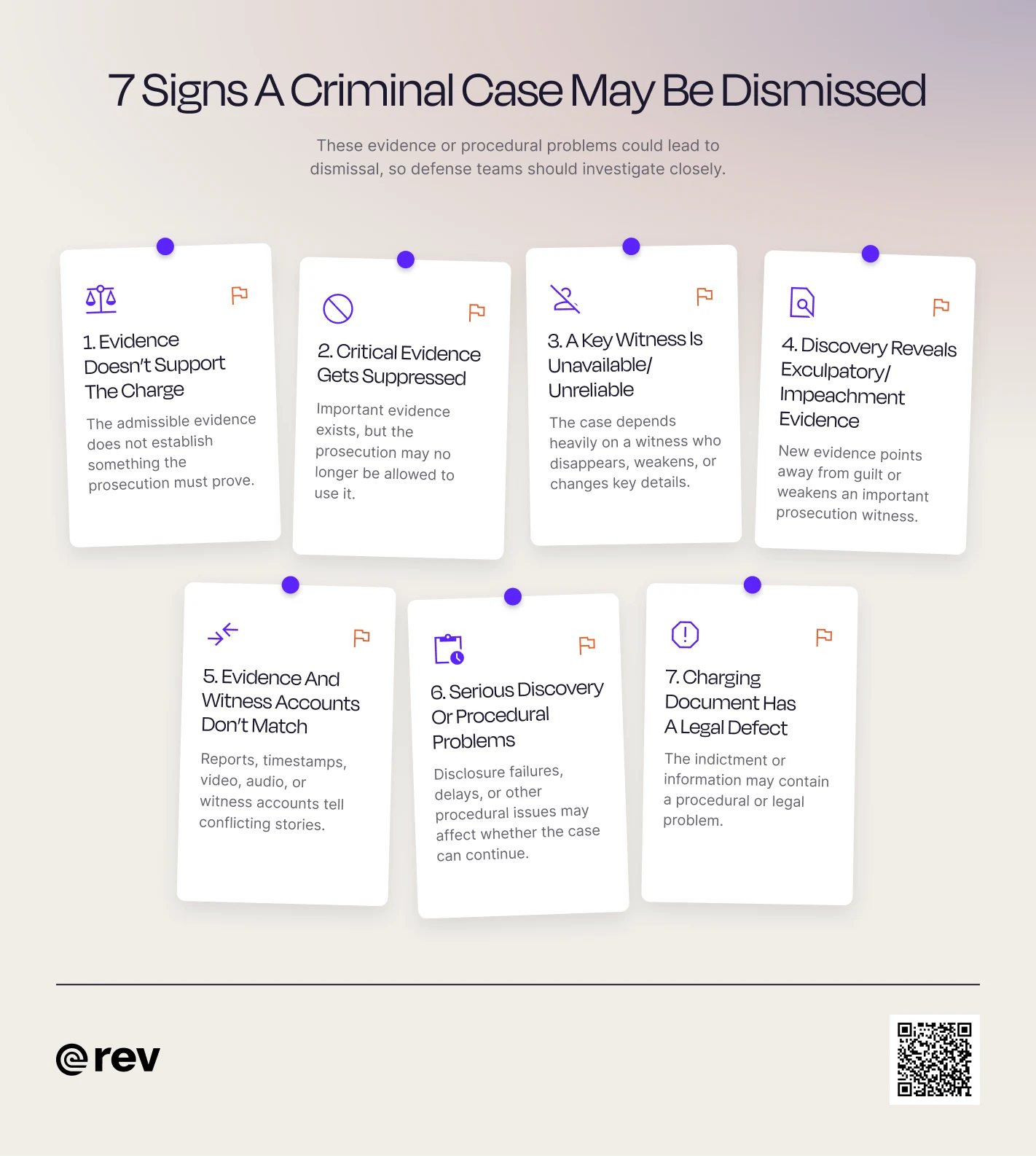
1. Evidence Doesn't Support An Element Of The Charge
Every criminal offense contains elements the prosecution must prove. If the available admissible evidence cannot support one of those required elements, the prosecution may have a fundamental problem.
Suppose a report claims a defendant knowingly possessed an illegal item. But footage, interviews, messages, or other records provide little support for that claim. That gap might spell the end of your case.
The important question isn't simply whether there is some evidence. It's what the evidence actually establishes when compared against every required element.
2. Critical Evidence Gets Suppressed
Sometimes the evidence exists, but the prosecution can't use it.
Evidence obtained in violation of a defendant's constitutional rights may be subject to suppression. If suppressed evidence was central to proving the case, losing it can substantially change the ability to properly argue and win the case.
For example, a court might exclude evidence that violated the Fourth Amendment when it was collected, or suppress a statement obtained in violation of applicable constitutional protections. What happens next depends on what evidence remains.
Suppression does not automatically lead to dismissal. But if the excluded material was doing most of the work, prosecutors may have difficulty moving forward.
3. A Key Witness Is Unavailable, Or Their Account Falls Apart
A missing witness isn't automatically fatal to a criminal case. Federal evidence rules, for instance, contain limited hearsay exceptions that may apply when a declarant is considered unavailable.
But the loss or weakening of a critical witness can matter considerably when the prosecution depends heavily on that person's testimony. The same is true when a witness remains available but their story changes.
Imagine that a witness describes one sequence of events during a 911 call, gives another version to responding officers, and changes a key detail again during a recorded interview. Each difference may have an innocent explanation. Taken together, though, they can raise questions about reliability or provide impeachment material.
Those inconsistencies are easier to spot when attorneys can compare the actual statements side by side instead of relying solely on summaries in police reports.
4. Discovery Reveals Exculpatory Or Impeachment Evidence
One of the biggest developments in a criminal case can be finding evidence that points away from guilt or undermines an important prosecution witness.
Under Brady v. Maryland and subsequent cases, prosecutors have constitutional obligations involving material exculpatory and impeachment evidence. The Department of Justice's current guidance for federal prosecutors states that exculpatory information inconsistent with an element of a charged offense and certain information casting substantial doubt on prosecution evidence must be disclosed.
Because of this, a potential Brady violation can become a major issue in a case.
Again, the remedy depends on the circumstances. A discovery problem does not mean charges automatically disappear. But withheld or newly uncovered evidence can alter how the defense evaluates witnesses, motions, trial strategy, and the strength of the prosecution's case.
5. Evidence And Witness Accounts Don't Match
Contradictions become especially important when evidence conflicts with the narrative used to support a charge.
Maybe an officer's report says an interaction happened in one order, while body-camera timestamps suggest another. A witness estimates that an event lasted several minutes, but surveillance footage shows only seconds. Or, dispatch audio might place an officer somewhere different from what another record suggests.
One discrepancy rarely tells the whole story. A pattern is harder to ignore.
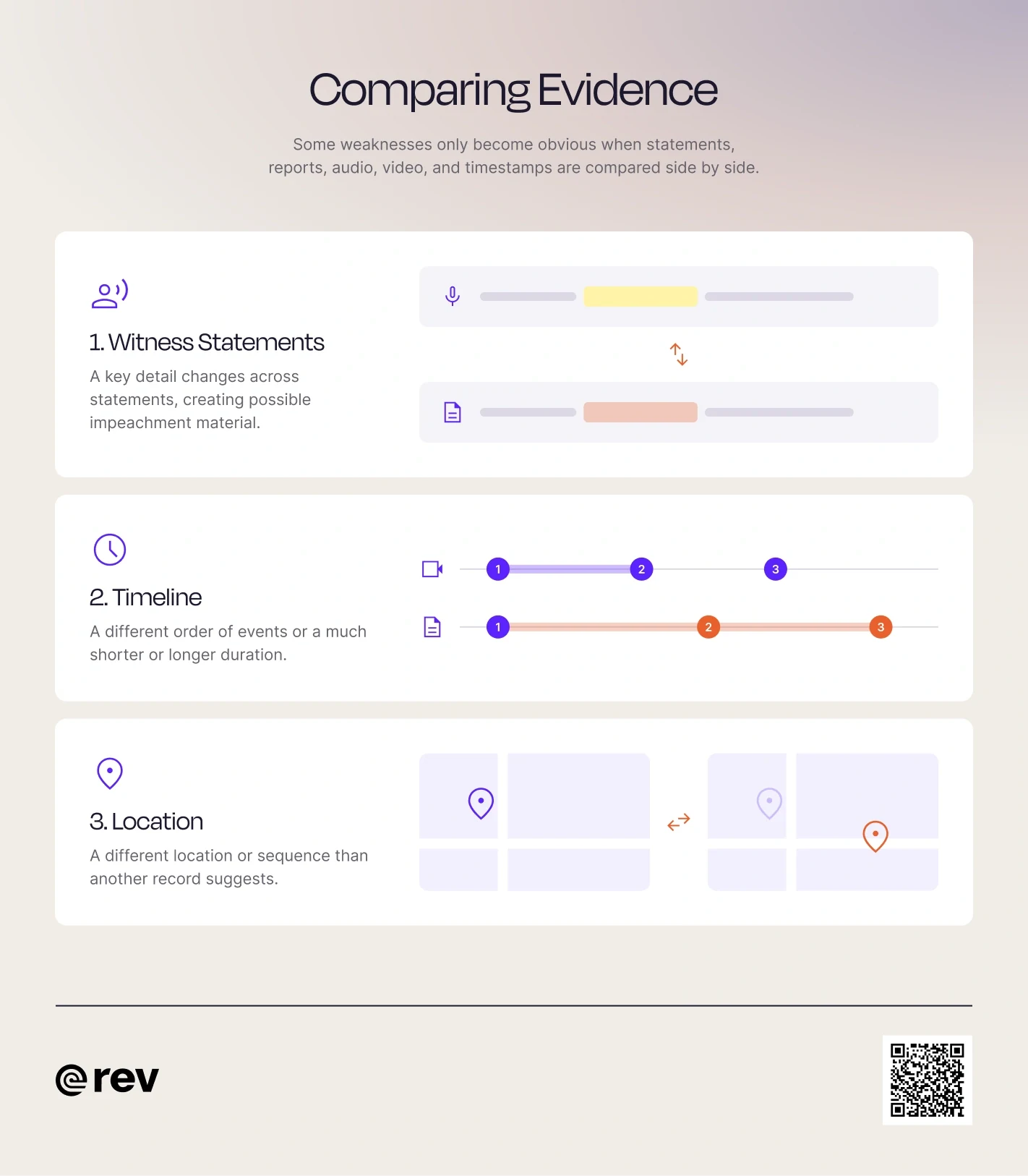
For defense teams trying to identify signs your case will be dropped, comparing statements against audio, video, timestamps, reports, and other records can reveal weaknesses that aren't obvious when those materials are reviewed separately. With Rev, reviewing all your case documents, videos, and photos at once is easy — in fact, we’ll even find and surface inconsistencies that will be ready for you next time you log in.
6. Serious Discovery Or Procedural Problems Develop
Criminal procedure imposes rules on how cases move forward and how certain information is exchanged.
In federal cases, Rule 16 governs criminal discovery and gives courts several options when a party fails to comply. A court may order discovery, grant a continuance, prohibit use of undisclosed evidence, or enter another appropriate order.
More serious circumstances can produce more serious consequences. DOJ has documented cases in which repeated disclosure failures contributed to a court dismissing a case with prejudice.
Timing can matter too. Federal Rule of Criminal Procedure 48 permits a court to dismiss an indictment, information, or complaint for certain unnecessary delays.
The exact rules and remedies depend on the jurisdiction and facts. For attorneys, the practical task is documenting what happened, when it happened, and how the issue affected the defense.
7. The Indictment Or Charging Document Has A Legal Defect
Sometimes the problem isn't buried in hours of footage. It's in the charge itself.
Defense counsel may challenge an indictment or information based on certain procedural errors. The grounds for dismissal depend on the governing law and procedural posture, so a defect doesn't necessarily mean the entire case disappears. Still, comparing the charging language against the evidence can expose an issue early.
That review can also reveal a simpler problem: the charge summary sounds plausible, but the record doesn't actually support what’s being alleged. When asked about the strongest grounds for dismissal, Alex Freeburg, founder and managing attorney of Freeburg Law, echoed a similar sentiment:
“It has to be something that forces the court to answer: even if everything the opposing side says is true, does this case legally belong here, and can it legally proceed?”
How To Find Evidence That Could Support Dismissal
The challenge for public defenders is often finding the right moments across a case with hours of body-camera footage, multiple interviews, 911 recordings, dispatch audio, PDFs, photographs, and police reports.
Start by building a timeline from the source evidence, not just the narrative in a report. Identify the events tied to each part of the charge, then compare how those events are described across every available source.
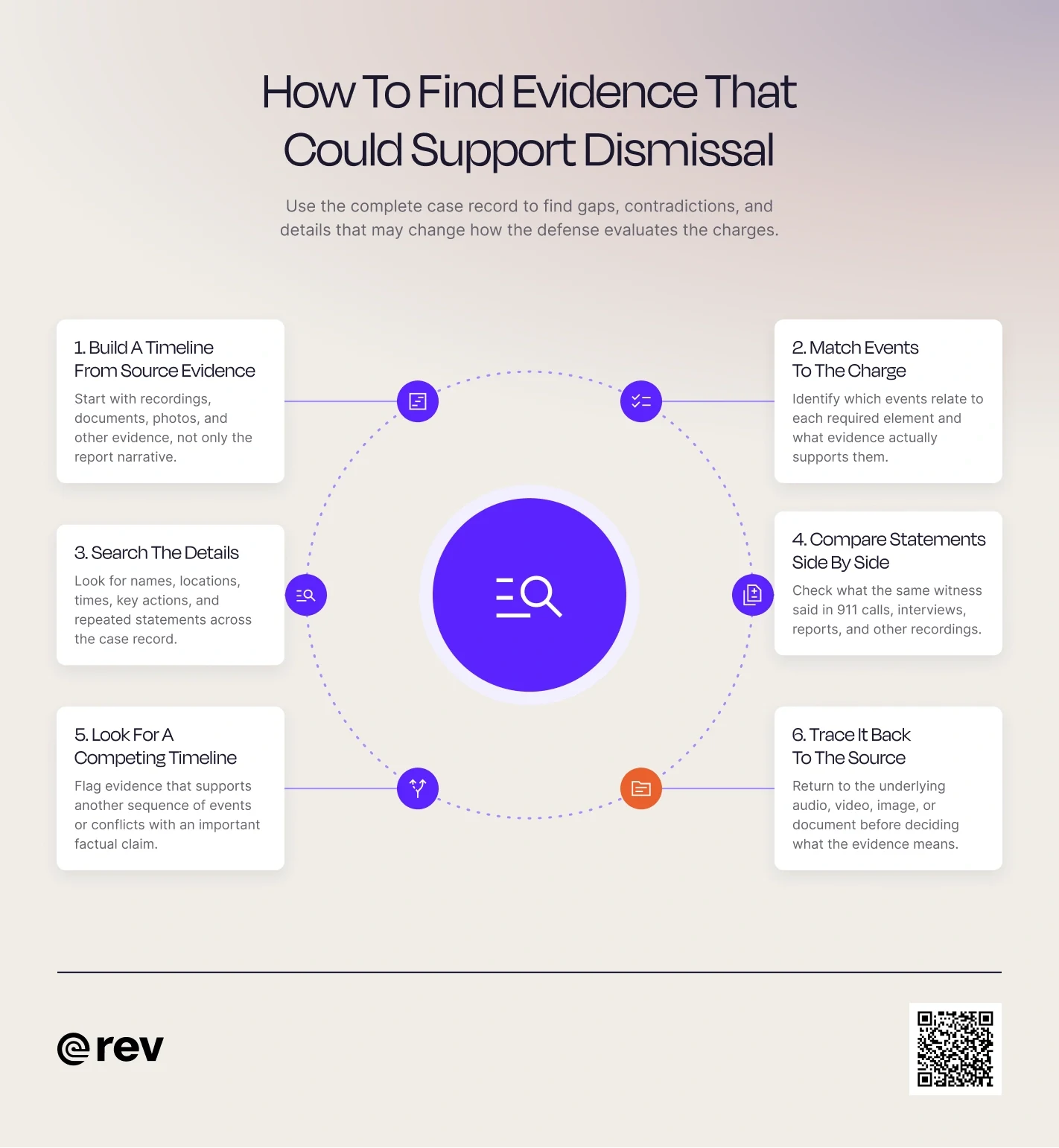
Pay particular attention to contradictions. Search for names, locations, times, key actions, and repeated statements. Compare what the same witness said at different points. Check whether reports accurately reflect recorded interviews. Look for evidence that supports an alternative timeline or conflicts with an important factual assertion.
Rev can help defense teams turn those scattered files into a searchable case record. Attorneys can search and compare audio, video, images, and documents across the evidence set, then trace findings back to the underlying source. That makes it easier to find the five seconds of body-camera footage or single interview statement that changes the case.
The goal isn't to have AI decide whether a case should be dismissed. That judgment should always stay with the attorney. The goal is to make sure the evidence needed to make that judgment doesn't stay buried in file 47 of a 200-file case.
Find The Evidence Before It Gets Lost In The Case File
There isn't one telltale sign that guarantees a criminal case will be dismissed. Sometimes the weakness is obvious. More often, it emerges only after comparing the prosecution's theory against what the complete evidence record actually shows.
Rev helps legal teams search across their case evidence, compare statements and timelines, and return to the original source when something doesn't line up. That means less time hunting through recordings and more time evaluating what the evidence actually means for the case.