

Mass Tort Intake: How To Scale Without Sacrificing Quality
Take a deep dive into mass tort cases, their intake process, and how your firm can update your strategies to take on high-volume cases with ease.


.webp)
Mass tort cases are unlike anything else in personal injury law. Instead of one client with one claim, you're managing hundreds — sometimes thousands — of people who were all harmed by the same product, drug, or company. The work doesn't just double. It explodes.
For personal injury attorneys who want to grow their practice in this space, the biggest challenge isn't finding clients. It's building a mass tort intake process that can handle the volume without letting critical details slip through the cracks.
This guide walks through what that mass tort client intake process looks like, how to build it, and where the right tools can make a real difference.
What Is Mass Tort Intake?
Mass tort intake is the process of identifying, screening, and onboarding potential clients who share a common injury or harm caused by the same defendant — typically a manufacturer, pharmaceutical company, or large corporation. It's the first phase of mass tort litigation, and it sets the tone for everything that follows.
During intake, your team collects basic information from each potential claimant, verifies they meet the criteria for the case, and documents their experience in enough detail to assess the strength of their claim. When done well, it provides a solid foundation for litigation. If not done right, though, you could be playing catch-up for months.
Traditional vs. Mass Tort Intake
The main difference between traditional and mass tort intake is the volume of clients you have to intake within a single case.
In a standard personal injury case, legal intake is a one-on-one process. You speak with a single client, gather their story, review their records, and make a decision. The workflow is manageable. One paralegal can handle it.
Mass tort intake operates at an entirely different scale. You may receive hundreds of inquiries in a single week, each requiring the same careful screening.
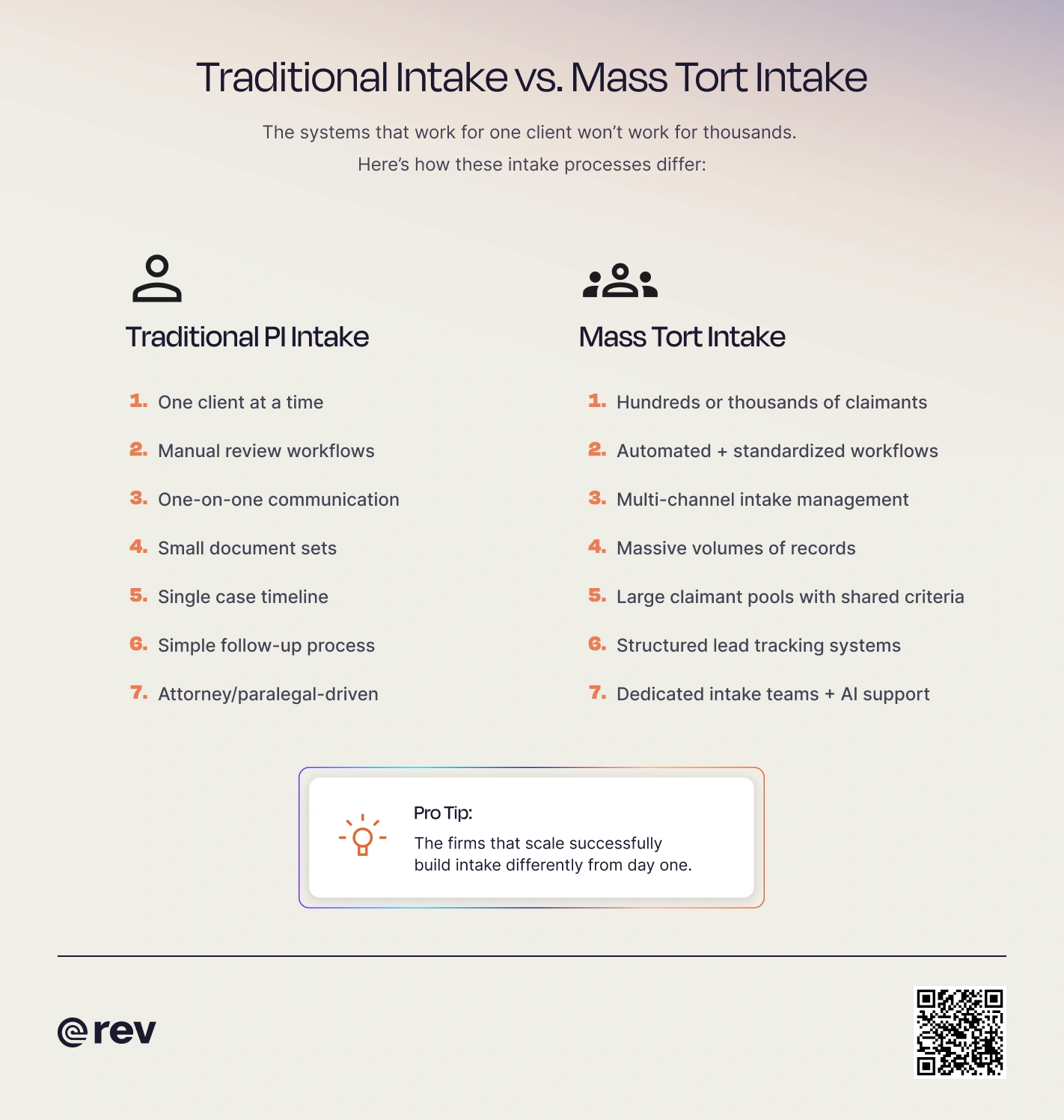
The legal questions are often consistent (did this person use the product? Were they injured in a specific way? When did the injury occur?), but the logistics of gathering that information from thousands of people at once is where firms can run into trouble. That's why mass tort strategies need to be built differently from the ground up.
It’s also important to understand the differences between a Mass Tort and a Class Action case. In a Mass Tort claim, each case is judged individually, while a Class Action case covers only a few individuals who represent an entire class of injured people.
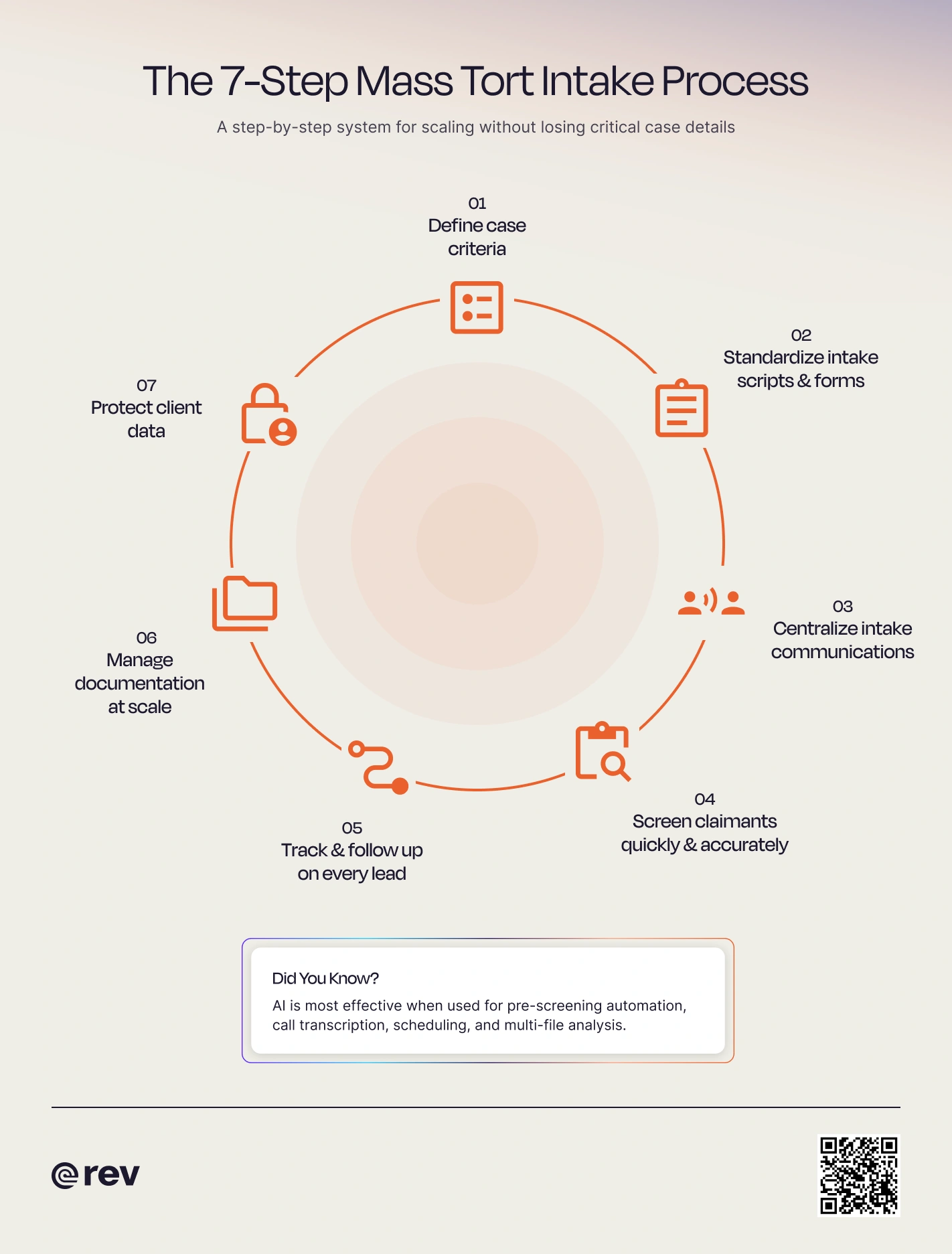
7 Steps For Effective Mass Tort Intake
A disorganized intake process is costly. Missed deadlines, overlooked claimants, and inconsistent documentation can weaken your case or expose your firm to liability. Because of this, having a defined strategy before the leads start coming in is non-negotiable.
Here's how to build an intake workflow that holds up at scale.
1. Define Your Case Criteria Upfront
Before your phone lines open, get clear on exactly who qualifies for your case. Ask questions such as:
- What product did they use?
- What injuries are covered?
- What's the minimum exposure period?
- What documentation will you need?
This sounds obvious, but many firms skip it — and end up screening hundreds of ineligible claimants. That's time and money your team doesn't have. Build a criteria checklist and train every intake staff member on it before the first call comes in.
Clear criteria also make automation more reliable. If your intake software is asking yes/no questions, those questions need to reflect airtight case requirements.
“AI is an incredible resource for intake because the communication can be streamlined using immediate contact with a potential client. Where before AI, there was delayed contact with a potential lead, and that would allow the lead to shop for another lawyer,” explains Jennifer Duffy, attorney at Duffy Law.
Now call centers are using AI to call out immediately to potentially hundreds of individuals at one time and get them on the phone for processing the intake and evaluation.”
2. Build a Consistent Intake Script And Form
Consistency is the backbone of scalable mass tort legal intake. Every potential claimant should be asked the same questions, in the same order, and it should all be documented in the same way. This creates a record your legal team can actually work with — and makes it far easier to identify patterns across claimants.
Your intake form should capture the basics: contact information, injury description, product use history, and any medical treatment they've received. But it should also be structured to generate useful case data. Think about how that form will look when it's been filled out by 500 people.
Use intake call templates to standardize how your team conducts these conversations. Rev's AI Templates, for example, can automatically extract key facts from recorded intake calls — flagging case-critical details and structuring them without your team having to manually review every recording word-for-word.
3. Centralize All Intake Communications
Mass tort cases generate a staggering volume of calls, emails, voicemails, and documents. If that information lives across different systems, or worse, in individual team members' inboxes, you're going to lose things.
Set up a centralized intake hub where every interaction is logged and searchable. That means a shared inbox, a central document repository, and a call recording system that captures every conversation. When a claimant calls back three weeks later, anyone on your team should be able to pick up exactly where things left off.
Rev's mobile app lets intake staff record client calls in the field with live transcription and real-time bookmarking. Those recordings sync directly to your desktop workspace, so nothing gets lost between a field interview and your central files. And this way, everyone on your team will be able to view and analyze all intake calls for a case in one central location.
4. Screen Claimants Quickly And Accurately
Speed matters in mass tort lead generation. Claimants who don't hear back quickly often move on to another firm. But speed can't come at the cost of accuracy, as signing an ineligible claimant is an expensive mistake.
The answer is a two-stage screening process. Start with an automated pre-screen to filter out anyone who clearly doesn't qualify or has a conflict of interest. Then route eligible leads to a live intake specialist for a more detailed conversation. This protects your team's time while ensuring no potentially viable claimant is dismissed too quickly.
Document both stages carefully. Record all your screening conversations, and run them through AI transcription and analysis to get a reliable record without requiring manual review.
5. Track And Follow Up On Every Lead
Not every claimant is ready to sign right away. Some need time to gather documentation. Others have questions. Many simply get busy and forget to call back. Without a structured follow-up process, those leads disappear.
Build a follow-up sequence with clear timelines and responsibilities. Answer questions like:
- Who owns each lead?
- When do they follow up?
- What happens if there's no response after the second attempt?
Define it before the case launches and enforce it consistently.
This is also where mass tort intake services can add real value. Third-party intake vendors can handle outbound follow-up at scale, freeing your in-house team to focus on qualified claimants who are ready to move forward.
“The ease of AI scheduling is a vital gift to those in crisis. Traditional intake often involves frustrating phone tag that adds stress to an overwhelmed individual,” explains Jason Plotkin, CEO and Managing Attorney at Pinder Plotkin.
“By allowing AI agents to handle qualification and scheduling during off-hours, we provide a seamless transition from ‘victim' to ‘client.’ AI can navigate the intake process and book consultations directly while my human team recharges. This protects the client experience by ensuring no one is ever ‘ghosted.’ When a victim secures a meeting on a Sunday or holiday, it restores their sense of control.”
6. Manage Documentation At Scale
Every claimant comes with paperwork. Medical records, pharmacy records, proof of purchase, photos — the list varies by case type, but the volume is always significant. A well-designed intake process accounts for how all of that documentation gets collected, stored, and reviewed.
Create clear document request checklists for claimants and build a system for tracking what's been received and what's still outstanding. Firms that wait until litigation to gather records often find themselves scrambling and missing critical evidence.
Rev's multi-file AI analysis lets you upload hundreds of files and identify key information across all of them at once, rather than reviewing each document individually. That kind of case intelligence is a significant time-saver when you're dealing with large claimant pools.
7. Protect Client Data From Day One
Mass tort cases involve sensitive medical and personal information for potentially thousands of people. Your intake process needs to handle that data with the same care you'd apply to any other privileged information.
Use platforms that are SOC 2 Type II certified and HIPAA-compliant. Ensure that any AI tools you're using don't train on your client data — attorney-client privilege doesn't end at your office door. Rev maintains strict data protections: your recordings and transcripts are never used to train third-party AI models, and all data is encrypted end-to-end.
You should also consider updating access levels from the beginning. Not everyone on your team needs access to every claimant's full file. Granular permissions reduce risk and keep sensitive information contained.
Internal Strategies For Mass Tort Cases
Beyond the intake workflow itself, there are operational decisions that can make or break a mass tort practice. These are the things that don't always show up in process guides, but they matter.
Staff Intentionally
Mass tort intake is not the place to be short-staffed. You'll need dedicated intake specialists, not attorneys or paralegals being pulled in two directions. Consider whether you need in-house staff, a third-party mass tort intake service, or some combination of both — and make that decision before cases start coming in, not after.
Train Relentlessly
Your intake script is only as good as the people using it. Train your team on the case criteria, the intake process, the technology you're using, and how to handle difficult conversations. Claimants calling in are often dealing with serious health issues. The quality of that first call shapes their perception of your firm and their likelihood of signing.
Review and Improve Continuously
Legal intake processes are never perfect from the jump. Set a cadence for reviewing what's working — maybe weekly at first, then monthly as things stabilize. Where are claimants dropping off? Where is your team losing time? What questions are creating confusion?
Use that feedback to refine the process throughout the case lifecycle.
Intake Challenges Your Team May Face
Even with strong mass tort campaign processes in place, intake comes with predictable pain points. Knowing they're coming makes them easier to navigate.
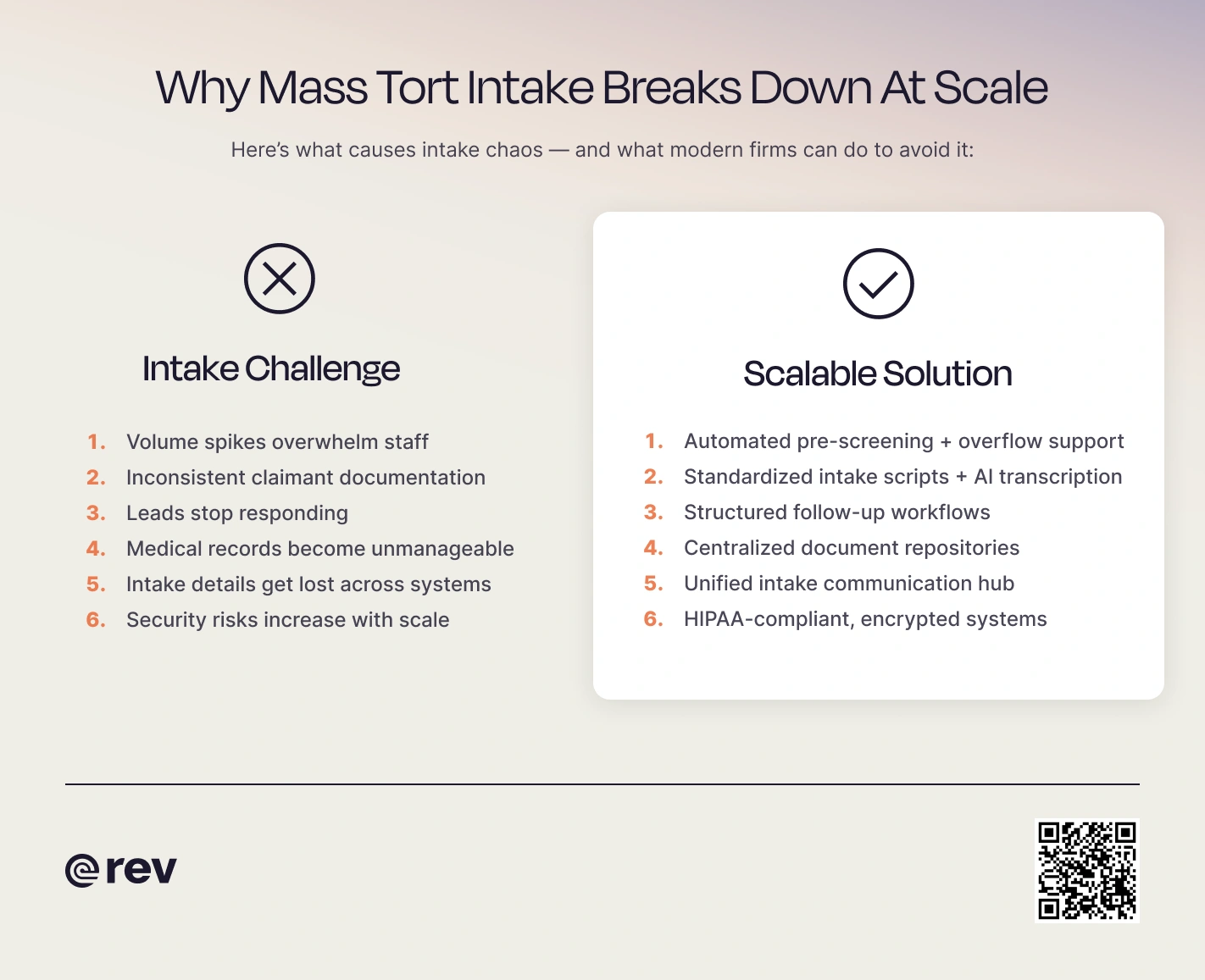
Volume spikes are the most common problem. When a new case launches or a news story breaks, your intake lines can be flooded overnight. Firms that don't have scalable infrastructure in place — whether that's overflow call handling, automated pre-screening, or additional contract staff — struggle to keep up.
Inconsistent documentation is another recurring issue. When dozens of people are conducting intake conversations, small variations in how questions are asked or documented add up to messy data. Standardized scripts, call recording, and AI-assisted transcription can all help enforce consistency across your team.
Claimant dropout is frustrating but common. Between the initial inquiry and actually signing a retainer, many potential claimants simply disengage. Long delays, confusing follow-up processes, and poor communication are the usual culprits.
The good news is that these are largely fixable with a better-designed follow-up system and clearer communication at every stage. Rev's AI Notetaker integrates with Zoom, Google Meet, Teams, and Webex so that no client meeting goes undocumented — making follow-ups faster and more personal.
Key Technology Shaping The Future Of Mass Torts
The firms winning in this space aren't just working harder, they're using better tools. A few categories of technology are making a meaningful difference:
- AI transcription and call analysis: Tools like Rev automatically transcribe intake calls and extract structured information from recordings. Instead of a paralegal listening to hours of audio, your team gets a searchable transcript with key facts already flagged.
- Intake-specific templates: AI Templates built for legal workflows can be customized to your specific case type. They can be customized to pull out injury descriptions, exposure history, product information, and more automatically.
- Multi-file AI analysis: When hundreds of claimant files need to be reviewed, tools that can analyze multiple documents simultaneously and surface patterns across them are invaluable. Rev's multi-file insights let you identify consistencies, contradictions, and gaps across large claimant pools at once.
- CRM and case tracking software: A dedicated legal CRM helps manage the entire claimant lifecycle from first contact through retainer signing, keeping follow-up on track, and ensuring no leads fall through the cracks.
- Secure document collection portals: Giving claimants a simple, secure way to upload medical records and other documentation reduces back-and-forth and gets you the information you need faster.
The AI for personal injury lawyers space is evolving quickly. Firms that adopt the right tools now will have a significant operational advantage as mass tort cases grow in volume and complexity.
Build An Intake Process That Can Handle What's Coming
Mass tort cases represent one of the biggest opportunities in personal injury law — and one of the most demanding operational challenges. The firms that succeed are the ones that treat intake as a strategic priority, not an afterthought.
Build your case management process before the leads arrive. Invest in the right tools, train your team, and make sure the technology you're using meets the security standards your clients deserve.
Rev gives personal injury teams a reliable foundation for mass tort intake: accurate transcription, AI-powered case intelligence, customizable intake templates, and enterprise-grade security. Hundreds of files can be uploaded and analyzed at once, giving your team the insights they need without the manual review burden.





.webp)