Speaker 1 (01:08):
[inaudible 00:00:00]. Ladies and gentlemen, please welcome back to the podium from CBS News, the president of the White House Correspondence Association, Weijia Jiang.
Weijia Jiang (01:25):
Welcome back to the 2026 White House Correspondence Dinner. I hope everyone enjoyed their meal.
Speaker X (01:32):
Yeah. [inaudible 00:01:33].
Weijia Jiang (01:35):
Since Calvin Coolidge became the first president to attend this event in 1924, nearly every sitting president has joined us at some point in their term. The tradition is rooted in a simple principle, that a president and the press corps that covers him can share a meal and even a joke. This dinner has never lacked for opinions. I know everyone has a lot of feelings about it, even in our normal circumstances, and people ask, "Should it still exist?"
(02:05)
But every year we pack the room. In fact, we just did it twice. Whatever brought you here tonight, this evening is dedicated to the First Amendment and the excellent work of our colleagues and scholars. President Trump, you are joining us tonight for the second time in three months, and we don't take that lightly. Thank you. Thank you again to Press Secretary Karoline Leavitt and the White House press team. Thanks to the relentless WHCA board members, our executive director, Steve Thomma, and our general counsel, Simon Lackovich for your hard work and friendship.
(02:58)
I have to say thank you again to my CBS News family for enduring a second round of dinner planning. And of course, my family, I love you so much. Our entertainer mentalist Oz Pearlman is also back with us. Thank you, Oz. For the record, he did guess Karoline's baby's name right last time, and we can't wait to see what you reveal. But you can skip the part where you guessed the president's phone number because half the reporters in this room already have it.
(03:36)
Finally, on behalf of the White House Correspondents Association, I also want to thank supporters from around the world across the political spectrum who sent well wishes after a shooting interrupted our event in April. Many of you are joining us on live stream and C-SPAN is the crew as it was that night. Photographers and technicians were under the stairs where the shooter was, but they never stopped rolling their cameras and transmitting live footage despite the circumstances. Thank you.
(04:14)
That night tested all of us, but it revealed something worth fighting for. While journalists in the ballroom were gathering facts and getting them to the public, I got a rare glimpse of something few of us ever see in real time. In a holding room, President Trump was huddled with members of his cabinet, asking questions, finding the best way to share the answers with everyone, which is our job description too.
(04:40)
I keep coming back to that split screen, not because it was dramatic, but because it quietly proved no matter how complicated or tense the relationship is between the press and the presidency, what we share is far more important than anything else. And that is our duty to serve the American people. As our country continues to celebrate 250 years of its extraordinary story, this gathering is further proof that the American press endures with it.
Video (05:21):
MUSIC: Whose broad stripes and bright stars through the perilous fight.
(05:25)
O'er the ramparts we watch'd were so gallantly streaming?
(05:25)
And the rocket's-
(05:25)
Speaker 5: The White House correspondence dinner was to be a night celebrating the First Amendment and 250 years of surviving, thriving, and overcoming our nation's many unthinkable challenges.
(05:42)
Weijia Jiang: Welcome to the 2026 White House Correspondence Dinner.
(05:48)
Speaker 6: But that celebration was stopped by a single gunman in an apparent attempt to assassinate the president.
(05:54)
Speaker X: Move, move, move. Where? There. There.
(05:54)
Speaker 7: I heard the loud bangs that were going off. It was extremely frightening. I was only a few feet away.
(06:02)
Speaker 8: We were all told to just get under the tables. And at first, some of the White House officials did too.
(06:07)
Speaker 9: A whole rush of people started to come up towards the front door.
(06:13)
Weijia Jiang: On a night when we are thinking about the freedoms in the First Amendment, we must also think about how fragile they are.
(06:19)
President Donald Trump: And that was very unexpected.
(06:23)
Speaker 5: The President and the White House Press Corps proved resilient.
(06:28)
President Donald Trump: This was an event dedicated to freedom of speech that was supposed to bring together members of both parties with members of the press. And in a certain way it did.
(06:38)
Speaker 5: So we are together again tonight proving our resolve and unyielding fortitude and to celebrate America at 250.
(06:49)
James Madison: Hello from 1789. I'm James Madison. Yes, that James Madison. I wrote the First Amendment. At the time we worried a king might control the press. Turns out you're now worried about tweets, algorithms, and people yelling on television. Let me clarify the rule. The government doesn't get to shut the press up, not when it's wrong, not when it's annoying, and not when it's asking uncomfortable questions.
(07:31)
Speaker X: Mr President [inaudible 00:07:32].
(07:31)
Speaker 12: The First Amendment and the freedom of the press, it is the foundation of our democracy.
(07:39)
Speaker 8: The freedom that we have to speak our mind, to share our views, share what we know.
(07:45)
Speaker 13: It's just so remarkable that we're able to question our world leaders, question the most powerful man in the world because of the First Amendment.
(07:55)
Speaker 14: As we mark the 250th anniversary of our birth, I'm hopeful that people throughout the country will come together to discuss the importance of this history and to appreciate even more what our ancestors did to secure our liberty and freedoms, including freedom of the press.
(08:13)
Speaker X: [inaudible 00:08:16].
(08:13)
Speaker 15: Good afternoon, everybody.
(08:19)
Speaker 16: I see we're trying a new experiment this morning. I hope it doesn't prove to be a disturbing influence.
(08:23)
Speaker 17: Our goal is to try to rock the boat, and we're supported by the First Amendment. I hope Ike would be proud of us.
(08:33)
Speaker X: [inaudible 00:08:36]. Are you planning on taking control over Iran's oil?
(08:35)
Speaker 17: We have a very vigorous group of people representing all different points of view, including a lot of the foreign press.
(08:42)
Speaker X: [foreign language 00:08:43]. [inaudible 00:08:43].
(08:42)
President Donald Trump: I just told them, "I've got to come over and see the fake news." Let's go.
(08:45)
Speaker 17: The presidents throughout history have complained about how they're treated in the press.
(08:52)
Speaker 18: We don't stop the publication in any papers. We don't fine anyone for something they say.
(08:58)
Speaker 17: And that's okay. That's part of the process.
(09:01)
Kaitlan Collins: Why are you so confident he'll change his behavior, Mr. President?
(09:05)
Joe Biden: I'm not confident he changed behavior. What the hell... What do you do all the time? When did I say I was confident?
(09:10)
Speaker 19: I don't want to be back at the White House today. It's a young person's game and I have great admiration for the reporters who are there because they have a tougher job than I ever had.
(09:18)
President Donald Trump: That's enough. Put down the mic.
(09:20)
Speaker 19: I must say today, folks, the reporters at the White House, my hat's off to you.
(09:25)
President Donald Trump: Peter, go ahead.
(09:26)
Peter: In Jim's defense, I've [inaudible 00:09:28]-
(09:28)
Whenever we face pushback from a politician or even from a president, it's not about us as a journalist. It's about the person we're covering.
(09:34)
Well, this is about the rest of us.
(09:34)
President Donald Trump: Well, I'm a big fan of yours either to be honest with you.
(09:36)
Peter: I understand. So let me ask you a question if I can.
(09:40)
Our job is to just keep asking tough questions.
(09:42)
Speaker 14: Our founders were often distraught about the press, the highly partisan media of their time. Yet Jefferson famously championed a free press, noting that he preferred newspapers without a government to a government without newspapers.
(09:58)
Thomas Jefferson: That's right. I favored a free press while my predecessor here, John Adams, signed a sedition act that could imprison journalists for saying anything malicious against the government. I ended the unconstitutional law when I took office, and thankfully it's never returned.
(10:19)
John Adams: Can't blame a guy for trying.
(10:21)
Speaker 10: So which is it? Are you winding this down or are you escalating it?
(10:25)
President Donald Trump: I can't tell you. I don't-
(10:25)
Speaker 19: Whenever there's a crisis, that's the time that people tune in.
(10:29)
Dan Rather: Thank you, Mr. President. Dan Rather with CBS News.
(10:32)
The effects of Watergate were beginning to corner President Richard Nixon. If the president thought you were going to ask a question he didn't want asked, he would try to throw you off balance right at the beginning.
(10:44)
Richard Nixon: Are you running for something?
(10:45)
Dan Rather: No, sir. Mr. President, are you?
(10:54)
Mr. President, in talking about the continuing recession tonight, you have blamed mistakes of the past and you blamed the Congress. Does any of the blame belong to you?
(11:05)
Richard Nixon:: Yes, because for many years I was a Democrat.
(11:09)
Speaker X: Why did you really want to go to war? From the moment you stepped into the White House [inaudible 00:11:13]-
(11:12)
Speaker 7: When we push them to answer questions on the record, they have an opportunity to explain their reasoning, explain their thinking, explain their goals.
(11:23)
Major: Can you tell the country, sir, why you are content with all the fanfare around this deal to leave the conscious of this nation and the strength of this nation unaccounted for in relation to these four Americans?
(11:33)
Barack Obama: The notion that I am content, Major, that's nonsense, and you should know better.
(11:42)
President Donald Trump: Hello, everybody. Have a good trip.
(11:44)
Speaker 22: Well, you can't fall asleep on Air Force One because you never know when the president's going to come back and take questions.
(11:52)
President Donald Trump: It's going to be a very long trip, right?
(11:52)
Speaker 23: Dan Compton, who's been with the president all day, is on the phone from Nebraska with [inaudible 00:11:57]-
(11:57)
Speaker 24: On 9/11, I was part of that small travel pool that the White House agreed to take on what was a 10-hour odyssey.
(12:04)
The President might be a target as well. And that is why he has come to as secure a place as he could.
(12:12)
The White House made sure that we had phone connections and that we had access to the President. It worked exactly the way it should.
(12:19)
Sophia Cai: So I dialed President Trump's number and he picked up just like anybody else.
(12:24)
Speaker 25: I just got off the phone with President Trump. It was a roughly nine-minute phone interview.
(12:29)
Peter: I've covered five different presidents. I have never seen one other than Donald Trump who regularly takes phone calls from reporters.
(12:36)
Speaker 26: New media is massively important to our country.
(12:39)
Speaker 27: Here's what you missed if you weren't tuned in.
(12:41)
Speaker 26: We utilize social media to help people understand what we're talking about, breaking it down in digestible ways that they can understand even the more nuanced news that's going on here at the White House.
(12:51)
And today we went through the Rose Garden into the Oval Office to see-
(12:54)
Every single outlet that's at the White House is shaping the national news. All of these outlets have a place here, and all of our audiences deserve to know what's going on in our country and in this White House.
(13:03)
Speaker 27: I don't think it's unusual for a president to be criticized. That seems to be one of the things that go with the job.
(13:15)
Speaker 14: As we look back over history, almost without exception, the better presidents at the end of their term have actually thanked the press in the spirit of, "You had your job to do, I had my job to do, and that's the way the country goes together."
(13:33)
Ronald Reagan: Truth be told, in the greater scheme of things, you are, I hesitate to say this, more essential to that common pursuit than I am. And that's why freedom of the press is and must always be above politics.
(13:49)
George W. Bush: My friends say, "What is it like to deal with the press corps?" I say, "These are just people that are trying to do the best they possibly can."
(13:55)
Barack Obama: You're not supposed to be sync offense. You're supposed to be skeptics. You're supposed to ask me tough questions and make sure that we are accountable to the people who sent us here. And you have done that.
(14:08)
Speaker X: I wonder whether the founding fathers might look with delight at the kind of vibrant conversations that Americans today are having in the national media, in social media. It's a very vibrant conversation that has its roots 250 years ago.
(14:33)
Mr. President [inaudible 00:14:34]-
(14:34)
James Madison: The noise you experience today, though at times overwhelming, is not necessarily a sign of decay. It may in part be the sound of liberty exercising itself somewhat chaotically to be sure. The true danger lies not in a press that is too free, but in one that forgets why it was made free at all. Enjoy the rest of the evening and thanks for helping us reach 250 years of American democracy. Cheers.
Weijia Jiang (15:09):
Thank you, founders. What a powerful... By the way, that was AI in case you missed it. What a powerful reminder that generation after generation White House correspondents have the privilege of writing the first draft of history. Serving as president of our association has been one of the great honors of my life. And as my final act, I was determined to carry out one more event to highlight the strength of our press corps.
(15:47)
I am honored to preside over this dinner, but I do have a fact-check because technically my last day in office was last week. Our next chapter is in amazing hands with one of the fiercest women I have ever known. She is my wonderful friend, my partner in 2026, 2027 WHCA president, Jacqui Heinrich, who I have asked to help present two very special awards. Jacqui.
Jacqui Heinrich (16:34):
Thank you, Weijia. And good evening everyone. Before anything else, I want to recognize Weijia Jiang for her leadership, her unwavering commitment to this press corps. Weijia, you have really represented this association with such professionalism. There we go. There we go. And she has. She has represented this association with such professionalism, integrity, grit. And I am so deeply grateful, not just for your example, but also more so for your friendship.
(17:35)
And to our members, I am humbled that you put your trust in me to lead the White House Correspondence Association for the next year. And I look forward to working alongside all of you as we continue our shared mission, pursuing the facts without fear or favor and exercising the freedoms protected by the First Amendment in service of the American people.
(17:59)
The attempt on President Trump's life last April was a sobering reminder that democracy is not immune to violence and the freedoms that we cherish can never be taken for granted. Political violence must have no home in America. And journalism can serve us well to broaden understanding, to shed light, and to inform our decisions, especially in this age of fast moving information that can reinforce our divisions.
(18:39)
And we are grateful to have President Trump here tonight taking part in this tradition that recognizes the essential role of a free press in our democracy. Thank you, President Trump.
President Donald Trump (18:50):
Thank you.
Jacqui Heinrich (18:53):
The events of that night also revealed the resilience of this Press Corps, the All-American sense of resolve that no act of intimidation will silence us, and the endurance of the First Amendment. And we're gathered here tonight because we believe that a free press always finds a way forward. And it is in that spirit that the WHCA Service Award was established to recognize exceptional service to this association. And it is fitting that one of the two awards that we are giving tonight goes to the staff of the Washington Hilton. They are hospitality professionals who always put service first. As harrowing events unfolded that night, their courage was on full display. The kitchen workers, the ballroom wait staff remained at their posts. When President Trump urged that the evening should continue, they prepared to serve more than 2,600 guests while they were still processing the shock alongside all of us. And when the Secret Service made the necessary call to postpone the remainder of the program, they immediately pivoted, preserving every unserved meal and donating them to local shelters.
(20:09)
And many of these dedicated professionals have worked dozens of White House correspondence dinners since this event first moved to the Washington Hilton in 1968. And 58 years later, we are deeply grateful for their partnership. We are proud of the history that we've built together, and we are excited to return to the Washington Hilton next year stronger than ever. Please welcome the Washington Hilton's general manager, Ken Jarka, and catering manager Keren Feketis to accept the WCA President's Award for Exceptional Service on behalf of the entire Washington Hilton team.
Weijia Jiang (21:34):
Congratulations, and thank you, Jacqui. I also want to thank the staff and security team right here at the Waldorf Astoria for putting so much time and care into helping us plan this event in a very short notice. That evening in April did not unfold as planned, but it ended exactly like it was supposed to. 2,600 guests plus hundreds of others who were working that night got to go home unharmed.
(22:06)
And that was made possible by the brave men and women of law enforcement and the United States Secret Service. On behalf of every person who was inside that ballroom, and every family who got to hear their loved ones say, "Don't worry. I'm okay." We thank you. One officer placed himself directly in harm's way and engaged the armed suspect. Even after gunfire struck his protective vest, he stayed in the fight and the attacker was stopped.
(22:43)
I know many of us have wondered, "What if he hadn't acted in that exact way? What if he had waited a few more seconds?" His courage that night reflects the core values of the Secret Service, duty, justice, courage, honesty, and loyalty, and is a commitment to safeguarding his country and community. They also shaped his career first as an infantryman and section leader in the United States Marine Corps. And since 2022 as an officer of the Secret Service protecting the White House complex and our nation's leaders.
(23:17)
Ladies and gentlemen, it is my honor to present the WHCA President's Award for Exceptional Service to Officer Victor Gonzalez of the United States Secret Service. Thank you again, Officer Gonzalez, and to all the law enforcement officials who work around the clock to keep us safe. Democracy is defended in many ways, sometimes with a badge, sometimes with a notebook and a deadline. The White House Correspondence Association started as a group of 50 reporters, and I am proud that our membership hit a record number in 2025. More than 1,000 people, including many from new media outlets.
(24:33)
Our press corps covers the presidency at all hours of the day in their personal lives. They miss out on a lot so that the world doesn't have to. If you are a past WHCA president here tonight, please stand. Former board members, please stand. Our chief White House correspondents, please stand. All current White House correspondents, reporters, producers, photographers, visual and audio journalists, please stand. And tonight, I also want to salute our colleagues in the Pentagon Press Corps.
(25:38)
Your work is invaluable, especially as our nation is at war. Please stand. And now we turn our attention to future White House correspondents, our incredible scholarship award winners. Please welcome our scholarship committee chair who also serves as the WHCA secretary, Brian Bennett of MS NOW.
Brian Bennett (26:14):
Hello, everybody. It means so much to be back together tonight. This is the part of the dinner each year that I look forward to the most. We have an incredible group of young journalists with us who are the recipients of this year's White House Correspondence Association scholarships. Since 1991, the WHCA has awarded scholarships to hundreds of journalism students. This year, we are helping fund the education of 30. Let me pull out my remarks here. 30 students from 16 colleges and universities.
(26:58)
They are from schools all over the country. Arizona, California, Illinois, Iowa, Maryland, Missouri, New Jersey, New York, Ohio, Puerto Rico, Tennessee, Virginia, Washington DC. We have important partners who extend the reach of our giving, and you all are a part of that. The WHCA and our partners went to great lengths to make sure as many of our scholars as possible could be here tonight with us.
(27:35)
And I'm happy to say that 26 out of the 30 of them were able to return for the second dinner. Some came back to DC from far away. Many were already here in Washington for the summer for journalism internships. When the April dinner was interrupted by the shooting, a lot of the scholars did what journalists do in dangerous situations. They started reporting, and they reported for their college newspapers. They are already showing their commitment to the work that we are all here to celebrate.
(28:18)
Our dinner is the primary fundraiser for our association and our scholarships. And because of that generosity, we were able to increase the amount of several scholarships this year. Thank you for being a part of this and supporting this work. And we also want to say thanks to the America 250 Commission for your generous donation to our scholarship fund. The scholars not only receive financial help to pay for school. Earlier this year, they had a tour of the White House and they met with White House officials.
(28:55)
They spent an afternoon with dozens of senior journalists who cover the White House, and they were paired with mentors, working journalists from the White House Correspondence Association who make a year-long commitment to offer advice and encouragement. We all had people along the way who helped make us better. And the WHCA Scholarship Program is a way that our association gives back and helps strengthen a new generation of journalists. Because of the commitment and your support, past WHCA scholarship recipients are now doing amazing things in journalism. We tracked some of them down to tell us about their work today.
Video (29:36):
Speaker 31: Being a White House Correspondence Association scholar opened up a new world for me.
(29:47)
Speaker 32: Being a scholar meant that I could have the financial freedom to do what I wanted.
(29:52)
Speaker 33: Being a WHCA scholar gave me access to so many mentors in a world of opportunities here in Washington DC.
(29:57)
Speaker 34: It gave me the chance to connect with other journalists, other members of the association.
(30:04)
Speaker 35: Journalism is important, and especially here at the White House where every day, every hour, every minute even matters. The decisions that are made here impact people across the country and around the world.
(30:17)
Speaker 36: The idea that you get to be a part of the first draft of history, it all is extremely inspiring and drives me as a journalist. There are so many pinch-me moments covering the White House, watching world leaders arrive here, walking into the press briefing room, getting to see Marine One land on the South Lawn, and getting to ask the President of the United States a question directly.
(30:41)
Being selected as a White House Correspondence Association scholar has played a huge role in my career.
(30:46)
Speaker 33: I was there as President Biden gave a toast to the freedom of the press, and also as Kim Kardashian strutted across the runway and posed for pictures among a room full of talented journalists.
(30:57)
Speaker 35: The stars, the outfits, the photographs. And I remember too, that was the year that Brittney Griner-
Speaker 2 (31:00):
... The photographs, and I remember too, that was the year that Brittney Griner had just returned home. And so being able to see her was really emotional.
Speaker 3 (31:08):
I was just inspired looking around at all the different scholars and how excited they were. And I think their excitement influenced my excitement about it.
Speaker 4 (31:15):
And it really was an eye-opening experience about just how important this role is.
Speaker 6 (31:23):
This White House Press Corps is not a mythical world. It exists and it is something that I can aspire to be a part of.
Speaker 5 (31:30):
And I owe a lot of credit to the WHCA for getting me here. So many journalists involved in this organization were willing to chat with me, to invest in me, and it's a cycle because of what they were able to pass on. I hope that I can play a role in doing that for the next generation as well.
Brian Bennett (31:51):
I can tell you, this year's scholarship recipients are also really impressive, and they're all sitting right over there. Let's meet them. Please stand as I read your name. From American University, Luisa Clausen. From Arizona State University, George Headley, Alysa Horton, and Kyle Sekenski. From Hampton University, Cristin Fluellen and Jade AbuBakr. From Howard University, Tatiana Allen and Madison Maynard and Ssanyu Lukoma. From Iowa State University, Erik Anderson. From Northwestern University, Jacques Abou-Rizk, Kaitlin Bender-Thomas, Samantha Freeman. From Iowa University, Nyla Gilbert, Aiden Ryan, Emily Stokes. From Princeton University, Aina Marzia. From Sagrado Corazón University in Puerto Rico, Ianis Soto Valle.
(33:08)
From Syracuse University, Ben Bascuk. From the University of California, Berkeley, Hyeyoon Cho. From the University of Kansas, Julia Hanson. From the University of Maryland, Laura Charleston, Lillian Gray, Danna Matthews, Ashley Neyra. From the University of Missouri. Kalli Fowler, Tyler Kirwan, Fletcher Mantooth. And from the University of Tennessee, Abigail Fanning.
(33:47)
Congratulations, scholars. Please be seated. There's one more scholarship that requires special attention. This year, we've added a new scholarship at New York University that has been named in honor of the legendary CBS News White House correspondent, Mark Knoller. As you all know, Mark passed away in August. And if you needed to know how many times the president had been to Camp David or went on vacation or played golf, Mark Knoller always had the facts and he was always willing to share. To remember Mark and to commemorate the new WHCA scholarship at his alma mater NYU, Here is a tribute put together by his friend and CBS News Chief Correspondent Major Garrett.
Mark Knoller (34:53):
I'm Mark Knoller, CBS News. And you could say that I'm kind of the CBS News numbers man at the White House.
Major Garrett (35:00):
You could say that, but that's less than half the story.
Mark Knoller (35:04):
Can you justify your role?
Major Garrett (35:06):
Mark did keep a log of presidential actions, everything from speeches and press conferences to vacations and foreign trips.
Mark Knoller (35:15):
By my count, President Obama had 65 domestic trips in 2010, spanning 104 days.
Major Garrett (35:24):
Knoller's numbers were so precise White House aides used them to backfill or correct their own records. Historians and journalists came to rely on Knoller's database, which he never hoarded, always shared.
President Clinton (35:38):
Mark.
President Bush (35:40):
Knoller.
Mark Knoller (35:41):
Mark Knoller.
Major Garrett (35:42):
Knoller considered that database the heartbeat of the presidency. To understand and cover a president, you had to know and remember all of a president's actions.
Mark Knoller (35:52):
President Obama does like to play golf. Since taking office, he has played golf 57 times.
President Bush (36:00):
I'll be glad to answer a couple of questions. Mark Knoller, are you with us?
Mark Knoller (36:03):
You bet.
Major Garrett (36:04):
Those who watched Knoller work were left in awe. Every White House reporter logs long hours. None logged as many as Knoller.
Mark Knoller (36:13):
I'm one of those lucky people that gets to work at something he loves doing. And so I really don't feel as though I'm sacrificing anything spending long days here.
Major Garrett (36:24):
Prolific and accurate reporting Mark Knoller's hallmarks, which serve the presidency and the nation well.
Brian Bennett (36:44):
We are honored to be able to add a new scholarship in Mark's name in partnership with NYU's Arthur L. Clark Journalism Institute. And even more happy to announce that the first recipient of the Mark Knoller Scholarship is Avril Silva. Please stand, Avril. Ladies and gentlemen, this year's WHCA Scholarship Students. When you see them tonight, offer them advice and offer them jobs. Many of them are already doing amazing journalism. They're all superstars. Thank you very much.
Speaker 7 (37:38):
Please welcome the chief correspondent for ABC News, the co-anchor of ABC's this week, and a former president of the White House Correspondence Association, Jonathan Karl.
Jacqui Heinrich (37:48):
Not quite yet, actually. Sorry about that, John. You're going to have to wait a second. We have a lot to celebrate this evening, everyone. We want to give a special thanks to those who value the work that we do, the freedoms that we stand for, including Paramount, the Emerson Collective and the Knight Foundation. All of them made donations to the WHCA after our April dinner was interrupted. And it is, by the way, our one fundraiser of the year. Their support will help our scholarship programs and our general operations in the next year. Thank you all very much.
(38:29)
All right. Now it is my pleasure to introduce two former White House correspondents who have served this association with distinction. They exemplify excellence in our field. They will help us recognize tonight's award winners. Jonathan Karl is the Chief Washington correspondent for ABC News. He is the co-anchor of This Week and he is a former president of the WHCA. He's got over three decades of experience in Washington. He's covered four presidents, 14 press secretaries, and just about every major beat in the city. And through it, he has earned many of journalism's highest honors, including some of the very awards that we are presenting tonight. But first to recognize our journalism awards, we have one of the country's defining voices with us tonight, Wolf Blitzer. Wolf is CNN's lead political anchor. He's the host of The Situation Room, and he's been a staple of CNN's political coverage since 1990, earning a reputation for steady authoritative reporting on some of the most consequential moments in modern history and earning multiple Emmy Awards himself for his distinguished career.
(39:46)
Please welcome me in joining Wolf to the stage.
Wolf Blitzer (39:50):
I'm standing up. Thank you very much for that really nice introduction. I'm so grateful. I'm so honored to be with all of you this evening. Each year, a panel of independent judges reviewed dozens of entries for the five major WHCA journalism awards. And it's my honor tonight to announce this year's winners. And I'd like to point out that this is really a special night for me. I don't know if many of you were at the first White House Correspondent's Association dinner in April, but it was for me, it was very memorable indeed. And I can report this time after the first course, I did not go to the men's room.
(40:53)
I've been to this dinner over these many, many years. I spent seven years as a White House correspondent. And I just want to remember with real excitement and passion who often came with me to these dinners over these many years. And that was the man who hired me at CNN, the man who created CNN, the late Ted Turner who recently passed away. And he was not only a mentor and a good friend, but he loved, loved journalism. When he hired me, he said, "Remember Wolf, we're the Cable News, News, capital N, capital E, capital W, capital S Network. This is where the news comes first. And don't forget that. Forget about your own personal opinions. Just report the news fairly and accurately. And if you can, do it first." And that's what I've been trying to do over all of these years. So let's remember Ted Turner, what he did for not just for CNN, but for CNN and all of the news organizations over these many, many years. The Aldo Beckman Award for Overall Excellence in White House coverage, named for the late Chicago Tribune correspondent, and former Association President Aldo Beckman goes to, and let's give him a big round of applause, Josh Dawsey of the Wall Street Journal. The judges said Josh Dawsey shows us how power works inside the presidency. And over the past year, his reporting has revealed how decisions are made, who influences them, and how power is exercised at the highest levels. Josh Dawsey went far beyond the deluge of breaking news to offer invaluable insights that can only result from deeply sourced enterprise reporting. In the tradition of Aldo Beckman, he exemplifies integrity, persistence, and a steadfast commitment to holding power to account. Ladies and gentlemen, the WHCA is pleased to give the Aldo Beckman Award to Josh Dawsey. Let's continue with the awards. Thank you. The WHCA gives out two awards for reporting under deadline pressure. One for print and one for broadcast. This year's print winner is Aamer Madhani and Zeke Miller of the Associated Press. When sources leaked that Trump administration officials were attempting to purge the National Security Council of Staff deemed not sufficiently aligned with the president's agenda, Madhani and Miller quickly moved to verify the claim. They uncovered an unprecedented vetting process. NSC staffers were asked about their past political contributions, voting records, and social media posts as a gauge of loyalty to the president. Ultimately, more than 150 NSC aids were removed resulting in the loss of considerable foreign policy expertise. The story that Madhani and Miller produced is as consequential as it is revelatory. Please welcome Zeke Miller accepting the award on behalf of the team. Now the Broadcast Award for Excellence Under Deadline Pressure. And this year's winner is my colleague and very good friend, Kaitlin Collins of CNN. Reporting by CNN's Kaitlin Collins on a historic showdown in the Oval Office between President Trump and Ukrainian President Zelenskyy launched a memorable day of nonstop insight and analysis, including her exclusive interview with the Secretary of State, Marco Rubio. Judges were awed by the depth of knowledge, access, and context that Kaitlin brought to coverage of a meeting that unraveled before the world's eyes. The WHCA is pleased to honor the deadline reporting of CNN's Kaitlin Collins. Let's give Kaitlin another big round of applause.
(46:50)
And now the award for excellence in presidential news coverage by visual, visual journalists. This award recognizes a video or photojournalist for covering the presidency at the White House or in the field. And this year's award goes to Andrew Harnick of Getty Images. He captured the moment an Oval Office visitor collapsed during an event. And from the judges, they say this: "Through sharp timing, layered composition and visual irony, this photograph expertly documents a true split screen moment in real time. The president's orientation and posture inadvertently echoed the statue to his right while the other half of the frame is defined by movement, a truly striking image of contrast skillfully captured in a chaotic moment." Please join me in congratulating Getty Images photographer Andrew Harnick, who also represents still photographers on the WHCA board.
(48:05)
There are more. And now the Katherine Graham Award for Courage and Accountability, named for the legendary Washington Post publisher. And it comes with a prize of $10,000. This year's award goes to the Wall Street Journal. The Journal's courageous reporting on President Trump's past relationship with financier Jeffrey Epstein triggered the release of the so-called Epstein files. Thousands of documents that might otherwise have remained hidden from the public. And despite the President's threat of a lawsuit, the journal published a story about a provocative letter to Epstein bearing President Trump's signature. Trump quickly filed a $20 billion lawsuit against the journal revealing reporter Khadeeja Safdar's home address. Her family had to be relocated, the Journal was kicked off of Air Force One, but the reporters continue to file revelatory stories. Please welcome the winners of the Katherine Graham Award from the Wall Street Journal. Khadeeja Safdar, Sadie Gurman, Annie Linskey, Josh Dawsey again, Alex Leary, Rebecca Ballhaus, and Ryan Barber. Their colleague, Joe Palazzolo, could not attend tonight. The Collier Prize for State Government Accountability is presented by the University of Florida College of Journalism and Communications. And this is the award's seventh year at dinner. And it comes with a check for $25,000. It's a lot of money. This year's award goes to KARE-11 in Minneapolis for its investigation Housing Hustle. The investigation exposed a massive organized fraud scheme within Minnesota's Housing Stabilization Services Program. A Medicaid-funded safety net meant to help people with disabilities and those facing homelessness find and keep housing. Reporter A.J. Lagoe uncovered ethical and oversight breaches at the highest levels. The investigation drove sweeping state reforms and waves of federal probes and charges. Said one [inaudible 00:51:48] "KARE-11's rigorous and piercing investigation of Medicare fraud had undeniable impact, including the suspension of more than 130 companies from the ability to bill Medicaid, the state terminating the HSS program, the firing of the state official in charge, federal raids, subpoenas, indictments and convictions, and enhanced screening, oversight and suspension powers for regulators. Here to accept the award from KARE-11, are reporter A.J. Legoe and producer Gary Knox. The Center for Integrity and News Reporting Award honors the most fair, impartial, objective news reporting by a member of the WHCA that has the courage to not fear and the discipline to not favor. It's sponsored and administered by the Arkansas-based Center for Integrity and News Reporting and comes with a prize of $25,000. The award goes to Tyler Pager of the New York Times. The judges said that "It is coverage of the first year of President Trump's second term. Pager demonstrates a disciplined, even-handed approach across a wide range of subjects, including supporters and donors, foreign policy, the Justice Department, and energy. The stories take readers inside consequential presidential decisions while presenting the facts. The work is deeply sourced and carefully verified, reflecting a clear dedication to getting it right without bias. Taken together, this body of work stands as a strong example of fair, impartial, and objective journalism, precisely the standard this award is intended to honor."
(54:12)
Let's hear it one more time for this year's winners. Ladies and gentlemen, thank you so much. But before we do that, let's give him another huge round of applause. And it's now my pleasure to introduce my good friend, longtime colleague, Jonathan Carl.
Jonathon Karl (55:06):
All right, the final award of the evening. It is a high honor to present the award created to recognize the fierce and fair women who cover the White House every day. But first, I just want to give a big thank you to Weijia Jiang. Weijia, your leadership was steady when steadiness was in short supply. You refused to let an act of violence take this dinner away from us. And because of you, it has gone on. You insisted that it happen. Thank you. Awesome. Courageous.
(55:48)
And Mr. President, I want to say it matters that you came here tonight. Thank you. For more than a hundred years, presidents have chosen to sit in a room of reporters who ask tough and often uncomfortable questions and who report without fear or favor. It's important. Thank you for being here. And in that spirit, I am thrilled to present award named after two women who didn't just cover history. They helped make it. In 1947, a woman joined the White House Press Corps and changed it forever. Her name was Alice Dunnigan. She was the first African-American woman ever credentialed at the White House. And just a few years later, she was joined by Ethel Payne. And together, they looked the most powerful man in the world in the eye and demanded answers about civil rights for Black Americans. President Eisenhower didn't always welcome those questions, but Alice and Ethel kept going and kept showing up and they kept asking. The WHCA Dunnigan Payne Award for Lifetime Achievement exists to honor their legacy and to recognize journalists who followed in their footsteps by breaking barriers for future generations.
(57:25)
So tonight, it is a privilege to present the award to two women who did exactly that. In a field long dominated by men, Melissa Young and Susan Walsh each built extraordinary careers as photojournalists, not by waiting for doors to be opened, but by bursting through them again and again for decades. Melissa Young, this one I knew very well, she worked at ABC News for 44 years. She began in local television in Miami and worked her way to Capitol Hill in the White House where she was one of the first female photojournalists in the Press Corps. Melissa documented the presidencies from Ronald Reagan to Donald Trump. She covered campaigns, secretaries of state and defense. She reported in disaster zones, war zones all around the world.
(58:23)
I worked side-by-side with Melissa for about half of those years. And I traveled to more than a dozen countries with her. I'm not going to mention the time I was briefly detained because that was on Capitol Hill and she came to my rescue. That kind of person. True. She's tireless and professional and a lot of fun to be around. She did it all with persistence, resilience, and quiet determination retiring just last year.
(58:52)
Susan Walsh, her career was built on anything but luck. When a promised job fell through after a college internship, she called the AP's Boston Bureau every single day for three weeks, just saying, "Give me a shot, will you?" Well, finally they did just that. She came in, she said yes to every assignment. She worked her way up. She got to cover Super Bowls, Boston Marathons, five Olympic Games. She transferred to Washington in 1997. And from there, she went on to photograph every U.S. president from Jimmy Carter to President Trump, traveling the world as part of the White House Press Corps.
(59:36)
In 1999, she was part of the AP team that was awarded the Pulitzer Prize for feature photography for her coverage of President Clinton's impeachment. She also served as the White House News Photographers Association fighting for press access at every turn. Susan also retired just last year and traded the briefing room in for the ice rink where she now plays hockey with her son. She's pretty good. Alice Dunnigan and Ethel Payne showed us what it looks like to refuse to be pushed aside so that they could keep bearing witness to what matters most. Melissa Young and Susan Walsh spent their careers doing exactly that. Two women, 80 years of combined service, and a legacy that honors everything this award stands for.
Melissa Young (01:00:35):
My job gave me purpose.
Susan Walsh (01:00:35):
I had a lot of fun.
Melissa Young (01:00:43):
I saw myself as part of the world that I was doing something that the world needed.
Susan Walsh (01:00:49):
I was always really excited to be in the room, see it, be a part of it. It kind of gave me the access and the confidence to go up to people and look into other people's worlds.
Melissa Young (01:01:01):
The camera definitely made me fearless, especially when I was doing news and traveling internationally. You had to be aggressive and that's when I had to be someone who I wasn't really sure I recognized all the time.
Susan Walsh (01:01:13):
Eight inaugurations, five Olympics, six Super Bowls, World Series, lots of sporting events, APEC summits, NATO summits.
Melissa Young (01:01:21):
You traveled in a way you would never do as a regular person. And I remember being in the Palace with Fidel Castro and Jesse Jackson, and I was just walking around and those spikes sort of going, "Whoa, here I am."
Susan Walsh (01:01:37):
One of the craziest, wildest ones that I'll always remember is when I was with President Trump at the DMZ. I swear there were times that I don't think my feet hit the ground as we were being moved, and it was such a chaotic, crazy thing.
Melissa Young (01:01:55):
9/11 and that just completely changed my life. That's when different kind of travel started for me. When they asked me ...
Melissa (01:02:00):
That's when different kind of travel started for me. When they asked me to go with President Bush to Iraq, there I was and an Iraqi journalist stood up in front of me, literally in front of me, and threw a shoe.
George W. Bush (01:02:18):
Thank you.
Speaker 8 (01:02:18):
[foreign language 01:02:19]
Melissa (01:02:18):
Secret Service jumped on him. I was right behind him. I remember trying to hold onto my tripod so I can keep shooting. And then when it was finally over, they rushed us into a room to do an interview with the president. I think I started to see that what I did was really important.
Susan (01:02:35):
I was traveling overseas with Jill Biden and we slowly went into Ukraine, get the picture of First Lady Biden meeting Mrs. Zelenskyy. And for all of the... I love you guys, my writer friends, but for all you writer friends who didn't want to give me a spot in the van, my picture ended up on the front page everywhere and your stories got bumped inside. Sorry.
Melissa (01:03:01):
And I hope there are more women that will follow through on this, especially in television, because it really is a great job.
Susan (01:03:11):
It was always such a confluent to be considered one of the boys, one of the guys. And now that I'm older and there's many more women doing this job, I'm like, "You know what? We're going to claim our space. You guys can be one of the girls because we got this."
Melissa (01:03:24):
Yep.
Susan (01:03:25):
"We got this."
Speaker 9 (01:03:26):
All right, please join me in welcoming Susan and Melissa to the stage.
Susan (01:03:36):
[inaudible 01:03:39]
Melissa (01:03:36):
[inaudible 01:03:39]
Susan (01:03:39):
[inaudible 01:03:39]
(01:03:39)
Can I say this is pretty awesome? I spent most of my career down in there, so I thank all the photographers and the photojournalists who had to cover this event. So it's really pretty cool to be up here and just kind of be a guest tonight. But they were gracious enough to give me an opportunity to say some things, so I'd like to say some things. First, Weijia, Jacqui and the entire Correspondents Board, I just want to thank you guys so much for selecting me this year, me and Melissa. I hope not to get emotional here. This award means like the world to me. Oh, I'm such a sucker. Sorry. I got this. I got this. This award means so much not because it's named for two incredible trailblazing women, but because honestly, I felt that this association didn't always value what we did as photographers. And there were many times that Melissa and I were the only two women in the White House travel pool. And I just have to say, things have changed and I love it. So there's a whole lot more women out there. So yeah. And I do have a couple of shout-outs. I have to thank the Associated Press for giving a chance... Woo. Giving a chance to a young photographer oh, so many years ago. I truly hope I made you proud.
(01:05:49)
To my son, Johnny... Oh, gosh. I practiced this and I was okay. To my son Johnny, who's here tonight, thank you for putting up with your mom's crazy work schedule. I love you. Yes. And to all my friends and colleagues that I've traveled the world with, your camaraderie, your support, and most importantly, your laughs have been absolutely the best. And in my retirement, I absolutely miss that the most. So thank you for all of that. And then finally, to all the journalists out there who are working incredibly hard to report the truth, despite access issues, insults, and subpoenas, keep it up. Your work matters and we need you now more than ever. Thank you so much for all you do.
Melissa (01:06:46):
ABC has been breaking barriers since its start. Innovation is in our DNA and being part of this work has always been my goal. Although this sounds simple, to achieve this, I've always had to fight. I'd fight to go places where they didn't send women. I'd fight to disasters and war zones. I'd fight to be part of the White House travel pool, covering seven presidents. I'd fight to do an Oval Office address. And on a personal level, I'd fight to have a family while keeping my 24/7 job. Thank you to the White House Correspondence Association for recognizing me, the first female broadcast camera person for this honor. I am so proud to receive this award for a lifetime of breaking barriers. I've been fighting for 44 years to be the best at capturing all the action at the White House since Ronald Reagan. My advice, keep up the good fight and tear down those walls. Thank you.
Jacqui Heinrich (01:08:21):
[inaudible 01:08:28] the picture.
Melissa (01:08:21):
Yeah [inaudible 01:08:31]
Susan (01:08:21):
[inaudible 01:08:31]
Melissa (01:08:21):
[inaudible 01:08:50]
Jacqui Heinrich (01:08:21):
[inaudible 01:08:52]
Susan (01:08:21):
Thank you very much.
Jacqui Heinrich (01:08:21):
Congratulations.
Weijia Jiang (01:09:25):
Congratulations again to all of our honorees tonight. I am confident that one day our scholarship winners could be the ones taking home awards. After all, not that long ago, we were you, young people passionate about journalism and determined to make it work. I've been thinking a lot about my own journey to this podium tonight. I grew up in rural West Virginia in a town at the foothills of the Allegheny Mountains, a town called Buckhannon, population 5,500. Those images of the devastating floods that you've been seeing are from my hometown. My heart, thoughts, and prayers are with everybody there.
(01:10:12)
After my dad finished grad school at WVU where he properly learned how to say, "Let's go Mountaineers," my parents decided to stay in the state to open a restaurant. It was such a treat when hunters came in and left deer meat as a tip. On Sundays after church, families packed into the dining room all dressed up. My mom learned every customer's name, their favorite dishes. I worked the cash register, topped off glasses of sweet tea and did my homework in the corner booth. A day like that seemed ordinary at the time. Looking back to think that days like that could be considered ordinary is the most powerful reminder of how extraordinary America is.
(01:10:55)
My dad came to the US as a student with just 67 bucks, or as Frankie might say, six, seven. My mom holding a small suitcase in one hand and a toddler me with the other. Yet they built a new life, a successful business and a real future. Our Chinese restaurant was the first in my town. Of those 5,500 residents, the Chinese American population of Buchanan was 3. My mom, my dad, and me. Growing up there was not always easy. Most folks had never laid eyes on people who looked like my family, but far more often than not, the community was welcoming and generous. Turns out deer meat is great in a stir-fry. In Mandarin, the word for America is [Mandarin 01:11:46] it literally means beautiful country. And I love that.
(01:11:50)
America the beautiful was never only about her landscapes or landmarks. It has always been about the promise that no matter where you come from, you get a shot at chasing your dreams. My dreams began right there in that family restaurant. A small TV in the back was often turned to the news, my dad's go-to for learning more English. In the middle of dinner service, it was the CBS Evening News anchored by Dan Rather and Connie Chung. I was hooked. In middle school, I won a contest to be a student reporter for a national news show called Channel One. And when a local news crew came to cover it, they learned just how big my dreams really were.
VIdeo (01:12:29):
Weijia: I hope to be the next Connie Chung and better. That's kind of hard, but that's my goal. And so I'm going to work very hard at trying to be a broadcast journalist.
Weijia Jiang (01:12:40):
30 years later, it's surreal to say that I've sat in Connie Chung's old chair to fill in on the evening news. And Connie and I have talked about how the White House beat and the White House Correspondents Association used to be a little bit of a boys club. For decades, women could be members, but they were not invited to sit at this dinner until 1962 when a woman who would become Dean of the Press Corps insisted. Thank you, Mrs. Helen Thomas. So tonight it means everything to stand here as the first woman of color ever elected, president of this association in its 112-year history. I'm here because of the tenacious women who came before me, Melissa, Susan, and support from my family who are with us tonight. My husband Luther, not from West Virginia, but Arkansas, similar enough. My amazing daughter, Frankie, little brother Jack, who should be sleeping by now. I love you more than anything in the world. I love you the most. My parents came to a country with almost nothing to give their daughter everything. And now I have that because they could be with me in this moment. Mama, Papa [Mandarin 01:14:08] And sitting with them, my middle school video production teacher, Mrs. Diane Williams, who spent countless hours on my submission for that contest that changed my life.
(01:14:29)
Like public school teachers across the United States, Mrs. Williams looked at a 13-year-old kid and said, "You can be whatever you want when you grow up." And she meant it. My story is like that of so many in this room and in this country, only in America. Only in America could a little girl born in China and raised an Appalachian coal country make her way to the Oval Office to ask questions of the President of the United States. Because when this is your home, you inherit something remarkable. The protections in the First Amendment, free religion, free speech, free press, free assembly, free petition. This fundamental right belongs to everyone. And that's exactly who the founders were thinking about when they protected a free press. Everyone, all Americans. They were not thinking about reporters.
(01:15:32)
A free press is not a favor to journalists because we're special. We are not special, but America is. No matter who you are, the freedom to criticize without fear of being destroyed, that's not a bug in our democracy. It's supposed to be the feature. In 1786 writing from Paris, Thomas Jefferson told his friend back in Virginia, "Our liberty depends on the freedom of the press and that cannot be limited without being lost." Five years later, that thought was enshrined in the Constitution after Jefferson urged James Madison to include a bill of rights. Many founders couldn't stand the press. Some things never change. But they understood if our access is restricted, it's really the people's access to information that is limited. If the media faces government pressure or censorship, it's the people who end up knowing less. That was true then and it's true now.
(01:16:34)
But having press freedom comes with a tremendous responsibility. We can't demand accountability without practicing it. Criticism of the media can be unfair. It can also be legitimate. We get a lot right, but sometimes we get things wrong. We mistake proximity to power for understanding it. And at times we get trapped in our own bubbles. There is a difference though, an existential difference between criticizing the press and trying to undermine it. One is healthy and it makes all of us better. The other is exactly what the founders hoped to prevent. Around the world, press freedom is not guaranteed. In many countries, reporters who criticize the government are detained without trial. Their stories erased. In the worst cases, they never make it home. Tonight, we think about all of them and we think about the protections that set us apart as a nation. Just 20 days ago, America turned 250 years old. The First Amendment is a big part of how she made it this far, and it falls on all of us to make sure it carries her through to the next 250 and beyond.
(01:17:48)
President Trump, I've covered you for a long time and so have many reporters in this room. When we ask questions, you push back, you give us answers, and we push back. You have always been a deal guy. Well, that's the deal. And the First Amendment is a done deal. And that's what we toast tonight. The freedoms that brought us back together even after they were threatened. So let's raise a glass to what makes ours a beautiful country.
(01:18:23)
And now, ladies and gentlemen, please join me in welcoming the 45th and 47th President of the United States, President Donald J. Trump.
MUSIC (01:18:34):
And I'm proud to be an American, where at least I know I'm free.
(01:18:34)
And I won't forget the men who died, who gave that right to me.
(01:18:34)
And I gladly stand up next to you and defend her still today.
(01:18:34)
Because there ain't no doubt I love this land.
(01:18:34)
God bless the USA.
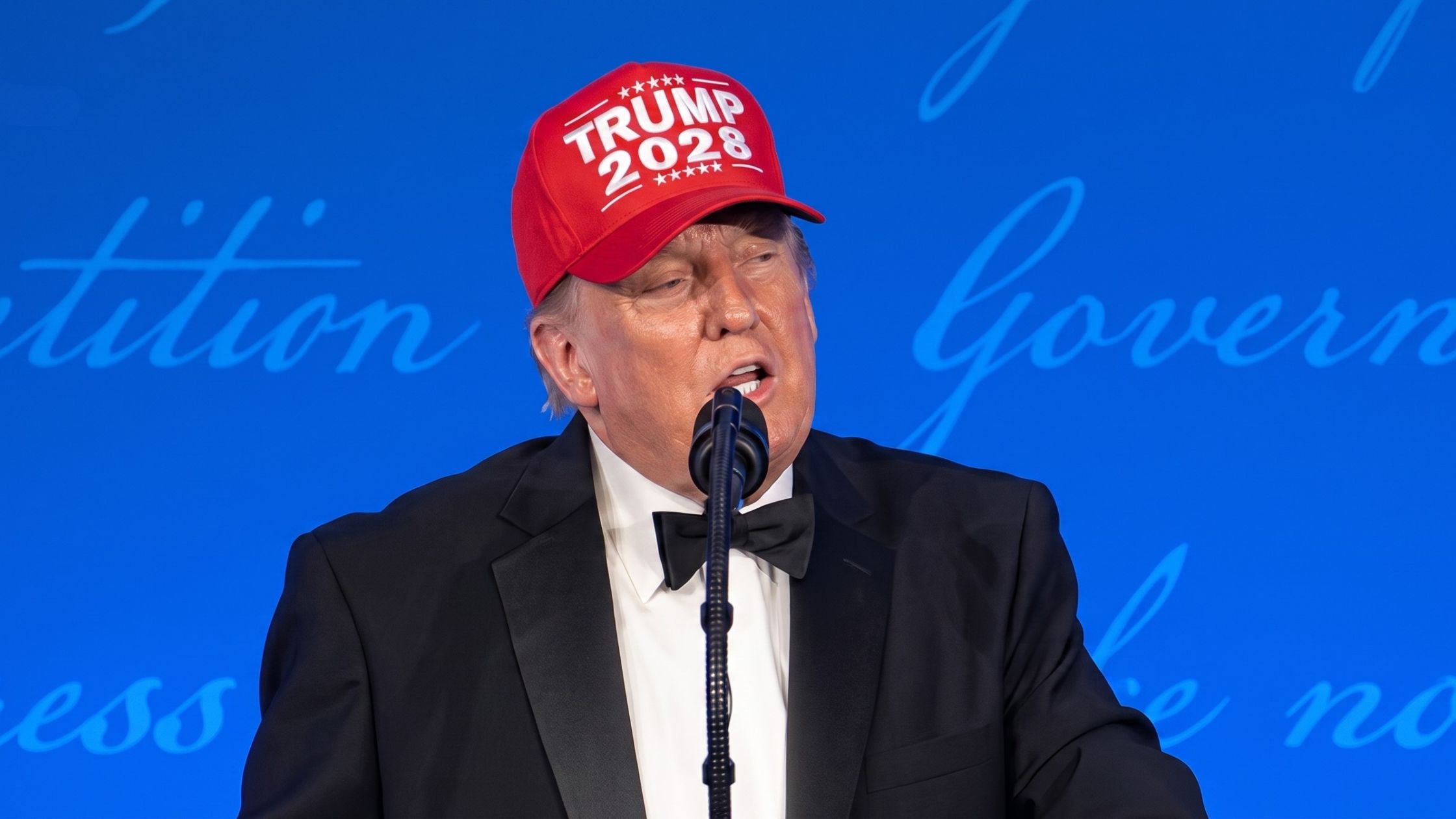
Donald Trump (01:19:04):
Wow, that was very beautiful, but this has not been an easy evening, all these awards. Do I have a say in those awards or those awards? But it's great to be back at a place that I know very well because I built it. And I'm very proud of it because I built it for $2.9 billion less than the Federal Reserve Building, which is a lot smaller, by the way. Figure that one out. But I am delighted to be here at the White House Correspondents Dinner. Amazing people. A lot of people that I like. Some I don't like at all. But I respect most of them. I must say that you do a great job, amazing job, and it's an honor.
(01:19:55)
As I said three months ago, the show must go on. We were backstage and we both wanted to just have it go on, whether it was two o'clock, three o'clock in the morning, it didn't matter. But in the end, it made more sense to do it the way we're doing it. And we had a great news conference at the White House in a very important room. And you did very well. I think we all did very well. It was a hell of an evening. I can tell you that. Won't soon be forgotten. And I think a lot was learned from that evening. A tremendous amount was learned about security and about other things, the dangers of what we all do. But just like my presidency, the second time is always better. It's always better. And the third time will be better yet. I'm only kidding.
(01:20:52)
From the earliest moments after the attack on our dinner last April, I knew we had to reschedule this event as soon as possible. We had to do it very quickly and we met very quickly and we figured something out. But the attempted mass murder at the Washington Hilton, that's what it could have been, was an assault on our democracy itself. Very serious situation. Many of you were there with me and some showed extreme bravery like Pete Hegseth, Steve Miller, Tom Homan. Really, they were standing on tables and most of you were under the tables, okay? But they did. They showed. I saw every one of them that were standing up in those tables. I didn't know if they were brave, if they were smart, if they were stupid as hell. But they were on those tables in some cases. And there were a lot of different feelings going on in the room at that moment. But after hearing the gunshots, many people yelled, "Get down, get down." Which caused Nicki Minaj to start twerking. Do you believe? Get down. She's the only one that really understood what that meant.
(01:22:09)
It's quite an evening. But tonight we come back together to answer that heinous attack with unwavering resolve and every one of us here this evening to show that in America, we do not yield to political violence. We don't. We can't do that. Can't do it. So in this country, we believe in freedom of speech. We settle our differences, not with bullets, but with open and vigorous debate. And no deranged loser with a gun will ever change that. We can't let that ever happen. A lot of very dangerous people out there. We can't let it happen.
(01:22:52)
I want to begin by expressing our gratitude to the incredible men and women who put their lives on the line every day to protect my family and myself, all presidents and lots of others. That's the United States Secret Service. So I appreciate it very much. And Sean and the whole group, amazing job. Amazing job. In recent months, they've repeatedly responded to threats with speed and professionalism and extraordinary courage. And there is no better example of that than Officer Victor Gonzales, who we just met. It was amazing. What he did was amazing. When the would-be assassin charged the checkpoint at speed, he was fast. When you looked at that, you had to look at it about 10 times before you really saw what was going on. He was quick, nasty. The gun made him nasty actually. But Officer Gonzales engaged the attacker without hesitation and took a bullet to the chest after his ballistic vest fortunately was on, saved his life, and Victor did not even want to go to the hospital for a checkup. We insisted, really, we wanted him to do it. We insisted, but he didn't want to go.
(01:24:14)
So to Officer Gonzales, Secret Service, Metropolitan Police, law enforcement generally, and even all of the militaries around us in the room tonight, we salute you and we thank you with all of our hearts. Thank you very much. Great job. Great job. Great job.
(01:24:53)
These are great people. So this evening we're picking up right where we left off, so let's have a little bit of fun. I said, "What do we do here? Is this supposed to be fun? Am I supposed to be serious? Am I supposed to be a comedian?" So I guess they said, "Maybe a little bit of everything." I know one thing I could never have done, the speech that I had ready, just a short while. Oh, that was going to be a doozy. I was so psyched. I was going to rip people. And I don't know, just something changed really for the better, but I just wouldn't want to do that. But we'll do a little ripping if you don't mind.
(01:25:38)
But it is too. I said, "How do we handle this? It's going to be a different kind of an evening." And it is. And in many ways, it's a more beautiful evening, actually. Everyone's looking really good tonight. And I know it was not easy finding shoes to go along with your bulletproof vest, which many people didn't want to wear because they'd rather die than look 20 pounds heavier. You know that, right? We have that a lot. They put one on me. I said, "Are you sure? I'm not wearing this."
(01:26:07)
"No, you look exactly 20." They say, "Sir, it's about 21 pounds." They said, "Not good." But I want to thank the outgoing president of the White House Correspondents Center Association. Now, she won't admit it and she should not admit it, but we sort of became friendly. In times of stress, on occasion, you become friendly. I have a lot of respect for Weijia, and I'll tell you, we went through a little bit of a war together. It turned out pretty good. It turned out pretty good because of a lot of good people. They stopped the tragedy. So I want to thank you very much. Fantastic.
(01:26:47)
And Weijia worked extremely hard to ensure this dinner was rescheduled. And we want to just thank her family. I just met her parents, her children, her husband. What a perfect family. So it's really great. Thank you very much all for putting up with this, for putting up with this, right? But let me also thank the incoming president of the Correspondents Association, Jacqui Heinrich. She could be very tough as a reporter, I will tell you. She can be nasty. She looks so beautiful, but she can be so nasty. How could that happen? But she just got married to a very successful congressman, a very good congressman. I'd like to have a couple of more votes from it, if that's okay. On occasion, he shows a little independence. We don't like that. But now he's a very professional guy and he loves our country. But that's a big thing. I just see what takes place. We're talking about what takes place to be in the position that you're leaving and that Jacqui's coming into. And it's a lot of work, a lot of friendships, a lot of talent. And so Jacqui, congratulations.
Jacqui Heinrich (01:28:02):
Thanks.
Donald Trump (01:28:02):
And congratulations are also in order for our favorite White House Press Secretary, Karoline Leavitt, who just had her second child. You and your husband. She's great. She's done a fantastic job. We all love her. She's done a fantastic job. She's another one. She can be nasty. But sometimes she has no choice. But Karoline may have one of the hardest jobs in the White House. She has to deal with all of you all of the time. And you could be very difficult. You can be very, very difficult people, but I'm probably being a little bit oversensitive. Sometimes I really do think that some of you don't like me. In fact, I read a report. I get 93% negative publicity. I said, "How the hell did I win the election by so much?" Think of it, I don't think that's true. I can't believe it's 93. In the '80s maybe, but not 93.
(01:29:09)
But this place is really the largest group of Trump derangement syndrome people ever put together at one time, I suspect. Some of you are lucky that our last dinner was cut short because I had brought with me what would possibly have been, I'm telling you, I had something. I was going to go after you. I feel so badly doing this. It's got to be such a letdown. Oh, yay, yay. But your lives were really in danger the last time for an opposite reason. But on the plus side, your careers were saved. And we really do. We have a complete and total. And I love the words complete and total, they say, but it means almost the same thing. I said, "It doesn't matter when you say it. It's called emphasis. It's called emphasis." But everyone is now really warming up the new White House, military center, drone port, highly protected ballroom. We have our ballroom. The windows are this thick.
(01:30:14)
I said to the people, "Well, if a bullet hits, what happens? Nothing. Nothing. It bounces right off, sir." This is the greatest bulletproof glass. I said, "AK-47, that's supposed to be a big one. I don't know so much about the guns. My sons know a lot." But I said, "I know it's big. What would happen?" They go, "Up," meaning it can take more. I said, "So if I'm making a speech and I hear that pinging sound at a window, what would I do?"
(01:30:42)
"Sir, leave the room right away, but you're going to be safe." We're building something that's going to be amazing. And in light of what we went through, I think people understand it. It's going to be amazing. A phenomenal, one of the biggest drone ports anywhere in the world right on the roof protecting the White House, not only the ballroom and what's underneath. It's supposed to be a top military secret, what's underneath, but then you get sued as usual and you have to reveal that you're building this unbelievable situation downstairs with room after room of very complex stuff. It was the military's dream to have it built. I wanted to have a ballroom because for 150 years they wanted it. And then the generals came to see me and they said, "Sir, you're building something. This gives us an opportunity to do something that will be so unbelievable and never happen again, because there's very little built under the White House, very hard to build under a very fragile building like that. It's very fragile. It's old and little different construction standards, frankly. And this is an opportunity for us to build something very powerful."
(01:31:51)
I said, "Let's keep it secret. They said, "No, no, we're telling you, sir, let's keep it secret." And then we get sued and we revealed every room, every aye ye, ye. We told the people that did the suit, they're not good people. We told them, we said, "You're being very unpatriotic when you bring a suit like this, but it is what it is. But it's moving fast. We're ahead of schedule. We're right on budget and it's going to be something like I think no country has." I just visited China. They have this magnificent room, The Great Room." They call it The Great Room. It's a great room, but what we have is going to blow. There won't be anything like it. It's going to be fantastic.
(01:32:33)
And with all of the things that are going along with it for safety and security of future presidents. I'm only going to be using it for about six months, assuming we finish it right on time. I get to use it... Somebody said, "He's building it for himself." I'm building it for the future. I use it. Now, had I not gone down six or seven stories, then in that case, I would've been able to get a couple of years out of it, but that was far more complex what we did downstairs than what we do upstairs. So we're very proud of it, those-
Donald Trump (01:33:00):
... Upstairs than what we do upstairs. So we're very proud of it though. It's going to be amazing. And I think I was just telling the whole group sitting at the table, we were talking about it. I said, "I think it's the White House Correspondents, so I don't see any reason why you wouldn't be able to use that. It's going to be very large and very beautiful and very safe and that's what you need." So I was thrilled to see that after witnessing the attack, even Democrat Senator John Fetterman told his fellow Democrats to drop the Trump derangement syndrome and build the White House ballroom, but it's much more than that. It's something that you're going to use. I predict that you're going to end up using it and a lot of people are going to end up using it. They're going to be as safe as you can possibly be.
(01:33:45)
But despite everything that happened at the previous dinner and all of the dangers involved, I'm told that this is still the hottest ticket in town, this ticket to get in tonight because it's a smaller room, it's a beautiful room, it's a luxury room. See those beautiful chandeliers? I can tell you everything about them if you'd like to know. See that beautiful capital above? See the beautiful capital. See everything, the brass, those chandeliers are great. I'm looking at them saying, I wonder if I could ... I sold this building and they're doing a nice job, they're nice people. But I'll tell you, I'm looking at them saying, "I wonder if I could walk out with those chandeliers because you can't buy them." They're very special. I won't tell you the fact. I won't mention that they're Czech crystal because I'd like to say everything's made here, but they are Czech crystal and they are beautiful.
(01:34:38)
And the Waldorf people are doing a really nice job. We're proud of them actually because when I left town, I was angry. I was a little bit angry. I was offered a nice price. I said, "I'm getting out of that place." And then I said, "Let's make a comeback." But I was very proud of this building. This building was hot. Remember the lobby floor? 82,000 feet. For those in the real estate business, 82,000 feet, it's a major floor. That thing was packed every single night. It was packed mostly Republicans, I would say, but it was packed every single night. It almost brings back memories. But I left town and I have just had nothing but good experience. And this might be the best experience of all, having all of these incredible people in this room. It's a great feeling, frankly. It's a great feeling. But tonight's event ... Thank you.
(01:35:34)
But tonight's event is even crazier than the last time. In fact, it's so successful that I've been informed by CBS News's David Ellison, who's going to do a ... He's the owner. He's the owner. He bought it, spent a lot of money, and he's going to make, I think, fantastic changes and keep some of the great stuff going. But the next year they're going to call it the Trump White House Correspondents Center. He told me that and I like that very much. We're going to change the name of it. Well, it's going to be so hot, just like our country is hot. We are hot, by the way. But to be honest, it's just about the only way that they're going to ever get me back here. You're going to have to change the name of the ... What? How's that one going? Not too good.
(01:36:18)
I hope that everyone finally got to enjoy their entire very delicious beef tenderloins, very special beef. And I want you all to know that Bobby Kennedy, who's right here, personally ran over the cow in his car. And he cut it up and he brought it here for you to eat tonight. So it's very fresh. And Bobby also suggested an appetizer featuring his favorite cut of male raccoon roadkill. But we drew the line at that, Cheryl. We said, "No, we're not going to do that. We're not doing that." We love Bobby. I'll tell you, he's a piece of work. It is fun, but he is a very different kind of a person, I will tell you. But he has what it takes and he's smart and he loves the country and he wants people to be made to feel good. Do you agree with that, Bobby? He wants people to feel good. And he's doing a fantastic job. Thank you, Bobby. Thank you. We can joke all we want, but thank you.
(01:37:24)
A lot's happened since the last time we were all together. Last month, we hosted one of the most incredible sporting events in world history at the White House. The UFC Freedom 250 fight, the UFC fight. When I announced that we're going to build a boxing ring right outside of the front door of the White House, I took a lot of heat. But it turned out that was, they say about the most viewed fight in history. It was beautiful.
(01:37:49)
So many things happened. It was supposed to rain. We're going to do it the week before and the weather was beautiful. And the weather came and it went. And now we came up to Wednesdays. They said, "Sir," this was on a Sunday night replacing 60 minutes, which is nice and unusual because usually it's Saturday night. And they said, "Sir," this was from Wednesday on. Tell me about weather. "Sir, it's going to rain. I think you're going to have to ... It's going to be one of the worst storms that we've seen in a long time. It's coming up the coast. It's going to hit you on Sunday night. It's going to be a disaster." I said, "Can you believe ..." And you saw the ring we built, Dana White, the great Dana White and everything. We had the best fighters in the world. Turned out we had the best fights that most people have ever seen, including me. It was just a miracle.
(01:38:37)
But what happened is we're waiting for this rain to come all day long and it's coming and it's horrible. And it's eight o'clock and we say, I think ... It hasn't rained yet. I said, "Maybe we should postpone it an hour. Maybe we should make it the next day." We didn't know what to do. And finally we just said, "Let's just have it." And it never rained. It was perfect. In fact, the week before it was 92 degrees. It was nice, but this was like 72 degrees. And the rain was coming and it came right over the White House. And it was like, thank you very much. It went like this. And other areas were drenched a few miles away. We didn't have a drop of rain. And it was absolutely one of the most incredible things anybody's ever seen. People said it's one of the most incredible nights of their lives.
(01:39:28)
So just remember before I came along, if you wanted to see someone lose consciousness on the south lawn of the White House, all you had to do is ask Joe Biden a question. Remember that. Oh, you think I'm kidding? But the big fight was such an amazing success that tonight I'm pleased to announce that we're going to host an even bigger one right in front of the White House. Every Friday night, every Saturday night, we're going to have fights in front of the White House. But we do have something coming that's. And I'm only kidding.
(01:40:02)
The one thing about the press that I learned, don't be sarcastic. Because I'm a very sarcastic person and I get sarcastic. And most people know that, but you have some bad people that will write it exactly like I say it. And I said, I was only kidding. But we are going to have Indy 500, Roger Penske's coming in mid-August and they're going to have it all throughout Washington, the greatest cars, the greatest drivers in the world. And that's going to be something. Already they have over 350,000 people signed up going down Pennsylvania Avenue, round the Capitol. And Roger, who's incredible, he won the Indianapolis 520 times. Think of it. Germany, Japan, all these countries, they spend billions and billions of dollars trying to win the Indy 500. And Roger wins it. He literally won it 20 times.
(01:40:55)
On the 18th time, I said, "That's amazing. I'm going to give him the Presidential Medal of Freedom." And I had him up. And then he won it two times after that. The guy's amazing. And he lost the last one by about six inches, if anybody watched it. So they're coming here and it's going to be something really exciting. We have unbelievable events. It's an unbelievable country.
(01:41:16)
And on July 4th, we were over at the mall and it was raining, supposed to be really bad again. And we had 450,000 people show up, and that's a light number. And I was told, "Sir, we're going to have to cancel the event." This was not good. And it was drizzling a little bit, not raining very hard. And people are calling me, friends of mine were calling me. And I got a call from Bret Baier. Bret Baier said, "It's not raining." I said, "Where are you?" I was standing at the mall and I'm waiting to go in the White House. Then others called up. They said the same thing. And I said, "This is terrible." But there was lightning. Not big lightning, but you don't have to have big lightning. It takes just a little bit to do some big damage. So they said, "Everybody must leave."
(01:42:07)
450,000 people were forced to leave and they left. And then I said to myself, I said, "Let me call up and find out what the hell's going on." And I called up and I spoke to a brilliant young man. He said, "Don't worry about it, sir. We can do it in a couple of weeks." I said, "You can't do it in a couple of weeks. This is the 250th birthday. In two weeks, what are we going to do? Say, let's go. We're going to have a redo." No. I said, "I'll speak if I have to speak at three o'clock in the morning. Two o'clock, one o'clock. I don't care. Call them all back. They're all gone."
(01:42:37)
450,000. And most of them were in cars or heading back to Texas and it was sad. And we said, "The show must go on." Very much like here, we said the same term. The show, it's a great term. It's true in life. The show has to go on. The show must go on. And I said, "The show must go on." I put it out on truth. The show must go on. And we had probably, Peter, 150,000 people come back, come back up higher, maybe. Thank you. Stand up, Peter. Tell them. More? It might've been more, but it was amazing. It was just an amazing crowd. And actually worked out better, a little like this. It worked out better than if we had done it at the normal seven o'clock, eight o'clock time.
(01:43:24)
It was incredible. We started speaking at 11 o'clock in the evening, but tremendous numbers of people. Tens, I mean, thousands and thousands came roaring back. And it was a great evening and it was a celebration. And we didn't do it the following day and we didn't do it two weeks later. We did it when we were supposed to do it. It was a fantastic celebration. But I can exclusively reveal to you this evening that for the heaviest of the heavyweights, we will have Sloppy Chris Christie, one of the sloppiest human beings you'll ever meet. Fighting, I would say, I could mention the governor of Chicago, but I'm going to mention instead Jerry Nadler. And they're fighting for a big piece of cheesecake, big fat piece of cheesecake. Who the hell wrote that line? But it is true. And then you have a congresswoman, Alexandria Ocasio-Cortez, AOC plus three. Let's do three friends. AOC plus three. And I watched her give that answer when she was over in Europe. It was not a good answer. If I ever gave that answer, I would be out of politics. Remember, you cannot have a 19-second wait time to answer really a very quite simple question, but we'll then have a rematch against an extreme simple question on a foreign policy from Munich Security Conference. There was a big security conference, and this was her first time up in terms of that. And we had a sort of little preview. And then Anderson Cooper was going to fight Lawrence O'Donnell. I'm not a fan of Lawrence O'Donnell. I like Anderson actually because he's covered me well for many years and he went bad as soon as I went for politics. But for years, he loved interviewing. I did so many interviews with him and he was great.
(01:45:14)
But he's got a little different persuasion than me in many ways actually. And Lawrence O'Donnell never liked him, never though he had any talent, but he's still making a living, so I can't knock it. But we had a contest for who had the lowest ratings and the lowest IQ on television. And that was actually Don Lemon, I think. When I said that he's the dumbest man on television, I said, "When you say some things, you never make a comeback." It's not like, "Oh gee, hey Don, let's have dinner some night." But I know what I'm saying. And then you have Bette Midler and Jane Fonda actually held a concert to protest the first UFC fight. They didn't want to see the fight. Very few people want ... They held an event. Three people showed up. And given the choice between seeing some of the really beat up faces of the UFC, almost everyone chose the people in the UFC. It was between the two of them or the UFC.
(01:46:14)
And what about Bruce Springsteen? What the hell happened to that guy? He looks like hell. I don't care what anyone says. I'm not supposed to say ... I'm sure he doesn't like the way I look, but I don't look so bad. But at a recent concert, Bruce, all he did was talk politics. He ought to run for office. That'd be interesting. But all he talked about, he made four political speeches in his three-hour show. The tour has been renamed Bored in the USA. And his new song was so bad that Chris Christie, who's like a fan, he goes out and tells everybody how he hates Chris Christie. Keep that guy out of my ... And I see Chris Christie there again, high-fiving Bruce Springsteen in the aisle. And Bruce Springsteen saw him and didn't even lift his hand up. And I just wanted, because I used to be friendly with Chris. Chris, when somebody doesn't like you, write them off, forget it. You got billions of people in the world. You don't have to make a jerk out of yourself.
(01:47:09)
But usually a comedian hosts this dinner. And I think we sort of changed it. Tonight we're going to have somebody who I think is really spectacular. But I've watched comedians get up for the dinner because I have been here actually quite a few times, people don't realize. And there's one time in particular when Barack Hussein Obama hosted it. Do you know who that is? And he hit me hard, but actually he hit me with respect. I was sitting with Melania at a table and you had Brooklyn Decker, supermodel at a table right next to her. And I really always will like her. She's married to a great tennis player, Andy. And she was at the table, not at my table. And I have watched this clip thousands of times. They keep playing it because they think that was the evening I decided to run for president. It was not.
(01:47:59)
In fact, I loved the evening. I looked at my wife, I said, "Can you believe it? All these people, that's all they're doing is talking about me. I love this dinner." It's true. And Obama was nice. It's amazing how things work out. He actually showed a picture of the White House with a big Trump on top, like I put a sign. And I'm sort of doing that when you think about it. I mean, he wasn't really wrong, but no, he was respectful. He was good. But it had nothing to do. It had nothing to do. I just decided that I wanted to make America great again. This had nothing to do with that dinner. I've gotten so many ... Yeah. I've gotten so many calls, for years they've been saying, "Was that the moment you decided to run?" Really, no. I left that night and the press was there. A lot of the same people that I see, they said, "Did you have a good time?"
(01:48:55)
"Unbelievable." And some thought I didn't have, but I did have. And I always remember though Brooklyn, she was so angry. She was much angrier than me. She was angry. She thought they were mocking me and they really weren't. It was just one of those things. And I had a great time. But I left and I thought ... I was there three or four times before that, but I sort of thought, wow, that dinner is really something special. And then I ran, I got elected. I thought the press treated me very, very unfairly. And I don't know, I think I made the right decision because you hate to go where maybe you're not wanted, but they did want me. They wanted me for ratings and they wanted me for other reasons, but not for love. And I said, "I'm not going to go." First time that ever happened, I think. Was that the first time? Just about. Presidents always came.
(01:49:49)
And I didn't go for four years because I got treated terribly by the press. In my opinion, unfairly. I know unfairly because I know the facts, but I got treated unfairly. I didn't go. And this year I was called by your president and your chairman and all of the people. And they said, "We'd like you to do it." And I said, "You know what? With time, time goes by, time passes, and you sort of look at life a little bit differently." I said, "Let's do it." And I didn't know it was going to turn out the way it did. It turned out to be the biggest event in the history of ... That was by far the biggest, for all the wrong reasons. But as I said before, a lot was learned from that evening. So much having to do with so many different things, including security. But it's an honor to do it. This is my first. I mean, I've been to it numerous times, but as President, I haven't been here and I'm glad. And they said, "Would you do it next year?" I said, "I will be back next year."
(01:50:47)
Now, if you get really, really nasty, maybe not. I don't know. But we're going to be back next year. [inaudible 01:50:57] will treat me very bad. But this year, the association decided not to have a comedian. So they considered using Jimmy Kimmel. Jimmy Fallon. These guys, they're terrible. They're terrible. Steven Colbert, these are people without talent. They get a lot. They have talent. You know who has talent? Their agent getting them the money they get. They have no talent. But they are not comedians. They're not funny people. They're angry people. They're sick people. But the association really put on a big show and they have somebody very special. I look forward to seeing him.
(01:51:32)
And so they thought about going with a professional clown for entertainment, but Adam Schiffty Schiff was not available. He's known ... I hate some people. I shouldn't say this. I'm not supposed to hate him. I'm supposed to love everybody, but he's a terrible person. He's a liar. And I called him Watermelon Head because he is the largest head I've ever seen with the smallest neck, pencil neck. How does that big, fat, ugly head stand on a little pencil neck?
(01:52:05)
And then I'm told that even Rosie O'Donnell reached out from Ireland. She really wanted to be here in order to honor me. She loves me very much. And she was desperate to come back to the United States and pay her respect to Donald J. Trump. But that didn't work out, unfortunately, because nobody wanted her to come back. But she's one of the greatest sufferers of Trump Derangement Syndrome. She's a sick young woman, sick older woman, I guess now I have to say. So instead we're honored to have for entertainment, the very talented mentalist, Oz Pearlman. Oz Pearlman.
(01:52:46)
And everybody, they said, "Are you going to stay?" I said, "Yeah, I'll stay. I mean, I think I'll stay. What the hell else am I going to do? I've got Iran, I've got this, I've got that." Which is all going extremely well. Don't believe the fake news. It's the only thing I've ... We were talking before, I said, "So we've hit Iran very hard. Their Navy is gone. Their Air Force is gone. 250 jets no longer. 159 boats." Good boats. In fact, I said, "Why the hell didn't we keep them? We could have used them." But 159, but all at the bottom of the sea. They have no radar. They have very few drones left despite what you see. And every once in a while they're going to set some things up, but they don't have much left. And by the way, they are talking to us right now. They'd love to make a deal.
(01:53:36)
I don't think they're ready to. I don't think it's time yet, but I'm willing to listen. But they cannot have a nuclear weapon. We don't want to see Washington D.C. or any of our cities or Israel or frankly, the Middle East destroyed with a nuclear weapon because I know the power of nuclear weapons. I see it. I get to see it. We're not going to let that happen. So this is all about we will not let them have a nuclear weapon. And they would use it. They would use it if they had it.
(01:54:09)
But Oz, I do have one question about what happened that time because he was there. How the hell did you not see that coming? He sees everything. He sees everything. He's telling me about your grandmother and your this. Why the hell didn't you ... We got to ask him that question when he gets up here. Why didn't he see that coming? But of course, this evening, it's really all about the fake news media and your handling of prizes and writing and producing and performing made up stories like the Academy Awards. Academy Awards used to be the epitome of ratings outside of the Super Bowl. It got the second most ratings. Now it's down in the dumps. Nobody wants to watch it anymore because they took on Trump. They hit me all night long and they hit me. "The winner is so-and-so."
(01:54:54)
"I want to talk about Donald Trump. I hate this man." Nobody wants to hear this stuff. Right, Peter? Nobody wants to. You ever see the ratings? They used to have 48 million people. Now they have two people watching, but they'll learn their lesson. But I want to personally congratulate CNN's Kaitlan Collins on receiving her award. It was all about me. It's a fake. She shouldn't get the award. It was a fake, but I didn't mind. I said, "Kaitlan, congratulations." But it was fake. There's no question about it. But she's a young, attractive woman. She never smiles. I said, "Kaitlan, do you have a smile? Smile. You have a nice position. You're at CNN Fake News. You should be a happy person. So smile, Kaitlan, just smile." But we attack.
(01:55:44)
And I thought Kaitlan had really made it big with a major new sponsorship. But then I informed her that it wasn't her on the Bud Light can. It was Dylan Mulvaney. And Dylan Mulvaney cost Bud Light $35 billion in market cap. That was the worst commercial ever made, by the way, for those few people that want to hear that. Most people don't care, but I would. I wouldn't want to hire Dylan anytime soon. Think of it. They hired Dylan Mulvaney and their market cap has gone down by $35 billion. Who wrote that commercial? And then you have writer Josh Dorsey. He also received, he's been killing me for years. No, he's been ... And yet tonight he shakes my hand, he hugs me, everything nice. He kills me. Josh is amazing. He writes more stories than any human being. There's nobody that writes more than Josh. He'll write four stories about me a day, all different subjects. I mean, I had the other day three stories and one on the ... He was upset about this. One was on page seven, three were on page one. They were all written by Josh.
(01:56:54)
But he's hit the big time and he's a workhorse and yet he's almost unhireable. He's just one of these guys. Wall Street Journal's lucky to have him, but really, it's unbelievable. He's almost unhireable. CNN is also here and I'm very disappointed they didn't bring Fake Tapper because he's had a rough couple of years Fake has. He calls me up every once in a while. If I pick it up, I pick up my phone. I used to go to this young lady. I'd say, "Any calls from the press?"
(01:57:26)
"No, sir."
(01:57:28)
I said, "Oh." Now I'm the President of the United States. I'd say to Steven Chung, Is Steven here someplace? Where's Steven? He's one of the toughest human beings I've ever met. Don't ever wrestle, Steven, you'll be in big trouble. But I say, "Steven, let me ask you, did the press call?"
(01:57:44)
"No, sir."
(01:57:47)
When I was a developer, I'd get a call every half an hour. For whatever reason, I always got disproportionate press. So I said, "Steven, nobody called?"
(01:57:55)
"No, sir."
(01:57:57)
Two hours later I say, "Hi, Steve. How we doing? Everything good? Anybody call?"
(01:58:00)
"No, sir. No press calls."
(01:58:03)
I said, "I'm President."
(01:58:03)
"Nope." They never call. So this went on for about a week. I'd say, "Karoline did the press call?"
(01:58:08)
"No, sir, no calls."
(01:58:11)
I said," Nothing. That's over a week. I haven't received a call." So I said," You know what I'll do? I'm going to give the press my phone number. That was the stupidest thing I ever did. I'm getting a call every 3.7 minutes. Steven, I don't know where the hell you've been, but the press calls, I'm getting calls, ring, ring. I was with somebody today. They said, "I've never heard a phone ring as much as [inaudible 01:58:35]."
(01:58:35)
Now, I look at the thing and usually just delete, delete, delete. Every once in a while, it'll be one of the people in this room that I like and I'll pick it up like this one right here calls me on occasion. She'll call me and she says, "Hello, sir. How are you? We want to talk about some horrible subject, like a horrible depressing subject."
(01:58:57)
I say, "Jackie, I don't want to talk about ... Congratulations, however, on your new marriage, but I don't want to talk about it." But it's true. And people call me now. And so for weeks I go, "No calls." And I learned then that both of them, they feel that I'm doing a great job and they feel I'm above it all. And that no person, hundreds of people call no person is good enough to talk to Trump. And so we don't even bother telling you.
(01:59:26)
That's not the way it works, Karoline. You have to let me know because sometimes I do like to speak to the press, but now I have the best system I've ever had. It rings. And just so you understand, you're much better at putting your name because if there's no name, I just can't do that. I pick up every once in a while. "Hello, I'm from Reno, Nevada. We're a startup paper. We're calling it the Reno Express." I said, "Do you believe I'm the President of the United States?"
(01:59:53)
"Mr. President, could I have your views on Iran?" And I just hang up. No, I get the craziest calls. I mean, some of them, my wife said, "I can't believe you do this. This is a hell of a way to live." But sometimes I get calls from very important ... Sometimes I can straighten out stories that are going to be fake and I can make them from a fake story to a good story. I always find that when you don't speak to the press, you always get a bad story. When you do speak to the press, you have a shot at getting a good story. Oh, look.
(02:00:24)
Look, if I were a reporter, and let's say I'm a big reporter, I work for the failing New York Times or I work for ... Well, I don't know, do they ever come to these dinners? Didn't they cancel out a long time ago? Big mistake. They should be here. But I get a call. I've always found that speaking to them, you just do better. You do better when you can, when you have the time. You speak to the reporter. You treat the reporter with respect. Sometimes now there are reporters where it doesn't matter. You can be so nice to them, it doesn't matter. You get treated unfairly, but you have a lot of great reporters where when you speak to them, you can get your point across and that's a good thing. But some people say that Jake Tapper is a great investigative reporter in D.C. and that's why after moderating our debate, it only took him one year to break the story that Joe Biden might possibly have suffered from cognitive decline.
(02:01:19)
It took him one year. He wrote a book about how great he was mentally, not too good. And I don't like Biden because Biden was very unfair to a lot of people. But Jill Biden insists that Joe would've beaten me in 2024, even though he was way down. She said he was way behind in the polls because he was seriously ahead. She felt he was going to win because he was seriously ahead on deceased voters. He was leading in the deceased crowd and there were a lot of them. You're finding out there's a lot of them. Look at the numbers that just came out yesterday. And it's traditional that at least one or two potential presidential hopefuls attend the Correspondents Dinner, but many of them seem to have really chickened out. I was disappointed that Gavin Newsom didn't show up. He didn't show up. He should be here. But I heard that he recently said that, "We will lose our country if we don't fight fire with fire." And to be fair, there's only one thing we know about Gavin and that's that he definitely doesn't want to fight fire with water. He's got a lot of water, never uses. What a disaster. That should have never happened. But Gavin Newsom recently did a career-threatening, one of the worst interviews I've ever seen where he said that he can't read a speech. He's incapable of reading a speech. He's a low IQ person. He's smarter, however, than all of the people in the room. And then he gets sued for being a racist when he said that. But he basically said he has various mental incapacities. He has difficulty in various other ailments mentally. And I'm looking and I say ... I'm watching this interview, I said, " This is the worst interview I've ever seen given by a professional politician."
(02:03:06)
I've been watching politicians for a long time, mostly on the previous side, because I haven't been doing this too long. How am I doing? For the number of minutes spent, not bad, but with Gavin ... So he said that all these things, and I said, "Anybody running against him? All they have to do is take that one interview and you can't lose." I actually put out a statement that Gavin Newsom has come out and said he will not be running for President because nobody can say what he said about himself and survive. Newsom was in big trouble when he openly admitted that Kamala was smarter than him. He said, "Kamala is smarter." If Kamala is smarter than someone, you don't want that person to be President of the United States of America. Between California's policies of enabling wildfires, paying drug addicts ...
Donald Trump (02:04:00):
... of enabling wildfires, paying drug addicts to be homeless, giving free sex changes to illegals, and telling rich people they're going to take away... "All of your money is going to be taken away." People are fleeing, and they're fleeing in droves. We can't have that in this country. It's becoming such a horrible and dangerous location that Ilhan Omar, one of my favorites, and her brother, are thinking about moving together, very much in love. The video has surfaced recently of Ilhan giving a speech referring to World War II as World War 11. And the issue about that, she thought she got it right, but I'm not surprised because she's a low-IQ person, and she's also a very dishonest person, and she ought to get the hell out of our country. She shouldn't be here. She shouldn't be in our country.
(02:04:56)
She also calls her brother husband number one. Omar is reportedly being investigated for fraud. She revised her net worth. I was shocked to see that she was worth much more than $30 million, and then when the press got on her, she revised it slightly downward to less than $18,000. So she went from much more than $30 million to $18,000. And I know Democrats, and the word Democrat is something that's come into fashion. I changed the E with a U, and most people don't know that dumb has a B, so we don't have to worry about that. It's very quiet. I thought it was quite good, but I haven't gotten much credit for that. Fake news, good. Pocahontas, good. I won't say Lying Ted because he's on my side. I don't talk about past conquests, but we have a lot of them I won't talk about.
(02:05:49)
They got a whole table full of Republicans there. They're saying, "No, don't mention my fricking name, will you, please?" But we've had a lot of good names, but the Democrats are there to destroy wealth. And honestly, they've gone absolutely crazy. Gavin Newscum's not only a man who really wants to run for president. He's doing a bad job running a state. You can't have somebody like a JB Pritzker, who I understand is not president sadly. But some people say, "Never use the fat word." And I don't. I would never call anybody fat. I have my own problems.