


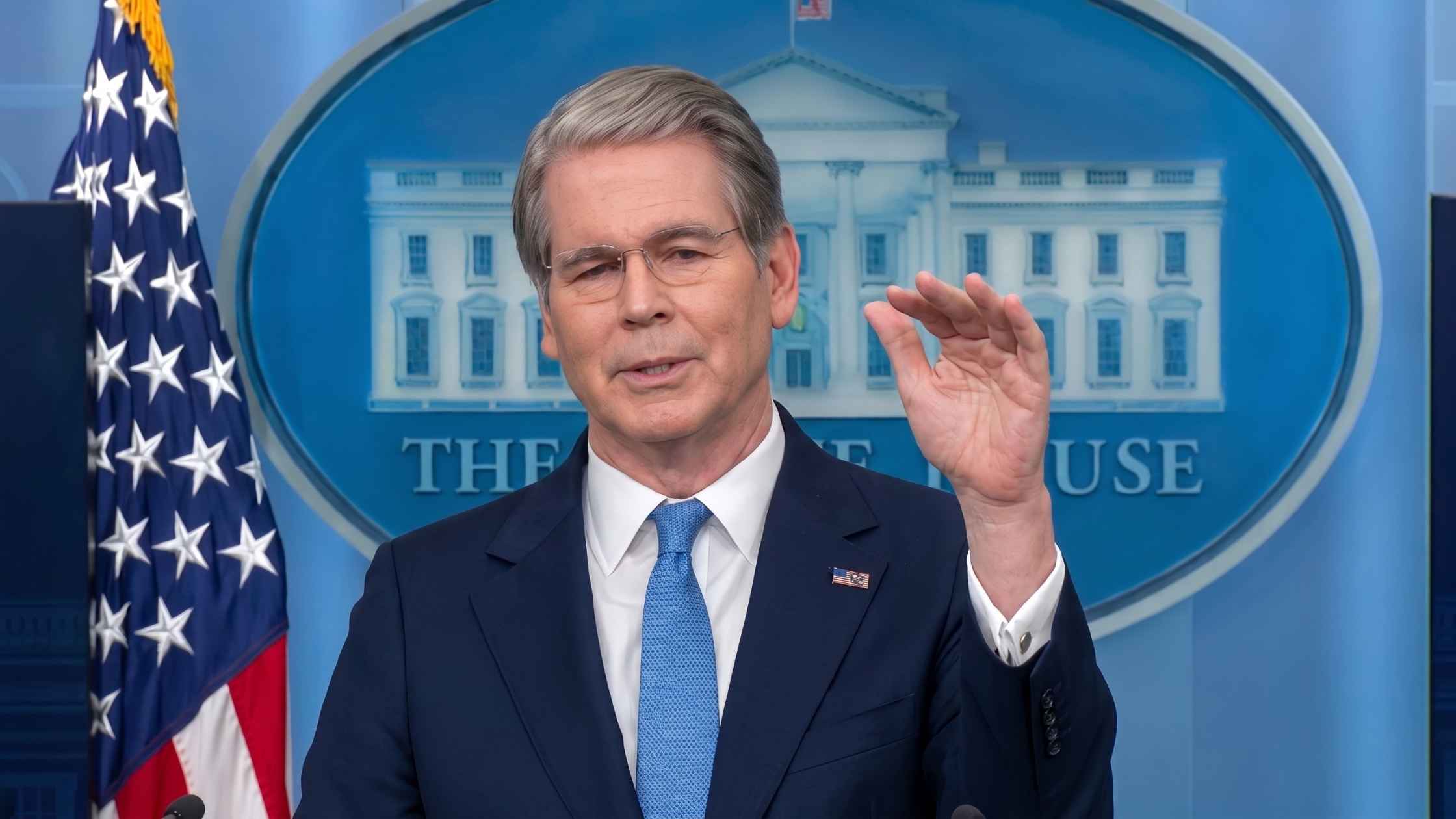
Scott Bessent (00:06):
Good afternoon, everyone.
Crowd (00:07):
Good afternoon.
Scott Bessent (00:08):
Good. Like to say it's a pleasure to be here today. This is my warmup for my Senate and House hearings next week. I don't want anyone yelling, "Reclaim my time." So let's start out with Trump Accounts. Trump Accounts I believe are the most important benefit for young people since the GI Bill. Today the app is now available on all major platforms bringing the President's vision directly to American homes. Nearly six million American children have been signed up for Trump Accounts, which will launch on July 4th and I would encourage all of you to go to trumpacount.gov to sign up.
(00:47)
We had a historic tax filing season. We passed the largest tax cuts in American history. The average refund this filing season is nearly $3,300, an 11% increase from last year. And importantly, very importantly, 62 million returns, 44% claimed at least one of the President's signature tax cuts. No tax on tips, no tax on overtime, the reduced taxes on Social Security benefits, 85% of our seniors paid no taxes and the audit deductibility on loans for American cars. And to remind everyone, Democrats, every Democrat voted against those programs. We've had sustained and resilient GDP growth. Real GDP has risen 2.6% over the past four quarters. Atlanta Fed's GDP now predicts 3.8% for this quarter, second quarter.
(01:45)
The U.S. energy dominance, part of our resilience stems from our energy dominance. Natural gas is down is my belief and the future's market is showing us oil will be lower than pre-conflict levels. We are more resilient to energy price fluctuations due to President Trump's energy dominance and deregulatory agenda. The United States is now the world's largest energy exporter. The United States has never exported so much energy or produced so much energy. Main Street prosperity, the average 401(k) is up almost $30,000 since President Trump's inauguration. President Trump RX has already saved Americans over $600 million. I'm sure all of you will want to report on that. And the unemployment rate remains low at 4.3%. So with that, I'm happy to ask the questions. I will mention three weeks ago I got an honorary degree from the University of South Carolina, so if you really want to get a question, you can call me Dr. Bessent.
Speaker 1 (02:45):
I want to start with these Trump Accounts. There's a lot of people, a lot of working class Americans that maybe don't have the financial expertise when it comes to stock markets and investing in general. In what ways are you simplifying this for all those Americans so that it's not just for one class of people but all Americans can have it?
Scott Bessent (03:13):
Well, that's a great question because 38% of Americans have no exposure to equities. They don't share in the great innovation, the machine that is the American economy or great capital markets which drives our prosperity. So if your child is born during President Trump's administration, Treasury puts in $1,000 as a seed investment. We've also created six learning pods so you can go online to the app that went up today and learn. And I think that this is going to be ... I've been a big proponent of financial literacy and I think this is going to be one of the greatest real-time financial literacy educations in history because it won't be ... " There's a street New York called Wall Street. This is what ... I don't really understand what happens there." American families are going to be able to look on their phone every day and see. And I think it's going to drive people to try to understand what they've got here. I think we're going to create a generation of shareholders. Ed?
Ed (04:22):
Thank you, Mr. Secretary. I guess first, well, we're starting to see the disruption of the oil supply in the Strait of Hormuz affect economic data. First, is there a deal on the table for a 60-day ceasefire to continue that? And then second, how fast could inflation then recede or retreat or is inflation sticky because the PCE was at a three-year-high?
Scott Bessent (04:46):
Well, first of all, PCE today month over month was 0.2, which we're looking at decimal points, but the estimate was 0.3. So one month doesn't a trend make. And what we've seen is actually oil prices are down about 10% in May. There are almost 2,000 ships waiting to come out of the Gulf and I think the oil market is going to be very well supplied on the other side of this and that we could see prices come down very quickly. We saw the UAE leave OPEC. So I would expect on the other side of this, that gasoline prices will follow the-
Ed (05:24):
... On the table.
Scott Bessent (05:25):
Sorry?
Ed (05:25):
Is there an agreement with Iran on the table?
Scott Bessent (05:29):
The teams have been going back and forth and President Trump has made it very clear. He talked about it at the cabinet meeting that he has several red lines and Iran has to turn over their highly enriched uranium, they cannot pursue a nuclear weapon and the Strait of Hormuz, back to your question on energy has to free transit, navigation of the seas has to be free and open as it was before. So he's not going to take a bad deal. He's going to make a great deal for the American people. Peter?
Peter (06:03):
Thank you. Dr. Bessent.
Scott Bessent (06:05):
Yep.
Peter (06:06):
How long until we see your signature next to President Trump's face on a $250 bill?
Scott Bessent (06:15):
Well, again, as Treasury Secretary, I have two mandates for U.S. currency. At present, no living person can be on U.S. currency and the currency must say, "In God we trust." So right now there is proposed legislation in front of the House, in front of the Senate to change the first requirement so that a living person, Donald J. Trump could be on the $250 bill. So it's all in the hands of the ... It's all up on Capitol Hill. At Treasury, we prepare things in advance. So we have prepared in advance that if the legislation is passed, but we will stick to the law.
Peter (07:02):
... Came up yesterday also at the cabinet meeting, President Trump said, "Oman will behave just like everybody else or we will have to blow them up." Are you guys back there in the West Wing making plans for a new war with Oman?
Scott Bessent (07:16):
Again, I think the president wanted to punctuate freedom of navigation in the strait. I had a call with the Omani ambassador this morning and he assured me that there were no plans for tolling the strait. As he said, our countries have had 200 years of good relations. He wants to have another 200 more. And I told him that this was a non-starter and he did not want to risk either the Omani individuals or Omani financial institutions getting sanctioned.
Speaker 2 (07:50):
Thank you, Mr. Secretary. Is it in the U.S.' interest to waive some sanctions on Iran or to unfreeze some of their assets before Iran has made concrete promises about getting rid of their nuclear program?
Speaker 2 (08:00):
... Create promises about getting rid of their nuclear program.
Scott Bessent (08:04):
Again, I'm not going to preview the deal, but I would think that the things would go very slowly in terms of that. So we'll see.
Speaker 3 (08:17):
Just to follow up on that, because it's our understanding that the U.S. has committed to discussing the matter of sanctions relief during this negotiation period. So just to be clear, is sanctions relief for Iran on the table?
Scott Bessent (08:28):
Again, it is a multifaceted agreement and nothing is going to be on the table until we see the Strait of Hormuz open and the Iranians agree that they have to turn over the highly enriched uranium and that they can't have a nuclear program. And to be clear here that this administration, President Trump has done something that no other administration is able to do. We have gotten the Iranians to talk about their nuclear program and to perhaps commit to not having one. That has never happened before. It had been off the table. So I think when you look at the results of the kinetic action of our economic pressure, it has worked to bring them to the table and have a discussion on this.
Speaker 4 (09:15):
Mr. Secretary, I just want to follow up. You said that the teams have been going back and forth, but can you confirm whether or not a tentative agreement has been reached in these negotiations with Iran?
Scott Bessent (09:27):
Again, everything depends on what the president wants to do and President Trump is not going to make a bad deal for the American people, for the U.S. And he was very clear at the cabinet meeting on yesterday what he wants.
Cara (09:50):
Cara from Lindell TV. I'm sorry, did I steal this question because I'm not that person?
Scott Bessent (09:53):
No, it's you.
Cara (09:54):
Okay. Thank you so much. Thank you for taking my question, Cara from Lindell TV. I really wanted to get your thoughts on digital currency. A lot of our viewers are increasingly worried that digital currency could one day be used to track people's spending or limit personal freedom. What's your philosophy on that and what safeguards is the treasury and its administration putting in place to make sure new digital payment systems protect Americans' privacy and freedoms in the future?
Scott Bessent (10:19):
Well, so this administration has been very clear. There will be no central bank digital currency, which I think would be the first step toward tracking. So we have taken that off the table. We've passed stablecoin legislation, bipartisan and the Clarity Act is now up on the hill and I think it has bipartisan support and the most important thing we can do is to make digital assets come into the United States, make the U.S. the home, our regulation, our best practices, are what will ensure good standards for these. When you look at digital assets, all the nonsense that happens, all the things you read about, that's because it's the wild, wild west offshore, so we got to bring it onshore. So I would encourage the House and the Senate to get clarity done.
Speaker 5 (11:13):
A lot of people talking about the IRS settlement, which has been rolled over now into this weaponization fund over at DOJ. Wanted to get your comment on the decision process as much as you can tell how that settlement came to be, how it was rolled over to DOJ and then the process for those funds now as it's played out.
Scott Bessent (11:35):
Good. So thank you for the question. This is going to be the only question I'll take on this matter today. So there's ongoing litigation so it'd be inappropriate for me to comment. President Trump is a great American who has endured more than 10 years of nonstop harassment and weaponization from the federal and state government actors. A bad actor at the IRS leaked more than 400,000 tax returns, including the Trump family, all the employees and that's how we got here now. No American should be targeted for political reasons and every citizen deserves fair treatment, full protection of the law. The Department of Justice represented Treasury and the IRS in this matter and I'm going to have to refer any questions to acting Attorney General Todd Blanche.
Speaker 6 (12:27):
Yeah, thanks. So President Trump has said that we can expect interest rates to come down very quickly a number of times with that last week, but the market at the moment probably does not expect any rate cuts this year. JP Morgan said this, Morgan Stanley and so on. So who is right? The president or the market?
Scott Bessent (12:47):
Well, I think again, I believe that we will get through this challenging period now on higher prices. On the other side of this, I've said publicly that I think we'll be back to substantial disinflation, but most importantly, I think we've got the Warsh Fed now. It's a new day at the Fed. The Treasury Secretary and the Fed Chair have lunch or breakfast every week. I had my first breakfast with Chair Warsh this morning and I believe that he will do the right thing to balance inflation and growth.
Speaker 7 (13:27):
Thank you, Secretary Bessent. I hope you were calling on me.
Scott Bessent (13:31):
Yes.
Speaker 7 (13:31):
So I'd like to ask you if you could provide a little more detail on what you're doing to shut down Iran's airlines and also on sanctions relief. A senior administration official briefed reporters over the weekend that sanctions relief will be commensurate with nuclear concessions, but at some point if the enriched uranium is given up, should we expect House cash to be flown to Iran? Could you describe how that looks?
Scott Bessent (13:54):
Well, couple of things. On the airlines, one thing that we're not going to do is restrict movement for religious reasons. So Iranians who want to make the pilgrimage, to Mecca or Medina will be allowed. We will also allow valid humanitarian reasons. But the other thing we can do is that when these airlines fly, they have to be refueled. They sell tickets, they pay landing fees. Anyone who accepts those, we will sanction. So they should be very clear that the state owned Iranian airlines are outlaws and cannot do this.
Speaker 8 (14:35):
Since you are the White House briefer today, I know you've been asked this already, but I'm wondering if you can just confirm on the record that there is a tentative deal that has been agreed for a 60-day extension of the ceasefire and then a continuation of nuclear talks.
Scott Bessent (14:50):
Again, it's always a mistake to get out ahead of the president so it is all going to be the president's decision. I think that we can see that the president very clearly stated his three, the open the Strait, highly enriched uranium, no nuclear program.
Speaker 9 (15:13):
Are those things part of the temporary deal right now, sir? Are those three aspects that you just outlined part of the temporary deal that has been agreed upon?
Scott Bessent (15:22):
That if there can be no deal without those, why would there be a deal without those?
Speaker 10 (15:29):
Thanks so much for taking the time. President Trump at the Cabinet meeting said he thought that reducing fraud would help to balance the budget. You put out the goal of getting the deficit to 3%. What's your timeline for achieving that and how do you think the ... What can you say to make the markets, given where rates are, like kind of process, kind of what your plan and agenda is?
Scott Bessent (15:53):
Well, they're GAO numbers, not my numbers, believe that there's about 500 billion a year of fraud. So could we very quickly get 250 billion of that ...
Scott Bessent (16:00):
... We very quickly get 250 billion of that. The budget deficit is approximately 1.8 trillion. So that would reduce the deficit substantially. If we could get that 500 billion number, I think it would engender confidence. You'd probably also go into a virtuous cycle, as the budget deficit narrowed interest rates would go down. No one reports it, but last year we actually had a fiscal contraction. Just to remind everyone, we inherited the worst budget deficit in history, in history, when we were not in a recession or not at war. 6.7%. We brought that down to about 5.5 or 5.4% this year. I think we stay on a good trajectory. [inaudible 00:16:47] You in the red.
Speaker 12 (16:50):
Mr. Secretary, without an executive order, does the US government have adequate defenses in place to address the risk created by Anthropic's new AI models?
Scott Bessent (17:01):
We have great collaboration between all of the labs that have the large language models, but between the US government and the labs. [inaudible 00:17:12]
Speaker 14 (17:13):
Thank you, Mr. Secretary... Is it me? Okay. Thank you, Mr. Secretary. Appreciate it. First, did you speak with the president before this briefing? Did he show any willingness to this 60 day ceasefire extension?
Scott Bessent (17:25):
I haven't seen the president today.
Speaker 14 (17:27):
I just want to follow up. When can Americans, the average American and can the US economy work for the average American without a deal with Iran?
Scott Bessent (17:37):
Again, I believe we've already seen oil prices come down substantially. We are pumping more oil than we've ever seen before. And as I said, these are short term challenges that we will get over and I think we'll move forward. [inaudible 00:17:55] In the white.
Speaker 15 (17:57):
Secretary, just to follow up-
Scott Bessent (17:58):
No, no, in the white.
Speaker 11 (17:59):
Thank you, Mr. Secretary. I appreciate it. Given how much this upcoming midterm election will hinge on the economy, what did you think about President Trump's comments in the cabinet meeting yesterday saying he didn't care about the midterms?
Scott Bessent (18:14):
So you're calling President Trump a statesman. You're saying that he is taking a statesman-like position, that he has a core belief and he believes that the most important thing is for Iran never to have a nuclear weapon. So I believe both things can be true, that we can do well in the midterms, that we perhaps have the makings of a deal here. And I believe that... And look, the economy, it is challenging now, but unemployment is still low. Tax refunds were high and consumer spending is still quite high. So in my private business over the years, I always looked at what were consumers doing, not what they were saying. And I'm in constant contact with the banks and every income quintile is still doing well. [inaudible 00:19:14] Eamon.
Eamon (19:16):
Thank you, Mr. Secretary. On the $250 bill, Mr. Secretary, you said the legalities of it are up on Capitol Hill, but I just wonder what your opinion is personally? Do you think it's a good idea for the president to put his face on America-
Scott Bessent (19:29):
Again, the president doesn't do it. The House and the Senate have to do it. [inaudible 00:19:36] Yeah.
Speaker 16 (19:36):
Yeah. Secretary Bessent, what are the remaining assurances that President Trump needs to see in order for him to sign off on the agreement with Iran?
Scott Bessent (19:49):
I don't think it could be clearer. [inaudible 00:19:52] Yes.
Speaker 13 (19:56):
You're following in the footsteps at the podium there of Secretary Rubio and Vice President Vance. There's been quite a lot of talk about their possible presidential ambitions. Does your presence here today indicate that we might see you running in 2028?
Scott Bessent (20:09):
No, I think it just means they run out of things on the food chain. [inaudible 00:20:14]
Speaker 17 (20:15):
Secretary Bessent, there's been some back and forth over the last several days and also with the US attacking Iranian drones yesterday. This morning, CENTCOM put out a statement that Iran had launched this ballistic missile towards Kuwait, calling it an egregious ceasefire violation. How can the administration still argue that a ceasefire is in effect?
Scott Bessent (20:34):
Again, with the Iranian government, we did not have regime change, but we changed the regime. As President Trump said at the cabinet meeting, as we've said other times, the first layer of leadership was eliminated, the second layer and we're now at the third layer. And the way to think about it is the Iranian government such as it is three pillars. It is the elected government, it is the IRGC and it is the clerics. And they are having trouble communicating. So we are being patient. We do not have unlimited patience. President Trump always prefers a peace deal. So everything we have done thus far has been defensive and at present that is what we will continue doing. But if President Trump doesn't think he can get a peace deal, then kinetic is back. [inaudible 00:21:29]
Speaker 18 (21:32):
Secretary, are you hopeful that the oil prices will go down once this conflict is over given the fact that the Strait of Hormuz remained closed and by the time this oil gets to the major markets, could be two or three months?
Scott Bessent (21:46):
Again, we see that the market, I believe, is very well supplied right now. The market seems to be going into balance for itself. So I think that as the Strait opens up, we're going to see this burst of ships come out. So we may actually see how quickly can it be refined? How quickly can it get to its destination? [inaudible 00:22:09]
Elina Shirazi (22:11):
Thank you so much. Elina Shirazi from The Daily Mail. You wrote resilience on your cabinet note meetings. Several times the photographer zoomed into it. Are you trying to keep the president calm? Are you trying to keep yourself calm? Why did you write all those notes?
Scott Bessent (22:24):
So people could look over my shoulder, photograph them and think they got a scoop. [inaudible 00:22:29]
Speaker 19 (22:32):
Is the United States considering a reconstruction program for Iran if a deal is signed?
Scott Bessent (22:38):
Again, I think we got to get to the deal before we get to the other side. [inaudible 00:22:43] Before we get to the... You in the pink.
Speaker 21 (22:46):
Mr. Secretary-
Speaker 12 (22:47):
In the red?
Scott Bessent (22:48):
No, in the pink.
Speaker 20 (22:48):
In the pink, thank you.
Cristina Londoño (22:52):
Cristina Londoño with Telemundo network. Mr. Secretary, how effective do you believe the current treasury restrictions have been in pressuring the Cuban government? And also if you're in the room when those talks are being held, are there any plans to either tighten the sanctions or to ease the sanctions against the Cuban government to get some type of change?
Scott Bessent (23:11):
Again, that's going to be up to the Cuban government, that they can go up, they can go down, that we've tried to get humanitarian aid in and the regime rejected it because they wanted to go through their corrupt system. So they could go up, they could go down. It's Karen Stick, Secretary Rubio, doing a fantastic job of managing this process and we at Treasury are working with him. [inaudible 00:23:42] In the red.
Reagan Reese (23:43):
Thank you. Reagan Reese with The Daily Caller. I want to ask you about Antifa. In October, the Treasury Department started working with the FBI to investigate who's funding Antifa. Can you give us an update on that investigation? How close are you guys to finding out who's funding it?
Scott Bessent (24:00):
It is ongoing. We made substantial progress and I think in the weeks and...
Scott Bessent (24:00):
It is ongoing. We made substantial progress, and I think in the weeks and months ahead we are going to have a lot to report. One thing that did go the under-reported that I would point out to all of you is the IRS is now giving guidance on the Form 990, which nonprofits they have to file, and we are going to encourage or demand that nonprofits know their grant recipients. So if a grant recipient is violent, if they are suppressing people's rights, then you are responsible for that. And I think that's a very good first step.
Speaker 23 (24:44):
There's new government data that shows that Americans are now saving a smaller share of their incomes than at any time over the past four years. Are you seeing signs that American households are dipping into their savings to pay for the higher costs of things like gas and groceries, and does data like that concern you right now?
Scott Bessent (25:01):
So academic literature would tell you lower savings rate can mean one of two things, the doomer view that you took, or that people have more confidence, or it could be something else, because for instance, stock market gains or 401(k) gains might not show up in savings. So they're looking at that, think that they can draw down their household savings.
Speaker 24 (25:29):
You're obviously concerned about the risks posed by advanced AI models like Methos to critical infrastructure. The financial sector is concerned as well. What types of changes are being considered to the AI executive order so it could pass? And do you believe that an AI executive order needs to include the pre-public access for government?
Scott Bessent (25:51):
Again, we're working very closely with the large language labs. They've been excellent partners, and we are going to get a solution that solves for the maximum calculus. What we want to do, the US is the AI leader in the world. We're an AI superpower. China is second. They are trailing substantially. We want to make sure that we keep that lead. So we are working on the exact calculus between innovation and safety, and we want to optimize for that. So you and the glasses. No, you don't have glasses on. You and the glasses.
Speaker 22 (26:34):
Thank you for taking my question. There was a report this morning that Justice Alito's son is working in your department. Can you confirm that that's the case? And if so, do you believe that that means that the justice should recuse himself from cases that involve your department?
Scott Bessent (26:52):
I am sure that Mr. Alito follows all legal and ethical guidelines, and I can assure you that at Treasury, we follow all the legal and ethical guidelines.
Caitlin (27:03):
Thank you, Mr. Secretary. I have two questions for you, but just to follow what you said about the-
Scott Bessent (27:06):
Well, you call me doctor, so I get one.
Caitlin (27:08):
Well, I'll shoot for two. You said that it's up to Congress. The president's face is on a $250 bill, but it is actually the Washington Post that's reporting two political appointees from the Treasury Department who have asked agencies to be ready to do that. Do you think politically it's a good idea to put his face on a $250 bill when people are struggling to afford gas and groceries?
Scott Bessent (27:29):
I don't really understand this Washington Post article that... Who here's from the Post? Yeah. Terribly written, terribly edited, because basically what it says is that Treasury is following the law and that we've created the bill and that it's up to Congress, but that we follow the bill and it's up to... I didn't really understand what the story was. Anyway-
Caitlin (27:50):
[inaudible 00:27:51] aren't involved in that two of your political appointees?
Scott Bessent (27:53):
Yeah, of course. But we prepare for everything if it gets passed. Just like we were ready six months in advance of the one big, beautiful bill for tax guidance. So we have to prepare in advance. You can't draw something up the day before.
Caitlin (28:07):
Politically, do you think it's a good idea, though, when people are struggling to afford gas and groceries?
Scott Bessent (28:11):
Look, I think that it's bifurcated that do you think we should have a 250th anniversary, the celebration?
Caitlin (28:21):
Well, that's happening anyway, but putting the president's face on a 250 dollar bill is a choice.
Scott Bessent (28:25):
But Caitlin, it's not happening anyway. It's happening because it's being funded by private citizens, by the federal government, by state governments, by municipal governments, to celebrate our country. And I don't think that there's anything untoward about having the President of the United States, that the person who was President of the United States on the 250th anniversary bill.
Speaker 27 (28:56):
[inaudible 00:28:56] what you just commented on there, Mr. Secretary, about the 1.8 billion dollar fund. Is it accurate that the general counsel of the Treasury Department resigned over that?
Scott Bessent (29:04):
I will not be taking any other questions. I will not be taking any other questions.
Speaker 28 (29:07):
But you know Wall Street [inaudible 00:29:09].
Speaker 25 (29:09):
Sir, given the scale of the assault from Russia on Kyiv in recent days and the fact that diplomacy seems to have settled down, there is no diplomatic talks happening right now between Russia, Ukraine, or the US. What about sanctions? Is the US considering sanctions on Russia at this time?
Scott Bessent (29:28):
Well, the US, this administration has put the hardest sanctions on Russia of any country. So let's review how the sanctions regime has gone since the Russian action on Ukraine. Biden administration put on very, what I would call, mild sanctions because they were worried about gasoline prices going up into an election. It would be an unstatesman-like sanctions that, probably, the worst national security advisor in the history of the country, Jake Sullivan, in an act of bravery on his way out the door in January, raised the sanction level on behalf of the Trump administration.
(30:13)
We let those in situ when we took office. They have fast-forward to October, and President Trump instructed me to sanction the two largest Russian oil companies, Lukoil and Rosneft, which we did. No other government has done that. So no one has done more sanctions than the Trump administration on Russian oil. No, here, who wants to own this? Gray hair. No, gray hair. No, you don't have gray hair.
Speaker 29 (30:56):
Me.
Scott Bessent (30:57):
Well, maybe you do.
Speaker 30 (31:01):
Thank you, Mr. Chair. When you had breakfast this morning with Fed Chair, did you request that the Fed lower interest rates?
Scott Bessent (31:08):
I had breakfast with Chair Powell 41 times, and I never did that. Okay. Last question.
Speaker 31 (31:19):
Oh, no.
Speaker 26 (31:19):
Thank you, sir. Governor Gavin Newsom has floated this idea of 100% state tax on Californians who have received money from President Trump's anti-weaponization fund. Your response to the governor's call for [inaudible 00:31:32].
Scott Bessent (31:32):
There's no cure for stupid. Okay. Thank you all.